WHAT’S INSIDE?
NEBRASKA MUNICIPAL REVIEW Official Publication of the League of Nebraska Municipalities
Scottsbluff, South XXX Sioux City, and Battle Creek are among municipalities XXX awarded CDBG funding. XXX
SEE PAGE 8
DECEMBER 2025
NEBRASKA MUNICIPAL REVIEW
What's inside?
Issue No. 1,208 The NEBRASKA MUNICIPAL REVIEW (ISSN 0028–1906) is published monthly and the official publication of the League of Nebraska Municipalities, an association of the cities and villages of Nebraska, published at 1335 L St., Lincoln, Nebraska 68508. Subscription rates are $5 per single copy — $50 plus tax for 12 issues. Periodicals postage paid at Lincoln, Nebraska. Views of contributors, solicited or unsolicited, are their own and not to be construed as having the endorsement of the League unless specifically and explicitly stated by the publisher. The NEBRASKA MUNICIPAL REVIEW is a nonprofit publication administered and supervised by the League of Nebraska Municipalities. All revenue derived from the publication is used by the association to defray publication costs.
League of NE Municipalities staff 402-476-2829 • www.lonm.org L. Lynn Rex, Executive Director Christy Abraham, Legal Counsel Lash Chaffin, Utilities Section Director Cherie DeFreece, Admin Assistant/ Membership Services Assistant Brenda Henning, Membership Services Assistant/ LIGHT Admin Assistant Ethan Nguyen, LNM/LARM Information Technology Manager Shirley Riley, Membership Services Director Jackson Sash, Utilities Field Representative/Training Coordinator Ashley Wolfe, Marketing/Communications Director
LARM staff
Dave Bos, Executive Director Tracy Juranek, Asst. Executive Director, Customer Service Specialist Diane Becker, Communications/Marketing Director Kyla Brockevelt, Executive Administrative Assistant Drew Cook, Customer Service Specialist John Hobbs, Loss Control Specialist James Kelley, Loss Control Specialist Fred Wiebelhaus, Loss Control/Claims Manager
POSTMASTER: SEND ADDRESS CHANGES TO NEBRASKA MUNICIPAL REVIEW, 1335 L STREET, LINCOLN, NEBRASKA 68508.
Have an idea, project or opinion to share? The League welcomes member articles, information, and op-eds. Want to reach local decision makers? The League can help you get your message out to Nebraska’s 3,500+ municipal officials.To learn more, contact Ashley Wolfe at 402-476-2829 or ashleyw@lonm.org. President President-Elect Vice President Past President
Executive Board
Directors
Leirion Gaylor Baird John W. Ewing, Jr. Sharon Powell Larry Evans Rod Petersen Jim Bulkley Betsy Vidlak Pat Heath Janine K. Schmidt Kyle Svec
Affiliated Sections
City Managers. Clerks Munic. Accounting & Finance Fire Chiefs Utilities
Marlin Seeman, Mayor, Aurora Bryan Bequette, Mayor, Nebraska City David Black, Mayor, Papillion Deb VanMatre, Former Mayor, Gibbon
Mayor, Lincoln Mayor, Omaha Village Board President, Utica Mayor, Minden Mayor, Louisville Mayor, Columbus Mayor, Scottsbluff City Administrator, Gering CMC/Treasurer, Morrill City Admin./Utilities Supervisor, Geneva Wes Blecke, Wayne Derek Bargmann, Seward Becky Erdkamp, Exeter Dennis Thompson, North Platte Pat Heath, Gering
National award for Lincoln
Features 7 8 11 12 16
22
NLC to host webinar focused on economic opportunities in rural areas Making way for change - NDED awards $14 million in Community Development Block Grant funding to municipalities across the state NEBRASKAland Foundation recognizes North Fork River Front with Rising Star Award A glimpse into the past - The history of Carnegie Libraries NLC: How municipalities can compete in the age of AI
17
Comms 101: Tips for effective messaging before session begins
20
Terrytown: Hascall Park unveils new murals, bringing art, light, and community pride
22 24
27
28
28
Lincoln Transportation and Utilities receives American Public Works Association award for infrastructure project Beatrice: A new place to roam Grand Island: Santa Cop Overpromising: The Achilles’ heel of local government leaders Free trainings by PlantNebraska
Columns 5 6
The Director's Message - L. Lynn Rex, LNM Executive Director Plan now to attend the 2026 League Midwinter Conference! The President’s Message - League President Marlin Seeman, Mayor of Aurora - Valuable sessions offered at recent NLC Conference
18
LARM – Be a leader in safety: Cultivating a safety culture
24
The Legal Corner by Tara Stingley, Cline Williams Wright Johnson & Oldfather, L.L.P. - Avoiding trial on disability discrimination claims
In each issue 3
Municipal Legal Calendar
30
Professional Directory
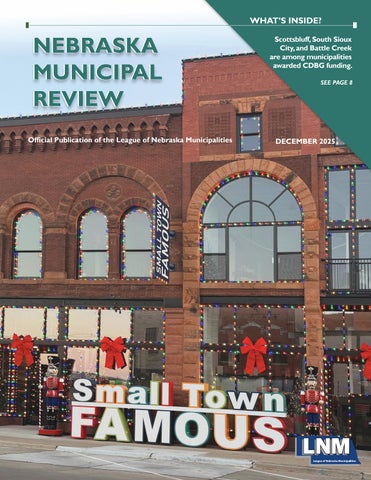
On the cover Small Town Famous in Hastings decorated for the holidays. Photo provided by Small Town Famous.
Municipal Legal Calendar
Larger Cities Legislative Committee Chaired by Mayor Don Groesser of Ralston John McGhehey, Mayor, Alliance Tobias Tempelmeyer, City Administrator, Beatrice Rusty Hike, Mayor, Bellevue Jim Ristow, City Administrator, Bellevue Mindy Rump, Mayor, Blair Phil Green, City Administrator, Blair Tom Menke, City Manager, Chadron Jim Bulkley, Mayor, Columbus Tara Vasicek, City Administrator, Columbus Dave Bauer, Mayor Crete Tom Ourada, City Administrator, Crete Jody Sanders, City Administrator, Fremont Kent Ewing, Mayor, Gering Pat Heath, City Administrator, Gering Roger Steel, Mayor, Grand Island Mike Evans, Mayor, Gretna Paula Dennison, City Administrator, Gretna Mark Funkey, City Administrator, Hastings James Liffrig, Mayor, Holdrege Chris Rector, City Administrator, Holdrege Brenda Jensen, City Manager, Kearney Brad DeMers, Asst. City Manager, Kearney Doug Kindig, Mayor, La Vista Kevin Pokorny, Director of Administrative Services, La Vista John Fagot, Mayor, Lexington Joe Pepplitsch, City Manager, Lexington Margaret Blatchford, Assistant City Attorney, Lincoln Riley Slezak, Senior Advisor to the Mayor, Lincoln Linda Taylor, Mayor, McCook Nate Schneider, City Manager, McCook Bryan Bequette, Mayor, Nebraska City Perry Mader, City Administrator, Nebraska City Justin Webb, Council Member, Norfolk Scott Cordes, City Administrator, Norfolk Brandon Kelliher, Mayor, North Platte Layne Groseth, City Administrator, North Platte Steve Krajewski, Mayor, Ogallala Kevin Wilkins, City Manager, Ogallala Thomas Warren, Chief of Staff, Omaha David Black, Mayor, Papillion Amber Powers, City Administrator, Papillion R. Paul Lambert, Mayor, Plattsmouth Emily Bausch, City Administrator, Plattsmouth Don Groesser, Mayor, Ralston Brian Kavanaugh, Council Member, Ralston Jack Cheloha, City Administrator, Ralston Art Lindberg, Mayor, Schuyler Lora Johnson, City Administrator, Schuyler Betsy Vidlak, Mayor, Scottsbluff Kevin Spencer, City Manager, Scottsbluff Joshua Eickmeier, Mayor, Seward Greg Butcher, City Administrator, Seward Brandon Bonregard, Mayor, Sidney Brett Kerkman, Vice-Mayor, Sidney Lance Hedquist, City Administrator, South Sioux City Jill Brodersen, Mayor, Wayne Wes Blecke, City Administrator, Wayne Barry Redfern, Mayor,York Dr. Sue Crawford, City Administrator,York
Smaller Cities Legislative Committee
Chaired by Tom Goulette, City Administrator of West Point
Lisa Schroedl, City Administrator/Clerk/Treasurer, Ainsworth Jessica Quady, City Administrator, Ashland Crystal Dunekacke, City Administrator/Economic Developer, Auburn Marlin Seeman, Mayor, Aurora Adam Darbo, City Administrator, Aurora Chris Anderson, City Administrator, Central City Andrew Lee, Admin/Clerk/Treasurer, Curtis Alan Michl, Chairperson, Exeter Becky Erdkamp, Clerk/Treasurer, Exeter Kyle Svec, City Administrator, Geneva Matt Smallcomb, City Administrator, Gibbon Gary Greer, City Administrator, Gothenburg Jana Tietjen, Clerk, Hebron Barb Straub, Admin/Clerk/Treasurer, Hemingford Kelly Oelke, City Administrator, Hickman Janine K. Schmidt, CMC/Treasurer, Morrill Sandra Schendt, Clerk/Treasurer, Nelson David Russell, Director of Gov. Affairs, NMPP Energy Sandy Kruml, Clerk/Treasurer, Ord Mike Feeken, Mayor, St. Paul Sandra Foote, Council Member, Superior Warren Myers, City Administrator, Sutton Jessica Meyer, City Administrator, Syracuse Kelly Adamson, City Council Member, Tekamah Sharon Powell, Village Board President, Utica Kyle Arganbright, Mayor,Valentine Melissa Harrell, City Administrator, Wahoo Desiree Soloman, City Attorney, Waterloo Stephanie Fisher, City Administrator, Waverly Tom Goulette, City Admin./Utility Superintendent, West Point Randy Woldt, Utilities Superintendent, Wisner Robert Costa, Community Planner,Yutan
(All statute citations to Revised Statutes of Nebraska)
FEBRUARY 2026 • • • • • • • • • • • • • • • • • •
CITIES OF THE FIRST CLASS Within 15 days of Passage Clerk publishes ordinances passed. (16-405) Within 10 days from meeting or before next meeting (whichever is sooner) Clerk to have minutes available for public inspection. (84-1413) On or before second Monday - Annual Library Board report due (51-213) Within 30 days from Council meeting Clerk publishes official proceedings of meeting. (19-1102) Within 20 days after end of month Treasurer files monthly financial report. (16-318) * *.Clerk must prepare agenda prior to next Board meeting. (84-1411) CITIES OF THE SECOND CLASS Within 15 days of Passage Clerk publishes ordinances passed. (17-613) Within 10 days from meeting or before next meeting (whichever is sooner) Clerk to have minutes available for public inspection. (84-1413) On or before second Monday - Annual Library Board report due. (51-213) Within 30 days from Council meeting Clerk publishes official proceedings of meeting. (19-1102) Within 20 days after end of month Treasurer files monthly financial report. (17-606) * *.Clerk must prepare agenda prior to next Council meeting. (84-1411) VILLAGES Within 15 days of Passage Clerk publishes ordinances passed. (17-613) Within 10 days from meeting or before next meeting (whichever is sooner) Clerk to have minutes available for public inspection. (84-1413) On or before second Monday - Annual Library Board report due. (51-213) Within 30 days from Trustees’ meeting Clerk publishes official proceedings of meeting. (19-1102) Within 20 days after end of month Treasurer files monthly financial report. (17-606) * * Clerk must prepare agenda prior to next Board meeting. (84-1411)
Director’s Message
Plan now to attend the 2026 League Midwinter Conference! Sessions to focus on initiatives and legislation relating to housing, economic development, grants and other municipal priorities BY L. LYNN REX, EXECUTIVE DIRECTOR, LNM
T
he League Midwinter Conference scheduled for February 23 and 24 at the Cornhusker Marriott in Lincoln affords municipal officials an invaluable opportunity to be informed about the latest developments and “best practices” for addressing some of the most important issues facing cities and villages across our state. The conference begins with general assembly sessions featuring keynote addresses by outstanding speakers on two of the most significant challenges for municipalities as well as the State of Nebraska: 1) changing demographics and “brain drain”; and 2) providing affordable/workforce housing. CHANGING DEMOGRAPHICS AND “BRAIN DRAIN” Josie Schafer, Ph.D., Director of the Center for Public Affairs Research at the University of Nebraska at Omaha, will present the first session entitled: “Changing Demographics and “Brain Drain” Challenges: What it means for your city or village!” About 17,000 people with a bachelor’s degree or higher left Nebraska since 2019; while 10,000 moved from Omaha and the metro area, the ENTIRE state is experiencing an exodus! Dr. Schafer will discuss independent and census-based research identifying the lack of jobs and potential for career growth as the key drivers of Nebraska’s outmigration trend; social, civic and environmental factors also contribute to the outmigration. The Nebraska Examiner recently reported on research by the Aksarben Foundation, a nonprofit business organization, which revealed “widespread talent and wage loss in every region of the state, driven largely, it said, by scarcity of quality jobs and limited wage growth.” In response to this alarming “brain drain,” Aksarben created a new nonprofit to help educate and enhance the state’s competitiveness. Although there are 4
no quick or easy solutions, Dr. Schafer will discuss how state and local leaders can collaborate to help address this crisis. AFFORDABLE/WORKFORCE HOUSING Shannon Harner, Executive Director of the Nebraska Investment Finance Authority (NIFA), will present an informative session outlining how your city or village can access and partner with NIFA’s numerous housing initiatives. As Shannon explained to the League Legislative Committees on September 24 during the 2025 League Annual Conference, NIFA has developed an innovative program for municipalities and developers to coordinate efforts to apply to NIFA for modular units to improve housing stock, especially in small cities and villages. The League hired Dave Ptak, an attorney with expertise in planning and zoning, to draft a model “Memo of Understanding” for municipalities and developers to use in applying to NIFA for these modular homes when they are available. Shannon also will discuss NIFA’s Grant Funding Dashboard, including grants available through “Nebraska Communities for Housing: NIFA’s Local Solution for Affordable Housing (C4H)” and the “Housing Study Grant Program.” Some municipalities are receiving millions of dollars of funding; has your city or village applied for funding? NIFA currently administers the state’s Low Income Housing Tax Credit (LIHTC) program created in 1986 to promote the development of affordable housing for low income individuals and families. In 2017, the Legislature passed the Nebraska Affordable Housing Tax Credit (AHTC) to provide a state-level match to the LIHTC. Designated as Nebraska’s housing credit allocation agency, NIFA is self-funded; no tax dollars are used to administer these programs. In addition, NIFA unanimously passed a groundbreaking resolution on December 12 allowing the Nebraska Continued on page 6 / See Conference
NEBRASKA MUNICIPAL REVIEW
President’s Message
Valuable sessions offered at recent NLC Conference BY LEAGUE PRESIDENT MARLIN SEEMAN, MAYOR OF AURORA
A
s President of the League of Nebraska Municipalities, I had the privilege of attending the National League of Cities (NLC) Conference in Salt Lake City, Utah from Nov. 19-22. The event brought together local leaders from across the country to explore innovative solutions, strengthen community leadership, and discuss the challenges and opportunities facing municipalities today. A highlight of the conference was the opportunity to visit several economic development and housing projects throughout the Salt Lake City area. These visits showcased a wide range of strategies that municipalities are using to stimulate growth and meet the evolving needs of their residents. Housing sessions focused on how cities can support diverse home values, expand workforce housing, and reflect modern needs. A tour of the Daybreak Development provided a firsthand look at these concepts in action. The development featured integrated recreation options, including walking/ biking trails and public transit access, as well as a variety of housing types. Another tour was to Park City, home of the Winter Olympics. We observed the ongoing use of Olympic facilities – including ski jumps, bobsled tracks, and downhill ski runs – which now serve youth and adults year-round for training and athletic development. This demonstrated how world-class facilities can continue to benefit communities long after major events have concluded and will be utilized in the 2034 Olympics! I participated in the Resolutions Committee meeting which reviewed proposed priorities for the coming year spanning a wide range of issues affecting cities and villages at both the local and national levels. The committee discussions underscored the importance of coordinated leadership among municipal officials nationwide as we work toward shared goals. One central theme of the conference was innovation – particularly the role of artificial intelligence (AI). Workshops emphasized the importance of preparing the next generation of leaders and workforce through strong collaboration among business, industry, and public officials. Speakers described AI not as a replacement for people, but as a tool that enhances effectiveness and expands the ability to share information across communities. The emerging “learning machine” approach of AI is expected to play a key role in workforce development, civic engagement, and improved service delivery. Data access and content creation, in particular, were highlighted as major strengths of the AI revolution that we must learn to harness responsibly. A second consistent theme throughout the workshops was community-driven civility. Participants emphasized that while change can be difficult, residents ultimately want solutions – and DECEMBER 2025
During the Annual Business Meeting, Mayor Seeman visited with newly elected NLC President Kevin Kramer, Councilman of Louisville, Kentucky. they want to feel heard. Civility serves as the foundation for constructive dialogue, allowing people with differing viewpoints to engage productively and confidently. The message was clear: when local governments create environments where people can share ideas respectfully, communities are better equipped to solve problems, grow, and thrive. Overall, the conference provided an invaluable opportunity for Nebraska delegates to exchange ideas with local leaders from across the nation. We explored new approaches to leadership, innovation, communication, and community engagement – insights that will help strengthen our own cities and villages. I am grateful to the League of Nebraska Municipalities for the opportunity to attend. The experience was well worth the time and effort, and I look forward to bringing these insights home to support continued growth and collaboration within our cities and villages. 5
Conference Continued from page 4
Department of Economic Development (DED) to transfer to NIFA administrative power for DED’s housing programs; some of these housing programs are funded by the state while others are funded federally. This transfer of programs from DED to NIFA will require passage of legislation in the 2026 session. CELEBRATING OUR NATION’S 250TH ANNIVERSARY Daryl Bohac, Director of the Nebraska State Historical Society, also is the Chair of the Nebraska Semiquincentennial Commission which coordinates and develops plans, programs, and events celebrating the 250th founding of the United States, marked by the Declaration of Independence in 1776. Daryl will speak during our luncheon on February 23 to explain how cities and villages can play an important role in helping to celebrate this important event. Another highlight of the conference will be the SENATOR APPRECIATION LUNCHEON on February 24; please do not miss this opportunity to visit with your state senator to discuss legislation affecting your municipality. The League Legislative Report will focus on carryover bills of municipal interest from the 2025 session as well as numerous bills we know will be introduced in the 2026 session, including amendments to: the Open Meetings Act, tax increment financing, the property tax cap on municipalities and counties, as well as various bills relating to affordable/
6
workforce housing. Addressing Nebraska’s reported current budget deficit of $471 million will undoubtedly dominate much of the session. CONCURRENT SESSIONS The Midwinter Conference program also will include timely sessions on a wide variety of topics, including: how the Nebraska Office of the CIO can assist municipalities with cybersecurity; how “creative districts” are transforming cities and villages; how to treat natural water contaminants and understand where they originate; what municipal employers need to know about healthcare trends for their employees; overall trends in the insurance market impacting cities and villages in Nebraska relating to property, liability, and workers comp; USDA grants available to help municipalities remove dead trees, protect watersheds, and train new arborists; understanding legislative terms and lexicon; how to limit your personal liability by avoiding conflicts of interest; an update from DED on Community Development Block Grants (CDBGs) and the Civic and Community Center Financing Fund (CCCFF); and the importance of “staying in your lane” by understanding your role in your form of government to enhance your effectiveness, minimize conflict, and limit your liability. In short, you will get a great return on your investment of time and resources to attend this conference! The League Executive Board, League staff, and I look forward to seeing you in February!
NEBRASKA MUNICIPAL REVIEW
NLC to host webinar focused on economic opportunities in rural areas
J
oin the National League of Cities (NLC) on Feb. 10 for a webinar exploring how rural community leaders are creating economic opportunity! As you know, local leaders are on the frontlines of developing programming, policies, and procedures that directly impact the economic mobility of the municipality’s residents. For rural communities and their leaders, the impacts and challenges are amplified. As rural communities grapple with economic mobility challenges, this webinar will showcase the impact rural leaders are making on their communities today. Hear from members of NLC’s Advancing Economic Mobility Rapid Grant cohorts on the lessons learned from their own economic mobility programs and key takeaways for municipalities of all sizes. From outreach and integration with key partners to buy-in for economic mobility programs, the insights from this conversation can be applied to all municipal leaders. Learn more and register now https://bit.ly/4jihncR.
IMPORTANT ANNOUNCEMENT Please note that the changes you sent to us for the 2026 Nebraska Directory of Municipal Officials may not have been entered into our database yet; therefore, some previous city council/village board members or employees may have received the December Nebraska Municipal Review. All changes should be made to our database before the January issue comes out. Sorry for any inconvenience or confusion.
Source – National League of Cities
Simplified Park Planning Helping you inspire your community from start to finish with pre-approved recreation solutions.
Tailored Product Selection
Learn more about partnering with CRS:
877-896-8442 crs4rec.com/park-planning CPV Contract No. 218097 Planning & Design
DECEMBER 2025
Installation
7
Nebraska Department of Economic Development
Making way for change
Scottsbluff was the recipient of a downtown revitalization grant through Nebraska Department of Economic Development. Photo provided by the City of Scottsbluff.
NDED awards $14 million in Community Development Block Grant funding to municipalities across the state
C
ongratulations to all Community Development Block Grant (CDBG) awardees for 2025. The Nebraska Department of Economic Development (NDED) has allocated over $14 million to fun 38 projects in 33 municipalities through the Downtown Revitalization, Planning, and Public Works funding. The CDBG program is designed to help awardees fund projects to enhance local vitality, public heath and safety, economic well-being, and quality of life. “Nebraskans take pride in having safe, clean, and welcoming communities,” said NDED Director Maureen Larsen. “As the state competes for talent—both to retain our youth and attract new residents—this quality-of-life advantage provides an important edge.” Each project was chosen because the community submitted a solid approach to impactful community development, demonstrating collaboration and local support from the community. Over $11 million was awarded to municipalities focused on improving critical infrastructure projects. The Public Works Program helps pay for projects including sewer main replacement, water system improvements, and construction projects for new and existing fire halls. 8
The Village of Clatonia was awarded $630,000 to put toward constructing a new fire hall. According to village officials, the current fire hall is much too small and requires careful manuevering to get multiple vehicles parked in the cramped space. This, in addition to the the current location—which pulls onto a state highway is less-than-ideal at times. “Now we are literally backing trucks in at an angle and then sucking against the wall to fit the next one in … in the new fire hall, you won’t have to pull one truck out to get another out,” said Karel Polocek, rescue captain for Clatonia Fire. “Everything’s going to have its own bay door and be more user friendly.” The Village of Walthill was awarded $630,000 and is one of four municipalities using funding to update its water system. According to Kevin Connot, the village’s economic development planner, Walthill is much like many small communities in the state with water infrastructure in need of updating. “A lot of the water infrastructure is quite old, with outdated water lines and valves and just isn’t functioning,” Connot said. This funding from NDED will allow failing valves and water leaks to be addressed and stay ahead of issues while they are more manageable. NEBRASKA MUNICIPAL REVIEW
2025 CDBG AWARDEES Downtown Revitalization - Grant total is $2,175,000
Battle Creek was awarded $586,159 through the Community Development Block Grant Public Works Program to be used to make improvements to Battle Creek Community Pride Care Center. The center is the largest employer in the municipality. Photo provided by the City of Battle Creek.
The City of Battle Creek was also the recipient of a CDBG Public Works grant. According to a release from the city, the municipality was awarded $586,000, which will go to upgrade at the Battle Creek Community Pride Care Center (CPCC). “This investment strengthens our community’s ability to provide essential care and support for our residents,” said Battle Creek Mayor Heath Mettler. “As Battle Creek’s largest employer, the CPCC is an anchor community partner and these improvements will ensure they can continue serving our citizens with excellence. The City of Battle Creek is grateful for the opportunities this grant will make possible.” The project will include infrastructure and facility improvements including the construction of a garage, sidewalk and window replacements, a new whirlpool tub, hot water heater, and commercial grade stove. Sources – Nebraska Department of Economic Development; Beatrice Daily Sun, Nebraska Public Media, City of Battle Creek
South Sioux City received $610,592 in public works funding from NDED for a water line improvement project. Photo provided by the City of South Sioux City.
DECEMBER 2025
Each municipality recieves $435,000 Burwell - rehab downtown commercial building facades, upgrade sidewalks and a public restroom to meet ADA requirements, and undertake a clearance and demolition project Gibbon - improve the appearance of downtown businesses with commercial rehabilitation activities, make sidewalk improvements to meet ADA guidelines, and complete a street improvement project Milford - rehabilitate several commercial storefronts in the downtown business district. Scottsbluff - improve the appearance of the downtown business district through commercial rehabilitation of private businesses. Tecumseh - address slum and blight conditions within downtown business district.
Planning Program - Grant total is $547,250 Beatrice - $53,000 - update comprehensive plan. Bloomfield - $53,000 - complete community redevelopment plan. Clearwater - $52,500 - create comprehensive plan. Decatur - $53,000 - create downtown revitalization plan. Gibbon - $53,000 - complete comprehensive plan. Greeley Center - $53,000 - create comprehensive plan. Haigler - $23,000 - create community development plan. Hitchcock County - $23,000 - create comprehensive plan. Minden - $53,000 - create water treatment plan. Octavia - $24,750 - update comprehensive plan. Pawnee City - $53,000 - update comprehensive plan. Wahoo - $53,000 - create downtown revitalization plan.
Public Works Program - Grant total is $11,450,981 Barneston - $400,000 - street improvement project. Battle Creek - $586,159 - improve the Battle Creek Care Center health facility. Beaver Crossing - $630,000 - construct a new community center building. Bridgeport - $327,233 - sewer main replacement project. Brock - $630,000 - street and ADA sidewalk improvements. Burr - $520,000 - water system improvement project. Burr - $560,000 - demolish and clear the existing fire hall and construct new fire hall. Burwell - $630,000 - sewer lift station replacement project. Clatonia - $630,000 - construct new fire hall building. Clearwater - $480,000 - street and ADA sidewalk improvements. DuBois - $598,000 - street and ADA sidewalk improvements. Fairbury - $440,000 - street improvement project. Greeley Center - $630,000 - street improvement project. Gresham - $597,000 - water and sewer system replacement project. Nebraska City - $630,000 - street improvement project. Nelson - $620,000 - street improvement project. North Loup - $380,000 - improve the village park playground. Richland - $630,000 - renovate the community building facility. South Sioux City - $610,592 - water line improvement project. Steinauer - $291,997 - sidewalk and street improvement project. Walthill - $630,000 - water system improvement project.
9
GET A QUOTE AND JOIN TODAY! The League Insurance Government Health Team (LIGHT) helps hundreds of its members throughout Nebraska obtain affordable health insurance coverage.
Plan and Network Choices With seven plan options and three networks to choose from, you’re sure to find one that meets your group’s coverage and benefit needs.
Affordable Plan Options
Available Network Options
Offering your employees much-needed protection against the high cost of medical care:
With several networks available, you have easy access to quality providers:
• Three PPO options • Four HSA-eligible high deductible options • Prescription drug coverage
• NEtwork BLUE (Statewide) • Premier Select BlueChoice (Regional) • Blueprint Health (Regional) • Out-of-state network availability
Enrollment Options Single: Covers the employee only Employee and spouse: Covers the employee and their spouse
Employee and children: Covers the employee
and their eligible dependent children, but does not provide coverage for the spouse
Family: Covers the employee and eligible dependents including a spouse
RECEIVE DEDUCTIBLE AND OUT-OF-POCKET CREDIT FROM YOUR CURRENT VALID GROUP PLAN WHEN YOU SWITCH!
LET’S GET STARTED Contact your current local Agent/Broker Or contact
Dennis Maggart Executive Vice President P: 913-378-9841 or 816-718-0335 Dennis@McInnesGroup.com
Jane Limbach Account Manager P: 913-378-9840 Jane@McInnesGroup.com Blue Cross and Blue Shield of Nebraska is an Independent Licensee of the Blue Cross and Blue Shield Association. 60-025-58 (01-17-23)
10
NEBRASKA MUNICIPAL REVIEW
Norfolk
T
NEBRASKAland Foundation recognizes North Fork River Front with Rising Star Award
he NEBRASKAland Foundation recognized the North The award was presented at a ceremony in the City Fork River Front as a 2025 Rising Star Award honoree, Council Chambers, highlighting the vision, innovation, celebrating its outstanding contribution to tourism and and community impact that made the project possible. This community life in Norfolk and across Northeast Nebraska. recognition underscores Norfolk’s commitment to enhancing Established in 1999, the Rising Star Award honors public spaces, fostering connection, and supporting economic exceptional public or private tourism attractions—or and cultural growth throughout the region. significant expansions of existing attractions—that The City of Norfolk congratulates all who contributed invigorate Nebraska’s economy and embody the spirit of to making the North Fork River Front a destination that the Good Life. The North Fork River Front exemplifies this continues to inspire pride and enjoyment for generations vision, creating memorable experiences for visitors while to come. Source – City of Norfolk strengthening the quality of life for local residents.
Contin
DECEMBER 2025
11
Photo of the from the North Platte Carnegie Library. This building was completed in 1912 and has since been renovated to serve as the North Platte Children’s Museum. Photo by the North Platte Historic Preservation Commission.
On April 8, 1910 a letter was received by Mayor Patterson stating, “If the city agree by resolution of the council to maintain a free public library at Over aacentury to books was athousand privilege, rather than cost ofago, notaccess less than twelve dollars a a right shared by the public. Yet one man’s philanthropic changed the year, and provides a suitable site for thevision building, landscape of public learning throughout the United States. That man was Mr.Carnegie, Carnegie will be glad to give twelve thousand Andrew a self-made industrialist millionaire with a dream. dollars to erect a free public library building for Between the late 19th and early 20th centuries, Who was Andrew Carnegie? Carnegie assisted in funding the construction of over Borncouncil in Scotland, Andrew Carnegie was North Platte.” At the next meeting, a quickly drawn 2,500 libraries across the world, more than 1,600 in to books. This interest would continue after his family of Directors wasto established the UnitedLibrary States alone. Board Carnegie’s libraries not only immigrated the United States. Heto would spend his opened up oversee the availability of books and knowledge to teen years in Allegheny and Pittsburgh, where he listened the building of the library. the general public, it laid the foundation for the modern to readings and discussions of books from the Trademan’s The lot was bought for $2,070 from the Knights public library system. Subscription Library. A library that his father helped From 1883 to 1929, a total of 2,509 libraries were create. This love for books would continue during his early of Columbus in May of 1910. The project was built with Carnegie’s funding. Of these, 1,689 were working years, and he would have access to the personal built in thegiven United States, in the UnitedMcMichael Kingdom library of James Anderson. to 660 Howard inColonel August of 1911. and Ireland, 125 in Canada, and 25 others in Australia, Colonel Anderson would be instrumental in the The was $8,676. Onof April South Africa, New building Zealand, Serbia,contract Belgium, France, foundation of many Carnegie’s10, beliefs. Anderson the Caribbean, Mauritius, Malaysia, and Fiji. provided books to “working boys” to allow them to 1912 it opened to the public. Restrooms were Carnegie’s grants were quite significant for the era acquire knowledge to improve themselves. This is despite in which they were handed out. Small towns would added to the building in 1925 in 1940 the disdainand from others who didn’tand believe that those less receive $10,000 to construct a library that would fortunate should have access to such readings. Carnegie addition was built on the west typically become the community’s most significant became aside. strong believer in a society based on merit,
A glimpse into the past ...
amenity. Almost $56.2 million was provided toward the construction of the 2,509 libraries that received funding. 12
2
where anyone could become successful with hard work and determination. NEBRASKA MUNICIPAL REVIEW
In 1889, Carnegie penned an essay entitled The Gospel of Wealth. Within the essay, he proclaimed that the wealthy had a moral obligation to the new upper class to be philanthropic for the betterment of society. He envisioned that libraries were an ideal way to provide resources to others to improve their lives.
Commissioned in 1892, the Fairfield Library would become the first library that Carnegie would fund for a community to which he had no personal ties. As fate would have it, the Fairfield project would be the spark for a new funding model to be used by Carnegie for 2,800 additional libraries. From that point forward, libraries wouldn’t just be built in Pennsylvania or Iowa, but throughout the United States and various countries in the world. The First Libraries Colonel Anderson’s philanthropic ways stuck with To this day, the Carnegie Library building in Fairfield still Carnegie, even after Andrew became wealthy himself. In stands and is now on the National Register of Historic Places. 1883, the first Carnegie-funded library would open. The However, the library itself moved to a new facility in 1996. first of what would become thousands of libraries for the The original structure is now home to the Carnegie Historical public to enjoy. But this library wouldn’t be in the United Museum, which occupies the first and third floors of the States; the structure was constructed in Dunfermline, building. The second floor houses the Jefferson Center for the Indian Hills Community College. Although the library Scotland, where he was born. The first library he funded in the United States was moved out of the building, it still provides an educational in Allegheny, Pennsylvania, where he was raised after impact on all three floors. crossing the pond from Scotland. This building would become even more noteworthy as it would also house The Carnegie Formula the first Carnegie Music Hall. Although the first library In 1897, Carnegie hired James Bertram as his personal he funded in the United States was in Allegheny, the first assistant. His right-hand man, Bertram essentially managed one to open was in Braddock, Pennsylvania, just a short the grant program for Carnegie. He reviewed the grant distance from Pittsburgh. Just a few years later, the library requests and worked with the local governments to ensure was expanded to include the third Carnegie Music Hall they met the requirements to receive funding. in the United States. Most of Carnegie’s libraries were approved for funding under a set of requirements known as the “Carnegie Formula.” The Formula required financial commitments for the operation and maintenance of the libraries to ensure they were supported by the local government into the future. As part of the “Carnegie Formula,” he required local governments to: • Demonstrate the public need for the library • Provide the land for the construction of the library • Budget at least 10% of the library construction costs within the municipal budget for operation of the library, including: - Funding to maintain the library throughout its lifespan Fairfield’s Carnegie Museum, Fairfield, Iowa, Funding to pay for library staff by oscophotos; Wikimedia CC-BY-SA-4.0 • Provide free services to all
How Fairfield, Iowa, Changed America
Until 1892, Andrew Carnegie’s focus was entirely on areas where he had personal ties. Scotland and Southwestern Pennsylvania benefited from his philanthropic efforts. However, U.S. Senator James Wilson, of Fairfield, Iowa, was the impetus that changed Carnegie’s view. Although there was a temporary library established in Fairfield, Senator Wilson saw the need to find a permanent home. Wilson lured the interest of his friend Andrew Carnegie to subsidize the construction of a permanent library. DECEMBER 2025
A Couple of Remaining Examples
Over the years, a number of these libraries have been demolished or sold to private owners as age and other factors have limited their viability. Many communities have simply outgrown these facilities. However, approximately 800 of Carnegie’s libraries are still in use as libraries. Continued on the next page
13
Red Oak, Iowa Of course, if I’m going to bring up Carnegie Libraries, I have to mention the one in my hometown. Prior to Carnegie’s assistance, the Red Oak Library was housed in the basement of Houghton State Bank. Looking for a permanent home, the residents of Red Oak looked to Andrew Carnegie. Built in 1909, the library has been a local hub of learning for over 100 years. Like many of these libraries, the Red Oak facility is also on the National Register of Historic Places. This library was highly influential to this blogger’s intellectual development. I can’t count the number of times I have visited this grand structure.
original building, they constructed a new facility that opened in 1979. Since then, the original library has been converted to the Charles City Art Center. Funded by memberships, grants, private donations, and our small endowment fund, the Art Center is free to the public.
Charles City Art Center, Charles City, Iowa. Photo provided by Chris Solberg
Estherville Public Library, Estherville, Iowa. Photo provided by Chris Solberg.
Other Examples Numerous other Carnegie libraries have been transformed from their existing roots into housing a new use. In Cedar Rapids, Iowa, the former library is hosting art as well, but as a wing to a larger art museum. The Carnegie library in North Platte, Nebraska now serves as a children’s museum. In Aledo, Illinois, the building has been transformed into a co-working facility for technology education, recruiting and employment. Xenia, Ohio, had a master plan developed that presented three potential options for redevelopers. The library in Olympia, Washington, has even been converted into a “Whiskey Library.”
Estherville, Iowa Another good example is the one in Estherville, Iowa. Like many other communities, the library in Estherville had a bit of a gypsy history, temporarily setting up shop at a variety of locations. However, city officials worked to obtain a grant from Carnegie. With the grant’s assistance, the ribbon was cut on the new building in 1903. A Lasting Legacy The community has held tight to the structure. Needing to Though the original Carnegie library program ended in expand to meet the needs of the community, Estherville added on 1929, the impact of the program continues to this day. to the library rather than moving on from it. Other communities Regardless of whether these buildings are still being utilized like Madison, Minnesota, and Manitou Springs, Colorado, have as libraries in Carnegie’s original intent or repurposed decided to do the same. through adaptive reuse, most are still having an impact on their communities. Adaptive Reuse Carnegie libraries were revolutionary in that they made Many communities have outgrown their Carnegie Library knowledge freely accessible to all, regardless of class, race, over the many decades since these libraries were built. or education. Many of these libraries have been openly Other communities have moved to new facilities due to the celebrated over the years as community hubs and sources maintenance costs tied to these aging structures. But these for information. They were built with sound construction beautiful structures are often quickly snatched up by someone standards, many of them beautifully adorned with brickwork. in the private sector. Many have since become ideal examples These historic structures have stood the test of time and serve of adaptive reuse, as purchasers often have an eager eye towards as iconic, historical monuments closely linked to the sense renovating these storied buildings. of community in many towns across the United States. The communities that were fortunate enough to receive funding Charles City, Iowa Charles City’s library opened on the corner of Jackson and Kelly through Andrew Carnegie’s philanthropic efforts should Streets in 1904 and was funded through the help of a $12,500 celebrate what they have. grant from Andrew Carnegie. As the community outgrew the 14
NEBRASKA MUNICIPAL REVIEW
About the Author
Christopher Solberg (AICP) is the editor of the blog, Rural Resurrection and also serves as the Deputy Community Development Director for the City of LaVista. But his true roots are in Red Oak, Iowa, a community of 5,500 persons southeast of Omaha. Chris has spent a significant amount of his career helping small towns. Through his time working for a regional planning association and for a private consultant Chris has helped numerous small towns throughout Iowa and Nebraska. Chris was the President of the Nebraska Planning and Zoning Association (NPZA) for eight years and a member of both the NPZA and NE APA Nebraska boards. To find this piece and read more content from Chris, visit https:// ruralresurrection.com.
DECEMBER 2025
15
Talent as the new infrastructure:
How municipalities can compete in the age of AI
BY PRINCE OHILEBO GARUBA, EXECUTIVE DIRECTOR, OHIO ASSOCIATION OF GOODWILL INDUSTRIES
A
I and the future of work mark a new era where talent has become the critical infrastructure. Just as cities once built highways, ports and power grids to fuel growth, today they must invest in people with the same urgency and scale. The cities that treat workforce development as core infrastructure, not as an afterthought, will be the ones that thrive in a rapidly shifting economy. In this new environment, talent pipelines are every bit as essential as roads and bridges, and they will determine which communities lead in innovation, competitiveness and shared prosperity. Learning from History: Highways as a Blueprint From the 1950s into the 1960s, the United States invested heavily in interstate highways to drive economic activity and growth. In 1956, the Federal-Aid Highway Act was signed by President Dwight D. Eisenhower. While framed partly as a national defense measure, it was equally an investment in commerce and modernizing the economy. The impact was transformational. Businesses followed the roads: warehouses, factories, and logistics hubs sprang up near interstates. Those connections generated economic advantages that lasted for decades. According to the Federal Highway Administration (as summarized by the Richmond Fed), about onequarter of United States productivity growth from 1950–1989 is attributable to increased highway investment. Cities with major interstates prospered, while those bypassed often stagnated. Today, the same can be said for workforce development. Just as highways once determined which cities would thrive, talent pipelines now decide which communities will compete and succeed in the future economy. The Future of Work: AI as a Catalyst More than ever, the conversation about the future of work has intensified. AI is being adopted more quickly than almost any technology in recent history, and we are already seeing many entry-level positions fade as well as some middlemanagement roles begin to change or disappear. Without action, this disruption could displace millions of workers, increasing long-term unemployment and poverty. Globally, automation and AI are projected to displace 85 million jobs by 2025, while creating 97 million new roles in their place (World Economic Forum). The challenge for cities is not whether jobs will change, but whether they will have the workforce ready to fill the new ones. The communities that prepare residents today, through programs stretching from high school to college to postgraduate training, will have a skilled workforce positioned to capture tomorrow’s opportunities. Continued on page 21 / See AI
16
NEBRASKA MUNICIPAL REVIEW
Comms 101
Tips for effective messaging before session begins
The second session of the 109th Nebraska Legislature kicks off Jan. 7, 2026, and to prepare for the first part of session, this is part one of a series on best practices for effective communication. Getting your message across in a memorable manner does not have to be complex. Below are 10 tips:
1. Share how the municipality’s tax dollars are spent. Share a summary of your
experiences and then schedule a meeting to discuss your municipality’s priorities for the next year.
2. Offer assistance to your Senator. Be sure to ask, “What can I do for you?” Do not wait until you need his/her assistance on an issue. It will go a long way and strengthen these relationships.
3. Prepare a brief summary of legislative issues that are important to your
municipality. If your city or village has a particular issue (or issues) you wish to discuss, prepare a one-page summary of the issue(s) you can leave with the Senator. Be sure to also provide information to his or her legislative aide.
4. Invite your Senator to attend city council and village board meetings. These
meetings will give your legislators an opportunity to discuss their priorities for the upcoming session.
5. Become acquainted with the legislative staff. Always be courteous. They are your link to getting an appointment and can help with your legislative issues.
6. Brief your Senator on what is going on in your municipality. Add them to your city or village mailing list for important issues.
7. Invite your Senator and staff to events and to visit project facilities, such as water
treatment plants, community redevelopment agencies, transportation projects, ribbon cuttings, etc.
8. Meet with your state and national legislative delegation. Discuss municipal issues prior to session.
9. Publicly recognize legislators for good works or legislation. 10. Attend League conferences to stay in-the-know on what is happening. Finally, please remember to share your conversations with League staff. Local circumstances make a big impact on advocacy efforts during the legislative session. Call or email the League office to provide updates. For communication questions, reach out to Ashley with the League at ashleyw@lonm.org. DECEMBER 2025
17
LARM
BE A LEADER IN SAFETY:
Cultivating a Safety Culture I
n Nebraska’s cities and villages, fostering a strong safety culture is essential to protect municipal employees, residents, and visitors. Safety leadership is not confined to supervisors or long-tenured staff. Every employee has the ability and responsibility to contribute to a safer workplace. A safety-first mindset begins with understanding and consistently applying safety protocols. Employees should be familiar with municipal safety policies, participate in regular training, stay informed about updates, and integrate safe practices into their daily routines. When safety becomes second nature, it reduces risk and reinforces a culture of accountability. Leadership in safety is best demonstrated through everyday actions. Employees set the tone by wearing appropriate personal protective equipment (PPE), maintaining clean and hazard-free workspaces, and following safety procedures, even when unsupervised. These visible commitments to safety encourage others to follow suit and build trust across teams. Open communication is also vital to a healthy safety culture. Municipalities should promote transparency by encouraging employees to report hazards, share safety tips, and voice concerns without fear of retaliation. Creating an environment where people feel safe to speak up helps identify and resolve issues before they escalate. To reinforce a culture of safety, municipalities should establish a dedicated Safety Committee. These committees serve as a central resource for reviewing and developing safety protocols, identifying areas for improvement, and facilitating communication
18
JAMES KELLEY LOSS CONTROL SPECIALIST, LARM
between departments and between administration and employees. They may also lead initiatives such as targeted training programs, safety campaigns, hazard assessments, regular workplace audits, and project tailgate meetings. Another critical strategy for strengthening a safety culture is the proper documentation and review of all accident and injury reports. Honest and thorough documentation helps identify patterns, root causes, and opportunities for improvement. Regular review of these reports by safety committees or leadership teams ensures that lessons are learned and corrective
NEBRASKA MUNICIPAL REVIEW
training is provided promptly and effectively. These efforts not only help prevent future incidents but also demonstrate a commitment to employee well-being. Municipalities can further strengthen their culture by encouraging collaboration on safety initiatives, recognizing and rewarding safe behavior, and celebrating milestones. Positive reinforcement boosts morale and reinforces the importance of safety in daily operations. Safety should be a team effort. Experienced employees play a vital role in mentoring newer staff by offering guidance, sharing practical knowledge, and providing encouragement. This builds confidence and ensures that safety knowledge is passed on effectively. Ultimately, safety must be embedded into every aspect of municipal work, from job descriptions and performance evaluations to operational planning and leadership decisions. When safety is treated as a core value rather than a compliance requirement, it influences behavior and decision-making at every level. Beyond protecting people, a strong safety culture also
delivers financial benefits. By reducing the frequency and severity of workplace incidents, municipalities lower the number of worker compensation claims. Insurance providers assess risk based on claim history, and municipalities that demonstrate proactive safety practices are viewed as lowerrisk clients. Those that prioritize safety tend to experience fewer claims and lower insurance premiums through robust safety programs and consistent improvement. By investing in safety, municipalities protect their workforce and safeguard their budgets. Being a leader in safety means building a culture where safety is everyone’s responsibility. When municipalities promote awareness, accountability, and collaboration and embrace structured approaches like safety committees, thorough incident reviews, and proactive risk management, they create a workplace where every employee feels empowered to take ownership of safety and protect one another with confidence. A strong safety culture not only reduces incidents but also enhances morale, productivity, and long-term financial stability.
In case you missed it ...
C
alling all Nebraska 3rd graders! The 2026 Nebraska Association of Emergency Management, US National Severe Weather Awareness Poster Contest is Weather Service Omaha/Valley Nebraska, Nebraska underway–it is time to let your creativity shine! National Guard, Nebraska Emergency Management Students can design posters featuring any severe weather Agency, and League of Nebraska Municipalities.Entries common in Nebraska–tornadoes, blizzards, hail, floods, due Feb. 6, 2026 to your local Emergency Management lightning, or wildfires–with a clear message about safety Director/Coordinator. Full rules and details: https://nema. or preparedness. nebraska.gov/articles.php?nid=330. This statewide contest is sponsored by Nebraska
ll o o o o p p w w e n a ? f n o o s g a n e i s m y a d i l Drea o h s i th Burbach Aquatics: helping communities bring their swimming pool wish lists to life.
SUPPORT@BURBACHINC.COM 608-348-3262 BURBACHAQUATICS.COM DECEMBER 2025
Wood River, Nebraska 19
Terrytown
Hascall Park unveils new murals, bringing art, light, and community pride to Terrytown BY JENI MATTERN, CITY CLERK/ TREASURER, CITY OF TERRYTOWN
R
esidents and guests gathered at Hascall Park to celebrate the unveiling and lighting of newly installed murals that have quickly become a beloved addition to the community. The project, created by local artist Mike Marquez with support from ReConnect Students, highlights the city’s commitment to enhancing public spaces and fostering community pride. During the decision making process, city leaders expressed strong enthusiasm for the project. Council Member Tyler Feil remarked, “That sounds like a great addition.” Council President Emily Norman added, “More people will want to come to our parks.” Council Member Brandon Ettleman noted the ongoing improvements across Terrytown’s parks, saying, “The parks are looking great now with the grass and no stickers in the playgrounds; this will just add to the hard work from the employees.” Artist Mike Marquez emphasized the collaborative spirit behind the murals. “I could not have done this without the help from the ReConnect Students,” Marquez said. “They helped prep the walls for base paint and did the paintings of the silhouettes on the front of the building. This was fun creating, and to see it come to life being lit up was just awesome.”
Photo provided by City of Terrytown.
At the lighting event, attendees were able to see the murals illuminated for the first time, drawing excitement and admiration from the crowd. Council Member Mike Minzey shared his reaction simply: “I really like it.” One of the standout features is a
An Electric Pump Company
You can count on us for all your fluid handling and process solutions!
800-383-PUMP
www.electricpump.com 20
vibrant butterfly mural designed specifically for photo opportunities. Visitors are encouraged to stand in front of the wings and experience the playful prompt: “What is it like to have wings?”
402-333-9660
www.mc2h2o.com NEBRASKA MUNICIPAL REVIEW
AI Continued from page 16
Talent Pipelines as Economic Development Strategy Companies no longer select cities based on tax breaks alone. Increasingly, they locate where they can find the skilled workers they need. Workforce readiness has become the deciding factor in economic development. Workforce investments also pay off. The U.S. Economic Development Administration reported that its $1.3 billion investment in workforce development projects in FY 2022 created or saved roughly 250,000 jobs and generated $3.6 billion in private investment. For local leaders, the workforce is not a programmatic issue, it is the modern equivalent of highways, the core infrastructure that attracts business investment and drives prosperity. Neighborhood Equity = Citywide Competitiveness The need to build talent infrastructure is also about equity. National numbers hide local disparities: residents in low-income, urban and rural communities often face higher barriers to training and employment. Without access to affordable childcare, reliable transportation and reskilling opportunities, entire communities risk being left off the talent map. Cities that expand access to workforce opportunities for underser ved neighborhoods not only reduce inequality but also strengthen their entire economy. A broader talent base makes the city more attractive to employers and more resilient in the face of disruption. Building Talent Infrastructure Through Partnerships No city can do this alone. Building workforce infrastructure requires cross-sector collaboration among city DECEMBER 2025
leaders, employers, workforce boards, nonprofits and educational institutions. These partnerships allow communities to braid resources, scale impact, and align training programs with the industries driving local growth. National surveys back this up: 77 percent of employers report difficulty filling roles, the highest in 17 years. For mayors and city councils, this means the competition is not just about attracting companies, but about proving their city has the skilled workforce to sustain them. A Look into the Future Just as the Federal-Aid Highway Act reshaped America’s economic map, today’s leaders face a similar decision. Will they invest in talent as infrastructure or risk being bypassed in the future economy? Cities that act boldly, framing workforce development as essential infrastructure will build the pipelines of talent needed to capture new industries, attract employers and expand opportunity for all residents. Those that do not may find themselves, like towns left off the interstate grid, struggling to catch up for decades. Source – National League of Cities
Engineering a world where everyone thrives.
jeo.com
Engineering | Architecture | Surveying | Planning
21
Lincoln
In November, Lincoln Transportation and Utilities was recognized for the 17th Street project, between “A” and “S” streets, by the APWA Nebraska Chapter.
Lincoln Transportation and Utilities receives American Public Works Association award for infrastructure project
I
n November, Lincoln Transportation and Utilities (LTU) was honored with a 2025 Project of the Year award from the American Public Works Association (APWA) Nebraska Chapter. The 17th Street project, between “A” and “S” streets, earned recognition in the “Transportation Project of Less than $5 Million” category. “Receiving this award highlights the dedication and expertise of our team and the impact of Lincoln on the Move in improving our city’s infrastructure,” said LTU Director Liz Elliott. “The 17th Street project demonstrates how careful planning, design and community engagement efforts can help enhance a street’s use and neighborhood surrounding it. By prioritizing safety, accessibility, and increasing multimodal options, we created a street that meets the diverse needs of residents, businesses, and visitors while supporting Lincoln’s long-term transportation goals. This recognition reflects the hard work and collaboration that make these improvements possible.” 22
From left to right: Danae Garfield, Lincoln Transportation and Utilities, APWA Nebraska President, Lindy Rogers; and APWA Nebraska Vice-President, Aaron Keller. Photo provided by City of Lincoln.
NEBRASKA MUNICIPAL REVIEW
APWA recognized the 1.3-mile Lincoln on the Move project for strong construction management, on-schedule completion, outstanding safety practices, and proactive community engagement. APWA also noted that the LTU team demonstrated environmental awareness, innovative problem-solving under challenging conditions, and a commitment to sustainability through the use of alternative materials and practices. Construction occurred from fall 2024 through summer 2025 and addressed issues with narrow lanes, deteriorating pavement, and localized drainage. Safety and accessibility improvements included upgraded ADA-compliant pedestrian
ramps, a buffered bike lane along the east curb from “A” to “R” streets, and continued StarTran service. The project included a mill and overlay, targeted base repairs, joint and crack sealing, utility adjustments, pavement markings, and inlet top replacements. Parking was relocated to accommodate the bike lane, and historic red stone curbs were salvaged for future use. The design was coordinated with a concurrent water main replacement to limit community impact. Community engagement, including an open house and consultations with the University of Nebraska-Lincoln and area residents, guided project decisions. LTU partnered with engineering consultant Olsson and contractor DAX Construction to deliver the project in roughly one year. Strategic sequencing and coordination reduced the construction timeline by six months. Environmental stewardship was integrated through material reuse, sediment control, and recycled asphalt pavement. The 17th Street project is part of Lincoln on the Move, a voterapproved program. The quarter-cent sales tax provides an estimated $18 million annually for Lincoln’s street system and has contributed more than $102 million since 2019 toward over 220 lane miles of street improvements, strengthening safety, accessibility, and multimodal connectivity across Lincoln. The $3.08 million project was funded through Lincoln on the Move and Highway Allocation Funds. The APWA Nebraska Chapter connects public works professionals statewide, providing opportunities to learn, network, and share best practices that advance high-quality public works across Nebraska. Source – City of Lincoln
DECEMBER 2025
23
The Legal Corner
Avoiding trial on disability discrimination claims BY TARA A. STINGLEY, CLINE WILLIAMS WRIGHT JOHNSON & OLDFATHER, L.L.P. Tara Stingley
T
he Americans with Disabilities Act (ADA) protects qualified employees and applicants with disabilities from discrimination and retaliation by employers. In a recent case, Jenny v. L3Harris Technologies, Inc., 144 F.4th 1194 (10th Cir. 2025), the Tenth Circuit Court of Appeals considered claims of disability discrimination and retaliatory discharge under the ADA. The Jenny decision illustrates key considerations for courts adjudicating these claims and best employer practices to avoid such cases going to trial. I. General Legal Principles The ADA broadly prohibits discrimination in employment on the basis of disability and forbids retaliation against an individual because that individual “opposed any act or practice made unlawful by [it].”i Additionally, the ADA requires employers to provide reasonable accommodation to qualified individuals with disabilities who are employees or applicants for employment, unless doing so would cause undue hardship.ii If an employer violates these rights, an employee may assert a discrimination claim. To establish such a claim, an employee generally must show that the employer harbored a discriminatory intent, as proved through direct or indirect evidence. In evaluating the employer’s intent, courts will consider whether the employer had non-discriminatory reasons for its treatment of the employee or whether alleged non-discriminatory reasons were simply a pretext for discrimination. II. Jenny v. L3Harris Technologies: Factual Background In Jenny v. L3Harris Technologies, the plaintiff, David Jenny, had worked for L3 Harris Technologies and its predecessors since 1992. In June 2019, the plaintiff served as senior director of international business development, a position 24
that required travel for work. His division’s policy was to book employees in coach-class seats. The plaintiff suffered from a recurring condition known as cellulitis, a painful bacterial infection of the skin and underlying tissue that thrives on poor circulation, which can occur from extended periods in cramped airplane seating. The plaintiff requested, and was granted, an ADA accommodation to sit in exit-row, business-class, or firstclass seating to allow for increased space. Over the next three months, the plaintiff’s supervisor changed. The plaintiff’s former supervisor disparaged his condition and accommodation request, including in front of the plaintiff’s new supervisor. The new supervisor took no action to disapprove of the disparaging comments, and he denied the plaintiff’s requests for international travel while granting others’ travel requests. The new supervisor also took steps to remove the plaintiff from his leadership role and to replace him. The plaintiff confronted the supervisor about this change, asked the supervisor to “fix it,” and if the issue couldn’t be fixed, asked to go somewhere else in the company. Instead of fixing it, however, the supervisor contacted human resources, indicated the plaintiff wanted to be “packaged out” of the company, and asked to include him in a reduction in force. As the company was reconsidering whether to replace the plaintiff, the plaintiff’s new supervisor defended his decision to discharge the plaintiff by arguing the plaintiff had poor performance, which was inconsistent with the reduction in force decision. The plaintiff sued his employer for disability discrimination and retaliatory discharge. The federal district court granted the employer’s motion for summary judgment and dismissed the case. NEBRASKA MUNICIPAL REVIEW
III. The Tenth Circuit’s Holding On appeal, the Tenth Circuit Court of Appeals reversed the judgment of the federal district court and remanded the case for trial by jury. In reaching this holding, the Tenth Circuit concluded the plaintiff had shown the new supervisor engaged in a pattern of discriminatory conduct, including listening to the plaintiff’s former supervisor’s disparaging comments about the plaintiff’s disability without disapproving them, denying the plaintiff’s travel requests (but approving the requests of others), using a vague reorganization process to remove the plaintiff from his position and to add a new employee to perform a virtually identical role, failing to adhere to his agreement with the plaintiff to try to “fix” the situation, and giving “shifting explanations” for firing the plaintiff. Under such facts, the Jenny court concluded, “A court would be hard-pressed to characterize this evidence as creating ‘only a weak issue of fact as to’ pretext.”iii According to the Tenth Circuit, the foregoing evidence created a possible inference that the new supervisor considered the plaintiff’s disability in eliminating his position. Therefore, the Tenth Circuit reversed the district court’s order and remanded the case for trial. IV. Practical Takeaways for Employers The Jenny case provides several important lessons for employers. First, employees should be instructed to avoid disparaging or potentially discriminatory statements to other employees on disabling conditions. Similarly, all employees, particularly supervisors and managers, should be trained on how to report and respond to disparaging or potentially discriminatory statements by others. Where inappropriate comments have occurred, promptly reporting and responding to such comments can help mitigate the adverse effects resulting from them. Second, employers should strive to treat similarly situated employees in a consistent manner. If consistency is not warranted under the circumstances, thus resulting in different treatment among employees, the employer must be able to articulate legitimate, non-discriminatory reasons for the different treatment. An employer’s inability to articulate a legitimate basis for the decision may be cited as evidence of discrimination. Finally, employers should carefully consider the basis and rationale for employee staffing and positional changes, in close consultation with human resources. While there may be numerous reasons for an employment change, an employer’s use of shifting rationales or citation of conflicting reasons may be evidence of discriminatory conduct.
Building a Better Future in NEBRASKA With a Strong Public Finance Partner D.A. Davidson & Co. is committed to strengthening the infrastructure and enriching the lives of people in our communities throughout Nebraska and across the nation.
Our bankers specialize in: • Bond Anticipation Notes • Paving Bonds • Water and Sewage Bonds • General Obligation Bonds • Utility System Revenue Bonds • Lease-Purchase Financing
Call:
(402) 392-7986 | Paul Greiger (402) 392-7989 | Cody Wickham (402) 392-7988 | Andy Forney (402) 392-7933 | Jerry Spethman
450 Regency Parkway, Suite 400 Omaha, NE 68114 | (800) 206-7523 D.A. Davidson & Co. member FINRA and SIPC
dadavidson.com
Editor’s Note: This article is not intended to provide legal advice to its readers. Rather, this article is intended to alert readers to new and developing issues. Readers are urged to consult their own legal counsel or the author of this article if they wish to obtain a specific legal opinion regarding their particular circumstances. The author of this article, Tara A. Stingley, can be contacted at Cline Williams Wright Johnson & Oldfather, L.L.P., 12910 Pierce Street, Suite 200, Omaha, NE 68144, (402) 397-1700, tstingley@clinewilliams.com or www.clinewilliams.com.
Endnotes
42 U.S.C.A. § 12203(a). ii 29 CFR § 1630.9. iii Jenny v. L3Harris Techs., Inc., 144 F.4th 1194, 1200 (10th Cir. 2025). i
DECEMBER 2025
25
Beatrice
A w e n PLACE TO
T
Roam
he City of Beatrice unveiled a new park in November. According to the city’s Facebook page, the Sertoma Astro Park’s new playground is officially open, and it’s a fantastic win for the community! Thanks to a public-private partnership with the Beatrice Sertoma Club, the project came to life with both the Sertoma Club and the city contributing to the new equipment. The park now features two playsets: one designed for preschoolers and another built for school-age kids. It also includes inclusive equipment like the Cirrus Swing, a multi-child swing that welcomes kids of all abilities, and the 360 Loop, a unique transfer-climber-slide combo that empowers children to explore and play independently. Top it off with new ADA-compliant sidewalks and poured-in-place rubber surfacing.
Source – City of Beatrice
26
NEBRASKA MUNICIPAL REVIEW
Grand Island
S NTA COP
PHOTOS PROVIDED BY THE CITY OF GRAND ISLAND
Grand Island Police Department officers and community volunteers gathered to wrap and deliver "Santa Cop" gifts.
wrap in one night and deliver in one night, just like Santa. It’s amazing. These “We families are great folks, and they just need a little boost this time of year. To see that and know you made an impact on their life–it really means the world. ”
- GIPD Lt. Jason Allan
DECEMBER 2025
27
Best Practices
Overpromising: The Achilles’ heel of local government leaders Can you care about everything, do everything, and pay for it? You can’t! Here’s how to manage that tendency.
ow many of us have overcommitted so we could make a citizen happy? How many H of us occasionally get sucked in by a social media thread that’s an endless list of city or county government inadequacies and citizen wants—wants there is no possible way to fund? But then you try. How many of us have created unreasonable expectations? As city and county managers, many of us have personally experienced the feeling that we have to fix everything in our community—and fix it all by the end of the week. What happens when we aren’t successful? We are disappointed, and our constituents begin to believe we can’t deliver on our promises. Overpromising can stifle real progress in your community—and leave your citizens doubting your real motives and abilities. What is the root cause of the “Great Overpromise?” From my experience, here are the two most common paths that get local leaders into trouble and cause us to overpromise: • Taxpayers are overburdened, so do more with less. • There must be somebody to blame (even if the situation is beyond our control).
28
Path #1: Taxpayers Are Overburdened, So Do More with Less. Local leaders fall into the trap that we should approach every issue from the view of the overburdened taxpayer. When someone in a meeting asks, “What are you doing for the overburdened taxpayer?” here’s a response you should have in your back pocket: “I view the people that live in our city as citizens. And they are proud to call themselves our citizens. Yes, they have a responsibility to pay taxes, but they also have a responsibility to maintain their property, obey our laws, and help others when they can. All of these are ways our citizens make our city the great place that it is. Yes, citizens deserve a better city, and most of them strive to make our city better every day (Athenian Oath). To call them simply taxpayers is to diminish their contribution.” The overburdened taxpayer argument often results in cutting taxes without fully understanding the impact. But, we can declare we’ve met our obligation to citizens! But, in short order, we walk into the greatest overpromise of all: Do more with less. As we all know, it is mathematically impossible to do more with less. Math tells us that 2 + 3 = 5, not 6. The math doesn’t work.
Doing less is OK. It’s our inability to accept less as an alternative that gets us into trouble. When confronted with the “do-more with-less” argument from a citizen, ask the citizen what they would like you to do less of and how they want you to achieve the more? Invite them to present their plan to the community and city council. Don’t be afraid to challenge their math. Path #2: There Must Be Somebody to Blame (even if the situation is beyond our control). When you face issues that are beyond your control, they are usually accompanied by claims there must be somebody to blame! Yes, on occasion there is someone to blame. But most failures, problems, and work at the local government level have their genesis in situations you have little control over. But rather than acknowledge our lack of control, what do we do? You guessed it—we overpromise. We pledge to fix it now!
NEBRASKA MUNICIPAL REVIEW
Here are three common “beyond-our-control” situations that lead to overpromising: 1. Sins of the past. These are decisions and choices made over decades that have created a problem today. One of the most common is not funding infrastructure replacement (e.g., streets, pipes, wires, and structures). At some point, there aren’t enough fingers for the dike. This is where most communities that are older than 100 years are today. They have huge capital project backlogs. Newly elected officials get caught in the promise that they will get to it all shortly— as if you can undo 100 years in a year or two. It’s not possible. It’s best to temper expectations and do the best you can and explain that the 100-year-old pipe isn’t simply the fault of the people working for the city today. Rather, it’s a decades-old problem that’s been passed from generation to generation. And now it’s our responsibility to take care of it. Resist the fix-it-now promises. It took generations to get to this point, and it will likely take generations to improve the situation. 2. Act of God. There are things that befall our communities that are beyond our control (e.g., tornadoes, floods, Arctic vortexes, etc.). With these situations come an early rush of adrenaline and enthusiasm to solve the most immediate problems. Most of us can get past the acute emergency, but recovery from any of these things isn’t a week or month in the making. It’s usually measured in years. We want to promise quick relief, but rebuilding and reconnecting utilities, homeowners, and schools and reestablishing social connections isn’t a next-day matter. It takes time and patience. It’s better to communicate reasonable and conservative deadlines; otherwise, your citizens end up living the emergency twice.
DECEMBER 2025
3. The changing world. Economic, social, and technological evolutions continue to change our country, state, and communities (e.g., on-line retail, social media, pandemics, cost of healthcare–or lack of health care if you’re in rural Kansas, and others). The march of emerging technologies can swamp even the best-run communities. Who would have ever thought a city would need to contemplate paying a ransom to get their data back? State and local government ransomware attacks have increased 58% to 69% over the last year alone. That trend isn’t going to change. Just keeping up with the technology needs of your community and understanding their implications isn’t a one-week, one-month, one-year journey. It can take years to bring new technology into the regulatory frameworks in which cities operate. But our temptation is to promise innovative technology solutions within the year–that’s not reasonable. Don’t waste a lot of time looking for somebody to blame when you’re dealing with sins of the past, an “Act of God” or the changing world. These situations are ripe for leading local leaders to overpromise. If you can manage expectations and keep the community engaged, together you can navigate your community to its best future version. Remember always the Athenian Oath: “… We will transmit this city not only not less, but greater and more beautiful than it was transmitted to us.” Michael Scanlon is the Principal at Our City Planning LLC. Michael is a recently retired City Manager from Kansas and Colorado communities. He can be reached at mscanlon@ ourcityplan.com.
© 2023 Micheal Scanlon. All rights reserved. First printed in 2023. Reprinted with permission.
29
E E R F ings
n i a r t
PlantNebraska (formerly the Nebraska Statewide Arboretum) will offer the following free Plant Talk webinars in January and February. All Plant Talks are open to the public. Registration is required at plantnebraska.org/plant-talks. Plant Talk: The GreatPlants of 2026 - PlantNebraska Horticulture Program Coordinator Bob Henrickson will talk about the GreatPlants 2026 selections: Perennial of the Year, Tree of the Year, Shrub of the Year and Grass of the Year. - Jan. 15 at noon CT - Zoom
Plant Talk: How to Speak for the Trees - You can’t make people care about trees and landscapes, but you can lead them there. PlantNebraska Sustainable Landscape Specialist Sarah Buckley explores practical strategies for convincing your community leaders and neighbors of the benefits of including trees in landscape projects. - Feb. 5 at noon CT - Zoom
Plant Talk: Species Diversity, Selection and Proper Planting Practices for Western Nebraska - Western Nebraska has different soils, annual rainfall amounts and temperature ranges than eastern Nebraska, which means different tree species thrive best there. Amy Seiler, Director of Parks, Recreation and Leisure Services in Gering, and Lyle Minshull, North Platte Parks and Recreation Director, discuss the importance of species diversity and offer advice and insights for tree selection and planting practices particular to western Nebraska. - Jan. 22 at noon CT - Zoom
Plant Talk: Community Canopy Decline & How We Can Help - Community Landscape and Forest Health Bureau Chief Christina Hoyt explains how and where community tree canopy is declining in Nebraska and suggests ways to help reverse this trend. - Feb. 12 at noon CT - Zoom Plant Talk: Gardening for Pollinators - Bob Gittins and Stacey Coury from the non-profit organization Nebraska Monarchs offer tips and advice on successful gardening for pollinators. Whether you are just getting started or are a seasoned gardener, there’s always more to learn, so join us for what’s sure to be an informative and interesting presentation. - Feb. 19 at noon CT - Zoom Source – PlantNebraska
Professional Directory MUNICIPAL CODE SERVICES, INC. MUNICIPAL CODE REVISION BASIC CODE FOR SMALL VILLAGES UPDATING FOR AMERICAN LEGAL AND OTHER CODES UPDATING FOR ZONING REGULATIONS POLICY MANUALS ENGINEERING ARCHITECTURE CONSTRUCTION FIELD SERVICES Omaha - 402.493.4800 | Lincoln - 402.488.2500 SCHEMMER.COM
30
Personal Service / Nebraska Company P.O. Box 164, Neligh, NE 68756 Phone 402.887.5022 leagle@mcnallylaw.net www.mcodeservices.com
Financial & Single Audits Budget Consulting & Preparation Retirement Plans Benchmarking & Rate Studies
Contact
Marcy Luth, Michael Hoback Joe Stump, Kyle Overturf or Tracy Cannon 1203 W. 2nd Street Grand Island, NE 68801 Ph 308.381.1810 Fax 308.381.4824 www.gicpas.com
NEBRASKA MUNICIPAL REVIEW
Serving Nebraska Cities and Villages… Economic Development Revenue/Utility Systems General Obligation/Voted Issues Legislative Interpretation and Assistance
gilmorebell.com
The choice of a lawyer is an important decision and should not be based solely on advertisements. Gilmore & Bell, PC has offices nationwide.
DECEMBER 2025
(402) 991-9450 info@gilmorebell.com
31
32
NEBRASKA MUNICIPAL REVIEW