WHAT’S INSIDE?
NEBRASKA MUNICIPAL REVIEW Official Publication of the League of Nebraska Municipalities
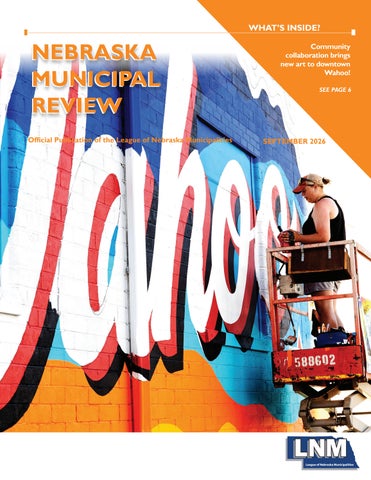
Community XXX collaboration brings new art toXXX downtown Wahoo! XXX
SEE PAGE 6
SEPTEMBER 2026
NEBRASKA MUNICIPAL REVIEW
What's inside?
Issue No. 1,217 The NEBRASKA MUNICIPAL REVIEW (ISSN 0028–1906) is published monthly and the official publication of the League of Nebraska Municipalities, an association of the cities and villages of Nebraska, published at 1335 L St., Lincoln, Nebraska 68508. Subscription rates are $5 per single copy — $50 plus tax for 12 issues. Periodicals postage paid at Lincoln, Nebraska and at additional mailing offices. Views of contributors, solicited or unsolicited, are their own and not to be construed as having the endorsement of the League unless specifically and explicitly stated by the publisher. The NEBRASKA MUNICIPAL REVIEW is a nonprofit publication administered and supervised by the League of Nebraska Municipalities. All revenue derived from the publication is used by the association to defray publication costs.
Sustainability efforts recognized in LIncoln
League of NE Municipalities staff 402-476-2829 • www.lonm.org L. Lynn Rex, Executive Director Christy Abraham, Legal Counsel Lash Chaffin, Utilities Section Director Cherie DeFreece, Admin Assistant/ Membership Services Assistant Brenda Henning, Membership Services Assistant/ LIGHT Admin Assistant Ethan Nguyen, LNM/LARM Information Technology Manager Shirley Riley, Membership Services Director Jackson Sash, Utilities Field Representative/Training Coordinator Ashley Wolfe, Marketing/Communications Director
LARM staff
Dave Bos, Executive Director Tracy Juranek, Asst. Executive Director, Customer Service Specialist Diane Becker, Communications/Marketing Director Kyla Brockevelt, Executive Administrative Assistant Drew Cook, Customer Service Specialist John Hobbs, Loss Control Specialist James Kelley, Loss Control Specialist Fred Wiebelhaus, Loss Control/Claims Manager
POSTMASTER: SEND ADDRESS CHANGES TO NEBRASKA MUNICIPAL REVIEW, 1335 L STREET, LINCOLN, NEBRASKA 68508.
Have an idea, project or opinion to share? The League welcomes member articles, information, and op-eds. Want to reach local decision makers? The League can help you get your message out to Nebraska’s 3,500+ municipal officials.To learn more, contact Ashley Wolfe at 402-476-2829 or ashleyw@lonm.org. President President-Elect Vice President Past President
Executive Board
Directors
Leirion Gaylor Baird John W. Ewing, Jr. Sharon Powell Larry Evans Rod Petersen Jim Bulkley Betsy Vidlak Mindy Rump Pat Heath Janine K. Schmidt Kyle Svec
Affiliated Sections
City Managers. Clerks Munic. Accounting & Finance Fire Chiefs Utilities
Marlin Seeman, Mayor, Aurora Bryan Bequette, Mayor, Nebraska City David Black, Mayor, Papillion Deb VanMatre, Former Mayor, Gibbon
Mayor, Lincoln Mayor, Omaha Village Board President, Utica Mayor, Minden Mayor, Louisville Mayor, Columbus Mayor, Scottsbluff Mayor, Blair City Administrator, Gering CMC/Treasurer, Morrill City Admin./Utilities Supervisor, Geneva Wes Blecke, Wayne Derek Bargmann, Seward Roger Nash, Hastings Cory Schmidt, Grand Island Gary Thurlow, Atkinson
8
Features 6 10
Public art through partnership: Wahoo’s community collaboration creates a downtown landmark AARP commits $153,685 in grants to enhance livability in Nebraska communities
11
Wildlife viewing grants available from Nebraska Game and Parks
12
New report affirms Nebraska’s top ranking among states
14
16
17
18 19 22
28
29
There’s a time and a place for effective storytelling City of Madison launches joint transportation plan efforts Melissa Garcia joins City of Norfolk as new economic development director Wood River turns a crisis into a community development triumph with completion of Legacy Station SBA federal disaster loans available for Nebraska nonprofits impacted by May storms NLC: What if cities onboarded residents like employers onboard employees? Grand Island Utilities uses sheep to help maintain solar farm Investment in housing development boosts rural communities
Columns 4 8 24
The Director’s Message - L. Lynn Rex, LNM Executive Director - League Executive Board made final loan payment on new League Building better serving the needs of members of the League, Utilities Section, LARM, and LIGHT for decades to come LARM - Animal bite prevention tips for municipal employees The Legal Corner by Tara Stingley, Cline Williams Wright Johnson & Oldfather, L.L.P. - ADA discrimination and hostile work environment claims: Lessons from the Eighth Circuit’s decision in Schmit v. Trimac Transportation
In each issue 3
Municipal Legal Calendar
30
Professional Directory
On the cover A new mural, coodinated by the Wahoo Area Arts Council and brought to life by Nebraska mural artist Taryn Janke, transforms a highly visible wall in downtown Wahoo into a vibrant public gathering point. Photos by Kate DeCoste Photography.
Larger Cities Legislative Committee
Municipal Legal Calendar
Chaired by Mayor Don Groesser of Ralston John McGhehey, Mayor, Alliance J.D. Cox, City Manager, Alliance Tobias Tempelmeyer, City Administrator, Beatrice Rusty Hike, Mayor, Bellevue Jim Ristow, City Administrator, Bellevue Mindy Rump, Mayor, Blair Phil Green, City Administrator, Blair David Scott, Deputy City Administrator of Operations, Blair Tom Menke, City Manager, Chadron Jim Bulkley, Mayor, Columbus Tara Vasicek, City Administrator, Columbus Dave Bauer, Mayor Crete Tom Ourada, City Administrator, Crete Jody Sanders, City Administrator, Fremont Kent Ewing, Mayor, Gering Pat Heath, City Administrator, Gering Roger Steele, Mayor, Grand Island Patrick Brown, City Administrator, Grand Island Ryan Schmitz, Utilities Director, Grand Island Mike Evans, Mayor, Gretna Paula Dennison, City Administrator, Gretna Mark Funkey, City Administrator, Hastings Derek Zeisler, Utility Manager, Hastings James Liffrig, Mayor, Holdrege Chris Rector, City Administrator, Holdrege Brenda Jensen, City Manager, Kearney Brad DeMers, Asst. City Manager, Kearney Doug Kindig, Mayor, La Vista Peyton Mastera, City Administrator, La Vista Kevin Pokorny, Director of Administrative Services, La Vista John Fagot, Mayor, Lexington Joe Pepplitsch, City Manager, Lexington Margaret Blatchford, Assistant City Attorney, Lincoln Riley Slezak, Senior Advisor to the Mayor, Lincoln Linda Taylor, Mayor, McCook Nate Schneider, City Manager, McCook Bryan Bequette, Mayor, Nebraska City Perry Mader, City Administrator, Nebraska City Justin Webb, Council Member, Norfolk Scott Cordes, City Administrator, Norfolk Brandon Kelliher, Mayor, North Platte Layne Groseth, City Administrator, North Platte Steve Krajewski, Mayor, Ogallala Kevin Wilkins, Assistant to the City Manager, Ogallala Thomas Warren, Chief of Staff, Omaha David Black, Mayor, Papillion Amber Powers, City Administrator, Papillion Mark Stursma, Deputy City Administrator, Papillion R. Paul Lambert, Mayor, Plattsmouth Emily Bausch, City Administrator, Plattsmouth Don Groesser, Mayor, Ralston Brian Kavanaugh, Council President, Ralston Jack Cheloha, City Administrator, Ralston Art Lindberg, Mayor, Schuyler Lora Johnson, City Administrator, Schuyler Betsy Vidlak, Mayor, Scottsbluff Kevin Spencer, City Manager, Scottsbluff Joshua Eickmeier, Mayor, Seward Greg Butcher, City Administrator, Seward Brandon Bonregard, Mayor, Sidney Brett Kerkman, Vice-Mayor, Sidney Lance Hedquist, City Administrator, South Sioux City Randy Meyer, Council Member, South Sioux City Jill Brodersen, Mayor, Wayne Wes Blecke, City Administrator, Wayne Barry Redfern, Mayor,York Dr. Sue Crawford, City Administrator,York
Smaller Cities Legislative Committee
Chaired by Tom Goulette, City Administrator of West Point
Lisa Schroedl, City Administrator/Clerk/Treasurer, Ainsworth Jessica Quady, City Administrator, Ashland Crystal Dunekacke, City Administrator/Economic Developer, Auburn Marlin Seeman, Mayor, Aurora Adam Darbo, City Administrator, Aurora Chris Anderson, City Administrator, Central City Alan Michl, Chairperson, Exeter Becky Erdkamp, Clerk/Treasurer, Exeter Kyle Svec, City Administrator, Geneva Matt Smallcomb, City Administrator, Gibbon Gary Greer, City Administrator, Gothenburg Jana Tietjen, Clerk, Hebron Kelly Oelke, City Administrator, Hickman Janine K. Schmidt, CMC/Treasurer, Morrill Sandra Schendt, Clerk/Treasurer, Nelson David Russell, Director of Gov. Affairs, NMPP Energy Sandy Kruml, Clerk/Treasurer, Ord Mike Feeken, Mayor, St. Paul Sandra Foote, Council Member, Superior Warren Myers, City Administrator, Sutton Jessica Meyer, City Administrator, Syracuse Kelly Adamson, City Council Member, Tekamah Sharon Powell, Village Board President, Utica Kyle Arganbright, Mayor,Valentine Melissa Harrell, City Administrator, Wahoo Mike Mogus, Administrator/PWD, Wakefield Desiree Soloman, City Attorney, Waterloo Stephanie Fisher, City Administrator, Waverly Tom Goulette, City Admin./Utility Superintendent, West Point Randy Woldt, Utilities Superintendent, Wisner Robert Costa, Community Planner,Yutan
(All statute citations to Revised Statutes of Nebraska)
NOVEMBER 2026 • • • • • • • • • • • • • •
CITIES OF THE FIRST CLASS First day Class C liquor license year begins. (53-124) Within 15 days of Passage Clerk publishes ordinances passed. (16-405) Within 10 days from meeting or before next meeting (whichever is sooner) Clerk to have minutes available for public inspection. (84-1413) Within 30 days from Council meeting Clerk publishes official proceedings of meetings including claims. (19-1102) Within 20 days after end of month Treasurer files monthly financial report. (16-318) * * Clerk must prepare agenda prior to next Council meeting. (84-1411) On or before December 1 TIF report due to Property Tax Administrator (18-2117.01) CITIES OF THE SECOND CLASS and VILLAGES First day Class C liquor license year begins. (53-124) Within 15 days of Passage.. Clerk publishes ordinances passed. (17-613) Within 10 days from meeting or before next meeting (whichever is sooner) Clerk to have minutes available for public inspection. (84-1413) Within 30 days from Council or Board meeting Clerk publishes official proceedings of meetings including claims. (19-1102) Within 20 days after end of month.Treasurer files monthly financial report. (17-606) * *.Clerk must prepare agenda prior to next Council or Board meeting. (84-1411) On or before December 1 TIF report due to Property Tax Administrator (18-2117.01)
LEAGUE OF NEBRASKA MUNICIPALITIES
UPCOMING CONFERENCES UTILITIES/PUBLIC WORKS CONFERENCE
Jan. 13 - 15, 2027
MIDWINTER CONFERENCE
Feb. 22 - 23, 2027
MUNICIPAL ACCOUNTING AND FINANCE CONFERENCE
June 16 - 18, 2027
Director’s Message
League Executive Board made final loan payment on new League Building better serving the needs of members of the League, Utilities Section, LARM, and LIGHT for decades to come BY L. LYNN REX, EXECUTIVE DIRECTOR, LNM
A
fter years of conservative budgeting to save funds and avoid paying interest on a loan, the League Executive Board on July 28, 2026, presented to Annie Matos of Union Bank & Trust the final loan payment for the new League Building which will serve cities and villages for another 50 years or more. Since moving into the new League Building on July 1, 2025, municipal officials from across the state have attended countless meetings in the Joe Hampton Conference Center (JHCC). Many of these meetings were with other local elected and appointed officials, State Senators, legislative staff members, representatives of the Governor’s office, as well as other state and federal officials. The League Executive Board and members of the Larger & Smaller Cities Legislative Committees typically hold their meetings in the JHCC which can accommodate up to 60 individuals when the room is set up in classroom style. The Board of Directors of the League Association of Risk Management (LARM) also schedules many of its meetings in the JHCC. In addition, there are two smaller conference rooms; each one can seat up to 10 individuals. All the conference rooms have the latest technology to accommodate virtual meetings, PowerPoint presentations, etc. If you need a place to meet with your State Senator or others, please let us know so we can reserve a conference room. We also have a designated office for visiting officials to use to conduct business. It was great having the 2026 Annual Conference of the Nebraska City/County Management Association (NCMA) in the JHCC in June. The League also will continue hosting meetings for State Senators and others in the public sector needing a large meeting space to discuss a wide variety of 4
important issues from affordable housing to zoning. For example, Sen. Brad von Gillern, Chair of the Legislature’s Revenue Committee, will be using the JHCC in December for a taxation workshop for State Senators with presentations by the League and the Nebraska Association of County Officials (NACO). BACKGROUND: Before 2010, various members of the League Executive Board had numerous discussions about the need for a new League office building when it was clear from engineers and architects that it would not be cost effective to retrofit the building again or make significant repairs to extend the life of the building for another 25 to 50 years. In 2011, the Lincoln Woman’s Club (LWC) indicated it would be selling its building and surrounding property which had twice the footprint of the former League office building. The League rented parking space from the LWC since the League purchased its property and building at 1335 L Street which had no parking attached. After the LWC rejected two offers from the League to purchase its building and property, the League Executive Board explored other options, including possibly purchasing property directly north of the former League building. On June 26, 2014, under the leadership of then-League President Marlene Johnson, former Mayor of West Point, the League Executive Board considered a motion to increase its offer to purchase the LWC, in light of previous offers rejected by the LWC. Then-York Mayor Chuck Harris made a motion, seconded by then-Seward City Administrator Brett Baker, which passed unanimously, to offer the LWC $825,000 for its building and property. The offer was accepted by the NEBRASKA MUNICIPAL REVIEW
LWC; the League was told the next highest bid to purchase the LWC was $815,000 from a Lincoln developer. As an extraordinary example of generosity and servant leadership, Joe Hampton, former Chair of the Lincoln City Council and Past League President from 1982-83, played a critical role in negotiating the purchase of the LWC building and property. Joe also wrote a check for $500,000 from his personal bank account to help the League finance the purchase of the LWC building and property. The League paid $325,000 to the LWC for the remainder of the purchase price and reimbursed Joe Hampton within a year. The conference room in the former League office building was named after Joe Hampton; the conference center in the new League office building was dedicated on Sept. 5, 2025, as the “Joe Hampton Conference Center (JHCC).” Joe Hampton (1925-2017) was the Founder and President/CEO of Hampton Enterprises - Properties & Construction. In FY 2015-16, efforts to construct a new League office building were delayed until adequate funding was available. Other key dates include: 1) in April 2018, League Officers and others wanted to preserve this location for a new League office building and did not accept an offer from the City of Lincoln to “swap land” so the city could build a parking garage on the north half of the block parallel to L Street; 2) in August 2022, then-League President Paul Lambert, Mayor of Plattsmouth, established and still Chairs the League Building Committee which dedicated countless hours in SEPTEMBER 2026
After years of conservative budgeting to save funds and avoid paying interest on a loan, the League Executive Board on July 28, 2026, presented to Annie Matos of Union Bank & Trust the final loan payment for the new League Building. (Seated from left in the front row) President-Elect Bryan Bequette, Mayor of Nebraska City; President Marlin Seeman, Mayor of Aurora; Annie Matos of Union Bank & Trust; Immediate Past President Deb VanMatre, Former Mayor of Gibbon; and Past President and Chair of the League Building Committee Paul Lambert, Mayor of Plattsmouth. (Standing from left in the back row) Mayor Mindy Rump of Blair; Janine Schmidt, CMC/Treasurer of Morrill; Mayor Larry Evans of Minden; Kyle Svec, City Administrator/Utilities Supervisor of Geneva; Mayor Rod Petersen of Louisville; Mayor Jim Bulkley of Columbus; Vice President David Black, Mayor of Papillion; Mayor Leirion Gaylor Baird of Lincoln; and Sharon Powell, Village Board President of Utica. (Not pictured) Mayor John W. Ewing, Jr. of Omaha; Mayor Betsy Vidlak of Scottsbluff; and Pat Heath, City Administrator of Gering.
meetings relating to the demolition and construction of the new League office building; and 3) in FY 2022-24, thenLeague President Deb VanMatre, thenMayor of Gibbon, worked closely with Mayor Lambert and other League officers to provide leadership and guidance to the League Executive Board and staff throughout this demolition and construction project which required approval from: a) the City of Lincoln’s Historic Preservation Commission to remove an historic landmark designation from the LWC property; and b) the Capitol Environs Commission relating to design oversight. Special thanks to Lincoln Mayor Leirion Gaylor Baird and the Lincoln City Council for providing needed tax increment financing with guidance from the Lincoln Urban Development Department so this project
could be built as envisioned by the League Executive Board. As President Marlin Seeman, Mayor of Aurora, emphasized on Sept. 5, 2025, at the dedication ceremony for the new League Building, it was a top priority of the League Executive Board and League Building Committee to keep our office building in this high-profile location to continue effective advocacy for our members before the Nebraska Legislature, state agencies, and the Governor. In addition, he stated the League, Utilities Section, LARM, and the League Insurance Government Health Team (LIGHT) would continue to provide other critically important services for member cities and villages.
5
Public art through partnership:
Wahoo’s community collaboration creates a downtown landmark STORY BY KATHRYN NYGREN, PRESIDENT OF THE WAHOO AREA ARTS COUNCIL MURAL PHOTOS BY KATE DECOSTE PHOTOGRAPHY
T
Across Nebraska, communities are discovering that public art can be more than beautification—it can be an investment in placemaking, community identity, and civic engagement.
he City of Wahoo's newest downtown Throughout the 10-month process, artist Taryn m u r a l , t h e 1 2 0 - f o o t - l o n g m u r a l Janke collaborated closely with the Wahoo Area entitled, “Wahoo in Full Color,” illustrates Arts Council to create artwork that reflects how municipalities along with non-profits, Wahoo's unique identity. The finished mural businesses, and residents can work together to incorporates recognizable historic landmarks in create projects that strengthen both a place and town, native elements, and symbols meaningful to the people who call it home. the community, such as Wahoo’s own namesake— Coordinated by the inaugural board of the the burning bush. A playful fox is a fun Easter egg newly formed Wahoo Area Arts Council and in the design and a nod to foxes inhabiting parts of brought to life by Nebraska mural artist Taryn Wahoo that have become a social media sensation. Janke of Color Me Crazy, LLC, the mural From its earliest planning stages, it was important transformed a highly visible downtown wall to the Wahoo Area Arts Council that the project into a vibrant public gathering point. While the was designed as a community initiative rather than finished artwork has become an attraction for the work of a single organization. The Council visitors and residents alike, perhaps its greatest sought to engage partners from every corner of the success lies in the collaborative process that made community, creating broad ownership and shared it possible. investment in the project's success.
6
NEBRASKA MUNICIPAL REVIEW
Financial support from the Wahoo Community Foundation provided the momentum needed to move the project from concept to reality. The Foundation's investment reflects the important role community foundations continue to play in supporting quality-of-life initiatives and placemaking projects throughout Nebraska. Equally important was the partnership with the Wahoo Eagles Club FOE 2971, which generously offered the exterior wall of its downtown building as the mural site. Their willingness to share a prominent piece of private property at the entrance to downtown Wahoo demonstrates how collaboration can create lasting public benefits. The process beyond the mural design, location and funding also required significant coordination and volunteer effort. Local attorney and the attorney for the City of Wahoo, Jovan Lausterer, contributed his time and expertise in contract negotiations. The Wahoo Street Department also became an essential project partner by providing more than logistics to barricade the street in front of the mural for its installation. When wall preparation didn’t go as planned, Street Superintendent Joe Wynn didn’t hesitate to step in with Street Department staff and equipment to support the project when a critical timeline was approaching. Their involvement highlights the valuable role municipal departments often play in community enhancement projects that extend beyond traditional public infrastructure.
SEPTEMBER 2026
Community engagement remained at the center of the initiative from beginning to end. Rather than relying exclusively on grants or large donors, the Wahoo Area Arts Council invited all residents to become stakeholders by asking them to “vote with their dollars.” The Wahoo Area Arts Council narrowed the prospective designs to two finalists and asked for community input—1 vote equaled $1. Donations of all sizes allowed community members to directly invest in the project at any level while demonstrating widespread public support for public art in downtown Wahoo. Local businesses amplified that enthusiasm by hosting fundraising events that combined community gathering with charitable giving. Pizza Hut and Scooter’s Coffee each organized fundraising promotions that encouraged residents to support the mural while supporting local businesses. The impact of projects like Wahoo in Full Color extends well beyond aesthetics. Public art has become an increasingly valuable component of downtown revitalization efforts throughout Nebraska. Murals create destinations, encourage pedestrian activity, generate tourism, inspire community events, and foster civic pride. They also provide highly visible examples of successful collaboration, demonstrating what communities can accomplish when diverse organizations unite around a shared vision.
Continued on page 11 / See Wahoo
7
LARM
Animal bite prevention tips for municipal employees A
JAMES KELLEY LOSS CONTROL SPECIALIST, LARM
nimal bites involving municipal employees when protecting food, offspring, or territory. From 2021 to 2025, have been increasing in recent years, making Animals that appear disoriented, drool prevention more important than ever. Public servants LARM experienced excessively, or act unusually aggressive may such as meter readers, utility crews, maintenance be sick and pose a greater risk. workers, and first responders regularly encounter To stay protected, public servants should domestic and wild animals in the field. rely on both safe work practices and proper animal bite related From 2021 to 2025, LARM experienced 72 animal equipment. Basic personal protective injury claims bite related injury claims totaling close to half a equipment such as thick gloves, long sleeves, totaling close to million dollars in paid losses, with a notable surge durable pants, and sturdy boots can help in 2024 and 2025 (22 and 20 claims, respectively). reduce injury severity. Other useful tools This is nearly double the historical average and is and methods include: accompanied by a significant increase in overall losses. • Animal deterrent sprays such as pepper These trends highlight both the high frequency and spray severity of these incidents, making dog bites one of • Noise deterrents like air horns or the costliest injury types. whistles Understanding animal behavior and using the right • Barriers such as vehicles, tool bags, clipboards, or tools and response strategies can help prevent injuries. Most garbage can lids animals show warning signs before becoming • Animal control tools such as catch poles or nets aggressive, and recognizing these cues is • Maintaining awareness, keeping a safe distance, and essential. Common red flags include identifying escape routes a stiff or tense body, raised fur Good habits in the field are just as important as having along the back, and prolonged the right gear. Avoid surprising animals whenever eye contact. Growling, possible. Announce your presence before entering a b a r k i n g , h i s s i n g , property and look for signs of animals before exiting or snarling signal your vehicle or entering a yard. Clues may include agitation, while bared chains or tie outs, worn paths, kennels or doghouses, teeth or flattened ears food and water bowls, toys, animal waste, or posted indicate increased risk. warnings such as “Beware of Dog.” Movement is another Body language also plays an important role. If key indicator. Lunging, confronted by an aggressive animal, stand slightly charging, or trying to move sideways instead of facing it directly, avoid prolonged behind you may suggest an eye contact, and move slowly. Stay calm and DO NOT attack is imminent. Animals RUN, as this can trigger a predatory chase response. are often more defensive
72
half a million dollars
8
NEBRASKA MUNICIPAL REVIEW
Stand your ground, use a firm voice, and give simple commands like “No,” “Stay,” or “Back,” while slowly backing away. Use available objects as barriers when possible.
If an attack occurs, your priority is to protect yourself and minimize injury. Stay curled up with your chin tucked and hands covering your head, neck, and chest, keeping movements minimal
and controlled. Use nearby objects like a bag or clipboard as a shield. Call for help only when safe, such as when the animal backs off or assistance is nearby, and avoid loud shouting if it increases aggression. If you are bitten or injured, act quickly. Move to a safe location and wash the wound with soap and water for at least five minutes. Apply pressure to control bleeding and seek medical care promptly. Report the incident according to your organization’s procedures, including details about the location, animal, owner, and circumstances. Follow up care is important to address infection risks such as rabies and tetanus. Municipalities can further reduce risk by providing training on recognizing animal behavior, establishing clear procedures for working around animals, coordinating with animal control, and tracking high-risk locations. Staying aware, prepared, and calm can make all the difference. Recognizing warning signs early and following safe work practices can help public employees avoid animal attacks and stay safe on the job.
What is happening in your city or village? Share your stories with the League! Email ashleyw@lonm.org.
SEPTEMBER 2026
9
AARP commits $153,685 in grants to enhance livability in Nebraska communities
A
ARP recently announced 12 Nebraska organizations will receive 2026 Community Challenge grant funding. Marking the program’s 10th anniversary, the grants are part of an $8.3 million commitment by AARP, doubling last year’s total, to fund 750 quick-action projects nationwide aimed at making communities more livable for people of all ages, especially older adults. The funds will support improvements to public spaces, transportation, housing, digital connectivity, disaster preparedness, and other local priorities that help improve social connections and strengthen neighborhoods and towns of all sizes. Since 2017, AARP Nebraska has awarded 46 grants and $590,494 through the program to nonprofit organizations and government entities across the state. “Communities across Nebraska are eager for solutions that increase mobility, connection, and quality of life,” said Todd Stubbendieck, State Director for AARP Nebraska. “With AARP’s Community Challenge grants, we’re empowering residents to bring meaningful improvements to life, and this year marks our biggest round of funding yet in the state.”
Public Places award category projects to create vibrant parks, open spaces, and community amenities CITY OF RALSTON Will add accessible terraces and new benches near a busy intersection and Memorial Plaza, creating comfortable gathering areas that better support people with mobility needs while honoring service members.
BROKEN BOW PUBLIC LIBRARY Will transform its lawn into an outdoor gathering space with seating, landscaping, and simple games, giving residents a welcoming place to rest, meet, and enjoy downtown events.
CARNEGIE ARTS CENTER Will install new murals during a downtown art festival, expanding a walkable public art corridor that encourages foot traffic and showcases community creativity.
CITY OF RAVENNA Will construct two outdoor pickleball courts with concrete surfaces, fencing, and permanent nets to provide residents with a safer, dedicated place to play and gather.
GLOBAL LEADERSHIP GROUP OMAHA Will host monthly neighborhood clean-up events, supplying tools, dumpsters, and organized routes for trash removal to improve walkability, safety, and community connection for residents, including adults age 50+.
Housing award category projects to expand accessible and affordable housing options FREMONT HABITAT FOR HUMANITY Will repair unsafe sidewalks and front porches during a neighborhood volunteer day, helping residents age 50+ reduce trip hazards, improve home entry, and enjoy safer walkability in established neighborhoods.
COMMUNITY ACTION PARTNERSHIP OF LANCASTER AND SAUNDERS COUNTIES Will provide home safety upgrades, such as grab bars, improved lighting, and non-slip surfaces, to low-income older adults through its existing weatherization program, supporting safer aging at home.
PARTNERS FOR LIVABLE OMAHA/ OUR STORY SMALL HOUSES Will open two newly built aging in place homes for guided public tours in an established neighborhood, demonstrating practical design features that promote safe living, independence, and affordability for residents age 50+.
Transportation award category projects to expand walkability, bikeability, and transit access CITY OF NEBRASKA CITY Will fill critical sidewalk gaps in one of its oldest neighborhoods, creating new accessible sections that improve pedestrian safety and help residents reach downtown services, shops, and community destinations without walking in traffic.
CEDAR COUNTY TRANSIT Will host community info sessions across the rural towns it serves and introduce technology upgrades that make scheduling on demand transit easier, supporting reliable access to medical care and daily needs.
LINCOLN TRANSPORTATION & UTILITIES Will construct a permanent pedestrian refuge island within an existing crosswalk, allowing people to cross in stages, improving driver visibility, and making it safer to navigate a busy roadway.
to strengthen digital access and digital literacy Digital Connections award category projects for older adults
HOWARD COUNTY SENIOR CITIZENS, INC. will introduce new laptops, tablets, and shared equipment to support hands on technology lessons for adults age 50 plus. Participants will learn essential digital navigation skills, including basic device use, printing, and screen sharing, to better access services and stay connected.
Source – AARP Nebraska
10
NEBRASKA MUNICIPAL REVIEW
Wahoo Continued from page 7
For the Wahoo Area Arts Council, the mural represents the beginning of a long-term commitment to expanding access to public art and strengthening community connections through creative placemaking. For the City of Wahoo, it serves as a reminder that successful municipal projects often depend upon partnerships that leverage the strengths of nonprofits, businesses, volunteers, foundations, municipal staff, and engaged citizens. As Nebraska communities continue to explore innovative approaches to downtown revitalization and quality-of-life improvements, Wahoo’s experience offers a practical model. The project required financial investment, volunteer The City of Wahoo’s newest downtown mural is 120-feet long and entitled, “Wahoo in Full Color.” Photos leadership, municipal support, provided by the City of Wahoo and taken by Kate DeCoste Photography. and community participation, but The true masterpiece is not simply the mural itself—it is the collaboration behind the result is an enduring public it. Through shared vision, local leadership, and broad community engagement, asset that reflects the values of the Wahoo has demonstrated that public art can become a catalyst for civic pride, community that created it. partnership, and continued investment in the places Nebraskans call home.
Wildlife viewing grants available from Nebraska Game and Parks
W
ant to bring more wildlife watching and nature-based experiences to your community? This opportunity can help make that happen. Apply now through Oct. 2 for Nebraska Game and Parks' Watchable Wildlife Grants. Projects must develop ways to improve wildlife observation and should have a positive impact on natural resources and wildlife. Here's a few more things to know: • Individuals, nonprofit, governmental, and for-profit entities
Every project is different. Our commitment stays the same.
TRUSTED TODAY. READY FOR TOMORROW.
DUNDEE BUSINESS DISTRICT STREETSCAPE | OMAHA, NE
Continued on page 21 / See Nature
SEPTEMBER 2026
11
A closer look where NE ranks
New report affirms Nebraska’s top ranking among states A new report highlights the best states to live, with Nebraska securing a top spot near the head of the list. “There is no better place to live, work, and raise a family than here in Nebraska, and this report reflects the incredible strength of our state. We are committed to continuing this momentum and making sure Nebraska remains a national leader for years to come.” - Gov. Jim Pillen First launched in 2017, the U.S. News and World Report: Best States Rankings measure performance across 71 metrics in eight categories that matter most to Americans including the economy, crime and corrections, infrastructure, natural environment, fiscal stability, healthcare, and opportunity. In the latest 2026 rankings, Nebraska earned the 5th overall spot in the nation. Substantial gains across the Midwest in the economy, healthcare, and natural environment sectors played a major role in the region’s overall rise. Nebraska performed exceptionally well in key categories, ranking third in infrastructure and eighth in fiscal stability. Nebraska’s infrastructure strength is driven by its large presence as an energy, transportation, and logistics hub. The state ranks third in energy, largely due to the combination of grid reliability, renewable energy generation, and affordable public power. In addition, Nebraska is a central hub for transportation thanks to its high-quality roads, well-maintained bridges, and short commute times. “States that ranked highly in the 2026 Best States rankings have demonstrated exceptional leadership in working toward a prosperous future for their citizens,” said U.S. News Executive Chairman & CEO Eric Gertler. “By excelling in pivotal areas like healthcare, education, and modern infrastructure, these top-performing states are proving that targeted policy and smart investments are the true catalysts for long-term opportunity and success.” Nebraska continues to build on its success in creating an environment focused on growing, attracting, and retaining top talent – reinforcing the state’s positioning as: open for business.
#5
Best states overall
#19
Crime & corrections
#11
Education
#34
Healthcare
#11
Natural environment
#15
Economy
#8 Fiscal stability #3 Infrastructure #14
Economy
Source – Office of the Governor
12
NEBRASKA MUNICIPAL REVIEW
GET A QUOTE AND JOIN TODAY! The League Insurance Government Health Team (LIGHT) helps hundreds of its members throughout Nebraska obtain affordable health insurance coverage.
Plan and Network Choices With seven plan options and three networks to choose from, you’re sure to find one that meets your group’s coverage and benefit needs.
Affordable Plan Options
Available Network Options
Offering your employees much-needed protection against the high cost of medical care:
With several networks available, you have easy access to quality providers:
• Three PPO options • Four HSA-eligible high deductible options • Prescription drug coverage
• NEtwork BLUE (Statewide) • Premier Select BlueChoice (Regional) • Blueprint Health (Regional) • Out-of-state network availability
Enrollment Options Single: Covers the employee only Employee and spouse: Covers the employee and their spouse
Employee and children: Covers the employee
and their eligible dependent children, but does not provide coverage for the spouse
Family: Covers the employee and eligible dependents including a spouse
RECEIVE DEDUCTIBLE AND OUT-OF-POCKET CREDIT FROM YOUR CURRENT VALID GROUP PLAN WHEN YOU SWITCH!
LET’S GET STARTED Contact your current local Agent/Broker Or contact
Dennis Maggart Executive Vice President P: 913-378-9841 or 816-718-0335 Dennis@McInnesGroup.com
Jane Limbach Account Manager P: 913-378-9840 Jane@McInnesGroup.com Blue Cross and Blue Shield of Nebraska is an Independent Licensee of the Blue Cross and Blue Shield Association. 60-025-58 (01-17-23)
SEPTEMBER 2026
13
There’s a time and a place for effective storytelling BY MICHAEL SCANLON, PRINCIPAL, OUR CITY PLANNING, LLC
Data is great—if you understand how it was collected and what it means. But so often in the local government world, we use data as a hammer to prove a point. A point tied to data is often forgotten within a week or even a few short hours. Unlike data, stories are built for our minds to remember. Stories allow for: Emotional engagement. Emotionally charged stories are remembered because they engage more of your brain. Relatability and context. Stories provide context and relatability, which help us understand the data and information with which we are presented. Cognitive engagement. Stories often require the listener to think, imagine, and predict—engaging multiple cognitive processes. Yes, data plays a role in the choices we recommend as local government leaders and the decisions our elected officials make. But the stories carry the day. Storytelling is used in education, marketing, and leadership to convey messages more effectively and ensure they are remembered. Here are a couple of quick stories that illustrate that point and will set you on your own storytelling journey.
The opossum on the roof
“There’s an opossum on my roof. What are you going to do about it?” Yes, that was the first constituent call I received as a newly minted city council member. I tried everything to calm the constituent down and tell her that in time the opossum would leave, but it didn’t matter. There was an opossum, it was on her roof, and, as her city council member, I needed to take care of it. I finally got her to agree to give it time to leave—and leave it did. Except this opossum loved my constituent’s maple tree that hung over her roof. So, it kept returning. And about every two weeks, I would get the opossum call: “The opossum is back on my roof. What are you going to do about it?” 14
Eventually, she grew tired of my answer. So, one night under the Citizens’ Comment period of a city council meeting, she relayed her opossum story to the full city council. With a bit of embellishment included in her story, she convinced the city council to act. No data. No input from city staff. Action was required. Now what can a city council do to stop a branch-jumping opossum? Well, as you can imagine, the answers ranged from shooting the critter, which the property owner didn’t want, to trapping and moving it to a park, which the parks and recreation director didn’t want. After 45 minutes of discussion, someone suggested the city council should write an ordinance that allowed the animal control officer to capture and euthanize wild animals that were becoming nuisances. Then the worst thing of all occurred: The city council decided it was time to start writing the ordinance during the meeting. If you want to watch a train wreck in slow motion, it’s the city council writing an ordinance on the fly. After another hour, we got to the end of the ordinance writing. A motion was made and quickly seconded, only to land at a tie vote. The mayor broke the tie for the great Opossum Ordinance of 1997. It was repealed within the year. That is the power of stories. My constituent convinced the city council through her experiences that the opossum was a problem that not only bothered her but others, although no other opossum roof sightings could be found (relatability). She was able to tap into council members’ emotions about how the opossum made her feel at night when she could NEBRASKA MUNICIPAL REVIEW
hear it walking across her roof. She said the “pitter patter” made it feel like someone was breaking into her home (emotional engagement). And she ended with: “Would you like an opossum on your roof?” (cognitive engagement). Stop and think about it for a moment. How many times have compelling stories from citizens turned into action by city councils. Probably more times than we would like to admit.
Time and place
Now let’s counter that story with one I’ve used hundreds of times. I call it the ‘time and place story’. Prior to, and following my experience as a city council member, I spent decades as a city administrator. When I was just getting into the profession, I had lunch on Fridays with a city manager who was mentoring me. He shared his thoughts on what made a good city manager, and he always reminded me that everything boiled down to time and place. Too often, he said, city managers get crosswise with their city council or community because they forget time and place. He noted that we can all come up with policies, ordinances, and ideas that might be very good. But, if introduced at the wrong time but in the right place, it will fail. If introduced at the right time and the wrong place, it will also fail. And if you want to get fired as a city manager, introduce something at the wrong time and in the wrong place. “You must match time and place if you want a policy to stick or an ordinance to matter. The right time and right place matters,” he counseled. Let’s return to the story of the opossum. Fast forward: It’s now the summer of 1998 and the Opossum Ordinance has proven ineffective. The city council is mad and wants answers SEPTEMBER 2026
from the staff. The staff does a great job pointing out that there’s only one house with an opossum problem, which is likely being caused by the compost pile with food scraps just 50 feet from the house. The staff asked what they should do if the homeowner refused to help with the opossum problem. Staff was right, but how do you get a city council to pivot? Well, time and place work well. Being “junior” on the city council, it was finally my turn to speak after other council members weighed in. I began, “I want to commend the city council for taking this issue to heart and wanting to help my constituent (emotional engagement). I tried and failed to solve her problem, and I appreciate the city council taking this issue on and being creative problem solvers when writing the ordinance (relatability). But I think this might be an instance where time and place matter.” Then I relayed what my mentor had told me when I was getting into the
profession, “This was a case where it was the right time to try to solve our constituent’s problem, but it was probably the wrong place. Had we known about the compost pile, our actions would have probably been different (cognitive engagement). But sometimes we all miss. May I suggest we repeal the ordinance that we’re having a hard time enforcing and see if we can convince the homeowner to get a compost bin? I don’t think this ordinance will ever work—it fails the time and place test.” Within seconds, there was a motion to repeal from the author of the ordinance, followed by a quick second, and a unanimous vote to repeal. The moral of these two stories is that time and place do matter. So, the next time you feel like creating a 50-slide PowerPoint presentation filled with bullet points, step back and put your presentation into a story. Good stories carry the day. Michael Scanlon is a retired city manager from Kansas and Colorado municipalities and the principal at Our City Planning, LLC.
Employment & Labor Law Public Finance & Bond Matters Real Estate & Infrastructure Projects Contracts & Procurement Litigation & Dispute Resolution
Information Technology, Cybersecurity & Privacy Healthcare Regulation & Operations Economic Development & Redevelopment Projects Governance, Compliance & Risk Management
OFFICES LOCATED IN OMAHA & LINCOLN | WWW.BAIRDHOLM.COM
15
Madison
City of Madison launches joint transportation plan efforts M
omentum continues to build in Madison as the city takes the next major step in its federal Safe Streets and Roads for All (SS4A) project. In 2022, the city was awarded a planning grant in the amount of $320,000. Following the exciting announcement of the federal grant award, the project has moved into the streets to seek public input. The planning project combines Madison the Safety Action Plan and Madison Transportation Master Plan. These plans will identify strategic safety improvements to Madison’s multimodal transportation network, City leaders, in partnership with regional engineering firm Olsson, have officially launched a communitywide survey, calling on area residents to help shape the future of local road safety. The newly launched survey gives area residents a direct voice in identifying where they face safety or infrastructure barriers while driving, walking, or biking. It specifically tracks local concerns regarding traffic behaviors like speeding, while pinpointing highpriority areas—such as school zones and downtown—that need urgent upgrades. Residents can also voice their support for specific engineering solutions, including new sidewalks, crosswalks, and trafficcalming designs. This input is critical as Olsson analyzes local data to build a proactive safety roadmap for the town.
"Big things are happening in Madison right now, and this project is proof that our town is leading the region in progress," said Rob Fite, Mayor of Madison. “We are taking proactive steps to ensure our infrastructure makes our community safer, keeps pace with our future growth opportunities, and strengthens Madison’s reputation as a wonderful place to raise a family." The grant does more than just fix roads; it serves as a powerful catalyst for local growth. "Securing the grant and developing a workable plan shows the entire region that Madison is actively competing for federal dollars to upgrade our community," said Andy Colvin, Economic Development Director. “Safe, accessible streets attract new businesses, boost property values, and signal to investors that Madison is a forward-thinking town on the rise.” Olsson is leveraging advanced traffic data alongside this local insight to build a highly tailored strategy. "We are thrilled to partner with Madison on this vital safety initiative," said Chris Rolling, Lead Project Manager at Olsson. “Combining hard data with real community experiences allows us to design a practical Action Plan that truly protects drivers, pedestrians, and cyclists." Source – City of Madison
“Big things are happening in Madison right now, and this project is proof that our town is leading the region in progress.” - Rob Fite, Mayor of Madison 16
NEBRASKA MUNICIPAL REVIEW
Norfolk
Melissa Garcia joins City of Norfolk as new economic development director
A Better Way to Get Around Helping communities move safer, smoother, and more efficiently—one intersection at a time.
T
he City of Norfolk is pleased to announce the hiring of Melissa Garcia as its new Economic Development Director. Garcia brings more than 15 years of experience in economic development, community engagement, organizational leadership Melissa Garcia and strategic partnerships to the position. As Economic Development Director, she will lead the City’s efforts to support business growth, attract investment, strengthen partnerships and create opportunities for continued economic growth in Norfolk. Garcia previously served as President of the Custer Economic Development Corporation, where she helped lead efforts that resulted in approximately $300 million in investment. She also served as Senior Community Affairs Manager for Black Hills Energy, leading economic development partnerships, community engagement, external communications and foundation grant efforts across Nebraska. Most recently, Garcia served as Chief People Officer for Daycos, Inc., where she provided strategic leadership and led recruitment, process improvement and organizational development initiatives. “I’m excited to join the City of Norfolk and contribute to our community in a new way. Norfolk has
jeo.com
Engineering | Architecture | Surveying | Planning
An Electric Pump Company
You can count on us for all your fluid handling and process solutions!
800-383-PUMP
www.electricpump.com
402-333-9660
www.mc2h2o.com
Continued on page 30 / See Garcia
SEPTEMBER 2026
17
Wood River
Wood River turns a crisis into a community development triumph with completion of Legacy Station STORY AND PHOTOS BY NEBRASKA DEPARTMENT OF ECONOMIC DEVELOPMENT
F
ierce storms struck Central Nebraska in 2019, causing the worst flooding in decades. In the small town of Wood River, rising flood waters forced the local nursing home to evacuate its residents and transfer them to another facility in a nearby community. In the wake of the flooding, the nursing home announced its decision to permanently shut down its Wood River location. Its closure put about 40 people out of work and left a 25,000-square-foot building sitting vacant. As the community of 1,350 residents reeled from news of the nursing home’s closure, local leaders met to discuss their options. At the time of the floods, Wood River Vision 20/20, a community planning group, had been raising funds to build a childcare center. With the former nursing home now sitting empty, they wondered if it could be repurposed. Turning a crisis into opportunity “The nursing home was open until the day the flood hit,” explained Sara Arnett, community volunteer and Compliance Officer for Heritage Bank in Wood River. “The building was in good condition. It wasn’t in disrepair. We had planned to build a new childcare center by our aquatic center, but with [the costs of ] new construction, we only would have been able Continued on page 20 / See Wood River
YOUR VISION. OUR EXPERTISE. BUILDING AQUATIC DREAMS FOR YOUR COMMUNITY.
BURBACHAQUATICS.COM | 608-348-3262 SUPPORT@BURBACHINC.COM | PLATTEVILLE, WI 18
NEBRASKA MUNICIPAL REVIEW
SBA federal disaster loans available for Nebraska nonprofits impacted by May storms
T
he U.S Small Business Administration (SBA) announced the availability of lowinterest federal disaster loans for eligible private nonprofit and faithbased organizations in Nebraska impacted by severe storms, straight-line winds, tornadoes, and flooding that occurred May 15-18. This Presidential Major Disaster Declaration provides Public Assistance to organizations in Buffalo, Fillmore, Gage, Howard, Jefferson, Nemaha, Thayer, and Thurston Counties. Eligible organizations can access physical disaster loans to repair damaged real estate and assets, Economic Injury Disaster Loans to maintain operating expenses, and mitigation funding to protect facilities against future storm damage. Funding is capped at $2 million per organization with interest rates as low as 3.625%, flexible terms up to 30 years, and no interest or required payments for the first 12 months following disbursement. The deadline to apply for physical damage loans is October 3, while the deadline for Economic Injury Disaster Loans is May 3, 2027. Private nonprofit organizations providing essential services of a governmental nature may file disaster loan applications online using the MySBA Loan Portal or in person at other locally announced locations. Source – Office of the Governor
SEPTEMBER 2026
19
Wood River Continued from page 18
to afford about 7,500 square feet.” The owner of the vacant nursing home agreed to sell it to the community for a nominal price of $100,000. Leaders in Wood River then immediately took action to transform half of the former nursing home facility (renamed as Legacy Station) into a childcare center.
They raised money for renovations—with major support from Wood River Community Foundation, Grand Island Community Foundation, and Heartland United Way—and got to work repurposing the building. The state supported the project through the Community Development Block Grant program. Stick Creek Kids Child Development Center opened in 2021, representing the first phase of the Legacy Station project.
Library Director Veronica Kaufman said the space has improved the library’s versatility, making it able to be used for small group meetings, parents with children, and after-school activities.
One building, many possibilities A committee then met to determine what to do with the other half of the former nursing home. At the time, the public library was preparing to expand, but there was not much room to grow at its existing location. “We were due for a bigger library because we were honestly out of space,” explained Veronica Kaufman, Library Director for the Maltman Memorial Library. “It would have taken a lot of structural changes to make [an expansion] work.” The City successfully applied for a planning grant through the state’s Civic and Community Center Financing Fund (CCCFF) to determine the best course of action for the library project. The study examined two options: upgrading the library at its original location or moving it into Legacy Station. The results showed that it made much more sense to move the library into Legacy Station, which would provide the library with three times its current space. Improving community resources In addition to the childcare center and the library, Wood River saw opportunities to use Legacy Station to achieve other goals. These included a new home for the town’s food pantry and senior center. “Our food pantry is run by the churches in town,” explained Arnett. “It’s all volunteer, but they’ve never had a space of their own, and that makes it challenging.” The pantry provides 75+ food backpacks to local kids each week, Sara Arnett, Compliance Officer for Heritage as well as being a general resource for Bank (left), with Wood River Mayor Greg Cramer.
20
Continued on the next page
NEBRASKA MUNICIPAL REVIEW
The Stick Creek Kids Childcare Development Center was opened in 2021. In 2023, Wood River received a $562,000 CCCFF grant, matched with over $1.5 million in local funding, to help complete Legacy Station.
community members in need of food. The senior center in Wood River had also been operating in less-than-ideal conditions. “It was in a small, old building that was very dated. It was not particularly accessible, with very limited space,” said Arnett. With support from a CCCFF construction grant and generous funding from area foundations, Wood River was able to remodel the rest of Legacy Station to house both a new food pantry and a new senior center. This summer, the finishing touches were made to these projects—with a grand opening set for July 25. Additionally, Legacy Station created its own public emergency storm shelter (steel/concrete reinforced restrooms),
which automatically unlocks when storm sirens start, to check off another community need. Stick Creek Kids contains a similar storm shelter for its own use. “I remember us debating that expense with the childcare center renovation project, because it was going to be another $75,000-$80,000 back in 2020,” said Arnett. “But we knew that [building an emergency shelter] would protect our precious children and staff.” W h e n t h e t ow n e n d u re d a n uncharacteristic December storm that included both a tornado warning and 85 mile-per-hour winds, all the teachers and kids from Stick Creek Kids Child Development Center were able to safely take shelter. “We were sure glad we had it,” said Arnett. “Now the public has a shelter in Legacy Station’s ‘hub’ as well!” A legacy for future generations Wood River Mayor Greg Cramer, who was mayor during the 2019 floods, said that seeing Legacy Station take shape throughout his time in office has been impactful. “To see it from start to finish has been great for me, especially since I work in construction. It’s great to reuse this facility because a lot of towns don’t get to do that,” he explained.
Nature
Continued from page 11
are encouraged and eligible to apply. • Potential projects include, but are not limited to, wildlife viewing blinds or decks, engaging pollinator gardens, binoculars and field guides for visitors, and wildlife viewing events. New and creative ideas are encouraged! •The maximum award is $6,000 per proposal. A 25% project match is required, which may include an in-kind match. If you have questions, contact meghan.thompson@nebraska.gov.
Use this QR code or link to apply and learn more. https://bit.ly/4q1UnBV
Now, this structure left vacant by the 2019 floods has become a bustling community hub serving residents of every generation. “We are working hard in Wood River to make this community be a place where young families want to come and put down roots,” Arnett added. “Legacy Station is now a capstone project. It’s the cherry on top of years of work by lots of community leaders.”
Building a Better Future in NEBRASKA With a Strong Public Finance Partner D.A. Davidson & Co. is committed to strengthening the infrastructure and enriching the lives of people in our communities throughout Nebraska and across the nation.
Our bankers specialize in: • Bond Anticipation Notes • Paving Bonds • Water and Sewage Bonds • General Obligation Bonds • Utility System Revenue Bonds • Lease-Purchase Financing
Call:
(402) 392-7986 | Paul Greiger (402) 392-7989 | Cody Wickham (402) 392-7988 | Andy Forney (402) 392-7933 | Jerry Spethman
450 Regency Parkway, Suite 400 Omaha, NE 68114 | (800) 206-7523 D.A. Davidson & Co. member FINRA and SIPC
dadavidson.com
SEPTEMBER 2026
21
What if cities onboarded residents like employers onboard employees? BY AARON HURST, FOUNDER AND CEO OF THE U.S. CHAMBER OF CONNECTION
In the U.S. Chamber of Connection’s I have hosted dozens of dinners in “Workplaces research, we found that people who my home in Seattle over the past onboard people and recently started a new job reported few years, bringing together people cities don’t; they higher levels of connection. Not across backgrounds and life stages to leave it to luck. If because they were different, but talk about their experience building we want stronger because workplaces are intentional. connection and community. What I communities, we have Workplaces onboard people and cities heard wasn’t random; it was the same to intentionally design don’t; they leave it to luck. If we want story, over and over. People wanted them.” stronger communities, we have to deeper relationships, but didn’t know intentionally design them. where to start, even after years in the In Seattle, we began testing what it would look like city. for a city to actively support connection, and realized At first, I thought this was a Seattle problem. But after surveying nearly 2,000 people across the country, we needed to combine narrative, onboarding, and it became clear it wasn’t. Nearly one in two Americans infrastructure. We’ve begun reframing the “Seattle Freeze” is at risk of social disconnection. A majority say they to an expectation that we show up for one another. We’re can’t rely on neighbors in an emergency, and most piloting citywide onboarding where the mayor welcomes newcomers and makes it clear: you are a Seattleite now. don’t regularly spend time with friends. Local leaders are seeing the consequences: declining This onboarding continues with practical pathways civility, more tension in public spaces, and less trust into the community, like social club fairs that introduce between neighbors. Increasingly, municipal officials newcomers to dozens of ways to get involved, from run and staff are feeling it too, reporting rising levels of clubs to cultural groups. We’re also investing in the people already doing this work by training community builders harassment, especially online. We tend to treat this as a behavior problem, but it’s on how to welcome and integrate newcomers so that connection doesn’t stop at the first interaction. a systems problem.
Before jumping to solutions, it’s worth asking a few questions: • • •
What are the expected behaviors toward • newcomers and strangers in your city? If someone moved to your city tomorrow, how would they know how to build community or • where to start? How easy is it for residents to start a social group, • host a gathering or organize something locally?
Are the people already building connection in your city visible, supported, and connected to one another? Do your public spaces encourage interaction or just co-existence? Who, if anyone, is responsible for social connection in your city?
If these questions are hard to answer, that’s not a failure, but could signal that a system to foster connection doesn’t exist yet. 22
NEBRASKA MUNICIPAL REVIEW
Here are four considerations to get this critical social infrastructure started in your municipality: 1. Municipalities Are Well-Positioned to Take the Lead Right now, no one owns social connection and that’s the problem. If no one owns it, it doesn’t happen. Cities can change that by making it someone’s job. Workplaces don’t leave connection to chance; they onboard newcomers and cities can do the same.
2. Build Intentional Systems by Working Across Sectors and Community Groups In Seattle, we brought together leaders from across sectors — the mayor’s office, civic and cultural organizations, and major employers — to begin aligning connection as a shared priority. That shift from isolated efforts to shared ownership is where real progress starts. Welcoming initiatives are one place to start, but the real opportunity is to build a system to support anyone entering the community. Every city already has people doing this in their own time with little support, from hosting dinners to leading niche social meetups. Small investments and coordination across sectors, like access to space, fewer permitting barriers, or modest funding can unlock far more connections than building something from scratch.
3. Provide New Residents with a Clear Connection Pathway For most residents, the biggest barrier is simple: the first step. People don’t need more options; they need a clear way in. Cities can lower that barrier by curating opportunities, creating simple entry points, and making it normal to participate. We’ve also seen how public spaces can be reimagined to support connections. Libraries, parks, and cultural institutions are often one of the first places newcomers go to experience their community’s amenities. They serve as natural hubs but are often designed for passive use. When cities design them for interaction, they become clear entry points into civic life.
4. Set the Culture You Want to See in Your Community Culture matters and a city’s narrative about itself shapes how people behave. The “Seattle Freeze” became a norm, and it set expectations for how Seattle residents interacted with one another. However, cities can set new ones — culture isn’t what we say, it’s what we expect from each other. Social connection and trust influence public safety, economic mobility, civic participation, and the daily experiences of residents and municipal staff. The good news is we’re not starting from scratch: the people, the places and the intent is there. Local leaders have a chance
SEPTEMBER 2026
to serve as coordinators and provide the conditions for connection to happen consistently and at scale. In the end, strong cities aren’t built just on infrastructure and policy — they’re built on relationships. Source - National League of Cities
23
The Legal Corner
ADA DISCRIMINATION AND HOSTILE WORK ENVIRONMENT CLAIMS:
Lessons from the Eighth Circuit’s decision in Schmit v.Trimac Transportation BY TARA A. STINGLEY CLINE WILLIAMS WRIGHT JOHNSON & OLDFATHER, L.L.P.
T
he Eighth Circuit Court of Appeals recently issued a decision that provides important guidance for employers navigating disability discrimination and hostile work environment claims under the Americans with Disabilities Act (ADA). In Schmit v. Trimac Transportation, Inc., 172 F. 4th 612 (8th Cir. 2026), the court affirmed summary judgment in favor of the employer on the plaintiff’s claims for ADA discrimination, hostile work environment, and retaliation. The Schmit decision illustrates several key principles that employers should understand, including the importance of documenting accommodations, consistently applying workplace policies, and defending claims for hostile work environment. I. General Legal Principles The ADA prohibits employers from discriminating against qualified individuals on the basis of disability in regard to hiring, advancement, discharge, compensation, training, and other terms and conditions of employment. To establish a prima facie case of disability discrimination under the ADA, an employee must show that they: 1. are a disabled person as defined by the ADA, 2. are qualified to perform the essential functions of their job, with or without reasonable accommodation, and 3. suffered an adverse employment action as a result of the disability. A “qualified individual” is one who meets the job’s prerequisites (such as skill, education, experience, and training requirements for the position) and who can perform the essential functions of the position with or without reasonable accommodation. The employee bears the burden of demonstrating that they are a qualified individual. Importantly, when an employee has applied for Social Security disability benefits and represented to the Social Security Administration (SSA) that they are unable to work, those representations do not automatically preclude a subsequent ADA claim. However, the employee must proffer a “sufficient explanation” for the apparent contradiction between claiming 24
“total disability” before the SSA and simultaneously claiming to be a “qualified individual” under the ADA. Purely factual statements of inability to work—made under penalty of perjury—that are inconsistent with being able to perform essential job functions will defeat an ADA claim unless adequately explained. To establish a hostile work environment claim based on disability, a plaintiff must show: 1. they are a member of a protected class; 2. they were subjected to unwelcome harassment; 3. the harassment resulted from their membership in the protected class; and 4. the harassment was sufficiently severe or pervasive to affect the terms, conditions, or privileges of employment. Courts assess these claims based on the totality of the circumstances, including the frequency and severity of the conduct, whether it was physically threatening or humiliating, and whether it unreasonably interfered with the employee’s job performance. Isolated incidents, unless extremely serious, are insufficient. Sporadic use of abusive language and ordinary workplace tribulations do not give rise to an actionable hostile work environment claim. II. Factual Background The plaintiff, Jason Schmit, drove a truck for Trimac Transportation, Inc. out of the company’s South Dakota terminal from May 2017 to August 2021. In December 2018, Schmit was diagnosed with Parkinson’s disease. Following his diagnosis, Trimac informally accommodated Schmit by assigning him to haul rock and coal (which did not require climbing ladders or pulling hoses), having a third party handle trailer washout, providing a five-day workweek ending by 1:00 PM, and allowing him to “haul light” (117,000 pounds or less) when not feeling well. In March 2021, Gene Williams was hired as the new terminal manager. Williams referenced the “limited” NEBRASKA MUNICIPAL REVIEW
amount of work Schmit could do and contacted Human Resources (HR) about Schmit’s disability. HR then requested that Schmit complete a formal “Request for Reasonable Accommodation.” Schmit stated he did not need additional accommodations beyond the informal ones already in place. In May 2021, Trimac approved and formally memorialized the existing accommodations. In the months that followed, several workplace conflicts arose. In June, the third-party service that had been hooking up trailers stopped doing so—a task Schmit could not perform because it required climbing a ladder. When Schmit approached Williams about the issue, Williams reportedly smirked. Williams also reported to HR that Schmit was not “hauling heavy” as expected. Trimac expected Schmit to haul heavy loads with heavy-duty trailers and coordinate with dispatch about hauling light, but Schmit sometimes hauled light with heavy trailers. Schmit explained that he could not predict his condition until starting his day at 3:00 AM, before Williams or dispatch were available, and that he did not want to switch to a light trailer because hauling heavy paid more. In July, a dash camera recorded Schmit running a stop sign, and Williams reprimanded him. Later that month, both Schmit and a non-disabled driver received written warnings for hauling heavy on a Wyoming interstate. Schmit emailed HR alleging “full-fledged targeting and harassment,” complaining about GPS monitoring, after-hours calls, and being told to use an air pressure gauge instead of the hammer test for tires. HR investigated and concluded the concerns involved holding Schmit accountable for compliance with established rules and policies, and was unable to substantiate any adverse action based on disability. In early August, Williams told Schmit he needed to do things “his way” or he would get rid of him “one way or another.” Around this same time, Disability Rights South Dakota sent a letter on Schmit’s behalf requesting continued existing accommodations plus two new ones: (1) that pre- and post-trip inspections be performed by others, and (2) that Schmit haul exclusively light loads. HR approved the existing accommodations but denied the new requests, citing DOT regulations requiring driver responsibility for inspections and the essential function of hauling heavy loads. On August 7, 2021, Schmit removed his belongings from his truck and told a coworker “he was done with this F’ing place.” He did not report to work on August 9. On August 10, Trimac sent an email “accepting his resignation.” Schmit denied resigning, claiming dispatch told him his truck was in service. On August 13, Schmit’s attorney notified Trimac SEPTEMBER 2026
of a wrongful termination claim. On August 18, 2021—just 11 days after leaving the workplace—Schmit applied for total Social Security disability benefits, writing: “I became unable to work because of my disabling condition on August 7, 2021.” In his Function Report, Schmit described an inability to climb, stand, or walk, muscle stiffness, decreased coordination, tremors, an inability to control his right hand, arm, right leg, and foot making it impossible to work, and hallucinations and delusions from medication. The SSA approved his application, finding a disability onset date of August 7, 2021. III. The Eighth Circuit’s Holding The Eighth Circuit affirmed summary judgment in favor of Trimac on all claims. Discrimination Claim. The court held that Schmit failed to demonstrate he was a “qualified individual” under the ADA. His representations to the SSA—sworn under penalty of perjury—stated that it was impossible for him to work, that he experienced hallucinations and delusions, and that he could not control his right hand, arm, right leg, or foot. These were purely factual statements fundamentally inconsistent with being able to perform the essential functions of his job. The court noted that while SSA statements do not automatically preclude an ADA suit, a plaintiff must proffer a sufficient explanation for the contradiction. Schmit’s argument that his condition only worsened after his termination failed because his own SSA application established a disability onset date of August 7—before Trimac’s August 10 email accepting his resignation. Hostile Work Environment Claim. The court also rejected Schmit’s hostile work environment claim. Schmit pointed to Williams referencing the limited work he could do, Williams’s threat to get rid of him, and an alleged pattern of berating. The court found these isolated incidents insufficient and not extremely serious, noting that sporadic use of abusive language does not rise to actionable harassment. The court further noted that the “ordinary tribulations of the workplace”— including smirking, after-hours calls, and discipline for violating established laws and policies—do not give rise to a hostile work environment claim. Retaliation Claim. The court further held that Schmit failed to show a causal connection between his protected activity (the accommodation request in April) and the adverse action (his departure/termination in August). A four-month gap was insufficient to establish temporal proximity alone. IV. Practical Takeaways for Employers The Schmit decision provides several actionable lessons for employers: Continued on page 30 / See Legal
25
Lincoln
Lincoln becomes tenth city in nation to earn sustainability certification The recognition is the highest honor for sustainability and highlights decades of work by the City of Lincoln
L
EED Platinum certification highlights decades of sustainability and resourceefficient efforts by the city. At a press conference in September, Mayor Leirion Gaylor Baird said that the City of Lincoln’s LEED (Leadership in Energy and Environmental Design) Platinum certification reflects the dedication of Lincoln’s residents, businesses, and government to build a strong, sustainable, and thriving community. The LEED rating system is used by the U.S. Green Building Council to measure a city’s sustainability, resource-efficiency and quality of life. Lincoln is the first city in Nebraska and the tenth in the nation to achieve the LEED Platinum certification, the highest level possible. “Achieving this certification demonstrates that the City is turning sustainability goals into meaningful results for our community – cleaning the air and water we share, reducing harmful emissions, and strengthening quality of life for current and future generations,” Mayor Gaylor Baird said. Joining Mayor Gaylor Baird at the news conference were City Councilmember Sändra Washington; Kim Morrow, Chief Sustainability Officer; and Hilari Varnadore, U.S. Green Building Council Vice President for State and Local Government. Morrow said that with encouragement from Councilmember Washington, the city sought the certification to show how Lincoln’s sustainability efforts compare to other cities across the nation and world. “After becoming the first city in Nebraska to adopt a climate action plan in 2021, we knew that we’d made great progress implementing it. By seeking this certification, we’re able to measure that progress against a broad range of sustainability criteria,” Morrow said. “We wanted an objective, third-party measure of what we do well and where we still have work 26
The City of Lincoln is the first in Nebraska and just the tenth in the nation to achieve the U.S. Green Building Council LEED for Cities and Communities program’s platinum certification, the highest level awarded. Photos provided by the City of Lincoln.
to do. That is exactly what the LEED for Cities program gave us.” Criteria used to certify Lincoln at the Platinum level included its work regarding: • Energy and Greenhouse Gas Emissions – Lincoln Electric System grid decarbonization, energy efficiency, and utility management, adoption of a climate action plan, LED streetlights • Natural Systems and Ecology – Prairie Corridor on Haines Branch development • Materials and Resources – development of the HazToGo and GoodToGo programs, solid waste diversion efforts, Bike Kitchen partnership • Quality of Life – affordable housing, human rights, economic growth, public health Morrow said the certification validates the strategic direction in which Lincoln is heading under Mayor Gaylor Baird’s Resilient Lincoln initiative. “This certification is not a finish line,” Morrow said. Rather, it is a strong foundation for us to build on. It gives us a clear, objective picture of where Lincoln stands today, and it will guide the next update to our Climate Action Plan. Most importantly, I hope that it tells our story in a way that can inspire more residents, more businesses, and more neighborhoods to join this work. Together, we can make Lincoln an even more sustainable, healthy, and resilient place to call home.” Continued on the next page / See Lincoln
NEBRASKA MUNICIPAL REVIEW
Gov. Pillen and Nebraska Tourism: Travel spending in Nebraska reached $4.72 billion in 2025
T
ravel spending in Nebraska reached $4.72 billion Buffalo County had the strongest growth among Nebraska’s in 2025, up 2.6% from the year before. That’s top five tourism counties last year. Paul Younes, whose family according to a newly issued report on the state’s tourism operates hotels and conference centers in Kearney, Grand industry. The finding was one of many highlighted Island and Hastings talked about the importance of creating during a news conference by Governor Jim Pillen and relationships and what it takes to attract visitors. Executive Director Jenn Gjerde of the Nebraska Tourism “In Kearney, we work to bring people together as much as Commission. we can. We bring conventions and special events to Kearney, “We say it all the time. In Nebraska, it’s the people, and we create so many opportunities here. Why does it work it’s the people of Nebraska,” said Gov. Pillen. “We have in Kearney? Because everybody works together. One person extraordinary attractions that we can brag about and alone doesn’t do it; the whole community comes together,” said enjoy right here. We don’t need to travel far to experience Younes. “Our job is to bring people to Kearney, ensure they great tourism, connect with great people, and take in the have a great experience and welcome them back to continue sights and scenery of Nebraska.” to come. The report, prepared by Dean Runyan Associates, found “What excites me most is that we continue to see growth,” that travel also generated nearly 42,000 jobs and $339.5 said Gjerde. “Tourism is no longer a nice-to-have. It supports million in state and local tax revenue, up $16.2 million jobs, brings money into our communities and generates tax from 2024 revenue across the state. There is a lot of opportunity in front “Here’s what I love about these numbers -- you can see of us, and we’re going after it.” what they mean in communities all across Nebraska,” In addition to the information contained in the Runyan said Gjerde. “It’s another night at a hotel, dinner at a Report, 2026 Future Partners research found that both recent local restaurant, a stop at a small business or a tank of and likely Nebraska travelers view the state as family-friendly, gas on the way to the next town. Those choices add up. safe, welcoming, scenic and relaxing. Tourism is a major economic driver for Nebraska, and “We develop that relationship, loyalty, and mutual trust by we continue to see that impact grow.” showing them what we can do for them,” said Younes. “You That growth has continued beyond the period covered could have all the facilities in the world wherever you want, by the report. but if you don’t have people like Nebraskans, you don’t have Nebraska closed the last fiscal year with another record anything.” in lodging tax collections, narrowly topping the previous “It’s really important that we quit being so humble, that we record. So far, this fiscal year, lodging tax collections are appreciate how extraordinary what we do truly is,” said Gov. running about 26% ahead of the same time last year. Pillen. “We have to get the word out, and the first part starts The annual Dean Runyan report looks at travel spending, with us. If we appreciate how extraordinary it is, the message jobs and tax revenue across Nebraska and includes gets out.” Source – Office of the Governor information for individual counties. For instance,
Lincoln Washington said her time mentoring a U.S. Green Building Varnadore said the U.S. Green Building Council is proud Council intern, who had previously worked on numerous to partner with communities like Lincoln that demonstrate community improvement projects, helped prompt her to what is possible when sustainability, innovation, and investigate how Lincoln could seek a LEED certification. community well-being are integrated into local governance. “Platinum certification is a recognition we earned together. “Lincoln's leadership in sustainability is helping create This spectacular achievement shows what’s possible when our an accessible community that is not only environmentally City leaders, team members, and residents lift up a vision of a responsible, but also economically competitive and more resilient Lincoln and work together to make that vision attractive to businesses, employers, talent, and investment,” a reality,” Washington said. Source – City of Lincoln Varnadore said. Continued from page 26
SEPTEMBER 2026
27
Grand Island
Grand Island Utilities uses sheep to help maintain solar farm BY SPENCER SCHUBERT, COMMUNICATIONS MANAGER, CITY OF GRAND ISLAND
T
he Grand Island Utilities Department is taking a natural approach to maintaining its solar farm this summer by partnering with local shepherd Garrett Didier. Didier’s flock of sheep is already grazing beneath the field’s solar panels to help manage vegetation throughout the site. The partnership provides an environmentally friendly alternative to traditional mowing by allowing sheep to naturally control grass and weeds around the solar array. The animals are well-suited for the work, as they can safely graze beneath the panels without damaging the equipment while reducing the need for mechanical mowing. "Finding innovative ways to operate our facilities more efficiently while being good stewards of our resources is always a priority," said Grand Island Utilities Production Engineer Jayson Rezek. "Using sheep to maintain the vegetation at our solar farm is a practical solution that benefits both the utility and a local agricultural producer." The practice, often referred to as "solar grazing," has become increasingly popular at solar installations across the country. By grazing beneath and around solar panels, sheep help maintain appropriate vegetation heights, reduce fuel consumption and emissions associated with mowing equipment and support sustainable land management. For Didier, the partnership also creates additional grazing opportunities for his flock while showcasing another way agriculture and renewable energy can work together. The sheep will periodically graze the site throughout the growing season as needed to maintain vegetation beneath the solar panels. The Grand Island Utilities solar farm is one component of the utility's ongoing efforts to provide reliable electric service while incorporating innovative and sustainable operational practices for the community.
Finding innovative ways to operate our facilities more efficiently while being “good stewards of our resources is always a priority. Jayson Rezek, ” Grand Island Utilities Production Engineer
28
NEBRASKA MUNICIPAL REVIEW
Center for Rural Affairs
Investment in housing development boosts rural communities BY RHEA LANDHOLM, MEDIA & MARKETING MANAGER, CENTER FOR RURAL AFFAIRS
Communities in every corner of the country struggle with a lack of affordable homes, directly affecting long-term economic stability of small towns. In rural areas specifically, housing shortages create a chain reaction. Young families may leave because they cannot find affordable or quality housing. In addition, older residents may remain in larger homes because downsizing options do not exist, which reduces available inventory for younger buyers. When there are not enough available homes or rentals, employers may have open jobs but cannot recruit workers. The Center for Rural Affairs is tackling affordable housing head on, making loans for housing development projects in Nebraska.
Making an impact
To date, the Center has approved housing development financing for projects in Nebraska totaling 59 housing units across the communities of York, Lyons/Decatur, Lexington, Columbus, Grand Island, and Madison. These projects represent approximately $6.61 million. “These projects are helping address one of the largest barriers facing rural communities today, the lack of quality, affordable, and attainable housing,” said Andi McClintic, associate director of lending and housing development. When new housing units are built in a community, she said, additional development often occurs. “New projects can help demonstrate market demand and support property values,” Andi said. “In many cases, one successful project helps create the momentum for future phases or other housing investments that may not have otherwise moved forward.”
The Center works with communities and developers to help finance rural housing projects that might not otherwise happen. One such project was the rehabilitation of five upper-story rental units in a historic Main Street building in Minden. Photo by Andi McClintic
Working alongside communities
In partnership with Spark, a nonprofit focused on neighborhood transformation and holistic community development in Nebraska’s largest city, the Center is helping to offer Developer Academies outside of Omaha. Spark’s Developer Academy is a week-long intensive training and networking opportunity for local emerging real estate developers, with curriculum focused on development fundamentals, informal business relationships, equitable development ecosystems, and access to financing. “By pairing financing with education, networking, and developer support, the Center can help more Offering technical assistance rural communities move housing projects from idea to Rural communities not only need capital, they also need more reality,” Andi said. “The Center is not only financing know-how. That is why the Center supports developers in building buildings, but also supporting the long-term vitality of their capacity to meet the needs of more rural people. rural Nebraska communities.” The Center works with communities, developers, and builders to finance projects that increase the supply of quality housing, including both new construction and rehabilitation. These loans are available to both nonprofit and for-profit developers for both rural workforce and multifamily housing loans up to $3 million. “The Center’s flexible approach is especially important in rural communities because many rural housing projects face barriers that traditional financing may not fully address,” Andi said. “The Center’s mission-driven lending allows the organization to evaluate both repayment ability and community impact, while still using sound underwriting.”
Do you have a project?
Individuals and organizations interested in housing development financing can contact Andi about your community’s needs. Reach her at andim@cfra.org or 308.833.0260. Learn more at cfra.org/housing-development-loans. SEPTEMBER 2026
29
Legal Continued from page 25
Document accommodations formally. Trimac’s decision to formalize Schmit’s previously informal accommodations proved valuable. Formal documentation of the interactive process and any accommodations provided creates a clear record that demonstrates the employer’s good faith. Employers should ensure all accommodation discussions and decisions are documented in writing, even when accommodations are initially provided informally. Train supervisors on proper conduct. While the employer ultimately prevailed in Schmit, Williams’s comment that he would get rid of Schmit “one way or another” is the type of statement that, in a closer case, could tip the balance. Employers should train supervisors to avoid making derogatory or unprofessional statements that could be interpreted as threats or evidence of discriminatory animus. Instead, supervisors should communicate performance expectations clearly and professionally, and direct accommodation-related issues to human resources. Maintain consistent policies and enforce them uniformly. A key factor in Trimac’s defense was that many of the actions Schmit characterized as “harassment” were actually consistent enforcement of established safety rules and workplace policies. The fact that a non-disabled driver received the same written warning as Schmit for the same violation further supported the employer’s position. Employers should ensure workplace policies are applied consistently to all employees, regardless of disability status, and should clearly document each instance of enforcement to maintain a defensible record.
Professional Directory Financial & Single Audits Budget Consulting & Preparation Retirement Plans Benchmarking & Rate Studies Certified Public Accountants & Consultants Certified Fraud Examiners Certified Management Accountants Certified Government Financial Managers Certified Valuation Analyst Personal Financial Specialist
www.miller-engineers.com | 308.234.6456
Contacts: Marcy Luth, Michael Hoback, Joe Stump, Kyle Overturf or Tracy Cannon 3123 W. Stolley Park Rd. Ste A Grand Island, NE 68801 308-381-1810 www.gicpas.com
WWW.MILCOINC.COM | 308.237.5923
Editor’s Note: This article is not intended to provide legal advice to its readers. Rather, this article is intended to alert readers to new and developing issues. Readers are urged to consult their own legal counsel or the author of this article if they wish to obtain a specific legal opinion regarding their particular circumstances. The author of this article, Tara A. Stingley, can be contacted at Cline Williams Wright Johnson & Oldfather, L.L.P., 12910 Pierce Street, Suite 200, Omaha, NE 68144, (402) 3971700, tstingley@clinewilliams.com, or www. clinewilliams.com. * Special thanks to Skylar Cell, Summer Associate, for her work in the preparation of this article. If you would like a copy of the endnotes for this article, please reach out to Ashleyw@lonm.org. Due to space constraints, they were not able to be included in this issue. Thanks!
Garcia Continued from page 17
accomplished so much in recent years, and I’m looking forward to building on that momentum,” said Garcia. “I look forward to building relationships, listening to what the community needs, and working collaboratively to create opportunities for businesses, residents, and the entire community to thrive.” “Melissa brings valuable experience, strong relationships and a fresh perspective to Nor folk,” said Mayor Shane Clausen. “Economic development is about creating opportunities for our community today while continuing to position Norfolk for the future, and I’m excited to have her on our team as we continue moving Norfolk forward.” Source – City of Norfolk MUNICIPAL CODE SERVICES, INC. MUNICIPAL CODE REVISION BASIC CODE FOR SMALL VILLAGES UPDATING FOR AMERICAN LEGAL AND OTHER CODES UPDATING FOR ZONING REGULATIONS POLICY MANUALS Personal Service / Nebraska Company
schemmer.com 30
P.O. Box 164, Neligh, NE 68756 Phone 402.887.5022 leagle@mcnallylaw.net
NEBRASKA MUNICIPAL REVIEW
See our website for a listing of attorneys and practice areas.
gilmorebell.com
The choice of a lawyer is an important decision and should not be based solely on advertisements. Gilmore & Bell, PC has offices nationwide.
SEPTEMBER 2026
info@gilmorebell.com
31
32
NEBRASKA MUNICIPAL REVIEW