WHAT’S INSIDE?
NEBRASKA MUNICIPAL REVIEW Official Publication of the League of Nebraska Municipalities
Meet Bryan Bequette, XXX Mayor of Nebraska City andXXX 2026-2028 League President. XXX
SEE PAGE 6
OCTOBER 2026
NEBRASKA MUNICIPAL REVIEW
What's inside?
Issue No. 1,218 The NEBRASKA MUNICIPAL REVIEW (ISSN 0028–1906) is published monthly and the official publication of the League of Nebraska Municipalities, an association of the cities and villages of Nebraska, published at 1335 L St., Lincoln, Nebraska 68508. Subscription rates are $5 per single copy — $50 plus tax for 12 issues. Periodicals postage paid at Lincoln, Nebraska and at additional mailing offices. Views of contributors, solicited or unsolicited, are their own and not to be construed as having the endorsement of the League unless specifically and explicitly stated by the publisher. The NEBRASKA MUNICIPAL REVIEW is a nonprofit publication administered and supervised by the League of Nebraska Municipalities. All revenue derived from the publication is used by the association to defray publication costs.
League of NE Municipalities staff 402-476-2829 • www.lonm.org L. Lynn Rex, Executive Director Christy Abraham, Legal Counsel Lash Chaffin, Utilities Section Director Cherie DeFreece, Admin Assistant/ Membership Services Assistant Brenda Henning, Membership Services Assistant/ LIGHT Admin Assistant Ethan Nguyen, LNM/LARM Information Technology Manager Shirley Riley, Membership Services Director Jackson Sash, Utilities Field Representative/Training Coordinator Ashley Wolfe, Marketing/Communications Director
LARM staff
Dave Bos, Executive Director Tracy Juranek, Asst. Executive Director, Customer Service Specialist Diane Becker, Communications/Marketing Director Kyla Brockevelt, Executive Administrative Assistant Drew Cook, Customer Service Specialist John Hobbs, Loss Control Specialist James Kelley, Loss Control Specialist Fred Wiebelhaus, Loss Control/Claims Manager
POSTMASTER: SEND ADDRESS CHANGES TO NEBRASKA MUNICIPAL REVIEW, 1335 L STREET, LINCOLN, NEBRASKA 68508.
Annual Conference recap Features 6
One-on-one with Nebraska City Mayor and League President Bryan Bequette
13
A recognition of service – Senator Mike Jacobson recognized at League Conference
14
Investing in gathering spaces - The City of Schuyler is completing projects and building community through partnerships
16
Let’s go have some fun! – New inclusive playground in Columbus
22
Saving the schoolhouse: How Nebraskans are transforming abandoned schools
30 Then-President Seeman’s remarks at the Annual Business Meeting on Sept. 25
Columns 4
Have an idea, project or opinion to share? The League welcomes member articles, information, and op-eds.
20
Want to reach local decision makers? The League can help you get your message out to Nebraska’s 3,500+ municipal officials.To learn more, contact Ashley Wolfe at 402-476-2829 or ashleyw@lonm.org.
26
President President-Elect Vice President Past President
10
The Director’s Message - L. Lynn Rex, LNM Executive Director - League Executive Board and LIGHT Board of Directors approve new health insurance program for municipalities with existing self-funded plans LARM - Safeguarding taxpayer dollars: Phishing threats to municipalities and how to fight back The Legal Corner by Tara Stingley, Cline Williams Wright Johnson & Oldfather, L.L.P. - Compensable commuting: DOL clarifies FLSA obligations for employees’ travel time
Executive Board
Directors
Leirion Gaylor Baird John W. Ewing, Jr. Larry Evans Rod Petersen Mindy Rump Brandon A. Kelliher Kelly Adamson Nick Colton Pat Heath Sandra Schendt. Kyle Svec
Affiliated Sections
City Managers. Clerks Munic. Accounting & Finance Fire Chiefs Utilities
Bryan Bequette, Mayor, Nebraska City David Black, Mayor, Papillion Jim Bulkley, Mayor, Columbus Marlin Seeman, Mayor, Aurora
Mayor, Lincoln Mayor, Omaha Mayor, Minden Mayor, Louisville Mayor, Blair Mayor, North Platte Council Member, Tekamah Council President, Imperial City Administrator, Gering Clerk/Treasurer, Nelson City Admin./Utilities Supervisor, Geneva Kelly Oelke, Hickman Derek Bargmann, Seward Roger Nash, Hastings Cory Schmidt, Grand Island Gary Thurlow, Atkinson
In each issue 3
Municipal Legal Calendar
31
Professional Directory
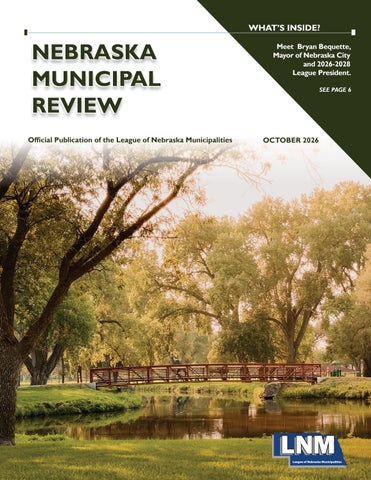
On the cover The updated South Park Pedestrian Bridge located in Schuyler. Photo provided by the City of Schuyler.
Municipal Legal Calendar
Larger Cities Legislative Committee Chaired by Mayor Don Groesser of Ralston John McGhehey, Mayor, Alliance J.D. Cox, City Manager, Alliance Tobias Tempelmeyer, City Administrator, Beatrice Rusty Hike, Mayor, Bellevue Jim Ristow, City Administrator, Bellevue Mindy Rump, Mayor, Blair Phil Green, City Administrator, Blair David Scott, Deputy City Administrator of Operations, Blair Tom Menke, City Manager, Chadron Jim Bulkley, Mayor, Columbus Tara Vasicek, City Administrator, Columbus Dave Bauer, Mayor Crete Tom Ourada, City Administrator, Crete Jody Sanders, City Administrator, Fremont Kent Ewing, Mayor, Gering Pat Heath, City Administrator, Gering Roger Steele, Mayor, Grand Island Patrick Brown, City Administrator, Grand Island Ryan Schmitz, Utilities Director, Grand Island Mike Evans, Mayor, Gretna Paula Dennison, City Administrator, Gretna Mark Funkey, City Administrator, Hastings Derek Zeisler, Utility Manager, Hastings James Liffrig, Mayor, Holdrege Chris Rector, City Administrator, Holdrege Brenda Jensen, City Manager, Kearney Brad DeMers, Asst. City Manager, Kearney Doug Kindig, Mayor, La Vista Peyton Mastera, City Administrator, La Vista Kevin Pokorny, Director of Administrative Services, La Vista John Fagot, Mayor, Lexington Joe Pepplitsch, City Manager, Lexington Margaret Blatchford, Assistant City Attorney, Lincoln Riley Slezak, Senior Advisor to the Mayor, Lincoln Linda Taylor, Mayor, McCook Nate Schneider, City Manager, McCook Bryan Bequette, Mayor, Nebraska City Perry Mader, City Administrator, Nebraska City Justin Webb, Council Member, Norfolk Scott Cordes, City Administrator, Norfolk Brandon Kelliher, Mayor, North Platte Layne Groseth, City Administrator, North Platte Steve Krajewski, Mayor, Ogallala Kevin Wilkins, Assistant to the City Manager, Ogallala Thomas Warren, Chief of Staff, Omaha David Black, Mayor, Papillion Amber Powers, City Administrator, Papillion Mark Stursma, Deputy City Administrator, Papillion R. Paul Lambert, Mayor, Plattsmouth Emily Bausch, City Administrator, Plattsmouth Don Groesser, Mayor, Ralston Brian Kavanaugh, Council President, Ralston Jack Cheloha, City Administrator, Ralston Art Lindberg, Mayor, Schuyler Lora Johnson, City Administrator, Schuyler Betsy Vidlak, Mayor, Scottsbluff Kevin Spencer, City Manager, Scottsbluff Joshua Eickmeier, Mayor, Seward Greg Butcher, City Administrator, Seward Brandon Bonregard, Mayor, Sidney Brett Kerkman, Vice-Mayor, Sidney Randy Meyer, Council Member, South Sioux City Lance Hedquist, City Administrator, South Sioux City Jill Brodersen, Mayor, Wayne Wes Blecke, City Administrator, Wayne Barry Redfern, Mayor,York Dr. Sue Crawford, City Administrator,York
Smaller Cities Legislative Committee
Chaired by Tom Goulette, City Administrator of West Point
Lisa Schroedl, City Administrator/Clerk/Treasurer, Ainsworth Jessica Quady, City Administrator, Ashland Crystal Dunekacke, City Administrator/Economic Developer, Auburn Marlin Seeman, Mayor, Aurora Adam Darbo, City Administrator, Aurora Chris Anderson, City Administrator, Central City Alan Michl, Chairperson, Exeter Becky Erdkamp, Clerk/Treasurer, Exeter Kyle Svec, City Administrator, Geneva Matt Smallcomb, City Administrator, Gibbon Gary Greer, City Administrator, Gothenburg Jana Tietjen, Clerk, Hebron Kelly Oelke, City Administrator, Hickman Janine K. Schmidt, CMC/Treasurer, Morrill Sandra Schendt, Clerk/Treasurer, Nelson David Russell, Director of Gov. Affairs, NMPP Energy Sandy Kruml, Clerk/Treasurer, Ord Mike Feeken, Mayor, St. Paul Sandra Foote, Council Member, Superior Warren Myers, City Administrator, Sutton Jessica Meyer, City Administrator, Syracuse Kelly Adamson, Council Member, Tekamah Sharon Powell, Village Board President, Utica Kyle Arganbright, Mayor,Valentine Melissa Harrell, City Administrator/Treasurer, Wahoo Mike Mogus, Administrator/PWD, Wakefield Desiree Soloman, City Attorney, Waterloo Stephanie Fisher, City Administrator, Waverly Tom Goulette, City Admin./Utility Superintendent, West Point Randy Woldt, Utilities Superintendent, Wisner Robert Costa, Community Planner,Yutan
(All statute citations to Revised Statutes of Nebraska)
DECEMBER 2026 • • • • • • • • •
• • • • • • • • •
CITIES OF THE FIRST CLASS Each month - Clerk publishes ordinances passed within 15 days after passage. (16-405) Within 10 days from meeting or before next meeting (whichever is sooner) - Clerk to have minutes available for public inspection. (84-1413) Within 30 days from Council meeting - Clerk publishes official proceedings of meetings. (19-1102) Within 20 days after the end of the month - Treasurer files monthly financial report. (16-318) * * Clerk must prepare agenda prior to next Council meeting. (84-1411) By December 31- Clerk files year-end certification of street superintendent with the Nebraska Department of Transportation Reminder - Notice of automatic renewal of liquor and beer other than Class C licenses must be published between January 10 and January 30 of each year. (53-135.01) Reminder - On or before January 31 provide county assessor each new lease or changed preexisting lease which went into effect during the previous year and a listing of previously reported leases that are still in effect. (77202.11) Reminder - On or before January 31, each municipality with a clean energy assessment district (PACE) submits report to Urban Affairs Committee. (13-3211) CITIES OF THE SECOND CLASS and VILLAGES Each month - Clerk publishes ordinances passed within 15 days after passage (17-613) Within 10 days from meeting or, before next meeting (whichever is sooner) Clerk to have minutes available for public inspection. (84-1413) Within 30 days from Governing Board meeting Clerk publishes official proceedings of meeting. (19-1102) Within 20 days after the end of the month Treasurer files monthly financial report. (17-606) * *.Clerk must prepare agenda prior to next Council or Board meeting. (84-1411) By December 31- Clerk files year-end certification of street superintendent with the Nebraska Department of Transportation Reminder - Notice of automatic renewal of liquor and beer other than Class C licenses must be published between January 10 and January 30 of each year. (53-135.01) Reminder - On or before January 31 provide county assessor each new lease or changed preexisting lease which went into effect during the previous year and a listing of previously reported leases that are still in effect. (77-202.11) Reminder - On or before January 31, each municipality with a clean energy assessment district (PACE) submits report to Urban Affairs Committee. (13-3211)
UPCOMING CONFERENCES UTILITIES/PUBLIC WORKS SECTION ANNUAL CONFERENCE
Jan. 13 - 15, 2027
LEAGUE MIDWINTER CONFERENCE
Feb. 22 - 23, 2027
MUNICIPAL ACCOUNTING AND FINANCE CONFERENCE
June 16 - 18, 2027
Director’s Message
League Executive Board and LIGHT Board of Directors approve new health insurance program for municipalities with existing self-funded plans BY L. LYNN REX, EXECUTIVE DIRECTOR, LNM
T
he League Executive Board and Board of Directors of the League Insurance Government Health Team (LIGHT) passed motions unanimously at their respective board meetings held in conjunction with the League Annual Conference in September to explore a self-funded health plan option for larger municipalities. This was done in response to requests from several cities of the first class that independently sponsor self-funded health plans. Following authorization from the League and LIGHT, Dennis Maggart, LIGHT’s Insurance Advisor with the McInnes Group, worked closely with LIGHT’s Legal Counsel Michelle Sitorius, an attorney with Cline Williams; representatives with Blue Cross and Blue Shield of Nebraska (BCBSNE); and the League to develop a new health insurance option for municipalities with existing self-funded plans. Dennis and Michelle also were instrumental in forming LIGHT in 2022 in partnership with the League and BCBSNE. On Oct. 21, 2026, the League Executive Board held its first meeting under the leadership of newly elected President Bryan Bequette, Mayor of Nebraska City, to discuss whether the League should approve a new health insurance option for municipalities with existing self-funded plans. It was important to inform the League Executive Board, and subsequently the LIGHT Board of Directors, that this new insurance option for cities with existing self-funded plans would function alongside LIGHT to allow each program to operate with a separate Board of Directors. Each Board could focus on their unique needs while also enabling them to benefit from the larger volume of covered lives when contracting with carriers and service providers. Following discussion, the League Executive Board unanimously passed a motion to name the new insurance program the League Association for Municipal Personnel (LAMP). The League Executive Board also unanimously passed the following motions: 4
1. To support the formation and operation of the League Association for Municipal Personnel (LAMP), an interlocal entity composed of Nebraska municipalities that independently sponsor selffunded health plans, and to support the cooperation between the League, LAMP, and the League Insurance Government Health Team (LIGHT) in soliciting proposals for, negotiating, and procuring third-party services and ancillary benefits coverage for the benefit of the members of LIGHT and LAMP, along with recommendations regarding the same by legal counsel; 2. To authorize the League to serve as the Administrator of LAMP, to carry out the policies established by the LAMP Board of Directors, and to provide day-to-day management of LAMP; 3. To authorize and direct the League Executive Director, on behalf of the League: a) to negotiate and execute any amendments to existing agreements to which the League is a party, as necessary to affect an arrangement among the League, LAMP, and LIGHT for the cooperative solicitation, negotiation, and procurement of third-party services and ancillary benefits coverage for the benefit of the members of LIGHT and LAMP, in the forms recommended by legal counsel; b) to execute an agreement with LAMP, licensing the League name and logo for the promotion of LAMP and the coverage and services procured by or through LAMP, and providing management services to LAMP, with compensation as agreed by the League and the LAMP Board of Directors, in the form recommended by legal counsel; and c) to execute any and all contracts, bids, deeds and conveyances of every kind and other instruments for affecting an arrangement among the League, LAMP, and LIGHT for the cooperative solicitation, negotiation, and procurement of thirdNEBRASKA MUNICIPAL REVIEW
party services and ancillary benefits coverage for the benefit of the members of LIGHT and LAMP. On Oct. 22, the LIGHT Board of Directors unanimously passed the following motions: 1. To approve and authorize LIGHT to work cooperatively with LAMP in soliciting proposals for, negotiating, and procuring third-party services and ancillary benefits coverage, along with recommendations regarding the same by legal counsel. 2. To authorize and direct either Chairperson Pa u l L a m b e r t , Ma yo r of Plattsmouth, or Vice Chairperson Tom Goulette, City Administrator of West Point, to execute, on behalf of LIGHT: a) any and all amendments to LIGHT’s existing third-party provider and ancillary benefits coverage agreements as are appropriate and necessary to extend the negotiated terms to LAMP and its members in the forms recommended by legal counsel; and b) all contracts, bids, deeds and conveyances of every kind and
“
League President Bryan Bequette Mayor of Nebraska City
LIGHT Board Chair Paul Lambert Mayor of Plattsmouth
other instruments for affecting an arrangement with LAMP for the cooperative solicitation, negotiation, and procurement of third-party services and ancillary benefits coverage for the benefit of the members of LIGHT and LAMP. LAMP will build on LIGHT’s existing partnership with BCBSNE for claims administration along with a unique group purchasing arrangement with HM Insurance Group for reinsurance (stop-loss) coverage that should provide superior policy terms in addition to enhanced
rate stability for members. Member municipalities of LAMP will have access to optional ancillary coverages such as life insurance, disability, dental, vision, and worksite products with attractive rates based on the combined volume of covered lives in LIGHT and LAMP. LAMP members also will be able to utilize the existing Benefit Administration Platform, COBRA Administration Services, and IRS Section 125 Administration Programs that are integrated with BCBSNE and the ancillary lines carrier to provide seamless benefit administration.
As I have indicated in previous League presentations and publications, the League Association of Risk Management (LARM) is the most important program the League has initiated and developed for member cities and villages while LIGHT was established by the League to benefit municipal employees. LAMP will be another successful option for municipal employees in member cities that independently sponsor self-funded health plans.
”
OCTOBER 2026
5
Meet the President
ONE ONE ON
WITH NEBRASKA CITY
Mayor Bryan Bequette BY ASHLEY WOLFE, MARKETING/ COMMUNICATIONS DIRECTOR, LNM
Some thoughts from the Mayor as he transitions into his new role as the 2026 - 2028 League President.
Mayor Bryan Bequette and wife, Kelly, at their restaurant in Nebraska City.
In 2015, Bequette was appointed Mayor of Nebraska City after the resignation of his predecessor. He went on to be re-elected in 2016, 2020, and 2024. Nebraska City is the only municipality in Nebraska that uses the commissioner form of government. As Mayor, Bequette also serves as the Commissioner of Public Safety. Mayor Bequette and Kelly have received many awards, including the Nebraska City Community Foundation Fund’s 2024 Philanthropist of the Year Award.
LNM: First off, what should people know about you? Mayor: Though I was born and raised in New Mexico, my dad was actually born in Hastings, Nebraska, which was my grandfather’s hometown. I guess I’ve sort of gone full circle now ebraska City Mayor Bryan Bequette is not new with the family name. I have been blessed to see a lot of places to the world of service, in fact he has built and live in many communities. While doing so, I was equally his career and most of his life on public service and blessed to have a wonderful family around me, and I’ve made helping make the world around him a better place. some great friends along the way. I’m by nature optimistic and Bequette was born and raised in Los Alamos, believe transparency and collaboration always get the best results. New Mexico. At age 18, he entered the Eastern New Mexico University ROTC program. Upon LNM: What sparked your interest in serving in local graduation, he joined the U.S. Army, where he was government? an active-duty helicopter pilot for 26 years. It was Mayor: My parents were a big influence on my public service. during his time stationed at Fort Riley, Kansas, that My dad was a police officer and my mom was a school bus driver. he met his wife Kelly who was originally from Peru, Even though my six siblings and I kept them busy, they always Nebraska. found time to serve the community by coaching youth sports, In 2009, after completing his time in the Army and leading scout troops. and working with organizations to develop retiring as a Colonel, Bequette, Kelly, and his three family and youth activities. I always remember my folks camping children moved to Nebraska City. Bequette spent or fishing reminding us “always leave the site better than you the next 12 years working for the Department of found it.” I hope to do that as Mayor, to leave the city better off Homeland Security in Lincoln before retiring from than before. While serving on the Army staff in the Pentagon, I that position in 2022. realized I lacked an understanding of how the department worked Mayor Bequette and Kelly bought The Keeping with Congress. I attended George Washington University and Room (a home décor store) in Nebraska City’s studied legislative affairs. Gaining more understanding of how historic district in 2012. They added a restaurant to the wheels of government turn, I became more predisposed to the business in 2014. serve in city governance when the opportunity arose.
N
6
NEBRASKA MUNICIPAL REVIEW
LNM: What advice would you offer to someone considering service as a local government official or employee in their municipality? Mayor: If you have a chance to serve, do so. Don’t worry about all the things you don’t know or understand, with a good attitude you will learn. While you’re learning, don’t be afraid to admit when you don’t know something. I learn new things about municipal governance on a near-daily basis. LNM: What is your favorite aspect of serving in your position? What is the biggest challenge? Mayor: I believe municipal government is the most impactful on people’s daily lives. I love helping individuals and groups achieve their goals.The biggest challenge I have found in municipal governance is funding. We always manage to fund needed services, but capital improvements and new high-dollar equipment purchases are often out of reach and get pushed out year to year. It’s important to know what you need so when grant opportunities, donations, or random federal dollars come along, your city or village is ready to compete for the funds. LNM: What is your favorite spot in Nebraska City? Mayor: My favorite spot in Nebraska City, other than our home, is our municipal 9-hole golf course (Wildwood). I’m grateful to be able to spend time outdoors in such a beautiful place. LNM: What is the toughest lesson you have learned as an elected official? Mayor: I am not a lifelong resident of Nebraska City so I didn’t have personal connections with most of our residents when I first became Mayor. I have been blessed to get to know so many people over the past 11-plus years. However, I have learned that it is really tough to reach as many residents as I would like; communicating broadly with residents takes effort but that effort is always well spent. LNM: What are you most proud of from your time serving as Mayor of Nebraska City? Mayor: When I became Mayor through appointment, I joined a council that wasn’t functioning very coherently. Working with past and present commissioners, we’ve worked together to build and maintain a climate of collaboration, transparency and mutual respect. And, not just within the council, but with staff and residents as well. LNM: In your opinion, what are the most important issues facing municipalities in Nebraska? Mayor: The most important issue facing municipalities is budgeting expenses against reliably forecasted revenue. Nebraska City is blessed to have a 1.5% sales tax and to Continued on page 8 / See President
OCTOBER 2026
7
President Continued from page 7
own our utilities which provide a substantial part of our annual revenue. However, our other major revenue source is property tax. With every gubernatorial and legislative candidate running on a platform of property tax reform, it’s not surprising that each legislative session involves bills aimed at changing property tax processes and/or limits. Budgeting can be really tough work and it doesn’t get any easier when one of your major streams of revenue changes almost annually as to process or amount. I would encourage all of our members to sit down with their State Senator to inform them about your budgeting process and overall budget. Helping our legislators understand municipal budgeting will most likely help them draft better property tax bills. I empathize with our sister school boards and county commissions. However, municipalities receive less than 12% of the property taxes levied statewide but we seem to all be lumped into one large “overspending” entity. Counties, school districts, and municipalities are all unique and that is why it is so important that we work closely
“I look forward to working with the League to advocate for all municipalities, including sustaining the richness of rural Nebraska.” - Bryan Bequette, Mayor of Nebraska City with each other, our State Senators, and the League in developing a reasonable and less problematic property tax solution. LNM: What are your interests outside of local government? Mayor: Kelly and I are blessed that three of our four grandkids live in Nebraska City and our fourth is soon to move back to Nebraska City. When my kids were growing up, they were my number one hobby, now grandkids fill that spot. I am also known to spend a fair amount of time golfing.
LNM: Final question, as you step into your role as League President what do you hope to accomplish during your term? Mayor: I definitely hope to leave our League in as good or better shape than when I accepted the gavel from Mayor Marlin Seeman. Given the next 2-year political landscape, we have our work cut out for us. I truly hope the level of division I see in the news in other states and across the country doesn’t reach that level here in Nebraska. I look forward to working with the League to advocate for all municipalities, including sustaining the richness of rural Nebraska. I hope over the next two years, the League will be successful in working with the Governor, Legislature, and sister statewide associations in developing and implementing sound property tax legislation and other important initiatives.
8
NEBRASKA MUNICIPAL REVIEW
Nebraska City Mayor and League Board President, Bryan Bequette with his family at the Henry Doorly Zoo in Omaha. From left to right: Michael Bequette; son-in-law, Jameson DeFreece; daughter, Taylor DeFreece; grandson; Mayor Bryan Bequette; granddaughter; wife, Kelly Bequette; grandson; granddaughter; daughter-in-law, Rachel Bequette; and son, Blake Bequette. Childrens’ names withheld at request of family. Photo provided.
MAYOR BEQUETTE’S THEME FOR HIS TERM AS LEAGUE PRESIDENT:
Visionary leadership, continuous progress, lasting impact.
Trees remind us that progress takes time and blessed are they who plant trees under whose shade they will never sit.
OCTOBER 2026
9
Cre
atin g th
Clockwise from top left: Mike Wallace, Legislative Director for Community and Economic Development with National League of Cities; Courtney Dunbar, Director of Site Selection at Burns & McDonnell; KC Belitz, Former Director of Nebraska Department of Economic Development; and Rachel Morgan, Director of Programs for Nebraska Arts Council were among the presenters at the 2026 Annual Conference.
Leag u netw e’s 117 th Annu orkin al g, co llabo Confere n ratio n, an ce offers d lea rning attendee s op
visi
e
portu
BY ASHLEY WOLFE, MARKETING & COMMUNICATIONS DIRECTOR, LNM
L
ocal government leaders face many challenges. Ranging from workforce recruitment and addressing infrastructure needs to economic development and the ever-evolving expectations of residents, the demands on municipalities continue to grow. Addressing those challenges requires strong leadership, practical solutions, and a willingness to
10
nitie
s for
on
expand how we look at things. This is why opportunities to network and learn together are so important. On Sept. 23-25 the League’s Annual Conference brought together municipal officials, staff, and vendors to learn, share ideas, and explore solutions to the problems facing cities and villages across Nebraska.
NEBRASKA MUNICIPAL REVIEW
The event kicked off on Wednesday with a Pre-conference Seminar focused solely on nuisance abatement. The panel, comprised of municipal attorneys representing cities and villages in Nebraska, shared best practices, practical strategies, and valuable takeaways for attendees to use to improve nuisance abatement in their community. Thursday opened with a warm welcome from League Executive Board President and Mayor of Aurora, Marlin Seeman. Mayor Seeman welcomed all first-time attendees and thanked the sponsors whose financial support allows the League to continue to provide valuable trainings and educational opportunities. For the first session of the day, Michael Wallace, Legislative Director for Community and Economic Development for the National League of Cities joined us to talk about the 21st Century ROAD to Housing Act and Congressman Mike Flood provided a recorded message for attendees highlighting how this bill will impact housing strategies in municipalities across the state. Next, nationally recognized experts Robyn Domber from Development Counsellors International and Courtney Dunbar from Burns & McDonnell joined to talk about what those at the state and local level can do to better compete to attract economic development and talent. The concurrent sessions touched on so many topics that municipal officials have expressed concerns or interest in learning more about. The session on the Community Improvement District Act explained the implications of LB 1130 and educated municipal leaders on what they can expect with the program. Leading with Civility, Dignity, and Respect touched on how to continue to treat those you are leading with care—and helping to redirect conversations back toward meaningful public engagement during heated or contentious topics at city council or village board meetings. Additional topics included the Federal ADA Title II Digital Accessibility Mandate that goes into effect for some municipalities next April, Artificial Intelligence, Data Centers, Creative Districts and best practices for knowing the difference between—and regulating—e-bikes, e-motos, and e-scooters. Continued on page 12 / See Conference Photos at right from top: Julie Harris, Executive Director of Bike Walk Nebraska, had a packed room for her session on E-bikes, E-motos, and E-scooters. Former League President and former Mayor of Gibbon Deb VanMatre, League President and Nebraska City Mayor Bryan Bequette, and Immediate Past President and Aurora Mayor Marlin Seeman posed for a photo following the election and board transition at the Annual Business Meeting on Friday. David Scott, Deputy City Administrator of Blair, and JD Cox, City Manager of Alliance, provide input as conference attendees.
OCTOBER 2026
11
Conference
Continued from page 11
At the conference, in anticipation of changes on the League Board, Mayor Marlin Seeman of Aurora presented plaques to members of the Executive Board who would be concluding their board tenure. Former Mayor of Gibbon and Immediate Past President Deb VanMatre, Scottsbluff Mayor Betsy Vidlak; and Utica Village Board President Sharon Powell were all presented with engraved mementos thanking them for their service. At the Annual Business Meeting held on Friday, Nick Colton, Council President of Imperial; and Kelly Adamson, Council Member of Tekamah; were elected by members to join the board. Additionally, Brandon A.
A TOKEN OF APPRECIATION
Kelliher, Mayor of North Platte, and Sandra Schendt, Clerk/Treasurer of Nelson (Clerk Representative), were approved to fill open seats on the board. Aurora Mayor Marlin Seeman passed the gavel to Nebraska City Mayor Bryan Bequette as he transitioned into the role of President of the League Executive Board. Papillion Mayor David Black moved up to President-Elect and Columbus Mayor Jim Bulkley moved to Vice-President of the Board. Aurora Mayor Marlin Seeman transitioned to Immediate Past President.
Executive Board Members moving off the Board were thanked for their service and received a plaque from the League.
Continued on page 19 / See Conference Deb VanMatre Former Mayor of Gibbon
Clockwise from top left: Former Blair City Administrator Rod Storm visits with Nebraska City Mayor Bryan Bequette. David Kramer, Parter at Baird Holm, addresses attendees on the topic of leadership and maintaining civility, dignity, and respect. A variety of sponsors were on hand to share their services and expertise with attendees. Here Columbus City Council member Ron Schilling visits with the representative from Precision Concrete Cutting. Lastly former City Administrator of Blair, Phil Green and Adam Flanagan from Bluestem Capital Partners touched on Capital Improvement Districts and the experience of municipal officials in Blair with the implementation.
READ AURORA MAYOR MARLIN SEEMAN’S SPEECH TO HAND OFF THE GAVEL AND WELCOME NEBRASKA CITY MAYOR BRYAN BEQUETTE INTO HIS NEW ROLE AS See page 30 LEAGUE PRESIDENT. 12
Betsy Vidlak Mayor of Scottsbluff
Sharon Powell Utica Village Board President
NEBRASKA MUNICIPAL REVIEW
Sen. Mike Jacobson was joined by family and friends–including legislative staff and representatives from the City of North Platte when he was presented with the League Distinguished Service Award. From left to right: Natalie Schunk, Committee Clerk for the Banking, Commerce & Insurance Committee; Dawn Miller, Finance Director for the City of North Platte; Sen. Jacobson’s wife, Julie and grandchild, Tripp; Ed Rieker, North Platte City Council Member; Layne Groseth, North Platte City Administrator; Brandon Kelliher, League Executive Board Member and Mayor of North Platte; Nick McNew, North Platte City Council Member; and Tori Richardson, Legislative Aide for Sen. Mike Jacobson.
A recognition of service
BY ASHLEY WOLFE, MARKETING/COMMUNICATIONS DIRECTOR, LNM
A
t the luncheon on Sept. 24, Sen. Mike Jacobson of North Platte was presented with the League Distinguished Service Award. Over the decades, this award has only been given to a few outstanding officials who have demonstrated extraordinary servant leadership within their communities and our state. Mayor Seeman’s extensive commentary on Sen. Jacobson’s leadership was informative and impressive. He recalled Sen. Jacobson’s many efforts safeguarding local control, opposing unfunded mandates to municipalities, and effectively advocating for legislation related to property tax relief, tax increment financing, and sustainable economic development. These issues are of the utmost importance to League members. Sen. Jacobson has been a thoughtful leader in North Platte and with the work he has done in the Nebraska Legislature. His expertise and credibility in the banking industry has empowered him to serve the citizens of Nebraska with distinction. Sen. Jacobson has used his longstanding and well-deserved reputation as a servant leader to help provide a better future for Nebraskans—most notably in bringing stakeholders together to build consensus even on the most controversial issues. The League and its members thank Sen. Mike Jacobson for his tireless advocacy and support. Municipal officials from North Platte, staffers from the Legislature, and family—including Sen. Jacobson’s grandson Tripp, all came together to celebrate his tremendous commitment to Nebraska.
OCTOBER 2026
13
Schuyler
Investing in gathering spaces
The City of Schuyler is completing projects and building community through partnerships. STORY & PHOTOS PROVIDED BY THE CITY OF SCHUYLER
I
n Schuyler, Nebraska, two recently completed projects demonstrate how community vision, partnerships, and thoughtful investment can transform public spaces. Warrior Plaza Amphitheater in the heart of downtown and the new South Park Pedestrian Bridge each began with a different need, but both share a common purpose—creating safe, welcoming spaces that bring people together.
From Vacant Lot to Warrior Plaza The vision for Warrior Plaza began in late 2022 when a group of dedicated community volunteers with the Colfax Foundation approached Mayor Art Lindberg and then-City Administrator William DeRoos with an idea for an underutilized vacant lot in Schuyler’s downtown business district. The Foundation envisioned something more than an empty lot. It saw an opportunity to create a green space and community gathering place that could host concerts, festivals, farmers markets, and other community celebrations. 14
As Mayor Lindberg describes it, the volunteers “had the vision to see what could be instead of what was.” With support from the City of Schuyler, the vision began to take shape. Following approval by the Schuyler City Council, a Community Development Block Grant (CDBG) application was submitted in February 2023. In April 2023, the project was awarded $309,380 in CDBG funding through the Nebraska Department of Economic Development. The CDBG award was combined with American Rescue Plan Act funds, a contribution from the Colfax Foundation, and City funds to move the project forward. JEO Consulting Group, Inc. completed
NEBRASKA MUNICIPAL REVIEW
the design for Warrior Plaza in August 2024. The project was advertised for bids in November 2024, with B-D Construction, Inc. ultimately awarded the construction contract. Warrior Plaza was completed in August 2025. Today, what was once a vacant downtown lot has become a flexible green space designed for community use. Warrior Plaza features open lawn seating, electrical hookups, dedicated food truck hookups, lighting and convenient public restrooms. The space has already become home to Schuyler’s weekly Farmers Market and serves as a gathering place for the community’s annual Christmas festivities and Cinco de Schuyler celebration. The Plaza continues to provide opportunities as new events come up Mayor Lindberg believes the transformation demonstrates what can happen when community organizations and local government share a vision. “This project is the result of multiple groups working together to make what was once a vacant lot into a beautiful space for the community to gather and enjoy the community.” While Warrior Plaza grew from a vision for an unused downtown property, another project began with a more practical concern: safety.
Connecting South Park During planning for the City’s 2024-2025 budget, then-City Administrator William DeRoos and Street and Parks Manager Kevin Colvin brought the condition of the existing South Park pedestrian bridge to the attention of the City Council. The aging concrete structure had served South Park for decades and had endured several floods. Its design consisted of a basic concrete crossing with open sides and handrails. City officials recognized that replacement would provide a safer, more accessible connection between the two areas of South Park. JEO Consulting Group, Inc. designed the new bridge in December 2024. The project went out for bid in June 2025, and General Excavating, LLC was awarded the construction contract. Construction was completed in December 2025 using City funds. The result is a significant improvement over the previous structure. The new pedestrian bridge features an engineered design with a bridge-plank style appearance and a spacious 10-footwide walkway, providing room for both pedestrians and bicyclists. Mo s t i m p o r t a n t l y, t h e b r i d g e Every project is different. Our commitment stays the same. reconnects Area 1 and Area 2 of South Park, allowing residents and visitors to move safely and comfortably between the two park areas. “The South Park Pedestrian Bridge is the latest addition and improvement to the City of Schuyler’s park system,” Lindberg said. “The spacious 10-footwide walkway allows both pedestrians and bicyclists to enjoy both park areas at their leisure.”
TRUSTED TODAY. READY FOR TOMORROW.
Continued on page 29 / See Schuyler DUNDEE BUSINESS DISTRICT STREETSCAPE | OMAHA, NE
OCTOBER 2026
15
Columbus
LET'S GO HAVE SOME FUN! BY MATT LINDBERG, PUBLIC COMMUNICATIONS, CITY OF COLUMBUS
New Playground celebrates inclusion, community, memories. and for just a few moments in July, Columbus Mayor Jim Bulkley wasn't the city's mayor.
16
NEBRASKA MUNICIPAL REVIEW
F
or a few moments on an afternoon in July, Columbus Mayor Jim Bulkley wasn't the city's mayor. He was simply a kid weaving through the playground’s climbing netting on his way to the top of the structure before settling into the signature swirl slide as attendees gathered below. Moments later, he emerged at the bottom wearing the unmistakable look of someone who had briefly forgotten meetings and responsibilities. Nearby, Columbus City Councilman Ron Schilling found another slide. “Yippie!” he shouted as he raced to the bottom. The laughter came just after the official playground dedication and speeches. And perhaps it perfectly captured what the newly dedicated all-inclusive Sertomaland Playground in East Pawnee Park was always intended to do. It gives people, regardless of age or ability, freedom to play. The dedication evemt celebrated the completion of the reconstructed playground, a project years in the making that transformed one of Columbus’ most beloved parks into a modern, accessible destination where children of all abilities can play together. The new playground replaces the former Sertomaland structure with an inclusive design featuring poured-in-place safety surfacing, ramps, bridges and accessible play features. Among its signature attractions is a 360-slide system equipped with a conveyor-style lift, allowing children with different mobility needs to independently reach the top before experiencing the thrill of the ride. Standing among residents exploring the new equipment, Bulkley said the finished playground represents far more than new slides. “It’s awesome,” he said. “You look at what’s here and the ability to make something totally inclusive for an entire community. This is one of only a few, probably, in the state that’s like this.” He said the project reflects what can happen when organizations unite behind a common purpose. “To be able to have collaborated with so many different partners, the Sertoma group, Nebraska Game and Parks... it just shows people working together to get something done.”
OCTOBER 2026
The playground’s completion also highlights work that often happens behind the scenes. The project was supported by a $215,606 Land and Water Conservation Fund grant, along with funding through the City’s voter-approved 1% sales tax program. Securing that funding required City staff to identify grant opportunities, prepare applications and navigate the extensive process long before construction ever began. Bulkley said that effort deserves recognition. “I think we all take grants for granted,” he said. “People don’t realize the effort that goes into getting grants for different things such as this. Staff does a great job of searching out those grants and doing the paperwork and putting in the effort that’s required.” Every successful grant, he said, benefits Columbus residents.
Photo at left and above: Columbus Mayor Jim Bulkley spends some time checking out the new playground in Columbus. Photos provided by the City of Columbus.
“Anything like that we get, whether it’s for a playground or for anything in our community, just takes away from the need to spend taxpayer money,” Bulkley said. “Quite honestly, most of our parks and those types of amenities are supported by taxpayer dollars. Anything we can do to reduce that is very good.” Schilling, who represents Ward 3, said the playground is especially meaningful for families on Columbus’ east side. “This is outstanding,” he said. “This gives the east side something more.” Combined with the park’s shelter and other amenities, Schilling said he believes the playground will continue to bring more families together. Continued on the following page
17
City Councilman Ron Schilling enjoys the new park, Sertomaland, in Columbus. The park which was largely funded by grants is also ADA compliant--making it a fun and accesssible space for everyone. Photo provided by the City of Columbus. Continued from page 17
“This is phenomenal,” he said. Like Bulkley, Schilling praised City staff for continually pursuing outside funding opportunities. “We’re constantly looking for grants,” he said. “Money’s out there for specific projects. We couldn’t do this if it wouldn’t be for those particular grants.” He said projects like Sertomaland help strengthen Columbus by creating places residents can enjoy while leaving a positive impression on visitors. “If we don’t put interesting, good-looking, usable items up for people to use, we don’t get a reputation. You’ve got to have amenities that people can use.” Schilling said the new playground also reflects Columbus’ continued commitment to investing in recreational opportunities for every child. “Now we have a lot for every kid,” he said. “It’s amazing.” One feature he especially appreciates is something many children may never think about. “It’s ADA compliant, too,” Schilling said. “That’s a big deal.” Among those celebrating the dedication was Shari Sorenson, Recreation Grants Administrator for the Nebraska Game and Parks Commission, whose agency helped make the project possible through the Land and Water Conservation Fund grant. For Sorenson, seeing the completed playground is one of the most rewarding parts of her work. “I’m always excited to see installations, and this looks fantastic,” she said. “I love having the soft surface for everyone to fall and bounce on, but then to also have it accessible is great.” She said accessibility is one of the key elements considered during the grant review process. 18
“ADA compliance is one of the things that we’re looking for,” Sorenson said. “We’re always excited when communities look at accessibility. We’re seeing that catch on, and that’s exciting.” Designed to welcome children across a wide range of ages and abilities, Sorenson said she believes the playground will serve Columbus well for years to come. “I think it’ll be great for the city,” she said. For Columbus Parks and Recreation Director Sydney Mroczek, the event marked the culmination of years of planning, partnerships, and hard work. “It’s exciting to see how many people it really brings together to make a project happen,” Mroczek said. Now that the dedication ceremony has officially happened, she said the playground belongs to the families who will fill it every day. “I’m looking for ward to the community using it and making memories,” she said. Director of General Services Betsy Eckhardt, who wrote the grant that made the new playground possible, beamed with glee as she watched people of all ages enjoying the space. “I absolutely love it,” Eckhardt said. As young kids and even a couple of teenagers climbed, laughed, and eagerly tested every corner of the new playground, the significance of the investment became clear. The dedication wasn’t simply about unveiling new equipment. It was about removing barriers. It was about creating a place where children of all abilities can play side by side, where parents can watch friendships form without limitations, and where a community’s investment becomes measured not in dollars, but in smiles. Continued on page 21 / See Columbus
NEBRASKA MUNICIPAL REVIEW
Autumnal colors in Clarkson Photo of the Clarkson water tower taken by Chuck Hackenmiller of Lincoln. This photo was originally posted in the Nebraska Through the Lens Facebook group. Thank you for allowing the League to share your photo, Chuck!
A Better Way to Get Around Helping communities move safer, smoother, and more efficiently—one intersection at a time.
jeo.com
Engineering | Architecture | Surveying | Planning
OCTOBER 2026
Conference Continued from page 12
The directors continuing to serve on the board include: John W. Ewing, Jr., Mayor of Omaha; Leirion Gaylor Baird, Mayor of Lincoln; Larry Evans, Mayor of Minden; Rod Petersen, Mayor of Louisville; and Mindy Rump, Mayor of Blair. Other representatives on the Board include Pat Heath, City Administrator of Gering (Manager/ Admin Representative) and Kyle Svec, City Administrator/Utilities Supervisor of Geneva (Utility Representative).
Annual Conference Sponsors A huge thank you to all our conference sponsors!
• Black Hills Energy • Blue Cross Blue Shield of Nebraska • Burbach Aquatics, Inc. • Carrothers Construction Co., LLC • Caselle Inc. • Catalis • Centrix Energy Partners • Commercial Recreation Specialists • Core & Main • Creative Sites, LLC • Cunningham Recreation/GameTime • D.A. Davidson & Co. • DSG • Eakes Office Solutions GBA Engineering Consultants • Hamilton Business Technologies • HOA Solutions, Inc. • IMEG • IMS Technology Group • JEO Consulting Group, Inc. • Johnson Service Company • KCAV • Kingery Construction Co. • LARM • LP Building Solutions • Miller & Associates Consulting Engineers, P.C. • Musco Lighting •Nebraska Investment Finance Authority (NIFA) • Nebraska Liquid Asset Fund (NLAF) Nebraska Public Power District • Nebraska Recycling Council NMPP Energy • Northland Securities, Inc. • NPAIT • Olsson • Pintail Engineering • Piper Sandler & Co. • Precision Concrete Cutting • RVW, Inc. • Schemmer • SEH, Inc. • Skywalker Drone Imagery, LLC • Snyder & Associates, Inc. • Sparq Data Solutions •Team Laboratory Chemical, LLC •Twotrees Technologies • Union Bank and Trust • USDA Rural Development • Vacanti Municipal Consulting Services, LLC • Veolia • Viking Industrial Painting • - denotes a display table
19
LARM
SAFEGUARDING TAXPAYER DOLLARS: PHISHING THREATS TO MUNICIPALITIES AND HOW TO FIGHT BACK
P
hishing attacks remain one of the most persistent cybersecurity threats to state and local governments. These scams impersonate trusted sources to steal data or money, exploiting human trust more than technical weaknesses. Phishing attacks on state and local governments continue to rise, with some sources indicating a doubling or more for each of the last several quarters, fueled by sophisticated social engineering aimed at resource-strapped municipal staff.
A particularly costly form of phishing is business email compromise (BEC), where attackers spoof executives or vendors to trick employees into sending unauthorized wire transfers or ACH payments. In 2025, the FBI reported over $3 billion in nationwide losses from BEC alone, with approximately 86% of these funds moved via wire transfer or ACH. Local governments are frequent targets because a single successful scam can divert large sums of public money. For municipalities, the impact goes beyond dollars lost. Funds meant for roads, public safety, schools, and parks disappear instantly and often irreversibly. In Nebraska, Broken Bow Public Schools fell victim in spring 2025, losing $1.8 million after staff followed fake payment instructions from what appeared to be a trusted construction vendor (approx. $780k was recovered and insurance paid $750k, final loss was ~$350k). General phishing also threatens resident privacy and operations. Attackers use email, text messages (smishing), or QR codes (quishing) to harvest credentials for payroll, permitting, or utility systems. Phishing is so widespread that nearly every organization will face some form of attempt. It’s not a question of if, but when, which is why ongoing staff training is essential. Strong defenses start with people and processes, not just technology. For ACH and wire fraud prevention, adopt these non-negotiable steps: 1. Tag external emails with a clear “EXTERNAL” warning and train staff to pause on red flags like “immediate” or “updated payment details.” 2. Scrutinize sender domains closely; jimselectricalservice. com looks a lot like jimselectricaIservice.com (note the capital I instead of the lowercase l) or jimselectricalservice.co. 3. Don’t act on email-only requests for ACH or banking updates. Verify by calling the sender using a pre-saved contact number, do not use the number(s) provided in the message. 20
4. Require dual approval for any new or modified vendor account. One employee confirms the change verbally; a second reviews the original invoice and co-signs the update. 5. For new accounts, send a small test deposit (such as $1) and wait for independent confirmation before releasing full payment. Robust, documented procedures are not bureaucratic obstacles; they represent the most cost-effective safeguard a municipality can implement. Requiring an independent telephone verification, mandating dual approval for any change in banking instructions, and conducting a small test deposit are simple disciplines that carry virtually no expense yet provide extraordinary protection. Following these procedures will greatly reduce the chance of any error, however, if you discover that a payment has been made in error, contact law enforcement and your bank immediately! Time is of the essence when it comes to reversing fund transfers. Other steps include enabling multi-factor authentication everywhere possible and running simulated phishing tests monthly to sharpen awareness. These tests are available from a variety of vendors and possibly your insurance or IT providers. Protecting taxpayer dollars demands vigilance, not speed. Verify every change, question every claim of urgency, and never allow an email alone to authorize the transfer of public money. Empowered, well-trained employees remain the strongest defense against phishing threats. NEBRASKA MUNICIPAL REVIEW
Columbus
Continued from page 18
“I remember we had summer picnics in the parks, and basically for the kids there was very little. Now we have a lot for every kid, and it’s amazing,” Schilling said. And if the sight of a mayor climbing through a playground tunnel and a councilman gleefully shouting
“Yippie!” as he sped down a slide proved anything, it’s that the best playgrounds don’t just bring out the child in children. They remind all of us that you’re never too old to play - and the memories created there will last far beyond the ride down the slide.
Building a Better Future in NEBRASKA With a Strong Public Finance Partner D.A. Davidson & Co. is committed to strengthening the infrastructure and enriching the lives of people in our communities throughout Nebraska and across the nation.
Our bankers specialize in: • Bond Anticipation Notes • Paving Bonds • Water and Sewage Bonds • General Obligation Bonds • Utility System Revenue Bonds • Lease-Purchase Financing
Call:
(402) 392-7986 | Paul Greiger (402) 392-7989 | Cody Wickham (402) 392-7988 | Andy Forney (402) 392-7933 | Jerry Spethman
450 Regency Parkway, Suite 400 Omaha, NE 68114 | (800) 206-7523 D.A. Davidson & Co. member FINRA and SIPC
dadavidson.com
OCTOBER 2026
21
Saving the schoolhouse: How Nebraskans are transforming abandoned schools
Jim Keim opened the Royal Milk Bottle & Dairy Museum in the old school building
W
BY JOLIE PEAL, REPORTER NEBRASKA PUBLIC MEDIA NEWS
hen visitors walk into the former Royal school building in northeast Nebraska, they’ll find an old milk bottling machine, butter churns and shelves full of vintage milk glasses. Jim Keim has turned the 1912 school building into the Royal Milk Bottle & Dairy Museum, boasting a wide collection of dairy memorabilia he’s collected over the years. “I spent my whole life in the dairy business,” Keim said. “I retired from HighlandRoberts Ice Cream Company in Norfolk.” Keim opened the dairy museum on Memorial Day this year. He had purchased the school building in 2024 and put a lot of work into getting it ready for opening day, like fixing up the walls and floors. “My daughter later told me ‘I was adamantly against you coming up here and buying this until I got in here and seen the building. It is such a neat old building,’” Keim said. The dairy museum is one of many — probably hundreds or even thousands — of schools in Nebraska that serve a new purpose in their communities. The number of school districts has been declining for years due to closures and consolidations: from 7,133 districts in 1926 to 544 in 2000. That number is 244 today. Rather than leaving buildings vacant or demolishing them, several communities are finding ways to repurpose them, like in Beatrice, where one of the elementary schools is being turned into affordable housing. Stoddard Elementary was initially constructed between 1956 and 1957. Hoppe Development helped turn the building into housing for a 55+ community with 25 units. The company has turned several school buildings into apartments, including in Royal school building now serves as the Royal Milk Bottle & Dairy Museum Grand Island and Lincoln. 22
Connor Menard, manager of project development at Hoppe Development, said communities are excited to see old buildings renovated into something new. “This was not this project, but another project we worked on, it was an elder person, a senior, and she was like, ‘I’m holding off on going on the other side until I get a unit in one of these places,’” Menard said. “I think people are really excited.” Stoddard Elementary was left vacant after Beatrice Public Schools consolidated its three elementary schools and one preschool into one new building that was completed in 2024.
Stoddard elementary in Beatrice Menard said the city donated the school and some ground that used to be an old ball field and play area. The empty ground will be turned into 45 townhomes for anyone to rent and a community building for a food pantry and small medical clinic. “ You’re turning the eyesore, deteriorating building into an asset for the community,” Menard said. “A lot of it was just listening to communities
NEBRASKA MUNICIPAL REVIEW
The Stoddard Elementary building was turned into affordable housing for a 55+ community with 25 units.
and hearing their need and creating more housing for them with existing buildings that they already have.” In addition to bringing more housing to communities, Menard said these projects revitalize the area around them, like bringing people to fill job openings. “We’ve really seen the area around it grow and thrive,” Menard said. “Sometimes it just brings new life to that area. People have more sense of purpose and place with it.” In Ewing, the high school was left vacant when the district consolidated with two others to make Summerland Public Schools in 2021. Dustin Wright and Mike Tagel didn’t let it sit empty for long, though, and took over ownership of the old Ewing High School building. They’ve been turning it into a strip mall of sorts, with the old classrooms being rented out to businesses like a second-hand store and flower shop.
“It’s all just trying to be a part of the community and make it grow,” Wright said. “That’s the whole reason I’m in here.” The building itself was constructed in 1992, and the gymnasium in the 1970s. The two have kept the structure of the school the same, and people who attended classes there can still see what used to be their teenage stomping grounds. “You can see there’s still whiteboards on the wall and stuff like that from this classroom,” Tagel said. “They just make do with what’s here.” Businesses renting a room are responsible for any remodeling they would like, while Wright and Tagel make sure to take care of the big problems that pop up. So far, there’s a childcare center, a flower shop and a secondhand store in the school, along with anyone who wants to rent out the gym. Linda Wingett, a volunteer with Sunset Thrift Store, said the school building offered more room for the increasing amount of clothes and items being donated. They were the first store to move in. Continued on the following page
The old Ewing High School building has been reimagined and turned into a place for businesses.
YOUR VISION. OUR EXPERTISE. BUILDING AQUATIC DREAMS FOR YOUR COMMUNITY.
BURBACHAQUATICS.COM | 608-348-3262 SUPPORT@BURBACHINC.COM | PLATTEVILLE, WI OCTOBER 2026
23
Continued from page 23
“We couldn’t wait to get here. I couldn’t wait to get here,” Wingett said. “Compared to what we had, you can understand why.” Doris Ann Bollwitt, another volunteer, said it’s a great idea to repurpose the school into a place for businesses. “The building is not that old, and it’s still in good condition, so it’s great that it’s being used for things,” Bollwitt said. “It makes me so sad to see these schools, or any building, that’s left to go to rack and ruin.” Right next door is This & That Floral, owned by Juliana Botha. She said having a space for businesses to exist next to each other brings more foot traffic. “I knew the secondhand store was here, but I found it really exciting to come in next to them, thinking we could draw business for each other,” Botha said. “I was excited about the idea of other businesses coming here together.” Botha’s business is in the old science room. A different flower shop used to reside in it before she started in January. Botha pointed out where some of the sinks still are, which she’s covered with black cloths. She brought in everything except the big silver cooler that was already there. Botha said she wasn’t sure what to expect when she started, but both Valentine’s Day and Mother’s Day proved successful. “This town is very supportive, and I’ve been very happy with that,” Botha said. “It took off really great for me.” On the other side of the school building is Bailey’s Little Cats, a child care center. Bailey Kester, the owner, said she wanted to be with her own kids all the time, and she wanted to help her community fill some of its childcare needs. Kester said the location of the old school building made it an ideal spot. “We had a bunch of parents moving back, like younger parents,” Kester said. “I just wanted to be right in the community, right in the middle of town, too.” Kester attended school at Ewing High School before it closed. She said it’s neat to see it turn into something new. “This was the old music room here, and then that was the old art room because I have two different sides here,” Kester said. “It’s cool seeing it change into something different, even though I went to school here.” A large part of Nebraska’s education history is the idea of the one-room schoolhouse. State legislators passed a law in 2005 requiring all Class I districts, which were 24
Ewing High School Repurposed! Sunset Thrift Shop Sunset Thrift Shop
This & That Floral Shop
elementary schools serving K-6 or K-8, to join another district with a high school. Those schools were mostly one-room schoolhouses, leading to many closing after joining another district. The Combs School in Homer closed long before that law, in 1964, during an earlier movement to consolidate schools. Susan Nelson Rudberg was a student during some of those final years, and now, she and her husband, Ted, teach students the history of the Combs School as board members of the Dakota County Historical Society. “This definitely is the oldest schoolhouse in Dakota County, NEBRASKA MUNICIPAL REVIEW
and probably in the state,” Ted said. “You can see it’s well built. A lot of the one-room schoolhouses had dirt floors and all, but they put a lot of money in. The pioneers really thought this was important, wood floors and glass.” The two show the modern students what learning used to look like. They teach the “3 R’s” written on the chalkboard — “Readin, Ritin and Rithmetic.” The Rudbergs explain how the students had to pour water in a basin to wash their hands. Susan said while she had two other students in her grade at the school, her older sister was the sole person in hers. The teacher would spend time with each grade, which Susan said ultimately helped everyone. “We’re really learning a lot because they were hearing it and reinforcing
Ted said. “How terrible that was, and all his friends would tease him and stuff.” One of their favorite moments, though, is telling the students someone “famous” is in the room. Ted pulled out a picture of the 1956-57 class of the Combs School. “We ask kids, do they know that person?” Ted said while pointing to a student on the far right. “I said, ‘Well, her name’s Susie Nelson.’ ‘Oh, we don’t know.’ ‘Well, she’s in this room,’ and then they can’t believe that’s her.” Susan said she loves sharing her experiences with the students, and
The Combs School building has moved twice since it was built in 1857. It now sits right outside of Homer. she enjoys seeing them make their own memories in the school during their visits, like playing outside and running away from the outhouses after seeing a spider. “It’s wonderful,” Susan said. “They just can’t believe I’m so old that I would have gone to a one-room country school.” Reprinted with permission
Susan and Ted Rudberg all the concepts and reminding them of that history they learned back in third grade,” Susan said. “They were reviewing it later, had it in their memory really strong.” They also tell the students about what would happen if someone misbehaved. There were the usual punishments of the dunce caps and drawing a circle on the chalkboard to put their nose in. “Her father went to school here, and grandmother, and he was saying, ‘Oh, the worst penalty was, the big desk back there, you’d have to sit next to a girl,’” OCTOBER 2026
An Electric Pump Company
You can count on us for all your fluid handling and process solutions!
800-383-PUMP
www.electricpump.com
402-333-9660
www.mc2h2o.com 25
The Legal Corner
Compensable commuting: DOL clarifies FLSA obligations for employees’ travel time BY TARA A. STINGLEY CLINE WILLIAMS WRIGHT JOHNSON & OLDFATHER, L.L.P.
T
he U.S. Department of Labor (DOL), Wage and Hour Division, recently issued two opinion letters addressing how the Fair Labor Standards Act (FLSA) applies to employees’ commuter travel. In the first letter, the DOL clarified that midday travel qualifies as “ordinary” commuter travel, which generally is not compensable under the FLSA.i In the second letter, the DOL stated that time spent receiving pages is not compensable, while time spent calling clients to schedule appointments and scheduling other field workers is compensable. Additionally, when field workers are required to be engaged in calling clients before or during a commute, such travel time would be compensable.ii General Legal Principles Under the FLSA Under the FLSA, covered employers are required to compensate employees for their work.iii Specifically, with limited exceptions, covered, nonexempt employees are entitled to at least the applicable minimum wage for every hour worked, along with overtime compensation of at least one and one-half times their regular rate of pay for hours worked over 40 hours per workweek.iv This obligation extends to work carried out at an employee’s home or at any location other than the employer’s premises or job site.v The FLSA defines “employ” as “to suffer or permit to work,”vi but does not otherwise define what constitutes “work.” Federal regulations interpreting the FLSA outline the general principles used to determine working time, making clear that “hours worked” are not limited to time spent on active productive labor. Rather, it also may include inactive time, such as waiting periods or short rest breaks. The longstanding exceptions to this rule during the workday are limited to bona fide meal breaks and off-duty time.vii In addition, the U.S. Supreme Court has held that the compensability of an employee’s time depends on whether it is spent predominantly for the employer’s benefit or for the employee’s own benefit.viii Generally speaking, “an employee’s workday on any particular day is the period between the time when the employee commences their first ‘principal activity’ and the time on 26
that day at which they cease such principal activity or activities.”ix Under 29 C.F.R. § 790.8, principal activities are those activities which the employee is employed to perform, thereby potentially resulting in a compensable workday running longer than the employee’s regularly scheduled shift. Compensation for Travel Time: Midday Commute As a general rule, “[n]ormal travel from home to work is not worktime.”x Such travel is a “normal incident of employment” that predominantly benefits the employee, who is allowed to choose where to reside.xi However, travel that forms part of an employee’s principal activities during the workday, such as job-site-to-job-site travel, must be counted as hours worked. Home-to-work travel may also become compensable in certain circumstances. In Opinion Letter FLSA2026-9, issued on July 22, 2026, the DOL clarified a point that has created confusion among employers in the era of flexible and hybrid work arrangements: an “ordinary” or “normal” commute constitutes a third category of non-compensable time within the continuous workday, distinct from off-duty time and meal breaks.xii This is true even when the commute occurs in the middle of the workday rather than at its traditional bookends. The DOL’s reasoning rests on the historical principle that ordinary commuting was never considered “work” under the FLSA and therefore the timing of the commute is irrelevant to its non-compensable character.xiii Under the foregoing principles, a midday commute remains “ordinary” so long as it is voluntary and primarily for the employee’s benefit. The DOL emphasizes that the employee does not need to demonstrate a reduction in total commute time; voluntariness alone is sufficient. Conversely, home-to-work travel is not “ordinary” and may be compensable where the travel and its timing are dictated by the employer and impose significant constraints on the employee such that the travel predominantly benefits the employer. NEBRASKA MUNICIPAL REVIEW
Illustrated Scenarios from the DOL • Second, an employee’s use of an employer-provided To illustrate the foregoing rules as applied to midday vehicle for commuting, and any activities that are merely commutes, the DOL provided several scenarios, including incidental to that vehicle’s use, are not considered part of the the following: employee’s principal work duties.xv Under this provision, the Scenario #1: Employee A is scheduled to work 9:00 fact that an employer owns the commuting vehicle does not a.m. to 5:00 p.m. and normally commutes from 8:00 by itself convert an otherwise ordinary, non-compensable to 9:00 a.m. and from 5:00 to 6:00 p.m. Driving two commute into compensable worktime. hours daily is not ideal for the employee who wants An important distinction for field workers, then, is between to avoid rush hour traffic. The employee requests to “incidental” activities versus “integral and indispensable” work from home from 8:00 to 10:00 a.m., commute activities. According to the DOL, an activity is “incidental” when from 10:00 to 10:30 a.m., work at the office until 3:30 it is a minor, expected consequence of the vehicle-commuting p.m., commute home from 3:30 to 4:00 p.m., and arrangement, such as passively receiving dispatch notifications.xvi finish her remaining work at home until 5:00 p.m., In contrast, activities that are intrinsic to the employee’s principal taking her normal 30-minute lunch at noon. Either work and cannot be dispensed with, such as calling clients to arrangement results in 7.5 hours of work performed. schedule service appointments, are “integral and indispensable” Employee A’s midday commute is ordinary and and therefore compensable.xvii non-compensable because the timing of the travel is genuinely voluntary and primarily benefits the Illustrated Scenarios from the DOL employee by allowing her to avoid heavy traffic. To illustrate the foregoing principles, Opinion Letter FLSA2026-10 addresses specific activities involving a field Scenario #2: Employee B volunteers to work service engineer who receives assignments at home, then travels additional hours on a short-staffed special project, directly to client sites in an employer-provided vehicle to install but only if she can perform the extra work at home and service equipment: during the early morning hours before leaving for her Receiving Assignments: Between 7:00 and 8:00 a.m. each regular shift at the office, rather than arriving at the morning, the engineer receives three to five pages via the office early or staying late. Employee B’s subsequent employer’s internal messaging system notifying him of client home-to-work commute remains an ordinary, nonservice requests. Each page takes approximately 15 seconds compensable commute, as the employer is permitting to accept. This time is not compensable, since receiving the employee to avoid the inconvenience of an earlier assignment notifications is an expected consequence of the or later unpaid commute, and the travel itself remains employer-provided-vehicle commuting arrangement and is primarily for the employee’s benefit. incidental to vehicle use. It does not constitute a principal activity or an activity integral and indispensable to the Compensation for Travel Time: Field Workers engineer’s primary job duties. Opinion Letter FLSA2026-10, also issued on July 22, Calling Clients to Schedule Appointments: After accepting addresses whether a field service engineer must be paid each page, the engineer calls the client to arrange the details of for time spent receiving dispatch pages, calling clients and the service appointment and, when necessary, calls other field other engineers to schedule appointments, and driving service engineers to coordinate coverage or assistance. This from home to the first client appointment of the day. time is compensable. Calling clients to schedule appointments Two statutory provisions influence this analysis, though is not merely incidental to commuting; it is integral and neither invalidates the general “predominantly benefits” indispensable to the engineer’s principal activity of installing test outlined above: and servicing equipment. Unlike passively receiving page • First, employers do not need to compensate notifications, scheduling calls are a necessary step without employees for time spent traveling to the place which the requested services cannot be performed. where they perform their principal work duties, or Scenario #1: The field service engineer leaves home at 8:00 for activities that are preliminary or postliminary to a.m., with all drive time to the first appointment falling those duties, so long as such travel or activities occur within his paid shift. Between 7:00 and 8:00 a.m., he receives before the employee begins, or after the employee pages and spends approximately 50 minutes calling clients finishes, the principal activities of the day.xiv However, to schedule appointments and coordinating with other employers still must compensate employees for travel engineers. He departs for the first client site immediately or activities occurring within the workday itself. Continued on page 29 / See Legal OCTOBER 2026
27
GET A QUOTE AND JOIN TODAY! The League Insurance Government Health Team (LIGHT) helps hundreds of its members throughout Nebraska obtain affordable health insurance coverage.
Plan and Network Choices With seven plan options and three networks to choose from, you’re sure to find one that meets your group’s coverage and benefit needs.
Affordable Plan Options
Available Network Options
Offering your employees much-needed protection against the high cost of medical care:
With several networks available, you have easy access to quality providers:
• Three PPO options • Four HSA-eligible high deductible options • Prescription drug coverage
• NEtwork BLUE (Statewide) • Premier Select BlueChoice (Regional) • Blueprint Health (Regional) • Out-of-state network availability
Enrollment Options Single: Covers the employee only Employee and spouse: Covers the employee and their spouse
Employee and children: Covers the employee
and their eligible dependent children, but does not provide coverage for the spouse
Family: Covers the employee and eligible dependents including a spouse
RECEIVE DEDUCTIBLE AND OUT-OF-POCKET CREDIT FROM YOUR CURRENT VALID GROUP PLAN WHEN YOU SWITCH!
LET’S GET STARTED Contact your current local Agent/Broker Or contact
Dennis Maggart Executive Vice President P: 913-378-9841 or 816-718-0335 Dennis@McInnesGroup.com
Jane Limbach Account Manager P: 913-378-9840 Jane@McInnesGroup.com Blue Cross and Blue Shield of Nebraska is an Independent Licensee of the Blue Cross and Blue Shield Association. 60-025-58 (01-17-23)
28
NEBRASKA MUNICIPAL REVIEW
Schuyler Continued from page 15
Investing in Community Warrior Plaza and the South Park Pedestrian Bridge are very different projects. One transformed a vacant downtown lot into a community destination; the other replaced aging infrastructure to improve safety and connectivity within a city park. Together, however, they demonstrate an important lesson for communities of all sizes: meaningful improvements often begin when someone recognizes what could be. For Warrior Plaza, that vision came from community volunteers who looked at an empty lot and imagined a place filled with people. Bringing that vision to reality required cooperation among the Colfax Foundation, city elected officials and staff, the Nebraska Department of Economic Development, JEO Consulting Group, B-D Construction, and others. For South Park, city staff recognized an aging piece of infrastructure and brought forward a solution that would not simply replace what existed, but provide a safer and more functional connection for
future generations. JEO Consulting Group, General Excavating, and the city worked together to bring that project to completion. Both projects represent Schuyler’s continued investment in quality of life—creating places where residents can gather, walk, bicycle, celebrate, and enjoy their community.
For Mayor Lindberg, that is ultimately what these investments are about: building a community that residents are proud to call home.
Legal Continued from page 27
pre-shift drive time (6:00–7:00 a.m.) but pays for drive upon completing the calls, at a time and to a destination time thereafter (7:00–8:00 a.m. plus the 30 minutes dictated by the employer. The drive time to the first client within the paid shift). Beginning at approximately location is compensable and is not an ordinary commute. 7:00 a.m., the engineer also spends much of the hour Because the engineer has already commenced principal making client-scheduling calls while driving. The first activities (the scheduling calls) immediately before the hour of driving is ordinary, non-compensable hometravel, the workday has begun. Moreover, the travel itself to-work travel because the engineer has not yet begun does not qualify as an “ordinary” commute, because the any principal activity and this period functions as a engineer lacks the freedom and flexibility of a normal normal pre-shift commute. However, once the engineer commute—the timing, destination, and manner of travel begins making client-scheduling calls, his workday are all employer-directed, and the employee is required to commences, and the remainder of the drive time until perform substantial work immediately before departing arrival at the first client site is compensable.xviii and immediately upon arrival. Best Practices for Employers Scenario #2: The engineer’s first appointment is at a The DOL’s recent opinion letters provide several lessons location 2.5 hours away, requiring him to leave home at for employers. First, employers seeking to extend 6:00 a.m. His employer does not pay for the first hour of Continued on page 30 / See Legal
OCTOBER 2026
29
Legal
Continued from page 29
midday commuting flexibility to non-exempt employees must keep an accurate record of all hours worked each workday and total hours worked each workweek, which may include the length or timing of a midday commute. Second, written policies should define the boundaries between ordinary commutes, compensable job-site-to-job-site travel, emergency call-out travel, and special oneday assignment travel, so that both employees and payroll staff understand when travel time must be recorded and compensated. Policies should also address the mechanics of midday commuting and telework or splitshift arrangements as well as provide a clear, accessible procedure for employees to report all hours actually worked each workday and workweek. Third, employers who provide vehicles to field-based employees should ensure that their dispatch and assignment protocols are structured to clearly distinguish between activities that are merely “incidental” to commuting and those that are “integral and indispensable” to the employee’s principal activities. Finally, where an employee performs work activities from home or during a commute and the exact time spent on such activities is difficult to determine from day to day, the employer and employee may consider entering into a “reasonable agreement” that outlines compensation for these travel periods and “takes into consideration all of the pertinent facts” to ensure that the employee is sufficiently compensated for all hours worked.xix For more information about FLSA compliance, employers can visit the DOL’s website at www.dol.gov. Editor’s Note: This article is not intended to provide legal advice to its readers. Rather, this article is intended to alert readers to new and developing issues. Readers are urged to consult their own legal counsel or the author of this article if they wish to obtain a specific legal opinion regarding their particular circumstances. The author of this article, Tara A. Stingley, can be contacted at Cline Williams Wright Johnson & Oldfather, L.L.P., 12910 Pierce Street, Suite 200, Omaha, NE 68144, (402) 397-1700, tstingley@clinewilliams.com or www.clinewilliams.com. Due to space constraints, we were unable to include the citations for this piece.To request them, please email ashleyw@lonm.org.
30
Aurora Mayor Marlin Seeman passes the gavel and welcomes Nebraska City Mayor Bryan Bequette into his new role as League President.
Then-President Seeman’s remarks at the Annual Business Meeting on Sept. 25
G
ood morning, it is my privilege to pass the gavel on to a friend of the League Bryan (Bequette). Most of us are aware that during the last two years, I have committed myself to three keywords: Curiosity, Courageous, and Creativity. Over that time, I have sought for myself and hopefully with others to implement those three words into my leadership as a citizen of our state, the Mayor of Aurora, and serving as your President the past two years. The three themes I want to leave you with today are kindness. The very idea that we can treat each other with dignity and respect to show grace to one another and hold each other up in times of trial and celebrate in times of success. Curiosity, by nature, we are all or should be very curious about our world, our role as leaders and more importantly, our commitment to be curious about how we can be effective followers as citizens of our community. My final theme is connectedness. No one person can stand alone both in times of trouble or times of great joy or success. We are connected by shared experiences of both leadership and our devotion to helping our communities grow, develop, and prosper. I want to thank each of you for how you have held me up, provided me with opportunities that were unimaginable years ago when I first started this journey. And now as I move to Past President, it is my goal to implement these themes in my personal life as well. It is my privilege to pass the gavel to the next leader of the League of Nebraska Municipalities, Bryan Bequette (Mayor of Nebraska City). NEBRASKA MUNICIPAL REVIEW
Professional Directory Financial & Single Audits Budget Consulting & Preparation Retirement Plans Benchmarking & Rate Studies
MUNICIPAL CODE SERVICES, INC. MUNICIPAL CODE REVISION BASIC CODE FOR SMALL VILLAGES UPDATING FOR AMERICAN LEGAL AND OTHER CODES UPDATING FOR ZONING REGULATIONS POLICY MANUALS
Certified Public Accountants & Consultants Certified Fraud Examiners Certified Management Accountants Certified Government Financial Managers Certified Valuation Analyst Personal Financial Specialist
www.miller-engineers.com | 308.234.6456
Contacts: Marcy Luth, Michael Hoback, Joe Stump, Kyle Overturf or Tracy Cannon
Personal Service / Nebraska Company
3123 W. Stolley Park Rd. Ste A
P.O. Box 164, Neligh, NE 68756 Phone 402.887.5022 leagle@mcnallylaw.net
Grand Island, NE 68801 308-381-1810
WWW.MILCOINC.COM | 308.237.5923
www.gicpas.com
schemmer.com
1. Publication Title
Statement of Ownership, Management, and Circulation (All Periodicals Publications Except Requester Publications) 2. Publication Number
Nebraska Municipal Review
3. Filing Date
10186 _
4. Issue Frequency
5. Number of Issues Published Annually
Monthly
12
1335 L Street, Ste A Lancaster, Lincoln, NE 68508-2596
14. Issue Date for Circulation Data Below
Nebraska Municipal Review
08/14/2026
15. Extent and Nature of Circulation
Average No. Copies No. Copies of Single Each Issue During Issue Published Preceding 12 Months Nearest to Filing Date
08/20/2026 6. Annual Subscription Price
a. Total Number of Copies (Net press run)
$50.00
7. Complete Mailing Address of Known Office of Publication (Not printer) (Street, city, county, state, and ZIP+4 ®)
Contact Person
Ashley Wolfe
Telephone (Include area code)
(402) 476-2829
8. Complete Mailing Address of Headquarters or General Business Office of Publisher (Not printer)
1335 L Street Lincoln, NE 68508 9. Full Names and Complete Mailing Addresses of Publisher, Editor, and Managing Editor (Do not leave blank) Publisher (Name and complete mailing address)
League of Nebraska Municipalities 1335 L Street, Lincoln, NE 68508
b. Paid Circulation (By Mail and Outside the Mail)
(1) Mailed Outside-County Paid Subscriptions Stated on PS Form 3541 (Include paid distribution above nominal rate, advertiser’s proof copies, and exchange copies)
3312
3312
(2)
Mailed In-County Paid Subscriptions Stated on PS Form 3541 (Include paid distribution above nominal rate, advertiser’s proof copies, and exchange copies)
118
118
(3)
Paid Distribution Outside the Mails Including Sales Through Dealers and Carriers, Street Vendors, Counter Sales, and Other Paid Distribution Outside USPS®
0
0
(4)
Paid Distribution by Other Classes of Mail Through the USPS (e.g., First-Class Mail®)
0
0
3430
3430
0
0
0
0
0
0
0
0
c. Total Paid Distribution [Sum of 15b (1), (2), (3), and (4)] d. Free or (1) Free or Nominal Rate Outside-County Copies included on PS Form 3541 Nominal Rate Distribution (2) Free or Nominal Rate In-County Copies Included on PS Form 3541 (By Mail and Free or Nominal Rate Copies Mailed at Other Classes Through the USPS Outside (3) (e.g., First-Class Mail) the Mail)
Editor (Name and complete mailing address)
Ashley Wolfe 1335 L Street, Lincoln, NE 68508
(4)
Managing Editor (Name and complete mailing address)
L. Lynn Rex 1335 L Street, Lincoln NE 68508
Free or Nominal Rate Distribution Outside the Mail (Carriers or other means)
e. Total Free or Nominal Rate Distribution (Sum of 15d (1), (2), (3) and (4))
10. Owner (Do not leave blank. If the publication is owned by a corporation, give the name and address of the corporation immediately followed by the names and addresses of all stockholders owning or holding 1 percent or more of the total amount of stock. If not owned by a corporation, give the names and addresses of the individual owners. If owned by a partnership or other unincorporated firm, give its name and address as well as those of each individual owner. If the publication is published by a nonprofit organization, give its name and address.) Full Name Complete Mailing Address
League of Nebraska Municipalities
13. Publication Title
1335 L Street, Lincoln NE 68508
f. Total Distribution (Sum of 15c and 15e)
0
0
3430
3430
g. Copies not Distributed (See Instructions to Publishers #4 (page #3))
50
50
h. Total (Sum of 15f and g)
3480
3480
i. Percent Paid (15c divided by 15f times 100)
100
100
* If you are claiming electronic copies, go to line 16 on page 3. If you are not claiming electronic copies, skip to line 17 on page 3.
Statement of Ownership, Management, and Circulation (All Periodicals Publications Except Requester Publications) 16. Electronic Copy Circulation
11. Known Bondholders, Mortgagees, and Other Security Holders Owning or Holding 1 Percent or More of Total Amount of Bonds, Mortgages, or Other Securities. If none, check box ✔ None Full Name
Complete Mailing Address
Average No. Copies Each Issue During Preceding 12 Months
a. Paid Electronic Copies
No. Copies of Single Issue Published Nearest to Filing Date
0
0
b. Total Paid Print Copies (Line 15c) + Paid Electronic Copies (Line 16a)
3430
3312
c. Total Print Distribution (Line 15f) + Paid Electronic Copies (Line 16a)
3430
3430
d. Percent Paid (Both Print & Electronic Copies) (16b divided by 16c Í 100) PS Form 3526, July 2014 (Page 2 of 4)
100
100
✔ I certify that 50% of all my distributed copies (electronic and print) are paid above a nominal price.
12. Tax Status (For completion by nonprofit organizations authorized to mail at nonprofit rates) (Check one) The purpose, function, and nonprofit status of this organization and the exempt status for federal income tax purposes: ✔ Has Not Changed During Preceding 12 Months
Has Changed During Preceding 12 Months (Publisher must submit explanation of change with this statement) PS Form 3526, July 2014 [Page 1 of 4 (see instructions page 4)] PSN: 7530-01-000-9931
PRIVACY NOTICE: See our privacy policy on www.usps.com.
17. Publication of Statement of Ownership ✔ If the publication is a general publication, publication of this statement is required. Will be printed
Publication not required.
9/30/26 in the ________________________ issue of this publication. 18. Signature and Title of Editor, Publisher, Business Manager, or Owner
Ashley Wolfe, Editor
Date
08/20/2026
I certify that all information furnished on this form is true and complete. I understand that anyone who furnishes false or misleading information on this form or who omits material or information requested on the form may be subject to criminal sanctions (including fines and imprisonment) and/or civil sanctions (including civil penalties).
OCTOBER 2026
31
32
NEBRASKA MUNICIPAL REVIEW