

NEBRASKA MUNICIPAL REVIEW
Issue No. 1,214
The NEBRASKA MUNICIPAL REVIEW (ISSN 0028–1906) is published monthly and the official publication of the League of Nebraska Municipalities, an association of the cities and villages of Nebraska, published at 1335 L St., Lincoln, Nebraska 68508. Subscription rates are $5 per single copy — $50 plus tax for 12 issues. Periodicals postage paid at Lincoln, Nebraska and at additional mailing offices. Views of contributors, solicited or unsolicited, are their own and not to be construed as having the endorsement of the League unless specifically and explicitly stated by the publisher
The NEBRASKA MUNICIPAL REVIEW is a nonprofit publication administered and supervised by the League of Nebraska Municipalities. All revenue derived from the publication is used by the association to defray publication costs.
League of NE Municipalities staff 402-476-2829 • www.lonm.org
L. Lynn Rex, Executive Director
Christy Abraham, Legal Counsel
Lash Chaffin, Utilities Section Director
Cherie DeFreece, Admin Assistant/ Membership Services Assistant
Brenda Henning, Membership Services Assistant/ LIGHT Admin Assistant
Ethan Nguyen, LNM/LARM Information Technology Manager
Shirley Riley, Membership Services Director
Jackson Sash, Utilities Field Representative/Training Coordinator
Ashley Wolfe, Marketing/Communications Director
LARM
staff
Dave Bos, Executive Director
Tracy Juranek, Asst. Executive Director, Customer Service Specialist
Diane Becker, Communications/Marketing Director
Kyla Brockevelt, Executive Administrative Assistant
Drew Cook, Customer Service Specialist
John Hobbs, Loss Control Specialist
James Kelley, Loss Control Specialist
Fred Wiebelhaus, Loss Control/Claims Manager
POSTMASTER: SEND ADDRESS CHANGES TO NEBRASKA MUNICIPAL REVIEW, 1335 L STREET, LINCOLN, NEBRASKA 68508.
Have an idea, project or opinion to share? The League welcomes member articles, information, and op-eds.
Want to reach local decision makers? The League can help you get your message out to Nebraska’s 3,500+ municipal officials.To learn more, contact Ashley Wolfe at 402-476-2829 or ashleyw@lonm.org
President Marlin Seeman, Mayor, Aurora
President-Elect Bryan Bequette, Mayor, Nebraska City
Vice President David Black, Mayor, Papillion Past President Deb VanMatre, Former Mayor, Gibbon
Directors
Leirion Gaylor Baird

What's inside?
MAFC recap 8 Features
A memory of a lifetime: League President Marlin Seeman’s family honors America’s fallen at Arlington National Cemetery
AARP Nebraska seeks nominations for the 2026 Andrus Award for Community Service
NLC: Supreme Court significantly modifies test used to determine Voting Rights Act compliance
Mayor, Lincoln
John W. Ewing, Jr. Mayor, Omaha
Sharon Powell Village Board President, Utica
Larry Evans Mayor, Minden
Rod Petersen Mayor, Louisville
Jim Bulkley Mayor, Columbus
Betsy Vidlak Mayor, Scottsbluff
Mindy Rump Mayor, Blair
Pat Heath City Administrator, Gering
Janine K. Schmidt
CMC/Treasurer, Morrill
Kyle Svec City Admin./Utilities Supervisor, Geneva
Affiliated Sections
City Managers Wes Blecke, Wayne Clerks Derek Bargmann, Seward
Munic. Accounting & Finance
Roger Nash, Hastings Fire Chiefs Cory Schmidt, Grand Island Utilities Gary Thurlow, Atkinson 7 16 28 14
Rural Nebraska village aims to survive and grow with new housing efforts
Finding the way – Grants: NDOT
NLC: Big Seven national coalition affirms state and local leadership partnership
Celebrating Homeownership Month: Rural Development loans can make homeownership a reality
York’s comprehensive plan update process is complete
Columns
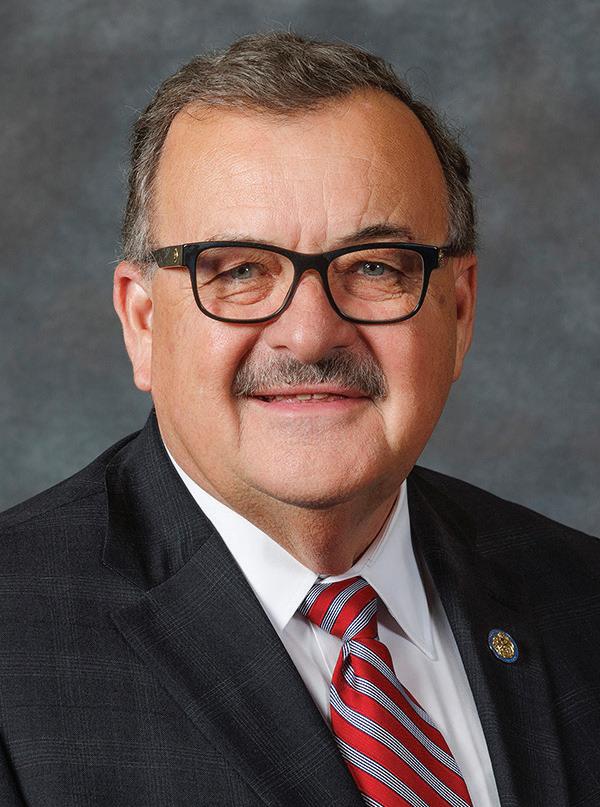
Guest Commentary - Sen. Mike Jacobson, District 42 - Giving thanks and reflecting on the 2026 legislative session
Guest Commentary - Craig S. Maher, Director of the NE State and Local Finance Lab - When the tax base walks out the door
LARM - De-escalation: A valuable skill for everyone
The Legal Corner by Tara Stingley, Cline Williams Wright Johnson & Oldfather, L.L.P. - Performance improvement plans after MULDROW: When is a PIP an adverse employment action?
In each issue
Legal Calendar
On the cover
League President and Aurora Mayor Marlin Seeman and his wife Nancy participated in the wreath-laying ceremony on May 23 at the Tomb of the Unknown Soldier in Arlington National Cemetery. Photo provided Marlin Seeman.
Larger Cities Legislative Committee
John McGhehey, Mayor, Alliance
J.D. Cox, City Manager, Alliance
Tobias Tempelmeyer, City Administrator, Beatrice
Rusty Hike, Mayor, Bellevue
Jim Ristow, City Administrator, Bellevue
Mindy Rump, Mayor, Blair
Phil Green, City Administrator, Blair
David Scott, Deputy City Administrator of Operations, Blair
Tom Menke, City Manager, Chadron
Jim Bulkley, Mayor, Columbus
Tara Vasicek, City Administrator, Columbus
Dave Bauer, Mayor Crete
Tom Ourada, City Administrator, Crete
Jody Sanders, City Administrator, Fremont
Kent Ewing, Mayor, Gering
Pat Heath, City Administrator, Gering
Roger Steele, Mayor, Grand Island
Patrick Brown, City Administrator, Grand Island
Mike Evans, Mayor, Gretna
Paula Dennison, City Administrator, Gretna
Mark Funkey, City Administrator, Hastings
James Liffrig, Mayor, Holdrege
Chris Rector, City Administrator, Holdrege
Brenda Jensen, City Manager, Kearney
Brad DeMers, Asst. City Manager, Kearney
Doug Kindig, Mayor, La Vista
Kevin Pokorny, Director of Administrative Services, La Vista
John Fagot Mayor, Lexington
Joe Pepplitsch, City Manager, Lexington
Margaret Blatchford, Assistant City Attorney, Lincoln
Riley Slezak, Senior Advisor to the Mayor, Lincoln
Linda Taylor, Mayor, McCook
Nate Schneider, City Manager, McCook
Bryan Bequette, Mayor, Nebraska City
Perry Mader, City Administrator, Nebraska City
Justin Webb, Council Member, Norfolk
Scott Cordes, City Administrator, Norfolk
Brandon Kelliher, Mayor, North Platte
Layne Groseth, City Administrator, North Platte
Steve Krajewski, Mayor, Ogallala
Kevin Wilkins, City Manager, Ogallala
Thomas Warren, Chief of Staff, Omaha
David Black, Mayor, Papillion
Amber Powers, City Administrator, Papillion
R. Paul Lambert, Mayor, Plattsmouth
Emily Bausch, City Administrator, Plattsmouth
Don Groesser, Mayor, Ralston
Brian Kavanaugh, Council President, Ralston
Jack Cheloha, City Administrator, Ralston
Art Lindberg, Mayor, Schuyler
Lora Johnson, City Administrator, Schuyler
Betsy Vidlak, Mayor, Scottsbluff
Kevin Spencer, City Manager, Scottsbluff
Joshua Eickmeier, Mayor, Seward
Greg Butcher, City Administrator, Seward
Brandon Bonregard, Mayor, Sidney
Brett Kerkman, Vice-Mayor, Sidney
Lance Hedquist, City Administrator, South Sioux City
Randy Meyer, Council Member, South Sioux City
Jill Brodersen, Mayor, Wayne
Wes Blecke, City Administrator, Wayne
Barry Redfern, Mayor, York
Dr. Sue Crawford, City Administrator, York
Smaller Cities
Legislative Committee
Chaired by Tom Goulette, City Administrator of West Point
Lisa Schroedl, City Administrator/Clerk/Treasurer, Ainsworth
Jessica Quady, City Administrator, Ashland
Crystal Dunekacke, City Administrator/Economic Developer, Auburn
Marlin Seeman, Mayor, Aurora
Adam Darbo, City Administrator, Aurora
Chris Anderson, City Administrator, Central City
Alan Michl, Chairperson, Exeter
Becky Erdkamp, Clerk/Treasurer, Exeter
Kyle Svec, City Administrator, Geneva
Matt Smallcomb, City Administrator, Gibbon
Gary Greer, City Administrator, Gothenburg
Jana Tietjen, Clerk, Hebron
Barb Straub, Admin/Clerk/Treasurer, Hemingford
Kelly Oelke, City Administrator, Hickman
Janine K. Schmidt, CMC/Treasurer, Morrill
Sandra Schendt, Clerk/Treasurer, Nelson
David Russell, Director of Gov. Affairs, NMPP Energy
Sandy Kruml, Clerk/Treasurer, Ord
Mike Feeken, Mayor, St. Paul
Sandra Foote, Council Member, Superior
Warren Myers, City Administrator, Sutton
Jessica Meyer, City Administrator, Syracuse
Kelly Adamson, City Council Member, Tekamah
Sharon Powell, Village Board President, Utica
Kyle Arganbright, Mayor, Valentine
Melissa Harrell, City Administrator, Wahoo
Desiree Soloman, City Attorney, Waterloo
Stephanie Fisher, City Administrator, Waverly
Tom Goulette, City Admin./Utility Superintendent, West Point
Randy Woldt, Utilities Superintendent, Wisner
Robert Costa, Community Planner, Yutan

Municipal Legal Calendar
(All statute citations to Revised Statutes of Nebraska)
AUGUST 2026
CITIES OF THE FIRST CLASS
• Within 10 days following meeting or before next meeting (whichever is sooner) Clerk to have minutes available for public inspection. (84-1413)
• Within 15 days of Passage Clerk publishes ordinances passed. (16-405)
• Within 30 days of Council meeting Clerk publishes official proceedings of meeting, including claims. (19-1102)
• On or before August Political subdivisions subject to city levy submit preliminary request for levy allocation to City Council. (77-3443)
• Prior to Notice of Budget Hearing Proposed annual or biennial budget statement available to public. (13-504) *
• Before August 15 Job titles and salaries of employees shall be published. (19-1102)
• On or before August 20 Receive the current taxable value of all property subject to levy from the County Assessor. (13-509)
• On or before September 1 City Council determines the final allocation of levy authority for its subdivisions (77-3443)
• On or before September 30 File adopted budget statement with County and State Auditor’s Office (13-508)*
• On or before September 30 File information on trade names and interlocal agreements with State Auditor’s Office (13-513)
• Within 20 days after end of month Treasurer files monthly financial report. (16-318)
• * * Clerk must prepare agenda prior to next Council meeting. (84-1411)
• On or after September 14 and prior to September 24 Joint public hearing if increasing property tax request by more than allowable growth percentage (77-1633)
• By September 4 Provide information to county if participating in joint public hearing (77-1633)
CITIES OF THE SECOND CLASS
• Within 10 days following meeting or before next meeting (whichever is sooner) Clerk to have minutes available for public inspection. (84-1413)
• Within 15 days of Passage Clerk publishes ordinances passed. (17-613)
• Within 30 days of Council meeting Clerk publishes official proceedings of meeting, including claims. (19-1102)
• On or before August 1 Political subdivisions subject to city levy submit preliminary request for levy allocation to City Council. (77-3443)
• Prior to Notice of Budget Hearing Proposed annual or biennial budget statement available to public. (13-504) *
• Before August 15 Job titles and salaries of employees shall be published. (19-1102)
• On or before August 20 Receive the current taxable value of all property subject to levy from the County Assessor. (13509)
• On or before September 1 City Council determines the final allocation of levy authority for its subdivisions (77-3443)
• On or before September 30 File adopted annual or biennial budget statement with County and State Auditor’s Office (13-508) *
• On or before September 30 File information on trade names and interlocal agreements with State Auditor’s Office (13-513)
• Within 20 days after end of month Treasurer files monthly financial report. (17-606)
• * * Clerk must prepare agenda prior to next Council meeting. (84-1411)
• On or after September 14 and prior to September 24 Joint public hearing if increasing property tax request by more than allowable growth percentage (77-1633)
• By September 4 Provide information to county if participating in joint public hearing (77-1633)
VILLAGES
• Within 10 days following meeting or before next meeting (whichever is sooner) Clerk to have minutes available for public inspection. (84-1413)
• Within 15 days of Passage Clerk publishes ordinances passed. (17-613)
• Within 30 days of Board of Trustees’ meeting Clerk publishes official proceedings of meeting, including claims. (19-1102)
• On or before August 1Political subdivisions subject to village levy submit preliminary request for levy allocation to Village Board. (77-3443)
• Prior to Notice of Budget Hearing Proposed annual or biennial budget statement available to public. (13-504) *
• Before August 15 Job titles and salaries of employees shall be published. (19-1102)
• On or before August 20 Recieve the current taxable value of all property subject to levy from the County Assessor. (13-509)
• On or before September 1 Village Board determines the final allocation of levy authority for its subdivisions (77-3443)
• On or before September 30 File adopted annual or biennial budget statement with County and State Auditor’s Office. (13-508) *
• On or before September 30 File information on trade names and interlocal agreements with State Auditor’s Office (13-513)
• Within 20 days after end of month Treasurer files monthly financial report. (17-606)
• * * Clerk must prepare agenda prior to next Village Board meeting (84-1411)
* Does not apply to cities with a biennial budget that are in the second year of the biennial budget period.
Chaired by Mayor Don Groesser of Ralston
A memory of a lifetime:
League President Marlin Seeman’s family honors America’s fallen at Arlington National Cemetery
BY LEAGUE PRESIDENT MARLIN SEEMAN AND NANCY SEEMAN
Editorial note: Thanks to League President Marlin Seeman, Mayor of Aurora, and his wife, Nancy, for agreeing to write this inspiring article about their recent trip to D.C. in celebration of “America 250.” Mayor Seeman and Nancy have been married and devoted to each other for 56 years. As retired teachers and servant leaders, they continue their ongoing commitment to their community.
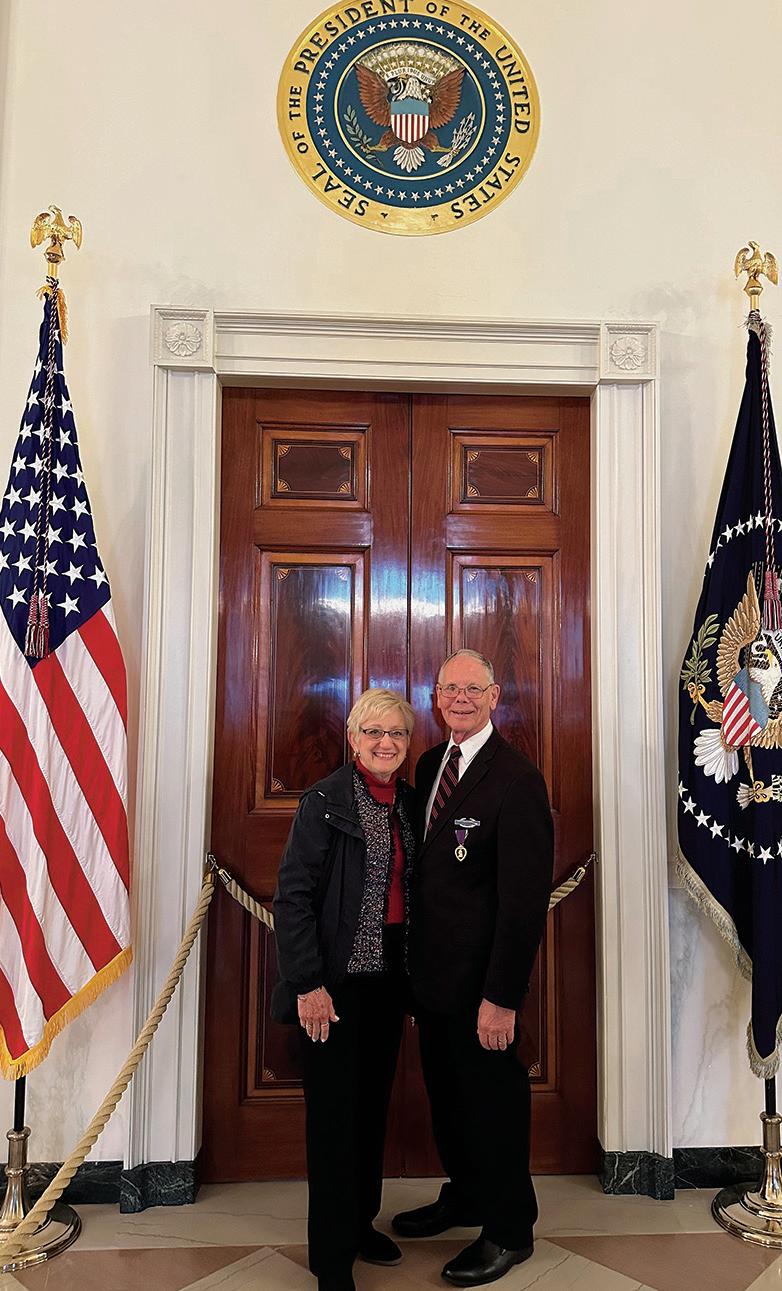
AMemorial Day weekend trip to Washington, D.C., became a true “memory of a lifetime!” Nancy and I were honored when our family was invited to participate in a wreath-laying ceremony on May 23 at the Tomb of the Unknown Soldier in Arlington National Cemetery.
The journey began last fall when Nancy and I shared with our two daughters and their families that we planned to celebrate America’s upcoming 250th anniversary with a family trip to the nation’s capital. The trip was our Christmas gift to our family.
Several months before the trip, former Nebraska Secretary of State Allen Beermann encouraged Nancy and me to apply for the honor of presenting Nebraska’s wreath at the Tomb of the Unknown Soldier. We submitted our request nearly six months in advance, but final confirmation did not arrive until just three weeks before departure.
The Arlington National Cemetery ceremonial staff informed us that two of our family members could join us in the ceremony. Nancy and I would present the wreath, while our daughters, Kristi O’Connor and Kelli Gibson, would accompany us during the solemn procession.
The day of the ceremony was marked by heavy rain. When we were greeted by our military escort, the Sergeant of the Guard apologized for the weather, remarking that he liked to think of the rain as “God’s tears weeping over the memory of our fallen brothers and sisters.” This poignant and emotional statement set the tone for the morning. As a Vietnam veteran and Purple Heart recipient, I noted the downpour simply reminded me of my days as an infantryman during my combat tour in Vietnam.
The wreath, provided by the League of Nebraska Municipalities, featured a red banner proudly displaying the name “Nebraska.”
Our family was deeply impressed by the professionalism and respect demonstrated by the Tomb Guards and ceremonial staff. Their unwavering commitment serves as a reminder of the honor and vigilance required to guard the Tomb of the Unknown Soldier 24 hours a day, every day of the year.
The ceremony carried special meaning because Nancy’s mother, Maxine Hoffman Pivonka, had the privilege of laying Nebraska’s wreath at the Tomb of the Unknown Soldier in 1942 while working for the Department of War during World War II. Historical photographs and a newspaper article from the Lincoln Journal Star help preserve the story of Maxine’s participation, making our experience even more poignant and emotional (see photo and clipping on page 5.)
Our family explored many of the nation’s most significant landmarks, including the U.S. Capitol, the White House, Smithsonian museums, and numerous memorials and monuments. Nancy and I expressed our appreciation to Congressman Mike Flood and his excellent staff for assisting us with White House tour passes. The opportunity allowed our family members to walk through many of the historic rooms that have welcomed world leaders and distinguished guests throughout American history.
A guided tour of the U.S. Capitol provided valuable insight into the workings of American government while showcasing the building’s remarkable architecture and statuary.
Aurora Mayor and League President Marlin Seeman and his wife, Nancy, in Washington, D.C.
“As a Vietnam veteran and Purple Heart recipient, I noted the downpour simply reminded me of my days as an infantryman during my combat tour in Vietnam.”
Marlin Seeman League President and Mayor of Aurora

The Smithsonian Institution offered compelling exhibits of our American history.
Our family visited many of the memorials, including those dedicated to Thomas Jefferson, Dr. Martin Luther King Jr., Abraham Lincoln, World War II, the Korean War, and the Vietnam War. The Vietnam Veterans Memorial held particular significance.
During a daytime visit to the memorial wall, I located the etched name of my fallen sergeant, Thomas Steven Jones, who died from wounds received only inches from where I was wounded in combat.
Our family also visited the nearby statue of the “Three Soldiers,” where I reflected on the bonds forged between soldiers in wartime. I shared lessons about teamwork, sacrifice, and the importance of always having one another’s back – values that remain just as relevant today as they were during my military service.
One of the most meaningful moments of the trip came during a return visit to the Vietnam Veterans Memorial at dusk. Surrounded by family members, I shared personal memories of service, sacrifice,
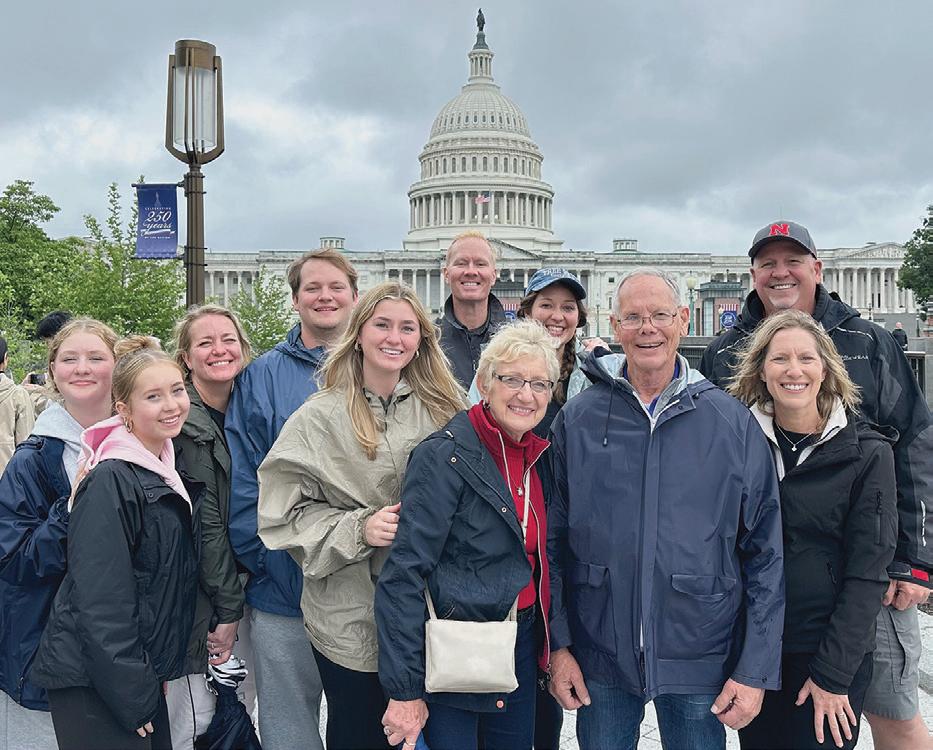
survival, and the realities of combat in Vietnam. For the Seeman family, the journey was far more than a vacation. It was an opportunity to honor those who served, reflect on America’s history, and strengthen family bonds. Most importantly, it created memories that will be cherished for a lifetime – an unforgettable tribute to service, sacrifice, and the enduring spirit of remembrance through three generations.
A LOOK BACK ...

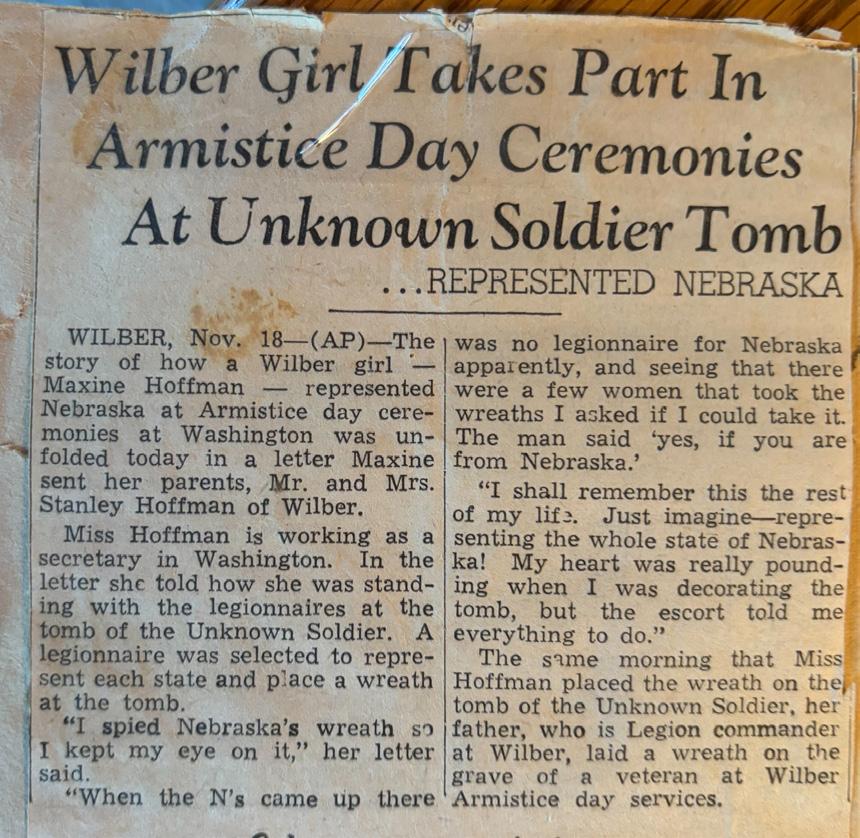
Photo and a newspaper clipping from the Nov. 18, 1942 issue of the Lincoln Star shows Maxine Hoffman Pivonka, Nancy’s mother in the dark coat, who had the privilege of laying Nebraska’s wreath at the Tomb of the Unknown Soldier in 1942. Provided by the Seeman family.
Sen. Jacobson: Giving thanks and reflecting on the 2026 legislative session
BY SENATOR MIKE JACOBSON, DISTRICT 42
Ifirst want to say THANK YOU for all the support in the primary election. I try to review every bill in the Legislature through the lens of what is best for District 42 and its residents. I recall supporting Democratic and Republican bills based on their impact on my constituents. In fact, I even voted against the Governor’s veto of a bill brought by Senator Roundtree because I committed to him early on that I would support it. Whenever I see him, he reminds me of how much it meant to him that I remained committed to my word even when the Governor was opposed. I have always believed that keeping your word is fundamental to building relationships and getting things done. If you compromise your integrity, what do you have left? I make it a point to never “trade” a vote. I focus my efforts on selling the merits of my bills rather than brokering trades. I also refuse to vote for bad bills.
As I talk with my constituents, I continue to hear one consistent message: property taxes are too high. I have responded by working with other Senators to limit how much political subdivisions can increase their tax asks (product of value x levy) and have asked them to cut their spending to the extent they can. However, I also hear from political subdivisions that they don’t appreciate “unfunded mandates” issued by the Legislature. For that reason, I always watch for bills that, if passed, would result in an unfunded mandate.
This year, Senator Wordekemper introduced LB 400, a bill he introduced on behalf of the Nebraska Professional Fire Fighters Association to change the rules governing workers’ compensation insurance. Workers’ compensation insurance is designed to compensate workers who are injured on the job and unable to work as a result. Most people have viewed this as physical injuries. The professional firefighters have filed and received compensation for cancer-related claims under workers’ compensation. However, like other workers’ comp claims, you must prove that the injury occurred as a result of your job duties.
As someone who has been fighting cancer (metastatic melanoma), I am sympathetic to the costs, emotional toll, and time commitment that cancer treatments take. My cancer was likely caused by sun exposure as far back as when I was a kid working on the farm. The doctors asked about my family history, but never about my occupation.
LB 400 suggested that, since firefighters have a slightly higher incidence of cancer, they should not need to prove that their cancer was caused by the job. Instead, the bill would have required their employer to prove that their cancer was NOT caused by the job. Logic would suggest that, regardless of the cause, any
firefighter who is diagnosed with cancer after performing the job for five or more years, or within five years after retirement, would automatically claim the job was the cause.
My nephew is a full-time paid firefighter in Lincoln and a fulltime farmer. Given his exposure to ag chemicals, diesel fumes, and sunlight, he could be at a higher risk for cancer. Yet, in any cancer-related workers’ compensation claim that he filed, it would be presumed that his cancer was due to his firefighting duties under LB 400 – despite his other risk factors. This would greatly increase the claim risks for municipalities and rural volunteer fire districts, as well as the cost of administering claims. In turn, this would greatly increase their insurance premiums or self-insurance costs, which are paid for with your property taxes. This creates a classic unfunded mandate. As a result, I led the filibuster to prevent this change in the law.
Over the years, I have consistently demonstrated my support for firefighters, both paid and volunteer. Our first responders are vital and put their lives on the line to protect people and property. Appropriate benefits are important for recruiting and retaining first responders, and it’s the job of elected officials to strike a balance between those benefits and the burden on the local taxpayer. Local departments can always make their own deals, but I don’t believe that the state should create an unfunded mandate to force this change in the law on our local political subdivisions.
Many bills that come before the Legislature seem to offer compassionate solutions to various problems, but they are generally not as simple as they may appear. For example, as chair of the Banking, Commerce, and Insurance Committee, we see bills every year that require insurance companies to pay for certain types of treatments or pharmaceuticals. I generally have opposed these bills because they increase costs for all premium payors and reduce competition among health plans and insurers. As they say, “there is no such thing as a free lunch.” The question is rarely as easy as whether we care about a program or policy; it is about the cost and whether it’s appropriate to require the cost to be paid in state law. These are not easy decisions, but they are part of the job.
It is a privilege to represent you in the Nebraska Legislature, and I look forward to hearing from you regarding issues that are important to you. I can be reached at 402-471-2729 or by emailing me at mjacobson@leg.ne.gov.
When the tax base walks out the door
The departure of a community’s major employer is about more than job losses. Finance managers need a fiscal strategy.

BY CRAIG S. MAHER, DIRECTOR OF THE NEBRASKA STATE AND LOCAL FINANCE LAB
When a major employer leaves town, the immediate story is job loss and the shock to the local economy and community identity. The fiscal story is what follows: declining revenues, fixed costs and a multiyear challenge to keep public services funded.
In Lexington, for example, the recent closure of a Tyson Foods plant will eliminate hundreds of jobs. But for local-government finance managers when something like that happens, the more consequential question is not how many jobs are lost — it is how the loss will move through the tax base and how that needs to be managed.
Sales taxes will soften first, property values will adjust more slowly, and infrastructure and service costs will remain. Managing that gap requires more than economic recovery. It requires a fiscal strategy: protecting the tax base, managing cash flow and repositioning assets before revenue losses become structural. That means planning for phased revenue loss, managing near-term cash flow disruptions and moving quickly to stabilize major properties before they become long-term fiscal liabilities.
Another Nebraska community, Sidney, shows how that transition unfolds. When Cabela’s was acquired and its headquarters operations shifted away, the town entered a prolonged adjustment. Years later, the community has stabilized, but only after population loss, weaker retail activity and gradual erosion of its economic base, forcing repeated budget adjustments rather than a one-time reset.
The central fiscal challenge is timing. Layoffs are immediate but revenue loss is not. Sales tax collections typically decline over months as household spending falls. Property tax impacts lag, often by years, as reassessments catch up with weaker demand and lower commercial values. Intergovernmental aid tied to population or economic activity can take even longer to adjust. At the same time, expenditures remain largely fixed and debt service must be paid. Public safety staffing is difficult to reduce quickly. In some cases, costs rise as demand increases for social services.
This creates a structural imbalance: revenues decline in stages while costs remain. As economist Steven Deller has noted, communities in this position are often facing “a permanent change in their economic base,” not a temporary downturn. For finance
officers, this is fundamentally a cash flow and structural balance problem, not just an economic one.
Disrupted Revenues
One of the most immediate questions for local officials is what happens to the shuttered property itself. In most cases, property taxes are still owed after a facility closes, but that does not mean they are paid. If a firm enters bankruptcy or abandons a site, tax payments can become delinquent. Local governments may eventually recover unpaid taxes through foreclosure or tax sale, but the process can take years. In the interim, revenues are disrupted and the property may sit idle, generating little or no economic activity and perhaps falling into dilapidation. In practice, local governments often find themselves at the back of the line in bankruptcy proceedings, meaning property tax collections can be delayed, reduced or, in some cases, partially unrecoverable. Even when ownership changes, reassessment often reduces the property’s value, particularly if the facility is highly specialized. That creates a permanent reduction in the tax base. Janesville, Wis., illustrates how long that process can take. More than a decade after General Motors closed its plant, the local economy has diversified, but the industrial site itself has remained difficult to redevelop at scale. Replacing the economic footprint of a single large employer required dozens of smaller firms and years of transition.
For local governments, the implication is clear: Site reuse is not just economic policy — it is fiscal policy.
The second fiscal exposure comes from prior public investments. Communities often provide tax incentives, infrastructure or other subsidies to attract large employers. When those employers leave, those commitments remain. Clawback provisions are intended to recover
Continued on page 15 / See Tax

STORY

BY ASHLEY WOLFE, MARKETING DIRECTOR, LNM
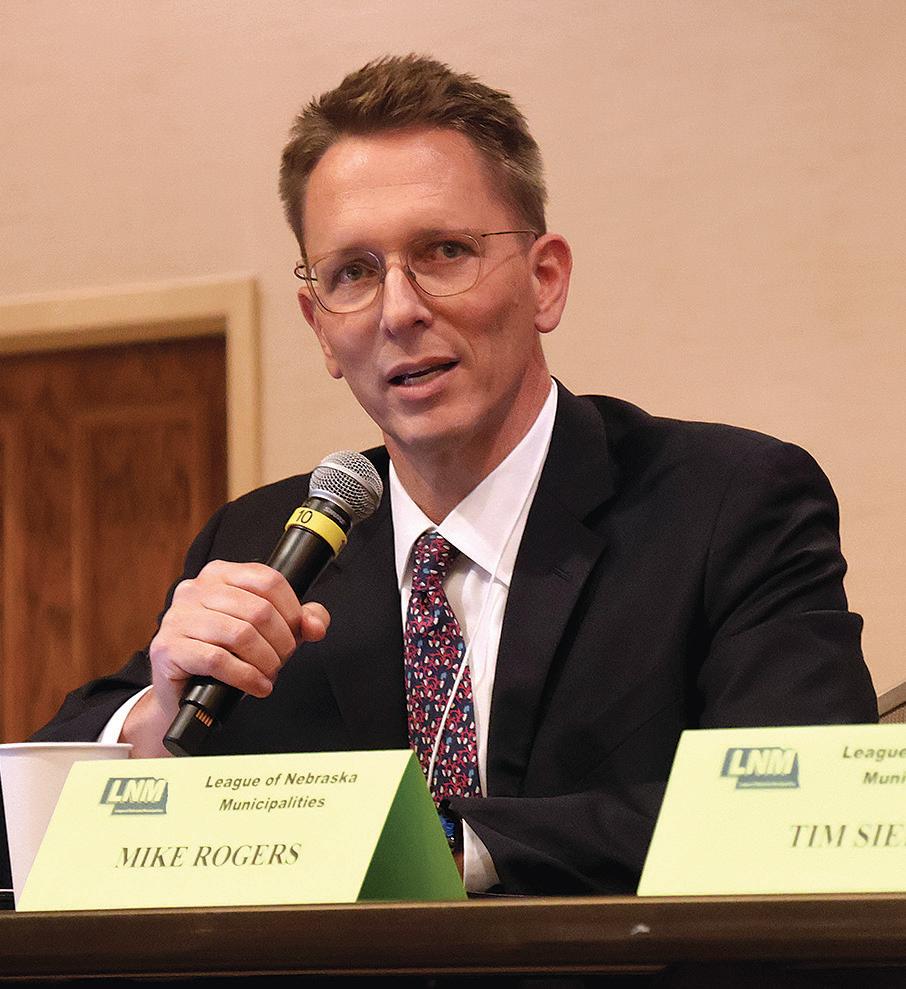
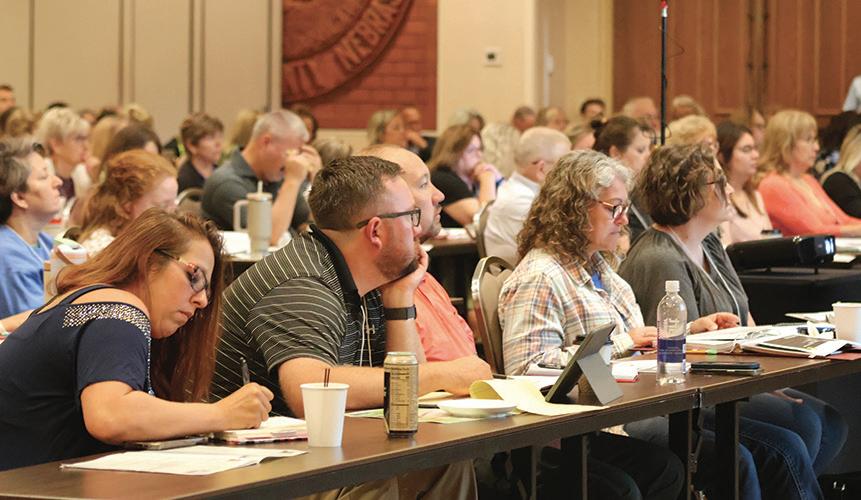
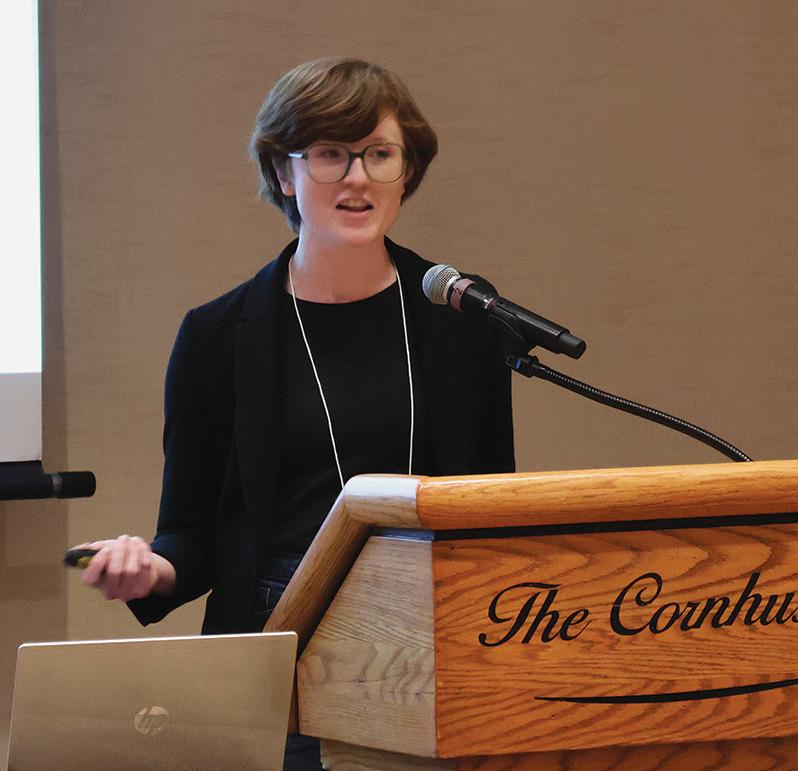
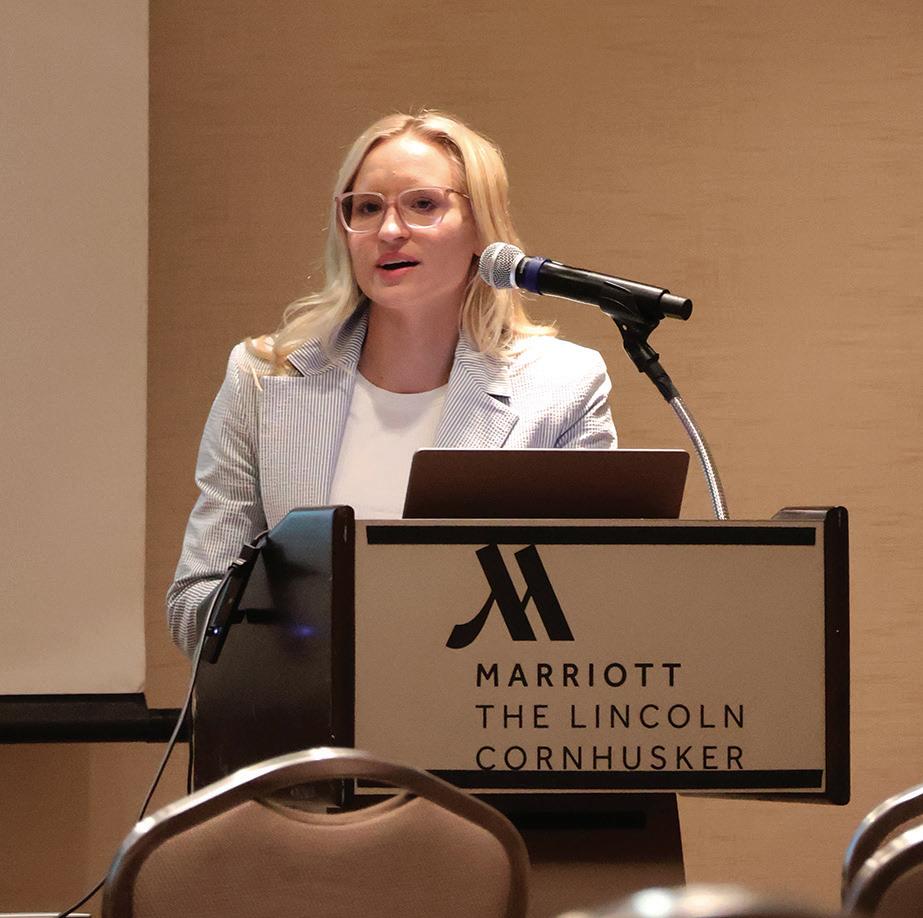
TheAtrium at the Cornhusker Marriott Hotel in Lincoln was abuzz June 17-19. The League’s Municipal Accounting and Finance Conference drew attendees from across the state, all gathering to sharpen their skills and brush up on municipal accounting knowledge. The Preconference Seminar kicked off with a panel discussion comprised of Mike Rogers, bond attorney with Gilmore & Bell and city attorneys from Lincoln and Grand Island. The Preconference Seminar is longer than typical conference sessions and that extra time was needed as Community Improvement Districts (CID) were a hot topic. LB 1130 was passed during the 2026 legislative session and municipalities are still trying to get a grasp on what it means and what responsibilities municipal officials have relating to the law. Rogers broke down the complex topic and Kari Fisk from the City of Grand Island and Tim Sieh from the City of Lincoln provided their insight as well.
AND PHOTOS
Mike Rogers, Attorney,Gilmore & Bell
When we live in a world full of acronyms, Fisk summed a CID up in a clear and concise manner—“A CID is basically a city within a city that is formed very fast,” Fisk explained.
Throughout the afternoon, questions arose as the speakers delved explanations of “What does a CID mean for those working in the city office?” to “What happens after the CID is formed?”
The speakers did their best to summarize 60 pages of Nebraska state statue and the nuances of statutory provisions while providing easy-touse reference documents showing what the implementation of a CID should look like for the municipality.
The full conference began on Thursday and 176 municipal representatives were able to join us in Lincoln for a few days packed
Continued on page 10 / MAFC

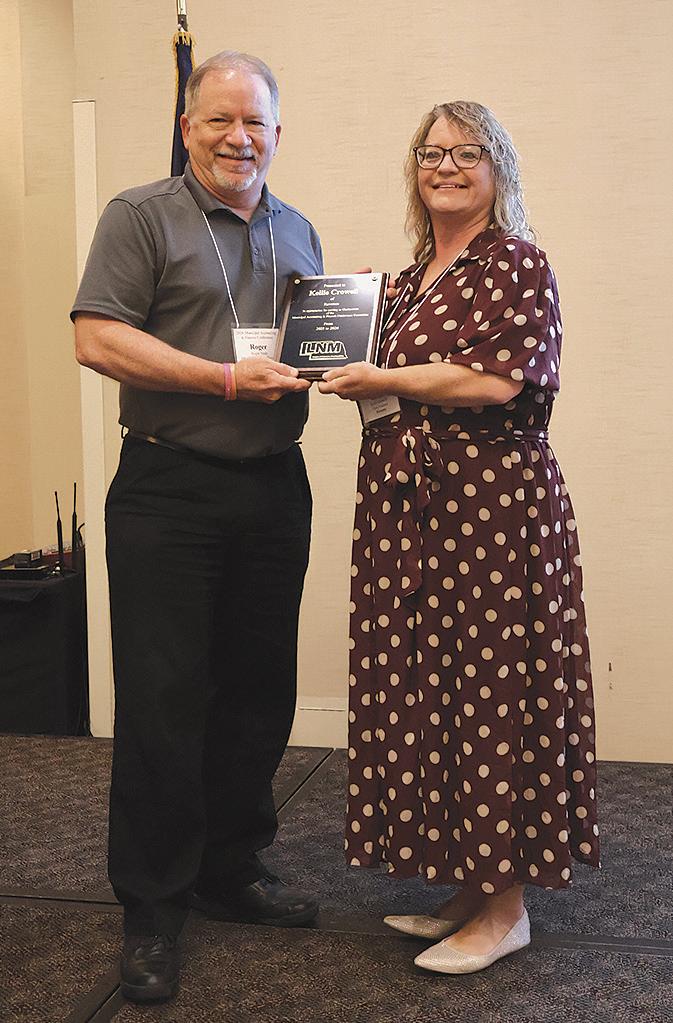
Roger Nash presented Kellie Crowell with a plaque recognizing her service as the 2025-26 Chairperson of the Municipal Accounting and Finance Conference Committee.
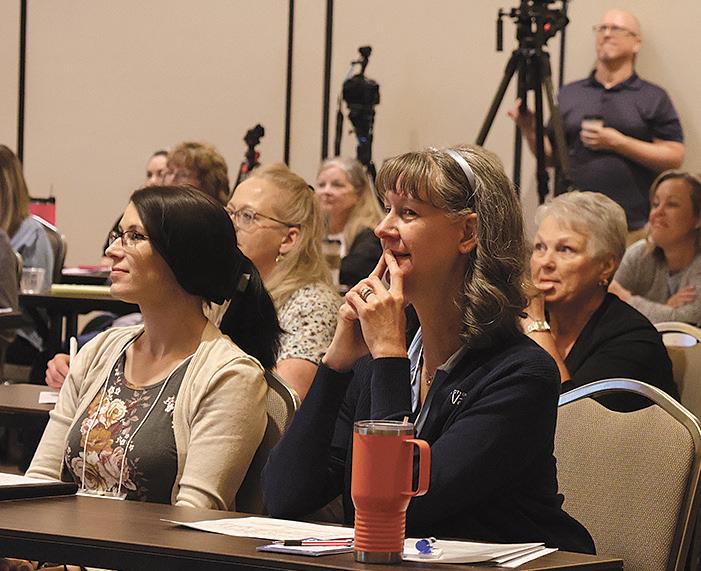
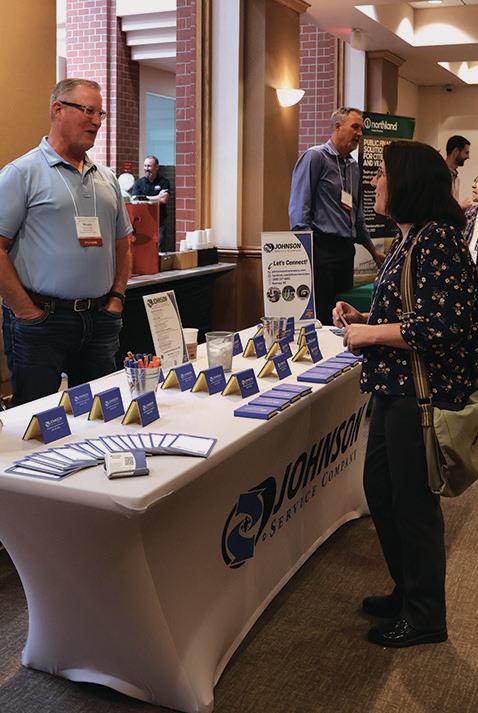
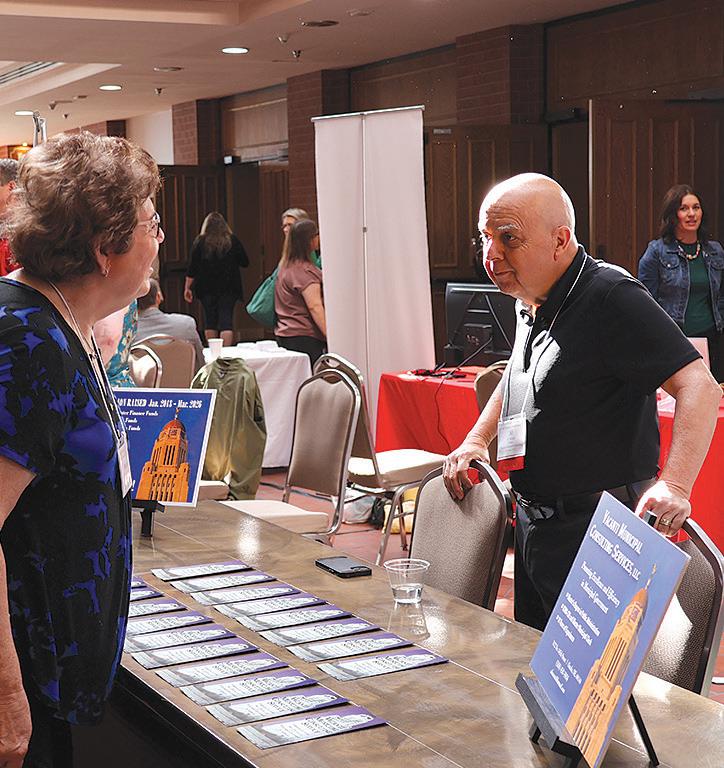
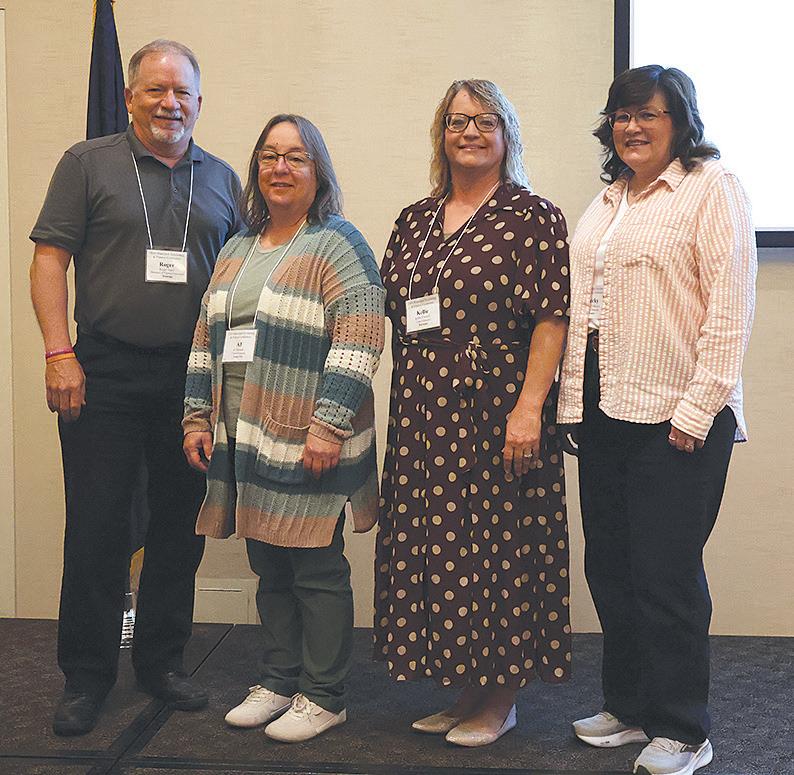
Members of the Municipal Accounting and Finance Conference Committee pose for a quick photo. Thank you, Roger Nash, AJ Reimers, Kellie Crowell, and Becky Erdkamp for all your work on making this conference a success.
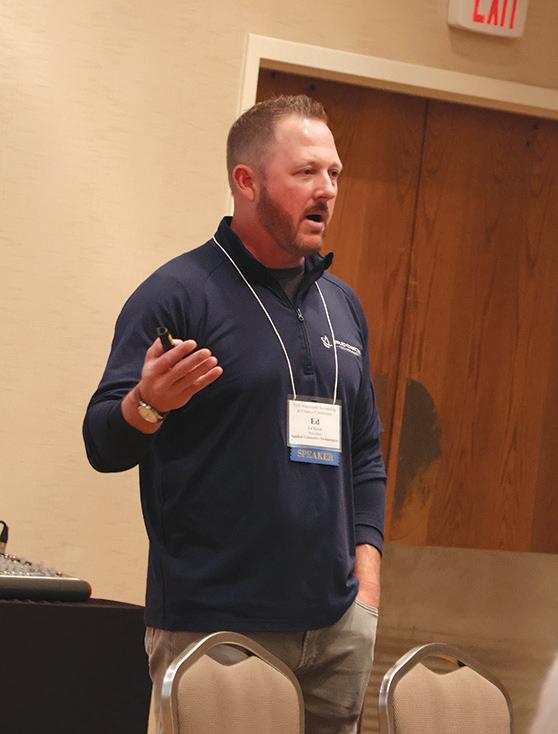
Ed Knott, Applied Connective Technologies
CONFERENCE SPONSORS
• ACLARIAN
• AMGL, CPAS & ADVISORS
• BENEFIT MANAGEMENT
CENTRIX
• CREATIVE SITES, LLC
• D.A. DAVIDSON & CO.
• HAMILTON BUSINESS TECHNOLOGIES
• JEO CONSULTING GROUP
• JOHNSON SERVICE COMPANY
• LA GRONE SLAMA LLC
• LARM
• LIGHT
MAFC
Continued from page 9

• MILLER & ASSOCIATES CONSULTING ENGINEERS, P.C.
• MMC CONSULTING
• NEBRASKA ENERGY FEDERAL CREDIT UNION
• NEBRASKA LIQUID ASSET FUND
• NORTHLAND SECURITIES, INC.
• NPAIT
• PIPER SANDLER & CO.
• SPARQ DATA SOLUTIONS
• UNION BANK & TRUST - NFIT
• VACANTI MUNICIPAL CONSULTING SERVICES, LLC

• DISPLAY TABLE
full of learning. Sessions touched on many topics including:
• Tax increment financing and recent changes
• Changes to the Open Meetings Act
• Sales tax reporting requirements for municipalities
• Swimming pools, mobile homes, and recreation camps and changes brought about by LB 759 regarding inspections and other details. Additionally, AI and cybersecurity were touched on in many sessions. Tarryn Moss from Hudl joined to share ways AI can help with some day-to-day operations and Ed Knott and Casey Beutler from Applied Connective Technologies hosted another

session that touched on cybersecurity and ways to protect yourself and the city or village from cyberattacks.
Chatter and sharing ideas was a constant thread. The idea sharing that happens when municipal officials come together is invaluable and we are proud to be able to help facilitate the conversations with the conference. But truly, it is those of you on the ground doing the work in local government who are the changemakers and we thank you for taking time out of your busy schedule to join us. We hope to see you again soon at a future conference or perhaps at one of the Legislative Committee meetings as we start planning for the 2027 legislative session.
Suzanne Polzkill, NE Department of Water, Energy, & Environment
Tarryn Moss, Hudl
AARP Nebraska seeks nominations for the 2026 Andrus Award for Community Service
AARP Nebraska is now accepting nominations for its 2026 Andrus Award for Community Service, which honors a Nebraskan age 50-plus who shares their experience, talent, and skills to enrich their community and enhance the lives of its residents. Nominations may be submitted by members of the public at large, including AARP members and volunteers, as well as external organizations and groups.
“AARP Nebraska is honored to recognize a devoted community volunteer who has drawn on their life experiences to inspire positive change and make a real, enduring impact within their community,” said Todd Stubbendieck, State Director for AARP Nebraska.
Nominations will be evaluated by AARP Nebraska's selection committee based on how the volunteer’s work has improved the community, reflected AARP’s mission and vision, and inspired other volunteers. The award recipient will be announced in fall 2026 and presented with a $2500 check to be donated to a nonprofit 501(c)(3) organization of their choice. Eligibility requirements for AARP Nebraska Andrus Award for Community Service nominees:
• Nominees must be 50 years of age or older, live in the awarding state, and do not need to be an AARP volunteer or an AARP member. Married couples or domestic partners who perform service together are eligible; however, teams are not.
• The achievements, accomplishments, or service on which the nomination is based must have been performed on a volunteer

basis, without pay. Volunteers receiving small stipends to cover costs associated with the volunteer activity are eligible.
• The achievements, accomplishments, or service on which the nominations are based must be replicable and inspire others to serve. Partisan political achievements, accomplishments, or service may not be considered.
• Not eligible: previous Andrus Award recipients, volunteers serving on the Andrus Award selection committee, AARP staff members, elected or appointed officials currently serving in office, and candidates currently campaigning for an elected office.
• This is not a posthumous award.
The application deadline is July 15, 2026. The AARP Andrus Award for Community Service is an annual awards program developed to honor individuals whose service is a unique and valuable contribution to society. Last year, AARP recognized outstanding individuals in nearly every state. To submit a Nebraska Andrus Award nomination, visit aarp.org/NE.
Source – AARP Nebraska


Supreme Court significantly modifies test used to determine Voting Rights Act compliance
BY STEPHANIE MARTINEZ-RUCKMAN, NATIONAL LEAGUE OF CITIES; AND AMANDA KARRAS, INTERNATIONAL MUNICIPAL LAWYERS ASSOCIATION
OnApril 19, the Supreme Court issued an opinion in Louisiana v. Callais that struck down Louisiana’s redistricting maps by significantly modifying the test courts must use to determine if a claim under Section 2 of the Voting Rights Act (VRA) for race-based vote dilution may proceed. More simply said, to prove whether a claim can proceed, a litigant must assert that a minority group has less opportunity than other voters to elect representatives of their choice.
In a 6-3 decision authored by Justice Alito, the Supreme Court held that a Section 2 claim will only succeed where “evidence supports a strong inference that the State intentionally drew its districts to afford minority voters less opportunity because of their race” and not other nonracial factors (like partisan advantage). That is because Section 2 of the VRA “was designed to enforce the Constitution— not collide with it.”
The Court explained the “general rule that the Constitution almost never permits the Federal Government or a State to discriminate on the basis of race” and that such discrimination triggers strict scrutiny. Under the new Callais test, if a map can be explained by the legislature seeking partisan advantage, then that will likely doom a Section 2 claim.
In this case, the Court found compliance with Section 2 “could not justify the State’s use of race-based redistricting” and the State’s use of the 2022 map with the second majority-Black district was therefore an unconstitutional racial gerrymander.
Case Background
In this case, after the 2020 census, Louisiana redrew its congressional districts. While the State’s population was approximately one-third African American, there was only one majority-Black district. A group of African American voters sued, and in 2022, a federal judge struck down the map as likely violating Section 2 of the VRA as
impermissibly diluting minority voting power and ordered the State to draw a new map with a second majority-Black district.
The State complied; that new map, with a second majorityBlack district, was challenged by a group of non-African American voters as a racial gerrymander in violation of the 14th Amendment. A new three-judge panel held that the map violated the Equal Protection Clause and the Supreme Court agreed to hear the case.
The Supreme Court heard oral argument last term. At the time, Louisiana argued it did not engage in racial gerrymandering, but that it had drawn the new second majority-Black district in a way for partisan advantage that would protect certain incumbents in Congress. In an unusual move, the Supreme Court did not issue a decision last term and instead held the case over for the current term and ordered new arguments on the question of whether “the State’s intentional creation of a second majority-minority congressional district violates” either the 14th Amendment or the 15th Amendment, which bars the government from denying or restricting voting rights based on race.
Impact to Cities
The result of the opinion is a narrowing of the VRA, which will remove checks on partisan-driven redistricting by requiring proof of intentional discrimination rather than just discriminatory results. This decision goes beyond congressional districts and could impact state legislature districts and councilmanic districts, thus directly impacting redistricting decisions in cities, towns and villages. As such, cities can be sued under the VRA, and it will be important for local elected officials to consult with their general counsel to understand obligations in redistricting. Additionally, while this case isn’t technically a partisan gerrymandering case, it likely invites more partisan gerrymandering; this is something that can result in excessive preemption of local governments in a manner that is democratically suspect.
GET A QUOTE AND JOIN TODAY!

The League Insurance Government Health Team (LIGHT) helps hundreds of its members throughout Nebraska obtain affordable health insurance coverage.
Plan and Network Choices
With seven plan options and three networks to choose from, you’re sure to find one that meets your group’s coverage and benefit needs.
Affordable Plan Options
Offering your employees much-needed protection against the high cost of medical care:
• Three PPO options
• Four HSA-eligible high deductible options
• Prescription drug coverage
Enrollment Options
Single: Covers the employee only
Employee and spouse: Covers the employee and their spouse
Employee and children: Covers the employee and their eligible dependent children, but does not provide coverage for the spouse
Family: Covers the employee and eligible dependents including a spouse
RECEIVE DEDUCTIBLE AND OUT-OF-POCKET CREDIT FROM YOUR CURRENT VALID GROUP PLAN WHEN YOU SWITCH!
Available Network Options
With several networks available, you have easy access to quality providers:
• NEtwork BLUE (Statewide)
• Premier Select BlueChoice (Regional)
• Blueprint Health (Regional)
• Out-of-state network availability
LET’S GET STARTED
Contact your current local Agent/Broker Or contact
Dennis Maggart
Executive Vice President P: 913-378-9841 or 816-718-0335
Dennis@McInnesGroup.com
Jane Limbach Account Man ager P: 913-378-9840
Jane@McInnesGroup.com

Residents of Bertrand conducted a study that showed an urgent need for housing. That helped secure a state grant and spurred other activity, including formation of an investment group focused on housing. Shown here is a bungalow the investment group gutted, renovated, and sold. Photo provided to the Nebraska Examiner by Beverly Hansen.
Rural Nebraska village aims to survive and grow with new housing efforts
Bertrand, in south-central Nebraska, has organized efforts to boost available houses, apartments
BY CINDY GONZALEZ, NEBRASKA EXAMINER
The south-central Nebraska town of Bertrand hadn’t seen a newly built house or apartment for 16 years until a fiveplex rose on an old mobile home park in 2024.
Among the first to live in the $1.1 million rental property was a school teacher, a young manufacturing worker and a retired man whose move there opened up a for-sale dwelling in the rural community of about 750. Such movement sparked by new residential development is critical to the survival of towns like Bertrand and others across Nebraska, a state that has made dents but still struggles with a housing shortage.
For its efforts on the fiveplex — which sparked other economic development — Bertrand was recognized in April by the Nebraska Commission on Housing and Homelessness as one of two 2026 winners of a “Nebraska Affordable Housing Trust Fund Award.”
The annual award was established in 2018 to highlight organizations and innovative execution of projects that have leveraged state housing trust funds to create quality and affordable housing.
The urban honoree was Habitat for Humanity of Omaha, which was awarded $820,000 to help construct 10 for-sale houses within the larger Bluestem Prairie
development in North Omaha. The homes targeted first-time homeowners earning 80% or less of the area’s median income. The Bluestem project revitalized the site of a former condemned and troubled apartment complex.
This year’s awards celebrate projects launched with the help of funds distributed a few years ago by the Nebraska Department of Economic Development.
In the case of Bertrand, the $525,000 state grant to its local housing authority in 2022 helped ignite other development in the ag-focused Phelps County village.
‘Eye-opener’
Beverly Hansen, an executive officer of the Bertrand Area Community Fund, recalled a housing study that served as the foundation for funding requests for the fiveplex. The study confirmed an urgent need for workforce and family housing. Hansen said it led to “visioning” sessions where school, government and community members discussed housing and other needs.
“It really was an eye-opener,” Hansen said of the forums led by the South Central Economic Development District (SCEDD), a nonprofit that helps promote and facilitate growth in 13 rural Nebraska counties.
Soon an investment team was born: Bertrand Community Builders. Dozens of investors came forward that summer of 2022, primarily to address the lack of housing but also to help attract new business, said Hansen, one of the group’s directors. Among the builders group’s first projects was renovating a run-
Continued on page 22 / See Housing
Tax
Continued from page 7
public investment, but their effectiveness is uneven. They may be difficult to enforce, particularly in bankruptcy, and rarely recover the full value of the subsidy. Clawbacks can mitigate risk at the margins, but they are not a substitute for managing underlying fiscal exposure.
At the same time, infrastructure built to support a major employer — roads, utilities, water systems — does not scale down. Debt service continues even if the revenue base that justified the investment has weakened. As Deller puts it, large employers often “get what they demand,” leaving communities with fiscal structures built around assumptions that may not hold once the employer departs. From a finance perspective, these incentives function as contingent liabilities: exposures that become visible only when conditions change.
Cascading Effects
These dynamics are not unique to manufacturing towns. In energy-dependent regions, for example, the same fiscal exposure appears in a different form. In parts of Wyoming, fossil fuel industries account for a large share of public revenues. When prices fall or firms exit, the effects cascade quickly — job losses, business closures, and declining tax collections that put pressure on state and local budgets. The lesson is consistent: Economic concentration translates directly into revenue concentration.
Diversification is often framed as an economic development goal. For finance officers, it is better understood as a revenue stabilization strategy. Research shows that more diversified economies experience less-severe employment shocks and more-stable revenue streams, particularly during downturns. But diversification is a long-term condition; it does not solve the immediate fiscal problem when a major employer leaves.
If anything, current development strategies suggest these risks are evolving rather than disappearing. Large-scale data centers and advanced manufacturing facilities are increasingly
the focus of local recruitment efforts. These projects promise investment and tax base growth, but they also require significant infrastructure and often concentrate economic activity in a small number of firms.
Recent debates in Wisconsin over a proposed artificial intelligence data center highlight these concerns. Local voters raised questions about infrastructure demands, resource use, and long-term fiscal exposure, ultimately requiring additional public oversight of such projects. The industries may be new. The fiscal question is not: ow much risk is the public sector assuming relative to the stability of the revenue stream?
Critical Strategies
When a major employer exits, local governments must shift from economic development to fiscal management. Several strategies become critical:
• Build multiyear revenue forecasts immediately — not after the first budget gap appears. Model phased declines across sales, property and intergovernmental revenues. Avoid treating the shock as a single-year event.
• Plan for cash flow disruption early. Delinquent taxes and lagged revenues will hit before structural decline is fully visible.
• Stabilize and reposition key assets. Idle industrial sites are fiscal liabilities. Accelerating reuse or interim activity can help restore the tax base.
• Reassess incentive exposure. Treat incentives as risk-bearing commitments and design future agreements with enforceability and downside protection in mind.
• Resequence capital plans. Shift from expansion-oriented investments to those that support redevelopment and economic repositioning.
• Think regionally. Access to a more diverse regional labor market can buffer local fiscal shocks.
The departure of a major employer is often framed as a question of economic recovery. For local governments, it is also a question of fiscal management. Sidney’s experience shows that recovery is possible — but slow, uneven and fiscally demanding. Janesville demonstrates how long it can take to rebuild a tax base around smaller employers. Wyoming’s energy communities illustrate how concentrated revenue structures amplify risk.
As Deller has cautioned, “Overdependence on one industry is setting them up for a very hard hit.” The defining challenge is not whether local economies eventually adapt. The real test is whether the balance sheet holds long enough for it to do so.
About the author: Craig S. Maher is a professor in the School of Public Administration at the University of Nebraska, Omaha, co-editor of Public Finance Journal and director of the Nebraska State and Local Finance Lab.
This piece is reprinted with permission from Governing, a publication that provides news, analysis and insights for the people making government work. For questions about Governing, reach out to Web Editor, Natalie Delgadillo at ndelgadillo@governing.com.
Finding the way
In this final selection of a three-part series, Nebraska Department of Transportation provides tips for strengthening grant applications to give municipalities the best shot at obtaining federal funding.
BY JESSIE SAMPSON, LIASON SERVICES MANAGER, NDOT
Lessons learned: How to strengthen federal infrastructure grant applications


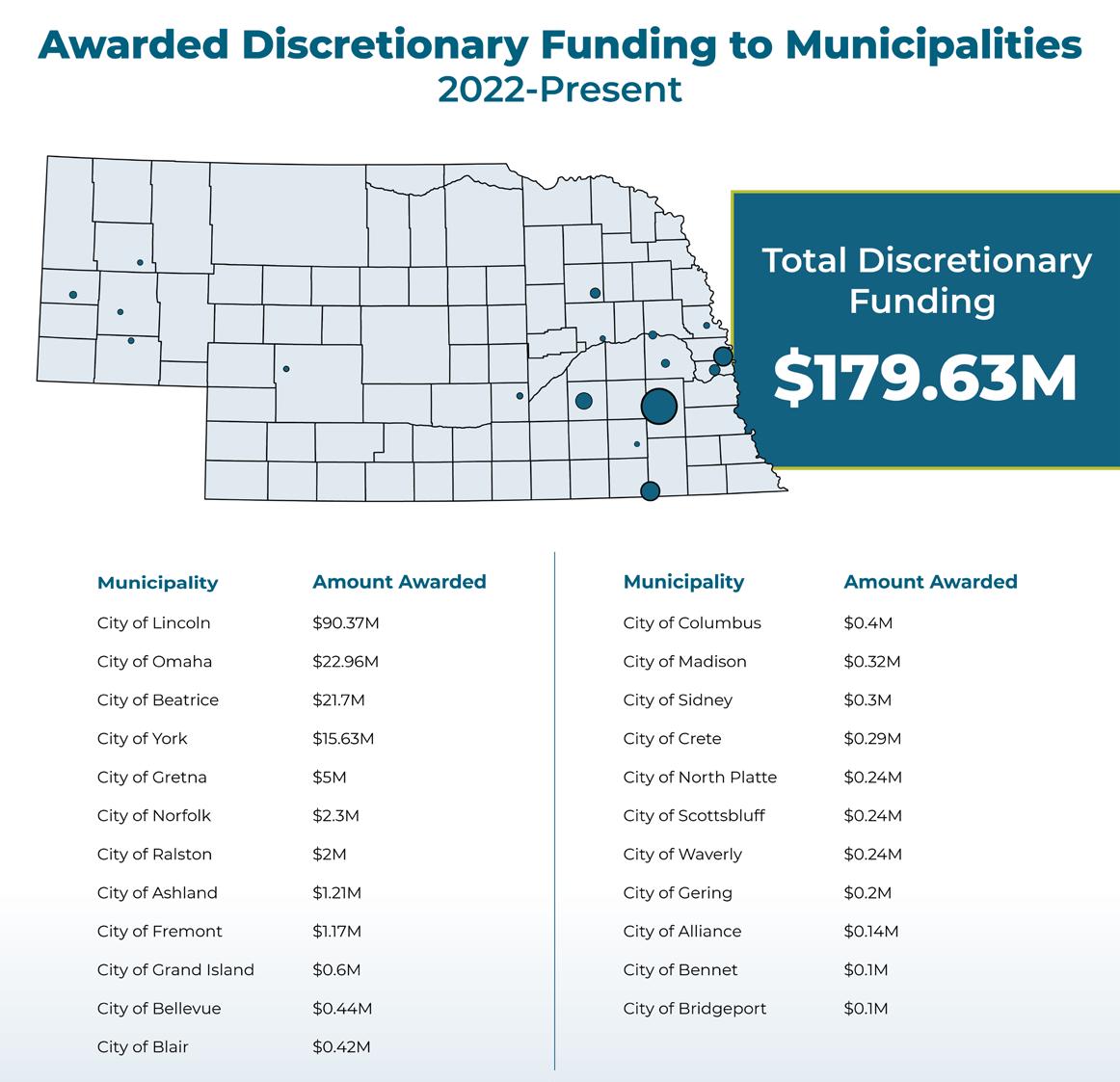
Overthe past two years, Nebraska communities have seen firsthand how the federal infrastructure funding landscape has become increasingly competitive. As more municipalities pursue discretionary grant opportunities, the ability to submit a strong application has become more critical than ever. Success now depends not only on strong project ideas, but also on project readiness, thorough planning, strategic partnerships, strong data, and compelling stories that demonstrate community impact.
In response to the increasingly competitive funding environment, the Nebraska Department of Transportation’s (NDOT) Infrastructure Hub (IHub) has worked with communities across the state to strengthen project readiness and improve the quality of federal grant applications.
Launched in August 2024, the IHub is Nebraska’s first intergovernmental resource focused solely on helping state and local public agencies compete for federal discretionary grants. From application assistance to grant management, this online tool supports local agencies, ensuring they can compete for federal discretionary grants with confidence.
“One of the biggest things we’ve learned is most of our local agencies didn’t necessarily have projects developed far enough to put together successful applications,” Jodi Gibson, NDOT’s local assistance division manager, said. “It has to be a little further developed than just an idea on the back of a napkin.”
In response, the IHub helps municipalities evaluate and “score” project readiness to determine whether a proposal is competitive for federal funding or needs further development before submission. In many cases, communities find that projects require additional planning, including cost estimates, to ensure any potential funding covers as much as possible. Beyond project readiness, successful applications also depend heavily on how well communities can demonstrate need and impact. While technical data is important, utilizing storytelling to clearly connect that data to real-


world benefits can significantly improve applications. Successful applications highlight economic benefits, quality of life improvements, resiliency, and more. Including local voices and stakeholder support can drive that even further.
“We’ve found that having conversations with stakeholders before writing an application is a great way to get a feel for how important the project is,” Gibson said. “Go talk to the co-op, go talk to these local business owners. Their feedback can be incorporated to make a competitive application.”
The type of project also plays a significant role in federal funding decisions. Safety-related projects continue to be a top federal priority, with initiatives focused on roadway safety, railroad crossing improvements, multimodal transportation, and vulnerable road users consistently performing well in competitive funding programs.
Even with strong project ideas and supporting elements, capacity remains a persistent challenge in securing federal funding. Many local agencies lack dedicated personnel to lead grant development, which limits their ability to consistently pursue and compete for federal funding opportunities. The IHub helps address this gap by providing technical assistance and support throughout the grant development process. That technical assistance has also helped demonstrate that rural communities can be highly competitive in securing federal funding when projects are properly developed and supported throughout the application process.
“Everybody’s lacking funding right now, so when funding becomes available, everybody is trying to get in the game. Communities that are most prepared are the ones that are able to compete,” Gibson said.
As discussions continue around the next federal transportation authorization bill, the iHub is continuing to monitor changes in funding priorities and program structure to help communities stay prepared. While the details are still taking shape, the focus remains on making sure municipalities are ready to respond and compete as new funding opportunities become available.
Building a Better Future in NEBRASKA
With a Strong Public Finance Partner
D.A. Davidson & Co. is committed to strengthening the infrastructure and enriching the lives of people in our communities throughout Nebraska and across the nation.


Our bankers specialize in:
• Bond Anticipation Notes
• Paving Bonds
• Water and Sewage Bonds
• General Obligation Bonds
• Utility System Revenue Bonds
• Lease-Purchase Financing
Call: (402) 392-7986 | Paul Greiger (402) 392-7989 | Cody Wickham (402) 392-7988 | Andy Forney (402) 392-7933 | Jerry Spethman


De-escalation: A valuable skill for everyone
While many associate de-escalation techniques with law enforcement, the ability to reduce tension is important for everyone. In today’s world, where conflicts can arise quickly, knowing how to de-escalate helps diffuse heated arguments, manage workplace disputes, or handle crisis situations. The goal is to lower the intensity of problematic behavior quickly and effectively while protecting everyone’s safety.
Prioritize safety
Before attempting de-escalation, assess your personal safety. Ensure you have an escape route and maintain a safe distance or barrier that allows you to retreat if the situation turns violent. Maintain this safety zone! Do not block the agitated person’s exit path. If another person is present, have them contact law enforcement so help is on the way.
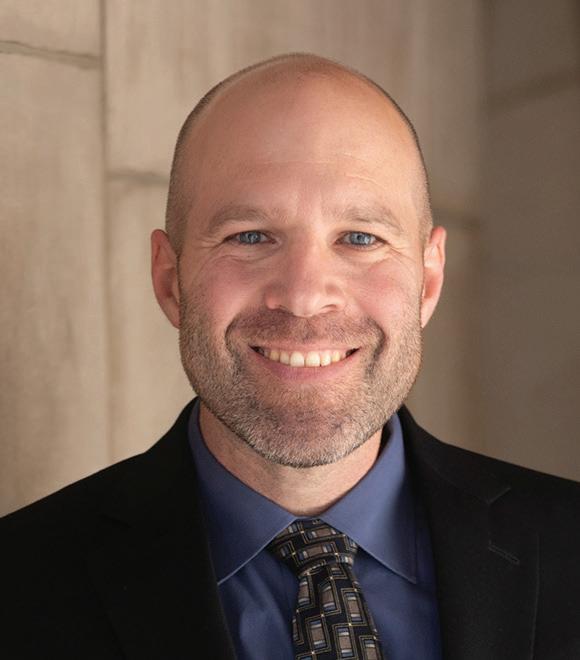
JOHN HOBBS LOSS CONTROL SPECIALIST, LARM
Build understanding
Respond to the person’s statements in a positive, understanding way without lying. Paraphrase what they say to confirm you heard them correctly and to show you are listening. Ask directly what they want or how they are feeling. Many people simply feel ignored or treated unfairly and want to be heard. Show empathy, and if you cannot agree, calmly agree to disagree.
While keeping a safe distance, project a calm, non-threatening posture. Stand at an angle to the person rather than “squaring up.” Keep your hands visible and relaxed in front of you. Avoid sudden movements or rushing toward the subject. Maintain some eye contact to show you are paying attention, but do not stare excessively. Keep a neutral facial expression.
Avoid threats or ultimatums. Instead, set clear, helpful limits. For example, rather than saying “If you don’t tell me your name, I won’t help you,” say “I can’t help resolve this if I don’t know your name.” Guide the person toward better outcomes without being patronizing.
Only one person should speak with the agitated individual. Use a level tone, speak loudly enough to be heard, but never yell. Use simple, short sentences and allow plenty of time for the person to process and respond. You may need to repeat yourself multiple times. Stay polite, caring, and non-reactive; avoid anger, sarcasm, or inflexibility. Listen closely and verbally acknowledge what the person says.
Give the person realistic hope that the situation can improve, using relevant examples when possible. Keep the conversation optimistic and minimize negative consequences without lying. If the person mentions jail, you might respond that jail could be a possibility, but their current actions will greatly influence the outcome.
In most situations, time works in your favor. Slowing down the interaction allows anger to subside, options to emerge, and solutions to develop. Even in difficult cases, prolonging calm contact gives law enforcement more time to arrive. De-escalation is a valuable skill that can prevent or reduce the negative outcomes of intense, hectic, or emergency situations.
Use non-threatening body language
Communicate calmly and effectively
Offer hope and take your time
Set limits without threats








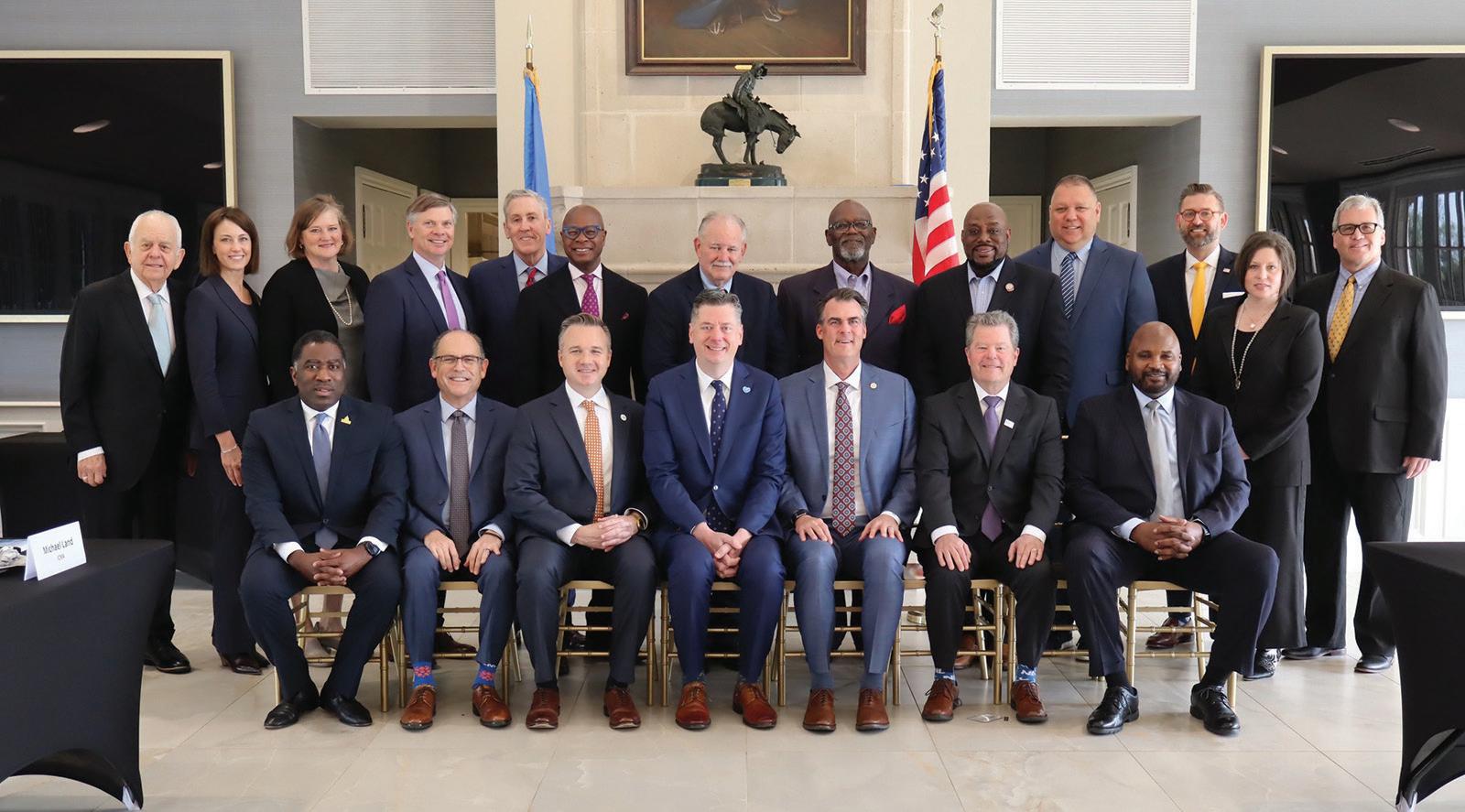
Big Seven national coalition affirms state and local leadership partnership
Lincoln Mayor Leirion Gaylor Baird was among those in attendance
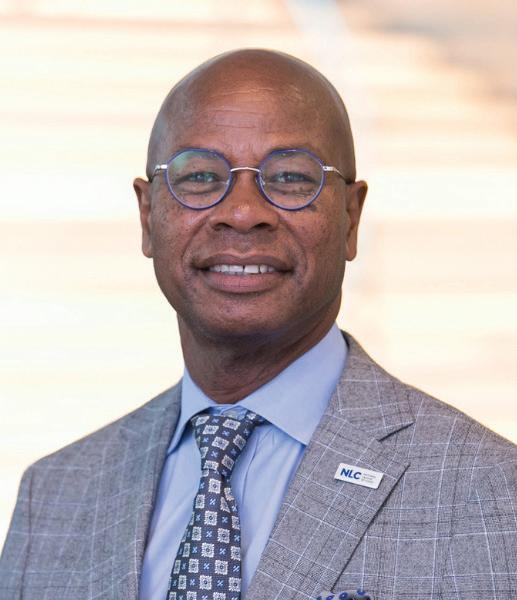
BY CLARENCE ANTHONY, EXECUTIVE DIRECTOR, NATIONAL LEAGUE OF CITIES
Asour nation approaches its 250th anniversary, I recently had the privilege to convene leaders of national associations representing state and local leaders across the country. Known as the Big Seven, made up of the nonpartisan organizations that represent state and local government associations, the gathering in Oklahoma City brought together elected leaderships and my fellow chief executives to consider the role of localities and the state of federalism today.
The Big Seven consists of:
• National Governors Association (NGA)
• National Conference of State Legislatures (NCSL)
• Council of State Governments (CSG)
• National League of Cities (NLC)
• U.S. Conference of Mayors (USCM)
• National Association of Counties (NACo)
• International City/County Management Association (ICMA)
Convening in Oklahoma City
Hosted by NGA Chair and Oklahoma Governor Kevin Stitt, the meeting included governors, mayors, state legislators, councilmembers at the city and county level, and local government leaders.
CLARENCE ANTHONY
At the center of our convening was a simple question: How do we define federalism as it is practiced today, and what does it require of each level of government now?
In Oklahoma, the answer quickly became clear: federalism is more than an abstract concept of government or a legal backstop. It is a living system that works best when federal, state and local governments exercise their shared power and civic responsibilities in coordination as partners in public service. That’s not to say there won’t be disagreements between the levels of government, but our convictions about federalism are critical for resolving such disagreements productively and moving forward in partnership. It requires expertise, mutual respect, and the willingness to administer policy with a confident posture, respecting the roles and responsibilities each level of government plays.
From the beginning, the convening
early engagement in policymaking to litigation, funding decisions, and coalition building — states and localities have agency. Exercising it effectively requires coordination, clarity, and confidence.
For NLC members, it reinforced that cities, towns, and villages are not operating in a vacuum. Local governance is inseparable from national security, economic competitiveness, and America’s standing in the world. It also means that our views on federalism have an outsized impact in our communities. Many of these are playing out across the country today — from preemptions and unfunded mandates to revenue-sharing and technical assistance.
What’s Next?
All Big Seven state and local government associations affirmed our commitment to using this coalition at the national level with a shared purpose, including clearer articulation of individual
For NLC, my focus remains on ensuring local leaders are heard, respected and equipped to get things done. As we mark 250 years of America, this is a time to reflect on what federalism has been, what we are doing to shape it today, and what we want it to be in the future.
America is not a finished project. What endures is the resolve of state and local leaders to keep working together, sometimes in constructive tension to make both stronger.
Prior to the convening, I shared George Washington’s Farewell Address delivered in 1796 with attendees. As George Washington cautioned, “the spirit of encroachment tends to consolidate the powers of all the departments in one.” Two hundred and fifty years later, that warning still resonates. Federalism endures not because it is neat or easy, but because it requires constant care, mutual respect, and partnership across levels of government.
As state and local leaders, our charge is clear: To show up with confidence, expertise, and a shared purpose, working together to protect the balance of power that makes our democracy resilient and

UR
R



Housing
Continued from page 14
down bungalow. She said the group put in funds plus roughly 2,000 volunteer hours to expand the structure and relocate a garage to the grounds. A second project entailed moving a cabin from Johnson Lake and preparing it for sale.
“That spurred a lot of activity in town,” Hansen said, including from individuals seeking to renovate and flip homes. She said the investment group bought three more lots to transform.
The fiveplex Sunset View Villas project, which opened in 2024 with the help of state affordable housing trust funds, was spearheaded by the Bertrand Housing Authority.
Executive Director LaDonna Bennett said the agency’s older, existing rental units were full and its waiting list was growing when it turned to area economic development groups, including Phelps County Development Corp. and SCEDD for support.
“We’ve had a lot of phone calls from younger people looking for a place,” Bennett said.
One of the town’s hurdles, she said, was that elderly people had moved out of their homes but families held onto the vacant properties.
“They’re starting to sell. That’s good,” Bennett said. “Cattle feeders need places for their employees to live.”
Maureen Larsen, director of the Nebraska Department of Economic Development, which administers the affordable housing trust fund, in a statement said there’s been “concerted effort” to increase availability of affordable housing across the state.
Since 1996, the affordable housing trust fund has supported construction or rehab of thousands of homes and assisted nonprofits and local governments in housing

efforts, the DED said. The most recent round of grants, announced last September, awarded $9.9 million to 17 housing projects to help build roughly 300 dwellings.
Sunset Villas rose on the former home of an obsolete trailer park with five one-story 950-square-foot units, each with two bedrooms and one bathroom.
“This thoughtful approach demonstrates how small communities can creatively repurpose existing land, stretch limited resources and deliver impactful housing solutions,” DED said in a statement.
New momentum
Hansen said she noticed a different momentum since leaving after college to pursue a banking career elsewhere in Nebraska and in Colorado. Raised on a farm just outside of town, she moved back in 2008 and jumped into the energy.
A Phelps County Development Corp. newsletter noted activity, including a $2.7 million aquatic center that opened in 2022 and renovation of a century-old downtown building with a yoga studio opened by a Denver transplant.
It said Bertrand was trying to attract visitors with new events such as a Hallmark Christmas and New Year’s Eve party, in addition to the longtime annual rodeo.
Among barriers to growth, Hansen said, has been difficulty in recruiting companies and skilled workers to construct in her small hometown. That has created slower movement than she’d like. But she’s heartened that the population has not declined, and she’s noticed some younger people moving back or to town.
She said a relatively new business and trades mentoring program in the public school system, funded with help from a grant from the Bertrand Area Community Fund, aims to keep more young talent in town and in growing business fields.
“I see the town revitalizing,” said Hansen.
Source – Nebraska Examiner, read more stories at www.nebraskaexaminer.com.
Showcasing America’s municipalities
As we mark the 250th anniversary of the signing of the Declaration of Independence, the National League of Cities will showcase the unique contributions of America’s municipalities. Local Gov 250 is a collaboration of local government associations and interested professionals to educate and celebrate the “democracy at the doorstep” facilitated by cities, counties, regional councils, and tribal governments. National League of Cities is a proud member of this coalition.
This guide is a resource for municipalities looking for inspiration for their America250 celebration. NLC encourages every municipality to join in marking this historic milestone in a way that matches your community’s resources.
Access the America250 Celebration Toolkit here!


EMPOWERING COMMUNITIES & DRIVING GROWTH SINCE 1935
D.A. Davidson & Co. is a trusted financial services firm with deep roots in Nebraska, partnering with cities and villages across the state to deliver meaningful results. From infrastructure improvements to economic growth initiatives, we help communities flourish. Our client-focused approach ensures every solution is tailored, every relationship valued, and every project designed to make a difference.
| (402) 392-7986 | pgrieger@dadco.com
WICKHAM | (402) 392-7989 | cwickham@dadco.com
| (402) 392-7988 | aforney@dadco.com


Performance improvement plans after MULDROW: When is a PIP an adverse employment action?
BY TARA A. STINGLEY * CLINE WILLIAMS WRIGHT JOHNSON & OLDFATHER, L.L.P.
Performance improvement plans, commonly known as PIPs, are often used by employers to address employee performance concerns. When an employee’s performance falls below expectations, a PIP can serve as a structured path toward correction and improvement by providing documented benchmarks, clear expectations, and an opportunity for the employee to improve their performance. However, after the United States Supreme Court broadened the legal standard for what constitutes an “adverse employment action” under federal anti-discrimination law in Muldrow v. City of St. Louis, 601 U.S. 346 (2024),i employers were left questioning which types of common employment practices could potentially expose them to discrimination claims.
A recent decision from the United States Court of Appeals for the First Circuit, Walsh v. HNTB Corp., 169 F.4th 330 (1st Cir. 2025),ii offers important clarity on that question with regard to PIPs and gives practical guidance for employers using them.
General Legal Principles
Under federal anti-discrimination laws such as Title VII of the Civil Rights Act and the Age Discrimination in Employment Act (“ADEA”), an employee who believes they have been discriminated against must satisfy several legal requirements to successfully state a legal claim. An employee generally must show:
(1) they are a member of a protected class;
(2) their job performance met the employer’s legitimate expectations;
(3) the employer subjected them to an adverse employment action; and
(4) the employer did not treat the employee in a class-neutral manner when taking the adverse action.iii
Previously, courts required that the adverse employment action be “material,” causing a “significant” employment disadvantage. This meant something more than a mere inconvenience or minor alteration of job responsibilities. Termination, demotion, and significant pay reductions were the typical examples of qualifying adverse actions.
However, in Muldrow , the Supreme Court rejected the materiality and significance requirements with regard to a sex
discrimination claim under Title VII. The Court held that an adverse employment action includes any conduct by an employer that leaves an employee “worse off” with respect to the “terms or conditions” of employment, regardless of the severity.iv Importantly, employees no longer need to show “significant” harm; a showing of “some harm” to the terms or conditions of their employment is sufficient.v Courts have since extended the Muldrow standard to the ADEA and other anti-discrimination statutes that use similar statutory language. A question left open after Muldrow was how courts would apply this broader standard to employment actions that are not as obviously adverse, such as PIPs. The First Circuit’s decision in Walsh directly addresses this question.
Walsh v. HNTB Corp.: Factual Background
Joanne Walsh worked for HNTB Corporation for over 25 years as a technology support representative.vi In August 2019, when Walsh was 54 years old, HNTB placed Walsh and a slightly older colleague on a three-month PIP. The PIPs were described by the court as “almost identical.”vii Walsh’s PIP identified several performance concerns, including that Walsh was perceived as “contentious, pushing back on suggestions/ ideas and unwilling to look for solutions before saying something can’t be done,” that she “hid in the IT room,” was “reluctant to engage with employees proactively,” and that she failed to maintain the IT office in a way that allowed others to access its resources.viii The PIP also noted Walsh had not improved upon concerns previously identified in her 2018 annual performance review.
The PIP identified its purpose as providing Walsh with “the opportunity to correct her unsatisfactory performance.”ix It did not assign Walsh new job duties, alter her job title or compensation, limit her ability to seek other positions within the company, or otherwise change the formal terms of her employment. Walsh successfully completed the PIP in November 2019.
About 10 months after completing the PIP, Walsh resigned from HNTB. She subsequently filed suit against HNTB alleging age discrimination under the ADEA and
Massachusetts law, arguing the PIP itself constituted an adverse employment action. She also alleged that her postPIP work environment had deteriorated to the point of constructive discharge, meaning her working conditions were so intolerable that a reasonable person would have felt compelled to resign.x
First Circuit’s Holding
On appeal, the First Circuit affirmed summary judgment in favor of HNTB on all claims. Specifically, the court addressed whether Walsh’s PIP constituted an adverse employment action under the new Muldrow standard.
The court acknowledged that Muldrow lowered the standard for employees by eliminating the prior requirement of showing “significant” harm. However, the court emphasized that Muldrow still requires an employee to demonstrate some change to the “terms or conditions” of their employment.xi A PIP does not automatically satisfy that requirement.
The court explained that the analysis is fact-based and PIP-specific, noting “there is no one-size-fits-all answer for whether a PIP constitutes an adverse employment action.”xii The court identified two ends of the spectrum.
On one end, a PIP that warns an employee about performance deficiencies or outlines a plan for skill development, without changing the employee’s duties, job title, compensation, or advancement opportunities, is not an adverse employment action, even after Muldrow. xiii
On the other end, a PIP that assigns new job responsibilities, changes the existing terms of employment, or deprives an employee of potential advancement opportunities may constitute an adverse employment action.xiv The court pointed to Anderson v. Amazon.com, Inc., xv as an example of a PIP that constituted an adverse employment action. There, the PIP gave the employee more and worse tasks, tarnished her permanent record, dampened her prospects of a promotion
or raise, and temporarily prevented her from transferring.xvi
Applying these principles to Walsh’s PIP, the court concluded the PIP fell into the first category and therefore was not an adverse employment action.xvii
The PIP did not assign new duties, alter Walsh’s title or pay, or limit her
ability to seek other employment opportunities.xviii Its only reference to a term of employment was the company’s reservation of its right to terminate Walsh, which existed regardless of the PIP and did not change Walsh’s status as an at-will employee.xix
Continued on page 30 / See Legal

Celebrating Homeownership Month: Rural Development loans can make homeownership a reality
is National Homeownership Month, promoting the benefits of homeownership and access to safe and quality homes. Many rural communities support making homeownership affordable, as it creates strong communities. The Single-Family Housing Direct Home Loan program is available to provide lower-income households with the opportunity to own adequate, modest, decent, safe, and sanitary homes in rural areas.
Single Family Housing Direct Home Loans
What does this program do?
This program allows for 100% financing with zero down payment for eligible buyers to purchase or build a home for their primary residence.
One of Gothenburg’s newest residents was able to purchase a home thanks to working with the Single-Family Housing Team at Rural Development (RD). Christina McLennan learned about RD’s program from her sister and started her application in December 2024. Unfortunately, timing was not quite right when she first submitted her application,
Who is eligible?
Applicants must meet income guidelines, have sufficient repayment ability, and have an acceptable credit history.
All communities in Nebraska are eligible for housing programs with the exception of Fremont, Grand Island, Hastings, Kearney, Lincoln, North Platte, Omaha, and South Sioux City/Dakota City.
Success Stories:

because after finding that she was eligible for the program, the first property contract she signed fell through. However, she was able to find a home later in the summer of 2025. Ms. McLennan shared, “I am so grateful for the seller’s flexibility and willingness to keep working with me.” Since the purchase of her home in January of 2026, she has been working alongside her family, removing old carpet and restoring hardwood floors. When RD checked in with Ms. McLennan this spring, she shared, “At 63, I never thought I’d own a home of my own, and now I do! I still pinch myself as I am walking around my house.” A supportive family and a determined individual remind us that it’s never too late to realize the American dream of homeownership.

What kind of funding is available?
A fixed interest rate loan with standard payback period of 33 years. The interest rate as of June 2026 is 5.125%. Payment assistance subsidy may also be available.
A southeast Nebraska resident shared that her former childhood home was for sale via an estate sale and had been vacant for a few years. She was hoping to purchase and update this home, so submitted an application with Rural Development’s (RD) Single Family Housing Team. While she had shopped around, this seemed to be the most affordable choice for her, although the home did need several updates and repairs. She later learned about the Purchase Rehab Resale program with Southeast Nebraska Development District (SENDD), and they assisted with gathering bids for needed and requested repairs, then signed a contract. Once RD was able to approve financing, SENDD purchased the home and managed the construction process before selling the updated home to the happy new homeowner. SENDD shared, “We’re glad we were able to get this one across the finish line. We truly appreciate your patience and assistance as we worked through everything along the way on this project.” A partnership helped make this Nebraskan’s dream of purchasing and restoring her childhood home a reality.


To learn more about any of the USDA Rural Development Programs that might be of value to your community, visit its website at rd.usda.gov/ne or call the USDA RD main line at (402) 437-5551.

York's comprehensive plan update process is complete
BY MELANIE WILKINSON, JUST MELANIE W. NEWS
TheCity of York’s updating process of the comprehensive plan is now complete, after nearly a year of listening sessions, roundtables, polls, interactive maps, workshops and open houses.
The council was presented with the final draft, which was given approval.
“The data collected was input and we had great engagement from the community,” York City Administrator Sue Crawford said.
A lot of topics were visited through the process, including land use, traffic flows, green space opportunities, housing areas, zoning for the “Tower District” (interchange area), etc.
“It has been a long process, and it needed to be so everyone had a chance to be engaged if they could or wanted to,” said Mayor Barry Redfern.
During the process, the contracted planning firm provided some very interesting information regarding population and more.
“The population of York was projected to be 7,622 in 2020 but instead reached 8,066, exceeding projections by 444 residents. This indicates that in-migration occurred. The most notable changes by age cohort include:
• Gain: Children ages 0-14 increased by 184 more residents than predicted, showing continued family growth.
• Gain: Young adults ages 15-24 gained 269 residents above projections, suggesting stronger retention or in-migration.
• Loss: Working-age adults ages 25-34 fell short of projections by 185 residents, highlighting challenges in attracting young workers or retaining York University graduates.
• Gain: Adults ages 45-54 exceeded projections by 75 residents, suggesting stability in mid-career households.
• Gain: Seniors ages 65-84 added 78 more residents than expected, reflecting an aging population and senior retention.
• Loss: Residents ages 85 and older declined slightly with 27 fewer than projected.
“A variety of reasons drive people to move to and from communities – such as jobs, housing, and quality of life factors like elder care – but the changes between projected and actual populations suggest York was able to attract more families and younger residents than expected. However, the underperformance

in the 25-34 cohort highlights ongoing challenges in retaining working-age adults, which may relate to employment opportunities and housing availability.”
When it comes to economic trends, it was found, “The largest share of York’s workforce is in educational services, health care, and social assistance, which account for 26.1% of all jobs. Manufacturing is the second-largest sector, employing 15.4% of workers, while retail trade and hospitality-related industries together make up more than 23% of employment. Professional and administrative services, construction, and transportation each contribute a smaller but steady share, reflecting a diverse economic base. Other significant segments include arts, entertainment, recreation, accommodation, and food services at 11.3% of the workforce.”
When looking at retail sales, “York’s taxable sales grew by 61% between 2010 and 2023. York continues to demonstrate a strong retail economy, capturing a significant share of spending from both residents and visitors, driven by its prime location and commercial presence along Interstate 80.”
It has been a long process, and it needed to be so everyone had a chance to be engaged if they could or wanted to. ” “
Barry Redfern, Mayor of York
rent, for sale, seasonal, and other categories. Within that total, however, only about 5.5% of all housing units were rentals available for rent. This limited supply creates a barrier to growth, making it difficult for new residents to find housing and for existing residents to move within the community without purchasing a home. If prospective residents cannot establish themselves in York, both population and economic growth may be constrained.
“York’s housing market is relatively affordable with median homes being valued at 2.73 times the median household income. This means that, if housing is available, the market is affordable relative to its population. The greatest challenge appears to be one of availability rather than base cost.”
A significant portion of the comprehensive plan pertains to land use, which outlines considerations
acres, has historically developed in an automobile-oriented manner and lacks safe, convenient options for pedestrians, bicyclists, and internal circulation. The Tower District Master Plan was prepared in September 2024 to proactively guide development and redevelopment of the area. The plan establishes a clear framework for coordinating land use, transportation, and public investment. Through the planning process, multiple conceptual development scenarios were evaluated and refined into a preferred conceptual master plan. The final plan blended mixed-use development near the interstate with transitions to residential, civic, park, and light industrial uses farther north. A key emphasis of the plan was the integration of trailoriented development, mixed-use commercial and entertainment areas, workforce housing, and park space to create a more walkable, bikeable,

Legal _________
Continued from page 25
The court also rejected Walsh’s constructive discharge claim. A resignation becomes a constructive discharge only when working conditions “become so onerous, abusive, or unpleasant that a reasonable person in the employee’s position would have felt compelled to resign.”xx The court concluded that the working conditions Walsh described after the PIP — a supervisor who occasionally raised his voice, managed closely, and took credit for others’ work — did not objectively rise to the level of conditions that would compel a reasonable person to quit. As the court observed, employees must endure “the ordinary slings and arrows that workers routinely encounter in a hard, cold world.”xxi
Practical Takeaways for Employers
While Walsh confirms a typical PIP is not an adverse employment action, the decision also identifies circumstances in which a PIP could be under Muldrow.
A well-drafted PIP should read as a roadmap to success, rather than termination. Employers who approach PIPs as a genuine opportunity for employee growth will be in the best position to avoid discrimination claims while also promoting a productive workplace. The following practices will help ensure a PIP serves its intended purpose.
First, a PIP should clearly state that its goal is to help the employee correct specific performance deficiencies. It should include objective, measurable benchmarks, a reasonable timeframe for improvement, and a description of the oversight, support, or resources the employer will provide throughout the PIP period.
Second, a PIP should avoid changing an employee’s terms of employment. The PIP should not impose new duties or tasks, restrict the employee’s advancement opportunities, or change the employee’s compensation or job title. Such changes can transform a typical PIP into an adverse employment action.
Third, employers should issue PIPs consistently. Selective use of PIPs against employees, without a legitimate basis, could create an inference of discriminatory motive.
Fourth, employers should document the employee’s performance concerns before resorting to a PIP. As Walsh illustrates, a well-documented history of performance concerns, through annual reviews and prior written feedback, evidences the legitimate, non-discriminatory basis for the PIP and ideally should precede it.
Fifth, employers should monitor the employee’s conduct during the PIP consistent with the employer’s underlying EEO policies and practices. As Walsh illustrates, even if the PIP itself is not an adverse action, comments made by supervisors during the PIP period can contribute to a constructive discharge claim if they reflect discriminatory bias. Supervisors should treat employees on PIPs professionally and avoid remarks and conduct that could be interpreted as discriminatory.
*Special thanks to Kylie C. Wisehart for her assistance in the research and preparation of this article.
This article is not intended to provide legal advice to its readers. Rather, this article is intended to alert readers to new and developing issues. Readers are urged to consult their own legal counsel or the author of this article if they wish to obtain a specific legal opinion regarding their particular circumstances. The author of this article, Tara A. Stingley, can be contacted at Cline Williams Wright Johnson & Oldfather, L.L.P., 12910 Pierce Street, Suite 200, Omaha, NE 68144, (402) 397-1700, tstingley@clinewilliams.com or www.clinewilliams.com
Editor’s Note: To request the citations for this article, please reach out to Ashley Wolfe at ashleyw@lonm.org.