WHAT’S INSIDE?
NEBRASKA MUNICIPAL REVIEW Official Publication of the League of Nebraska Municipalities
Learn more about the XXX ADA accessibility mandate and how it applies to your XXX municipality. XXX SEE PAGE 8
AUGUST 2026
NEBRASKA MUNICIPAL REVIEW
What's inside?
Issue No. 1,216 The NEBRASKA MUNICIPAL REVIEW (ISSN 0028–1906) is published monthly and the official publication of the League of Nebraska Municipalities, an association of the cities and villages of Nebraska, published at 1335 L St., Lincoln, Nebraska 68508. Subscription rates are $5 per single copy — $50 plus tax for 12 issues. Periodicals postage paid at Lincoln, Nebraska and at additional mailing offices. Views of contributors, solicited or unsolicited, are their own and not to be construed as having the endorsement of the League unless specifically and explicitly stated by the publisher. The NEBRASKA MUNICIPAL REVIEW is a nonprofit publication administered and supervised by the League of Nebraska Municipalities. All revenue derived from the publication is used by the association to defray publication costs.
League of NE Municipalities staff 402-476-2829 • www.lonm.org L. Lynn Rex, Executive Director Christy Abraham, Legal Counsel Lash Chaffin, Utilities Section Director Cherie DeFreece, Admin Assistant/ Membership Services Assistant Brenda Henning, Membership Services Assistant/ LIGHT Admin Assistant Ethan Nguyen, LNM/LARM Information Technology Manager Shirley Riley, Membership Services Director Jackson Sash, Utilities Field Representative/Training Coordinator Ashley Wolfe, Marketing/Communications Director
LARM staff
Dave Bos, Executive Director Tracy Juranek, Asst. Executive Director, Customer Service Specialist Diane Becker, Communications/Marketing Director Kyla Brockevelt, Executive Administrative Assistant Drew Cook, Customer Service Specialist John Hobbs, Loss Control Specialist James Kelley, Loss Control Specialist Fred Wiebelhaus, Loss Control/Claims Manager
POSTMASTER: SEND ADDRESS CHANGES TO NEBRASKA MUNICIPAL REVIEW, 1335 L STREET, LINCOLN, NEBRASKA 68508.
Have an idea, project or opinion to share? The League welcomes member articles, information, and op-eds. Want to reach local decision makers? The League can help you get your message out to Nebraska’s 3,500+ municipal officials.To learn more, contact Ashley Wolfe at 402-476-2829 or ashleyw@lonm.org. President President-Elect Vice President Past President
Executive Board
Directors
Leirion Gaylor Baird John W. Ewing, Jr. Sharon Powell Larry Evans Rod Petersen Jim Bulkley Betsy Vidlak Mindy Rump Pat Heath Janine K. Schmidt Kyle Svec
Affiliated Sections
City Managers. Clerks Munic. Accounting & Finance Fire Chiefs Utilities
Marlin Seeman, Mayor, Aurora Bryan Bequette, Mayor, Nebraska City David Black, Mayor, Papillion Deb VanMatre, Former Mayor, Gibbon
Mayor, Lincoln Mayor, Omaha Village Board President, Utica Mayor, Minden Mayor, Louisville Mayor, Columbus Mayor, Scottsbluff Mayor, Blair City Administrator, Gering CMC/Treasurer, Morrill City Admin./Utilities Supervisor, Geneva Wes Blecke, Wayne Derek Bargmann, Seward Roger Nash, Hastings Cory Schmidt, Grand Island Gary Thurlow, Atkinson
Supreme Court roundup Features
28
6
Effective disagreement:The hidden discipline that protects leaders under pressure
8
Two deadlines, one big requirement: The ADA accessibility mandate
13
Nebraska Game and Parks: The Land and Water Conservation Fund (LWCF) grant program is now open for applications!
14 15
Hackers hit U.S. water systems: Why recent cyberattacks are a wake-up call for critical infrastructure The 2026 NE Recreation and Park Association Conference is heading to Norfolk!
16
NLC Case Study: Advancing Economic Mobility Rapid grant in Grand Island
20
USDA Rural Development: Public safety equipment and infrastructure replacement or renovation projects
22
City of York marks grand opening, dedication of state-of-the-art fire station
25
Bike Walk Nebraska: New statewide safety campaign focuses on safety of everyone
Columns 4
The Director's Message - L. Lynn Rex, LNM Executive Director - League advocates for legislation developed by a statewide membership-driven process with a unified voice
26
The Legal Corner by Jessica K. Robinson, Cline Williams Wright Johnson & Oldfather, L.L.P. - Using AI at City Hall: What every Nebraska municipality should know
In each issue 3
Municipal Legal Calendar
31
Professional Directory
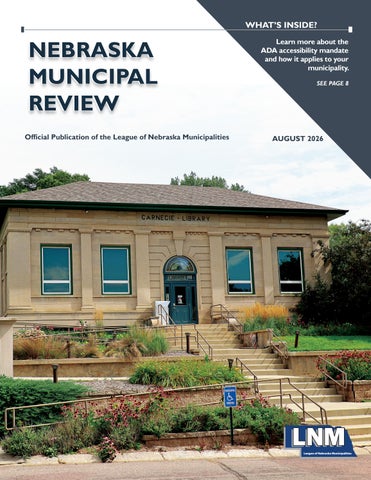
On the cover The Ponca Public Library is one of the original Carnegie Libraries in the state and is still being used for its intended purpose. According to the Nebraska Library Commission, Carnegie Libraries were built between 1901 and 1922 utilizing Carnegie grants.
Municipal Legal Calendar
Larger Cities Legislative Committee
(All statute citations to Revised Statutes of Nebraska)
Chaired by Mayor Don Groesser of Ralston John McGhehey, Mayor, Alliance J.D. Cox, City Manager, Alliance Tobias Tempelmeyer, City Administrator, Beatrice Rusty Hike, Mayor, Bellevue Jim Ristow, City Administrator, Bellevue Mindy Rump, Mayor, Blair Phil Green, City Administrator, Blair David Scott, Deputy City Administrator of Operations, Blair Tom Menke, City Manager, Chadron Jim Bulkley, Mayor, Columbus Tara Vasicek, City Administrator, Columbus Dave Bauer, Mayor Crete Tom Ourada, City Administrator, Crete Jody Sanders, City Administrator, Fremont Kent Ewing, Mayor, Gering Pat Heath, City Administrator, Gering Roger Steele, Mayor, Grand Island Patrick Brown, City Administrator, Grand Island Ryan Schmitz, Utilities Director, Grand Island Mike Evans, Mayor, Gretna Paula Dennison, City Administrator, Gretna Mark Funkey, City Administrator, Hastings Derek Zeisler, Utility Manager, Hastings James Liffrig, Mayor, Holdrege Chris Rector, City Administrator, Holdrege Brenda Jensen, City Manager, Kearney Brad DeMers, Asst. City Manager, Kearney Doug Kindig, Mayor, La Vista Peyton Mastera, City Administrator, La Vista Kevin Pokorny, Director of Administrative Services, La Vista John Fagot, Mayor, Lexington Joe Pepplitsch, City Manager, Lexington Margaret Blatchford, Assistant City Attorney, Lincoln Riley Slezak, Senior Advisor to the Mayor, Lincoln Linda Taylor, Mayor, McCook Nate Schneider, City Manager, McCook Bryan Bequette, Mayor, Nebraska City Perry Mader, City Administrator, Nebraska City Justin Webb, Council Member, Norfolk Scott Cordes, City Administrator, Norfolk Brandon Kelliher, Mayor, North Platte Layne Groseth, City Administrator, North Platte Steve Krajewski, Mayor, Ogallala Kevin Wilkins, City Manager, Ogallala Thomas Warren, Chief of Staff, Omaha David Black, Mayor, Papillion Amber Powers, City Administrator, Papillion Mark Stursma, Deputy City Administrator, Papillion R. Paul Lambert, Mayor, Plattsmouth Emily Bausch, City Administrator, Plattsmouth Don Groesser, Mayor, Ralston Brian Kavanaugh, Council President, Ralston Jack Cheloha, City Administrator, Ralston Art Lindberg, Mayor, Schuyler Lora Johnson, City Administrator, Schuyler Betsy Vidlak, Mayor, Scottsbluff Kevin Spencer, City Manager, Scottsbluff Joshua Eickmeier, Mayor, Seward Greg Butcher, City Administrator, Seward Brandon Bonregard, Mayor, Sidney Brett Kerkman, Vice-Mayor, Sidney Lance Hedquist, City Administrator, South Sioux City Randy Meyer, Council Member, South Sioux City Jill Brodersen, Mayor, Wayne Wes Blecke, City Administrator, Wayne Barry Redfern, Mayor,York Dr. Sue Crawford, City Administrator,York
Smaller Cities Legislative Committee
Chaired by Tom Goulette, City Administrator of West Point
Lisa Schroedl, City Administrator/Clerk/Treasurer, Ainsworth Jessica Quady, City Administrator, Ashland Crystal Dunekacke, City Administrator/Economic Developer, Auburn Marlin Seeman, Mayor, Aurora Adam Darbo, City Administrator, Aurora Chris Anderson, City Administrator, Central City Alan Michl, Chairperson, Exeter Becky Erdkamp, Clerk/Treasurer, Exeter Kyle Svec, City Administrator, Geneva Matt Smallcomb, City Administrator, Gibbon Gary Greer, City Administrator, Gothenburg Jana Tietjen, Clerk, Hebron Kelly Oelke, City Administrator, Hickman Janine K. Schmidt, CMC/Treasurer, Morrill Sandra Schendt, Clerk/Treasurer, Nelson David Russell, Director of Gov. Affairs, NMPP Energy Sandy Kruml, Clerk/Treasurer, Ord Mike Feeken, Mayor, St. Paul Sandra Foote, Council Member, Superior Warren Myers, City Administrator, Sutton Jessica Meyer, City Administrator, Syracuse Kelly Adamson, City Council Member, Tekamah Sharon Powell, Village Board President, Utica Kyle Arganbright, Mayor,Valentine Melissa Harrell, City Administrator, Wahoo Desiree Soloman, City Attorney, Waterloo Stephanie Fisher, City Administrator, Waverly Tom Goulette, City Admin./Utility Superintendent, West Point Randy Woldt, Utilities Superintendent, Wisner Robert Costa, Community Planner,Yutan
OCTOBER 2026 • • • • • • • • • • • • • • • • • • • • • • • • • • • • • • • • • •
• • •
•
CITIES OF THE FIRST CLASS Within 10 days following meeting or before next meeting (whichever is sooner) Clerk to have minutes available for public inspection. (84-1413) Within 15 days of Passage Clerk publishes ordinances passed. (16-405) Within 30 days of Council meeting Clerk publishes official proceedings of meeting including claims. (19-1102) First Day Fiscal year begins. (16-701) After start of fiscal year Treasurer makes annual report to Mayor and Council. (16-720) Oct. 9 A vote to exceed levy limits must be approved by this date (77-3444) On or before Oct. 15 Final Property Tax Request Certified and forwarded to County Clerk. (77-1632) Oct. 31.Annual Certification of Program Compliance filed with the Board of Public Roads Classifications and Standards (39-2121) Within 20 days after end of month Treasurer files monthly financial report. (16-318) Within 60 days after close of fiscal year Treasurer publishes Statement of Receipts and Disbursements. /Semi-annual financial statement published. (16-318) (16-722) (19-1101) * *.Clerk must prepare agenda prior to next Council meeting. (84-1411) Within six months after close of fiscal year audit of city’s accounts completed. (19-2903) CITIES OF THE SECOND CLASS Within 10 days following meeting or before next meeting (whichever is sooner) Clerk to have minutes available for public inspections. (84-1413) Within 15 days of Passage Clerk publishes ordinances passed. (17-613) Within 30 days of Council meeting Clerk publishes official proceedings of meeting including claims. (19-1102) First Day Fiscal year begins. (17-701) Oct. 9 A vote to exceed levy limits must be approved by this date (77-3444) On or before Oct. 15 Final Property Tax Request Certified and forwarded to County Clerk. (77-1632) Oct. 31.Annual Certification of Program Compliance filed with the Board of Public Roads and Classification and Standards (39-2121) Within 20 days after end of month Treasurer files monthly financial report. (17-606) Within 60 days after close of Fiscal Year Treasurer publishes Statement of Receipts and Disbursements. (17-606) (191101) * * Clerk must prepare agenda prior to next Council meeting. (84-1411) Within six months after close of fiscal year audit of city’s accounts completed. (19-2903) VILLAGES Within 10 days following meeting or before next meeting (whichever is sooner) Clerk to have minutes available for public inspections. (84-1413) Within 15 days of Passage Clerk publishes ordinances passed. (17-613) Within 30 days of Board of Trustees’ meeting Clerk publishes official proceedings of meeting including claims. (19-1102) First day.Fiscal year commences. (17-701) Oct. 9 A vote to exceed levy limits by election or by townhall meeting must be approved by this date (77-3444) On or before Oct. 15 Final Property Tax Request Certified and forwarded to County Clerk. (77-1632) Oct. 31.Annual Certification of Program Compliance filed with the Board of Public Roads and Classification and Standards (39-2121) Within 20 days after end of month Treasurer files monthly financial report. (17-606) Within 60 days after close of Fiscal Year Treasurer publishes Statement of Receipts and Disbursements. (17-606) (191101) * * Clerk must prepare agenda prior to next Board meeting. (84-1411) Within six months after close of fiscal year audit of village’s accounts completed unless audit requirement waived by State Auditor. (19-2903) (84-304) ALL MUNICIPALITIES On or before November 1.Each municipality which offers a defined benefit plan pursuant to section 401(a) of the Internal Revenue Code which was open to new members on January 1, 2004, shall submit written notification to the Nebraska Retirement Systems Committee of the Legislature that it offers such a plan. (13-2402) October 15 Each municipality that offers such a defined benefit retirement plan shall electronically file with the committee a copy of the most recent annual actuarial valuation of the retirement plan. (13-2402) October 15 Each municipality that offers such a defined benefit retirement plan shall electronically file a report with the committee if either of the following conditions exists as of the latest annual actuarial valuation of the retirement plan: (i) The contributions do not equal the actuarial requirement for funding; or (ii) the funded ratio is less than eighty percent. (13-2402) October 15 Each municipality which offers such a defined benefit plan shall conduct an experience study at least once every four years to review the actuarial assumptions used to determine funding needs for its defined benefit plan. Each such political subdivision shall electronically file a copy of the most recent actuarial experience study with the committee by October 15, 2016, and shall electronically file a copy of each study completed pursuant to this subsection by the next October 15 after completion of the study (13-2402)
LEAGUE OF NEBRASKA MUNICIPALITIES
UPCOMING CONFERENCES ANNUAL CONFERENCE
Sept. 23 - 25, 2026
UTILITIES/PUBLIC WORKS CONFERENCE
Jan. 13 - 15, 2027
MIDWINTER CONFERENCE
Feb. 22 - 23, 2027
Director’s Message
League advocates for legislation and policies developed by a statewide membership-driven process BY L. LYNN REX, EXECUTIVE DIRECTOR, LNM
S
Omaha (metropolitan class), Lincoln (primary class), and the 31 cities of the first class. The Mayors and City Managers/Administrators of every city of the first class are invited to serve along with others interested in doing so. The 30 members of the SCLC represent villages and cities of the second class. It is more difficult for some officials from smaller municipalities to participate in person since many do not have the flexibility to do so; hopefully, more officials will join the committee and participate by Zoom. If you are interested in being a member of either committee, please email Brenda Henning at brendah@ lonm.org. The first meeting of the LCLC and SCLC was held Aug. 27 in Lincoln at the Joe Hampton Conference Center in the League Building. Members of the LCLC and SCLC have the option to meet in person or by Zoom for the first and third meetings. Both Committees will meet Sept. 23 before the League Annual Conference and again Oct. 29 to review additional requests for legislative action. Committee members will continue discussing a wide variety of issues, including: the property tax cap on municipalities and counties (Property Tax Growth Limitation Act); a proposed constitutional amendment to address unfunded mandates; local option sales tax refunds due to state incentive programs; and reducing municipal keno tax. Other requests for legislative action relate to Flock cameras, data centers, and electric vehicles (e-bikes, e-motos, and e-scooters). Committee members also will be considering requests involving the governance and/or membership of planning commissions, airport authorities, and library boards. Following the national trend, the historic “partnership” between the State of Nebraska and its political subdivisions continues to evolve with legislative efforts to increase state pre-emption, impose unfunded mandates, and restrict sources of revenue. Notwithstanding, the League Executive
4
NEBRASKA MUNICIPAL REVIEW
ince 1910, the League of Nebraska Municipalities has been the ONLY statewide organization representing the interests of cities and villages with a unified voice before the Nebraska Legislature, state and federal agencies as well as other organizations. With grassroots support from members, the League effectively advocates for local control and decisionmaking empowering municipal officials to shape the destiny of their city or village and improve the quality of life of their citizens. The League’s legislative team never has a potential conflict of interest when testifying at hearings or meeting with the Governor, State Senators, members of Nebraska’s Congressional delegation, state or federal agencies, and others. In contrast to lobbyists with multiple clients, the League’s legislative team only represents YOU! As a nonpartisan, membership-driven organization, the League’s legislative policy development relies on the dedicated municipal officials serving on the League Larger Cities Legislative Committee (LCLC), chaired by Ralston Mayor Don Groesser; and the Smaller Cities Legislative Committee (SCLC), chaired by Tom Goulette, City Administrator of West Point. Both officials have chaired these committees for many years. (Members of both committees are listed every month on page 2 of the Review.) Special thanks to the elected and appointed officials from across the state serving either on the LCLC or SCLC. They commit a significant amount of time and effort to review and make recommendations on requests for legislative action submitted by municipal officials, State Senators, state agencies, statewide organizations, and others to the League Executive Board. The 15 members of the League Executive Board are elected at the Annual Business Meeting during the League Annual Conference. The 66 members of the LCLC include officials from
Board recognizes the importance of continuing to advocate for a restored “balance of power” and a fundamental respect for the distinct roles of the state and its municipalities. This is imperative in order to grow Nebraska’s economy and provide essential and desired services to the citizens of our state, including, but not limited to: public health and safety, transportation and utility infrastructure, community and economic development, workforce development, and affordable housing. The League’s advocacy before the Legislature on behalf of cities and villages in Nebraska continues to be critically important since municipalities are subject to “Dillon’s Rule.” Judge John Forrest Dillon described local governments in an 1868 case as “creatures of the state” with only those powers as authorized by the state. The Nebraska Supreme Court has consistently upheld Dillon’s Rule as noted in the case below. “Legislative grants of power are strictly construed pursuant to what has become known as Dillon’s rule, which provides: ‘[A] municipal corporation possesses and can exercise these powers only: (1) Those granted in express terms; (2) those necessarily or fairly implied in, or incident to, the powers expressly granted; and (3) those essential to the declared objects and purposes of the municipality, not merely convenient, but indispensable.’” Consumers Coal Co. v. City of Lincoln, 109 Neb. 51, 69-70, 189 N.W. 643, 650 (1922). After reviewing recommendations from both League Legislative Committees, the League Executive Board will finalize the League Legislative Package for the 2027 session. Thanks to the many State Senators who introduce legislation on behalf of the League assuring that cities and villages have the “grant of power” from the Legislature to govern effectively and provide necessary services and programs to citizens. AUGUST 2026
Above: League Executive Board Member Sharon Powell, Village Board President of Utica, shares her thoughts at the Executive SCLC meeting. Bottom left: Following the LCLC meeting, League President-Elect Bryan Bequette, Mayor of Nebraska City, visited with League President Marlin Seeman, Mayor of Aurora. Below right: League Vice President David Black, Mayor of Papillion, visits with LCLC Committee Member Art Lindberg, Mayor of Schuyler, before the LCLC meeting.
A shot of the LCLC in action as members converse about proposed legislation for the 2027 session.
(From left to right): League Executive Board Member Jim Bulkley, Mayor of Columbus; League President Marlin Seeman, Mayor of Aurora; League President-Elect Bryan Bequette, Mayor of Nebraska City; and League Vice President David Black, Mayor of Papillion.
5
Effective disag The hidden discipline that protects leaders under pressure BY MATTHEW JOHNSON, ICMA-CM, TOWN MANAGER - JAMESTOWN, NC
T
he moments that test a leader’s governance, scrutiny is part of resolve most rarely announce public service, and disagreement is themselves. They do not arrive labeled as “Staff watch how leaders part of democracy. But experienced respond to challenges, crises. They appear as routine questions, leaders recognize when the nature and governing bodies clarifications, or requests for additional of the exchange changes. Staff stop information. On paper, nothing seems taking notes and begin watching, observe whether unusual. leadership reactions are communication becomes more I experienced a moment like that grounded or defensive.” cautious, and the conversation during a public meeting when a routine moves beyond the issue itself and agenda item shifted unexpectedly. A toward questions of credibility, line of questioning moved beyond the authority, and intent. policy itself and into questions of the administration’s The underlying question becomes unspoken but credibility and intent. The air in the room changed. Staff powerful: Is the institution still in control of itself? who had been confidently presenting moments earlier When that question begins to surface, leadership became visibly still. The governing body was no longer responsibility shifts. The leader is no longer managing evaluating the item. They were watching the response. information; they are managing institutional stability. In that moment, I realized the most important leadership task was not providing a faster or more Why Traditional Leadership Training Falls Short detailed answer. It was preserving institutional stability. Local government leaders ae extensively trained in By slowing the exchange, reinforcing process, and budgeting, planning, policy implementation, and responding with clarity rather than defensiveness, the operational management. These technical skills are temperature in the room gradually lowered. The facts essential. But disagreement under pressure is not had not changed, but something more important had primarily a technical challenge. It is a human one. been protected. The institution remained intact. When individuals perceive a threat to their authority, Most local government leaders recognize this moment credibility, or control, the brain’s threat detection when they encounter it, yet few have language to system activates automatically—the “fight or flight” describe it, and even fewer have been trained to manage response. This response prepares the individual for it. This is the discipline of effective disagreement. protection rather than collaboration. Rational analysis narrows and defensive behaviors emerge. When Disagreement Becomes Institutional Risk These behaviors often appear procedural, such as Disagreement is not inherently harmful. In fact, healthy repeated requests for information, public questioning, disagreement strengthens governance. It improves and escalating demands for clarification. But beneath decisions, increases transparency, and builds public trust. these behaviors lies a deeper motivation: restoring The risk emerges when disagreement shifts from policy certainty and control. evaluation to institutional destabilization. This is not dysfunction. It is human biology. The These moments often begin subtly. A question during challenge arises when these individual threat responses a public meeting, an email copied broadly in the name begin to influence institutional behavior. Staff become of transparency, or a request framed as clarification hesitant, communication narrows, and decisionbut experienced as suspicion. On its surface, the making slows. Leaders spend more time managing exchange appears routine. Questions are part of perceived risk than advancing organizational priorities. 6
NEBRASKA MUNICIPAL REVIEW
reement
Gradually, the institution shifts from mission-focused to self-protective. This shift rarely occurs through a single dramatic event. It most often occurs through accumulation. Small moments of instability that, left unaddressed, begin to reshape how the organization functions. Over time, institutional confidence erodes. Leaders as Sources of Stability In uncertain environments, people look to leadership behavior for cues. Staff watch how leaders respond to challenges, and governing bodies observe whether leadership reactions are grounded or defensive. These observations shape how others interpret the institutional environment. When leaders respond reactively, uncertainty spreads. When leaders respond with calm clarity, stability spreads. Leadership composure signals that the institution remains grounded. Leadership clarity signals that processes remain intact. Leadership restraint signals that decisions will be guided by structure rather than emotion. Effective leaders understand that their response to disagreement teaches others how the institution operates. Three Practical Tools Leaders Can Apply Immediately Effective disagreement is not theoretical. It is practical. Leaders can strengthen institutional stability in real time using specific behaviors. 1. Reinforce Process Before Providing Answers. The instinctive response to disagreement is to immediately answer the question. But answering too quickly can unintentionally reinforce the AUGUST 2026
perception that institutional direction is governed by pressure rather than process. Instead, effective leaders reinforce process first. An example response: “We will review that question through our established process and provide a complete and accurate response.” This response accomplishes two objectives simultaneously. It ensures accuracy while reinforcing structure, and it demonstrates that the organization operates through process rather than reaction. 2. Protect Role Clarity. Institutional stability depends on clear understanding of governance roles. When these roles become blurred, instability follows. Effective leaders reinforce clarity without asserting personal authority. An example response: “Our responsibility is to administer adopted policies and ensure their consistent implementation. We will continue to do so in alignment with governing body direction.” This protects institutional function while maintaining professional neutrality. 3. Slow the Moment. Pressure creates urgency. Ur g e n c y i n v i t e s r e a c t i v e decisions. Reactive decisions often introduce additional instability. Effective leaders slow the moment. Leadership experts emphasize that in difficult conversations, a leader’s first response should be intentional rather than reactive. A strategic pause allows the leader to respond with intention rather than instinct. Simple language Continued on page 18 / See Disagree
7
Author speaking at the 2026 Annual Conference
Two deadlines, one big requirement:
The ADA accessibility mandate
BY BROCK FUEMMELER, PRESIDENT, IMS TECHNOLOGY GROUP
This article originally ran in the March/April issue of the Missouri Municipal Review. A few changes have been made to ensure accuracy.
A
cross Nebraska—and the entire country—local governments are facing an important change in how they manage digital information. A new federal rule now requires public organizations to make their online and digital content accessible to people with disabilities. This change is often called the ADA digital accessibility mandate. Many municipalities have heard about this requirement but are unsure what it really means or how to prepare. By looking at the issue through the “5 W’s” - Who, What, Where, When, and Why - we can break the mandate into simple, practical terms.
WHO is affected? The new accessibility requirements apply to all state and local government organizations. That includes: • Cities and villages • Counties • Municipal departments • Public utilities • Police and fire departments • Libraries • Public schools and universities • Any agency or board that serves the public
In short, if your organization is part of local government in Nebraska, this mandate applies to you. The rule exists to protect people with disabilities, including those who are blind or have low vision, are deaf or hard of hearing, have mobility challenges, or have cognitive or learning disabilities. These residents must be able to access government information in the same way as everyone else. This requirement does not just apply to large cities. Small towns, rural counties and special districts are included as well. The size of your community does not determine whether the rule applies—it only affects how soon you must comply.
WHAT does “digital accessibility” really mean? Many people assume digital accessibility only refers to a city or county website. While websites are a major part of the requirement, accessibility goes far beyond that. Digital accessibility means that all information your organization provides electronically must be usable by people with disabilities. This includes: • Public-facing content • Websites • Online forms • Meeting agendas and minutes • Budgets and reports • Permits and applications • Public notices • PDFs and downloadable documents • Social media posts 8
• Internal and direct communication • Emails sent to residents • Attachments shared with the public • Online portals • Electronic newsletters • Documents provided upon request The key point is this: accessibility is not limited to what appears on your homepage. Any document or message that your organization creates and distributes digitally must be accessible. For example, a PDF agenda posted online for a city council meeting must be readable by screen-reading software. A utility bill emailed to residents must be formatted so that someone with visual impairment can understand it. A job application posted on your website must be usable by someone with limited visibility. If a document is necessary for a resident to participate in a government program, service or activity, it must be accessible. NEBRASKA MUNICIPAL REVIEW
WHERE does the mandate apply? Accessibility is not limited to one specific location or platform. If your organization is providing information in digital form—no matter where or how—it must meet accessibility standards. Even documents stored for many years, such as archived meeting minutes or old ordinances, may need to be made accessible if they are still being used by the public. The rule focuses on equal access. If a resident can find and use information online, a resident with a disability must be able to do the same.
WHEN do municipalities need to comply? One of the most important parts of this mandate is the timeline. The federal government has created two different compliance deadlines based on community size: Larger Communities: Applies to cities, counties, and public entities serving 50,000 people or more. Deadline- April 24, 2027 Smaller Communities: Applies to cities, counties, and public entities serving fewer than 50,000 people. Deadline - April 26, 2028
These deadlines are firm. They are not suggestions or long-term goals. By these dates, public organizations must already have their digital content in compliance. For many Missouri municipalities, this timeline is closer than it appears. Local governments often manage thousands of documents created over many years. Reviewing and updating all that material can take significant time and planning. It is also important to understand that accessibility is not a one-time project. Any new document created after the deadline must also be accessible. Accessibility becomes part of everyday operations. Continued on the following page
YOUR VISION. OUR EXPERTISE. BUILDING AQUATIC DREAMS FOR YOUR COMMUNITY.
BURBACHAQUATICS.COM | 608-348-3262 SUPPORT@BURBACHINC.COM | PLATTEVILLE, WI AUGUST 2026
9
Author speaking at the 2026 Annual Conference
The mandate applies everywhere digital information is shared. This includes: • Official municipal websites • Online document repositories • Email systems • Public records portals • Online payment systems • Social media platforms • Internal systems used to communicate with the public
Author speaking at the 2026 Annual Conference
WHY was this mandate created? The purpose of the rule is simple: equal access. For years, much of the public’s interaction with government has been moved online. Residents pay bills, apply for permits, read council agendas, and communicate with city hall through digital tools. But for millions of Americans with disabilities, much of this information has been difficult—or impossible—to use. A person who is blind may not be able to read a scanned PDF that lacks proper formatting. Someone who relies on assistive technology may not be able to navigate an online form. A resident with limited vision may not be able to understand poorly structured documents. The Americans with Disabilities Act (ADA) has always
required equal access to government services. The new mandate simply updates those long-standing principles for the digital world. By requiring accessibility, the federal government is ensuring that: • Residents with disabilities can participate fully in civic life. • Government communication is inclusive. • Public services are available to everyone. • Local governments avoid discrimination, even if unintentional. • Accessibility is not just a technical requirement—it is a civil rights issue.
Common misunderstandings Because the topic is new to many municipalities, several myths have developed.
MYTH: “Our website vendor handles accessibility, so we’re covered.” REALITY: Even if your website itself meets accessibility standards, the documents you post on it—such as PDFs, forms, and reports— must also be accessible. Website accessibility alone is not enough.
MYTH: “Old documents don’t matter.” REALITY: If archived documents are still posted online and used by the public, they may need to be made accessible.
to get started:
1. Assign ownership
Identify who is responsible for accessibility compliance.
2. Create a plan
Establish a roadmap with goals, timelines, and standards.
MYTH: “Accessibility only affects people with severe disabilities.” REALITY: Accessible design benefits many people, including older adults,
3. Inventory your PDFs
MYTH: “This only applies to big cities.” REALITY: Every public entity is included. The only difference between large
4. Prioritize high-risk content
mobile device users, and anyone who needs clearer, betterorganized information.
and small communities is the compliance deadline.
Understand the size of your existing document backlog.
Focus on frequently used or required public documents first.
The risks of ignoring accessibility
Failing to comply with the mandate can lead to serious consequences. Local governments that do not provide accessible digital content may face:
5. Assess and budget
• Civil rights complaints • Loss of public trust • Investigations by federal agencies • Potential impacts on state or • Lawsuits federal funding • Required corrective action plans Beyond legal risks, inaccessibility can prevent residents from participating in their own local government. That undermines transparency and public service. 10
5
Steps
Run a sample audit to estimate remediation effort and cost.
NEBRASKA MUNICIPAL REVIEW
Moving forward The ADA digital accessibility mandate represents a major change in how municipalities manage information. But it is also an opportunity. By improving accessibility, local governments can: • Communicate more clearly • Improve transparency with all residents • Strengthen public engagement • Modernize outdated records • Demonstrate a commitment to inclusion The key is to begin planning early. Municipalities should start by evaluating current websites, documents, and communication practices. Training staff, updating workflows, and creating long-term strategies will be essential steps. Accessibility is not just about meeting a deadline—it is about ensuring that every member of the community can fully participate in local government.
Final thoughts Nebraska municipalities exist to serve all residents. The new digital accessibility mandate helps make sure that “all residents” truly means everyone. By understanding the who, what, where, when and why of this requirement, local leaders can take confident steps toward compliance—and toward a more inclusive future. About the Author: Brock Fuemmeler is president of IMS Technology Group, a Missouri-based information management company headquartered in Mexico, Missouri. IMS Technology Group provides digital accessibility services to organizations nationwide, including municipalities, school districts, and other public entities. The company partnered in developing an innovative PDF remediation platform called Accessibility on Demand, designed to help organizations efficiently meet ADA and WCAG compliance requirements. Missouri municipalities can utilize Statewide Contract MS250263001 for accessibility services. To learn more about IMS Technology Group and its accessibility solutions, visit www.imstechnologygroup.com.
Building a Better Future in NEBRASKA With a Strong Public Finance Partner D.A. Davidson & Co. is committed to strengthening the infrastructure and enriching the lives of people in our communities throughout Nebraska and across the nation.
Our bankers specialize in: • Bond Anticipation Notes • Paving Bonds • Water and Sewage Bonds • General Obligation Bonds • Utility System Revenue Bonds • Lease-Purchase Financing
Call:
(402) 392-7986 | Paul Greiger (402) 392-7989 | Cody Wickham (402) 392-7988 | Andy Forney (402) 392-7933 | Jerry Spethman
An Electric Pump Company
You can count on us for all your fluid handling and process solutions!
450 Regency Parkway, Suite 400 Omaha, NE 68114 | (800) 206-7523 D.A. Davidson & Co. member FINRA and SIPC
dadavidson.com
800-383-PUMP
www.electricpump.com AUGUST 2026
402-333-9660
www.mc2h2o.com 11
ADA Web Accessibility: A Practical Checklist for Cities On April 24, 2024, the United States Department of Justice (DOJ) established a final rule requiring all state and local governments to ensure their public-facing websites and mobile applications meet Web Content Accessibility Guidelines (WCAG) 2.1, Level AA. Compliance timelines vary by population size and begin between 2027 and 2028.
What the New ADA Rule Requires ☐ Web and digital content must meet WCAG 2.1 AA standards ☐ Applies to websites, documents and multimedia ☐ Enforced by the U.S. Department of Justice ☐ Compliance deadlines vary by population size
At-Risk Areas for Cities
Compliance Deadlines April 24, 2027 – Public entities (other than special districts) serving populations of 50,000 or more. April 26, 2028 – Public entities serving populations of fewer than 50,000. These deadlines apply to all digital content, including websites, mobile apps and electronic documents, unless covered by an exemption
Alt Text & Images ☐ All images should include descriptive alt text ☐ Logos include alt text identifying the organization ☐ Charts and graphics should include text descriptions ☐ Text is not embedded in images alone, include captions (example: a social media post) Alt text should describe meaning, not appearance.
☐ PDFs (agendas, minutes, reports, etc.) ☐ Websites ☐ Images without alt text ☐ Videos without captions ☐ Online forms ☐ Archived content still publicly available ☐ Archived content that has been modified after comply date
DOJ has developed a fact sheet recommending first steps for state and local governments available at www.ada.gov/resources/web-rule-first-steps - The summary is designed to provide introductory information about the rule’s requirements, summary of exceptions and other information about complying with the rule.
PDF & Documents (new content) *For pdf documents moving forward after comply deadline
PDF & Documents (existing content)
*For pdf documents currently exisitng on website and/or website archives
☐ PDFs are not scanned images of text ☐ Documents use built-in heading styles ☐ Reading order is logical ☐ Links describe the destination (not “click here”) ☐ Tables include proper headers ☐ Document title is set in properties ☐ Accessibility checker has been run on document to ensure compliance
First Steps Every City Can Take
☐ Prioritize content that is still public and in use ☐ Focus first on high-traffic or required documents such as meeting minutes and online forms ☐ Remediate to standards content when it is updated or revised after comply date ☐ Remove content that is no longer needed ☐ Document decisions and progress as good-faith efforts.
Responsibility & Ownership
☐ Designate an internal accessibility point person ☐ Create a plan of action ☐ Inventory public-facing digital content ☐ Prioritize high-use or required materials ☐ Use basic accessibility checkers ☐ Document good-faith efforts
☐ An accessibility point person is identified ☐ Roles are defined across departments and understanding of basic expectations ☐ IT, communications & leadership are aligned ☐ Accessibility is built into workflows going forward ☐ ADA has long required public entities with 50 or more employees to designate an ADA coordinator.
Prepared by: Missouri Municipal League - Learn more: mocities.com
*This checklist is intended for awareness and planning purposes and does not constitute legal advice.
12
Version 2.0 – March 2026
NEBRASKA MUNICIPAL REVIEW
Nebraska Game & Parks
The Land and Water Conservation Fund (LWCF) grant program is now open for applications! BY AMELIA BAKER AND SHARI SORENSON, NEBRASKA GAME & PARKS
T
his federally funded program administered through the Nebraska Game and Parks Commission supports outdoor recreation in Nebraska by providing funding to eligible state and local government entities for acquiring, developing, and renovating parks, recreation areas, and public lands. The LWCF grant application window closes October 30, 2026, at noon (CST).
INTERESTED IN APPLYING FOR FUNDING? VIRTUAL OFFICE HOURS - Pop in if you have questions on the LWCF grant portal, grant program, or application questions. Thursday, Aug. 20; 11 a.m.-noon (CST) JOIN HERE
Monday, Sept. 21 noon-1 p.m. (CST) JOIN HERE
Tuesday, Oct. 6 2-3 p.m. (CST) JOIN HERE
HOW TO APPLY FOR LWCF
There are detailed guides available to help project sponsors prepare for the grant application. For example, the standard application guide can be found here, under the Applying for funds section. All proposed projects must align with the outdoor recreation priorities identified in the current Statewide Comprehensive Outdoor Recreation Plan (SCORP). One of the most important questions in the application is Question 5 – Describe how the project aligns with SCORP Priorities. Alignment with SCORP is critical – it’s worth a third of the overall score!
Using an example from an LWCF project at Fort Robinson State Park, we will lay out how Question 5 may be answered.
Game and Parks proposes expanding equestrian campsites and facilities at Fort Robinson State Park in keeping with current demand and the extensive tie the fort has always had with horses and their riders. Fort Robinson State Park (Fort Robinson) is the largest of the state parks comprising of 22,000 plus acres of exquisite Pine Ridge scenery, Old West history, exceptional lodging, scenic camping and the park’s own bison, longhorn herds, and horses. The park is a horse rider’s paradise offering 20 miles of trails within the park and other trails. The park has over 400,000 annual visitors, mainly compressed during the summer camping season, and approximately 69% of the summer visitors are from outside Nebraska, all heavily driven by regional trail riders and history enthusiasts. Although the park has many facilities and amenities, the proposal focuses only on existing equestrian facilities which are: equestrian fields, a working historic barn with stalls, the Mare Barn complex which includes indoor stalls and outdoor pens, and 20 campsites near Mare Barn. The current campsites are typically booked out months in advance, and neither the number of horse pens or campsites meet the number of requests received by the park. Game and Parks gauges the need and desire for facilities based on park visitor surveys, public comments at quarterly meetings, and camp site requests. A specific survey regarding the proposed project was offered in 2022 and 2023 and based on over 400 responses, specific components were selected for the expansion. The project proposes the following: Adding 25 full‐service camping pads and 30 horse pens, road work, installation of water, sanitary sewer and electrical utilities, a concrete run at the horse pens, general seeding, and site restoration. In addition to being full-service, the pads will extend to accommodate horse trailers. Behind the pens, a sloped concrete run will carry debris downhill to a designated waste area allowing for easy cleaning and maintenance. The campground would be conveniently located next to modern restrooms, laundry facility, and the Mare Barn complex. The components of this proposal have been designed to meet the needs of the equestrian visitors, require minimal maintenance, and of materials with a long useful life. This project will enhance and support the extensive list of equestrian events at the park: 4-H Horse Camp in June, weekly rodeos on Thursdays during the summer, annual group rides and a Remount Endurance ride in September, two guided trail rides, pony rides for children under 5, and stagecoach ride which takes a historic loop around the fort grounds. In addition Continued on page 14 / See LWCF
AUGUST 2026
13
Hackers hit U.S. water systems:
Why recent cyberattacks are a wake-up call for critical infrastructure A BY LOCKTON CYBER & TECHNOLOGY PRACTICE
series of coordinated cyberattacks targeting municipal water systems across the United States has renewed concerns about the vulnerability of critical infrastructure. Although no drinking water contamination was reported, the incidents demonstrated how cybercriminals can disrupt essential public services by compromising operational technology (OT) systems that manage water treatment and distribution. Between July 26 and 27, 2026, more than 30 municipal water systems in Minnesota experienced cyber-related disruptions. Communities including Braham, Plymouth, South St. Paul, and Maple Plain reported issues affecting automated water and wastewater operations. Federal cybersecurity officials reported that attackers gained access to programmable logic controllers (PLCs), the industrial computers responsible for critical infrastructure processes. In several cases, operators were locked out after passwords were modified. Importantly, water quality was not affected, and operators maintained service through manual controls and contingency procedures. While no organization has officially been identified as responsible, preliminary assessments suggested a possible connection to Iranian-linked threat actors. No ransom demand was reported, indicating disruption rather than financial gain may have been the objective. The response quickly expanded to include state and federal agencies. Minnesota activated a statewide cybersecurity response, while the FBI and EPA issued nationwide warnings to water utilities. The broader lesson extends well beyond the water sector: attackers do not need to physically damage infrastructure to create significant operational disruption. Gaining access to OT environments and denying legitimate access can interrupt services and trigger emergency response actions. For executives and risk managers, these events are a timely reminder that cyber risk is business risk. As threat actors increasingly target operational technology and critical infrastructure, organizations must ensure their security controls, recovery capabilities, and insurance programs keep pace with the evolving threat landscape.
Key steps to reduce OT cyber risk Isolate operational technology from the public internet wherever possible.
Eliminate default credentials and strengthen authentication controls.
Review and validate remote access and thirdparty connections.
Maintain tested manual and business continuity procedures.
Ensure incident response plans address operational technology environments.
What organizations can do
Any organization that relies on industrial control systems should use this incident as an opportunity to reassess core cyber controls. The following measures remain among the most effective ways to prevent these events or limit their impact: • • • • •
Segment IT and OT networks to reduce the likelihood of a compromise spreading into operational systems. Require MFA for all remote access, particularly connections into OT environments. Strengthen privileged access controls by restricting admin rights, rotating credentials, and eliminating shared or default passwords. Deploy EDR/MDR monitoring across IT and OT environments to identify and respond to suspicious activity quickly. Maintain disciplined patching and vulnerability management, prioritizing internet-facing systems and critical assets.
• • • •
Keep immutable, tested backups of IT and OT data to support rapid recovery. Develop and test OT-specific incident response plans, including manual operating procedures where appropriate. Assess third-party and vendor access with the same rigor applied to internal users. Conduct regular tabletop exercises to validate response plans and identify gaps before an incident occurs.
The most important takeaway is that continuity planning works. The affected utilities maintained essential services because they were prepared to operate manually when automated systems became unavailable. 14
NEBRASKA MUNICIPAL REVIEW
Don’t miss it!
The 2026 Nebraska Recreation and Park Association Conference is heading to Norfolk in September
T
he 2026 Nebraska Recreation and Park Association (NeRPA) Conference, themed “Well Played,” is coming to Norfolk September 15–17. This year’s conference will bring parks and recreation professionals together for three days of professional development, networking, learning, and fun! Attendees will have the opportunity to participate in six professional development sessions covering parks, recreation, and therapeutic recreation, along with facility and parks tours showcasing some of Norfolk’s recreational amenities. The conference will also feature 20+ vendors, equipment demonstrations, a 9-hole golf outing, whitewater tubing, meals and social events, prizes, raffles, and an auction. The conference will feature comedian and entrepreneur James Robilotta, presenting “Leading Imperfectly.” With a mix of education, connection, and recreation, the 2026 NeRPA Conference promises to be a great opportunity to learn, connect, and play well in Norfolk!
Register here! Source – The City of Norfolk
LWCF Continued from page 13
to providing great accommodations, the project gives more people the opportunity to experience the rugged and wide-open landscape that only Fort Robinson can offer. Fort Robinson, from 1874, is one of the great historic places of the American West with an equestrian history that embodies this project. The response shows how the community influenced the project, why the project is needed, why this particular project was selected, and how it enhances and can increase appreciation for outdoor recreation by Nebraskans and other state visitors.
A Better Way to Get Around Helping communities move safer, smoother, and more efficiently—one intersection at a time.
jeo.com
Engineering | Architecture | Surveying | Planning
AUGUST 2026
15
CASE STUDY THE SHORT OF IT
NLC Economic Opportunity and Financial Empowerment (EOFE) team recently published a case study around their Advancing Economic Mobility Rapid Grant program engagement with Grand Island.
MUNICIPALITY: Grand Island, Nebraska POPULATION: 53,131 REGION: Midwest PARTNER: Central Community College
Entrepreneurship Center, Grand Island Area Economic Development Corporation
PROBLEM: The City of Grand Island wanted to support local small food businesses in their journey to expand their services from cottage industry to new business opportunities. SOLUTION: Leveraging funds from NLC’s 2024 Advancing Economic Mobility Rapid Grant program, the City of Grand Island created the Grand Island Community Kitchen Pilot program to provide business training courses, stipends, and upscaling workshops to help a set of 10 food business entrepreneurs.
OUTCOME: Through the successful execution of the pilot, the City of Grand Island gained new partnerships and expanded the Community Kitchen Pilot program model into new industries.
BACKGROUND
In 2023, the City of Grand Island unveiled its Economic Development Plan (PDF). One of the key priorities was to provide technical assistance, grants, and support to small local businesses to stimulate economic growth. To meet this need, the City partnered with the Grand Island Area Economic Development Corporation (GIAEDC) to identify entrepreneurial needs and business development opportunities. As the host city of the Nebraska State Fair, food-industry businesses marked a particularly unique area of opportunity for the City of Grand Island. In June 2024, the City of Grand Island launched its first farmer’s market in 20 years. Through this farmer’s market, the City of Grand Island could pilot strategies, support small businesses, and identify long-term growth opportunities for their vendors. In other words, the initial cohort of farmer’s market businesses could serve as an incubator for new and exciting programs for small food-based businesses.
PROBLEM
Surveys of the initial cohort of vendors and other food industry workers, collected by City of Grand Island officials, brought forward a handful of common issues. First, the lack of commercial kitchen space hampered the upscale from homebased to commercial production. Commercial kitchens furnished with the necessary equipment were extremely cost-prohibitive for small food businesses. Second, entrepreneurs need additional industry-specific training to understand the nuances of their businesses such as licensure, permitting, and taxes. Finally, entrepreneurs identified the need for startup capital as a barrier to fully launching their businesses. 16
SOLUTION After receiving a $20,000 award as part of NLC’s 2024 Advancing Economic Mobility
Rapid Grant program, the City of Grand Island launched the Grand Island Community Kitchen Pilot program. Through this program, the City of Grand Island, in collaboration with the Grand Island Area Economic Development Corporation, and Central Community College Entrepreneurship Center, worked directly with 10 entrepreneurs to scale and expand their businesses. Each of the entrepreneurs participated in a four-week intensive course hosted by Central Community College on business foundations with an additional workshop on expanding their businesses. Upon completing the course, each of the participants received a $2,000 stipend to support their business.
OUTCOME At the conclusion of the training program, each of the participants graduated and expanded their businesses. Two of the participants expanded or started new physical locations. Five participating businesses became a part of the local Grand Island Farmer’s Market. Finally, one participating business owner won “Big Idea Grand Island 2024” – a local pitch competition hosted by the GIAEDC and CCC NEBRASKA MUNICIPAL REVIEW
WHAT DOES THE CITY OF GRAND ISLAND
OUTCOME (CONTINUED) HAVE TO SAY ABOUT THE ADVANCING Entrepreneurship Center with a grand prize of $10,000 to support their business growth. The continued success of each of the Grand Island Community Kitchen Pilot program participants opened the door to new partnerships and programs. To facilitate the use of commercial kitchen space for local business owners, the city began a partnership with the University of NebraskaExtension and its Raising Nebraska facility, located on the Nebraska State Fair campus, to serve as a commercial kitchen hub. This partnership allows Grand Island-based entrepreneurs to access the centrally located commercial kitchen facility after business hours at a discounted rate. As a continuation of the Grand Island Community Kitchen pilot model, the City of Grand Island approved a $105,000 grant in 2025 from the city’s LB840 program to launch the Business Blueprint Workshop to support entrepreneurs in industries such as HVAC, construction, plumbing, electrical, and die making. Modeled after the previous cohort, the participants took part in a six-week course focused on growing their business with a $3,000 stipend at the conclusion of the program. For the City of Grand Island, the Community Kitchen Pilot program, in partnership with NLC, marked a novel way to support the business ecosystem within the city. With the success of the pilot program, multiple avenues to support small businesses emerged at the state and national level. By investing in small local businesses, the City of Grand Island continues to support the growth and vitality of their community.
Source – National League of Cities
AUGUST 2026
ECONOMIC MOBILITY RAPID GRANT PROGRAM EXPERIENCE?
BY SPENCER SCHUBERT, GRAND ISLAND COMMUNICATIONS MANAGER
C
ommunities across America are working to create opportunities for entrepreneurs, and we feel what makes Grand Island special is our willingness to bring people together to turn those goals into action. The National League of Cities' recognition of our city is an honor, but it reflects the collaborative spirit that exists here. The Community Kitchen Pilot program Grand Island representatives Laura was never about a single organization. It McAloon and Mary Berlie represented the was the result of partnerships between the municipality in El Paso, TX at the NLC City of Grand Island, Central Community cohort meeting. Photo provided by the City College, the Grand Island Area Economic of Grand Island. Development Corporation, local business leaders and aspiring entrepreneurs who were willing to invest in their own futures. The program's success demonstrates what can happen when a community works together to remove barriers and create pathways for success. It also reinforces that some of the best solutions come from listening to local needs and building partnerships around them. We are proud of the entrepreneurs who took part in the program and the organizations that helped make it possible. Their success is Grand Island's success. "When local government, education, economic development partners and entrepreneurs work toward a common goal, we can achieve results that not only strengthen our community but also serve as a model for others across the country. While we’re honored to have Grand Island’s work recognized, this recognition really belongs to the entrepreneurs and community partners who helped make the program a success. Their willingness to innovate and invest in our community is what continues to drive Grand Island forward." - MAYOR ROGER STEELE
Above: Action shots from the Community Kitchen Pilot program at the Grand Island Entrepreneurship Center at Central Community College.
17
Disagree
Continued from page 7
can create stabilizing space. An example response: “That is an important question. We will review it carefully and provide a thorough response.” This communicates respect while preserving institutional control. T h e C o m p o u n d i n g Ef f e c t o f Leadership Response Institutions are shaped over time by leadership behavior, particularly during moments of pressure. When leaders respond reactively, institutions become reactive. When leaders respond with clarity and consistency, institutions become resilient. Staff confidence strengthens, communication improves, and decision-making accelerates. Public trust grows because institutional behavior remains predictable and grounded. Institutions rarely fail because of disagreement itself. They weaken when disagreement gradually erodes clarity, confidence, and trust. Effective disagreement prevents that erosion. Leadership’s Quiet Responsibility Much of leadership occurs in moments that appear unremarkable to outside observers. It occurs in how leaders respond to challenges, how they reinforce processes, and how they preserve clarity when others feel uncertainty. Effective disagreement is not about winning arguments. It is about protecting the institutional conditions that allow public service to function. Leadership under pressure is not defined by the absence of disagreement. It is defined by the ability to ensure disagreement strengthens the institution rather than weakens it. Editor’s note: This piece was originally published in the July 2026 issue of ICMA’s PM Magazine. Thank you to Editor Kerry Hansen for allowing the reprint.
18
NEBRASKA MUNICIPAL REVIEW
GET A QUOTE AND JOIN TODAY! The League Insurance Government Health Team (LIGHT) helps hundreds of its members throughout Nebraska obtain affordable health insurance coverage.
Plan and Network Choices With seven plan options and three networks to choose from, you’re sure to find one that meets your group’s coverage and benefit needs.
Affordable Plan Options
Available Network Options
Offering your employees much-needed protection against the high cost of medical care:
With several networks available, you have easy access to quality providers:
• Three PPO options • Four HSA-eligible high deductible options • Prescription drug coverage
• • • •
Enrollment Options Single: Covers the employee only Employee and spouse: Covers the employee and their spouse
Employee and children: Covers the employee
and their eligible dependent children, but does not provide coverage for the spouse
Family: Covers the employee and eligible dependents including a spouse
RECEIVE DEDUCTIBLE AND OUT-OF-POCKET CREDIT FROM YOUR CURRENT VALID GROUP PLAN WHEN YOU SWITCH!
NEtwork BLUE (Statewide) Premier Select BlueChoice (Regional) Blueprint Health (Regional) Out-of-state network availability
LET’S GET STARTED Contact your current local Agent/Broker Or contact
Dennis Maggart Executive Vice President P: 913-378-9841 or 816-718-0335 Dennis@McInnesGroup.com
Jane Limbach Account Manager P: 913-378-9840 Jane@McInnesGroup.com Blue Cross and Blue Shield of Nebraska is an Independent Licensee of the Blue Cross and Blue Shield Association. 60-025-58 (01-17-23)
AUGUST 2026
19
USDA Rural Development:
Public safety equipment and infrastructure replacement or renovation projects
M
any rural communities in Nebraska need to replace their public safety equipment due to age or to meet current safety standards. Additional challenges include undersized fire halls and bays which can create logistical issues when storing or accessing equipment in an emergency. The Community Facility Direct Loan/Grant program can assist with unique financing options. In this issue we highlight a city who partnered with their Rural Fire District to upgrade the pumper truck, which will continue to be on call for years to come. Our Community Facilities program may help your organization fulfill the needs of your community with a feasible financing option.
Community Facilities Loan & Grant Program: What does this program do?
Who is eligible?
What kind of funding is available?
Provides funding for public bodies, non-profit organizations, and federally recognized American Indian Tribes to provide public safety services, essential health care, and other civic based services. Examples include fire and rescue stations, health care facilities, adult and childcare centers, assisted living facilities, town halls, schools and libraries.
Most state and local governmental entities, private nonprofits, and Federally recognized Tribes in rural areas and towns with populations of 20,000 or less, or Tribal lands in rural areas.
Long-term (up to 40 years), lowinterest loans. The loan term is based on the useful life of the facilities financed and has a fixed interest rate for the life of the loan. Interest rate is determined based on the median household income of the primary service area and the type of project. Grant funds are limited but may be available to entities that qualify.
How may funds be used?
To finance the purchase, build or improve essential community facilities, and buy equipment. Additional project related expenses such as planning and environmental studies are also eligible.
Success Story: Rural Development funds were used to help the City of Bloomfield upgrade their 1994 truck to a 2009 pumper truck. The older truck had outlived its useful life and had multiple and costly mechanical issues making it unreliable for providing public safety against rural fire threats. Common calls for the Volunteer Fire Department include grass, machinery, and farm field fires. In addition, the firetruck had manual transmission that was difficult to operate which could cause delays and safety hazards. New models are unaffordable for small rural communities and used vehicles can be difficult to find. Luckily, the Bloomfield Rural Fire Department had a pumper truck to meet the city’s needs and serve both of their service areas. The City Volunteer Fire Department and Bloomfield Rural Fire District have 35 volunteer members that serve the City of Bloomfield and the surrounding area consisting of approximately 342 square miles. Rural Development obligated Direct Loan and Grant funds to purchase the pumper truck that will continue to serve the population of Bloomfield (986 according to US 2020 Census data) and Knox County for many more years to come!
To learn more about any of the USDA Rural Development Programs that might be of value to your community, visit the website at rd.usda.gov/ne or call the USDA RD main line at (402) 437-5551.
20
NEBRASKA MUNICIPAL REVIEW
Together, America Prospers
Community Facilities Direct Loan & Grant What does this program do? This program provides affordable funding to develop essential
What is an eligible area? Rural areas including cities, villages, townships, and towns including Federally recognized Tribal lands with no more than 20,000 residents according to the latest U.S. Census Data are eligible for this program.
community facilities in rural areas. An essential community
How may funds be used?
facility is defined as a facility
Funds can be used to purchase, construct, and/or improve essential community facilities, to purchase equipment, and to pay related project expenses.
that provides an essential service to the local community for the orderly development of the community in a primarily rural area, and does not include private, commercial, or business undertakings.
Who may apply for this program? Eligible borrowers include: • Public bodies • Community-based nonprofit corporations • Federally recognized Tribes
Examples of essential community facilities include: • Healthcare facilities such as hospitals, medical clinics, dental clinics, nursing homes, or assisted living facilities • Public facilities such as town halls, courthouses, airport hangars, or street improvements • Community support services such as child care centers, community centers, fairgrounds, or transitional housing • Public safety services such as fire departments, police stations, prisons, police vehicles, fire trucks, public works vehicles, or equipment
• Local food systems such as community gardens, food pantries, community kitchens, food banks, food hubs, or greenhouses For a complete list see Code of Federal Regulations 7 CFR, Part 1942.17(d) for loans; 7 CFR, Part 3570.62 for grants. What kinds of funding are available? • Low interest direct loans • Grants • A combination of the two above, as well as our loan guarantee program. These may be combined with commercial financing to finance one project if all eligibility and feasibility requirements are met. What are the funding priorities? Priority point system based on population, median household income • Small communities with a population of 5,500 or less • Low-income communities having a median household income below 80% of the state nonmetropolitan median household income.
• Educational services such as museums, libraries, or private schools • Utility services such as telemedicine or distance learning equipment
AUGUST 2026
21
York
City of York leaders gather for a photo at the ribbon cutting for the new fire station. From left to right: Mayor Barry Redfern, City Administrator Sue Crawford, Councilmember Tony North, Captain Brian Quick, Councilmember Jennifer Sheppard; Chief Tony Bestwick, Councilmember Doreen Lopez; Captain Roy Nickels; Captain Matt Nunnenkamp; Councilmember Stephen Postier; and Councilmember J.W. Wilkerson.
City of York marks grand opening, dedication of state-of-the-art fire station STORY AND PHOTOS BY MELANIE WILKINSON, EDITOR - JUSTMELANIEW.COM
T
he weather was wonderfully and unseasonably cool Saturday morning, June 27, as members of the York Fire Department, the York City Council, York City Administration, and the community gathered in the east parking lot of the city’s new fire department to celebrate its grand opening and formal dedication. After years of conversation, research, planning, and building, the new state-of-the-art facility is finally a beautiful and highlyfunctional 23,400-square-feet of reality. After the American Legion presented the Colors and the Star Spangled Banner was sung, a prayer was said in which it was noted how “fire stations are built for love – not soft love but long, rugged love for from inside these walls, they will go to serve and save people they’ve never met. Love becomes action. Their work is of the Spirit’s making. Today we dedicate this station. Lord bless these walls, bless the equipment, bless the leadership and staff, bless every first responder, bless their families waiting at home, bless the community who needs and will receive help from this house.” York Fire Chief Tony Bestwick addressed the crowd, saying, 22
Ben Francisco, York Volunteer firefighter and chaplin provides a prayer for the ribbon cutting.
“We started this process in 2022 and one of the biggest problems was finding the location. We looked at many different places and we always kept coming back to this one. It was just a dream but now, it is reality. We appreciate the work of the city administration and the council as they have been on this journey with us.” NEBRASKA MUNICIPAL REVIEW
He also thanked the contractors, including BRW Architects. The architectural company said, “The new York fire station is a significant investment in the safety and future of its community. Thoughtfully designed to support modern fire and rescue operations, the facility incorporates spaces for apparatus, training and firefighter support, along with the technology needed for efficient emergency response. This station strengthens the fire department’s ability to serve the community both now and in the future.” “With this building, the future is bright and we dedicate this station to the safety of York,” Bestwick said further. Bestwick, joined by the three York Fire captains; Mayor Barry Redfern; York City Administrator Sue Crawford; and York City Council Members Tony North, Jerry Wilkinson, Jennifer Sheppard, Stephen Postier and Doreen Lopez, then dedicated the station – not using a ribbon but rather a hose as it was much more fitting for the occasion. The station was open until noon so members of the community could tour the facility and see all the features. There were also fun things for kids to do while they were there. And those who visited the station had plenty to see – the lobby, a public restroom, the administrative office, the chief ’s office, a conference/ volunteer lounge, the captains’ offices, the captain’s dorm, the regular dorms, the utility room, the report office, a conference storage area, a training room, exercise room, decontamination utility room, decontamination bathroom, a huge space for gear storage, the watch office, a dayroom, a large kitchen/dining area, pantry, EMS storage, apparatus bays, the training tower, and shop area. Continued on page 24 / See York
AUGUST 2026
Every project is different. Our commitment stays the same.
TRUSTED TODAY. READY FOR TOMORROW.
DUNDEE BUSINESS DISTRICT STREETSCAPE | OMAHA, NE
23
York Continued from page 23
“This station strengthens the fire department’s ability to serve the community both now and in the future,” BRM Architects explained. “It contains seven pull-through, double-stacked apparatus bays as well as sleeping area for seven crew members. Community and training rooms will serve the public as well as first responders and home-awayfrom-home living spaces give the crew comfortable areas to decompress. Decontamination rooms and airlocks protect the living spaces and allow firefighters to protect themselves from unseen dangers as they follow decontamination procedures. And the training tower allows the crew to stay practiced and ready for calls.” During the tours, more details were explained. The day room and kitchen is an important part of the station “as the career staff works 24 hours on and 48 hours off, so for 24 hours this is their home. Meals are made every day by staff. During the evenings, the day room is utilized. We like to think of our job like a marathon so having a chance to rest helps improve mood and mental function when we have a busy 24-hour shift. “And yes, we get to sleep while in the station,” career firefighters/EMTs explained. “This is primarily from 10 p.m. to 6 a.m., that’s when the dorms are utilized. Each person has their own bedding and they are private settings.” The captain of each shift utilizes the captain’s dorm, which has its own workspace and computer. There is an office for the fire chief and the administrative office is the greeting place for the public. A large and very functional training room is where they hold monthly meetings as well as table top training exercises. There is a small kitchenette in this space, where simple meals can be prepared for the monthly meeting as well. The exercise room is amazing. “Part of being a firefighter is being in good shape,” tour guides said, “so this allows both career and volunteer staff to 24
From left to right, York Fire Captain Brian Quick, Chief Tony Bestwick, Captain Roy Nickels, and Captain Matt Nunnenkamp.
maintain a well-regimented workout schedule.” Long gone are the days where bunker gear is stored next to the trucks – there is a completely separate space just for bunker gear. And there is a completely different space for cleaning/ decontaminating bunker gear. And in the center of it all is a tornado shelter, specifically constructed for just that purpose. As reiterated by city officials, “This station will serve this community well for many, many decades to come. This is a major investment in the safety of and future of York.”
Employment & Labor Law Public Finance & Bond Matters Real Estate & Infrastructure Projects Contracts & Procurement Litigation & Dispute Resolution
Information Technology, Cybersecurity & Privacy Healthcare Regulation & Operations Economic Development & Redevelopment Projects Governance, Compliance & Risk Management
OFFICES LOCATED IN OMAHA & LINCOLN | WWW.BAIRDHOLM.COM
NEBRASKA MUNICIPAL REVIEW
Bike Walk Nebraska
New statewide safety campaign focuses on safety of everyone BY CAIT DUMAS-HEIN, ASSOCIATE DIRECTOR, BIKE WALK NEBRASKA
B
ack to school is upon us again. It’s the season of dusting off backpacks, refreshing school supplies, and flushing out new household schedules. The return of school also comes with an influx of children biking, walking, and rolling to school. At Bike Walk Nebraska, we advocate for the safety of the most vulnerable of road users - pedestrians, bicyclists, and mobility device users, such as wheel chairs. While using our roads comes with a level of risk for all users, when your vehicle of choice is a scooter in comparison to an SUV, your level of vulnerability is much higher. With school around the corner, we’re launching a new statewide safety campaign to remind everyone of the shared responsibility of being on the road. The Watch For Wheels campaign encourages all Nebraskans— whether they travel by foot, bicycle, wheelchair, scooter, motorcycle, or vehicle—to watch out for each other when using the roads. Hundreds of Nebraskans are either injured or killed as pedestrians and bicyclists in the state every year, with an 82% increase in vulnerable road user fatalities compared to the 5-year average. As the state continues to grapple with safety issues, the Watch For Wheels campaign is stepping in to help remind everyone of the shared responsibility to keep each other safe. Oftentimes, when talking about roadway safety, an usvs-them mentality starts to creep into the discussion. We
hear, ‘Well, cyclists shouldn’t be on the road; they should use the sidewalk,’ or ‘Drivers are the worst, they’re never paying attention.’” What gets lost in the discourse is, at some point, we all become a vulnerable road user. It’s when we walk the final block to the coffee shop, step out of our car on the side of the road, or take a stroll around our neighborhood. Our hope with Watch For Wheels is to remind us all that we can each do our part in keeping each other safe, because at the end of the day, those on our roads, sidewalks, and trails are our neighbors, friends, and family members. The next crash could be someone we know, if not ourselves. So, we’re calling on all Nebraskans to look out for each other. As a driver, slow down and drive undistracted; bicyclists should signal and ride predictably; and pedestrians are asked to use walk signals and crosswalks when able. Is a community education campaign the end-all-be-all of roadway safety? Far from it. We also implore decisionmakers to prioritize infrastructure and policy. But it can help us foster an environment of safety this school year.
Will you join us in the pledge and Watch for Wheels? Help us spread the word. You can find Watch For Wheels campaign resources for social media and request stickers and kid-friendly safety tip flyers at www.bikewalknebraska.org/resources/watch-for-wheels. AUGUST 2026
25
The Legal Corner
Using AI at City Hall: What every Nebraska municipality should know BY JESSICA K. ROBINSON, CLINE WILLIAMS WRIGHT JOHNSON & OLDFATHER, L.L.P.
C
onsider a routine morning at city hall. A clerk asks ChatGPT to polish a draft notice to residents. A department head uses Microsoft Copilot to summarize a long email chain before a council meeting. An administrator pastes a rough budget narrative into a chatbot and asks it to “make this sound more professional.” For these employees, using AI has become a normal part of their workflow. What they may not realize is that those prompts, in addition to the AI’s responses, could someday become the subject of an open-records request or litigation. Artificial intelligence is already part of daily work in many Nebraska municipalities, regardless of whether the governing body ever formally approved it. This reality creates two legal duties every municipal leader should understand: (1) AI prompts and outputs may be public records subject to disclosure and retention, and (2) those same AI chat logs may also need to be preserved once litigation is reasonably anticipated. The proliferation of AI has not changed the fundamental rules governing public records, retention, and preservation; it simply makes those rules easier to overlook. This article explains both duties in practical terms, and why every municipality should consider adopting a written AI policy. Are AI prompts and outputs “public records” in Nebraska? The answer likely depends on the circumstances, but the statute’s breadth suggests “probably.” Nebraska law defines public records broadly to include “all records and documents, regardless of physical form,” that belong to a city, village, or other political subdivision.i The statute also provides that data which qualifies as a public record in its original form remains a public record when stored in computer files. The format of the “public record” does not matter. Whether the content lives in a chatbot window, a Copilot summary, or a saved log, what matters is whether 26
it was created or received in the course of conducting municipal business. Where the record is stored does not change the analysis. The Nebraska Supreme Court has held that “of or belonging to” a public body includes records the body is entitled to possess, even when a private party physically holds them.ii This principle may apply to AI: prompts and outputs often reside on a vendor’s servers—such as those operated by OpenAI or Microsoft—rather than on municipal hardware. The practical takeaway is simple: an AI conversation sitting on a vendor’s platform is not necessarily shielded from disclosure simply because of its location, though access and exemption issues may still apply. Not every AI interaction must be disclosed. Nebraska law recognizes exemptions,iii but the municipality bears the burden of proving one applies,iv and exempt information should generally be redacted rather than withheld wholesale.v The everyday duty: Retention schedules and AI records The duty to retain particular records applies all the time, not just when a lawsuit looms. Under Nebraska’s Records Management Act, records with administrative, legal, or fiscal value must be managed under retention and disposition schedules approved through the state’s records-management process.vi Consider AI used to draft ordinances, prepare council packets, evaluate bids, conduct HR investigations, or prepare other official work. If AI outputs inform decisions, budgets, ordinances, or public communications, they likely carry retention value and should not be left to ad hoc deletion. The key question is whether a given AI interaction is a “record” that must be kept for its scheduled period or “nonrecord material” that may be routinely destroyed. NEBRASKA MUNICIPAL REVIEW
The Act allows nonrecord materials to be destroyed without prior approval, but whether a particular AI prompt qualifies as a record depends on the statutory definition and the content itself.vii A throwaway grammar-check prompt may differ from an AI-generated analysis that shapes a public decision, but each requires a case-by-case determination. Because this classification drives everything else, municipalities should confirm which definitions and retention schedules apply to their records before finalizing internal guidance. The safe default: treat AI outputs that contribute to official work the same way you would treat the underlying document if a staff member had created it without using AI. The litigation switch: Preservation, deleted chats, and spoliation risk A different and stronger duty kicks in when litigation is reasonably anticipated: the duty to preserve. Both federal and Nebraska discovery rules address electronically stored information.viii If such information that should have been preserved is lost because reasonable preservation steps were not taken, courts may impose sanctions, which can be severe, particularly where the loss appears intentional. AI chat histories are electronically stored information and pose a special trap: many consumer AI tools keep conversations only briefly or automatically delete them. If that automatic purge continues after a duty to preserve has arisen, relevant evidence can quietly disappear. The practical message for municipalities? Routine deletion practices that are perfectly acceptable today can become a serious problem the moment litigation is reasonably anticipated. That is when auto-deletion must be suspended and AI tools considered alongside email and other electronic records within the bounds of a litigation hold. Although Nebraska courts have not yet addressed AI prompts specifically, existing public records, records-management, and discovery principles provide a practical framework for municipalities today. The best protection is a written AI policy The records, retention, and preservation issues described above are far easier to manage when a municipality decides in advance
how its staff may use AI. A written AI policy is among the most practical safeguards a municipality can adopt. Employees are already using AI whether or not leadership has approved it. The real choice is not whether AI will be used but whether it will be used openly, under clear rules, or quietly, with hidden risk. Where feasible, municipalities may wish to favor enterprise AI tools because they often provide retention, export, litigationhold capabilities, and administrative oversight that personal accounts typically lack, though capabilities vary by vendor and product. A municipality cannot preserve or produce what it cannot access. A practical checklist for Monday morning For administrators and elected officials, the following steps translate the above into action: • Inventory AI use across departments, including standalone tools and AI features built into software you already own. • Review retention schedules to cover AI outputs that inform decisions, budgets, ordinances, or public communications. • Update litigation-hold templates to list AI tools expressly and require suspending auto-deletion when litigation is anticipated. • Adopt a written AI policy covering approved tools, offlimits information, records retention, litigation holds, and training. • Train staff so employees understand that AI prompts and outputs may be public records subject to retention and disclosure. The next time an employee opens ChatGPT to draft a memo or summarize a meeting, they are not stepping outside Nebraska’s public records, records-management, or discovery rules—they are stepping squarely into them. The sooner municipalities recognize that reality, the better prepared they will be to use AI confidently and responsibly. Editor’s Note: This article is not intended to provide legal advice to its readers. Rather, this article is intended to alert readers to new and developing issues. Readers are urged to consult their own legal counsel or the author of this article if they wish to obtain a specific legal opinion regarding their particular circumstances. The author of this article, Jessica K. Robinson, can be contacted at Cline Williams Wright Johnson & Oldfather, L.L.P., 233 South 13th Street, Suite 1900, Lincoln, NE 68508, (402) 474-6900, jrobinson@clinewilliams.com, or www.clinewilliams.com.
Endnotes
i Neb. Rev. Stat. § 84-712.01(1). v State ex rel. BH Media Grp., Inc. v. Frakes, 305 Neb. 780, ii Evertson v. City of Kimball, 278 Neb. 1, 9, 767 N.W.2d 751, 759 808, 943 N.W.2d 234, 251 (2020). (2009); Huff v. Brown, 305 Neb. 648, 652, 941 N.W.2d 515, 519 (2020). vi Neb. Rev. Stat. § 84-1212.01(2). iii Neb. Rev. Stat. § 84-712.05. vii Neb. Rev. Stat. § 84-1215(1) (destruction of nonrecord maiv Neb. Rev. Stat. § 84-712.03(2); Neb. Journalism Trust v. Neb. terials); Neb. Rev. Stat. § 84-1202(4) (definition of “record”). Dep’t of Env’t & Energy, 316 Neb. 174, 186, 3 N.W.3d 351, 370 viii Fed. R. Civ. P. 37(e); Neb. Ct. R. Disc. § 6-337(e). (2024); Aksamit Resource Mgmt. v. Neb. Pub. Power Dist., 299 Neb. 114, 123, 907 N.W.2d 301, 308 (2018) (superseded by statute on other grounds).
AUGUST 2026
27
U.S. Supreme Court
2025-26 TERM ROUNDUP:
Decisions important to local government BY STEPHANIE MARTINEZ-RUCKMAN, LEGISLATIVE DIRECTOR OF HUMAN DEVELOPMENT, NLC
I
n their 2025-2026 term, the Supreme Court of the United States (SCOTUS) issued decisions that directly impact local governments on issues including local government tax foreclosure and the amount of equity that is due back to a homeowner after a tax sale; election law and redistricting issues; law enforcement issues, including qualified immunity and geofence warrants; birthright citizenship; and the Second Amendment. Consistent with our legal advocacy efforts and through our partnership with the Local Government Legal Center (“LGLC”), the National League of Cities (NLC) participated in amicus briefs presenting sound and persuasive legal arguments to the court on principles and issues important to good municipal government. This article breaks down the most significant SCOTUS rulings and their implications for local governments from this past term. Understanding these decisions is essential for local officials to navigate the changing legal landscape and effectively serve their communities. PUNG V. ISABELLA
The issues in this case were 1) whether taking/selling a home to satisfy government debt and keeping surplus violates the Takings Clause when the sale is from an “artificially depressed auction price”; and 2) whether taking of real estate worth more than debt and sold for fraction of fair market value is an excessive fine under the Eighth Amendment. The case was brought by the estate of Timothy Pung, a homeowner in Isabella County, Mich., who had long received a Principal Residence Exemption from property taxes on his residence. After his death, the property’s continuing entitlement to the exemption became the subject of dispute. Ultimately, a delinquency of $2,242 was assessed against the property, which the estate refused to pay. The county initiated foreclosure proceedings, and the home was subsequently sold at public auction for $76,008. The county then returned the balance — slightly less than $74,000 — to the estate. Given that the county had assessed the home for property tax purposes at $194,000 and the residence was resold some 18 months later by the auction purchaser for $195,000, the estate sought to recover a much higher amount from the county, arguing that fair market value was the proper baseline under the Fifth Amendment’s Takings Clause “just compensation” requirement. 28
NEBRASKA MUNICIPAL REVIEW
The Supreme Court ruled that the Fifth Amendment’s Takings Clause does not require the government to use fair market value as a baseline when it sells a foreclosed property at a tax auction and returns only the surplus proceeds above the outstanding tax debt. The Court also rejected the taxpayer’s claim that the county’s forfeiture process constituted an excessive fine in violation of the Eighth Amendment. This decision is a win for local governments as it preserves the basic architecture of tax foreclosure law as it has operated in jurisdictions across the country for generations. Local governments retain the ability to satisfy unpaid tax debts through public auction without exposure to liability for the gap between sale price and fair market value, provided the auction itself is procedurally sound. Property tax revenue is of overwhelming importance to local government budgets. Had the Court ruled against the county in this case, it would have undermined the ability of local governments to preserve their property tax structures and collect property tax debts nationwide. CASE V. MONTANA The issue in this case was whether a criminal probable cause standard is required for community caretaker warrantless entry, or if an officer’s objectively reasonable belief that an emergency is occurring sufficient? In this case, law enforcement entered the home of a suicidal individual without a warrant after his girlfriend called them to report his suicide threat and based on other observations at the home that indicated he might be suicidal. Mr. Case was shot by law enforcement in the home after he pulled back a curtain and appeared to reach for a nearby handgun. He sought to suppress the evidence of the gun in his criminal trial based on the warrantless entry into the home. (He was charged with the crime of causing apprehension of serious bodily harm to a police officer.) The Supreme Court held that law enforcement officers do not need criminal probable cause to enter a home without a warrant when they have an objectively reasonable basis to believe an occupant is seriously injured or imminently threatened with such injury. This decision is a win for local government as it allows law enforcement to enter a home to help members of the community in circumstances that do not involve criminal activity, such as where an individual may be suicidal or where a neighbor calls in a wellness check. The standard adopted by the Court will reduce liability for police and local governments in these circumstances. FIRST CHOICE WOMEN’S RESOURCE CENTERS, INC. V. DAVENPORT
The issue in this case was whether constitutionally-based challenges to state or local administrative subpoenas can be heard in federal court before state proceedings have concluded. At issue was an administrative subpoena issued by the New Jersey Attorney General to First Choice Women’s Resource Centers, Inc. based on concerns that First Choice was misrepresenting its services in its marketing materials. The subpoena was based on potential violations of a New Jersey law that made it unlawful to mislead donors and that data sought in the subpoena included names and addresses of First Choice’s donors. The subpoena was not “self-executing,” meaning that it had no force or effect until enforced by order of the New Jersey Superior Court, giving First Choice the opportunity to decline compliance, challenge the scope of the subpoena, etc. Instead, First Choice preemptively brought an action in federal court to enjoin the subpoena under Section 1983, arguing that the mere fact of the subpoena inhibited donors from contributing for fear that their identities would be made public, undermining First Choice’s right of free association protected by the First Amendment. The Supreme Court held that where a state Attorney General’s administrative subpoena sought an organization’s donor information, the subpoena recipient could preemptively challenge it in federal court on First Amendment right of association grounds, even though the subpoena had yet to be held enforceable in state court. The Court found First Choice had standing to sue in federal court as it had suffered a cognizable injury as there is a “vital relationship between privacy in one’s associations and the freedom to associate.” Local governments utilize administrative subpoenas to investigate potential wrongdoing in their communities as they seek to safeguard the health and welfare of their constituents. This decision is a loss for local government as it clarifies that federalism concerns will not protect state or local administrative subpoenas from preemptive challenge in federal court when First Amendment associational rights are implicated. The decision’s reach may be limited based on the focus of the injury associated with the state seeking donor information. AUGUST 2026
29
OLIVIER V. CITY OF BRANDON The issues in this case were: 1) whether Heck v. Humphrey bars a Section 1983 challenge to a local ordinance where the plaintiff seeks prospective injunctive relief instead of damages; and 2) whether Heck bars a Section 1983 suit where the individual was never incarcerated / never had a habeas opportunity, and never obtained a reversal, expungement or pardon. This case involved a street preacher who had been convicted of violating the City’s ordinance restricting protests and loud microphones near the public amphitheater (the restriction applied in a content-neutral manner). His conviction was a misdemeanor and he never served any jail time. Olivier wanted to return to the venue to continue to preach after his conviction, but without the threat of criminal punishment, so he brought a Section 1983 action seeking only forwardlooking relief, asking the court to declare the ordinance unconstitutional and prevent its enforcement against him. The Supreme Court held that Heck v. Humphrey does not bar a Section 1983 suit seeking purely prospective relief, assuming a credible threat of prosecution. This decision is a technical loss for local government, but the Court cabined its holding in two important ways. First, it did not answer the second question about the application of the Heck bar in circumstances where the individual never had access to habeas because it found the first question fully disposed of the case. That question was of greater concern to local governments given the potential onslaught of Section 1983 litigation — a decision allowing such suits to proceed would have wrought. The Court also specifically noted that it was not saying that “every person can challenge his statute of conviction through a Section 1983 suit for wholly prospective relief ” and instead, reserved the question of “whether a person may bring such a suit while he is in custody for violating the statute challenged.” CHATRIE V. UNITED STATES
The issue in this case was whether geofence warrants violate the Fourth Amendment prohibition against unreasonable search. In this case, police used a geofence warrant to find a suspect who committed a bank robbery. The geofence warrant was served on Google; there was a three-step process between law enforcement and Google to review location history of users within the geofence that began with fully anonymized data but ultimately produced individual names, leading to the suspect in this case. The questions centered on whether law enforcement’s review of location data for a short period of time constituted a search, and whether law enforcement review of data voluntarily provided to Google by users is a search — and finally, whether the geofence warrant itself met the Fourth Amendment’s requirements. The Supreme Court held that law enforcement conducts a search under the Fourth Amendment when it reviews location data a user voluntarily provides to their cell phone company. The Court did not decide whether the geofence warrant was reasonable under the Fourth Amendment and instead remanded to the lower court to determine that question in the first instance. This decision is a technical loss for local government as the Court rejected the government’s arguments that law enforcement’s review of the data was not a search because: A) it only reviewed a short time-period of the location data (2 hours); and/or B) the location data is voluntarily shared with the cellphone providers (i.e., the third-party doctrine). But, because the Court did not decide whether the geofence warrant itself was reasonable, law enforcement may still be able to utilize these warrants if they meet the Fourth Amendment’s requirements. Lower courts will decide that question. MONSANTO V. DURNELL The issue in this case was whether a duty to add warning to label under state law is preempted by federal agency determination that no warning is required. Local governments have a significant interest in ensuring this Court’s preemption jurisprudence considers the careful balance between federal and state/local power inherent in our constitutional structure. The Supreme Court held that the Federal Insecticide, Fungicide and Rodenticide Act (FIFRA) expressly preempts state labeling requirements that are “in addition to” or “different from” federal labeling requirements. This decision is a loss for local government. While the overall decision was a technical loss, because the Court did not reach the question of implied preemption the decision will have less of an impact on other preemption issues in the future.
30
NEBRASKA MUNICIPAL REVIEW
OTHER CASES
The Court also issued two additional decisions of interest to local governments in which NLC did not file briefs — Louisiana v. Callais and Trump v. Barbara. In Louisiana v. Callais, the Supreme Court struck down Louisiana’s redistricting maps by significantly modifying the test courts must use to determine if a claim under Section 2 of the Voting Rights Act (VRA) for race-based vote dilution may proceed. To prove whether a claim can proceed, a litigant must assert that a minority group has less opportunity than other voters to elect representatives of their choice. The result of the opinion is a narrowing of the VRA, which will remove checks on partisan-driven redistricting by requiring proof of intentional discrimination rather than just discriminatory results. This decision goes beyond congressional districts and could impact state legislature districts and councilmanic districts, thus directly impacting cities, towns and villages redistricting decisions. In Trump v. Barbara, the Supreme Court struck down President Trump’s Executive Order purporting to end birthright citizenship. In doing so, the majority relied on the plain text of the Fourteenth Amendment’s Citizenship Clause, the unbroken history of English common law through Reconstruction that recognized birthright citizenship, and existing Supreme Court precedent. While the Executive Order was always couched as prospective, the result avoids potentially stripping approximately 250,000 children per year of citizenship. This would have resulted in likely increased burdens for local governments that provide critical services to residents in their communities, as these children would no longer be eligible for federal benefits like TANF and WIC. It would have also created some uncertainty for local governments as to how vital records should be administered for children born to parents lacking legal status going forward. The Court’s decision maintains the status quo for both individuals and local governments. This piece is co-authored by Amanda Karras, the Executive Director and General Counsel for the International Municipal Lawyers Association (IMLA). NLC, IMLA, and NACo formed the Local Government Legal Center (LGLC) in 2023, a coalition of national local government organizations to provide education to local governments regarding the Supreme Court.
Professional Directory
schemmer.com Financial & Single Audits Budget Consulting & Preparation Retirement Plans Benchmarking & Rate Studies Certified Public Accountants & Consultants Certified Fraud Examiners Certified Management Accountants Certified Government Financial Managers Certified Valuation Analyst Personal Financial Specialist Contacts: Marcy Luth, Michael Hoback, Joe Stump, Kyle Overturf or Tracy Cannon 3123 W. Stolley Park Rd. Ste A Grand Island, NE 68801 308-381-1810 www.gicpas.com
MUNICIPAL CODE SERVICES, INC. MUNICIPAL CODE REVISION BASIC CODE FOR SMALL VILLAGES UPDATING FOR AMERICAN LEGAL AND OTHER CODES UPDATING FOR ZONING REGULATIONS POLICY MANUALS
www.miller-engineers.com | 308.234.6456
Personal Service / Nebraska Company P.O. Box 164, Neligh, NE 68756 Phone 402.887.5022 leagle@mcnallylaw.net
AUGUST 2026
WWW.MILCOINC.COM | 308.237.5923
31
32
NEBRASKA MUNICIPAL REVIEW