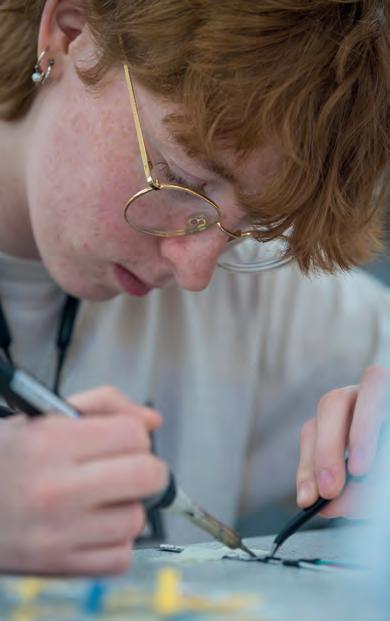
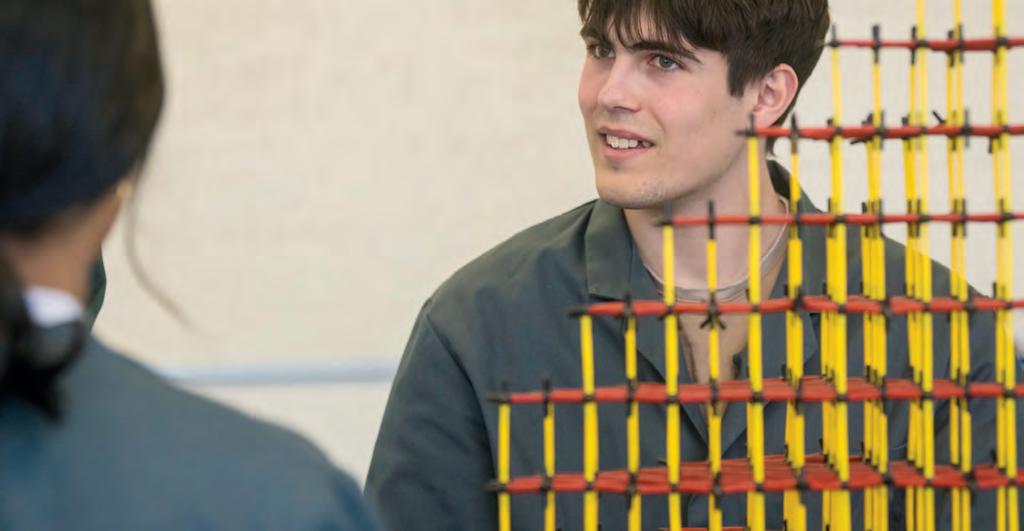
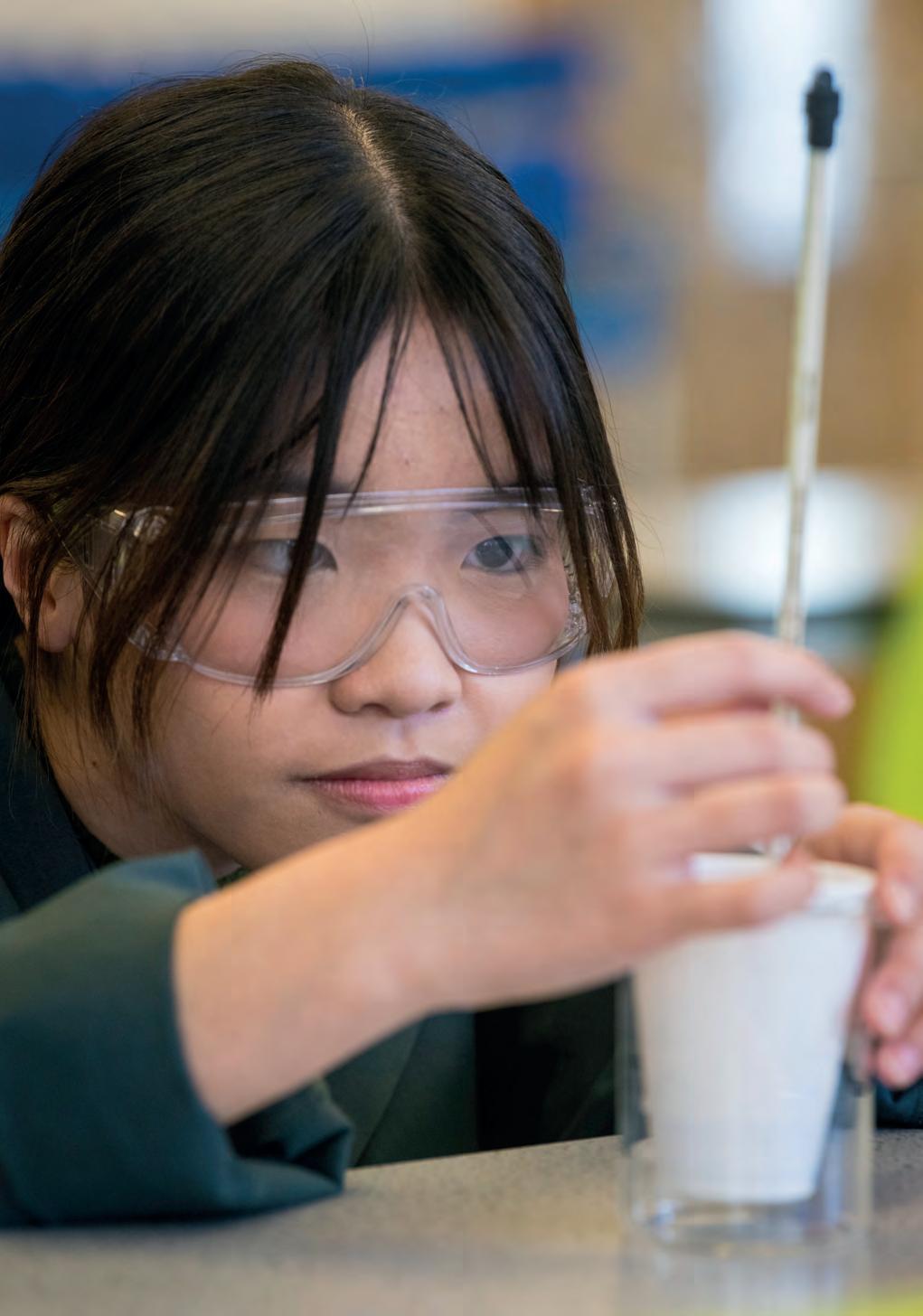
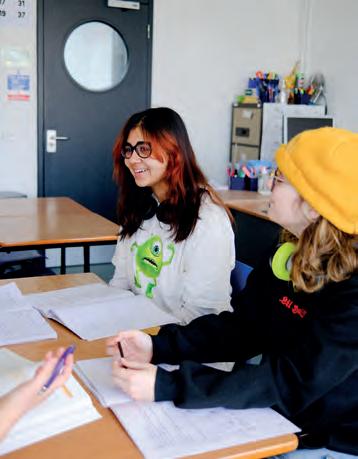
I am delighted that you are considering joining Long Road Sixth Form College. We are a friendly, inclusive college and we will welcome you into our community from the moment you make an application to study with us.
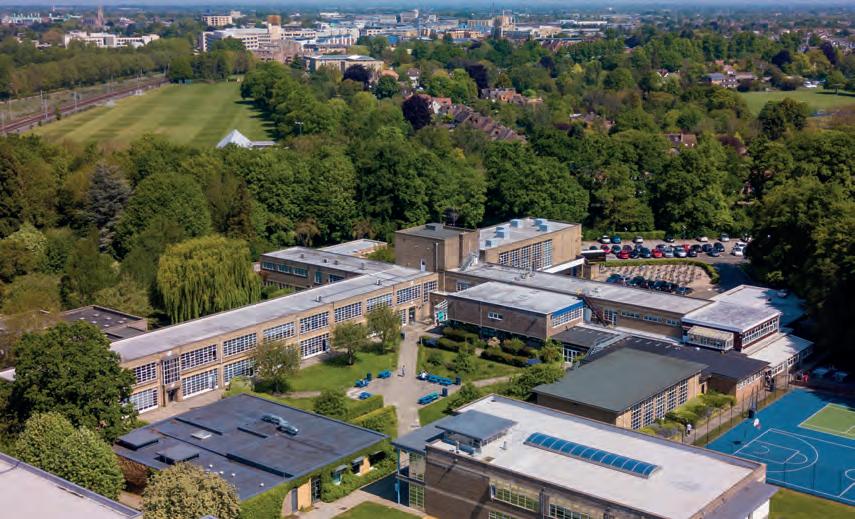
We understand that the move from school can sometimes feel a little daunting. Don’t worry - we make sure you have individual support throughout your time with us, ensuring a smooth transition to get the most out of college life. At Long Road, you’ll learn in a mature, university style setting (no bells or uniforms) at our lovely green campus, where we help you gain the knowledge and skills to thrive here, and in the future.
We are experts in 16-19 education. Our students are successful because our teachers are truly committed subject specialists. We recognise every student is unique and we provide the support that’s right for you. Long Road has a long and proud history of supporting students to achieve their very best. All too soon you’ll be thinking of your next move; and we will help you with that too, whether you are applying to university, aiming for an apprenticeship, or seeking employment. We don’t assume one route is right for everyone.
Our goal is your success. We want you to leave Long Road proud of what you have contributed and achieved; ready to make a positive difference in the world.
Do visit our website where we have lots of material to give you a real flavour of college life and do come and see us at one of our Open Evenings to really appreciate all that Long Road can offer you. I look forward to meeting you soon. My very best wishes,
Steve Dann Principal
12 REASONS TO CHOOSE LONG ROAD
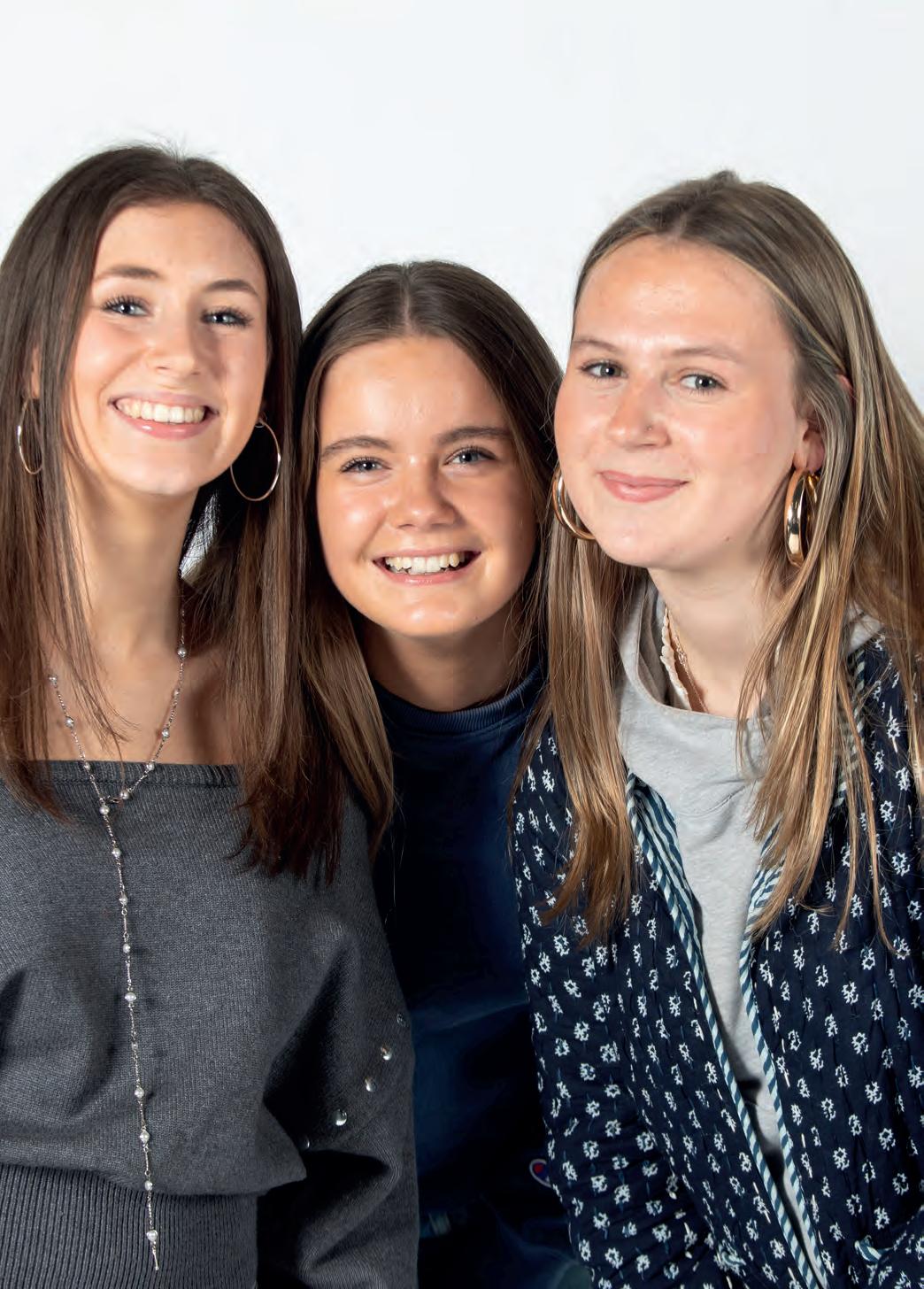
Rosie, Poppy and Liv joined us from Soham Village College, King James Academy Royston and Etonbury Academy. This year they all successfully completed the Long Road Scholars’ programme.
“All the teachers go above and beyond to help their students and are willing to provide extra help to allow us to succeed. The atmosphere at Long Road is friendly, relaxed and allows you to have independence whilst providing support if you need it.”
Taij (she/her) joined us from the Netherhall School to study Level 3 Applied Science, Level 3 Psychology and Sociology A Level.
“College has a lots of different spaces, including quiet areas for studying and more social spaces where you can relax and hang out. This means you can choose to focus on your work or spend time with others depending on what you prefer.”
WE’RE A SPECIALIST SIXTH FORM COLLEGE
Studying at Long Road Sixth Form College is very different to studying at school.
You’ll find yourself surrounded by like-minded peers, all aged between 16 and 19, in a vibrant and mature college environment. You’ll meet new friends from a wide range of backgrounds, ethnicities, cultures, religions, and nationalities; our diverse Long Road community will shape the way you view the world and give you the opportunity to explore new aspects of your identity.
Lessons will take place from Monday to Friday, between 9am and 4:10pm, with three 1.5-hour classes per subject per week, but, not all your learning will be sat at a desk. You’ll attend workshops and seminars led by business leaders, research scientists, musicians, designers, former students, academics and other experts relating to your study programme and future goals.
The environment on our campus is very similar to the environment found at universities: focused and professional. You have the freedom to wear your own clothes and will call your teachers by their first name. Independent study is key to your success and gives you flexibility with your time, allowing you to further enrich your learning outside of the classroom. This is all part of our goal to ensure that you are prepared for your next steps, whether that’s university study, an apprenticeship, or employment.
WE NURTURE INDEPENDENT LEARNING2
Perhaps the biggest difference to school is the new level of independence you gain as a Long Road student. We’ll encourage your learning to flourish with independent study periods, and you will develop your skills, attitudes and knowledge in preparation for your next steps, whatever they may be.
You’ll find a variety of study spaces across the campus for you to visit between your lessons. Much of your independent study time will be spent in our Student Centre or our newly renovated Learning Resource Centre; a study complex made up of a central library, computer room, group study area and quiet study space. You can spend this time reviewing your class notes, completing assignments, reading around your topics, discovering current research in your field, and preparing for your next lesson.
REASONS
All our resources are easily accessible online giving you the flexibility to choose where you spend your independent study time; this could be working from home, at your favourite café or outside in one of our many green spaces.
Making the transition to studying at sixth form might be challenging: you will need to step up and take ownership of your learning. But don’t worry; as you settle into Long Road life, you’ll learn how to organise your independent study time, carry out your own research, analyse sources, and present your arguments.
At Long Road, we use the VESPA framework to support you to achieve your best. It’s designed around practical strategies that are focused on developing your vision, effort, systems, practices and attitude - 5 important areas of self-development that together add up to sixth form success!
“Teachers support students to develop their resilience and confidence rapidly. Students benefit from the college VESPA programme, which supports them to become more independent and take greater responsibility for their own progress.” – Ofsted 2025
TO CHOOSE LONG ROAD
COMMITTED & APPROACHABLE STAFF 3
At Long Road, we share a passion for learning and its capacity to transform lives; our goal is to empower you to fulfil your unique potential and inspire you to make a positive difference in the world.
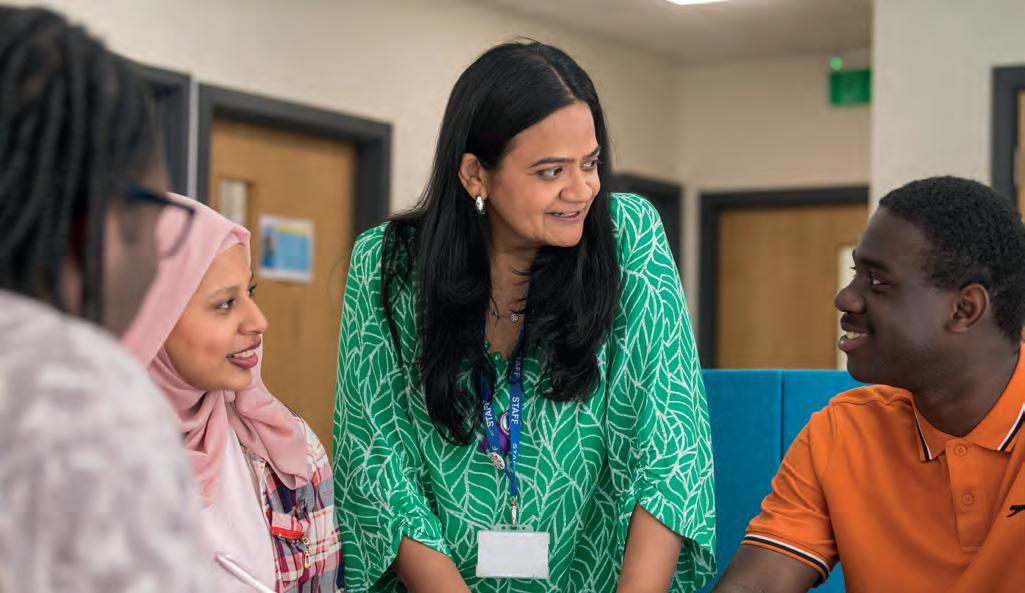
Whatever courses you choose, you will be taught by our our friendly and approachable subject specialist teachers. Smaller class sizes, of up to 26 students, mean they will get to know you as an individual, and you’ll receive more one-to-one attention than you’re used to in secondary school. There will be high expectations on your learning, you need to be ready to participate in every lesson and have mature group discussions. All courses run additional support workshops twice a week, which are a great time to focus on homework, get a headstart on revision, or receive extra guidance tailored to your strengths and weaknesses. With the support of our highly qualified teachers, you’ll not only understand the academic content needed for your studies but also develop your evaluation, organisation, time management and research skills and learn how to confidently present your opinions in a professional manner.
We know that moving from school to college is a big change, a new campus, new faces and a new level of independence. To help you have a smooth transition, you will be assigned a Progress Coach who will help you to settle into Long Road life. Working together with you and your family from the moment you join our community, they will be on hand to guide you throughout your time with us.
Inspiring you to find your vision is key to the Progress Coach role. At the start of your course, they will support you in developing the characteristics, habits and mindset which will help you to realise your potential at Long Road. They will guide you to make use of effective tools that enable you to aim high, to reflect on what you’re good at, and develop the new skills, systems and attitudes necessary for successful sixth form study. We know it feels like a big step - but your Progress Coach will help you build your confidence. You’ve got this!
ONE-TO-ONE SUPPORT
It’s never too soon to start thinking about your next steps, and when you need to make decisions about your future you will be supported every step of the way. Regular group tutorials and workshops will help you explore your options so that you can make an informed choice on your future. Trained to provide up-todate information and impartial advice about careers, your Progress Coach will work with you individually to identify your career goals and find the pathway that best suits you and your ambitions. By supporting you to find the extra-curricular activities that build a great personal statement, a stand-out CV, or just fill you with joy, your Progress Coach will motivate you to take action and put in place everything you need to step forward into a happy and fulfilling future.
You will have the opportunity to engage in:
• One-to-one Progress Reviews to monitor your academic progress and support your wellbeing.
• Advice and tips to help you achieve your potential and get the most out of your time with us.
• Practical tools to build effective Level 3 independent study skills including time management, organisation, and revision techniques.
• Regular tutorials that support your personal development and build your confidence as a responsible citizen taking your first steps in the adult world.
• Creating your own personal progression plan, with advice on careers, good-quality apprenticeships and university pathways.
Oliver (he/him) joined us from King James Academy Royston to study Level 3 Applied Business, Psychology and Sport.
“My favourite thing about Long Road is being able to study whilst playing football within my day to day life and spend time with my friends as well as I enjoy my lessons very much.”
4
GREAT TRAVEL LINKS
Managing your journey to college is all part of that step-up to more independence and responsibility. Although there is no school bus, travelling to Long Road couldn’t be easier. Our location on the Cambridge Biomedical Campus means all major local bus services stop close to the college entrance, including buses from Stagecoach, Whippet, and the Guided Busway.
CAMBRIDGE HISTORIC CITY CENTRE
CAMBRIDGE SOUTH STATION
Located just a 7-minute walk from our campus
All major bus services stop at
& THE BIOMEDICAL CAMPUS which are located right next to us
ADDENBROOKE’S
TRUMPINGTON PARK & RIDE
BABRAHAM ROAD PARK & RIDE
CAMBRIDGE
CAMBRIDGE
If travelling by train is your quickest option, you’ll likely benefit from the new Cambridge South Station, located just a 7-minute walk from our campus. Alternatively, Cambridge Central Railway Station is only a 25-minute walk from the college and well served by buses.
If you live close-by and can cycle to college we have numerous bike racks and a bike maintenance stand on campus, complete with a range of essential tools, including a bicycle pump.
Still figuring out your journey? Check out the journey planner on our website.
BY TRAIN
All information is correct at the time of going to print. Please contact your service provider for further information.
BUS
All information is correct at the time of going to print. Please contact your service provider for further information.
Way)
Way)
BY GUIDED BUS
All information is correct at the time of going to print. Please contact your service provider for further information.
Edward (he/him) joined us from Downham Market Academy to study Level 3 Applied Computing, IT and Music.
“I chose to study at Long Road because of the Intuitive course choices, inviting and comfortable atmosphere, great teachers, and great campus.”
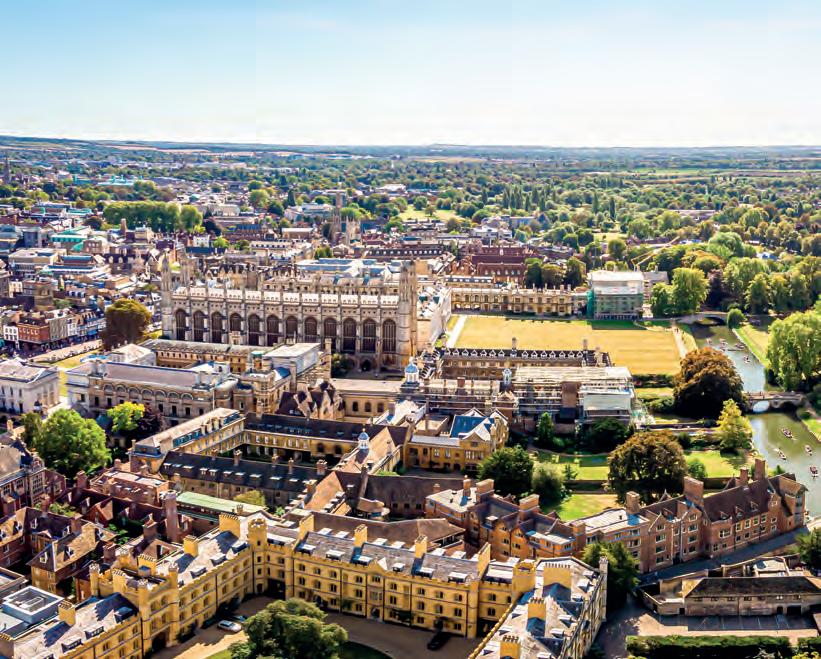
STUDY IN A WORLD FAMOUS CITY
Our location on the Cambridge Biomedical Campus places you at the heart of cutting-edge scientific research. The prestigious reputation and history of Cambridge continues to attract international STEM sector companies such as AstraZeneca, GlaxoSmithKline, Apple, Amazon, ARM and the Wellcome Sanger Institute, some of whom are our neighbours. Our highly qualified staff have developed strong links with those working on the Cambridge Biomedical Campus putting you in an excellent position to learn from world-leading academics and industry specialist scientists. REASONS
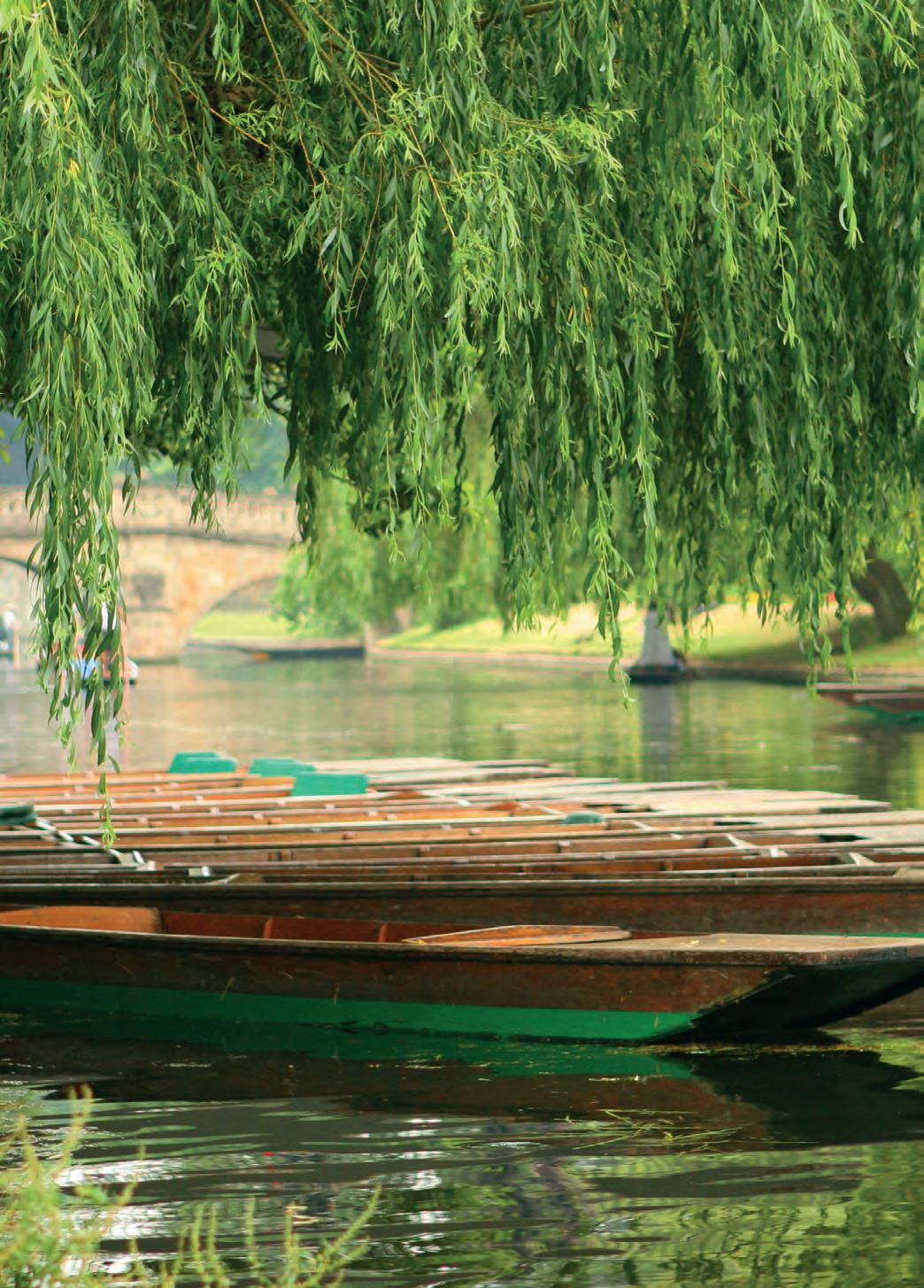
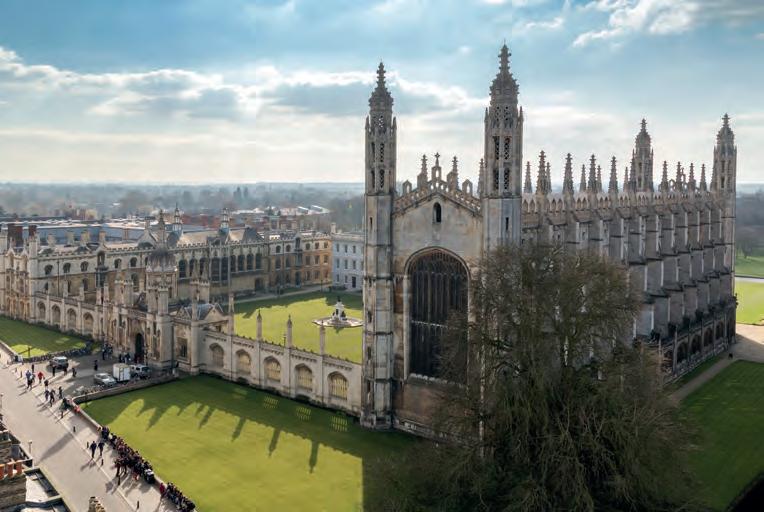
Outside of your lessons you will have the opportunity to explore the world-famous city of Cambridge. If you’re studying Design Technology, Art, or Photography, the beautiful architecture of the city is the perfect inspiration for your next piece of artwork. Climb the tower of Great St Mary’s Church for the best views of the city centre, before crossing the road where you can visit the iconic King’s College Chapel. English students might choose to take the scenic 15-minute bicycle ride across Grantchester Meadows and visit The Orchard Tea Rooms, a favourite hang-out spot of great writers such as Virginia Woolf and William Wordsworth. Geographers and Biologists can pick up a free pass to the Botanic Gardens, where you can expand your knowledge on everything from tropical plants to British wildlife. A sunny day is the perfect time to go punting along the River Cam, giving you a unique view of the University of Cambridge – perhaps you’re aspiring to study there? We’ll support you to achieve that goal!
AMAZING FACILITIES AND GREEN SPACES 6
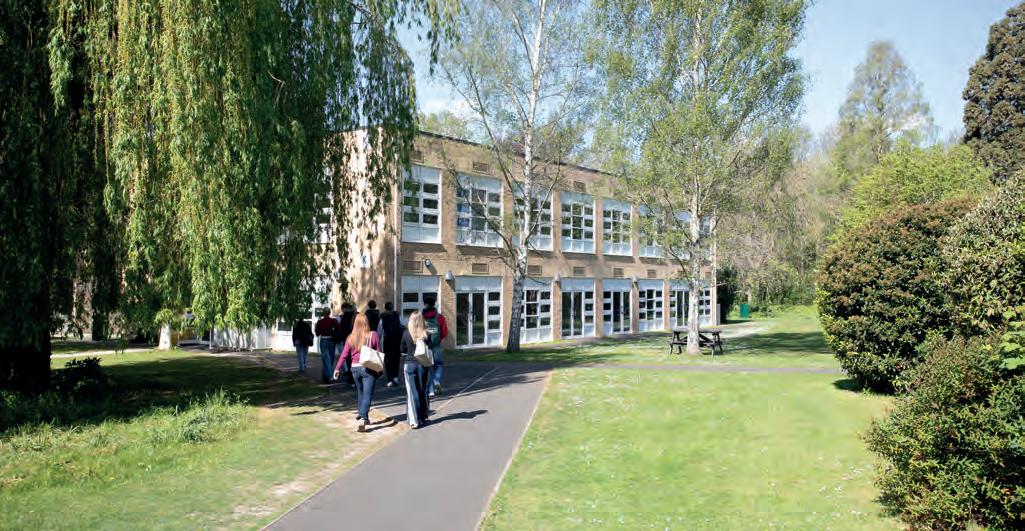
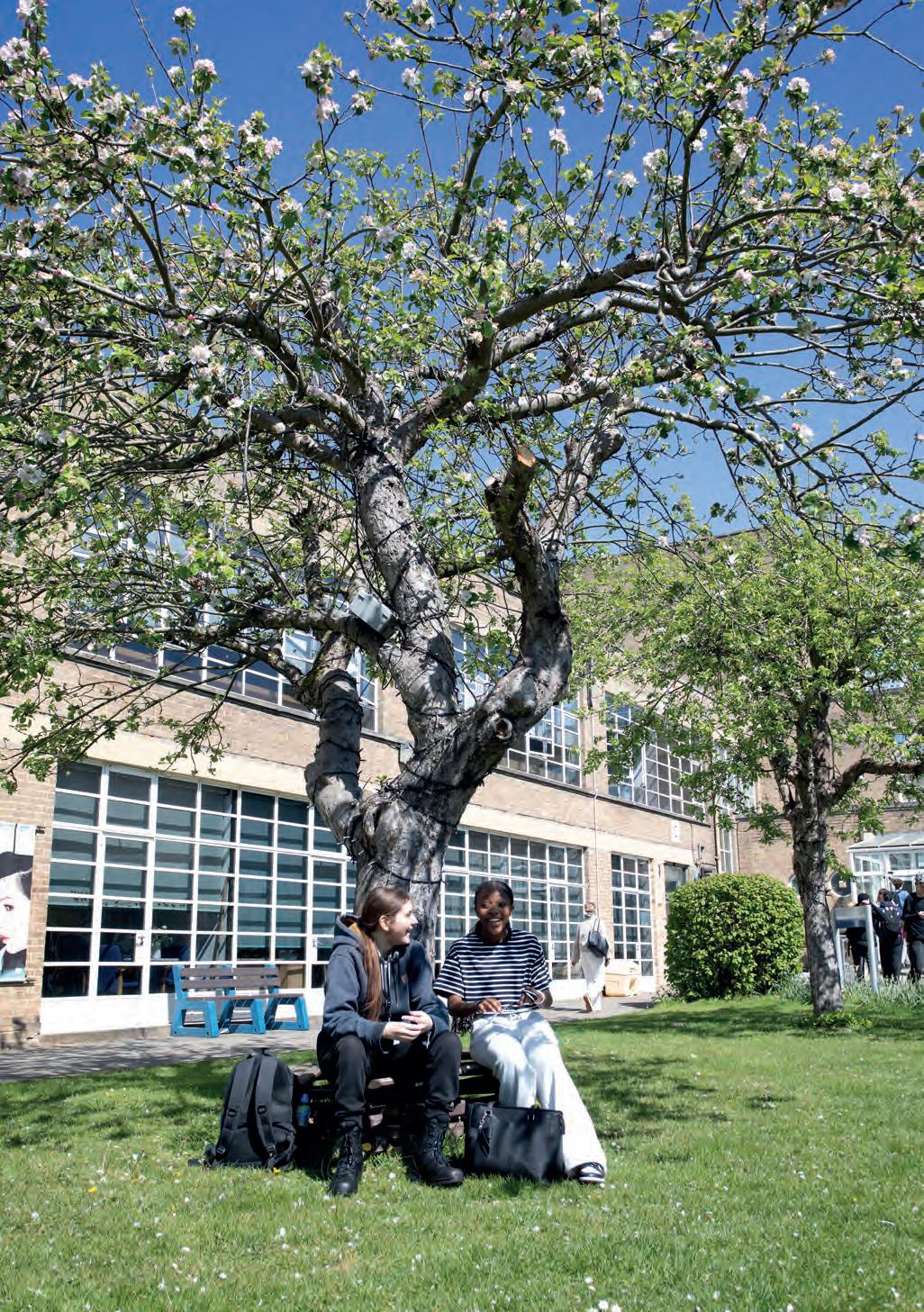
At Long Road Sixth Form College you experience the best of both worlds; a spacious green and leafy campus just a short distance from the lively centre of Cambridge.
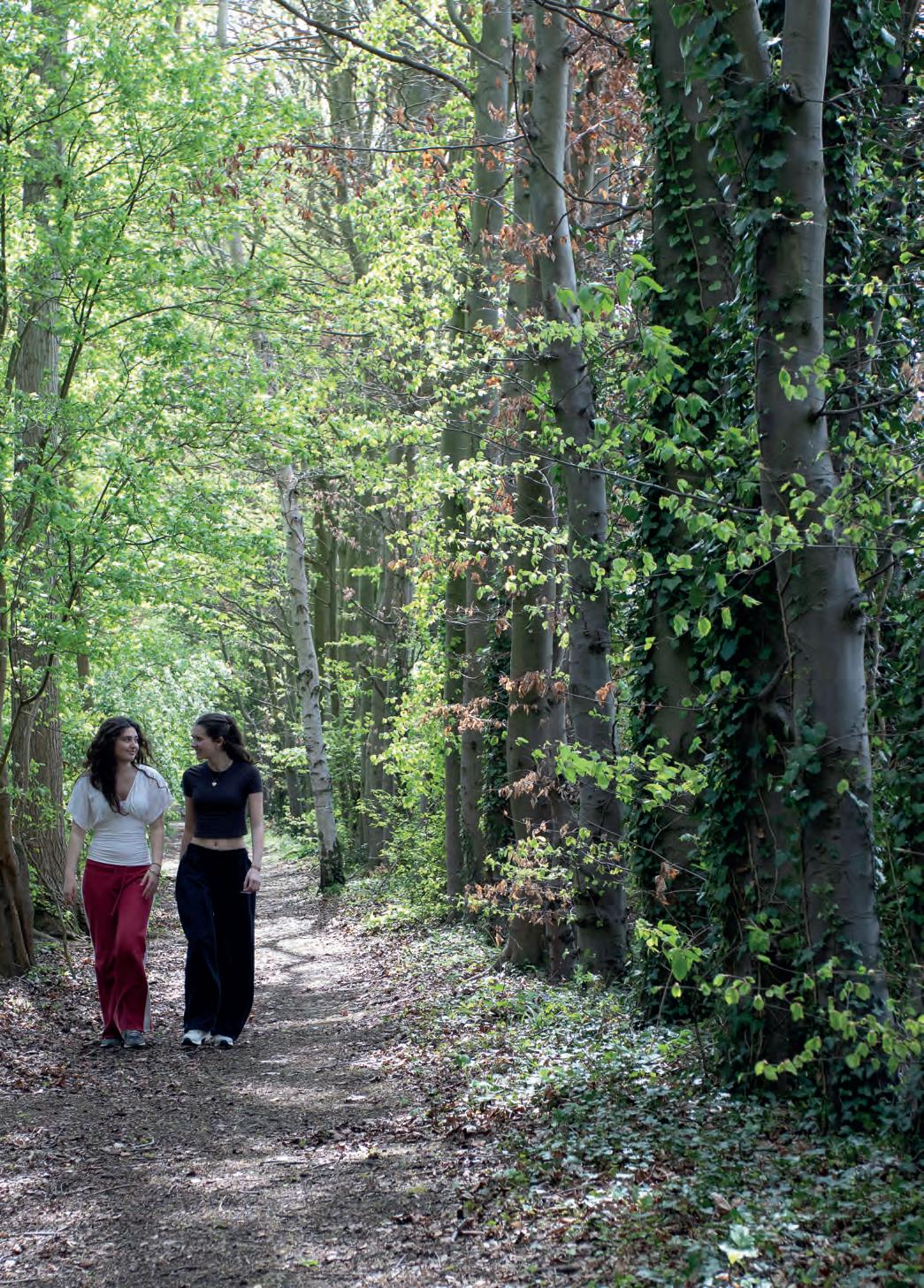
Breathing in the fresh air as you take a stroll along our woodland walk will make you feel a world away from city life. With several thousand trees on campus, including a number of rare species such as an Indian Bean Tree and Giant Redwood, we are very wildlife friendly – keep an eye out for foxes, rabbits, pheasants, ducks and owls!
We are committed to sustainability and playing our part in addressing the climate crisis. In recognition of the high quality of our teaching and learning, the Department of Education awarded us additional funds to build a new teaching block, which we ensured is environmentally conscious – it even achieved a BREEAM excellent rating, the highest rating for sustainability! The building itself is powered by solar panels which can be found on its green roof, providing a habitat for a range of plant life. Inside you will find two open-plan study spaces as well as eight spacious classrooms overlooking our woodland walk and wildlife pond, the ideal peaceful location for you to focus on research and revision. Across the campus you’ll find over 100 budding young trees, kindly gifted to us by the Woodland Trust and planted by our students. The planting of these Oaks and Silver Birches is all part of our re-wilding project and plans to further increase the biodiversity of our campus.
We are continually investing in new academic and leisure facilities across our campus to ensure that you have the best possible experience whilst studying with us. Ever wondered what it’s like to be a biomedical scientist, lab scientist, bioinformatician, software developer, quantity surveyor, or an engineer? Working in partnership with Addenbrooke’s Hospital, Illumina and Murphy, our Careers Team have created immersive virtual reality content that gives you an exclusive insight into these roles.
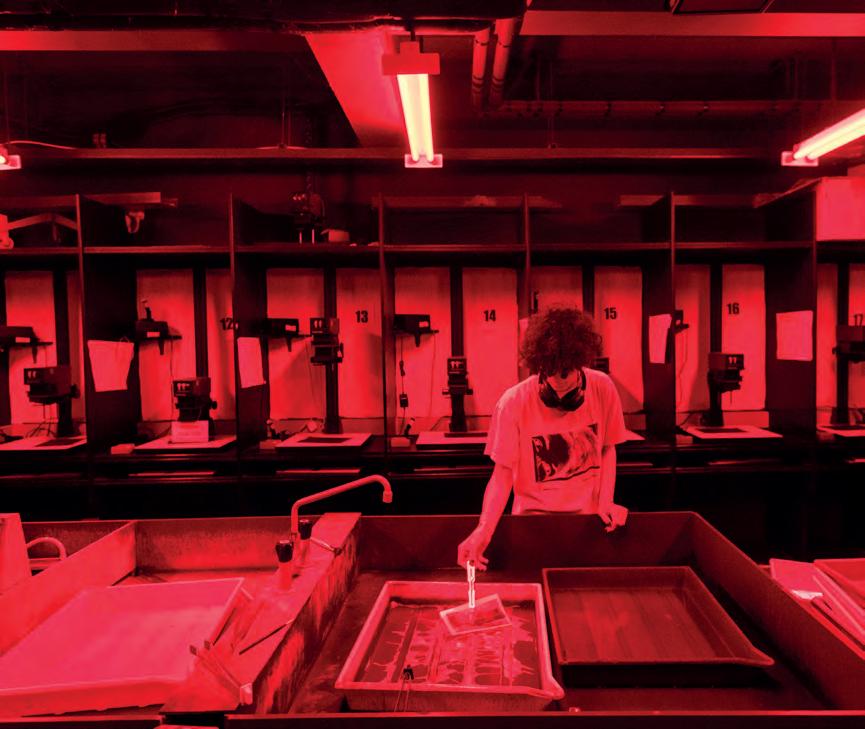
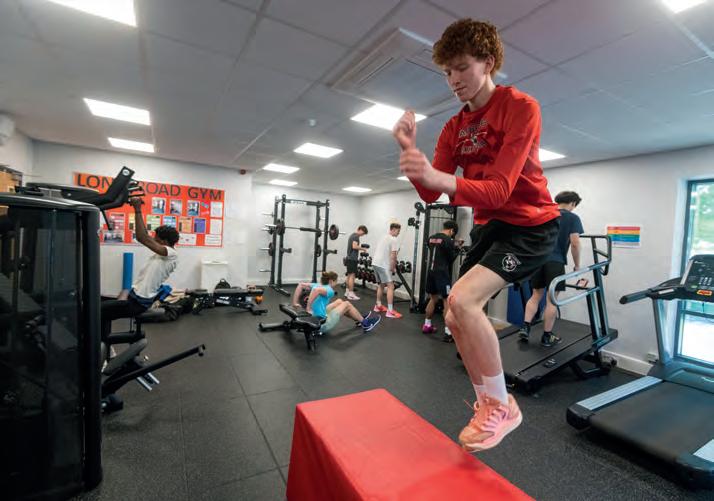
If you’re an aspiring artist you’ll find yourself working in our specialist art and design studios, or if photography is your passion you’ll be developing your skills in our professional studio and darkroom. Future BAFTA Award winners will find themselves centre stage in our black box theatre, while sports stars can spend their time training in our on-campus gym, sports lab or out on our extensive sports fields.
Nicolas (he/him) joined us from Newmarket Academy to study Level 3 Applied Sport and PE A Level, as well as play for our Basketball Academy.
“I chose Long Road because I wanted to get a great education while also being a student athlete. My favourite thing is having access to the Sports Centre all day meaning I can go to the gym and use the basketball court between lessons.”
A BROAD ENRICHMENT PROGRAMME 7
College life isn’t just about studying – it’s about discovering who you are, meeting new people, and getting involved in something that inspires you. Our wide range of student-led clubs and societies are designed to help you build confidence, develop teamwork skills, and find your passion beyond the classroom.
Do you love being centre stage? Join Choir, Dance, Band Jam or take part in our half-termly Open Mic performances. If you prefer being behind the camera why not make a horror film at Slasher School, or write an article for our student film magazine, The Long Lens. Looking to challenge yourself? Join the Duke of Edinburgh Gold Award – a great way to develop resilience, leadership, and independence. Rather get lost in a fantasy world? Join our Dungeons and Dragons Club, Warhammer Club or Pokémon Club. Whatever your passion, you can find your people here.
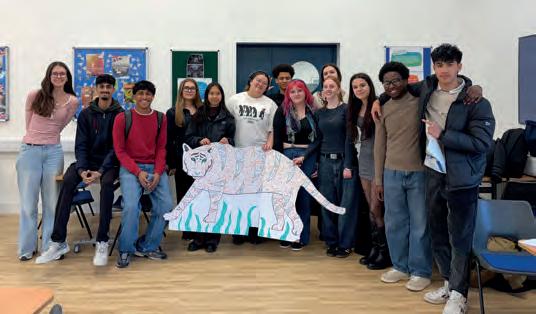
Want to be the change in the world? Youth Social Action is a key part of our enrichment programme, allowing you to take meaningful action on issues that matter to you and your communities. As a founding member of Cambridge Citizens, our students have the opportunity to lead local campaigns and work with key public figures, including the Mayor of Cambridge and Peterborough, on issues such as part-time work, youth friendly spaces and public transport - this year we led a successful campaign to save the Tiger Bus Pass for 2026-2027!
Celebrate your heritage, religion and identity at one of our diversity groups such as Filipino Society or Christian Union. Our biggest event of the year is Culture Day, a celebration of the diversity and inclusivity of our college community. Organised by our Multi-Cultural Society, all students are invited to dress in their traditional cultural clothing and take part in a range of activities including cook-offs, sports tournaments, performances and a global fashion runway.
Getting involved in any of our enrichment groups is a great way to take a break, meet new friends, and build skills that will stay with you for life. Your wellbeing matters to us, so step out of your comfort zone and discover what you love!
Ella & Lilly are part of our college Netball team, who this year achieved something special by making it to the National Championships for the first time! Securing a top-10 finish on their debut is an incredible achievement and a huge credit to the whole squad.
Ella (she/her) joined us from Sancton Wood School to study Level 3 Sport Extended Diploma
“I chose Long Road as it has good sport facilities to use both in and out of lessons.”
Lilly (she/her) joined us from Saffron Walden County High School to study Level 3 Sport and Level 3 Business.
“My favourite thing about long road is the support I’ve been given to help with my dyslexia by my teachers, and the friendly atmosphere making it so easy to getting along with students and teachers.”
8
EXTENSIVE SPORTS OPPORTUNITIES
From fitness newbies to aspiring Olympic athletes, we can offer you access to a fantastic range of indoor and outdoor sports facilities. What’s important to us is that you’re able to take care of your physical and mental wellbeing, that’s why we encourage all students to participate in keep-fit activities. Indoors we have a four-badminton court Sports Hall, Sports Lab, and a gym with a wide range of equipment, all available for you to use throughout the college day. Head outdoors to our wonderful field space where you can use our all-weather pitch, football pitch, rugby pitch and hard courts.
Looking for an easy way to make new friends? Look no further! Joining one of our sports teams is a great way to meet new people and build lifelong friendship. The below sports all train or play competitive fixtures every Wednesday afternoon, and we’ll schedule your timetable in a way that means you never have a clash with lessons and matches:
• Men’s and Women’s Football
• Women’s Netball
• Men’s and Women’s Hockey
• Men’s and Women’s Basketball
• Men’s and Women’s Rugby
Join the Histon Scholars, linked to Histon Men’s Football Club, or our Men’s Basketball Academy, linked to the Cambridge Cats Basketball Club, and combine a high-performance sports programme with your studies - our basketball team compete in the Academies Basketball League, the second highest tier in English basketball for colleges at U19 level! Want to try something new? We offer Rowing too, launching from Cambridge University Boat Club and organised through East Anglia Youth Rowing. We can even support you in taking part in individual sports, such as badminton, cross-country running, tennis, and golf.
If you’re just in it for the fun, try our Casual Sports programme which runs throughout the week and includes sports such as Volleyball, Short Tennis, Table Tennis and Badminton. You can turn up, play for fun and get involved with the social side of sport! Can’t find a sport that you love? Let us know - we’re always happy to try to facilitate any sport based on student demand.
Ryan (he/him) joined us from Castle Manor Academy to study A Levels in Business, Economics and Politics.
“As a Long Road student I’ve had the amazing opportunity to get involved in the UNLOC Cambridge student forum and visit the House of Lords in Westminster, where I saw how real decisions are made and spoke about youth issues with people who can genuinely make a difference. This experience really helped develop my confidence and confirmed my aspiration to become a diplomat.
On top of this, I chaired the Tiger Pass celebration day at Long Road, where I questioned the Mayor about extending the scheme. This was especially meaningful to me as the pass supports many students financially and socially, and it helped me grow my public speaking and leadership skills.
What stands out most to me is how supportive Long Road is in encouraging students to take part in opportunities like this, helping us build confidence, skills, and professional networks beyond the classroom”.
WE GIVE YOU ADDED ADVANTAGES 9
DEDICATED MED SQUAD
Successfully winning a place to study at medical, veterinary or dental school is a challenge, with a very competitive application process. But don’t worry—if you dream of becoming a doctor, vet or dentist, our unique Med Squad programme will give you the best possible advantage. Our dedicated Med Squad team will meet with you regularly, support you to secure work experience using our strong links with Addenbrooke’s Hospital, advise you on different courses and help you target the university most suited to you and your career goals. As you begin to make your applications you will focus on developing your personal statement, practising your interview skills and taking part in workshops run by students from the University of Cambridge who will mentor you as you prepare for the UCAT assessment.
So far this year, nearly 90% of our Year 2 Med Squad students have received offers from their chosen universities, which include Imperial College London, Queen Mary London, Nottingham, Plymouth, Royal Vet College, Surrey and Harper-Keele.
Student testimonials
“I have really enjoyed this programme. The support sessions mean I know how to get the most out of my placement and feel confident while doing it. There are also opportunities to have contact with Anglia Ruskin University that I feel will really help me when applying for the higher education course that I want to do.”
“Sessions are informative and help with any worries you may have within your placement. The work placement will benefit me as it will help me get into the university course that I wish to do in the future, it’s a good learning experience and is enjoyable!”
“I enjoy these extra lessons as they will benefit me in the future by building my knowledge on what skills I need as a primary school teacher. I also enjoy the placement as it helps me build my confidence.”
GET INTO PRIMARY TEACHING
Do you have a passion to get into teaching? Perhaps you had a teacher who inspired you to push yourself, made you feel heard when you felt invisible or supported you in a difficult time. If that is the difference you want to make to children’s lives, our Get into Primary Teaching programme is the perfect fit for you!
On our programme you will complete a weekly placement in a primary school gaining first-hand experience as a teaching assistant. This practical learning is combined with a weekly theory lesson and on-the-job observations from our staff, helping you to identify your strengths and give you detailed feedback on how to improve your areas for development.
You will also have the chance to visit university Primary Education taster days, hearing from lecturers, exploring their facilities and meeting their students.
During your second year of study you have the opportunity to complete an Extended Project Qualification focusing on an area of teaching that most interests you, giving you a step-up when you come to make your university applications.
BOOST YOUR CV WITH AN EPQ
Boost your CV and enhance your personal statement while carrying out an independent project on a topic you love. The Extended Project Qualification (EPQ) is equivalent to half an A Level, but it is so much more than an extra qualification. An EPQ is the perfect way to showcase your independent learning and working, problem solving, project management, organisation and research skills to employers and universities. In fact, this additional qualification is so highly valued that some universities will even lower their entry requirement if you achieve a high EPQ grade! Independence is key to the EPQ, meaning you get to choose what you’d like to study and how you’d like to study it. The topic can be related to your other subjects, or can be something completely different, and you decide how you present your final product.
Types of Projects:
• Dissertation: A dissertation is an essay of 5000-6000 words, providing an answer to a question and focusing on a topic about which there has been debate.
• Artefact: An artefact is an object produced as a solution to a design brief. It must be based on thorough research, and records must be kept indicating how ideas developed as the project progressed.
• Performance: A performance could be music, drama, dance or sport related. It must take place before an audience, and records must be kept which show the development of skills and techniques.
• Investigation: An investigation is a project – often scientific or psychological – that tests a hypothesis and involves the collection and analysis of data.
If you decide to carry out the EPQ you’ll start in the summer term of Year 1, giving you time to think about your goals after Long Road and tailor your EPQ to help achieve these dreams. Although it is largely independent study, you’ll have a specialised EPQ tutor to keep you on track and weekly lessons to help you to understand the requirements of the qualification. Some recent examples of student work include:
• The impact of VAR on professional football.
• A dissertation on whether there should be measures in place to control the global population.
• Jane Austen’s portrayal of women in Pride and Prejudice and the extent to which it was a true reflection of female gender roles in the nineteenth century.
• The impact of music on reaction times when driving.
• The effect of phosphoric acid on teeth.
• A TED-style talk on the importance of failing well.
• The creation of a dance representing women in sport.
• The design and creation of a portfolio to showcase the skills required to create effective theatrical and media make up.
• The design and development of a program with the aim of using machine learning to develop AI capabilities within a video game.
Agatha (she/her) joined us from Saffron Walden County High School to study Biology, Chemistry and Psychology A Levels.
“I chose to study at Long Road because I wanted a change of environment from secondary school, and it feels a lot more independent and mature here.”
Helena (she/her) joined us from St Mary’s School to study Biology, Chemistry and Environmental Science A Levels.
“I chose Long Road because of the support from the teachers. They know how to push you but are always available to help if you need it. I love the green areas around campus as well, especially during a sunny day.”
10 HAPPY, CARING, INCLUSIVE COMMUNITY
Feeling a little nervous about starting sixth form?
That’s totally normal. We understand that moving up from school to college can feel overwhelming, but don’t worry, your wellbeing is our top priority.
Throughout your time at Long Road, you will be encouraged and supported to develop your skills and independence, find your future path, and achieve your goals. We believe that every student can achieve their unique potential and we aim to develop the most effective study programme for you. Whatever challenges you may face, our dedicated Safeguarding and Wellbeing Team are here to work alongside you, your family, and your teachers to support you in reaching your goals. We offer one-to-one support to help you overcome the stress and worries of everyday life and booking a wellbeing session is quick and simple via our self-booking page. If you need more specialist support, we can signpost or complete referrals to suitable support services.
Regular wellbeing events take place throughout the year for everyone, including visits from local services and therapy dogs who love coming in for cuddles during exam season! We’re partnered with a 24/7 helpline staffed by trained counsellors which you can access at any time, day or night, 365 days a year for support or advice on a whole range of issues. You can even access free online or telephone counselling if ongoing support is needed. Their app is full of tips and advice on practical topics including debt, finance, housing, relationships and legal advice, as well as self-care tools and activities to help you manage and overcome barriers to good health and wellbeing.
We’re proudly rated Outstanding (Ofsted 2025) for our additional learning support provision. If you have an EHC plan, you will work closely with a keyworker Specialist Teacher and may have additional support from one of our Learning Support Assistants in lessons.
“Teachers have an excellent knowledge of students’ education, health and care plans and consequently support these students extremely well. Parents and carers are rightly highly complimentary of the work staff do with their young people.” Ofsted 2025
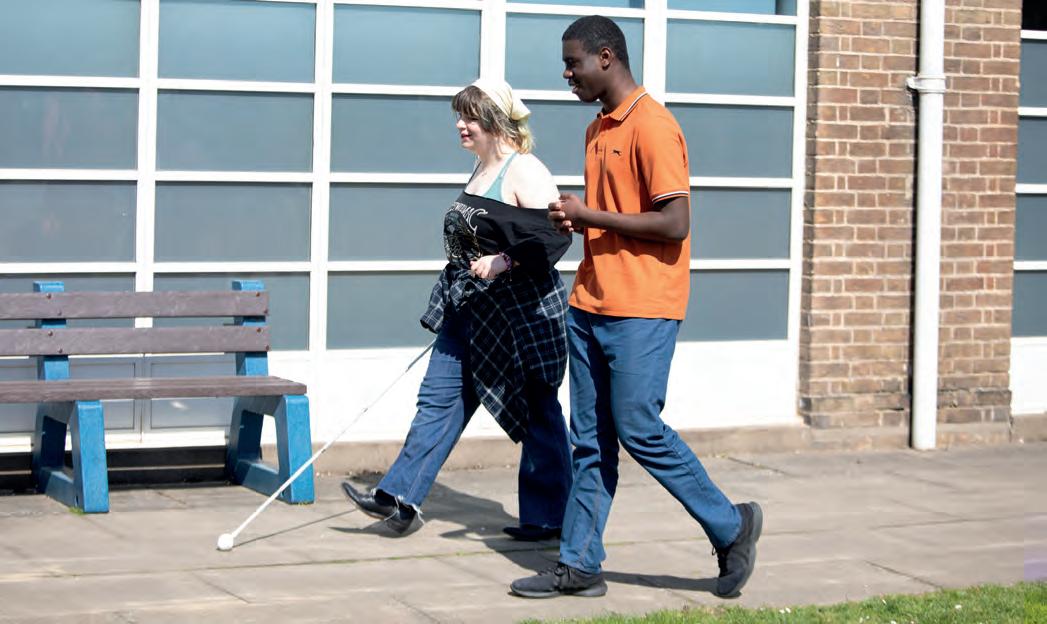
The entire campus is wheelchair accessible, with accessible toilets in each area of college. If you ever need a break from the busy college environment you can relax in our low sensory room, available for students who experience sensory difficulties. Our Additional Learning Support (ALS) team run a range of student clubs throughout the week to help you develop your social skills and make new friends. They can also offer assessment for exam access arrangements and will be the ones to process any exam access arrangements you already have in place. Whatever their role, all our staff have a strong commitment to ensuring our students have equal opportunities to succeed and achieve their personal best.
Rosa (she/her) joined us from Cambourne Village College to study Level 3 Criminology, Drama and English Lang & Lit A Levels.
“My favourite thing about Long Road is the independence we are given. Being in the middle of Cambridge allows us to learn new life skills and explore the city, and the college itself has many places for us to work and socialise.”
Oli (he/him) joined us from Cambourne Village College to study Level 3 Business, Sociology A Level and English Lang & Lit A Level.
“I chose to study at Long Road because of the range of subjects you can choose to study. It allows you to explore different interests you didn’t even know you had and enables you to expand your horizons.”
THE WIDEST RANGE OF COURSES 11
At Long Road, we provide you with the widest choice of courses to build your unique study programme: art, science, humanities, languages, media, sport, social sciences, performance – we have it all!
We give you the freedom to create your own academic study programme with unique combinations of both A Levels and Level 3 Applied Qualifications. All Level 3 study programmes consist of a learning aim equalling three parts. One A Level equals one part; Level 3 Applied qualifications equal one, two or three parts. You can combine courses in any way to create your individual full-time study programme. If you need to boost your GCSE grades, you can study a one-year transition programme made up of GCSEs or Level 2 Diplomas.
Creative geniuses, who have already completed Level 3 studies, can progress to our Level 4 Foundation Art and Design course. Previous Foundation Art Graduate Exhibitions have been held at prestigious venues across Cambridge such as the Fitzwilliam Museum, Madingley Hall and the Cambridge Museum of Technology.
Once you’ve made your application, we’ll invite you to a meeting during which we can give you advice and guidance on the best combination of subjects to meet your progression aims.
Your choices: Select just A levels... ...or just Diplomas …or a mixture of both
3 A Levels
1 Extended Diploma
3 Extended Certificates
1 Diploma & 1 Extended Certificate
1 A Level & 2 Extended Certificates
1 A Level & 1 Diploma
2 A Levels + 1 Extended Certificate
All courses are correct at the time of publishing. Please visit our website for the most up-to-date information. www.longroad.ac.uk
OUR COURSES
Level 4 Foundation Diploma
• Ar t & Design
A Levels
• Art, Craft and Design
• Biology
• Business Studies
• Chemistry
• Design Technology
• Drama and Theatre
• Economics
• English Language and Literature
• English Literature
• Environmental Science
• Film Studies
• French
• Geography
• History
• Mathematics
• Mathematics, Further
• Media Studies
• Photography
• Art, Craft and Design
• Physical Education
• Physics
• Politics
• Psychology
• Religion, Philosophy and Ethics
• Sociology
• Spanish
Level 3 Applied
Qualifications
• Applied Science
• Ar t and Design
• Business
• Computing
• Criminology
• Games Development
• Graphic Design
• Health and Social Care
• IT: App Development
• Media
• Mental Health
• Music
• Musical Theatre
• Psychology
• Sport
Level 2 Applied
Qualifications
• Ar t and Design
• Health and Social Care
• IT
• Media
GCSE
• Double Science
• English Language
• Film Studies
• Maths
• Sociology
A Levels
A Levels are two-year academic qualifications which you can take in a variety of subjects. To create a full-time study programme, you need to choose the equivalent of three courses. You can do this by choosing three A Levels or combining A Levels and Level 3 Applied Qualifications. Check out page 53 to see how to do this.
A Level courses are on the purple pages.
Assessment
You will be assessed by examination at the end of Year 2. Some A Levels have a coursework component, usually 20% of your final grade.
Entry requirements
• Five GCSEs at Grade 5 or above.
• Grade 5 or above in relevant GCSE subjects.
Please see our website for specific course entry requirements.
Your future
You can use your A Levels to progress to University, an apprenticeship or employment.
Note:
All courses are correct at the time of publishing. Please visit our website for the most up-to-date information. www.longroad.ac.uk
Level 3 Applied Qualifications
Level 3 Applied Qualifications are two-year courses which combine practical learning with the study of theory. Although each subject is related to a general area of employment, the skills you develop can be transferred to a wide range of careers.
To create a full-time study programme, you need to choose the equivalent of three A Level courses. You can do this by choosing one large Level 3 Applied Qualification or combining smaller Level 3 Applied Qualifications with A Levels, turn to page 53 to see how to do this.
Level 3 Applied qualifications can be studied as:
•an Extended Certificate = 1 course
•a Diploma = 2 courses
•an Extended Diploma = 3 courses
Level 3 Diplomas are shown on the red pages.
Assessment
You will be assessed through a mixture of both exams and coursework over the two years of study.
Entry requirements
• Five GCSEs at Grade 4 or above
• Grade 4 or above in relevant GCSE subjects
Please see our website for specific course entry requirements.
Your future
You can use your Level 3 Applied qualification to progress to university, an apprenticeship or employment.
Qualification Reforms: V Levels
The Government is currently reforming the Applied Qualifications landscape. Eventually, a new qualification called V Levels will replace existing BTECs, OCR Cambridge Technicals, UAL and WJEC applied courses. V Levels will be the size of one A level, and will be graded A*-E. They will have a modular structure and be assessed by both exams and non-exam assessments (NEA). Updates will be available on our website as information becomes available.
Note:
All courses are correct at the time of publishing. Please visit our website for the most up-to-date information. www.longroad.ac.uk
Level 2 Applied Qualifications
This one-year programme, unique to sixth-form providers, gives you an alternative academic pathway to Level 3 study, apprenticeships or employment.
These courses focus on applied learning and opportunities for direct employment sector experience. Expectations during the year will be high, with an emphasis on developing a range of skills to help you be effective in the workplace and take on the challenge of Level 3 study.
There is a clear progression route to the Level 3 Applied courses offered at Long Road. To progress to Level 3 study, you must satisfy the minimum entry requirements of each chosen Level 3 course and demonstrate commitment to learning during your transition year through high attendance and achievement.
This full programme of study can be taken alongside GCSE Maths and/or GCSE English. To provide sufficient focus on obtaining at least Grade 4 in GCSE Maths and/or GCSE English, students taking both of these courses are likely to follow a GCSE retake pathway rather than a Level 2 Applied pathway.
Entry requirements
•Three GCSEs at Grade 4
•GCSE English and GCSE Maths at Grade 3
•GCSE Maths and/or GCSE English must be retaken if not achieved at Grade 4 or above
Note:
All courses are correct at the time of publishing. Please visit our website for the most up-to-date information. www.longroad.ac.uk
Level 2 GCSE
This one-year programme enables you to build the foundations needed to succeed on a Level 3 study programme.
The programme includes tutorial support and the development of study skills. To progress to Level 3 study, you must satisfy the minimum entry requirements of each Level 3 course and have demonstrated commitment and success during the transition year through high attendance and achievement.
Entry requirements
• Three GCSEs at Grade 4
• GCSE English and GCSE Maths at Grade 3
• GCSE Maths and/or GCSE English must be retaken if not achieved at Grade 4 or above
Note:
All courses are correct at the time of publishing. Please visit our website for the most up-to-date information. www.longroad.ac.uk
LEVEL 4 FOUNDATION DIPLOMA
Art and Design
Minimum Entry Requirements
• Grade 4 in GCSE English and GCSE Maths
• Successful completion of a full study programme of three A Level courses (or equivalent)
• A creative A Level with a minimum Grade B, or a Level 3 Applied qualification in Art, Graphic Design, or Photography at Grade:
- Extended Certificate: M
- Diploma: MM
- Extended Diploma: DMM
A portfolio of work must be submitted prior to the Advice and Guidance Meeting, demonstrating a standard that will allow you to benefit from the course.
Assessment
•Coursework: 100%
•Exam Board: UAL
This fast-paced, one-year programme is ideal for students who have completed their A Level or Level 3 Applied studies and are looking to refine their creative practice before progressing to university, an apprenticeship or employment. It delivers a broad range of creative skills and techniques while fostering critical thinking and reflective practice. The course aims to help students build a strong portfolio to support progression into higher education or the creative industry.
Students benefit from local, national, and international excursions, as well as workshops and talks from visiting industry professionals, providing valuable insights into creative career opportunities. A dedicated team of teaching staff, all with professional experience in the arts and creative industries, support students throughout the course. The programme builds on prior experience, integrating existing skills with new techniques and processes, contextualised through research and reflective practice. This fosters independence and ensures a strong understanding of the standards required for higher education or alternative career paths.
LEVEL 3 DIPLOMA
Applied Science
Extended Certificate
Minimum Entry Requirements
Five GCSEs at Grade 4 including:
• Grade 5 in GCSE Maths
• Grade 5 in two GCSE Sciences or Grade 5,5 in GCSE Double Science
• Grade 4 in GCSE English Language or GCSE English Literature
Assessment
•50% Exam
•50% Coursework
•Exam Board: Pearson
If you are looking to build a learning programme with a strong core of scientific study or looking to progress to higher education or a career in the STEM industry, then Level 3 Applied Science may be the course for you!
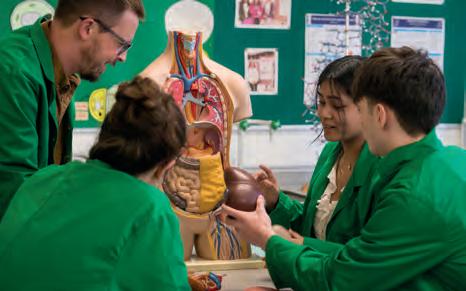
You will study the principles and applications of biology, chemistry and physics, as well as practical scientific procedures and techniques. In addition to those units, you will also have the opportunity to develop your investigation skills with an independent experiment of your choice. There are three examined units and two internally assessed units where students will engage in practical tasks to develop their scientific skills and knowledge.
Our Applied Science course is designed for students who are interested in learning about science alongside other fields of study, with a view to progressing to a wide range of higher education courses and as a pathway to employment. Most students go on to study for degrees in areas such as science, bio-veterinary science, nursing and education. It can lead to careers in healthcare, medical sciences, community work, forensics and many other fields.
LEVEL 3 DIPLOMA
Art and Design
Extended Diploma
Minimum Entry Requirements
Five GCSEs at Grade 4 including:
• Grade 4 in GCSE English Language or GCSE English Literature
• Grade 4 in GCSE Art or Merit in Level 2 Ar t Assessment
• 100% Coursework
• Exam Board: OCR Cambridge Technicals
Do you relish all aspects of the creative art and design world? This course gives you creative freedom when responding to assignment briefs, meaning you will gain skills in a wide range of processes and techniques. These include digital, photography, printmaking, surface pattern,3D design, fashion and textiles, graphic design and illustration.
The course is delivered in specialist studios by experienced teachers. You will work alongside your peers completing final work for your portfolio along with sketchbooks containing your research, ideas and proposals. You will become competent in both presenting and explaining your work alongside project management and responding to a brief creatively.
We enrich all learning with visiting speakers and trips that will enable you to complete firsthand research. Visits have included destinations such as the National Portrait Gallery, the Courtauld Institute, White Cube Gallery, the Victoria and Albert Museum, the British Museum and Tate Modern.
The course is fast-paced, exciting and enables students to gain experience in varying techniques, alongside focusing on specialist areas that provide portfolio evidence for their next progression pathway. By the end of this course, you will have produced a stunning and varied portfolio, demonstrating your commitment and passion for the creative world.
A LEVEL
Art, Craft and Design
A level
Minimum Entry Requirements
Five GCSEs at Grade 5 including:
•Grade 5 in GCSE Art*
•Grade 4 in GCSE
English Language or GCSE English Literature
*If GCSE Art has not been studied, a portfolio may be accepted for consideration by the course team.
Assessment
•40% Exam
•60% Coursework
•Exam Board: OCR
Enrich your creativity as an artist or designer through a series of integrated, theoretical, and practical workshops taught by teachers, who have a range of industrial backgrounds, in our specialist art and design studios. Over two years you will create and present a practical portfolio of specialist work reflecting personal expression of ideas and feelings through the skilful manipulation of visual and written language.
We have three pathways for you to choose from:
• Fine Art: On this pathway you will work with drawing, painting, and printmaking techniques. This includes photographic silkscreen printing, traditional dry point etching, photography, mixed media, digital painting, and ceramics. You will learn about artist movements and how to critically analyse the work of other artists. Focus areas: Painting, Printmaking and Digital Painting.
• Fashion and Textiles: This is a creative and experimental pathway that follows an art and design-based approach. Our studio practice offers workshops that introduce a range of techniques covering material manipulation with fabric and fibres, garment construction, fashion drawing, three-dimensional structures, textile silk screen printing, digital pattern design, and digital presentation skills. You’ll have the chance to experiment with a range of ideas for designing, making and researching areas such as fashion design, textile, or interior structures. You will be encouraged to incorporate printed textile processes into your design work and direct the styling of your photo shoots with your final work.
• Graphic Illustration: On this pathway you will be offered a flexible approach to graphic design and illustration. You will be encouraged to incorporate printmaking and painting processes into graphic design and illustration developmental work. Through practical workshops on printmaking and digital techniques you will gain experience working with Photoshop Illustrator and InDesign. We undertake both practical and theoretical research work, and ideas are explored through both graphic design and illustration assignments. Focus areas: Character Designs, Short Stories, Typography and Layout, Promotional Posters and Packaging.
A LEVEL
Biology
A level
Minimum Entry Requirements
Five GCSEs at Grade 5 including:
•Grade 6 in GCSE Maths
•Grade 6 in GCSE Biology and another GCSE Science, or 6,6 in GCSE
Double Science
•Grade 4 in GCSE English
Language or GCSE
English Literature
Assessment
•100% Exam
•Exam Board: Edexcel
Of all the sciences, advances in Biology have been unprecedented over recent years, and promises to continue to be so in the future. We’ve integrated many of these advances, and the issues surrounding them, into our Biology syllabus, such as the growing field of epigenetics and genomic medicine or the ethics of using animals in medical research, putting you at the heart of cutting-edge scientific research and debate.
Many aspects of the course regularly appear on the national news (recent examples being climate change, viruses, and clinical trials for new drugs). You will focus on our physical bodies, looking at how the human body functions when both well and unwell, explore heart and lung physiology, drugs in sport, and consider why it is that the Government is so keen for us to exercise. As with the other sciences, the study of Biology helps you to build up skills in research, problem solving, organisation and analytical skills. Some of the content we cover includes Chemistry and Maths, but it is not necessary for you to study these alongside Biology at A Level; we will teach you all the Chemistry and Maths that you need to know. There is also significant overlap with A Levels in Geography (ecosystems, succession, conservation of species and climate change), Physical Education (human anatomy and physiology), and Psychology (brain structure and function, and how we perceive the visual world).
To support your exams, your abilities in effective memorising techniques, applying knowledge, analysis and evaluation will also be developed to maximise your final grade. Our detailed and extensive support materials will hugely benefit you over the two years of the course. Practical work is a critical part of the programme, so we will work to enhance your skills to enable a smooth transition to university or employment.
Business Studies
Minimum Entry Requirements
Five GCSEs at Grade 5 including:
•Grade 5 in GCSE English Language or Grade 5 in GCSE English Literature and Grade 4 in GCSE English Language
•Grade 5 in GCSE Maths
•Grade 5 in GCSE Business, or a Merit in Business Level 2, if taken
Assessment
•100% Exam
•Exam Board: EDUQAS
Business A Level lifts the lid on business organisations and investigates what makes them tick. You will learn how functions such as marketing, human resources, product development and finance all work closely together in order to achieve the aims and objectives of the business. You will also look at influences outside of the business that affects it, such as the economy.
In your first year, you will learn what it takes to set up and run a business and the types of business organisations there are. You will then look at financial aspects of business along with the human and operational areas.
The second year of the course considers a broader overview of business strategies, economic influences on the business, and how the different parts of the business react to these issues; as well as learning tools to analyse and judge the success of a business.
Business students find that there is a huge range of opportunities for them, whether this is through a traditional university route, where you may want to specialise in a particular area of business, or through an apprenticeship route. You might consider employment or even developing that fantastic business idea you had in the first term of your studies!
LEVEL 3 DIPLOMA
Business
Extended Certificate
Minimum Entry Requirements
Five GCSEs at Grade 4 including:
•Grade 4 in GCSE English Language or GCSE English Literature
•Grade 4 in GCSE Maths
•Grade 4 in GCSE Business, or a Merit in Business Level 2, if taken
Assessment
•50% Exam
•50% Coursework
•Exam Board: OCR
Our Business Extended Certificate course is designed to meet the changing needs of the business sector and to prepare you for the challenges you’ll face in Higher Education or employment.
Through deepening your analysis and research skills, you will explore ways in which businesses respond to changes in their economic, social and technological environment, and gain an appreciation of the influence different stakeholders can have upon a business.
You will create portfolios of work, which will include presentations, role plays and formal reports to develop and assess your communication skills. You will also develop skills in other widely used business software tools such as excel to create Gantt Charts in order to undertake Critical Path Analysis. You will also gain key business skills such as how to analyse key financial data from balance sheets and income statements and write a variety of communications in a professional manner.
The course is broad in its content and will give students the opportunity to study a wide variety of topics, giving them an insight into future pathways. The course will provide students with a number of soft skills required by employers as they will have been exposed to a workload that will require them to manage deadlines, prioritise tasks and delegate work within teams.
Minimum Entry Requirements
Five GCSEs at Grade 5 including:
• Grade 6 in GCSE Maths
• Grade 6 in GCSE Chemistry and another GCSE Science, or 6,6 in GCSE Double Science
• Grade 4 in GCSE English Language or GCSE English Literature
Assessment
•100% Exam
• Exam Board: OCR
Have you ever wondered how many atoms there are in a drop of water? Or thought about what is happening to the dye molecules in your clothing to give them colour? Would you be interested to know what is inside the medicine you take? Our A Level Chemistry course will help you discover answers to questions like these and transform your appreciation of the world around you.
This course will develop your understanding of unimaginably tiny particles like atoms, molecules and ions that you cannot directly experience, and reveal how the structure and arrangement of these particles affect the properties of materials you can actually see. You will also learn how to describe and represent the structures and substances you encounter in a way that will allow effective communication with other chemists.
The course is presented in a series of ten topical storylines in which you will see the relevance of all the chemistry you study. These include reactions in the atmosphere leading to ozone depletion, creating efficient chemical processes for industry and designing drug molecules with the correct shape to interact with a particular enzyme. Practical work is integrated into every topic and you will have plenty of opportunities to develop your experimental skills in our specialised laboratories, using extensive equipment and materials and collaborating with other students. You will also have an opportunity to carry out a chemistry-based research project as part of an Extended Project Qualification.
Chemistry is central to science and highly valued by universities and employers because of the range of skills you develop. The course is essential for entry into many medical and veterinary orientated courses and suitable for further study in engineering, biochemical sciences and pharmacy as well as many others.
LEVEL 3 DIPLOMA
Computing
Extended Certificate
Minimum Entry Requirements
Five GCSEs at Grade 4 including:
•Grade 5 in GCSE Maths
•Grade 5 in GCSE Computing, if taken
•Grade 4 in GCSE English Language or GCSE English Literature
HelloButton() method.
Assessment
•66% Exam
•34% Coursework
•Exam Board: Edexcel
Our Level 3 Extended Certificate in Computing provides a practical and applied way of learning about Computer Science, Network security and HumanComputer Interaction (HCI). This course will prepare you for progression into a wide range of pathways at university, apprenticeships, and employment.
Within the course you will discover the core principles that underpin all areas of computer science, developing computational-thinking and coding skills which will be put to the test as you solve problems. You will deepen your knowledge by studying computing concepts and their application through programming and design methodologies.
With the ever-growing importance of IT network security, we will give you relevant and contemporary knowledge about IT system security threats, methods used to protect against them and data encryption.
Former students have successfully progressed to study university courses in specific areas, such as Computer Science, Ethical Hacking and Cybersecurity, Computer Games Development and Mechanical Engineering. Others have joined local organisations for their apprenticeship schemes, including the companies AstraZeneca and Amazon.
Whatever progression route you choose, this course will give you the skills and knowledge needed to follow a career path in the Computing and IT industry.
LEVEL 3 DIPLOMA
Criminology
Minimum Entry Requirements
Five GCSEs at Grade 4 including:
•Grade 5 in GCSE English Language or GCSE English Literature
•Grade 4 in GCSE Maths or GCSE Science
Extended Certificate Assessment
•50% Exam
•50% Controlled Assessment
•Exam Board: WJEC
Criminology studies potential explanations of criminality. Within the course, we explore how individuals, the criminal justice system of England and Wales, society and public agencies respond to crime. Whilst studying criminology you will compare critical approaches of the criminal justice system and evaluate the effectiveness of crime control in England and Wales, through the use of theory and application of offences and punishments.
You will study various high profile case studies and real-world examples of crime which demonstrate the processes involved in investigating a crime scene through to the trial in a court room. You will analyse the impact of crime reporting in the media, and how this impacts the public perception of crime; whilst exploring the social construction of criminality and the theories behind it.
You will also consider how ‘the media’ portrays crime can have a significant impact on how crime levels are perceived and understood by society. Through reviewing particular campaigns, you will also understand how changes in law and government policy can occur. Using this knowledge, you will then plan your own campaign for change relating to a particular crime. The skills learned, will enable you to take this qualification into either employment, apprenticeships or onto Higher Education.
A LEVEL
Design Technology
A level
Minimum Entry Requirements
Five GCSEs at Grade 5 including:
•Grade 5 in GCSE
English Language
•Grade 5 in GCSE Maths
•Grade 5 in GCSE Design Technology, if taken
Assessment
•50% Exam
•50% Coursework
•Exam Board: AQA
At its heart, Design Technology is about combining curiosity, problem solving, creativity and technical know-how to find solutions for real world problems. If you are creative, technically minded, driven to investigate challenging problems and deliver user-centred solutions then this subject could be for you.
You will carry out a mix of project work activities from user centred research, design communication, design development, prototyping and practical activities alongside lessons which focus on the theoretical study of design: material properties, manufacturing techniques, design history and methodologies. While there is a significant practical element to the course, the academic study of design theory will make up one out of three lessons each week. The course is further enriched with external trips to design events and exhibitions in Cambridge, London and beyond.
You will develop your understanding of real-world problems and come up with effective, empathetic solutions. We will discuss issues such as ecology, ethics, economics, cultural differences and social responsibility as well as how good design improves our lives. Your project work will involve research, creative problem solving, project management as well as designing and making skills. You will learn how to generate and communicate design ideas with professional computeraided-design software and develop your freehand sketching and rendering. You will consolidate your new skills by undertaking a major coursework project consisting of a portfolio and made prototype - this is your chance to really explore your interests as you set your own brief and develop work that will aid you in your own unique progression route.
Managing your own projects and balancing the practical and theoretical demands of the course is a challenging experience, but one that will provide you with fantastic transferable skills for any industry. Design Technology
A Level goes well with the sciences, maths and other technical courses, as well as creative subjects and the social sciences. Our students go on to university courses, apprenticeships or employment in product design, fashion & textile design, architecture, interior design, graphic design, 3D design, art, engineering and many others.
A LEVEL
Drama and Theatre Studies
A level
Minimum Entry Requirements
Five GCSEs at Grade 5 including:
•Grade 5 in GCSE English Literature
•Grade 4 in GCSE English Language
•A successful audition where you demonstrate your practical per formance or theatre design skills
Assessment
•40% Exam
•60% Coursework
•Exam Board: EDUQAS
Drama and Theatre Studies is an exciting, inspiring, and challenging course which encourages creativity and independence, enabling you to become an effective theatre maker as a performer and/or designer. It is a highly practical course which prepares you for further study in higher education and drama schools.
The course is divided into three components:
• Theatre Workshop: will see you studying a practical reinterpretation of a chosen text extract which you will develop using the working methods and techniques of a chosen practitioner or theatre company. The written coursework documents your creative process. You can work as either a performer or a designer
• Text in Action: is a practical component where you will create, develop and perform/ design a devised piece and a scripted piece. The written coursework documents, analyses and evaluates your creative process.
• Text in Performance: consists of both theoretical and practical study of three set texts from actor, director and designer perspectives, which will demonstrate your knowledge and understanding of how drama and theatre is developed and performed. You will also analyse the work of others by viewing live theatre productions.
The main focus of the course is the interpretation, development and making of theatre in preparation for both devised and scripted live performances. You will have the benefit of working with industry trained staff and practitioners within the department, who have many years of experience in teaching Drama and Theatre and preparing students for auditions.
A LEVEL Economics
A level
Minimum Entry Requirements
Five GCSEs at Grade 5 including:
•Grade 5 in GCSE English
Language or Grade 5 in GCSE
English Literature with a Grade 4 in GCSE English Language
•Grade 5 in GCSE Maths
*A minimum Grade 4 in GCSE
English Language is required to study this course.
Assessment
•100% Exam
•Exam Board: Edexcel
Economics is concerned with the allocation of resources and attempts to solve a fundamental problem in human societies: what to make, how to make it, who to make it for?
A Level Economics provides an introduction to many of the real-world topics that will influence the rest of your life – unemployment, mortgage rates, economic prosperity and the environment. Our course provides a solid foundation of both macroeconomic and microeconomic knowledge that will enable you to analyse and evaluate world events with a greater degree of understanding.
Economics tries to model events and predict future outcomes based on highly technical models. If you like to solve problems and figure out how things work, then this course will suit you.
By studying A Level Economics, you will develop a broad range of skills, applicable to your future life and careers. These include data analysis and numerical skills, the ability to critically assess real world events and situations and an understanding of the key economic factors which will influence the world in which you live.
The course is entirely exam assessed but with a variety of question lengths, from multiple choice to essays. The longer questions emphasise analysing and evaluating data, so be prepared to use your numeracy and literacy skills.
Economics students’ progress to a wide variety of destinations both in higher education and employment. A substantial number go on to study either Economics or a closely related subject, with Business, Finance and Law at the top of this list. Other students move into employment, often via the apprenticeship route; accountancy is a favourite.
A LEVEL
English Language and Literature
A level
Minimum Entry Requirements
Five GCSEs at Grade 5 including:
•Grade 5 in GCSE
English Language
•Grade 5 in GCSE English Literature
Assessment
•80% Exam
•20% Coursework
•Exam Board: EDUQAS
Explore the myriad methods writers use to create meaning through this in-depth study of English Language and Literature. You’ll examine a wide range of texts, both literary and non-literary, learning how to use precise literary and linguistic terminology to analyse and compare works across genres and time.
The course covers literature (prose, poetry & drama) as well as spoken language texts and Truman Capote’s renowned true crime nonfiction novel, “In Cold Blood”. The prose text we study is “The Color Purple” by Alice Walker, and our drama studies are shaped by Shakespeare’s tragedy “Othello” and Alan Bennett’s modern masterpiece “The History Boys”. Study of the different contexts in which all texts are created further illuminates how meaning is interpreted and how art is in constant conversation with life.
? ; & “ “{
Lessons will be an engaging mix of discussion, debates, pair, independent and group work. You’ll develop the skills to write in a variety of styles and genres, and you’ll create a portfolio of your own fiction and non-fiction writing.
Throughout your studies, there will be opportunities to attend a range of activities to support your learning, including trips to see plays in performance, where possible. In recent years, our students have visited Shakespeare’s Globe in London, the Cambridge Arts Theatre and the ADC Theatre, Cambridge.
A LEVEL
English Literature
A level
Minimum Entry Requirements
Five GCSEs at Grade 5 including:
•Grade 5 in GCSE
English Language
•Grade 5 in GCSE
English Literature
Assessment
•80% Exam
•20% Coursework
•Exam Board: Edexcel
English Literature is for anyone who loves to read; if you like to discuss novels, plays and poetry this is the course for you! Our English Literature A Level will develop your skills in communicating, arguing, and writing. Throughout the course you will study eight texts from different time periods across poetry, prose, and drama.
Drama: You will explore the genre of tragedy, considering its conventions and how these have been adapted at different points in literary history. Focusing on a Shakespearean tragedy and a 20th century tragedy you will consider the ways writers create characters and the stagecraft which gives the plays their emotional and dramatic impact. We will draw upon historic and modern performances of the plays, visiting the theatre to watch productions when possible.
Prose: Linked by the theme of the supernatural, you will compare two gothic novels considering the ways that writers make their books scary or unsettling and the ways that the supernatural is used to represent real anxieties within society. You will read a 19th century and a modern novel, allowing us to consider how modern readers might respond differently to those in the past.
Poetry: You will study two texts from different time periods, one a lively and varied collection of 21st century poems, and the other from a historic literary period. We will analyse unseen poems and make comparisons, using precise technical vocabulary to discuss the ways in which poets use language and structure to create meanings.
Your coursework project will allow you to independently study two texts: one chosen by your teacher and the other any text of your own choice. You will research a range of secondary academic readings and the historic contexts of the time.
A LEVEL
Environmental Science
A level
Minimum Entry Requirements
Five GCSEs at Grade 5 including:
•Grade 6,6 in GCSE Science
•Grade 5 in GCSE Maths
•Grade 4 in GCSE English Language or GCSE English Literature
Assessment
•100% Exam
•Exam Board: AQA
Students who enjoy a multi-disciplinary approach to learning and have a keen interest in the sustainability of our planet will find our course engaging and thought provoking. Lessons include real life case studies, meaning this contemporary qualification has never been more relevant!
Throughout your two years of study you will cover modules on:
• The Living Environment
• The Physical Environment
• Pollution
• Energy Resources
• Biological Resources
• Sustainability
• Research Methods
Over the two-year course you will consider environmental issues and reach conclusions based on reliable evidence-based information and quantitative data. You will develop an understanding of how human society relies upon natural systems for resources and life support systems. You will use your understanding of these systems to propose changes in society that would produce sustainable lifestyles.
Scientific research is a fundamental part of Environmental Science, and good research skills are needed to collect representative data so that you can form reliable conclusions in your research. We place a strong emphasis on developing your Working Scientifically skills, and there are opportunities for skills development and independent thinking throughout the course. You will plan and conduct investigative activities into environmental issues, undertaking a minimum of 4 days of fieldwork.
The assessment structure is clear and straightforward and uses a mixture of question styles, so that you have the best opportunity to demonstrate your knowledge and understanding. This course is a great accompaniment to A Levels in Geography, Biology, Chemistry, Physics and Maths and develops key skills including communication, teamwork, and critical thinking.
A LEVEL
Film Studies
A level
Minimum Entry Requirements
Five GCSEs at Grade 5 including:
•Grade 5 in GCSE English Language
•Grade 5 in GCSE Film Studies, if taken
Assessment
•70% Exam
•30% Coursework
•Exam Board: OCR
Film Studies is about how we engage with films on a textual level; their form and aesthetics, how they produce meaning, and how they articulate our world to us. It encourages you to watch, analyse, discuss and write about films from different perspectives. If you love films and are interested in the creation and analysis of cinema, then you will enjoy Film Studies A Level!
Over the two-year course, you will study twelve films, including films from major film movements, and production styles from the USA and the UK, as well as European and World Cinema. You will consider your role as a spectator in the construction of meaning and examine film as an aesthetic art form, a storytelling medium and how films reflect their social and political contexts. This course not only enables you to understand how films both make meaning and reflect wider societal values but will also develop your own film-making skills and put theory into practice. Topics of study will include Silent Cinema, Film Noir, French New Wave, Surrealism, Ideology, Auteur Cinema, US and British Contemporary film and Documentary.
A Level Film Studies is a well-regarded subject which allows for significant creative and interpretive scope. The combination of theoretical understanding coupled with technical and creative knowledge means that the qualification offers you the chance to develop your own skills grounded in an academic context. As such, it fits very well alongside a range of other creative and technical subjects to give you a strong basis for university study. Many students go on to study film, television, journalism, or other creative industry related courses. Alternatively, it provides an excellent qualification for a creative apprenticeship or a successful career in the film industry.
A LEVEL
French
A level
Minimum Entry Requirements
Five GCSEs at Grade 5
including:
•Grade 6 in GCSE
French
•Grade 5 in GCSE
English Language
Assessment
•100% Exam
•Exam Board: AQA
Learning a language is an amazing and enriching experience, particularly if you enjoy discovering patterns, losing yourself in books and films, learning about new cultures and traveling. As a French A Level student, you will learn the intricacies of French grammar, giving you a deeper insight in the inner workings of the French (and English) language to make you a better communicator.
Throughout your two years of study, you will focus on the following key objectives: understanding and appropriate reaction to spoken and written language, manipulating language to express complex ideas, and the ability to analyse, evaluate and criticise original texts. In addition to being able to understand and interpret both the written and the spoken language, the focus on these objectives will develop your analytical, research, communication and critical-thinking skills.
You will develop your listening and reading skills and learn to translate complex texts accurately both from French into English and from English into French. You will study a novel, currently “Bonjour Tristesse”, and a film, currently “La haine”, in the original language, which will help evolve your analytical skills as well your capacity to write in French. You will read extracts from French newspapers and magazines, as well as watch French media and listen to French podcasts. You will conduct and present a research project on a topic of your choosing, which you will then discuss in-depth allowing your speaking skills to flourish. With millions of French speakers worldwide, the importance of French as a world language is more and more appreciated. Being able to interact with people in their own language will open the doors to a wondrous world of possibilities such as the opportunity to work abroad.
LEVEL 3 DIPLOMA
Games Development
Extended Diploma
Minimum Entry Requirements
Five GCSEs at Grade 4 including:
•Grade 4 in GCSE English Language or GCSE English Literature
•Merit in Level 2 Media, if taken
Assessment
•100% Coursework
•Exam Board: UAL
Our dynamic Games Development course is designed to ignite your creativity while providing a nationally recognised qualification that universities and industry professionals truly value. The course encourages experimentation, critical thinking, and professional practice, ensuring you graduate with both technical expertise and a strong creative voice.
From day one, you will explore the core principles of games development, gaining the essential skills required to enter this fast-growing industry. With outstanding industry connections and inspiring, professionally written project briefs, you will work in ways that reflect real studio environments. Our career-focused curriculum supports you in discovering the pathway that suits your strengths — whether that’s design, programming, or production — helping you build a portfolio that stands out.
While Games Development is at the heart of the course, you will also investigate how games technologies are transforming other industries, including filmmaking, animation, law enforcement, courtroom simulation, architecture, and medicine. This broader perspective opens up an exciting range of progression opportunities and future careers.
The course is practical and hands-on, underpinned by essential theory that deepens your understanding of how and why interactive experiences work. At the end of each year, you will take ownership of your learning through a selfdirected project, allowing you to specialise and refine your creative identity.
With strong university links and clear progression routes, we actively prepare you for higher education as well as employment. Through academic guidance, portfolio development, and industry insight, you will leave confident, capable, and ready to progress into university or directly into the creative industries.
A LEVEL Geography A level
Minimum Entry Requirements
Five GCSEs at Grade 5 including:
•Grade 5 in GCSE
English Language
•Grade 5 in GCSE Geography or Grade 5 in GCSE English Literature if GCSE Geography has not been studied
•Grade 4 in GCSE Maths
Assessment
•80% Exam
•20% Coursework
•Exam Board: Edexcel
Geography is the study of people and their relationship with their environment, the impact each has on the other and the challenges of managing the consequences. You will take part in fieldwork, classroom discussions and internet research, and reflect on your own experiences: how will the changes to the planet affect you, and how are you influencing these changes?
You will begin by studying the Carbon Cycle and Energy Security - How do we “keep the lights on” and avoid runaway climate change? We then move on to Globalisation – why is the world increasingly interconnected, how has this helped drive development, inequality and environmental degradation; how could we manage this better? The Water Cycle and Water Insecurity takes a similar approach to our work on Carbon, really focusing on how we manage this crucial resource sustainably. Shaping Places then focuses on regeneration; why do some places in the UK need extra help and how might this “levelling-up” be achieved? Tectonic Processes and Hazards is our final Physical Geography topic of year 1, with an in-depth study of the causes of tectonic hazards and management responses. We finish the first year with fieldwork and start a coursework report on a topic of your choosing from an area of geography that interests you and you would like to develop further using data collected in `the field’.
In Year 2, after completing your coursework report, you will study Glaciated Landscapes – how do ice sheets and glaciers operate to produce distinctive landscapes? How are these landscapes being changed by both physical processes and human activities? This is followed by Superpowers; the study of the pattern of power across the world including analysis of how superpower dominance has changed over time and what this means for the global economy, global politics and the environment. We finish the course pulling together aspects of Human Geography around the themes of Migration, Identity and Sovereignty- how have changes studied in Globalisation and Superpowers affected the `nation state’, their populations and the environment?
LEVEL 3 DIPLOMA
Graphic Design
Extended Certificate
Minimum Entry Requirements
Five GCSEs at Grade 4 including:
•Grade 4 in GCSE English Language or GCSE English Literature
• Grade 4 or a Merit in one of the below subjects:
▪– GCSE Ar t
▪– GCSE DT
▪– GCSE Media
▪– GCSE Photography
▪– Level 2 Ar t
▪– Level 2 Media
Assessment
•100% Coursework
•Exam Board: OCR
Do you love everything graphic design, typography and illustration? Are you looking to develop your digital skills and get to grips with the fundamentals of graphic design such as composition, type layout and image-based work? Over the course of two years, you will explore all these aspects of graphic design and more. The regular application of these skills to real world scenarios will prepare you for apprenticeships, employment, or university.
In our dedicated studio you will be using the latest Adobe Creative Suite software on Apple iMacs with drawing tablets, scanners, and a printer available to all students.
The course consists of three projects in the first year and three projects in the second year. Each project will differ in their graphic design context such as book cover design, magazine design, album artwork, and branding and logo design. We are also very proud to be able to offer live projects set up with local companies which run alongside the course and offer you excellent realworld experience; whether it’s creating brochures for medical professionals, artwork for Arbury Carnival or t-shirts for Strawberry Fair. We set up the course to be as practical course to get you on the right track to follow your vocation.
Throughout your two years of study your teachers will encourage and support you to produce highly creative and personal responses to each project. Continuous assessment, with grades given at the end of each project, will help you to develop your visual art and design-based skills. During your second year your teacher will also guide you in creating a personal portfolio for your application to university or apprenticeships.
LEVEL 3 DIPLOMA
Health & Social Care
Extended Certificate Extended Diploma
Minimum Entry Requirementss
Five GCSEs at Grade 4 including:
• Grade 4 in GCSE English Language
• Merit in Level 2 Health & Social Care, if taken
Assessment
•45% Exam
•55% Coursework
•Exam Board: OCR
The vital services and essential support provided by health and social care workers can never be underestimated. It is a career for life where every individual is valued. Our Level 3 Health and Social Care course will give you the opportunity to gain an excellent introduction to a future career in this growing and exciting sector.
Teaching is led by specialist staff who have the expert knowledge and industry experience to support your learning and future progression. You will study topics including principles of health and social care, anatomy and physiology, person-centred care, mental health, physiological conditions and public health. You will gain an understanding of careers and roles in the health and social care sector, the different individuals you might support and work with, and the importance of best practice.
You will learn by applying your skills and knowledge to activities that are relevant to what happens in health and social care workplaces. There are opportunities to complete work placements at the end of Year 1, providing you with experience of care work and development of core skills.
In addition to your academic studies, you will be offered further enrichment activities linked to your classroom learning that will give you first-hand experience and boost your CV. Previously, this has included: achieving an accredited first aid certificate, participating in health and social care research projects, undertaking mental health training and collaborating with the local community to promote care and support of individuals with dementia, through the Dementia Friends scheme.
By the end of year 2 you will be equipped with the skills and knowledge you need to progress onto university, apprenticeships, employment or further specialist training, opening up a wide range of career opportunities such as nursing, midwifery, social work and paramedic.
A LEVEL History
Minimum Entry Requirements
Five GCSEs at Grade 5 including:
• Grade 5 in GCSE English Language
• Grade 5 in GCSE History
• Grade 5 in another Humanities subject or GCSE English Literature
A level Assessment
•80% Exam.
•20% Coursework
•Exam Board: AQA
1603 17021649 1865 1953
Studying A level History at Long Road will enable you to develop your skills of communication, evaluation, and assessment as you study revolution, the collapse of the monarchy and the establishment of new regimes. We will also support your understanding of different time periods and the impact of political change on societies by giving you a number of opportunities to learn outside the classroom with activities such as guest speakers, trips and student conferences. This course involves extensive reading and writing, and we will support you in developing these skills further in lessons.
All students study England 1603-1702, considering the causes and events of the English Civil War and the execution of King Charles I in 1649 and assessing how far the monarchy was changed after the Restoration. All students also produce a coursework extended essay on the struggle for black Civil Rights in America, 18601965, looking at primary material as well as how historians have viewed this period. Students are expected to work independently on the coursework, showing high levels of self-motivation and organisation.
We give you the opportunity to specialise in either Russia 1917-1953 or Germany 1918-1945. Specialising in Russia will lead you to study the revolutions of 1917, Bolshevik Russia, Stalin’s rule and Russia’s emergence as a superpower following the Second World War. Specialising in Germany involves studying the German revolution of 1918-1919 and the establishment of the Weimar Republic, the Nazis in power and their impact on the German population.
LEVEL 3 DIPLOMA
IT: App Development
Extended Certificate
Minimum Entry Requirements
Five GCSEs at Grade 4 including:
• Grade 4 in GCSE English Language or GCSE English Literature
• Grade 4 in GCSE Maths
•Grade 4 in GCSE Computer Science, or a Merit in Level 2 IT, if taken
Assessment
• 40% Exam 60% Coursework
IT is at the heart of everyday modern life; at work, at home and in our leisure time. All organisations need software applications, meaning a wide range of career opportunities are open to you: from web development to game design, user experience design, and software development.
You will study software development fundamentals, including development models, project planning, and user interface design, while learning practical application development methods used across the IT industry. You will complete hands-on projects creating functioning software, games, and prototypes, taking your ideas through the full development cycle from initial requirements to user testing. The projects replicate how software products are developed in a real business environment.
Completing coursework for each unit means you will develop excellent research, documentation, and presentation skills. These, along with the practical development and problem-solving skills you will refine while working on projects, are all highly valued by employers.
No two years are dealt with in quite the same way because the software development industry changes very quickly, and we try to reflect those changes by keeping the content up to date, engaging, fit for purpose and suitable for the needs of IT students.
A LEVEL Mathematics
A level
Minimum Entry Requirements
Five GCSEs at Grade 5 including:
• Grade 6 in GCSE Maths
• Grade 6 in two GCSE Sciences or 6,6 in GCSE
Double Science
• Grade 4 in GCSE English Language or GCSE English Literature
Assessment
•100% Exam
•Exam Board: Edexcel
In the modern world, mathematics is not only relevant but crucial to the development of methods that can be applied to solve problems in science and society. Mathematics is excellent training for the mind, requiring precise and accurate work, clear logical thought and problem-solving skills. Why not join us and put your knowledge to the test?!
In Year 1, you will study a range of topics in pure maths: proof, algebra, graphs, binomial expansions, trigonometry, logarithms, calculus (differentiation and integration) and 2D vectors. You will also study two branches of applied mathematics. Mechanics deals with motion and the forces producing motion, while statistics is all about drawing conclusions from the analysis of data and probabilities.
In Year 2, you will study a further selection of pure maths including sequences, advanced calculus and 3D vectors. You will also continue the study of statistics, looking at conditional probability and the normal distribution, as well as some further statistical hypothesis testing. In mechanics, we study moments, modelling with forces and friction, projectiles and more advanced kinematics.
You will be encouraged to enter the Senior Maths Challenge and Senior Maths Team Challenge. You will also benefit from the Cambridge University STIMULUS project and opportunities to attend lectures and workshops. Support is also available for students wanting to take STEP or AEA papers.
A LEVEL Mathematics (Further)
A level
Minimum Entry Requirements
Five GCSEs at Grade 5 including:
•Grade 7 in GCSE Maths
•Grade 6 in two GCSE
Sciences or 6,6 in GCSE
Double Science
• Grade 4 in GCSE English
Language or GCSE English
Literature
• Can only be studied as a 4th subject alongside Maths
A Level
Assessment
•100% Exam
•Exam Board: Edexcel
Further Maths acts as a perfect bridge between A Levels and university education, helping you to develop the skills required to work at degree level in any subject. Encounter fascinating concepts, such as the complex roots of equations, right from the start of our Further Mathematics course. You will study advanced mechanics and statistics, as well as solve intricate problems and explore new mathematical ideas.
You will be taught in two dedicated groups throughout your time at college, one for Maths and one for Further Maths. Our course is structured so that you can learn complex further maths topics from the start of the year, working at a faster pace and at greater depth.
In Year 1, you will study the following compulsory topics from Further Pure Maths: complex numbers, roots of polynomials, matrices and applications, proof by induction, series and the use of vectors to solve problems with lines and planes in 3D. You will also be studying topics from two applied options, Statistics and Mechanics. The statistics and mechanics will develop the ideas introduced in the mathematics course and bring in some additional topics.
In Year 2 there is a greater focus on the compulsory Further Pure Maths with topics covering: advanced complex numbers, series and calculus methods, polar coordinates, hyperbolic functions and differential equations. In statistics, we study more advanced theoretical probability and hypothesis tests. In Mechanics, we study elastic strings and collisions in 2D.
Students studying both maths and further maths have an excellent choice of careers, many in well-paid professions. Further maths is also highly regarded by many top universities for mathematics, science and engineering courses, as well as computing and economics.
A LEVEL Media Studies
A level
Minimum Entry Requirements
Five GCSEs at Grade 5 including:
• Grade 5 in GCSE English Language
• Grade 5 in GCSE Media or Merit in Media Level 2, if taken
Assessment
•70% Exam
•30% Coursework
•Exam Board: EDUQAS
Our lives have become dominated by screens. But what advantages do they present us, and what problems do they raise? In an ever-changing world, an ability to analyse the messages, values, and ideologies inherent in media have become ever more important. How does online and social media manipulate its audiences? How do television shows construct compelling, challenging narratives? And how does news media set agendas? Over the length of this course, you will engage with a range of issues and perspectives surrounding the media.
In A Level Media Studies, you will focus on textual analysis, representations of people and places, how audiences are influenced, and how media industries are structured. Media Studies is, at its heart, the practice of ‘breaking down’ media products to work out exactly how they were made, why they were made, and for who they were made. To explore this, you will learn a whole new vocabulary, which will change your perspective forever on how media works, and how it influences the world, for better and for worse!
In addition to the theoretical, discussion-based work completed in the classroom, you will also create media products. This is a hands-on subject, and you must be prepared to approach a wide range of often challenging ideas and difficult concepts.
Throughout your time on the course, you will study advertising and marketing, newspapers, video games, music video, radio, and film marketing, exploring magazines, television, and online media in significant detail. Finally, you will have the opportunity to demonstrate your creative abilities; producing a full-length music video you shoot yourself for an existing song, as well as a tie-in magazine excerpt that promotes your work, learning how to shoot and edit footage to create a compelling, unique project.
Ultimately, Media Studies is ideal for students who love engaging with media and want to take their passion to the next level.
LEVEL 3 DIPLOMA
Media
Extended Certificate Diploma
Extended Diploma
Minimum Entry Requirements
Five GCSEs at Grade 4 including:
• Grade 4 in GCSE English
Language or GCSE
English Literature
• Merit in Level 2 Media, if taken
Assessment
Extended Certificate:
•100% Coursework
•Exam Board: UAL
Diploma:
•100% Coursework
•Exam Board: UAL
Extended Diploma:
•100% Coursework
•Exam Board: UAL
If you want to develop your creative skills, enjoy playing with images and sound, like working with people and are passionate about Film and TV then this is the course for you!
The main media taught is Film and TV, although there are many other things you will get the opportunity to try, depending on which of the applied media courses interests you:
• The Extended Certificate includes projects in filmmaking, scriptwriting, sound effects and visual effects.
• The Diploma includes projects in filmmaking, scriptwriting, sound effects, visual effects, cinematography and special effects.
• The Extended Diploma includes units in filmmaking, scriptwriting, sound effects, visual effects, special effects, 3D and animation. You will study a wide range of media alongside Film & TV and be given media briefs, for instance: create a title sequence, or documentary. In your Final Major Project, you will choose an area of media in which to specialise.
No matter what course you choose, our teachers will give you a huge amount of support, so you don’t need any prior knowledge. We have visiting speakers throughout the year and run trips to film festivals, visual effects festivals and cinemas. In previous years we have taken students on a trip to New York!
The majority of our students progress onto university study, but some students move straight into industry. Relevant work experience is key to making this transition and is something we strongly encourage and support all our students to participate in.
LEVEL 3 DIPLOMA
Mental Health
Extended Certificate
Minimum Entry Requirements
Five GCSEs at Grade 4 including:
• Grade 4 in GCSE English Language
Assessment
•40% Exam
•60% Coursework
•Exam Board: Cambridge OCR
Mental wellbeing is just as important as physical health in shaping our daily lives. Equally, the reverse is true – our daily activities can work to shape our mental health. This exciting new qualification explores the vast range of factors that have positive and negative influences on our mental wellbeing, as well as the roles of individuals and organisations in ensuring our society can be as mentally healthy as possible.
Throughout your two years of study you will explore both the historical and current perspectives of mental health, as well as the challenges faced by individuals and societies that link to our wellbeing. From the influence of social media to environmental concerns about climate change, we will consider the contemporary issues that so many of us are exposed to on a regular basis, that could harm our mental health – or transform it for the better.
You will learn how mental wellbeing is a diverse concept that means different things to individuals. You will understand how individuals can be empowered to manage their mental health and wellbeing, as well as the valuable role that all organisations can play in supporting service users and employees. This will support your next steps into a multitude of careers, ensuring you have a solid understanding of mental wellbeing and the confidence to promote a mentally healthy workplace.
LEVEL 3 DIPLOMA
Music
Extended Certificate
Minimum Entry Requirements
Five GCSEs at Grade 4 including:
• Grade 4 in GCSE English Language or GCSE English Literature
Our Music Extended Certificate gives you a taste of what it is to work in the music industry. As a music student, you will be playing and performing in ensemble groups, both in and out of the college. You will learn the requirements of working within a creative field using a practical approach, while developing your knowledge of the career opportunities that are available in this constantly evolving industry. If you are ultimately aiming to progress into a career in the music or creative sectors then this course is for you!
You will develop skills that are valued in all areas of work, such as performance techniques, communication skills and teamwork. You will have the opportunity to focus on your personal vocal/
LEVEL 3 DIPLOMA
Musical Theatre
Extended Certificate
Minimum Entry Requirements
Five GCSEs at Grade 4 including:
•Grade 4 in GCSE English Language or GCSE
English Literature
•Grade 4 in GCSE Drama, if taken
•A successful Musical Theatre audition
Assessment
•33% Exam
•67% Coursework
•Exam Board: Edexcel
Musical Theatre is a highly practical course, providing you with the necessary skills and opportunities you need to develop into a ‘triple threat’ performer. The course consists of a combination of rehearsals, performances, reports, journals, and presentations, allowing the Musical Theatre performer to be fully understood.
Key Musical Theatre practitioners will be explored, and a range of repertoire learnt. You will develop your singing technique and jazz dance skills, before learning how to successfully bring together your acting, singing, and dancing skills into a Musical Theatre performance. You will continuously evaluate your skill development and set yourself targets in development journals. This leads onto the performance of a full musical and devising of a Musical Theatre piece in the second year where all these skills can be put into practise.
You will be expected to take part in Performing Arts enrichment such as choir, dance technique, LAMDA and college productions. This will support the development of your performance skills ready
The professional approach gives you the preparation you need to pursue a Musical Theatre course at a top conservatoire, or a university course. The course also supports a range of transferable skills to further any career in
A LEVEL Photography
A level
Minimum Entry Requirements
Five GCSEs at Grade 5 including:
• Grade 5 in GCSE Photography or GCSE Art*
• Grade 4 in GCSE English Language or GCSE English Literature
*If GCSE Photography or GCSE Art has not been studied, a portfolio may be accepted for consideration by the course team.
Assessment
•40% Exam
•60% Coursework
•Exam Board: AQA
A Level Photography will teach you how to use a range of cameras to take incredible pictures. You will be taught new skills in both digital and analogue photography. The course is all about exploration, of your ideas and your vision as a photographer. You will learn to print your photographs in the darkroom as well as working in Mac suites using the latest Adobe software to enhance and redefine your digital imagery.
The first year of study is a journey of discovery. You will be encouraged to be curious and proactive as you learn new ways of thinking and creating. Our staff are experienced specialists who are passionate about photography. We are keen to help you develop your skills and find your own visual language. We offer excellent facilities including an industry standard photographic studio and a large, well-equipped darkroom which you will learn to use to take your photography further.
In the second year, you will produce a sustained and focussed portfolio of work to submit for the coursework component. Throughout the course there is an emphasis on developing your creativity through studying the work and techniques of established photographers. You will learn to use your research as inspiration in the development of your own projects. You will be expected to reflect on your practical work and produce an illustrated essay based on investigations into your chosen photographic practice.
We offer students an exciting range of enrichment activities, including regular trips to galleries and location shoots. To help you make informed choices about your future, we invite visiting speakers who are leading industry practitioners as well as representatives of universities. We encourage our students to participate in work opportunities, gaining valuable experience and enhancing their photographic skills. Our students benefit from great educational trips to visit photography exhibitions every term. Students interested in a career in photography and the creative industries are encouraged to put on exhibitions of their work in the college.
A LEVEL Physical Education
A level
Minimum Entry Requirements
Five GCSEs at Grade 5 including:
• Grade 5 in GCSE English Language
• Grade 5,5 in GCSE
Double Science or Grade 5 in GCSE Biology
• Grade 4 in GCSE Maths
• Regular participation in a competitive sport
Assessment
•70% Exam
•30% Coursework
•Exam Board: WJEC
The sports industry is an integral part of modern society and at a professional level is a lucrative business. On our A Level PE course, you will go on a journey that will take you through many different avenues of the sports industry and, in particular, the application of sport science. You will gain an insight into how the body and mind work together to influence sports performance, both positively and negatively.
You will learn by applying your skills, knowledge and understanding to activities that reflect what happens in the real world of sport and exercise science industry, from the importance of physical training for sports performance to the influence of biomechanics in the analysis of individual and team performance. You will also consider the role of nutrition on sports performance, as well as looking at sport and its influence on society throughout history and in the present day.
Choosing one sport to specialise in, through either performing or coaching, you will complete a written project that will analyse and evaluate your performance in order to enhance and develop your ability in your chosen sport. Throughout the course, you will be required to demonstrate and apply your knowledge of the factors underpinning involvement in physical activity and sport.
Teaching is by specialist staff who have the relevant knowledge and experience to support your learning and future progression in the sports industry. By the end of Year 2, you will be equipped with the skills and knowledge you need to progress onto university, apprenticeships, employment or further specialist training; opening up a wide range of career opportunities. If you are considering studying degrees such as Physical Education teaching, Physiotherapy, Sport Psychology or Sport and Exercise Science, our course is an ideal preparation.
A LEVEL Physics A
Minimum Entry Requirements
Five GCSEs at Grade 5 including:
• Grade 6 in GCSE Maths
•Grade 6 in GCSE Physics and another GCSE Science, or 6,6 in GCSE
Double Science
• Grade 4 in GCSE English Language or GCSE
level Assessment
English Literature
•100% Exam
•Exam Board:
OCR Physics A
Physics affects every part of our daily lives, from civil, mechanical, motor and aeronautical engineering, to how we have harnessed both nuclear energy to heat and light our environment, and waves to communicate. In this exciting and challenging subject, you will examine the origins and structure of the universe, from subatomic particles to the vast areas of the cosmos.
In Year 1, you will cover Forces, Motion, Electrons, Waves and Photons. In Year 2, you will cover Newtonian World, Astrophysics, Fields, Particles and Medical Physics. The topics covered build on concepts you learnt in your first year, increasing in interest as we explore more challenging aspects of Physics. We place a strong emphasis on developing your practical skills and transferable scientific skills including planning, implementing, analysing and evaluating through practical work completed in our Physics laboratory.
By the end of the course, you will be able to show how gravitational fields change as you move further away from planets and will study how gravity determines the changes in the universe and be able to explain the origins and fate of the universe. The world of medicine is used to show how the application of physics principles is integral to medical scanners. You will know how Einstein’s theory can be used to predict the output of energy from fusion and fission reactions.
Many of our students go on to take physics related degrees including motor sport engineering, computer games technology, biomedical sciences, architecture and of course all branches of engineering, for which physics is essential.
A LEVEL
Politics
A level
Minimum Entry Requirements
Five GCSEs at Grade 5 including:
• Grade 5 in GCSE English Language
• Grade 5 in a GCSE Humanities subject (e.g. GCSE Histor y, GCSE Religious Studies)
• Grade 4 in GCSE Maths
Assessment
•100% Exam
•Exam Board: AQA
According to Edmund Burke MP (17291797) society is a partnership ‘...between those who are living, those who are dead and those who are yet to be born’. He believed it was vital that knowledge was passed down to different generations.
Politics A Level will allow you to understand and engage with the world around you whilst understanding how we got to where we are. There has never been a more important time to study Politics.
How does the UK government differ from other democratic and non-democratic countries? How well are rights protected in the UK and USA? Vital questions about how democracy functions in the UK and USA and what powers are held by those who govern us are just small parts of the course, alongside wider ideas such as Liberalism, Socialism, Nationalism and Conservatism that have shaped the modern world in both positive and negative ways.
Across both years of the course, we will study political ideologies and both UK and US Politics and government, covering democracy, political parties, pressure groups and electoral systems alongside the UK and US Constitutions, Parliament and Congress, Prime Minister and President, as well as rights and the role played by the Supreme Courts. We will study how these systems emerged and how they have changed with recent challenges.
You will have the opportunity to attend a range of trips, talks and workshops including visiting speakers. This past year these have included talks from local MPs Charlotte Cane and Pippa Heylings alongside a virtual exchange with American students from Troy High School in Michigan and meeting Bobby Dean MP along with our partners at Colchester. Earlier this year, Politics students visited Paris where they focused on a case study on nationalism in France and how power uses art.
This is an excellent subject for anyone looking to study Politics, History, Law or Economics at university and opens doors to career paths in law, journalism, local government or the wider civil service.
A LEVEL Psychology
A level
Minimum Entry Requirements
Five GCSEs at Grade 5
including:
• Grade 5 in GCSE English Language or Grade 5 in GCSE English Literature with a Grade 4 in GCSE
English Language
• Grade 5 in GCSE Maths
•Grade 5,5 in GCSE
Double Science or Grade 5 in GCSE Biology
Assessment
•100 % Exam
•Exam Board: AQA
We are all amateur psychologists in that we constantly try to understand the behaviour of people around us. In seeking to understand human behaviour, psychologists use scientific research to look at a range of influences from early childhood experiences and socialisation to biological factors such as genes, hormones and brain structure. These approaches will have different implications and issues, which you will seek to understand as a student of psychology, in addition to a range of fascinating topics and research methods.
In Year 1 you will explore social influence, including: conformity, obedience and authority, models of memory and how eyewitness testimony goes wrong, the way children develop attachments to their parents and their impact on later life, and mental illnesses including issues with diagnosis and their treatment. You will study the various approaches to explaining behaviour, how psychology has developed as a science and explore how a range of research techniques are used within the topics, developing your expertise through practical experience.
In Year 2 you will explore four key topic areas: biopsychology, including the brain, nervous system and how sleep works, how schizophrenia is caused and treated, the development of gender identity and forensic psychology, which studies the causes of criminal behaviour and rehabilitation. You will discuss a number of debates within psychology, including the implications of the nature vs nurture debate, research bias and the ethics of psychological research. You will also develop your understanding of research methodology further, adding statistical analysis to your skillset.
While you may not yet know whether you want a career in Psychology, the skills you develop in science, research and writing as part of the course are attractive to any employer, making Psychology a great foundation for a wide range of careers.
LEVEL 3 DIPLOMA
Psychology
Extended Certificate
Minimum Entry Requirements
Five GCSEs at Grade 4 including:
•Grade 4 in GCSE English Language
•Grade 4 in GCSE Maths
• Grade 4,4 in GCSE
Double Science or Grade 4 in GCSE Biology
Assessment
•50% Exam
•50% Coursework
•Exam Board: Edexcel
Psychology is the scientific study of the human mind and behaviour. Applied Psychology focuses on how psychology can be used to tackle real world problems and improve people’s lives. Unlike A Level Psychology, you will be assessed by both coursework and examinations, meaning your final grade is not based on exams only.
In Year 1, you will explore four key approaches in psychology: Social, Cognitive, Learning and Biological. You will develop your understanding of how psychological research and concepts can explain gender identity, aggression, and consumer behaviour. The exam will require you to apply your knowledge to real world scenarios. The coursework will involve writing a research proposal as well as planning, conducting, and reviewing your own research.
In Year 2, you will study health psychology, building on the knowledge of psychological approaches you developed in year 1. You will look at a variety of topics including theories of health belief, stress and addiction, treatments for these conditions, methods used to persuade people to adopt health behaviours and theories of non-compliance to treatments. Your coursework
A LEVEL Religion (Buddhism), Philosophy of Religion and Ethics
A level
Minimum Entry Requirements
Five GCSEs at Grade 5 including:
• Grade 5 in GCSE English Language
• Grade 5 in GCSE
Religious Studies, if taken
• Grade 5 in another
Humanities subject (e.g.
GCSE Histor y, GCSE
English Literature, GCSE Sociology)
Assessment
•100 % Exam
•Exam Board: EDUQAS
Does God exist? Why is there suffering? How should we live our lives? Who was Buddha? Why do people meditate? Religion, Philosophy and Ethics A Level explores the variety of answers to these questions from the great thinkers of Buddhism, Philosophy and Ethics.
There are three components covered each with their own two-hour exam at the end of the course:
1. Buddhism: You will study central concepts and teachings, such as nirvana, karma and rebirth, as well as key figures, texts and practices including the Buddha, the Dalai Lama, the Pali Canon, meditation and mindfulness. You will also study central concepts and teachings, such as nirvana, karma, and rebirth. You will investigate the impact of historical and social developments in the global spread of Buddhism to Japan, Tibet and Britain as well as analyse issues within Buddhism such as its relationship with modern science and the roles of gender in religion.
2. Philosophy of Religion: you will cover classical and modern arguments for and against the existence of God, the challenges to religious belief (from psychology and atheism and the problem of evil), the study of religious experience and miracles and the study of religious language as symbol, myth, analogy.
3. Religion and Ethics: You will study religious and secular ethical theories such as Virtue Theory, Natural Law, and Utilitarianism. As you develop and deepen your understanding of these theories you will apply them to moral issues such as immigration, euthanasia, and polyamory. You will also analyse the scholarly debate about freewill versus determinism.
Our Religion, Philosophy and Ethics course gives you the opportunity to develop your skills in critical thinking and both written and verbal communication, which are highly valued by by both universities and employers. You’ll find the knowledge and skills learnt on this course useful in many careers including law, education, public services, health care and social work.
A LEVEL
Sociology
A level
Minimum Entry Requirements
Five GCSEs at Grade 5 including:
• Grade 5 in GCSE English Language or Grade 5 in GCSE English Literature with Grade 4 in GCSE English Language
•Grade 5 in GCSE Sociology, if taken
•Grade 5 in another GCSE Humanities subject
(e.g. GCSE Histor y, GCSE Religious Studies, GCSE Geography)
•Grade 4 in GCSE Maths
Assessment
•100% Exam
•Exam Board: AQA
Sociology is the academic study of social behaviour, attempting to answer questions about why society works the way it does, and why people behave the way they do. Studying sociology is inherently interesting. It gives you the tools to understand behaviour and how the world operates. You will never be the same again!
In Year 1, you will study the role and purpose of education; educational policies, teacher-pupil relationships; and educational achievement of different social groups. You will investigate different sociological views on the role of the family, the changing experience of childhood and relationships between couples. You will also learn about the way in which sociologists study society, and the methods they use to do this.
In Year 2, you will study the social role of religion, including explanations for the rise of religious extremism, the debate about whether the world is becoming more secular, and new religious movements including cults and sects. Then move onto the causes of crime and why some groups are more likely to break the norms of society than others. You will examine green crime, state crime as well as media representations and influences on crime.
Sociology forces you to look at the world in new ways. You will study theories of key sociologists and have the opportunity for discussion, drawing on your own experiences, opinions, enabling you to relate to relevant sociological ideas and evidence. We make use of outside speakers and arrange trips, for example to local universities.
You will develop a range of transferable skills, including the ability to think sociologically, by placing yourself in the shoes of others, developing essay skills of analysis and evaluation and presenting information academically. The study of Sociology at this level can lead to a range of further studies and possible careers including: law, police work, journalism, teaching, the medical professions, human resources, social work, management, civil service, probation work and the world of business in general.
A LEVEL
Spanish
A level
Minimum Entry Requirements
Five GCSEs at Grade 5 including:
• Grade 6 in GCSE Spanish
• Grade 5 in GCSE English Language
Assessment
•100% Exam
•Exam Board: AQA
Developing your knowledge of the Spanish language is a valuable skill to have and enjoy. It allows you to communicate effectively and interact with people in a more meaningful way. It also allows you to travel more widely enriching your experiences. It is an excellent way of meeting new friends.
As a Spanish A Level student, you will learn the intricacies of the Spanish language. It will help you improve your understanding of Spanish grammar thereby giving you a deeper insight into its inner workings, making you a better speaker and conversationalist.
Your two years of study will focus on the following key objectives:
• understanding how to appropriately react to spoken and written language,
• expressing complex ideas,
• developing the ability to analyse, evaluate and criticise original texts.
The qualification consists of four main topics:
• Current trends of the Hispanic Society
• Multiculturalism
• The Political Life in the Hispanic World
• Ar t & Culture
You will develop your listening and reading skills and learn to translate complex texts accurately both from Spanish into English and vice versa.
You will study a novel, como agua para chocolate, and a film, currently Volver, in the original text which will improve your analytical skills as well your capacity to write in Spanish. Finally, you will have the opportunity to conduct and present a research project on a topic of your choosing, allowing your speaking skills to flourish.
With over 400 million Spanish speakers worldwide, and it’s continuing growth in popularity, the importance of Spanish as a world language is increasingly appreciated. Being able to interact with people in their own language will open the doors to a wondrous world of possibilities.
LEVEL 3 DIPLOMA
Sport
Extended Certificate
Diploma
Extended Diploma
Minimum Entry Requirements
Five GCSEs at Grade 4 including:
• Grade 4 in GCSE English Language or GCSE
English Literature
•Grade 4,4 in GCSE
Double Science
• Grade 4 in GCSE PE or Merit in Level 2 Spor t, if taken
Assessment
Extended Certificate:
•42% Exam
•58% Coursework
•Exam Board: OCR
Diploma:
•100% Coursework
•Exam Board: OCR
Extended Diploma:
•100% Coursework
•Exam Board: OCR
This course is designed for individuals who are passionate about all things sport, whether through participation, coaching, volunteering, or spectating. By the end of the two years of study, you will have the confidence to plan and lead sport and exercise in a wide variety of practical settings.
Alongside practical working, the qualification includes a substantial written coursework element, strong organisational skills are required. In order to achieve the highest grades, you will need to complete 5-10 hours independent learning per week. Active participation in sport beyond college is highly advantageous, although not essential.
On the Extended Certificate, you will study Body Systems, Sports Coaching, Sports Injuries & Rehabilitation, and Sports Nutrition & Exercise for Specific Groups. The course blends scientific theory with practical application, developing knowledge of anatomy, training, injury management and performance. It supports progression to university, apprenticeships and careers in sport science, physiotherapy, coaching and physical education.
The Diploma and Extended Diploma are designed for students aspiring to careers in the sport and health sectors. To support your progression in this field, you will study a broad range of topics, including Anatomy & Physiology, Sports Nutrition, Sports Coaching, Sports Psychology, Practical Team Sports, Applied Exercise Physiology and Sports Rehabilitation.
We offer a comprehensive enrichment programme, including our physiotherapy careers group, which supports students preparing for undergraduate physiotherapy courses and careers in therapy and rehabilitation. You also have the opportunity to gain a First Aid at Work qualification each year. We work closely with Anglia Ruskin University’s Sport and Exercise Science Department, who host progression days for our students. Recent trips have included a Strength and Conditioning Day at St George’s Park and the Thornbridge Residential trip for Extended Diploma students.
LEVEL 2 DIPLOMA
Art and Design
Minimum Entry Requirements
Three GCSEs at Grade 4
including:
•Grade 3 in GCSE
English Language
•Grade 3 in GCSE
Maths Assessment
•100% Coursework
•Exam Board: OCR
On this exciting course you will explore a range of specialisms including digital, photography, printmaking, fashion and textiles, graphic design and illustration.
You will spend your time in specialist art studios, including a computer suite and traditional darkroom. Lessons are engaging, fun, and focus on creative work as well as researching the work of other relevant artists and designers. You will produce sketchbooks where you will document all your practical work and your research.
The Level 2 Art Diploma course is supported with a range of local trips to museums and galleries in Cambridge such as the Archeology and Anthropology Museum, Botanical Gardens and the Fitzwilliam museum. You will gain valuable support and information for their progression options from your tutors.
Unit project titles are varied, working with titles such as ‘Collections, Sense of Place and Natural Forms, which allow students the opportunity to respond and explore techniques and specific elements of interest. It is 100% coursework with 6 units delivered across the one-year programme.
This course is ideal for students who may wish to pursue a creative progression route in areas such as art, design, fashion, graphics, and photography and prepares them for Level 3 study at Long Road.
LEVEL 2 DIPLOMA
Health and Social Care
Minimum Entry Requirements
Three GCSEs at Grade 4 including:
• Grade 3 in GCSE English Language
• Grade 3 in GCSE Maths
Assessment
•100% Coursework
•Exam Board: OCR
Ever since you were young you have known that you want to work with people, helping them through difficult times in their lives. People come to you when they need reassurance, you don’t judge, you don’t preach, you are just there to help. If this sounds like you, a career in Health and Social Care may be calling to you. This course will help you to develop the knowledge, skills and values that you will need in order to progress to Health and Social Care Level 3 study.
You will complete a number of units as part of the course, which include:
• Communication: the processes and skills of communication and how they apply to a range of people with differing communication needs.
• Creative and therapeutic activities: you will learn how creativity and therapeutic activities can be used to support people with various needs.
• Anatomy and Physiology: how cells, tissues, organs and organ systems all work together, along with what might go wrong and how to care for people who are ill.
• Individual needs: understanding how people’s needs vary across a diverse group of people and how to meet these needs in a caring and efficient fashion.
•Vocational Experience in a health, social care or early years set ting: you will be suppor ted in choosing where to complete a 2-week work placement in an appropriate health, social care or early years set ting. You will complete an evidence booklet and be able to put the theory you have learned in the classroom into practice.
LEVEL 2 DIPLOMA IT
Minimum Entry Requirements
Three GCSE’s at Grade 4
including:
•Grade 3 in GCSE English Language
•Grade 3 in GCSE Maths
Assessment
•100% Coursework
• Exam Board: OCR
Visual products and social media are powerful tools businesses use to communicate with customers and promote their brand and form the focus of our Level 2 IT programme. On this course, you will develop the skills and knowledge needed to create professional visual products such as posters, digital banners, animations, and social media content for specified business purposes.
You will learn to select appropriate software and hardware, apply design fundamentals, and create content that meets audience needs.
You will also learn how businesses use social media channels effectively to build brand awareness, engage customers, and achieve business objectives. You’ll explore different platforms, create compelling content, and understand the legal and ethical considerations of digital marketing.
The course is a smaller Level 2 qualification, equivalent in size to one GCSE, studied alongisde GCSE courses. Working as part of a cohesive group, receiving tutorial support and study skills assistance from our specialist staff, you will build the foundations to enable you to be successful on a Level 3 study programme.
LEVEL 2 DIPLOMA
Media
Minimum Entry Requirements
Three GCSEs at Grade 4 including:
• Grade 3 in GCSE English Language
• Grade 3 in GCSE Maths
Assessment
•100% Coursework
•Exam Board: OCR
Are you interested in media production as a possible career? On our Level 2 Media course you will develop the skills needed to work within creative media industries, following professional practices at all times throughout your studies.
This course will allow you to develop your creativity and confidence with two key Adobe applications: Photoshop and Premiere for graphic design work and short video productions of their own.
While on the course, you will complete seven units covering:
• basic video and audio production training
• digital photography, including using a photography studio
• graphic design for a range of print products, including posters and covers
• producing a two-minute video production with a title sequence
• researching the BBC and one of their television programmes
It is mainly a practical course, meaning you will learn about media concepts through producing media artefacts. There are nine sessions a week, which can be taken alongside an English or Maths GCSE retake course if necessary.
This course will give you a broad foundation to progress onto one of our Level 3 Media courses for a further two years; with Long Road Alumni going on to achieve careers in Film, Graphic Design and Photography after leaving Long Road.
GCSE: LEVEL 2
Double Science
Minimum Entry Requirements
Three GCSEs at Grade 4 including:
• Grade 3 in GCSE English Language
• Grade 3 in GCSE Maths
• Grade 3,3 in GCSE Science
Assessment
•100% Exam
•Exam Board: AQA
We believe that science has something to offer every student, and that everyone needs some level of relevant scientific understanding. Our course provides a Level 2 science qualification, enabling those of all abilities and aspirations to realise their potential and progress.
The course covers all three sciences and the content is divided into two main sections, Biological Science and Physical Science, which make connections between areas of Biology, Chemistry and Physics.
There’s no better way to learn about science than through purposeful practical activities as part of day- to-day teaching and learning. Our practicals are clearly laid out in the specification, so you know exactly what’s required and they are deliberately open, so can be covered in the way that suits students best.
This one-year qualification enables you to extend your range of GCSE qualifications to progress to Level 3 courses, gaining the equivalent of two GCSEs. Working as part of a cohesive group and receiving tutorial support and study skills assistance from our specialist staff, you will build the foundations and skills which will enable you to be successful on a Level 3 study programme.
GCSE: LEVEL 2
English Language
Minimum Entry Requirements
Three GCSE’s at Grade 4 including:
• Grade 3 in GCSE English Language
Students must study GCSE
English if they have not achieved a Grade 4
Assessment
•100% Exam
•Exam Board: Edexcel
Our English Language GCSE course is designed for students who have not yet achieved Grade 4 in English GCSE. In all our classes we nurture a caring and supportive culture; course trips enable you to turn your classmates into friends and develop mutual trust which will build your confidence in lessons.
Your teachers will offer additional workshops and one-to-one support to further develop and boost your literacy skills. We balance collaborative group tasks with independent assignments. Our lessons are interesting, structured and varied; teaching methods involve discussions, as a whole class as well as in small groups. You can expect to produce significant amounts of writing in every lesson, which will really develop your literacy.
Throughout the course you will read, analyse and evaluate a range of extracts from 19th century fiction as well as 20th and 21st century non-fiction. You will spend time in lessons practising a range of activities and writing tasks that will develop your approach to imaginative and transactional writing, for example speech writing, letter writing and article writing.
At the end of the year you will sit two exams focusing on one 19th century literary prose text and two non-fiction 20th and 21st century texts. You will also write one piece of original creative writing and one piece of original transactional writing. Your studies will prepare you for your exams ensuring that you feel confident and wellequipped for the examination period.If you have taken your Spoken Language endorsement in school and have obtained at least a pass grade, you will not need to take it again.
GCSE: LEVEL 2
Film
Minimum Entry Requirements
Three GCSE’s at Grade 4 including:
• Grade 3 in GCSE English Language
• Grade 3 in GCSE Maths
Assessment
•70% Exam
•30% Coursework
•Exam Board: WJEC
Film is an important part of many people’s lives. GCSE Film Studies is designed to draw on your enthusiasm for film and introduce you to a wide variety of cinematic experiences through films which have been important in the development of cinema and film technology. On this course you will experience a powerful medium which inspires a range of responses from the emotional to the reflective as you are drawn into characters, their narratives and the issues films raise.
The Film Studies GCSE comprises of three components:
Key Developments in US Film: This component assesses knowledge and understanding of three US films chosen from a range of options. You will study one pair of US mainstream films and one US independent film produced between 1930 – 1960 and 1961 – 1990; using these films to explore key developments in film and film technology.
Global Film: Narrative, Representation and Film Style: This component assesses knowledge and understanding of three global films produced outside the US chosen from a range of options including one global English language film, one global non-English language film and one contemporary UK film.
Production: This component assesses the ability to apply knowledge and understanding of film to the creation of your own screenplay for a new film, and its accompanying evaluative analysis. You will produce an evaluative analysis of the production in relation to comparable, professionally-produced films & screenplays.
GCSE: LEVEL 2
Mathematics
Minimum Entry Requirements
Three GCSE’s at Grade 4 including:
• Grade 3 in GCSE Maths
Students must study GCSE Maths if they have not achieved a Grade 4
Assessment
•100% Exam
•Exam Board: Edexcel
A pass in GCSE Maths is essential for progression onto a wide variety of further study, training or employment. Our highly qualified, supportive and experienced specialist teachers will provide an opportunity for you to redefine your relationship with mathematics, increase your confidence and improve on previous exam outcomes. Our exam results are consistently amongst the best in the country.
This Maths GCSE course focuses on three key assessment objectives:
• Applying standard techniques: the recollection of facts, formulae and algorithms in order to accurately and efficiently perform a range of calculations.
• Reasoning, interpreting and communicating mathematically: covering the choice of calculations and presentation of structured techniques.
• Solving problems: the selection of appropriate mathematical techniques in order to solve problems in a variety of contexts which may be unfamiliar or novel.
Our course emphasises problem-solving and mathematical communication to help prepare you for the workplace where the ability to think logically when making decisions and clearly explain reasoning are highly valued skills.
GCSE: LEVEL 2
Sociology
Minimum Entry Requirements
Three GCSE’s at Grade 4
including:
• Grade 3 in GCSE English
Language
• Grade 3 in GCSE Maths
Assessment
•100% Exam
• Exam Board: WJEC
Sociology is the study of society. It tries to explain how society works, and how it affects people’s behaviour. During this course you will be encouraged to explore and debate contemporary social issues to enable you to challenge taken-forgranted assumptions and to question your everyday understanding of social phenomena. By following this course, you will develop your own sociological awareness through active engagement with the contemporary social world.
You will consider how human beings acquire their identity and examine the process of passing on culture from generation to generation. This theme is continued through a detailed study of two agents of socialisation: families and education, which will provide you with a deeper, more theoretical understanding of the social world.
You will study why sociologists believe the family is so important and look at changing patterns of family life. You will study the functions of the education system, looking at differences between gender, ethnicity and social class in terms of who does best in our education system.
You will enhance your awareness of the social world through an examination of social structures and their influence on human behaviour. You will learn about the different sociological explanations for the causes of crime, such as inequality, poor family life and poverty. You will look at different forms of status and inequality in society, such as those linked to gender, class and ethnicity. You will look at the different types of research methods sociologists use when studying society, and their strengths and weaknesses.
Harry (he/him) joined us from Bottisham Village College to study A Levels in Business, Economics and Psychology.
“I chose to study at Long Road because the courses were intriguing and the atmosphere was very welcoming. My favourite thing is how kind and friendly everyone is, and how engaging the teachers are.”
The world of work is changing. Technology is developing at a rapid pace and change happens quickly, so it’s more important than ever for you to develop the essential skills that employers will look for. As a specialist sixth form college, our experienced Careers & Employability Team and subject specialist teachers are committed to helping you to explore all your possible career pathways.
You might already have a plan for your future. Maybe you’ve got several ideas buzzing around your head; perhaps you’ve got no clue at all. That’s fine! Whatever stage you’re at, your time with us at Long Road will help you identify your skills and strengths, develop your vision of what impact you want to have on the world around you, and explore the pathways that will work best for you—whether that’s university study, an apprenticeship, a gap year, or stepping directly into the world of work.
You will be able to take advantage of a full programme of careers events all year round—jobs fairs with leading companies, inspirational subject talks, workplace visits, employer-led projects and workshops, and opportunities to meet apprenticeship and training providers.
Meeting employers in person is the best way of opening your eyes to the huge variety of careers available to you after Long Road. We organise several large careers events throughout the year, with employers from different sectors available to provide information and insight into a variety of career pathways.
Annual events include
• Careers Fair held over a full day, with over 30 companies participating
• Apprenticeships event, held during National Apprenticeships Week in February, for parents and students with many employers and training providers attending
• Marketing and Engineering Challenges with experts in these fields guiding and leading real-world problem-solving challenges for students over several weeks
• Interactive workshops designed to build teamwork and problemsolving skills
• A Degree Apprenticeships Preparation Programme including applications and assessment centre tips
• Talks by industry experts from a range of professions
• CV and Mock Interview clinics with professional volunteers
• Visits to cutting-edge workplaces including tech leader TTP and global computing company AMD
We invite professionals, often college alumni, to visit your lessons so you can see how the subjects you are studying are relevant to real-life jobs. Visiting speakers will discuss their own career journeys with you, and give you hints and tips on how to secure your dream job. Our employer-led challenges give you the chance not only to build your skills, but also your career networks. Every year we work with Sookio, a Cambridge based marketing consultancy, and other marketing experts to give students the opportunity to learn about the principles of marketing, carry out market research, and work in teams to create their own marketing campaigns. Engineering consultancy Ramboll work with us to run an annual challenge which includes a visit to the Department of Engineering at the University of Cambridge. To give you real insight into the world of work and the opportunity to ask the questions that matter, we host Q&A panels focused on the Creative Industries and Sport Careers where you can meet professionals representing a variety of sector roles.
Our team are always here to help you secure invaluable work experience opportunities that will really help you learn work-ready skills, boost your confidence, and build your CV. Our Careers Space SharePoint site is updated daily with opportunities.
We will show you how to find up-to-date information about the jobs market and give you the chance to practice your interview technique using Virtual Reality headsets. You can request personal one-to-one guidance from our own qualified careers advisers, and every student has free access to Unifrog, a state-of-the-art careers platform to support you each step of the way, whatever pathway you choose. We know it works! We are incredibly proud that, including gap years, 93% of our students moved into positive destinations in summer 2025.
NEXT STEPS
University
For many of our students, university is the next step, with two-thirds of our students choosing this pathway. They are successful too. Our graduates have higher than average completion rates and achieve great results, with over 80% of Long Road alumni achieving a 1st or 2:1 Honours degree.
Did you know that last year our students ended up at over 100 different universities all over the UK? From successful places at the University of Cambridge in England, the University of Edinburgh in Scotland to Cardiff University in Wales, as well as a wide variety of universities and specialist creative arts colleges in London and the Southeast, we are proud of the courage our students show in stepping out of their comfort zone to try something new. With more and more overseas universities teaching in English, we can help you broaden your horizons even further.
We have built successful relationships with a number of fantastic institutions. We’ve recently hosted workshops with the University of Sheffield, Norwich University of the Arts, University of Essex, Goldsmiths (University of London), and the University of Leicester, as well as subject taster days at the University of Lincoln. We’ve even attended bespoke events hosted by our higher education neighbours ARU and the University of Cambridge, and further afield at the UEA and the University of Warwick. Our Aim Higher programme is designed to help you aim high and reach your goals.
Exploring the different subjects, courses and institutions on offer through regular workshops and special tutorials will help both you and your family navigate the world of higher education. We are always on hand to answer any questions you have about loans and student finance, different types of universities and colleges, entry requirements or the UCAS process. There’s advice at every step of your journey.
Aiming for Oxbridge?
On our Russell Group Preparation Programme you will receive one-toone support from recent Oxbridge alumni, meet university Admissions Officers and be guided through every step of your application.
Alumni Profile
Lorenzo Long Road Alumnus 2024
Theoretical Physics, Durham University
“Long Road drew me in with both its locality to Cambridge City Centre and yet breathable arrangement in the Biomedical Campus; further its flexible support mixed with independence helped to strengthen my work ethic.
I found that many great teachers and support staff helped to guide me, especially in the aspect of university application: I went from anxiety of paying for higher education, to eventually securing an offer to study Natural Sciences at Corpus Christi College in Cambridge.
Though this outcome did not come to pass, I left the college with an A* in Mathematics, and a further 3 A’s in Further Maths, Physics and Politics. I am now wrapping up my busy and fruitful second year at Durham University studying Theoretical Physics- I certainly would not change it; and all having done so on the benefit of the formidable academic stepping stone that I established at Long Road.”
Higher and Further Education
Not sure if university is right for you? Don’t worry, we will help you explore all your options. We can advise on Foundation years and access to Higher Education. If you don’t think a full degree programme is the right choice and you want a more vocational route into your dream career, we will help you to explore other technical qualifications and find the right further education course to make your next steps a success.
Alumni Profile
Shelley Long Road Alumnus 2023
Level 4 Art Foundation Long Road Sixth Form College
Graphic Design, Nottingham Trent University
“My favourite memory of Long Road was getting to meet new people from around East Anglia and meeting my friends who I have remained close with even into university. I chose to stay on after my A Levels to study the Art Foundation course because I wanted to increase my understanding of the Art disciplines and narrow down my ideas for my future; choosing between Fine Art, Graphic Design and Illustration. The course ultimately helped me in deciding to do Graphic Design at university as I enjoyed it the most within my time at Long Road.”
NEXT STEPS
Apprenticeships and Degree Apprenticeships
Want to earn while you learn? We know that university isn’t for everyone, and the growth of high-quality apprenticeships means there has never been a better time to explore alternatives. You can even study for a degree at the same time as developing the on-the-job skills needed by industry. We will help you understand the different types of apprenticeship available through our careers and tutorial programmes, keep you updated with live vacancies locally and nationally, and support you to develop strong applications that stand out in a competitive market.
Our annual Apprenticeship Information Evening is perfect if you’re looking to kick-start your career. We invite students and parents to meet over 30 employers and training providers about their apprenticeship opportunities and to answer your questions. From IT and Tech, Finance and Pharmaceutical, uniformed public services and the NHS, we’ve got it covered.
Alumni Profile
Joe
Long Road Alumnus 2025 Environmental Consultancy Degree Apprenticeship, Wiser Environment
“I chose to study at Long Road because it has a great reputation for high education standards and has great opportunities for sport and music, both of which I studied during my time at the college. My favourite thing about the college was the freedom I was given to grow as a person and the independence I gained. The extra-curricular activities on offer were excellent, I met so many amazing people and made amazing memories.
Long Road enabled me to achieve good grades, mature as a person and grow in confidence. All of this meant I was able to successfully enrol onto a Degree Apprenticeship for a big construction company. Since leaving Long Road I have been working as a Construction Planner for Farrans who have sponsored my degree in Construction Management.”
Employment
Once you know where you’re heading, we can help you get there! We work with employer volunteers to develop students’ employability and prepare them for industry, advising on CVs, job searches, applications and interviews. Our careers events bring industry experts onto campus, providing real insight into a variety of jobs. You will have a wealth of opportunities to gain knowledge and employability skills, learning from industry talks, projects and live briefs from local businesses and global companies.
Alumni Profile
Joe Long Road Alumnus 2013 Business Owner - MittFit
“Since leaving Long Road in 2013 I have started my own business, MittFit, which has grown to 6-figure fitness company with 2 Cambridge locations, helping thousands of local residents and over 50,000 people worldwide! I have won awards and worked with some of the biggest international companies including Reebok, lululemon, DHL, Men’s Health, AstraZeneca and more. I now have a team of 7 coaches that work with over 400 adults and children every week.
Long Road showed me the importance of working hard and committing to deadlines. My teachers were really supportive and a huge part of my personal growth. The college supported me in gaining my Level 2 fitness instructor certificate, which helped me get my first job in a gym and started the journey to where I am now!”
Photography: Ian Cumming, and Steve Edwards
TRAVEL LINKS GUIDE TO LONG ROAD SIXTH FORM COLLEGE