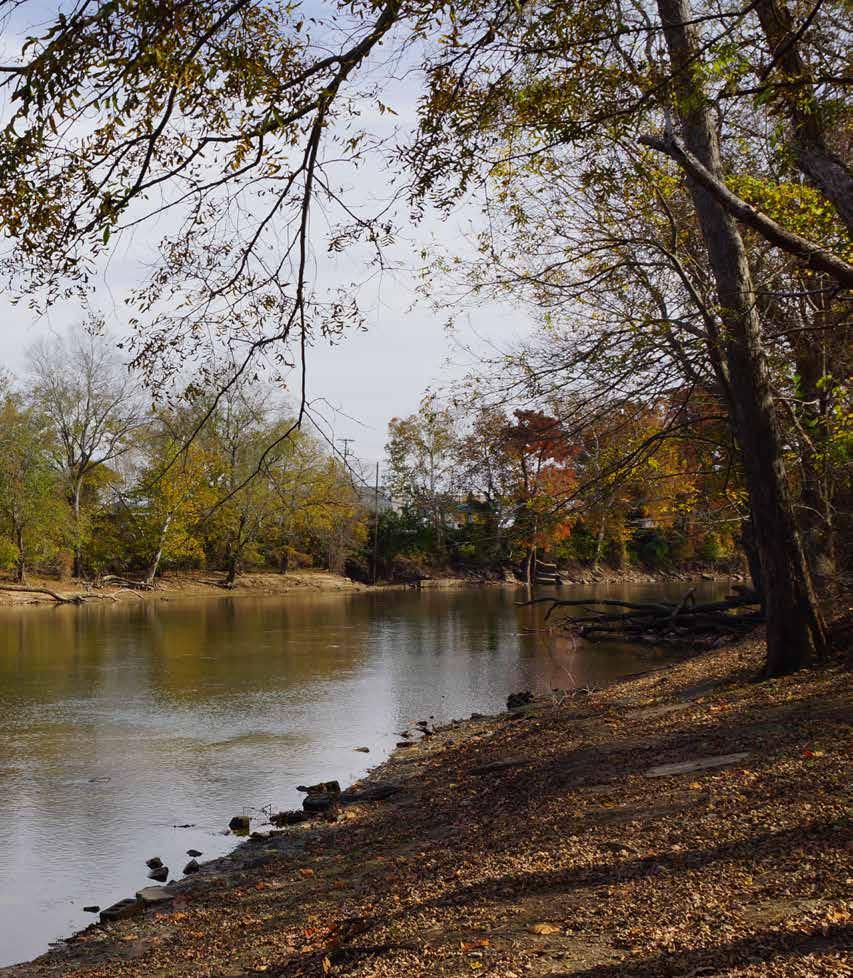
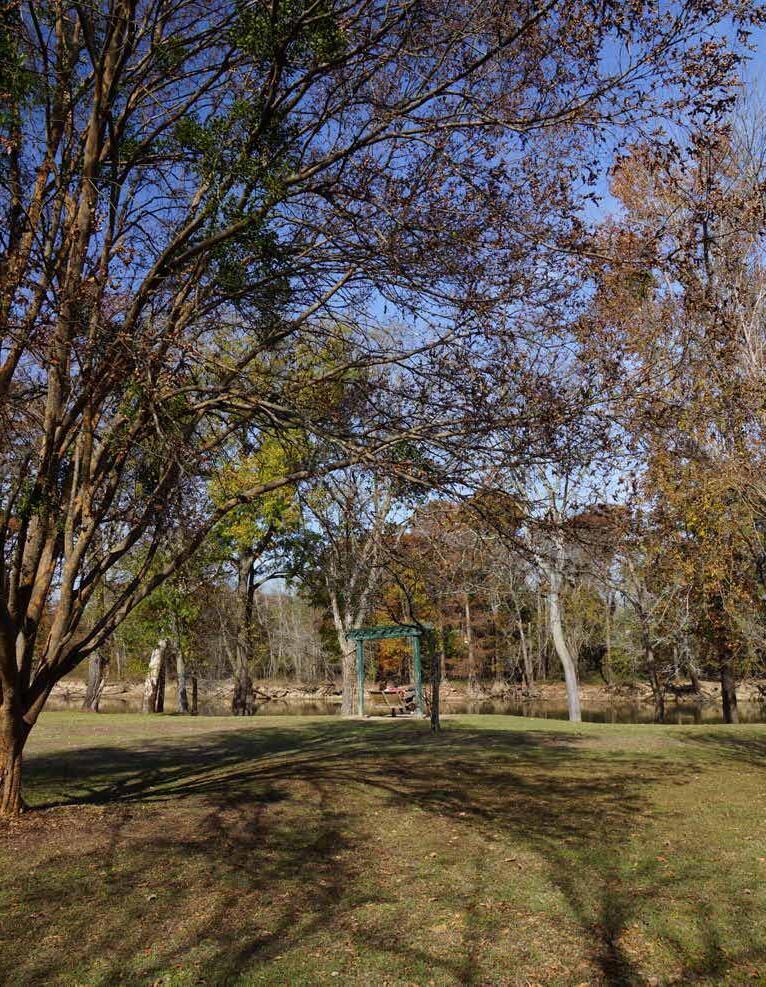
Fall on the Neuse River. Photo by Laura Ashley Lamm, Ed.D.
CONTRIBUTORS IN THIS ISSUE
Laura Ashley Lamm, Ed.D.
Editor-in-Chief
P.J. Drew
Writer and Photographer
Madeline Gray
Photography
Mike Hanafin
Writer
Denise Sharpe
Graphic Design
Penelope Taylor
Writer
Project Gutenberg Library
Historical Text and Photographs
INQUIRIES
Advertising and Distribution: ads@lenoirlantern.com
Press Releases and Story Ideas: stories@lenoirlantern.com
CONNECT WITH
US
facebook.com/thelenoirlantern @lenoirlantern
The Lenoir Lantern
Published by Long Leaf Pine Publishing, LLC www.lenoirlantern.com
CAN’T GET ENOUGH?
An online version is coming soon. To learn more about us, including digital copies, exclusive content, contributor bios, special surprises, and more be sure to keep watch as the website launches shortly.
FRONT COVER
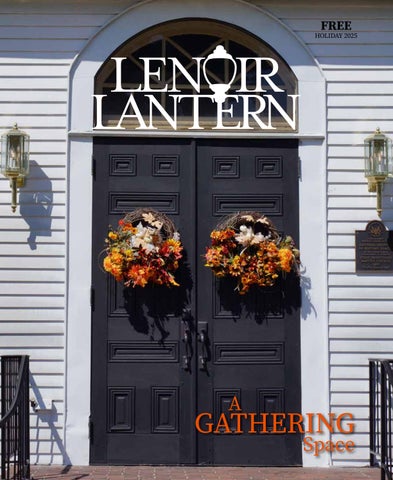
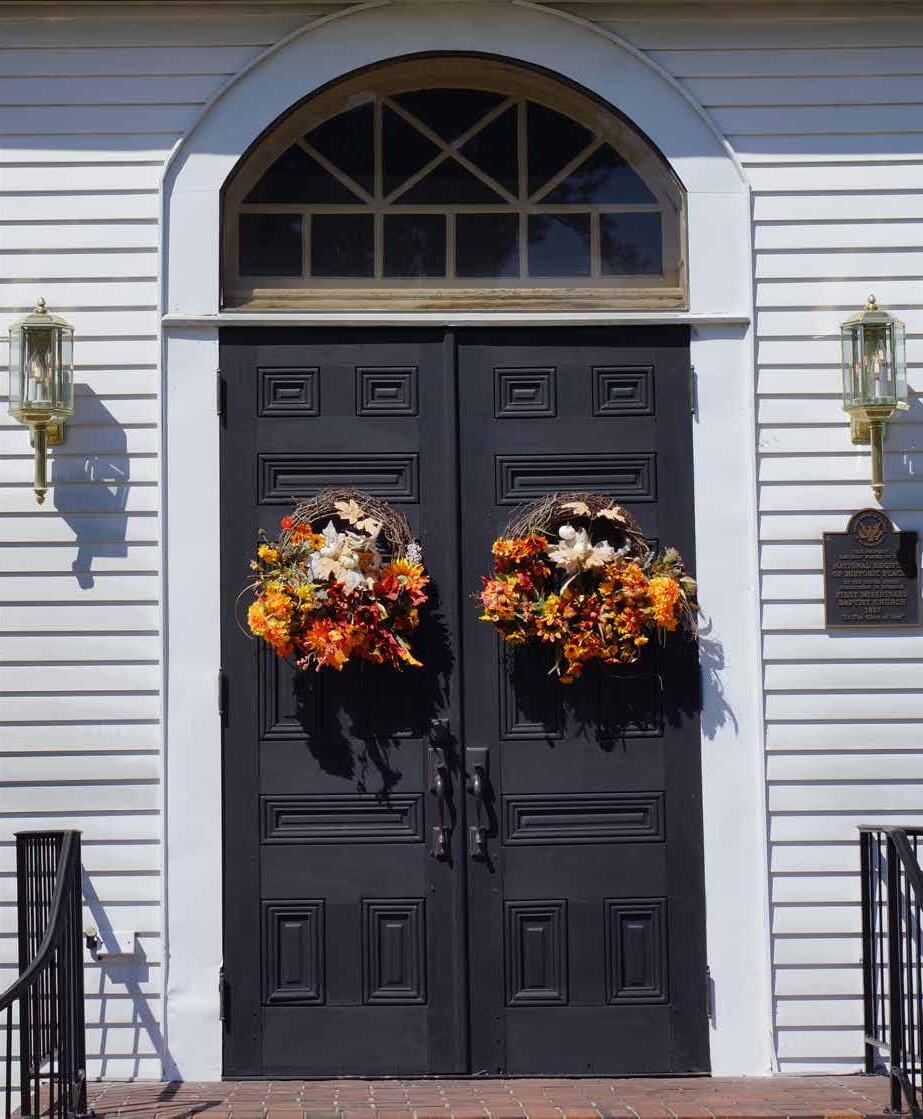
The front doors welcome all to the First Missionary Baptist Church in LaGrange.
LaGrange’s newest marketplace brings customers into a wonderland of arts, crafts and vintage finds
28
The Community Hub: Neuse Regional Libraries
The libraries remain the center point for the communities they serve by offering everything from books to podcast studio sessions
34 Always a Win with the SPCA
Columnist Mike Hanafin shares of the victory in shelter adoptions and the delights these furry additions bring to the home
36
The Journey of Tiny Jesus: Little Figurines, Big Movement
Blooms-n-Grace owner Dondi Smith tells of sharing the joy of Jesus through tiny figurines
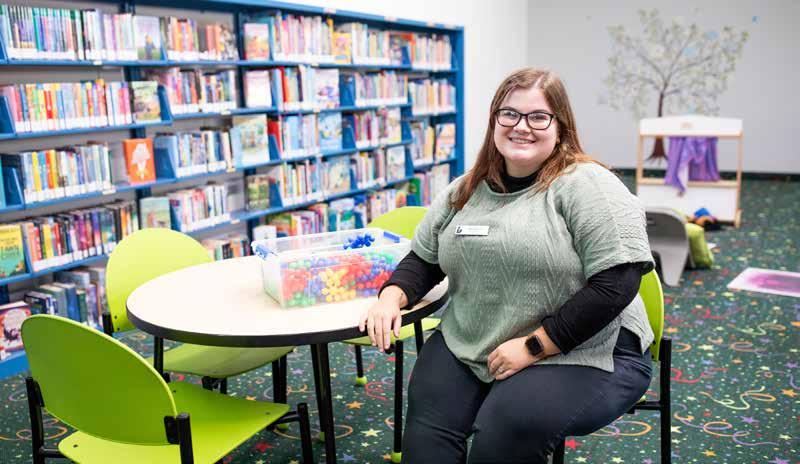
The children’s stacks of the Kinston-Lenoir County Public Library.
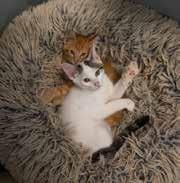
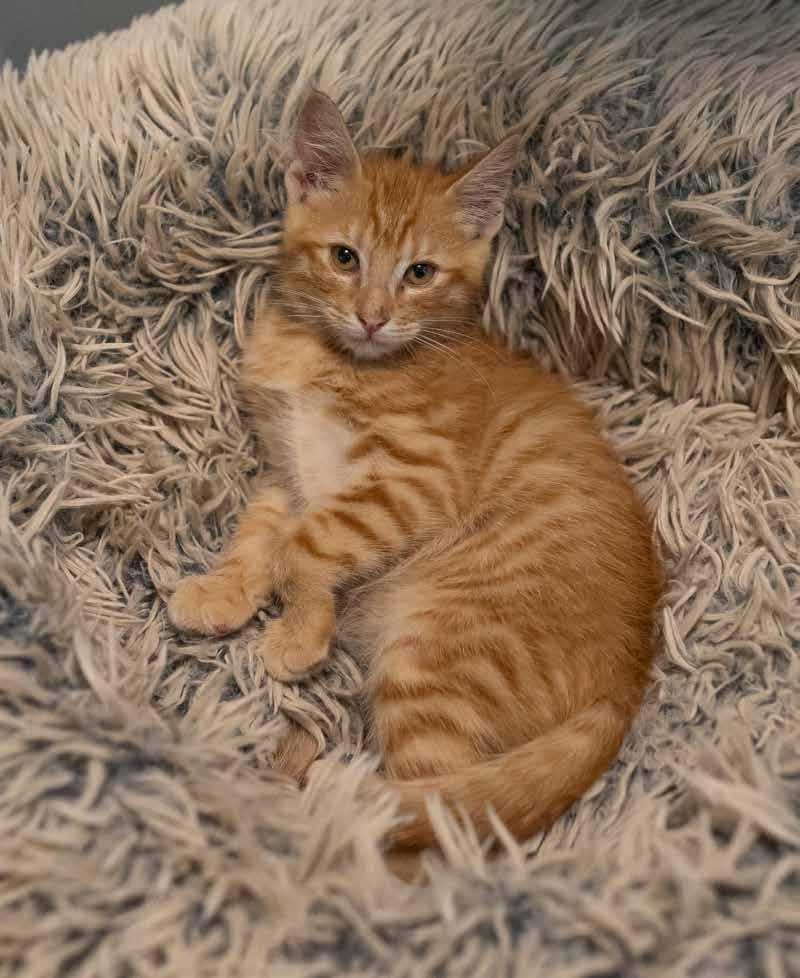
Available kittens relax and await visitors in the cat show room at the SPCA. Read more on pg. 34.
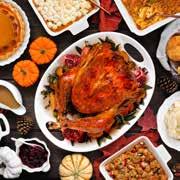
Dive into turkey and side dishes in the Thanksgiving special section beginning on pg. 18.
Learn why shopping small makes a big difference on pg. 24.
“For where two or three come together in my name, there I am with them.”
Matthew 18:20 (NIV)
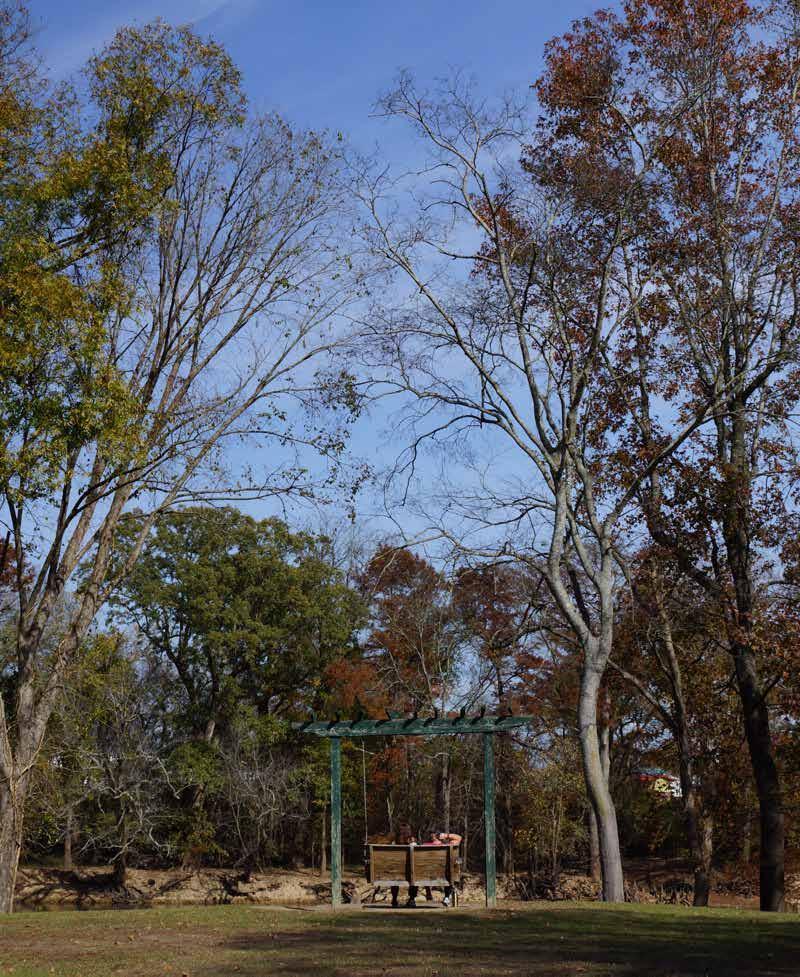
Neuseway Nature Park, Kinston. Photo by Laura Ashley Lamm, Ed.D.
Letter From the Editor
Well, I do declare, the holidays are upon us. The months, as most do, have passed quickly. They have slipped by between day-to-day tasks, successes and setbacks, joys and sorrows. But when the leaves change and autumn ushers itself in, we tend to pause, reflect, and find thankfulness in the blessing and journey that brought us here.
It is a renewing of sorts. A gathering of all that we hold dear and a chance to remind ourselves of just how far we have come and how we are prepared to continue on.
We gather with our stories. Those we know by heart and those we weave into the fabric of our lives—our own stories.
We gather with traditions. Ones we pass from generation to generation and ones we are only beginning.
We gather with books that teach us, inspire us and take us to places undiscovered.
We gather inside our creativity and imagination and sharpen the talents we share with others.
We gather with our chosen groups, the ones that encourage us and lift us up.
We gather with the furry pets we have welcomed into the family.
We gather around the table and share a meal with those we value most.
We gather for conversation.
We gather to invest time.
We gather to thank Jesus.
And all the while, we are creating a gathering space.
A space where we come together. A space where we are welcomed. Lenoir County is full of gathering spaces. Open this issue and you will meet some of those spaces, and when you are finished reading, explore the county and find the ones that call to you the most.
Finally, on behalf of everyone at the Lenoir Lantern, we give thanks to each of you. We are grateful for your enthusiasm and support of this new publication. You have helped us create a space in which we can all gather and share in the goodness found in Lenoir County.
Laura Ashley Lamm, Ed.D. Editor-in-Chief
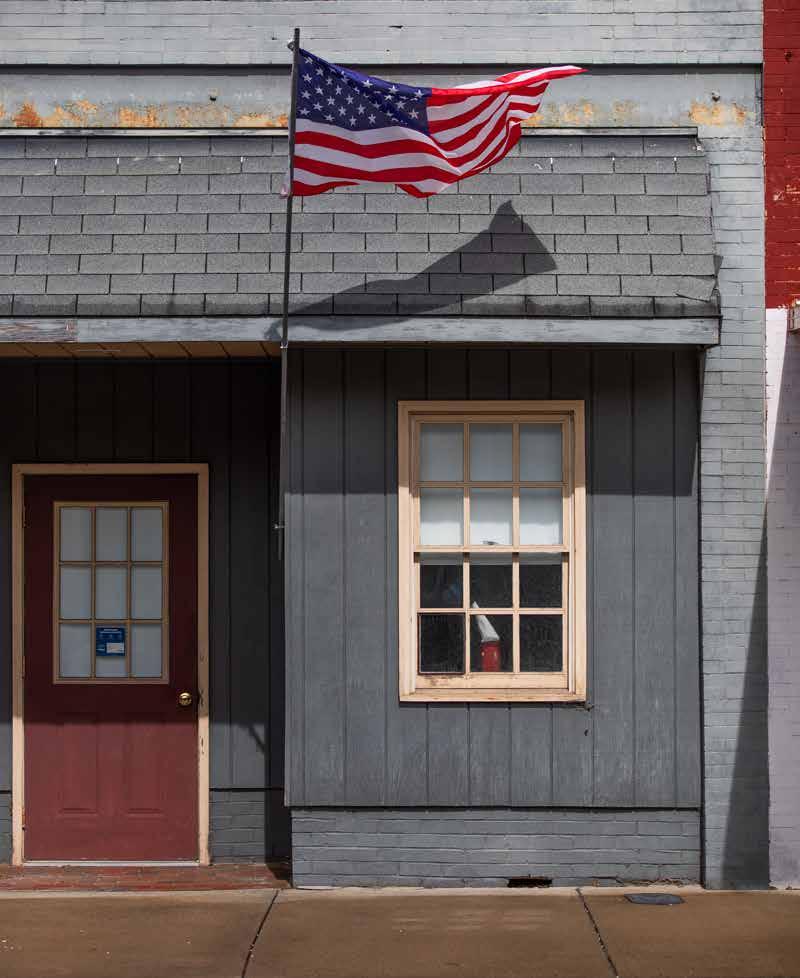
The American flag proudly waves on the streets of downtown LaGrange. Photo by Madeline Gray
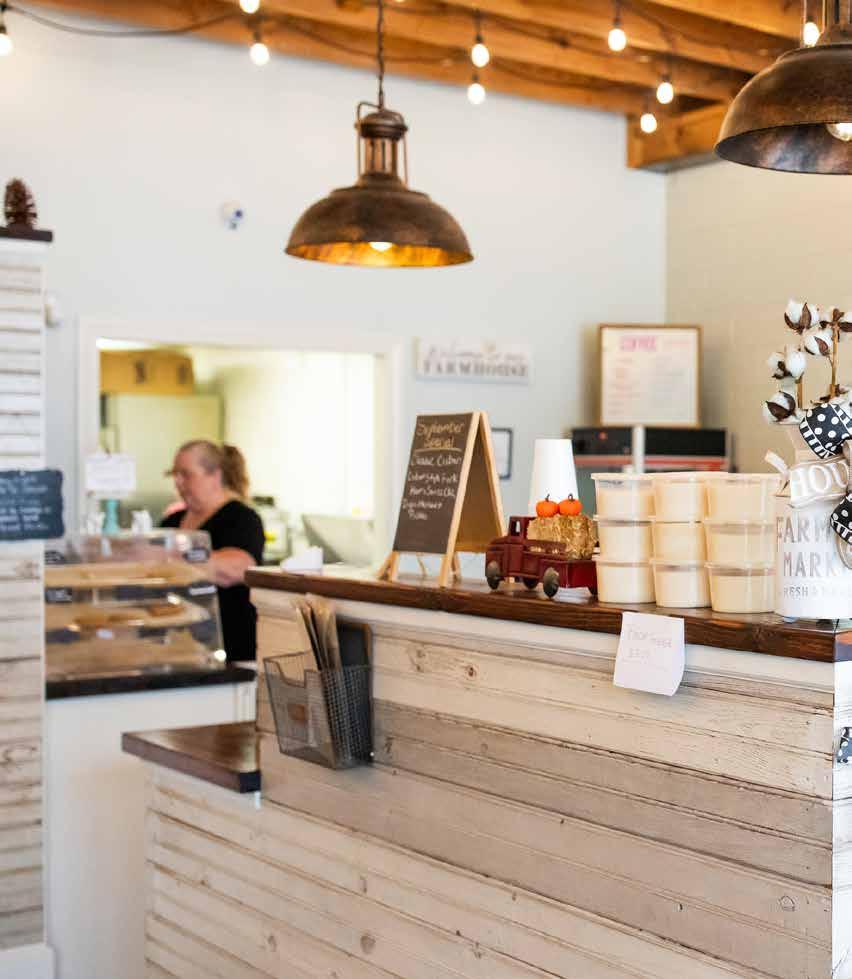
The Farmhouse, Deep Run. Photo by Madeline Gray
SOUTHERN COMFORTS
Aunt Susanna’s Thanksgiving Dinner
Written by: Lucy Maud Montgomery
Lucy Maud Montgomery, author of Anne of Green Gables, takes readers on a journey through a quirky Thanksgiving dinner in this classic short story penned in 1907.
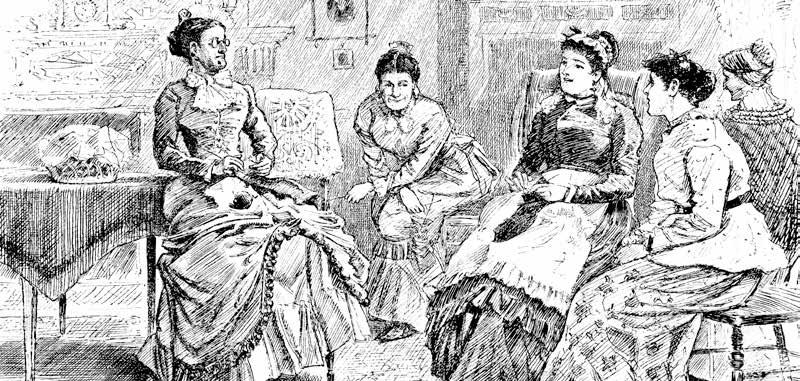
“Here’s Aunt Susanna, girls,” said Laura who was sitting by the north window—nothing but north light does for Laura who is the artist of our talented family. Each of us has a little pet new-fledged talent which we are faithfully cultivating in the hope that it will amount to something and soar highly some day. But it is difficult to cultivate four talents on our tiny income. If Laura wasn’t such a good manager we never could do it.
Laura’s words were a signal for Kate to hang up her violin and for me to push my pen and portfolio out of sight. Laura had hidden her brushes and water colors as she spoke. Only Margaret continued to bend serenely over her Latin grammar. Aunt Susanna frowns on musical and literary and artistic ambitions but she accords a faint approval to Margaret’s desire for an education. A college course, with a tangible diploma at the end, and a sensible pedagogic aspiration is something Aunt Susanna can understand when she tries hard. But she cannot understand messing with paints, fiddling, or scribbling, and she has only unmeasured contempt for messers, fiddlers, and scribblers. Time was when we had paid no attention to Aunt Susanna’s views on these points; but ever since she had, on one incautious day when she was in high good humor, dropped a pale, anemic little hint that she might send Margaret to college if she were a good girl we had been bending all our energies towards securing Aunt Susanna’s approval. It was not enough that Aunt Susanna should approve of Margaret; she must approve of the whole four of us or she would not help Margaret. That is Aunt Susanna’s way. Of late we had been growing a little discouraged. Aunt Susanna had recently read a magazine article which stated that the higher education of women was ruining our country and that a woman who was a B.A. couldn’t, in the very nature of things, ever be a housewifely, cookly creature. Consequently, Margaret’s chances looked a little foggy; but we hadn’t quite given up hope. A very little thing might sway Aunt
Susanna one way or the other, so that we walked very softly and tried to mingle serpents’ wisdom and doves’ harmlessness in practical portions.
When Aunt Susanna came in Laura was crocheting, Kate was sewing, and I was poring over a recipe book. That was not deception at all, since we did all these things frequently—much more frequently, in fact, than we painted or fiddled or wrote. But Aunt Susanna would never believe it. Nor did she believe it now.
She threw back her lovely new sealskin cape, looked around the sitting-room and then smiled—a truly Aunt Susannian smile.
“What a pity you forgot to wipe that smudge of paint off your nose, Laura,” she said sarcastically. “You don’t seem to get on very fast with your lace. How long is it since you began it? Over three months, isn’t it?”
“This is the third piece of the same pattern I’ve done in three months, Aunt Susanna,” said Laura presently. Laura is an old duck. She never gets cross and snaps back. I do; and it’s so hard not to with Aunt Susanna sometimes. But I generally manage it for I’d do anything for Margaret. Laura did not tell Aunt Susanna that she sold her lace at the Women’s Exchange in town and made enough to buy her new hats. She makes enough out of her water colors to dress herself.
Aunt Susanna took a second breath and started in again.
“I notice your violin hasn’t quite as much dust on it as the rest of the things in this room, Kate. It’s a pity you stopped playing just as I came in. I don’t enjoy fiddling much but I’d prefer it to seeing anyone using a needle who isn’t accustomed to it.”
Kate is really a most dainty needlewoman and does all the fine sewing in our family. She colored and said nothing—that being the highest pitch of virtue to which our Katie, like myself, can attain.
“And there’s Margaret ruining her eyes over books,” went on Aunt Susanna severely. “Will you kindly tell me, Margaret Thorne, what good you ever expect Latin to do you?”
“Well, you see, Aunt Susanna,” said Margaret gently— Magsie and Laura are birds of a feather—”I want to be a teacher if I can manage to get through, and I shall need Latin for that.”
All the girls except me had now got their accustomed rap, but I knew better than to hope I should escape. “So you’re reading a recipe book, Agnes? Well, that’s better than poring over a novel. I’m afraid you haven’t been at it very long though. People generally don’t read recipes upside down—and besides, you didn’t quite cover up your portfolio. I see a corner of it sticking out. Was genius burning before I came in? It’s too bad if I quenched the flame.”
“A cookery book isn’t such a novelty to me as you seem to think, Aunt Susanna,” I said, as meekly as it was possible for me. “Why I’m a real good cook—’if I do say it as hadn’t orter.’”
I am, too.
“Well, I’m glad to hear it,” said Aunt Susanna skeptically, “because that has to do with my errand her to-day. I’m in a peck of troubles. Firstly, Miranda Mary’s mother has had to go and get sick and Miranda Mary must go home to wait on her. Secondly, I’ve just had a telegram from my sister-in-law who has been ordered west for her health, and I’ll have to leave on to-night’s train to see her before she goes. I can’t get back until the noon train Thursday, and that is Thanksgiving, and I’ve invited Mr. and Mrs. Gilbert to dinner that day. They’ll come on the same train. I’m dreadfully worried. There doesn’t seem to be anything I can do except get on of you girls to go up to the Pinery Thursday morning and cook the dinner for us. Do you think you can manage it?”
We all felt rather dismayed, and nobody volunteered with a rush. But as I had just boasted that I could cook it was plainly my duty to step into the breach, and I did it with fear and trembling.
“I’ll go, Aunt Susanna,” I said.
“And I’ll help you,” said Kate.
“Well, I suppose I’ll have to try you,” said Aunt Susanna with the air of a woman determined to make the best of a bad business. “Here is the key of the kitchen door. You’ll find everything in the pantry, turkey and all. The mince pies are all ready made so you’ll only have to warm them up. I want dinner sharp at twelve for the train is due at 11:50. Mr. and Mrs. Gilbert are very particular and I do hope you will have things right. Oh, if I could only be home myself! Why will people get sick at such inconvenient times?”
“Don’t worry, Aunt Susanna,” I said comfortingly. “Kate and I will have your Thanksgiving dinner ready for you in tiptop style.”
“Well I’m sure I hope so. Don’t get to mooning over a story, Agnes. I’ll lock the library up and fortunately there are no fiddles at the Pinery. Above all, don’t let any of the McGinnises in. They’ll be sure to be prowling around when I’m not home. Don’t give that dog of theirs any scraps either. That is Miranda Mary’s one fault. She will feed that dog in spite of all I can do and I can’t walk out of my own back door without falling over him.” We promise to eschew the McGinnises and all their
works, including the dog, and when Aunt Susanna had gone we looked at each other with mingled hope and fear.
“Girls, this is the chance of your lives,” said Laura. “If you can only please Aunt Susanna with this dinner it will convince her that you are good cooks in spite of your nefarious bent for music and literature. I consider the illness of Miranda Mary’s mother a Providential interposition—that is, if she isn’t too sick.”
“It’s all very well for you to be pleased, Lolla,” I said dolefully. “But I don’t feel jubilant over the prospect at all. Something will probably go wrong. And then there’s our own nice little Thanksgiving celebration we’ve planned, and pinched and economized for weeks to provide. That is half spoiled now.”
“Oh, what is that compared to Margaret’s chance of going to college?” exclaimed Kate. “Cheer up, Aggie. You know we can cook. I feel that it is now or never with Aunt Susanna.”
I cheered up accordingly. We are not given to pessimism which is fortunate. Ever since father died four years ago we have struggled on here, content to give up a good deal just to keep our home and be together. This little gray house—oh, how we do love it and its apple trees—is ours and we have, as aforesaid, a tiny income and our ambitions; not very big ambitions but big enough to give zest to our lives and hope to the future. We’ve been very happy as a rule. Aunt Susanna has a big house and lots of money but she isn’t as happy as we are. She nags us a good deal—just as she used to nag father—but we don’t mind it very much after all. Indeed, I sometimes suspect that we really like Aunt Susanna tremendously if she’d only leave us alone long enough to find it out.
Thursday morning was an ideal Thanksgiving morning—bright, crisp and sparkling. There had been a white frost in the night, and the orchard and the white birch wood behind it looked like fairyland. We were all up early. None of us had slept well, and both Kate and I had had the most fearful dreams of spoiling Aunt Susanna’s Thanksgiving dinner.
“Never mind, dreams always go by contraries, you know,” said Laura cheerfully. “You’d better go up to the Pinery early and get the fires on, for the house will be cold. Remember the McGinnises and the dog. Weigh the turkey so that you’ll know exactly how long to cook it. Put the pies in the oven in time to get piping hot— lukewarm mince pies are an abomination. Be sure—” “Laura, don’t confuse us with any more cautions,” I groaned, “or we shall get hopelessly fuddled. Come on, Kate, before she has time to.”
It wasn’t very far up to the Pinery—just ten minutes’
walk, and such a delightful walk on that delightful morning. We went through the orchard and then through the white birch wood where the loveliness of the frosted boughs awed us. Beyond that there was a lane between ranks of young, balsamy, white-misted firs and then an open pasture field, sere and crispy. Just across it was the Pinery, a lovely old house with dormer windows in the roof, surrounded by pines that were dark and glorious against the silvery morning sky. The McGinnis dog was sitting on the back-door steps when we arrived. He wagged his tail ingratiatingly, but we ruthlessly pushed him off, went in and shut the door in his face. All the little McGinnises were sitting in a row on their fence, and they whooped derisively. The McGinnis manners are not those which appertain to the caste of Vere de Vere; but we rather like the urchins— there are eight of them—and we would probably have gone over to talk to them if we had not had the fear of Aunt Susanna before our eyes.
We kindled the fires, weighed the turkey, put it in the oven and prepared the vegetables. Then we set the dining-room table and decorated it with Aunt Susanna’s potted ferns and dishes of lovely red apples. Everything went so smoothly that we soon forgot to be nervous. When the turkey was done, we took it out, set it on the back of the range to keep warm and put the mince pies in. The potatoes, cabbage and turnips were bubbling away cheerfully, and everything was going as merrily as a marriage bell. Then, all at once, things happened.
In an evil hour we went to the yard window and looked out. We saw a quiet scene. The McGinnis dog was still sitting on his haunches by the steps, just as he had been sitting all the morning. Down in the McGinnis yard everything wore an unusually peaceful aspect. Only one McGinnis was in sight—Tony, aged eight, who was perched up on the edge of the well box, swinging his legs and singing at the top of his melodious
Irish voice. All at once, just as we were looking at him, Tony went over backward and apparently tumbled head foremost down his father’s well.
Kate and I screamed simultaneously. We tore across the kitchen, flung open the door, plunged down over Aunt Susanna’s yard, scrambled over the fence and flew to the well. Just as we reached it, Tony’s red head appeared as he climbed serenely out over the box. I don’t know whether I felt more relieved or furious. He had merely fallen on the blank guard inside the box: and there are times when I am tempted to think he fell on purpose because he saw Kate and me looking out at the window. At least he didn’t seem at all frightened, and grinned most impishly at us.
Kate and I turned on our heels and marched back in as dignified a manner as was possible under the circumstances. Half way up Aunt Susanna’s yard we forgot dignity and broke into a run. We had left the door open and the McGinnis dog had disappeared.
Shall I forget the sight we saw or the smell we smelled when we burst into that kitchen. There on the floor was the McGinnis dog and what was left of Aunt Susanna’s Thanksgiving turkey. As for the smell, imagine a commingled odor of scorching turnips and burning mince pies, and you have it.
The dog fled out with a guilty yelp. I groaned and snatched the turnips off. Kate threw open the oven door and dragged out the pies. Pies and turnips were ruined as irretrievably as the turkey.
“Oh, what shall we do?” I cried miserably. I knew Margaret’s chance of college was gone forever.
“Do!” Kate was superb. She didn’t lose her wits for a second. “We’ll go home and borrow the girls’ dinner. Quick—there’s just ten minutes before train time. Throw those pies and turnips into this basket—the
turkey too—we’ll carry them with us to hide them.”
I might not be able to evolve an idea like that on the spur of the moment, but I can at least act up to it when it is presented. Without a moment’s delay we shut the door and ran. As we went I saw the McGinnis dog licking his chops over in their yard. I have been ashamed ever since of my feelings toward that dog. They were murderous. Fortunately I had no time to indulge them.
It is ten minutes walk from the Pinery to our house, but you can run it in five. Kate and I burst into the kitchen just as Laura and Margaret were sitting down to dinner. We had neither time nor breath for explanations. Without a word I grasped the turkey platter and the turnip tureen. Kate caught one hot mince pie from the oven and whisked a cold one out of the pantry.
“We’ve—got—to have—them,” was all she said. I’ve always said that Laura and Magsie would rise to any occasion. They saw us carry their Thanksgiving dinner off under their very eyes and they never interfered by word or motion. They didn’t even worry us with questions. They realized that something desperate had happened and that the emergency called for deed not words.
“Aggie,” gasped Kate behind me as we tore through the birch wood, “the border—of these pies—is crimped— differently—from Aunt Susanna’s.”
“She—won’t know—the difference,” I panted. “Miranda—Mary—crimps them.”
We got back to the Pinery just as the train whistle blew. We had ten minutes to transfer turkey and turnips to Aunt Susanna’s dishes, hide our own, air the kitchen, and get back our breath. We accomplished it. When Aunt Susanna and her guests came we were prepared for them: we were calm—outwardly—and the second mince pie was getting hot in the oven. It was ready by the time it was needed. Fortunately our turkey was the same size as Aunt Susanna’s, and Laura had cooked a double supply of turnips, intending to warm them up the next day. Still, all things considered, Kate and I didn’t enjoy that dinner much. We kept thinking of poor Laura and Magsie at home, dining off potatoes on Thanksgiving!
But at least Aunt Susanna was satisfied. When Kate and I were washing the dishes she came out quite beamingly.
“Well, my dears, I must admit that you made a very good job of the dinner, indeed. The turkey was done to perfection. As for the mince pies—well, of course
Miranda Mary made them, but she must have had extra good luck with them, for they were excellent and heated to just the right degree. You didn’t give anything to the McGinnis dog, I hope?”
“No, we didn’t give him anything,” said Kate. Aunt Susanna did not notice the emphasis. When we had finished the dishes we smuggled our platter and tureen out of the house and went home. Laura and Margaret were busy painting and studying and were just as sweet-tempered as if we hadn’t robbed them of their dinner. But we had to tell them the whole story before we even took off our hats.
“There is a special Providence for children and idiots,” said Laura gently. We didn’t ask her whether she
meant us or Tony McGinnis or both. There are some things better left in obscurity. I’d have probably said something much sharper than that if anybody had made off with my Thanksgiving turkey so unceremoniously.
Aunt Susanna came down the next day and told Margaret that she would send her to college. Also she commissioned Laura to paint her a water-color for her dining-room and said she’d pay her five dollars for it.
Kate and I were rather left out in the cold in this distribution of favors, but when you come to reflect that Laura and Magsie had really cooked that dinner, it was only just.
Anyway, Aunt Susanna has never since insinuated that we can’t cook, and that is as much as we deserve. LL
From the Taste Kitchen of the Lenoir Lantern
In a Lenoir County kitchen, passing down recipes is a cherished tradition. Written by hand, spackled with flour, and including an extra dash of this or splash of that, recipes are steeped in memories and cultural identity.
This Stewed Potatoes recipe comes straight from the late Arlene Crisp Aaseby and featured in her collection of recipes known as “Old Carolina Tobacco Country Cook Book.” This easy recipe will make a great addition to your Thanksgiving feast.
Do you have a beloved recipe you’d like to share with the community?
Send it our way and it may be featured in another issue. Email stories@lenoirlantern.com with your submission.
Stewed Potatoes
Ingredients:
4-5 medium potatoes
Salt and pepper to taste
3 medium onions (optional) Just enough water to come to
¼ lb. salt pork in about the top of the potatoes 1-inch pieces and fried out
Peel and cut the potatoes into pieces (about 8-12 pieces per potato). Peel and quarter the onions and put in a stewpot or saucepan. Add salt and pepper. Add the fried pork – dripping and all. Cover and cook until potatoes start to fall apart and liquid starts to thicken.
Shake and Swish: A Cider Cocktail
Ingredients:
Frozen Cranberry Juice Concentrate
Sprite Zero Sparkling Apple Cider
Make sure the frozen cranberry juice is partially thawed before using. While the juice does not need to be liquid entirely, ensure the juice has softened. If some frozen chunks remain, do not fret. A little frozenness makes the beverage extra delicious and adds froth on top of the drink.
Quick Tips: Refrigerate the Sprite and apple cider before use. Make a few minutes prior to serving as the punch is best served chilled. Ice waters down the punch. If you are not a fan of cranberry or apple cider, these beverages can be switched with cranberry-apple concentrate or grape cider.
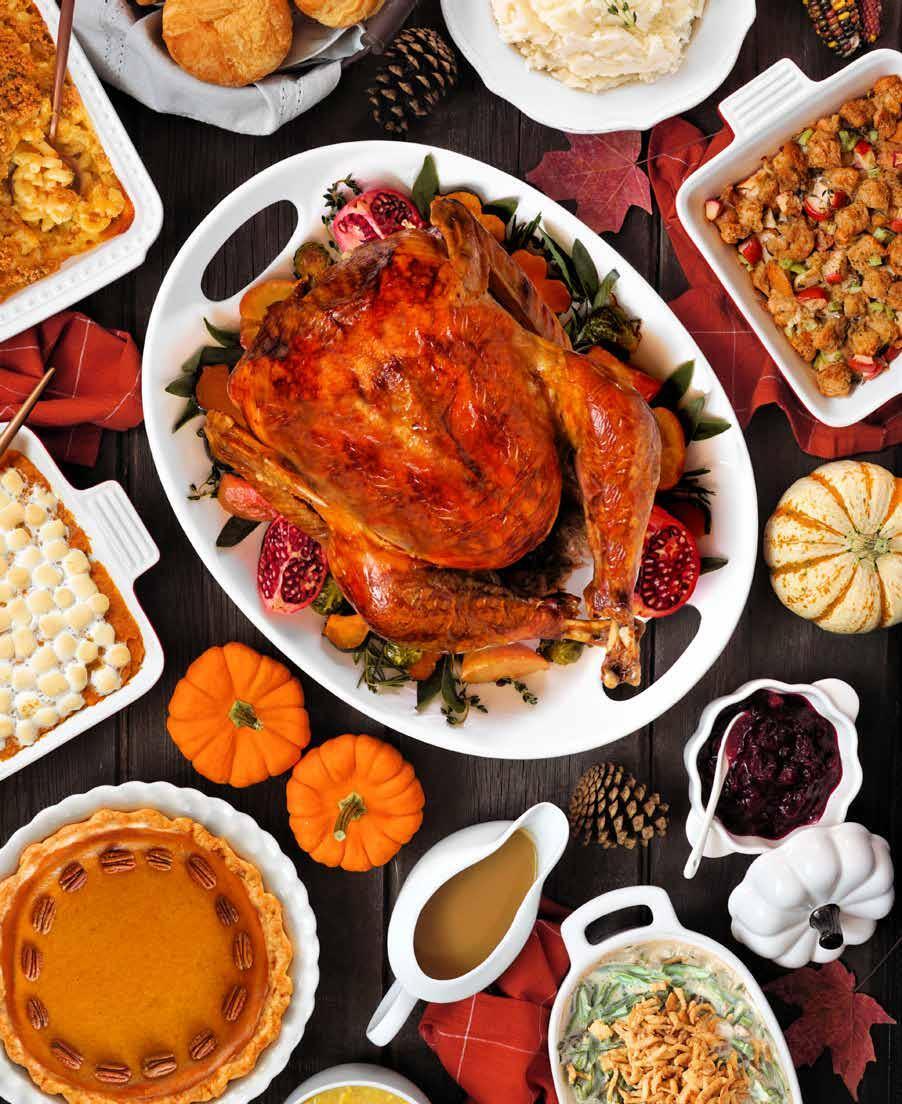
Thanksgiving feast featuring turkey and all the trimmings.
Step Aside for the Dishes
Written By P.J. Drew
When gathering around the table at Thanksgiving, many people will feast on the traditional food staples of the holiday -- turkey, potatoes, squash, corn and cranberries. From North Carolina to California, tables across America include these foods as part of their Thanksgiving traditions.
How exactly did these foods find their way to the holiday meal list? The Smithsonian’s National Museum of Natural History believes most of what is eaten today originated in Mexico and South America before making its way through the Southwestern United States and fanning outward.
Here is a quick look at some of your favorite side dishes that help bring together the big feast of the day.
Cranberries
While native to the United States, European settlers once called these “bearberries” because it was common place to see bears feast on these berries in the 1600s. American Indians were the first to use cranberries as food, medicine and dye, and these are thought to have been eaten at the First Thanksgiving.
Potatoes
Potatoes are notable globe-trotters. South America produced potatoes approximately 10,000 years ago. Snagged by the Spanish and carted to Europe, settlers in the Eastern United States brought them over as a crop for the land.
It’s those sweet potatoes that North Carolinians fancy. North Carolina is the largest sweet potato producing state in the nation and has been since 1971. According to the NC Sweet Potato Commission, farmers produce more than 60 percent of the nation’s supply, exceeding one billion pounds, with most sweet potatoes growing in Sampson, Nash, Wilson and Johnston counties.
Corn
American Indians planted and harvested corn and taught the Pilgrims to do the same. LL
GOBBLE, GOBBLE, GOBBLE.
That is not all turkeys say. They also cluck and purr.
COUNT
THEM, 1-2-3 . . .
Let’s Talk Turkey!
Written By P.J. Drew
an adult turkey has between 5,000 and 6,000 feathers.
(US Fish and Wildlife Service)
MOVE OVER, BALD EAGLE.
Ben Franklin thought the wild turkey would make a better national symbol, referring to them as a “bird of courage.”
(US Fish and Wildlife Service)
DIAL 1-800-BUTTERBALL …
The Butterball Turkey Talk-Line has turkey experts available to answer all of your holiday cooking questions from November to December. This toll-free consumer help line has been saving holiday meals from burning for 45 years.
(Butterball)
NO.
2 IN THE NATION.
North Carolina produces 27 million turkey birds annually, falling slightly short of Minnesota’s production of 32 million birds.
(USDA)
Marking a National Holiday
Written By P.J. Drew
President George Washington was the first to proclaim Americans should hold a day of thanksgiving and prayer in 1789, but it was President Abraham Lincoln in 1862 who decreed Thanksgiving Day was to be observed every fourth Thursday in November.
Since then, only twice has a President changed the day of observation. Both changes are accredited to Franklin D. Roosevelt, who during the Great Depression gave merchants more selling days before Christmas, moving the holiday to the third Thursday in 1939 and 1940. He was met with such resistance by the public, a Congressional Joint Resolution in 1941 officially set the fourth Thursday in November as Thanksgiving Day. LL
A WHOLE LOTTA BIRD. In the U.S. each year, 46 million turkeys are eaten during Thanksgiving.
(USDA)
George Washington
DASH AND SPLASH
Savor the Season, Kinston. Photo by Madeline Gray
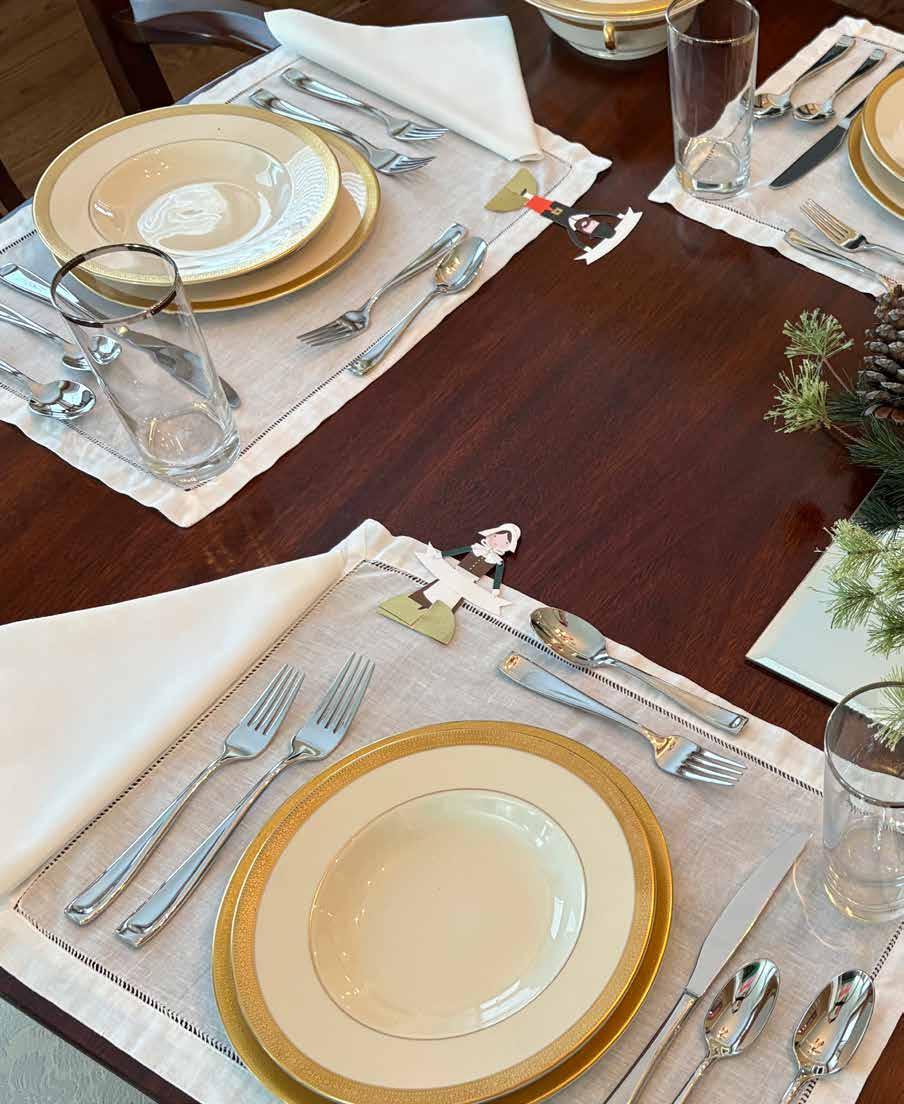
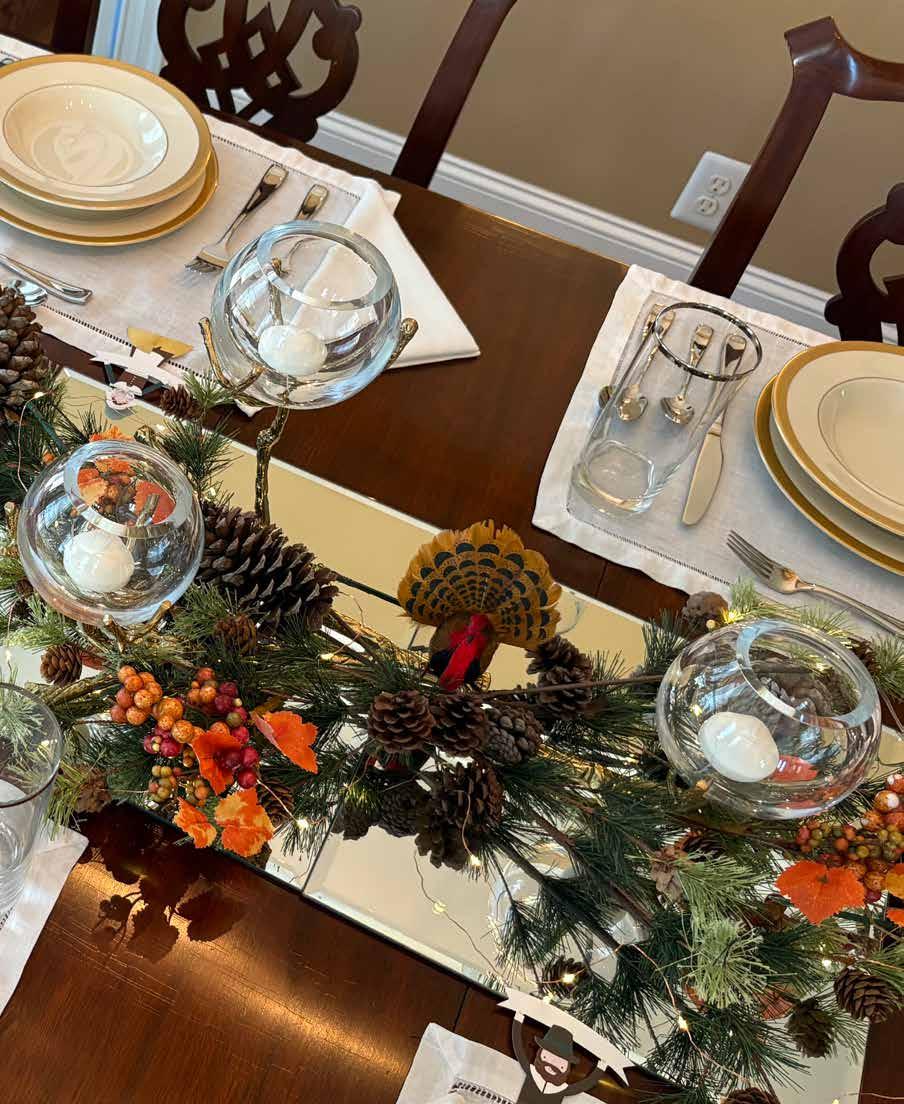
An informal place setting complete with name cards.
THE CONFIDENT TABLE
Written and
Photographed
by Penelope Taylor
As we enter the holiday season, sharing meals with our friends and families is one of our favorite traditions. Turkey, ham, oysters, string beans, potatoes, biscuits, and apple pie are often part of the menu. Reliving memories and making new ones become part of the animated conversations around the table.
Your feeling comfortable at the table is key to having a good time, and understanding the place setting is one way to do just that….
Let’s look at an informal, four-course place setting.
The four courses of the meal are 1) Soup, 2) Salad, 3) Main Course, and 4) Dessert.
First, look at the place setting, and use the outermost utensil when you begin the courses. If there are two utensils on the left side of the plate and are three on the right side of the plate, use the soup spoon, first, because it is the outermost utensil.
The soup course will be served at the beginning of the meal. Once the soup has been enjoyed, the soup bowl and the spoon will be removed.
Second, there are two forks on the left of the
plate—a small fork on the outside and a larger fork on the inside, closer to the plate. Use the outermost fork, the smallest, to eat your salad. Also, if the place setting has a small knife on the right side of the plate, use that knife with the salad course. Once you have completed the salad course, the salad fork and the knife will be removed along with the plate.
Third, once the salad has been eaten, the remaining large fork and knife indicate the main course is next. Once you have completed the main course, the plate and utensils will be removed.
Fourth, the final course is the dessert. Use the spoon and/or fork at the top of the place setting to eat your dessert. You or your server should slide the dessert fork and spoon to either side of the dessert plate before beginning this course. Sometimes, the dessert fork and/or spoon is brought in with the plate when the dessert is served.
Understanding the informal place setting will help you feel more comfortable and confident in the environment so you may focus on the presence of others. Eating with friends and relatives in their dining rooms or in nice restaurants is a wonderful way to create memories that last a lifetime. LL
Step into The Looking Glass A Specialty Marketplace in LaGrange
Alice stepped through the looking glass situated above the fireplace and into a fantastical, wonderous world where logic and time are upside down and adventures await. Stepping through the front doors of The Looking Glass marketplace in LaGrange, shoppers are transported into a whimsical world of arts and
Written By Laura Ashley Lamm, Ed.D.
crafts, vintage marks of decades past, locally made goods and much more.
“The Looking Glass is a marketplace where a bunch of different people come together with a love for creating, selling and sharing,” said owner and artisan Heather Watson. “There are so many artists in our
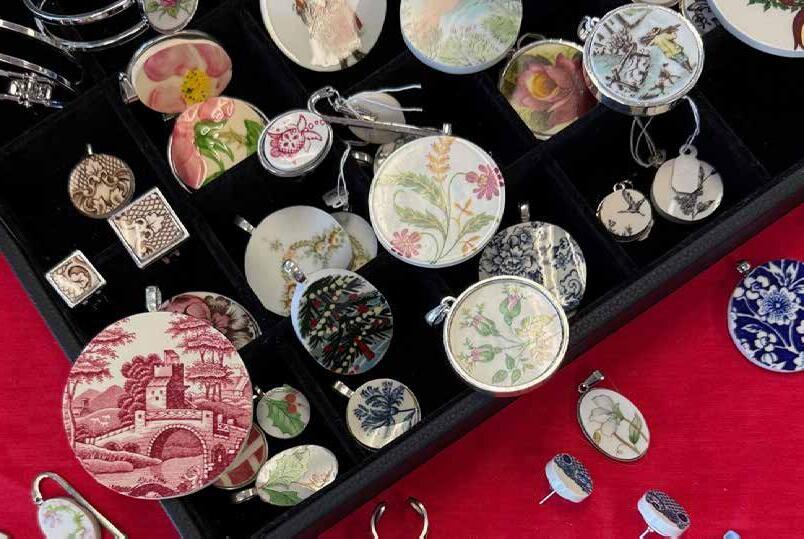
The Looking Glass vendor Jennifer Withers-Jones, owner of Resolute Remnants, turns heirloom china into treasured jewelry.
Photo by Laura Ashley Lamm, Ed.D.
area that we wanted to bring as many artists together to showcase their talents and provide a space where community members can shop small and shop local.”
The Looking Glass opened its doors into a land of antiques, arts, home furnishings, and handmade goods in October. Half of the vendors inside were once exhibitors at The Shoppes at Royall Marketplace in Goldsboro. The Shoppes at Royall announced they were closing their doors and rather than fall down the rabbit hole of the unknown, the group of artists banded together and formed a new plan.
“We knew we wanted to stay together,” said Watson. “We began looking for a place and deciding which of us would spearhead the business.”
As a home for several vendors, a Lenoir County location beside two of LaGrange’s longest retailers was the perfect option.
“The Men’s Den and Sutton’s Shoes are staples in LaGrange having been in business more than 30 years,” said Watson. “Jill (Watkins) knew the owners and made the introduction. As soon as I walked in, everything fell into place.”
She added, “I could see the layout and a space for each vendor. I immediately envisioned us together and knew this was the right choice.”
Watson, an elementary school teacher in Wayne County, has long appreciated literature and the artistic outlets found when creativity and imagination combine. As a nod to Lewis Carroll’s famed works of Alice’s Adventures in Wonderland and Through the Looking-Glass and What Alice Found There, Watson named her own vendor booth “The Looking Glass.” From there the name grew and become more than one woman’s booth. The Looking Glass is home to 52 vendors with a variety of goods. Some vendors are reselling unique finds and antiques. Other vendors are retailers offering gifts for any occasion or decorations and necessities for the home. Artists from the community offer delicate crafts and one-of-a-kind handmade items. Clothing, jewelry, pottery, stained glass, and artwork adorn the spaces. Two quilters use their talents to take items of value to a family, such as the t-shirts of a relative that has passed, and makes those into bears, quilts, and ornaments. This holiday
season, the marketplace offers plenty of options for presents and ornaments. There is something for everyone and every taste.
Vendors range in age from young age of 11 to the mature age of 94. The young vendors offer kid snack stations that can be enjoyed instore. Another young vendor, Ribbons by Rita, offers hairbows and accessories for all occasions.
“While there is a range of age between our youngest and oldest vendors, everyone gets along fabulously,” said Watson. “We have a huge mix of gifts and items available because our vendors have so many different talents.”
“When you hear ‘shop small, shop local,’ this is what they are talking about. No two artists are alike. There is an array of talents and crafts in store from people in your community,” she added.
A team effort helped bring The Looking Glass to fruition. Fellow vendors Jill Watkins, Laura Pittman and Vonne Lankford gathered, along with their husbands, and began creating a space in a total of six weeks.
“We went from having no where to go to being open in six weeks. We were a unit, a force that came together to present the best business opportunities to the vendors that wanted to come with us from Royall Marketplace,” said Watson.
Moving from Goldsboro to LaGrange is a major benefit to the residents of Lenior County and surrounding communities. With a vast variety of goods in one location, many shopping needs and gifts can be found locally.
Though she has passed her vendor booth name on to the store, Watson is still carrying her own goods in The Looking Glass under the name “House Brand.”
“It like restaurants that have a house brand of wine. The House Brand is something that will always be there -- it is good and steady,” said Watson.
When shopping through The Looking Glass, think of it like a treasure hunt, said Watson, as there is something unique to uncover and a fun adventure along the way when one shops the marketplace.
The Looking Glass is open Monday – Saturday from 10 a.m. to 6 p.m., and Sunday from 1 p.m. – 5 p.m. at 7943 U.S. Hwy 70 in LaGrange. LL
Shop Small This Season
Written and Photographed by P.J. Drew
Small businesses are the heartbeat of communities, especially small communities. They are places where people do more than purchase a good or service. Residents gather to catch up on community news and the wellbeing of those around them. Visitors find a warm greeting. These places become gathering spots where people congregate and celebrate the joys of life from weddings and sports wins to prom and cotillion as well as the difficult moments of losing a dear friend.
When you buy from a locally owned business, the same business owner you see behind the counter will be investing back in the community. When investments come to mind, think of Little League team sponsors, school fundraisers and athletic boosters, and community college scholarships, most of which are given by the locals – residents and businesses alike. This holiday season, consider shopping small and shopping local. As reported by the N.C. Governor’s Office and N.C. State University, there are more than 1 million small businesses in North Carolina employing 1.8 million people, which is close to half of all the
workers in the state. Small businesses are helping to fuel the economy, and not just in the Old North State. The nation is home to 36 million small businesses according to the U.S. Small Business Administration. In 2010, American Express founded Small Business Saturday where the day after Black Friday is set aside to celebrate and encourage shopping small and shopping local; something we should do regularly. American Express’ annual small business report shows nationally, small businesses create two-thirds of net new jobs and account for 40 percent of the nation’s economic output.
When you shop local, you are buying more than a tactile good. You will be met with genuine customer service by someone who is passionate about the community. You will find unique gifts that have been lovingly handmade or carefully selected for the boutique. You will see the fruits of your investment in a local business being returned throughout the year. Join us this season and shop small, shop local in Lenoir County. LL
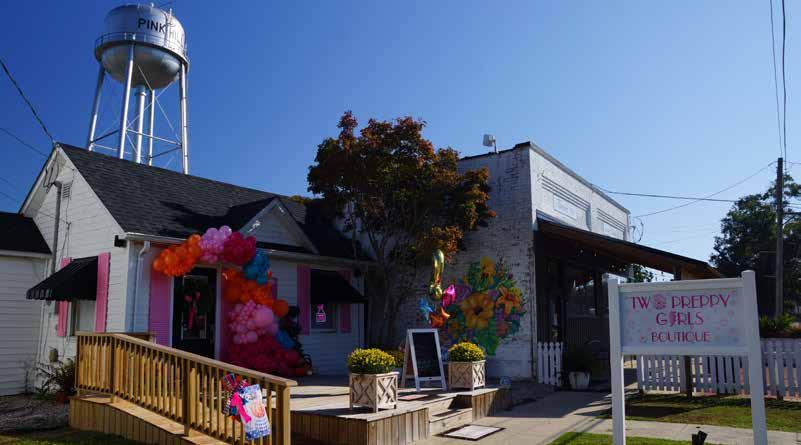
Two Preppy Girls Boutique, Pink Hill
Copper & Loom, LaGrange. Photo By Laura Ashley Lamm, Ed.D.
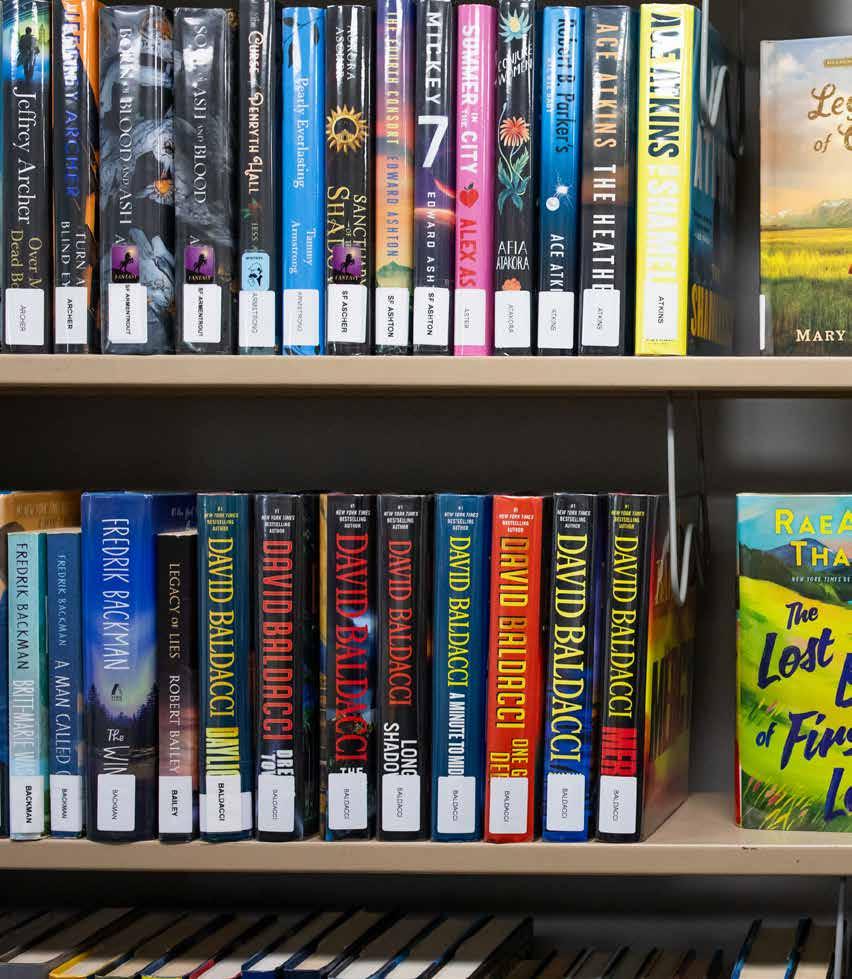
Stacks of books wait for readers at the Pink Hill Public Library.
The Community Hub: Neuse Regional Libraries
Written By Laura Ashley Lamm, Ed.D.,
Photography by Madeline Gray
For generations, libraries have been a gathering place of knowledge, exploration, and congregation for the members of community. Patrons of all ages, from the youngest on the verge of formal schooling to the oldest nearing nonagenarian status can enjoy programs, lessons and activities on a variety of topics, in addition to a never-ending supply of books.
Historical figures have touted the value of such a space. Malcum X stated, “The library is a delivery room for the birth of ideas, a place where history comes to life.” Veteran journalist Walter Cronkite remarked, “Whatever the cost of our libraries, the price is cheap compared to that of an ignorant nation.”
Libraries bring value to a community and none more so than in Lenoir County.
“We are the center, community hub of Pink Hill. We are the place to meet, we are the place to share ideas, we are the place to create through our programs -everyone has a story to tell that comes back to the Pink Hill Library,” said Lori Bradford, branch manager of the Pink Hill Public Library.
The Pink Hill Public Library is part of the Neuse Regional Libraries system, which includes eight branches: Comfort, Greene County, LaGrange, Maysville, Pink Hill, Pollocksville, Trenton, and Kinston-
Lenoir County, the organization’s headquarters. The libraries play significant roles in the communities they serve. They grant patrons access to information through computers and electronic databases; offer assistance with technology and employment applications; provide creative programming centered around crafts and skills; instructional educational prep programs like Countdown to Kindergarten, and much more.
“We have seen our role shift a lot in the last few years as more of a community center because there aren’t as many places these days where people can go and engage with the community. People use the term, ‘third space.’ You have work and home, and then those spaces in the community where you can engage. There are not many of those spaces anymore. The library has stepped up to fill that role,” said Justin Stout, head of information services in Kinston.
“There are things we offer that most would not normally associate with the library. For example, the Chess Club. We have that program because there is not anything like that in our community. After we started it, we found there were a lot of people here who wanted to play chess but did not have anywhere to go and play. We are giving people a place where they can go and engage
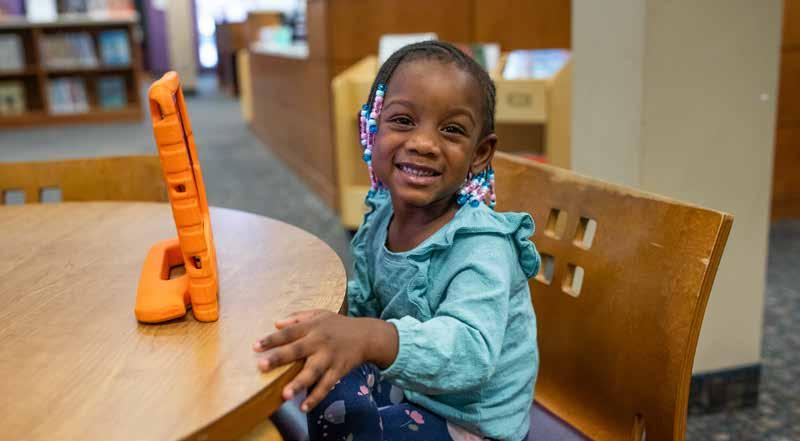
Brightlynn McClain, 3, enjoys a morning of activities in the Children’s Library of the Kinston-Lenoir County Public Library.
with other people,” he added.
Most recognize libraries as offering book rentals free of charge. Additional programs and services are also offered to the community at no cost.
“The library is one of the last places you can go without the expectation of spending money. It is a free place. You do not have to buy a coffee or go out to dinner. It is one of the only places that comes to top of mind where there is no expectation to spend any sort of money,” said Bess Peacock, branch manager of the LaGrange Public Library.
She added, “We have a big homeschool community here in LaGrange. A lot of families bring their kids for interactive activities with others, to join Storytime or to just spend time here. Families are checking out books, playing educational games on the computers, and enjoying a space to take their kids.”
As communities seek spaces for conversation and engagement, in addition to quiet rooms, the libraries have expanded and adapted to meet the evolving needs of the community. The Kinston-Lenoir County Public Library offers a Digital Media Lab, a fully-equipped
creative studio designed for use by patrons in creating videos, music and podcasts. The library also offers a multi-sensory room, an inclusive space focused on calming and visual sensory needs, and tactile objects. Spaces are free to use and individual time slots can be reserved. Collectively, the libraries offer a Digital Resource Rover which travels to Lenoir, Jones and Greene Counties with a collection of books, free Wi-Fi, copying and lamination, and IPads and laptops. It is a one-stop shop that comes straight to patrons.
“Our programs will keep increasing because we want to continue to meet the changing needs of our community,” said Bradford. “I grew up in libraries and definitely understand the need for a space. I didn’t always live in the best socio-economic place, but I made my place any place you could go that was free. The only thing expected of me in the library was to enjoy, exist, and have a good time.”
The Neuse Regional Libraries provide spaces that are welcoming for everyone while meeting their individual needs. “In my experience working in the library, the library serves as different things for people. Some
Lori Bradford, branch manager of the Pink Hill Public Library, states, “We are the center, community hub of Pink Hill.”
people use our library as almost a lifeline when it comes to services we offer such as job searching assistance, answering computer and phone technology questions, using the Internet as many don’t have access at home, faxing documents, making copies,” said Christopher Nelson, marketing and engagement librarian. “If people don’t have it and we offer it for free, people come to us because we are fulfilling a need,” he added. The more time people spend at the library, the more their appreciation for the library and its role in the community grows. “We create a love for the library starting in our early literacy programs and carry it through elementary school to teenage years and to adulthood. By having programming and services for all ages, we are keeping the love of the library going and continuing to provide access to information at every age,” said Peacock.
The Neuse Regional Libraries remain steadfast in its ability to provide information to patrons, to ignite the spark of ideas, and to bring history to life while propelling future generations.
“These libraries have always played the role of providing access to information. The format changes over the years, but our role has always been to make sure people are able to get to the information,” said Stout.
He added, “If they don’t have money to buy books, they can come here and get them. If they don’t have the Internet at home, they can come here and use it. It is all about providing access and making sure there is a place people can go in the community to get the information they need, to learn things or new skills they need, to learn more about the community, and to learn where they can go and find help. That will always be central to our role. The formats and the technologies may change over the years, but access to information is what defines libraries.”
To learn more about the array of programs and services offered by the Neuse Regional Libraries, visit www. neuselibrary.org or visit your local branch.
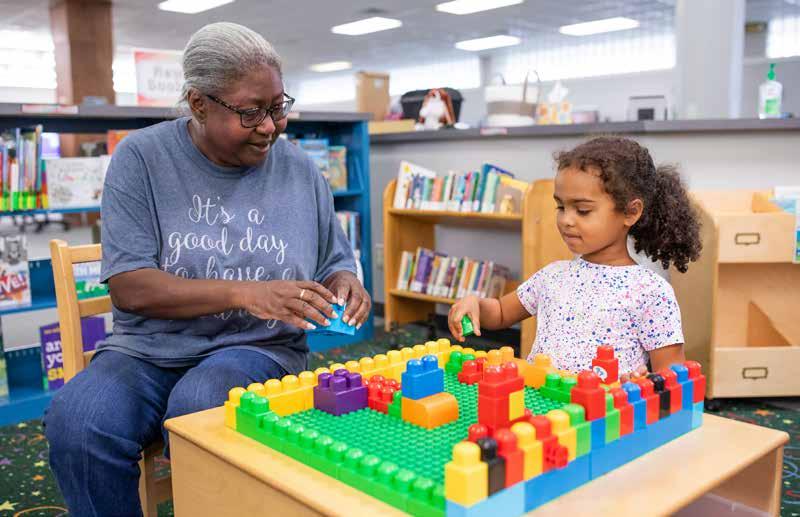
Angela Cook, left, and Luna Corbitt, 6, right, enjoy an afternoon of blocks and books at the LaGrange Public Library.
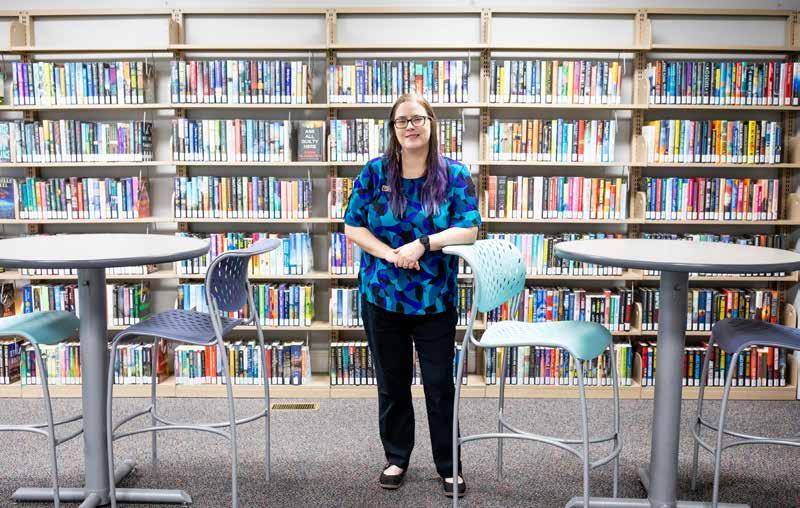
Top: Bess Peacock, branch manager of the LaGrange Public Library, believes a love and appreciation for the library can begin with early literacy programs. Bottom: Christopher Nelson, marketing and engagement librarian, stated the Neuse Regional Libraries provide spaces that are welcoming for everyone.
Always a Win with the SPCA
Written By Mike Hanafin
Photography by Madeline Gray
If ever there was a “win, win” organization in any community, it would be the local SPCA. In fact, you can add many more “wins” once you get to know what the SPCA does, and maybe get involved yourself—either by donation, or volunteering.
My late mom always loved cats. I mean loved cats. And, all her beloved cats – Boots, Benji, Sasha, and Smoky – came from shelters. Cats, who were either abandoned, strays, or surrendered due to various circumstances, ended up at our local shelter. After some tender loving care by shelter staff and volunteers, their found their “furever home”—my mom’s home. Many of us know similar stories for other family pets— especially dogs, and small animals like rabbits. My mom volunteered at our local SPCA, and two years ago, I started volunteering at mine as well.
That is when I fully recognized the mutual benefit, for the animals, myself and other volunteers. We are helping SPCA staff by spending extra time with the animals, helping assorted animals acclimatize to the shelter (hopefully temporarily), and helping them to become more adoptable. There is a special sense of satisfaction that comes with watching a cat’s or dog’s progress from being scared and nervous on arrival at the shelter to being taken to their new home as a more relaxed, loving, and happy pet for a fortunate person or family.
In the process, volunteers get the bonus of spending hours with animals that appreciate your attention and affection. No matter how stressful my day might be, after two hours volunteering with cats, my day is brighter. And hopefully, so are theirs. In a nutshell, I get to play with cats. Other volunteers hang out and walk with dogs… or rabbits or birds or other animals. It is fun. Yes, sometimes it is challenging, when all you can do is talk softly with a frightened and nervous cat. But, that little bit of kindness helps, too. Maybe the next day, the cat or dog is a little bit more relaxed, and you can interact more.
Volunteers do take training courses (online and comprehensive) mostly to recognize certain behaviors in animals to help them promote good behaviors and soften the less-good behaviors. Animals arriving at a shelter are understandably stressed. Some cats and dogs adapt more easily than others. SPCA staff are also trained to match the right animals with the right humans. The goal is to help all the animals become adoptable, and hopefully that gives the fine people who adopt shelter animals an easier task of blending them into their lives. Win, win, win.
Some people come to SPCA shelters with no expectations to adopt an animal. They “just want to play with some cats” or bring their children to the shelter to learn about animals. What a great way to learn, and help the shelter animals re-acclimate themselves to loving humans. But invariably, people with no initial intention of adopting, start to think about it. Or maybe they decide they would like to volunteer, too. Another win, win, win. The SPCA’s value to the community is immense. The SPCA helps protect animals, provide spay and neuter programs to help control pet population, and expand the mental health benefits when humans have loving and beloved pets.
The Lenoir County SPCA is one of only a few animal shelters in North Carolina run by a non-profit organization instead of a county-run animal control department. They accept approximately 2,500 stray, neglected, abused, or surrendered animals from Lenoir County annually, and receive only partial funding for shelter operations from Kinston/Lenoir County. They are a cause that is definitely worth a donation through financial resources, time, or both.
Visit the Lenoir County SPCA’s website at www.lenoircountyspca.org to see photos and details of current adoptable animals. You might just fall in love.
Available kittens relax and await visitors in the cat show room at the SPCA.
The Journey of Tiny Jesus:
Little Figurines, Big Movement
Written and Photographed By Laura Ashley Lamm, Ed.D.
Standing at a mere 1.4 inches tall, tiny Jesus figurines are packing big meaning into their small stature. Sporadically placed in public areas around towns, offices and businesses, or handed to unassuming individuals, these figurines have set off a movement.
The figurines have become a popular way to spread faith in a simple, tangible form. They serve as an acting reminder of Jesus’ presence and love. When provided in public for others to find or offered for others to take as a personal keepsake, the figurines become a quiet source of comfort. Often serving as a reminder of the faith one can carry and the faith one has through Jesus.
Routinely referred to as the “Little” or “Tiny” Jesus Movement, social media is spreading the call. From TikTok trends and Facebook posts to You Tube videos and pastoral mentions, the Little Jesus movement has steadily grown in 2025.
For Dondi Smith, the co-owner of Blooms-n-Grace floral shop and boutique, sharing Jesus figurines faceto-face has lifted the spirts of customers and strangers alike.
“Little Jesus came about before I opened the shop. I had seen a pastor talk about them online and I thought, ‘that is so cool.’” said Smith.
Watching a pastor discuss leaving and gifting the figurines to others, Smith decided to continue the tradition locally in Lenoir County. She purchased a bag of 50 figurines with the intent to pass them out to strangers and spread the love of Jesus.
“Me and my husband, before we had Blooms-nGrace would putts [shopping and browsing] every
Saturday. I would grab a handful and put them in my pocket. I would just walk up to the most unassuming people - teenagers, older gentlemen - and I would go, ‘Can I give you something?’” said Smith.
“And they would go, ‘sure,’ and I would give them a little Jesus. I would watch the biggest smile come on their face. When we opened the shop, I had already given out 200,” she added.
Since opening her shop in April, Smith is close to having given away almost 400 figurines. She keeps the little Jesus figurines in a bowl on the counter. Customers will routinely walk up and ask, “How much?’ after admiring their cuteness.
“I don’t sell little Jesus, but I will give you a little Jesus,” said Smith. “You can have one, just put him in your pocket. Some people will take one and I’ll go, ‘Do you need another one to give away?’”
Nine times out of 10, customers will take two figurines. One to keep for themselves and one to pass on and spread the love of Jesus to another human being.
Smith feels led to help spread the word of Jesus. “It’s what you’re supposed to do,” she said. “I always tell my story of how good and forgiving God is. My whole life is a testimony of the goodness and the forgiveness and the mercy and the grace of God.”
Blooms-n-Grace is for the glory of God, she added. Customers can walk in and find a little Jesus along with beautiful flower arrangements, and an owner willing to pray with you, too. “If someone walks in and needs prayer, I’ll pray with them right here,” said Smith.
OLD NORTH STATE
Carter-Finley Stadium, Raleigh. Photo by Laura Ashley Lamm, Ed.D.
ASHEVILLE
Unwrap the secrets of Ancient Egypt as the Biltmore takes visitors on a journey into the world of “The Boy King” through the exhibition, Tutankhamun: His Tomb and His Treasures. Featuring nearly 1,000 dazzling expert-crafted replicas of King Tut’s exquisite burial goods, this exhibition is the only opportunity to experience his treasures in their entirety exactly as they were found. Tickets required. Open daily through Jan. 4, 2026.
SEAGROVE
As the “Pottery Capital of the United States,” Seagrove is home to more than 100 potters. The Celebration of Seagrove Potters provides the opportunity to meet potters, purchase works, and more during the annual festival from Nov. 21-23.
RALEIGH
The Annual American Indian Heritage Celebration will bring together musicians, dancers, artists, storytellers and authors from North Carolina’s eight state-recognized tribes. Hosted by the N.C. Museum of Art, join the celebration Nov. 21-22.
RALEIGH
The NC State Wolfpack and the UNC Tar Heels battle over the pigskin during their annual Thanksgiving weekend game. The teams and their dedicated fans will meet at Carter-Finley Stadium for the sold-out football game on Nov. 29. ESPN will televise the game.
DURHAM
The Durham Art Walk and Holiday Market is a carnival of visual arts and fine crafts held in downtown Durham. Spend Nov. 22-23 immersed in shopping, live music, dining, and historic tours.
WINSTON-SALEM
Quality craftsmanship and excellent design are the hallmarks of the Piedmont Craftsmen’s Fair. Held annually since 1963, the fair showcases the handwork of more than 150 artisans in a setting that gives shoppers a meet-and-greet with artisans and views of craft technique demonstrations. The fair takes place Nov. 22-23.
WILMINGTON
Bonfires, moonshine and strangers that become friends, the Cucalorus Film Festival provides more than just a great selection of local and international films. Join the unique movie experience from Nov. 19-23.
Seagrove
THE LAST WORD
Neuseway Nature Park, Kinston. Photo by Laura Ashley Lamm, Ed.D.
Children’s Corner
Thanksgiving BINGO!
When gathering with friends and family for the holiday, take time away from technology. Enjoy conversation, laughs and a quick game of the classic BINGO. Simply cut out the playing board and cards below. Select an announcer to shuffle the card deck, draw and call out the images. Use candy corn as tokens. First person to complete a row shouts “BINGO!”
Acorn Cupcake
Honey Pumpkin Latte
Roasted Turkey Carrots
Blueberries Invitation
Across
1.
5.
6.
10.
11.
12.
14.
17.
19.
20.
A Grateful Classic
Complete the puzzle with your knowledge of classic things associated with Thanksgiving.
Down
2.
4.
7.
8. Thanksgiving with friends
9. Friends’ Monica and Ross compete for this trophy
13. Coming together
15.
16. Thanksgiving leftovers led to this invention
18.
Calls for a dash, pinch, cup or tablespoon
3. Pigskin
Running race
Used as a spice or in a pie or latte
Green and string
Shuck it
New York hosts this annual event
Department Store
Horn of plenty
Table focal point
Pumpkin or apple
The Pilgrim’s ship
Both a rock band and a side dish
Turkey’s side dish
One of the Peanuts’ gang
Sound of a turkey
let me letyougo
But before I do, let me tell you one more story . . .
Edwin Way Teale (1899-1980) was an American naturalist who dedicated his life to studying nature, its organisms, and their relationship to the environment. Teale spent his days in fields visually documenting insects through photography with his collection having amassed more than 15,000 images. His work substantially contributed to the expansion of entomology. A notable author, he often detailed his views and discoveries within nature through the written word. Teale’s 20,000-mile journey through the North American winter became the topic of his book, Wandering Through Winter, which earned him the Pulitzer Prize for General Nonfiction in 1966.
But, it is his novel, Autumn Across America (1956), in which he poetically describes the role of man and nature during such a pivotal season as the one in which leaves fall from trees and the ground grows barren in anticipation of the coming winter.
“For man, autumn is a time of harvest, of gathering together. For nature, it is a time of sowing, of scattering abroad,” he writes.
As the holiday season approaches, it is often a busy time in which we shuffle from one event to another and elbow our way through stores searching for the perfect gift at the best sale price. However, the holiday also brings us together with family, friends, neighbors and strangers. This is a time of year in which we gather around the table for dinners and fundraisers, at the counter and at the cash register, in church pews and bleachers, and in fields and Christmas tree lots.
While nature scatters leaves and trees become barren, nature prepares itself for a new season dawning. It relishes that which brought ii here, welcomes the change, and turns for the inbound winter. For humans, we come together to recognize and appreciate where the year has brought us and to reflect and prepare for where the coming year will take us. It is a time to take stock of our harvest – those blessings for which we give thanks and the people and places in which we hold dear – and to feel the warmth when we chose to gather here.