

Where the GOOD THINGS BLOOM
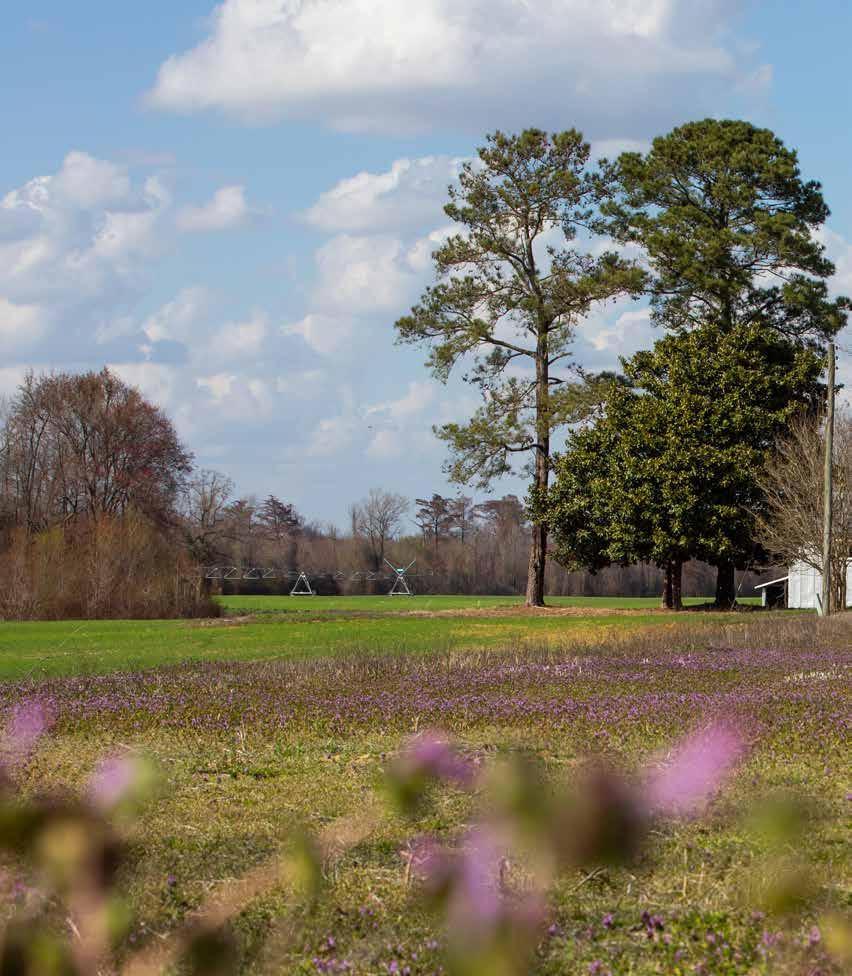
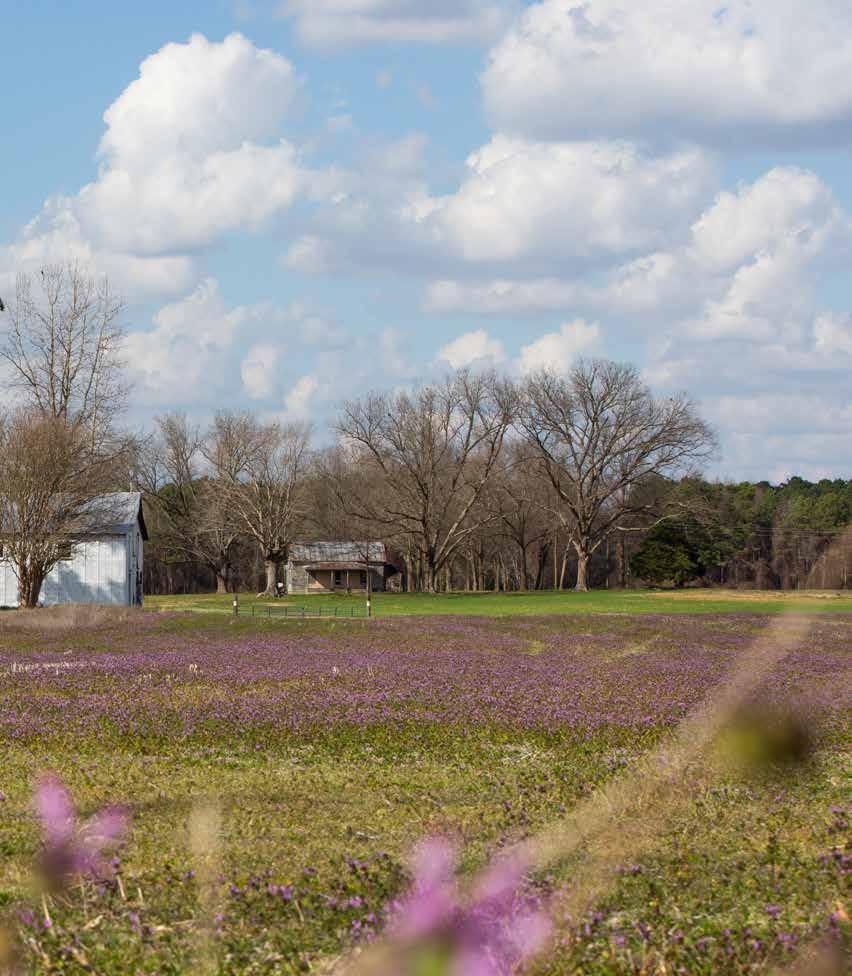
View from an afternoon drive in Deep Run. Photo by Madeline Gray.
CONTRIBUTORS IN THIS ISSUE
Laura Ashley Lamm, Ed.D.
Editor-in-Chief
P.J. Drew
Writer and Photographer
Madeline Gray
Photography
Denise Sharpe
Graphic Design
Grayson Smith
Writer and Photographer
INQUIRIES
Advertising and Distribution: ads@lenoirlantern.com
Press Releases and Story Ideas: stories@lenoirlantern.com

CONNECT WITH US facebook.com/thelenoirlantern @lenoirlantern

The Lenoir Lantern
Published by Long Leaf Pine Publishing, LLC www.lenoirlantern.com

READ THE LANTERN ONLINE!
Scan the QR code for access to our website and digital copies of the magazine.
FRONT
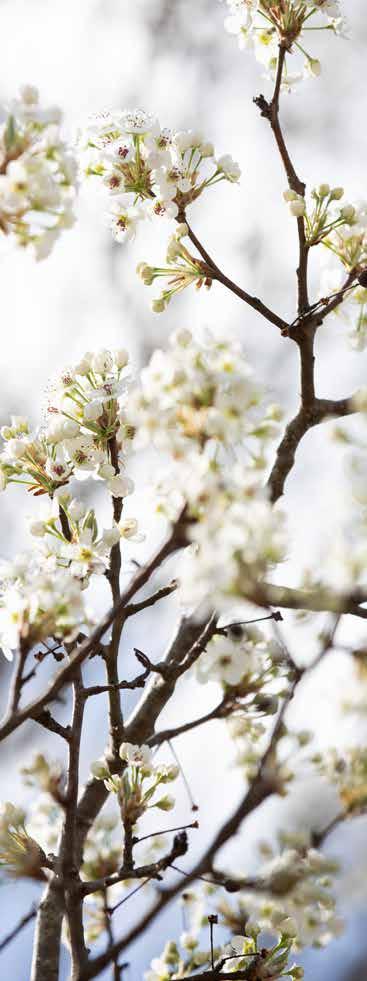
Photo by Madeline Gray
Stars, Stripes & Stories: Adventures Around America
Celebrate America’s 250th birthday with an activity book perfect for young patriotic explorers. Perfect for kids of all ages, this interactive book brings U.S. history to life covering U.S. Presidents, the 50 States, and key milestones from the nation’s history. Featuring 100 pages of educational games, word searches, coloring pages, trivia, DIY crafts and more. This is the ultimate guide to helping your child learn and celebrate America!
Pre-orders begin May 1 at longleafpinepublishing.com

Talk of the Town

Jaydon Cintron, a Chick-fil-A worker and good Samaritan, found $10,000 in cash on the floor of the store’s bathroom. Rather than keep the cash for himself, he turned it in to Human Resources. The money was returned to its owner who offered Cintron a $500 reward.

Kinston High School Men’s Basketball won the 2026 NCHSAA 3A Basketball State Championship with an 8054 victory over Walkertown. The Vikings secured their 12th state title in program history. That makes them second to New Hanover (14) with alltime state title wins.
Words from Afar
“Just dropping a note as I was reading the Lenoir Lantern online and it made me feel good about the people of America and helped me find several great places to detour on my journey to Florida this summer. I can’t wait to visit Lenoir County in person!”
Anika S., New York
JUICY GOSSIP
Let’s Hear from You
We love a delicious Southern dish whose recipe has been passed down from generation to generation. Share one of your favorite recipes with us at stories@lenoirlantern.com.
Looking Ahead
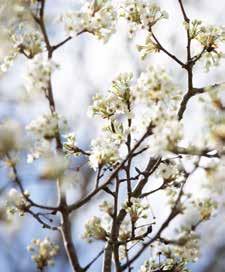

The Summer Issue celebrates great adventures, good times, and America’s 250th.
Connect With Us





24
A Rural Town on the Rise
Discover what makes the Town of LaGrange one of the East’s best places to live.
30
A Double Win Fees associated with obtaining a passport help college students in financial need at Lenoir Community College.
40 Matters of the Heart
Dr. Brian Simpson takes readers inside the heart with a breakdown of symptoms and preventative measures aimed at reducing cardiovascular disease and heart attacks.
52 From the Earth to the Moon and Back
Celebrate the Earth all year long. Take a look at the historic Artemis II mission and discover fascinating facts about the Earth.
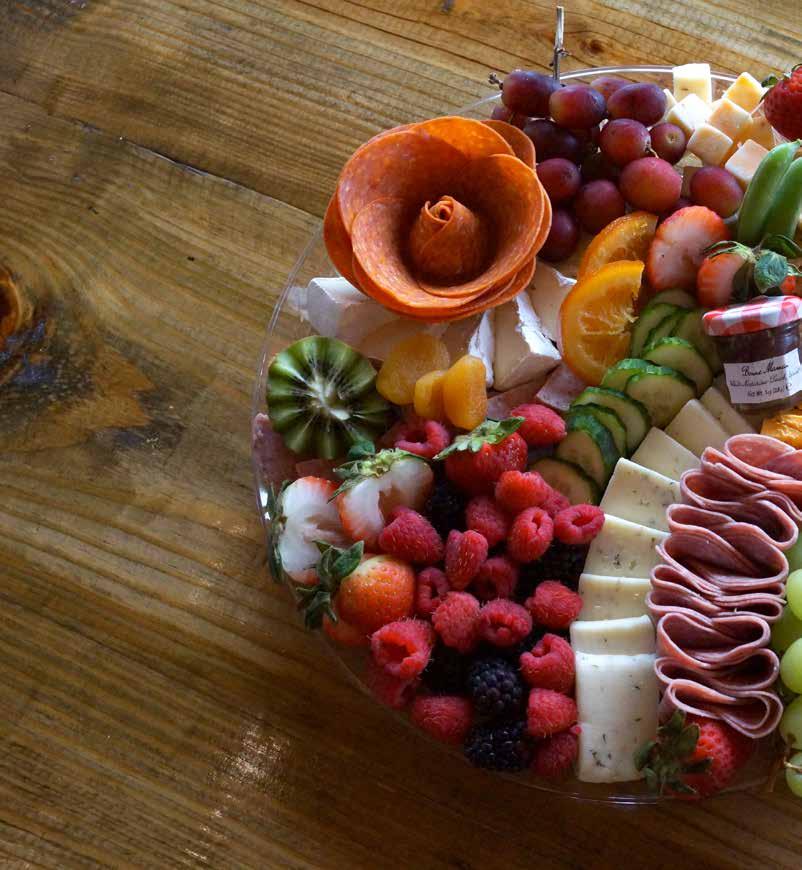
Cotton Pickin Blessed delivers charcuterie boards filled with delicious goodness in Deep Run. Read more on page 14.


Dr. Gregory Gridley shares the importance of getting quality sleep. Read on pg. 38.
Find locally made treasures at Leon Thomas. Read more on pg. 22.
Use this checklist when applying for a passport. Find it on pg. 35.
“As surely as the sun rises, He will appear; He will come to us like the winter rains, like the spring rains that water the earth.”
Hosea
6:3
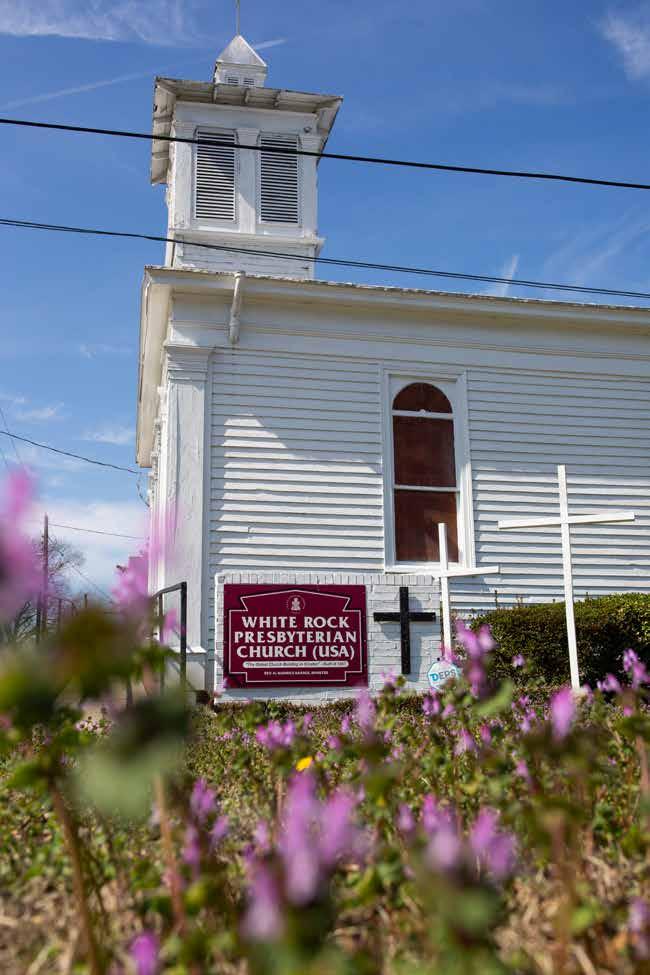
White Rock Presbyterian Church, Kinston. Photo by Madeline Gray
Letter From the Editor
Well, I do declare, things are blooming everywhere.
Bloom, a term and directive synonymous with the Spring season, often references a period of flowering. Where after much waiting, a seed having been watered and showered with sunlight begins to develop into what it was always meant to be—a beautiful flower.
The word bloom is also known to usher in a state of great beauty, freshness, or vigor.
Spring days are filled with increasing temperatures, blue skies, sunshine, and enough pollen to season us like cooked chickens. Nevertheless, it is the prime time to witness the onset of a great flowering.
Take an afternoon drive and crisscross from one end of the county to the other, and you will see telltale signs of blooming. Within nature, trees, flowers and crops are entering their “season of becoming” after a harsh winter. More importantly, you will see the people of this county coming into their own—blooming—into the greatness they know they can be and this community deserves.
Within the pages of this Lenoir Lantern issue, you will read stories of great beauty, brilliance and strength. You will meet people using their talents, skills and passion to bloom exactly where they are planted. You will meet people creating a better community for everyone.
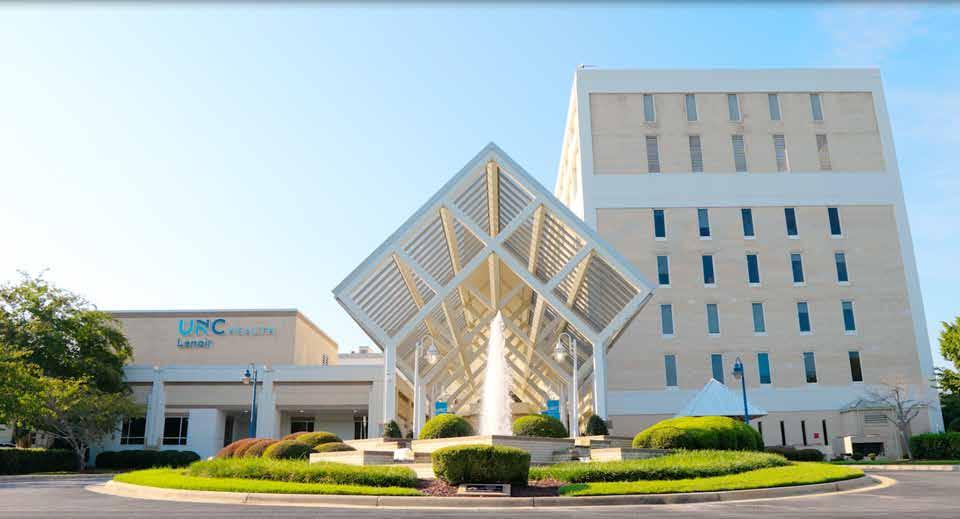
The Town of LaGrange is embracing growth and rising for the next generation. The Small Business Center is shepherding entrepreneurs towards fulfilling their dreams. UNC Health Lenoir is strengthening cardiology services and powering longevity through heart-healthy living. As more people seek to explore the world around them, the Passport Office is helping connect us together. The Farmhouse is providing local dining options, and Leon Thomas Treasures is spotlighting local artists.
There is plenty of beauty, freshness and vigor to be found. After all, Lenoir County is where the good things bloom.
Laura Ashley Lamm, Ed.D. Editor-in-Chief
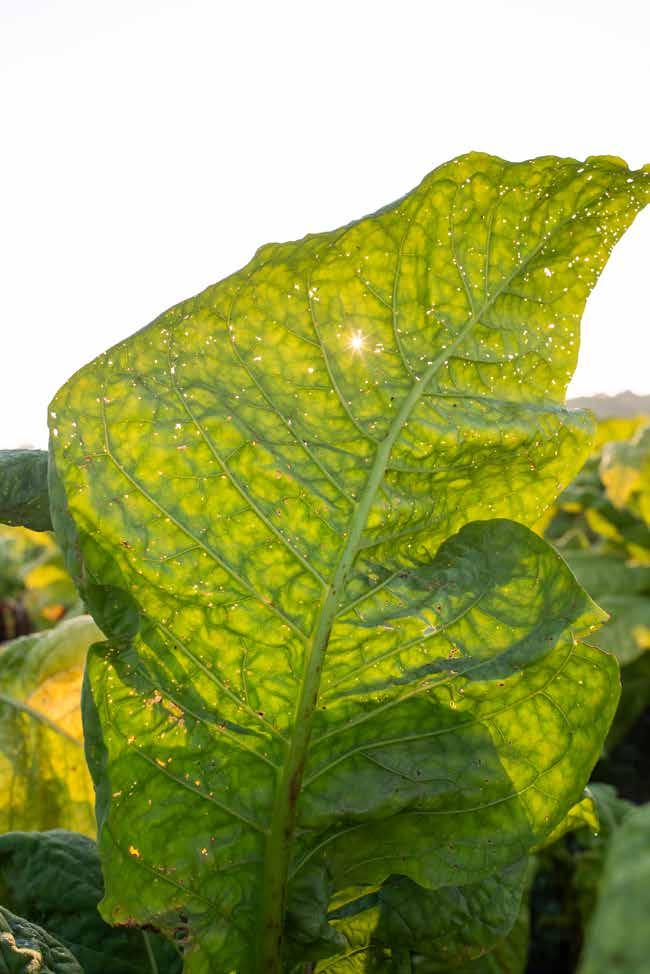
The sun bursts through a tobacco leaf on Hwy 258 N in Lenoir County.
Photo by Madeline Gray
There is a skill, a passion, a dedication, a purpose. Stories tell others who we are, what we stand for, and what we are doing. The way stories are told – written – is the very thread that shares in words what matters to us most. At Long Leaf Pine Publishing, we are storytelling for Eastern North Carolina and beyond. Whether its media and communications consulting, writing and editing, publishing or strategic planning, we can help you tell your story.
www.longleafpinepublishing.com

SOUTHERN COMFORTS
Lagrange Public Library. Photo by Madeline Gray
The Farmhouse
Words by: Laura Ashley Lamm, Ed.D.
Photography by: Madeline Gray
Charcuterie boards are one of the culinary feats that have been around for centuries with mainstream popularity gaining in the Americas during the 1990s. Today, they are one of the top requested staples for gatherings and parties.
The term charcuterie dates to the 15th century in France and is derived from the French words: chair (flesh) and cuit (cooked). Charcuterie refers to the shops that sold pork products. As the request for the delicatessen grew, cultures around the world adapted the practice and placed their own spin on the board.
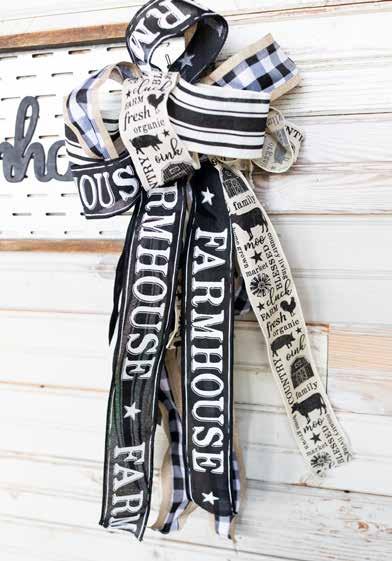
The American pronunciation of charcuterie aligns with the sounding of “shaar – koo – tr -ee,” though the Southern dialect lends itself to a few extra syllables and drawn-out vowels. Nevertheless, it is a favorite among the people.
The modern charcuterie board is both creative and delicious and can include an assortment of food from meats and cheeses to candy and desserts. Charcuterie boards can easily be paired with wine for dinner, offered as a snack during a Mahjong game, or taken to a tailgate party for grazing; they are quite often the perfect party staple.
Arranging the foods in cascading displays with a vibrant color palate and the right recipe of flavors for optimal taste is an art form that needs the best artist, and that lends us to calling Deep Run’s own Beverly Cherry Pope.
Pope established Cherry Blossom Boards and Cotton Pickin Blessed in February 2020. What started as a pandemic hobby for enjoyment blossomed into a thriving charcuterie board and catering business. During the pandemic, Pope found pictures of charcuterie boards on Pinterest and began creating her own unique version. She created one for a relative’s birthday, which led to creating boards for friends and grazing tables for events.
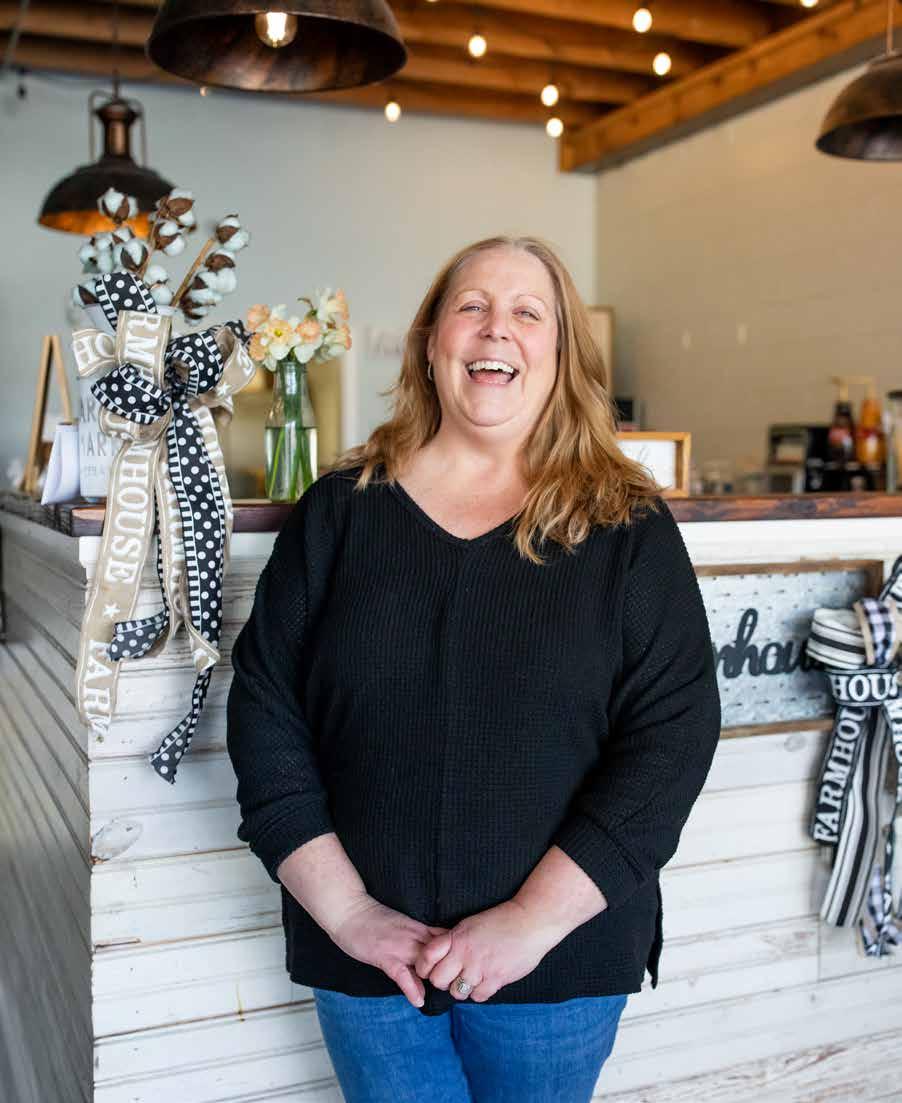
“I love bring here and I want to give back to the community,” said Beverly Cherry Pope, owner of The Farmhouse.
Pope had always had a niche for entertaining and simply found creating parties, tablescapes, menus and charcuterie boards fun. “I really enjoy making charcuterie boards and getting my creative juices going,” she added.
The charcuterie boards are always customized to the clients’ preferences and vary in sizes. Delicacies include pepperoni roses, salami, assorted cheeses, fruits and meats, crackers, dips, honey, croissants, turkey, ham, and prosciutto, to name a few.
“Every board is different. I start with grapes, pepperoni and salami and build around from there,” said Pope. “I always end with the addition of blackberries, raspberries, and blueberries.”
Pope enjoys the art of creating charcuterie boards and the unique challenge of designing them to match a client’s theme. From a woodlands theme complete with waffle cones covered in green melting chocolate to large-scale grazing tables for weddings, Pope adds a special touch by creating eye-catching spreads that are equally delicious.
Pope can accommodate most requests and appreciates at least a 24hour notice for orders. Cherry Blossom Boards make the perfect addition to a party, card game or gathering of friends and family.
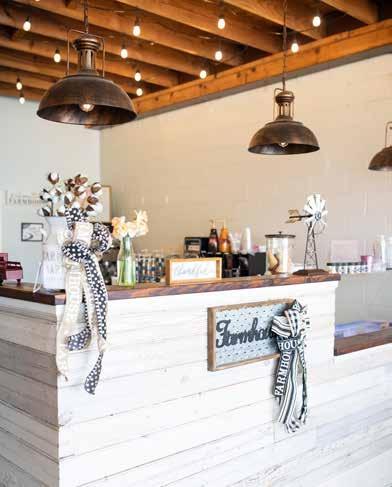
Pope’s culinary masterpieces have grown in the years since opening Cherry Blossom Boards. For the last three years, she has served as the manager of The Farmhouse. In March, Pope assumed ownership of he premier deli and ice cream shop in downtown Deep Run.
“The Farmhouse is a friendly, warm and inviting place,” said Pope. “Everything is made fresh,” she added. “We offer no fried foods.”
Travelers driving from Wilmington to Greenville can make a quick detour off the main highway, while locals know the location is a short drive from South Lenoir High School. After school, students can often be found in the restaurant for milkshakes and chicken-baked ranch pasta. Other specials including chicken salad, chicken alfredo, deli-style sandwiches, daily soups, ice cream, and milkshakes are regular favorites along with large 16-inch thin crust pizza and penne pasta dishes. Customers can eat in or take out.

“Deep Run is a very homely little town where everyone is friendly,” added Pope. “We welcome everyone to stop by.”
Pope can be found behind the counter at The Farmhouse greeting customers and preparing meals. She has lived in Deep Run since she was 16-years-old and is passionate about seeing the community thrive. “I know 90 percent of the people in town and enjoy talking to them whether it is at a church function or at the shop, and consider them friends,” said Pope. “I enjoy being here and want to give back to the community.”
The Farmhouse is open Monday thru Wednesday from 11 a.m. – 7 p.m., Thursday from 11 a.m. – 8 p.m., Friday from 11 a.m. – 4 p.m., and Saturday from 11 a.m. – 2 p.m. The shop is closed on Sundays. Catering services with Cotton Pickin Blessed and charcuterie spreads from Cherry Blossom Boards are available as requested and orders can be placed with Pope or by visiting The Farmhouse. LL
THE APPETIZER CONUNDRUM
Written by: Grayson Smith
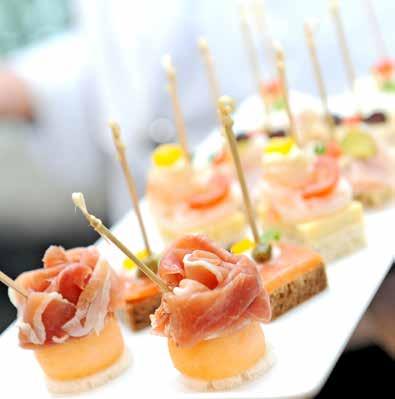
Enjoying appetizers centers around cleanliness and around using the correct utensil and napkin/small plate.
“Appetizer” is a general term for three different types food:
1) Canapés —Appetizers eaten with the fingers.
2) Hors d’oeuvres—Appetizers eaten primarily with a knife and fork.
3) Crudités —Appetizers, such as fruits and vegetables, dipped in a sauce of any kind.
Appetizers may be provided on trays carried around by wait staff or may be available on a buffet. If you’re taking only one or two appetizers at a time, using a napkin will work nicely in lieu of a plate. With three or more items, however, a plate is necessary.
If you’re serving yourself at a buffet table and have moved through the line, step back at least four steps to avoid eating over the table or blocking others. In addition, exchanging pleasantries by the table is fine, but engaging in a full conversation could block the flow. Other guests may feel as if they are intruding on your conversation when they walk up to the table.
At a formal event where the tables are set for dinner, appetizers are to be eaten away from the dinner table. Stand during the appetizer/cocktail hour unless chairs are provided—in addition to those at the dining table(s).
Key Finger Food Tips:
• Transfer of Food from Serving Dish to Plate/Napkin: Transfer all foods, including dips, first to your plate/ napkin and then to your mouth. It’s considered good manners for anything you’re eating to touch your plate/ napkin before your lips.
• The Three-Second Rule: To avoid dripping on yourself, raise your plate/napkin about ten to twelve inches from your mouth and hold the food slightly above the plate/ napkin for about three seconds before eating the food.
• The “No Double Dip” Rule: Never re-dip a chip or vegetable that has already been bitten.
• Sushi & Small Bites: Eat Sushi with fingers or chopsticks.
• Toothpicks & Skewers: Use toothpicks and skewers as a “handle” to eat food. To discard disposable toothpicks and skewers at casual parties, wrap them in your paper napkin and dispose of them in the nearest trash receptacle; if there isn’t one nearby, you can throw them away in the kitchen. If you are using a plate, leave the toothpicks/skewers on your plate.
• The Glass, Plate/Napkin Dilemma: Holding a glass and plate/napkin in one hand and eating and shaking someone’s hand with the other is a balancing act. An option might be to hold your empty napkin under your glass and place your plate on top of your glass. You have one hand free to eat or to shake someone’s hand. If you don’t have a plate and your appetizer is on your napkin, then you could place your napkin on top of the glass. (Most beverage napkins are wider than the mouth of the glass.) If possible, use two napkins for extra strength so an appetizer doesn’t tear the napkin or fall into your glass.
• Soft Food on a Plate: Avoid pushing food with your fingers. Use a fork or other utensil, if provided.
Eating appetizers at a party is a common social event that may serve as the “event before the event” or the main event. Canapés, hors d’oeuvres, and crudités are generally designed to be eaten while standing, making them ideal for a cocktail party or informal gathering.
From the Taste Kitchen of the Lenoir Lantern
Do you have a beloved recipe you’d like to share with the community? Send it our way and it may be featured in another issue. Email stories@lenoirlantern.com with your submission.
Benedictine Open –Face Sandwich
This small sandwich or canapé was originated by and named for Miss Jennie Benedict, who for many years catered the most affluent parties in Louisville, Kentucky.
Ingredients:
• 1 package Philadelphia cream cheese
• Chopped onion to taste
• Chopped cucumber to taste
• Mayonnaise to blend
• Salt to taste
• Green fruit coloring
• Thin slices of bread
Instructions: Mix cheese, onion and cucumber together. Moisten with mayonnaise and season to taste with salt. Color pale green with fruit coloring. Mix thoroughly and spread on open-face bread or between thin slices of bread. Serves: 24
Ingredients:
• 1 cup Greek yogurt (plain or vanilla)
• 1-2 tbsp honey or maple syrup
• 1 tsp vanilla extract
Instructions: Mix all ingredients in a bowl until smooth. For best results, let it chill in the fridge for 30 minutes to allow flavors to mingle.
Serving Suggestions: Serve with apples, strawberries, grapes, pineapple, melon, kiwi, or pretzels.
Yogurt Fruit Dip





DASH AND SPLASH
Daniela Matus, 5, enjoys swinging at the playground at La Grange Municipal Park. Photo by Madeline Gray
The Hunt for a Little Bit of Everything
Words by Laura Ashley Lamm, Ed.D., Photography by Madeline Gray
When it comes to shopping, everyone is always on a hunt. Some are searching for the perfect blouse that transitions from work to after hours. Others are searching for a gift for dear Aunt Sally or for Uncle Bob, who is always collecting. Then there is the special treat that hunters pick up for themselves. The experience becomes easier when a little bit of everything is found in one store.
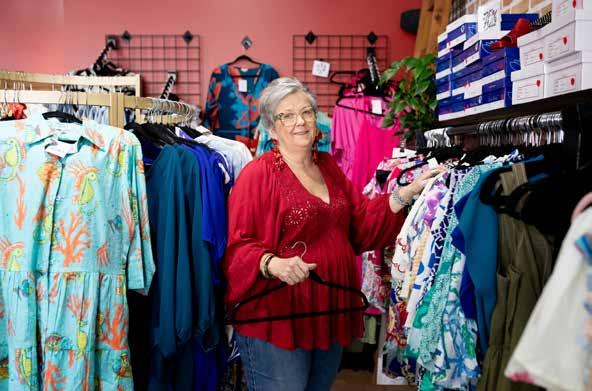
Leon Thomas Treasures, located in downtown Kinston, is bustling with customers dropping by for a quick purchase or lingering for a visit and a stroll. “Leon Thomas is a multifunctional boutique offering a little bit of everything and a large selection of clothes and “Made in North Carolina” products,” said Manager Bonnie Foy. “You can’t come in and not find something you want,” she added, “and you can’t see it all in one visit.”
Every corner of the store is filled with something different. Steak sauces and rubs are to the right or a hand painted birthday card is to the left. Take time and enjoy the hunt, the “treasure” is yours to find. Foy enjoys meeting customers and learning about their shopping interests as she uses the information to influence purchasing decisions for the shop. She rotates
merchandise regularly to ensure the latest trends are always available. The store, which once housed only artisan goods, has expanded. Leon Thomas Treasures includes clothing, jewelry, pocketbooks, housewares, artwork, gifts, and locally made and North Carolina made goods.
“We offer customers a broad range of products that are all different and unique—and not found at every store,” she said.
The inclusion of local, regional and statewide artisans is important to Foy. “I am happy to share the special products made around North Carolina. Each of our businesses support each other; there is good all around,” she said.
While there are good treasures to be found in Leon Thomas, there is also lively conversation and community connectivity.
“My love is retail. I love seeing people and helping put a smile on their faces,” said Foy. “Retail is all about personalization, and I love coming to this place and seeing what I can do to help someone find the right item for themselves or someone else.”
Bonnie Foy, manager of Leon Thomas Treasures, helps patrons find the perfect NC made gift.

Mallards glide across the pond at Lenoir Community College. Photo by Madeline Gray
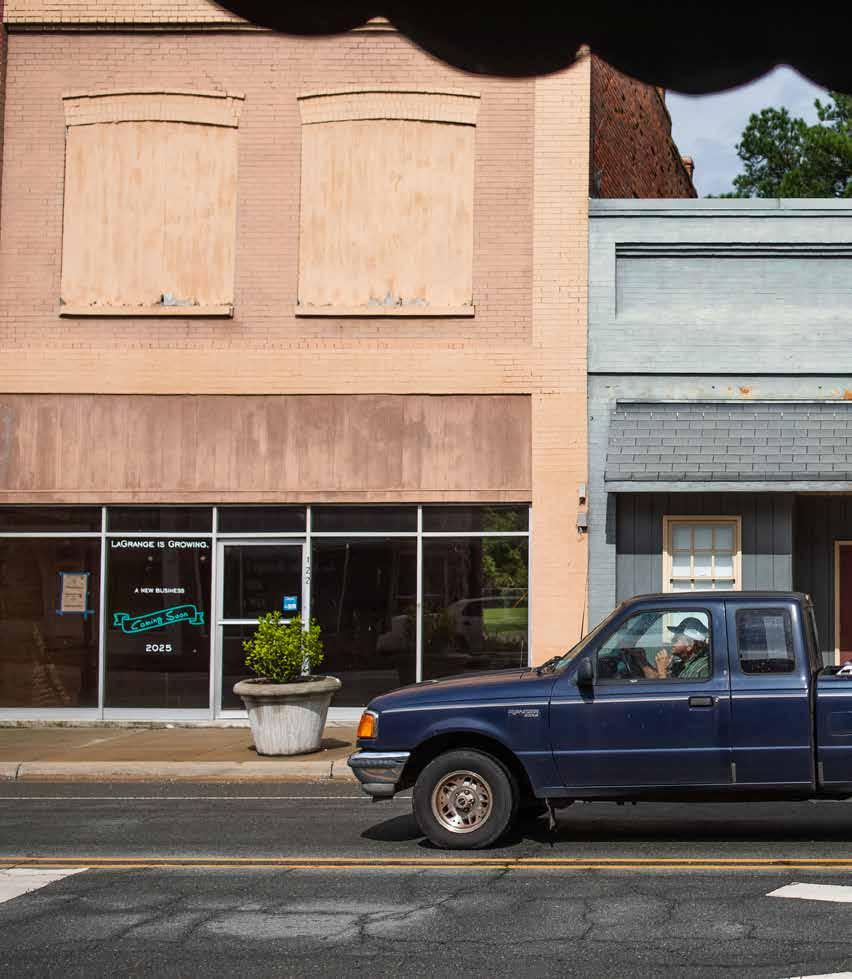
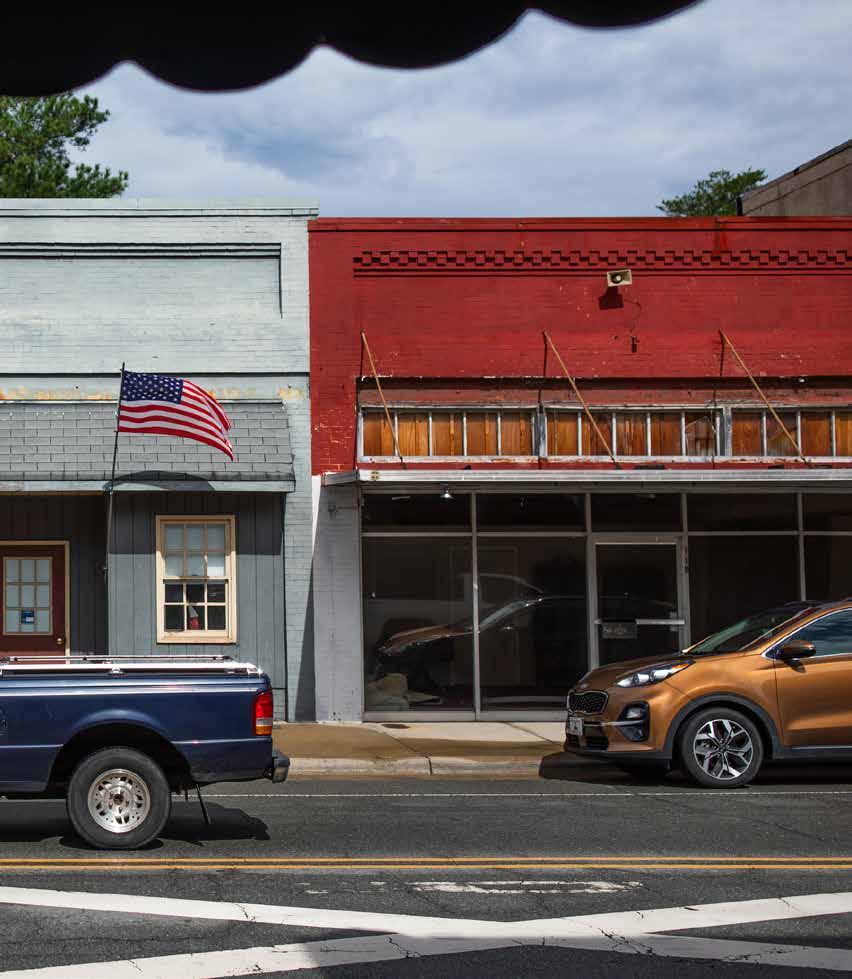
Caswell Street, a main thoroughfare in downtown LaGrange.
Town of LaGrange:
A Rural Town on the Rise
Written By Laura Ashley Lamm, Ed.D., Photography by Madeline Gray
Stepping into the sunshine and feeling the light breeze while in LaGrange gives one a good feeling. People wave as they drive down Caswell Street, one of the town’s main thoroughfares, while others walking down the street stop to introduce themselves. This neighborly welcomeness has become the anchor through which the growth and spirit of the town and its residents pulsate.
“LaGrange is a community on the move. We are a small town with big ideas. As a quaint, laid-back community away from the hustle and bustle of a large city, we are the ideal place to settle down and engage with your neighbors,” said LaGrange Mayor Bobby Wooten.
Wooten, who has spent the last several years as mayor, is highly regarded by his peers for not only his dedication to the town, but also his genuine desire to help LaGrange rise to its greatest potential. He was born and reared in LaGrange and apart from four years in the Air Force, he has spent his life there.
“I enjoy serving the people of LaGrange,” said Wooten. “There really is no place like home.”
The Town of LaGrange is home to approximately 3,100 residents and counting. The US Census Bureau reports LaGrange is experiencing steady population increases with an average increase of 3 percent or more each of the last five years.
“We are trying to prepare for the growth we know is coming,” said Wooten, “while also accommodating for the growth we are experiencing.”
CNBC consistently ranks North Carolina as the #1 State for Business (three times in the last four years) placing a massive spotlight on the Tar Heel State. As economic developers and industries eye building locations and land, LaGrange has positioned itself to accommodate growth and welcome newcomers.
LaGrange’s location provides ample opportunity for businesses. Situated between Goldsboro and Kinston,
transportation options include easy access to US Hwy 70 and fast connections to the North Carolina Global TransPark. Proximity also provides a readily available, diverse workforce with high engagement in manufacturing, logistics, and entry-level roles which are bolstered by the nearby cities of Kinston and Goldsboro, and access to two community colleges, Lenoir and Wayne. The housing market is plentiful with a mix of new-construction homes and traditional single-family homes.
“We invite people to come and look around LaGrange and spend a day here,” said Wooten. “For families looking for a place to live, we have a lot of singlefamily homes being built. We are poised for growth and can attract industries and offer locations viable for manufacturing.”
While LaGrange offers all the markings for an economic development advantage, its greatest asset is the one area most cities and towns struggle with – community engagement.
A hallmark of LaGrange is its ability to create civic engagement and provide opportunities for interaction within the borders of the town. Volunteers established and have subsequently run, Engage LA. As a local, volunteer-driven community organization, Engage LA focuses on fostering community growth, collaboration, and unity through events and development projects. The organization acts as a community spark to ignite the town’s spirit and often partner with local businesses, individual supporters, and the town government. Engage LA is the team behind Concerts in the Park, a free summer concert series at the LaGrange Community Park; Monthly Bingo, which happens on the third Tuesday of every month, and the Garden Spot Music Festival in September.
“Neighbors are working together making our community an even more enjoyable place to be,” said Wooten. “I like to think we are a community on the move. A small town with big ideas.” LL
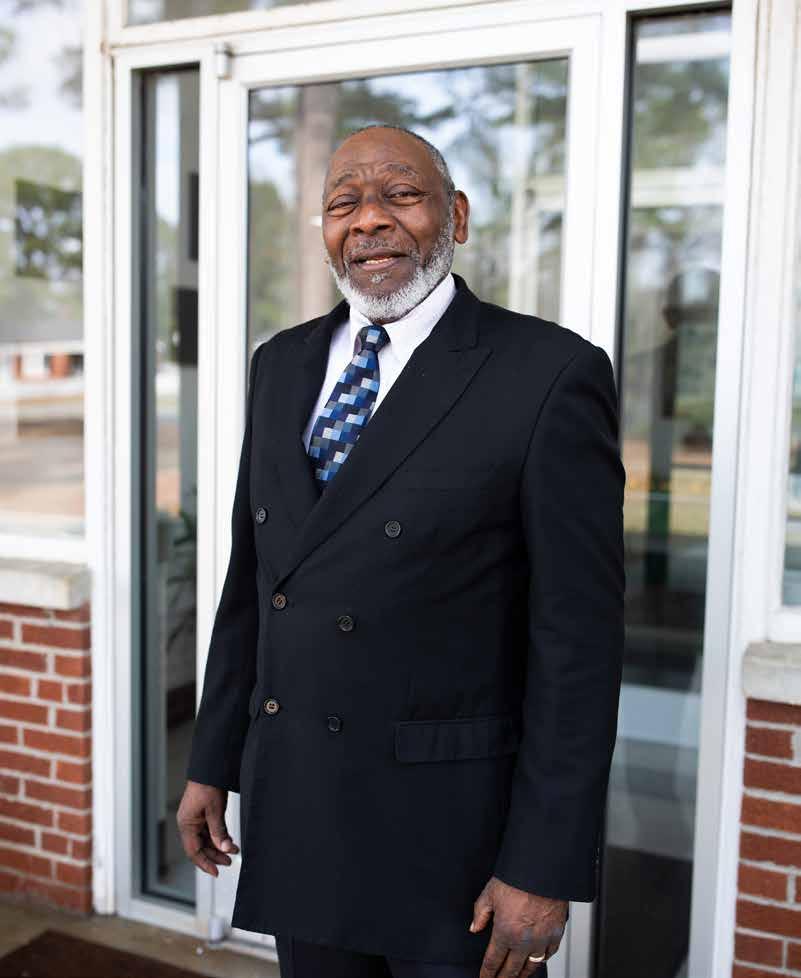
“I think we are a community on the move. A small town with big ideas,” said LaGrange Mayor Bobby Wooten.

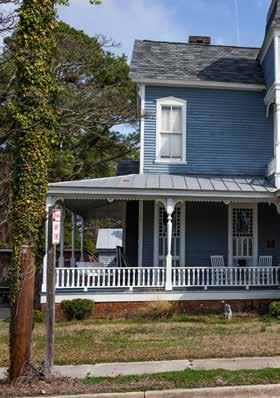
LaGrange Garden Club
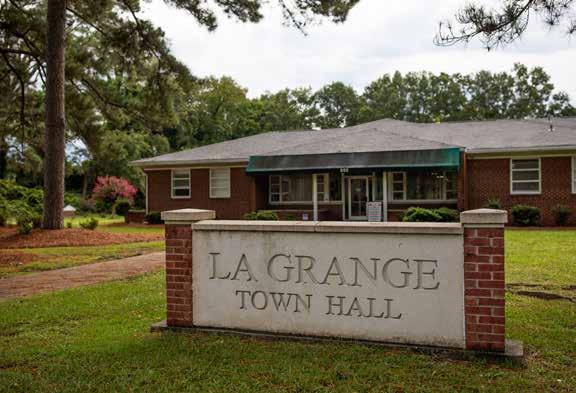
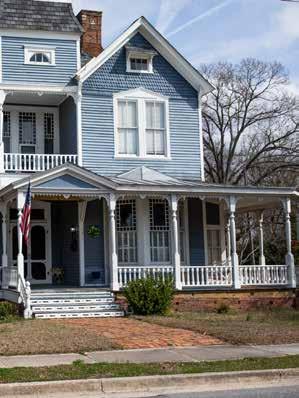
Historic homes on Railroad St. Town Hall

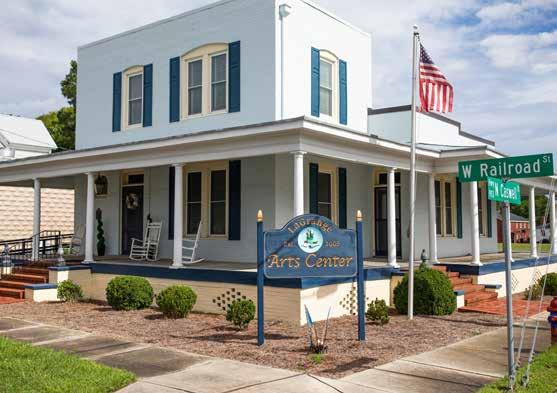
Arts Center
The Double Win:
Obtain a Passport, Gift a Scholarship
Words by: Laura Ashley Lamm, Ed.D., Photography by: Madeline Gray
The journey starts as a small, blue booklet with blank pages ready for fresh ink. Once opened, a world of opportunity awaits. The U.S. Passport can bring walks through the columns of the Parthenon, views of the Mona Lisa in the Louve, hops with kangaroos in the land down under, and treks through the Lapland for a reindeer safari.
As one begins planning the trip, setting aside a vacation fund, and dreaming of adventure, a crucial first step is applying and obtaining a passport. While the process can seem overwhelming and complex for many, the U.S. Passport Acceptance Facility at Lenoir Community College (LCC) is making the application experience enjoyable, but most importantly, attainable.
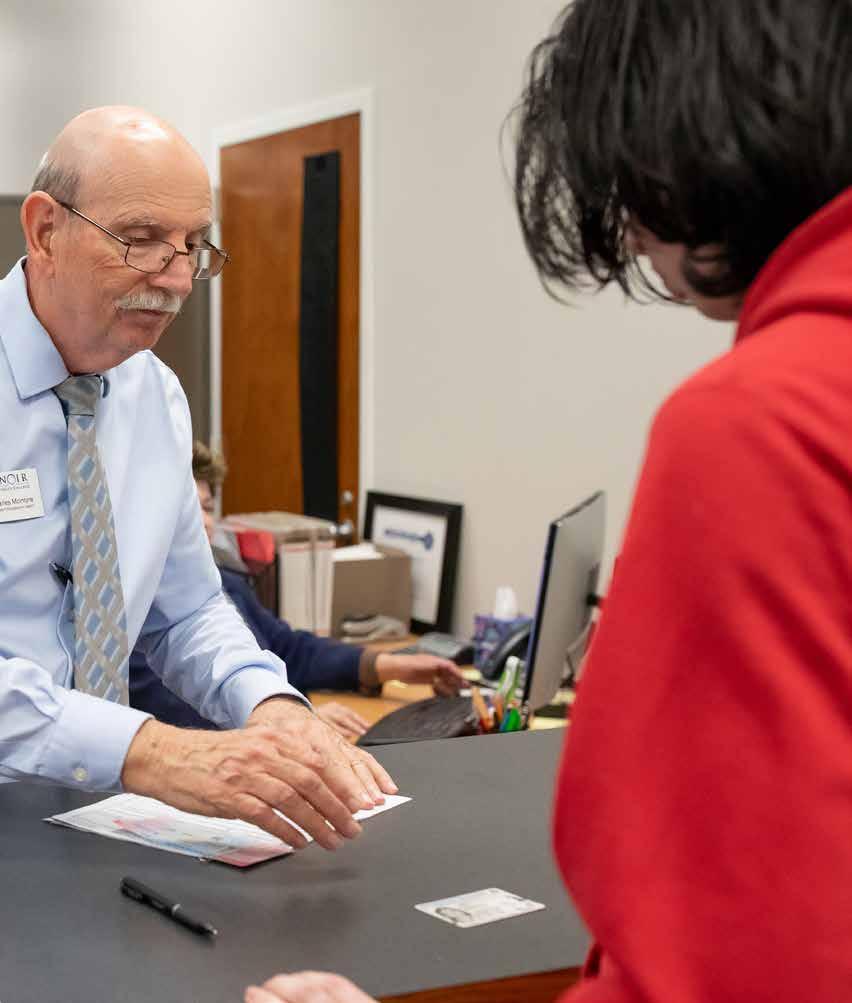
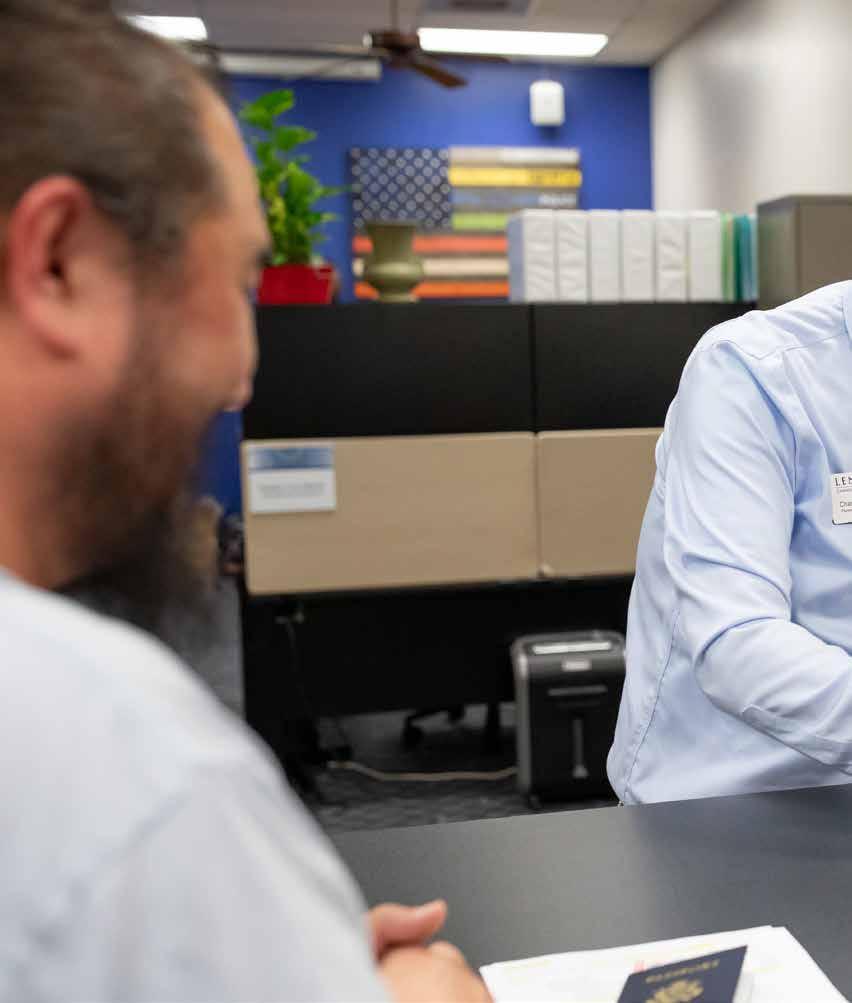
Charles McIntyre, senior passport acceptance agent, helps citizens apply for a U.S. Passport.
“I am helping someone obtain a life goal,” said Charles McIntrye, senior passport acceptance agent. “They are checking an item off their bucket list or going on their first cruise after having worked their whole lives. It is meaningful to me to help them with the process.”
“People often feel daunted by the process of obtaining a passport,” he added, “but, we’re going to help you get through this.”
The U.S. Dept. of State designated LCC as a Passport Acceptance Facility in 2013. Individuals can apply for a passport directly through the Office of Institutional Advancement. Services are available for individuals requesting a passport for the first time.
There are five requirements to obtain a U.S. Passport:
1. Complete a U.S. Passport Application.
2. Provide a certified birth certificate or original Certificate of Naturalization with photograph attached.
3. Provide two passport photographs.
4. Present a valid driver’s license, military ID or government employee ID.
5. Provide two forms of payment (checks or money orders only).
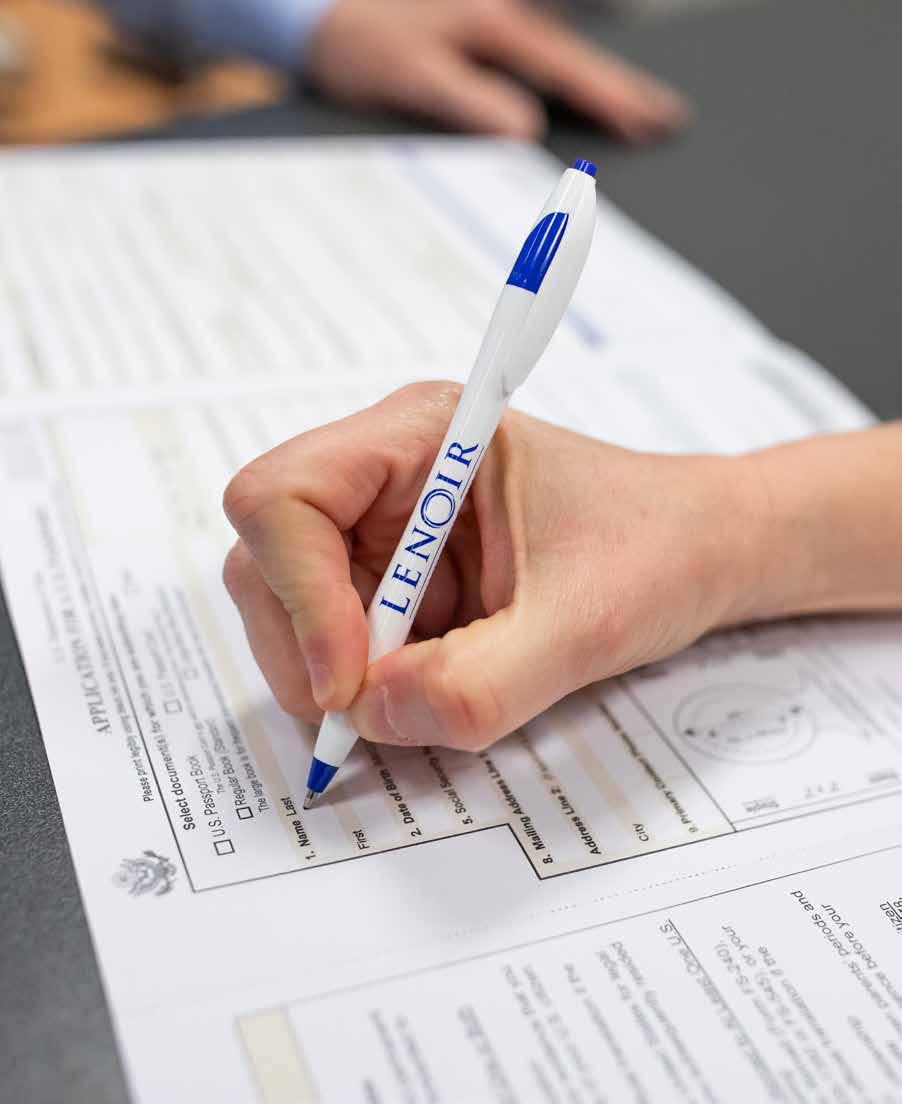
“We go through the entire application with the applicant. Once we go through the application line by line and make sure it is as good as we can make it, at that point, we take and attach their photo and collect the fees. We place them under oath, witness their signing of the document, and it goes out in the mail to Passport Services,” said McIntyre.
Applications are available at the Passport Acceptance Facility, and agents are readily available to answer questions and guide you through the steps. Requirements for passport photographs are specific. Upon request, agents can take applicant photographs on site and ensure they meet federal regulations.
All fees associated with the application and issuance of a U.S. Passport are federally mandated. The U.S. Dept. of State does charge for the issuance of passports, and the cost varies by routine or expedited service as well as regular or overnight return. The cost for a routine issuance of an adult passport book, with no overnight delivery, is $130. The cost for an expedited issuance of an adult passport book, with no overnight delivery, is $160. An execution fee, made payable to the local agency administering application, in this case the LCC Passport Office, is also required by the U.S. Dept. of State.
The passport application execution fee is set at $35; however, each agency or organization that serves as an official passport office may designate how the execution

for an applicant.
fee is kept and used. For example, if you obtain a passport through Staples, the company keeps the fee as another profit stream for the retail giant. If you obtain a passport through the Passport Acceptance Facility at LCC, the LCC Foundation applies the fee towards student scholarships, helping the very people in your community.
One of the biggest reasons we started doing a passport business is because $35 is mandated by the federal government as the fee to stand before a passport agent. For your first passport, you are required to appear before a passport agent. We take that $35, and it goes into our scholarship program. I like to tell people, ‘It’s a win-win.’ They get to come to a family-friendly environment, and it also helps a student get an education,” said Jeanne Kennedy, executive director of the LCC Foundation.
“Most people get a good feeling when they learn how their fee is being used. They realize they are getting more out of this than just a passport by getting to help someone they may never meet,” said McIntyre.
The LCC Foundation averages between $72,000 - $99,000 in net profits a year from the passport execution fees, noted Kennedy. Scholarships are available for curriculum,
Bill Johnson, passport acceptance agent, reviews application materials

“I like to tell people, ‘It’s a win-win.’ They get to come to a family-friendly environment, and it also helps a student get an education,” said Jeanne Kennedy.
workforce development, and continuing education students.
“We really try to meet our students wherever they are and whatever program they are in,” said Kennedy. “Last year, thanks to our dedicated, generous donors and the passport office, we were able to give out $539,000 in scholarships.”
For this academic year, 1245 students received scholarships at LCC. “It makes a big difference in a student’s life to be able to receive money to help them through college,” Kennedy added.
The Passport Acceptance Facility at LCC is open Wednesday thru Saturday from 9 a.m. – 12 p.m. and 12:30 p.m. – 3 p.m. Citizens should arrive no later than 2:30 p.m. The office is walk-in only and does not accept appointments. An individual does not need to be a resident of Lenoir County to apply for a passport at the LCC location. The passport office has three full-time and four part-time staff to assist applicants.
“Most passport facilities are appointment only with only so many slots per day,” said McIntyre. “We offer walk-ins only, with a flexible staff and Saturday hours, to accommodate everyone who needs a passport.”
McIntrye and Kennedy recommend obtaining a passport at least six months before a planned international trip. Applicants can expect a processing time of four to six weeks
by the federal government with new passports arriving via the U.S. Postal Service. Supplied citizenship documents are returned separately by mail.
The LCC Foundation and the Passport Acceptance Facility at LCC are not branches of the U.S. Postal Service. While agents follow procedures and mail applications to the federal government, applicants requesting overnight mail delivery to the federal Processing Facility must obtain and pay for their mailing envelope before arriving at LCC.
Applicants should remember that information on the application and birth certificate must be the same. Any individual applying for a passport must be present, including children. Both parents must be present for a child to obtain a passport. Additional steps must be taken for children who have deceased or incarcerated parents, or for those who have adoptive or foster parents. Adult passports are valid for 10 years while minor (children 15 and under) passports are valid for 5 years. Adult passports are renewable, minor passports are not. Call the Passport Office to discuss or visit www.travel.state.gov online for more information.
The Passport Acceptance Facility is located on the main campus of LCC at 231 Hwy 58 South in Kinston. LL
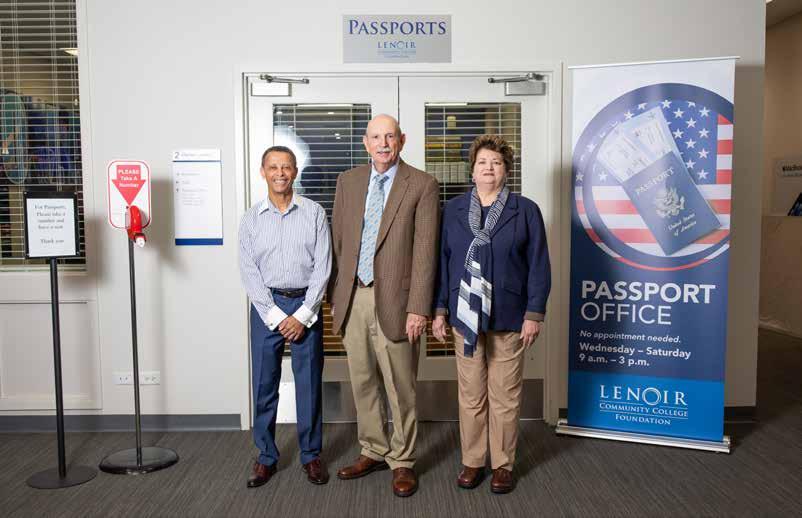
From left: Bill Johnson, Charles McIntyre and Tammy Mooring, passport acceptance agents, at the Passport Acceptance Facility at Lenoir Community College.
Application Checklist for a US Passport
Terms to Know:
Process Time:
Routine (4-6 weeks)
Expedite (2-3 weeks)
Mailing times not included.
Requirements:
p Completed application using black ink
p Certified documentation (birth certificate or naturalization certificate)
p Two passport photographs
p Valid driver’s license, military ID or government employee ID
p Two forms of payment (check or money order)
Step 1: Acquire one of two official certificates:
p Certified birth certificate
pOriginal Certificate of Naturalization (with photo attached)
Step 2: Acquire one of three identification cards:
p Driver’s license
p Military ID
p Government Employee ID
Step 3: Establish two payments:
p Passport Payment:
A check or money order is accepted.
Make payable to the U.S. Dept. of State.
Full name and date of birth on applicant must be printed or typed on the front of the check.
p Processing Service Payment:
A check, money order or exact cash is accepted. Make payable to the LCC Foundation.
Step 4: Acquire two passport photographs.
p If photographs are not acquired in advance, images may be taken at the LCC Passport Office.
Step 5: Arrive at the Passport Office at Lenoir Community College during business hours.
Step 6: Complete an application for one of the following:
p Passport Book
p Passport Card
p Passport Book and Car
Step 7: Present all required documentation and fees to the Passport Agent.
Step 8: Allow up to six weeks for delivery of passport book and return documents.
U.S. Dept. of State Passport Book Fees: (for adults and children 15 & under)
*Denotes overnight return delivery
U.S. Dept. of State Passport Card Fees: (for adults and children 15 & under)
U.S. Dept. of State Passport Book & Card Fees: (for adults and children 15 & under)
*Denotes overnight return delivery
Execution Fees: Made payable to the LCC Foundation
A Start Up in Business
Written by: Laura Ashley Lamm, Ed.D.
Starting a business can be a daunting process. Before the process even begins, entrepreneurs have spent years believing in their dreams and weighing the possibility of making them a reality. They have considered the emotional toll of owning their own business, calculated the financial cost, evaluated inventory, and sketched operational hours. When they feel the time is right, they take the plunge.
But, starting a business can be less overwhelming with the right help and resources. The Lenoir Community College Small Business Center can guide entrepreneurs towards growth and success.
“The Small Business Center is a good place to talk through an idea with someone who can provide a neutral opinion and guide you towards the right next steps for your business and all at no cost to you,” said Director Lee Albritton.
The Lenoir Community College Small Business Center (SBC) provides free services to residents and small businesses in Lenoir, Jones and Greene counties. It is part of North Carolina’s state-funded Small Business Center Network (SBCN). The SBC is currently located at the Aerospace and Advanced Manufacturing Center on Hwy 58 North in Kinston.
The SBC offers one-on-one assistance through coaching and accountability partners. Support is offered as entrepreneurs navigate challenges associated with finding employees, developing a work ethic, building teams, writing a business plan and growing a customer base. Assistance is also provided as individuals obtain industry specific documentations and certifications. “With the established small business network, we can connect you to an expert in your area,” said Albritton. “We offer many wonderful resources for the community through the Small Business Center.”
Services with the SBC are offered at no cost to the community.

For rural communities, like those in Lenoir County, small businesses play an important role, says Albritton. “Most startup businesses don’t last past the 3-year mark due to lack of funding,” he said. “When locally owned and operated businesses are supported, they, in turn, invest back into the local economy.”
“Everything we do—offering training events, connecting people through the Small Business Network, offering courses through the college—is to help entrepreneurs start new businesses,” said Albritton.
The SBC serves more than 9,000 residents annually, said Albritton, offering in-person coaching sessions and online seminars and trainings. Events often fall in the categories of start-up assistance, marketing and sales, cash flow management, customer relations, non-profit, and technology. Assistance in English and Spanish are available.
In North Carolina, small businesses account for the majority of newly created jobs every year. However, starting and growing a small business can be a challenging process. For North Carolinians, a network of support is readily available statewide. A Small Business Center is located at each of the state’s 58 community colleges. The centers are designed to help guide budding entrepreneurs through “the steps of considering, planning, developing, opening, and operating a small business.” In 2025, the SBCN helped 669 businesses get started and aided in the creation and maintaining of 6,827 jobs.
Residents interested in making an appointment with Albritton may call 252-208-1225, and those interested in registering for events may visit https://www.lenoircc.edu/ aboutlcc/sbc/. LL
Director Lee Albritton

GETHCA FIXED RIGHT UP
A spray of colorful flowers. Photo by Madeline Gray

The Rhythm of Restful Sleep
Written By Laura Ashley Lamm, Ed.D.
One of the best things we can do for ourselves when at home is get a good night’s sleep. For many, that is a task that is hard to come by. Sleep becomes the item at the bottom of the to-do list. Days and nights are packed full with professional and family responsibilities and sleep falls in place for a few hours.
Sleep is important to our overall wellbeing. Understanding why is a crucial step towards incorporating more restful hours into 24-hours.
Sleep is important to a number of brain functions, including how neurons communication with each other, and without sleep, you cannot form or maintain the pathways in your brain that let you learn and create new memories, according to the National Institute of Neurological Disorders and Stroke. In fact, your brain and body stay remarkably active while you sleep and lack of sleeps results in more difficulty concentrating and responding quickly when awake.
“The guidelines of sleep are pretty clear. Seven to nine hours is best. Recent studies show poor sleep reduces life expectancy,” said Dr. Gregory Gridley, Ph.D., medical psychologist at UNC Health Lenoir.
“Sleep is a restorative dynamic. Your brain produces a human growth hormone when you sleep, so you are getting a metabolic clearance. The metabolic clearance of your brain is where the build of the consequences of metabolisms and toxins come out and clear. You, in fact, lob off memory you don’t need and you store new memory.”
In essence, sleep plays of the role housekeeper. It comes in and sweeps away or removes toxins in your brain that build you
while you are awake. When the brain lacks enough sleep, you lack energy and that’s when you turn to carb cravings.
“If you don’t sleep enough or you sleep too much, what tends to happen is your brain does not have the energy – generally speaking – to function well. As a result, you tend to look for energy in food and may gain weight,” said Gridley.
“You are going to self-medicate, in a sense, with carbohydrates because they give you a mood and physical boost. The problem with simple sugars, they go in quickly and come out as quickly as they go in. That drops the blood sugar, maybe lower than when you started out, and that’s why you ear the whole box of chocolate chip cookies,” he continued.
Sleep has long been a favored study among researchers with findings proving the value of sleep to the body.
“If you take young guys and test them at Point A with half of them sleeping less than six-and-ahalf hours and the other half sleeping more than six-and-a-half-hours, and then test them at Point B, the guys who slept less will get a C+ while the guys who slept more than six hours will get an A,” said Gridley.
It is worth noting that every person is different. Each person will have varying health conditions, metabolisms, cognitive functions, routines and circadian rhythms.
“Everyone is different. When physicians meet with a patient, we get a detailed overview of their entire health and when you get into treatment dynamics, it is really a synthesis of all of those things,” said Gridley, “but, we do see a disruptive effect of sleep.” LL

Building Better Sleep Habits
If you are combating a lack of sleep or difficulty sleeping, there are ways to help mitigate the strain on your brain and body and reset yourself into a healthier rhythm.
1 Set a schedule. Go to bed and wake up at the same time each day.
2 Exercise for at least 30 minutes most days of the week if you can. Other options are exercising three days a week. It is best to not exercise within a few hours of bedtime as your body will be alert and energized.
3 Avoid caffeine, nicotine, and alcoholic drinks late in the day and before bed.
4 Relax before bed. Take a warm bath, read, meditate or try breathwork.
5 Put down your phone. Aim for at least 60 minutes of no screen time before bed.
6 Create a room for sleep. A calming atmosphere can help you prepare and fall asleep faster. Avoid bright lights and loud sounds. Keep the room at a comfortable temperature.
7 Try red light therapy. Sit in front of a red light box for 30 minutes. The warm, gentle light helps shift the nervous system from “fight-or-flight” mode by easing muscle tension, reducing pain and lowering stress.
8 Practice breathwork, such as the 4-7-8 technique. Inhale for four (ex. count 1-2-3-4), hold for seven, and exhale for eight.
9 Don’t lie in bed awake. If you can’t get to sleep, do something else, like reading or listening to calming music, until you feel tired. Saying to yourself, ‘I can’t fall asleep,’ only adds stress to the mind and body.
10 See a doctor if you have problems sleeping or if you feel unusually tired during the day. They can help identify the problem and find the best solution for you.
Matters of the Heart
Words by: Laura Ashley Lamm, Ed.D.
A healthy human heart beats approximately 100,000 times a day, pumping roughly 2,000 gallons of blood through the body. Over a 70-year lifetime, that is more than 2.5 billion beats. This tireless, daily activity keeps organs and tissues oxygenated, making the heart the body’s master engine.
“Cardiology is the No. 1 killer in Eastern North Carolina. It is the thing that causes the most symptoms for the most people, and it is the thing that when it doesn’t work, it is the lynch pin of everything else,” said Dr. Brian F. Simpson, interventional cardiologist at UNC Health Lenoir.

Identifying the Cause of Chest Pain
Most people associate chest pain as the first identifiable factor when having a heart attack. Chest pain can also be attributed to anxiety and panic attacks or even pulled muscles. Understanding the difference and when to see the doctor is crucial.
“The symptom I look out for the most is the classic chest
pain,” said Simpson. “The symptoms related to the heart can include you’re having more trouble breathing or you can’t walk as far as you used to. It can be that you are losing steam, and you can’t achieve what you used to be able to achieve.”
When it comes to pain in the chest, if it feels like the weight of an elephant pushing on you, take notice.
“We always think of the classic heart attack symptoms— pain in the center of the chest that feels like an elephant. More and more we are seeing people who have less typical symptoms like pain in the shoulder, pain going into the neck, and often times, symptoms that just don’t feel right,” said Simpson.
Often people feel a sense of doom, a sense that something is off, or experience a feeling they have not felt before, said Simpson.
“The first thing I always think of—if it is rapidly worsening and not getting better, that means be worried about your heart or be worried that it could be your heart. There is no definitive way, but the best approach is identifying something that is not improving over time,” he said.
“If it is rapidly worsening, know that muscles don’t usually do that,” said Simpson. If you move a particular muscle or are able to push on it, then you can know the muscle is the cause of the pain. But, you can still have the muscle evaluated by a physician to be sure.
Exploratory Appointments vs. Emergency Room Visits
With the sudden onset of chest pain and worsening symptoms, a visit to the emergency room follows. An
emergency room doctor evaluates and calls a cardiologist if necessary.
“If the emergency doctor is worried enough, they will call me into the emergency room, and we will talk. Sometimes we can do a few tests in the hospital, i.e., bloodwork, imaging, and electricity tests of the heart. If things are safe, stable, and improving, then we set up an appointment with the clinic. If not, we go directly from the emergency department to the cath lab,” said Simpson.
The better approach is when patients can be seen in the clinic, said Simpson, as it allows for a one-on-one discussion about health history, genetics, preventative measures and proactive plans.
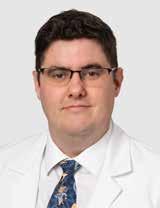
“Ninety percent of what I do is looking at your story. What makes it better? What makes it worse? What is your family history? What is going on in your home life? What kind of foods have you been eating? What is your blood pressure? What are your cholesterol levels? From this we are able to tease out if you have a heart artery blockage or heart failure,” said Simpson. When Simpson is in the room with the patient, he said he takes a broad approach to understanding the health of the patient, but he is also looking for five things to help answer the questions, “What is going on with your risk of heart disease and plaque in the heart arteries? What are we able to control? What is out of our control?” Those five things include the following: the role of genetics, the rate of blood pressure, the amount of physical activity, the levels of cholesterol, the intake of sugar and the use of tobacco.
The Role Genetics Play
Heart disease often has a strong genetic component, with inherited genes accounting for roughly one-third to one-half of the risk for coronary artery disease, reports the Journal of Cardiology. Genetic factors can cause inherited arrhythmias, cardiomyopathy, or high cholesterol.
“One way I think of heart plaque and heart artery disease is that it’s like having an above ground pool. You have two hoses going into the pool, and one hose is your genetics. You can’t change that. That hose is filling the pool no matter what. If that water reaches the top level of the pool, it’s flooding the whole yard,” said Simpson.
Cardiologists want to avoid the pool filling and overflowing into the yard as that action can cause heart attacks. Most of the cases seen in emergency situations by Simpson could have been prevented and treated differently to avoid the heart attack all together, he said. While one hose leading to the pool

is genetically related, the other hose contains all things that can be controlled, such as blood pressure and cholesterol.
The Rise of Blood Pressure and a Sedimentary Lifestyle
Blood pressure, often known as the silent killer, is one condition that can be controlled.
“Blood pressure is what we call the silent killer. Blood pressure being too high puts more strain on the heart. It damages the kidneys and the endorphins, but people don’t feel that day to day. When your blood pressure is high at home, you are not noticing that as your body gets used to that level,” said Simpson.
“The majority of people need blood pressure medicines to stabilize the risk,” said Simpson.
“It’s not a failure but the reality of our modern world where we have free access to salt and Southern food. One hundred years ago when we were working 12-hour days, it was very different,” he added.
Sedimentary jobs in which employees sit for long periods of time, long-haul truck drivers, and professions in which movement and walking is minimal increase the blood pressure.
“Sitting for long periods of time is hard on our bodies. Our bodies are not used to the idea of a 10-hour stressful environment, without physically doing things,” said Simpson. “So, the blood pressure goes up, and the plaque starts depositing. The act of being sedentary drives up the blood pressure over time.”
He continued, “In the moment, when you are being active, your blood pressure does jump up, but it trains your body to
Simpson
handle a normal blood pressure. When we are sedentary, our bodies maladapt to that, and the blood pressure goes up over time.”
The Impact of Cholesterol
When examining cholesterol levels, part include identifying the patient’s daily diet and the high fat content ingested during meals.
“Cholesterol that we take in by food doesn’t usually make a difference. It is really the fat intake and sugar intake combined with our genetics,” said Simpson. There are a wide range of medicines to help lower cholesterol, which include popular drugs, such as Lipitor and Crestor, and which reduce LDL (the “bad” cholesterol) and cardiovascular risk by blocking liver production. They also prevent plaque from becoming unstable, rupturing and causing a heart attack.
“What I usually tell my patients is that it is not a cholesterol lowering medicine, it is a plaque medicine,” said Simpson. “What we are trying to do doesn’t concern the cholesterol and the medicine—it the is plaque I am trying to prevent from getting worse.”
Sugar Intake and Tobacco Use
High blood sugars directly cause inflammation and plaque, said Simpson. Living in Eastern North Carolina, sugar is a food and beverage staple and can lead to high blood sugar. Watching one’s sugar intake can make a difference. Smoking damages the heart and blood vessels by promoting plaque buildup, and raising blood pressure leads to cardiovascular disease, among other damages to the human body. Simpson advises that quitting smoking is vitally important.
Maintenance vs. Testing
After careful analysis and discussion, the cardiologist will decide if preventative treatment or testing is warranted. Preventative treatment is maintaining low cholesterol and blood pressure, for example. “For those patients who do need more, we talk about imaging the heart with sound waves just like they do a baby’s ultrasound,” said Simpson.
Heart tests evaluate the structure, function and electrical activity of the heart to diagnose conditions like heart disease, arrhythmias, or damage. Tests include electrocardiograms for electrical activity, echocardiograms for imaging, stress tests for exercise response, and blood tests for cardiac damage markers.
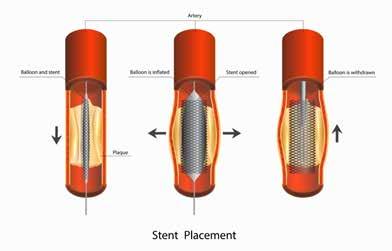
Heart Catheterizations and Stent Placements
Heart disease progression may signal the need for a heart catheterization and a stent placement.
“This is an above ground pool we are talking about. We have those two hoses that are filling the pool with water. What the stent does is basically add another pool right beside it and filter some of that water out,” said Simpson. “We are not actually fixing the underlining problem of water constantly filling the pool; we are resetting the clock for when that blockage is a problem.”
The first human cardiac catheterization was performed in 1929 by German physician Werner Forssmann. According to the National Institute of Health, Forssmann at 25 years of age, performed the procedure on himself by inserting a catheter in a vein in his arm while under local anesthesia. His research was expanded upon by André Frédéric Cournand and Dickinson W. Richards, and collectively the trio was awarded the Nobel Prize in Physiology or Medicine in 1956 for the development of cardiac catheterization.
“The procedure itself is a very safe and well-tolerated procedure. Most patients are able to doze on the table during the procedure and do not remember it,” said Simpson of both heart catheterization and stent procedures. We are able to do most caths through the wrist. A small catheter about the size of spaghetti gets inserted into the wrist and all the way up to the heart.”
He continued, “If there is a problem there (in the heart) then we snake a wire, tinier than a strand of hair, all the way into the heart artery. Then we balloon with a small balloon all of that disease out of the way. We are not removing any of that disease, but we are pushing it out of the way. Then we put a stent.”
A heart stent is a tiny, expandable metal mesh tube inserted into a narrowed coronary artery to restore blood flow to the heart. Stents were pioneered by Dr. Julio Palmaz and Dr. Richard Schatz. Palmaz, a radiologist, invented the first commercially successful, balloon-expandable intravascular stent (the Palmaz Stent) in the 1980s, which revolutionized cardiac care by holding clogged arteries open. He co-developed this pivotal technology with cardiologist and Duke alumnus Schatz.
“Imagine a Chinese finger trap except it is facing the opposite direction. With a Chinese finger trap, you pull harder, and the harder you pull, the tighter it gets. A stent is designed the opposite way. Once it is put into place, it will not collapse. A stent is designed with rare earth metals to be the absolute strongest it can be, and it will hold open that artery,” said Simpson.
He continued, “A stent does not move the disease out of the way but instead pushes the disease out of the way—disease
meaning ‘the plaque and calcium.’ Those stents, once they are in place, hit a reset button. You now have an artery—like a pipe in your home—that is brand new and has great flow. Once we hit that reset button, the disease process starts again.”
Following stent placements, ongoing conversations with the patient’s cardiology team take place to prevent new problems and to protect the stent that was put in. Incorporating medications, lifestyle, physical activity, and non-smoking have an impact. The goal is to prevent the disease from rapidly growing in the area around the stent or in other areas of the heart that have not been treated. After the procedure, most patients return home the same day.
“Patients can live a long and happy life with stents. Heart disease itself is a dangerous disease if left untreated. If treated, patients can live full, normal lives,” said Simpson. LL
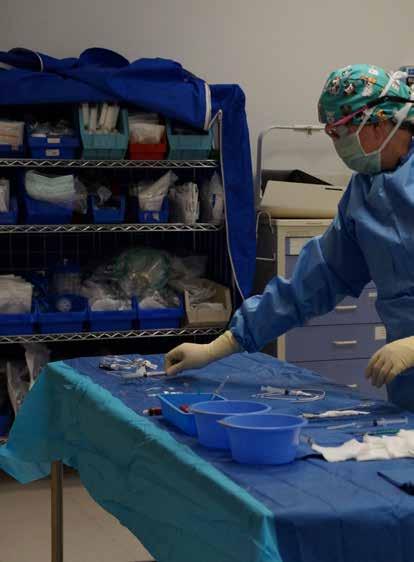
Inside UNC Lenoir’s New Cath Lab
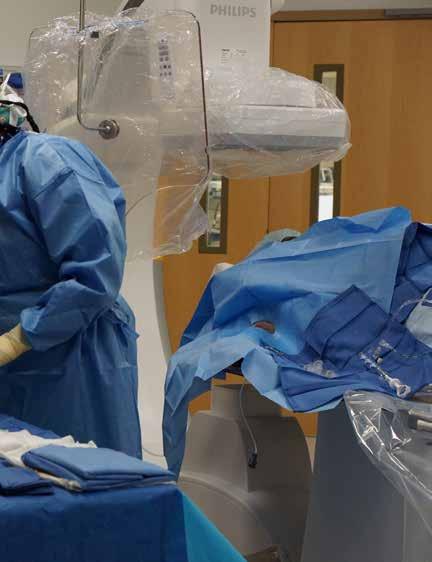
When caring for the heart, a cardiologist may suggest a diagnostic cardiac catheterization test. As a minimally invasive outpatient procedure, the test is used to detect heart conditions like coronary artery disease, valve problems, or muscle dysfunction. The procedure can be performed close to home at UNC Health Lenoir. The hospital recently opened doors to a new Cardiac Catheterization Lab (Cath Lab). Featuring state-of-the-art equipment, such as the Philips Azurion 3, the Cath Lab is elevating its vascular capabilities through the physiology and imaging platform IntraSight, Philips Interventional Hemodynamic system and interventional tools all available at the touch screen module at the side table. The Philips system also includes a higher X-ray to image conversion efficiency (DQE) making imaging of vascular arteries sharper and clearer that ever before.
With the reconstruction of the Cath Lab, more cardiovascular needs of patients can be met. Stents can be performed in the lab as well as shock wave catheters, an interventional procedure that utilizes a fluid-filled catheter connected to an energy source that generates mechanistically tuned ultrasonic acoustic pressure waves – or shockwaves – for modification, fracture, and fragmentation of vascular calcification.
“Through shockwaves, you can move plaque around in the vessel walls and get a good-sized stent in there to create more blood flow,” said Lisa Garner, RN, MSN, nurse manager of angiography. “We have the latest and greatest technology in the Cath Lab so you don’t have to go somewhere else to get the care you need, but can receive care right here at home.”
The reconstruction of the Cath Lab and the installation of new equipment was part of UNC Health Lenoir’s facilities master plan. LL
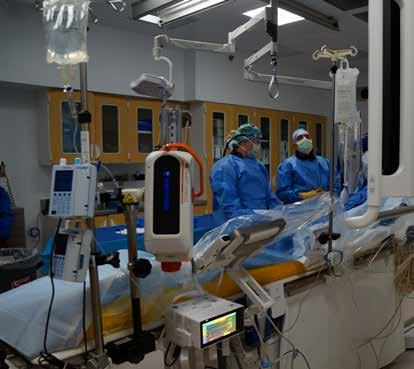
Jaclyn Levey, special procedures technician, and Dr. Alan Kirollos, cardiologist, review the blood a patient’s heart during a right heart catheterization.
Jaclyn Levey, special procedures technician, prepares the sterilized tools for a heart catheterization
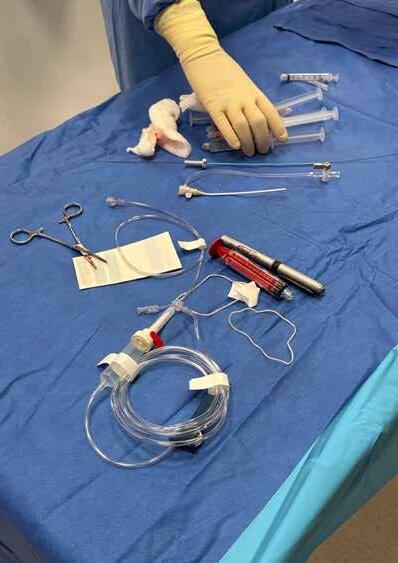

Tools await sterilization and discarding following a heart catheterization procedure.
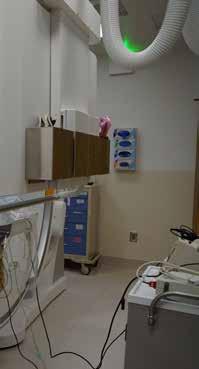
Row of stents are boxed and waiting should a patient’s heart require the placement of one.
blood pressure and oxygen in the right atrium of
catheterization at UNC Health Lenoir’s new Cath Lab.
L.A. Lamm



OLD NORTH STATE
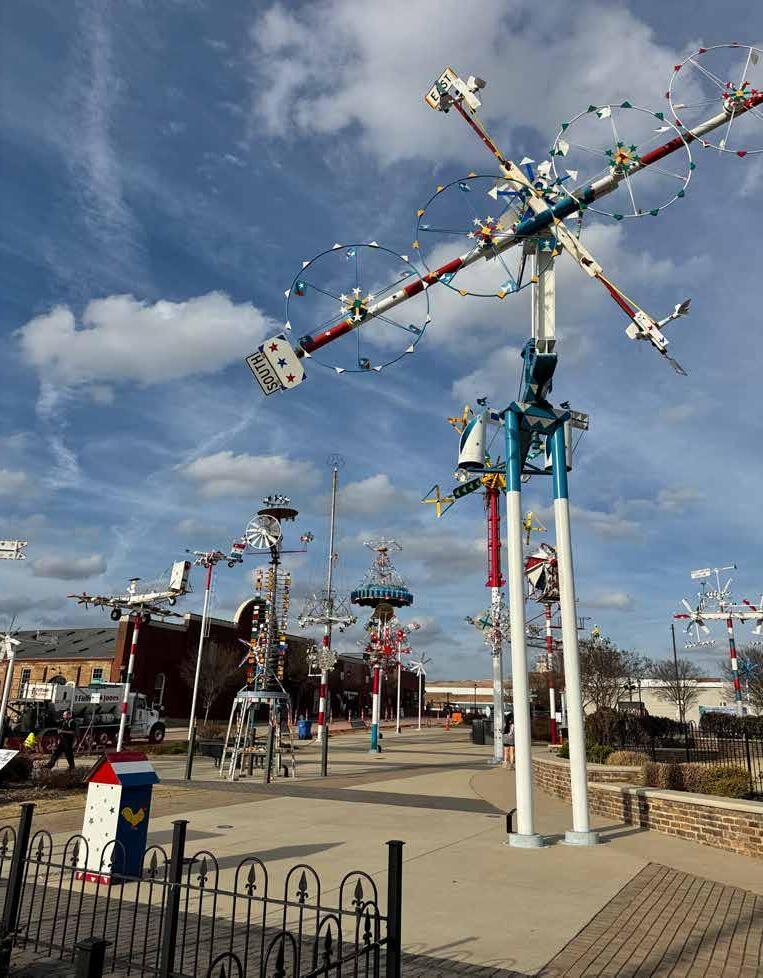
Vollis Simpson Whirligig Park, Wilson. Photo by P.J. Drew
RALEIGH
When it comes to agriculture, it’s got to be NC. The Got to Be NC Festival features agricultural exhibits, tractor parades, carnival rides, live music and food trucks celebrating all things made here. Happening at the NC State Fairgrounds, the festival runs May 1517. Free.
FARMVILLE
A staple for 35 years, the Farmville Dogwood Festival returns April 23 – 26 with live music, carnival rides, movies, food trucks and entertainment. Country music’s Parmalee headlines on Saturday night for a concert under the stars. Visit farmvilledogwoodfest. com for more.
HAVELOCK
The Cherry Point Air Show featuring the legendary U.S. Navy Blue Angels will fly May 9 -10 at MCAS Cherry Point. NC’s largest air show is free and open to the public.
WILSON
Blast off with for an evening of cosmic exploration at the North Carolina Statewide Star Party at the Imagination Station Science and History Museum on Friday, April 24 from 6:30 – 9 p.m. Celebrate space, the Moon, and humanity’s journey beyond Earth. Interactive stations and live telescope viewing. Free.
SNOW HILL
Celebrate the rich tradition of the Greene Central High School Rams mascot at Greene County’s Ram Fest on April 18 from 10 a.m. – 4 p.m. at the Greene County Recreation Complex. Features a Rabbit Show, Antique Tractor Show, live music, bounce houses. Free.
AURORA
North Carolina Fossil Festival celebrates the Aurora Fossil Museum and the rich fossil record of North Carolina from May 23-24. Activities include digging for fossils, fossil displays, silent auction, live entertainment, food & craft vendors and a dinosaur show. Free.
Seagrove

THE LAST WORD
Neuseway Nature Park, Kinston. Photo by Madeline Gray
Things that Bloom
Complete the puzzle with your knowledge of things associated with blooming.
3. Flue-cured "gold leaf"
5. Plants that take two seasons to flower
3. Flue-cured "gold leaf" 5. Plants that take two seasons to flower
9. Once held the title of Queen Azalea. Talks alongside Regis, Ryan and Mark.
9. Once held the title of Queen Azalea. Talks alongside Regis, Ryan and Mark.
10. “Every rose has its _____.”
10. “Every rose has its _____.”
11. NC state tree
11. NC state tree
12. Plants that flower and die in one season
12. Plants that flower and die in one season
14. Pear tree named for US horticulturalist
14. Pear tree named for US horticulturalist
16. Plants that come back for many seasons
16. Plants that come back for many seasons
18. Pink, red and white shrubs
18. Pink, red and white shrubs
20. Star-studded cast includes Sally Field, Julia Roberts, Dolly Parton. Two words.
20. Star-studded cast includes Sally Field, Julia Roberts, Dolly Parton. Two words.
Alan Thicke led this American sitcom. Two words. 4. Ripen in late spring, used in pies.
Two words.
Ripen in late spring, used in pies. 6. 1968 hit; “Build Me Up ________.”
6. 1968 hit; “Build Me Up ________.”
7. Official flower of NC 8. Scenic drive in NC mountains. Three words.
7. Official flower of NC 8. Scenic drive in NC mountains. Three words.
13. Sweet, crunchy hybrid of a snow pea and a garden pea. Two words.
13. Sweet, crunchy hybrid of a snow pea and a garden pea. Two words.
15. Home of the Azalea Festival
15. Home of the Azalea Festival 17. As the saying goes, ‘April showers bring
Children’s Corner
Can You Find?
Explore the world around you with this STEM activity.
Materials Needed: Two toilet paper or paper towel rolls, construction paper, crayons, tape, and stickers.
Directions: Create a pair of binoculars that allow you to find colorful objects in the world around you. Use your binoculars to identify things of different colors. Fill in the chart below.
Can you find something . .
NASA’s Artemis II Mission to the Moon



Artemis
Comes from the Greek goddess of the moon and twin sister of Apollo
THE BEGINNING
Genisis 1-2 on the fourth day, God created the sun, moon, and stars.
4
Astronauts
Reid Wiseman, Commander Victor Glover, Pilot Christina Koch, Mission Specialist Jeremy Hansen, Mission Specialist
10 days
8.2 billion People on Earth

695,000 miles
Total Distance of Mission Equal to 12.2 million American football fields being placed together

Images: NASA
238,855 miles
Distance from the Earth to the Moon
equal to leaving Pink Hill, NC by car and circling the Earth’s equator 9.6 times.
1,080 miles
Moon’s Radius
equal to leaving Deep Run, NC by car and driving I-95 N until reaching Eastern Ontario, Canada



"We will always choose Earth. We will always choose each other."
Christina Koch
"We
need Jesus – whether on Earth or circling the Moon."
Victor Glover
DINOSAUR DINOSAUR FOSSILS FOSSILS INOSAUR OSSILS
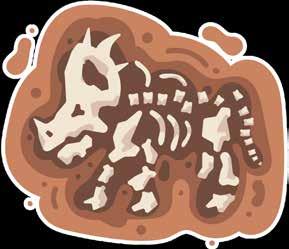
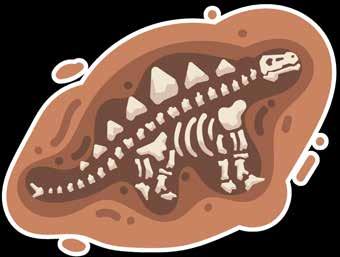
A fossil is tangible proof of a plant or animal from the distant past. This can include their preserved remains or other signs, like imprints they left in the earth while they existed.


Raptorex
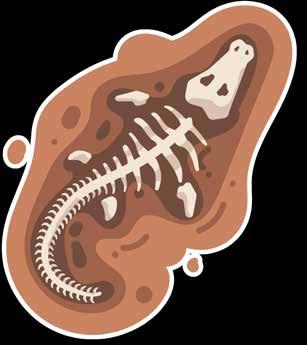
Spinosaurus Mosasaurus
STEM Celebration
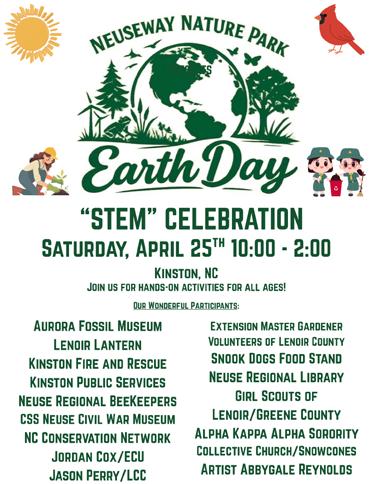
The Neuseway Nature Park is gearing up for an Earth Day “STEM” Celebration on Sat., April 25 from 10 a.m. – 2 p.m. at the Park. Filled with hands-on learning activities, this free event is fun for the whole family. Join organizations from Lenoir County and Eastern NC as they share about the Earth through activities using science, technology, engineering and mathematics. It is a day full of discovery in the beautiful outdoors of the Neuseway Nature Park and the Ellis Planetarium, Health & Science Museum. While there tour the Nature Center and visit the reptiles, explore giant human organ models and a farm-to-table room, or enjoy the playground.
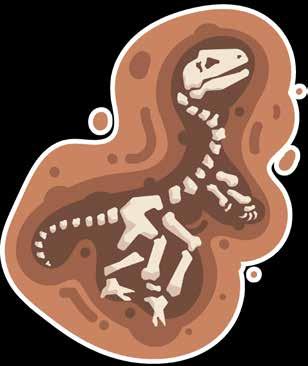
Elasmosaurus S tyracosaurus
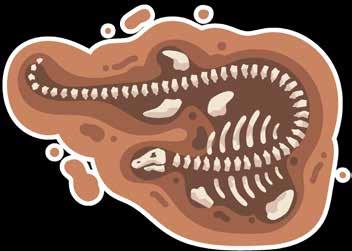
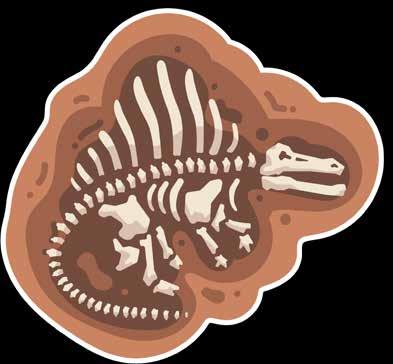
Be sure to stop by and visit the Lenoir Lantern booth as we will take you on a dinosaur fossil dig. Explore the eras of the dinosaurs on Earth while you dig for your very own miniature fossil to take home. Dinosaurs roamed the Earth more than 245 million years ago with fossils found on all seven continents. Become an archeologist (a scientists who studies the past) and search through the sand to uncover the remains of a Brachiosaurus, Spinosaurus, Velociraptor or Tyrannosaurus Rex.
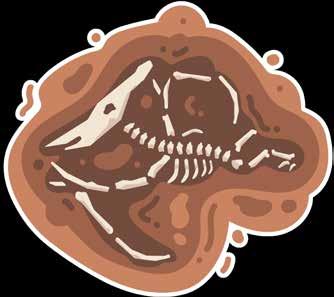
Stegosaurus
Loki, one of the Kinston Police’s K-9s, runs during a recent training day.
let me letyougo
But, before I do, let me tell you one more story ….
There is a lovely, but poignant motivational statement most have heard before:
“Bloom where you are planted.”
It is a statement that simply asks you to thrive, find contentment and make the most of current circumstances.
The ability to bloom becomes an easy task when nestled alongside amplifying one’s talents and skill sets, and bringing recognition to that which you are passionate. Milestones, achievements, accomplishments, and joyfulness are found here.
For the reverse, when navigating the difficult or unwanted situation, the ability to bloom becomes burdensome and tiring, and often requires more than one failed attempt. Discouragement and desire to give up are rampant, but the point is to merely keep trying. Keep going until the blooming arrives.
The quote is often attributed to Saint Francis de Sales (1567-1622), a Catholic bishop famous for his gentle approach to faith and for his desire to make faith accessible.
In faith, it asks you to find peace where God has placed you regardless of the difficulty you are facing. There is a purpose and a reason for God’s decision. And so, in this season, you are asked to develop perseverance, to grow and to find value in your current situation.
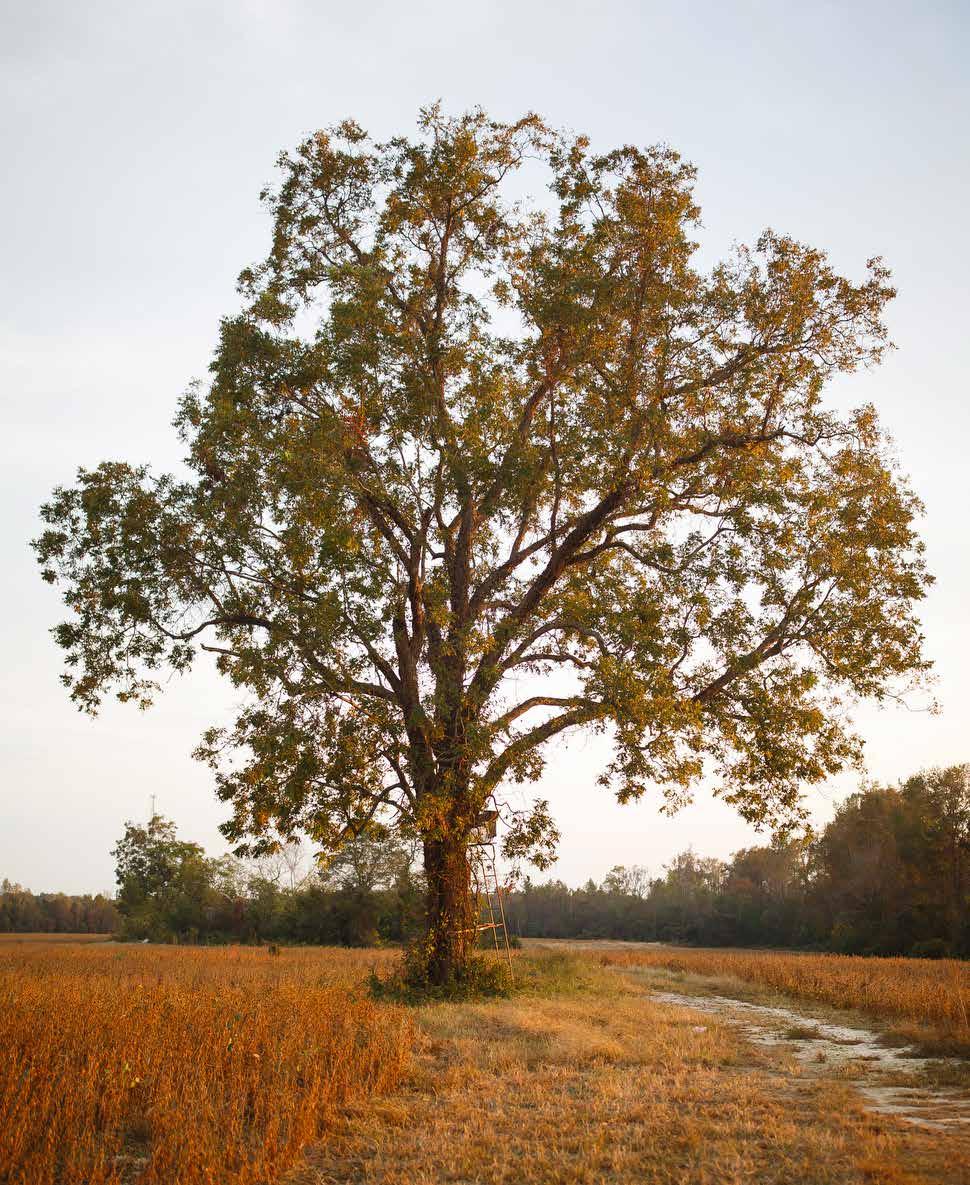
“Bloom where you are planted.”
A flower cannot always select the location where it will bloom the best, or control the temperature and weather, it merely responds the best it knows how. A warm front can cause an early bloom. A cold front can cause a delayed bloom. Regardless, the flower still beautifully blooms, exactly where it was planted. And so can you.
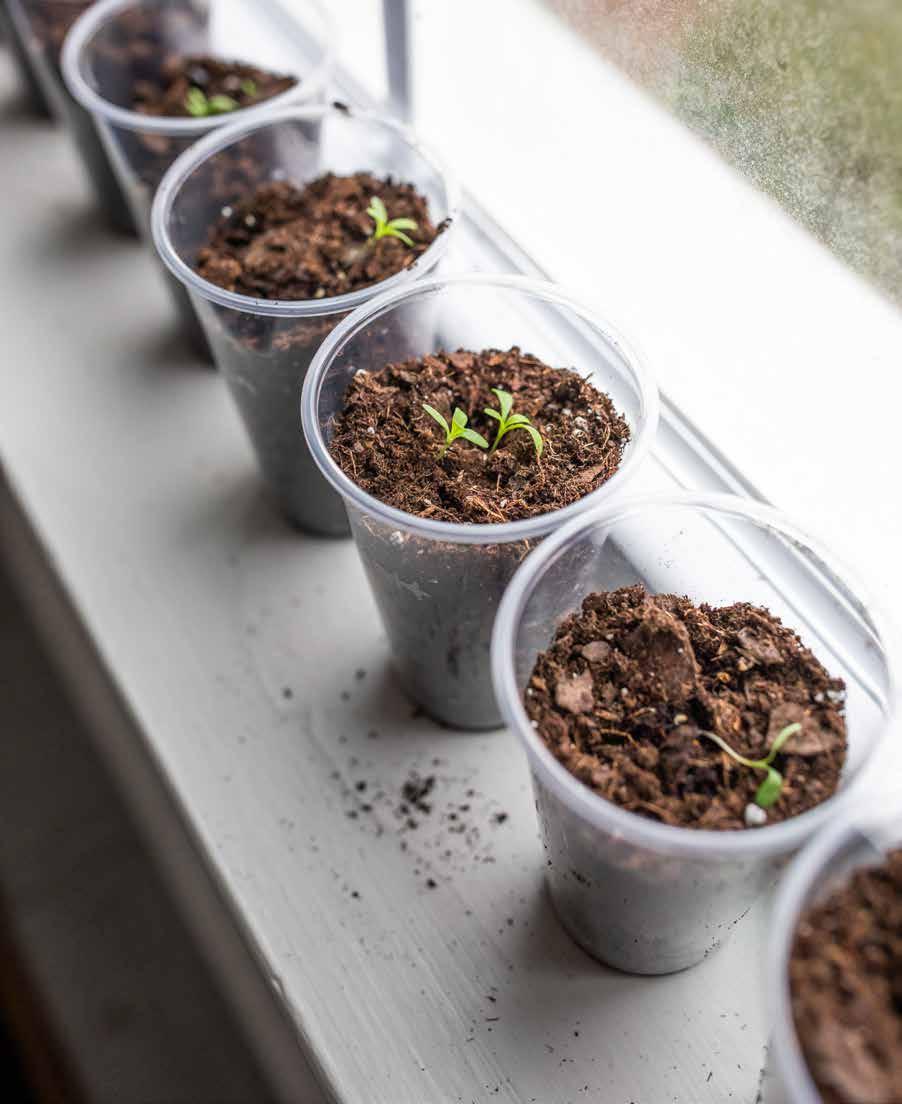
Students grow plants at the Collective Leadership Academy.
www.longleafpinepublishing.com