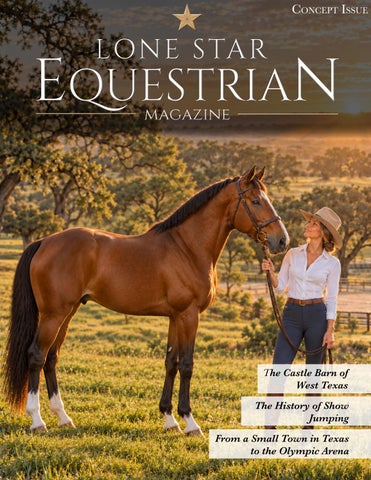
Concept Issue
The Castle Barn of West Texas The History of Show Jumping From a Small Town in Texas to the Olympic Arena
Contents
Publisher
Wichmann & Co, LLC
Editor
Cecilia Wichmann
Contributors
Caroline Whitaker Jameson Reed Elena Castillo Brooke McAllister Daniel Mercer Sofia Bennett Travis Hollis Natalie Price Gabriel Navarro Claire Montgomery
From the Publisher
4
The Art of Leaving the Rails Up
5
The Castle Barn of West Texas
8
From a Small Texas Town to the Olympic Arena 12 What Protects You When You Need It?
14
Before the First Horse Enters the Ring
15
The Things Every Horse Person Has Said
18
Lone Star Equestrian Magazine is a quarterly digital publication owned and published by Wichmann & Co Publishing & Media. © 2027 Wichmann & Co, LLC. All rights reserved. Unless otherwise credited, magazine Acontent may not be reproduced, distributed, or republished without written permission from the rights holder. Opinions expressed by contributors and advertisers are their own and do not necessarily reflect the views of the publisher. The publisher reserves the right to decline advertising that does not align with the magazine’s mission. Lone Star Equestrian Magazine 601 Burnett St Wills Point, TX 75169 (469) 224-0885
hello@lonestarequestrianmagazine.com www.lonestarequestrianmagazine.com
Concept Issue • Lone Star Equestrian magazine 3
From the Publisher
I hope you recognize the care, hard work and love of horses that connect us across disciplines. This magazine is just getting started, and I would love for you to be part of it. Follow Lone Star Equestrian Magazine on Facebook and Instagram, join the conversation and tell us what you would like to read. If there is a rider, trainer, groom, volunteer, horse or organization we should highlight, please reach out through lonestarequestrianmagazine.com or email hello@lonestarequestrianmagazine.com. Thank you for opening this issue. I cannot wait to see whose story we tell next. Cecilia Wichmann Publisher, Lone Star Equestrian Magazine
Welcome to Lone Star Equestrian Magazine. Seeing these pages come together is exciting, but what excites me most is thinking about the people and horses whose stories will fill them. Texas has an incredible equestrian community. Some of us spend our weekends at horse shows. Others are out on the trails, working cattle, caring for horses at home, teaching the next generation or simply trying to squeeze in a ride before the sun goes down. However we came to horses, we know how much dedication lives behind the moments everyone else sees. That is what this magazine is about. We want to celebrate the full range of equestrian life, from show jumping, dressage and eventing to working equitation, vaulting, western disciplines, trail riding and everything in between. You do not need a ribbon on your wall or a familiar name to have a story worth telling. The trainer who stays late with a struggling student, the groom who knows a horse better than anyone, the volunteer who makes an event possible and the rider who finally finds the courage to try again all belong in these pages. We want Lone Star Equestrian to leave you inspired and teach you something useful along the way. You might discover a discipline you have never tried, learn from someone else’s experience or meet a horse and rider you will find yourself cheering for. Most of all, 4 Lone Star Equestrian Magazine • Concept Issue
The Art of Leaving the Rails Up
Before there were courses Horses had crossed obstacles for centuries before anyone called it show jumping. Riders needed to clear ditches, walls and hedges while traveling, hunting or serving in the The crowd grows quiet as a horse cavalry. Putting those skills in front turns toward the last fence. The rid- of an audience came later. er has already made a dozen decisions that most spectators never saw: The Dublin Horse Show offers where to turn, how many strides to a vivid glimpse of the sport’s betake, when to wait and when to ask ginnings. At its first show in 1864, for more. One rail separates a clear jumping tests included a high leap round from four faults. Then the over hurdles dressed with gorse, horse lifts off, the rider follows, and a wall jump built from loose stone and a wide leap with water beyond for a moment both are in the air. it. These were recognizably relatShow jumping is wonderfully easy ed to today’s jumping, though they to watch. The fences stay up or looked much closer to challenges they come down. The clock settles a rider might meet outdoors than the close calls. Yet that simple score to the brightly painted fences of a hides a long history of changing modern arena. Dublin Horse Show ideas about horses, riding and com- 5-9 August 2026 petition. As horse shows grew, jumping beFrom gorse hedges to Olympic arenas, show jumping has always asked the same question: can a horse and rider meet a challenge together?
came something people could gather to see. A good horse was no longer demonstrating only that it could get across a field. It was showing its ability against other horses, with spectators watching every attempt.
A new way to ride One of the most consequential changes happened in the saddle. Around the turn of the twentieth century, Italian cavalry officer Federico Caprilli developed a forward riding position that allowed the rider to follow the horse more naturally over a fence. His approach helped reshape jumping technique, and its influence remains visible whenever a rider folds forward with a horse in flight. That change matters because a jump is more than the instant a horse leaves the ground. The pair must approach in balance, arrive at
Concept Issue • Lone Star Equestrian magazine 5
Who got to compete The sport’s history includes barriers beyond the fences. Olympic jumping was long restricted to men, with military status shaping eligibility in its early decades. Women competed in Olympic dressage in 1952, but Olympic jumping did not open to women until 1956. Today, women and men compete against one another in international jumping. The change widened the field and helped the sport grow beyond its cavalry roots. Across the United States, jumping now has a path that reaches from a rider’s first schoolJacues Cariou competing at the 1912 Summer Olympics in Stockholm. ing show to national competition a workable takeoff point and land Course designers arrange obstacles and international teams. The scale ready for whatever comes next. The so the difficulty comes from their changes along that journey. The rider’s job is to help the horse an- relationship to one another, as well central work does not: learning swer each question without getting as their size. Riders walk the course a horse, building confidence and beforehand, studying distances and making good decisions together. in its way. possible routes. Once the round beCompetition was changing, too. gins, the horse has only moments to Where show jumping stands Jumping appeared at the Paris understand each approaching fence. today Olympics in 1900 alongside high At the top of the sport, jumping fills jump, long jump and a mail coach That is why a clear round can look major arenas, Olympic venues and event. Equestrian sport was absent almost uneventful to a newcomer. international team competitions. from the next two Games, then re- Often, the better the partnership, The FEI’s League of Nations carturned at Stockholm in 1912 with the less effort the audience can ries forward the tradition of nations individual and team jumping. The see. Small adjustments made three meeting over a course, while World international framework that fol- strides before a fence can determine Cup competitions give individual lowed helped turn local contests what happens over it. horse and rider partnerships anothinto a sport in which riders from er stage. different nations could meet on the The rules give spectators a way in. same course. In a typical faults and time compe- The conversation around the sport tition, knocking down an obstacle has grown as well. Horse welfare is The course became the or having a refusal adds penalties. A now a stated focus of international pair that exceeds the allowed time governance, including attention to challenge An early jumping test could ask, can also receive faults. When a class horses’ physical and psychological in effect, “How high?” A modern calls for a jump-off, leading rid- wellbeing. That discussion reaches course asks a string of questions ers return over a shortened course from the rules of competition to the instead. Can this pair shorten its where a tighter turn might win the daily choices made in training and stride for a combination? Carry class or bring down a rail. Compe- care. inside. enough power across a wide oxer? tition formats vary, but the tension Turn without losing balance? Keep between accuracy and speed runs For all the changes since those its composure when a colorful fence through them all. gorse-trimmed hurdles in Dublin, appears late in the round? the sight that draws people in has endured. A horse and rider enter 6 Lone Star Equestrian Magazine • Concept Issue
the ring with a course neither can complete alone. They have rehearsed, traveled and learned each other’s habits. Then the bell rings, and they must make it work together, one fence at a time.
Concept Issue • Lone Star Equestrian magazine 7
The Castle Barn of West Texas At a family horse farm outside Fort Davis, an unusual old barn tells a story of ambition, hardship, and the people who chose to stay.
is the oldest building still in daily use. Horses have passed through its doors for more than a century. Its walls have sheltered feed during droughts, tack during storms, and generations of children who were From the road, the barn looks almost told to finish their chores before goout of place. Two short stone towers ing inside for supper. rise above its roofline, and tall wooden doors sit beneath an arch wide The story begins in 1909, when enough for a wagon team. Beyond Elias and Margaret Voss bought it are horse pastures, distant moun- a stretch of land with a dependtains, and the broad West Texas sky. able well and a view of the Davis The building looks like a little castle Mountains. Elias raised cattle, but that wandered into ranch country Margaret loved horses. She wanted andA decided to make itself useful. a proper place to care for them, esThe people who built it would have pecially the mares and young stock liked that description, although use- that needed closer attention than an fulness mattered far more to them open pasture could give. than appearances. At Coyote Ridge Farm, the barn Elias wanted a barn that would stand
up to West Texas weather. Margaret wanted one that was beautiful. The result was a sturdy working building with thick stone walls, generous stalls, and two small towers that gave it the look of a fortress. According to family lore, Margaret had saved a picture of a European stable in an old magazine and kept it tucked among the plans. Whatever inspired its shape, the barn was built for work. The broad aisle gave horses and handlers room to move. High windows brought light into the stalls. The towers held supplies and provided a lookout across the surrounding pasture. Its stone walls kept the interior cooler through summer afternoons and offered protection when hard wind swept across the ranch. Beauty did not spare the Voss family Photo: Chat GPT
8 Lone Star Equestrian Magazine • Concept Issue
from difficult years. Drought tested the well and thinned the grazing. Feed became scarce. There were seasons when keeping the horses meant finding work elsewhere to pay for hay. Later, changing markets brought a different question: whether the family could afford to keep the farm at all.
through good years and hard ones. The barn has lasted because generations of people found a use for it and a reason to care for it. That may be the most West Texas thing about this little castle. It was built to be admired, but it earned its place by being useful.
Each generation found its own reason to stay. Some kept cattle. Others focused on horses, training ranch mounts and raising a small number of foals. For a time, the stalls were mostly empty. Then a daughter came home with plans to bring horses back to the place where she had learned to ride. Today, the old barn is still the center of Coyote Ridge. Its doors open early, and the sound of hooves carries through the aisle much as it did when the Voss family first moved in. Repairs have been made where they were needed. The roof has been replaced, stalls have been improved, and the horses receive the care that modern knowledge makes possible. The stone towers remain. Visitors often stop to photograph the barn first. It is easy to understand why. Against the mountains, those towers make an unforgettable picture. But spend a little longer at the farm and the quieter details begin to matter more: a worn place in the stone where a door has swung for decades, an old hitching ring beside the arch, the path people still take between the barn and the house. Coyote Ridge is a horse farm with a remarkable building. It is also a place shaped by the ordinary work of caring for animals, repairing what breaks, and making a home Concept Issue • Lone Star Equestrian magazine 9
10 Lone Star Equestrian Magazine • Concept Issue
From a Small Texas Town to the Olympic Arena With Triumph WSH beside her, dressage rider Emily Hart prepares for the ride of her life in Los Angeles
She was drawn to dressage because every improvement seemed to ask a new question of her. A better transition could take weeks. A movement that looked effortless from the rail required strength, timing, and trust.
The first time Emily Hart rode a horse, she was six years old, her boots were too big, and she had to be lifted into At local shows, Emily and her family loaded the trailer the saddle. before sunrise. They drove home with ribbons sometimes and a list of things to work on almost always. Her The lesson took place outside Wills Point, Texas, in an trainer taught her to watch the whole ride before judgarena that turned dusty in the summer and muddy after ing a single movement. Emily learned to do the same a good rain. Emily’s family knew little about dressage. with herself. They knew only that she loved horses, and that once she started riding, getting her to come home was the As she grew older, there were harder choices. Friends difficult part. left for college and new careers while Emily arranged work around horses, lessons, and competitions. MonTwenty years later, Emily is preparing to represent the ey was tight. Progress was slow. Some seasons, simply United States at the 2028 Olympic Games in Los An- keeping a horse sound and getting to the next show felt geles. Her partner is Triumph WSH, the horse whose like an achievement but she kept going. name now appears beside hers on the biggest entry list of her career. Meeting Triumph Triumph WSH came into Emily’s life when she was no For Emily, the news still feels a little unreal. longer looking for a horse who would impress her on the first ride. She wanted one she could build a partner“I keep thinking about that little girl who used to beg for ship with. one more lap around the arena,” she says. “She would have been happy just to know she was still riding.” Triumph had talent and plenty of opinions. He could offer a beautiful movement one moment and question Learning to Listen Emily’s request the next. Learning what helped him Emily did not begin with an expensive horse or a plan feel confident took time. Emily adjusted her training, to reach the Olympics. Her first years were spent on listened to the people around her, and learned when to patient lesson horses who taught her how to sit quiet- ask for more and when to end on a good note. ly, steer clearly, and recover when things went wrong. She mucked stalls to earn extra time at the barn and “He made me a better rider because I couldn’t rush watched older riders long after her own lesson ended. him,” she says. “I had to be clear. I had to be fair. And I had to pay attention to what he was telling me.”
12 Lone Star Equestrian Magazine • Concept Issue
Their results came gradually. A stronger test led to a more demanding competition. A disappointing weekend sent them home to practice. Emily’s team grew to include the people who helped care for Triumph every day, from her trainer and veterinarian to the groom who could tell by his expression what kind of morning he was having. By the time the pair reached the highest levels of the sport, their work together had become their greatest strength. Emily knew when Triumph was ready to give more. Triumph trusted her enough to try. The Call Emily was at the barn when she learned she had been selected for the U.S. Olympic dressage team. Triumph was in his stall, waiting for his breakfast. She called her parents first. Then she walked back to Triumph, put a hand on his neck, and stood with him for a while. The road ahead still holds training days, travel, and the pressure of entering an arena watched by the world. Emily knows the Olympic ride will last only minutes. She also knows how many people and horses helped her reach it. Back in Wills Point, the arena where she learned to ride is still there. Its footing has been improved over the years, but a Texas summer can still leave dust on a rider’s boots. Emily hopes the children taking lessons there will see her and Triumph in Los Angeles and imagine where their own riding might lead. When Emily enters the Olympic arena, she will do what she has practiced since childhood: take a breath, settle into the saddle, and ask her horse for the first step.
Concept Issue • Lone Star Equestrian magazine 13
What Protects You When You Need It?
Sponsored article mockup | Akin’s Insurance Agency, Terrell
icy help pay to repair or replace it? The answer depends on the policy. Coverage for damage you cause Horse people know how much while towing does not necessarily planning goes into a trip. There is mean the trailer itself is protected. the feed, the tack, the paperwork, Before your next trip, ask your agent the route, and the inevitable check what is covered, what is excluded, to make sure the trailer lights are and what deductible you would pay. working. But when was the last time you checked the insurance on the Then look at the truck. It may be truck and trailer carrying it all? your everyday vehicle, but it also has a demanding job on show weekIt is an easy question to put off. A ends. Reviewing your auto coverage policy gets renewed, the payment gives you a chance to talk through goes through, and life moves on. liability limits, damage to your own Meanwhile, you may have bought vehicle, and the way you use it. a different trailer, added a barn to your property, or started hauling Your property deserves the same atfarther from home. The coverage tention. A home policy may cover you chose a few years ago may de- some structures beyond the house, serve another look. but barns, sheds, equipment, and Start with the trailer. If it is dam- property used for business can raise aged in a collision, stolen, or caught different coverage questions. If in a storm, would your current pol- you have made improvements or
14 Lone Star Equestrian Magazine • Concept Issue
changed how you use your land, tell your agent. A conversation now is much easier than trying to sort out a surprise after a loss.
That is where Casi at Akin’s Insurance Agency in downtown Terrell can help. She can look at the things you need to protect, shop the options available to you, and help you compare more than the monthly price. The goal is to understand what a policy actually does for your home, vehicles, trailer, and other property before you need to use it. Casi does not offer insurance for the horse itself. But for many riders, the horse is only one part of a much bigger picture. The property you care for, the vehicle you drive, and the trailer you depend on are worth a careful review too.
Before the First Horse Enters the Ring
The first rider may be the start of the show for spectators. For the people working behind the scenes, the day began hours earlier.
By the time a horse ewtrots into the arena, a great deal has already happened. Someone checked the footing. Someone opened the gates, set out signs, organized paperwork, and made sure riders knew where to go. At a jumping show, a crew may have walked the course and adjusted rails. At a dressage show, volunteers may be checking numbers and keeping the warm-up area moving. Across disciplines, people are answering questions, solving small problems, and watching the clock. Most of that work goes unnoticed. That is usually a sign it is being done well. A horse show brings together animals, people, vehicles, equipment, and a schedule that can change in an instant. A rider scratches. A trailer arrives late. A horse needs a few extra minutes. The weather turns. Behind the scenes, someone has to work out what happens next while keeping the day fair, safe, and welcoming for everyone. The work starts well before show morning. Entries need to be processed. Officials and volunteers need assignments. Arenas, parking areas, and schedules need to be ready for the number of horses expected. For a small local show, the person handling one of those jobs may also be handling three others.
Then the trailers begin to arrive.
through a long day.
For riders, those first moments can set the tone for the day. Clear directions to parking, a friendly face at check-in, and an answer to a last-minute question make it easier to focus on the horse at the other end of the lead rope. That welcome takes effort, especially when the person offering it has been on their feet since dawn.
Texas equestrian sports depend on people willing to do this work. Some are paid professionals. Others are volunteers, family members, or riders who give up a day of competing to help their club put on a show. They are part of the horse community just as surely as the people in the saddle.
Once classes begin, the crew settles into a rhythm. Gates open and close. Results are recorded. Equipment is moved or reset. Riders are called when it is their turn. The pace can feel calm from the rail, even when the team running the show is making dozens of decisions an hour.
The next time you visit a show, take a moment to look beyond the arena. Notice the person keeping track of the order of go, the crew tending the course, and the volunteers helping a first-time competitor find the right ring. Say thank you if you get the chance.
When the final horse leaves and the There are moments of reward, too. spectators head home, they may still A young rider comes out of the ring be there, putting equipment away grinning after finishing a first class. and getting the grounds ready for A horse that was nervous in the another day. Tomorrow’s first ride warm-up settles and does its job. A will begin with their work, too. competitor thanks a volunteer on the way back to the trailer. Those small exchanges can carry someone Concept Issue • Lone Star Equestrian magazine 15
16 Lone Star Equestrian Magazine • Concept Issue
Concept Issue • Lone Star Equestrian magazine 17
The Things Every Horse Person Has Said
Spend enough time around horses and your vocabulary changes. Ordinary words take on entirely new meanings. You begin saying things in public that make strangers turn around. And somehow, you can describe a horse’s personality in three sentences while struggling to explain what you do for a living. Whether you ride dressage, jump, event, vault, compete in working equitation, or simply love being at the barn, a few phrases seem to belong to all of us. “He’s usually very good.” This is commonly said moments before a horse does something memorable.
“Don’t let him know you have treats.”
He already knows. He knew when you walked into the barn. He heard the wrapper before you reached the aisle. He has also noticed that you gave one to the horse next door, and he would like to discuss the matter immediately. “We’re working on it.” A useful phrase that can cover almost anything: transitions, straightness, confidence, patience, a tricky jump, a new pattern, standing still for the farrier, or getting through a lesson without losing a stirrup. It’s also an honest description of life with horses. Even on the best days, there is always something to learn.
Perhaps he stops to inspect a flowerpot he has passed every day for six years. Perhaps he decides the judge’s “She takes care of me.” booth is new and suspicious. Perhaps the quiet horse you brought to an event discovers that he has opinions This is the one that sounds simple until you try to exabout applause. plain it.
He probably is usually very good. Today, however, he A good horse teaches timing and patience. She notices has an audience. when you are tense. She asks you to pay attention to what is happening right now. Some days she gives you “I’ll just be at the barn for an hour.” a wonderful ride. Other days she teaches you how to laugh, take a breath, and try again tomorrow. No horse person believes this, yet we keep saying it. That relationship is why we show up early, stay late, and First, there is a horse to catch. Then a water trough keep coming back through Texas heat, mud, wind, and looks low. Someone needs help holding a gate. You find the occasional surprise weather forecast. a missing glove, discover a loose fence board, and get into a conversation about feed that somehow lasts 25 Our disciplines may look different from one another. minutes. Our horses certainly do. But somewhere between the Three hours later, you are still in your barn clothes, first greeting at the stall door and that familiar goodbye slightly hungry, and wondering how the afternoon dis- before heading home, we speak a language of our own. appeared. Your horse, meanwhile, has enjoyed a perfectly normal day. And yes, we’ll probably be at the barn for another hour. “That’s his good side.”
Have one we missed? Tell us on Facebook or Instagram. We may feature readers’ favorite barn sayings in a fuThis can refer to a photograph, a training exercise, a ture issue. mane that refuses to lie flat, or the side of the trailer he prefers to load on. The meaning depends entirely on the horse. For some, the good side changes daily. 18 Lone Star Equestrian Magazine • Concept Issue
SPRING 2027 | FOUNDING ADVERTISER RATES A new digital magazine celebrating Texas horses, riders and the people behind the sport.
$60
BUSINESS CARD
QUARTER PAGE
Small format, ideal for local businesses
A clear offer, logo and contact details
$90
ONE-THIRD PAGE
HALF PAGE
Room for your message and contact details
$225
More space for imagery and your message
$400
FULL PAGE
$125
TWO PAGE SPREAD
A dedicated page for your brand
$700
A bold visual presence across two pages
PREMIUM PLACEMENTS Inside front cover $500
Back cover $550
EVERY AD INCLUDES Full color placement, a clickable website link, and one advertiser spotlight on our Facebook and Instagram pages during the issue. One spotlight on each platform per booked issue.
BOOK TWO ISSUES AND SAVE 15% The discount applies to the listed rate for each of the two issues. Rates are per issue. Finished artwork supplied by advertiser; design help is available. Spring 2027 artwork deadline: February 1, 2027. Ask us for final ad dimensions.
LET'S PUT YOUR BUSINESS IN THE SADDLE
hello@lonestarequestrianmagazine.com | lonestarequestrianmagazine.com
f
Concept Issue • Lone Star Equestrian magazine 19
@lonestarequestrianmag