T H E L O N E LY E N T R E P R E N E U R · 2 0 2 6 F O U N D E R B R I E F
THE CREDIT GAP: ONLY 42% OF SMALL BUSINESSES GET THE LOAN THEY ASKED FOR The Federal Reserve's 2026 data shows most founders are funding growth with partial approvals and personal guarantees. Here's how to plan for the money you'll actually get.
Every founder who has applied for a business loan knows the moment. The application is in, the plan is built around the number, and then the answer comes back: yes, but not all of it. According to the Federal Reserve's 2026 Report on Employer Firms, that "yes, but" is now the most common experience in small business lending. In other words, the plan you build around the loan is usually not the plan you get to execute. This article breaks down what the data says, why it matters more than most founders admit, and how to run your business so a partial approval doesn't break it.
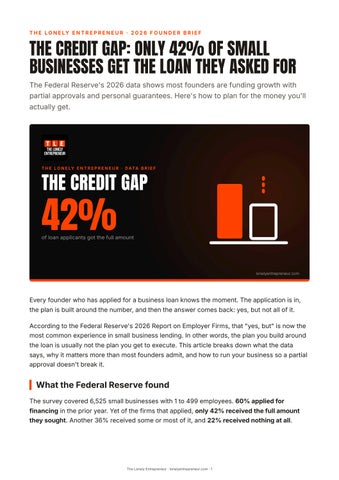
What the Federal Reserve found The survey covered 6,525 small businesses with 1 to 499 employees. 60% applied for financing in the prior year. Yet of the firms that applied, only 42% received the full amount they sought. Another 36% received some or most of it, and 22% received nothing at all.
The Lonely Entrepreneur · lonelyentrepreneur.com · 1
Put simply, more than half of applicants walked away without the full amount they needed. That's not an edge case. It's the norm. Consider what usually happens next. You asked for $250,000 to cover inventory, two hires and a system upgrade. Instead, you get $140,000. Now every leader on your team needs an answer to the same question: which part of the plan dies?
The number founders rarely talk about Meanwhile, there is a second number founders rarely discuss in public. Among firms with outstanding debt, 59% used a personal guarantee, and 51% pledged business assets. In practice, that means the majority of small business borrowing is tied directly to the founder's house, savings and family security. Consequently, the stress of a loan decision is never just financial; it's personal. Founders lie awake not because the spreadsheet is complicated, but because the downside lands at their kitchen table.
The Lonely Entrepreneur · lonelyentrepreneur.com · 2
Why so many founders are borrowing now The pressure behind those applications is not reckless expansion. Instead, it is cost. 77% of employer firms named rising costs or tariff-related costs as a financial challenge in the Fed survey. Tariff costs hit retail (69%) and manufacturing (62%) hardest. At the same time, NFIB's October 2026 data shows credit is getting more expensive and less routine. Only 25% of owners borrow regularly, compared with a historical average of 34%, and a net 13% reported paying a higher interest rate on their most recent loan. As a result, the founders who do borrow are often borrowing under pressure, at worse terms, and for survival as much as growth.
Where the full approvals actually happen Fortunately, the data also points to a better path. Small banks fully approved 57% of applicants, the highest full-approval rate of any lender type in the survey. That matters, because many founders go straight to the biggest bank they already use or to an online lender with a fast form. Speed feels like progress. However, the data suggests that relationships, local knowledge and a banker who understands your business still win more complete approvals.
Five ways to plan for a partial "yes" The smartest founders don't hope for the full amount. Rather, they plan for the realistic one. Here's how. 1. Build three versions of the plan. Before you apply, write the plan at 100%, 60% and 0% of the requested amount. Decide in advance what gets cut at each level. Therefore, when the answer comes, you execute instead of panic.
The Lonely Entrepreneur · lonelyentrepreneur.com · 3
2. Rank every use of funds by payback. Inventory that sells in 60 days pays back faster than a new office. A sales hire with a clear pipeline pays back faster than a brand refresh. Fund the fastest payback first. 3. Start the small-bank relationship before you need it. Open an account, meet the commercial lender, share your numbers quarterly. Then, when you apply, you're a known business, not a file. 4. Negotiate the guarantee, not just the rate. Founders fixate on interest rates. Yet limiting a personal guarantee, capping it, or setting conditions for its release can matter far more to your family's risk. Ask; many founders never do. 5. Fix the cash flow before you borrow for it. If late-paying customers are the reason you need a line of credit, a deposit policy or shorter terms may solve part of the problem for free. Borrowing to finance other people's slow payments is expensive.
What lenders look at before they say "some of it" A partial approval is rarely random. Instead, it usually reflects specific concerns a lender has about your business. Knowing them in advance lets you fix them, or at least address them in your application. Cash-flow coverage. Can current operating cash flow cover the new payment with room to spare? If the answer depends on growth that hasn't happened yet, expect a smaller number. Customer concentration. If one or two customers drive most of your revenue, the lender sees a single point of failure. Clean, current books. Late or messy financials signal risk, even when the business is healthy. Up-to-date statements are the cheapest credibility you can buy. A clear use of funds. "Working capital" is vague. "Inventory for the Q2 contract with these three customers" is specific, measurable and easier to approve. Owner reliance. If the business can't run without you, the lender is lending to you personally, which is exactly why guarantees appear. Each of these is fixable. Moreover, each one makes the business stronger whether or not you borrow.
A scenario worth rehearsing Imagine a services firm doing $1.8M a year. The founder applies for $300,000 to hire three people for a new contract. The bank approves $180,000 with a personal guarantee. Without a plan, the founder takes the money, hires all three anyway and hopes the contract pays fast. With a plan, the founder hires two, negotiates a 30% deposit from the client to fund the third, and asks the bank to release the guarantee after twelve months of on-time
The Lonely Entrepreneur · lonelyentrepreneur.com · 4
payments. Same approval, very different risk. The difference isn't the loan; it's the thinking before signing.
The decision nobody should make alone Here's what the data doesn't show: how many of these decisions are made by one person, late at night, without a second opinion. Should you sign the guarantee? Should you take the partial loan or walk away? Should you cut the hire or the inventory? These are exactly the decisions where an experienced outside perspective is worth the most, and exactly where most founders have the least of it. Bankers are paid to lend. Brokers are paid to place. Your team depends on you to look certain. That's the gap The Lonely Entrepreneur was built to fill.
How The Lonely Entrepreneur helps with financing decisions Founder Michael Dermer built a company to 1,000 employees and learned the hard way what it costs to make these calls alone. TLE now offers a clear path depending on where you are: Not sure your business is lender-ready? Start with the free Dermer Diagnosis. It scores your business out of 100 across five areas, ranks your biggest exposures and gives you a 30-day action plan. Lenders look for many of the same weaknesses. Facing one big financing call right now? Book a Founder Clarity Hour: 60 minutes with a senior consultant, a pre-call intake, and a written action plan with three dos and three don'ts. Under $1M in revenue and building alone? The Learning Community includes 400+ financing sources, 5,000+ learning modules, unlimited group coaching and weekly live sessions with Michael Dermer. That's where you pressure-test a loan decision with founders who've signed the same papers. Between $1M and $5M? The five-week Founder Blueprint builds your money plan alongside customers, team and your CEO role, with five hours of one-on-one coaching. Running a $5M to $50M company? A Sidekick gives you a senior partner for CEO-level issues, including capital strategy, with weekly check-ins.
The Lonely Entrepreneur · lonelyentrepreneur.com · 5
The bottom line The credit gap isn't going away soon. Costs are high, credit is tighter, and most approvals are partial. However, founders who plan for the partial "yes," build relationships with small banks, negotiate guarantees and get a second opinion before they sign will make better decisions than those who apply and hope. Your next step: take the free Dermer Diagnosis before your next application. It takes about eight minutes, and it shows you what a lender is likely to see first.
Frequently asked questions What share of small business loan applications are fully approved? In the Federal Reserve's 2026 Report on Employer Firms, 42% of applicants received the full amount they sought, 36% received some, and 22% received nothing. Do small business owners usually sign personal guarantees? Yes. 59% of firms with outstanding debt used a personal guarantee, and 51% pledged business assets. Which lenders approve small business loans in full most often? Small banks, with a 57% fullapproval rate among applicants in the same survey. How should I plan if I only get part of my loan? Write the plan at 100%, 60% and 0% of the request before you apply, rank uses of funds by payback, and decide in advance what gets cut.
The Lonely Entrepreneur · lonelyentrepreneur.com · 6
Where can I get an outside opinion on a financing decision? The Lonely Entrepreneur offers a free Dermer Diagnosis, a one-on-one Founder Clarity Hour, and a Learning Community with 400+ financing sources and weekly group coaching.
Sources Federal Reserve, 2026 Report on Employer Firms (Small Business Credit Survey) NFIB Small Business Economic Trends, October 2026 The Lonely Entrepreneur
The Lonely Entrepreneur helps founders make better decisions, with a free Dermer Diagnosis, the Learning Community, Founder Blueprint and Sidekick. lonelyentrepreneur.com
The Lonely Entrepreneur · lonelyentrepreneur.com · 7