2026/27 season at the Southbank Centre
Free concert programme
What happens when we really listen? This season we’re exploring the extraordinary ways that listening can inspire creativity, connection and new perspectives.
To begin our journey, we asked eight Royal College of Art students to listen to a piece of music featured in our London season, from Stravinsky’s The Firebird to Tchaikovsky’s Sixth Symphony. From there, the artists unleashed their imagination, each creating an original artwork based on their personal response to the music.
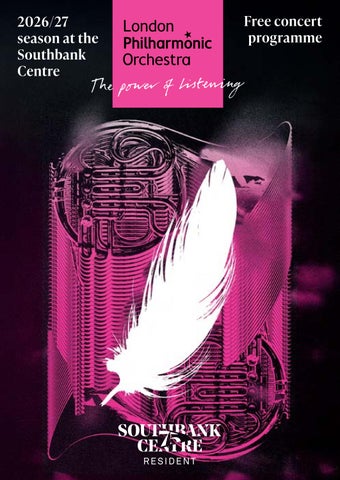
You can see how varied their visual interpretations of the music were from the artworks on this page and on the programme cover.
If you haven’t had the chance to see the artworks on billboards around London, you can view them all in detail on our website. You can also find out more about each of the artists and the processes they used, as well as listen to the music that inspired them.
Check out the artworks and the pieces that inspired them: lpo.org.uk/listening Artworks designed by (clockwise from top left) Megan Peng, Zengyue Zhao, CTZ, Yunqi Peng, Anna Korbel, Yejin Seo, Ishita Sharma, Ruwani Rajapakse
Principal Conductor Edward Gardner supported by Aud Jebsen Principal Guest Conductor Karina Canellakis supported by Richard Buxton Conductor Emeritus Vladimir Jurowski KBE Patron HRH The Duke of Kent KG Artistic Director Jesús Herrera Chief Executive David Burke Leader Pieter Schoeman supported by Neil Westreich
Southbank Centre’s Royal Festival Hall Friday 6 November 2026 | 7.30pm
Alice Sara Ott plays Beethoven Beethoven Piano Concerto No. 4 (34 mins) Interval (20 min) Mahler Symphony No. 1 (including ‘Blumine’) (65 mins) Karina Canellakis conductor
Generously supported by Richard Buxton
Alice Sara Ott piano
Approximate finish time: 9.40pm Please note the timings shown are given only as a guide.
Contents 2 Welcome 3 Tonight in 2 minutes 4 About us 6 On stage tonight 7 Karina Canellakis 8 Alice Sara Ott 9 In Search of Purpose: Our 2026/27 season theme 10 Programme notes 17 Sound Futures donors 18 Thank you 20 LPO administration
London Philharmonic Orchestra • 6 November 2026 • Alice Sara Ott plays Beethoven
Welcome
LPO news The Power of Listening
Welcome to the Southbank Centre
Tonight’s work, Mahler’s Symphony No. 1, was one of the pieces of music featured in our ‘The Power of Listening’ project this autumn. In an exciting collaboration with the Royal College of Art, eight postgraduate students were each given a different piece of music to listen to, chosen from our current concert season. They then created an original artwork in response – capturing the emotions, memories, thoughts and images the music sparked in them.
We’re the UK’s largest centre for the arts and one of the nation’s top five visitor attractions, showcasing the world’s most exciting artists at our venues in the heart of London. As a charity, we bring millions of people together by opening up the unique art spaces that we care for. The Southbank Centre is made up of the Royal Festival Hall, Queen Elizabeth Hall, Purcell Room, Hayward Gallery, National Poetry Library and Arts Council Collection. We’re one of London’s favourite meeting spots, with lots of free events and places to relax, eat and shop next to the Thames.
The artworks were displayed throughout September at a sound gallery – a specially built installation featuring billboards with sets of headphones – at Vinegar Yard in London, as well as on the Tube network and around London.
We hope you enjoy your visit. If you need any information or help, please ask a member of staff. You can also email hello@southbankcentre.co.uk or write to us at Southbank Centre, Belvedere Road, London SE1 8XX.
See artist CTZ’s artwork inspired by Mahler’s Symphony No. 1 – ‘Where your brain stops scrolling’ – along with the other seven artworks and the stories behind them – at lpo.org.uk/listening
Subscribers to our email updates are the first to hear about new events, offers and competitions. Just head to our website to sign up.
Tour news It’s been a busy autumn of touring for the Orchestra, with a trip to Beijing in early October for performances at the Beijing Opera House and Beijing Music Festival, followed by a Spanish tour taking in Barcelona, Zaragoza, Madrid and Valencia. The touring continues next month, with a packed schedule of eight cities across Germany and the Netherlands in the first week of December.
Printed with the planet in mind
Follow all our adventures on our socials to see all the behind-the-scenes action from our tours.
This paper has been sourced from well-managed FSC®-certified forests, recycled materials, and other controlled sources. It is also Carbon Balanced, meaning the carbon impact of its production is offset by the World Land Trust. Prefer a paper-free option? Scan here for PDF versions of all our programmes to read or download on your phone or tablet.
Tonight’s programme cover Artwork by Royal College of Art student Yunqi Peng: ‘Heavy brass, lighter mind’. Designed while listening to Stravinsky’s The Firebird (Finale), performed by the LPO under Vladimir Jurowski. #thepoweroflistening
2
Tonight in 2 minutes
New to classical? Short on time? Your quick guide to tonight’s concert.
What to expect
The vibe
Alice Sara Ott plays Beethoven
In the first half of tonight’s concert we’ll hear Beethoven’s Piano Concerto No. 4, full of quiet beauty and playful exchanges between piano and orchestra. After the interval, the ranks of the Orchestra will swell for Mahler’s mighty Symphony No. 1, a vivid musical journey from birdsong and gentle nature scenes to a thrilling, triumphant finale.
Take your seats... The players tune up their instruments, then the conductor, Karina, and soloist, Alice, come on stage. Once the applause dies down, sit back and enjoy the music ...
3
movements
34 mins
Who’s on stage?
Karina Canellakis: conductor
American conductor Karina Canellakis is the London Philharmonic Orchestra’s Principal Guest Conductor. She leads several concerts with the Orchestra each season, both here at the Royal Festival Hall and on tour. A former orchestral violinist with the Berlin Philharmonic, Karina has since built a stellar international conducting career.
Alice Sara Ott: piano
Alice is the guest soloist in tonight’s first piece: Beethoven’s Piano Concerto No. 4. She’s performed with orchestras and ensembles around the world, and tonight marks her debut with the London Philharmonic Orchestra.
London Philharmonic Orchestra
Tonight there are almost 100 London Philharmonic Orchestra musicians on stage. Our talented members represent over 14 different nationalities, and many of them enjoy busy solo, chamber and teaching careers alongside their orchestral roles. Turn to page 6 for tonight’s player list.
Ludwig van Beethoven Piano Concerto No. 4 with soloist Alice Sara Ott A concerto is a showpiece for a solo instrument accompanied by an orchestra. Beethoven was himself a brilliant pianist, and his writing for the instrument is full of expressive detail, making the most of its Longer classical pieces are often ability to sing, sparkle and made up of surprise. In this Concerto, movements, or shorter the piano and orchestra sections. Applause is usually saved for after exchange ideas in music the final movement. that is sometimes playful, sometimes tender, with a Maybe song-like middle movement an encore! and an energetic finale. The soloist might Interval 20 min
play a little extra surprise piece, if the applause is loud enough!
Gustav Mahler Symphony No. 1
5
movements
65 mins
Mahler’s First Symphony takes us on an hour-long musical journey, from the awakening of nature to a gloriously exhilarating finale. We’ll hear birdsong, folk tunes, and a surprising funeral march based on the nursery rhyme ‘Frère Jacques’, as Mahler builds a world of vivid colours, shifting moods and thrilling climaxes. Tonight’s performance also includes ‘Blumine’, a lyrical, tender extra movement that Mahler later removed from the Symphony, offering a glimpse of a gentler side to his musical world.
At the end of the concert, we applaud the performers. The conductor will acknowledge the Leader (chief First Violin), Alice, and might highlight other players for particular appreciation and applause. You’re welcome to take photos during the applause! Want to read more? Turn to page 10 for a deeper dive into tonight’s works.
London Philharmonic Orchestra • 6 November 2026 • Alice Sara Ott plays Beethoven
© Mark Allan
About us: London Philharmonic Orchestra
Connecting worldwide
Uniquely groundbreaking and exhilarating to watch and hear, since 1932 we’ve been recognised as one of the world’s leading orchestras, celebrated for our excellence, versatility, invention and inclusivity. Our mission is to create unrivalled orchestral experiences on stage and cultivate human connections beyond it. We achieve this through our exceptional live performances, pioneering education and community projects, acclaimed recordings, online activity and trailblazing international tours.
We’re one of the world’s most-streamed orchestras, with over 15 million plays of our content each month. We’re the most followed UK orchestra on Instagram, the most followed orchestra globally on TikTok, and the third most followed globally across all social platforms. Our 2024 Sky Arts documentary series, ‘Backstage with the London Philharmonic Orchestra’, was nominated for a 2025 BAFTA, and a second series, ‘Inside the Music’, will be broadcast this autumn.
Our home is here at the Southbank Centre’s Royal Festival Hall, where we’re at the beating heart of London’s cultural life. You can also hear us at our resident venues in Brighton, Eastbourne and Saffron Walden, and on tour worldwide. For over 60 years we’ve been Resident Symphony Orchestra at Glyndebourne Festival Opera, combining the magic of opera with Glyndebourne’s glorious setting in the Sussex countryside.
Our conductors Our Principal Conductors have included great historic names like Sir Adrian Boult, Bernard Haitink, Klaus Tennstedt and Kurt Masur. In 2021 Edward Gardner became our 13th Principal Conductor, and Vladimir Jurowski became Conductor Emeritus in recognition of his impact as Principal Conductor from 2007–21. Karina Canellakis is our current Principal Guest Conductor, and Sir George Benjamin is our Composer-in-Residence.
Life’s big moments Everyone will have heard the Grammy-nominated London Philharmonic Orchestra, whether it’s playing the world’s National Anthems for every medal ceremony of the London 2012 Olympics and Paralympics, our iconic recording with Pavarotti that made Nessun Dorma a global football anthem, or closing the flotilla at The Queen’s Thames Diamond Jubilee Pageant. And you’ll almost certainly have heard us on the soundtracks for major films including The Lord of the Rings.
Next generations We’re committed to nurturing the next generation of musicians and music-lovers: we love seeing the joy of children and families experiencing their first musical moments, and we’re passionate about inspiring schools and teachers through dedicated concerts, workshops, resources and training. Reflecting our values of collaboration and inclusivity, our OrchLab and
4
London Philharmonic Orchestra • 6 November 2026 • Alice Sara Ott plays Beethoven
Alice Ivy-Pemberton Tonight’s Leader
Open Sound Ensemble projects offer music-making opportunities for adults and young people with disabilities and special educational needs. Today’s young instrumentalists are the orchestra members of the future, and we offer a range of opportunities to support their progression. Our LPO Junior Artists programme creates pathways into the profession for young players from under-represented backgrounds, and our LPO Young Composers and Future Firsts schemes support the next generation of professional musicians, bridging the transition from education to professional careers. The LPO Conducting Fellowship supports the development of outstanding early-career conductors from backgrounds underrepresented in the profession.
2026/27 season
Alice Ivy-Pemberton joined the London Philharmonic Orchestra as Co-Leader in February 2023.
Our season theme, In Search of Purpose, explores the human spirit’s resilience and quest for meaning, inspired by Beethoven’s triumph over despair and the ways subsequent composers have used music as a vessel to confront life's big questions. Principal Conductor Edward Gardner returns with programmes including Britten’s War Requiem, Stravinsky’s The Firebird, and Composer-in-Residence George Benjamin’s opera Lessons in Love and Violence. We’ll also welcome back titled conductors Karina Canellakis and Vladimir Jurowski, as well as Chief Conductor & Artistic Advisor Designate Paavo Järvi.
Praised by The New York Times for her ‘sweet-toned playing’, Alice has performed as a soloist, chamber and orchestral musician to international acclaim. While growing up in New York City and studying with Nurit Pacht, Alice made a nationally televised Carnegie Hall debut aged ten, and was a finalist at the Menuhin International Competition at the age of 12. Alice earned her Bachelors and Masters degrees at The Juilliard School under the tutelage of Itzhak Perlman and Catherine Cho as a fully-funded recipient of the Kovner Fellowship. During her studies she won Juilliard’s Violin Concerto Competition, performed extensively with the New York Philharmonic and The Philadelphia Orchestra, and led orchestras under the baton of Barbara Hannigan, Xian Zhang and Matthias Pintscher. Upon graduating in 2022 she was awarded the Polisi Prize and a Benzaquen Career Advancement Grant in recognition of ‘tremendous talent, promise, creativity, and potential to make a significant impact in the performing arts’.
Our lineup of soloists this season includes Alice Sara Ott, Patricia Kopatchinskaja, Hilary Hahn, Pekka Kuusisto, Renée Fleming and Mitsuko Uchida, and we join the London Philharmonic Choir in celebrating its 80th anniversary year with Fauré’s Requiem alongside a choral world premiere by Dame Judith Weir. The season concludes on 24 April with Elgar’s The Dream of Gerontius, again with the LPC. New music remains a core pillar this season, with further premieres by Mark Simpson, Jacob Mühlrad, Dai Fujikura and Kevin Puts.
An avid chamber musician, Alice has collaborated with Itzhak Perlman, Anthony Marwood, Gil Shaham and members of the Belcea, Doric, Juilliard and Brentano string quartets, and performed with the Chamber Music Society of Lincoln Center. Festival appearances include Music@Menlo, Moritzburg and Yellow Barn. Also a passionate advocate for new music and its social relevance, Alice created Drowning Monuments, a noted multimedia project on climate change that brought together five world premieres for solo violin.
The season also sees tours to China, Spain, Germany, Belgium, the Netherlands and the Canary Islands, as well as performances and community events in our Brighton, Eastbourne and Saffron Walden residencies.
lpo.org.uk
5
London Philharmonic Orchestra • 6 November 2026 • Alice Sara Ott plays Beethoven
On stage tonight First Violins
Alice Ivy-Pemberton Leader
Chair supported by the Hodson family
Vesselin Gellev Sub-Leader Lasma Taimina Chair supported by Irina Gofman & Mr Rodrik V. G. Cave
Megan Yang Minn Majoe
Chair supported by Dr Alex & Maria Chan
Cassandra Hamilton
Chair supported by Jenny Watson CBE
Yang Zhang Martin Höhmann
Chair supported by Hans-Wilhelm & Evelyn Jenckel
Katalin Varnagy Nilufar Alimaksumova Sylvain Vasseur Thomas Eisner Amanda Smith Izzy Howard Will Hillman Daniel Pukach
Second Violins
Tania Mazzetti Principal
Chair supported by The Candide Trust
Claudia Tarrant-Matthews Chair supported by anonymous donors
Coco Inman Kate Birchall Nancy Elan Nynke Hijlkema Marie-Anne Mairesse Joseph Maher Sophie Phillips Ashley Stevens Sioni Williams Olivia Ziani Kate Cole Jamie Hutchinson
Violas
Rebecca Chambers Guest Principal Melissa Dattas Guillaume Leroy Katharine Leek Martin Wray
Chair supported by David & Bettina Harden
Cor Anglais
Benedetto Pollani Laura Vallejo James Heron Alistair Scahill Michelle Bruil Jenny Poyser Rachel Robson
Helen Vigurs
Clarinets
Benjamin Mellefont* Principal Chair supported by Sir Nigel Boardman & Prof. Lynda Gratton
Cellos
Chair supported by Bianca & Stuart Roden
Henry Shapard Co-Principal Waynne Kwon David Lale Heeyeon Cho Leo Melvin Sue Sutherley Helen Thomas Iain Ward
Bethany Crouch Paul Richards*
Bass Trombone
Thomas Watmough Principal Chair supported by Roger Greenwood
Bethany Crouch
Bass Clarinet
Kevin Rundell* Principal Sebastian Pennar* Co-Principal Tom Walley
Stewart McIlwham* Principal
Max Garrard Duncan Fuller Oliver Johnson Will Scotland
Ruth Harrison Hannah Grayson
Trumpets
Paul Beniston* Principal
Oboes
Chair supported by the Williams family in memory of Grenville Williams
Ian Hardwick* Principal Alice Munday
Tom Nielsen* Principal Anne McAneney*
Chair supported by David & Yi Buckley
Chair supported by anonymous donors
Jack Tostevin-Hall Helen Vigurs
David Hilton Tom Watts Imogen Timmins
6
Karen Hutt Principal
Chair supported by Joe Topley & Tracey Countryman
Oliver Yates
Harp
Chair supported by Friends of the Orchestra
Chair supported by The Thompson Family Charitable Trust
Percussion
Horns
John Ryan* Principal Elise Cambell Mark Vines Co-Principal
Piccolos
Chair supported by Victoria Robey CBE
Chair supported by an anonymous donor
Chair supported by Victoria Robey CBE
Hannah Grayson Stewart McIlwham* Ruth Harrison
Timpani
Contrabassoon
Annemarie Federle Principal
Chair supported by Malcolm & Alison Thwaites
Chair supported by William & Alex de Winton
Paddy Davies
Simon Estell* Principal
Juliette Bausor Principal
Lee Tsarmaklis* Principal
Bassoons
Simon Estell*
Flutes
Tuba
Simon Carrington* Principal
Chair supported by Louise Worthington
Lowri Estell Ben Havinden-Williams Yijia Cui Elen Roberts David Brown
Lyndon Meredith Principal
Paul Richards* Principal Roberto Giaccaglia Guest Principal Helen Storey*
Chair supported by William & Alex de Winton
Trombones
David Whitehouse Principal Andrew Cole Gemma Riley
E-flat Clarinets
Double Basses
Paul Beniston* Principal William O’ Sullivan David Geoghegan
Thomas Watmough
Chair supported by Roger Greenwood
Kristina Blaumane Principal
Offstage Trumpets
Francesca Lombardelli
Rosanna Rolton Principal * Professor at a London conservatoire
Assistant Conductor Shira Samuels-Shragg
The LPO also acknowledges the following chair supporters whose players are not present at this concert: Gill & Garf Collins Dr Barry Grimaldi Sir Simon Robey Eric Tomsett Neil Westreich
London Philharmonic Orchestra • 6 November 2026 • Alice Sara Ott plays Beethoven
Karina Canellakis Principal Guest Conductor, London Philharmonic Orchestra
Cleveland and Philadelphia orchestras. She was Principal Guest Conductor of the Berlin Radio Symphony Orchestra from 2019–23, and in 2023/24 was a featured Artist-in-Residence at Vienna’s Musikverein.
© Marco Borggreve
Last season, Karina made her Hamburg State Opera debut with a production of Bartók’s Bluebeard’s Castle and Zemlinsky’s A Florentine Tragedy. She conducts at least one opera-in-concert each season with the RFO at the Concertgebouw, featuring Debussy’s Pelléas et Mélisande in 2026/27. She made her critically acclaimed Santa Fe Opera debut in summer 2024 with Strauss’s Der Rosenkavalier, and conducted Poulenc’s Dialogues des Carmélites at the Théâtre des Champs-Elysées. With the RFO, Karina programmes an eclectic season of wide-ranging repertoire, conducting new commissions alongside great masterworks at Amsterdam’s Concertgebouw and TivoliVredenburg in Utrecht.
Karina Canellakis has been Principal Guest Conductor of the London Philharmonic Orchestra since 2021 and Chief Conductor of the Netherlands Radio Philharmonic Orchestra (RFO) since 2019. Acclaimed internationally for the interpretive depth and emotional impact of her performances, she is welcomed by the world’s finest musical institutions.
2023 saw the start of a multi-album collaboration between Karina, the Netherlands Radio Philharmonic and Pentatone, with their debut release, Bartók’s Concerto for Orchestra and Four Orchestral Pieces, earning a Grammy nomination. Her second album, Bartók’s Bluebeard’s Castle, was released in April 2025 to glowing international reviews, and was the winner of BBC Music Magazine’s 2026 Opera Award. A third album, pairing Rachmaninov’s The Bells and Symphonic Dances, was released to critical acclaim in June 2026.
This season, Karina leads three Royal Festival Hall concerts with the London Philharmonic Orchestra, showcasing the ‘explosive chemistry’ (The Times) that has become a hallmark of their partnership. Following tonight’s concert, she returns on 27 January 2027 with a programme featuring Mozart’s Violin Concerto No. 5 (‘Turkish’) with Hilary Hahn, and Brahms’s Symphony No. 1. This will be followed by concerts in Gran Canaria and Tenerife as part of the Canary Islands Music Festival.
October 2025 saw Karina’s first full album release on the LPO’s own label: a pairing of Tchaikovsky’s Fifth and Sixth Symphonies, recorded live in concert at the Royal Festival Hall. A second release on the Label, Rachmaninov’s Symphony No. 2, is planned for early 2027 (see page 16).
Other highlights of Karina’s 2026/27 season include her debut at the Bavarian State Opera with Massenet’s Werther, as well as return engagements with the Royal Concertgebouw, Bavarian Radio Symphony, Chicago Symphony, San Francisco Symphony and Berlin Radio Symphony orchestras. She also makes her debuts with the Pittsburgh Symphony, Orchestre Philharmonique de Radio France and Gothenburg Symphony Orchestra.
Already known to many in the classical music world as a virtuoso violinist, Karina was encouraged to become a conductor by Sir Simon Rattle while playing as a violinist in the Berlin Philharmonic’s Karajan-Akademie. She performed for several years as soloist, guest leader and chamber musician, spending summers at the Marlboro Music Festival, until conducting eventually took over after she won the Sir Georg Solti Award in 2016.
Karina made her conducting debut with the Vienna Philharmonic at the Mozartwoche Salzburg in January 2026, and has developed close relationships with many of the world’s leading orchestras. She is a repeat guest with the top American orchestras such as the New York Philharmonic; the Boston, Chicago and San Francisco symphonies; the Los Angeles Philharmonic; and the
Karina Canellakis’s position with the London Philharmonic Orchestra is generously supported by Richard Buxton.
7
London Philharmonic Orchestra • 6 November 2026 • Alice Sara Ott plays Beethoven
Alice Sara Ott piano
be released in spring 2027 on Deutsche Grammophon, with whom Alice enjoys a successful partnership and for whom she has recorded exclusively since 2008.
© Jónatan Grétarsson
Tonight marks Alice’s debut with the London Philharmonic Orchestra. This season, she will also perform piano concertos by Beethoven, Ravel and Grieg with the Pittsburgh Symphony, Minnesota Orchestra, NHK Symphony Orchestra in Tokyo and Vienna Symphony Orchestra. She continues her international recital tour, pairing the Nocturnes of John Field with sonatas by Beethoven. Her Deutsche Grammophon recording of Field’s complete Nocturnes topped international classical charts, reached the Top 30 of Germany’s mainstream pop chart, and was named Apple Music Classical’s Album of the Year 2025. In summer 2026, Alice appeared as a guest mentor on the popular mainstream series, Channel 4’s The Piano, joining Mika and Claudia Winkleman.
German pianist Alice Sara Ott is one of the most original musical voices of her generation. Her work brings together performance, recording and visual storytelling in projects shaped by a distinct artistic identity and a compelling, contemporary narrative. Whether re-examining familiar repertoire or introducing audiences to new music, she approaches each programme as a world of its own. The 2026/27 concert season marks the beginning of two new artistic relationships in the UK. As Collaborative Artist with the City of Birmingham Symphony Orchestra for two seasons, Alice will perform with the orchestra in Birmingham and internationally, as well as taking part in chamber music, recording and wider creative projects. In 2027, she also begins a yearlong position as Artist-in-Residence at London’s Barbican with a series of performances and specially conceived projects. Contemporary repertoire sits at the core of Alice’s performances, and in February 2027 she will give the world premiere of Joe Hisaishi’s Piano Concerto with the composer conducting The Philadelphia Orchestra. Alice works closely with the composer Bryce Dessner, and in spring 2027 will present his Love, Icebox in concert halls across Europe including at the Barbican and in Antwerp, Berlin and Hamburg. Written for Alice, it is a work for solo piano inspired by the recently published collection of love letters from composer John Cage to choreographer Merce Cunningham. The premiere took place in December 2025 at the Fondation Louis Vuitton in Paris, with celebrated actor Isabelle Huppert reading a selection of the letters. An album of Dessner’s music from this performance, paired with the piano concerto he wrote for Alice, will
8
London Philharmonic Orchestra • 6 November 2026 • Alice Sara Ott plays Beethoven
In Search of Purpose At a moment of deep personal crisis in 1802, Ludwig van Beethoven confronted his hearing loss and questioned whether he could go on. In music, he found a way forward – and in doing so, transformed it into a powerful vehicle for human expression and resilience. From this journey, our 2026/27 season takes its title: ‘In Search of Purpose’. Throughout the season we’ll trace Beethoven’s path from despair to hope in his Fifth Symphony and a cycle of his piano concertos, and explore his ongoing legacy. And we hear from composers finding their purpose in the face of conflict, grief, and life’s biggest questions.
Tonight’s works and our 2026/27 season theme
Tonight’s programme explores purpose in the universal, finding humanity and meaning within music itself. Beethoven’s Fourth Piano Concerto begins with remarkable intimacy, unfolding into music of quiet nobility and generosity. After the interval, Mahler’s First Symphony expands that journey into a vast landscape shaped by nature, memory, and the contradictions of human experience. Both composers transform personal feeling into something much bigger, searching for purpose through connection, wonder, and the shared emotional power of orchestral music. Check out the full season:
lpo.org.uk/purpose
Jesús Herrera on Purpose Our Artistic Director on why he chose this season’s theme, and why context matters because it is fantastic, but to be as generous as we can in how we provide that context. Exploring themes that amplify the depth of the music and connect listeners to its essence is a challenge, in my opinion, undoubtedly worth taking on.’
‘While it’s true that many of the iconic works we are so fortunate to perform were written decades or often centuries ago, they all emerged from artists who were driven to express something fundamentally human. This means the inspiration within these compositions can reflect experiences just as close to anyone in today’s audience, regardless of their previous exposure to an orchestra.
Jesús’s full interview appeared in the latest issue of the LPO magazine, Tune In. Read it online here:
As custodians of this incredible legacy, I believe it is a beautiful duty not just to present this repertoire
9
London Philharmonic Orchestra • 6 November 2026 • Alice Sara Ott plays Beethoven
Programme notes Ludwig van Beethoven 1770–1827
Piano Concerto No. 4 in G major, Op. 58 1805–06
Alice Sara Ott piano
1. Allegro moderato 2. Andante con moto 3. Rondo (Vivace) Rather than a gradually diminishing ability to perceive sound, Beethoven was plagued by an intense form of tinnitus, in which a loud ringing in his ears obscured all external sounds. The affliction began as early as his mid-twenties, and over time began to manifest itself as deafness. Although the effects were erratic and varied from day to day, by 1816 Beethoven was left with almost no hearing at all. While he continued to compose prolifically throughout these years, his hearing problems had other implications for performances of his works.
Courtesy of the Royal College of Music, London
Although he himself had given the premieres of his first three piano concertos, by the time the fourth concerto came to be premiered, his hearing had worsened to such an extent that he was forced to seek out an alternative soloist. Despite asking a number of renowned pianists to perform the work, each of them refused and, left with little choice, Beethoven was forced to give the work’s premiere himself: first in a private concert to his patron Prince Lobkowitz in March 1807, and later in its public premiere in Vienna in December 1808. In fact, the 1808 concert proved to be one of the most memorable of Beethoven’s life: not only was it Beethoven’s last appearance as a soloist in public, the four-hour long concert also saw the premieres of his Symphonies Nos. 5 and 6, the Fantasia in C minor for piano, orchestra and chorus, the aria Ah! Perfido, the Fantasia in G minor for solo piano, and two sections of
10
London Philharmonic Orchestra • 6 November 2026 • Alice Sara Ott plays Beethoven
Programme notes ‘One of my favourite moments of this Concerto is the very opening . It begins with the piano, and it sounds almost like the beginning of a slow movement ... it’s so magical , especially in the concert hall.’
the Mass in C minor. Despite the promising programme, however, it was not a particularly happy occasion: the music was greatly under-rehearsed, the hall itself cold and uncomfortable, and Beethoven’s own performance was, according to reports, close to a shambles. This undoubtedly did little to endear the audience to Beethoven’s grand new works. Indeed, although today it is celebrated as a turningpoint in Beethoven’s concerto writing, listeners at the premiere of the Fourth Piano Concerto found its innovative structure and radical departure from traditional techniques somewhat alienating. In an unusual structural twist, the Concerto breaks with the tradition of orchestral introductions and opens with a pulsating melody for solo piano. This lyrical opening sets the tone for the Concerto which, although at times vibrant and dramatic, is governed by a sense of calm and tranquillity. The pervading sweet tones of the first movement are broken at the opening of the slow second movement, however, by gruff, accented outbursts from the strings, who begin to initiate a musical argument. Yet these interruptions are met by a calm response from the soloist, who, through a dramatic dialogue over the course of the movement, gradually pacifies the strings and hushes them into submission. Their compliance is rewarded in the finale, with a huge release of energy and a sparkling duet for soloist and orchestra that brings the work to a witty conclusion.
Conductor Karina Canellakis
Watch the full interview: Karina Canellakis on Beethoven Scan the QR code to watch the video
Programme note © Jo Kirkbride
Interval – 20 minutes An announcement will be made five minutes before the end of the interval.
11
London Philharmonic Orchestra • 6 November 2026 • Alice Sara Ott plays Beethoven
Programme notes Gustav Mahler 1860–1911
Symphony No. 1 in D 1888
1. Langsam. Schleppend – Immer sehr gemächlich [Slow, held back – Always very leisurely] 2. ‘Blumine’ [Flowers]: Andante allegretto 3. Kräftig bewegt, doch nicht zu schnell – Trio: Recht gemächlich [Moving strongly, but not too fast – Trio: leisurely] 4. Feierlich und gemessen, ohne zu schleppen – Sehr einfach und schlicht wie eine Volksweise [Solemn and measured, without dragging – Very simple, like a folk melody] 5. Stürmich bewegt – Sehr gesangvoll [Tempestuously – Very melodious]
12
London Philharmonic Orchestra • 6 November 2026 • Alice Sara Ott plays Beethoven
Programme notes Gustav Mahler once told a friend that his First Symphony was ‘the most spontaneous and daringly composed of my works’, a surprising remark when one considers that it probably took him over four years to write (from 1884 to 1888), and that even then it went through several revisions before reaching its final form.
composed around the same time as the Symphony was begun. The initially radiant but ultimately darkening song had recalled a youthful love gone wrong, and was inspired by just such an episode in Mahler’s own life. The symphonic movement, however, ends in optimistic vein.
At its premiere in November 1889 in Budapest (where Mahler was at that time conductor of the Royal Opera), it had five movements and went under the title of ‘Symphonic Poem in two parts’. For subsequent performances in Hamburg and Weimar, it acquired a title – ‘Titan’, after the novel by the German Romantic writer Jean Paul – and also a written programme by Mahler himself, describing the ideas and imagery behind the music. It was not until its fourth performance, in Berlin in 1896, that it emerged as more or less the four-movement ‘symphony’ we know today, without title or programme.
The original second movement is the one that Mahler later dropped. Entitled ‘Blumine’ (‘Flowers’), it is probably an adaptation of music he had written in 1884 to illustrate an episode in a tableaux vivant – a staged scene in which people pose as though part of a painting – entitled Der Trompeter von Säkkingen. In the scene, a lover wafts his serenade across a moonlit Rhine; certainly the music has appropriate stillness and luminosity. Mahler’s stated reason for omitting it was that it was ‘insufficiently symphonic’, and he may have agreed with his friend Natalie Bauer-Lechner that it was ‘sentimentally indulgent’, but the presence of such an interlude can be said to have a later and greater parallel in the famous Adagietto of the Fifth Symphony.
Clearly Mahler’s initial feeling that ‘it would be child’s play for performers and listeners’ was somewhat misplaced, and indeed audience reaction to the Symphony in its early years of existence was hostile. That may explain Mahler’s indecision over how to present it, but, for all that, this debut by one of the greatest of all symphonists has a bursting energy and freshness to it that can make the blood run faster in the veins. Tonight’s performance presents it in its original form, reinstating the ‘Blumine’ movement dropped by Mahler after 1894 and nearly destroyed by him, but recovered from a private collection in 1967.
The third movement is rustic and strongly rhythmic, Mahler’s affectionate evocation of the rural dances of his childhood and their favourite form, the waltz-like Ländler. Again there is melodic material derived from a song – ‘Hans und Grethe’ from his Lieder and Gesänge of the early 1880s – though this time less overtly presented and without apparent specific significance. A central ‘Trio’ brings a more graceful mood, before the bucolic lurchings of the first section return. The ‘Human Comedy’ part of the Symphony opens with a funeral march, though one weirdly based on the nursery tune of ‘Frère Jacques’ (or ‘Bruder Martin’, as Mahler would have known it), initially intoned by a glassily muted solo double bass and then taken up and adorned by the other instruments over stately-treading timpani and basses. Mahler’s programme explains that it was inspired by a well-known engraving from an Austrian children’s book, showing a huntsman’s funeral in which the coffin is attended by an assortment of woodland animals and village musicians. ‘The movement is intended to express alternately the moods of jesting irony and eerie brooding’, Mahler declared; the former can certainly be heard in the twiceappearing episode of klezmer-like band music, but there is also a central episode, based on another Gesellen song, ‘Die zwei blauen Augen’ which offers perhaps the most dreamily reposeful moments in the whole Symphony.
Mahler’s suppressed programme for the ‘Symphonic poem’ labelled its two parts as ‘From the Days of Youth’ (movements 1, 2 and 3) and the Dante-esque ‘Commedia humana’ (movements 4 and 5). Certainly there is a nostalgic feel to the first movement; even though Mahler was only in his mid-twenties when he began it, it is filled with sounds remembered from his Moravian childhood, particularly in the spaciousness of the opening pages, which present a wide-open sonic landscape peppered by cuckoo-cries and bugle-calls from distant barracks. ‘The awakening of nature and early dawn’ was how Mahler described it in his programme, a phenomenon he may well have missed in his busy conducting career. Eventually the music coalesces into melody and moves into the main part of the movement, where again there is a sense of looking back as Mahler borrows a theme from ‘Ging heut’ Morgens übers Feld’, one of his Lieder eines fahrenden Gesellen (‘Songs of a Wayfarer’),
Continues on next page
13
London Philharmonic Orchestra • 6 November 2026 • Alice Sara Ott plays Beethoven
Programme notes ‘The final buildup in the Symphony is one of the greatest things of all time ... the horns stand up; the players on stage are all smiling. You can’t not smile – it’s just so uplifting to be on stage with the Orchestra and just let them fly ...’
The mood is shattered by the intrusion of the last movement – ‘Dall’ Inferno al Paradiso, as the sudden cry of a wounded heart’ according to Mahler’s discarded programme. The movement brings together material from its predecessors, but there is more than a formal struggle going on here. The frenzied anguish of the opening gives way to a long and consoling string theme, but bursts out again, only to be challenged by a new version of the first theme, proposed quietly at first by the trumpets but then quickly growing in confidence. A return of the nature-music of the Symphony’s opening questions the seeming inevitability of the direction things are taking, but eventually the main theme creeps back in on violins to begin its inexorable build towards a final peroration, which, when it comes, is as life-affirmingly emphatic as in any Mahler symphony.
Conductor Karina Canellakis
Watch the full interview: Karina on Mahler’s First Symphony Scan the QR code to watch
Programme note © Lindsay Kemp
On the LPO Label: Mahler’s Symphony No. 1 Gustav Mahler: Symphony No. 1 in D major (inc. ‘Blumine’) Vladimir Jurowski conductor London Philharmonic Orchestra LPO-0070 Scan to listen now or find out more
Available on CD from all good retailers, and on all major streaming platforms.
14
London Philharmonic Orchestra • 6 November 2026 • Alice Sara Ott plays Beethoven
Mahler’s Time Lindsay Kemp explores why Mahler symphonies are appreciated more today than during the composer's own lifetime.
all the lyrical and textual enhancements that implies; and he developed pragmatic new movement schemes and took an adventurous approach to harmony and key relationships, often ending a symphony in a different key to the one in which it had started.
Mahler’s symphonies are not just giants of the concert repertoire; they are supreme statements of human achievement in art. These are works any selfrespecting orchestra needs to have in its repertoire, and which are popular with audiences too. But it was not always so. For the first 50 to 70 years of their existence (they were composed between 1884 and 1911, the year of Mahler’s death) they were widely denigrated as the overblown and eccentric final throes of late Romanticism. In the age first of Schoenberg and Stravinsky, and later Stockhausen and Boulez, musical opinion was suspicious of music conceived on such a lavish scale and with such apparently self-indulgent autobiographical content. ‘Absolute music’ was the more desirable goal, and Mahler’s searing emotionalism was scorned and banished to the margins.
‘A symphony must be like the world – it must embrace everything.’ Gustav Mahler to Jean Sibelius What probably contributes most immediately to Mahler’s popularity today, however, is not so much its progressive features as that same subjective emotionalism for which he was originally condemned, and which finds realisation in symphonies of grand scale, vivid orchestration, ardent lyricism, probing harmony and vitalising counterpoint. His style is unique, unmistakable and fearlessly eclectic. Yearning romantic melodies jostle with Austrian folk-tunes, bugle-calls and sounds from nature; vulgarity and distortion rub shoulders with warmth and beauty; and movements of monumental gravity, gut-wrenching terror or heaven-storming joy sit side-by-side with miniatures of exquisite tenderness and intimacy. The result is music that speaks to the open-minded listener with unfiltered power and directness. Over a century after they were written, the vagaries of musical fashion have fallen away and we are at the point where in Mahler’s music, as the conductor Lorin Maazel has put it, ‘we feel its moments of ecstatic rapture and catastrophic loss as if they were our own.’ ‘My time will come,’ Mahler once said. We are well and truly in it.
His flame was kept alive during this period thanks to the advocacy of certain conductors – including his protégés Bruno Walter in Vienna and later America, and Willem Mengelberg in Holland – yet his symphonies failed to win a wider presence in the concert hall. At the Proms, for instance, there were only 11 Mahler symphony performances before the 1960s, and six of those were of No. 4. Assessments such as that of Vaughan Williams – that Mahler was a ‘tolerable imitation of a composer’ – were common. In the last 60 years, however, the change in fortune could hardly have been more complete. To take the Proms again as an example, there have been around 200 Mahler symphony performances since 1960. Recordings and radio have of course been largely responsible by creating fuller access, but that alone would not have been enough if the music had not proved in itself to be of massive and lasting greatness.
© Lindsay Kemp
Wherein does that greatness lie? Well, part of Mahler’s achievement was to take the idea of the programmatic symphony and infuse it with the intense expressiveness of Wagner. The ‘programmes’ for his symphonies were more emotional trajectories than spelt-out narratives – and Mahler did not consider them to be vital to the listener’s appreciation any more than Beethoven or Berlioz had before him – but their presence strengthens the music’s sense of direction and provides a way of binding together the disparate elements in symphonies lasting an hour or more. Mahler also extended the symphony’s communicative range by introducing into it song and song melody, with
We’d love to hear from you We hope you enjoy tonight’s concert. Could you spare a few moments afterwards to complete a short survey about your experience? Your feedback will help to shape our future plans. Just scan the QR code to begin. Thank you!
15
On the LPO Label: Karina Canellakis conducts Tchaikovsky Tchaikovsky Symphonies No. 5 & 6 Karina Canellakis conductor London Philharmonic Orchestra Recorded live in concert at the Royal Festival Hall LPO-0137
Scan to listen now or find out more
‘The decision to appoint Canellakis was a stroke of genius on the LPO’s part – her rapport with the Orchestra grows stronger with every collaboration.’
Music OMH ★★★★★
Our next concert with Karina Canellakis Wednesday 27 January 2027, 7.30pm Southbank Centre’s Royal Festival Hall Hilary Hahn plays Mozart R Schumann Julius Caesar Overture Mozart Violin Concerto No. 5, K219 (Turkish) Brahms Symphony No. 1 Karina Canellakis conductor Hilary Hahn violin
lpo.org.uk
16
London Philharmonic Orchestra • 6 November 2026 • Alice Sara Ott plays Beethoven
Sound Futures donors We are grateful to the following donors for their generous contributions to our Sound Futures campaign. Thanks to their support, we successfully raised £1 million by 30 April 2015 which has now been matched pound for pound by Arts Council England through a Catalyst Endowment grant. This has enabled us to create a £2 million endowment fund supporting special artistic projects, creative programming and education work with key venue partners including our Southbank Centre home. Supporters listed below donated £500 or over. For a full list of those who have given to this campaign please visit lpo.org.uk/soundfutures.
Masur Circle Arts Council England Dunard Fund Victoria Robey CBE Emmanuel & Barrie Roman The Underwood Trust
Welser-Möst Circle William & Alex de Winton John Ireland Charitable Trust The Tsukanov Family Foundation Neil Westreich
Tennstedt Circle Valentina & Dmitry Aksenov Richard Buxton The Candide Trust Michael & Elena Kroupeev Kirby Laing Foundation Mr & Mrs Makharinsky Alexey & Anastasia Reznikovich Sir Simon Robey Bianca & Stuart Roden Simon & Vero Turner The late Mr K Twyman
Solti Patrons Ageas John & Manon Antoniazzi Gabor Beyer, through BTO Management Consulting AG Jon Claydon Mrs Mina Goodman & Miss Suzanne Goodman Roddy & April Gow The Jeniffer & Jonathan Harris Charitable Trust Mr James R.D. Korner OBE Christoph Ladanyi & Dr Sophia Ladanyi-Czernin Robert Markwick & Kasia Robinski The Maurice Marks Charitable Trust
Mr Paris Natar The Rothschild Foundation Tom & Phillis Sharpe The Viney Family
Haitink Patrons Mark & Elizabeth Adams Dr Christopher Aldren Mrs Pauline Baumgartner Lady Jane Berrill Mr Frederick Brittenden David & Yi Yao Buckley Mr Clive Butler Gill & Garf Collins Mr John H Cook Mr Alistair Corbett Bruno De Kegel Georgy Djaparidze David Ellen Christopher Fraser OBE David & Victoria Graham Fuller Goldman Sachs International Mr Gavin Graham Moya Greene Mrs Dorothy Hambleton Tony & Susie Hayes Malcolm Herring Catherine Høgel & Ben Mardle Mrs Philip Kan Rehmet Kassim-Lakha de Morixe Rose & Dudley Leigh Lady Roslyn Marion Lyons Miss Jeanette Martin Duncan Matthews KC Diana & Allan Morgenthau Charitable Trust Dr Karen Morton Mr Roger Phillimore Ruth Rattenbury The Reed Foundation The Rind Foundation Sir Bernard Rix David Ross & Line Forestier (Canada)
17
Carolina & Martin Schwab Dr Brian Smith Lady Valerie Solti Mr & Mrs G Stein Dr Peter Stephenson Miss Anne Stoddart TFS Loans Limited Marina Vaizey Jenny Watson Guy & Utti Whittaker
Pritchard Donors Ralph & Elizabeth Aldwinckle Mrs Arlene Beare Mr Patrick & Mrs Joan Benner Mr Conrad Blakey Dr Anthony Buckland Paul Collins Alastair Crawford Mr Derek B. Gray Mr Roger Greenwood The HA.SH Foundation Darren & Jennifer Holmes Honeymead Arts Trust Mr Geoffrey Kirkham Drs Frank & Gek Lim Peter Mace Mr & Mrs David Malpas Dr David McGibney Michael & Patricia McLaren-Turner Mr & Mrs Andrew Neill Mr Christopher Querée The Rosalyn & Nicholas Springer Charitable Trust Timothy Walker CBE AM Christopher Williams Peter Wilson Smith Mr Anthony Yolland and all other donors who wish to remain anonymous
London Philharmonic Orchestra • 6 November 2026 • Alice Sara Ott plays Beethoven
Thank you As a registered charity, we are extremely grateful to all our supporters who have given generously to the LPO over the past year to help maintain the breadth and depth of the LPO’s activities, as well as supporting the Orchestra both on and off the concert platform.
Artistic Director’s Circle The American Friends of the London Philharmonic Orchestra William & Alex de Winton Catherine Høgel & Ben Mardle Aud Jebsen Sir Simon & Lady Robey CBE
Orchestra Circle
Anonymous donors Geoff Andrew & Family Richard Buxton Irina Gofman & Mr Rodrik V. G. Cave The Hodson Family Mr & Mrs Philip Kan Neil Westreich
Principal Associates
Steven M. Berzin Shashank Bhagat Sir Nigel Boardman & Prof. Lynda Gratton George Ramishvili The Tsukanov Family
Associates
Anonymous donors Garf & Gill Collins Michelle Crowe Hernandez & Christian Hernandez Barry Grimaldi Malcolm Herring Stuart & Bianca Roden The Thompson Family Charitable Trust Malcolm & Alison Thwaites Joe Topley & Tracey Countryman The Williams family in memory of Grenville Williams
Gold Patrons
David & Yi Buckley Dr Alex & Maria Chan Jane Coulson Nadia Crandall John & Sam Dawson Nadya Eropkina Fiona Espenhahn in memory of Peter Mr Roger Greenwood David & Bettina Harden
Anonymous donors Yibo Bao Mrs Amna Boheim Basil Demeroutis & Natasha Trevitt Mr Luke Gardiner The Jeniffer & Jonathan Harris Charitable Trust Tom & Phillis Sharpe
Elizabeth Meshkvicheva Andrew T Mills Mr & Mrs Andrew Neill Jamie Njoku-Goodwin John Nickson & Simon Rew Mikhail Noskov & Vasilina Bindley Mr Stephen Olton Andrew & Cindy Peck Mr Roger Phillimore Nigel Phipps & Amanda McDowall Mr Michael Posen Marie Power Neil & Karen Reynolds Sir Bernard Rix Mr Robert Ross Sir Charles Roxburgh KCB Baroness Shackleton John & Madeleine Tucker Mr & Mrs John & Susi Underwood Laurence Watt Joanna Williams Hannah Young
Bronze Patrons
Principal Supporters
Hans-Wilhelm & Evelyn Jenckel John & Angela Kessler Vladimir Kuznetsov Peter & Lucy Noble Simon & Lucy OwenJohnstone Irene Rosner David Julian & Gill Simmonds Eric Tomsett The Viney Family Jenny Watson CBE Guy & Utti Whittaker Louise Worthington
Silver Patrons
Anonymous donors Nicholas Berwin Dame Colette Bowe Mr Bernard Bradbury Simon Burke & Rupert King Desmond & Ruth Cecil Mr John H Cook Andrew Davenport Deborah Dolce Cameron & Kathryn Doley Harron Ellenson & Charles Miller Smith Ulrike & Benno Engelmann Charles Fulton Gini Gabbertas Igor & Lyuba Galkin Dr Emily Gardner Jenny & Duncan Goldie-Scot Mr Daniel Goldstein David & Jane Gosman Mr Gavin Graham Mrs Dorothy Hambleton Eugene & Allison Hayes Mr & Mrs Ralph Kanza Rose & Dudley Leigh Drs Frank & Gek Lim Graham Long Sofiya Machulskaya James Maxey-Branch
Anonymous donors David Aird Dr M. Arevuo Julian & Annette Armstrong Roger & Clare Barron Mr Geoffrey Bateman Mrs A Beare Mateusz Bek Mr Alistair Corbett Mr David Edgecombe Sir Timothy Fancourt Jonathan Franklin Professor Erol & Mrs Deniz Gelenbe Steve & Cristina Goldring Prof Emeritus John Gruzelier Iain & Alicia Hasnip Nick Hely-Hutchinson Mr Peter Imhof Bruce & Joanna Jenkyn-Jones Per Jonsson Alexandra Jupin & John Bean Mr Ian Kapur Gee Lee Sir Nicholas & Lady Lyons Mr Nikita Mishin Simon Moore Mrs Terry Neale Mr James Pickford
18
Mr Andrea Santacroce & Olivia Veillet-Lavallée Erika & Edward Song Mr & Mrs G Stein Andrew & Rosemary Tusa Mr Wolf-Christian Ulrich Ben Valentin KC Mr Rodney Whittaker Christopher Williams
Supporters
Anonymous donors Ralph & Elizabeth Aldwinckle Mr John D Barnard David Burke & Valerie Graham Mr Julien Chilcott-Monk Alison Clarke & Leo Pilkington Miss Tessa Cowie Will Gold Ray Harsant Dr Joan Hester The Jackman Family Mr David MacFarlane Dame Jane Newell DBE Michael Noyce Oliver & Josie Ogg Mr & Mrs Graham & Jean Pugh Tony & Hilary Vines Dr June Wakefield Mr R Watts Mr John Weekes Mr C D Yates
Hon. Benefactor Elliott Bernerd
Hon. Life Members
Alfonso Aijón Dame Carol Colburn Grigor DBE Robert Hill Keith Millar Victoria Robey CBE Mrs Jackie Rosenfeld OBE Cornelia Schmid Timothy Walker CBE AM Laurence Watt
London Philharmonic Orchestra • 6 November 2026 • Alice Sara Ott plays Beethoven
Thank you
a
b
LPO Ensemble Members
We are grateful to individuals who chose to leave the Orchestra a gift in their Will: In memory of Paul Morgan In memory of Donald Pelmear In memory of Rita Reay In memory of Peter J Watson In memory of Nicola Goodman In memory of Kenneth Shaw In memory of Allner Mavis Channing In memory of Peter Coe In memory of Doris Tylee
LPO Corporate Members Bloomberg Carter-Ruck Solicitors French Chamber of Commerce German-British Chamber of Industry & Commerce Lazard Natixis Corporate & Investment Banking Walpole
Preferred Partners Amazon Web Services Google Lay & Wheeler Lindt & Sprüngli Mayer Brown Steinway & Sons Welbeck
Trusts and Foundations
ABO Trust Adam Mickiewicz Institute Art Mentor Foundation Lucerne Candide Trust Cockayne – Grants for the Arts David Solomons Charitable Trust Dunard Fund Foyle Foundation Garfield Weston Foundation The Baily Thomas Charitable Fund The Golsoncott Foundation Jerwood Foundation John Thaw Foundation John Horniman's Children's Trusts The Ian Askew Charitable Trust Idlewild Trust Kirby Laing Foundation The Lennox Hannay Charitable Trust
Trusts and Foundations
Lord and Lady Lurgan Trust Lucille Graham Trust The Marchus Trust Margaret Killbury Foundation Maria Björnson Memorial Fund The 29th May 1961 Charitable Trust PRS Foundation The Radcliffe Trust Rivers Foundation Rothschild Foundation Scops Arts Trust Sir William Boreman's Foundation The John S Cohen Foundation TIOC Foundation UK Friends of the Felix Mendelssohn Bartholdy Foundation Vaughan Williams Foundation The Risman Foundation The Viney Family The Barbara Whatmore Charitable Trust and others who wish to remain anonymous.
c
Principal Partners
a
Principal Supporter b
c
Board of the American Friends of the LPO
Major Supporters
Logo strip. Where the logo appears on a blue strip of pantone 293, there m top of strip to top of logo and bottom of logo to bottom of strip. Artwork h
We are grateful to the Board of the American Friends of the London Philharmonic Orchestra, who assist with fundraising for our activities in the United States of America:
Company Title set in Aldine 721 Lt BT
Corporate Sponsors
Hannah Young Chair Lora Aroyo Jon Carter Alexandra Jupin Natalie Pray MBE Dr Irene Rosner David Marc Wassermann Dr Catherine C. Høgel Hon. Director
Principal Partner
OrchLab Project Partner
LPO International Board of Governors
Principal Supporter
Natasha Tsukanova Chair Steven M. Berzin Shashank Bhagat Irina Gofman Olivia Ma George Ramishvili Florian Wunderlich
Major Supporter
19
London Philharmonic Orchestra • 6 November 2026 • Alice Sara Ott plays Beethoven
London Philharmonic Orchestra Administration Board of Directors
New Generation Board
Finance
Dr Catherine C. Høgel Chair Sir Nigel Boardman Vice-Chair Mark Vines* President Kate Birchall* Vice-President Emily Benn David Buckley David Burke Simon Burke Simon Carrington* Michelle Crowe Hernandez Deborah Dolce Simon Estell* Fiona Gordon Jesús Herrera Minn Majoe* Jamie Njoku-Goodwin OBE Julian Simmonds Claudia Tarrant-Matthews* Neil Westreich David Whitehouse* *Player-Director
Ellie Ajao Peter De Souza Vivek Haria Rianna Henriques Zerlina Vulliamy
Frances Slack Finance Director
Advisory Council Roger Barron Chairman Christopher Aldren Kate Birchall Amna Boheim Richard Brass Helen Brocklebank YolanDa Brown OBE Sao Bui-Van David Burke Simon Callow CBE Desmond Cecil CMG Jane Coulson Andrew Davenport Guillaume Descottes Cameron Doley Lena Fankhauser Christopher Fraser OBE Jenny Goldie-Scot Jonathan Harris CBE FRICS Nick Hely-Hutchinson DL Jesús Herrera Dr Catherine C. Høgel Martin Höhmann Tanya Joseph Jamie Korner OBE Julianne Lee Andrew Neill Nadya Powell Sir Bernard Rix Victoria Robey CBE Baroness Shackleton Thomas Sharpe KC Daisuke Tsuchiya Mark Vines Chris Viney Laurence Watt Elizabeth Winter
Dayse Guilherme Finance Manager Jean-Paul Ramotar IT Manager & Finance Officer
General Administration Jesús Herrera Artistic Director
Education & Community
David Burke Chief Executive Monica Rutherford PA to the Executive & Office Manager
Talia Lash Education & Community Director Lowri Thomas Alex Tighe Education & Community Project Managers
Concert Management Roanna Gibson Concerts & Planning Director Graham Wood Concerts & Recordings Manager Natasha Sofla Tours Manager Alice Drury Tours & Projects Co-ordinator Alison Jones Concerts & Artists Co-ordinator Nicola Stevenson Concerts & Recordings Co-ordinator Matthew Freeman Recordings Consultant Andrew Chenery Orchestra Personnel Manager Helen Phipps Orchestra & Auditions Manager Martin Sargeson Librarian Sydney Minor Assistant Librarian Patrick McEntee Stage & Operations Manager
20
Sophie Lonergan Senior Marketing Manager (maternity leave) Katie Vickers Senior Marketing Manager (maternity cover) Georgie Blyth Press & PR Manager Josh Clark Data, Insights & CRM Manager Greg Felton Digital Creative Isobel Jones Marketing Manager
Claudia Clarkson Regional Partnerships Manager
Rachel Williams Publications Manager
Maria Ribalaygua Sales & Ticketing Manager
Development
Lia Kingdon Digital & Social Media Co-ordinator
Laura Willis Development Director
Cara Liddiard Marketing Assistant
Rosie Morden Senior Development Manager
Archives
Eleanor Conroy Development Events Manager
Philip Stuart Discographer
Zsuzsanna Deák Major Donor Manager
Gillian Pole Recordings Archive
Owen Mortimer Corporate Relations Manager
Professional Services
Anna Quillin Trusts & Foundations Manager
Charles Russell Speechlys Solicitors
Holly Eagles Development Co-ordinator
Crowe Clark Whitehill LLP Auditors
Faye Jones Development Assistant
Dr Barry Grimaldi Honorary Doctor
Kirstin Peltonen Development Associate
Gabrielle Slack-Smith Deputy Stage Manager
Louise Williams Marketing & Communications Director
Lily Nattrass Education & Community Co-ordinator
Nick Jackman Campaigns & Projects Director
Jonathan Lockwood Transport Manager
Marketing & Communications
Mr Chris Aldren Honorary ENT Surgeon Mr Simon Owen-Johnstone Hon. Orthopaedic Surgeon London Philharmonic Orchestra, 89 Albert Embankment, London SE1 7TP Tel: 020 7840 4200 Box Office: 020 7840 4242 Email: admin@lpo.org.uk lpo.org.uk Printer John Good Ltd
Love the LPO? Take it home with you!
LPO merchandise on sale at selected Royal Festival Hall concerts. Find us in the Level 2 Foyer, next to the Welcome Desk.
Or browse and order online at shop.lpo.org.uk
DISCOVER DISCOVER With 170 years of history, Lay & Wheeler are here to support you through every step of your fine wine journey. laywheeler.com/discover
WINE
FINE
99524 LH Lindt LPO Excellence Advert Update v2.pdf
1
14/08/2024
11:50
Discover Excellence, Expect Delicious. In partnership with