2026/27 season at the Southbank Centre
Free concert programme
What happens when we really listen? This season we’re exploring the extraordinary ways that listening can inspire creativity, connection and new perspectives.
To begin our journey, we asked eight Royal College of Art students to listen to a piece of music featured in our London season, from Stravinsky’s The Firebird to Tchaikovsky’s Sixth Symphony. From there, the artists unleashed their imagination, each creating an original artwork based on their personal response to the music.
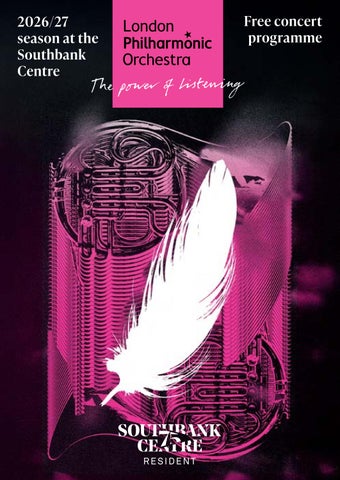
You can see how varied their visual interpretations of the music were from the artworks on this page and on the programme cover.
If you haven’t had the chance to see the artworks on billboards around London, you can view them all in detail on our website. You can also find out more about each of the artists and the processes they used, as well as listen to the music that inspired them.
Check out the artworks and the pieces that inspired them: lpo.org.uk/listening Artworks designed by (clockwise from top left) Megan Peng, Zengyue Zhao, CTZ, Yunqi Peng, Anna Korbel, Yejin Seo, Ishita Sharma, Ruwani Rajapakse
Principal Conductor Edward Gardner supported by Aud Jebsen Principal Guest Conductor Karina Canellakis supported by Richard Buxton Conductor Emeritus Vladimir Jurowski KBE Patron HRH The Duke of Kent KG Artistic Director Jesús Herrera Chief Executive David Burke Leader Pieter Schoeman supported by Neil Westreich
Southbank Centre’s Royal Festival Hall Wednesday 4 November 2026 | 7.30pm
Karina Canellakis conducts Beethoven Elgar Violin Concerto (45 mins) Interval (20 min)
Contents 2 Welcome 3 Tonight in 2 minutes 4 About us 5 Leader: Pieter Schoeman 6 On stage tonight 7 Karina Canellakis 8 Christian Tetzlaff 9 In Search of Purpose: Our 2026/27 season theme 10 Programme notes 17 Sound Futures donors 18 Thank you 20 LPO administration
Dai Fujikura Radiance (UK premiere)* (10 mins) Beethoven Symphony No. 5 (36 mins) Karina Canellakis conductor
Generously supported by Richard Buxton
Christian Tetzlaff violin * Co-commissioned by the London Philharmonic Orchestra, Thessaloniki State Symphony Orchestra, the 34th Music Biennale Zagreb, Tokyo Symphony Orchestra, Hiroshima Symphony Orchestra, Sendai Philharmonic Orchestra and NTR ZaterdagMatinee.
Approximate concert finish time: 9.45pm Please note the timings shown are given only as a guide.
This concert is being recorded for broadcast on BBC Radio 3 on Tuesday 19 January 2027 at 7.30pm. It will remain available for 30 days after that on BBC Sounds.
London Philharmonic Orchestra • 4 November 2026 • Karina Canellakis conducts Beethoven
Welcome
LPO news Behind the scenes with LPO Friends
Welcome to the Southbank Centre
Earlier today, Friends of the Orchestra enjoyed exclusive, behind-the-scenes access to a rehearsal with conductor Karina Canellakis and violinist Christian Tetzlaff ahead of tonight’s concert.
We’re the UK’s largest centre for the arts and one of the nation’s top five visitor attractions, showcasing the world’s most exciting artists at our venues in the heart of London. As a charity, we bring millions of people together by opening up the unique art spaces that we care for.
If you’d like to see for yourself what goes into preparing for a concert – plus enjoy a host of other amazing benefits, like a private bar space and meeting our musicians – join our family of Members today, from just £7 per month.
The Southbank Centre is made up of the Royal Festival Hall, Queen Elizabeth Hall, Purcell Room, Hayward Gallery, National Poetry Library and Arts Council Collection. We’re one of London’s favourite meeting spots, with lots of free events and places to relax, eat and shop next to the Thames.
Interested in finding out more? Scan the QR code or visit lpo.org.uk/membership
We hope you enjoy your visit. If you need any information or help, please ask a member of staff. You can also email hello@southbankcentre.co.uk or write to us at Southbank Centre, Belvedere Road, London SE1 8XX.
The Power of Listening Tonight’s work, Beethoven’s Symphony No. 5, was one of the pieces of music featured in our ‘The Power of Listening’ project this autumn. In an exciting collaboration with the Royal College of Art, eight postgraduate students were each given a different piece of music to listen to, chosen from our current concert season. They then created an original artwork in response – capturing the emotions, memories, thoughts and images the music sparked in them.
Subscribers to our email updates are the first to hear about new events, offers and competitions. Just head to our website to sign up.
The artworks were displayed throughout September at a sound gallery – a specially built installation featuring billboards with sets of headphones – at Vinegar Yard in London, as well as on the Tube network and around London.
Printed with the planet in mind This paper has been sourced from well-managed FSC®-certified forests, recycled materials, and other controlled sources. It is also Carbon Balanced, meaning the carbon impact of its production is offset by the World Land Trust.
See artist Anna Korbel’s artwork inspired by Beethoven’s Symphony No. 5 – ‘Escape in four movements’ – along with the other seven artworks and the stories behind them – at lpo.org.uk/listening
Prefer a paper-free option? Scan here for PDF versions of all our programmes to read or download on your phone or tablet.
Tonight’s programme cover Artwork by Royal College of Art student Yunqi Peng: ‘Heavy brass, lighter mind’. Designed while listening to Stravinsky’s The Firebird (Finale), performed by the LPO under Vladimir Jurowski. #thepoweroflistening
2
Tonight in 2 minutes
New to classical? Short on time? Your quick guide to tonight’s concert.
What to expect
The vibe
Karina Canellakis conducts Beethoven
Tonight we hear two landmark works that have become classics of the orchestral repertoire, as well as a brand new piece by London-based Japanese composer Dai Fujikura. The first piece in the programme, Elgar’s Violin Concerto, is expansive and lyrical. After the interval, Fujikura’s Radiance offers a brief, vivid change of colour. To finish, Beethoven’s famous Fifth Symphony takes us from its instantly recognisable opening to a thrilling, triumphant finale.
Take your seats... The players tune up their instruments, then the conductor, Karina, and soloist, Christian, come on stage. Once the applause dies down, sit back and enjoy the music ...
3
movements
45 mins
Who’s on stage?
Karina Canellakis: conductor
American conductor Karina Canellakis is the London Philharmonic Orchestra’s Principal Guest Conductor. She leads several concerts with the Orchestra each season, both here at the Royal Festival Hall and on tour. A former orchestral violinist with the Berlin Philharmonic, Karina has since built a stellar international conducting career.
Interval 20 min
1
movement
10 mins
Christian Tetzlaff: violin
Christian is the guest soloist in tonight’s first piece: Elgar’s Violin Concerto. One of today’s most admired violinists, he’s known for performances that combine intensity, thoughtfulness and a strong sense of individuality.
London Philharmonic Orchestra
Tonight there are over 70 London Philharmonic Orchestra musicians on stage. Our talented members represent over 14 different nationalities, and many of them enjoy busy solo, chamber and teaching careers alongside their orchestral roles. Turn to page 6 for tonight’s player list.
Edward Elgar Violin Concerto with soloist Christian Tetzlaff A concerto is a Longer classical showpiece for a solo pieces are often made up of instrument accompanied movements, or shorter by an orchestra. sections. Applause is usually saved for after Elgar, one of England’s the final movement. best-loved composers, filled his Violin Concerto with memorable melodies, Maybe an encore! from reflective moments to The soloist might energetic, technically play a little extra surprise piece, if demanding passages.
4
movements
36 mins
the applause is loud enough!
Dai Fujikura Radiance (UK premiere) This is only the second ever performance of Radiance, following its world premiere in Greece just days ago, and tonight the composer is here with us to hear it. Fujikura’s music draws on sound, texture and light to create an entirely new musical world. Ludwig van Beethoven Symphony No. 5 Beethoven’s Fifth Symphony is one of the most recognisable pieces of classical music, opening with four famous notes that return throughout the first movement. From its dramatic start, the music builds towards a triumphant finale, moving from darkness and tension to brightness and celebration.
At the end of the concert, we applaud the performers. The conductor will acknowledge the Leader (chief First Violin), Pieter, and might highlight other players for particular appreciation and applause. You’re welcome to take photos during the applause! Want to read more? Turn to page 10 for a deeper dive into tonight’s works.
London Philharmonic Orchestra • 4 November 2026 • Karina Canellakis conducts Beethoven
© Mark Allan
About us: London Philharmonic Orchestra
Connecting worldwide
Uniquely groundbreaking and exhilarating to watch and hear, since 1932 we’ve been recognised as one of the world’s leading orchestras, celebrated for our excellence, versatility, invention and inclusivity. Our mission is to create unrivalled orchestral experiences on stage and cultivate human connections beyond it. We achieve this through our exceptional live performances, pioneering education and community projects, acclaimed recordings, online activity and trailblazing international tours.
We’re one of the world’s most-streamed orchestras, with over 15 million plays of our content each month. We’re the most followed UK orchestra on Instagram, the most followed orchestra globally on TikTok, and the third most followed globally across all social platforms. Our 2024 Sky Arts documentary series, ‘Backstage with the London Philharmonic Orchestra’, was nominated for a 2025 BAFTA, and a second series, ‘Inside the Music’, will be broadcast this autumn.
Our home is here at the Southbank Centre’s Royal Festival Hall, where we’re at the beating heart of London’s cultural life. You can also hear us at our resident venues in Brighton, Eastbourne and Saffron Walden, and on tour worldwide. For over 60 years we’ve been Resident Symphony Orchestra at Glyndebourne Festival Opera, combining the magic of opera with Glyndebourne’s glorious setting in the Sussex countryside.
Our conductors Our Principal Conductors have included great historic names like Sir Adrian Boult, Bernard Haitink, Klaus Tennstedt and Kurt Masur. In 2021 Edward Gardner became our 13th Principal Conductor, and Vladimir Jurowski became Conductor Emeritus in recognition of his impact as Principal Conductor from 2007–21. Karina Canellakis is our current Principal Guest Conductor, and Sir George Benjamin is our Composer-in-Residence.
Life’s big moments Everyone will have heard the Grammy-nominated London Philharmonic Orchestra, whether it’s playing the world’s National Anthems for every medal ceremony of the London 2012 Olympics and Paralympics, our iconic recording with Pavarotti that made Nessun Dorma a global football anthem, or closing the flotilla at The Queen’s Thames Diamond Jubilee Pageant. And you’ll almost certainly have heard us on the soundtracks for major films including The Lord of the Rings.
Next generations We’re committed to nurturing the next generation of musicians and music-lovers: we love seeing the joy of children and families experiencing their first musical moments, and we’re passionate about inspiring schools and teachers through dedicated concerts, workshops, resources and training. Reflecting our values of collaboration and inclusivity, our OrchLab and
4
London Philharmonic Orchestra • 4 November 2026 • Karina Canellakis conducts Beethoven
Pieter Schoeman Leader
Today’s young instrumentalists are the orchestra members of the future, and we offer a range of opportunities to support their progression. Our LPO Junior Artists programme creates pathways into the profession for young players from under-represented backgrounds, and our LPO Young Composers and Future Firsts schemes support the next generation of professional musicians, bridging the transition from education to professional careers. The LPO Conducting Fellowship supports the development of outstanding early-career conductors from backgrounds underrepresented in the profession.
© Benjamin Ealovega
Open Sound Ensemble projects offer music-making opportunities for adults and young people with disabilities and special educational needs.
2026/27 season Our season theme, In Search of Purpose, explores the human spirit’s resilience and quest for meaning, inspired by Beethoven’s triumph over despair and the ways subsequent composers have used music as a vessel to confront life's big questions. Principal Conductor Edward Gardner returns with programmes including Britten’s War Requiem, Stravinsky’s The Firebird, and Composer-in-Residence George Benjamin’s opera Lessons in Love and Violence. We’ll also welcome back titled conductors Karina Canellakis and Vladimir Jurowski, as well as Chief Conductor & Artistic Advisor Designate Paavo Järvi.
Pieter Schoeman was appointed Leader of the London Philharmonic Orchestra in 2008, having previously been Co-Leader since 2002. He is also a Professor of Violin at Trinity Laban Conservatoire of Music & Dance. As well as at the Southbank Centre’s Royal Festival Hall, Pieter has performed worldwide as a soloist and recitalist at famous venues including the Amsterdam Concertgebouw, Moscow’s Rachmaninoff Hall, Capella Hall in St Petersburg, Staatsbibliothek in Berlin and Hollywood Bowl in Los Angeles. He has also appeared as Guest Leader with many leading orchestras across the world. As a chamber musician, he regularly appears at London’s prestigious Wigmore Hall. His chamber music partners have included Anne-Sophie Mutter, Veronika Eberle, Patricia Kopatchinskaja, Boris Garlitsky, Jean-Guihen Queyras, Yannick Nézet-Séguin, Martin Helmchen and Julia Fischer. Pieter has performed numerous times as a soloist with the London Philharmonic Orchestra. Highlights have included Vivaldi’s Four Seasons, the Brahms Double Concerto with Kristina Blaumane, Florence Price’s Violin Concerto No. 2, and the Britten Double Concerto with Alexander Zemtsov, which was released on the LPO Label to great critical acclaim.
Our lineup of soloists this season includes Alice Sara Ott, Patricia Kopatchinskaja, Hilary Hahn, Pekka Kuusisto, Renée Fleming and Mitsuko Uchida, and we join the London Philharmonic Choir in celebrating its 80th anniversary year with Fauré’s Requiem alongside a choral world premiere by Dame Judith Weir. The season concludes on 24 April with Elgar’s The Dream of Gerontius, again with the LPC. New music remains a core pillar this season, with further premieres by Mark Simpson, Jacob Mühlrad, Dai Fujikura and Kevin Puts.
Pieter’s chair in the London Philharmonic Orchestra is generously supported by Neil Westreich.
Video series: ‘Humans of the Orchestra’ Scan the QR code to watch our interview with Pieter
The season also sees tours to China, Spain, Germany, Belgium, the Netherlands and the Canary Islands, as well as performances and community events in our Brighton, Eastbourne and Saffron Walden residencies.
lpo.org.uk
5
London Philharmonic Orchestra • 4 November 2026 • Karina Canellakis conducts Beethoven
On stage tonight First Violins
Pieter Schoeman* Leader
Chair supported by Neil Westreich
Vesselin Gellev Sub-Leader Lasma Taimina
Chair supported by Irina Gofman & Mr Rodrik V. G. Cave
Minn Majoe
Chair supported by Dr Alex & Maria Chan
Cassandra Hamilton
Chair supported by Jenny Watson CBE
Katalin Varnagy Yang Zhang Izzy Howard Martin Höhmann
Chair supported by Hans-Wilhelm & Evelyn Jenckel
Nilufar Alimaksumova Thomas Eisner Sylvain Vasseur Tom Aldren Amanda Smith
Second Violins
Tania Mazzetti Principal
Chair supported by The Candide Trust
Emma Oldfield Co-Principal Claudia Tarrant-Matthews Chair supported by anonymous donors
Coco Inman Nynke Hijlkema Marie-Anne Mairesse Joseph Maher Sophie Phillips Ashley Stevens Sioni Williams Sarah Thornett Olivia Ziani
Violas
Oboes
Rebecca Chambers
Ian Hardwick* Principal Jack Tostevin-Hall
Guest Principal
Guillaume Leroy Melissa Dattas Laura Vallejo Benedetto Pollani Martin Wray
Clarinets
Benjamin Mellefont* Principal
Chair supported by Sir Nigel Boardman & Prof. Lynda Gratton
Chair supported by David & Bettina Harden
Thomas Watmough
Katharine Leek James Heron Michelle Bruil Alistair Scahill
Chair supported by Roger Greenwood
Bassoons
Roberto Giaccaglia
Cellos
Guest Principal
Henry Shapard Principal David Lale Francis Bucknall Heeyeon Cho Auriol Evans Tom Roff Helen Thomas Iain Ward
Lorna West
Tuba
Lee Tsarmaklis* Principal
Chair supported by William & Alex de Winton
Timpani
Simon Carrington* Principal
Chair supported by Victoria Robey CBE
* Professor at a London conservatoire
Assistant Conductor Shira Samuels-Shragg
Contrabassoon
Simon Estell* Principal
Horns
John Ryan* Principal Elise Campbell Mark Vines Co-Principal
Double Basses
Chair supported by Friends of the Orchestra
Kevin Rundell* Principal Sebastian Pennar*
Max Garrard
Co-Principal
George Peniston Tom Walley
Trumpets
Paul Beniston* Principal
Chair supported by William & Alex de Winton
Chair supported by the Williams family in memory of Grenville Williams
Lowri Estell Charlotte Kerbegian
Tom Nielsen* Principal Anne McAneney*
Flutes
Chair supported by anonymous donors
Juliette Bausor Principal Chair supported by Malcolm & Alison Thwaites
Trombones
Ian Mullin Stewart McIlwham*
David Whitehouse Principal Andrew Cole
Piccolo
Bass Trombone
Stewart McIlwham*
Lyndon Meredith Principal
Principal
Chair supported by The Thompson Family Charitable Trust
6
The LPO also acknowledges the following chair supporters whose players are not present at this concert: An anonymous donor David & Yi Buckley Gill & Garf Collins Dr Barry Grimaldi The Hodson family Sir Simon Robey Bianca & Stuart Roden Eric Tomsett Joe Topley & Tracey Countryman Louise Worthington
London Philharmonic Orchestra • 4 November 2026 • Karina Canellakis conducts Beethoven
Karina Canellakis Principal Guest Conductor, London Philharmonic Orchestra
Philharmonic; the Boston, Chicago and San Francisco Symphonies; the Los Angeles Philharmonic; and the Cleveland and Philadelphia orchestras. She was Principal Guest Conductor of the Berlin Radio Symphony Orchestra from 2019–23, and in 2023/24 was a featured Artist-in-Residence at Vienna’s Musikverein.
© Marco Borggreve
Last season, Karina made her Hamburg State Opera debut with a production of Bartók’s Bluebeard’s Castle and Zemlinsky’s A Florentine Tragedy. She conducts at least one opera-in-concert each season with the RFO at the Concertgebouw, featuring Debussy’s Pelléas et Mélisande in 2026/27. She made her critically acclaimed Santa Fe Opera debut in summer 2024 with Strauss’s Der Rosenkavalier, and conducted Poulenc’s Dialogues des Carmélites at the Théâtre des Champs-Elysées. With the RFO, Karina programmes an eclectic season of wide-ranging repertoire, conducting new commissions alongside great masterworks at Amsterdam’s Concertgebouw and TivoliVredenburg in Utrecht.
Karina Canellakis has been Principal Guest Conductor of the London Philharmonic Orchestra since 2021 and Chief Conductor of the Netherlands Radio Philharmonic Orchestra (RFO) since 2019. Acclaimed internationally for the interpretive depth and emotional impact of her performances, she is welcomed by the world’s finest musical institutions.
2023 saw the start of a multi-album collaboration between Karina, the Netherlands Radio Philharmonic and Pentatone, with their debut release, Bartók’s Concerto for Orchestra and Four Orchestral Pieces, earning a Grammy nomination. Her second album, Bartók’s Bluebeard’s Castle, was released in April 2025 to glowing international reviews, and was the winner of BBC Music Magazine’s 2026 Opera Award. A third album, pairing Rachmaninov’s The Bells and Symphonic Dances, was released to critical acclaim in June 2026.
This season, Karina leads three Royal Festival Hall concerts with the London Philharmonic Orchestra, showcasing the ‘explosive chemistry’ (The Times) that has become a hallmark of their partnership. Following tonight’s concert, she returns this Friday (6 November) to conduct Beethoven’s Piano Concerto No. 4 with Alice Sara Ott, alongside Mahler’s Symphony No. 1. On 27 January 2027, she returns for a programme featuring Mozart’s Violin Concerto No. 5 (‘Turkish’) with Hilary Hahn, and Brahms’s Symphony No. 1. This will be followed by concerts in Gran Canaria and Tenerife as part of the Canary Islands Music Festival.
October 2025 saw Karina’s first full album release on the LPO’s own label: a pairing of Tchaikovsky’s Fifth and Sixth Symphonies, recorded live in concert at the Royal Festival Hall (see page 16). A second release on the Label, Rachmaninov’s Symphony No. 2, is planned for early 2027.
Other highlights of Karina’s 2026/27 season include her debut at the Bavarian State Opera with Massenet’s Werther, as well as return engagements with the Royal Concertgebouw, Bavarian Radio Symphony, Chicago Symphony, San Francisco Symphony and Berlin Radio Symphony orchestras. She also makes her debuts with the Pittsburgh Symphony, Orchestre Philharmonique de Radio France and Gothenburg Symphony Orchestra.
Already known to many in the classical music world as a virtuoso violinist, Karina was encouraged to become a conductor by Sir Simon Rattle while playing as a violinist in the Berlin Philharmonic’s Karajan-Akademie. She performed for several years as soloist, guest leader and chamber musician, spending summers at the Marlboro Music Festival, until conducting eventually took over after she won the Sir Georg Solti Award in 2016.
Karina made her conducting debut with the Vienna Philharmonic at the Mozartwoche Salzburg in January 2026, and has developed close relationships with many of the world’s leading orchestras. She is a repeat guest with the top American orchestras such as the New York
Karina Canellakis’s position with the London Philharmonic Orchestra is generously supported by Richard Buxton.
7
London Philharmonic Orchestra • 4 November 2026 • Karina Canellakis conducts Beethoven
Christian Tetzlaff violin
© Giorgia Bertazzi
Christian made his first recording – Bartók’s Violin Concerto No. 2 – with the London Philharmonic Orchestra in 1992, and made his debut with the Berlin Philharmonic with the same work three years later. His most recent release on the Ondine label – the Elgar and Adès Violin Concertos with the BBC Philharmonic under John Storgårds – was awarded the 2026 Opus Klassik award for Instrumentalist of the Year. In addition to the 27 violin concertos he has recorded, Christian has made numerous recordings of solo and duo works, as well as chamber music with the Tetzlaff Quartet and the trio he founded with pianist Lars Vogt. His awards include the German Radio Critics’ Award, the Midem Classical Award, and several Diapason d’Or awards. Chamber music is integral to Christian Tetzlaff’s musical personality. In 1994 he founded the Tetzlaff Quartet with his sister, cellist Tanja Tetzlaff. The ensemble tours each season, and in 2026/27 performs in Vienna, Amsterdam and London. The Quartet was awarded a Diapason d’or l’année award in 2015 for their recording of Berg’s Lyric Suite and Mendelssohn’s String Quartet No. 1. Christian and Tanja Tetzlaff also perform regularly as a trio with pianist Kiveli Dörken.
With performances that reveal his individual approach to the emotional and structural depth of the music, German violinist Christian Tetzlaff is recognised for his naturally expressive and insightful interpretations. His wide-ranging repertoire extends from the muchloved concertos of Tchaikovsky, Beethoven, Mozart, Sibelius, Shostakovich, Bartók and Brahms to lesserknown concertos by Giovanni Battista Viotti, Joseph Joachim and György Ligeti, as well as contemporary works by Jörg Widmann and Thomas Adès. In 2023 he was named Artistic Director of the Spannungen Festival in Heimbach, Germany, which he continues in founder Lars Vogt’s memory.
As well as tonight’s concert with the London Philharmonic Orchestra, this season sees Christian return to the Berlin Philharmonic, Finnish Radio, Lucerne Festival, London Symphony and Montreal Symphony orchestras. As Artist-in-Residence with the Bergen Philharmonic Orchestra, he appears twice with the Bergen Philharmonic and once with the Bergen Youth Orchestra. Further highlights of the season include national premieres of Ondřej Adámek’s Violin Concerto No. 2 (Thin Ice) in London, Hamburg and Bergen, and horn trios with Kirill Gerstein and Stefan Dohr in Vienna and Hamburg.
Christian’s career took off in 1988, when the celebrated conductor Sergiu Celibidache invited him to perform with the Munich Philharmonic in Munich and Berlin. This led to his US debut with The Cleveland Orchestra under Christoph von Dohnányi. Since then, he has been in demand with major international orchestras including the Berlin, Vienna and New York Philharmonics, the Boston and Chicago Symphony Orchestras, the Royal Concertgebouw, and the London Symphony Orchestra. He is a regular guest of the London Philharmonic Orchestra: in 2023 he toured South Korea with the Orchestra and Edward Gardner, and and in 2024 he completed a European tour with the Orchestra, including in Vienna with Karina Canellakis.
Christian Tetzlaff performs on a violin made by Peter Greiner. He teaches at the Kronberg Academy, and lives in Berlin with his wife, photographer Giorgia Bertazzi, and their three children.
8
London Philharmonic Orchestra • 4 November 2026 • Karina Canellakis conducts Beethoven
In Search of Purpose At a moment of deep personal crisis in 1802, Ludwig van Beethoven confronted his hearing loss and questioned whether he could go on. In music, he found a way forward – and in doing so, transformed it into a powerful vehicle for human expression and resilience. From this journey, our 2026/27 season takes its title: ‘In Search of Purpose’. Throughout the season, we’ll trace Beethoven’s path from despair to hope, illustrated tonight in his Fifth Symphony, and across a cycle of his piano concertos. We’ll also explore his ongoing legacy, hearing from composers finding their purpose in the face of conflict, grief, oppression and life’s biggest questions.
Tonight’s works and our 2026/27 season theme
Tonight’s programme explores purpose in resilience. Beethoven’s Fifth Symphony remains one of music’s defining journeys from struggle towards triumph. Written as the composer confronted increasing deafness, it has become a symbol of perseverance and determination in the face of adversity. Dai Fujikura’s new work Radiance is directly shaped by Beethoven, using a transformed recording as a starting point before creating entirely new music that grows out of it. Throughout this evening, composers continue searching and creating, revealing resilience not as certainty or heroism, but as the courage to move forward.
Check out the full season:
lpo.org.uk/purpose
Jesús Herrera on Purpose Our Artistic Director on why he chose this season’s theme, and why context matters because it is fantastic, but to be as generous as we can in how we provide that context. Exploring themes that amplify the depth of the music and connect listeners to its essence is a challenge, in my opinion, undoubtedly worth taking on.’
‘While it’s true that many of the iconic works we are so fortunate to perform were written decades or often centuries ago, they all emerged from artists who were driven to express something fundamentally human. This means the inspiration within these compositions can reflect experiences just as close to anyone in today’s audience, regardless of their previous exposure to an orchestra.
Jesús’s full interview appeared in the latest issue of the LPO magazine, Tune In. Read it online here:
As custodians of this incredible legacy, I believe it is a beautiful duty not just to present this repertoire
9
London Philharmonic Orchestra • 4 November 2026 • Karina Canellakis conducts Beethoven
Programme notes Edward Elgar 1857–1934
Violin Concerto in B minor, Op. 61 1910
Christian Tetzlaff violin
1. Allegro 2. Andante 3. Allegro molto On 10 November 1910, Edward Elgar conducted the premiere of his Violin Concerto in London’s Queen’s Hall. The soloist, and dedicatee of the Concerto, was the great Austrian virtuoso Fritz Kreisler (1875–1962).
while the Elgar family were staying near Rome. Back at their home in Hereford, Lady (Alice) Elgar noted that her husband ‘was possessed with his music for the Violin Concerto’.
Dora Penny (the subject of ‘Variation X’ from Elgar’s Enigma Variations) recalled the occasion: ‘The place was simply packed. Kreisler came on looking white as a sheet – even for a player of his great experience it must have been a nervous moment – but he played superbly. E.E. was also, obviously, very strung up, but all went well and the ovation at the end was tremendous.’ Kreisler was unequivocal in his enthusiasm for the Concerto: ‘You have written an immortal work’, he told Elgar after spending some of the autumn of 1910 in the composer’s company.
Although he learnt the violin and for some time taught the instrument, Elgar was wise enough to seek advice about structure and fingering from W H (Billy) Reed, the leader of the London Symphony Orchestra. Kreisler, who attended the 1910 Gloucester Three Choirs Festival, met with Elgar and they went through the Concerto together before an invited audience. Reed, who was present, described the event as ‘a wonderful artistic experience’. Another witness wrote: ‘Kreisler stood, splendidly dignified as always, fiddle in hand. At one moment Kreisler would edge Elgar off the piano stool while he himself took the composer’s place, and, with a deprecatory remark: “Na, na, Edward”, and in an appeal to us the audience, would attempt to show the composer his idea of the right and proper manner in which the music should go. Of course Elgar would lift him from the piano stool laughingly and say: “Na, na Fritz, this is how I want it played”.’
Elgar had begun a violin concerto in the 1890s, but destroyed the sketches. It was after meeting Kreisler at the Leeds Festival in 1904 that he gave serious consideration to composing a concerto, and the following year Kreisler began to exert pressure through an interview in the Hereford Times: ‘If you want to know whom I consider to be the greatest living composer, I say without hesitation Elgar … I say this to please no one; it is my own conviction … I wish Elgar would write something for the violin. He could do so, and it would be certainly something effective’. However, The Kingdom (1906) and the First Symphony (1908) would come before Elgar settled down to the serious business of composing the Violin Concerto in the spring of 1909,
One of the inspirations behind the Concerto was Mrs Alice Stuart-Wortley, daughter of the painter Sir John Everett Millais. A close relationship had developed between the Elgars and the Stuart-Wortleys, and Elgar had nicknamed Alice ‘Windflower’ after the white anemone nemerosa, a flower that meant much to them. Elgar would refer in correspondence with this
10
London Philharmonic Orchestra • 4 November 2026 • Karina Canellakis conducts Beethoven
Programme notes ‘other’ Alice to the themes in the Concerto as ‘Windflower’. At the head of the score, Elgar quotes, in Spanish, from the novel Gil Blas by the 17th-century French novelist Alain-René Lesage, the following: ‘Aqui está encerrada el alma de . . . . .’ (Herein is enshrined the soul of . . . . .’). The five dots, as Elgar made clear, stood for a woman’s name. The Concerto opens with a substantial orchestral passage that introduces the movement’s main themes, before a single horn heralds the entrance of the violin. Soloist and orchestra explore the material before a beguiling new theme follows, surely a statement of Elgar’s feelings for his ‘Windflower’. Elgar then develops the material, his mastery complete, as the soloist rhapsodises on the various themes. As the movement builds towards its return to the opening music, the intensity increases, the dialogue between the violin and orchestra becoming more complex before the final bars. The second movement begins quietly, with the orchestra introducing its main theme. The violin introduces a new idea and, as the movement develops, the soloist is ‘enshrined’ in music of subtle nobility. It is also a world of great intimacy, the listener seeming to intrude, before the movement ends with soloist and orchestra communing together in a hushed reverie. Elgar once said of the ending of the Andante: ‘This is where two souls merge and melt into one another.’ In the third movement, the violin leaps away in rising passages before the orchestra states the principal Vivace (‘lively’) theme. Elgar moves from the virtuosic to the lyrical almost from bar to bar, but a change to Allegro (marked ‘nobilmente’) settles the music before arriving at the key of B major and a theme from the Andante. Then the soloist embarks on the most original part of the Concerto, the accompanied cadenza (virtuosic solo passage) and its pizzicato tremolando: Elgar asks the stringed instruments of the orchestra to be ‘thrummed’ with the soft part of three or four fingers across the strings. Material from previous movements is considered by the violin and orchestra before a coda leads to the Concerto’s triumphant ending.
Yehudi Menuhin and Edward Elgar at Abbey Road Studios before the 16-year-old violinist began recording the Concerto on 14 July 1932. On 20 November that year, Menuhin performed the work with the newly formed London Philharmonic Orchestra at the Royal Albert Hall, with Elgar conducting.
Programme note © Andrew Neill
Interval – 20 minutes An announcement will be made five minutes before the end of the interval.
11
London Philharmonic Orchestra • 4 November 2026 • Karina Canellakis conducts Beethoven
Programme notes Dai Fujikura born 1977
Radiance
2026 (UK premiere)
Radiance received its world premiere last Saturday, 31 October, in Thessaloniki, Greece, performed by the Thessaloniki State Symphony Orchestra under Kornilios Michailidis. On the origins of the piece, the composer recalls: ‘I was invited to write an orchestral work on the scale of a Beethoven symphony, with the request that it might, in some way, “echo” Beethoven’s world. My first instinct was research: I began reading Beethoven’s letters. Coming straight from completing my opera The Great Wave – rooted in the life of Hokusai – the contrast was striking. Hokusai, as I came to know him through that work, embodied forward motion: resilient, pragmatic and relentlessly optimistic, always swimming against the current. Beethoven’s letters, by comparison, often felt dark, burdened, even depressive. Perhaps this is part of the enduring European image of the “genius artist” – I’m not sure.
© Taichi Nishimaki
In any case, the letters did not spark the piece I needed to write. And I also knew I did not want to borrow Beethoven’s musical material. For me, composing is about building a utopia I would like to live in – one that listeners are welcome to visit. I don’t need to import existing furniture from someone else’s house. Instead, I found an approach that allowed Beethoven to be present as a catalyst, not as quotation. I took a recording of a single movement from a Beethoven symphony (I will not say which), and stretched it to around five times its original length, transforming it into a slow, heavy, low-frequency landscape. I then began composing my own music directly “on top” of that sound. Once the composition had found its direction, I removed the stretched recording entirely – leaving only what I had written, and developing the piece from there. As a result, the score contains no Beethoven themes, no Beethoven harmonies and no Beethoven pitches: what remains is my music, shaped by the shadow-process that generated it.
Co-commissioned by the London Philharmonic Orchestra, Thessaloniki State Symphony Orchestra, the 34th Music Biennale Zagreb, Tokyo Symphony Orchestra, Hiroshima Symphony Orchestra, Sendai Philharmonic Orchestra and NTR ZaterdagMatinee.
12
London Philharmonic Orchestra • 4 November 2026 • Karina Canellakis conducts Beethoven
Programme notes The work begins in a high register – as if light appears first – suggesting, by contrast, the low, weighty terrain of the stretched source that is no longer audible.
The title reflects that emergence: brightness not as decoration, but as something that rises out of pressure and gravity, once the source has been taken away.’
Radiance is a title that points to the piece’s core sensation: a kind of light that appears first – high, clear and weightless – while its origin lies in a slow, heavy, low-frequency “shadow”.
Dai Fujikura, 2026
Composer profile: Dai Fujikura The chief characteristics of his music include frank expressive immediacy, whether voiced by texture (often interacting textures) or by melody, as well as a sure handling of instruments, alone or in combination, and wide-ranging references, especially to nature and science.
Born in Osaka, Dai Fujikura came to England when he was 15 and has remained in this country ever since. After leaving Dover College, he studied at Trinity College of Music with Daryl Runswick, at first with the intention of becoming a film composer, though exposure to the works of Boulez, Ligeti and Takemitsu changed his mind. A first encounter with Japanese instruments, at Darmstadt in 1997, was also important. He then completed his training with Edwin Roxburgh at the Royal College of Music and with Sir George Benjamin at King’s College, London.
Major works include Solaris, an opera after Stanisław Lem’s novel, using IRCAM resources. This was first performed in Paris in 2015 and has had further productions, making it one of the most widely presented of recent operas. A Dream of Armageddon, after the short story by H.G. Wells, had its premiere in Tokyo in 2020.
While still a student, he began to make a mark, notably with Fifth Station (2003–4), the first of several pieces for musicians positioned in different parts of the hall, and a work showing his dramatic command of instrumental gesture and texture. It was performed by the London Sinfonietta in 2004, and led to important commissions: from the Lucerne Festival (Stream State, 2005, conducted by Boulez), the Donaueschingen Festival (Vast Ocean, a trombone concerto with electronics, 2005) and the BBC Proms (Crushing Twister, 2006).
Always responding with vim to the challenge of writing for soloists who match his energy, Fujikura has produced four piano concertos and others for flute, bassoon, horn, tuba, viola, cello and double bass. He has also featured less regular soloists (recorder, rock guitar) and, recently, players on Japanese instruments (shakuhachi, shamisen, koto). Scores for films (Listen to the Universe), television and radio need to be mentioned, and a book (in Japanese) whose title carries a nice irony in the light of his packed creative life: Too Early for an Autobiography.
Identifiable neither as British nor as Japanese, Fujikura has created his own context with his output of almost two hundred works, many of them on a large scale.
Composer profile © Paul Griffiths
13
London Philharmonic Orchestra • 4 November 2026 • Karina Canellakis conducts Beethoven
Programme notes Ludwig van Beethoven 1770–1827
Symphony No. 5 in C minor, Op. 67 1808
1. Allegro con brio 2. Andante con moto 3. Scherzo: Allegro – 4. Allegro that it sounds in any way like Haydn. The music here is astonishingly terse, pared down to the melodic minimum, and the second theme, a relaxed horn-call expansion of the main motif answered by a reassuring embrace from the violins and woodwind, is quickly upon us. Yet it is this consolatory theme which, after a combative development section, reappears in swirling, nightmarish transformation in the movement’s long and turbulent coda.
Whatever the Fifth Symphony was to its earliest audiences, it was not comfortable. Those who took their seats in Vienna’s Theater an der Wien on 22 December 1808 for the concert at which the work was first performed would doubtless have had some idea what to expect. Anyone who had already heard the ‘Eroica’, or indeed the ‘Pastoral’ Symphony, which was also premiered earlier in the same concert, would have known that Beethoven had greatly expanded the timescale of the symphonic form, raised its level of seriousness and expressive weight, and brought to it an increasingly theatrical, even narrative strain. But few can have been prepared for the brusque, almost visceral assault this unique work was to make on their senses.
There is more than a hint of Haydn’s influence, too, in the slow second movement, which has the overall shape of one of his favourite forms, the ‘double variation set’ in which two themes are varied in alternation. The second of Beethoven’s themes provides occasional brief foretastes of the exultant mood of the finale, but at the end of this particular movement it is the more graceful first theme that wins the day.
Where did it come from? Well, Beethoven was a revolutionary of course, but he was one who worked within an established tradition, and who was subject to his fair share of influences. Several of these come together in the Fifth Symphony. One was Mozart, with whom he shared a special feeling for the expressive power of the key of C minor; another was the largescale, open-heartedly bombastic music composed for the public celebrations of Revolutionary France; and a third was Haydn, his teacher, who time and time again had shown in his string quartets and symphonies how to construct whole movements from small but richly suggestive thematic cells.
As in the Fourth Symphony, Beethoven did not call the third movement a scherzo, though in form and function it is one. If there is humour here, however, it is of a grim cast and beset by uncertainty. When a sturdier theme emerges, it is brief and troubled, dominated by a balefully intoned horn-call transformation of the fournote motif from the first movement. The mood lightens in the scurryingly fugal major-key ‘trio’ section (heard twice), but at its second reappearance the first theme, played pizzicato and pianissimo, takes on a stealthy, nocturnal character, before leading us to the most celebrated passage in the whole Symphony. Here, over held string notes and sinister tappings from the timpani,
This last influence is undoubtedly at its most potent in the highly dramatic first movement, totally dominated as it is by its famous four-note opening motif. Not
14
London Philharmonic Orchestra • 4 November 2026 • Karina Canellakis conducts Beethoven
Programme notes wisps of the first theme are heard, leading us for the moment we know not where. Gradually the excitement rises, until with a last sudden rush we find ourselves propelled into the blazingly triumphant C major of the finale. It is one of the most upliftingly theatrical moments in all music, and the unequivocal joyfulness of the ensuing movement (almost unremittingly loud, by the way, and reinforced for the purpose by Beethoven with trombones, piccolo and double bassoon) is not even diverted by the brief, perhaps mocking reapparance about halfway through of the third movement’s main theme, now gloriously overcome.
Video: Karina Canellakis on Beethoven’s Fifth Symphony Scan the QR code to watch the interview
Whether one feels the Fifth Symphony as a journey from darkness to light, a depiction of adversity overcome, or as an emergence from some sort of underworld, there is no doubt that it has an effect on the listener that goes beyond the appreciation of its musical and formal niceties. Beethoven himself has left little clue as to what the Symphony is ‘about’, save for a possibly apocryphal remark to a friend about the first movement: ‘thus Fate knocks at the door’. Yet we know that he thought of many of his instrumental works in programmatic terms; whether or not we as listeners can guess them correctly, the fact that in his greatest symphonies we can sense them so strongly is proof of his success.
We’d love to hear from you We hope you enjoy tonight’s concert. Could you spare a few moments afterwards to complete a short survey about your experience? Your feedback will help to shape our future plans.
Programme note © Lindsay Kemp
Just scan the QR code to begin. Thank you!
More with Karina Canellakis this season Friday 6 November 2026
Wednesday 27 January 2027
Beethoven Piano Concerto No. 4 Mahler Symphony No. 1 (including ‘Blumine’)
R Schumann Julius Caesar Overture Mozart Violin Concerto No. 5, K219 (Turkish) Brahms Symphony No. 1
Karina Canellakis conductor Alice Sara Ott piano
lpo.org.uk
15
Karina Canellakis conductor Hilary Hahn violin
On the LPO Label: Karina Canellakis conducts Tchaikovsky Tchaikovsky Symphonies No. 5 & 6 Karina Canellakis conductor London Philharmonic Orchestra Recorded live in concert at the Royal Festival Hall LPO-0137 Scan to listen now or find out more
‘The decision to appoint Canellakis was a stroke of genius on the LPO’s part – her rapport with the Orchestra grows stronger with every collaboration.’
Music OMH ★★★★★
R3_adventures2_150x105mm_grey.pdf
C
M
Y
CM
MY
CY
CMY
K
1
29/07/2025
08:59
London Philharmonic Orchestra • 4 November 2026 • Karina Canellakis conducts Beethoven
Sound Futures donors We are grateful to the following donors for their generous contributions to our Sound Futures campaign. Thanks to their support, we successfully raised £1 million by 30 April 2015 which has now been matched pound for pound by Arts Council England through a Catalyst Endowment grant. This has enabled us to create a £2 million endowment fund supporting special artistic projects, creative programming and education work with key venue partners including our Southbank Centre home. Supporters listed below donated £500 or over. For a full list of those who have given to this campaign please visit lpo.org.uk/soundfutures.
Masur Circle Arts Council England Dunard Fund Victoria Robey CBE Emmanuel & Barrie Roman The Underwood Trust
Welser-Möst Circle William & Alex de Winton John Ireland Charitable Trust The Tsukanov Family Foundation Neil Westreich
Tennstedt Circle Valentina & Dmitry Aksenov Richard Buxton The Candide Trust Michael & Elena Kroupeev Kirby Laing Foundation Mr & Mrs Makharinsky Alexey & Anastasia Reznikovich Sir Simon Robey Bianca & Stuart Roden Simon & Vero Turner The late Mr K Twyman
Solti Patrons Ageas John & Manon Antoniazzi Gabor Beyer, through BTO Management Consulting AG Jon Claydon Mrs Mina Goodman & Miss Suzanne Goodman Roddy & April Gow The Jeniffer & Jonathan Harris Charitable Trust Mr James R.D. Korner OBE Christoph Ladanyi & Dr Sophia Ladanyi-Czernin Robert Markwick & Kasia Robinski The Maurice Marks Charitable Trust
Mr Paris Natar The Rothschild Foundation Tom & Phillis Sharpe The Viney Family
Haitink Patrons Mark & Elizabeth Adams Dr Christopher Aldren Mrs Pauline Baumgartner Lady Jane Berrill Mr Frederick Brittenden David & Yi Yao Buckley Mr Clive Butler Gill & Garf Collins Mr John H Cook Mr Alistair Corbett Bruno De Kegel Georgy Djaparidze David Ellen Christopher Fraser OBE David & Victoria Graham Fuller Goldman Sachs International Mr Gavin Graham Moya Greene Mrs Dorothy Hambleton Tony & Susie Hayes Malcolm Herring Catherine Høgel & Ben Mardle Mrs Philip Kan Rehmet Kassim-Lakha de Morixe Rose & Dudley Leigh Lady Roslyn Marion Lyons Miss Jeanette Martin Duncan Matthews KC Diana & Allan Morgenthau Charitable Trust Dr Karen Morton Mr Roger Phillimore Ruth Rattenbury The Reed Foundation The Rind Foundation Sir Bernard Rix David Ross & Line Forestier (Canada)
17
Carolina & Martin Schwab Dr Brian Smith Lady Valerie Solti Mr & Mrs G Stein Dr Peter Stephenson Miss Anne Stoddart TFS Loans Limited Marina Vaizey Jenny Watson Guy & Utti Whittaker
Pritchard Donors Ralph & Elizabeth Aldwinckle Mrs Arlene Beare Mr Patrick & Mrs Joan Benner Mr Conrad Blakey Dr Anthony Buckland Paul Collins Alastair Crawford Mr Derek B. Gray Mr Roger Greenwood The HA.SH Foundation Darren & Jennifer Holmes Honeymead Arts Trust Mr Geoffrey Kirkham Drs Frank & Gek Lim Peter Mace Mr & Mrs David Malpas Dr David McGibney Michael & Patricia McLaren-Turner Mr & Mrs Andrew Neill Mr Christopher Querée The Rosalyn & Nicholas Springer Charitable Trust Timothy Walker CBE AM Christopher Williams Peter Wilson Smith Mr Anthony Yolland and all other donors who wish to remain anonymous
London Philharmonic Orchestra • 4 November 2026 • Karina Canellakis conducts Beethoven
Thank you As a registered charity, we are extremely grateful to all our supporters who have given generously to the LPO over the past year to help maintain the breadth and depth of the LPO’s activities, as well as supporting the Orchestra both on and off the concert platform.
Artistic Director’s Circle The American Friends of the London Philharmonic Orchestra William & Alex de Winton Catherine Høgel & Ben Mardle Aud Jebsen Sir Simon & Lady Robey CBE
Orchestra Circle
Anonymous donors Geoff Andrew & Family Richard Buxton Irina Gofman & Mr Rodrik V. G. Cave The Hodson Family Mr & Mrs Philip Kan Neil Westreich
Principal Associates
Steven M. Berzin Shashank Bhagat Sir Nigel Boardman & Prof. Lynda Gratton George Ramishvili The Tsukanov Family
Associates
Anonymous donors Garf & Gill Collins Michelle Crowe Hernandez & Christian Hernandez Barry Grimaldi Malcolm Herring Stuart & Bianca Roden The Thompson Family Charitable Trust Malcolm & Alison Thwaites Joe Topley & Tracey Countryman The Williams family in memory of Grenville Williams
Gold Patrons
David & Yi Buckley Dr Alex & Maria Chan Jane Coulson Nadia Crandall John & Sam Dawson Nadya Eropkina Fiona Espenhahn in memory of Peter Mr Roger Greenwood David & Bettina Harden
Anonymous donors Yibo Bao Mrs Amna Boheim Basil Demeroutis & Natasha Trevitt Mr Luke Gardiner The Jeniffer & Jonathan Harris Charitable Trust Tom & Phillis Sharpe
Elizabeth Meshkvicheva Andrew T Mills Mr & Mrs Andrew Neill Jamie Njoku-Goodwin John Nickson & Simon Rew Mikhail Noskov & Vasilina Bindley Mr Stephen Olton Andrew & Cindy Peck Mr Roger Phillimore Nigel Phipps & Amanda McDowall Mr Michael Posen Marie Power Neil & Karen Reynolds Sir Bernard Rix Mr Robert Ross Sir Charles Roxburgh KCB Baroness Shackleton John & Madeleine Tucker Mr & Mrs John & Susi Underwood Laurence Watt Joanna Williams Hannah Young
Bronze Patrons
Principal Supporters
Hans-Wilhelm & Evelyn Jenckel John & Angela Kessler Vladimir Kuznetsov Peter & Lucy Noble Simon & Lucy OwenJohnstone Irene Rosner David Julian & Gill Simmonds Eric Tomsett The Viney Family Jenny Watson CBE Guy & Utti Whittaker Louise Worthington
Silver Patrons
Anonymous donors Nicholas Berwin Dame Colette Bowe Mr Bernard Bradbury Simon Burke & Rupert King Desmond & Ruth Cecil Mr John H Cook Andrew Davenport Deborah Dolce Cameron & Kathryn Doley Harron Ellenson & Charles Miller Smith Ulrike & Benno Engelmann Charles Fulton Gini Gabbertas Igor & Lyuba Galkin Dr Emily Gardner Jenny & Duncan Goldie-Scot Mr Daniel Goldstein David & Jane Gosman Mr Gavin Graham Mrs Dorothy Hambleton Eugene & Allison Hayes Mr & Mrs Ralph Kanza Rose & Dudley Leigh Drs Frank & Gek Lim Graham Long Sofiya Machulskaya James Maxey-Branch
Anonymous donors David Aird Dr M. Arevuo Julian & Annette Armstrong Roger & Clare Barron Mr Geoffrey Bateman Mrs A Beare Mateusz Bek Mr Alistair Corbett Mr David Edgecombe Sir Timothy Fancourt Jonathan Franklin Professor Erol & Mrs Deniz Gelenbe Steve & Cristina Goldring Prof Emeritus John Gruzelier Iain & Alicia Hasnip Nick Hely-Hutchinson Mr Peter Imhof Bruce & Joanna Jenkyn-Jones Per Jonsson Alexandra Jupin & John Bean Mr Ian Kapur Gee Lee Sir Nicholas & Lady Lyons Mr Nikita Mishin Simon Moore Mrs Terry Neale Mr James Pickford
18
Mr Andrea Santacroce & Olivia Veillet-Lavallée Erika & Edward Song Mr & Mrs G Stein Andrew & Rosemary Tusa Mr Wolf-Christian Ulrich Ben Valentin KC Mr Rodney Whittaker Christopher Williams
Supporters
Anonymous donors Ralph & Elizabeth Aldwinckle Mr John D Barnard David Burke & Valerie Graham Mr Julien Chilcott-Monk Alison Clarke & Leo Pilkington Miss Tessa Cowie Will Gold Ray Harsant Dr Joan Hester The Jackman Family Mr David MacFarlane Dame Jane Newell DBE Michael Noyce Oliver & Josie Ogg Mr & Mrs Graham & Jean Pugh Tony & Hilary Vines Dr June Wakefield Mr R Watts Mr John Weekes Mr C D Yates
Hon. Benefactor Elliott Bernerd
Hon. Life Members
Alfonso Aijón Dame Carol Colburn Grigor DBE Robert Hill Keith Millar Victoria Robey CBE Mrs Jackie Rosenfeld OBE Cornelia Schmid Timothy Walker CBE AM Laurence Watt
London Philharmonic Orchestra • 4 November 2026 • Karina Canellakis conducts Beethoven
Thank you
a
b
LPO Ensemble Members
We are grateful to individuals who chose to leave the Orchestra a gift in their Will: In memory of Paul Morgan In memory of Donald Pelmear In memory of Rita Reay In memory of Peter J Watson In memory of Nicola Goodman In memory of Kenneth Shaw In memory of Allner Mavis Channing In memory of Peter Coe In memory of Doris Tylee
LPO Corporate Members Bloomberg Carter-Ruck Solicitors French Chamber of Commerce German-British Chamber of Industry & Commerce Lazard Natixis Corporate & Investment Banking Walpole
Preferred Partners Amazon Web Services Google Lay & Wheeler Lindt & Sprüngli Mayer Brown Steinway & Sons Welbeck
Trusts and Foundations
ABO Trust Adam Mickiewicz Institute Art Mentor Foundation Lucerne Candide Trust Cockayne – Grants for the Arts David Solomons Charitable Trust Dunard Fund Foyle Foundation Garfield Weston Foundation The Baily Thomas Charitable Fund The Golsoncott Foundation Jerwood Foundation John Thaw Foundation John Horniman's Children's Trusts The Ian Askew Charitable Trust Idlewild Trust Kirby Laing Foundation The Lennox Hannay Charitable Trust
Trusts and Foundations
Lord and Lady Lurgan Trust Lucille Graham Trust The Marchus Trust Margaret Killbury Foundation Maria Björnson Memorial Fund The 29th May 1961 Charitable Trust PRS Foundation The Radcliffe Trust Rivers Foundation Rothschild Foundation Scops Arts Trust Sir William Boreman's Foundation The John S Cohen Foundation TIOC Foundation UK Friends of the Felix Mendelssohn Bartholdy Foundation Vaughan Williams Foundation The Risman Foundation The Viney Family The Barbara Whatmore Charitable Trust and others who wish to remain anonymous.
c
Principal Partners
a
Principal Supporter b
c
Board of the American Friends of the LPO
Major Supporters
Logo strip. Where the logo appears on a blue strip of pantone 293, there m top of strip to top of logo and bottom of logo to bottom of strip. Artwork h
We are grateful to the Board of the American Friends of the London Philharmonic Orchestra, who assist with fundraising for our activities in the United States of America:
Company Title set in Aldine 721 Lt BT
Corporate Sponsors
Hannah Young Chair Lora Aroyo Jon Carter Alexandra Jupin Natalie Pray MBE Dr Irene Rosner David Marc Wassermann Dr Catherine C. Høgel Hon. Director
Principal Partner
OrchLab Project Partner
LPO International Board of Governors
Principal Supporter
Natasha Tsukanova Chair Steven M. Berzin Shashank Bhagat Irina Gofman Olivia Ma George Ramishvili Florian Wunderlich
Major Supporter
19
London Philharmonic Orchestra • 4 November 2026 • Karina Canellakis conducts Beethoven
London Philharmonic Orchestra Administration Board of Directors
New Generation Board
Finance
Dr Catherine C. Høgel Chair Sir Nigel Boardman Vice-Chair Mark Vines* President Kate Birchall* Vice-President Emily Benn David Buckley David Burke Simon Burke Simon Carrington* Michelle Crowe Hernandez Deborah Dolce Simon Estell* Fiona Gordon Jesús Herrera Minn Majoe* Jamie Njoku-Goodwin OBE Julian Simmonds Claudia Tarrant-Matthews* Neil Westreich David Whitehouse* *Player-Director
Ellie Ajao Peter De Souza Vivek Haria Rianna Henriques Zerlina Vulliamy
Frances Slack Finance Director
Advisory Council Roger Barron Chairman Christopher Aldren Kate Birchall Amna Boheim Richard Brass Helen Brocklebank YolanDa Brown OBE Sao Bui-Van David Burke Simon Callow CBE Desmond Cecil CMG Jane Coulson Andrew Davenport Guillaume Descottes Cameron Doley Lena Fankhauser Christopher Fraser OBE Jenny Goldie-Scot Jonathan Harris CBE FRICS Nick Hely-Hutchinson DL Jesús Herrera Dr Catherine C. Høgel Martin Höhmann Tanya Joseph Jamie Korner OBE Julianne Lee Andrew Neill Nadya Powell Sir Bernard Rix Victoria Robey CBE Baroness Shackleton Thomas Sharpe KC Daisuke Tsuchiya Mark Vines Chris Viney Laurence Watt Elizabeth Winter
Dayse Guilherme Finance Manager Jean-Paul Ramotar IT Manager & Finance Officer
General Administration Jesús Herrera Artistic Director
Education & Community
David Burke Chief Executive Monica Rutherford PA to the Executive & Office Manager
Talia Lash Education & Community Director Lowri Thomas Alex Tighe Education & Community Project Managers
Concert Management Roanna Gibson Concerts & Planning Director Graham Wood Concerts & Recordings Manager Madeleine Ridout Glyndebourne & Projects Manager Natasha Sofla Tours Manager Alice Drury Tours & Projects Co-ordinator Alison Jones Concerts & Artists Co-ordinator Nicola Stevenson Concerts & Recordings Co-ordinator Matthew Freeman Recordings Consultant Andrew Chenery Orchestra Personnel Manager Helen Phipps Orchestra & Auditions Manager Martin Sargeson Librarian
Jonathan Lockwood Transport Manager Gabrielle Slack-Smith Deputy Stage Manager
20
Sophie Lonergan Senior Marketing Manager (maternity leave) Katie Vickers Senior Marketing Manager (maternity cover) Georgie Blyth Press & PR Manager Josh Clark Data, Insights & CRM Manager Greg Felton Digital Creative Isobel Jones Marketing Manager
Claudia Clarkson Regional Partnerships Manager
Rachel Williams Publications Manager
Maria Ribalaygua Sales & Ticketing Manager
Development
Lia Kingdon Digital & Social Media Co-ordinator
Laura Willis Development Director
Cara Liddiard Marketing Assistant
Rosie Morden Senior Development Manager
Archives
Eleanor Conroy Development Events Manager
Philip Stuart Discographer
Zsuzsanna Deák Major Donor Manager
Gillian Pole Recordings Archive
Owen Mortimer Corporate Relations Manager
Professional Services
Anna Quillin Trusts & Foundations Manager
Charles Russell Speechlys Solicitors
Holly Eagles Development Co-ordinator
Crowe Clark Whitehill LLP Auditors
Faye Jones Development Assistant
Dr Barry Grimaldi Honorary Doctor
Kirstin Peltonen Development Associate
Patrick McEntee Stage & Operations Manager
Louise Williams Marketing & Communications Director
Lily Nattrass Education & Community Co-ordinator
Nick Jackman Campaigns & Projects Director
Sydney Minor Assistant Librarian
Marketing & Communications
Mr Chris Aldren Honorary ENT Surgeon Mr Simon Owen-Johnstone Hon. Orthopaedic Surgeon London Philharmonic Orchestra, 89 Albert Embankment, London SE1 7TP Tel: 020 7840 4200 Box Office: 020 7840 4242 Email: admin@lpo.org.uk lpo.org.uk Printer John Good Ltd
Love the LPO? Take it home with you!
LPO merchandise on sale at selected Royal Festival Hall concerts. Find us in the Level 2 Foyer, next to the Welcome Desk.
Or browse and order online at shop.lpo.org.uk
DISCOVER DISCOVER With 170 years of history, Lay & Wheeler are here to support you through every step of your fine wine journey. laywheeler.com/discover
WINE
FINE
99524 LH Lindt LPO Excellence Advert Update v2.pdf
1
14/08/2024
11:50
Discover Excellence, Expect Delicious. In partnership with