57685 LPO 9 Feb 2011_57685 LPO 9 Feb 2011 02/02/2011 13:07 Page 1
Principal Conductor VLADIMIR JUROWSKI Principal Guest Conductor YANNICK NÉZET-SÉGUIN Leader PIETER SCHOEMAN Composer in Residence JULIAN ANDERSON Patron HRH THE DUKE OF KENT KG Chief Executive and Artistic Director TIMOTHY WALKER
AM†
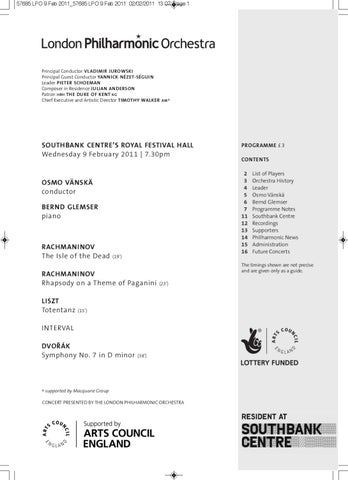
SOUTHBANK CENTRE’S ROYAL FESTIVAL HALL Wednesday 9 February 2011 | 7.30pm
BERND GLEMSER piano
(19’)
RACHMANINOV Rhapsody on a Theme of Paganini LISZT Totentanz
(23’)
INTERVAL
†
List of Players Orchestra History Leader Osmo Vänskä Bernd Glemser Programme Notes Southbank Centre Recordings Supporters Philharmonic News Administration Future Concerts
The timings shown are not precise and are given only as a guide.
(15’)
DVOŘÁK Symphony No. 7 in D minor
CONTENTS 2 3 4 5 6 7 11 12 13 14 15 16
OSMO VÄNSKÄ conductor
RACHMANINOV The Isle of the Dead
PROGRAMME £3
(38’)
supported by Macquarie Group
CONCERT PRESENTED BY THE LONDON PHILHARMONIC ORCHESTRA
57685 LPO 9 Feb 2011_57685 LPO 9 Feb 2011 02/02/2011 13:07 Page 2
LONDON PHILHARMONIC ORCHESTRA
FIRST VIOLINS Pieter Schoeman* Leader Vesselin Gellev Sub-Leader Chair supported by John and Angela Kessler
Helena Smart Katalin Varnagy Catherine Craig Thomas Eisner Tina Gruenberg Martin Hรถhmann Chair supported by Richard Karl Goeltz
Geoffrey Lynn Robert Pool Sarah Streatfeild Yang Zhang Rebecca Shorrock Peter Nall Galina Tanney Joanne Chen SECOND VIOLINS Clare Duckworth Principal Chair supported by Richard and Victoria Sharp
Jeongmin Kim Joseph Maher Kate Birchall Chair supported by David and Victoria Graham Fuller
Nancy Elan Fiona Higham Nynke Hijlkema Marie-Anne Mairesse Ashley Stevens Andrew Thurgood Dean Williamson Sioni Williams Peter Graham Stephen Stewart
VIOLAS Gillianne Haddow Guest Principal Robert Duncan Katharine Leek Susanne Martens Benedetto Pollani Emmanuella Reiter-Bootiman Laura Vallejo Daniel Cornford Sarah Malcolm Naomi Holt Isabel Pereira Miranda Davis CELLOS Susanne Beer Principal Francis Bucknall Laura Donoghue Santiago Sabino Carvalho + Gregory Walmsley Sue Sutherley Susanna Riddell Tom Roff Helen Rathbone Rosie Banks DOUBLE BASSES Tim Gibbs Principal Laurence Lovelle George Peniston Richard Lewis Roger Linley Kenneth Knussen Helen Rowlands Louis Garson
FLUTES Sue Thomas* Principal Joanna Marsh Stewart McIlwham*
TRUMPETS Nicholas Betts Principal Anne McAneney*
PICCOLO Stewart McIlwham* Principal
Daniel Newell
OBOES Ian Hardwick Principal Angela Tennick COR ANGLAIS Sue Bohling Principal Chair supported by Julian and Gill Simmonds
CLARINETS Robert Hill* Principal Emily Meredith BASS CLARINET Paul Richards Principal
Chair supported by Geoff and Meg Mann
TROMBONES Mark Templeton* Principal David Whitehouse BASS TROMBONE Lyndon Meredith Principal TUBA Lee Tsarmaklis Principal TIMPANI Simon Carrington* Principal PERCUSSION Rachel Gledhill Principal Andrew Barclay* Co-Principal Chair supported by Andrew Davenport
BASSOONS John Price Principal Gareth Newman*
Keith Millar Sacha Johnson
CONTRA BASSOON Simon Estell Principal
HARP Rachel Masters* Principal
HORNS John Ryan Principal Martin Hobbs Jenny Cox Gareth Mollison Nicolas Wolmark Anthony Chidell Alistair Rycroft
* Holds a professorial appointment in London +
Chevalier of the Brazilian Order of Rio Branco
Chair Supporters The London Philharmonic Orchestra also acknowledges the following chair supporters whose players are not present at this concert: Caroline, Jamie and Zander Sharp The Tsukanov Family
2 | London Philharmonic Orchestra
57685 LPO 9 Feb 2011_57685 LPO 9 Feb 2011 02/02/2011 13:07 Page 3
LONDON PHILHARMONIC ORCHESTRA
Patrick Harrison
Seventy-eight years after Sir Thomas Beecham founded the London Philharmonic Orchestra, it is recognised today as one of the finest orchestras on the international stage. Following Beecham’s influential founding tenure the Orchestra’s Principal Conductorship has been passed from one illustrious musician to another, amongst them Sir Adrian Boult, Bernard Haitink, Sir Georg Solti, Klaus Tennstedt and Kurt Masur. This impressive tradition continued in September 2007 when Vladimir Jurowski became the Orchestra’s Principal Conductor and, in a further exciting move, the Orchestra appointed Yannick Nézet-Séguin its new Principal Guest Conductor from September 2008. The London Philharmonic Orchestra has been performing at Southbank Centre’s Royal Festival Hall since it opened in 1951, becoming Resident Orchestra in 1992. It plays there around 40 times each season with many of the world’s most sought after conductors and soloists. Concert highlights in 2010/11 include an exploration of Mahler’s symphonies and complete song cycles during the composer’s anniversary season; the premières of works by Matteo D’Amico, Magnus Lindberg and Brett Dean; a rare opportunity to hear Rossini’s opera Aureliano in Palmira in collaboration with long term partner Opera Rara; and works by the Orchestra’s new Composer in Residence, Julian Anderson. In addition to its London season and a series of concerts at Wigmore Hall, the Orchestra has flourishing
residencies in Brighton and Eastbourne, and performs regularly around the UK. It is unique in combining these concert activities with esteemed opera performances each summer at Glyndebourne Festival Opera where it has been the Resident Symphony Orchestra since 1964. The London Philharmonic Orchestra performs to enthusiastic audiences all round the world. In 1956 it became the first British orchestra to appear in Soviet Russia and in 1973 made the first ever visit to China by a Western orchestra. Touring continues to form a significant part of the Orchestra’s schedule and is supported by Aviva, the International Touring Partner of the London Philharmonic Orchestra. Tours in 2010/11 include visits to Finland, Germany, South Korea, Spain, France, Belgium and Luxembourg. Having long been embraced by the recording, broadcasting and film industries, the London Philharmonic Orchestra broadcasts regularly on domestic and international television and radio. It also works with the Hollywood and UK film industries, recording soundtracks for blockbuster motion pictures including the Oscar-winning score for The Lord of the Rings trilogy and scores for Lawrence of Arabia, The Mission, Philadelphia and East is East. The London Philharmonic Orchestra made its first recordings on 10 October 1932, just three days after its first public performance. It has recorded and broadcast
London Philharmonic Orchestra | 3
57685 LPO 9 Feb 2011_57685 LPO 9 Feb 2011 02/02/2011 13:07 Page 4
LONDON PHILHARMONIC ORCHESTRA
PIETER SCHOEMAN
regularly ever since, and in 2005 established its own record label. The recordings on its own label are taken mainly from live concerts given with distinguished conductors over the years including the Orchestra’s Principal Conductors from Beecham and Boult, through Haitink, Solti and Tennstedt, to Masur and Jurowski. Recent additions to the catalogue have included acclaimed releases of Christmas choral music conducted by Vladimir Jurowski, Bruckner’s Symphony No. 6 conducted by Christoph Eschenbach, Verdi’s Requiem conducted by Jesús López-Cobos, Holst’s The Planets conducted by Vladimir Jurowski and Elgar’s Symphony No. 1 and Sea Pictures with Vernon Handley and Janet Baker. The Orchestra’s own-label CDs are also widely available to download. Visit www.lpo.org.uk/shop for the latest releases.
‘ … a simply tremendous performance of Mahler’s 3rd Symphony … Jurowski and his players plunged us into a winter of discontent so profoundly expectant that even the inveterate coughers were silenced.’ EDWARD SECKERSON, THE INDEPENDENT, 23 SEPTEMBER 2010
The Orchestra reaches thousands of Londoners through its rich programme of community and school-based activity in Lambeth, Lewisham and Southwark, which includes the offshoot ensembles Renga and The Band, its Foyle Future Firsts apprenticeship scheme for outstanding young instrumentalists, and regular family and schools concerts. To help maintain its high standards and diverse workload, the Orchestra is committed to the welfare of its musicians and in December 2007 received the Association of British Orchestras/Musicians Benevolent Fund Healthy Orchestra Bronze Charter Mark. There are many ways to experience and stay in touch with the Orchestra’s activities: visit www.lpo.org.uk, subscribe to our podcast series, download our iPhone application and join us on Facebook and Twitter.
4 | London Philharmonic Orchestra
In 2002, Pieter Schoeman joined the London Philharmonic Orchestra as Co-Leader. He was appointed Leader in 2008. Born in South Africa, he made his solo debut with the Cape Town Symphony Orchestra at the age of ten. He studied with Jack de Wet in South Africa, winning numerous competitions, including the 1984 World Youth Concerto Competition in America. In 1987 he was offered the Heifetz Chair of Music scholarship to study with Eduard Schmieder in Los Angeles and in 1991 his talent was spotted by Pinchas Zukerman who recommended that he move to New York to study with Sylvia Rosenberg. In 1994 he became her teaching assistant at Indiana University, Bloomington. Pieter Schoeman has performed as a soloist and recitalist throughout the world in such famous halls as the Concertgebouw in Amsterdam, Moscow’s Rachmaninov Hall, Capella Hall in St Petersburg, Staatsbibliothek in Berlin, Hollywood Bowl in Los Angeles and Southbank Centre’s Queen Elizabeth Hall in London. As a chamber musician he regularly performs at London’s prestigious Wigmore Hall. As a soloist with the London Philharmonic Orchestra, he has performed Arvo Pärt’s Double Concerto with Boris Garlitsky and Benjamin Britten’s Double Concerto with Alexander Zemtsov, which was recorded and released on the Orchestra’s own record label to great critical acclaim. Last October he performed the Brahms Double Concerto with Kristina Blaumane. In 1995 Pieter Schoeman became Co-Leader of the Orchestre Philharmonique de Nice. Since then he has performed frequently as Guest Leader with the symphony orchestras of Barcelona, Bordeaux, Lyon and Baltimore as well as the BBC Symphony Orchestra. This season he has been invited to lead the Rotterdam Philharmonic Orchestra on several occasions. Pieter Schoeman has recorded numerous violin solos with the London Philharmonic Orchestra for Chandos, Opera Rara, Naxos, X5, the BBC and for American film and television. He led the Orchestra in its soundtrack recordings for The Lord of the Rings trilogy. He teaches at Trinity College of Music in London.
Patrick Harrison
LEADER
57685 LPO 9 Feb 2011_57685 LPO 9 Feb 2011 02/02/2011 13:07 Page 5
OSMO VÄNSKÄ
Ann Marsden
CONDUCTOR
Praised for his intense and dynamic performances, Osmo Vänskä is recognised for compelling interpretations of the standard, contemporary and Nordic repertoires, as well as the close rapport he establishes with the musicians he leads. In 2003, he became the tenth Music Director of the Minnesota Orchestra and has since drawn extraordinary reviews for concerts both at home and abroad. Together they have an annual series at New York’s Carnegie Hall and tour regularly both in the US and Europe. They gave an exceptional pair of concerts at the 2010 BBC Proms. His contract with the Minnesota Orchestra has been extended until 2015. Vänskä and the Minnesota Orchestra’s recordings of the complete Beethoven Symphonies have amassed rave reviews, the New York Times hailing them as ‘the definitive cycle of our time’, whilst their recording of Beethoven’s Symphony No. 9 received a 2008 Grammy nomination for Best Orchestral Performance. Their latest release of Bruckner’s Symphony No. 4 will soon be followed by a cycle of Beethoven’s Piano Concertos with pianist Yevgeny Sudbin. They have recently recorded Tchaikovsky’s complete piano concertos with pianist Stephen Hough to critical acclaim. Osmo Vänskä was Music Director of the Lahti Symphony Orchestra from 1988 and now holds the position of Conductor Laureate. During two decades at the helm, he transformed this regional ensemble into one of Finland’s flagship orchestras. Their partnership received widespread attention through its complete collection of multi-award winning Sibelius recordings and its international performances at venues in London, Birmingham, Vienna and New York.
Internationally in demand as a guest conductor, Osmo Vänskä has worked with many of the world’s leading orchestras including, in the US, the Boston Symphony, Chicago Symphony, Philadelphia and New York Philharmonic. In Europe he has conducted the Berlin Philharmonic, Munich Philharmonic, Royal Concertgebouw, Czech Philharmonic and BBC Symphony Orchestras. In addition he has developed regular relationships with the San Francisco Symphony, New World Symphony, Cleveland, London Philharmonic and Yomiuri Nippon Symphony Orchestras as well as with the Orchestre de Paris, Gewandhausorchester Leipzig and Mostly Mozart Festival, New York. Vänskä began his music career as a clarinettist. He held the co-principal chair of the Helsinki Philharmonic Orchestra from 1977 to 1982 and the principal chair of the Turku Philharmonic from 1971 to 1976. Following conducting studies under Jorma Panula at Finland’s Sibelius Academy, he was awarded first prize at the 1982 Besançon International Young Conductors’ Competition. Three years later he began his tenure with the Lahti Symphony as Principal Guest Conductor, while also serving as Music Director of the Iceland Symphony Orchestra and the Tapiola Sinfonietta. In addition, he served as Chief Conductor of the BBC Scottish Symphony Orchestra from 1997 to 2002. In recent years, Osmo Vänskä has enjoyed a return to performing on the clarinet. He made his Twin Cities clarinet performance debut at the Sommerfest in 2005 and has played chamber music with members of the Minnesota Orchestra, and at Napa Valley’s Music in the Vineyards and the Mostly Mozart festivals. The many honours and distinctions awarded to him include an honorary doctorate from the University of Glasgow, given in recognition of his tenure as Chief Conductor of the BBC Scottish Symphony Orchestra, and a Doctor of Humane Letters from the University of Minnesota’s School of Music in 2008. He was also honoured with a Royal Philharmonic Society Award for his outstanding contribution to classical music. Osmo Vänskä was named Musical America Conductor of the Year in 2005 and was honoured by Columbia University with the 2010 Ditson Conductor’s Award for the advancement of American music.
London Philharmonic Orchestra | 5
57685 LPO 9 Feb 2011_57685 LPO 9 Feb 2011 02/02/2011 13:07 Page 6
BERND GLEMSER PIANO
Almost all of his current 32 CD recordings have received awards from music magazines. A further CD was released in the autumn of 2009, comparing and contrasting preludes and fugues by Bach and Shostakovich. December 2009 saw the pianist back in the recording studio, celebrating Chopin’s bicentenary with the complete Ballades and Scherzos which were released in October 2010.
In 1989 the young pianist Bernd Glemser was appointed the youngest professor in Germany’s academic history. Still a student of Russian pianist and teacher Vitaly Margulis at the time, he had to leave college to take up the post, completing his examinations during the following two years. The young Bernd Glemser took the opportunity to perform internationally by travelling the world until 1987 and entering competitions. Unknowingly he broke a record that has been on the books since 1890: he won 17 competitions and special prizes in a row, the prize money allowing him to buy his first grand piano. Since then, the passionate virtuosity of his playing, coupled with elegance, flair and poetic sensibility, have been fascinating audiences from Chile to China, where in 1996 he was the first Western musician to perform nationwide live on television playing Tchaikovsky’s Piano Concerto No. 1. Bernd Glemser now has a vast and varied repertoire ranging from baroque to modern and delights listeners with his unerring sense of style. 32 highly-acclaimed CDs, television recordings, 15-20 radio broadcasts worldwide, a year of concerts with conductors such as Herbert Blomstedt, Riccardo Chailly, Franz Welser-Möst, Wolfgang Sawallisch and Dimitri Kitajenko – all confirm Glemser’s status as one of the world’s top young pianists.
6 | London Philharmonic Orchestra
Bernd Glemser has a particular affinity for the works of Rachmaninov and performed the composer’s Piano Concerto No. 3 with the Philadelphia Orchestra and Wolfgang Sawallisch at their celebration of the composer’s 100th birthday: a long journey for a boy from the hills of Southern Germany, who often had to ski to his piano lessons. In addition to his many awards, Bernd Glemser received the Andor Foldes Prize in 1992 and the European Pianist’s Prize in 1993 in Zürich. In 2003, he was awarded the Federal Cross of Merit by German President Rau.
57685 LPO 9 Feb 2011_57685 LPO 9 Feb 2011 02/02/2011 13:07 Page 7
PROGRAMME NOTES
SPEEDREAD Are you sitting comfortably? Good, because one concept dominates the first half of this evening’s concert – death. Chilling, incomprehensible and terrifying it can be, as in Rachmaninov’s tone poem The Isle of the Dead. But in a sense, death is there to be cheated and teased, too. In the ‘dances of death’ that follow, both Liszt and Rachmaninov invite the ‘final judgement’ theme Dies Irae into their scores only to give it a good prod and probe. Both respect it, but Rachmaninov appears marginally less perturbed by its implications than Liszt.
Sergei RACHMANINOV
Rather more abstract and employing a far wider range of thematic material is Dvořák’s Seventh Symphony. But this piece, too, is stalked by darkness – though perhaps it’s more the darkness of clouds than that of the grave. It’s certainly a darkness that Dvořák believed he could overcome. The symphony sees him doing just that: the doubts and frustrations he experienced as a composer are defeated by symphonic music of compelling structure and argument; the clouds of D minor are resolutely dispersed in the final bars as the symphony at last finds the key of D major. The result is not only Dvořák’s best symphony, but arguably one of the finest and most materially rich ever written.
THE ISLE OF THE DEAD
1873-1943
It was probably some time in 1907. Sergei Rachmaninov wandered into a Paris gallery and spotted a black and white reproduction of Arnold Böcklin’s painting The Isle of the Dead. A white figure appears to stand in a boat on a river. The figure is Charon, the boatman of the River Styx who rows bodies across the waters from the land of the living to the realm of the dead – a densely wooded island that meets the waters with steep, imposing cliffs. Rachmaninov’s creative response to Böcklin’s painting was this intense, brooding tone poem completed two years later in 1909. From a dark mist, Rachmaninov conjures the steady rhythm of Charon’s oars and the progress of his boat in an irregular five-in-a-bar rhythm, while creating a concurrent image of the island, bathed in a curious muted light. At the work’s climax the composer suggests one last view of earthly passions in what he called a ‘life theme’, but it’s soon crushed by a crashing climax after which the music lurches back
towards the darkness of the river. The boatman, another journey complete, disappears into nothingness. Death stalks every note of The Isle of the Dead. So how does Rachmaninov make his music so morbidly evocative? Well, partly by his masterly use of dark orchestral and harmonic colourings. But he has help from the monastic ‘plainsong’ tradition, too. He makes extensive use of the Dies Irae plainsong, a sombre theme representing the verses from the Requiem Mass that warn of the ‘day of wrath that will dissolve the world in ashes’. The theme had long fascinated composers with its very tangible implications of mortality, and is everywhere in The Isle of the Dead – sometimes in snatched fragments, sometimes stated fully and explicitly. It forms an integral part of the work’s distinctly deathly footing. But this wasn’t the last time Rachmaninov would use the theme, as we shall hear next.
London Philharmonic Orchestra | 7
57685 LPO 9 Feb 2011_57685 LPO 9 Feb 2011 02/02/2011 13:07 Page 8
PROGRAMME NOTES
Sergei RACHMANINOV
RHAPSODY ON A THEME OF PAGANINI BERND GLEMSER piano
1873-1943
Exactly a quarter of a century after he finished The Isle of the Dead, Rachmaninov penned this Rhapsody for piano and orchestra based on a theme from Nicolai Paganini’s Caprice in A minor for solo violin. Paganini was a 19th century virtuoso of Liszt-like mysticism. Folklore had it that he obtained supernatural talents and the woman of his dreams after a pact with the devil; the violinist’s skeletal appearance only encouraged such conjecture. ‘Why not resurrect the legend about Paganini, who, for perfection in his art and for a woman, sold his soul to an evil spirit?’ asked Rachmaninov later in retrospective reference to the Rhapsody. Why not indeed; after all, it presented the perfect opportunity for a devilish revival of the Dies Irae theme. Ironically perhaps, the structure of 24 individual variations on a single theme actually afforded Rachmaninov considerable freedom. The composer, for musicologist David Fanning, was finally allowed to ‘step outside his own musical persona and let it assume all sorts of roles.’ Fanning goes on to observe that the piece is ‘one of the least rhapsodic works Rachmaninov ever wrote, and at the same time one of the most disciplined and inventive sets of variations ever composed.’ The circumstances of composition certainly helped. Rachmaninov was experiencing something of a creative drought in 1934; he had produced only three works in eight years. He travelled to his newly purchased villa on the banks of Lake Lucerne to write the Rhapsody, and experienced a sudden and sustained outburst of creativity. It was finished in days – Rachmaninov reportedly telephoning the pianist Vladimir Horowitz with regular excitable reports on the piece’s progress. That’s certainly apparent in Rachmaninov’s music, which seems to flow forth with white-hot inspiration,
8 | London Philharmonic Orchestra
combining compelling invention with propulsive drama and incisive wit. The composer was on the piano stool for the first performance on 7 November 1934, in which Leopold Stokowski conducted the Philadelphia Orchestra at the Baltimore Academy of Music in Maryland, USA. The Rhapsody can be divided into three parts: a sort of opening Allegro encompassing Variations 1-10; a central section placing a Scherzo within a slow movement from Variations 11-18; and a sparkling finale from Variations 19-24. Rachmaninov appears determined to play games with Paganini’s theme right from the off. He begins by placing his first variation before the statement of the theme (usually, to aid the listener, a set of variations would open with the unadorned theme). The next signpost to listen out for is the first airing of the Dies Irae theme in Variation 7, ominously intoned by the piano; you can immediately sense the similarity in shape between the Dies Irae plainsong and Paganini’s original theme. ‘Variations 8, 9 and 10 are the development of the evil spirit’ explained Rachmaninov, citing Variation 11 as ‘a turning point into the domain of love.’ He later suggested Variation 12 depicted the woman for whom Paganini would bargain with the devil, with Variation 13 the virtuoso’s first conversation with the woman. After the darkness of Variations 16 and 17 comes the famous Variation 18 and the Rhapsody’s most lingering melody: a wistful, nostalgic theme based on an inversion (a turning ‘upside-down’) of the theme. The final six Variations constitute an increasingly dazzling finale until Rachmaninov teases both Paganini and the forces of darkness with a nonchalant, throwaway ending employing just a fragment of the theme.
57685 LPO 9 Feb 2011_57685 LPO 9 Feb 2011 02/02/2011 13:07 Page 9
PROGRAMME NOTES
Franz LISZT
TOTENTANZ, S126/R457 BERND GLEMSER piano
1811-1886
Totentanz is Franz Liszt’s treatment of the Dies Irae theme in the form of a set of variations for piano and orchestra. In the mid nineteenth century, Liszt had stridden fearlessly onto the European concert stage – not so much hogging its limelight as redefining its proportions. Outstandingly gifted as both pianist and composer, Liszt became a true cause célèbre, garnering a cult-like following and appearing all over Europe. Behind the glitz, Liszt was a serious musical innovator: his visionary pioneering of the ‘symphonic poem’ laid the foundations for the form that would become common currency in the late 19th century. Sources point to two significant works that inspired Liszt to write Totentanz, a ‘Paraphrase for Piano and Orchestra’. One is the fresco of the Last Judgement by Andrea Orcagna; the other a series of woodcuts by Hans Holbein of similar subject matter bearing the name ‘Der Totentanz’ (Dance of Death). We can’t be sure which was ultimately responsible for prompting Liszt’s piece, but such influence chimed perfectly with the composer’s Romantic ideals: the reflection of extra-
musical imagery and philosophy in a concert work for orchestra. Also worth considering are Liszt’s lifelong Catholicism and his obsession with death, the latter born from his experience of the Parisian cholera epidemic of 1832, which saw the city overflowing with corpses. The initial drafting of Totentanz took place in 1849, and Liszt fine-tuned the piece for some years before its first performance in 1865 in The Hague. Liszt’s version of the Dies Irae theme is first heard at the work’s opening, above thumping chords from the piano supported by a bass drum. After a cadenza, described by Liszt scholar Derek Watson as ‘a truly fiendish flourish’ comes a statement of the theme by the soloist and a set of five variations. A new 8-note theme derived from the Dies Irae plainsong is then heard and itself subjected to variations before another cadenza and a return to the original theme. Like its composer, Totentanz displays immense colour and character, and more than a hint of the supernatural.
INTERVAL 20 minutes An announcement will be made five minutes before the end of the interval.
London Philharmonic Orchestra | 9
57685 LPO 9 Feb 2011_57685 LPO 9 Feb 2011 02/02/2011 13:07 Page 10
PROGRAMME NOTES
Antonín DVOŘÁK
SYMPHONY NO. 7 IN D MINOR, OP. 70 Allegro maestoso | Poco adagio | Scherzo: vivace | Finale: Allegro
1841-1904
The Seventh might not be Dvořák’s most popular symphony, but it’s arguably his best. In the composer’s own mind, he simply had to deliver something special for the London Philharmonic Society who had commissioned the piece in 1884. His career was at a crossroads: success had finally come, offers were being made, and contacts were putting themselves forward. Brahms and others were urging Dvořák to consider a move from his hometown of Prague to Vienna or Berlin. All Dvořák had to do – in his own mind – was prove that he could already write first-class symphonic music; music that didn’t overly rely on indigenous Czech material and that demonstrated a firm grasp of symphonic thought. On that front, Dvořák more than succeeded with his Seventh Symphony. It was first performed on 22 April 1885 in St James’s Hall, London, and was immediately hailed as a masterpiece. As a symphony it’s near flawless and certainly Dvořák’s most organic and wellargued. For that, the composer had Brahms to thank. Dvořák had recently heard Brahms’s Third Symphony whose taut, concise and clear-cut structure is wholly evident here. There are also a good few points of direct comparison: both symphonies contain radiant horn solos (you’ll hear Dvořák’s in his second movement) and both are stalked by a sense of underlying darkness. That darkness – or perhaps ‘severity’ is a better word – was uncommon in Dvořák’s music up to this point. The Seventh was the composer’s first symphony written in a minor key and it only rarely finds the major. Even so, the joy and bustle associated with Dvořák’s music is somehow ever present, too – either fighting to be heard or peering through the composer’s minor-key colourings. Perhaps it’s partly the composer’s profusion of rich melodies that keeps the symphony so consistently radiant, even when resolutely rooted in the minor (as in the demonic dance of the Scherzo, for example).
10 | London Philharmonic Orchestra
So organic and rich in cross-referencing is the Seventh’s music that an analysis of its themes and their origins is best left for academics. What’s worth listening out for in the first movement is the restlessness of Dvořák’s lower strings which help create a feeling of impending stormy weather; throughout, instruments enter in a fragmentary fashion, each seeming to stride into the conversation with conflicting views. Occasionally, the music finds the space to blossom outwards – as if emerging from a thick, wooded path into a bright, open clearing. Dvořák’s second movement is a continuous, river-like flow of inspired melodies opening with what sounds like an old-style chorale in a serene F major, the key that also closes the movement. The aforementioned horn solo which comes later represents one of the symphony’s only moments of warmth: a sudden appearance of the sun between clouds reflecting those similar moments in the first movement. Though the third movement features an idyllic ‘trio’ section, it’s surrounded by a demonic dance built from an insistent, syncopated figure; it combines duple and triple time in reference to the ‘furiant’, a fiery Czech folk dance. Dvořák didn’t want to over-egg his use of such devices and themes from Czech folk music in the symphony, and his use of them in the finale is fleeting and subtle. This movement is a fierce tussle, relieved only by its bright secondary idea cast in a major key and first heard on cellos, supported by lightly ornamenting violins. Dvořák seems to triumph over the movement’s nervous energy as he introduces a theme of distinctly Czech character on the flutes. In a dramatic coda, the symphony’s final paragraph, Dvořák finally achieves victory and the music plunges dramatically into D major in its closing bars. Programme notes by Andrew Mellor © 2011
57685 LPO 9 Feb 2011_57685 LPO 9 Feb 2011 02/02/2011 13:07 Page 11
SOUTHBANK CENTRE
FUNharmonics Family Concert
WELCOME TO SOUTHBANK CENTRE
Magic Music
We hope you enjoy your visit. We have a Duty Manager available at all times. If you have any queries please ask any member of staff for assistance.
Sunday 27 February 2011 | 11.30am Royal Festival Hall Patterson The Magic Orchestra Dukas The Sorcerer’s Apprentice Chadwick Anansi the Magical Spiderman De Falla Ritual Fire Dance from Love, the Magician Arnold Overture, Tam O’Shanter Williams Hedwig’s Theme from Harry Potter and the Philosopher’s Stone Offenbach Orpheus in the Underworld David Angus conductor Chris Jarvis presenter
Eating, drinking and shopping? Southbank Centre shops and restaurants include: Foyles, EAT, Giraffe, Strada, YO! Sushi, wagamama, Le Pain Quotidien, Las Iguanas, ping pong, Canteen, Caffè Vergnano 1882, Skylon, Concrete and Feng Sushi, as well as cafes, restaurants and shops inside Royal Festival Hall, Queen Elizabeth Hall and Hayward Gallery. If you wish to get in touch with us following your visit please contact Kenelm Roberts, our Head of Customer Relations, at Southbank Centre, Belvedere Road, London SE1 8XX or email customer@southbankcentre.co.uk or phone 020 7960 4250. We look forward to seeing you again soon. A few points to note for your comfort and enjoyment:
Foyer Events from 10am You can try your hand at playing an orchestral instrument at one of our Have-a-Go sessions, get your face painted or join our human orchestra – all in the foyers before and after the performance.
TICKETS Child £4-£8; Adult £8-£16 For booking details see page 16.
PHOTOGRAPHY is not allowed in the auditorium LATECOMERS will only be admitted to the auditorium if there is a suitable break in the performance RECORDING is not permitted in the auditorium without the prior consent of Southbank Centre. Southbank Centre reserves the right to confiscate video or sound equipment and hold it in safekeeping until the performance has ended MOBILES, PAGERS AND WATCHES should be switched off before the performance begins
London Philharmonic Orchestra | 11
57685 LPO 9 Feb 2011_57685 LPO 9 Feb 2011 02/02/2011 13:07 Page 12
RECORDINGS ON THE LONDON PHILHARMONIC ORCHESTRA’S OWN RECORD LABEL
LPO-0036 Osmo Vänskä conducts Rachmaninov’s Symphony No. 3 and Bax’s Tintagel ‘Vänskä’s account of the Third Symphony is a marvel of measured, uninflated eloquence.’ PAUL DRIVER, THE SUNDAY TIMES, 23 NOVEMBER 2008
LPO-0004 Vladimir Jurowski conducts Rachmaninov’s The Isle of the Dead and Symphonic Dances ‘... dramatic and focused ... Jurowski’s slow-burning Rachmaninov is irresistible.’ INDEPENDENT ON SUNDAY
LPO-0042 Neeme Järvi conducts Dvořák’s Requiem with soloists Lisa Milne, Karen Cargill, Peter Auty, Peter Rose and the London Philharmonic Choir ‘Neeme Järvi leads a sturdy, evocative performance graced by gorgeous singing from the London Philharmonic Choir.’ JOSHUA KOSMAN, SAN FRANCISCO CHRONICLE, 7 MARCH 2010
LPO-0029 Kurt Masur conducts Schubert’s Unfinished Symphony and Janáček’s Glagolitic Mass with soloists Zdena Kloubová, Karen Cargill, Pavol Breslick, Gustáv Beláček and the Czech Philharmonic Choir of Brno ‘... this awesomely muscular, vital account of Janá˘c ek’s Glagolitic (or Czech) Mass …’ RICK JONES, TIMES KNOWLEDGE, 8 SEPTEMBER 2007
The recordings may be downloaded in high quality MP3 format from www.lpo.org.uk/shop. CDs may also be purchased from all good retail outlets or through the London Philharmonic Orchestra: telephone 020 7840 4242 (Mon-Fri 10am-5pm) or visit the website www.lpo.org.uk
12 | London Philharmonic Orchestra
57685 LPO 9 Feb 2011_57685 LPO 9 Feb 2011 02/02/2011 13:07 Page 13
We would like to acknowledge the generous support of the following Thomas Beecham Group Patrons, Principal Benefactors and Benefactors: Thomas Beecham Group Mr & Mrs Richard & Victoria Sharp Julian & Gill Simmonds The Tsukanov Family
Guy & Utti Whittaker
Mr Daniel Goldstein Mrs Barbara Green Oliver Heaton Peter MacDonald Eggers Mr & Mrs David Malpas Andrew T Mills Mr Maxwell Morrison Mr Michael Posen Mr & Mrs Thierry Sciard Mr John Soderquist & Mr Costas Michaelides Mr & Mrs G Stein Mr & Mrs John C Tucker Howard & Sheelagh Watson Mr Laurie Watt Mr Anthony Yolland
Principal Benefactors Mark & Elizabeth Adams Jane Attias Lady Jane Berrill Desmond & Ruth Cecil Mr John H Cook Mrs Sonja Drexler Mr Charles Dumas David Ellen Commander Vincent Evans
Benefactors Mrs A Beare Dr & Mrs Alan Carrington CBE FRS Marika Cobbold & Michael Patchett-Joyce Mr & Mrs Stewart Cohen Mr Alistair Corbett Mr David Edgecombe Mr Richard Fernyhough
Garf & Gill Collins Andrew Davenport David & Victoria Graham Fuller Richard Karl Goeltz John & Angela Kessler Mr & Mrs Makharinsky Geoff & Meg Mann Caroline, Jamie & Zander Sharp Eric Tomsett
Ken Follett Michael & Christine Henry Mr Glenn Hurstfield Mr R K Jeha Mr & Mrs Maurice Lambert Mr Gerald Levin Sheila Ashley Lewis Wg. Cdr. & Mrs M T Liddiard OBE JP RAF Mr Frank Lim Paul & Brigitta Lock Mr Brian Marsh John Montgomery Edmund Pirouet Mr Peter Tausig Mrs Kazue Turner Lady Marina Vaizey Mr D Whitelock Hon. Benefactor Elliott Bernerd Hon. Life Members Kenneth Goode Mrs Jackie Rosenfeld OBE
The generosity of our Sponsors, Corporate Members, supporters and donors is gratefully acknowledged. Corporate Members Appleyard & Trew llp AREVA UK British American Business Brown Brothers Harriman Charles Russell Destination Québec – UK Diagonal Consulting Lazard Leventis Overseas Man Group plc Québec Government Office in London Corporate Donor Lombard Street Research In-kind Sponsors Google Inc Heineken The Langham London Lindt & Sprüngli Ltd Sela / Tilley’s Sweets Villa Maria
Trusts and Foundations Allianz Cultural Foundation The Andor Charitable Trust Ruth Berkowitz Charitable Trust The Boltini Trust Borletti-Buitoni Trust Britten-Pears Foundation The Candide Charitable Trust The John S Cohen Foundation The Coutts Charitable Trust The Dorset Foundation The D’Oyly Carte Charitable Trust Dunard Fund The Equitable Charitable Trust The Eranda Foundation The Ernest Cook Trust The Fenton Arts Trust The Foyle Foundation The Jonathan & Jeniffer Harris Trust Capital Radio’s Help a London Child The Idlewild Trust Trust The Emmanuel Kaye Foundation The Leverhulme Trust Lord and Lady Lurgan Trust Maurice Marks Charitable Trust The Michael Marks Charitable Trust Marsh Christian Trust
UK Friends of the FelixMendelssohn-Bartholdy Foundation The Mercers’ Company Adam Mickiewicz Institute Paul Morgan Charitable Trust Maxwell Morrison Charitable Trust Musicians Benevolent Fund The R K Charitable Trust Serge Rachmaninoff Foundation The Reed Foundation The Rubin Foundation The Seary Charitable Trust The Samuel Sebba Charitable Trust Sound Connections The Stansfield Trust The Steel Charitable Trust The Bernard Sunley Charitable Foundation The Swan Trust John Thaw Foundation The Underwood Trust Garfield Weston Foundation Youth Music and others who wish to remain anonymous.
London Philharmonic Orchestra | 13
57685 LPO 9 Feb 2011_57685 LPO 9 Feb 2011 02/02/2011 13:07 Page 14
PHILHARMONIC NEWS
Yannick Nézet-Séguin Following his successful concerts with us in January, our Principal Guest Conductor Yannick Nézet-Séguin next turns his attention to a concert of French music on 16 February, including Berlioz’s Symphonie fantastique, and to a Mozart and Mahler programme on 19 February.
With appointments with the London Philharmonic and Rotterdam Philharmonic Orchestras and the announcement last year of his appointment as Music Director of the Philadelphia Orchestra from the 2012/13 season, Yannick Nézet-Séguin is currently one of the most sought after conductors on the international scene. Listen to him talking about his February concerts with us and his conducting ethos in general by visiting www.lpo.org.uk/podcasts. Education Work On 27 February the Orchestra brings the magic of music to a young audience at its next Family Concert with a programme featuring Dukas’s Sorcerer’s Apprentice, Malcolm Arnold’s Tam O’Shanter, John Williams’ music from Harry Potter and the Philosopher’s Stone and Stephen Chadwick’s song – Anansi the Magical Spiderman. This term’s Schools Concerts on 30 March are for 12 to 14-year-olds and present Icarus at the Edge of Time, a futuristic reimagining of the classic Greek myth set in
Marco Borggreve
Mozart’s Sinfonia Concertante which opens the second concert introduces the young string players Stefan Jackiw (violin) and Richard Yongjae O’Neill (viola), and the concert culminates in what Bruno Walter called ‘the most personal utterance among Mahler’s creations, and perhaps in all music’ – his Das Lied von der Erde. The soloists will be Sarah Connolly and Toby Spence.
Yannick Nézet-Séguin outer space. It tells of a boy who challenges the awesome power of a black hole and the unyielding forces of Einstein’s general relativity. Based on the book by world renowned physicist Brian Greene, it features a cutting-edge film by Al + Al with live narration by David Morrissey and a score by Philip Glass, and is proudly supported by Deutsche Bank. In conjunction with the concert, players from the Orchestra are assisting in a composition and film project running at the Lilian Baylis School in Lambeth and the Jo Richardson Community School in Dagenham. Science pupils are working on visuals to go with the music. Together they will produce a film which combines both elements and reflects the scientific principles behind the story. This project is generously supported by Sonja Drexler and the Eranda Foundation.
Hear every note
Hard of hearing? Visit the cloakroom for equipment to improve your concert experience.
14 | London Philharmonic Orchestra
57685 LPO 9 Feb 2011_57685 LPO 9 Feb 2011 02/02/2011 13:07 Page 15
ADMINISTRATION
BOARD OF DIRECTORS
GENERAL ADMINISTRATION
ORCHESTRA PERSONNEL
ARCHIVES
Martin Höhmann Chairman Stewart McIlwham Vice-Chairman Sue Bohling Simon Carrington Lord Currie* Jonathan Dawson* Anne McAneney George Peniston Sir Bernard Rix* Kevin Rundell Sir Philip Thomas* Sir John Tooley* The Rt Hon. Lord Wakeham DL* Timothy Walker AM †
Timothy Walker AM † Chief Executive and Artistic Director
Andrew Chenery Orchestra Personnel Manager
Edmund Pirouet Consultant
Sarah Thomas Librarian
Philip Stuart Discographer
Michael Pattison Stage Manager
Gillian Pole Recordings Archive
*Non-Executive Directors
THE LONDON PHILHARMONIC TRUST Pehr Gyllenhammar Chairman Desmond Cecil CMG Jonathan Harris CBE FRICS Dr Catherine C. Høgel Martin Höhmann Angela Kessler Clive Marks OBE FCA Victoria Sharp Julian Simmonds Timothy Walker AM † Laurence Watt AMERICAN FRIENDS OF THE LONDON PHILHARMONIC ORCHESTRA, INC.
Alison Atkinson Digital Projects Manager FINANCE David Burke General Manager and Finance Director David Greenslade Finance and IT Manager CONCERT MANAGEMENT Roanna Chandler Concerts Director Ruth Sansom Artistic Administrator Graham Wood Concerts, Recordings and Glyndebourne Manager Alison Jones Concerts Co-ordinator Jenny Chadwick Tours and Engagements Manager Jo Orr PA to the Executive / Concerts Assistant Matthew Freeman Recordings Consultant
Camilla Begg Assistant Orchestra Personnel Manager Ken Graham Trucking Instrument Transportation (Tel: 01737 373305)
Nick Jackman Development Director Harriet Mesher Charitable Giving Manager Phoebe Rouse Corporate Relations Manager
Elisenda Ayats Development and Finance Officer
Kath Trout Marketing Director
Photograph on the front cover by Patrick Harrison.
Ellie Dragonetti Marketing Manager
Programmes printed by Cantate.
Helen Boddy Marketing Co-ordinator
Fiona Lambert Education and Community Consultant
Frances Cook Publications Manager
PROFESSIONAL SERVICES
Anne Findlay Education Officer
Samantha Kendall Box Office Administrator (Tel: 020 7840 4242)
Richard Mallett Education and Community Producer
Ed Weston Intern
Dr Louise Miller Honorary Doctor
The London Philharmonic Orchestra Limited is a registered charity No. 238045.
MARKETING
EDUCATION AND COMMUNITY PROGRAMME
Crowe Clark Whitehill LLP Auditors
www.lpo.org.uk Visit the website for full details of London Philharmonic Orchestra activities.
Photographs of Rachmaninov, Liszt and Dvořák courtesy of the Royal College of Music, London.
We are very grateful to the Board of the American Friends of the London Philharmonic Orchestra for its support of the Orchestra’s activities in the USA.
Charles Russell Solicitors
89 Albert Embankment London SE1 7TP Tel: 020 7840 4200 Fax: 020 7840 4201 Box Office: 020 7840 4242
DEVELOPMENT
Melissa Van Emden Events Manager
LONDON PHILHARMONIC ORCHESTRA
Valerie Barber Press Consultant (Tel: 020 7586 8560)
†Supported by Macquarie Group
London Philharmonic Orchestra | 15
57685 LPO 9 Feb 2011_57685 LPO 9 Feb 2011 02/02/2011 13:07 Page 16
FUTURE CONCERTS AT SOUTHBANK CENTRE’S ROYAL FESTIVAL HALL
JTI FRIDAY SERIES Friday 11 February 2011 | 7.30pm
MAHLER ANNIVERSARY JTI FRIDAY SERIES Friday 25 February 2011 | 7.30pm
Weber Overture, Der Freischütz Mozart Piano Concerto No. 22, K482 Beethoven Overture, Coriolan Schumann Symphony No. 4
Mahler Lieder eines fahrenden Gesellen Mahler Symphony No. 9 Christoph Eschenbach conductor Christopher Maltman baritone
Louis Langrée conductor David Fray piano
6.15pm–6.45pm | FREE Pre-Concert Event Royal Festival Hall Surrey University music lecturer Jeremy Barham explores ‘Ends and beginnings: Mahler and the Ninth’. Louis Langrée and David Fray Christoph Eschenbach and Christopher Maltman
Wednesday 16 February 2011 | 7.30pm Ravel Suite, Mother Goose Berlioz La Mort de Cléopâtre Berlioz Symphonie fantastique
JTI FRIDAY SERIES Friday 18 March 2011 | 7.30pm
Yannick Nézet-Séguin conductor Anna Caterina Antonacci soprano 6.15pm–6.45pm | FREE Pre-Concert Event Royal Festival Hall A discussion around the music of Berlioz.
Yannick NézetSéguin and Anna Caterina Antonacci
MAHLER ANNIVERSARY Saturday 19 February 2011 | 7.30pm Mozart Sinfonia Concertante, K364 Mahler Das Lied von der Erde Yannick Nézet-Séguin conductor Stefan Jackiw violin Richard Yongjae O’Neill viola Sarah Connolly mezzo soprano Toby Spence tenor
16 | London Philharmonic Orchestra
Prokofiev Suite, The Love for Three Oranges Haydn Piano Concerto in D Stravinsky Capriccio Shostakovich Symphony No. 6 Vladimir Jurowski conductor Emanuel Ax piano 6.15pm–6.45pm | FREE Pre-Concert Event Royal Festival Hall How serious was the music of Haydn, Stravinsky, Prokofiev and Shostakovich? Professor Alexander Ivashkin discusses the use of jokes, allusions, parodies and enciphered riddles through the centuries.
TO BOOK
Tickets £9-£38 | Premium seats £55 London Philharmonic Orchestra Ticket Office 020 7840 4242 | www.lpo.org.uk Mon-Fri 10am-5pm; no booking fee Southbank Centre Ticket Office | 0844 847 9920 www.southbankcentre.co.uk/lpo Daily, 9am-8pm. £2.75 telephone / £1.75 online booking fees; no fee for Southbank Centre members