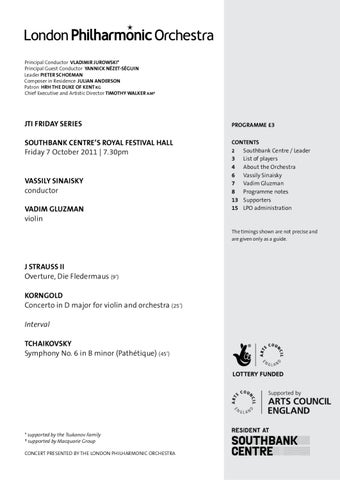
Principal Conductor VLADIMIR JUROWSKI* Principal Guest Conductor YANNICK NÉZET-SÉGUIN Leader pieter schoeman Composer in Residence JULIAN ANDERSON Patron HRH THE DUKE OF KENT KG Chief Executive and Artistic Director TIMOTHY WALKER AM†
JTI FRIDAY SERIES
PROGRAMME £3
SOUTHBANK CENTRE’S ROYAL FESTIVAL HALL Friday 7 October 2011 | 7.30pm
CONTENTS 2 Southbank Centre / Leader 3 List of players 4 About the Orchestra 6 Vassily Sinaisky 7 Vadim Gluzman 8 Programme notes 13 Supporters 15 LPO administration
VASSILY SINAISKY conductor VADIM GLUZMAN violin
The timings shown are not precise and are given only as a guide.
J STRAUSS II Overture, Die Fledermaus (9’) KORNGOLD Concerto in D major for violin and orchestra (25’) Interval TCHAIKOVSKY Symphony No. 6 in B minor (Pathétique) (45’)
* supported by the Tsukanov Family † supported by Macquarie Group CONCERT PRESENTED BY THE LONDON PHILHARMONIC ORCHESTRA
Welcome
pieter schoeman Leader
Pieter Schoeman joined the London Philharmonic Orchestra as Co-Leader in 2002, and was appointed Leader in 2008.
WELCOME TO SOUTHBANK CENTRE
Eating, drinking and shopping? Southbank Centre shops and restaurants include Foyles, EAT, Giraffe, Strada, YO! Sushi, wagamama, Le Pain Quotidien, Las Iguanas, ping pong, Canteen, Caffè Vergnano 1882, Skylon, Concrete and Feng Sushi, as well as cafes, restaurants and shops inside Royal Festival Hall, Queen Elizabeth Hall and Hayward Gallery. If you wish to get in touch with us following your visit please contact Kenelm Robert, our Head of Customer Relations, at Southbank Centre, Belvedere Road, London SE1 8XX or phone 020 7960 4250 or email customer@southbankcentre.co.uk We look forward to seeing you again soon. A few points to note for your comfort and enjoyment: PHOTOGRAPHY is not allowed in the auditorium. LATECOMERS will only be admitted to the auditorium if there is a suitable break in the performance. RECORDING is not permitted in the auditorium without the prior consent of Southbank Centre. Southbank Centre reserves the right to confiscate video or sound equipment and hold it in safekeeping until the performance has ended. MOBILES, PAGERS AND WATCHES should be switched off before the performance begins.
© Patrick Harrison
We hope you enjoy your visit. We have a Duty Manager available at all times. If you have any queries please ask any member of staff for assistance.
Born in South Africa, he made his solo debut aged 10 with the Cape Town Symphony Orchestra. He studied with Jack de Wet in South Africa, winning numerous competitions including the 1984 World Youth Concerto Competition in the US. In 1987 he was offered the Heifetz Chair of Music scholarship to study with Eduard Schmieder in Los Angeles and in 1991 his talent was spotted by Pinchas Zukerman, who recommended that he move to New York to study with Sylvia Rosenberg. In 1994 he became her teaching assistant at Indiana University, Bloomington. Pieter has performed worldwide as a soloist and recitalist in such famous halls as the Concertgebouw in Amsterdam, Moscow’s Rachmaninov Hall, Capella Hall in St Petersburg, Staatsbibliothek in Berlin, Hollywood Bowl in Los Angeles and Southbank Centre’s Queen Elizabeth Hall in London. As a chamber musician he regularly performs at London’s prestigious Wigmore Hall. As a soloist with the London Philharmonic Orchestra, Pieter has performed Arvo Pärt’s Double Concerto with Boris Garlitsky, Brahms’s Double Concerto with Kristina Blaumane and Britten’s Double Concerto with Alexander Zemtsov, which was recorded and released on the Orchestra’s own record label to great critical acclaim. He has recorded numerous violin solos with the London Philharmonic Orchestra for Chandos, Opera Rara, Naxos, X5, the BBC and for American film and television, and led the Orchestra in its soundtrack recordings for The Lord of the Rings trilogy. In 1995 Pieter became Co-Leader of the Orchestre Philharmonique de Nice. Since then he has performed frequently as Guest Leader with the symphony orchestras of Barcelona, Bordeaux, Lyon and Baltimore, as well as with the BBC Symphony Orchestra. Pieter is a Professor of Violin at Trinity Laban Conservatoire of Music and Dance.
2 | London Philharmonic Orchestra
LONDON PHILHARMONIC ORCHESTRA
First Violins Pieter Schoeman* Leader (first half) Dennis Kim Guest Leader (second half) Vesselin Gellev Chair supported by John and Angela Kessler
Heather Badke Katalin Varnagy Catherine Craig Martin Höhmann Chair supported by Richard Karl Goeltz
Geoffrey Lynn Robert Pool Yang Zhang Peter Nall Galina Tanney Joanne Chen Sarah Buchan Caroline Sharp Caroline Frenkel Second Violins Clare Duckworth Principal Chair supported by the Sharp Family
Jeongmin Kim Joseph Maher Kate Birchall Chair supported by David and Victoria Graham Fuller
Fiona Higham Ashley Stevens Dean Williamson Stephen Stewart Mila Mustakova Sheila Law Elizabeth Baldey Stephen Dinwoodie Sioni Williams Alison Strange
Violas Fiona Winning Guest Principal Robert Duncan Rebekah Newman Katharine Leek Benedetto Pollani Emmanuella Reiter-Bootiman Laura Vallejo Susanne Martens Daniel Cornford Alistair Scahill Miranda Davis Anthony Byrne Cellos Susanne Beer Principal Francis Bucknall Laura Donoghue Jonathan Ayling Chair supported by Caroline, Jamie and Zander Sharp
Flutes Susan Thomas Principal Joanna Marsh Stewart McIlwham*
Trumpets Paul Beniston* Principal Anne McAneney* Chair supported by Geoff and Meg Mann
Piccolo Stewart McIlwham* Principal Trombones Mark Templeton* Principal Oboes David Whitehouse Ian Hardwick Principal Fraser MacAulay Bass Trombone Lyndon Meredith Principal Cor Anglais Sue Bohling Principal Tuba Chair supported by Lee Tsarmaklis* Principal Julian and Gill Simmonds
Clarinets Robert Hill* Principal Nicholas Carpenter* Co-Principal
Gregory Walmsley Santiago Carvalho† Susanna Riddell Tom Roff Helen Rathbone Pavlos Carvalho
Bass Clarinet Paul Richards Principal
Double Basses Kevin Rundell* Principal Tim Gibbs Co-Principal Laurence Lovelle George Peniston Kenneth Knussen Tom Walley Helen Rowlands Damian Rubido Gonzalez
Horns John Ryan* Principal Martin Hobbs Stephen Nicholls Gareth Mollison Marcus Bates
Bassoons Gareth Newman* Principal Simon Estell
Timpani Simon Carrington* Principal Percussion Andrew Barclay* Principal Chair supported by Andrew Davenport
Keith Millar Ignacio Molins Harp Rachel Masters* Principal Celeste Catherine Edwards
* Holds a professorial appointment in London † Chevalier of the Brazilian Order of Rio Branco
London Philharmonic Orchestra | 3
LONDON PHILHARMONIC ORCHESTRA
The London Philharmonic Orchestra is one of the world’s finest orchestras, balancing a long and distinguished history with a reputation as one of the UK’s most adventurous and forward-looking orchestras. As well as performing classical concerts, the Orchestra also records film and computer game soundtracks, has its own record label, and reaches thousands of Londoners every year through activities for schools and local communities. The Orchestra was founded by Sir Thomas Beecham in 1932, and since then has been headed by many of the great names in the conducting world, including Sir Adrian Boult, Bernard Haitink, Sir Georg Solti, Klaus Tennstedt and Kurt Masur. The current Principal Conductor is Russian Vladimir Jurowski, appointed in 2007, with French-Canadian Yannick Nézet-Séguin as Principal Guest Conductor.
You may well have heard the London Philharmonic Orchestra on film soundtrack recordings: it has recorded many blockbuster scores, from The Lord of the Rings trilogy to Lawrence of Arabia, The Mission, Philadelphia and East is East. The Orchestra also broadcasts regularly on television and radio, and in 2005 established its own record label. There are now over 50 releases on the label, which are available on CD and to download. Recent additions include Dvořák’s Symphonic Variations and Symphony No. 8 conducted by Sir Charles Mackerras; Holst’s The Planets conducted by Vladimir Jurowski; Mahler’s Symphony No. 8 under Klaus Tennstedt; and Shostakovich Piano Concertos with Martin Helmchen under Vladimir Jurowski. The Orchestra was also recently honoured with the commission to record all 205 of the world’s national anthems for the London 2012 Olympics Team Welcome Ceremonies and Medal Ceremonies.
The Orchestra is based at Royal Festival Hall in London’s Southbank Centre, where it has performed since it opened in 1951 and been Resident Orchestra since 1992. It gives around 40 concerts there each season with many of the world’s top conductors and soloists. Concert highlights in 2011/12 include a three-week festival celebrating the music of Prokofiev, concerts with artists including Sir Mark Elder, Marin Alsop, Renée Fleming, Stephen Hough and Joshua Bell, and several premières of works by living composers including the Orchestra’s Composer in Residence, Julian Anderson. In addition to its London concerts, the Orchestra has flourishing residencies in Brighton and Eastbourne, and performs regularly around the UK. Every summer, the Orchestra leaves London for four months and takes up its annual residency accompanying the famous Glyndebourne Festival Opera in the Sussex countryside, where it has been Resident Symphony Orchestra since 1964.
To help maintain its high standards and diverse workload, the Orchestra is committed to the welfare of its musicians and in December 2007 received the Association of British Orchestras/Musicians Benevolent Fund Healthy Orchestra Bronze Charter Mark.
The London Philharmonic Orchestra tours internationally, performing to sell-out audiences worldwide. In 1956 it became the first British orchestra to appear in Soviet Russia and in 1973 made the first-ever visit to China by a Western orchestra. Touring remains a big part of the Orchestra’s life: tours in the 2011/12 season include visits to Belgium, Switzerland, Germany, the US, Spain, China, Russia, Oman, Brazil and France.
Find out more and get involved!
4 | London Philharmonic Orchestra
The London Philharmonic Orchestra maintains an energetic programme of activities for young people and local communities. Highlights include the ever-popular family and schools concerts, fusion ensemble The Band, the Leverhulme Young Composers project and the Foyle Future Firsts orchestral training scheme for outstanding young players. Over the last few years, developments in technology and social networks have enabled the Orchestra to reach even more people worldwide: all its recordings are available to download from iTunes and, as well as a YouTube channel, news blog, iPhone app and regular podcasts, the Orchestra has a thriving presence on Facebook and Twitter.
lpo.org.uk facebook.com/londonphilharmonicorchestra twitter.com/LPOrchestra
The London Philharmonic Orchestra has maintained accessible ticket prices for its Friday concerts for more than half a century. Our support of the ‘JTI Friday Series’ ensures it can continue to do so. JTI is driven by the creativity of 25,000 diverse, enquiring minds made up of 90 nationalities. Imagine the potential.
www.jti.com
VASSILY SINAISKY
© Marco Borggreve
CONDUCTOR
Russian conductor Vassily Sinaisky’s international career was launched in 1973 when he won the Gold Medal at the prestigious Karajan Competition in Berlin. His early work with Kirill Kondrashin at the Moscow Philharmonic Orchestra and with Ilya Musin at the Leningrad Conservatoire provided him with an incomparable grounding. Soon after his success at the Karajan Competition, he was appointed Chief Conductor of the Latvian National Symphony Orchestra, a post he held from 1976 to 1987. He then became Music Director and Principal Conductor of the Moscow Philharmonic Orchestra, leading numerous high-profile projects with the orchestra both in Russia and on tour.
Philharmonic have included a ‘Shostakovich and his Heroes’ festival in 2006, tours to Europe and China, and many appearances at the BBC Proms. With the Malmö Symphony Orchestra, he has toured in the UK and to Amsterdam’s Concertgebouw, and recorded an acclaimed four-disc series of the symphonies of Franz Schmidt. He has also held the positions of Principal Guest Conductor of the Netherlands Philharmonic Orchestra and Music Director of the Russian State Orchestra.
In September 2010 Vassily Sinaisky was announced as the new Chief Conductor and Music Director of the Bolshoi Theatre, Moscow. Highlights of his first season in this new role included a new production of Rimsky-Korsakov’s The Golden Cockerel as well as tours to Athens and London. This season will see the reopening of the Bolshoi’s main stage after extensive refurbishment. Other highlights will include a new production of Strauss’s Der Rosenkavalier with the British director Stephen Lawless, the Bolshoi’s first ever production of this opera.
In addition to the aforementioned set of the symphonies of Franz Schmidt for Naxos with the Malmö Symphony Orchestra, Vassily Sinaisky’s other recordings include many with the BBC Philharmonic including works by Shostakovich, Tchaikovsky, Rimsky-Korsakov, Shchedrin, Glinka, Liadov, Schreker and Szymanowski. Vassily Sinaisky is a noted and influential teacher, and holds the position of Professor of Conducting at the St Petersburg Conservatoire.
As a guest conductor, Vassily Sinaisky has worked with orchestras including the Royal Concertgebouw, Leipzig Gewandhaus, North German Radio Symphony, Los Angeles Philharmonic and Philadelphia orchestras. As well as tonight’s concert and subsequent tour to the Netherlands with the London Philharmonic Orchestra, this season he will also conduct the Berlin Radio Symphony Orchestra, Czech Philharmonic Orchestra, Oslo Philharmonic, Orchestre Philharmonique de Radio France, Netherlands Philharmonic Orchestra, St Louis Symphony and Russian National Orchestra. Vassily Sinaisky additionally holds the positions of Conductor Emeritus of the BBC Philharmonic and Honorary Conductor of the Malmö Symphony Orchestra, Sweden. Memorable projects with the BBC 6 | London Philharmonic Orchestra
Sinaisky has a distinguished pedigree as an operatic conductor and in addition to his projects at the Bolshoi Theatre, he recently conducted Boris Godunov at San Francisco Opera with Samuel Ramey. Other productions have included Carmen and Der Rosenkavalier for English National Opera. His conducting of a new production of Shostakovich’s Lady Macbeth of Mtsensk at the Komische Oper Berlin received unanimous acclaim in the international press.
VADIM GLUZMAN
© John Kringas
violin
Lauded by both critics and audiences as a performer of great depth, virtuosity and technical brilliance, Israeli violinist Vadim Gluzman has appeared throughout the world as a soloist and with his wife, the pianist Angela Yoffe. Vadim Gluzman appears regularly with major orchestras such as the London Philharmonic and Israel Philharmonic orchestras, the London, Chicago, Detroit, Houston and Vancouver symphony orchestras, the Royal Scottish National Orchestra, the San Francisco Symphony, the Cincinnati Symphony, the Seattle Symphony, the Deutsches Symphonie Orchester Berlin, the Minnesota Orchestra, the Munich Philharmonic, the Dresden Philharmonic, the Stuttgart Radio Symphony Orchestra, the Czech Philharmonic Orchestra and the NHK and KBS orchestras. He has collaborated with the world’s most prominent conductors including the late Yehudi Menuhin, Neeme Järvi, Andrew Litton, Marek Janowski, Itzhak Perlman, Peter Oundjian, Paavo Järvi, Rafael Frühbeck de Burgos, Yan Pascal Tortelier, Hannu Lintu and Tugan Sokhiev. He has also performed at festivals such as Verbier, Ravinia, Lockenhaus, Pablo Casals, Colmar, Jerusalem, the Schwetzinger Festspiele and Festival de Radio France. A passionate advocate of new music, Vadim Gluzman has collaborated with a number of today’s foremost composers such as Arvo Pärt, Pēteris Vasks, Lera Auerbach, Michael Daugherty, Sofia Gubaidulina, Menachem Wiesenberg and Richard Rodney Bennett, premièring their works in concert and recordings. Highlights of Vadim Gluzman’s 2010/11 season included the critically acclaimed UK première of Michael Daugherty’s Fire and Blood with the London Symphony Orchestra conducted by Kristjan Järvi, a recital debut at Wigmore Hall, a tour of Australia, a tour with the New York-based Orpheus Chamber Orchestra that included a performance at Carnegie Hall, and appearances with the San Francisco and Toronto symphony orchestras.
Highlights of summer 2011 included the inaugural season of the North Shore Chamber Music Festival, Illinois, of which Gluzman is Artistic Director, and performances at the Colmar International Festival in France, Germany’s Herrenchiemsee Festival, with Brazil’s Orquestra Filarmônica de Minas Gerais, the San Antonio Symphony in Texas and Israel’s Jerusalem Symphony. Performances this season include the Orquesta Sinfónica Nacional de Mexico, Minnesota Orchestra, Louisiana Philharmonic Orchestra, Indianapolis Symphony and Pro Musica Chamber Orchestra. European engagements include performances with the BBC Symphony Orchestra and Royal Scottish National Orchestra in the UK; the Gewandhaus Orchestra and Dresden Philharmonic in Germany; the Brno Philharmonic Orchestra in the Czech Republic; the Finnish Radio Symphony Orchestra; and Orquesta Sinfónica RTVE in Spain. A highly acclaimed recording artist, Vadim Gluzman’s recordings are released exclusively on BIS Records. His latest, an all-Bruch album released in spring 2011, features the renowned Concerto No. 1 in G minor, the violin version of the Romance in F major, and the String Quintet in A minor. Recorded with the Bergen Philharmonic and conductor Andrew Litton, it has received much acclaim from the press including the ‘Opus d’Or’ from the French magazine Opus Haute Définition. Recent albums include recordings of Korngold’s Violin Concerto coupled with Dvarionas’s Violin Concerto and his Pezzo elegiaco with Neeme Järvi conducting The Hague Residentie Orchestra, and of Bernstein’s Serenade, Barber’s Violin Concerto and Bloch’s Baal Shem Suite with the São Paulo Symphony Orchestra conducted by John Neschling. Born in 1973 in the Ukraine, Vadim Gluzman began studying the violin aged seven. Before moving to Israel in 1990, he studied under Roman Sne, Zakhar Bron and later under Yair Kless in Tel Aviv. He also studied in the USA with Arkady Fomin and at The Juilliard School with Masao Kawasaki and the late Dorothy DeLay. Early in his career, he enjoyed the encouragement and support of Isaac Stern, and in 1994 he received the prestigious Henryk Szeryng Foundation Career Award. Vadim Gluzman plays the extraordinary 1690 ex-Leopold Auer Stradivari, on extended loan to him through the generosity of the Stradivari Society of Chicago.
London Philharmonic Orchestra | 7
PROGRAMME NOTES
Speedread We open this evening with the evergreen overture to Johann Strauss’s Die Fledermaus (The Bat), the most successful of all Viennese operettas. A later Austrian composer, the amazingly precocious Erich Korngold, was invited to Hollywood for a film assignment in 1934. Signed up by Warner Brothers, he composed 17 film scores in 13 years, and in 1945 based his lusciously romantic Violin Concerto on themes from four of them.
Johann STRAUSS II
Romanticism of a darker sort characterises Tchaikovsky’s Sixth Symphony, dubbed the ‘Pathétique’ by his brother, and the composer died only nine days after the first performance. The first two movements reflect his sorrows and fleeting joys. The third is a brilliant march, but the symphony ends with a despairing Adagio expressing Tchaikovsky’s dread of ‘eternal nothingness’.
OVERTURE, DIE FLEDERMAUS
1825–1899
Of the two Austrian composers, father and son, by the name of Johann Strauss, it was Johann II who became the greater master of the Viennese waltz. Besides dance music he composed 16 operettas, of which Die Fledermaus (The Bat) was the third. Produced on 5 April 1874 at Vienna’s Theater an der Wien, it established itself as the most successful of all Viennese operettas. Based on a French comedy by Offenbach’s librettists, who had themselves drawn upon a German comedy, the plot tells how a certain Dr Falke, having been made the butt of an embarrassing practical joke by his friend Eisenstein, gets his revenge by separately persuading the joker, his wife and their maid to attend the same party pretending to be someone else. Hilarious complications inevitably follow.
8 | London Philharmonic Orchestra
The overture is based on some of the evergreen tunes in this lively work. After three from the third act we hear the famous waltz from the Act Two finale. Then comes a taste of the Act One farewell trio (beginning with an oboe tune in 3/4 time), in which each participant pretends to be sad but can hardly help dancing for joy in anticipation of secretly attending the party. A shortened reprise follows, omitting the oboe tune, and the overture ends with a brief, vivacious coda.
Erich Wolfgang KORNGOLD 1897–1957
Erich Korngold, born in Brno (Moravia) of Austrian parentage, had his first major composition, a pantomime, produced at the Vienna Opera when he was 11 years old and two one-act operas staged in Munich while he was still in his teens. By then Richard Strauss, Bruno Walter and Otto Klemperer were conducting his compositions, and Schnabel and Cortot played his piano pieces. The Dead City, a three-act opera produced in 1920, was an international success. When Max Reinhardt, the celebrated stage producer, went to Hollywood in 1934 to make a film of A Midsummer Night’s Dream, he invited Korngold to adapt Mendelssohn’s music. The Austrian composer took so well to working for the cinema that Warner Brothers signed him up, and in the next 13 years (he settled permanently in California in 1938) he composed music for 17 films and won two Oscars. In his last decade he turned his back on Hollywood and concentrated on writing for the concert hall in the romantic style that had made his film music so successful. Themes from four of his film scores provided the material for the Violin Concerto, which Korngold composed in the summer of 1945 and dedicated to Alma Mahler-Werfel, widow of Gustav Mahler and wife of the novelist Franz Werfel. It was composed at the wish of the Polish violinist Bronisław Huberman (1882–1947), but Jascha Heifetz introduced it on 15 February 1947 with the St Louis Symphony Orchestra, and took it triumphantly round America in the following years.
Concerto in D major for violin and orchestra vadim gluzman violin Moderato nobile Romanze Allegro assai vivace
The unashamedly romantic opening theme, which is introduced by the soloist and taken up briefly by the orchestra with solo embellishments, is more memorable than the 1937 film, Another Dawn, for which it was composed. An energetic display for the soloist leads to the tenderly expressive second subject in A major, which takes the solo instrument, as so much of the concerto does, to the top of its compass. This theme comes from one of Bette Davis’s best pictures, the 1939 historical drama Juarez. Recollections of the first theme precede a virtuosic central cadenza for the soloist. Then both subjects are reprised, the second one now in D major, and a passionate peroration brings the movement to a close. Anthony Adverse (1936) yielded the principal theme of the Romanze, a long, lyrical and nostalgic melody that the soloist floats high above a soft cushion of orchestral support. After a misterioso episode with the violin muted the melody returns and winds gently down. In sharp contrast the finale is a merry set of variations on a tune from The Prince and the Pauper (1937). Setting out as a spiky dance, it demands great virtuosity of the soloist, who is busily occupied virtually all the way to the brilliant ending.
INTERVAL – 20 minutes An announcement will be made five minutes before the end of the interval. London Philharmonic Orchestra | 9
PROGRAMME NOTES
Peter Ilyich TCHAIKOVSKY 1840–1893
With five symphonies behind him, six if you include Manfred, Tchaikovsky still felt that he had yet to achieve his best work in this medium. The public had been pleased with the Fifth Symphony, but the critics had been cool and Tchaikovsky himself, who was among the least self-confident of composers, entertained doubts about its worth. Confessing to ‘a massive desire’ to write a symphony that would be the keystone of all his music, he began work in 1892, but the four movements he sketched disappointed him, and he cast them aside. (That Symphony in E flat has since been reconstructed, published and performed.) In February 1893 he tried again, and this time things went well. Writing to his nephew, Vladimir Davidov, Tchaikovsky disclosed that the new work would be a programme symphony ‘but with a programme that shall remain an enigma to all’. He added: ‘This programme is deeply subjective, and while composing it in my mind during my journey (to Odessa) I often wept bitterly. On my return I set to work on the sketches, and things progressed with such fervour and speed that in less than four days I had completely finished the first movement and had already clearly outlined the other movements in my mind.’ Among new features, he wrote, the finale would not be a loud Allegro but an Adagio of considerable dimensions. ‘You cannot imagine how delighted I feel now that I have convinced myself that my time is not yet spent and that I’m still capable of work.’ Foreign travel, including a visit to England to receive an honorary degree in Cambridge and conduct a concert in London, interrupted work, but by August the symphony was finished, and Tchaikovsky was able to write to Davidov: ‘I definitely consider it the very best and especially the most sincere of all my works. I love it as I have never loved any of my other musical offspring.’ The première was fixed for 28 October in St Petersburg
10 | London Philharmonic Orchestra
Symphony No. 6 in B minor (Pathétique) Adagio – Allegro non troppo Allegro con grazia Allegro molto vivace Finale: Adagio lamentoso
and rehearsals began. Tchaikovsky noticed a lack of enthusiasm for the work in the players, and after the performance, which he conducted, he was disappointed by the audience’s response. He remained convinced that this was his masterpiece, an opinion that the world at large soon came to share. But by then the composer was dead. On the day after the first performance the score had to be sent to the publisher. Tchaikovsky wanted a title for the symphony and accepted the suggestion of ‘Pathétique’ from his brother, Modest. Almost at once he changed his mind, but the label has stuck ever since. Three days later Tchaikovsky fell ill with, it was said, cholera contracted through drinking unboiled water, and on 6 November – just nine days after the performance of the symphony – he died. But was it death from natural causes? A theory much debated in recent years is that it might have been suicide to escape public disgrace for homosexual indiscretions. There is, however, no proof of that assertion, and the present majority view is against it. Although the precise programme behind the Sixth Symphony remains an enigma, it is clear that it is basically autobiographical. Modest Tchaikovsky, drawing upon conversations with his brother, claimed that the first movement represented his life with its mixture of sorrows, fear of death and love of the beautiful, while the second movement stood for fleeting joys and the third for his musical development. The finale represented his spiritual state in his last years, when he realised that even artistic fame could not alleviate his dread of ‘eternal nothingness’. It would be unwise to rely heavily upon Modest’s testimony, but we know from surviving notes that Tchaikovsky did have a plan in mind for a four-movement symphony depicting Youth, Love, Disappointment and Death.
Bassoons and basses set the predominant in the the conductor. The entire piece is in effect mood a meditation first bars with a theme that rises slowly and painfully around the still point of a single note D, sustained with repeated At the change to a faster tempo throughout insetbacks. varying colours. The ‘stillness’ of the title the andto woodwind extend the theme, maystrings also refer its subdued volume. There isadding one other rhythmic ideas with arepeatedly nervous restlessness. constant subsidiary in the music: a figure tapped out There are also brass fanfares related the opening quietly by the side drum, which the to composer described phrase. When the music quietens, a passage for the as a blues rhythm, but which could just as well be a cellos ushers in thetosecond subject, a romantic ghostly reference a recurring rhythm in the tune slow on muted strings. Flute and bassoon introduce a countermovement of Schubert’s String Quintet. melody, which runs its course before the romantic tune returns in full orchestral dress. A sudden explosion sets off a furiously energetic development, but eventually the second subject steals in, rises to a last passionate climax INTERVAL – 20tominutes and dies, followed its grave by a solemn cortege.
For the third movement Tchaikovsky Around this fixed note and repeatedprovides rhythm,athere brilliant march built from a few phrases in are subtly shifting colours, little circling repeated figures and skilfully varied tone colours and contexts. Whether the rhythmic flourishes which become increasingly dense triumphant climax implies a real within or hollow victory is up and elaborate, but all contained a twilight to the listener to decide. world which some have seen as a foreshadowing of the
composer’s imminent suicide. In the first movement the spectre of death provoked strenuous opposition. Now, in the finale, it reappears and resistance has all but ebbed away. The strings lament the inevitability of earthly dissolution. Twice the music rises to a climax of protest, but after the second there is no strength left and the symphony sinks into silence. A month before the first performance Tchaikovsky was invited to compose music for a play An announcement will be made five minutes before the end of theRequiem. interval.He declined because, he said, he had entitled already written it in this symphony. The second movement has been called a waltz with a limp, due to its 5/4 rhythm. Here, perhaps, the ‘fleeting Programme notes © Eric Mason joys’ of the composer’s life are recalled, but the mood darkens in the central section with its throbbing bass and lamenting string phrases.
Hear every note
Are you hard of hearing or do you use a hearing aid?
Did you know Royal Festival Hall, Queen Elizabeth Hall and Purcell Room all have free-of-charge equipment available to help you get the most out of the music you may be missing? Visit the relevant cloakroom up to one hour before the performance to collect the equipment and learn how to use it effectively.
London Philharmonic Orchestra |7 London Philharmonic Orchestra | 11
13 January — 1 February 2012
Get closer to Sergei Prokofiev A festival curated by Vladimir Jurowski
Festival highlights include — The world première of an oratorio version of Prokofiev’s Ivan the Terrible — Prokofiev’s incidental music to Egyptian Nights with excerpts from texts by Bernard Shaw, Pushkin and Shakespeare read by Simon Callow — Excerpts from ballets Cinderella and Chout (The Buffoon) — Free classical club night with Gabriel Prokofiev and Rambert Dance Company
lpo.org.uk/prokofiev Get closer to one of the most misunderstood men in 20th-century music
We would like to acknowledge the generous support of the following Thomas Beecham Group Patrons, Principal Benefactors and Benefactors: Thomas Beecham Group The Tsukanov Family The Sharp Family Julian & Gill Simmonds Garf & Gill Collins Andrew Davenport David & Victoria Graham Fuller Richard Karl Goeltz John & Angela Kessler Mr & Mrs Makharinsky Geoff & Meg Mann Caroline, Jamie and Zander Sharp Eric Tomsett Mrs Sonja Drexler Guy & Utti Whittaker Principal Benefactors Mark & Elizabeth Adams Jane Attias Lady Jane Berrill Desmond & Ruth Cecil Mr John H Cook Mr Charles Dumas
David Ellen Commander Vincent Evans Mr & Mrs Jeffrey Herrmann Peter MacDonald Eggers Mr & Mrs David Malpas Andrew T Mills Mr Maxwell Morrison Mr Michael Posen Mr & Mrs Thierry Sciard Mr John Soderquist & Mr Costas Michaelides Mr & Mrs G Stein Mr & Mrs John C Tucker Mr & Mrs John & Susi Underwood Howard & Sheelagh Watson Mr Laurie Watt Benefactors Mrs A Beare Dr & Mrs Alan Carrington CBE FRS Mr & Mrs Stewart Cohen Mr Alistair Corbett Mr David Edgecombe Mr Richard Fernyhough Ken Follett
Pauline & Peter Halliday Michael & Christine Henry Mr Glenn Hurstfield Mr R K Jeha Mr & Mrs Maurice Lambert Mr Gerald Levin Sheila Ashley Lewis Wg. Cdr. & Mrs M T Liddiard OBE JP RAF Mr Frank Lim Paul & Brigitta Lock Mr Brian Marsh John Montgomery Edmund Pirouet Mr Peter Tausig Mrs Kazue Turner Lady Marina Vaizey Mr D Whitelock Hon. Benefactor Elliott Bernerd Hon. Life Members Kenneth Goode Edmund Pirouet Mrs Jackie Rosenfeld OBE
The generosity of our Sponsors, Corporate Members, supporters and donors is gratefully acknowledged: Corporate Members Appleyard & Trew llp AREVA UK British American Business Charles Russell Destination Québec – UK Diagonal Consulting Lazard Leventis Overseas Man Group plc Corporate Donor Lombard Street Research In-kind Sponsors Google Inc Heineken The Langham London Lindt & Sprüngli Ltd Sela / Tilley’s Sweets Villa Maria
Trusts and Foundations Arts and Business Allianz Cultural Foundation The Boltini Trust Britten-Pears Foundation The Candide Charitable Trust The Coutts Charitable Trust The Delius Trust Dunard Fund The Equitable Charitable Trust The Eranda Foundation The Fenton Arts Trust The Foyle Foundation The Jeniffer and Jonathan Harris Charitable Trust Hattori Foundation for Music and the Arts Capital Radio’s Help a London Child The Hobson Charity The Kirby Laing Foundation The Leverhulme Trust Lord and Lady Lurgan Trust Maurice Marks Charitable Trust Marsh Christian Trust
The Mercers’ Company Adam Mickiewicz Institute Paul Morgan Charitable Trust Maxwell Morrison Charitable Trust Musicians Benevolent Fund The Serge Prokofiev Foundation Serge Rachmaninoff Foundation The Reed Foundation The Seary Charitable Trust The Samuel Sebba Charitable Trust The David Solomons Charitable Trust The Steel Charitable Trust The Stansfield Trust The Bernard Sunley Charitable Foundation The Swan Trust John Thaw Foundation The Thistle Trust The Underwood Trust Garfield Weston Foundation Youth Music and others who wish to remain anonymous London Philharmonic Orchestra | 13
Vintage Jansen Janine Jansen performs with the London Philharmonic Orchestra in 2011/12
Tchaikovsky
Violin Concerto 16 November 2011
Mozart
Violin Concerto No. 5 3 December 2011
Prokofiev
Violin Concerto No. 2
“Her playing is sensationally good” The Sunday Times Tickets £9-£65 London Philharmonic Orchestra 020 7840 4242 | lpo.org.uk (No fees) Southbank Centre Ticket Office 0844 847 9920 | southbankcentre.co.uk (Booking fees apply) Book for all three concerts and save 10%
14 | London Philharmonic Orchestra
Janine Jansen © Felix Broede
1 February 2012
Administration
Board of Directors
General Administration
Orchestra Personnel
Archives
Martin Höhmann Chair Stewart McIlwham Vice-Chair Sue Bohling Lord Currie* Jonathan Dawson* Gareth Newman George Peniston Sir Bernard Rix* Kevin Rundell Sir Philip Thomas* Timothy Walker AM†
Timothy Walker AM† Chief Executive and Artistic Director
Andrew Chenery Orchestra Personnel Manager
Philip Stuart Discographer
Sarah Thomas Librarian
Gillian Pole Recordings Archive
*Non-Executive Directors
The London Philharmonic Trust Victoria Sharp Chair Desmond Cecil CMG Jonathan Harris CBE FRICS Dr Catherine C. Høgel Martin Höhmann Angela Kessler Clive Marks OBE FCA Julian Simmonds Timothy Walker AM† Laurence Watt American Friends of the London Philharmonic Orchestra, Inc.
Alison Atkinson Digital Projects Manager
London Philharmonic Orchestra Julia Boon 89 Albert Embankment David Burke Assistant Orchestra Personnel SE1 7TP FSC_57678 LPO 14 January 2011 15/09/2011 12:30 Page London 1 General Manager and Manager Tel: 020 7840 4200 Finance Director Ken Graham Trucking Fax: 020 7840 4201 David Greenslade Instrument Transportation Box Office: 020 7840 4242 Finance and IT Manager (Tel: 01737 373305) lpo.org.uk Finance
Development
Roanna Gibson Concerts Director
Nick Jackman Development Director
Ruth Sansom Artistic Administrator
Harriet Mesher Charitable Giving Manager
Graham Wood Concerts, Recordings and Glyndebourne Manager
Alexandra Rowlands Corporate Relations Manager
Alison Jones Concerts Co-ordinator Jenny Chadwick Tours and Engagements Manager Jo Orr PA to the Executive / Concerts Assistant
Professional Services
Education & Community
Charles Russell Solicitors
Patrick Bailey Education and Community Director
Dr Louise Miller Honorary Doctor
The London Philharmonic Orchestra Limited is a registered charity No. 238045.
Concert Management
We are very grateful to the Board of the American Friends of the London Philharmonic Orchestra for its support of the Orchestra’s activities in the USA.
Crowe Clark Whitehill LLP Auditors
Michael Pattison Stage Manager
Matthew Freeman Recordings Consultant
Anne Findlay Education Manager Caz Vale Community and Young Talent Manager Richard Mallett Education and Community Producer
Melissa Van Emden Events Manager Laura Luckhurst Corporate Relations and Events Officer Elisenda Ayats Development and Finance Officer
Photograph of Korngold © Franz Lowy. Photograph of Tchaikovsky courtesy of the Royal College of Music, London. Front cover photograph © Benjamin Ealovega. Printed by Cantate. †Supported by Macquarie Group
Marketing Kath Trout Marketing Director Ellie Dragonetti Marketing Manager Rachel Fryer Publications Manager Helen Boddy Marketing Co-ordinator Samantha Kendall Box Office Manager (Tel: 020 7840 4242) Valerie Barber Press Consultant (Tel: 020 7586 8560)
London Philharmonic Orchestra | 15
honegger pastorale d’ÉtÉ symphony no. 4 une cantate de noËl Vladimir Jurowski conductor
siBelius / lutosŁawski symphony no. 5 pohJola’s daughter concerto for orchestra Jukka-Pekka Saraste conductor
LPO-0056
LPO-0057
LPO-0058
New releases on the LPO label
Busoni doktor faust Sir Adrian Boult conductor
Supported by the Adam Mickiewicz Institute as part of the Polska Music grant programme
Available from lpo.org.uk/shop, all good CD outlets and the Royal Festival Hall shop. Downloads available from iTunes, Amazon, eMusic and classicsonline.com.
LPO Contemporaries is a scheme for busy London professionals in their 20s and 30s, offering a chance to become involved with and support the Orchestra and to socialise with like-minded individuals. This tailor-made programme offers a range of events across the year, including three hand-picked London Philharmonic Orchestra concerts with drinks and dinner, Champagne Open Rehearsals, and receptions and parties at venues across the capital. Membership starts from just £150 a year (£15 a month by direct debit). We are very grateful to our Executive Members, listed below, whose £250 membership includes a £100 donation to the Orchestra’s Education and Community Programme. Mr Mike Cobb and David Attenborough Mr and Mrs Alexandra and Mariano Espada Dr Catherine C Høgel Dr David Holdsworth Ms Alexis Levin Mr Jaspal Pachu Mr Stuart Poyser lpo.org.uk/contemporaries facebook.com/lpocontemporaries
16 | London Philharmonic Orchestra