57692 LPO 6 Mar 2011_57692 LPO 6 Mar 2011 25/02/2011 11:53 Page 1
Principal Conductor VLADIMIR JUROWSKI Principal Guest Conductor YANNICK NÉZET-SÉGUIN Leader PIETER SCHOEMAN Composer in Residence JULIAN ANDERSON Patron HRH THE DUKE OF KENT KG Chief Executive and Artistic Director TIMOTHY WALKER
AM†
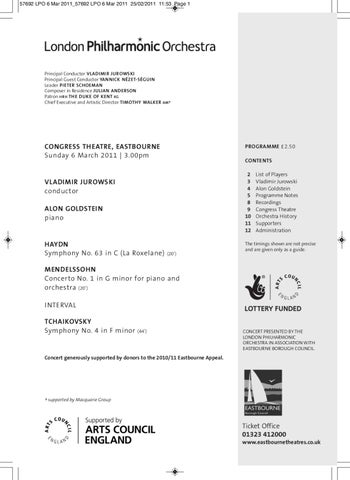
CONGRESS THEATRE, EASTBOURNE Sunday 6 March 2011 | 3.00pm
PROGRAMME £2.50 CONTENTS 2 3 4 5 8 9 10 11 12
VLADIMIR JUROWSKI conductor ALON GOLDSTEIN piano
HAYDN Symphony No. 63 in C (La Roxelane)
(20’)
List of Players Vladimir Jurowski Alon Goldstein Programme Notes Recordings Congress Theatre Orchestra History Supporters Administration
The timings shown are not precise and are given only as a guide.
MENDELSSOHN Concerto No. 1 in G minor for piano and orchestra (20’) INTERVAL TCHAIKOVSKY Symphony No. 4 in F minor
(44’)
CONCERT PRESENTED BY THE LONDON PHILHARMONIC ORCHESTRA IN ASSOCIATION WITH EASTBOURNE BOROUGH COUNCIL.
Concert generously supported by donors to the 2010/11 Eastbourne Appeal.
†
supported by Macquarie Group
Ticket Office 01323 412000 www.eastbournetheatres.co.uk
57692 LPO 6 Mar 2011_57692 LPO 6 Mar 2011 25/02/2011 11:53 Page 2
LONDON PHILHARMONIC ORCHESTRA
Chair supported by John and Angela Kessler
Katerina Mitchell Katalin Varnagy Catherine Craig Thomas Eisner Tina Gruenberg Martin Höhmann Chair supported by Richard Karl Goeltz
Geoffrey Lynn Robert Pool Sarah Streatfeild Yang Zhang SECOND VIOLINS Clare Duckworth Principal Chair supported by Richard and Victoria Sharp
Jeongmin Kim Joseph Maher Kate Birchall Chair supported by David and Victoria Graham Fuller
Nancy Elan Fiona Higham Ashley Stevens Dean Williamson Sioni Williams Heather Badke Alison Strange Stephen Stewart VIOLAS Alexander Zemtsov* Principal Chair supported by The Tsukanov Family
Robert Duncan Katharine Leek Susanne Martens Benedetto Pollani Emmanuella Reiter-Bootiman Laura Vallejo Daniel Cornford
CELLOS Kristina Blaumane Principal Susanne Beer Co-Principal Francis Bucknall Laura Donoghue Jonathan Ayling Chair supported by Caroline, Jamie and Zander Sharp
Santiago Sabino Carvalho + Gregory Walmsley DOUBLE BASSES Kevin Rundell* Principal Tim Gibbs Co-Principal Laurence Lovelle George Peniston Richard Lewis FLUTES Sue Thomas* Principal Eilidh Gillespie PICCOLO Stewart McIlwham* Principal OBOES Ian Hardwick Principal Angela Tennick
TRUMPETS Paul Beniston* Principal Anne McAneney* Chair supported by Geoff and Meg Mann
Nicholas Betts Co-Principal TROMBONES Mark Templeton* Principal David Whitehouse BASS TROMBONE Lyndon Meredith Principal TUBA Lee Tsarmaklis Principal TIMPANI Simon Carrington* Principal PERCUSSION Rachel Gledhill Principal Andrew Barclay* Co-Principal Chair supported by Andrew Davenport
Keith Millar
CLARINETS Nicholas Carpenter Principal Katie Lockhart BASSOONS Gareth Newman* Principal Simon Estell HORNS John Ryan Principal Abel Pereira Guest Principal Martin Hobbs Marcus Bates Gareth Mollison
* Holds a professorial appointment in London +
Chevalier of the Brazilian Order of Rio Branco
Chair Supporters The London Philharmonic Orchestra also acknowledges the following chair supporters whose player is not present at this concert: Julian and Gill Simmonds
2 | London Philharmonic Orchestra
Patrick Harrison
FIRST VIOLINS Pieter Schoeman* Leader Vesselin Gellev Sub-Leader
Pieter Schoeman was appointed Co-Leader of the London Philharmonic Orchestra in 2002 and Leader in 2008. Born in 1969 in South Africa he made his debut at the age of ten with the Cape Town Symphony Orchestra. Since then he has performed as soloist and recitalist in such famous halls as the Concertgebouw in Amsterdam, Moscow’s Rachmaninov Hall, Capella Hall in St Petersburg, Staatsbibliothek in Berlin, Hollywood Bowl in Los Angeles and Wigmore Hall, London. He has also played extensively on radio and television in the United States, Russia, South Africa, China and the UK. In 1995, he became CoConcertmaster of the Orchestre Philharmonique de Nice in France and has also performed as Guest Concertmaster with the symphony orchestras of Barcelona, Bordeaux, Lyon and Baltimore. This season he will lead the Rotterdam Philharmonic Orchestra on several occasions. He teaches at Trinity College of Music.
57692 LPO 6 Mar 2011_57692 LPO 6 Mar 2011 25/02/2011 11:53 Page 3
VLADIMIR JUROWSKI
Karen Robinson
CONDUCTOR
Born in Moscow, the son of conductor Mikhail Jurowski, Vladimir Jurowski completed the first part of his musical studies at the Music College of the Moscow Conservatory. In 1990 he relocated with his family to Germany where he continued his studies in Dresden and Berlin, studying conducting with Rolf Reuter and vocal coaching with Semion Skigin. In 1995 he made his international debut at the Wexford Festival, where he conducted Rimsky-Korsakov’s May Night. The same year saw his brilliant debut at the Royal Opera House Covent Garden in Nabucco. In 1996 he joined the ensemble of Komische Oper Berlin, becoming First Kapellmeister in 1997 and continuing to work at the Komische Oper on a permanent basis until 2001. Since 1997 Vladimir Jurowski has been a guest at some of the world’s leading musical institutions including the Royal Opera House Covent Garden, Teatro La Fenice di Venezia, Opéra Bastille de Paris, Théâtre de la Monnaie Bruxelles, Maggio Musicale Festival Florence, Rossini Opera Festival Pesaro, Edinburgh Festival, Semperoper Dresden and the Teatro Comunale di Bologna (where he served as Principal Guest Conductor between 2000 and 2003). In 1999 he made his debut at the Metropolitan Opera New York with Rigoletto. In January 2001 Vladimir Jurowski took up the position of Music Director of Glyndebourne Festival Opera and in 2003 was appointed Principal Guest Conductor of the London Philharmonic Orchestra, becoming the Orchestra’s Principal Conductor in September 2007. He also holds the title of Principal Artist of the Orchestra of the Age of Enlightenment, and from 2005 to 2009 served as Principal Guest Conductor of the Russian National Orchestra with whom he will continue to work in the years ahead.
Vladimir Jurowski is a regular guest with many of the world’s leading orchestras including the Berlin Philharmonic, Oslo Philharmonic, Royal Concertgebouw, Bavarian Radio Symphony, Dresden Staatskapelle, Los Angeles Philharmonic and Philadelphia Orchestras as well as the Gewandhausorchester Leipzig. Highlights of the 2010/11 season and beyond include his debuts with the Vienna Philharmonic, Cleveland, San Francisco Symphony and Mahler Chamber Orchestras, and return visits to the Chicago Symphony, Chamber Orchestra of Europe, Berlin Philharmonic, Royal Concertgebouw, St Petersburg Philharmonic and Philadelphia Orchestras. His operatic engagements have included Jenůfa, The Queen of Spades and Hänsel und Gretel at the Metropolitan Opera, Parsifal and Wozzeck at Welsh National Opera, War and Peace at the Opéra National de Paris, Eugene Onegin at La Scala Milan, as well as Die Zauberflöte, La Cenerentola, Otello, Macbeth, Falstaff, Tristan und Isolde, Don Giovanni, The Rake’s Progress and Peter Eötvös’ Love and Other Demons at Glyndebourne Opera. Future engagements include new productions of Die Meistersinger and The Cunning Little Vixen at Glyndebourne, Die Frau ohne Schatten at the Metropolitan Opera, Russlan and Ludmila at the Bolshoi Theatre, and Iolanta at the Dresden Semperoper. Jurowski’s discography includes the first ever recording of Giya Kancheli’s cantata Exil for ECM (1994), L’Étoile du Nord by Meyerbeer for Naxos-Marco Polo (1996), and Werther for BMG (1999) as well as live recordings of works by Rachmaninov, Turnage, Tchaikovsky, Britten, Brahms and Shostakovich on the London Philharmonic Orchestra’s own label, and Prokofiev’s Betrothal in a Monastery on Glyndebourne Opera’s own label. He also records for PentaTone with the Russian National Orchestra, with releases to date including Tchaikovsky’s Suite No. 3 and Stravinsky’s Divertimento from Le Baiser de la fée, Shostakovich’s Symphonies Nos 1 and 6, Prokofiev’s Symphony No. 5 and Tchaikovsky’s Hamlet Incidental Music. Glyndebourne have released DVD recordings of his performances of La Cenerentola, Gianni Schicchi, Die Fledermaus and Rachmaninov’s The Miserly Knight, and other recent DVD releases include Hänsel und Gretel from the Metropolitan Opera New York, and his first concert as the London Philharmonic Orchestra’s Principal Conductor featuring works by Wagner, Berg and Mahler (released by Medici Arts).
London Philharmonic Orchestra | 3
57692 LPO 6 Mar 2011_57692 LPO 6 Mar 2011 25/02/2011 11:53 Page 4
ALON GOLDSTEIN
Janette Beckmen
PIANO
Alon Goldstein is one of the most original and sensitive artists of his generation, admired for his musical intelligence and dynamic personality. He made his orchestral debut at the age of 18 with the Israel Philharmonic and Zubin Mehta, and in April 2008 made a triumphant return with Herbert Blomstedt. In recent seasons he has performed with the Los Angeles Philharmonic, Philadelphia and Rhode Island Philharmonic Orchestras as well as with the symphony orchestras of San Francisco, Baltimore, St Louis, Houston, Vancouver, Kansas City and North Carolina. His 2010/11 orchestral season includes his debut today with the London Philharmonic Orchestra and Vladimir Jurowski, a return to the IRIS Orchestra for Saint-Saëns’ Concerto No. 2 with Michael Stern, Tchaikovsky’s Concerto No. 1 with Jaime Laredo and the Vermont Symphony, and Avner Dorman’s Lost Souls with the Santa Barbara Symphony under Nir Kabaretti. He can be heard in recital and chamber music concerts in Beijing, Guatamala City, Kent, Chicago, Los Angeles, Coral Gables, Seattle, Minneapolis, Jerusalem,Tel Aviv and Paris, among others. A highlight of his 2009/10 season was giving two world premières: the Lost Souls piano concerto written for him by Israeli composer Avner Dorman with the Kansas City Symphony and music director Michael Stern, and a concerto by Mark Kopytman with Avner Biron and the Jerusalem Camerata Orchestra. He also gave performances of Chopin’s Concerto No. 2 with the Delaware Symphony and Mozart’s Concerto K453 with the Jerusalem Symphony. In 2009/10 Alon gave recitals in Chicago, Washington DC and Henry Crown Symphony Hall in Israel. He was
4 | London Philharmonic Orchestra
featured at the Seattle Chamber Music Festival performing all three Schumann piano trios and gave chamber music concerts at the Jerusalem International Chamber Music Festival with principals from the Berlin Philharmonic and violinist Nikolaj Znaider. In the 2008/09 season, he made his Carnegie Hall debut in the Mozart Triple Concerto alongside Joseph Kalichstein and Shai Wosner. As an ardent chamber musician, Alon has collaborated with violinist Jaime Laredo and cellist Sharon Robinson, with the Tokyo String Quartet at the 92nd Street Y in New York, in trio performances with cellist Amit Peled and violinist Ilya Kaler, and in recital with Amit Peled and clarinettist Alexander Fiterstein. Alon Goldstein has appeared at the Gilmore, Santa Fe, Tanglewood, Ravinia, Marlboro and Seattle Festivals in the United States as well as at Prussia Cove in England, the Verbier Festival in Switzerland and the Klavier Festival in Rühr, Germany. He has performed at the Hollywood Bowl with the Los Angeles Philharmonic and at Millennium Park in Chicago with the Grant Park Symphony Orchestra. Alon was a Performance Fellow at the Guildhall School of Music and Drama in London, where he initiated an innovative chamber music series and organised annual festivals devoted to the 4-hands piano repertoire. Later he spent two seasons as Artist-in-Residence at the Theo Lieven International Piano Foundation at Lake Como, Italy, where he was able to enjoy private master classes with world renowned musicians. A winner of numerous competitions, among them the Arianne Katcz Piano Competition in Tel Aviv, Nena Wideman Competition in the US and the Francois Shapira Competition in Israel, he is also the recipient of the 2004 Salon di Virtuosi Career Grant and the America Israel Cultural Foundation Scholarships. The Phillips Collection in Washington DC chose a live recording of one of Alon’s recitals there for its first CD release. Other recordings include solo recital programmes through the Jerusalem Music Centre ‘Mishkenot Sha’ananim’ and the Israeli Music Institute featuring works by Israeli composers. Alon graduated from the Peabody Conservatory where he studied with Leon Fleisher and served as his assistant.
57692 LPO 6 Mar 2011_57692 LPO 6 Mar 2011 25/02/2011 11:53 Page 5
PROGRAMME NOTES
SPEEDREAD We start this afternoon with one of the boldest and brightest of Haydn’s middle-period symphonies. The first of its four movements is based on the overture to one of his operas. The second movement is a set of variations that originally formed part of incidental music to a play about Roxelane, the slave girl who became the favourite concubine of a 16th-century sultan of the Ottoman Empire. Mendelssohn was only 22 years old when the King and Queen of Bavaria attended a Munich concert of his music. The composer appeared as both conductor and solo pianist, and the première of his First Piano Concerto
Joseph HAYDN
earned him a big success. The first and last of the three linked movements are full of the joie de vivre he enjoyed at that time. Between them comes a delicate Andante with a song-like theme. Tchaikovsky considered in his Fourth Symphony how life alternates ‘between grim reality and fleeting dreams of happiness’. Fate intrudes upon waltz-time longings in the first of the four movements. Wistful memories occupy the second movement, which is followed by a novel three-part scherzo. The boisterous finale is based on a Russian folksong; ‘rejoice in the joy of others and life is bearable after all’. © Eric Mason
SYMPHONY NO. 63 IN C (LA ROXELANE) Allegro | La Roxelane: Allegretto (o più tosto allegro) | Menuet e trio: Allegretto | Finale: Prestissimo
1732-1809
Haydn was especially pressed for time in the 1770s because he had to satisfy his princely employer’s passion for opera and still maintain a supply of new symphonies. So it is no surprise that he recycled some of his compositions for this symphony, which exists in two substantially different versions. We shall hear the first version, which dates from 1777 or soon after. The first movement is a symphonic adaptation of the overture to Haydn’s opera Il mondo della luna (The World of the Moon). It makes a particularly arresting effect on account of the bright key of C major and in this version the bold deployment of two trumpets and timpani to emphasise the sharp dynamic contrasts. The main group of themes is in three parts, of which only the third returns in the recapitulation. It was probably in 1777 that a theatrical troupe performed Charles Simon Favart’s 1761 play The Three Sultans in the Prince’s theatre at Esterháza. One of the characters was the historical Roxelane, the 16th-century
Circassian slave who became the favourite concubine of the Sultan of the Ottoman Empire, Suleiman the Magnificent. She not only persuaded him to dismiss the rest of the 300 women in his harem but also turned him against his son and heir so that her own son might succeed to the throne. Haydn composed incidental music for the play, and adapted an entr’acte from it to provide the second movement of the symphony. It takes the form of a double set of variations bearing the name of that remarkable lady and alternating between the keys of C minor and C major. A flute is added to the orchestra in this movement only, and for the first hundred bars the violins are muted. A neat Allegretto minuet and trio follow with much alternation between piano and forte in the former. The symphony ends with a dashing Prestissimo based on a fragment that Haydn had had on hand for some time. © Eric Mason
London Philharmonic Orchestra | 5
57692 LPO 6 Mar 2011_57692 LPO 6 Mar 2011 25/02/2011 11:53 Page 6
PROGRAMME NOTES
Felix MENDELSSOHN 1809-1847
Mendelssohn’s early-flowering genius as a composer and his virtuosity as a pianist together quickly earned him a considerable international reputation. He was still only 22 years old when – on 17 October 1831 – he appeared as conductor and soloist at a Munich concert of his works attended by the King and Queen of Bavaria. The programme consisted of the overture to A Midsummer Night’s Dream, the First Symphony and the first performance of this concerto. In the last part of the concert, as the composer reported in a letter next day, ‘I came to my piano concerto and met with a long and vivid reception. After my playing they tried to call me back and applauded, but I was modest and did not appear again.’ The concerto was just as successful elsewhere, and many pianists gratefully took it into their repertoires. Unlike the Italian Symphony and the later Violin Concerto, both of which cost Mendelssohn much labour to perfect, the G minor Piano Concerto came easily to him. It was, he said, ‘a thing quickly thrown off’. He dedicated it to Delphine von Schauroth, a young Munich pianist who, he admitted, had actually composed one effective passage in it. Not that Mendelssohn needed assistance; although this concerto is labelled as his first, he had composed several for one and two pianos in his teens. We cannot look to this one for searching profundity, but it is a thoroughly enjoyable work reflecting the young composer’s enjoyment of his life at that moment, and it embodies some interesting formal novelties. There is no orchestral exposition to precede the soloist’s entry, the three movements are linked together and themes from the first reappear in the last. A short orchestral crescendo heralds the soloist, who enters with a showy declamation in double octaves and then introduces the first subject proper. The orchestra takes up the theme, and the piano, as if objecting to being ignored, roars out some octave scales in the bass. 6 | London Philharmonic Orchestra
CONCERTO NO. 1 IN G MINOR FOR PIANO AND ORCHESTRA, OP. 25 ALON GOLDSTEIN piano Molto allegro con fuoco – | Andante – | Presto – Molto allegro e vivace
This subdues the orchestra, and the piano has a dozen or so brilliant bars before proceeding to the tranquil second subject, first in the related key of B flat and then in the more expansive D flat. Mendelssohn dispenses with the customary rounding off of this exposition and moves on to the development, which is mainly concerned with the second subject and a plunging octave from the piano’s first outburst. The reappearance of the orchestra’s original crescendo signals the recapitulation, which is very short, and a fiery coda follows. When this seems to be approaching a normal close, the horns and trumpets take up the rhythm with a fanfare on B natural, enabling the piano to modulate quietly into the key of E for the Andante. In this restful, delicately scored movement the orchestra is reduced to two flutes, bassoon, horn and divided strings, and the violins are not employed until near the end. The song-like theme is given out by the cellos before passing to the soloist for repetition and elaboration, supported at the last by a soft shimmer from violins in four parts. Again there is no break between movements. The horns and trumpets sound their fanfare, now on E, and an agitated orchestral passage follows. But the pianist enters brightly in the key of G major and, after a display of arpeggios, introduces the finale’s cheerful main theme. Although there is a subsidiary subject, Mendelssohn maintains a happy momentum without bothering much about formal development. Towards the end the orchestra reminds us of the piano’s octave declamation at the beginning of the concerto, and the pianist briefly recalls the first movement’s second subject, a simple way of giving the concerto extra cohesion. © Eric Mason
57692 LPO 6 Mar 2011_57692 LPO 6 Mar 2011 25/02/2011 11:53 Page 7
PROGRAMME NOTES
INTERVAL 20 minutes A bell will be rung 3, 2 and 1 minute before the end of the interval.
Peter Ilyich TCHAIKOVSKY
SYMPHONY NO. 4 IN F MINOR, OP. 36 Andante sostenuto – Moderato con anima | Andantino in modo di Canzona | Scherzo: Allegro | Finale: Allegro con fuoco
1840-1893
For two unconnected reasons 1877 was a fateful year in Tchaikovsky’s life. First, it was the year in which his friendship with Nadezhda von Meck, the wealthy benefactress whom by mutual agreement he never intentionally met, ripened. Tchaikovsky wrote to her in May that he had been at work since the winter on a symphony, and by early June he was able to tell her that the four movements were complete except for orchestration. She accepted the dedication ‘To my best friend’ on condition that her name was not specified. At this time Tchaikovsky became engrossed in composing his opera Eugene Onegin, and the Pushkin story was a powerful factor in persuading him into a loveless marriage that July to a young woman he hardly knew. Within two months he was brought to a nervous breakdown and attempted suicide, and not until December was he sufficiently recovered to tackle the orchestration of the symphony. He worked at this in Venice and completed the task in San Remo early in the New Year. The first performance took place in Moscow on 22 February 1878 under Nicholas Rubinstein, but it was ill-prepared and made little impression. The St Petersburg première in November under Eduard Napravnik was a success, but the symphony did not become popular in Russia during the composer’s lifetime. He himself, often a prey to self-doubt, thought the symphony the best he had so far composed. ‘I
believe’, he said, ‘that I have written music which cannot fall into oblivion.’ Thanks to his correspondence with Mrs von Meck we have a detailed account of the programme underlying the Fourth Symphony. The sinister brass fanfare that opens and dominates the first movement represents Fate, Tchaikovsky wrote, ‘the force that prevents us from ever attaining complete happiness...It can never be overcome. One can only submit to it and take refuge in futile longings.’ The main part of the movement, marked ‘in waltz time’, begins with such longings, expressed by a syncopated melody that becomes increasingly agitated and rises to a despairing climax. Clarinet and bassoon exchanges lead to the second subject on clarinet – ‘Would it not be better to turn away from reality and plunge oneself in dreams?’ Flutes and oboes take up this theme over a cello countermelody which soon becomes a swaying major-key theme for the violins against soft drum-taps, answered by a major version of the syncopated melody on woodwind – ‘Some luminous human form passes by and beckons. All that was dark and joyless is forgotten.’ Happiness does not last; the agitation returns and the Fate motive reappears to open the development section, which is almost exclusively concerned with the first subject and the ever more insistent Fate. ‘Thus the whole of life’, wrote Tchaikovsky, ‘is a continual alternation between grim reality and fleeting dreams of
London Philharmonic Orchestra | 7
57692 LPO 6 Mar 2011_57692 LPO 6 Mar 2011 25/02/2011 11:53 Page 8
PROGRAMME NOTES
happiness.’ The recapitulation recalls the themes in unorthodox D minor, and there is a long coda ending with the first subject. The second movement, in B flat minor, expresses the ‘melancholy which steals over us when, at evening, we sit indoors alone, weary of work ... A long procession of memories goes by. How sad to think how much is already past! And yet these recollections of youth are sweet.’ A solo oboe plays a plaintive, folk-like tune with pizzicato string accompaniment. The cellos take it over and this brings an answering melody, after which both ideas are repeated in different scoring. The faster central episode in F major has another folk-like tune, introduced by clarinets and bassoons. When the original themes return, they are presented in still more varied dress and with charming ornaments. Tchaikovsky had high hopes that the novel scherzo would please. It is in three sections, the first being for pizzicato strings and representing ‘fleeting images that come into a man’s head when he has been drinking’. The trio section is for woodwind (suggested by peasants
on the spree and a street song) and brass (a distant military brand), after which the three sections of the orchestra join forces in a brilliantly conceived and executed recapitulation. For the main theme of the finale Tchaikovsky borrowed a Russian folksong, In the field there stood a birch tree, which is introduced by the woodwind after two noisy introductory flourishes. A further statement of the flourishes announces the second theme, a jolly marchlike tune for full orchestra. The intention is to suggest a rustic holiday with its attendant merrymaking. ‘If you cannot find reason for happiness in yourself ... get out among the people. See what a good time they have.’ There follow two groups of variations on the folksong, divided by the second theme. The last variation is interrupted by the sudden return of the Fate theme. This time, however, it does not dampen spirits for long, and the symphony ends in a merry mood. ‘Simple, unspoiled happiness does exist. Rejoice in the joy of others and life is bearable after all.’ © Eric Mason
RECORDINGS ON THE LONDON PHILHARMONIC ORCHESTRA’S OWN RECORD LABEL LPO-0009 Vladimir Jurowski conducts Tchaikovsky’s Manfred Symphony ‘... it is a wonderfully vivid recording of an exceptionally vibrant, immaculately played performance ... a superb disc.’ THE GUARDIAN, 2 JUNE 2006
LPO-0039 Vladimir Jurowski conducts Tchaikovsky’s Symphonies Nos 1 and 6 ‘Both are exceptional performances, superbly recorded with a breathtaking range of dynamics … In both works, the playing of the LPO is world class.’ ANDREW CLEMENTS, THE GUARDIAN, 4 SEPTEMBER 2009
The recordings may be downloaded in high quality MP3 format from www.lpo.org.uk/shop. CDs may also be purchased from all good retail outlets or through the London Philharmonic Orchestra: telephone 020 7840 4242 (Mon-Fri 10am-5pm) or visit the website www.lpo.org.uk
8 | London Philharmonic Orchestra
57692 LPO 6 Mar 2011_57692 LPO 6 Mar 2011 25/02/2011 11:53 Page 9
CONGRESS THEATRE, EASTBOURNE ARTISTIC DIRECTOR CHRIS JORDAN GENERAL MANAGER GAVIN DAVIS
WELCOME TO THE CONGRESS THEATRE Welcome to this afternoon’s performance by the London Philharmonic Orchestra. We hope you enjoy the concert and your visit here. As a courtesy to others, please ensure all pagers, mobile phones or watches with alarms are switched off during the performance. Thank you. We are delighted and proud to have the London Philharmonic Orchestra reside at the Congress Theatre for the fourteenth year. Thank you, our audience, for continuing to support the concert series. Without you, these concerts would not be possible. We welcome comments from our customers. Should you wish to contribute, please speak to the house manager on duty or write to Suzanne Hopp, Marketing Manager, Eastbourne Theatres, Compton Street, Eastbourne, East Sussex, BN21 4BP.
FUTURE CONCERTS
Wilson Hermanto and Jennifer Pike
Sunday 17 April 2011 | 3.00pm Schubert Overture, Rosamunde Brahms Violin Concerto Tchaikovsky Symphony No. 6 (Pathétique)
Perry So and Valeriy Sokolov
TO BOOK Call the Ticket Office on 01323 412000
Wilson Hermanto conductor Jennifer Pike violin
Credit Card Hotline 01323 411555
Sunday 5 June 2011 | 3.00pm
On-line booking www.eastbournetheatres.co.uk
Wagner Overture, The Mastersingers Tchaikovsky Violin Concerto Weber Overture, Oberon Schumann Symphony No. 3
Tickets £12 | £19 | £22 | £24 Premium Seats £28
Perry So conductor Valeriy Sokolov violin
London Philharmonic Orchestra | 9
57692 LPO 6 Mar 2011_57692 LPO 6 Mar 2011 25/02/2011 11:53 Page 10
LONDON PHILHARMONIC ORCHESTRA
Seventy-eight years after Sir Thomas Beecham founded the London Philharmonic Orchestra, it is recognised today as one of the finest orchestras on the international stage. Following Beecham’s influential founding tenure the Orchestra’s Principal Conductorship has been passed from one illustrious musician to another, amongst them Sir Adrian Boult, Bernard Haitink, Sir Georg Solti, Klaus Tennstedt and Kurt Masur. This impressive tradition continued in 2007 when Vladimir Jurowski became the Orchestra’s Principal Conductor and, in a further exciting move, the Orchestra appointed Yannick Nézet-Séguin its new Principal Guest Conductor from September 2008. The London Philharmonic Orchestra has been performing at Southbank Centre’s Royal Festival Hall since it opened in 1951, becoming Resident Orchestra in 1992. It plays there around 40 times each season with many of the world’s most sought after conductors and soloists. In addition to its London season and a series of concerts at Wigmore Hall, the Orchestra has flourishing residencies in Brighton and Eastbourne, and performs regularly around the UK. It is unique in combining these concert activities with esteemed opera performances each summer at Glyndebourne Festival Opera where it has been the Resident Symphony Orchestra since 1964. The London Philharmonic Orchestra performs to enthusiastic audiences all round the world. In 1956 it became the first British orchestra to appear in Soviet Russia and in 1973 made the first ever visit to China by a Western orchestra. Touring continues to form a
significant part of the Orchestra’s schedule and is supported by Aviva, the International Touring Partner of the London Philharmonic Orchestra. Tours in 2010/11 include visits to Finland, Germany, South Korea, Spain, France, Belgium and Luxembourg. Having long been embraced by the recording, broadcasting and film industries, the London Philharmonic Orchestra broadcasts regularly on domestic and international television and radio. It also works with the Hollywood and UK film industries, recording soundtracks for blockbuster motion pictures including the Oscar-winning score for The Lord of the Rings trilogy. The London Philharmonic Orchestra made its first recordings on 10 October 1932, just three days after its first public performance. It has recorded and broadcast regularly ever since, and in 2005 established its own record label. The recordings on its own label are taken mainly from live concerts given with distinguished conductors over the years including the Orchestra’s Principal Conductors from Beecham and Boult, through Haitink, Solti and Tennstedt, to Masur and Jurowski. The Orchestra reaches thousands of Londoners through its rich programme of community and school-based activity in Lambeth, Lewisham and Southwark, which includes the offshoot ensembles The Band, its Foyle Future Firsts apprenticeship scheme for outstanding young instrumentalists, and regular family and schools concerts.
2010/11 Eastbourne Appeal The London Philharmonic Orchestra is proud to have been resident at the Congress Theatre in Eastbourne for the last 14 years. Today’s concert, generously supported by donors to the 2010/11 Eastbourne Appeal, is particularly special as it is Principal Conductor Vladimir Jurowski’s first appearance at the Congress Theatre. We are always delighted by the generosity and welcome of our audiences in Eastbourne and we are extremely grateful to those who have already donated to this year’s appeal. All funds raised will go directly towards helping the London Philharmonic Orchestra maintain the level of excellence that allows it to be recognised as one of the world’s great symphony orchestras. In particular, your support will make the Eastbourne residency possible and will help to secure its future in the difficult economic times ahead. It is not too late to support the 2010/11 Eastbourne Appeal, which runs for the remainder of our Eastbourne season. If you do feel able to contribute, we would be extremely grateful. Donations of any size make a real difference to the financial stability of the Orchestra. To donate contact Elisenda Ayats at the Orchestra’s office on 020 7840 4225 or at elisenda.ayats@lpo.org.uk. Thank you for your support of the Orchestra.
10 | London Philharmonic Orchestra
57692 LPO 6 Mar 2011_57692 LPO 6 Mar 2011 25/02/2011 11:53 Page 11
We would like to acknowledge the generous support of the following Thomas Beecham Group Patrons, Principal Benefactors and Benefactors: Thomas Beecham Group Mr & Mrs Richard & Victoria Sharp Julian & Gill Simmonds The Tsukanov Family Garf & Gill Collins Andrew Davenport David & Victoria Graham Fuller Richard Karl Goeltz John & Angela Kessler Mr & Mrs Makharinsky Geoff & Meg Mann Caroline, Jamie & Zander Sharp Eric Tomsett Guy & Utti Whittaker Principal Benefactors Mark & Elizabeth Adams Jane Attias Lady Jane Berrill Desmond & Ruth Cecil Mr John H Cook Mrs Sonja Drexler Mr Charles Dumas David Ellen Commander Vincent Evans
Mr Daniel Goldstein Mrs Barbara Green Oliver Heaton Mr & Mrs Jeffrey Herrmann Peter MacDonald Eggers Mr & Mrs David Malpas Andrew T Mills Mr Maxwell Morrison Mr Michael Posen Mr & Mrs Thierry Sciard Mr John Soderquist & Mr Costas Michaelides Mr & Mrs G Stein Mr & Mrs John C Tucker Howard & Sheelagh Watson Mr Laurie Watt Mr Anthony Yolland Benefactors Mrs A Beare Dr & Mrs Alan Carrington CBE FRS Marika Cobbold & Michael Patchett-Joyce Mr & Mrs Stewart Cohen Mr Alistair Corbett Mr David Edgecombe
Mr Richard Fernyhough Ken Follett Michael & Christine Henry Mr Glenn Hurstfield Mr R K Jeha Mr & Mrs Maurice Lambert Mr Gerald Levin Sheila Ashley Lewis Wg. Cdr. & Mrs M T Liddiard OBE JP RAF Mr Frank Lim Paul & Brigitta Lock Mr Brian Marsh John Montgomery Edmund Pirouet Mr Peter Tausig Mrs Kazue Turner Lady Marina Vaizey Mr D Whitelock Hon. Benefactor Elliott Bernerd Hon. Life Members Kenneth Goode Mrs Jackie Rosenfeld OBE
The generosity of our Sponsors, Corporate Members, supporters and donors is gratefully acknowledged. Corporate Members Appleyard & Trew llp AREVA UK British American Business Brown Brothers Harriman Charles Russell Destination Québec – UK Diagonal Consulting Lazard Leventis Overseas Man Group plc Québec Government Office in London Corporate Donor Lombard Street Research In-kind Sponsors Google Inc Heineken The Langham London Lindt & Sprüngli Ltd Sela / Tilley’s Sweets Villa Maria
Trusts and Foundations Allianz Cultural Foundation The Andor Charitable Trust Arts and Business Ruth Berkowitz Charitable Trust The Boltini Trust Borletti-Buitoni Trust Britten-Pears Foundation The Candide Charitable Trust The John S Cohen Foundation The Coutts Charitable Trust The Dorset Foundation The D’Oyly Carte Charitable Trust Dunard Fund The Equitable Charitable Trust The Eranda Foundation The Ernest Cook Trust The Fenton Arts Trust The Foyle Foundation The Jeniffer and Jonathan Harris Charitable Trust Capital Radio’s Help a London Child The Idlewild Trust The Emmanuel Kaye Foundation The Leverhulme Trust Lord and Lady Lurgan Trust Maurice Marks Charitable Trust The Michael Marks Charitable Trust
Marsh Christian Trust UK Friends of the FelixMendelssohn-Bartholdy Foundation The Mercers’ Company Adam Mickiewicz Institute Paul Morgan Charitable Trust Maxwell Morrison Charitable Trust Musicians Benevolent Fund The R K Charitable Trust Serge Rachmaninoff Foundation The Reed Foundation The Rubin Foundation The Seary Charitable Trust The Samuel Sebba Charitable Trust Sound Connections The Stansfield Trust The Steel Charitable Trust The Bernard Sunley Charitable Foundation The Swan Trust John Thaw Foundation The Underwood Trust Garfield Weston Foundation Youth Music and others who wish to remain anonymous.
London Philharmonic Orchestra | 11
57692 LPO 6 Mar 2011_57692 LPO 6 Mar 2011 25/02/2011 11:53 Page 12
ADMINISTRATION
BOARD OF DIRECTORS
GENERAL ADMINISTRATION
ORCHESTRA PERSONNEL
ARCHIVES
Martin Höhmann Chairman Stewart McIlwham Vice-Chairman Sue Bohling Simon Carrington Lord Currie* Jonathan Dawson* Anne McAneney George Peniston Sir Bernard Rix* Kevin Rundell Sir Philip Thomas* Sir John Tooley* The Rt Hon. Lord Wakeham DL* Timothy Walker AM †
Timothy Walker AM † Chief Executive and Artistic Director
Andrew Chenery Orchestra Personnel Manager
Edmund Pirouet Consultant
Sarah Thomas Librarian
Philip Stuart Discographer
Michael Pattison Stage Manager
Gillian Pole Recordings Archive
*Non-Executive Directors
THE LONDON PHILHARMONIC TRUST Pehr Gyllenhammar Chairman Desmond Cecil CMG Richard Karl Goeltz Jonathan Harris CBE FRICS Dr Catherine C. Høgel Martin Höhmann Angela Kessler Clive Marks OBE FCA Victoria Sharp Julian Simmonds Timothy Walker AM † Laurence Watt AMERICAN FRIENDS OF THE LONDON PHILHARMONIC ORCHESTRA, INC. We are very grateful to the Board of the American Friends of the London Philharmonic Orchestra for its support of the Orchestra’s activities in the USA. PROFESSIONAL SERVICES Charles Russell Solicitors Crowe Clark Whitehill LLP Auditors
Alison Atkinson Digital Projects Manager FINANCE David Burke General Manager and Finance Director David Greenslade Finance and IT Manager CONCERT MANAGEMENT Roanna Chandler Concerts Director Ruth Sansom Artistic Administrator Graham Wood Concerts, Recordings and Glyndebourne Manager Alison Jones Concerts Co-ordinator Jenny Chadwick Tours and Engagements Manager Jo Orr PA to the Executive / Concerts Assistant Matthew Freeman Recordings Consultant
Camilla Begg Assistant Orchestra Personnel Manager Ken Graham Trucking Instrument Transportation (Tel: 01737 373305) DEVELOPMENT Nick Jackman Development Director Harriet Mesher Charitable Giving Manager Phoebe Rouse Corporate Relations Manager Melissa Van Emden Events Manager Elisenda Ayats Development and Finance Officer MARKETING Kath Trout Marketing Director Ellie Dragonetti Marketing Manager
EDUCATION AND COMMUNITY PROGRAMME
Helen Boddy Marketing Co-ordinator
Fiona Lambert Education and Community Consultant
Frances Cook Publications Manager
Anne Findlay Education Officer
Samantha Kendall Box Office Administrator (Tel: 020 7840 4242)
Caz Vale Community Officer
Ed Weston Intern
Richard Mallett Education and Community Producer
Valerie Barber Press Consultant (Tel: 020 7586 8560)
LONDON PHILHARMONIC ORCHESTRA 89 Albert Embankment London SE1 7TP Tel: 020 7840 4200 Fax: 020 7840 4201 Box Office: 020 7840 4242 www.lpo.org.uk Visit the website for full details of London Philharmonic Orchestra activities. The London Philharmonic Orchestra Limited is a registered charity No. 238045. Photographs of Haydn, Mendelssohn and Tchaikovsky courtesy of the Royal College of Music, London. Photograph on the front cover by Karen Robinson. Programmes printed by Cantate.
Dr Louise Miller Honorary Doctor †Supported by Macquarie Group
12 | London Philharmonic Orchestra