57701 LPO 4 May 2011_57701 LPO 4 May 2011 27/04/2011 12:05 Page 1
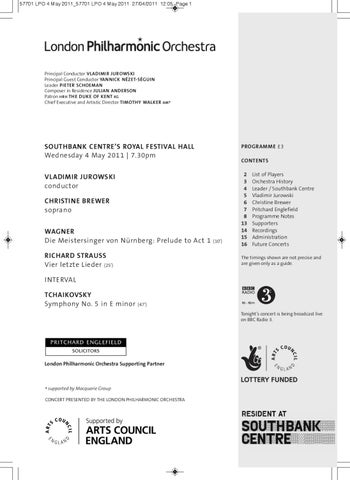
Principal Conductor VLADIMIR JUROWSKI Principal Guest Conductor YANNICK NÉZET-SÉGUIN Leader PIETER SCHOEMAN Composer in Residence JULIAN ANDERSON Patron HRH THE DUKE OF KENT KG Chief Executive and Artistic Director TIMOTHY WALKER
AM†
SOUTHBANK CENTRE’S ROYAL FESTIVAL HALL Wednesday 4 May 2011 | 7.30pm
PROGRAMME £3 CONTENTS
VLADIMIR JUROWSKI conductor CHRISTINE BREWER soprano WAGNER Die Meistersinger von Nürnberg: Prelude to Act 1 RICHARD STRAUSS Vier letzte Lieder (25’)
(10’)
2 3 4 5 6 7 8 13 14 15 16
List of Players Orchestra History Leader / Southbank Centre Vladimir Jurowski Christine Brewer Pritchard Englefield Programme Notes Supporters Recordings Administration Future Concerts
The timings shown are not precise and are given only as a guide.
INTERVAL TCHAIKOVSKY Symphony No. 5 in E minor
(47’) Tonight’s concert is being broadcast live on BBC Radio 3.
London Philharmonic Orchestra Supporting Partner
†
supported by Macquarie Group
CONCERT PRESENTED BY THE LONDON PHILHARMONIC ORCHESTRA
57701 LPO 4 May 2011_57701 LPO 4 May 2011 27/04/2011 12:05 Page 2
LONDON PHILHARMONIC ORCHESTRA
FIRST VIOLINS Pieter Schoeman* Leader Vesselin Gellev Sub-Leader Chair supported by John and Angela Kessler
Katalin Varnagy Catherine Craig Thomas Eisner Tina Gruenberg Martin Hรถhmann Chair supported by Richard Karl Goeltz
Geoffrey Lynn Robert Pool Florence Schoeman Sarah Streatfeild Yang Zhang Rebecca Shorrock Alain Petitclerc SECOND VIOLINS Clare Duckworth Principal Chair supported by Richard and Victoria Sharp
Joseph Maher Kate Birchall Chair supported by David and Victoria Graham Fuller
Nancy Elan Fiona Higham Nynke Hijlkema Ashley Stevens Sioni Williams Heather Badke Stephen Stewart Elizabeth Baldey Caroline Frenkel Caroline Simms Steve Dinwoodie
VIOLAS Tom Dunn Guest Principal Robert Duncan Katharine Leek Susanne Martens Benedetto Pollani Emmanuella Reiter-Bootiman Laura Vallejo Naomi Holt Michelle Bruil Miranda Davis Rebecca Carrington Martin Fenn CELLOS Kristina Blaumane Principal Susanne Beer Co-Principal Francis Bucknall Laura Donoghue Jonathan Ayling Chair supported by Caroline, Jamie and Zander Sharp
Santiago Sabino Carvalho + Gregory Walmsley Sue Sutherley Susanna Riddell Elizabeth Wiklander DOUBLE BASSES Kevin Rundell* Principal Tim Gibbs Co-Principal Laurence Lovelle George Peniston Richard Lewis Kenneth Knussen Tom Walley Louis Garson
FLUTES Jaime Martin* Principal Sue Thomas* Marta Santamaria PICCOLOS Stewart McIlwham* Principal Marta Santamaria OBOES Ian Hardwick Principal Angela Tennick COR ANGLAIS Sue Bohling Principal Chair supported by Julian and Gill Simmonds
TROMBONES Mark Templeton* Principal David Whitehouse BASS TROMBONE Lyndon Meredith Principal TUBA Lee Tsarmaklis Principal TIMPANI Simon Carrington* Principal PERCUSSION Rachel Gledhill Principal Andrew Barclay* Co-Principal Chair supported by Andrew Davenport
CLARINETS Nicholas Carpenter Principal Emily Meredith
HARP Rachel Masters* Principal
BASS CLARINET Paul Richards Principal
CELESTE Catherine Edwards
BASSOONS John Price Principal Gareth Newman* Simon Estell
ASSISTANT CONDUCTOR Thomas Blunt
HORNS John Ryan* Principal Martin Hobbs Adrian Uren Gareth Mollison Stephen Nicholls TRUMPETS Paul Beniston* Principal Anne McAneney* Chair supported by Geoff and Meg Mann
Nicholas Betts Co-Principal
* Holds a professorial appointment in London +
Chevalier of the Brazilian Order of Rio Branco
Chair Supporters The London Philharmonic Orchestra also acknowledges the following chair supporters whose player is not present at this concert: The Tsukanov Family
2 | London Philharmonic Orchestra
57701 LPO 4 May 2011_57701 LPO 4 May 2011 27/04/2011 12:05 Page 3
LONDON PHILHARMONIC ORCHESTRA
Seventy-eight years after Sir Thomas Beecham founded the London Philharmonic Orchestra, it is recognised today as one of the finest orchestras on the international stage. Following Beecham’s influential founding tenure the Orchestra’s Principal Conductorship has been passed from one illustrious musician to another, amongst them Sir Adrian Boult, Bernard Haitink, Sir Georg Solti, Klaus Tennstedt and Kurt Masur. This impressive tradition continued in September 2007 when Vladimir Jurowski became the Orchestra’s Principal Conductor and, in a further exciting move, the Orchestra appointed Yannick Nézet-Séguin its new Principal Guest Conductor from September 2008. The London Philharmonic Orchestra has been performing at Southbank Centre’s Royal Festival Hall since it opened in 1951, becoming Resident Orchestra in 1992. It plays there around 40 times each season with many of the world’s most sought after conductors and soloists. Concert highlights in 2010/11 include an exploration of Mahler’s symphonies and complete song cycles during the composer’s anniversary season; the premières of works by Matteo D’Amico, Magnus Lindberg and Brett Dean; a rare opportunity to hear Rossini’s opera Aureliano in Palmira in collaboration with long term partner Opera Rara; and works by the Orchestra’s new Composer in Residence, Julian Anderson. In addition to its London season and a series of concerts at Wigmore Hall, the Orchestra has flourishing residencies in Brighton and Eastbourne, and performs regularly around the UK. It is unique in combining these concert activities with esteemed opera performances each summer at Glyndebourne Festival Opera where it has been the Resident Symphony Orchestra since 1964. The London Philharmonic Orchestra performs to enthusiastic audiences all round the world. In 1956 it became the first British orchestra to appear in Soviet Russia and in 1973 made the first ever visit to China by a Western orchestra. Touring continues to form a significant part of the Orchestra’s schedule and is supported by Aviva, the International Touring Partner of the London Philharmonic Orchestra. Tours in 2010/11 include visits to Finland, Germany, South Korea, Spain, France, Belgium and Luxembourg. Having long been embraced by the recording, broadcasting and film industries, the London
Philharmonic Orchestra broadcasts regularly on domestic and international television and radio. It also works with the Hollywood and UK film industries, recording soundtracks for blockbuster motion pictures including the Oscar-winning score for The Lord of the Rings trilogy and scores for Lawrence of Arabia, The Mission, Philadelphia and East is East. The London Philharmonic Orchestra made its first recordings on 10 October 1932, just three days after its first public performance. It has recorded and broadcast regularly ever since, and in 2005 established its own record label. The recordings on its own label are taken mainly from live concerts given with distinguished conductors over the years including the Orchestra’s Principal Conductors from Beecham and Boult, through Haitink, Solti and Tennstedt, to Masur and Jurowski. Recent additions to the catalogue have included acclaimed releases of Klaus Tennstedt conducting Mahler’s Symphony No. 8 with soloists Julia Varady, Jane Eaglen, Susan Bullock, Trudeliese Schmidt, Jadwiga Rappé, Kenneth Riegel, Eike Wilm Schulte, Hans Sotin, London Philharmonic Choir, Eton College Boys’ Choir and London Symphony Chorus; and a Shostakovich CD with Vladimir Jurowski conducting Shostakovich’s Piano Concertos Nos 1 and 2 and the Piano Quintet with Martin Helmchen. The Orchestra’s own-label CDs are also widely available to download. Visit www.lpo.org.uk/shop for the latest releases. The Orchestra reaches thousands of Londoners through its rich programme of community and school-based activity in Lambeth, Lewisham and Southwark, which includes the offshoot ensembles Renga and The Band, its Foyle Future Firsts apprenticeship scheme for outstanding young instrumentalists, and regular family and schools concerts. To help maintain its high standards and diverse workload, the Orchestra is committed to the welfare of its musicians and in December 2007 received the Association of British Orchestras/Musicians Benevolent Fund Healthy Orchestra Bronze Charter Mark. There are many ways to experience and stay in touch with the Orchestra’s activities: visit www.lpo.org.uk, subscribe to our podcast series, download our iPhone application and join us on Facebook and Twitter. London Philharmonic Orchestra | 3
57701 LPO 4 May 2011_57701 LPO 4 May 2011 27/04/2011 12:05 Page 4
PIETER SCHOEMAN
SOUTHBANK CENTRE
In 2002, Pieter Schoeman joined the London Philharmonic Orchestra as Co-Leader. He was appointed Leader in 2008. Born in South Africa, he made his solo debut with the Cape Town Symphony Orchestra at the age of ten. He studied with Jack de Wet in South Africa, winning numerous competitions, including the 1984 World Youth Concerto Competition in America. In 1987 he was offered the Heifetz Chair of Music scholarship to study with Eduard Schmieder in Los Angeles and in 1991 his talent was spotted by Pinchas Zukerman who recommended that he move to New York to study with Sylvia Rosenberg. In 1994 he became her teaching assistant at Indiana University, Bloomington. Pieter Schoeman has performed as a soloist and recitalist throughout the world in such famous halls as the Concertgebouw in Amsterdam, Moscow’s Rachmaninov Hall, Capella Hall in St Petersburg, Staatsbibliothek in Berlin, Hollywood Bowl in Los Angeles and Southbank Centre’s Queen Elizabeth Hall in London. As a chamber musician he regularly performs at London’s prestigious Wigmore Hall. As a soloist with the London Philharmonic Orchestra, he has performed Arvo Pärt’s Double Concerto with Boris Garlitsky and Benjamin Britten’s Double Concerto with Alexander Zemtsov, which was recorded and released on the Orchestra’s own record label to great critical acclaim. Last October he performed the Brahms Double Concerto with Kristina Blaumane. In 1995 Pieter Schoeman became Co-Leader of the Orchestre Philharmonique de Nice. Since then he has performed frequently as Guest Leader with the symphony orchestras of Barcelona, Bordeaux, Lyon and Baltimore as well as with the BBC Symphony Orchestra. Pieter Schoeman has recorded numerous violin solos with the London Philharmonic Orchestra for Chandos, Opera Rara, Naxos, X5, the BBC and for American film and television. He led the Orchestra in its soundtrack recordings for The Lord of the Rings trilogy. He is a Professor at Trinity College of Music in London.
4 | London Philharmonic Orchestra
Patrick Harrison
LEADER
WELCOME TO SOUTHBANK CENTRE We hope you enjoy your visit. We have a Duty Manager available at all times. If you have any queries please ask any member of staff for assistance. Eating, drinking and shopping? Southbank Centre shops and restaurants include: Foyles, EAT, Giraffe, Strada, YO! Sushi, wagamama, Le Pain Quotidien, Las Iguanas, ping pong, Canteen, Caffè Vergnano 1882, Skylon, Concrete and Feng Sushi, as well as cafes, restaurants and shops inside Royal Festival Hall, Queen Elizabeth Hall and Hayward Gallery. If you wish to get in touch with us following your visit please contact Kenelm Roberts, our Head of Customer Relations, at Southbank Centre, Belvedere Road, London SE1 8XX or phone 020 7960 4250 or email customer@southbankcentre.co.uk. We look forward to seeing you again soon. A few points to note for your comfort and enjoyment: PHOTOGRAPHY is not allowed in the auditorium LATECOMERS will only be admitted to the auditorium if there is a suitable break in the performance RECORDING is not permitted in the auditorium without the prior consent of Southbank Centre. Southbank Centre reserves the right to confiscate video or sound equipment and hold it in safekeeping until the performance has ended MOBILES, PAGERS AND WATCHES should be switched off before the performance begins
57701 LPO 4 May 2011_57701 LPO 4 May 2011 27/04/2011 12:05 Page 5
VLADIMIR JUROWSKI
Karen Robinson
CONDUCTOR
Born in Moscow, the son of conductor Mikhail Jurowski, Vladimir Jurowski completed the first part of his musical studies at the Music College of the Moscow Conservatory. In 1990 he relocated with his family to Germany where he continued his studies in Dresden and Berlin, studying conducting with Rolf Reuter and vocal coaching with Semion Skigin. In 1995 he made his international debut at the Wexford Festival, where he conducted Rimsky-Korsakov’s May Night. The same year saw his brilliant debut at the Royal Opera House Covent Garden in Nabucco. In 1996 he joined the ensemble of Komische Oper Berlin, becoming First Kapellmeister in 1997 and continuing to work at the Komische Oper on a permanent basis until 2001. Since 1997 Vladimir Jurowski has been a guest at some of the world’s leading musical institutions including the Royal Opera House Covent Garden, Teatro La Fenice di Venezia, Opéra Bastille de Paris, Théâtre de la Monnaie Bruxelles, Maggio Musicale Festival Florence, Rossini Opera Festival Pesaro, Edinburgh Festival, Semperoper Dresden and the Teatro Comunale di Bologna (where he served as Principal Guest Conductor between 2000 and 2003). In 1999 he made his debut at the Metropolitan Opera New York with Rigoletto. In January 2001 Vladimir Jurowski took up the position of Music Director of Glyndebourne Festival Opera and in 2003 was appointed Principal Guest Conductor of the London Philharmonic Orchestra, becoming the Orchestra’s Principal Conductor in September 2007. He also holds the title of Principal Artist of the Orchestra of the Age of Enlightenment, and from 2005 to 2009 served as Principal Guest Conductor of the Russian National Orchestra with whom he will continue to work in the years ahead.
Vladimir Jurowski is a regular guest with many of the world’s leading orchestras including the Berlin Philharmonic, Oslo Philharmonic, Royal Concertgebouw, Bavarian Radio Symphony, Dresden Staatskapelle, Los Angeles Philharmonic and Philadelphia Orchestras as well as the Gewandhausorchester Leipzig. Highlights of the 2010/11 season and beyond include his debuts with the Vienna Philharmonic, Cleveland, San Francisco Symphony and Mahler Chamber Orchestras, and return visits to the Chicago Symphony, Chamber Orchestra of Europe, Berlin Philharmonic, Royal Concertgebouw, St Petersburg Philharmonic and Philadelphia Orchestras. His operatic engagements have included Jenůfa, The Queen of Spades and Hänsel und Gretel at the Metropolitan Opera, Parsifal and Wozzeck at Welsh National Opera, War and Peace at the Opéra National de Paris, Eugene Onegin at La Scala Milan, as well as Die Zauberflöte, La Cenerentola, Otello, Macbeth, Falstaff, Tristan und Isolde, Don Giovanni, The Rake’s Progress and Peter Eötvös’ Love and Other Demons at Glyndebourne Opera. Future engagements include new productions of Die Meistersinger and The Cunning Little Vixen at Glyndebourne, Die Frau ohne Schatten at the Metropolitan Opera, Russlan and Ludmila at the Bolshoi Theatre, and Iolanta at the Dresden Semperoper. Jurowski’s discography includes the first ever recording of Giya Kancheli’s cantata Exil for ECM (1994), L’Étoile du Nord by Meyerbeer for Naxos-Marco Polo (1996), and Werther for BMG (1999) as well as live recordings of works by Rachmaninov, Turnage, Tchaikovsky, Britten, Brahms and Shostakovich on the London Philharmonic Orchestra’s own label, and Prokofiev’s Betrothal in a Monastery on Glyndebourne Opera’s own label. He also records for PentaTone with the Russian National Orchestra, with releases to date including Tchaikovsky’s Suite No. 3 and Stravinsky’s Divertimento from Le Baiser de la fée, Shostakovich’s Symphonies Nos 1 and 6, Prokofiev’s Symphony No. 5 and Tchaikovsky’s Hamlet Incidental Music. Glyndebourne have released DVD recordings of his performances of La Cenerentola, Gianni Schicchi, Die Fledermaus and Rachmaninov’s The Miserly Knight, and other recent DVD releases include Hänsel und Gretel from the Metropolitan Opera New York, and his first concert as the London Philharmonic Orchestra’s Principal Conductor featuring works by Wagner, Berg and Mahler (released by Medici Arts).
London Philharmonic Orchestra | 5
57701 LPO 4 May 2011_57701 LPO 4 May 2011 27/04/2011 12:05 Page 6
CHRISTINE BREWER SOPRANO
Now regarded as one of the finest singers of her generation, American soprano Christine Brewer began her professional career with Opera Theatre of Saint Louis, with whom she has performed the roles of Ellen Orford in Peter Grimes and Donna Anna in Don Giovanni, and the title roles in Strauss’s Ariadne auf Naxos, Haydn’s Armida and Britten’s Gloriana. Other engagements have included the roles of Countess Almaviva in Le nozze di Figaro with New York City Opera and the Royal Opera, Covent Garden, and Donna Anna at the Edinburgh Festival under Sir Charles Mackerras and in London, New York and Florida. She has sung Gluck’s Iphigenie en Tauride in Madrid; Leonore in Fidelio at the Gulbenkian, Lisbon, in London and in San Francisco; Weber’s Oberon with Richard Hickox in London; Strauss’s Die Aegyptische Helena, Britten’s Peter Grimes and Gluck’s Alceste in Santa Fe; Gloriana with Richard Hickox at the Aldeburgh Festival; and Chrysothemis in Elektra with the Cleveland Orchestra and Franz Welser-Möst. Other roles include Färberin in Die Frau ohne Schatten with the Lyric Opera of Chicago and the Paris Opera, and Isolde with the BBC Symphony Orchestra and Donald Runnicles, the Los Angeles Philharmonic and Esa-Pekka Salonen, at the Edinburgh Festival with Jonathan Nott and with the San Francisco Opera and Runnicles. Christine Brewer has achieved international renown for her performances of Strauss’s Ariadne auf Naxos, having sung the title role for English National Opera, Opéra de Lyon (in Lyon and Paris), at the Santa Fe Festival and at the Metropolitan Opera under James Levine.
6 | London Philharmonic Orchestra
In concert, Miss Brewer appears with the major American and European Orchestras with Sir Roger Norrington, Michael Tilson Thomas, Kurt Masur, John Adams, Christoph von Dohnányi, Andrew Litton, John Nelson, Wolfgang Sawallisch, Ivan Fischer, Zubin Mehta, Esa-Pekka Salonen, Antonio Pappano, Sir Colin Davis and Sir Simon Rattle. Her wide discography includes Don Giovanni under Sir Charles Mackerras, Barber’s Vanessa under Leonard Slatkin, Fidelio with Sir Colin Davis, both Tristan und Isolde and Strauss’s Vier letzte Lieder with Donald Runnicles, and she appears in Graham Johnson’s complete Schubert Edition for Hyperion. Engagements have included the gala concerts to re-open the Royal Opera House, Covent Garden, under Bernard Haitink and Britten’s War Requiem in Rome with Antonio Pappano, and she has forged strong links with the BBC Proms most notably with performances of Wagner’s Die Walküre and Götterdämmerung and Schoenberg’s Gurrelieder under Donald Runnicles, and Mahler’s 8th Symphony under Sir Simon Rattle. Christine Brewer’s European concert engagements include appearances with the Concertgebouw and Bayerische Rundfunk Orchestras with Mariss Jansons, the Berlin Philharmonic Orchestra with Sir Simon Rattle, the BBC Symphony Orchestra with Jiří Bělohlávek, the London Philharmonic Orchestra with Vladimir Jurowski, the London Symphony Orchestra with Sir Colin Davis and the Accademia Santa Cecilia with Antonio Pappano. Miss Brewer is the recipient of the BBC Radio 3 Listener’s Award of the 2008 Royal Philharmonic Society Music Awards.
57701 LPO 4 May 2011_57701 LPO 4 May 2011 27/04/2011 12:06 Page 7
57701 LPO 4 May 2011_57701 LPO 4 May 2011 27/04/2011 12:06 Page 8
PROGRAMME NOTES
SPEEDREAD In their own very distinct ways, Pyotr Ilyich Tchaikovsky and Richard Strauss found themselves in situations that must have felt both hopeless and profoundly depressing. Tchaikovsky’s life was riddled with tragedy. Tortured by his public genius and private homosexuality, the composer entertained the idea that his existence might be driven by fate and that he was powerless to direct its course. In his Fourth and Fifth Symphonies, he grapples with that idea. Perhaps in the Fifth he manages to wrestle himself free of its clutches – then again, perhaps not. Either way, he resisted the urge to explicitly explain the symphony’s meaning, leaving the privilege of interpretation to performers and listeners. A veritable stroll-in-the-park next to Tchaikovsky’s, Richard Strauss’s life was largely unperturbed and nonchalantly fruitful, enhanced by a long and mostly
Richard WAGNER
happy marriage. Until, that was, the grotesque excesses of Nazism began to signal the disintegration of his homeland from within. For Strauss, the destruction of Germany’s cultural institutions during the Second World War was a small but tragic echo of the bigger cost of the conflict; a sign of the inane dehumanization that could lead man to slaughter man. The year before his death, looking around him at a Germany in ashes, Strauss penned the Four Last Songs – his final acceptance that the end had come. Nothing so profound controls the Prelude to Wagner’s only comic opera Die Meistersinger von Nürnberg. But just as Strauss’s music seems so inevitable – and Tchaikovsky’s tries hard not to be – Wagner’s Prelude takes three musical ideas and ultimately combines them with such skill that the very act of doing so feels somehow predestined. Fateful in a musical sense, at least, and astoundingly exhilarating for it.
DIE MEISTERSINGER VON NÜRNBERG: PRELUDE TO ACT 1
1813-1883
No gods, no dragons, no potions and no miracles: The Mastersingers of Nuremberg is certainly the most downto-earth of Richard Wagner’s music dramas. The composer began sketching the work in 1845, imagining a French or Italian style ‘intrigue comedy’; though there’s the odd gag in the Ring, this would be Wagner’s first and last attempt at comic opera. For it, he took real historical figures and placed them in a splendid 16thcentury Nuremberg where they indulged in one of the city’s most illustrious traditions: the public song competition of the Mastersingers Guild. Immediate, human and amusing the opera may be, but it lacks no majesty. And as Wagner’s longest opera, it certainly isn’t diminutive either.
8 | London Philharmonic Orchestra
The same, on both counts, can be said of Wagner’s Prelude. It showcases three of the opera’s main musical ideas: the hearty, noble theme associated with the song prize ceremony; the yearning, aspiring tune associated with the young Knight Walther von Stolzing (who has desires on the opera’s central love interest, Eva); and the theme with which the youngsters of Nuremberg gently mock the traditions of their elders. Listen out, at the height of the Prelude, as all three themes are combined in a taut, weaving counterpoint (complete with characteristic scurrying strings) that feels gloriously inevitable.
57701 LPO 4 May 2011_57701 LPO 4 May 2011 27/04/2011 12:06 Page 9
PROGRAMME NOTES
Richard STRAUSS
VIER LETZTE LIEDER (FOUR LAST SONGS) CHRISTINE BREWER soprano Frühling | September | Beim Schlafengehen | Im Abendrot
1864-1949
By 1948, the year of his Vier letzte Lieder, Richard Strauss had witnessed the cultural and physical destruction of his beloved Germany from within. But if the ravaging of Europe during the Second World War depressed Strauss beyond words, he had a lifelong companion to console him – the soprano voice. He turned to it for the five last creative acts before his death in September 1949: the four songs that form the Vier letzte Lieder, and another non-related aria discovered in the mid 1980s. After the ceasefire that ended the war Strauss settled in Switzerland. But he remained gravely depressed, not least as politics continued to negatively infiltrate cultural life (now American political action as much as the Nazi legacy). Desperate to action his self-styled blueprint for Germany’s cultural rebirth, Strauss lobbied officials relentlessly. His son Franz recognised the futility of this action, advising him simply to ‘write some songs’. Strauss visited Franz some months later, fleetingly depositing a manuscript with his daughter-inlaw as ‘the songs your husband ordered’. That rather bureaucratic description belies four songs for soprano and orchestra of extraordinary profundity and intimacy. One setting of words by Eichendorff (Im Abendrot) and three by Hesse all suggest resignation in the face of death – Strauss’s musical reaction feels like the natural successor to all the prodigality and liveliness of his earlier tone poems.
Not that those tone poems are forgotten. Strewn among Strauss’s floating, twisting soprano line and glowing orchestrations are a handful of references to the composer’s past life and works: snippets of the tone poems and operas are included – not so much witticisms as acknowledgements of the past as a mechanism for accepting the future. His loving use of a solo horn is often said to reference his wife Pauline, though Strauss biographer Michael Kennedy has said that Pauline ‘haunts every bar’ – apparent from the delirious love expressed in Frühling to the fluttering twinned larks of Im Abendrot. Creeping, slippery modulations add to the feeling of other-worldliness and transcendence that pervades the songs. Strauss never heard these songs performed. The set we now know, heard here in the order prescribed by the British publisher Ernest Roth, was first performed at the Royal Albert Hall in May 1950 – eight months after the composer’s death. It may have been that Strauss was happy to leave his work for the ears of others. Many believe his non-attendance at public performances of the late masterpiece Metamorphosen – another lament for the lost Germany and a sort of Prelude to the Vier letzte Lieder – was indicative of the very personal and emotional nature of the piece; that he would have considered his public reaction to a performance too much of a window into his soul.
London Philharmonic Orchestra | 9
57701 LPO 4 May 2011_57701 LPO 4 May 2011 27/04/2011 12:06 Page 10
PROGRAMME NOTES
Frühling
Spring
In dämmrigen Grüften Träumte ich lang Von deinen Bäumen und blauen Lüften Von deinem Duft und Vogelgesang.
In dusky vaults I long dreamed Of your trees and blue skies, Your scents and birdsong.
Nun liegst du erschlossen In Gleiss und Zier Von Licht übergossen Wie ein Wunder vor mir.
Now you lie revealed In glittering adornment Bathed in light Like a miracle before me.
Du kennst mich wieder, Du lockst mich zart, Es zittert durch all meine Glieder Deine selige Gegenwart.
You recognise me, You tenderly entice me, There quivers through all my limbs Your blessed presence.
Hermann Hesse* September
September
Der Garten trauert, Kühl sinkt in die Blumen der Regen. Der Sommer schauert Still seinem Ende entgegen.
The garden is in mourning, Coolly the rain falls on the flowers. The summer shudders Quietly towards its end.
Golden tropft Blatt um Blatt Nieder vom hohen Akazienbaum. Sommer lächelt erstaunt und matt In den sterbenden Gartentraum.
Golden leaf after leaf drops Down from the tall acacia tree. Summer smiles astonished and faint In the dying garden dream.
Lange noch bei den Rosen Bleibt er stehen, sehnt sich nach Ruh. Langsam tut er die (grossen) Müdegewordenen Augen zu.
For a long time by the roses It lingers, longing for rest. Slowly it closes its (big) Weary eyes.
Hermann Hesse* Beim Schlafengehen
On Going to Sleep
Nun der Tag mich müd’ gemacht, Soll mein sehnliches Verlangen Freundlich die gestirnte Nacht Wie ein müdes Kind empfangen.
Now the day has tired me, My ardent wish is to Welcome the starry night Like a weary child.
Hände lasst von allem Tun, Stirn vergiss du alles Denken, Alle meine Sinne nun Wollen sich in Schlummer senken.
Hands be done with every deed, Brow forget your every thought, All my senses now Want to sink in slumber.
Und die Seele unbewacht Will in freien Flügen schweben, Um im Zauberkreis der Nacht Tief und tausendfach zu leben.
And the unguarded spirit Wants in free flight to soar, So in the magic circle of the night Deeply and a thousandfold to live.
Hermann Hesse*
10 | London Philharmonic Orchestra
57701 LPO 4 May 2011_57701 LPO 4 May 2011 27/04/2011 12:06 Page 11
PROGRAMME NOTES
Im Abendrot
In the Sunset
Wir sind durch Not und Freude gegangen Hand in Hand, vom Wandern ruhn wir (beide) nun überm stillen Land.
We have through hardship and joy walked hand in hand, from our travels we are resting now in the quiet countryside.
Rings sich die Täler neigen, es dunkelt schon die Luft, zwei Lerchen nur noch steigen nachträumend in den Duft.
All around the valleys incline, it is already getting dark, only two larks are still rising dreamily in the atmosphere.
Tritt her und lass sie schwirren, bald ist es Schlafenzeit, dass wir uns nicht verirren in dieser Einsamkeit.
Come here and leave them whirring, it will soon be time to sleep, we must not lose our way in this solitude.
O weiter, stiller Friede! So tief im Abendrot. Wie sind wir wandermüde – ist dies etwa der Tod?
O spacious, silent peace! So profound in the sunset. How travel-weary we are – is this perhaps death?
Joseph von Eichendorff * From Hermann Hesse "Gedichte". Vier letzte Lieder – Strauss/Hesse/Eichendorff. © Copyright 1950 by Boosey & Co. Ltd. Reproduced by permission of Boosey & Hawkes Music Publishers Ltd. English translations © by Eric Mason.
INTERVAL 20 minutes An announcement will be made five minutes before the end of the interval.
Pyotr Ilyich TCHAIKOVSKY
SYMPHONY NO. 5 IN E MINOR, OP. 64 Andante – Allegro con anima | Andante cantabile, con alcuna licenza | Valse: Allegro moderato | Finale: Andante maestoso – Allegro vivace
1840-1893
So filled with torment was Tchaikovsky’s personal life that you can well understand why he’d be tempted to put the tragic course of its events down to fate. In reality, he wasn’t that quick to accept the concept of predestination as a controlling force, but he did chew over it a great deal – within his music and outside it.
Some of the biggest clues to any conclusions he might have drawn are found in this symphony. Tchaikovsky’s mood was dark when he began to consider a new symphony in the spring of 1888. He was tormented still by the failure of his most recent major
London Philharmonic Orchestra | 11
57701 LPO 4 May 2011_57701 LPO 4 May 2011 27/04/2011 12:06 Page 12
PROGRAMME NOTES
orchestral work – the Manfred Symphony – and racked with ongoing pain as he battled to keep his homosexuality secret (itself a stroke of fate, in Tchaikovsky’s mind, but one that loaded ever more emphasis on the question of whether to ‘pursue freedom’). In the context of all this personal stress, the composer felt his musical inspiration drying up, and wrote despairingly to his brother to say so. In fact, such fractious circumstances usually had the opposite effect on Tchaikovsky’s muse, and this was no exception. Shortly after that fraternal letter was written, the composer started to sketch out his ideas for the symphony; six weeks later he’d finished his short score, and by August of 1888 the full orchestration. ‘I have not blundered’, Tchaikovsky said of the piece upon its completion, ‘it has turned out well.’ But his sentiments were short lived: at the symphony’s unveiling in St Petersburg on 5 November the audience reaction was muted; Tchaikovsky sank, once again, into a resigned depression. Fate had dealt its hand once more. In a notebook, Tchaikovsky described the work’s opening paragraph as ‘complete resignation before fate.’ We hear a theme played quietly by unison clarinets; this is Tchaikovsky’s fate ‘motto’, and it will undergo masterly transformations of shape and mood (though always in the context of a march rhythm) as the composer’s thoughts develop. Which they do, and quickly: by the Allegro section, Tchaikovsky is annotating his music thus: ‘Murmurs, doubts … shall I throw myself into the embrace of faith?’ The battle between freedom and fate – by implication, ‘secrecy’ and ‘openness’ – is on. The second movement is centred on a loving, heartfelt theme offered by a solo horn and responded to by an oboe and a floating clarinet. But as this nocturnal,
glistening mood takes effect on the whole orchestra, the fate motif intrudes to disrupt happiness and prompt an uneasy silence. Similarly, at the end of the waltz-time third movement – inspired by a street song Tchaikovsky heard in Italy – the fate theme is sounded, ominously fleeting and with a brooding quietness. But suddenly, as the finale begins, the motto has been transformed: it resounds triumphantly (and in the major) in the movement’s introduction and in its coda, hurled forwards on horns and trumpets. But is this really a victory over fate? Musicologist Paul Griffiths points to a strange emptiness at the movement’s height; ‘more and more force and less and less conviction’, he says of the gathering momentum of Tchaikovsky’s sonata form, as if the composer’s creative perceptiveness has the victory more than any sense of personal conviction or freedom. From that we might conclude that Tchaikovsky has accepted the pre-determined course of his life and resigned himself to it – with all the flattened optimism and relief such resignation can provide. Or perhaps this final movement of Tchaikovsky’s Fifth is akin to that of Beethoven’s: an unmitigated triumph over predestination; a splendid transcendence from darkness to light. We know Tchaikovsky continued to struggle with his sexuality in secret. Perhaps that’s at the heart of this symphony’s preoccupation with contrasts and paradoxes both musical and philosophical. What’s undisputed is its richness and variance. Across its rollercoaster of original sounds and extremes of tempo, the symphony poses quite an emotional journey – whatever the exit point. Programme notes by Andrew Mellor © 2011
Live orchestral concerts broadcast on BBC Radio 3 are a vital part of the station’s output and I’m delighted that we will continue our long association with the London Philharmonic Orchestra by bringing performances from this season to the widest possible audience. Roger Wright Controller, BBC Radio 3
12 | London Philharmonic Orchestra
57701 LPO 4 May 2011_57701 LPO 4 May 2011 27/04/2011 12:06 Page 13
We would like to acknowledge the generous support of the following Thomas Beecham Group Patrons, Principal Benefactors and Benefactors: Thomas Beecham Group Mr & Mrs Richard & Victoria Sharp Julian & Gill Simmonds The Tsukanov Family Garf & Gill Collins Andrew Davenport David & Victoria Graham Fuller Richard Karl Goeltz John & Angela Kessler Mr & Mrs Makharinsky Geoff & Meg Mann Caroline, Jamie & Zander Sharp Eric Tomsett Guy & Utti Whittaker Principal Benefactors Mark & Elizabeth Adams Jane Attias Lady Jane Berrill Desmond & Ruth Cecil Mr John H Cook Mrs Sonja Drexler Mr Charles Dumas David Ellen Commander Vincent Evans
Mr Daniel Goldstein Mrs Barbara Green Oliver Heaton Mr & Mrs Jeffrey Herrmann Peter MacDonald Eggers Mr & Mrs David Malpas Andrew T Mills Mr Maxwell Morrison Mr Michael Posen Mr & Mrs Thierry Sciard Mr John Soderquist & Mr Costas Michaelides Mr & Mrs G Stein Mr & Mrs John C Tucker Howard & Sheelagh Watson Mr Laurie Watt Mr Anthony Yolland Benefactors Mrs A Beare Dr & Mrs Alan Carrington CBE FRS Marika Cobbold & Michael Patchett-Joyce Mr & Mrs Stewart Cohen Mr Alistair Corbett Mr David Edgecombe
Mr Richard Fernyhough Ken Follett Michael & Christine Henry Mr Glenn Hurstfield Mr R K Jeha Mr & Mrs Maurice Lambert Mr Gerald Levin Sheila Ashley Lewis Wg. Cdr. & Mrs M T Liddiard OBE JP RAF Mr Frank Lim Paul & Brigitta Lock Mr Brian Marsh John Montgomery Edmund Pirouet Mr Peter Tausig Mrs Kazue Turner Lady Marina Vaizey Mr D Whitelock Hon. Benefactor Elliott Bernerd Hon. Life Members Kenneth Goode Mrs Jackie Rosenfeld OBE
The generosity of our Sponsors, Corporate Members, supporters and donors is gratefully acknowledged. Corporate Members Appleyard & Trew llp AREVA UK British American Business Brown Brothers Harriman Charles Russell Destination Québec – UK Diagonal Consulting Lazard Leventis Overseas Man Group plc Québec Government Office in London Corporate Donor Lombard Street Research In-kind Sponsors Google Inc Heineken The Langham London Lindt & Sprüngli Ltd Sela / Tilley’s Sweets Villa Maria Trusts and Foundations Allianz Cultural Foundation The Andor Charitable Trust Arts and Business
Ruth Berkowitz Charitable Trust The Boltini Trust Borletti-Buitoni Trust Britten-Pears Foundation The Candide Charitable Trust The John S Cohen Foundation The Coutts Charitable Trust The Delius Trust The Dorset Foundation The D’Oyly Carte Charitable Trust Dunard Fund The Equitable Charitable Trust The Eranda Foundation The Ernest Cook Trust The Fenton Arts Trust The Foyle Foundation The Jeniffer and Jonathan Harris Charitable Trust Hattori Foundation for Music and the Arts Capital Radio’s Help a London Child The Idlewild Trust The Emmanuel Kaye Foundation The Leverhulme Trust Lord and Lady Lurgan Trust Maurice Marks Charitable Trust The Michael Marks Charitable Trust Marsh Christian Trust
UK Friends of the FelixMendelssohn-Bartholdy Foundation The Mercers’ Company Adam Mickiewicz Institute Paul Morgan Charitable Trust Maxwell Morrison Charitable Trust Musicians Benevolent Fund The R K Charitable Trust Serge Rachmaninoff Foundation The Reed Foundation The Rubin Foundation The Seary Charitable Trust The Samuel Sebba Charitable Trust Sound Connections The Stansfield Trust The Steel Charitable Trust The Bernard Sunley Charitable Foundation The Swan Trust John Thaw Foundation The Underwood Trust Garfield Weston Foundation Youth Music and others who wish to remain anonymous.
London Philharmonic Orchestra | 13
57701 LPO 4 May 2011_57701 LPO 4 May 2011 27/04/2011 12:06 Page 14
RECORDINGS ON THE LONDON PHILHARMONIC ORCHESTRA’S OWN RECORD LABEL
LPO-0003 Klaus Tennstedt conducts orchestral excerpts from Wagner operas ‘Every bar of these performances is filled with the extra adrenalin that one expects at a really memorable concert.’ BBC MUSIC MAGAZINE
LPO-0039 Vladimir Jurowski conducts Tchaikovsky’s Symphonies Nos 1 and 6 ‘Both are exceptional performances, superbly recorded with a breathtaking range of dynamics … In both works, the playing of the LPO is world class.’ ANDREW CLEMENTS, THE GUARDIAN, 4 SEPTEMBER 2009
LPO-0009 Vladimir Jurowski conducts Tchaikovsky’s Manfred Symphony ‘... it is a wonderfully vivid recording of an exceptionally vibrant, immaculately played performance ... a superb disc.’ THE GUARDIAN, 2 JUNE 2006
The recordings may be downloaded in high quality MP3 format from www.lpo.org.uk/shop. CDs may also be purchased from all good retail outlets or through the London Philharmonic Orchestra: telephone 020 7840 4242 (Mon-Fri 10am-5pm) or visit the website www.lpo.org.uk
14 | London Philharmonic Orchestra
57701 LPO 4 May 2011_57701 LPO 4 May 2011 27/04/2011 12:06 Page 15
ADMINISTRATION
BOARD OF DIRECTORS
GENERAL ADMINISTRATION
ORCHESTRA PERSONNEL
ARCHIVES
Martin Höhmann Chairman Stewart McIlwham Vice-Chairman Sue Bohling Lord Currie* Jonathan Dawson* Gareth Newman George Peniston Sir Bernard Rix* Kevin Rundell Sir Philip Thomas* The Rt Hon. Lord Wakeham DL* Timothy Walker AM †
Timothy Walker AM † Chief Executive and Artistic Director
Andrew Chenery Orchestra Personnel Manager
Edmund Pirouet Consultant
Sarah Thomas Librarian
Philip Stuart Discographer
Michael Pattison Stage Manager
Gillian Pole Recordings Archive
*Non-Executive Directors
Alison Atkinson Digital Projects Manager FINANCE David Burke General Manager and Finance Director David Greenslade Finance and IT Manager CONCERT MANAGEMENT
THE LONDON PHILHARMONIC TRUST
Roanna Chandler Concerts Director
Pehr Gyllenhammar Chairman Desmond Cecil CMG Richard Karl Goeltz Jonathan Harris CBE FRICS Dr Catherine C. Høgel Martin Höhmann Angela Kessler Clive Marks OBE FCA Victoria Sharp Julian Simmonds Timothy Walker AM † Laurence Watt
Ruth Sansom Artistic Administrator
AMERICAN FRIENDS OF THE LONDON PHILHARMONIC ORCHESTRA, INC. We are very grateful to the Board of the American Friends of the London Philharmonic Orchestra for its support of the Orchestra’s activities in the USA. PROFESSIONAL SERVICES Charles Russell Solicitors Crowe Clark Whitehill LLP Auditors Dr Louise Miller Honorary Doctor
Graham Wood Concerts, Recordings and Glyndebourne Manager Alison Jones Concerts Co-ordinator Jenny Chadwick Tours and Engagements Manager Jo Orr PA to the Executive / Concerts Assistant Matthew Freeman Recordings Consultant EDUCATION AND COMMUNITY PROGRAMME Patrick Bailey Education and Community Director
Camilla Begg Assistant Orchestra Personnel Manager Ken Graham Trucking Instrument Transportation (Tel: 01737 373305)
Nick Jackman Development Director Harriet Mesher Charitable Giving Manager Phoebe Rouse Corporate Relations Manager
Laura Luckhurst Corporate Relations and Events Officer Elisenda Ayats Development and Finance Officer
www.lpo.org.uk Visit the website for full details of London Philharmonic Orchestra activities. The London Philharmonic Orchestra Limited is a registered charity No. 238045.
Photographs of Wagner, Strauss and Tchaikovsky courtesy of the Royal College of Music, London.
MARKETING
Photograph on the front cover by Karen Robinson.
Kath Trout Marketing Director
Programmes printed by Cantate.
Ellie Dragonetti Marketing Manager Helen Boddy Marketing Co-ordinator
Anne Findlay Education Manager
Frances Cook Publications Manager
Caz Vale Community Officer
Samantha Kendall Box Office Manager (Tel: 020 7840 4242)
Richard Mallett Education and Community Producer
89 Albert Embankment London SE1 7TP Tel: 020 7840 4200 Fax: 020 7840 4201 Box Office: 020 7840 4242
DEVELOPMENT
Melissa Van Emden Events Manager
LONDON PHILHARMONIC ORCHESTRA
Ed Weston Intern Valerie Barber Press Consultant (Tel: 020 7586 8560)
†Supported by Macquarie Group
London Philharmonic Orchestra | 15
57701 LPO 4 May 2011_57701 LPO 4 May 2011 27/04/2011 12:06 Page 16
FUTURE CONCERTS AT SOUTHBANK CENTRE’S ROYAL FESTIVAL HALL
FUNHARMONICS FAMILY CONCERT Sunday 15 May 2011 | 11.30am Kodály The Viennese Musical Clock from Háry János Suite Prokofiev Waltz from Cinderella: Suite No. 1 Haydn Excerpt from Symphony No. 101 (The Clock) McNeff The Clockwork Suite Beethoven Allegretto from Symphony No. 8 J Strauss Perpetuum mobile Ponchielli Dance of the Hours from La gioconda Stuart Stratford conductor Chris Jarvis presenter Foyer Events from 10am You can try your hand at playing an orchestral instrument in one of our Have-a-Go sessions, get your face painted or join our human orchestra – all in the foyers before and after the performance. Generously supported by The Jeniffer and Jonathan Harris Charitable Trust.
Vladimir Jurowski and Christian Gerhaher
MAHLER ANNIVERSARY Saturday 28 May 2011 | 7.30pm Haydn Symphony No. 88 Mahler Songs from Des knaben Wunderhorn Brahms Symphony No. 4
Sound Games Puzzles, illusions, deception, tricks ... Debut Sounds presents new music on a theme of ‘Games’ by four young composers alongside works by Lutosławski and Birtwistle performed by Foyle Future Firsts and members of the London Philharmonic Orchestra.
Southbank Centre’s Queen Elizabeth Hall Wednesday 8 June 2011 | 7.30pm Harrison Birtwistle Theseus Game Witold Lutosławski Jeux Vénitiens Blai Soler Plain-Chant Mihyun Woo Metamorphose Emily Wright Incantation Erick Flores Foliage Clement Power conductor Thomas Blunt conductor Foyle Future Firsts Members of the London Philharmonic Orchestra The Foyle Future Firsts programme is generously funded by The Foyle Foundation with additional support from The D’Oyly Carte Charitable Trust, The Fenton Arts Trust, Musicians Benevolent Fund, Eranda Foundation and The Seary Charitable Trust. The Orchestra’s Young Composers Scheme is supported by Eranda Foundation. The Debut Sounds concert is supported by donors to the London Philharmonic Orchestra Annual Appeal 2010/11.
Vladimir Jurowski conductor Christian Gerhaher baritone
TO BOOK
6.15pm–6.45pm | FREE Pre-Concert Event Royal Festival Hall Surrey University music lecturer Jeremy Barham examines ‘Music of the people? Mahler’s folksong revival in the Lieder and symphony’.
Tickets 15 May: Child £4-£8 | Adult £8-£16 Tickets 28 May: £9-£38 | Premium seats £55 Tickets 8 June: £9 | Students £4 London Philharmonic Orchestra Ticket Office 020 7840 4242 | www.lpo.org.uk Mon-Fri 10am-5pm; no booking fee Southbank Centre Ticket Office | 0844 847 9920 www.southbankcentre.co.uk/lpo Daily, 9am-8pm. £2.75 telephone / £1.75 online booking fees; no fee for Southbank Centre members
16 | London Philharmonic Orchestra