Principal Conductor VLADIMIR JUROWSKI* Principal Guest Conductor YANNICK NÉZET-SÉGUIN Leader pieter schoeman Composer in Residence JULIAN ANDERSON Patron HRH THE DUKE OF KENT KG Chief Executive and Artistic Director TIMOTHY WALKER AM†
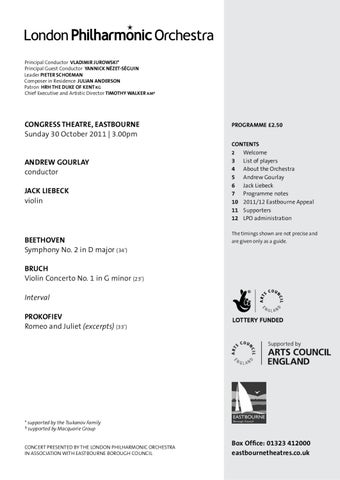
CONGRESS THEATRE, EASTBOURNE Sunday 30 October 2011 | 3.00pm
ANDREW GOURLAY conductor JACK LIEBECK violin
BEETHOVEN Symphony No. 2 in D major (34’)
PROGRAMME £2.50 CONTENTS 2 Welcome 3 List of players 4 About the Orchestra 5 Andrew Gourlay 6 Jack Liebeck 7 Programme notes 10 2011/12 Eastbourne Appeal 11 Supporters 12 LPO administration The timings shown are not precise and are given only as a guide.
BRUCH Violin Concerto No. 1 in G minor (23’) Interval PROKOFIEV Romeo and Juliet (excerpts) (33’)
* supported by the Tsukanov Family † supported by Macquarie Group CONCERT PRESENTED BY THE LONDON PHILHARMONIC ORCHESTRA IN ASSOCIATION WITH EASTBOURNE BOROUGH COUNCIL
Box Office: 01323 412000 eastbournetheatres.co.uk
congress theatre, eastbourne Artistic Director Chris Jordan General Manager Gavin Davis
Welcome to the Congress Theatre Welcome to this afternoon’s performance by the London Philharmonic Orchestra. We hope you enjoy the concert and your visit here. As a courtesy to others, please ensure mobile phones and watch alarms are switched off during the performance. Thank you. We are delighted and proud to have the London Philharmonic Orchestra reside at the Congress Theatre for the fifteenth year. Thank you, our audience, for continuing to support the concert series. Without you, these concerts would not be possible. We welcome comments from our customers. Should you wish to contribute, please speak to the House Manager on duty, email theatresmarketing@eastbourne.gov.uk or write to Suzanne Hopp, Marketing Manager, Eastbourne Theatres, Compton Street, Eastbourne, East Sussex, BN21 4BP.
London Philharmonic Orchestra 2011/12 concerts at the Congress Theatre, Eastbourne For full details and booking information pick up a brochure from the foyer today.
Sunday 15 January 2012 | 3.00pm Prokofiev Symphony No. 1 (Classical) Glazunov Saxophone Concerto Villa Lobos Fantasia Tchaikovsky Symphony No. 5 Danail Rachev conductor Amy Dickson saxophone
Sunday 12 February 2012 | 3.00pm Dvořák Overture, Carnival Dvořák Cello Concerto Dvořák Symphony No. 7 Eckehard Stier conductor Colin Carr cello Sunday 25 March 2012 | 3.00pm Weber Overture, Oberon Mendelssohn Violin Concerto Vaughan Williams The Lark Ascending Sibelius Symphony No. 5 Fabien Gabel conductor Fanny Clamagirand violin
‘[Amy Dickson] has an individual and unusual tone, luscious, silky-smooth, sultry and voluptuous by turns; her phrasing is beautifully finished, her control of dynamic infinitely subtle.’ Gramophone
Sunday 22 April 2012 | 3.00pm Beethoven Overture, Egmont Beethoven Piano Concerto No. 5 (Emperor) Tchaikovsky Swan Lake (excerpts) Carl Davis conductor Melvyn Tan piano
Tickets £12–£28 | Congress Theatre Box Office: 01323 412000 | Book online: www.eastbournetheatres.co.uk
2 | London Philharmonic Orchestra
LONDON PHILHARMONIC ORCHESTRA
Cellos Jonathan Ayling Principal
Chair supported by John and Angela Kessler
Chair supported by Caroline, Jamie and Zander Sharp
Xuan Du Shlomy Dobrinsky Geoffrey Lynn Lisa Obert Ishani Bhoola Maeve Jenkinson Sarah Buchan Charlotte Scott Holly Bhattacharya Jennifer Christie Dafydd Williams
Gregory Walmsley Santiago Carvalho† Susanna Riddell Tom Roff Pavlos Carvalho Tae-Mi Song Double Basses Kevin Rundell* Principal Tom Walley Helen Rowlands Lowri Morgan Charlotte Kerbegian
Horns Mark Vines Principal Gareth Mollison Tim Ball Anthony Chidell Sam Jacobs Trumpets Paul Beniston* Principal Anne McAneney*
© Fran Collin
First Violins Vesselin Gellev Leader
Chair supported by Geoff and Meg Mann
Nicholas Betts Co-Principal
Vesselin Gellev (Leader)
Bulgarian violinist Vesselin Gellev has been a featured soloist with the London Second Violins Trombones Philharmonic Orchestra, Clare Duckworth Principal Mark Templeton* Principal Flutes Spoleto Festival Orchestra, Chair supported by David Whitehouse Susan Thomas Principal the Sharp Family New Haven Symphony Sarah Bennington Bass Trombone Joseph Maher Orchestra and Juilliard Lyndon Meredith Principal Kate Birchall Piccolo Orchestra, among others. Chair supported by David Katie Bicknell Tuba He won First Prize at the and Victoria Graham Fuller Lee Tsarmaklis* Principal Concert Artists Guild Oboes Fiona Higham Competition in New David Theodore Timpani Andrew Thurgood Guest Principal Simon Carrington* Principal York as a member of the Mila Mustakova Katie Bennington Antares Quartet, and has Elizabeth Baldey Percussion recorded several albums Stephen Dinwoodie Cor Anglais Andrew Barclay* Principal and toured worldwide Naomi Anner Helen Vigurs Chair supported by Emma Martin as Concertmaster Andrew Davenport Clarinets of Kristjan Järvi’s Keith Millar Violas Thomas Watmough Grammy-nominated Ollie Yates Steve Burnard Guest Principal Absolute Ensemble. Eddie Hackett Guest Principal Emily Meredith Sarah Cresswell He has performed as Laura Vallejo Bass Clarinet Benedetto Pollani Guest Leader with Harp Paul Richards Principal Katharine Leek orchestras including Rachel Masters* Principal Isabel Pereira the Royal Philharmonic Tenor Saxophone Piano / Celeste Miranda Davis Orchestra, Royal Scottish Martin Robertson Catherine Edwards Martin Fenn National Orchestra, BBC Bassoons Jennifer Edwards National Orchestra of Richard Skinner Guest Principal * Holds a professorial Wales, Mahler Chamber appointment in London Emma Harding Orchestra and the † Chevalier of the Brazilian Accademia Nazionale di Contra-bassoon Order of Rio Branco Simon Estell Principal Santa Cecilia. Vesselin studied at The Juilliard Chair Supporters School, and joined the London Philharmonic The London Philharmonic Orchestra also acknowledges the following chair supporters Orchestra as Sub-Leader whose players are not present at this concert: in 2007. His chair is Richard Karl Goeltz supported by John and Julian and Gill Simmonds Angela Kessler. Cornet Nicholas Betts
London Philharmonic Orchestra | 3
LONDON PHILHARMONIC ORCHESTRA
The London Philharmonic Orchestra is one of the world’s finest orchestras, balancing a long and distinguished history with a reputation as one of the UK’s most adventurous and forward-looking orchestras. As well as performing classical concerts, the Orchestra also records film and computer game soundtracks, has its own record label, and reaches thousands of Londoners every year through activities for schools and local communities. The Orchestra was founded by Sir Thomas Beecham in 1932, and since then has been headed by many of the great names in the conducting world, including Sir Adrian Boult, Bernard Haitink, Sir Georg Solti, Klaus Tennstedt and Kurt Masur. The current Principal Conductor is Russian Vladimir Jurowski, appointed in 2007, with French-Canadian Yannick Nézet-Séguin as Principal Guest Conductor.
You may well have heard the London Philharmonic Orchestra on film soundtrack recordings: it has recorded many blockbuster scores, from The Lord of the Rings trilogy to Lawrence of Arabia, The Mission, Philadelphia and East is East. The Orchestra also broadcasts regularly on television and radio, and in 2005 established its own record label. There are now over 50 releases on the label, which are available on CD and to download. Recent additions include Dvořák’s Symphonic Variations and Symphony No. 8 conducted by Sir Charles Mackerras; Holst’s The Planets conducted by Vladimir Jurowski; Mahler’s Symphony No. 8 under Klaus Tennstedt; and Shostakovich Piano Concertos with Martin Helmchen under Vladimir Jurowski. The Orchestra was also recently honoured with the commission to record all 205 of the world’s national anthems for the London 2012 Olympics Team Welcome Ceremonies and Medal Ceremonies.
The Orchestra is based at Royal Festival Hall in London’s Southbank Centre, where it has performed since it opened in 1951 and been Resident Orchestra since 1992. It gives around 40 concerts there each season with many of the world’s top conductors and soloists. Concert highlights in 2011/12 include a three-week festival celebrating the music of Prokofiev, concerts with artists including Sir Mark Elder, Marin Alsop, Renée Fleming, Stephen Hough and Joshua Bell, and several premières of works by living composers including the Orchestra’s Composer in Residence, Julian Anderson. In addition to its London concerts, the Orchestra has flourishing residencies in Brighton and Eastbourne, and performs regularly around the UK. Every summer, the Orchestra leaves London for four months and takes up its annual residency accompanying the famous Glyndebourne Festival Opera in the Sussex countryside, where it has been Resident Symphony Orchestra since 1964.
To help maintain its high standards and diverse workload, the Orchestra is committed to the welfare of its musicians and in December 2007 received the Association of British Orchestras/Musicians Benevolent Fund Healthy Orchestra Bronze Charter Mark.
The London Philharmonic Orchestra tours internationally, performing to sell-out audiences worldwide. In 1956 it became the first British orchestra to appear in Soviet Russia and in 1973 made the first-ever visit to China by a Western orchestra. Touring remains a big part of the Orchestra’s life: tours in the 2011/12 season include visits to Belgium, Switzerland, Germany, the US, Spain, China, Russia, Oman, Brazil and France.
Find out more and get involved!
4 | London Philharmonic Orchestra
The London Philharmonic Orchestra maintains an energetic programme of activities for young people and local communities. Highlights include the ever-popular family and schools concerts, fusion ensemble The Band, the Leverhulme Young Composers project and the Foyle Future Firsts orchestral training scheme for outstanding young players. Over the last few years, developments in technology and social networks have enabled the Orchestra to reach even more people worldwide: all its recordings are available to download from iTunes and, as well as a YouTube channel, news blog, iPhone app and regular podcasts, the Orchestra has a thriving presence on Facebook and Twitter.
lpo.org.uk facebook.com/londonphilharmonicorchestra twitter.com/LPOrchestra
ANDREW GOURLAY
© Shambhala
CONDUCTOR
Andrew Gourlay is Assistant Conductor to Sir Mark Elder and the Hallé, and Music Director of the Hallé Youth Orchestra. As the recent winner of the Cadaqués Orchestra International Conducting Competition, his First Prize secures concerts with 29 orchestras around the world, including the Royal Flemish Philharmonic and BBC Philharmonic orchestras.
Touring Opera, and The Marriage of Figaro at the Benjamin Britten International Opera School. A professional trombonist until his mid-20s, by the age of 25 Andrew had freelanced with the Hallé, BBC Philharmonic, BBC National Orchestra of Wales, Philharmonia Orchestra, Opera North and London Sinfonietta. He toured South America and Europe as a member of the Gustav Mahler Jugendorchester under Claudio Abbado. Chamber music highlights included winning the Royal Over-Seas League Music Competition. Andrew has presented The Early Music Show on BBC Radio 3, along with several features broadcast on the same station.
Born in Jamaica, Andrew grew up in the Bahamas, the Philippines, Japan and England. A trombonist and pianist by training, his first concerts as a conductor took place at Manchester University whilst studying on the Joint Course with the Royal Northern College of Music. He subsequently won a postgraduate scholarship to study conducting at the Royal College of Music in London, where he prepared Bruckner symphonies for Bernard Haitink and Mozart symphonies for Sir Roger Norrington. In 2008 Andrew Gourlay was chosen to conduct the London Symphony Orchestra in a public masterclass with Valery Gergiev, as well as masterclasses with Bernard Haitink. He was selected by Gramophone as their ‘One to Watch’ in 2010 and was featured as a ‘Rising Star’ in the July 2011 issue of BBC Music magazine. Andrew Gourlay appears regularly in concert with the Hallé at The Bridgewater Hall in Manchester and on tour. He has conducted recordings with the London Symphony, Irish Chamber and BBC Scottish Symphony orchestras. In 2010 he stood in for an indisposed Sir Colin Davis for the Barbican Young Orchestra’s final concert. As well as his continuing work with the Hallé, recent and future guest engagements include the BBC National Orchestra of Wales, BBC Scottish Symphony Orchestra, Royal Flanders Philharmonic Orchestra, Orquesta Sinfónica de Chile and orchestras throughout Spain. Opera engagements have included Rusalka and La Tragédie de Carmen as Staff Music Director of English London Philharmonic Orchestra | 5
JACK LIEBECK VIOLIN
© Chris Dunlop
Born in London in 1980, Jack Liebeck made his concerto début with the Hallé aged 15. Now established as one of the most compelling young violinists on the concert platform, he has performed with many of the world’s leading orchestras including the Royal Stockholm Philharmonic, Indianapolis Symphony, English Chamber, Belgian National, Bournemouth Symphony, Lausanne Chamber, Oslo Philharmonic, Philharmonia, Nieuw Sinfonietta Amsterdam, Polish National Radio Symphony, Royal Liverpool Philharmonic and Royal Scottish National orchestras, under the baton of conductors including Martyn Brabbins, Roy Goodman, Günther Herbig, Alexander Lazarev, Sir Neville Marriner, Sakari Oramo, Libor Pešek, Jukka-Pekka Saraste, Yuri Simonov, Leonard Slatkin, Bramwell Tovey and Barry Wordsworth. Jack is a committed chamber musician and in 2002 made his acclaimed London recital début to a sold-out Wigmore Hall. Musical collaborations have included performances with Katya Apekisheva, Renaud and Gautier Capuçon, Michael Collins, Julius Drake, Bengt Forsberg, Lynn Harrell, Angela Hewitt, Piers Lane, Christopher Maltman, Leon McCawley, Charles Owen, Joan Rodgers, Jean-Yves Thibaudet and Ashley Wass. He has appeared at many major festivals including Bath, Cheltenham, Harrogate, Belfast, Aldeburgh Summer Proms, Kuhmo, Montpellier, Montreux, Reims, Spoleto and the Australian Festival of Chamber Music. Jack’s début disc on the Quartz label with pianist Katya Apekisheva was released in 2004 to enormous critical acclaim: it was selected as ‘CD of the Week’ in The Telegraph, ‘Strad Selection’ in The Strad magazine and received a Classical BRIT Award nomination. In 2009 Jack signed an exclusive contract with Sony Classical, for whom he has released the Dvořák Violin Concerto with Garry Walker and the Royal Scottish National Orchestra, and Dvořák’s Sonata and Sonatina with Katya Apekisheva. Following this release, both The Telegraph and the Evening Standard awarded it ‘CD of the Week’ and the The Telegraph declared: ‘the young British violinist Jack Liebeck has in recent years been 6 | London Philharmonic Orchestra
coming to the fore as a musician of exceptional gifts, blessed as he is with a glorious, mellifluous tone and interpretative insight. This is wondrous playing of the most compelling sort.’ It was this recording that secured Jack the 2010 Classical BRIT Award for Young British Performer of the Year. His newest disc of the complete Brahms Sonatas, again with Katya Apekisheva, was released in 2010 to huge critical acclaim. Recent performances include the Sibelius Violin Concerto, Chausson’s Poème and Saint-Saens’s Introduction and Rondo Capriccioso with the BBC National Orchestra of Wales; acclaimed solo recitals in London (the City of London Festival, Wigmore Hall and Queen Elizabeth Hall), Copenhagen and Tilburg; two chamber concerts with Brett Dean at Wigmore Hall; Vaughan Williams’s The Lark Ascending with the Royal Liverpool Philharmonic Orchestra in Liverpool and at the Royal Albert Hall for Classic FM Live; the Korngold Violin Concerto with the Ulster Orchestra; the Mendelssohn Violin Concerto with the Royal Philharmonic and English Chamber orchestras; Magnus Lindberg’s Violin Concerto with the Scottish Chamber Orchestra, Royal Stockholm Philharmonic and Oslo Philharmonic orchestras, and Berg’s Chamber Concerto with Manchester Camerata for the BBC. Forthcoming highlights include the Dvořák Violin Concerto with the Queensland Symphony Orchestra; Roberto Gerhard’s Violin Concerto with the Real Filharmonía de Galicia and Brett Dean’s The Lost Art of Letter Writing with the Royal Stockholm Philharmonic Orchestra, as well as recitals at Wigmore Hall and across the UK. Jack is featured as soloist on the soundtrack of the film Jane Eyre by Oscar-winning composer Dario Marianelli, released in September 2011 on Sony Classical. In January 2012 he will record the Glazunov and Sibelius concertos with the BBC National Orchestra of Wales conducted by Paul Watkins. Jack is Artistic Director of the Oxford May Music Festival, a festival of music, science and the arts. He plays the ‘Ex-Wilhelmj’ J.B. Guadagnini dated 1785.
PROGRAMME NOTES
Speedread ‘Artists are fiery by nature and do not weep’, Beethoven said, and ignored the torment of deafness in his Second Symphony, a work of forceful character without precedent in 1802. We follow this 60 years on with the passionate romanticism of Bruch’s much loved First Violin Concerto. Then we end the
Ludwig van BEETHOVEN 1770–1827
In 1802 Beethoven set down the torments of deafness that drove him to contemplate suicide, yet there is no trace of them in his Second Symphony, which he completed soon afterwards. ‘Artists are fiery by nature and do not weep’, he wrote, and this symphony proves the point. There is plenty of fire here and nothing of tears. The spacious slow introduction is far-reaching because its ideas are developed in the following Allegro and also influence the later movements. A rushing downward scale takes us into the Allegro. This has two themes; the first is formed from the chord of D and the second is march-like in A, the dominant key. When this material has been developed, the violin scale that ended the introduction ushers in the recapitulation. The movement ends with an extensive coda. Beethoven anticipates Schubert in the Larghetto, a serene unfolding of melody. Three tunes are subtly and delightfully ornamented before they reappear in their original form.
afternoon with excerpts from one of the greatest 20th-century ballet scores. Prokofiev movingly portrays the tragic passion of Shakespeare’s Romeo and Juliet amid the violence and splendour of Renaissance Italy.
SYMPHONY NO. 2 IN D MAJOR Adagio molto – Allegro con brio Larghetto Scherzo: Allegro Allegro molto
The boisterous side of Beethoven’s nature appears in the short third movement, the first that he labelled Scherzo. The sudden dynamic contrasts are not so much for drama as fun. The main theme’s crotchets are delicately tossed from one section of the orchestra to another in a way that Berlioz compared to the gambolling of fairy sprites. And there is a joke in the central trio section, where the strings loudly interrupt the nimble theme. Still more jovial is the finale, and the abrupt loud tail on the soft main theme is typical of the composer’s wit. The second subject dates back at least to Palestrina’s time but fits so well that it sounds freshly minted. There is a third prominent theme, a descending phrase first heard on clarinet and bassoon, after which the first subject is developed at some length. The summing-up is long and exhilarating, the soft interplay of themes full of gaiety to the last.
London Philharmonic Orchestra | 7
PROGRAMME NOTES
Max BRUCH 1838–1920
Max Bruch was a successful conductor and composer. In his own time this German musician was particularly admired for his numerous choral compositions, but today he is best known by three works: this first of his three violin concertos, the Kol Nidrei variations for cello and orchestra, and the Scottish Fantasy for violin and orchestra. The richly romantic concerto is hugely popular, deservedly so because it shows a complete understanding of the medium. Violinists have cause to be grateful for music that rewards a virtuosic technique while offering a generous flow of melody. Bruch completed the concerto in 1866 when he was director of concerts in Koblenz, and the first performance was given there the same year. The first movement is not a sonata-form structure but an extensive prelude linked to the slow movement. A brief woodwind introduction precedes the entry of the soloist, who offers two short recitatives before embarking on the ardent first subject. The lyrical second subject follows almost at once, again on the solo violin, which elaborates the ideas in rhapsodical fashion. At length the first theme returns in a new guise in an orchestral summing-up. The reappearance of the concerto’s opening bars is the cue for the soloist to expand the initial violin recitatives into a cadenza, arriving at the key of G major. But the orchestra breaks in emphatically in E-flat, the key of the slow movement into which the prelude quietly merges without a break.
violin concerto No. 1 in g minor jack liebeck violin Prelude: Allegro moderato – Adagio Finale: Allegro energico
This Adagio begins with a long-drawn, expressive theme for the violin. The second subject makes its first appearance softly in the lower regions of the orchestra while the soloist is rhapsodising high above, and there is a third subject in G major, a lyrical version of the prelude’s main theme. The development opens with the orchestra taking the first theme into the remote and mysterious region of G-flat. An eloquent discussion follows, rising to a passionate climax and arriving back at E-flat for a recapitulation and coda in which the main theme is reserved to make a serene conclusion. An orchestral introduction leads from the slow movement’s E-flat to the finale’s G major, in which key the soloist introduces a principal theme that calls for an impressive display of double stopping. Orchestra and soloist energetically elaborate this before the orchestra brings in the D major second subject, a broad theme that begins with an octave drop. The violin repeats this on the lower strings and a short development follows. Bruch gives the soloist ample opportunities for display, maintaining excitement all the way to a brilliant ending.
INTERVAL – 20 minutes A bell will be rung 3, 2 and 1 minute before the end of the interval.
8 | London Philharmonic Orchestra
Sergei PROKOFIEV 1891–1953
In 1934, shortly after resettling permanently in his native Russia, Prokofiev was invited by the Kirov Theatre in St Petersburg to compose music for a ballet version of Romeo and Juliet. When doubts about the suitability of Shakespeare’s tragedy caused the theatre to drop the project, the Bolshoi Theatre in Moscow took it over. Prokofiev composed the music, one of the century’s great ballet scores, in the summer of 1935, and it was given a concert performance in Moscow that October. Amazing as it now seems, the Bolshoi decided that the music was unsuitable for dancing and cancelled the composer’s contract. So he arranged two concert suites (and a third in 1946), combining more than one number of the theatre score in some movements. The popularity of the suites obliged the authorities to think again. The Czech city of Brno staged the ballet in 1938, and the following year the Kirov Ballet decided to mount it with choreography by Leonid Lavrovsky. The première on 11 January 1940 was a huge success. Lavrovsky then moved to the Bolshoi, for whom he remounted the ballet in 1946, and that spectacular production was chosen for the Bolshoi Ballet’s British début at Covent Garden in 1956. Among other productions have been versions choreographed by Sir Frederick Ashton for the Royal Danish Ballet, John Cranko for Stuttgart and Sir Kenneth MacMillan for Britain’s Royal Ballet. The lasting success of the ballet has been due above all to the mastery with which Prokofiev realised in musical terms the facets of Shakespeare’s play: the nobility and passion of Romeo, the burgeoning of Juliet from child into young woman, the violence and splendour of Renaissance Italy. The ominous introduction to ‘Montagues and Capulets’ accompanies the Prince of Verona’s ban on street fighting. The main part of this movement begins
romeo AND JULIET: EXCERPTS Montagues and Capulets Masks Death of Tybalt Romeo at Juliet’s before parting Romeo at Juliet’s Tomb Death of Juliet
and ends with the stately dance of the nobles at the Capulets’ ball. The middle section is the music of Juliet’s pas de deux with Paris. Next we hear the dance of Romeo, Mercutio and Benvolio as they don masks and gatecrash the ball. ‘Death of Tybalt’ is based on music for the climax of Act Two. Lady Capulet’s nephew, the arrogant Tybalt, has killed Romeo’s friend Mercutio. Romeo draws his sword and after a tremendous fight kills Tybalt. Against a pattern of fierce chords a wild, keening melody spreads through the orchestra as Tybalt’s body and the hysterical Lady Capulet are borne away and the Prince banishes Romeo for life. Romeo is secretly in Juliet’s chamber the next day as dawn approaches. ‘It was the nightingale and not the lark’, she says, ‘that pierced the fearful hollow of thine ear.’ An ornithological flute confirms this, and the following passage recalls the couple’s passionate earlier love music. In this concert version Prokofiev incorporates the theme associated with the sleeping potion that Friar Laurence gives Juliet so that she can escape a forced marriage to Paris. Having pretended to agree to marry Paris, Juliet retires to bed and swallows the potion. Mistakenly taken for dead, Juliet is laid to rest in the Capulet family vault. Romeo has not received the Friar’s message that Juliet is only drugged, and hastens to the tomb. He picks up and dances with Juliet’s seemingly lifeless body – ‘Arms take your last embrace’. Then he drinks poison and dies. Juliet awakens, finds Romeo dead and stabs herself with his dagger. Programme notes © Eric Mason
London Philharmonic Orchestra | 9
London Philharmonic Orchestra 2011/12 Eastbourne Appeal The London Philharmonic Orchestra is extremely proud of its longstanding relationship with Eastbourne, having performed at the Congress Theatre for the past 14 years. This season focuses on award-winning young artists and we were delighted to open the year on Sunday 9 October with a performance conducted by London Philharmonic Orchestra Assistant Conductor Nicholas Collon. Today’s concert features violinist Jack Liebeck, winner of the 2010 Classical BRIT Award ‘Young British Performer of the Year’, and we are delighted to be able to showcase young talent in this way. The London Philharmonic Orchestra’s 2011/12 Eastbourne Appeal will support the Orchestra’s work with talented emerging artists. We are extremely grateful for the support and loyalty shown to us by audiences in Eastbourne, and in particular to those that have already donated to this year’s Appeal. This support will ensure that the Orchestra and talented young artists can continue performing at Eastbourne over the forthcoming season and beyond. A pre-concert reception for all Appeal donors, with London Philharmonic Orchestra staff and players, will be held in spring 2012 and we look forward to meeting some of you then. The 2011/12 Eastbourne Appeal runs for the whole of the Orchestra’s Eastbourne season. If you do feel able to contribute to this year’s appeal we would be extremely grateful and gifts of any size make a real difference to the financial stability of the Orchestra. Donations can be made by contacting Elisenda Ayats at the Orchestra’s office on 020 7840 4225 or elisenda.ayats@lpo.org.uk. Thank you for your support of the Orchestra.
Award-winning saxophonist Amy Dickson joins the London Philharmonic Orchestra at Eastbourne’s Congress Theatre. ‘She has an individual and unusual tone, luscious, silky-smooth, sultry and voluptuous by turns; her phrasing is beautifully finished, her control of dynamic infinitely subtle.’ Gramophone magazine
Sunday 15 January 2012 | 3.00pm Congress Theatre, Eastbourne PROKOFIEV Symphony No. 1 (Classical) GLAZUNOV Saxophone Concerto VILLA LOBOS Fantasia TCHAIKOVSKY Symphony No. 5 Danail Rachev conductor Amy Dickson saxophone Amy Dickson’s appearance is made possible by the generous support of the Hattori Foundation for Music and the Arts
Tickets £12-£24 | Premium seats £28 01323 412000 | eastbournetheatres.co.uk Keep in touch with the LPO via email: sign up to the Eastbourne e-bulletin by visiting any of the Eastbourne concert pages at lpo.org.uk
10 | London Philharmonic Orchestra
We would like to acknowledge the generous support of the following Thomas Beecham Group Patrons, Principal Benefactors and Benefactors: Thomas Beecham Group The Tsukanov Family The Sharp Family Julian & Gill Simmonds Garf & Gill Collins Andrew Davenport David & Victoria Graham Fuller Richard Karl Goeltz John & Angela Kessler Mr & Mrs Makharinsky Geoff & Meg Mann Caroline, Jamie and Zander Sharp Eric Tomsett Mrs Sonja Drexler Guy & Utti Whittaker Principal Benefactors Mark & Elizabeth Adams Jane Attias Lady Jane Berrill Desmond & Ruth Cecil Mr John H Cook Mr Charles Dumas David Ellen
Commander Vincent Evans Mr & Mrs Jeffrey Herrmann Peter MacDonald Eggers Mr & Mrs David Malpas Andrew T Mills Mr Maxwell Morrison Mr Michael Posen Mr & Mrs Thierry Sciard Mr John Soderquist & Mr Costas Michaelides Mr & Mrs G Stein Mr & Mrs John C Tucker Mr & Mrs John & Susi Underwood Howard & Sheelagh Watson Mr Laurie Watt Mr Anthony Yolland
Michael & Christine Henry Mr Glenn Hurstfield Mr R K Jeha Mr Gerald Levin Sheila Ashley Lewis Wg. Cdr. & Mrs M T Liddiard OBE JP RAF Mr Frank Lim Paul & Brigitta Lock Mr Brian Marsh John Montgomery Edmund Pirouet Mr Peter Tausig Mrs Kazue Turner Lady Marina Vaizey Mr D Whitelock Bill Yoe
Benefactors Mrs A Beare Dr & Mrs Alan Carrington CBE FRS Mr & Mrs Stewart Cohen Mr Alistair Corbett Mr David Edgecombe Mr Richard Fernyhough Ken Follett Pauline & Peter Halliday
Hon. Benefactor Elliott Bernerd Hon. Life Members Kenneth Goode Edmund Pirouet Mrs Jackie Rosenfeld OBE
The generosity of our Sponsors, Corporate Members, supporters and donors is gratefully acknowledged: Corporate Members Appleyard & Trew llp AREVA UK British American Business Charles Russell Destination Québec – UK Lazard Leventis Overseas Man Group plc Corporate Donor Lombard Street Research In-kind Sponsors Google Inc Heineken The Langham London Lindt & Sprüngli Ltd Sela / Tilley’s Sweets Villa Maria
Trusts and Foundations Arts and Business Allianz Cultural Foundation The Boltini Trust Britten-Pears Foundation The Candide Charitable Trust The Coutts Charitable Trust The Delius Trust Dunard Fund The Equitable Charitable Trust The Eranda Foundation The Fenton Arts Trust The Foyle Foundation The Jeniffer and Jonathan Harris Charitable Trust Hattori Foundation for Music and the Arts Capital Radio’s Help a London Child The Hobson Charity The Kirby Laing Foundation The Leverhulme Trust Lord and Lady Lurgan Trust Maurice Marks Charitable Trust Marsh Christian Trust
The Mercers’ Company Adam Mickiewicz Institute Paul Morgan Charitable Trust Maxwell Morrison Charitable Trust Musicians Benevolent Fund Newcomen Collett Foundation The Serge Prokofiev Foundation Serge Rachmaninoff Foundation The Reed Foundation The Seary Charitable Trust The Samuel Sebba Charitable Trust The David Solomons Charitable Trust The Steel Charitable Trust The Stansfield Trust The Bernard Sunley Charitable Foundation The Swan Trust John Thaw Foundation The Thistle Trust The Underwood Trust Garfield Weston Foundation Youth Music and others who wish to remain anonymous London Philharmonic Orchestra | 11
Administration
Board of Directors
General Administration
Orchestra Personnel
Archives
Martin Höhmann Chair Stewart McIlwham Vice-Chair Sue Bohling Lord Currie* Jonathan Dawson* Gareth Newman George Peniston Sir Bernard Rix* Kevin Rundell Sir Philip Thomas* Timothy Walker AM†
Timothy Walker AM† Chief Executive and Artistic Director
Andrew Chenery Orchestra Personnel Manager
Philip Stuart Discographer
Sarah Thomas Librarian
Gillian Pole Recordings Archive
*Non-Executive Directors
The London Philharmonic Trust Victoria Sharp Chair Desmond Cecil CMG Jonathan Harris CBE FRICS Dr Catherine C. Høgel Martin Höhmann Angela Kessler Clive Marks OBE FCA Julian Simmonds Timothy Walker AM† Laurence Watt American Friends of the London Philharmonic Orchestra, Inc.
Alison Atkinson Digital Projects Manager
London Philharmonic Orchestra 89 Albert Embankment David Burke London SE1 7TP General Manager and Tel: 020 7840 4200 Finance Director Ken Graham Trucking Fax: 020 7840 4201 FSC_57678 LPO 14 January 2011 15/09/2011 12:30 Page Box 1 Office: 020 7840 4242 David Greenslade Instrument Transportation Finance and IT Manager (Tel: 01737 373305) lpo.org.uk Finance
The London Philharmonic Orchestra Limited is a registered charity No. 238045.
Development
Roanna Gibson Concerts Director
Nick Jackman Development Director
Ruth Sansom Artistic Administrator
Harriet Mesher Charitable Giving Manager
Graham Wood Concerts, Recordings and Glyndebourne Manager
Alexandra Rowlands Corporate Relations Manager
Photographs of Beethoven and Bruch courtesy of the Royal College of Music, London.
Melissa Van Emden Events Manager
Photograph of Prokofiev © Boosey and Hawkes.
Laura Luckhurst Corporate Relations and Events Officer
Front cover photograph © Benjamin Ealovega.
Elisenda Ayats Development and Finance Officer
Printed by Cantate.
Alison Jones Concerts Co-ordinator Jenny Chadwick Tours and Engagements Manager Jo Orr PA to the Executive / Concerts Assistant
Professional Services
Education & Community
Charles Russell Solicitors
Patrick Bailey Education and Community Director
Dr Louise Miller Honorary Doctor
Julia Boon Assistant Orchestra Personnel Manager
Concert Management
We are very grateful to the Board of the American Friends of the London Philharmonic Orchestra for its support of the Orchestra’s activities in the USA.
Crowe Clark Whitehill LLP Auditors
Michael Pattison Stage Manager
Matthew Freeman Recordings Consultant
Anne Findlay Education Manager Caz Vale Community and Young Talent Manager Richard Mallett Education and Community Producer
Marketing Kath Trout Marketing Director Ellie Dragonetti Marketing Manager Rachel Fryer Publications Manager Helen Boddy Marketing Co-ordinator Samantha Kendall Box Office Manager (Tel: 020 7840 4242) Lucy Martin Intern Valerie Barber Press Consultant (Tel: 020 7586 8560)
12 | London Philharmonic Orchestra
†Supported by Macquarie Group