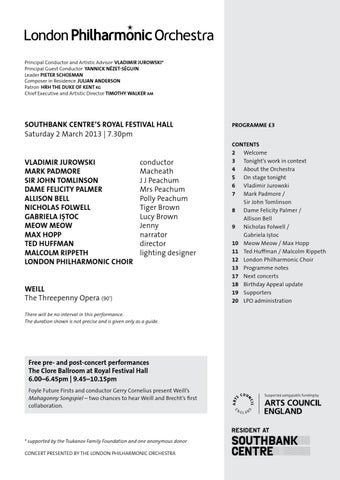
Principal Conductor and Artistic Advisor VLADIMIR JUROWSKI* Principal Guest Conductor YANNICK NÉZET-SÉGUIN Leader pieter schoeman Composer in Residence JULIAN ANDERSON Patron HRH THE DUKE OF KENT KG Chief Executive and Artistic Director TIMOTHY WALKER AM
SOUTHBANK CENTRE’S ROYAL FESTIVAL HALL Saturday 2 March 2013 | 7.30pm
Vladimir Jurowski Mark Padmore Sir John Tomlinson Dame Felicity Palmer Allison Bell Nicholas Folwell Gabriela IŞtoc Meow Meow Max Hopp Ted Huffman MALCOLM RIPPETH London Philharmonic Choir
conductor Macheath J J Peachum Mrs Peachum Polly Peachum Tiger Brown Lucy Brown Jenny narrator director lighting designer
WEILL The Threepenny Opera (90’) There will be no interval in this performance. The duration shown is not precise and is given only as a guide.
Free pre- and post-concert performances The Clore Ballroom at Royal Festival Hall 6.00–6.45pm | 9.45–10.15pm Foyle Future Firsts and conductor Gerry Cornelius present Weill’s Mahagonny Songspiel – two chances to hear Weill and Brecht’s first collaboration.
* supported by the Tsukanov Family Foundation and one anonymous donor CONCERT PRESENTED BY THE LONDON PHILHARMONIC ORCHESTRA
PROGRAMME £3 CONTENTS 2 Welcome 3 Tonight’s work in context 4 About the Orchestra 5 On stage tonight 6 Vladimir Jurowski 7 Mark Padmore / Sir John Tomlinson 8 Dame Felicity Palmer / Allison Bell 9 Nicholas Folwell / Gabriela Iştoc 10 Meow Meow / Max Hopp 11 Ted Huffman / Malcolm Rippeth 12 London Philharmonic Choir 13 Programme notes 17 Next concerts 18 Birthday Appeal update 19 Supporters 20 LPO administration
Welcome
WELCOME TO SOUTHBANK CENTRE We hope you enjoy your visit. We have a Duty Manager available at all times. If you have any queries please ask any member of staff for assistance. Eating, drinking and shopping? Southbank Centre shops and restaurants include Foyles, EAT, Giraffe, Strada, YO! Sushi, wagamama, Le Pain Quotidien, Las Iguanas, ping pong, Canteen, Caffè Vergnano 1882, Skylon, Concrete and Feng Sushi, as well as cafes, restaurants and shops inside Royal Festival Hall, Queen Elizabeth Hall and Hayward Gallery. If you wish to get in touch with us following your visit please contact the Visitor Experience Team at Southbank Centre, Belvedere Road, London SE1 8XX, phone 020 7960 4250, or email customer@southbankcentre.co.uk We look forward to seeing you again soon. A few points to note for your comfort and enjoyment: PHOTOGRAPHY is not allowed in the auditorium. LATECOMERS will only be admitted to the auditorium if there is a suitable break in the performance. RECORDING is not permitted in the auditorium without the prior consent of Southbank Centre. Southbank Centre reserves the right to confiscate video or sound equipment and hold it in safekeeping until the performance has ended. MOBILES, PAGERS AND WATCHES should be switched off before the performance begins.
Southbank Centre’s The Rest Is Noise, inspired by Alex Ross’s book The Rest Is Noise Presented by Southbank Centre in partnership with the London Philharmonic Orchestra. southbankcentre.co.uk/therestisnoise The Rest Is Noise is a year-long festival that digs deep into 20th-century history to reveal the influences on art in general and classical music in particular. Inspired by Alex Ross’s book The Rest Is Noise, we use film, debate, talks and a vast range of concerts to reveal the fascinating stories behind the century’s wonderful and often controversial music. We have brought together the world’s finest orchestras and soloists to perform many of the most significant works of the 20th century. We reveal why these pieces were written and how they transformed the musical language of the modern world. Over the year, The Rest Is Noise focuses on 12 different parts. The music is set in context with talks from a fascinating team of historians, scientists, philosophers, political theorists and musical experts as well as films, online content and other special programmes. If you’re new to 20th-century music, then this is your time to start exploring with us as your tour guide. There has never been a festival like this. Jude Kelly Artistic Director, Southbank Centre
2 | London Philharmonic Orchestra
Tonight’s work in context
1898 Bertolt Brecht born in Augsburg, Bavaria, Germany
1900
1900 Kurt Weill born in Dessau, Germany 1901 Death of Queen Victoria 1904 New York City subway opened 1906 Kellogg’s began selling Corn Flakes 1908 First commercial radio transmission
1910 1912 Sinking of the RMS Titanic. Premiere of Schoenberg’s Pierrot Lunaire in Berlin 1914 Outbreak of World War I 1916 Albert Einstein published his Theory of General Relativity
1920
1918 1919 1920 1921
End of World War I Automatic pop-up toaster patented Beginning of Prohibition in the USA Weill began stuying composition with Ferruccio Busoni in Berlin
1922 Creation of the Soviet Union (USSR) 1925 Premiere of Berg’s opera Wozzeck in Berlin 1926 Weill married actress Lotte Lenya: they divorced in 1933 and married again in 1937 1928 Premiere of The Threepenny Opera at Berlin’s Theater am Schiffbauerdamm
1930
1929 Wall Street Crash 1932 London Philharmonic Orchestra founded by Sir Thomas Beecham 1933 1935 1936
1940
Nazi Party came to power in Germany and banned The Threepenny Opera, considering it ‘degenerate art’ Weill moved to New York Death of King George V
1939 Outbreak of World War II
1945 End of World War II 1946 Microwave oven invented
1950
1948 Strauss composed his Four Last Songs 1949 Orwell’s Nineteen Eighty-Four published 1950 Kurt Weill died in New York City after suffering a heart attack
1955 Vietnam War began 1956 Bertolt Brecht died in East Berlin
London Philharmonic Orchestra | 3
London Philharmonic Orchestra
The London Philharmonic Orchestra is one of the world’s finest orchestras, balancing a long and distinguished history with a reputation as one of the UK’s most adventurous and forward-looking orchestras. As well as giving classical concerts, the Orchestra also records film and video game soundtracks, has its own record label, and reaches thousands of Londoners every year through activities for schools and local communities. The Orchestra was founded by Sir Thomas Beecham in 1932, and since then its Principal Conductors have included Sir Adrian Boult, Sir John Pritchard, Bernard Haitink, Sir Georg Solti, Klaus Tennstedt and Kurt Masur. The current Principal Conductor is Vladimir Jurowski, appointed in 2007, and Yannick Nézet-Séguin is Principal Guest Conductor.
The London Philharmonic Orchestra has recorded many blockbuster scores, from The Lord of the Rings trilogy to Lawrence of Arabia, The Mission, East is East, Hugo, and The Hobbit: An Unexpected Journey. It also broadcasts regularly on television and radio, and in 2005 established its own record label. There are now nearly 70 releases available on CD and to download. Recent additions include Tchaikovsky’s Symphonies Nos. 4 & 5 with Vladimir Jurowski; Brahms’s Symphonies Nos. 1 & 3 with Klaus Tennstedt; a disc of orchestral works by Mark-Anthony Turnage; and the world premiere of the late Ravi Shankar’s First Symphony conducted by David Murphy. In summer 2012 the London Philharmonic Orchestra performed as part of The Queen’s Diamond Jubilee Pageant on the River Thames, and was also chosen to record all the world’s national anthems for the London 2012 Olympics.
The Orchestra is Resident Orchestra at Southbank Centre’s Royal Festival Hall in London, where it has performed since it opened in 1951, giving around 40 The London Philharmonic concerts there each Orchestra maintains an season. 2012/13 Jurowski and the LPO were on exceptional energetic programme of highlights include activities for young people three concerts form, and the performance had a real and local communities. with Vladimir edge-of-your-seat excitement. The Guardian Highlights include the Jurowski based (29 September 2012, Royal Festival Hall: Rachmaninoff, Shchedrin, Denisov & Miaskovsky) Deutsche Bank BrightSparks around the theme Series; the Leverhulme of War and Peace Young Composers project; and the Foyle Future Firsts in collaboration with the Russian National Orchestra; orchestral training programme for outstanding young Kurt Weill’s The Threepenny Opera, also conducted by players. Over recent years, developments in technology Jurowski; 20th-century American works with Marin and social networks have enabled the Orchestra to Alsop; Haydn and Strauss with Yannick Nézet-Séguin; reach even more people worldwide: all its recordings and the UK premiere of Carl Vine’s Second Piano are available to download from iTunes and, as well Concerto with pianist Piers Lane under Vassily Sinaisky. as a YouTube channel, news blog, iPhone app and Throughout 2013 the Orchestra is collaborating with regular podcasts, the Orchestra has a lively presence on Southbank Centre on The Rest Is Noise festival, based Facebook and Twitter. on Alex Ross’s book of the same name and charting the 20th century’s key musical works and historical events. Find out more and get involved! The Orchestra has flourishing residencies in Brighton and Eastbourne, and performs regularly around lpo.org.uk the UK. Every summer, the Orchestra leaves London for four months and takes up its annual residency facebook.com/londonphilharmonicorchestra accompanying the famous Glyndebourne Festival Opera, where it has been Resident Symphony Orchestra twitter.com/LPOrchestra since 1964. The Orchestra also tours internationally, performing concerts to sell-out audiences worldwide. Tours in the 2012/13 season include visits to Spain, Germany, France, Switzerland, the USA and Austria. 4 | London Philharmonic Orchestra
On stage tonight
Cello Kristina Blaumane
Trombone Mark Templeton*
Assistant Conductor Ilyich Rivas
Double Bass Laurence Lovelle
Percussion & Timpani Andrew Barclay
Associate Director Zack Wintour
Chair supported by Andrew Davenport
Flute & Piccolo Sue Thomas Chair supported by the Sharp Family
Harmonium, Piano & Celeste Catherine Edwards
Clarinet Nicholas Carpenter*
Bandone贸n Eddie Hessian
Saxophones Martin Robertson Tim Holmes
Banjo & Mandolin James Ellis
Bassoon Gareth Newman* Trumpets Paul Beniston* Anne McAneney*
Repetiteur Catherine Edwards Surtitles Paula Kennedy
Guitar & Hawaiian Guitar Nigel Woodhouse
* Holds a professorial appointment in London
Chair supported by Geoff & Meg Mann
The London Philharmonic Orchestra also acknowledges the following chair supporters whose players are not present at this concert: John & Angela Kessler Moya Greene Sonja Drexler David & Victoria Graham Fuller Caroline, Jamie & Zander Sharp Julian & Gill Simmonds
London Philharmonic Orchestra | 5
Vladimir Jurowski
© Chris Christodoulou
Principal Conductor and Artistic Advisor
One of today’s most sought-after and dynamic conductors, acclaimed worldwide for his incisive musicianship and adventurous artistic commitment, Vladimir Jurowski was born in Moscow, and completed the first part of his musical studies at the Music College of the Moscow Conservatory. In 1990 he relocated with his family to Germany, continuing his studies at the High Schools of Music in Dresden and Berlin. In 1995 he made his international debut at the Wexford Festival conducting Rimsky-Korsakov’s May Night, and the same year saw his debut at the Royal Opera House, Covent Garden, with Nabucco. Vladimir Jurowski has been Music Director of Glyndebourne Festival Opera since 2001, and in 2003 was appointed Principal Guest Conductor of the London Philharmonic Orchestra, becoming the Orchestra’s Principal Conductor in September 2007. He also holds the titles of Principal Artist of the Orchestra of the Age of Enlightenment and Artistic Director of the Russian State Academic Symphony Orchestra. He has also held the positions of First Kapellmeister of the Komische Oper, Berlin (1997–2001); Principal Guest Conductor of the Teatro Comunale di Bologna (2000–03); and Principal Guest Conductor of the Russian National Orchestra (2005–09). Vladimir Jurowski is a regular guest with many leading orchestras in both Europe and North America, including the Berlin and Oslo Philharmonic orchestras; the Dresden Staatskapelle; the Leipzig Gewandhausorchester; the Tonhalle Orchester Zurich; and the Royal Concertgebouw, Philadelphia, Chicago Symphony, Bavarian Radio Symphony and Mahler Chamber orchestras. Highlights of the 2012/13 season and beyond include his debuts with the Vienna Philharmonic, Boston Symphony, New York Philharmonic, NHK Symphony and San Francisco Symphony orchestras, and return visits to the Chamber Orchestra of Europe; the Tonhalle Orchester Zurich; the Accademia di Santa Cecilia; and the Philadelphia, St Petersburg Philharmonic, Royal Concertgebouw and Chicago Symphony orchestras. 6 | London Philharmonic Orchestra
Jurowski made his debut at the Metropolitan Opera, New York, in 1999 with Rigoletto, and has since returned for Jenůfa, The Queen of Spades and Hansel and Gretel. He has conducted Parsifal and Wozzeck at Welsh National Opera; War and Peace at the Opera National de Paris; Eugene Onegin at Teatro alla Scala, Milan; Ruslan and Ludmila at the Bolshoi Theatre; and Iolanta and Die Teufel von Loudon at the Dresden Semperoper, as well as The Magic Flute, La Cenerentola, Otello, Macbeth, Falstaff, Tristan und Isolde, Die Meistersinger von Nürnberg, Don Giovanni, The Rake’s Progress, The Cunning Little Vixen and Peter Eötvös’s Love and Other Demons at Glyndebourne Festival Opera. Future engagements include new productions of Ariadne auf Naxos at Glyndebourne; Die Frau ohne Schatten at the Metropolitan Opera; Moses und Aron at the Komische Oper, Berlin; and The Fiery Angel at the Bayerische Staatsoper in Munich. Jurowski’s discography includes the first ever recording of the cantata Exil by Giya Kancheli for ECM; Meyerbeer’s L’etoile du Nord for Marco Polo; Massenet’s Werther for BMG; and a series of records for PentaTone with the Russian National Orchestra. The London Philharmonic Orchestra has released a wide selection of his live recordings on its LPO Live label, including Brahms’s Symphonies Nos. 1 and 2; Mahler’s Symphony No. 2; Rachmaninoff’s Symphonic Dances; Tchaikovsky’s Symphonies 1, 4, 5, 6 and Manfred; and works by Turnage, Holst, Britten, Shostakovich, Honegger and Haydn. His tenure as Music Director at Glyndebourne has been documented in a CD release of Prokofiev’s Betrothal in a Monastery, and DVD releases of his performances of La Cenerentola, Gianni Schicchi, Die Fledermaus, Don Giovanni, and Rachmaninoff’s The Miserly Knight. Other DVD releases include Hansel and Gretel from the Metropolitan Opera New York; his first concert as the London Philharmonic Orchestra’s Principal Conductor featuring works by Wagner, Berg and Mahler; and DVDs with the Orchestra of the Age of Enlightenment (Beethoven’s Symphonies Nos. 4 and 7) and the Chamber Orchestra of Europe (Strauss and Ravel), all released by Medici Arts. Vladimir Jurowski’s position as Principal Conductor and Artistic Advisor of the London Philharmonic Orchestra is generously supported by the Tsukanov Family Foundation and one anonymous donor.
Sir John Tomlinson
Macheath | tenor
J J Peachum | bass
Mark Padmore has established a flourishing career in opera, concert and recital. His performances of the Bach Passions are acclaimed throughout the world. Recent opera work includes the leading role in Harrison Birtwistle's The Corridor at the Aldeburgh and Bregenz festivals, and future plans include Captain Vere in Britten's Billy Budd for Glyndebourne Festival Opera. In concert, Mark has performed with many of the world’s leading orchestras including the Berlin, Vienna and New York Philharmonic orchestras, the Royal Concertgebouw Orchestra, and the Orchestra of the Age of Enlightenment. Mark has given recitals in Amsterdam, Barcelona, Brussels, Madrid, Milan, Moscow, New York, Paris and Vienna. He appears frequently at London's Wigmore Hall, where he first sang all three Schubert songcycles in May 2008. He was subsequently their Artist in Residence for the 2009/10 season and in 2011/12 repeated the cycles there with pianist Paul Lewis. He also recently sang the cycles at the Theater an der Wien and at Salle Gaveau in Paris with Till Fellner. Composers who have written for him include Mark-Anthony Turnage, Alec Roth, Sally Beamish, Thomas Larcher and Huw Watkins. Mark has made many recordings including the Bach Passions with Philippe Herreweghe and Paul McCreesh and, on DVD, the St Matthew Passion with Sir Simon Rattle and the Berlin Philharmonic. Recordings for Harmonia Mundi include Britten's Serenade for Tenor, Horn and Strings and Schubert's Winterreise with Paul Lewis, which won Gramophone magazine's Vocal Solo Award for 2010. Mark is Artistic Director of the St Endellion Summer Music Festival in Cornwall.
© Robert Workman
© Marco Borggreve
Mark Padmore
John Tomlinson was born in Lancashire. He gained a BSc in Civil Engineering at Manchester University before winning a scholarship to the Royal Manchester College of Music. He was awarded a CBE in 1997 and knighted in the Queen’s Birthday Honours of 2005. John Tomlinson sang at the Bayreuth Festival for 18 consecutive seasons as Wotan in Das Rheingold and Die Walküre, Wanderer in Siegfried, Hagen in Götterdämmerung, Titurel and Gurnemanz in Parsifal, King Marke in Tristan und Isolde, Heinrich in Lohengrin and the title role in Der fliegende Holländer. Other engagements include Milan, Geneva, Barcelona, Lisbon, New York, Chicago, San Francisco, San Diego, Paris, Amsterdam, Berlin (Deutsche Oper and Deutsche Staatsoper), Dresden, Hamburg, Frankfurt, Munich, Vienna and Bilbao, and the Festivals of Orange, Aix-enProvence, Salzburg, Edinburgh, Glyndebourne and the Maggio Musicale, Florence. He has sung regularly with English National Opera since 1974 and with the Royal Opera, Covent Garden, since 1977, and has also appeared with all the other leading British opera companies. His repertoire includes Hans Sachs and Pogner in Die Meistersinger von Nürnberg; Landgraf in Tannhäuser; Baron Ochs in Der Rosenkavalier; Boromeo in Palestrina; Orestes in Elektra; Moses in Moses und Aron; the world premieres of Harrison Birtwistle’s Gawain and the Green Knight (Green Knight) and The Minotaur (title role); Claggart in Billy Budd; Rocco in Fidelio; King Philip and the Grand Inquisitor in Don Carlos; Sarastro in The Magic Flute; Leporello and Commendatore in Don Giovanni; Lindorf, Coppelius, Dr Miracle and Dapertutto in The Tales of Hoffmann; Golaud and Arkel in Pelléas et Mélisande; Boris Timofeyevich Ismailov in Lady Macbeth of Mtsensk; the title role and Pimen in Boris Godunov; the General in The Gambler; and Thomas Becket in Murder in the Cathedral. Future performances include engagements at the Royal Opera, Covent Garden, and in Munich, Vienna, Salzburg Festival, Berlin, Hamburg, Frankfurt, Antwerp and Tokyo. London Philharmonic Orchestra | 7
Allison Bell
Mrs Peachum | mezzo soprano
Polly Peachum | soprano
Dame Felicity Palmer has had a career spanning some four decades, firstly as a concert soprano and, since the 1980s, as an operatic mezzo soprano. She is one of the most versatile performing artists singing today. She has performed at all the world’s major opera houses including Glyndebourne Festival Opera; the Royal Opera House, Covent Garden (including Sweeney Todd and Elektra); her debut at the Metropolitan Opera, New York, in Wagner’s Ring Cycle with James Levine and many subsequent appearances; Das Rheingold and Die Walküre in Munich with Zubin Mehta; Dialogues des carmélites with Riccardo Muti at La Scala, Milan, and with Michel Plasson in Zurich and Toulouse; as well as work in Amsterdam, Chicago, San Francisco, Paris, and at English National Opera in London.
Allison Bell studied Music and History at the University of Sydney and continued her studies in Europe, participating in masterclasses with Joan Sutherland, Magda Olivero, Ghena Dimitrova, Ileana Cotrubas, Gundula Janowitz and Dietrich Fischer-Dieskau. Awards include the La Scala Prize and a scholarship to study with Virginia Zeani at the Viñas Competition in Barcelona.
Dame Felicity has also long distinguished herself in concert performances with orchestras including the BBC Symphony, London Symphony, English Chamber, Philharmonia, Royal Philharmonic and Royal Concertgebouw orchestras; the Concentus Musicus Wien; and the New York Philharmonic; Los Angeles Philharmonic and Boston Symphony orchestras. She has recorded Elektra with the WDR Orchestra and Semyon Bychkov, and two concerts of the same opera were recently recorded for LSO Live with Valery Gergiev at the helm. There is also a recording of Dialogues des carmélites with English National Opera and Paul Daniel. Recent and future engagements include Elektra for Rome Opera; Peter Grimes at La Scala, Milan; and a revival of Dialogues des carmélites at The Metropolitan Opera, New York. Dame Felicity Palmer is represented by Intermusica worldwide.
© Felipe Pagani
© Christian Steiner
Dame Felicity Palmer
Her opera roles include La Folie, Morgana, Aspasia, Madame Herz, Queen of the Night, Glauce, Adele, Olympia, Lakmé, Zerbinetta, Waldvogel, Bubikopf, Cunegonde and Pretty Polly (Birtwistle’s Punch and Judy). Allison was acclaimed for her performance as Sierva in the world premiere of Peter Eötvös’s Love and Other Demons at Glyndebourne, followed by the National Opera of Lithuania and Opéra National du Rhin. She was soloist for Eötvös Retrospectives throughout Europe and the CD ‘Ensemble Linea Play Eötvös’, winning a FONOGRAM award and Orphée d’Or from the Académie Internationale du Disque Lyrique. With the London Philharmonic Orchestra and Vladimir Jurowski she has performed Schnittke’s Three Scenes, Madrigals and Der gelbe Klang; Schoenberg’s Pierrot Lunaire; and Grisey’s Quatre chants pour franchir le seuil. Recent and future engagements include Carmina Burana (Orquesta Sinfónica Nacional de Colombia); Le Feu/La Princesse/Le Rossignol (L’enfant et les sortilèges, Bolshoi, Moscow); Berio’s Chamber Music (London Sinfonietta); Mahler’s Das klagende Lied (Berlin, Munich); Waldvogel (Siegfried, Longborough); Fabián Panisello’s Libro del Frío (Britten Sinfonia, Madrid); Ligeti’s Mysteries of the Macabre and Lutosławski’s Chantefleurs et Chantefables (Tasmanian Symphony Orchestra); Pierrot Lunaire (BBC Concert Orchestra); John Zorn’s La Machine de l’Être (BBCSSO/Volkov) and Claude Vivier’s Trois airs pour un opéra imaginaire with the Philharmonia Orchestra. Allison acknowledges the generous support of the Richard Carne Trust and Lansons Communications.
8 | London Philharmonic Orchestra
Gabriela Iştoc
Tiger Brown | baritone
Lucy Brown | soprano
Nicholas Folwell made his Royal Opera debut as Harašta in The Cunning Little Vixen, returning as Nachtigall in Die Meistersinger von Nürnberg and Antonio in The Marriage of Figaro. He has performed his signature role of Alberich in the Ring Cycle at Opéra d’Angers-Nantes, Nationale Reisopera, Den Nye Opera, Scottish Opera, Opera North, Welsh National Opera and Longborough Festival Opera.
Romanian soprano Gabriela Iştoc was a trainee at the National Opera Studio in London in 2012. She graduated from the National University of Music in Bucharest and continued at the Royal Irish Academy of Music in Dublin (studying singing with Dr Veronica Dunne) and the Opera Theatre Company's Young Associate Artists' Programme, also in Dublin.
His international career highlights have included Trinity Moses in Rise and Fall of the City of Mahagonny (Nantes), Koroviev in York Höller's The Master and Margarita (world premiere at Opéra de Paris), Ottokar in Der Freischütz (Zwingenberger Festival), and Marullo in Rigoletto (Frankfurt). His roles cover a wide range, from standard repertoire to contemporary works. He created roles in several world premieres with English National Opera including Mutius in Stephen Oliver's Timon of Athens, the title role in Judith Weir's Blond Eckbert, and Mr Van Tricasse in Gavin Bryars's Dr Ox’s Experiment. Other world premieres include Pope Clement VI in Nicola LeFanu’s Light Passing for BBC Radio 3, and Judith Weir’s Armida for Channel 4 Television. His frequent radio broadcasts have included Haushofmeister in Zemlinsky’s Der Zwerg, Short Prisoner in From the House of the Dead, and roles in Harrison Birtwistle’s The Mask of Orpheus and Prokofiev’s The Fiery Angel at the BBC Proms. Nicholas Folwell has sung in concert performances of Weill's The Seven Deadly Sins (London Sinfonietta), Mahagonny Songspiel (City of Birmingham Symphony Orchestra), Pizzaro in Fidelio (London Philharmonic Orchestra), Lysiart in Euryanthe (OAE) and the title role in Der fliegende Holländer (Chelsea Opera Group). He is currently performing in David Pountney’s new production of Lulu for Welsh National Opera. Future engagments include Antonio in The Marriage of Figaro for Glyndebourne Festival Opera and Alberich in the Ring Cycle for Opéra di Dijon.
© Mihai Cucu
Nicholas Folwell
Gabriela is a laureate of numerous vocal competitions: the Paul Constantinescu Competition, the George Georgescu Contest, the National Singing Competition of Focşani, Second Prize and Borsa di studio della Fondazione Lucia Valentini Terrani for the youngest singer in the Iris Adami Corradetti Competition (Padua), Second Prize and Premio Speciale Teatro Massimo di Palermo e Banca Don Rizzo at the Città di Alcamo International Competition, the Irene Sandford Award (Dublin), Geoghegan and Gervase Cups in the Feis Ceoil (Dublin), the Robert and Margaret Lefever Study Award, and the 2011 Wessex Glyndebourne Association Award. Her previous operatic roles include Adina (L’elisir d’amore), Serpina (Pergolesi's La serva padrona), Fiordiligi (Così fan tutte), Barbarina (The Marriage of Figaro) and Gilda (Rigoletto). For Glyndebourne Festival Opera, Gabriela sang the roles of Eurydice in Followers and Ludovina in The Yellow Sofa, both by Julian Philips, and understudied the roles of First Nymph in Rusalka, Giannetta in L’elisir d’amore and the Vixen in The Cunning Little Vixen. She was a Jerwood Young Artist in 2011. Further engagements for 2013 include Echo in Strauss’s Ariadne auf Naxos for Glyndebourne Festival Opera, and concerts in Romania.
London Philharmonic Orchestra | 9
Max Hopp
Jenny | mezzo soprano
narrator
Post-postmodern diva Meow Meow’s unique brand of ‘kamikaze cabaret’ and performance art exotica has hypnotised, inspired and terrified audiences globally. The spectacular crowd-surfing queen of song ‘drags cabaret kicking and screaming into the 21st century’ (Time Out New York), with trailblazing sell-out seasons from New York and Berlin to London’s Apollo Theatre and the Sydney Opera House. Named ‘a cabaret diva of the highest order’ (New York Post), ‘sensational’ (The Times), One of the Top Performers of the Year by the New Yorker, ‘The Queen of Chanson’ by the Berliner Zeitung and ‘a phenomenon’ by the Australian press, multi-award winning Meow has been curated by David Bowie, Pina Bausch and Mikhail Baryshnikov, amongst others, and has created original works for numerous international arts festivals and venues as well as performing everything from Schubert and Schumann with orchestras to touring with punk outfit Amanda Palmer and The Dresden Dolls. She was recently seen starring in London's West End in The Umbrellas of Cherbourg and in Cocteau's Le Bel Indifférent for the Greenwich Music Festival. She returned to the West End for a series of solo concerts at the Apollo Theatre and performed an extended season of Meow Meow's Little Match Girl at Southbank Centre’s Queen Elizabeth Hall in December 2012. She has won the Edinburgh International Festival Fringe Prize, the Green Room Awards, the Helpmann Awards, the Sydney Theatre Awards, and the New York Franklin Furnace Performance Art Award. Upcoming projects include a solo concert at Lincoln Center, New York, and collaborations with Barry Humphries and the Australian Chamber Orchestra, Pink Martini and the Oregon Symphony.
10 | London Philharmonic Orchestra
© Kim Frank
© Karl Giant
Meow Meow
Max Hopp was born in Berlin in 1972 and graduated from the renowned Ernst Busch Academy of Dramatic Art. His first engagement was at the Bremer Theatre in 1995. Since then he has appeared at some of the most famous theatres in the German-speaking countries: the Schauspielhaus Hamburg (1996–2000), the Schauspielhaus Zürich (2001–05), the Münchner Kammerspiele (2001–03) and the Deutsches Theater Berlin (2002). Since 2005 he has appeared at the Volksbühne Berlin in plays directed by Frank Castorf, Dimiter Gotscheff, Christoph Marthaler and David Marton. Max Hopp has also starred on opera stages including the Komische Oper Berlin, and toured with his solo programme 'The Hollywood Songbook', which includes songs by Eisler and Brecht. In the 2012/13 season Max Hopp appears in a leading role in the rock opera The Black Rider at the Theater Basel. Since 2000 Max Hopp has starred in over 30 German TV productions and several films, directed by Andy and Lana Wachowski, Andreas Kleinert, Sherry Hormann and others. Max Hopp replaces the previously advertised narrator, Otto Sander.
© Kristin Hoebermann
Ted Huffman
Malcolm Rippeth
director
lighting designer
American stage director Ted Huffman has created opera and theatre productions throughout North America and Europe. New productions in 2012/13 include Peter Maxwell Davies’s The Lighthouse for English Touring Opera, opening at ROH2 Royal Opera House Covent Garden; Poulenc’s Les Mamelles de Tirésias for the Aldeburgh Festival and the Conservatoire royal de Bruxelles; Stravinsky's A Soldier's Tale for the Greenwich Music Festival, Connecticut; Ullmann’s Der Kaiser von Atlantis for Central City Opera in collaboration with the Colorado Symphony; Humperdinck's Hansel and Gretel for Pittsburgh Opera; Carmen for Opera Birmingham, Alabama; and Apprentice Showcase Scenes for Santa Fe Opera. Ted joined the directing staff of the Metropolitan Opera during the 2011/12 season for a revival of Britten’s Billy Budd.
Malcolm Rippeth has designed extensively for theatre, opera and dance. In 2010 he won a Village Voice OBIE award as a member of the design team for Brief Encounter off-Broadway; in 2009 the Theatregoers’ Choice Award for Best Lighting Designer for his work on Brief Encounter and Six Characters in Search of an Author in the West End; and in 2011 he was nominated for the Outer Critics Circle Award for Outstanding Lighting Design for Brief Encounter on Broadway.
Ted co-founded the Greenwich Music Festival in Connecticut, where he continues to serve as the company’s Artistic Director. At the festival, Ted has created productions of Poulenc’s La voix humaine, Ullmann’s Der Kaiser von Atlantis, Monteverdi’s Il ritorno d'Ulisse in patria and Henze’s El Cimarrón, for which he received a nomination for 'Best Opera Direction 2010' in Opernwelt magazine. As a guest teacher and director, Ted has been engaged by many young artist development programmes including Canadian Opera Company’s Studio, LA Opera’s Domingo-Thornton Young Artist Program, Pittsburgh Opera Studio, and the Santa Fe Opera Apprentice Program. Ted attended Choate Rosemary Hall and Yale University, where he majored in Humanities. He is also a graduate of San Francisco’s Merola Opera Program and the Jerwood Opera Writing Programme at the Aldeburgh Festival. He completed an apprenticeship with director Robert Wilson at the Watermill Center.
His recent theatre credits include The Promise (Donmar Warehouse); Wah! Wah! Girls, Six Characters in Search of an Author and The Umbrellas of Cherbourg (West End); The Dead (Abbey, Dublin); London (Paines Plough); Belong (Royal Court); West Side Story (The Sage, Gateshead); Decade (Headlong Theatre at St Katharine Docks); Calendar Girls (West End/Australia/Canada) and HMS Pinafore (Guthrie Theater, Minneapolis). His many productions for Kneehigh Theatre include The Wild Bride, Steptoe and Son, Brief Encounter and The Red Shoes. In addition he has lit productions for the Tricycle Theatre, Lyric Hammersmith, English Touring Theatre, Gate Theatre Dublin and many of the UK’s leading regional theatres including National Theatre Wales, Birmingham Rep, West Yorkshire Playhouse, Northern Stage, Salisbury Playhouse, Bristol Old Vic and the National Theatre of Scotland. His opera and dance credits include Armida and Le nozze di Figaro (Garsington Opera); Seven Deadly Sins (Welsh National Opera/Diversions Dance); Carmen Jones (Royal Festival Hall) and numerous productions for balletLORENT including Rapunzel, Designer Body and la nuit intime.
London Philharmonic Orchestra | 11
London Philharmonic Choir Patron HRH Princess Alexandra | President Sir Roger Norrington | Artistic Director Neville Creed Accompanist Jonathan Beatty | Chairman Mary Moore | Choir Manager Kevin Darnell
© GreenEgg Ltd
of Memory and Goldie’s Sine Tempore in the Evolution! Prom. The Choir performed at the Doctor Who Proms in 2008 and 2010, and in 2011 appeared in Verdi’s Requiem, Liszt’s A Faust Symphony and Beethoven’s Missa Solemnis. Last year it performed Elgar’s The Apostles with Sir Mark Elder and Howells’s Hymnus Paradisi under Martyn Brabbins.
Founded in 1947, the London Philharmonic Choir is widely regarded as one of Britain’s finest choirs, consistently meeting with great critical acclaim. It has performed under leading international conductors throughout the last 65 years and made numerous recordings for CD, radio and television. Enjoying a close relationship with the London Philharmonic Orchestra, the Choir frequently joins it for concerts in the UK and abroad. In 2011/12, engagements included Scriabin’s Prometheus, Poem of Fire, Rossini’s Stabat Mater, Prokofiev’s Ivan the Terrible, Bruckner’s Te Deum, Szymanowski’s Symphony No. 3, Zemlinsky’s Psalm 23, Delius’s Sea Drift and Suk’s Ripening. This season, concerts with the LPO have included Rachmaninoff’s The Bells, Haydn’s Nelson Mass, Schoenberg’s A Survivor from Warsaw, Brahms’s Ein deutsches Requiem and Elgar’s The Dream of Gerontius. Future engagements include Stravinsky’s Symphony of Psalms, Orff’s Carmina Burana and Tippett’s A Child of our Time. Recently released CDs with the London Philharmonic Orchestra include Brahms’s Ein deutsches Requiem with Yannick Nézet-Séguin, Holst’s The Planets and Mahler’s Symphony No. 2 under Vladimir Jurowski, and Beethoven’s Missa Solemnis with Christoph Eschenbach. The Choir appears regularly at the BBC Proms at the Royal Albert Hall, and performances have included the UK premieres of Mark-Anthony Turnage’s A Relic
12 | London Philharmonic Orchestra
The Choir has visited numerous European countries and performed in Kuala Lumpur, Hong Kong and Perth, Australia. The Choir also works with other leading orchestras, and last June joined forces with the London Symphony Orchestra and Chorus to perform Berlioz’s Grande Messe des Morts with Sir Colin Davis at St Paul’s Cathedral. The Choir also sings in Raymond Gubbay’s Classical Spectacular and Christmas concerts, and has appeared in gala concerts with Russell Watson and Katherine Jenkins. The Choir prides itself on achieving first-class performances from its members, who are volunteers from all walks of life. For more information, including details about how to join, please visit www.lpc.org.uk Sopranos Clare Brady, Gemma Chance, Sarah Deane-Cutler, Rosha Fitzhowle, Jane Hanson, Francesca Harris, Laura Hunt, Natalie Millet, Katie Milton, Tracey Szwagrzak Altos Joanna Arnold, Deirdre Ashton, Susannah Bellingham, Helen Clough, Kathryn Gilfoy, Alexis Kessler Calice, Muriel Swijghuisen Reigersberg, Phillipa Walden Tenors Nicholas Arratoon, Andrew Mackie, Miles Phillips, Owen Toller Basses Simon Bainbridge, David Booth, Noel Chow, Marcus Daniels, Rylan Holey, Johan Pieters, Tony Piper, Jim Wilson
Programme notes
Kurt Weill
Die Dreigroschenoper (The Threepenny Opera) Text arranged by Bertolt Brecht (1898–1956)
1900–1950
Introduction In the febrile atmosphere of the last years of the Weimar Republic, and in particular of the capital Berlin, the greatest theatrical success was The Threepenny Opera by the newly formed team of Bertolt Brecht and Kurt Weill (who was born 113 years ago today). The piece had its premiere in Berlin in 1928, ran there for nearly two years, and was taken up by theatres everywhere. An adaptation of John Gay’s 18th-century ballad opera The Beggar’s Opera, it is set in Soho among
thieves, beggars and whores: the gangster Macheath marries Polly Peachum, whose father runs an army of beggars; Macheath is captured, escapes and is caught again; but he is saved from the gallows by the pardon necessary for an operatic happy ending. This performance is of Weill’s musical numbers, scored for a dance band and drawing on the idioms of the dance music of the time, with a linking narration specially written by Brecht for concert performances.
‘The Weimar Republic, as embodied in the culture of Berlin, invites melodrama. Every violent act or image seems to foreshadow the catastrophe to come. But it is too easy to write the story of German culture from 1918 to 1933 as the prelude to the next chapter. Berlin was a city of possibilities, of myriad outcomes, glowing with promise as well as threat. It played host to Communists, Nazis, Social Democrats, nationalists, New Objectivists, Expressionists, Dadaists, and straggling Romantics. Its spirit spoke in the meeting of opposites. In the wake of the humiliation of defeat, Berlin shook off its imperial past and reinvented itself as the prototype of media-saturated urban cultures to come – the first all-night city, the city without shame. The young composers of Berlin – among them Kurt Weill, Paul Hindemith, Ernst Krenek, Hanns Eisler and Stefan Wolpe – happily joined in the frenzy. Like their counterparts in Paris and New York, they picked up the rhythms of jazz, the noise of industry, the fashionable clutter of twenties life. They not only gained entry to popular culture but at times took control of it: Weill’s Threepenny Opera charmed Germany as Show Boat charmed America. Weill and company seemed on the verge of solving the ultimate mystery – how to break the divide between classical music and modern society. “Music is no longer a matter of the few”, Weill proclaimed in 1928. “The musicians of today have made this sentence their own. Their music, therefore, is simpler, clearer, and more transparent … Once musicians obtained everything they had imagined in their most daring dreams, they started again from scratch.”’ Alex Ross, The Rest Is Noise (Fourth Estate)
London Philharmonic Orchestra | 13
Programme notes
Synopsis Mr Peachum, a sanctimonious individual who controls an army of beggars about to flood on to the streets for the Queen’s coronation, discovers that his daughter Polly is in love with the notorious gangster Macheath. After Polly and Macheath have gone through a form of marriage, they receive the congratulations of the police chief Tiger Brown, an old army comrade of Macheath and a useful ally. Polly learns that her father intends to turn Macheath in to the police, and advises Macheath to flee. But instead he visits a brothel, where one of the whores, Jenny, betrays him to the police. In jail, Macheath is visited by Polly and by Brown’s daughter Lucy, who also considers herself his wife. Lucy helps Macheath escape, to Peachum’s disgust. Brown arrives to arrest Peachum along with some of his fraudulent beggars; but, when Peachum threatens to reveal Brown’s friendship with Macheath, Brown reluctantly gives the order for the gangster to be recaptured. Back in prison, Macheath is visited by his friends and his wives, before being led to the gallows. Just in time, Brown appears on horseback to announce the Queen’s pardon and her gift of a castle and a peerage.
History The Threepenny Opera was written for a small Berlin theatre, the Theater am Schiffbauerdamm. The impresario Ernst Josef Aufricht, who had recently taken over the theatre, was looking for a new work to launch his tenancy, and came across the young writer Bertolt Brecht, who was already making his mark as poet and playwright. Brecht offered him a ‘minor work’ that he had in progress, an adaptation of John Gay’s Beggar’s Opera (which had been revived in a famously long run at the Lyric Theatre, Hammersmith in the early 1920s). As musical collaborator Brecht proposed Kurt Weill, whom Aufricht knew as a composer of modernist chamber operas, but who had recently begun his collaboration with Brecht on what was to become their Mahagonny opera. Brecht and Weill worked closely together on the piece, especially during a shared holiday on the French Riviera. During the rehearsal period the title was changed from The Beggar’s Opera to The Threepenny Opera, reflecting not only the low-life setting but also the economical staging. The rehearsals also brought many revisions to the text and the score, some to 14 | London Philharmonic Orchestra
accommodate changes of casting; even the famous ‘Moritat von Mackie Messer’ was a last-minute addition. Eventually, after a chaotic dress rehearsal which had gone on until five in the morning, the show opened on 31 August 1928. The piece did not attract a full house on its first night, but most of the reviews were enthusiastic, and within weeks it was sold out every night and enjoyed mustsee status in Berlin society. It ran for 250 performances before transferring to another theatre. Within a week of its opening, it had been snapped up by 50 other German theatres; its songs were played by dance bands, and were bestsellers in printed editions; Weill’s concert suite, the Kleine Dreigroschenmusik or ‘Little Threepenny Music’, appeared on orchestral programmes; a film was made in 1930. The name Dreigroschen was even attached to a Berlin bar and a range of wallpaper. All this came to an end when the Nazis took power in 1933: The Threepenny Opera, written by a Communist and a Jew, was banned, and placed in the category of ‘degenerate art’. (When an exhibition devoted to ‘Degenerate Music’ was mounted in Düsseldorf in 1938, however, the room devoted to the work had to be closed because it was attracting such large and attentive crowds.) Meanwhile, the piece was catching on in other countries. Its first exposure in Britain was a BBC broadcast in 1935 (which called it ‘The TuppennyHa’penny Opera’ – though the more exact translation of the title has since prevailed, surviving the loss of the old currency and its threepenny bit). In the USA, the work’s biggest success came after Weill’s death, in an adaptation by Marc Blitzstein; this led to the popular success of recordings of the ‘Moritat’, as ‘Mack the Knife’.
The source and Brecht’s treatment The original Beggar’s Opera was mounted in London in 1728 and proved a huge popular success. It was conceived as a home-made riposte to Handel’s London seasons of Italian opera, with its cast of singing actors and its realistic setting in the lower depths of London life. Instead of florid arias, there were popular ballads and folk dance tunes – and even a few well-known Handel melodies – to which John Gay fitted words and
the German-born Johann Christoph Pepusch provided accompaniments. The conventions of opera were satirised, especially in the final scene, when the beggarnarrator intervenes to reprieve the anti-hero Macheath from the gallows and so provide the traditional happy ending. Brecht based his text on a translation of The Beggar’s Opera by his regular collaborator Elisabeth Hauptmann; he also incorporated ballads by François Villon and Rudyard Kipling, as well as numbers from other projects of his own. He made some changes to the plot, in particular replacing the jailer Lockit by the corrupt police chief Tiger Brown. The prevailing tone is one not of polemics – though Brecht made some stronger political points in later revisions of the script – but of indignant protest against corruption, hypocrisy and the selfsatisfaction of the better-off. The latter is famously the object of Macheath’s scorn in the Second Finale, when he declares ‘Food is the first thing: morals follow on.’
mandolin; a timpanist and percussionist who also played second trumpet; and a pianist-director who also played harmonium and celeste. Weill made full use of the possibilities offered by this combination, though some parts are marked ‘ad lib’. The original scoring – as represented in the version of the score in the Kurt Weill Edition – is heard tonight, played by a band of 15 players, large enough to fulfil all its requirements. The musical numbers are linked by a narration written by Brecht for an unknown occasion, presumably a concert performance or a recording, and preserved in the Bertolt Brecht Archive.
‘A new type of musical theatre’
Weill’s score nods in its early stages to the 18thcentury origins of The Beggar’s Opera: the Overture, like Pepusch’s, includes a fugue; and Mr Peachum’s first song is to the tune of the character’s first song in The Beggar’s Opera, ‘Through all the employments of life’. Towards the end of Act III, too, Weill makes use of traditional formal archetypes, with a sequence of recitative, dramatic aria and chorale prelude. But most of his score is in the dance rhythms and idioms of the dance bands of the time, with easily singable melodic lines accompanied by Weill’s characteristic piquant harmonies, at once dissonant and supportive.
Brecht described The Threepenny Opera as a ‘play with music’, and it does not combine words and music in the conventional manner of opera or operetta. Individual numbers certainly correspond to recognisable operatic types – for example, there are duets of love, male comradeship and female rivalry – but they do not grow out of the spoken dialogue or reveal more of the characters. Instead, they are sung as set pieces, addressed to the audience, with sharply different stage lighting, and with titles displayed on placards. This explains how so many of the solo numbers could have been switched from one character to another during the rehearsal period, and even after the premiere. What coherence that existed was not between words and music but within the music, in motivic and harmonic resemblances between the different numbers. It is hardly surprising that in 1929 Weill described his style of writing as ‘the most consistent reaction to Wagner. It signifies the complete destruction of the concept of music drama.’
The band at the first production was an actual dance band, the Lewis Ruth Band, which consisted of seven players doubling on a wide array of instruments: a woodwind player covering three sizes of saxophone, flute, piccolo and clarinet; a second woodwind player playing two saxophones, clarinet and bassoon; a specialist trumpeter; a player of trombone and double bass; a one-man ‘string section’ covering banjo, bandoneón (the button accordion chiefly associated with the tango), cello, guitar, Hawaiian guitar and
But Weill was also reacting to the high art of opera, and also to the more bourgeois genre of operetta, by emulating John Gay in his use of vernacular musical styles. In an article for a music magazine in 1928 (translated in Stephen Hinton’s Cambridge Opera Handbook on The Threepenny Opera), Weill wrote that his task in the work had been ‘to write music that could be sung by actors, that is, by musical amateurs. At first this appeared to be a limitation. As work progressed, however, it proved to be an enormous enrichment.
The music
London Philharmonic Orchestra | 15
Programme notes
Only the realisation of a coherent, identifiable melodic line made possible The Threepenny Opera’s real achievement: the creation of a new type of musical theatre.’ And that ‘new type of musical theatre’ marked a breakthrough in 20th-century music, proving that it was possible to use popular music to say serious things. Programme notes by Anthony Burton © 2013 Extracts from Robert David Macdonald’s English translation of THE THREEPENNY OPERA by permission of Alan Brodie Representation Ltd. www.alanbrodie.com THE THREEPENNY OPERA A play with music in a prelude and 8 scenes Based on John Gay’s THE BEGGAR’S OPERA Translation into German by Elisabeth Hauptmann Adaptation and lyrics by Bertolt Brecht Music by Kurt Weill Concert narration by Bertolt Brecht, English translation by Stephen Hinton
LPO Label sale on iTunes 12 February–11 March 2013 | www.iTunes.com/LPO From 12 February–11 March, we’re offering special discounts on all our LPO Label albums on iTunes. With over 70 releases in the LPO catalogue – from Handel to Holst, and Shostakovich to Ravi Shankar – there’s something for every taste, so grab a bargain this month!
Some of our recent releases – browse the full LPO catalogue at www.iTunes.com/LPO
Vladimir Jurowski conducts Tchaikovsky Symphonies Nos. 4 & 5
Klaus Tennstedt conducts Brahms Symphonies Nos. 1 & 3
16 | London Philharmonic Orchestra
New orchestral works by Mark-Anthony Turnage
Paavo Berglund conducts Sibelius Symphonies Nos. 5 & 6
Next LPO concerts at Royal Festival Hall
Saturday 6 April 2013 | 7.30pm Stravinsky Symphony of Psalms Orff Carmina Burana Hans Graf conductor Sally Matthews soprano Andrew Kennedy tenor Rodion Pogossov baritone London Philharmonic Choir Trinity Boys Choir Free pre-concert discussion 6.15–6.45pm | Royal Festival Hall Hans Graf looks at Stravinsky’s Symphony of Psalms and the lasting appeal of Carmina Burana.
Saturday 27 April 2013 | 7.30pm Webern Variations Op. 30 Berg Lulu Suite Martinů Double Concerto for Two String Orchestras, Piano and Timpani Bartók Music for Strings, Percussion and Celeste Vladimir Jurowski conductor Barbara Hannigan soprano
Wednesday 1 May 2013 | 7.30pm Vaughan Williams Symphony No. 4 Tippett A Child of our Time Ryan Wigglesworth conductor Rebecca Evans soprano Pamela Helen Stephen mezzo soprano Ben Johnson tenor Matthew Rose bass London Philharmonic Choir Free pre-concert discussion 6.15–6.45pm | Royal Festival Hall Writer and broadcaster Daniel Snowman takes a look at Tippett’s A Child of our Time.
Friday 17 May 2013 | 7.30pm JTI Friday Series Stravinsky Jeu de Cartes Prokofiev Violin Concerto No. 2 Shostakovich Symphony No. 6 Vladimir Jurowski conductor Patricia Kopatchinskaja violin
Booking details Tickets £9–£39 London Philharmonic Orchestra Ticket Office 020 7840 4242 Monday to Friday 10.00am–5.00pm lpo.org.uk Southbank Centre Ticket Office 0844 847 9920 Daily 9.00am–8.00pm southbankcentre.co.uk
2013/14 season – on sale now Our 2013/14 season at Royal Festival Hall is now on sale. Browse and book online at www.lpo.org.uk/ newseason or call us on 020 7840 4208 to request a copy of the season brochure or to book by phone. Highlights of the new season include: • A centenary celebration of the music of Britten, including Peter Grimes and the War Requiem • The Orchestra celebrates The Genius of Film Music, exploring some of the scintillating film scores created between 1960–2000 • Yannick Nézet-Séguin demonstrates his flair for French repertoire with Poulenc and Dutilleux • Vladimir Jurowski conducts John Adams’s powerful and theatrical Nativity oratorio El Niño • Classical guitarist Miloš Karadaglič performs Rodrigo’s evocative Concierto de Aranjuez • The world premiere of James MacMillan’s Viola Concerto with soloist Lawrence Power
London Philharmonic Orchestra | 17
London Philharmonic Orchestra Birthday Appeal update Two double bass stools
Three tom-toms
Carmina Burana music hire for 6 April 2013
Thank you so much to all of our audience members who have given us a birthday present for our 80th birthday. Thanks to you, the Appeal has already raised over £10,000 and the double bass stools and tom-toms are on their way! However, we still need your help with obtaining the other presents on our wish list, such as our children’s concerts illustrations, choir scores for Carmina Burana and recording for a live stream. Please visit www.lpo.org.uk/birthday and help celebrate our 80th by donating to our present wish list. All presents, big or small, are greatly received by the Orchestra and, while you’re at it, why not leave us a birthday message or memory from the last 80 years?
‘Thank you LPO for providing such joy to me, my friends and all the audiences over the last 80 years. Have a great birthday!’ ‘Many thanks for the concerts over the years. My father was a double bass player but in those days never had a stool!’ ‘A very happy birthday. I have enjoyed many years with the LPO. The performances have been first class. I am also celebrating my 80th year in 2013!’
Illustrations for our FUNharmonics family concerts With special thanks to the following people who have given over £250 to our Birthday Appeal: Mr Aldwinckle, Mrs A Beare, Mr G Bitar, Mr C Blakey, Mr G A Collens, Mrs S Drexler, Mrs A Kessler, Mr R P Harsant, Dr & Mrs F Lim, Mr R McCann, Professor D Kelly, Mrs G Pole, Mrs V Sharp, Mr C Williams Recording a concert for live stream
Donate today – pick up a birthday card as you leave the concert tonight! For more information visit www.lpo.org.uk/birthday, email katherine.hattersley@lpo.org.uk or call 020 7840 4212.
18 | London Philharmonic Orchestra
We would like to acknowledge the generous support of the following Thomas Beecham Group Patrons, Principal Benefactors and Benefactors: Thomas Beecham Group The Tsukanov Family Foundation Anonymous The Sharp Family Julian & Gill Simmonds Garf & Gill Collins Andrew Davenport Mrs Sonja Drexler David & Victoria Graham Fuller Moya Greene John & Angela Kessler Mr & Mrs Makharinsky Geoff & Meg Mann Caroline, Jamie & Zander Sharp Eric Tomsett Guy & Utti Whittaker Manon Williams Principal Benefactors Mark & Elizabeth Adams Jane Attias Lady Jane Berrill Desmond & Ruth Cecil Mr John H Cook Mr Charles Dumas
David Ellen Commander Vincent Evans Mr Daniel Goldstein Mr & Mrs Jeffrey Herrmann Peter MacDonald Eggers Mr & Mrs David Malpas Mr Maxwell Morrison Mr Michael Posen Mr & Mrs Thierry Sciard Mr John Soderquist & Mr Costas Michaelides Mr & Mrs G Stein Mr & Mrs John C Tucker Mr & Mrs John & Susi Underwood Lady Marina Vaizey Howard & Sheelagh Watson Mr Anthony Yolland Benefactors Mrs A Beare Dr & Mrs Alan Carrington CBE FRS Mr & Mrs Stewart Cohen Mr Alistair Corbett Mr David Dennis Mr David Edgecombe Mr Richard Fernyhough Ken Follett Michael & Christine Henry
Ivan Hurry Mr Glenn Hurstfield Mr R K Jeha Mr Gerald Levin Sheila Ashley Lewis Wg. Cdr. & Mrs M T Liddiard OBE JP RAF Mr Frank Lim Paul & Brigitta Lock Mr Brian Marsh Andrew T Mills John Montgomery Mr & Mrs Andrew Neill Edmund Pirouet Professor John Studd Mr Peter Tausig Mrs Kazue Turner Mr Laurie Watt Des & Maggie Whitelock Christopher Williams Bill Yoe Hon. Benefactor Elliott Bernerd Hon. Life Members Kenneth Goode Pehr G Gyllenhammar Edmund Pirouet Mrs Jackie Rosenfeld OBE
The generosity of our Sponsors, Corporate Members, supporters and donors is gratefully acknowledged: Corporate Members Silver: AREVA UK British American Business Destination Québec – UK Hermes Fund Managers Pritchard Englefield Bronze: Lisa Bolgar Smith and Felix Appelbe of Ambrose Appelbe Appleyard & Trew LLP Berkeley Law Charles Russell Lazard Leventis Overseas Corporate Donor Lombard Street Research Preferred Partners Corinthia Hotel London Heineken Lindt & Sprüngli Ltd Villa Maria
In-kind Sponsors Google Inc Sela / Tilley’s Sweets Trusts and Foundations BBC Performing Arts Fund The Boltini Trust Sir William Boreman’s Foundation The Boshier-Hinton Foundation Britten-Pears Foundation The Candide Trust The Coutts Charitable Trust Diaphonique, Franco-British fund for contemporary music Dunard Fund Embassy of Spain, Office for Cultural and Scientific Affairs The Equitable Charitable Trust Fidelio Charitable Trust The Foyle Foundation J Paul Getty Junior Charitable Trust The Jeniffer and Jonathan Harris Charitable Trust Capital Radio’s Help a London Child The Hobson Charity The Kirby Laing Foundation
The Idlewild Trust The Leverhulme Trust Marsh Christian Trust Adam Mickiewicz Institute The Peter Minet Trust Paul Morgan Charitable Trust The Diana and Allan Morgenthau Charitable Trust Maxwell Morrison Charitable Trust Musicians Benevolent Fund Newcomen Collett Foundation The Austin & Hope Pilkington Trust Serge Rachmaninoff Foundation The Rothschild Foundation The Samuel Sebba Charitable Trust The Bernard Sunley Charitable Foundation John Thaw Foundation The Tillett Trust The Underwood Trust Sir Siegmund Warburg’s Voluntary Settlement Kurt Weill Foundation for Music Garfield Weston Foundation and others who wish to remain anonymous
London Philharmonic Orchestra | 19
Administration
Board of Directors
General Administration
Orchestra Personnel
Archives
Victoria Sharp Chairman Stewart McIlwham* President Gareth Newman* Vice-President Desmond Cecil CMG Vesselin Gellev* Jonathan Harris CBE FRICS Dr Catherine C. Høgel Martin Höhmann* Angela Kessler George Peniston* Sir Bernard Rix Kevin Rundell* Julian Simmonds Mark Templeton* Sir Philip Thomas Natasha Tsukanova Timothy Walker AM Laurence Watt Dr Manon Williams
Timothy Walker AM Chief Executive and Artistic Director
Andrew Chenery Orchestra Personnel Manager
Philip Stuart Discographer
Sarah Thomas Librarian (maternity leave)
Gillian Pole Recordings Archive
Sarah Holmes Librarian (maternity cover)
Professional Services
* Player-Director
Advisory Council Victoria Sharp Chairman Richard Brass Sir Alan Collins Jonathan Dawson Christopher Fraser OBE Clive Marks OBE FCA Stewart McIlwham Lord Sharman of Redlynch OBE Timothy Walker AM American Friends of the London Philharmonic Orchestra, Inc. Margot Astrachan Chairman David E. R. Dangoor Vice Chair/Treasurer Kyung-Wha Chung Peter M. Felix CBE Alexandra Jupin Dr. Felisa B. Kaplan William A. Kerr Jill Fine Mainelli Kristina McPhee Dr. Joseph Mulvehill Harvey M. Spear, Esq. Danny Lopez Honorary Chairman Noel Kilkenny Honorary Director Victoria Sharp Honorary Director Richard Gee, Esq Of Counsel Robert Kuchner, CPA
Alison Atkinson Digital Projects Manager Finance David Burke General Manager and Finance Director
Michael Pattison Stage Manager
Jo Orr PA to the Chief Executive / Concerts Assistant
Marketing
Matthew Freeman Recordings Consultant
Mia Roberts Marketing Manager
Education & Community
Rachel Williams Publications Manager
Charles Russell Solicitors
Crowe Clark Whitehill LLP Julia Boon Auditors Assistant Orchestra Personnel David Greenslade Manager FSC_57678 14 January 2011 15/09/2011 12:30 Page Dr 1 Louise Miller Finance and ITLPO Manager Honorary Doctor Ken Graham Trucking Concert Management Instrument Transportation London Philharmonic Roanna Gibson Development Orchestra Concerts Director 89 Albert Embankment (maternity leave) Nick Jackman London SE1 7TP Development Director Ruth Sansom Tel: 020 7840 4200 Artistic Administrator / Acting Fax: 020 7840 4201 Helen Searl Head of Concerts Department Box Office: 020 7840 4242 Corporate Relations Manager lpo.org.uk Graham Wood Katherine Hattersley Concerts and Recordings Charitable Giving Manager The London Philharmonic Manager Orchestra Limited is a Melissa Van Emden registered charity No. 238045. Barbara Palczynski Events Manager Glyndebourne and Projects Photograph of Weill courtesy Laura Luckhurst Administrator of the Weill-Lenya Research Corporate Relations and Jenny Chadwick Center, Kurt Weill Foundation Events Officer Tours and Engagements for Music, New York. Sarah Fletcher Manager Development and Finance Front cover photograph Alison Jones Officer © Patrick Harrison. Concerts Co-ordinator
Patrick Bailey Education and Community Director Alexandra Clarke Education Manager Caz Vale Community and Young Talent Manager Richard Mallett Education and Community Producer
20 | London Philharmonic Orchestra
Kath Trout Marketing Director
Samantha Kendall Box Office Manager (Tel: 020 7840 4242) Libby Northcote-Green Marketing Co-ordinator Isobel King Intern Albion Media Public Relations (Tel: 020 3077 4930)
Printed by Cantate.