57702 LPO 28 May 2011_19 June 06.qxd 20/05/2011 14:37 Page 1
Principal Conductor VLADIMIR JUROWSKI Principal Guest Conductor YANNICK NÉZET-SÉGUIN Leader PIETER SCHOEMAN Composer in Residence JULIAN ANDERSON Patron HRH THE DUKE OF KENT KG Chief Executive and Artistic Director TIMOTHY WALKER
AM†
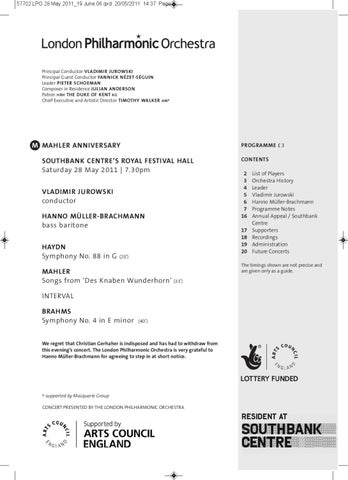
MAHLER ANNIVERSARY
PROGRAMME £3
SOUTHBANK CENTRE’S ROYAL FESTIVAL HALL Saturday 28 May 2011 | 7.30pm
CONTENTS
VLADIMIR JUROWSKI conductor HANNO MÜLLER-BRACHMANN bass baritone HAYDN Symphony No. 88 in G
(20’)
MAHLER Songs from ‘Des Knaben Wunderhorn’ (33’) INTERVAL BRAHMS Symphony No. 4 in E minor
(40’)
We regret that Christian Gerhaher is indisposed and has had to withdraw from this evening’s concert. The London Philharmonic Orchestra is very grateful to Hanno Müller-Brachmann for agreeing to step in at short notice.
†
supported by Macquarie Group
CONCERT PRESENTED BY THE LONDON PHILHARMONIC ORCHESTRA
2 3 4 5 6 7 16 17 18 19 20
List of Players Orchestra History Leader Vladimir Jurowski Hanno Müller-Brachmann Programme Notes Annual Appeal / Southbank Centre Supporters Recordings Administration Future Concerts
The timings shown are not precise and are given only as a guide.
57702 LPO 28 May 2011_19 June 06.qxd 20/05/2011 14:37 Page 2
LONDON PHILHARMONIC ORCHESTRA
FIRST VIOLINS Pieter Schoeman* Leader Katerina Mitchell Katalin Varnagy Catherine Craig Tina Gruenberg Martin Hรถhmann Chair supported by Richard Karl Goeltz
Robert Pool Sarah Streatfeild Yang Zhang Rebecca Shorrock Alain Petitclerc Galina Tanney Joanne Chen Alina Petrenko Ishani Bhoola Caroline Frenkel SECOND VIOLINS Clare Duckworth Principal Chair supported by Richard and Victoria Sharp
Jeongmin Kim Joseph Maher Kate Birchall Chair supported by David and Victoria Graham Fuller
Nancy Elan Fiona Higham Nynke Hijlkema Ashley Stevens Andrew Thurgood Imogen Williamson Peter Graham Stephen Stewart Mila Mustakova Sheila Law Elizabeth Baldey Stephen Dinwoodie VIOLAS Fiona Winning Guest Principal Robert Duncan Katharine Leek Susanne Martens
Benedetto Pollani Emmanuella Reiter-Bootiman Laura Vallejo Naomi Holt Michelle Bruil Miranda Davis Sarah Malcolm Rebecca Carrington CELLOS Kristina Blaumane Principal Susanne Beer Co-Principal Francis Bucknall Laura Donoghue Jonathan Ayling Chair supported by Caroline, Jamie and Zander Sharp
Santiago Sabino Carvalho + Gregory Walmsley Sue Sutherley Susanna Riddell Tom Roff Rosie Banks Tae Mi Song DOUBLE BASSES Kevin Rundell* Principal Tim Gibbs Co-Principal Laurence Lovelle George Peniston Richard Lewis Kenneth Knussen Tom Walley Helen Rowlands Louis Garson Damian Rubido Gonzalez FLUTES Jaime Martin* Principal Sue Thomas* Ian Mullin Jane Spiers PICCOLO Stewart McIlwham* Principal
OBOES Ian Hardwick Principal Angela Tennick Sue Bohling William Oinn COR ANGLAIS Sue Bohling Principal Chair supported by Julian and Gill Simmonds
CLARINETS Robert Hill* Principal Steve Morris Katie Lockhart Andrew Mason E FLAT CLARINET Katie Lockhart BASS CLARINET Katie Lockhart BASSOONS John Price Principal Gareth Newman* Principal Simon Estell Susanna Dias Graham Hobbs
TROMBONES David Whitehouse Principal Robert Workman BASS TROMBONE Lyndon Meredith Principal TUBA Lee Tsarmaklis Principal TIMPANI Simon Carrington* Principal Antoine Bedewi PERCUSSION Andrew Barclay* Principal Chair supported by Andrew Davenport
Keith Millar Antoine Bedewi Ignacio Molins HARP Rachel Masters* Principal
ASSISTANT CONDUCTOR Thomas Blunt
CONTRA BASSOON Simon Estell Principal HORNS John Ryan* Principal Martin Hobbs Adrian Uren Gareth Mollison Nicolas Wolmark TRUMPETS Paul Beniston* Principal Anne McAneney* Chair supported by Geoff and Meg Mann
Nicholas Betts Co-Principal
* Holds a professorial appointment in London +
Chevalier of the Brazilian Order of Rio Branco
Chair Supporters The London Philharmonic Orchestra also acknowledges the following chair supporters whose players are not present at this concert: John and Angela Kessler The Tsukanov Family
2 | London Philharmonic Orchestra
57702 LPO 28 May 2011_19 June 06.qxd 20/05/2011 14:37 Page 3
LONDON PHILHARMONIC ORCHESTRA
Patrick Harrison
Seventy-eight years after Sir Thomas Beecham founded the London Philharmonic Orchestra, it is recognised today as one of the finest orchestras on the international stage. Following Beecham’s influential founding tenure the Orchestra’s Principal Conductorship has been passed from one illustrious musician to another, amongst them Sir Adrian Boult, Bernard Haitink, Sir Georg Solti, Klaus Tennstedt and Kurt Masur. This impressive tradition continued in September 2007 when Vladimir Jurowski became the Orchestra’s Principal Conductor and, in a further exciting move, the Orchestra appointed Yannick Nézet-Séguin its new Principal Guest Conductor from September 2008. The London Philharmonic Orchestra has been performing at Southbank Centre’s Royal Festival Hall since it opened in 1951, becoming Resident Orchestra in 1992. It plays there around 40 times each season with many of the world’s most sought after conductors and soloists. Concert highlights in 2010/11 include an exploration of Mahler’s symphonies and complete song cycles during the composer’s anniversary season; the premières of works by Matteo D’Amico, Magnus Lindberg and Brett Dean; a rare opportunity to hear Rossini’s opera Aureliano in Palmira in collaboration with long term partner Opera Rara; and works by the Orchestra’s new Composer in Residence, Julian Anderson. In addition to its London season and a series of concerts at Wigmore Hall, the Orchestra has flourishing
residencies in Brighton and Eastbourne, and performs regularly around the UK. It is unique in combining these concert activities with esteemed opera performances each summer at Glyndebourne Festival Opera where it has been the Resident Symphony Orchestra since 1964. The London Philharmonic Orchestra performs to enthusiastic audiences all round the world. In 1956 it became the first British orchestra to appear in Soviet Russia and in 1973 made the first ever visit to China by a Western orchestra. Touring continues to form a significant part of the Orchestra’s schedule and is supported by Aviva, the International Touring Partner of the London Philharmonic Orchestra. Tours in 2010/11 include visits to Finland, Germany, South Korea, Spain, France, Belgium and Luxembourg. Having long been embraced by the recording, broadcasting and film industries, the London Philharmonic Orchestra broadcasts regularly on domestic and international television and radio. It also works with the Hollywood and UK film industries, recording soundtracks for blockbuster motion pictures including the Oscar-winning score for The Lord of the Rings trilogy and scores for Lawrence of Arabia, The Mission, Philadelphia and East is East. The London Philharmonic Orchestra made its first recordings on 10 October 1932, just three days after its first public performance. It has recorded and broadcast
London Philharmonic Orchestra | 3
57702 LPO 28 May 2011_19 June 06.qxd 20/05/2011 14:37 Page 4
LONDON PHILHARMONIC ORCHESTRA
PIETER SCHOEMAN
regularly ever since, and in 2005 established its own record label. The recordings on its own label are taken mainly from live concerts given with distinguished conductors over the years including the Orchestra’s Principal Conductors from Beecham and Boult, through Haitink, Solti and Tennstedt, to Masur and Jurowski. Recent additions to the catalogue have included acclaimed releases of Christmas choral music conducted by Vladimir Jurowski, Bruckner’s Symphony No. 6 conducted by Christoph Eschenbach, Verdi’s Requiem conducted by Jesús López-Cobos, Holst’s The Planets conducted by Vladimir Jurowski and Elgar’s Symphony No. 1 and Sea Pictures with Vernon Handley and Janet Baker. The Orchestra’s own-label CDs are also widely available to download. Visit www.lpo.org.uk/shop for the latest releases.
‘ … a simply tremendous performance of Mahler’s 3rd Symphony … Jurowski and his players plunged us into a winter of discontent so profoundly expectant that even the inveterate coughers were silenced.’ EDWARD SECKERSON, THE INDEPENDENT, 23 SEPTEMBER 2010
The Orchestra reaches thousands of Londoners through its rich programme of community and school-based activity in Lambeth, Lewisham and Southwark, which includes the offshoot ensembles Renga and The Band, its Foyle Future Firsts apprenticeship scheme for outstanding young instrumentalists, and regular family and schools concerts. To help maintain its high standards and diverse workload, the Orchestra is committed to the welfare of its musicians and in December 2007 received the Association of British Orchestras/Musicians Benevolent Fund Healthy Orchestra Bronze Charter Mark. There are many ways to experience and stay in touch with the Orchestra’s activities: visit www.lpo.org.uk, subscribe to our podcast series, download our iPhone application and join us on Facebook and Twitter.
4 | London Philharmonic Orchestra
In 2002, Pieter Schoeman joined the London Philharmonic Orchestra as Co-Leader. He was appointed Leader in 2008. Born in South Africa, he made his solo debut with the Cape Town Symphony Orchestra at the age of ten. He studied with Jack de Wet in South Africa, winning numerous competitions, including the 1984 World Youth Concerto Competition in America. In 1987 he was offered the Heifetz Chair of Music scholarship to study with Eduard Schmieder in Los Angeles and in 1991 his talent was spotted by Pinchas Zukerman who recommended that he move to New York to study with Sylvia Rosenberg. In 1994 he became her teaching assistant at Indiana University, Bloomington. Pieter Schoeman has performed as a soloist and recitalist throughout the world in such famous halls as the Concertgebouw in Amsterdam, Moscow’s Rachmaninov Hall, Capella Hall in St Petersburg, Staatsbibliothek in Berlin, Hollywood Bowl in Los Angeles and Southbank Centre’s Queen Elizabeth Hall in London. As a chamber musician he regularly performs at London’s prestigious Wigmore Hall. As a soloist with the London Philharmonic Orchestra, he has performed Arvo Pärt’s Double Concerto with Boris Garlitsky and Benjamin Britten’s Double Concerto with Alexander Zemtsov, which was recorded and released on the Orchestra’s own record label to great critical acclaim. Last October he performed the Brahms Double Concerto with Kristina Blaumane. In 1995 Pieter Schoeman became Co-Leader of the Orchestre Philharmonique de Nice. Since then he has performed frequently as Guest Leader with the symphony orchestras of Barcelona, Bordeaux, Lyon and Baltimore as well as the BBC Symphony Orchestra. Pieter Schoeman has recorded numerous violin solos with the London Philharmonic Orchestra for Chandos, Opera Rara, Naxos, X5, the BBC and for American film and television. He led the Orchestra in its soundtrack recordings for The Lord of the Rings trilogy. He is a Professor at Trinity College of Music in London.
Patrick Harrison
LEADER
57702 LPO 28 May 2011_19 June 06.qxd 20/05/2011 14:37 Page 5
VLADIMIR JUROWSKI
Karen Robinson
CONDUCTOR
Born in Moscow, the son of conductor Mikhail Jurowski, Vladimir Jurowski completed the first part of his musical studies at the Music College of the Moscow Conservatory. In 1990 he relocated with his family to Germany where he continued his studies in Dresden and Berlin, studying conducting with Rolf Reuter and vocal coaching with Semion Skigin. In 1995 he made his international debut at the Wexford Festival, where he conducted Rimsky-Korsakov’s May Night. The same year saw his brilliant debut at the Royal Opera House Covent Garden in Nabucco. In 1996 he joined the ensemble of Komische Oper Berlin, becoming First Kapellmeister in 1997 and continuing to work at the Komische Oper on a permanent basis until 2001. Since 1997 Vladimir Jurowski has been a guest at some of the world’s leading musical institutions including the Royal Opera House Covent Garden, Teatro La Fenice di Venezia, Opéra Bastille de Paris, Théâtre de la Monnaie Bruxelles, Maggio Musicale Festival Florence, Rossini Opera Festival Pesaro, Edinburgh Festival, Semperoper Dresden and the Teatro Comunale di Bologna (where he served as Principal Guest Conductor between 2000 and 2003). In 1999 he made his debut at the Metropolitan Opera New York with Rigoletto. In January 2001 Vladimir Jurowski took up the position of Music Director of Glyndebourne Festival Opera and in 2003 was appointed Principal Guest Conductor of the London Philharmonic Orchestra, becoming the Orchestra’s Principal Conductor in September 2007. He also holds the title of Principal Artist of the Orchestra of the Age of Enlightenment, and from 2005 to 2009 served as Principal Guest Conductor of the Russian National Orchestra with whom he will continue to work in the years ahead.
Vladimir Jurowski is a regular guest with many of the world’s leading orchestras including the Berlin Philharmonic, Oslo Philharmonic, Royal Concertgebouw, Bavarian Radio Symphony, Dresden Staatskapelle, Los Angeles Philharmonic and Philadelphia Orchestras as well as the Gewandhausorchester Leipzig. Highlights of the 2010/11 season and beyond include his debuts with the Vienna Philharmonic, Cleveland, San Francisco Symphony and Mahler Chamber Orchestras, and return visits to the Chicago Symphony, Chamber Orchestra of Europe, Berlin Philharmonic, Royal Concertgebouw, St Petersburg Philharmonic and Philadelphia Orchestras. His operatic engagements have included Jenůfa, The Queen of Spades and Hänsel und Gretel at the Metropolitan Opera, Parsifal and Wozzeck at Welsh National Opera, War and Peace at the Opéra National de Paris, Eugene Onegin at La Scala Milan, as well as Die Zauberflöte, La Cenerentola, Otello, Macbeth, Falstaff, Tristan und Isolde, Don Giovanni, The Rake’s Progress and Peter Eötvös’ Love and Other Demons at Glyndebourne Opera. Future engagements include new productions of Die Meistersinger and The Cunning Little Vixen at Glyndebourne, Die Frau ohne Schatten at the Metropolitan Opera, Russlan and Ludmila at the Bolshoi Theatre, and Iolanta at the Dresden Semperoper. Jurowski’s discography includes the first ever recording of Giya Kancheli’s cantata Exil for ECM (1994), L’Étoile du Nord by Meyerbeer for Naxos-Marco Polo (1996), and Werther for BMG (1999) as well as live recordings of works by Rachmaninov, Turnage, Tchaikovsky, Britten, Brahms and Shostakovich on the London Philharmonic Orchestra’s own label, and Prokofiev’s Betrothal in a Monastery on Glyndebourne Opera’s own label. He also records for PentaTone with the Russian National Orchestra, with releases to date including Tchaikovsky’s Suite No. 3 and Stravinsky’s Divertimento from Le Baiser de la fée, Shostakovich’s Symphonies Nos 1 and 6, Prokofiev’s Symphony No. 5 and Tchaikovsky’s Hamlet Incidental Music. Glyndebourne have released DVD recordings of his performances of La Cenerentola, Gianni Schicchi, Die Fledermaus and Rachmaninov’s The Miserly Knight, and other recent DVD releases include Hänsel und Gretel from the Metropolitan Opera New York, and his first concert as the London Philharmonic Orchestra’s Principal Conductor featuring works by Wagner, Berg and Mahler (released by Medici Arts).
London Philharmonic Orchestra | 5
57702 LPO 28 May 2011_19 June 06.qxd 20/05/2011 14:37 Page 6
HANNO MÜLLER-BRACHMANN BASS BARITONE
Hanno Müller-Brachmann began his musical training in Basel and in Freiburg. He attended Dietrich FischerDieskau’s Lied classes in Berlin and he continues to study with Rudolf Piernay. He has appeared with many of the world’s leading orchestras and conductors, singing Bach’s St Matthew Passion with the London Philharmonic Orchestra under Masur; Bach’s St John Passion with the Monteverdi Choir and Orchestra under Gardiner and with the Leipzig Gewandhaus Orchestra under Chailly; Berlioz’s Romeo et Juliette with the Berlin Staatskappelle under Luisi; Schubert’s Alfonso und Estrella with the Berlin Philharmonic under Harnoncourt; Beethoven’s Symphony No. 9 with the Philharmonia Orchestra under Dohnányi and with the Leipzig Gewandhaus Orchestra under Chailly; Beethoven’s Symphony No. 9 and Rossini’s Stabat Mater with the Orchestra Sinfonica di Milano Giuseppe Verdi under Chailly; Britten’s War Requiem with the European Youth Orchestra under Ashkenazy and with the Orchestre National de France under Masur; Schoenberg’s Survivor from Warsaw with the Radio Sinfonie Orchester under Gielen; Mahler’s Kindertotenlieder with the Sinfonieorchester Basel under Holliger; and Mahler’s Des Knaben Wunderhorn with the Orchestre Philharmonique de Radio France under Chung. He made his Carnegie Hall debut with the Chicago Symphony Orchestra under Barenboim and has sung at the Festivals of Granada, Dresden, Salzburg, Lucerne, Vienna’s Klangbogen, Tanglewood and the BBC Proms.
6 | London Philharmonic Orchestra
Hanno Müller-Brachmann made his operatic debut in 1996 in Telemann’s Orpheus under René Jacobs at the Deutsche Staatsoper Berlin, where he has been a member of the ensemble since 1998 and where he is currently singing the great Mozart roles of Leporello, Figaro, Guglielmo and Papageno as well as his first Wotan under Barenboim. His other roles in the house include Amfortas in Parsifal under Barenboim, Kaspar in Der Freischütz, Oreste in Elektra, Tomsky in The Queen of Spades and Golaud in Pelléas et Mélisande. At the Bavarian State Opera he has sung Oreste, Guglielmo, Papageno and Figaro. At the San Francisco Opera he made his debut, as Guglielmo, under Gielen. He made his debut for the Hamburg State Opera, singing Amfortas and for the Vienna State Opera he has sung Guglielmo and Leporello. In addition to opera and oratorio, he also devotes himself to Lied and can be heard in recitals in Berlin at both the Staatsoper and Philharmonie. He has also given recitals in Graz, Amsterdam, Antwerp, Tokyo, Hamburg, Paris, Lausanne and London’s Wigmore Hall as well as at the Schwarzenberg Schubertiade, Berlin Festwochen, Ittingen and Edinburgh Festivals. He works with the pianists Burkhard Kehring, András Schiff, Philippe Jordan, Graham Johnson, Malcolm Martineau and Daniel Barenboim. He also teaches song in Berlin. Hanno Müller-Brachmann has appeared in various radio and television productions and has recorded Schubert recital discs for Harmonia Mundi and Naxos Records, and a Schumann recital disc for Hyperion Records. His recordings also include Die Zauberflöte conducted by Claudio Abbado for Deutsche Grammophon, which won Gramophone’s ‘Best Opera Recording of the Year’ and most recently the St Matthew Passion for Decca with Riccardo Chailly and the Leipzig Gewandhaus Orchestra.
57702 LPO 28 May 2011_19 June 06.qxd 20/05/2011 14:37 Page 7
PROGRAMME NOTES
SPEEDREAD Three major symphonists grace this programme. Haydn has justly been called ‘the father of the symphony’ for his achievement in transforming it from light court music into the definitive orchestral genre, the measure of a composer’s intellectual and expressive powers. Brahms, having lingered before addressing the challenge thrown
Joseph HAYDN
down by Beethoven, produced in his Fourth and last symphony not only one of his own most powerful works, but also one of the summits of Romantic orchestral music. And while Mahler is represented by vocal music tonight, songs were no less a crucial part of his creative personality, informing and enriching his allencompassing symphonic world.
SYMPHONY NO. 88 IN G Adagio – Allegro | Largo | Menuetto and Trio: Allegretto | Finale: Allegro con spirito
1732-1809
The compositional circumstances of Haydn’s last 23 symphonies were very different from those of their 80odd predecessors, most of which had been written for local performance at the court of his employer, Prince Nikolaus Esterházy. The 1780s saw the composer’s international fame and popularity rise to new heights, and after a Parisian concert society commissioned a set of six symphonies from him in 1785, his subsequent examples were all written for foreign consumption. The ‘Paris’ Symphonies (Nos. 82–87) were an enormous success, even by the standards of a composer who was already one of the most frequently represented in the French capital’s concert life. Surpassing even the high standards set by Haydn’s previous symphonies, their expressive breadth and inventive mastery of form gave his international reputation a substantial boost, and further commissions quickly followed. The next two symphonies, Nos 88 and 89, were composed in 1787 and entrusted to Johann Tost, a violinist in the Esterházy band, to take with him on a forthcoming trip to the French capital and place with a publisher; they can thus be seen as a supplement to the original ‘Paris’ symphonies set, cut from the same brilliant cloth. Symphony No. 88 is a superb example of how in his later symphonies Haydn could effortlessly mix easy
popularity of style with formidable intellectual strength. After a poised slow introduction, the opening Allegro is built almost entirely around statements and reformulations of its initial seven-note motif and the wriggling bass figure which soon accompanies it; there is no ‘second theme’. The Largo is one of Haydn’s finest, admired by Brahms among others. Its relatively unusual tempo marking suggests seriousness of intent, which Haydn reiterates with surprise use of trumpets and drums; not only is this the first time he had used them in a slow movement, but here they have been silent throughout the first movement. This slow movement has the feel of a set of variations, but is in fact a study in sending successive hearings of its hymn-like theme in different directions. The third movement is a minuet and trio offering a gloriously coloured vision of peasant merrymaking (nothing courtly about this one), and the symphony ends with a typically bustling sonata-rondo in which one of the main theme’s restatements kicks off a canon between upper and lower strings. The ability to incorporate dazzling counterpoint of this kind into essentially lighthearted music with so little fuss or sense of incongruity was just one of Haydn’s many cherishable talents.
London Philharmonic Orchestra | 7
57702 LPO 28 May 2011_19 June 06.qxd 20/05/2011 14:37 Page 8
PROGRAMME NOTES
Gustav MAHLER
SONGS FROM ‘DES KNABEN WUNDERHORN’ HANNO MÜLLER-BRACHMANN bass baritone Des Antonius von Padua Fischpredigt | Lob des hohen Verstandes | Rheinlegendchen | Trost im Unglück | Das irdische Leben | Der Tamboursg’sell | Revelge
1860-1911
With a few early and minor exceptions, Mahler’s entire output was concentrated on the genres of song and symphony. Furthermore, the two were inextricably linked components in his creative engine-room, as the song-movements of several of his symphonies and the ‘symphony’ Das Lied von der Erde reveal. For Mahler, who did not compose his symphonies from beginning to end but assembled them in the order in which the ideas for movements came to him, the insertion of a well-chosen song could be the answer to a symphonic problem, a vital piece in the jigsaw. But the writing of songs also played a vital part in his development as an expressive artist, and perhaps nowhere did he find his voice more decisively than in his settings of texts from the great collection of Germanic folk poetry known as Des Knaben Wunderhorn (The Boy’s Magic Horn). Collected, touched up and published by Achim von Arnim and Clemens Brentano in the early 1800s, the poems treated with varying degrees of humour and seriousness such subjects as the trials of love, the indignities of poverty and the intrusion of war on ordinary lives, and for the last fifteen years or so of the nineteenth century they dominated Mahler’s imagination. During this period he composed more than 20 settings of words from this collection (far more than from any other source), and also included songs to Wunderhorn texts – as well as melodic material referencing other settings – in his Second, Third and Fourth symphonies. His clearest declaration of affinity with the Wunderhorn poems, however, was the set of twelve songs published with piano or orchestral accompaniment in the years around 1900, from which come the seven songs we hear tonight.
8 | London Philharmonic Orchestra
Although Mahler often retained the strophic feel of the original folk-verse, his settings are predictably free, detailed and sophisticated, and his strong personal identification with their content, coupled on occasion with his acute sense of irony, both turns up the emotional heat and opens up new expressive pathways. Des Antonius von Padua Fischpredigt (St Anthony of Padua preaches to the Fishes) is a satirical number whose restless perpetuum mobile accompaniment found a second home in the scherzo of the Second Symphony, while the opening theme of the comical jab at the critical profession that is Lob des hohen Verstandes (In Praise of High Intellect) was re-used in the finale of the Fifth. Rheinlegendchen (Rhine Legend), in which a reaper fantasises on how to recover a lost sweetheart, is, in its own rather louche particular way, the most folk-like of tonight’s settings, and there is earthy humour in the humorous dialogue of Trost im Unglück (Consolation in Misfortune). Matters take a deeper and more serious turn in the last three songs in this selection. Das irdische Leben (Earthly Life) is a dialogue between an anguished mother and the child she cannot afford to feed; the harrowing Der Tamboursg’sell (The Drummer Boy) explores the feelings of a child soldier condemned to death for desertion with the help of a typical Mahlerian funeral march; and the military life rings an eerie note in Revelge (Reveille), an extended song about a ghostly army with orchestral interludes and a march figure which later resurfaced in the Seventh Symphony.
57702 LPO 28 May 2011_19 June 06.qxd 20/05/2011 14:37 Page 9
PROGRAMME NOTES
Des Antonius von Padua Fischpredigt
St Anthony of Padua preaches to the Fishes
Antonius zur Predigt die Kirche find’t ledig. Er geht zu den Flüssen und predigt den Fischen. Sie schlag’n mit den Schwänzen, im Sonnenschein glänzen. Die Karpfen mit Rogen sind all’ hierher zogen. Hab’n die Mäuler aufrissen, sich Zuhörn’s beflissen. Kein Predigt niemalen den Fischen so g’fallen. Spitzgoschete Hechte, die immerzu fechten, Sind eilends herschwommen zu hören den Frommen. Auch jene Phantasten, die immerzu fasten, Die Stockfisch’ ich meine, zur Predigt erscheinen. Kein Predigt niemalen den Stockfisch’ so g’fallen. Gut Aale und Hausen, die Vornehme schmausen, Die selbst sich bequemen die Predigt vernehmen. Auch Krebse, Schildkroten, sonst langsame Boten, Steigen eilig vom Grund zu hören diesen Mund. Kein Predigt niemalen den Krebsen so g’fallen. Fisch’ grosse, Fisch’kleine, vornehm’ und gemeine, Erheben die Köpfe wie verständ’ge Geschöpfe Auf Gottes Begehren die Predigt anhören. Die Predigt geendet, ein jeder sich wendet. Die Hechte bleiben Diebe, die Aale viel lieben: Die Predigt hat g’fallen, sie bleiben wie Allen. Die Krebs’ geh’n zurücke, die Stockfisch’ bleiben dicke, Die Karpfen viel fressen, die Predigt vergessen. Die Predigt hat g’fallen, sie bleiben wie Allen.
When Anthony preaches the church is empty. He goes to the rivers and preaches to the fish. They flick their tails, glint in the sunshine.
Lob des hohen Verstandes
In Praise of High Intellect
Einstmal in einem tiefen Tal Kuckuck und Nachtigall Täten ein Wett’ anschlagen, Zu singen um das Meisterstück, Gewinn’ es Kunst, gewinn’ es Glück, Dank soll er davon tragen.
Once upon a time in a deep valley The cuckoo and the nightingale Struck a bet: Whichever of them could sing a mastersong, Winning by art or good fortune, Should have the prize.
Der Kuckuck sprach: ‘So dir’s gefällt Hab’ ich den Richter wählt.’ Und tät gleich den Esel ernennen! ‘Denn weil er hat zwei Ohren gross So kann er hören desto bos Und was recht ist kennen!’
The cuckoo said: ‘If it please you I have chosen the judge.’ And straightway named the donkey! ‘For because he has two big ears He can hear all the better what’s bad And know what’s right!’
Sie flogen vor den Richter bald Wie dem die Sache ward erzählt. Schuf er, sie sollten singen! Die Nachtigall sang lieblich aus!
Soon they flew to the judge And told him how things stood. He ordered them to sing. The nightingale sang out sweetly!
The carp and roach are all drawn here. Their mouths gape wide, the better to listen. No sermon ever pleased the fish so much. Sharp-mouthed pike, who are constantly fighting, Have hurriedly swum here to hear the holy man. Also those dreamers, who are always fasting, The cod I mean, appear at the sermon. No sermon ever pleased the cod so much. Fine eels and sturgeon, the aristocratic feeders, make themselves comfortable to hear the sermon. Crabs too and turtles, otherwise slow on their errands, Rise quickly from the ground to hear these words. No sermon ever pleased the crabs so much. Big fish, little fish, high-born and low, Raise their heads like intelligent creatures At God’s desire to listen to the sermon. The sermon ended, each one turns away. The pike remain thieves, the eels love a lot: They liked the sermon, they remain like all. The crabs go backwards, the cod stay stupid, The carp eat a lot, forget the sermon. They liked the sermon, they remain like all.
London Philharmonic Orchestra | 9
57702 LPO 28 May 2011_19 June 06.qxd 20/05/2011 14:37 Page 10
PROGRAMME NOTES
Der Esel sprach: ‘Du machst mir’s kraus! Ija! Ija! Ich kann’s in Kopf nicht bringen.’
The donkey said: ‘You make me muddled! Hee-haw! Hee-haw! I cannot understand it.’
Der Kuckuck drauf fing an geschwind Sein Sang durch Terz und Quart und Quint. Dem Esel g’fiels, er sprach nur: ‘Wart! Mein Urteil will ich sprechen.
The cuckoo quickly began His song through thirds and fourths and fifths. It pleased the donkey, he just said: ‘Wait! I will announce my judgement.
‘Wohl sungen hast du, Nachtigall! Aber Kuckuck singst gut Choral Und hältst den Takt fein innen. Das sprech’ ich nach mein’ hoh’n Verstand Und kost’ es gleich ein ganzes Land, So lass ich’s dich gewinnen.
You have sung well, nightingale! But cuckoo sings a good chorale And keeps strictly to the beat. I speak from my high intellect And even if it cost a whole country, I make you the winner.
Kuckuck, kuckuck, ija!’
Cuckoo, cuckoo, hee-haw!’
Rheinlegendchen
Rhine Legend
Bald gras’ ich am Neckar, Bald gras’ ich am Rhein, Bald hab’ ich ein Schätzel, Bald bin ich allein.
Sometimes I mow by the Neckar, Sometimes I mow by the Rhine, Sometimes I’ve a sweetheart, Sometimes I’m alone.
Was hilft mir das Grasen Wenn d’Sichel nicht schneid’t! Was hilft mir ein Schätzel Wenn’s bei mir nicht bleibt!
What use is the mowing If the sickle won’t cut? What use is a sweetheart If she won’t stay with me?
So soll ich denn grasen Am Neckar, am Rhein, So werf’ ich mein goldenes Ringlein hinein.
So if I must mow By the Neckar and Rhine, I shall throw in My little gold ring.
Es fliesset im Neckar Und fliesset im Rhein, Soll schwimmen hinunter Ins Meer tief hinein.
It will flow in the Neckar And flow in the Rhine, And float down To the deep sea.
Und schwimmt es, das Ringlein, So frisst es ein Fisch. Das Fischlein soll kommen Auf’s Königs sein Tisch.
And as the ring floats, A fish will swallow it. The fish will come To the King’s table.
Der König tät fragen: ‘Wem’s Ringlein sollt’ sein?’ Da tät mein Schatz sagen: ‘Das Ringlein g’hört mein.’
The King will ask: ‘Whose ring can this be?’ My sweetheart will answer: ‘The ring belongs to me.’
10 | London Philharmonic Orchestra
57702 LPO 28 May 2011_19 June 06.qxd 20/05/2011 14:37 Page 11
PROGRAMME NOTES
Mein Schätzlein tät springen Bergauf und bergein, Tät mir wied’rum bringen Das Goldringlein mein!
My sweetheart will go leaping Up and downhill, Will bring back to me My little gold ring.
Kannst grasen am Neckar, Kannst grasen am Rhein, Wirf du mir nur immer Dein Ringlein hinein!
You can mow by the Neckar, You can mow by the Rhine, But always throw me Your ring in the water.
Trost im Unglück
Consolation in Misfortune
Husar Wohlan! Die Zeit ist kommen! Mein Pferd das muss gesattelt sein. Ich hab’ mir’s vorgenommen, Geritten muss es sein! Geh’ du nur hin! Ich hab’ mein Teil! Ich lieb’ dich nur aus Narretei! Ohn’ dich kann ich wohl leben, ja leben! Ohn’ dich kann ich wohl sein! So setz ich mich auf’s Pferdchen Und trink’ ein Gläschen kühlen Wein! Und schwör’s bei meinem Bärtchen Dir ewig treu zu sein.
Hussar Well! The time has come! My horse must be saddled. I have made up my mind, ridden it must be! Just go away! I’ve had my fill! I love you only out of foolishness. I can well live without you, yes live! Without you I can be happy! So I’ll mount my horse And drink a glass of cool wine And swear by my beard To be true to you forever.
Mädchen Du glaubst du bist der Schönste Wohl auf der ganzen weiten Welt, Und auch der Angenehmste! Ist aber weit, weit gefehlt! In meines Vaters Garten Wächst eine Blume drin; So lang’ will ich noch warten Bis die noch grösser ist. Und geh’ du nur hin! Ich hab’ mein Teil! Ich lieb’ dich nur aus Narretei! Ohn’ dich kann ich wohl leben, Ohn’dich kann ich wohl sein!
Girl You think you are the handsomest man In the whole wide world, And also the most agreeable! But that is far, far wrong! In my father’s garden There is a flower growing; I will wait only Until it is bigger. So just go away! I’ve had my fill! I love you only out of foolishness! I can well live without you, Without you I can be happy!
Beide Du glaubst ich werd’ dich nehmen! Dass hab’ ich lang’ noch nicht im Sinn! Ich muss mich deiner schämen Wenn ich in Gesellschaft bin.
Both You think that I will take you! That’s long not been in my mind! I have to be ashamed of you When I am in company.
London Philharmonic Orchestra | 11
57702 LPO 28 May 2011_19 June 06.qxd 20/05/2011 14:37 Page 12
PROGRAMME NOTES
Das irdische Leben
Earthly Life
‘Mutter, ach Mutter, es hungert mich. Gib mir Brot, sonst sterbe ich!’ ‘Warte nur, warte nur, mein liebes Kind, Morgen wollen wir ernten geschwind.’ Und als das Korn geerntet war, Rief das Kind noch immerdar: ‘Mutter, ach Mutter, es hungert mich. Gib mir Brot, sonst sterbe ich! ‘Warte nur, warte nur, mein liebes Kind, Morgen wollen wir dreschen geschwind.’ Und als das Korn gedroschen war, Rief das Kind noch immerdar: ‘Mutter, ach Mutter, es hungert mich. Gib mir Brot, sonst sterbe ich! ‘Warte nur, warte nur, mein liebes Kind, Morgen wollen wir backen geschwind.’ Und als das Brot gebacken war, Lag das Kind auf der Totenbahr.
‘Mother, oh Mother, I am hungry. Give me bread, or I shall die!’ ‘Just wait, just wait, my dear child, Tomorrow we’ll quickly go reaping.’ And when the corn was harvested, Still the child kept crying: ‘Mother, oh Mother, I am hungry. Give me bread, or I shall die! ‘Just wait, just wait, my dear child, Tomorrow we’ll quickly go threshing.’ And when the corn was threshed, Still the child kept crying: ‘Mother, oh Mother, I am hungry. Give me bread, or I shall die! ‘Just wait, just wait, my dear child, Tomorrow we’ll quickly get baking.’ And when the bread was baked, The child lay dead upon a bier.
Der Tamboursg’sell
The Drummer Boy
Ich armer Tamboursg’sell! Man führt mich aus dem G’wölb. Wär ich ein Tambour blieben, Dürft ich nicht gefangen liegen. O Galgen, du hohes Haus, Du siehst so furchtbar aus. Ich schau’ dich nicht mehr an, Weil i’ weiss das i’ g’hör d’ran. Wenn Soldaten vorbei marschier’n Bei mir nit einquartier’n, Wenn sie fragen wer i’ g’wesen bin: Tambour von der Leibkompanie! Gute Nacht, ihr’ Marmelstein’, Ihr Berg’ und Hügelein! Gute Nacht, ihr Offizier, Korporal und Musketier! Gute Nacht, ihr Offizier, Korporal und Grenadier! Ich schrei’ mit heller Stimm’ Von Euch ich Urlaub nimm’. Gute Nacht! Gute Nacht!
I am a poor drummer boy! They are taking me out of the cell. Had I stayed a drummer, I would not have lain imprisoned. Oh gallows, you high house, You look so dreadful. I shall look at you no more, For I know that’s where I belong. When soldiers march past To quarters not mine, When they ask who I was, Say: ‘Drummer from the First Company!’ Good night, you marble stones, You mountains and hills! Good night, you officers, Corporal and musketeer! Good night, you officers, Corporal and grenadier! I cry with a loud voice, From you I take my leave. Good night! Good night!
12 | London Philharmonic Orchestra
57702 LPO 28 May 2011_19 June 06.qxd 20/05/2011 14:37 Page 13
PROGRAMME NOTES
Revelge
Reveille
Des Morgens zwischen drei’n und vieren Da müssen wir Soldaten marschieren Das Gässlein auf und ab. Tral-la-li, tral-la-ley, tral-la-lera. Mein Schätzel sieht herab!
In the morning between three and four We soldiers have to march Up and down the street. Tral-la-li, tral-la-ley, tral-la-lera. My sweetheart looks on.
Ach Brüder, jetzt bin ich geschossen, Die Kugel hat mich schwer, schwer getroffen. Trag’mich in mein Quartier. Tral-la-li, tral-la-ley, tral-la-lera. Es ist nicht weit von hier.
Ah brothers, I’ve just been shot, The bullet has badly, badly wounded me. Carry me back to my quarters. Tral-la-li, tral-la-ley, tral-la-lera. It isn’t far from here.
Ach Bruder, ach Bruder, ich kann dich nicht tragen. Die Feinde haben uns geschlagen! Helf’ dir der liebe Gott. Tral-la-li, tral-la-ley, tral-la-lera. Ich muss, ich muss marschieren bis in Tod!
Ah brother, ah brother, I cannot carry you. The enemy have beaten us! May dear God help you. Tral-la-li, tral-la-ley, tral-la-lera. I must, I must march on to my death!
Ach Brüder, ach Brüder, ihr geht ja mir vorüber, Als wär’s mit mir vorbei. Tral-la-li, tral-la-ley, tral-la-lera. Ihr tretet mir zu nah.
Ah brothers, ah brothers, you pass me by, As if it’s all over with me. Tral-la-li, tral-la-ley, tral-la-lera. You are treading too close to me.
Ich muss wohl meine Trommel rühren. Sonst werd’ich mich verlieren. Tral-la-li, tral-la-ley, tral-la-la. Die Brüder dicht gesät, Sie liegen wie gemäht.
I have to beat my drum Else I shall be lost. Tral-la-li, tral-la-ley, tral-la-la. The brothers thickly spread Lie like mown grass.
Er schlägt die Trommel auf und nieder, Er wecket seine stillen Brüder. Sie schlagen und sie schlagen ihren Feind. Tral-la-li, tral-la-ley, tral-la-lera-la-la. Ein Schrecken schlägt den Feind.
He beats the drum high and low, He wakes his silent brothers. They strike and beat their foe. Tral-la-li, tral-la-ley, tral-la-lera-la-la. Terror strikes the foe.
Er schlägt die Trommel auf und nieder, Da sind sie vor dem Nachtquartier schon wieder. Ins Gässlein hell hinaus Sie zieh’n vor Schätzleins Haus. Tral-la-li, tral-la-ley, tral-la-lera.
He beats the drum high and low, They are soon back at the night quarters again. Outside in the bright street They march to his sweetheart’s house. Tral-la-li, tral-la-ley, tral-la-lera.
Des Morgens stehen da die Gebeine In Reih und Glied, sie steh’n wie Leichensteine. Die Trommel steht voran Dass sie ihn sehen kann. Tral-la-li, tral-la-ley, tral-la-lera.
There in the morning lie the bones In row upon row like corpses of stone. The drum stands at the front So that she can see it. Tral-la-li, tral-la-ley, tral-la-lera. English translations © Eric Mason London Philharmonic Orchestra | 13
57702 LPO 28 May 2011_19 June 06.qxd 20/05/2011 14:37 Page 14
PROGRAMME NOTES
INTERVAL 20 minutes An announcement will be made five minutes before the end of the interval.
Johannes BRAHMS
SYMPHONY NO. 4 IN E MINOR, OP. 98 Allegro non troppo | Andante moderato | Allegro giocoso | Allegro energico e passionato
1833-1897
Brahms was well into his forties by the time he completed a symphony; like many nineteenth-century composers he found the idea of following in the footsteps of Beethoven a daunting one. Yet having laboured on and off for fifteen years to produce the First Symphony in 1876, he summoned the next three in only nine years, the expressive and formal inhibitions which had previously dogged him now seemingly cast off. Indeed, by the time he came to compose the Fourth Symphony in 1884-5 he had acquired new freedom and daring, as his friend the conductor and pianist Hans von Bülow noted during preparations for the première in Meiningen in October 1885: ‘Just back from rehearsal. No. 4 stupendous, quite original, quite new, individual and rock-like. Breathes incomparable energy from start to finish.’ No-one could deny that, though there were others among Brahms’s friends – including three of his closest supporters in Clara Schumann, Elisabeth von Herzogenberg and the critic Eduard Hanslick – who were initially baffled and disappointed by the work’s unusual nature and form. Bülow, however, had had an
14 | London Philharmonic Orchestra
insight into its most striking innovation a few years earlier when Brahms showed him a chorus from Bach’s church cantata Nach dir, Herr, verlanget mich (BWV150), consisting of variations over a repeating, rising bassline. ‘What would you think of a symphonic movement written on this theme one day?’ Brahms had asked. ‘But it is too heavy, too straightforward. It would have to be chromatically altered in some way.’ The result is there to hear – including that chromatic alteration in the form of a prominent sharpening of the fifth note – in the extraordinary passacaglia finale of this symphony, a movement which, by turning to a formal model from Baroque times, finds a new solution to the problem of how to conclude a big and powerful symphonic work. But it is not just this granitic statement that makes the Fourth one of the greatest of Romantic symphonies. There is the tightly motivic first movement, whose marking of Allegro non troppo is realised not just in the restless poetic beauty of the first theme but in the way that the second theme, a surging, passionate cello melody heralded by brass fanfares, serves to increase the sense of forward motion rather than (as was more
57702 LPO 28 May 2011_19 June 06.qxd 20/05/2011 14:37 Page 15
PROGRAMME NOTES
customary) relax it. Perhaps for the same reason, there is no repeat of the exposition, though the central development does start out as if it were one with a clear return to the opening theme. By contrast, the moment of recapitulation is disguised, the opening figure being heard slowed down on woodwind amid a cloud of string flourishes, before the first theme resumes its course as if nothing had happened. A substantial and impassioned coda then drives the movement to a stormy finish. The elegiac and delicately scored Andante moderato gains depth by playing off the emotional distance of a modally inflected main theme against the warmth of a more conventionally major-key second. The reappearance of the latter on full strings in the second half of the movement forms a rich climax, before the music subsides to the sombre mood of the opening. The third movement, the only one among Brahms’s symphonies to qualify as a scherzo, is taut and vigorous – powerful enough in its material, it has often been
said, to form a finale in itself. Interestingly, it was the last of the symphony’s movements to be composed, which suggests that its terse energy and ebullience (it was not often that Brahms called for a triangle) were precisely calculated to prepare the way for the stern majesty of the finale. The form and genesis of that finale has already been described, but not its effect. Following the example of Bach’s D minor Chaconne for solo violin (a work Brahms admired greatly), the 30 variations over the eight-note bass-line are shepherded into contrasting sections which give the music a broad emotional contour that prevents it from succumbing to repetitiveness. Indeed, the effect is of implacable momentum and controlled strength, so that by the time the variations have been crowned by a vehement coda, we have witnessed a rare spectacle: a nineteenth-century symphony that ends not in triumph but convincingly in tragedy. Programme notes © Lindsay Kemp
Listen Again You can hear tonight’s performance of Brahms’s Symphony No. 4 and Haydn’s Symphony No. 88 again online. Available for two weeks from early June, this is the perfect way to relive the concert. You will also be able to listen to Composer in Residence Julian Anderson’s The Crazed Moon, recorded in March. Visit www.lpo.org.uk/listenagain to sign up for email alerts when online concerts are available.
Hear every note
Hard of hearing? Visit the cloakroom for equipment to improve your concert experience.
London Philharmonic Orchestra | 15
57702 LPO 28 May 2011_19 June 06.qxd 20/05/2011 14:37 Page 16
2010/11 ANNUAL APPEAL: DEBUT SOUNDS The London Philharmonic Orchestra would like to thank everyone who has donated to this year’s Annual Appeal, which is raising funds for the Orchestra’s Debut Sounds concert on Wednesday 8 June 2011. The Orchestra’s Young Composers Scheme, led by Composer in Residence Julian Anderson, develops the key skills needed to work with a professional orchestra and to build a career in composition. Their music will be performed by an ensemble of Foyle Future Firsts and London Philharmonic Orchestra musicians. The Orchestra has received over 100 donations to this year’s appeal and we would like to thank the following donors for their major contributions: Mr Ferry F van Dijk The Elephant Trust Mr Derek Gray Ray Harsant
John & Angela Kessler In memory of David Scurfield The Sharp Family
In addition, we were delighted to take part in The Big Give in December 2010, through which online donations to the Annual Appeal were doubled. We are extremely grateful to Arts & Business and The Reed Foundation for their support through this initiative. It is not too late to donate The Debut Sounds concert, which will see the first public performance of the three composers’ works, is taking place at Southbank Centre’s Queen Elizabeth Hall on Wednesday 8 June 2011. If you do feel able to contribute we would be extremely grateful and donations of any size make a real difference. To donate, please contact Elisenda Ayats on 020 7840 4225 or visit our website at www.lpo.org.uk.
WELCOME
A few points to note for your comfort and enjoyment:
TO SOUTHBANK CENTRE
LATECOMERS will only be admitted to the auditorium if there is a suitable break in the performance
We hope you enjoy your visit. We have a Duty Manager available at all times. If you have any queries please ask any member of staff for assistance. Eating, drinking and shopping? Southbank Centre shops and restaurants include: Foyles, EAT, Giraffe, Strada, YO! Sushi, wagamama, Le Pain Quotidien, Las Iguanas, ping pong, Canteen, Caffè Vergnano 1882, Skylon, Concrete and Feng Sushi, as well as cafes, restaurants and shops inside Royal Festival Hall, Queen Elizabeth Hall and Hayward Gallery. If you wish to get in touch with us following your visit please contact Kenelm Roberts, our Head of Customer Relations, at Southbank Centre, Belvedere Road, London SE1 8XX or email customer@southbankcentre.co.uk or phone 020 7960 4250. We look forward to seeing you again soon.
16 | London Philharmonic Orchestra
PHOTOGRAPHY is not allowed in the auditorium
RECORDING is not permitted in the auditorium without the prior consent of Southbank Centre. Southbank Centre reserves the right to confiscate video or sound equipment and hold it in safekeeping until the performance has ended MOBILES, PAGERS AND WATCHES should be switched off before the performance begins
57702 LPO 28 May 2011_19 June 06.qxd 20/05/2011 14:37 Page 17
We would like to acknowledge the generous support of the following Thomas Beecham Group Patrons, Principal Benefactors and Benefactors: Thomas Beecham Group Mr & Mrs Richard & Victoria Sharp Julian & Gill Simmonds The Tsukanov Family Garf & Gill Collins Andrew Davenport David & Victoria Graham Fuller Richard Karl Goeltz John & Angela Kessler Mr & Mrs Makharinsky Geoff & Meg Mann Caroline, Jamie & Zander Sharp Eric Tomsett Guy & Utti Whittaker Principal Benefactors Mark & Elizabeth Adams Jane Attias Lady Jane Berrill Desmond & Ruth Cecil Mr John H Cook Mrs Sonja Drexler Mr Charles Dumas David Ellen Commander Vincent Evans
Mr Daniel Goldstein Mrs Barbara Green Oliver Heaton Mr & Mrs Jeffrey Herrmann Peter MacDonald Eggers Mr & Mrs David Malpas Andrew T Mills Mr Maxwell Morrison Mr Michael Posen Mr & Mrs Thierry Sciard Mr John Soderquist & Mr Costas Michaelides Mr & Mrs G Stein Mr & Mrs John C Tucker Howard & Sheelagh Watson Mr Laurie Watt Mr Anthony Yolland Benefactors Mrs A Beare Dr & Mrs Alan Carrington CBE FRS Marika Cobbold & Michael Patchett-Joyce Mr & Mrs Stewart Cohen Mr Alistair Corbett Mr David Edgecombe
Mr Richard Fernyhough Ken Follett Pauline & Peter Halliday Michael & Christine Henry Mr Glenn Hurstfield Mr R K Jeha Mr & Mrs Maurice Lambert Mr Gerald Levin Sheila Ashley Lewis Wg. Cdr. & Mrs M T Liddiard OBE JP RAF Mr Frank Lim Paul & Brigitta Lock Mr Brian Marsh John Montgomery Edmund Pirouet Mr Peter Tausig Mrs Kazue Turner Lady Marina Vaizey Mr D Whitelock Hon. Benefactor Elliott Bernerd Hon. Life Members Kenneth Goode Mrs Jackie Rosenfeld OBE
The generosity of our Sponsors, Corporate Members, supporters and donors is gratefully acknowledged. Corporate Members Appleyard & Trew llp AREVA UK British American Business Brown Brothers Harriman Charles Russell Destination Québec – UK Diagonal Consulting Lazard Leventis Overseas Man Group plc Québec Government Office in London Corporate Donor Lombard Street Research In-kind Sponsors Google Inc Heineken The Langham London Lindt & Sprüngli Ltd Sela / Tilley’s Sweets Villa Maria Trusts and Foundations Allianz Cultural Foundation The Andor Charitable Trust Arts and Business
Ruth Berkowitz Charitable Trust The Boltini Trust Borletti-Buitoni Trust Britten-Pears Foundation The Candide Charitable Trust The John S Cohen Foundation The Coutts Charitable Trust The Delius Trust The Dorset Foundation The D’Oyly Carte Charitable Trust Dunard Fund The Equitable Charitable Trust The Eranda Foundation The Ernest Cook Trust The Fenton Arts Trust The Foyle Foundation The Jeniffer and Jonathan Harris Charitable Trust Hattori Foundation for Music and the Arts Capital Radio’s Help a London Child The Idlewild Trust The Emmanuel Kaye Foundation The Leverhulme Trust Lord and Lady Lurgan Trust Maurice Marks Charitable Trust The Michael Marks Charitable Trust Marsh Christian Trust
UK Friends of the FelixMendelssohn-Bartholdy Foundation The Mercers’ Company Adam Mickiewicz Institute Paul Morgan Charitable Trust Maxwell Morrison Charitable Trust Musicians Benevolent Fund The R K Charitable Trust Serge Rachmaninoff Foundation The Reed Foundation The Rubin Foundation The Seary Charitable Trust The Samuel Sebba Charitable Trust Sound Connections The Stansfield Trust The Steel Charitable Trust The Bernard Sunley Charitable Foundation The Swan Trust John Thaw Foundation The Thistle Trust The Underwood Trust Garfield Weston Foundation Youth Music and others who wish to remain anonymous.
London Philharmonic Orchestra | 17
57702 LPO 28 May 2011_19 June 06.qxd 20/05/2011 14:37 Page 18
RECORDINGS ON THE LONDON PHILHARMONIC ORCHESTRA’S OWN RECORD LABEL
LPO-0008 Klaus Tennstedt conducts Haydn’s The Creation with soloists Lucia Popp, Anthony Rolfe Johnson and Benjamin Luxon, and the London Philharmonic Choir ‘The playing and choral singing are consistently thrilling, while the line-up of soloists ... has rarely been bettered’. GUARDIAN, 10 FEBRUARY 2006
LPO-0012 Klaus Tennstedt conducts Mahler’s Symphony No. 1 and Songs of a Wayfarer with Thomas Hampson ‘... a stirring account, with his tight control causing Mahler’s climactic outbursts – both joyous and nostalgic – to hit home potently ... The LPO’s lead bassist tackling Mahler’s minor-key overhaul of ‘Frère Jacques’ is fittingly melancholic, while the finale is packed with energy and bracing inevitability.’ CLASSIC FM
NEW RELEASE JUROWSKI’S FIRST RECORDED MAHLER SYMPHONY LPO-0054 Vladimir Jurowski conducts Mahler’s Symphony No. 2 (Resurrection) with Adriana Kučerová, Christianne Stotijn and the London Philharmonic Choir
LPO-0043 Vladimir Jurowski conducts Brahms’s Symphonies Nos 1 and 2 ‘This pair of budget-priced CDs on the LPO’s own label demonstrate how, in the right hands, the first two symphonies can thrill and delight … exquisite wind playing …genuinely exciting …’ GRAHAM RICKSON, THE ARTS DESK, 22 FEBRUARY 2010
The recordings may be downloaded in high quality MP3 format from www.lpo.org.uk/shop. CDs may also be purchased from all good retail outlets or through the London Philharmonic Orchestra: telephone 020 7840 4242 (Mon-Fri 10am-5pm) or visit the website www.lpo.org.uk
18 | London Philharmonic Orchestra
57702 LPO 28 May 2011_19 June 06.qxd 20/05/2011 14:37 Page 19
ADMINISTRATION
BOARD OF DIRECTORS
GENERAL ADMINISTRATION
ORCHESTRA PERSONNEL
ARCHIVES
Martin Höhmann Chairman Stewart McIlwham Vice-Chairman Sue Bohling Lord Currie* Jonathan Dawson* Gareth Newman George Peniston Sir Bernard Rix* Kevin Rundell Sir Philip Thomas* The Rt Hon. Lord Wakeham DL* Timothy Walker AM †
Timothy Walker AM † Chief Executive and Artistic Director
Andrew Chenery Orchestra Personnel Manager
Edmund Pirouet Consultant
Sarah Thomas Librarian
Philip Stuart Discographer
Michael Pattison Stage Manager
Gillian Pole Recordings Archive
*Non-Executive Directors
Alison Atkinson Digital Projects Manager FINANCE David Burke General Manager and Finance Director David Greenslade Finance and IT Manager CONCERT MANAGEMENT
THE LONDON PHILHARMONIC TRUST
Roanna Chandler Concerts Director
Pehr Gyllenhammar Chairman Desmond Cecil CMG Richard Karl Goeltz Jonathan Harris CBE FRICS Dr Catherine C. Høgel Martin Höhmann Angela Kessler Clive Marks OBE FCA Victoria Sharp Julian Simmonds Timothy Walker AM † Laurence Watt
Ruth Sansom Artistic Administrator
AMERICAN FRIENDS OF THE LONDON PHILHARMONIC ORCHESTRA, INC. We are very grateful to the Board of the American Friends of the London Philharmonic Orchestra for its support of the Orchestra’s activities in the USA. PROFESSIONAL SERVICES Charles Russell Solicitors Crowe Clark Whitehill LLP Auditors Dr Louise Miller Honorary Doctor
Graham Wood Concerts, Recordings and Glyndebourne Manager Alison Jones Concerts Co-ordinator Jenny Chadwick Tours and Engagements Manager Jo Orr PA to the Executive / Concerts Assistant Matthew Freeman Recordings Consultant EDUCATION AND COMMUNITY PROGRAMME Patrick Bailey Education and Community Director
Camilla Begg Assistant Orchestra Personnel Manager Ken Graham Trucking Instrument Transportation (Tel: 01737 373305)
Nick Jackman Development Director Harriet Mesher Charitable Giving Manager Phoebe Rouse Corporate Relations Manager
Laura Luckhurst Corporate Relations and Events Officer Elisenda Ayats Development and Finance Officer
www.lpo.org.uk Visit the website for full details of London Philharmonic Orchestra activities. The London Philharmonic Orchestra Limited is a registered charity No. 238045.
Photographs of Haydn, Mahler and Brahms courtesy of the Royal College of Music, London.
MARKETING
Photograph on the front cover by Karen Robinson.
Kath Trout Marketing Director
Programmes printed by Cantate.
Ellie Dragonetti Marketing Manager Helen Boddy Marketing Co-ordinator
Anne Findlay Education Manager
Frances Cook Publications Manager
Caz Vale Community Officer
Samantha Kendall Box Office Manager (Tel: 020 7840 4242)
Richard Mallett Education and Community Producer
89 Albert Embankment London SE1 7TP Tel: 020 7840 4200 Fax: 020 7840 4201 Box Office: 020 7840 4242
DEVELOPMENT
Melissa Van Emden Events Manager
LONDON PHILHARMONIC ORCHESTRA
Ed Weston Intern Valerie Barber Press Consultant (Tel: 020 7586 8560)
†Supported by Macquarie Group
London Philharmonic Orchestra | 19
57702 LPO 28 May 2011_19 June 06.qxd 20/05/2011 14:37 Page 20
FUTURE CONCERTS
Glyndebourne Earlier this month, the London Philharmonic Orchestra moved down to Sussex to take part in the 2011 Glyndebourne Festival Opera season.
Sound Games Puzzles, illusions, deception, tricks ... Debut Sounds presents new music on a theme of ‘Games’ by four young composers alongside works by Lutoslawski and Birtwistle performed by Foyle Future Firsts and members of the London Philharmonic Orchestra.
Southbank Centre’s Queen Elizabeth Hall Wednesday 8 June 2011 | 7.30pm Harrison Birtwistle Theseus Game Witold Lutoslawski Jeux vénitiens Blai Soler Plain-Chant Mihyun Woo Metamorphose Emily Wright Incantation Erick Flores Foliage Clement Power conductor Thomas Blunt conductor Foyle Future Firsts Members of the London Philharmonic Orchestra The Foyle Future Firsts programme is generously funded by The Foyle Foundation with additional support from The D’Oyly Carte Charitable Trust, The Fenton Arts Trust, Musicians Benevolent Fund, Eranda Foundation and The Seary Charitable Trust. The Orchestra’s Young Composers Scheme is supported by Eranda Foundation. The Debut Sounds concert is supported by donors to the London Philharmonic Orchestra Annual Appeal 2010/11.
TO BOOK Tickets £9 | Students £4 London Philharmonic Orchestra Ticket Office 020 7840 4242 | www.lpo.org.uk Mon-Fri 10am-5pm; no booking fee Southbank Centre Ticket Office | 0844 847 9920 www.southbankcentre.co.uk/lpo Daily, 9am-8pm. £2.75 telephone / £1.75 online booking fees; no fee for Southbank Centre members
20 | London Philharmonic Orchestra
The Festival opened on 21 May with the first ever production at Glyndebourne of Wagner’s Die Meistersinger von Nürnberg. The ten performances will be conducted by Vladimir Jurowski with Gerald Finley making his role debut as Hans Sachs. The Orchestra will also play for Donizetti’s L’elisir d’amore conducted by Enrique Mazzola, Dvořák’s Rusalka conducted by Andrew Davis and Britten’s The Turn of the Screw with Jakub Hrůša conducting. Telephone (01273 813813) and online booking (www.glyndebourne.com) are now open to the general public. Summer Concerts Over the summer you can also catch the London Philharmonic Orchestra at Eastbourne on Sunday 5 June for a programme of Wagner, Tchaikovsky, Weber and Schumann and at Brighton on Saturday 11 June for a programme of Tchaikovsky and Dvořák. On 2 July Vladimir Jurowski conducts a programme of Wagner, Strauss and Brahms at the Cheltenham Festival and on 26 July the Orchestra and Jurowski appear at the BBC Proms in the Royal Albert Hall for a concert comprising Kodály’s Dances of Galanta, Bartók’s Piano Concerto No. 2 and Liszt’s Faust Symphony. 2011/12 Season Vladimir Jurowski opens the London Philharmonic Orchestra’s 2011/12 season at Southbank Centre’s Royal Festival Hall on Wednesday 21 September with a homage to Mussorgsky. Sergei Leiferkus will sing the composer’s Songs and Dances of Death in a programme which also includes Night on a Bare Mountain and the world première of Alexander Raskatov’s homage to Mussorgsky – A White Night’s Dream. For full details of the 2011/12 season visit www.lpo.org.uk or telephone 020 7840 4242 for a brochure.