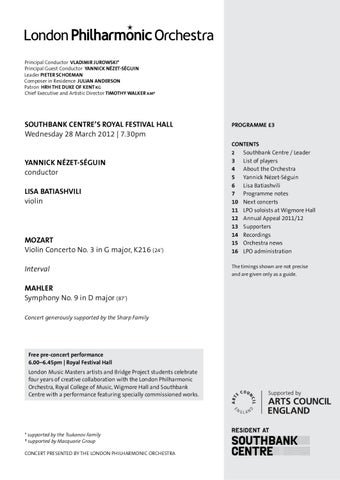
Principal Conductor VLADIMIR JUROWSKI* Principal Guest Conductor YANNICK NÉZET-SÉGUIN Leader pieter schoeman Composer in Residence JULIAN ANDERSON Patron HRH THE DUKE OF KENT KG Chief Executive and Artistic Director TIMOTHY WALKER AM†
SOUTHBANK CENTRE’S ROYAL FESTIVAL HALL Wednesday 28 March 2012 | 7.30pm
yannick nézet-séguiN conductor lisa batiashvili violin
mozart Violin Concerto No. 3 in G major, K216 (24’) Interval mahler Symphony No. 9 in D major (87’) Concert generously supported by the Sharp Family
Free pre-concert performance 6.00–6.45pm | Royal Festival Hall London Music Masters artists and Bridge Project students celebrate four years of creative collaboration with the London Philharmonic Orchestra, Royal College of Music, Wigmore Hall and Southbank Centre with a performance featuring specially commissioned works.
* supported by the Tsukanov Family † supported by Macquarie Group CONCERT PRESENTED BY THE LONDON PHILHARMONIC ORCHESTRA
PROGRAMME £3 CONTENTS 2 Southbank Centre / Leader 3 List of players 4 About the Orchestra 5 Yannick Nézet-Séguin 6 Lisa Batiashvili 7 Programme notes 10 Next concerts 11 LPO soloists at Wigmore Hall 12 Annual Appeal 2011/12 13 Supporters 14 Recordings 15 Orchestra news 16 LPO administration The timings shown are not precise and are given only as a guide.
Welcome
pieter schoeman Leader
Pieter Schoeman joined the London Philharmonic Orchestra as Co-Leader in 2002, and was appointed Leader in 2008.
WELCOME TO SOUTHBANK CENTRE
Eating, drinking and shopping? Southbank Centre shops and restaurants include Foyles, EAT, Giraffe, Strada, YO! Sushi, wagamama, Le Pain Quotidien, Las Iguanas, ping pong, Canteen, Caffè Vergnano 1882, Skylon, Concrete and Feng Sushi, as well as cafes, restaurants and shops inside Royal Festival Hall, Queen Elizabeth Hall and Hayward Gallery. If you wish to get in touch with us following your visit please contact the Visitor Experience Team at Southbank Centre, Belvedere Road, London SE1 8XX, phone 020 7960 4250 or email customer@southbankcentre.co.uk We look forward to seeing you again soon. A few points to note for your comfort and enjoyment: PHOTOGRAPHY is not allowed in the auditorium. LATECOMERS will only be admitted to the auditorium if there is a suitable break in the performance. RECORDING is not permitted in the auditorium without the prior consent of Southbank Centre. Southbank Centre reserves the right to confiscate video or sound equipment and hold it in safekeeping until the performance has ended. MOBILES, PAGERS AND WATCHES should be switched off before the performance begins.
© Patrick Harrison
We hope you enjoy your visit. We have a Duty Manager available at all times. If you have any queries please ask any member of staff for assistance.
Born in South Africa, he made his solo début aged 10 with the Cape Town Symphony Orchestra. He studied with Jack de Wet in South Africa, winning numerous competitions including the 1984 World Youth Concerto Competition in the US. In 1987 he was offered the Heifetz Chair of Music scholarship to study with Eduard Schmieder in Los Angeles and in 1991 his talent was spotted by Pinchas Zukerman, who recommended that he move to New York to study with Sylvia Rosenberg. In 1994 he became her teaching assistant at Indiana University, Bloomington. Pieter has performed worldwide as a soloist and recitalist in such famous halls as the Concertgebouw in Amsterdam, Moscow’s Rachmaninov Hall, Capella Hall in St Petersburg, Staatsbibliothek in Berlin, Hollywood Bowl in Los Angeles and Southbank Centre’s Queen Elizabeth Hall in London. As a chamber musician he regularly performs at London’s prestigious Wigmore Hall. As a soloist with the London Philharmonic Orchestra, Pieter has performed Arvo Pärt’s Double Concerto with Boris Garlitsky, Brahms’s Double Concerto with Kristina Blaumane, and Britten’s Double Concerto with Alexander Zemtsov, which was recorded and released on the Orchestra’s own record label to great critical acclaim. He has recorded numerous violin solos with the London Philharmonic Orchestra for Chandos, Opera Rara, Naxos, X5, the BBC and for American film and television, and led the Orchestra in its soundtrack recordings for The Lord of the Rings trilogy. In 1995 Pieter became Co-Leader of the Orchestre Philharmonique de Nice. Since then he has performed frequently as Guest Leader with the symphony orchestras of Barcelona, Bordeaux, Lyon and Baltimore, as well as with the BBC Symphony Orchestra. Pieter is a Professor of Violin at Trinity Laban Conservatoire of Music and Dance.
2 | London Philharmonic Orchestra
LONDON PHILHARMONIC ORCHESTRA
First Violins Pieter Schoeman Leader (second half) Mila Georgieva Guest Leader (first half) Vesselin Gellev Sub-Leader Chair supported by John & Angela Kessler
Soran Lee Katalin Varnagy Catherine Craig Martin Höhmann Chair supported by Richard Karl Goeltz
Geoffrey Lynn Robert Pool Sarah Streatfeild Yang Zhang Rebecca Shorrock Peter Nall Galina Tanney Joanne Chen Alina Petrenko Second Violins Philippe Honore Guest Principal Jeongmin Kim Joseph Maher Kate Birchall Chair supported by David & Victoria Graham Fuller
Fiona Higham Andrew Thurgood Ashley Stevens Marie-Anne Mairesse Nancy Elan Nynke Hijlkema Dean Williamson Sioni Williams Alison Strange Peter Graham
Violas David Marks Guest Principal Robert Duncan Gregory Aronovich Katharine Leek Benedetto Pollani Laura Vallejo Susanne Martens Alistair Scahill Isabel Pereira Naomi Holt Claudio Cavalletti Sarah Malcolm Cellos Kristina Blaumane Principal Francis Bucknall Laura Donoghue Jonathan Ayling Chair supported by Caroline, Jamie & Zander Sharp
Gregory Walmsley Santiago Carvalho† Susanna Riddell Elisabeth Wiklander Tom Roff Helen Rathbone Double Basses Kevin Rundell* Principal Laurence Lovelle George Peniston Richard Lewis Helen Rowlands Kenneth Knussen Tom Walley Joe Melvin Flutes Susan Thomas Principal Ian Mullin Joanna Marsh Hannah Grayson
Piccolo Stewart McIlwham* Principal Oboes Ian Hardwick Principal Angela Tennick Will Oinn Cor Anglais Sue Bohling Principal Chair supported by Julian & Gill Simmonds
Clarinets Robert Hill* Principal Emily Meredith James Burke
Trumpets Paul Beniston* Principal Anne McAneney* Chair supported by Geoff & Meg Mann
Nicholas Betts Co-Principal Daniel Newell Trombones Mark Templeton* Principal David Whitehouse Bass Trombone Lyndon Meredith Tuba Lee Tsarmaklis* Principal
Bass Clarinet Paul Richards Principal
Timpani Simon Carrington* Principal Adam Clifford
E-flat Clarinet Nicholas Carpenter* Principal
Percussion David Jackson Guest Principal Andrew Barclay*
Bassoons Catherine Maguire Guest Principal Gareth Newman* Laurence O’Donnell Contra-bassoon Simon Estell Principal Horns John Ryan* Principal Martin Hobbs Mark Vines Co-Principal Gareth Mollison Duncan Fuller
Chair supported by Andrew Davenport
Keith Millar Jeremy Cornes Harps Rachel Masters* Principal Emma Ramsdale
* Holds a professorial appointment in London † Chevalier of the Brazilian Order of Rio Branco
Chair Supporters The London Philharmonic Orchestra also acknowledges the following chair supporter whose player is not present at this concert: The Sharp Family
London Philharmonic Orchestra | 3
LONDON PHILHARMONIC ORCHESTRA
The London Philharmonic Orchestra is one of the world’s finest orchestras, balancing a long and distinguished history with a reputation as one of the UK’s most adventurous and forward-looking orchestras. As well as performing classical concerts, the Orchestra also records film and computer game soundtracks, has its own record label, and reaches thousands of Londoners every year through activities for schools and local communities. The Orchestra was founded by Sir Thomas Beecham in 1932, and since then has been headed by many of the great names in the conducting world, including Sir Adrian Boult, Bernard Haitink, Sir Georg Solti, Klaus Tennstedt and Kurt Masur. The current Principal Conductor is Russian Vladimir Jurowski, appointed in 2007, with French-Canadian Yannick Nézet-Séguin as Principal Guest Conductor. The Orchestra is based at Royal Festival Hall in London’s Southbank Centre, where it has performed since it opened in 1951 and been Resident Orchestra since 1992. It gives around 40 concerts there each season with many of the world’s top conductors and soloists. Concert highlights in 2011/12 include a three-week festival celebrating the music of Prokofiev, concerts with artists including Sir Mark Elder, Marin Alsop, Renée Fleming, Stephen Hough and Joshua Bell, and several premières of works by living composers including the Orchestra’s Composer in Residence, Julian Anderson. In addition to its London concerts, the Orchestra has flourishing residencies in Brighton and Eastbourne, and performs regularly around the UK. Every summer, the Orchestra leaves London for four months and takes up its annual residency accompanying the famous Glyndebourne Festival Opera in the Sussex countryside, where it has been Resident Symphony Orchestra since 1964. The London Philharmonic Orchestra tours internationally, performing to sell-out audiences worldwide. In 1956 it became the first British orchestra to appear in Soviet Russia and in 1973 made the first-ever visit to China by a Western orchestra. Touring remains a big part of the Orchestra’s life: tours in the 2011/12 season include visits to Belgium, Switzerland, Germany, the US, Spain, China, Russia, Oman, Brazil and France.
4 | London Philharmonic Orchestra
You may well have heard the London Philharmonic Orchestra on film soundtrack recordings: it has recorded many blockbuster scores, from The Lord of the Rings trilogy to Lawrence of Arabia, The Mission, Philadelphia, East is East and Hugo. The Orchestra also broadcasts regularly on television and radio, and in 2005 established its own record label. There are now over 60 releases on the label, which are available on CD and to download. Recent additions include Dvořák’s Symphonic Variations and Symphony No. 8 conducted by Sir Charles Mackerras; Holst’s The Planets conducted by Vladimir Jurowski; Shostakovich Piano Concertos with Martin Helmchen under Vladimir Jurowski; and Sibelius’s Symphony No. 5 and Lutosławski’s Concerto for Orchestra under Jukka-Pekka Saraste. The Orchestra was also recently honoured with the commission to record all 205 of the world’s national anthems for the London 2012 Olympics Team Welcome Ceremonies and Medal Ceremonies. To help maintain its high standards and diverse workload, the Orchestra is committed to the welfare of its musicians and in December 2007 received the Association of British Orchestras/Musicians Benevolent Fund Healthy Orchestra Bronze Charter Mark. The London Philharmonic Orchestra maintains an energetic programme of activities for young people and local communities. Highlights include the ever-popular family and schools concerts, fusion ensemble The Band, the Leverhulme Young Composers project and the Foyle Future Firsts orchestral training scheme for outstanding young players. Over the last few years, developments in technology and social networks have enabled the Orchestra to reach even more people worldwide: all its recordings are available to download from iTunes and, as well as a YouTube channel, news blog, iPhone app and regular podcasts, the Orchestra has a lively Twitter presence. Find out more and get involved! lpo.org.uk twitter.com/LPOrchestra
Yannick Nézet-Séguin
© Marco Borggreve
CONDUCTOR
At 37 years old, Yannick Nézet-Séguin is one of the most highly respected and sought-after conductors on today’s international classical music scene and has been widely praised by audiences, critics and artists alike for his musicianship, dedication and charisma. He is Principal Guest Conductor of the London Philharmonic Orchestra, and Artistic Director and Principal Conductor of the Orchestre Métropolitain in Montreal. He is also Music Director of the Rotterdam Philharmonic Orchestra, and in June 2010 was appointed Music Director Designate of the Philadelphia Orchestra – he will take up the full title of Music Director from the 2012/13 season. A native of Montreal, Yannick has conducted all the major Canadian orchestras. Since his European début in 2004, he has appeared regularly with many of Europe’s leading orchestras including the Orchestre National de France, Dresden Staatskapelle, Royal Stockholm Philharmonic Orchestra and Chamber Orchestra of Europe. Yannick made his BBC Proms début in 2009 with the Scottish Chamber Orchestra and returned the following year with the Rotterdam Philharmonic Orchestra. Recent highlights include highly successful tours of the Far East and North America with the Rotterdam Philharmonic, as well as his débuts with the Bavarian Radio Symphony Orchestra, Berlin Philharmonic, Vienna Philharmonic (at the 2010 Salzburg Mozartwoche), Tonhalle-Orchester Zürich, Accademia Nazionale di Santa Cecilia, The Philadelphia Orchestra, Los Angeles Philharmonic and Boston Symphony Orchestra.
and Gounod’s Roméo et Juliette with the Mozarteum Orchester Salzburg. Summer 2011 saw a revival of Don Giovanni. He made his début at Teatro alla Scala, Milan with the festival’s production of Roméo et Juliette in June 2011. Last month he made his début at the Royal Opera House, Covent Garden with Dvořák’s Rusalka. Highlights of Yannick’s 2011/12 season include an extensive tour of Germany with the Rotterdam Philharmonic Orchestra and return visits to the Vienna Philharmonic, Berlin Philharmonic and Dresden Staatskapelle. Opera performances include Faust with the Metropolitan Opera and Don Carlo at the Netherlands Opera. Yannick’s first three Rotterdam Philharmonic Orchestra recordings on the EMI/Virgin label comprise an Edison Award-winning album of Ravel’s orchestral works; the Beethoven and Korngold violin concertos with Renaud Capuçon; and Fantasy: A Night at the Opera with flautist Emmanuel Pahud. Recent releases with BIS Records include discs of Strauss (Ein Heldenleben/ Four Last Songs) and Berlioz (Symphonie fantastique/ La mort de Cléopâtre). His discography also includes several award-winning recordings with the Orchestre Métropolitain on the ATMA Classique label. In April 2009 he recorded Brahms’s German Requiem with the London Philharmonic Orchestra on its own LPO Label. Yannick studied piano, conducting, composition and chamber music at the Quebec Conservatoire in Montreal and continued his studies with renowned conductors, most notably the Italian maestro Carlo Maria Giulini. His honours include a prestigious Royal Philharmonic Society Award, the Virginia Parker Prize from the Canada Council in 2000, numerous Prix Opus from the Quebec Music Council, and Canada’s highly coveted National Arts Centre Award. He was awarded an honorary doctorate by the University of Quebec in Montreal in 2011.
A notable operatic conductor, Yannick made his critically acclaimed Metropolitan Opera début in December 2009 with a new production of Bizet’s Carmen and has since returned for a new production of Verdi’s Don Carlo. For the Netherlands Opera he has conducted Janáček’s The Makropulos Case and Puccini’s Turandot with the Rotterdam Philharmonic Orchestra. Having made his début at the Salzburg Festival in 2008, he returned in 2010 for Don Giovanni with the Vienna Philharmonic London Philharmonic Orchestra | 5
Lisa Batiashvili
© Mat Hennek
violin
Few young soloists command the degree of warmth and respect from fellow musicians all over the world as violinist Lisa Batiashvili. She appears season after season with many of the world’s greatest orchestras. In the US she regularly performs with the Los Angeles Philharmonic, Boston Symphony, Chicago Symphony and Philadelphia orchestras. In Europe she works with the Berlin Philharmonic Orchestra, Gewandhausorchester Leipzig, Royal Concertgebouw Orchestra, Staatskapelle Dresden and Orchestre de Paris. In the 2011/12 season Lisa Batiashvili performs with the New York Philharmonic Orchestra under Alan Gilbert; NHK Symphony Orchestra under Charles Dutoit; and Sydney Symphony Orchestra under Vladimir Ashkenazy. Further highlights include a European tour with the Royal Stockholm Philharmonic Orchestra under Sakari Oramo; concerts with both the London Philharmonic and Rotterdam Philharmonic orchestras under Yannick Nézet-Séguin; and the Tonhalle-Orchester Zürich and Orchestre National de France under David Zinman. She also returns to the NDR Sinfonieorchester under Thomas Hengelbrock; Bamberg Symphony Orchestra under Jonathan Nott; and Accademia Nazionale di Santa Cecilia under Yuri Temirkanov. Lisa Batiashvili has an exclusive recording contract with Deutsche Grammophon. She received an ECHO Klassik award for her début album for the label, released in February 2011, featuring Shostakovich’s Violin Concerto No. 1 with the Bavarian Radio Symphony Orchestra and Esa-Pekka Salonen. Chamber music has always played an important part in Lisa’s schedule, with invitations from festivals including Salzburg, Edinburgh International, Aldeburgh, Tanglewood, Schleswig-Holstein and Verbier. This season she tours as part of a quartet with François Leleux, Lawrence Power and Sebastian Klinger including concerts in Antwerp, Paris, Vienna and Neumarkt. Other regular chamber music partners include Adrian Brendel and Till Fellner. Lisa’s commitment to new music has 6 | London Philharmonic Orchestra
seen her give several world premières in recent seasons, including Magnus Lindberg’s Violin Concerto and Nicolas Bacri’s Double Concerto for Violin, Oboe and Chamber Orchestra, as well as his Capriccio for Three Violins and Orchestra. In 1995, as the youngest ever competitor aged 16, Lisa was awarded second prize in the Sibelius Competition in Helsinki. In 2003 she was named winner of the Schleswig-Holstein Musik Festival’s Leonard Bernstein Award and was later awarded the Beethoven Ring Prize from the Beethovenfest in Bonn. In 2008 Lisa was honoured with the MIDEM Classical Award and the ‘Choc de L’année’ for her Sony recording of the Sibelius and Lindberg Violin Concertos. The same year she received an ECHO Klassik award. She was recently announced as the winner of the prestigious International Accademia Musicale Chigiana Prize in Siena. Lisa studied with Professor Ana Chumachenko at Hamburg’s Musikhochschule, having previously worked with Professor Mark Lubotski. She plays the 1709 Engleman Stradivarius kindly loaned by the Nippon Music Foundation.
PROGRAMME NOTES
Speedread Tonight’s programme presents a musical yin and yang. From Mozart’s youthful bravura to the painful acquiescence of Mahler’s late symphony, all the joy and disappointment of life can be heard in these scores. The 19-year-old Mozart ducks and dives in his third Violin Concerto, written for one of Salzburg’s local dignitaries. Bored by demands at court, this rare foray into instrumental music provided much-needed artistic and financial relief. In the end, Salzburg
Wolfgang Amadeus MOZART 1756–91
Although we picture Mozart as a man of travel, he was tied to the Salzburg court. Both Mozart and his father were employees of the city’s Prince Archbishop. The pomp and wealth of their employment suited many facets of their characters, but it was not always conducive to a happy life. By the time Mozart composed this Violin Concerto in September 1775, he was at the end of his tether. He constantly provided new music for the liturgy, but his mind was on other things. His father encouraged him to explore new sources of income, and local Salzburg dignitaries provided the commissions. Mozart most wanted to write opera, but contemporary concertos and piano sonatas provided diversity from the pompous religiosity at court. All of Mozart’s extant violin concertos date from his Salzburg youth. A proficient string player, Mozart was able to show off his skills both as a composer and an instrumentalist. His solo violin parts are clearly conceived within the texture, providing flourishes while still directing the orchestra. By the time he reached
lost its greatest son, who travelled around Europe before settling in Vienna. A century later, another small-town boy arrived in the Imperial capital to become the music director at its opera house. But an exhausting schedule, the constant sniping of the press, and domestic tragedy wore Mahler down. By 1909, at the end of his life, he summarised the pain and regret of that existence in his epic Ninth Symphony.
Violin Concerto No. 3 in G major, K216 lisa batiashvili violin 1 Allegro 2 Adagio 3 Rondeau. Allegro
Vienna, Mozart shifted his attention to keyboard concertos but, like these Salzburg works, they were also written for primarily financial purposes. Despite the monetary impetus, this Concerto bursts with life. It depicts a young man released from the shackles of his employer. Broad chords pose a question, requiring an answer. Rather than repeating the phrase, Mozart’s response spirals off with breathless energy, contradicting the equal phrases of the initial statement. He continues to channel that independent spirit as harmonic pace and cadence points belie expectation. Ducking and diving around more formulaic harmonies, Mozart maintains a cheeky presence through the opening movement’s chromatic passing notes and clipped acciaccaturas. Although the central Adagio is more reserved – with Mozart requesting the use of mutes – the pert tenor of the first movement continues. The flute commentary after each solo violin statement reassures us of a happy mood. That sentiment is further confirmed in the London Philharmonic Orchestra | 7
PROGRAMME NOTES
opening of the rustic finale. Its equal four-bar phrases restore propriety, though Mozart refuses to suppress his natural wit, as the solo violin breaks free. But however humorous those first statements, Mozart surprises with a modulation into the relative minor. Rather than being a brief tonal enclave, it remains fixed, casting its melancholic shadow. The violin cadenza is likewise formed within the minor key, disturbing a pervasively
happy mood. Even as the Rondo theme breaks through once more, Mozart’s harmonic ambitions have not been sated and the music suddenly stops before switching into G minor and a new metre and tempo. That too is short-lived and Mozart returns to G major and, eventually, the opening rondo. Cheeky to the last, the work ends with a pert woodwind cadence.
INTERVAL – 20 minutes An announcement will be made five minutes before the end of the interval.
Gustav MAHLER 1860–1911
By the time Mahler began his Ninth Symphony in 1909, his symphonic output had already charted a vast gamut of emotions and styles. From early professions of faith and hope, to the violent tragedy of the Sixth and the outspoken Eighth, Mahler showed that the symphony could be all things to all people. His Ninth was something different. The death of his daughter in 1907 had stalled his symphonic plans and, during the summer of 1908, he had busied himself not with a symphony per se, but what would become Das Lied von der Erde. Over the course of those otherworldly songs, Mahler had come back to symphonic life. Its final movement – ‘Der Abschied’ [The Farewell] – is an epic goodbye to life on earth. That valedictory scheme hangs over the Ninth Symphony. Rather than aspiring to the heroic philosophy of Beethoven, as his earlier symphonies had, Mahler’s Ninth is a slow retreat into silence.
8 | London Philharmonic Orchestra
Symphony No. 9 in D major 1 2 3 4
Andante comodo – Allegro risoluto – Tempo I Im Tempo eines gemächlichen Ländlers [In a comfortable Ländler tempo] Rondo. Burleske – Allegro assai. Sehr trotzig [Very insolent] Adagio – Sehr langsam und noch zurückhaltend [Very slow and yet restrained]
Despite that fragile goal, there is much violence along the way. The opening movement veers between a regretful D major and brusque retorts in D minor. The tension between the two is the driving force behind the music, though Mahler frequently blurs such easy distinctions over the course of the opening Andante. Stumbling into life, the orchestra finds voice in a series of outlandish climaxes. When Alban Berg heard the Symphony after Mahler’s death, he wrote to his wife that the first movement was ‘a premonition of death … that registers itself again and again. Everything earthly that has been dreamt away culminates in it (hence the climaxes breaking forth like new ebullitions after the sweetest passages).’ Although Berg’s analysis is somewhat skewed by hindsight and his intense grief over Mahler’s death in 1911, his description remains apt. Beethoven and his successors had maintained an overriding symphonic
procedure in which larger forms were created through the development of smaller motifs. In his Ninth Symphony Mahler deconstructs symphonic precedent, presenting thematic material only to break it down into its constituent parts. The final pages of the opening movement are regretful glances at those motifs, finally reducing to a whispered high D. The second movement is disarmingly bucolic. A Ländler, the dance that appeared in Mahler’s first symphony, captures all the freshness of the Austrian countryside. Peering out of the window of his composing huts, Mahler constantly evoked those magisterial surroundings. The hopeful rising line in the violas and bassoons – all in the purest key of C major – appears to have moved away from Berg’s morbid description. This is life in all its verdant glory. Even the sudden shift into E major is a happy one. Perhaps Berg had overstated the case.
A horn offers some consolation as the music slowly moves back to the tonic, but despondency is pervasive. Knotty chords and elastic themes overlap, tugging at the heart. Gradually instruments as yet unheard in the finale join the tumult, but their enormous rumble soon gives way to another pallid form. A rocking figure appears in the clarinet and harp, while the cor anglais, flute and bass clarinet play in ghostly isolation. A final return to D-flat major summons uncharted strength, provoking a sweet sound of acquiescence. After a thunderous tutti the music falters one last time, trailing off into eternity. Programme notes © Gavin Plumley
The third movement, however, shows that it is Mahler who protests too much. The Ländler was a reminder of what has been lost, as the Rondo Burleske demonstrates when unleashed in all its caustic glory. Screaming woodwind jars against the underlying marching figure. Totally uninhibited, individual lines strain at the leash. As soon as one instrumental group expires, another joins the fray. The horns announce one last staggering affront, before revealing a haven in D major (the key in which the symphony began). In the seraphic beauty of this passage, dominated by the ‘turning’ figure that features in all of Mahler’s last works, we realise just how far we have fallen. More nefarious elements burst through again and the marching figure rebuilds. Cantankerous, determined and totally destroying that peace, it moves towards a terrifying conclusion. Browbeaten by the Rondo’s unremitting attack, the finale is a shivering goodbye. The violins’ opening statement collapses into a warm D-flat major. The music recalls Beethoven’s ‘Les adieux’ piano sonata and the hymn ‘Abide with me’, but Mahler ploughs a much deeper furrow, veering away from the home key. As it shifts eerily into C-sharp minor, the opening theme becomes increasingly skeletal. A viola solo sounds within the waste but soon trails off, moving to the second violins and then to a solo violin. Regret turns to solitude and, as in the first movement, seemingly unified motifs fragment and disappear. London Philharmonic Orchestra | 9
next concertS at royal festival hall
Friday 13 April 2012 | 7.30pm Royal Festival Hall JTI Friday Series Mozart Symphony No. 35 (Haffner) Beethoven Piano Concerto No. 2* Julian Anderson Past Hymns Stravinsky Symphony in C The International Conductors’ Academy of the Allianz Cultural Foundation: Thomas Blunt conductor Domingo Hindoyan conductor Ward Stare conductor John Lill piano * Supported by Dunard Fund Supported by the Allianz Cultural Foundation
Wednesday 18 April 2012 | 7.30pm Royal Festival Hall Schumann Overture, Genoveva Kalevi Aho Sieidi: Concerto for Solo Percussion and Orchestra (world première)* Brahms Symphony No. 1 Osmo Vänskä conductor Colin Currie percussion * Commissioned by the London Philharmonic Orchestra, the Luosto Classic Festival and Gothenburg Symphony Orchestra
Saturday 28 April 2012 | 7.30pm Royal Festival Hall Messiaen Les Offrandes oubliées Beethoven Piano Concerto No. 1* Tchaikovsky Symphony No. 4 Yan Pascal Tortelier conductor Hong Xu piano * Supported by Dunard Fund
Free pre-concert performance 6.00–6.45pm | Royal Festival Hall Thomas Blunt conducts the Foyle Future Firsts orchestral apprentices in UK premières of Luke Bedford’s By the Screen in the Sun at the Hill on the Gold and David Bruce’s Steampunk. The Foyle Future Firsts Programme is generously funded by The Foyle Foundation with additional support from the Angus Allnatt Charitable Foundation, the Idlewild Trust, the Lord and Lady Lurgan Trust, the Seary Charitable Trust and the Musicians Benevolent Fund.
Wednesday 2 May 2012 | 7.30pm Royal Festival Hall Janáček Suite, The Cunning Little Vixen Dvořák Piano Concerto* Suk Symphonic Poem, Ripening Vladimir Jurowski conductor Martin Helmchen piano London Philharmonic Choir * Supported by Dunard Fund
Free pre-concert discussion 6.15–6.45pm | Royal Festival Hall Professor Geoffrey Chew explores three giants of the Czech repertoire. Osmo Vänskä and Colin Currie
‘Soloist Colin Currie was a miracle of cool-headed brilliance.’ The Telegraph, July 2010 Free pre-concert discussion 6.15–6.45pm | Royal Festival Hall Colin Currie explores Kalevi Aho’s Sieidi: Concerto for Solo Percussion and Orchestra.
10 | London Philharmonic Orchestra
Booking details Tickets £9–£39 | Premium seats £65 London Philharmonic Orchestra Box Office 020 7840 4242 Monday to Friday 10.00am–5.00pm lpo.org.uk (no transaction fee) Southbank Centre Box Office 0844 847 9920 Daily 9.00am–8.00pm southbankcentre.co.uk (transaction fees apply)
Chamber Contrasts 2012 Soloists of the London Philharmonic Orchestra at Wigmore Hall Now in its sixth season, the London Philharmonic Orchestra’s Chamber Contrasts series returns with two charming programmes in which you can hear some of the Orchestra’s finest performers in the glorious acoustics of Wigmore Hall. Supported by Dunard Fund
Saturday 14 April, 7.30pm | Wigmore Hall RAVEL Introduction and Allegro BLISS Clarinet Quintet TCHAIKOVSKY Souvenir de Florence Soloists of the London Philharmonic Orchestra including Rachel Masters harp Sue Thomas flute Robert Hill clarinet Find out more and listen to clips online: lpo.org.uk/chambercontrasts Tickets £12, £16, £22, £26 London Philharmonic Orchestra Box Office 020 7840 4242 | lpo.org.uk (no booking fee) Wigmore Hall Box Office 020 7935 2141 | wigmore-hall.org.uk
© Patrick Harrison
(£2 administration fee for telephone bookings; £1 administration fee for online bookings)
London Philharmonic Orchestra | 11
London Philharmonic Orchestra
Annual Appeal 2011/12 in aid of the Community Programme Despite living close to Royal Festival Hall, many people in South London have never visited the venue or heard an orchestra perform. We are committed to our work in the community to ensure that as many people as possible can access and enjoy music of the highest quality. There are three dynamic projects within the Community Programme, providing inspirational musical opportunities for children and their families. Animate Orchestra is a young person’s ‘orchestra for the 21st century’, offering young people in Lewisham and Greenwich a creative pathway for them to continue their playing as they make the transition from primary to secondary education – a time when many young musicians give up. Young people make music side by side with London Philharmonic Orchestra musicians. The Band is the Orchestra’s fusion ensemble for young people in South London, at which they improvise, create, and rehearse their own music – from classical to jazz, hip hop, rock, and more. Members have inspirational contact with London Philharmonic Orchestra players, in sessions led by some of the UK’s leading tutors. FUNharmonics are our Family Concerts – an interactive introduction for all the family to music and the orchestra, presented by Chris Jarvis of CBeebies. Free foyer activities before and after the concert include Have-a-Go sessions where children can try out a range of orchestral instruments with our musicians; and the Human Orchestra – fun rhythmic sessions where music is performed using body percussion, singing, drumming, and clapping. Your Support In order to undertake this essential work we depend entirely on donations from charitable sources each year, and we are asking you to help us to support this work in the communities surrounding the South Bank. If you do feel able to contribute to this year’s Appeal we would be extremely grateful. Gifts of any size make a real difference; to donate please contact Elisenda Ayats on 020 7840 4225 or elisenda.ayats@lpo.org.uk. For more information, and to donate online, please visit lpo.org.uk/support_us/appeal And now, for the first time, you can also donate up to £10 to the Orchestra by text message. To donate, text PHIL12 and the amount you wish to donate (£1, £2, £3, £4, £5, or £10) to 70070. e.g. to donate £10 text PHIL12 £10 to 70070 For more information, please visit lpo.org.uk/text
12 | London Philharmonic Orchestra
We would like to acknowledge the generous support of the following Thomas Beecham Group Patrons, Principal Benefactors and Benefactors: Thomas Beecham Group The Tsukanov Family Anonymous The Sharp Family Julian & Gill Simmonds Garf & Gill Collins Andrew Davenport David & Victoria Graham Fuller Richard Karl Goeltz John & Angela Kessler Mr & Mrs Makharinsky Geoff & Meg Mann Caroline, Jamie & Zander Sharp Eric Tomsett Mrs Sonja Drexler Guy & Utti Whittaker Principal Benefactors Mark & Elizabeth Adams Jane Attias Lady Jane Berrill Desmond & Ruth Cecil Mr John H Cook Mr Charles Dumas David Ellen
Commander Vincent Evans Mr & Mrs Jeffrey Herrmann Peter MacDonald Eggers Mr & Mrs David Malpas Andrew T Mills Mr Maxwell Morrison Mr Michael Posen Mr & Mrs Thierry Sciard Mr John Soderquist & Mr Costas Michaelides Mr & Mrs G Stein Mr & Mrs John C Tucker Mr & Mrs John & Susi Underwood Lady Marina Vaizey Howard & Sheelagh Watson Mr Laurie Watt Mr Anthony Yolland
Pauline & Peter Halliday Michael & Christine Henry Mr Ivan Hurry Mr Glenn Hurstfield Mr R K Jeha Mr Gerald Levin Sheila Ashley Lewis Wg. Cdr. & Mrs M T Liddiard OBE JP RAF Mr Frank Lim Paul & Brigitta Lock Mr Brian Marsh John Montgomery Edmund Pirouet Mr Peter Tausig Mrs Kazue Turner Mr D Whitelock Bill Yoe
Benefactors Mrs A Beare Dr & Mrs Alan Carrington CBE FRS Mr & Mrs Stewart Cohen Mr Alistair Corbett Mr David Dennis Mr David Edgecombe Mr Richard Fernyhough Ken Follett
Hon. Benefactor Elliott Bernerd Hon. Life Members Kenneth Goode Pehr G Gyllenhammar Edmund Pirouet Mrs Jackie Rosenfeld OBE
The generosity of our Sponsors, Corporate Members, supporters and donors is gratefully acknowledged: Corporate Members Silver: AREVA UK British American Business Destination Québec – UK Hermes Fund Managers Bronze: Appleyard & Trew LLP Berkeley Law Charles Russell Lazard Leventis Overseas Corporate Donor Lombard Street Research In-kind Sponsors Google Inc Heineken Lindt & Sprüngli Ltd Sela / Tilley’s Sweets Villa Maria Trusts and Foundations Addleshaw Goddard Charitable Trust Arts and Business Allianz Cultural Foundation
Angus Allnatt Charitable Foundation The Boltini Trust Britten-Pears Foundation The Candide Charitable Trust The Coutts Charitable Trust The Delius Trust Diaphonique, Franco-British fund for contemporary music Dunard Fund The Equitable Charitable Trust The Eranda Foundation The Fenton Arts Trust The Foyle Foundation The Jeniffer and Jonathan Harris Charitable Trust Hattori Foundation for Music and the Arts Capital Radio’s Help a London Child The Hobson Charity The Kirby Laing Foundation The Idlewild Trust The Leverhulme Trust Lord and Lady Lurgan Trust Maurice Marks Charitable Trust Marsh Christian Trust The Mercers’ Company Adam Mickiewicz Institute
The Peter Minet Trust Paul Morgan Charitable Trust The Diana and Allan Morgenthau Charitable Trust Maxwell Morrison Charitable Trust Musicians Benevolent Fund Newcomen Collett Foundation The Austin & Hope Pilkington Trust The Serge Prokofiev Foundation Serge Rachmaninoff Foundation The Reed Foundation The Rothschild Foundation The Seary Charitable Trust The Samuel Sebba Charitable Trust The David Solomons Charitable Trust The Steel Charitable Trust The Stansfield Trust The Bernard Sunley Charitable Foundation The Swan Trust John Thaw Foundation The Thistle Trust The Underwood Trust Kurt Weill Foundation for Music Garfield Weston Foundation Youth Music and others who wish to remain anonymous London Philharmonic Orchestra | 13
New recordings
on the London Philharmonic Orchestra label
Vladimir Jurowski conducts Honegger’s Pastorale d’été, Symphony No. 4 and Une Cantate de Noël LPO–0058 | £9.99 ‘[The Fourth Symphony] is full of charm and tactile invention, vividly realised in this live recording.’ The Sunday Times, 30 October 2011 ‘All three works on this unexpectedly satisfying CD communicate a joie de vivre without ever sounding lightweight.’ The Financial Times, 21 November 2011
bernard haitink conducts ravel’s daphnis et chloÉ LPO–0059 | £9.99 ‘Finely honed, played with sensitivity and virtuosity ... a compelling realisation of a great score.’ Classicalsource.com, 6 February 2012
ravi shankar: symphony April 2012
LPO–0062
LPO–0061
LPO–0060
Coming soon ...
christoph eschenbach conducts beethoven’s missa solemnis
NEEMe JäRVI CONDUCTS DVOŘÁK’s STABAT MATER May 2012
April 2012
Browse and order online at lpo.org.uk/shop, or call the Box Office on 020 7840 4242
14 | London Philharmonic Orchestra
orchestra news
The Queen’s Diamond Jubilee Pageant Sunday 3 June 2012 As part of the Queen’s Diamond Jubilee celebrations, on 3 June the London Philharmonic Orchestra will perform onboard a barge as part of a 1000-vessel flotilla on the Thames, the largest river celebration in 350 years. At the centre of the procession, which will sail from Putney to Tower Bridge, will be the Queen and the Duke of Edinburgh aboard the Pageant’s flagship The Spirit of Chartwell. Millions of spectators are expected to line the river banks, and giant screens on the Embankment will show the 7.5-mile procession.
Glyndebourne 2012 Booking is now open for the 2012 Glyndebourne Festival season, which opens on 20 May. The London Philharmonic Orchestra has been Resident Symphony Orchestra at Glyndebourne since 1964. This year, the Orchestra will give performances of Janáček’s The Cunning Little Vixen under Vladimir Jurowski, Rossini’s La Cenerentola under James Gaffigan, Puccini’s La bohème under Kirill Karabits, and a double-bill of Ravel’s L’heure espagnole and L’enfant et les sortilèges under Kazushi Ono. Tickets start from £10 and you can book by telephone (01273 813813), or read full details and book online: glyndebourne.com
The Orchestra, conducted by David Parry, will perform a Last Night of the Proms-style selection of British music, which will also be recorded for a CD to be released on the LPO Label. thamesdiamondjubileepageant.org
Tour news – Russia, Spain and Germany The Orchestra is looking forward to a rare trip to Russia next month – its first since 1975 – where it has been invited to perform as part of the prestigious International Rostropovich Festival in Moscow. The annual festival, which first took place in 2010, was created to honour the memory of the great Russian cellist Mstislav Rostropovich, who died in 2007. Following the major tour of China with Yan Pascal Tortelier in the New Year, where the Orchestra performed in the recently opened Guangzhou Opera House and in Wuhan, Changsha and Beijing, other recent tours have included Spain and Germany with violinist Joshua Bell during February and March, where the Orchestra played to sold-out houses throughout. The next trips for the Orchestra include the Théâtre des Champs Elysées, Paris, in June; the Rheingau Festival in Germany in July; and the Grafenegg Festival, Austria, in August.
Wednesday 18 April 2012, 7pm, Royal Festival Hall Pre-concert talk and interval drinks Join London’s young professionals for an evening of music and drinks. Before the LPO concert there will be a pre-concert talk by Gavin Plumley, followed by interval drinks courtesy of Sipsmith Independent Spirits. If you’re interested in joining LPO Contemporaries or would just like to find out what it’s all about, please come along! Non-members can attend for just £30 per person, which includes concert ticket, pre-concert talk, and drinks. For more information, contact Laura Luckhurst on 020 7840 4209 or laura.luckhurst@lpo.org.uk facebook.com/lpocontemporaries lpo.org.uk/contemporaries London Philharmonic Orchestra | 15
Administration
Board of Directors
General Administration
Orchestra Personnel
Archives
Martin Höhmann Chair Stewart McIlwham Vice-Chair Sue Bohling Lord Currie* Jonathan Dawson* Gareth Newman George Peniston Sir Bernard Rix* Kevin Rundell Sir Philip Thomas* Timothy Walker AM†
Timothy Walker AM† Chief Executive and Artistic Director
Andrew Chenery Orchestra Personnel Manager
Philip Stuart Discographer
Sarah Thomas Librarian
Gillian Pole Recordings Archive
*Non-Executive Directors
The London Philharmonic Trust Victoria Sharp Chair Desmond Cecil CMG Jonathan Harris CBE FRICS Dr Catherine C. Høgel Martin Höhmann Angela Kessler Clive Marks OBE FCA Julian Simmonds Natasha Tsukanova Timothy Walker AM† Laurence Watt Manon Williams American Friends of the London Philharmonic Orchestra, Inc. We are very grateful to the Board of the American Friends of the London Philharmonic Orchestra for its support of the Orchestra’s activities in the USA.
Alison Atkinson Digital Projects Manager
London Philharmonic Orchestra Julia Boon 89 Albert Embankment David Burke Assistant Orchestra Personnel SE1 7TP General Manager and Manager FSC_57678 LPO 14 January 2011 15/09/2011 12:30 Page London 1 Tel: 020 7840 4200 Finance Director Ken Graham Trucking Fax: 020 7840 4201 David Greenslade Instrument Transportation Box Office: 020 7840 4242 Finance and IT Manager (Tel: 01737 373305) lpo.org.uk Finance
The London Philharmonic Orchestra Limited is a registered charity No. 238045.
Concert Management
Development
Roanna Gibson Concerts Director
Nick Jackman Development Director
Ruth Sansom Artistic Administrator
Harriet Mesher Charitable Giving Manager
Graham Wood Concerts, Recordings and Glyndebourne Manager
Melissa Van Emden Events Manager
Front cover photograph © Benjamin Ealovega.
Laura Luckhurst Corporate Relations and Events Officer
Printed by Cantate.
Alison Jones Concerts Co-ordinator Jenny Chadwick Tours and Engagements Manager
Elisenda Ayats Development and Finance Officer
Jo Orr PA to the Executive / Concerts Assistant
Marketing
Matthew Freeman Recordings Consultant Education & Community
Professional Services
Michael Pattison Stage Manager
Charles Russell Solicitors
Patrick Bailey Education and Community Director
Crowe Clark Whitehill LLP Auditors
Alexandra Clarke Education Manager
Dr Louise Miller Honorary Doctor
Caz Vale Community and Young Talent Manager Richard Mallett Education and Community Producer
16 | London Philharmonic Orchestra
Kath Trout Marketing Director Ellie Dragonetti Marketing Manager Rachel Fryer Publications Manager Helen Boddy Marketing Co-ordinator Samantha Kendall Box Office Manager (Tel: 020 7840 4242) John Barnett Intern Valerie Barber Press Consultant (Tel: 020 7586 8560)
Photograph of Mahler © A. Dupont.
†Supported by Macquarie Group