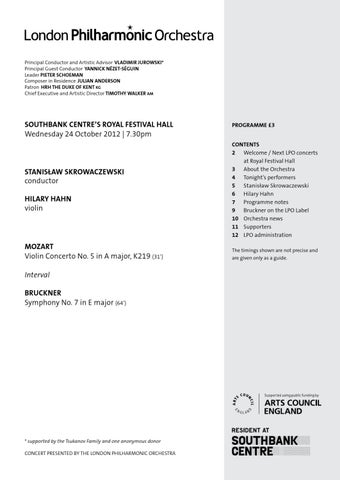
Principal Conductor and Artistic Advisor VLADIMIR JUROWSKI* Principal Guest Conductor YANNICK NÉZET-SÉGUIN Leader pieter schoeman Composer in Residence JULIAN ANDERSON Patron HRH THE DUKE OF KENT KG Chief Executive and Artistic Director TIMOTHY WALKER AM
SOUTHBANK CENTRE’S ROYAL FESTIVAL HALL Wednesday 24 October 2012 | 7.30pm
Stanisław Skrowaczewski conductor hilary hahn violin
mozart Violin Concerto No. 5 in A major, K219 (31’) Interval bruckner Symphony No. 7 in E major (64’)
* supported by the Tsukanov Family and one anonymous donor CONCERT PRESENTED BY THE LONDON PHILHARMONIC ORCHESTRA
PROGRAMME £3 CONTENTS 2 Welcome / Next LPO concerts at Royal Festival Hall 3 About the Orchestra 4 Tonight’s performers 5 Stanisław Skrowaczewski 6 Hilary Hahn 7 Programme notes 9 Bruckner on the LPO Label 10 Orchestra news 11 Supporters 12 LPO administration The timings shown are not precise and are given only as a guide.
Welcome
WELCOME TO SOUTHBANK CENTRE We hope you enjoy your visit. We have a Duty Manager available at all times. If you have any queries please ask any member of staff for assistance. Eating, drinking and shopping? Southbank Centre shops and restaurants include Foyles, EAT, Giraffe, Strada, YO! Sushi, wagamama, Le Pain Quotidien, Las Iguanas, ping pong, Canteen, Caffè Vergnano 1882, Skylon, Concrete and Feng Sushi, as well as cafes, restaurants and shops inside Royal Festival Hall, Queen Elizabeth Hall and Hayward Gallery. If you wish to get in touch with us following your visit please contact the Visitor Experience Team at Southbank Centre, Belvedere Road, London SE1 8XX, phone 020 7960 4250, or email customer@southbankcentre.co.uk
We look forward to seeing you again soon. A few points to note for your comfort and enjoyment: PHOTOGRAPHY is not allowed in the auditorium. LATECOMERS will only be admitted to the auditorium if there is a suitable break in the performance. RECORDING is not permitted in the auditorium without the prior consent of Southbank Centre. Southbank Centre reserves the right to confiscate video or sound equipment and hold it in safekeeping until the performance has ended. MOBILES, PAGERS AND WATCHES should be switched off before the performance begins.
next LPO concerts at royal festival hall Friday 26 October 2012 | 7.30pm JTI Friday Series Brahms Piano Concerto No. 1 Bruckner (arr. Skrowaczewski) Adagio from String Quintet in F Shostakovich Symphony No. 1 Stanisław Skrowaczewski conductor Garrick Ohlsson piano Wednesday 31 October 2012 | 7.30pm Sibelius Symphony No. 3 Mozart Violin Concerto No. 3 Nielsen Symphony No. 6 (Sinfonia semplice) Osmo Vänskä conductor Christian Tetzlaff violin ‘Christian Tetzlaff has the kind of technique that makes you forget the difficulty of the piece and simply wonder at the range of expression, the variety of tone and colour at his disposal.’ Evening Standard
2 | London Philharmonic Orchestra
Booking details London Philharmonic Orchestra Ticket Office 020 7840 4242 Monday to Friday 10.00am–5.00pm lpo.org.uk (no transaction fee) Southbank Centre Ticket Office (transaction fees apply) 0844 847 9920 Daily 9.00am–8.00pm southbankcentre.co.uk
LONDON PHILHARMONIC ORCHESTRA
The London Philharmonic Orchestra is one of the world’s finest orchestras, balancing a long and distinguished history with a reputation as one of the UK’s most adventurous and forward-looking orchestras. As well as giving classical concerts, the Orchestra also records film and video game soundtracks, has its own record label, and reaches thousands of Londoners every year through activities for schools and local communities. The Orchestra was founded by Sir Thomas Beecham in 1932, and since then its Principal Conductors have included Sir Adrian Boult, Bernard Haitink, Sir Georg Solti, Klaus Tennstedt and Kurt Masur. The current Principal Conductor is Vladimir Jurowski, appointed in 2007, and Yannick Nézet-Séguin is Principal Guest Conductor.
The London Philharmonic Orchestra has recorded many blockbuster scores, from The Lord of the Rings trilogy to Lawrence of Arabia, The Mission, East is East, Hugo, and The Hobbit: An Unexpected Journey. It also broadcasts regularly on television and radio, and in 2005 established its own record label. There are now nearly 70 releases available on CD and to download. Recent additions include Dvořák’s Stabat Mater under Neeme Järvi; Tchaikovsky’s Symphonies Nos. 4 & 5 with Vladimir Jurowski; Sibelius’s Symphonies Nos. 5 & 6 under the late Paavo Berglund; and the world premiere of Ravi Shankar’s First Symphony conducted by David Murphy. In summer 2012 the London Philharmonic Orchestra performed as part of The Queen’s Diamond Jubilee Pageant on the River Thames, and was also chosen to record all the world’s national anthems for the London 2012 Olympics.
The Orchestra is Resident Orchestra at the Royal Festival Hall in London’s Southbank Centre, where it has performed since it opened in 1951, giving around 40 The London Philharmonic Orchestra maintains an concerts there each season. 2012/13 highlights include energetic programme of activities for young people and three concerts with Vladimir Jurowski based around local communities. Highlights include the Deutsche the theme of War and Peace in collaboration with the Bank BrightSparks Russian National Orchestra; Kurt schools’ concerts; the Weill’s The Threepenny Opera, ‘As things stand now, the LPO must rate Leverhulme Young also conducted by Jurowski; as an example to all orchestras.’ Composers project; 20th-century American works Musicalcriticism.com, July 2011 and the Foyle Future with Marin Alsop; Haydn and (BBC Proms 2011: Liszt, Bartók and Kodály) Firsts orchestral Strauss with Yannick Nézettraining programme Séguin; and the UK premiere of for outstanding young players. Over recent years, Carl Vine’s Second Piano Concerto with pianist Piers developments in technology and social networks have Lane under Vassily Sinaisky. Throughout 2013 the enabled the Orchestra to reach even more people Orchestra will collaborate with the Southbank Centre worldwide: all its recordings are available to download on The Rest Is Noise festival, based on Alex Ross’s book from iTunes and, as well as a YouTube channel, news of the same name and charting the 20th century’s key blog, iPhone app and regular podcasts, the Orchestra musical works. has a lively presence on Facebook and Twitter. The Orchestra has flourishing residencies in Brighton Find out more and get involved! and Eastbourne, and performs regularly around the UK. Every summer, the Orchestra leaves London for four months and takes up its annual residency lpo.org.uk accompanying the famous Glyndebourne Festival Opera, where it has been Resident Symphony Orchestra facebook.com/londonphilharmonicorchestra since 1964. The Orchestra also tours internationally, performing concerts to sell-out audiences worldwide. twitter.com/LPOrchestra Tours in the 2012/13 season include visits to Spain, Germany, France, Switzerland, the USA and Austria.
London Philharmonic Orchestra | 3
tonight’s performers
First Violins Georgy Valtchev Guest Leader Ilyoung Chae Chair supported by Moya Greene
Ji-Hyun Lee Katalin Varnagy Catherine Craig Thomas Eisner Tina Gruenberg Martin Höhmann Geoffrey Lynn Robert Pool Sarah Streatfeild Yang Zhang Rebecca Shorrock Galina Tanney Helena Smart Ishani Bhoola Second Violins Annabelle Meare Guest Principal Joseph Maher Kate Birchall Chair supported by David & Victoria Graham Fuller
Fiona Higham Ashley Stevens Marie-Anne Mairesse Nancy Elan Andrew Thurgood Sioni Williams Alison Strange Stephen Stewart Mila Mustakova Sheila Law Elizabeth Baldey
Violas Helen Kamminga Guest Principal Robert Duncan Gregory Aronovich Katharine Leek Benedetto Pollani Laura Vallejo Susanne Martens Emmanuella ReiterBootiman Naomi Holt Isabel Pereira Miranda Davis Sarah Malcolm Cellos Kristina Blaumane Principal Susanne Beer Co-Principal Francis Bucknall Laura Donoghue Jonathan Ayling Chair supported by Caroline, Jamie & Zander Sharp
Gregory Walmsley Santiago Carvalho† Susan Sutherley Susanna Riddell David Lale Double Basses Kevin Rundell* Principal Tim Gibbs Co-Principal Laurence Lovelle George Peniston Kenneth Knussen Lowri Morgan Charlotte Kerbegian Antonia Bakewell
Flutes Sue Thomas Principal Chair supported by the Sharp Family
Stewart McIlwham* Oboes Ian Hardwick Principal Angela Tennick Clarinets Nicholas Carpenter* Principal Emily Meredith Bassoons Gareth Newman* Principal Simon Estell Horns David Pyatt Guest Principal Duncan Fuller Nicolas Wolmark Gareth Mollison Marcus Bates
Trombones Mark Templeton* Principal David Whitehouse Bass Trombone Lyndon Meredith Principal Tuba Lee Tsarmaklis* Principal Timpani Simon Carrington* Principal Percussion Andrew Barclay* Principal Chair supported by Andrew Davenport
* Holds a professorial appointment in London † Chevalier of the Brazilian Order of Rio Branco
Wagner Tubas Mark Vines Stephen Nicholls Martin Hobbs Anthony Chidell Trumpets Paul Beniston* Principal Anne McAneney* Chair supported by Geoff & Meg Mann
Tom Rainer William O’Sullivan
Chair Supporters The London Philharmonic Orchestra also acknowledges the following chair supporters whose players are not present at this concert: John & Angela Kessler Julian & Gill Simmonds
4 | London Philharmonic Orchestra
Stanisław Skrowaczewski
© Toshiyuki Urano
conductor
Stanisław Skrowaczewski commands a rare position in the international musical scene, being both a renowned conducting figure and a highly regarded composer. Having conducted all the top orchestras during his long and distinguished career, Skrowaczewski is now the world’s oldest working major conductor. Born in 1923 in Poland, Skrowaczewski began musical studies aged four; composed his first symphonic work at seven; gave his first public piano recital at 11; and two years later played and conducted Beethoven’s Third Piano Concerto. A hand injury during the war terminated his keyboard career, after which he concentrated on composing and conducting. In 1946 he became conductor of the Wrocław (Breslau) Philharmonic, and he later served as Music Director of the Katowice Philharmonic (1949–54), Kraków Philharmonic (1954–6) and Warsaw National Orchestra (1956–9). Skrowaczewski spent the immediate post-war years studying with Nadia Boulanger in Paris. In 1948 he conducted the Paris premiere of Shostakovich’s Fifth Symphony with the Orchestre Philharmonique de Radio France. After winning the 1956 International Competition for Conductors in Rome, he was invited by George Szell to make his American debut conducting the Cleveland Orchestra. This led to engagements with the New York Philharmonic, Pittsburgh Symphony and Cincinnati Symphony orchestras and, in 1960, to his appointment as Music Director of the Minneapolis Symphony Orchestra (now the Minnesota Orchestra), a position he held for 19 years. During the 1960s he made his debuts with the London, Chicago and Boston symphony orchestras; the Los Angeles, Munich, Vienna and Berlin Philharmonic orchestras; the Philadelphia Orchestra; the Royal Concertgebouw Orchestra; as well as with the Vienna State Opera and the Metropolitan Opera, New York. From 1984 to 1991, Skrowaczewski was Principal Conductor of the Hallé, with whom he gave concerts throughout Europe and the USA and recorded
extensively. In 2007 Skrowaczewski was appointed Principal Conductor of the Yomiuri Nippon Symphony Orchestra, Tokyo, for three highly successful seasons, during which time many of his performances were recorded live for Columbia Records. Guest engagements continue to take Skrowaczewski across North America, Europe and Japan. As well as two concerts with the London Philharmonic Orchestra, highlights of his 2012/13 season include returns to the Hallé; the Orchestre National de Lyon; the Bruckner Orchester Linz; and the Frankfurt Radio and Gothenburg symphony orchestras. Skrowaczewski is currently Conductor Laureate of the Minnesota Orchestra, Principal Guest Conductor of the Deutsche Radio Philharmonie, and Honorary Conductor Laureate of the Yomiuri Nippon Symphony Orchestra, all of which he also conducts this season. Still an active composer, Skrowaczewski’s works have recently been performed by the Bavarian Radio Symphony, German Radio Philharmonic, Yomiuri Nippon Symphony and Minnesota orchestras. His Concerto for Orchestra (1985) and Passacaglia Immaginaria (1995) were both nominated for the Pulitzer Prize. The recipient of numerous accolades, Skrowaczewski has six Honorary Doctorates, awarded most recently by the universities of Minnesota and Wrocław, the New England Conservatory of Music and the Karol Szymanowski Academy of Music, Katowice. His interpretations of Bruckner have earned him the Bruckner Society of America’s Kilenyi Medal of Honor and the Gold Medal of the Mahler-Bruckner Society, and his programming of contemporary music at the Minnesota Orchestra was acknowledged with five ASCAP Awards. Of particular note within Skrowaczewski’s extensive discography are his complete recordings of Bruckner and Beethoven symphonies with the Saarbrücken Radio Symphony Orchestra for Arte Nova Classics, which received enormous critical acclaim. The Bruckner set was included in BBC Music Magazine’s ‘Top Ten Discs of the Decade’. Published in 2011, a comprehensive account of Skrowaczewski’s life can be found in Seeking the Infinite: The Musical Life of Stanisław Skrowaczewski, by Frederick Harris Jr; it is available via seekingtheinfinite.com.
London Philharmonic Orchestra | 5
hilary hahn violin
© Peter Miller
American violinist Hilary Hahn’s probing interpretations, technical brilliance and commitment to new music have not only made her one of the most sought-after artists of our time, but also brought her love of classical music to a diverse audience. Although only 32 years old, her international recognition, including two Grammys, multiple Diapason d’Or and German Record Critics’ awards, and the 2008 Classic FM/Gramophone Artist of the Year title are testament to her talent and drive. Hahn appears regularly with the world’s elite orchestras and at prestigious recital series. During the 2010/11 season she embarked on a demanding recital tour covering 56 cities across four continents. After a planned tour of Japan in April 2011 was cancelled owing to the March tsunami disaster, Hahn organised four benefit concerts in the US to help aid the recovery. During the 2011/12 season she performed with the Baltimore Symphony Orchestra in its opening gala concert; the Orchestre Philharmonique de Radio France; the Netherlands Radio Philharmonic Orchestra; the NDR Radiophilharmonie; the Royal Scottish National Orchestra; Camerata Salzburg; and the Pittsburgh, Houston, San Francisco, Montreal and Alabama symphony orchestras. She also toured the US presenting the first half of her commissioning project In 27 Pieces: The Hilary Hahn Encores with long-time recital partner Valentina Lisitsa. She also gave concerts in Germany, France, Spain and Eastern Europe. In the 15 years since she began recording, Hahn has released 12 albums on the Deutsche Grammophon and Sony labels, as well as three DVDs, an Oscar-nominated film soundtrack, an award-winning recording for children, and various compilations. In repertoire as diverse as Bach, Stravinsky, Elgar, Beethoven, Vaughan Williams, Mozart, Schoenberg, Paganini, Spohr, Barber, Bernstein and Korngold, her recordings have received every critical prize in the international press, and have met with equal popular success. All have spent weeks in Billboard’s Classical Top Ten chart.
6 | London Philharmonic Orchestra
A 2008 recording of Schoenberg and Sibelius concertos entered the Billboard chart at No. 1 and spent the next 23 weeks in the chart. This album brought Hahn her second Grammy: the 2009 Award for Best Instrumental Soloist Performance with Orchestra. Her first Grammy came in 2003 for her Brahms and Stravinsky concertos album. In 2009 Hahn’s former teacher, composer Jennifer Higdon, wrote a Pulitzer Prize-winning concerto for her. This was released in September 2010 along with works by Tchaikovsky. Hilary’s most recent album Silfra is the culmination of a two-year exploratory improvisation project in collaboration with German prepared-piano master and innovator Hauschka. The music on this ambitious and free-spirited collection is a tribute to the Silfra rift in Iceland. Hahn’s commitment to contemporary music is shown by her current project In 27 Pieces: The Hilary Hahn Encores. She commissioned 27 composers to write short pieces for violin and piano, to be premiered during the 2011/12 and 2012/13 seasons and recorded for release next season. Shorter pieces remain a crucial part of every violinist’s education and repertoire, and Hahn believes potential new favourites should be encouraged and performed as well as longer works. Hahn has appeared on the covers of all major classical music publications and has been featured in mainstream magazines such as Vogue, Elle and Marie Claire. In 2001, she was named ‘America’s Best Young Classical Musician’ by Time. In January 2010 she appeared as guest artist, playing Bartók and Brahms, on The Tonight Show With Conan O’Brien. Hahn is an avid writer and interviewer, posting diary entries on her website at hilaryhahn.com. She produces a YouTube channel (youtube.com/hilaryhahnvideos) and serves as guest host for the contemporary classical music blog Sequenza21. Elsewhere, her violin case comments on life as a travelling companion on Twitter: @violincase. In 2004, Hilary was a soloist on the Oscar-nominated soundtrack to the film The Village. She has made guest appearances on two albums by the alt-rock band … And You Will Know Us By The Trail of Dead and on Grand Forks by Tom Brosseau, and she has collaborated and toured with folk/rock singersongwriter Josh Ritter.
PROGRAMME NOTES
Speedread At first glance, Bruckner’s spacious, romantically lyrical Seventh Symphony and Mozart’s classically concise Fifth Violin Concerto may not seem to have a lot in common. But Bruckner revered his great forerunner and fellow Austrian, and studied him intently. The serene long opening melody of his Seventh Symphony has the kind of sensuous beauty and elegant formal balance that we find, on a much smaller scale, in
Wolfgang Amadeus Mozart 1756–91
Mozart wrote at least four of his five violin concertos in one year, 1775, when he was 19 years old. At this time he was still the employee of the Archbishop of Salzburg. Next to nothing is known about why Mozart wrote so many solo works for violin around this time (a substantial ‘Concertone’ for two violins and orchestra dates from the previous year) – or why he never seriously returned to the form again. But as Konzertmeister (leader) of the Archbishop’s orchestra, Mozart would almost certainly have been expected to provide solo music for his employer’s entertainment, and he may well have played the solo parts himself – he certainly had the capability. Even so, while there is technically brilliant writing in these concertos, the general tendency is more towards lyrical beauty, formal balance and wit. After hearing one particularly virtuosic violin concerto, Mozart wrote to his father that although he had quite enjoyed it, ‘you know that I am no lover of difficulties’. Several times, on hearing violin playing that pleased him thoroughly, he wrote that ‘it went smoothly as oil.’
Mozart’s gorgeous slow central movement. Mozart may be wittier and lighter on his feet than Bruckner, but both composers pay tribute to dance music: Bruckner celebrating the rhythms and curvaceous melodies of the rural Ländler (country cousin of the sophisticated urban waltz) in his Scherzo, or Mozart pitting courtly Minuet against ‘Turkish’ stomping in his Rondo finale.
Violin Concerto No. 5 in A major, K219 (‘Turkish’) Hilary Hahn violin 1 Allegro aperto 2 Adagio 3 Rondeau: Tempo di Menuetto – Allegro – Tempo di Menuetto The Fifth Concerto is the most adventurous, ingenious and beguiling of the five violin concertos. Mozart begins the first movement, Allegro aperto [Lively, broad in style] by lulling his audience into a false sense of security. The opening orchestral section seems reasonably conventional by later 18th-century standards: it presents us with a number of themes, all ripe for development, and builds to a stirring conclusion. At this point we would expect the soloist to pick up one of the themes we’ve already heard and run with it for a while. Instead, there’s a pause, the tempo drops to Adagio, and the soloist sings to us sweetly for a moment or two. The Adagio itself pauses – then the soloist relaunches the Allegro aperto, but with a new theme of its own. We never hear the Adagio music again (unless the soloist decides to allude to it in her solo cadenza), but the memory of that charming surprise persists, resurfacing in many touches of subtle poetry. The second movement, Adagio, is significantly longer than any of the slow movements in Mozart’s previous violin concertos. There are echoes here of some of the great lyrical declarations of love in Mozart’s operas,
London Philharmonic Orchestra | 7
PROGRAMME NOTES
yet the writing – as throughout the Concerto – is wonderfully suited to the violin. The finale is the most surprising and ingenious of the three movements. Mozart calls it a Rondeau (‘Rondo’, or in English ‘Round’), signifying a structure in which the main theme keeps returning, after contrasting ideas, to create a kind of circling effect. In this Rondo finale, however, Mozart gives us a kind of ‘Rondo within a Rondo’. Some way into the movement, the minuet tempo is suddenly interrupted by an Allegro, which twice lurches into wild, rough-edged dance music. This style of deliberately un-refined folksy music, in a robust two beats per bar, was characterised in Mozart’s
time as ‘Turkish’ (hence the Concerto’s nickname). That it was a long way from real Turkish music needn’t concern us too much here; in any case the intention was almost certainly parody. Vienna had withstood sieges by massed Turkish armies in 1529 and 1683, and the idea of the ‘heathen Turk’ still had power to disturb Austrians in Mozart’s day. In the Concerto’s finale the elegant, eminently European minuet (ancestor of the Viennese waltz) eventually returns and – quietly – wins the day. The enemy has been invoked and ridiculed, and ‘civilised’ musical values have been shown to prevail. We may smile knowingly at this kind of stereotyping today, yet the charm of the music remains hard to resist.
INTERVAL – 20 minutes An announcement will be made five minutes before the end of the interval.
Anton Bruckner 1824–96
Symphony No. 7 in E major 1 2 3 4
Allegro moderato Adagio: Sehr feierlich und sehr langsam [Very solemn and slow] Scherzo: Sehr schnell [Very fast] – Trio: Etwas langsamer [Somewhat slower] Finale: Bewegt, doch nicht schnell [Lively, but not fast]
The world premiere of Bruckner’s Seventh Symphony in 1884 was the big turning point in the composer’s career. The previous 16 years had been a hard lesson in patience. In 1868, the 44-year-old Bruckner had left his Upper Austrian homeland for Vienna, full of hope. Instead he experienced rejection and mockery from the Viennese musical establishment. The first performance of the Third Symphony in 1877, by a visibly reluctant Vienna Philharmonic, was a catastrophe. The hall gradually emptied, and Bruckner was then subjected to a hideous mauling in the press. After that, few were disposed to take him seriously.
through so much anguish in Vienna’. A few months later, on 23 September, Bruckner began sketching the Seventh Symphony. Apparently the Symphony’s wonderful opening melody came to Bruckner in a dream: a friend from Bruckner’s younger days played the theme on a viola, with the words ‘This will bring you success’. If this is true it was prophetic: the premiere of the Seventh Symphony – significantly, not in conservative Vienna, but in the more culturally progressive German city of Leipzig – was one of the greatest successes of Bruckner’s life. One critic wrote, ‘How is it possible that he could remain so long unknown to us?’
Then, in 1881, the long-delayed premiere of the Fourth under Hans Richter began to turn the tide. Buoyed up by this, Bruckner began work on one of his most grandly affirmative works, the choral-orchestral Te Deum, which he dedicated proudly ‘to God, for having brought me
It isn’t hard to believe that the long, serenely arching first theme (cellos and violas, with horn at first) could have come straight from the unconscious – a gift of nature. As the theme is repeated on full orchestra the vision intensifies, then fades. A more melancholy second
8 | London Philharmonic Orchestra
theme (oboe and clarinet) aspires to recover lost glory. Eventually it sounds as though it might succeed, in a long crescendo over a repeated bass note, topped with brass fanfares. But this is suddenly cut off, and a more animated third theme follows: an earthy dance tune (strings in unison, with woodwind and brass support). After this, Bruckner allows us memories of his original vision; but it is only at the end of the movement that the promise of the opening is fulfilled: the Symphony’s opening motif rises steadily through the orchestra, crescendo, over a long-held major triad. Bruckner may have had the elemental one-chord crescendo that opens Wagner’s Das Rheingold at the back of his mind, but the effect here is quite different – after all this is a culmination, not a beginning. It is said that Bruckner composed the Adagio in the knowledge that his idol Wagner hadn’t long to live. There is an unmistakable note of mourning in the noble first theme, in which Bruckner uses – for the first time – a quartet of so-called ‘Wagner tubas’ (more like deep horns than tubas). Just before the lovely second theme (strings, in 3/4), hushed horn and tubas allude to Wagner’s masterpiece Tristan und Isolde, but unless this is pointed out, you’d hardly notice it: the effect is pure Bruckner. In some performances the Adagio’s climax is crowned by a cymbal clash, with triangle and timpani.
(This wasn’t Bruckner’s idea, but a suggestion from two friends.) Either way, it’s a thrilling moment: a revelation of pure light, after which the tubas, joined by horns, sing a magnificent elegy, then the movement concludes in peace. Like many of Bruckner’s earlier scherzos, the Scherzo of the Seventh Symphony reveals its rustic roots at almost every turn. (Bruckner often played in country dance-bands in his youth.) There are strong echoes of the Austrian Ländler, country cousin of the sophisticated Viennese waltz. But there is an obsessive, elemental drive here. The central Trio is much gentler, more songful, after which the Scherzo is repeated. Then comes the finale – unusually for Bruckner it’s the lightest (and in most performances, the shortest) of the four movements. Again there are three themes: a dancing, dotted theme (violins); a solemn chorale on violins and violas above a ‘walking’ pizzicato bass; and a jagged version of the first theme for full orchestra in unison. Excitement builds towards the end, until at last Bruckner reveals that the finale’s dancing first theme is simply the Symphony’s serene opening motif in disguise: we have travelled full circle. Programme notes by Stephen Johnson
Bruckner Symphonies on the LPO Label
Symphony No. 4
Symphony No. 6
Symphony No. 7
Symphony No. 8
Klaus Tennstedt conductor
Christoph Eschenbach conductor
Klaus Tennstedt conductor
Klaus Tennstedt conductor
LPO–0014 | £9.99
LPO–0049 | £9.99
LPO–0030 | £9.99
LPO–0032 | £9.99
Available from www.lpo.org.uk/shop, the London Philharmonic Orchestra Box Office (020 7840 4242, Monday–Friday 10am–5pm), all good CD outlets and the Royal Festival Hall shop. Downloads available from iTunes, Amazon, eMusic and classicsonline.com.
London Philharmonic Orchestra | 9
orchestra news
Tennstedt conducts Brahms’s Symphonies Nos. 1 & 3: new release on the LPO Label November sees an exciting new release on the Orchestra’s own CD label: Brahms’s Symphonies Nos. 1 & 3 under the late Klaus Tennstedt (LPO–0068). Tennstedt enjoyed a close and enduring relationship with the London Philharmonic Orchestra that resulted in his appointment as its Principal Conductor and Music Director in 1983, later becoming Conductor Laureate. Renowned for his interpretations of the German Romantic repertoire, Tennstedt once said he loved the LPO so much because ‘it is a romantic orchestra’. These live recordings were made at Royal Festival Hall concerts in 1983 and 1992. The double CD is priced £10.99 and is available from Thursday 1 November. Listen to soundclips and buy online at lpo.org.uk/shop
Animate Orchestra expands into Lambeth & Southwark Animate Orchestra is a partnership between Trinity Laban Conservatoire of Music and Dance, the London Philharmonic Orchestra and local music services that offers children aged 9–15 the opportunity to write their own music and play together in a mixed instrumental ensemble. Last month saw Animate Orchestra expand its reach into the boroughs of Southwark and Lambeth, following two successful years in Greenwich and Lewisham where it was launched in 2010. Members perform on instruments as varied as bassoon, guitar, ukulele and laptop, and draw upon their individual skills and interests to create their own music from scratch. To find out about Animate Orchestra courses in your borough, visit animateorchestra.org.uk Animate Orchestra is supported by The Mayor of London’s Fund for Young Musicians, Esmée Fairbairn Foundation, Lewisham Council and Trinity Laban Conservatoire of Music & Dance.
10 | London Philharmonic Orchestra
Student Pulse: the new app for student concert-goers in London The London Philharmonic Orchestra and its student scheme, NOISE, have joined forces with nine other London orchestras and venues to launch an iPhone and Android app that pulls together each organisation’s student schemes onto one platform, offering discounted tickets and loyalty points to student bookers. Simply book tickets directly through the app on your phone, and receive your e-ticket on your phone to show on the door on the night. The app and the ticket discounts are available to full-time students from any UK university. To find out more about the scheme, its partners, and to download the app, visit studentpulselondon.co.uk
Greatest Video Game Music 2 Over the summer we were back in the recording studio for the follow-up album to last year’s hugely popular Greatest Video Game Music. Once again conductor Andrew Skeet has created symphony orchestra versions of a huge range of familiar tunes, including music from Final Fantasy VII, The Elder Scrolls V, Street Fighter II, Assassin’s Creed, Mass Effect 3, Halo, Legend of Zelda: Dragon Roost Island, Little Big Planet, and many others. The album will be released on Tuesday 6 November. Watch a short preview film and listen to advance soundclips at www.lpo.org.uk/heroes/
We would like to acknowledge the generous support of the following Thomas Beecham Group Patrons, Principal Benefactors and Benefactors:
Guy & Utti Whittaker Manon Williams
David Ellen Commander Vincent Evans Mr Daniel Goldstein Mr & Mrs Jeffrey Herrmann Peter MacDonald Eggers Mr & Mrs David Malpas Andrew T Mills Mr Maxwell Morrison Mr Michael Posen Mr & Mrs Thierry Sciard Mr John Soderquist & Mr Costas Michaelides Mr & Mrs G Stein Mr & Mrs John C Tucker Mr & Mrs John & Susi Underwood Lady Marina Vaizey Howard & Sheelagh Watson Mr Laurie Watt Mr Anthony Yolland
Ken Follett Pauline & Peter Halliday Michael & Christine Henry Mr Ivan Hurry Mr Glenn Hurstfield Mr R K Jeha Mr Gerald Levin Sheila Ashley Lewis Wg. Cdr. & Mrs M T Liddiard OBE JP RAF Mr Frank Lim Paul & Brigitta Lock Mr Brian Marsh John Montgomery Mr & Mrs Andrew Neill Edmund Pirouet Mr Peter Tausig Mrs Kazue Turner Des & Maggie Whitelock Bill Yoe
Principal Benefactors Mark & Elizabeth Adams Jane Attias Lady Jane Berrill Desmond & Ruth Cecil Mr John H Cook Mr Charles Dumas
Benefactors Mrs A Beare Dr & Mrs Alan Carrington CBE FRS Mr & Mrs Stewart Cohen Mr Alistair Corbett Mr David Dennis Mr David Edgecombe Mr Richard Fernyhough
Hon. Benefactor Elliott Bernerd
Thomas Beecham Group The Tsukanov Family Anonymous The Sharp Family Julian & Gill Simmonds Garf & Gill Collins Andrew Davenport Mrs Sonja Drexler David & Victoria Graham Fuller Moya Greene John & Angela Kessler Mr & Mrs Makharinsky Geoff & Meg Mann Caroline, Jamie & Zander Sharp Eric Tomsett
Hon. Life Members Kenneth Goode Pehr G Gyllenhammar Edmund Pirouet Mrs Jackie Rosenfeld OBE
The generosity of our Sponsors, Corporate Members, supporters and donors is gratefully acknowledged: Corporate Members Silver: AREVA UK British American Business Destination Québec – UK Hermes Fund Managers Pritchard Englefield Bronze: Lisa Bolgar Smith and Felix Appelbe of Ambrose Appelbe Appleyard & Trew LLP Berkeley Law Charles Russell Lazard Leventis Overseas Education Partner Boeing Corporate Donor Lombard Street Research Preferred Partners Corinthia Hotel Heineken Lindt & Sprüngli Ltd Villa Maria
In-kind Sponsors Google Inc Sela / Tilley’s Sweets Trusts and Foundations Addleshaw Goddard Charitable Trust Angus Allnatt Charitable Foundation BBC Performing Arts Fund The Boltini Trust Britten-Pears Foundation The Candide Trust The Coutts Charitable Trust Diaphonique, Franco-British fund for contemporary music Dunard Fund The Equitable Charitable Trust The Eranda Foundation Fidelio Charitable Trust The Foyle Foundation J Paul Getty Junior Charitable Trust The Jeniffer and Jonathan Harris Charitable Trust Capital Radio’s Help a London Child The Hobson Charity The Kirby Laing Foundation The Idlewild Trust The Leverhulme Trust
Marsh Christian Trust Adam Mickiewicz Institute The Peter Minet Trust Paul Morgan Charitable Trust The Diana and Allan Morgenthau Charitable Trust Maxwell Morrison Charitable Trust Musicians Benevolent Fund Newcomen Collett Foundation The Austin & Hope Pilkington Trust Serge Rachmaninoff Foundation The Rothschild Foundation The Seary Charitable Trust The Samuel Sebba Charitable Trust The David Solomons Charitable Trust The Steel Charitable Trust The Bernard Sunley Charitable Foundation John Thaw Foundation The Underwood Trust Sir Siegmund Warburg’s Voluntary Settlement Kurt Weill Foundation for Music Garfield Weston Foundation and others who wish to remain anonymous London Philharmonic Orchestra | 11
administration
Board of Directors
General Administration
Orchestra Personnel
Archives
Victoria Sharp Chairman Stewart McIlwham* President Desmond Cecil CMG Vesselin Gellev* Jonathan Harris CBE FRICS Dr Catherine C. Høgel Martin Höhmann* Angela Kessler Gareth Newman* George Peniston* Sir Bernard Rix Kevin Rundell* Julian Simmonds Mark Templeton* Sir Philip Thomas Natasha Tsukanova Timothy Walker AM Laurence Watt Dr Manon Williams
Timothy Walker AM Chief Executive and Artistic Director
Andrew Chenery Orchestra Personnel Manager
Philip Stuart Discographer
Sarah Thomas Librarian
Gillian Pole Recordings Archive
Michael Pattison Stage Manager
Professional Services
Finance David Burke General Manager and Finance Director
Julia Boon Assistant Orchestra Personnel Manager
* Player-Director
Advisory Council Jonathan Dawson Clive Marks OBE FCA Lord Sharman of Redlynch OBE Victoria Sharp Timothy Walker AM American Friends of the London Philharmonic Orchestra, Inc. Margot Astrachan Chairman David E. R. Dangoor Vice Chair/Treasurer Kyung-Wha Chung Peter M. Felix CBE Alexandra Jupin Dr. Felisa B. Kaplan William A. Kerr Jill Fine Mainelli Kristina McPhee Dr. Joseph Mulvehill Harvey M. Spear, Esq. Danny Lopez Honorary Chairman Noel Kilkenny Honorary Director Victoria Sharp Honorary Director Richard Gee, Esq Of Counsel Robert Kuchner, CPA
Alison Atkinson Digital Projects Manager
Charles Russell Solicitors Crowe Clark Whitehill LLP Auditors
Ken Graham Trucking David Greenslade Instrument Transportation FSC_57678 14 January 2011 15/09/2011 12:30 Page Dr 1 Louise Miller Finance and ITLPO Manager Honorary Doctor Development Concert Management Roanna Gibson Concerts Director (maternity leave) Ruth Sansom Artistic Administrator / Acting Head of Concerts Department Graham Wood Concerts and Recordings Manager Barbara Palczynski Glyndebourne and Projects Administrator Jenny Chadwick Tours and Engagements Manager Alison Jones Concerts Co-ordinator Jo Orr PA to the Chief Executive / Concerts Assistant
Nick Jackman Development Director Helen Searl Corporate Relations Manager Katherine Hattersley Charitable Giving Manager Melissa Van Emden Events Manager Laura Luckhurst Corporate Relations and Events Officer Sarah Fletcher Development and Finance Officer Marketing Kath Trout Marketing Director Mia Roberts Marketing Manager
Matthew Freeman Recordings Consultant
Rachel Williams Publications Manager
Education & Community
Samantha Kendall Box Office Manager (Tel: 020 7840 4242)
Patrick Bailey Education and Community Director Alexandra Clarke Education Manager Caz Vale Community and Young Talent Manager Richard Mallett Education and Community Producer
12 | London Philharmonic Orchestra
Libby Northcote-Green Marketing Co-ordinator Claire Lampon Intern Albion Media Public Relations (Tel: 020 3077 4930)
London Philharmonic Orchestra 89 Albert Embankment London SE1 7TP Tel: 020 7840 4200 Fax: 020 7840 4201 Box Office: 020 7840 4242 lpo.org.uk The London Philharmonic Orchestra Limited is a registered charity No. 238045. Photograph of Bruckner courtesy of the Royal College of Music, London. Front cover photograph © Patrick Harrison. Printed by Cantate.