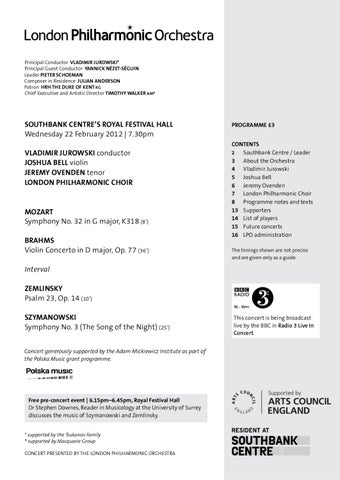
Principal Conductor VLADIMIR JUROWSKI* Principal Guest Conductor YANNICK NÉZET-SÉGUIN Leader pieter schoeman Composer in Residence JULIAN ANDERSON Patron HRH THE DUKE OF KENT KG Chief Executive and Artistic Director TIMOTHY WALKER AM†
SOUTHBANK CENTRE’S ROYAL FESTIVAL HALL Wednesday 22 February 2012 | 7.30pm VLADIMIR JUROWSKI conductor JOSHUA BELL violin JEREMY OVENDEN tenor london philharmonic choir
MOZART Symphony No. 32 in G major, K318 (8’) BRAHMS Violin Concerto in D major, Op. 77 (36’)
PROGRAMME £3 CONTENTS 2 Southbank Centre / Leader 3 About the Orchestra 4 Vladimir Jurowski 5 Joshua Bell 6 Jeremy Ovenden 7 London Philharmonic Choir 8 Programme notes and texts 13 Supporters 14 List of players 15 Future concerts 16 LPO administration The timings shown are not precise and are given only as a guide.
Interval ZEMLINSKY Psalm 23, Op. 14 (10’) SZYMANOWSKI Symphony No. 3 (The Song of the Night) (25’) Concert generously supported by the Adam Mickiewicz Institute as part of the Polska Music grant programme.
Free pre-concert event | 6.15pm–6.45pm, Royal Festival Hall Dr Stephen Downes, Reader in Musicology at the University of Surrey discusses the music of Szymanowski and Zemlinsky. * supported by the Tsukanov Family † supported by Macquarie Group CONCERT PRESENTED BY THE LONDON PHILHARMONIC ORCHESTRA
This concert is being broadcast live by the BBC in Radio 3 Live In Concert.
Welcome
pieter schoeman Leader
Pieter Schoeman joined the London Philharmonic Orchestra as Co-Leader in 2002, and was appointed Leader in 2008.
WELCOME TO SOUTHBANK CENTRE
Eating, drinking and shopping? Southbank Centre shops and restaurants include Foyles, EAT, Giraffe, Strada, YO! Sushi, wagamama, Le Pain Quotidien, Las Iguanas, ping pong, Canteen, Caffè Vergnano 1882, Skylon, Concrete and Feng Sushi, as well as cafes, restaurants and shops inside Royal Festival Hall, Queen Elizabeth Hall and Hayward Gallery. If you wish to get in touch with us following your visit please contact Kenelm Robert, our Head of Customer Relations, at Southbank Centre, Belvedere Road, London SE1 8XX or phone 020 7960 4250 or email customer@southbankcentre.co.uk We look forward to seeing you again soon. A few points to note for your comfort and enjoyment: PHOTOGRAPHY is not allowed in the auditorium. LATECOMERS will only be admitted to the auditorium if there is a suitable break in the performance. RECORDING is not permitted in the auditorium without the prior consent of Southbank Centre. Southbank Centre reserves the right to confiscate video or sound equipment and hold it in safekeeping until the performance has ended. MOBILES, PAGERS AND WATCHES should be switched off before the performance begins.
© Patrick Harrison
We hope you enjoy your visit. We have a Duty Manager available at all times. If you have any queries please ask any member of staff for assistance.
Born in South Africa, he made his solo début aged 10 with the Cape Town Symphony Orchestra. He studied with Jack de Wet in South Africa, winning numerous competitions including the 1984 World Youth Concerto Competition in the US. In 1987 he was offered the Heifetz Chair of Music scholarship to study with Eduard Schmieder in Los Angeles and in 1991 his talent was spotted by Pinchas Zukerman, who recommended that he move to New York to study with Sylvia Rosenberg. In 1994 he became her teaching assistant at Indiana University, Bloomington. Pieter has performed worldwide as a soloist and recitalist in such famous halls as the Concertgebouw in Amsterdam, Moscow’s Rachmaninov Hall, Capella Hall in St Petersburg, Staatsbibliothek in Berlin, Hollywood Bowl in Los Angeles and Southbank Centre’s Queen Elizabeth Hall in London. As a chamber musician he regularly performs at London’s prestigious Wigmore Hall. As a soloist with the London Philharmonic Orchestra, Pieter has performed Arvo Pärt’s Double Concerto with Boris Garlitsky, Brahms’s Double Concerto with Kristina Blaumane, and Britten’s Double Concerto with Alexander Zemtsov, which was recorded and released on the Orchestra’s own record label to great critical acclaim. He has recorded numerous violin solos with the London Philharmonic Orchestra for Chandos, Opera Rara, Naxos, X5, the BBC and for American film and television, and led the Orchestra in its soundtrack recordings for The Lord of the Rings trilogy. In 1995 Pieter became Co-Leader of the Orchestre Philharmonique de Nice. Since then he has performed frequently as Guest Leader with the symphony orchestras of Barcelona, Bordeaux, Lyon and Baltimore, as well as with the BBC Symphony Orchestra. Pieter is a Professor of Violin at Trinity Laban Conservatoire of Music and Dance.
2 | London Philharmonic Orchestra
LONDON PHILHARMONIC ORCHESTRA
The London Philharmonic Orchestra is one of the world’s finest orchestras, balancing a long and distinguished history with a reputation as one of the UK’s most adventurous and forward-looking orchestras. As well as performing classical concerts, the Orchestra also records film and computer game soundtracks, has its own record label, and reaches thousands of Londoners every year through activities for schools and local communities. The Orchestra was founded by Sir Thomas Beecham in 1932, and since then has been headed by many of the great names in the conducting world, including Sir Adrian Boult, Bernard Haitink, Sir Georg Solti, Klaus Tennstedt and Kurt Masur. The current Principal Conductor is Russian Vladimir Jurowski, appointed in 2007, with French-Canadian Yannick Nézet-Séguin as Principal Guest Conductor. The Orchestra is based at Royal Festival Hall in London’s Southbank Centre, where it has performed since it opened in 1951 and been Resident Orchestra since 1992. It gives around 40 concerts there each season with many of the world’s top conductors and soloists. Concert highlights in 2011/12 include a three-week festival celebrating the music of Prokofiev; concerts with artists including Sir Mark Elder, Marin Alsop, Renée Fleming, Stephen Hough and Joshua Bell; and several premières of works by living composers including the Orchestra’s Composer in Residence, Julian Anderson. In addition to its London concerts, the Orchestra has flourishing residencies in Brighton and Eastbourne, and performs regularly around the UK. Every summer, the Orchestra leaves London for four months and takes up its annual residency accompanying the famous Glyndebourne Festival Opera in the Sussex countryside, where it has been Resident Symphony Orchestra since 1964. The London Philharmonic Orchestra tours internationally, performing to sell-out audiences worldwide. In 1956 it became the first British orchestra to appear in Soviet Russia and in 1973 made the first-ever visit to China by a Western orchestra. Touring remains a big part of the Orchestra’s life: tours in the 2011/12 season include visits to Belgium, Switzerland, Germany, the US, Spain, China, Russia, Oman, Brazil and France.
You may well have heard the London Philharmonic Orchestra on film soundtrack recordings: it has recorded many blockbuster scores, from The Lord of the Rings trilogy to Lawrence of Arabia, The Mission, Philadelphia and East is East. The Orchestra also broadcasts regularly on television and radio, and in 2005 established its own record label. There are now over 60 releases on the label, which are available on CD and to download. Recent additions include Dvořák’s Symphonic Variations and Symphony No. 8 conducted by Sir Charles Mackerras; Holst’s The Planets conducted by Vladimir Jurowski; Mahler’s Symphony No. 8 under Klaus Tennstedt; Shostakovich Piano Concertos with Martin Helmchen under Vladimir Jurowski; and Sibelius’s Symphony No. 5, Pohjola’s Daughter and Lutosławski’s Concerto for Orchestra under Jukka-Pekka Saraste. The Orchestra was also recently honoured with the commission to record all 205 of the world’s national anthems for the London 2012 Olympics Team Welcome Ceremonies and Medal Ceremonies. To help maintain its high standards and diverse workload, the Orchestra is committed to the welfare of its musicians and in December 2007 received the Association of British Orchestras/Musicians Benevolent Fund Healthy Orchestra Bronze Charter Mark. The London Philharmonic Orchestra maintains an energetic programme of activities for young people and local communities. Highlights include the ever-popular family and schools concerts, fusion ensemble The Band, the Leverhulme Young Composers project and the Foyle Future Firsts orchestral training scheme for outstanding young players. Over the last few years, developments in technology and social networks have enabled the Orchestra to reach even more people worldwide: all its recordings are available to download from iTunes and, as well as a YouTube channel, news blog, iPhone app and regular podcasts, the Orchestra has a lively Twitter presence. Find out more and get involved! lpo.org.uk twitter.com/LPOrchestra
London Philharmonic Orchestra | 3
VLADIMIR JUROWSKI
© Chris Christodoulou
CONDUCTOR
Born in Moscow, the son of conductor Mikhail Jurowski, Vladimir Jurowski completed his initial studies at the Music College of the Moscow Conservatory. In 1990 he relocated with his family to Germany where he continued his studies in Dresden and Berlin. In 1995 he made his international debut at the Wexford Festival, where he conducted Rimsky-Korsakov’s May Night. The same year saw his brilliant début at the Royal Opera House, Covent Garden, in Nabucco. In 1996 he joined the ensemble of Komische Oper Berlin, becoming First Kapellmeister in 1997 and continuing to work at the Komische Oper on a permanent basis until 2001. Since 1997 Vladimir Jurowski has been a guest at some of the world’s leading musical institutions including the Royal Opera House, Covent Garden; Teatro La Fenice di Venezia; Opéra Bastille de Paris; Théâtre de la Monnaie Bruxelles; Maggio Musicale Festival, Florence; Rossini Opera Festival, Pesaro; Edinburgh International Festival; Dresden Semperoper; and the Teatro Comunale di Bologna (where he served as Principal Guest Conductor between 2000 and 2003). In 1999 he made his début at the Metropolitan Opera in New York with Rigoletto. In January 2001 Jurowski took up the position of Music Director of Glyndebourne Festival Opera and in 2003 was appointed Principal Guest Conductor of the London Philharmonic Orchestra, becoming the Orchestra’s Principal Conductor in September 2007. He also holds the titles of Principal Artist with the Orchestra of the Age of Enlightenment and Artistic Director of the Russian State Academic Symphony Orchestra. From 2005 to 2009 he served as Principal Guest Conductor of the Russian National Orchestra, with whom he continues to work and whom he will conduct in two concerts at Royal Festival Hall in October 2012 as part of a joint ‘War & Peace’ mini-series with the LPO. Vladimir Jurowski is a regular guest with many of the world’s leading orchestras including the Berlin Philharmonic, Oslo Philharmonic, Royal Concertgebouw, Bavarian Radio Symphony, Los Angeles Philharmonic
4 | London Philharmonic Orchestra
and Philadelphia orchestras, as well as the Staatskapelle Dresden and the Gewandhausorchester Leipzig. Highlights of the 2011/12 season and beyond include his débuts with the Vienna Philharmonic, Boston Symphony Orchestra, NHK Symphony Orchestra Tokyo and San Francisco Symphony, and return visits to the Chamber Orchestra of Europe, Staatskapelle Dresden, Tonhalle Orchester Zurich, Accademia Nazionale di Santa Cecilia and the Chicago Symphony, St Petersburg Philharmonic, Royal Concertgebouw and Philadelphia orchestras. Jurowski’s operatic engagements have included Jenůfa, The Queen of Spades and Hänsel und Gretel at the Metropolitan Opera, Parsifal and Wozzeck at Welsh National Opera, War and Peace at the Opéra National de Paris, Eugene Onegin at La Scala Milan, Iolanta at the Dresden Semperoper and Ruslan and Ludmila at the Bolshoi Theatre, as well as The Magic Flute, La Cenerentola, Otello, Macbeth, Falstaff, Tristan und Isolde, Die Meistersinger von Nürnberg, Don Giovanni, The Rake’s Progress, and Peter Eötvös’s Love and Other Demons at Glyndebourne Festival Opera. Future engagements include new productions of Ariadne auf Naxos and The Cunning Little Vixen at Glyndebourne, Die Frau ohne Schatten at the Metropolitan Opera and Moses und Aron at the Komische Oper Berlin. Jurowski’s discography includes the first ever recording of Giya Kancheli’s cantata Exil for ECM, Meyerbeer’s L’étoile du nord for Naxos-Marco Polo, and Werther for BMG, as well as numerous live recordings on the London Philharmonic Orchestra’s own label. He has also recorded works by Prokofiev, Shostakovich, Tchaikovsky and Stravinsky for PentaTone with the Russian National Orchestra. Vladimir Jurowski’s position as Principal Conductor of the London Philharmonic Orchestra is generously supported by the Tsukanov Family.
JOSHUA BELL
© Lisa Marie Mazzucco
VIOLIN
Joshua Bell has enchanted audiences worldwide with his breathtaking virtuosity and tone of rare beauty. He first came to widespread attention at the age of 14 in a highly acclaimed orchestral début with Riccardo Muti and The Philadelphia Orchestra. His Carnegie Hall début and a recording contract further confirmed his presence in the music world. Today he is equally at home as a soloist, chamber musician, orchestra leader and composer who performs his own cadenzas to many of the major concertos. In 2011 he became Music Director of London’s Academy of St Martin in the Fields. Bell’s 2011/12 festival appearances include Ravinia, Tanglewood, Verbier and Mostly Mozart. He will perform with the Los Angeles Philharmonic Orchestra and the Montreal, Dallas, Colorado, Atlanta and National symphony orchestras, and as leader and soloist with The Academy of St Martin in the Fields. 2012 highlights include a US tour with ASMF and a North American recital tour with pianist Sam Haywood. Later this month he will tour Spain and Germany with the London Philharmonic Orchestra and Vladimir Jurowski. Bell records exclusively for Sony Classical. His latest disc, French Impressions, featuring repertoire by Ravel, SaintSaëns and Franck with pianist Jeremy Denk, was released in January 2012. Other recent releases include the soundtracks to For Colored Girls and Defiance; Vivaldi’s The Four Seasons; Tchaikovsky’s Violin Concerto with the Berlin Philharmonic; At Home With Friends featuring Chris Botti, Sting, Josh Groban, Regina Spektor, Tiempo Libre and others; The Red Violin Concerto; The Essential Joshua Bell; Voice of the Violin; and Romance of the Violin, which Billboard magazine named the 2004 Classical CD of the Year, and Bell the Classical Artist of the Year. He has also made critically acclaimed recordings of the Sibelius, Goldmark, Beethoven and Mendelssohn concertos. Bell’s Grammy-nominated recording Gershwin Fantasy premièred a new work for violin and orchestra based on themes from Gershwin’s Porgy and Bess. Its success led
to an all-Bernstein recording that included the première of the West Side Story Suite as well as a new recording of the composer’s Serenade. Bell also collaborated with Wynton Marsalis on the Grammy-winning spoken word children’s album Listen to the Storyteller and Béla Fleck’s Grammy Award-winning Perpetual Motion. Sony Classical film soundtracks on which Bell has performed also include The Red Violin, Ladies in Lavender and Iris. A champion of new music for the violin, Bell has premièred works by composers Nicholas Maw, John Corigliano, Aaron Jay Kernis, Edgar Meyer, Behzad Ranjbaran and Jay Greenberg. Bell grew up on a farm in Bloomington, Indiana. He received his first violin aged four after his parents noticed him plucking tunes with rubber bands he had stretched around the handles of his chest of drawers. By 12 he had become serious about the instrument, thanks in large part to the inspiration of renowned violinist and pedagogue Josef Gingold, who became his beloved teacher and mentor. In 1989 Joshua received an Artist Diploma in Violin Performance from Indiana University. His alma mater honoured him with a Distinguished Alumni Service Award only two years after his graduation, and he has since received the Indiana Governor’s Arts Award. Joshua Bell has been the subject of a BBC Omnibus documentary, and he appeared as himself in the film Music of the Heart starring Meryl Streep. He has been profiled in publications ranging from The New York Times and Newsweek to People Magazine’s ‘50 Most Beautiful People’ issue, Gramophone and USA Today. Bell was named 2010 Instrumentalist of the Year by Musical America. He is an inductee in the Hollywood Bowl Hall of Fame, recognised as a young global leader by the World Economic Forum, serves on the artist committee of the Kennedy Center Honors and is on the Board of Directors of the New York Philharmonic. He is the recipient of the Humanitarian Award from Seton Hall University and received the Academy of Achievement Award for exceptional accomplishment in the arts. In 2009 he was invited by the President and First Lady Michelle Obama to perform at the White House.
London Philharmonic Orchestra | 5
JEREMY OVENDEN
© Pierre-Philippe Hofmann
tenor
English tenor Jeremy Ovenden studied with Norman Bailey and Neil Mackie at the Royal College of Music, London, and privately with Nicolai Gedda.
His current and future plans include Mozart’s Litaniae de venerabili altaris sacramento at the Salzburg Festival with Concentus Musicus Wien and Nikolaus Harnoncourt; Nerone in Monteverdi’s L’incoronazione di Poppea for Paris Opera and at La Scala, Milan; Tigrane in Handel’s Radamisto at Theater an der Wien; a tour and recording singing Belfiore in Mozart’s La finta giardiniera with René Jacobs and the Double Bande; Handel’s Messiah and Haydn’s The Creation with the Orchestra Sinfonica Nazionale della Rai, Turin; Mendelssohn’s Elijah with the Bergen Philharmonic Orchestra; Britten’s Serenade for Tenor, Horn and Strings with the Aarhus Symphony Orchestra; Britten’s War Requiem with the Danish National Symphony Orchestra and John Nelson; Berlioz’s L’Enfance du Christ with the MDR Symphony Orchestra and Choir, Leipzig; Mozart’s Coronation Mass with Le Cercle de l’Harmonie; Haydn’s Stabat Mater with Ensemble Orchestral de Paris; Handel’s Dixit Dominus, again with Concentus Musicus Wien and Nikolaus Harnoncourt in Vienna and Lucerne; Handel’s Messiah with the Academy of Ancient Music and Bernard Labadie; and in 2015, the title role in Monteverdi’s Il ritorno d’Ulisse in patria, again with the Academy of Ancient Music and Richard Egarr. Jeremy recently sang Ferrando in Così fan tutte for the Royal Opera, Covent Garden, and the Berlin Staatsoper; Monsieur Vogelsang in Mozart’s Der Schauspieldirektor with Concerto Köln and Ivor Bolton; Publio in Mozart’s Il sogno di Scipione at the Vienna Musikverein with Nikolaus Harnoncourt; Belfiore in La finta giardiniera and Jupiter in Handel’s Semele at La Monnaie, Brussels; Don Ottavio in Mozart’s Don Giovanni in Berlin with Daniel Barenboim; and the title role in Monteverdi’s Orfeo, Oronte in Handel’s Alcina and Ilio in Cavalli’s Ercole amante for Netherlands Opera. Concert appearances include Haydn’s The Seasons with the London Symphony Orchestra and Sir Colin
6 | London Philharmonic Orchestra
Davis (also recorded for LSO Live), with the Deutsche Symphonie Orchester, Berlin, and Andrew Manze and at the Schleswig-Holstein Musik Festival with Paul McCreesh; Handel’s Saul on tour and for a Harmonia Mundi recording with René Jacobs; Haydn’s Harmoniemesse with Sir Simon Rattle and the Orchestra of the Age of Enlightenment; Mozart’s Betulia liberata with Nikolaus Harnoncourt at the Vienna Musikverein and in concert for the Salzburg Festival, where he has also appeared as Fracasso in Mozart’s La finta semplice; Don Asdrubale in Mozart’s Lo sposo deluso and Biondello in Mozart’s L’oco del Cairo conducted by Michael Hofstetter; Mozart’s Mass in C minor with Yannick Nézet-Séguin and Betulia liberata conducted by Christoph Poppen. In 2004, Jeremy made his début at La Scala, Milan, in Salieri’s Europa riconosciuta conducted by Riccardo Muti, and has returned to sing Don Ottavio with Gustavo Dudamel and Oronte in Handel’s Alcina with Giovanni Antonini. He has also sung Male Chorus in The Rape of Lucretia in Genova and Florence. Jeremy’s extensive discography includes Bach’s St Mark Passion, St John Passion and Cantatas; Handel’s Saul; Haydn’s The Seasons and The Creation; Mozart’s Il sogno di Scipione; Mozart’s Betulia liberata; La finta semplice; L’oca del Cairo and Lo sposo deluso. His most recent disc of Mozart arias with the Orchestra of the Age of Enlightenment prompted David Cairns of The Sunday Times to comment: ‘Ovenden’s attractive, bright tenor … his rhythm, diction and easy flexibility of voice, are exemplary.’
london philharmonic choir PATRON HRH Princess Alexandra | PRESIDENT Sir Roger Norrington | ARTISTIC DIRECTOR Neville Creed ACCOMPANIST Jonathan Beatty | CHAIRMAN Mary Moore | CHOIR MANAGER Kevin Darnell
Founded in 1947, the London Philharmonic Choir is widely regarded as one of Britain’s finest choirs, consistently meeting with great critical acclaim. It has performed under leading international conductors throughout the last 65 years and made numerous recordings for CD, radio and television. Its Artistic Director is Neville Creed. Enjoying a close relationship with the London Philharmonic Orchestra, the Choir frequently joins it for concerts in the UK and abroad. In 2010/11, engagements included Mahler’s Symphony No. 3 and Das klagende Lied, Bartók’s The Miraculous Mandarin, Dvořák’s Te Deum and Stabat Mater, Fauré’s Requiem, Holst’s The Planets and Elgar’s The Dream of Gerontius. This season, concerts with the LPO have included Scriabin’s Prometheus, Poem of Fire, Prokofiev’s Ivan the Terrible and Bruckner’s Te Deum. Future engagements include Delius’s Sea Drift and Suk’s The Ripening. Recently released CDs with the London Philharmonic Orchestra include Dvořák’s Requiem conducted by Neeme Järvi, Brahms’s Ein deutsches Requiem with Yannick Nézet-Séguin and Holst’s The Planets, Mahler’s Symphony No. 2, Haydn’s The Seven Last Words of our Saviour on the Cross and Honneger’s Une Cantate de Noël under Vladimir Jurowski. Sopranos Annette Argent, Harriet Carey, Olivia Carter, Paula Chessell, Emily Clarke, Sheila Cox, Sarah Deane-Cutler, Timotia Devi, Lucy Doig, Sally Donegani, Alison Flood, Rachel Gibbon, Elisabeth Giselbrecht, Emily Grey, Jane Hanson, Sally Harrison, Carolyn Hayman, Elizabeth Hicks, Laura Hunt, Georgina Kaim, Jenni Kilvert, Olivia Knibbs, Ilona Kratochvilova, Frances Lake, Kathryn Leigh, Roseanna Levermore, Suzannah Lipmann, Clare Lovett, Janey Maxwell, Marj McDaid, Natalie Millet, Katie Milton, Felicity Mowat, Linda Park, Alice Pugh, Claire Spencer, Rose Stachniewska, Louisa Sullivan, Tracey Swagrzak, Susan Thomas, Isobel Timms, Agnes Tisza, Nicola Ward, Frances Wheare Altos Joanna Arnold, Deirdre Ashton, Phye Bell, Susannah Bellingham, Alexis Calice, Andrei Caracoti, Isabelle Cheetham, Isobel Chester, Noel Chow, Yvonne Cohen, Liz Cole, Alice Conway, Janik Dale, Moira Duckworth, Fiona Duffy-Farrell, Andrea Easey, Lynn Eaton, Carmel Edmonds, Sarah Elstone, Regina Frank, Kathryn Gilfoy, Sophy Holland, Katy Jones-Pritchard, Marjana Jovanovic Morrison, Andrea Lane, Claire Lawrence,
Appearing regularly at the BBC Proms at the Royal Albert Hall, the Choir’s performances have included Beethoven’s Symphony No. 9, Elgar’s The Dream of Gerontius, Rachmaninov’s The Bells and the UK premières of MarkAnthony Turnage’s A Relic of Memory and Goldie’s Sine Tempore in the Evolution! Prom. The Choir performed at the Doctor Who Proms in 2008 and 2010, and in 2011 appeared in Verdi’s Requiem, Liszt’s A Faust Symphony and Beethoven’s Missa Solemnis. The Choir works with other leading orchestras, has visited numerous European countries and performed in Kuala Lumpur, Hong Kong and Perth, Australia. The Choir will appear at Le Touquet International Music Masters Festival in France in April 2012. Last May it joined forces with the London Symphony Chorus to perform Walton’s Belshazzar’s Feast with the Royal Philharmonic Orchestra under Andrew Litton, and in December sang Messiah with the Mozart Festival Orchestra under Oliver Gooch. The Choir also sings in Raymond Gubbay’s Classical Spectacular and Christmas concerts, and has appeared in galas with Russell Watson and Katherine Jenkins. The London Philharmonic Choir prides itself on achieving first-class performances from its members, who are volunteers from all walks of life. For more information, including details about how to join, please visit www.lpc.org.uk Laetitia Malan, Mary Moore, Sophie Morrison, Rachel Murray, Raluca Negriuc, Carolyn Saunders, Muriel Swijghuisen Reigersberg, Susi Underwood, Libby Vannet, Jenny Watson Tenors Scott Addison, David Aldred, Geir Andreassen, Chris Beynon, Tom Cameron, Lorne Cuthbert, Kevin Darnell, Michael Delany, Aloysius Fekete, Colin Fleming, Lucas Souza Gomes, Josh Haley, Stephen Hodges, Rob Home, Patrick Hughes, Tony Masters, Rhydian Peters, Filipe Salvador, Owen Toller, Tony Wren Basses Euan Au, Jonathon Bird, Gordon Buky-Webster, Adam Bunzl, Geoff Clare, David Clark, Rob Collis, Phillip Dangerfield, Marcus Daniels, Ian Frost, Paul Gittens, Nigel Grieve, Martin Harvey, Mark Hillier, Stephen Hines, David Hodgson, Rylan Holey, Martin Hudson, Anthony McDonald, John Morris, Ashley Morrison, William Parsons, Johan Pieters, Tony Piper, David Regan, Fraser Riddell, John Salmon, Christopher Short, Peter Sollich, Alex Thomas, James Torniainen, Hin-Yan Wong, John Wood
London Philharmonic Orchestra | 7
PROGRAMME NOTES
Speedread Two splendid one-movement symphonies frame tonight’s concert, though Mozart’s 32nd and Szymanowski’s Third are worlds apart in style and atmosphere. Mozart’s Symphony shows his response to the musical riches he’d encountered in Paris; Szymanowski’s The Song of the Night evokes a luxurious Middle Eastern dream-world, its opulent scoring turning mediaeval Persian mystical poetry into a fabulous tapestry of 20th-century romantic sound. In its gentler way, Zemlinsky’s setting of
Wolfgang Amadeus MOZART
Psalm 23 also combines the sensuous and the devotional in a manner that would have scandalized some of Mozart’s contemporaries – though perhaps not Mozart himself. Between these comes one of the greatest of all violin concertos, the Brahms: not so much a ‘star vehicle’ as a symphony for violin and orchestra, in which – as in Szymanowski’s Third Symphony – the relationship between the soloist and the other performers is essential to the drama of the music.
Symphony No. 32 in G major, K318 Allegro spiritoso – Andante – Primo tempo
1756–91
Musicologists like to put pieces in pigeonholes. Mozart didn’t actually call this work ‘Symphony’ – in fact he didn’t give it any kind of genre description. When he wrote the work in 1779, he had just returned from a trip to Paris, where he had hoped – in vain – to find prestigious employment, and thus escape servitude to the Archbishop of Salzburg, Count Hieronymus von Colloredo, whose treatment of Mozart was becoming more and more dictatorial. In Paris Mozart had heard comic opera overtures whose structure broadly resembles that of Symphony No. 32, so many writers have tried hard to prove that the music was really intended as a curtain-raiser for a theatre work. In fact there’s no evidence for this at all: Mozart may simply have been trying out new formal models. Whatever the case, this lively, highly compact piece manages to say a great deal in well under ten minutes. It begins like a grand symphonic first movement, presenting strikingly contrasting themes, then developing them towards a
8 | London Philharmonic Orchestra
climax. But at the point where we might expect the first theme to return, the music pauses expectantly, and a slow movement begins. Eventually this too breaks off, and the first movement resumes, as though nothing had happened to stop it. Cleverly, Mozart delays the return of the very first theme until the end, where it rounds off the structure brilliantly. Mozart may not have called this a ‘symphony’, but as a symphonic argument, it’s a triumph.
Johannes BRAHMS 1833–97
Today, Brahms’s Violin Concerto (1878) is regarded as one of the high points of the solo violin repertoire. Yet it is also rather untypical of the romantic concerto literature. Certainly the solo part is challenging: the Austrian violinist and conductor Josef Hellmesberger, who directed the first performance, went so far as to call it a concerto ‘not for, but against the violin’. But there is so much more to this concerto than attentiongrabbing virtuoso display. In fact it is often more like a symphony for violin and orchestra, in which the violin leads the argument, but the orchestra is rarely totally subservient. Brahms wrote the concerto for his close friend, the virtuoso violinist and composer Joseph Joachim (1831–1907). From the start, Brahms was concerned to tailor the solo part to Joachim’s style. Joachim made numerous suggestions, not all of which Brahms accepted; nevertheless Joachim left his imprint indelibly on the solo part, and even on some of the orchestral writing: the wonderful orchestral return at the end of the first movement’s unaccompanied cadenza was rescored, to magical effect, at Joachim’s instigation.
Violin Concerto in D major, Op. 77 Original cadenza by Joshua Bell JOSHUA BELL violin Allegro non troppo Adagio Allegro giocoso, ma non troppo vivace
key, with more dramatic, rhythmically complex writing – good romantic ‘striving’ solo writing in fact – but this is soon calmed by lyrical solo woodwind. Towards the end of the movement the tempo notches up, with suitably impressive cascading chords for the violin; but memories of the thoughtful melodic writing are likely to be just as persistent. The lovely long oboe tune that opens the Adagio is followed by ecstatic solo outpourings from the violin. Some violinists have grumbled at the way Brahms gives the best tune to the oboe, but perhaps this was his way of reminding the soloist (and the audience) that this concerto isn’t simply a ‘star vehicle’ – the violinist is really ‘first among equals’. The finale is full of the kind of Hungarian ‘gypsy’ figurations Brahms loved – though this is probably also a tribute to the Hungarian-born Joachim. After a brief, downward plunging cadenza, there’s a brilliant faster coda, though with a lovely surprise hush just before the three emphatic final chords.
The concerto begins with a simple but eloquent theme on bassoons, violas and cellos, joined by horns. A moment later there’s a soft change of harmony and the movement settles into a kind of slow, graceful waltz motion. Stark contrast is provided by a minor-inflected forte theme, starting in unison. The contrast between these three ideas sets the tone for the whole first movement. When the soloist enters, it is in the minor
INTERVAL – 20 minutes An announcement will be made five minutes before the end of the interval. London Philharmonic Orchestra | 9
PROGRAMME NOTES
Alexander ZEMLINSKY
PSALM 23, OP. 14 Allegro spiritoso – Andante – Primo tempo
1871–1942
In many ways Alexander Zemlinsky stands between his two fellow Viennese giants, Gustav Mahler and Arnold Schoenberg. There were strong personal, as well as musical connections. Before she met and married Mahler, Alma Schindler had been Zemlinsky’s lover. The loss of Alma devastated Zemlinsky, but it didn’t stop him revering Mahler and his music. Zemlinsky became a friend and unofficial tutor to Schoenberg when both composers were in their 20s; indeed Schoenberg wrote later that it was Zemlinsky he had to thank ‘for practically all my knowledge of technique and the problems of composition’. The relationship grew closer when Schoenberg married Zemlinsky’s sister Matthilde in 1901. Later it came under appalling strain when Matthilde had an affair with the painter Richard Gerstl, who subsequently committed suicide. Yet again this in no way damaged the two composers’ mutual admiration.
Zemlinsky composed his setting of the enduring popular Psalm 23 – ‘The Lord is my shepherd’ – in 1910, two years after the Matthilde-Gerstl affair and Schoenberg’s plunge into the unexplored waters of atonality in his String Quartet No. 2 and the one-act opera Erwartung (‘Anticipation’). Psalm 23 could hardly be less like those two tortured, nightmarish masterpieces in mood or style. There are echoes of Mahler, and English listeners may be reminded of Delius at times, yet it’s also clear that Zemlinsky is very much his own man. The refined orchestral palette and the strong sense of line are typical, as is the sensitive word-setting: Zemlinsky has a fine flair for placing a telling harmonic twist or a little touch of instrumental colour to bring out sometimes unexpected nuances in the words. At the end Zemlinsky brings back the opening line of the Psalm to end in a mood of delicately perfumed serenity.
Der Herr ist mein Hirte; mir wird nichts mangeln. Er weidet mich auf grüner Aue, er führet mich zum frischen Wasser. Er erquicket meine Seele, er führet mich auf rechter Strasse um seines Namens willen. Und ob ich schon wanderte im finstern Tal, fürchte ich kein Unglück, denn du bist bei mir, dein Stab und Stecken trösten mich. Du bereitest vor mir einen Tisch gegen meine Feinde.
The Lord is my shepherd; I shall not want. He makes me lie down in green pastures; He leads me beside still waters. He restores my soul; He leads me in paths of righteousness, for His name’s sake. Even though I walk through the valley of the shadow of death, I will fear no evil, for You are with me; Your rod and Your staff, they comfort me. You prepare a table before me in the presence of my enemies; You anoint my head with oil; my cup overflows. Surely goodness and mercy shall follow me all the days of my life, and I shall dwell in the house of the Lord forever.
Du salbest mein Haupt mit Öl und schenkest mir voll ein. Gutes und Barmherzigkeit werden mir folgen mein Leben lang und ich werde bleiben im Hause des Herrn immerdar.
10 | London Philharmonic Orchestra
Karol Szymanowski
Symphony No. 3 (The Song of the Night) JEREMY OVENDEN tenor
1882–1937
The sung text is overleaf. The Polish composer Karol Szymanowski was fascinated by the culture of the Islamic Middle East. But like Debussy, who evoked Spain hauntingly in piece after piece but only ever spent half a day in the country itself, Szymanowski had only minimal contact with the lands of his dreams by the time he wrote his Third Symphony. As with many other Western European artists, ‘The Orient’, or ‘The Mystic East’, remained more fantasy than actuality: a place to travel in the imagination without the risk of messy reality blundering in and spoiling it all. Szymanowski’s knowledge of Islamic art and literature was, however, quite extensive for a man of his time and place. One of his most significant discoveries was the poetry of 13th-century Persian mystic Jalāl’ad-Dīn Rumi, and particularly the magnificent poem that became the basis of Szymanowski’s choral-orchestral Third Symphony, The Song of the Night. The sensuous beauty of the night, and human love as a symbol of the relationship between God and man, are central themes here – as in so much of Rumi’s writing. On another occasion he wrote that, ‘The lover’s cause is separate from all other causes; love is the astrolabe of God’s mysteries’ – lines that could stand as a motto for Szymanowski’s Third Symphony. The erotically charged imagery of Rumi’s poem enchanted Szymanowski, and as a homosexual he was particularly struck by the fact that the intimate ‘friend’ addressed in the verses was male. Accordingly he set Rumi’s words for tenor solo, chorus and huge, colourenhanced orchestra. For some years after the war it was common in Poland to perform the Symphony with a soprano soloist instead of tenor, but this may have been more a consequence of Soviet Communist prudery than
of valid performing tradition. Szymanowski’s score is quite clear: the singer is male; and the Polish language makes it clear that the lover addressed is male too. Luxuriously beautiful harmonies and textures are common in Szymanowski’s music, particularly the period 1914–16 during which the Third Symphony was written. But this score is perhaps the most opulent, extravagantly gorgeous sound-tapestry he ever created. Perhaps the timing is significant. As Europe was throwing itself into a period of unprecedented carnage, an upheaval that would change the world Szymanowski knew out of all recognition, the desire for escape – to find meaning and consolation in another kind of world – understandably intensified. The Symphony is in one continuous movement, which seems to rise and fall in huge waves, the two main climaxes massively enhanced by the use of the organ. In between are passages which – to borrow a phrase from Wagner – convey ‘the softness and shimmer of silk’. At the final climax there is an unmistakable reference (orchestra and organ alone) to the famous ‘desire’ theme from Wagner’s Tristan and Isolde. Yet the end is peace: a deep C, sustained by hushed double basses and organ, whilst violins, violas and cellos perform fabulous gossamer glissandi up and down the string, like the trembling of a veil in a gentle breath of warm night air. Programme notes © Stephen Johnson
London Philharmonic Orchestra | 11
SZYMANOWSKI: The SONG OF THE NIGHT
O, nie śpij, druhu, nocy tej! Tyś jest Duch, a myśmy chorzy nocy tej! Odpędź z oczu Twoich sen! Tajemnica się rozwidni nocy tej! Tyś jest Jowisz na niebiosach, wśród gwiazd krążysz firmamentu, nocy tej! Nad otchłanie orła pędź! Bohaterem jest Twój Duch nocy tej!
Do not sleep, O friend, through this night! You, a soul, while we suffer through this night! Ban slumber from your eyes! Revealed is the great secret in this night! You are God in the high heaven, Round the starry vault of heaven you go round in this night! Like an eagle soar above! Now is your soul tonight a hero!
Jak cicho, inni śpi ... Ja i Bóg jesteśmy sami nocy tej! Jaki szum! Wschodzi szczęście, prawda skrzydłem opromienia nocy tej! Nie śpij, druhu! Gdybym przespał aż do ranka, jużbym nigdy nie odzyskał nocy tej! Targowiska już ucichły, patrz na rynek gwiezdnych dróg nocy tej! Lew i Orion, Andromeda i Merkury krwawo lśni nocy tej. Wpływ złowieszczy miota Saturn, Wenus płynie w złotym dżdżu nocy tej! Zamilknięciem wiąże język, lecz ja mówię bez języka nocy tej!
So quiet, others sleep ... I and God together, alone in this night! What sound! Joy rises, Truth with shining wing shines in this night! Sleep not, friend! If I slept on until dawn, I should never, never again see this night! Roads on earth are silent, There see the starry paths of this night! Leo, Orion, Andromeda and Mercury gleam blood-red through this night. Saturn binds with fated powers, Venus swims in golden rain through this night! Silence chains my tongue, But I speak, though without a tongue, in this night!
Jalāl’ad-Dīn Rumi (1207–73) Polish translation by Tadeusz Miciński (1873–1918)
English translation by Keith Anderson, courtesy of Naxos Rights International Ltd.
Next concert with the London Philharmonic Choir Saturday 24 March 2012 | 7.30pm Royal Festival Hall Delius Sea Drift* plus Julian Anderson The Discovery of Heaven (world première)† and Elgar Symphony No. 1
Sir Mark Elder and Roderick Williams
Sir Mark Elder conductor | Roderick Williams baritone | London Philharmonic Choir * Performance generously supported by The Delius Trust. † Commissioned by the London Philharmonic Orchestra with kind support from The Boltini Trust and the Britten-Pears Foundation, and the New York Philharmonic (Alan Gilbert, Music Director).
Tickets £9–£39 | Premium seats £65 London Philharmonic Orchestra Box Office: 020 7840 4242 Mon–Fri 10.00am–5.00pm | lpo.org.uk
12 | London Philharmonic Orchestra
We would like to acknowledge the generous support of the following Thomas Beecham Group Patrons, Principal Benefactors and Benefactors: Thomas Beecham Group The Tsukanov Family Anonymous The Sharp Family Julian & Gill Simmonds Garf & Gill Collins Andrew Davenport David & Victoria Graham Fuller Richard Karl Goeltz John & Angela Kessler Mr & Mrs Makharinsky Geoff & Meg Mann Caroline, Jamie & Zander Sharp Eric Tomsett Mrs Sonja Drexler Guy & Utti Whittaker Principal Benefactors Mark & Elizabeth Adams Jane Attias Lady Jane Berrill Desmond & Ruth Cecil Mr John H Cook Mr Charles Dumas
David Ellen Commander Vincent Evans Mr & Mrs Jeffrey Herrmann Peter MacDonald Eggers Mr & Mrs David Malpas Andrew T Mills Mr Maxwell Morrison Mr Michael Posen Mr & Mrs Thierry Sciard Mr John Soderquist & Mr Costas Michaelides Mr & Mrs G Stein Mr & Mrs John C Tucker Mr & Mrs John & Susi Underwood Lady Marina Vaizey Howard & Sheelagh Watson Mr Laurie Watt Mr Anthony Yolland
Ken Follett Pauline & Peter Halliday Michael & Christine Henry Mr Ivan Hurry Mr Glenn Hurstfield Mr R K Jeha Mr Gerald Levin Sheila Ashley Lewis Wg. Cdr. & Mrs M T Liddiard OBE JP RAF Mr Frank Lim Paul & Brigitta Lock Mr Brian Marsh John Montgomery Edmund Pirouet Mr Peter Tausig Mrs Kazue Turner Mr D Whitelock Bill Yoe
Benefactors Mrs A Beare Dr & Mrs Alan Carrington CBE FRS Mr & Mrs Stewart Cohen Mr Alistair Corbett Mr David Dennis Mr David Edgecombe Mr Richard Fernyhough
Hon. Benefactor Elliott Bernerd Hon. Life Members Kenneth Goode Pehr G Gyllenhammar Edmund Pirouet Mrs Jackie Rosenfeld OBE
The generosity of our Sponsors, Corporate Members, supporters and donors is gratefully acknowledged: Corporate Members Silver: AREVA UK British American Business Hermes Fund Managers Bronze: Appleyard & Trew LLP Berkeley Law Charles Russell Destination Québec – UK Lazard Leventis Overseas Corporate Donor Lombard Street Research In-kind Sponsors Google Inc Heineken Lindt & Sprüngli Ltd Sela / Tilley’s Sweets Villa Maria Trusts and Foundations Addleshaw Goddard Charitable Trust Arts and Business Allianz Cultural Foundation Angus Allnatt Charitable Foundation
The Boltini Trust Britten-Pears Foundation The Candide Charitable Trust The Coutts Charitable Trust The Delius Trust Dunard Fund The Equitable Charitable Trust The Eranda Foundation The Fenton Arts Trust The Foyle Foundation The Jeniffer and Jonathan Harris Charitable Trust Hattori Foundation for Music and the Arts Capital Radio’s Help a London Child The Hobson Charity The Kirby Laing Foundation The Idlewild Trust The Leverhulme Trust Lord and Lady Lurgan Trust Maurice Marks Charitable Trust Marsh Christian Trust The Mercers’ Company Adam Mickiewicz Institute The Peter Minet Trust Paul Morgan Charitable Trust
The Diana and Allan Morgenthau Charitable Trust Maxwell Morrison Charitable Trust Musicians Benevolent Fund Newcomen Collett Foundation The Austin & Hope Pilkington Trust The Serge Prokofiev Foundation Serge Rachmaninoff Foundation The Reed Foundation The Rothschild Foundation The Seary Charitable Trust The Samuel Sebba Charitable Trust The David Solomons Charitable Trust The Steel Charitable Trust The Stansfield Trust The Bernard Sunley Charitable Foundation The Swan Trust John Thaw Foundation The Thistle Trust The Underwood Trust Kurt Weill Foundation for Music Garfield Weston Foundation Youth Music and others who wish to remain anonymous London Philharmonic Orchestra | 13
LONDON PHILHARMONIC ORCHESTRA
First Violins Pieter Schoeman* Leader Vesselin Gellev Sub-Leader Chair supported by John & Angela Kessler
Radu Bitica Grace Lee Katalin Varnagy Martin Höhmann Chair supported by Richard Karl Goeltz
Geoffrey Lynn Robert Pool Catherine Craig Yang Zhang Rebecca Shorrock Alain Petitclerc Peter Nall Galina Tanney Joanne Chen Sarah Buchan Second Violins Clare Duckworth Principal Chair supported by the Sharp Family
Jeongmin Kim Joseph Maher Fiona Higham Ashley Stevens Kate Birchall Chair supported by David & Victoria Graham Fuller
Marie-Anne Mairesse Dean Williamson Sioni Williams Heather Badke Peter Graham Stephen Stewart Mila Mustakova Sheila Law Violas Jonathan Barritt Guest Principal Robert Duncan Gregory Aronovich Susanna Martens Katharine Leek
Benedetto Pollani Emmanuella ReiterBootiman Daniel Cornford Michelle Bruil Martina Forni Isabel Pereira Alistair Scahill Cellos Kristina Blaumane Principal Susanne Beer Co-Principal Francis Bucknall Laura Donoghue Jonathan Ayling Chair supported by Caroline, Jamie & Zander Sharp
Gregory Walmsley Santiago Carvalho† Susanna Riddell Tom Roff Helen Rathbone Double Basses Kevin Rundell* Principal Tim Gibbs Co-Principal Laurence Lovelle George Peniston Richard Lewis Helen Rowlands Tom Walley Joe Melvin Flutes Jaime Martín* Principal Susan Thomas Ian Mullin Piccolos Stewart McIlwham* Principal Ian Mullin Oboes Ian Hardwick Principal Angela Tennick John Robert
14 | London Philharmonic Orchestra
Cor Anglais Sue Bohling Principal Chair supported by Julian & Gill Simmonds
Clarinets Robert Hill* Principal Emily Meredith James Burke Bass Clarinet Paul Richards Principal E-flat Clarinet Nicholas Carpenter Principal Bassoons Gareth Newman* Principal Laurence O’Donnell Julia Staniforth Contra-bassoon Simon Estell Principal Horns John Ryan* Christopher Parkes Guest Principal Martin Hobbs Mark Vines Co-Principal Gareth Mollison Tim Ball Anthony Chidell Trumpets Paul Beniston* Principal Anne McAneney* Chair supported by Geoff & Meg Mann
Nicholas Betts Co-Principal Joe Sharp Trombones Mark Templeton* Principal David Whitehouse
Bass Trombone Christian Jones Contra-bass Trombone Lyndon Meredith Tuba Lee Tsarmaklis* Principal Timpani Simon Carrington* Principal Percussion Andrew Barclay* Principal Chair supported by Andrew Davenport
Keith Millar Olly Yates Ignacio Molins Eddy Hackett Harps Rachel Masters* Principal Helen Sharp Piano Catherine Edwards Celeste Bernard Robertson Organ Roderick Elms
Assistant Conductor Thomas Blunt
* Holds a professorial appointment in London † Chevalier of the Brazilian Order of Rio Branco
future concerts
Saturday 24 March 2012 | 7.30pm Royal Festival Hall Julian Anderson The Discovery of Heaven (world première)† Delius Sea Drift* Elgar Symphony No. 1 Sir Mark Elder conductor Roderick Williams baritone London Philharmonic Choir † Commissioned by the London Philharmonic Orchestra with kind support from The Boltini Trust and the Britten-Pears Foundation, and the New York Philharmonic (Alan Gilbert, Music Director). * Performance generously supported by The Delius Trust.
Friday 13 April 2012 | 7.30pm Royal Festival Hall JTI Friday Series Mozart Symphony No. 35 (Haffner) Beethoven Piano Concerto No. 2* Julian Anderson Past Hymns Stravinsky Symphony in C The International Conductors’ Academy of the Allianz Cultural Foundation John Lill piano * Supported by Dunard Fund.
Wednesday 18 April 2012 | 7.30pm Royal Festival Hall Schumann Overture, Genoveva Kalevi Aho Percussion Concerto (world première)* Brahms Symphony No. 1 Sir Mark Elder and Roderick Williams
Barlines free post-concert discussion The Clore Ballroom at Royal Festival Hall Sir Mark Elder and Composer in Residence Julian Anderson discuss The Discovery of Heaven.
Wednesday 28 March 2012 | 7.30pm Royal Festival Hall Mozart Violin Concerto No. 3 Mahler Symphony No. 9 Yannick Nézet-Séguin conductor Lisa Batiashvili violin Concert generously supported by the Sharp Family.
Free pre-concert performance 6.00–6.45pm | Royal Festival Hall London Music Masters Artists and Bridge Project students celebrate four years of creative collaboration with the London Philharmonic Orchestra, Royal College of Music, Wigmore Hall and Southbank Centre with a performance featuring specially commissioned works.
Osmo Vänskä conductor Colin Currie percussion * Kalevi Aho’s Percussion Concerto is commissioned by the London Philharmonic Orchestra, the Luosto Classic Festival and Gothenburg Symphony.
Free pre-concert discussion 6.15pm–6.45pm | Royal Festival Hall Colin Currie explores Kalevi Aho’s Percussion Concerto.
Booking details Tickets £9–£39 | Premium seats £65 London Philharmonic Orchestra Box Office 020 7840 4242 Monday to Friday 10.00am–5.00pm lpo.org.uk (no transaction fee) Southbank Centre Box Office 0844 847 9920 Daily 9.00am–8.00pm southbankcentre.co.uk (transaction fees apply) In person at Royal Festival Hall Box Office Daily 10.00am–8.00pm (no transaction fee)
London Philharmonic Orchestra | 15
Administration
Board of Directors
General Administration
Orchestra Personnel
Archives
Martin Höhmann Chair Stewart McIlwham Vice-Chair Sue Bohling Lord Currie* Jonathan Dawson* Gareth Newman George Peniston Sir Bernard Rix* Kevin Rundell Sir Philip Thomas* Timothy Walker AM†
Timothy Walker AM† Chief Executive and Artistic Director
Andrew Chenery Orchestra Personnel Manager
Philip Stuart Discographer
Sarah Thomas Librarian
Gillian Pole Recordings Archive
*Non-Executive Directors
The London Philharmonic Trust
Alison Atkinson Digital Projects Manager
Michael Pattison Stage Manager
London Philharmonic Orchestra Julia Boon 89 Albert Embankment David Burke Assistant Orchestra Personnel SE1 7TP FSC_57678 LPO 14 January 2011 15/09/2011 12:30 Page London 1 General Manager and Manager Tel: 020 7840 4200 Finance Director Ken Graham Trucking Fax: 020 7840 4201 David Greenslade Instrument Transportation Box Office: 020 7840 4242 Finance and IT Manager (Tel: 01737 373305) lpo.org.uk Finance
Victoria Sharp Chair Desmond Cecil CMG Jonathan Harris CBE FRICS Dr Catherine C. Høgel Martin Höhmann Angela Kessler Clive Marks OBE FCA Julian Simmonds Natasha Tsukanova Timothy Walker AM† Laurence Watt
Concert Management
Development
Roanna Gibson Concerts Director
Nick Jackman Development Director
Ruth Sansom Artistic Administrator
Harriet Mesher Charitable Giving Manager
Graham Wood Concerts, Recordings and Glyndebourne Manager
Melissa Van Emden Events Manager
Alison Jones Concerts Co-ordinator
Laura Luckhurst Corporate Relations and Events Officer
American Friends of the London Philharmonic Orchestra, Inc.
Jenny Chadwick Tours and Engagements Manager
Elisenda Ayats Development and Finance Officer
We are very grateful to the Board of the American Friends of the London Philharmonic Orchestra for its support of the Orchestra’s activities in the USA.
Jo Orr PA to the Executive / Concerts Assistant
Marketing
Professional Services
Education & Community
Charles Russell Solicitors
Patrick Bailey Education and Community Director
Crowe Clark Whitehill LLP Auditors Dr Louise Miller Honorary Doctor
Matthew Freeman Recordings Consultant
Anne Findlay Education Manager Caz Vale Community and Young Talent Manager Richard Mallett Education and Community Producer
16 | London Philharmonic Orchestra
Kath Trout Marketing Director Ellie Dragonetti Marketing Manager Rachel Fryer Publications Manager Helen Boddy Marketing Co-ordinator Samantha Kendall Box Office Manager (Tel: 020 7840 4242) John Barnett Intern Valerie Barber Press Consultant (Tel: 020 7586 8560)
The London Philharmonic Orchestra Limited is a registered charity No. 238045. Photographs of Brahms, Zemlinsky and Szymanowski courtesy of the Royal College of Music, London. Front cover photograph © Chris Christodoulou Printed by Cantate. †Supported by Macquarie Group