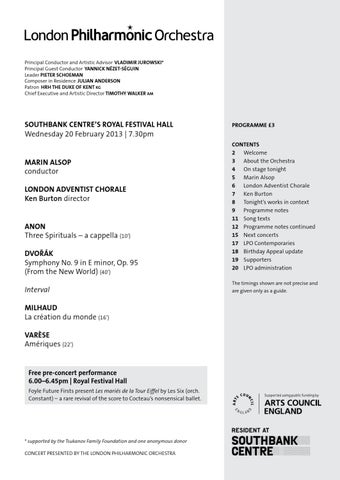
Principal Conductor and Artistic Advisor VLADIMIR JUROWSKI* Principal Guest Conductor YANNICK NÉZET-SÉGUIN Leader pieter schoeman Composer in Residence JULIAN ANDERSON Patron HRH THE DUKE OF KENT KG Chief Executive and Artistic Director TIMOTHY WALKER AM
SOUTHBANK CENTRE’S ROYAL FESTIVAL HALL Wednesday 20 February 2013 | 7.30pm
marin alsop conductor london adventist chorale Ken Burton director
anon Three Spirituals – a cappella (10’) dvoŘÁk Symphony No. 9 in E minor, Op. 95 (From the New World) (40’) Interval milhaud La création du monde (16’) varèSE Amériques (22’)
Free pre-concert performance 6.00–6.45pm | Royal Festival Hall Foyle Future Firsts present Les mariés de la Tour Eiffel by Les Six (orch. Constant) – a rare revival of the score to Cocteau’s nonsensical ballet.
* supported by the Tsukanov Family Foundation and one anonymous donor CONCERT PRESENTED BY THE LONDON PHILHARMONIC ORCHESTRA
PROGRAMME £3 CONTENTS 2 Welcome 3 About the Orchestra 4 On stage tonight 5 Marin Alsop 6 London Adventist Chorale 7 Ken Burton 8 Tonight’s works in context 9 Programme notes 11 Song texts 12 Programme notes continued 15 Next concerts 17 LPO Contemporaries 18 Birthday Appeal update 19 Supporters 20 LPO administration The timings shown are not precise and are given only as a guide.
Welcome
WELCOME TO SOUTHBANK CENTRE We hope you enjoy your visit. We have a Duty Manager available at all times. If you have any queries please ask any member of staff for assistance. Eating, drinking and shopping? Southbank Centre shops and restaurants include Foyles, EAT, Giraffe, Strada, YO! Sushi, wagamama, Le Pain Quotidien, Las Iguanas, ping pong, Canteen, Caffè Vergnano 1882, Skylon, Concrete and Feng Sushi, as well as cafes, restaurants and shops inside Royal Festival Hall, Queen Elizabeth Hall and Hayward Gallery. If you wish to get in touch with us following your visit please contact the Visitor Experience Team at Southbank Centre, Belvedere Road, London SE1 8XX, phone 020 7960 4250, or email customer@southbankcentre.co.uk We look forward to seeing you again soon. A few points to note for your comfort and enjoyment: PHOTOGRAPHY is not allowed in the auditorium. LATECOMERS will only be admitted to the auditorium if there is a suitable break in the performance. RECORDING is not permitted in the auditorium without the prior consent of Southbank Centre. Southbank Centre reserves the right to confiscate video or sound equipment and hold it in safekeeping until the performance has ended. MOBILES, PAGERS AND WATCHES should be switched off before the performance begins.
Southbank Centre’s The Rest Is Noise, inspired by Alex Ross’s book The Rest Is Noise Presented by Southbank Centre in partnership with the London Philharmonic Orchestra. southbankcentre.co.uk/therestisnoise The Rest Is Noise is a year-long festival that digs deep into 20th-century history to reveal the influences on art in general and classical music in particular. Inspired by Alex Ross’s book The Rest Is Noise, we use film, debate, talks and a vast range of concerts to reveal the fascinating stories behind the century’s wonderful and often controversial music. We have brought together the world’s finest orchestras and soloists to perform many of the most significant works of the 20th century. We reveal why these pieces were written and how they transformed the musical language of the modern world. Over the year, The Rest Is Noise focuses on 12 different parts. The music is set in context with talks from a fascinating team of historians, scientists, philosophers, political theorists and musical experts as well as films, online content and other special programmes. If you’re new to 20th-century music, then this is your time to start exploring with us as your tour guide. There has never been a festival like this. Jude Kelly Artistic Director, Southbank Centre
2 | London Philharmonic Orchestra
London Philharmonic Orchestra
The London Philharmonic Orchestra is one of the world’s finest orchestras, balancing a long and distinguished history with a reputation as one of the UK’s most adventurous and forward-looking orchestras. As well as giving classical concerts, the Orchestra also records film and video game soundtracks, has its own record label, and reaches thousands of Londoners every year through activities for schools and local communities. The Orchestra was founded by Sir Thomas Beecham in 1932, and since then its Principal Conductors have included Sir Adrian Boult, Sir John Pritchard, Bernard Haitink, Sir Georg Solti, Klaus Tennstedt and Kurt Masur. The current Principal Conductor is Vladimir Jurowski, appointed in 2007, and Yannick Nézet-Séguin is Principal Guest Conductor.
The London Philharmonic Orchestra has recorded many blockbuster scores, from The Lord of the Rings trilogy to Lawrence of Arabia, The Mission, East is East, Hugo, and The Hobbit: An Unexpected Journey. It also broadcasts regularly on television and radio, and in 2005 established its own record label. There are now nearly 70 releases available on CD and to download. Recent additions include Tchaikovsky’s Symphonies Nos. 4 & 5 with Vladimir Jurowski; Brahms’s Symphonies Nos. 1 & 3 with Klaus Tennstedt; a disc of orchestral works by Mark-Anthony Turnage; and the world premiere of the late Ravi Shankar’s First Symphony conducted by David Murphy. In summer 2012 the London Philharmonic Orchestra performed as part of The Queen’s Diamond Jubilee Pageant on the River Thames, and was also chosen to record all the world’s national anthems for the London 2012 Olympics.
The Orchestra is Resident Orchestra at Southbank Centre’s Royal Festival Hall in London, where it has performed since it opened in 1951, giving around 40 The London Philharmonic concerts there each Orchestra maintains an season. 2012/13 The LPO were on exceptional form, energetic programme of highlights include activities for young people three concerts and the performance had a real and local communities. with Vladimir edge-of-your-seat excitement. The Guardian Highlights include the Jurowski based (29 September 2012, Royal Festival Hall: Rachmaninoff, Shchedrin, Denisov & Miaskovsky) Deutsche Bank BrightSparks around the theme Series; the Leverhulme of War and Peace Young Composers project; and the Foyle Future Firsts in collaboration with the Russian National Orchestra; orchestral training programme for outstanding young Kurt Weill’s The Threepenny Opera, also conducted by players. Over recent years, developments in technology Jurowski; 20th-century American works with Marin and social networks have enabled the Orchestra to Alsop; Haydn and Strauss with Yannick Nézet-Séguin; reach even more people worldwide: all its recordings and the UK premiere of Carl Vine’s Second Piano are available to download from iTunes and, as well Concerto with pianist Piers Lane under Vassily Sinaisky. as a YouTube channel, news blog, iPhone app and Throughout 2013 the Orchestra is collaborating with regular podcasts, the Orchestra has a lively presence on Southbank Centre on The Rest Is Noise festival, based Facebook and Twitter. on Alex Ross’s book of the same name and charting the 20th century’s key musical works and historical events. Find out more and get involved! The Orchestra has flourishing residencies in Brighton and Eastbourne, and performs regularly around lpo.org.uk the UK. Every summer, the Orchestra leaves London for four months and takes up its annual residency facebook.com/londonphilharmonicorchestra accompanying the famous Glyndebourne Festival Opera, where it has been Resident Symphony Orchestra twitter.com/LPOrchestra since 1964. The Orchestra also tours internationally, performing concerts to sell-out audiences worldwide. Tours in the 2012/13 season include visits to Spain, Germany, France, Switzerland, the USA and Austria. London Philharmonic Orchestra | 3
On stage tonight
First Violins Abigail Young Guest Leader Ilyoung Chae Chair supported by Moya Greene
Catherine Craig Tom Eisner Robert Pool Sarah Streatfeild Yang Zhang Grace Lee Rebecca Shorrock Galina Tanney Madeleine Easton Robert Yeomans Katie Littlemore Francesca Smith Alina Petrenko Jamie Hutchinson Second Violins Alison Kelly Guest Principal Joseph Maher Fiona Higham Marie-Anne Mairesse Nancy Elan Emma Wragg Chloé Boireau Gavin Davies Dean Williamson Stephen Stewart Mila Mustakova Elizabeth Baldey Kate Birchall Chair supported by David & Victoria Graham Fuller
Daniel Cornford Isabel Pereira Martin Fenn Miriam Eisele Susanne Martens Alistair Scahill Cellos Timothy Gill Guest Principal Francis Bucknall Laura Donoghue Jonathan Ayling Chair supported by Caroline, Jamie & Zander Sharp
Gregory Walmsley Santiago Carvalho† Sue Sutherley Susanna Riddell Tom Roff Sibylle Hentschel Double Basses Tim Gibbs Principal Laurence Lovelle George Peniston Kenneth Knussen Helen Rowlands Tom Walley Catherine Ricketts Margarida Castro Flutes Wissam Boustany Guest Principal Sue Thomas Chair supported by the Sharp Family
Sheila Law
Joanna Marsh Violas Helen Kamminga Guest Principal Robert Duncan Gregory Aronovich Benedetto Pollani Laura Vallejo Michelle Bruil
Alto Flute Sue Thomas Piccolos Stewart McIlwham* Principal Frank Nolan
Oboes Ian Hardwick Principal Angela Tennick Holly Randall
Trombones Mark Templeton* Principal David Whitehouse Duncan Wilson
Cor Anglais Gill Callow
Bass Trombones Lyndon Meredith Principal Lewis Edney
Clarinets Robert Hill* Principal Emily Meredith Katie Lockhart Bass Clarinet Paul Richards Principal E-flat Clarinet Nicholas Carpenter* Principal Bassoons Gareth Newman* Principal Emma Harding Susana Dias Contrabassoons Simon Estell Principal Claire Webster Horns John Ryan* Principal David Pyatt Principal Martin Hobbs Mark Vines Co-Principal Gareth Mollison Duncan Fuller Meilyr Hughes Anthony Chidell Trumpets Paul Beniston* Principal Anne McAneney* Chair supported by Geoff & Meg Mann
Nicholas Betts Co-Principal Daniel Newell David Hilton William O’Sullivan
Contrabass Trombone Lyndon Meredith Tubas Lee Tsarmaklis* Principal Jonathan Rees Timpani Simon Carrington* Principal Christopher Thomas Percussion Andrew Barclay* Principal Chair supported by Andrew Davenport
Keith Millar Olly Yates Sacha Johnson Eddy Hackett Ignacio Molins Sarah Mason Nigel Bates James Bower Harps Rachel Masters* Principal Lucy Haslar Piano / Celeste Catherine Edwards
* Holds a professorial appointment in London † Chevalier of the Brazilian Order of Rio Branco
The London Philharmonic Orchestra also acknowledges the following chair supporters whose players are not present at this concert: Sonja Drexler • John & Angela Kessler • Julian & Gill Simmonds
4 | London Philharmonic Orchestra
Marin Alsop
© Grant Leighton
conductor
Marin Alsop is an inspiring and powerful voice on the international music scene, a Music Director of vision and distinction who passionately believes that music has the power to change lives. She is recognised across the world for her innovative approach to programming and for her deep commitment to education and the development of audiences of all ages. Her success as Music Director of the Baltimore Symphony Orchestra was recognised when, in 2009, her tenure was extended to 2015. Alsop took up the post of Principal Conductor of the São Paulo Symphony Orchestra at the start of the 2012 season, steering the orchestra in its artistic and creative programming, recording ventures and its education and outreach activities. In August 2012 she led the Orchestra on a European tour, with acclaimed performances at the BBC Proms in London and at the Concertgebouw’s Robeco Summer Concerts in Amsterdam. Since 1992, Marin Alsop has been Music Director of California’s Cabrillo Festival of Contemporary Music, where she has built a devoted audience for new music. Building an orchestra is one of Alsop’s great gifts, and she retains strong links with her previous orchestras – the Bournemouth Symphony Orchestra (Principal Conductor 2002–08; now Conductor Emeritus) and the Colorado Symphony Orchestra (Music Director 1993–2005; now Music Director Laureate). Marin Alsop has guest conducted the great orchestras of the world including the Philadelphia Orchestra, Cleveland Orchestra, Los Angeles Philharmonic, Royal Concertgebouw Orchestra, La Scala Philharmonic, Orchestre de Paris and Bavarian Radio Symphony Orchestra. In Europe, she regularly returns to the Frankfurt Radio Symphony, Royal Stockholm Philharmonic and the Czech Philharmonic orchestras. Alsop has a close relationship with both the London Philharmonic and London Symphony orchestras, appearing with both orchestras most seasons, as well as with the Orchestra of the Age of Englightenment. She is also Artist in Residence at the Southbank Centre in London.
Highlights of 2012/13 include Marin Alsop’s Viennese debut with the Vienna Symphony Orchestra at the Musikverein; a performance of the Brahms Requiem with the MDR Symphony Orchestra at the Leipzig Gewandhaus; and her debut with Orchestre National de France in Paris. Since taking up her position in Baltimore in 2007, Marin Alsop has spearheaded educational initiatives that reach more than 60,000 school and pre-school students. In 2008 she launched ‘OrchKids’, which provides music education, instruments and mentorship to the city’s neediest young people, and in 2010 the BSO Academy, where local non-professional musicians work for a week with members of the orchestra. In 2008 Marin Alsop became a Fellow of the American Academy of Arts & Sciences and, in the following year, was chosen as Musical America’s Conductor of the Year. She is the recipient of numerous awards and is the only conductor to receive the prestigious MacArthur Fellowship, given to US residents in recognition of exceptional creative work. She was inducted into the American Classical Music Hall of Fame in 2010 and was the only classical musician to be included in The Guardian’s ‘Top 100 Women’, celebrating the centenary of International Women’s Day in 2011. In October 2012 Alsop was presented with Honorary Membership (HonRAM) of the Royal Academy of Music, London. Alsop’s extensive discography on Naxos includes a notable set of Brahms symphonies with the London Philharmonic Orchestra, and a highly praised Dvořák series with the Baltimore Symphony. The first disc of her Prokofiev symphonic cycle with the São Paulo Symphony Orchestra was Orchestral Choice in BBC Music Magazine. Other award-winning recordings include Bernstein’s Mass (Editor’s Choice, Gramophone Awards 2010) and Jennifer Higdon’s Percussion Concerto with Colin Currie on the LPO Label (LPO-0035, Grammy Award 2010). Born in New York City, Marin Alsop attended Yale University and The Juilliard School. Her conducting career was launched when, in 1989, she was a prize-winner at the Leopold Stokowski International Conducting Competition and in the same year was the first woman to be awarded the Koussevitzky Conducting Prize from the Tanglewood Music Center, where she was a pupil of Leonard Bernstein.
London Philharmonic Orchestra | 5
London Adventist Chorale
The London Adventist Chorale was formed in 1981 to bring together and develop the latent talents of singers from various Seventh-day Adventist churches. Its current Principal Conductor is Ken Burton, who has conducted the choir for over two decades. The choir’s first artistic director was the late John Tolman, who laid out the vision for the choir: highstandard performances of varied and challenging sacred repertoire, with a heavy leaning toward a cappella music. Fundamental to the original vision was that the choir would be of a standard to ‘stand before kings and queens’, a statement borrowed from a Bible verse. Throughout its years, under several directors including Derek Hoyte and Tina Brooks, this dream has been realised; the choir has made a strong impact on the international choral world through its moving performances, combining, as one music critic put it, ‘discipline with fervour’. Its repertoire over the years has included music in Hebrew, African-American spirituals, close harmony, and Western choral music from Renaissance through to new commissions. The Chorale’s performances have been experienced by tens of millions worldwide on stage, screen, recordings and radio appearances. It has performed at most of the UK’s major venues. Among the many notable venues and performances have been Blenheim Palace in the presence of former US President Bill Clinton, Buckingham Palace on the occasion of Her Majesty 6 | London Philharmonic Orchestra
The Queen’s Golden Jubilee, Toronto’s Sky Dome before an audience of 70,000, and BBC Proms concerts. In 1994, the Chorale won the prestigious ‘Choir of the Year’ title, and a year later was awarded BBC UK Gospel Choir Of the Year. Even to the present day, many of the UK’s choral directors have stated that the London Adventist Chorale has had a profound influence on the UK choral scene: it is not uncommon to see the inclusion of African-American spirituals – a genre that has been almost unilaterally preserved in the UK by the Chorale – on concert programmes and in competition repertoire. The choir has collaborated with many notable artists including Bryn Terfel, Sir Willard White, Larnelle Harris, Wynton Marsalis, Wilhelmenia Fernandez and Lesley Garrett. The choir performs yearly Christmas concerts at the Clonter Opera Theatre in Cheshire and at celebrity chef Raymond Blanc’s Le Manoir aux Quat’ Saisons. It has also been involved with the Kijani Kenya Trust, which raises funds for HIV/Aids and conservation projects in Kenya through a high-calibre music festival and an ongoing education programme. The London Adventist Chorale’s recordings to date include the debut album ‘Turn Your Eyes Upon Jesus’, and ‘Deep River’, ‘Steal Away’ (EMI) and ‘Live In Australia’.
Ken Burton Director, London Adventist Chorale
Sopranos Rachael Brown Yasmina H Solé (Burton) Fifi Mckenzie-Cook Roxane Digman Nkomo Meklit Negussie Chimaine Sampson Marlene Skerritt Carina Stewart-Pryce Altos Geanina Cucu Gemma Cudjoe Virginie Oculi-Dinal Andrea Philip Joan Saddler Louanne Sampson Tenors Roderick Adams Robert Carr Reuel Jones Elias Kalumba Keith Kirk Denzle McDonald Paul Weekes Basses Benjamin Béloni Arnold Best David Grant André Jones Alex Nsimbi Duane Wright
Ken Burton’s international musical activities cover a wide range of genres and roles. He regularly directs two choirs – the London Adventist Chorale and the Croydon SDA Gospel Choir, and following the latter’s involvement in several BBC Songs of Praise performances founded the session broadcast choir The Adventist Vocal Ensemble, out of which came a quartet, Tessera, which he founded and sings with regularly on Songs of Praise. Ken has several of his choral works published by Faber Music, Oxford University Press and the Royal School of Church Music, and he is a regular adjudicator for ‘Choir of the Year’ – the very competition where, in 1994, he had his two regular choirs in the same final, the London Adventist Chorale winning. He was also one of the judges for Channel 4’s ‘Gospel Singer of the Year’. Ken has contributed to ITV’s The X Factor as a vocal contractor, session singer and choral arranger, for contestants and special guests including Beyoncé, will.i.am, Christina Aguilera, Robbie Williams and Rihanna. He also has a strong background in classical music and has worked as a chorusmaster training choirs in large-scale works such as Verdi’s Requiem and Brahms’s German Requiem. He has conducted, composed and arranged choral and orchestral works for orchestras including the London Mozart Players, City of Birmingham Symphony Orchestra, Orchestra of the Swan, and various BBC orchestras. In 2006 he conducted the 60th annual performance of Handel’s Messiah at the Metropolitan Baptist Church in Washington DC. He was recently a guest on the BBC’s ‘Proms Plus’, introducing a concert that included Tippett’s A Child of Our Time. In addition to his regular performance-based activities, Ken is also involved with the Kijani Kenya Trust: a UKbased charity that raises funds for HIV and conservation projects in Kenya. In 2012 he worked as a vocal coach for the UK charity Youth Music’s Cultural Olympiad choir, Youth Music Voices, who performed at venues including WOMAD and the Royal Opera House.
London Philharmonic Orchestra | 7
Tonight’s works in context
1840 1850
1841 Antonín Dvořák born in Nelahozeves, near Prague (then part of Bohemia in the Austrian Empire, now Czech Republic) 1845–52 Irish Potato Famine 1854 Britain and France declared war on Russia and the Crimean War began
1860 1870
1859 Darwin’s On the Origin of Species published 1861–65 American Civil War 1869 Tolstoy’s War and Peace published 1876 Prototype telephone invented by Alexander Graham Bell
1880
1880 Dostoyevsky’s The Brothers Karamazov published 1883 Edgard Varèse born in Paris. Death of Richard Wagner 1886 First sales of Coca-Cola in the USA, originally marketed as a patent medicinal remedy
1890 1900
1892 Darius Milhaud born in Aix-en-Provence, France 1893 Premiere of Dvořák’s Symphony No. 9 in New York 1896 Henri Becquerel discovered radioactivity. First modern Olympic games held in Athens 1901 Death of Queen Victoria 1904 Death of Dvořák in Prague
1910
1908 First commercial radio transmission 1912 Sinking of the RMS Titanic. Premiere of Schoenberg’s Pierrot Lunaire in Berlin 1914 Outbreak of World War I
1920
1918 End of World War I
1930
1926 Premiere of Varèse’s Amériques (original version) in Philadelphia
1922 Creation of the Soviet Union (USSR) 1923 Premiere of Milhaud’s La création du monde in Paris 1932 London Philharmonic Orchestra founded by Sir Thomas Beecham 1936 Death of King George V
1940
1939 Outbreak of World War II in Europe 1945 End of World War II
1950
1949 Orwell’s Nineteen Eighty-Four published 1955 Vietnam War began
1960 1970
1962 Cuban Missile Crisis 1965 Death of Varèse in New York 1969 Neil Armstrong became the first man on the Moon. Stonewall riots in New York 1974 Death of Milhaud in Geneva
8 | London Philharmonic Orchestra
Programme notes
Speedread Dvořák spent three years in the early 1890s teaching in New York, and during that period he composed his Ninth Symphony, subtitled ‘From the New World’, as a demonstration to his students of how a national musical style could be created from the idioms of American folk and popular music. His models included spirituals, songs which had grown out of the African-American experience of slavery: he would presumably have been delighted that the melody of the slow movement of his Symphony should have been taken into the repertoire of spirituals, as ‘Going Home’.
Some 30 years after Dvořák’s stay, the French composer Darius Milhaud visited New York, and was thrilled by his discovery of jazz in Harlem. He incorporated the rhythms, colours and clichés of jazz into his score for La création du monde, a ballet based on African legends about the origins of the world. By this time, the French-born composer Edgard Varèse had settled into life as a New Yorker. His Amériques for very large orchestra uses the language of European modernism to evoke the teeming life of the big city in the machine age, but also the thrill of discovery of the unknown.
Anon: Three Spirituals – a cappella 1 Deep River (arr. Luboff) 2 Swing Low, Sweet Chariot (arr. Burton) 3 Going Home (arr. Burton)
African-American spirituals, considered by many to be the first true indigenous musical form of the New World, are the improvised creations of Africans who were enslaved in the United States. To those enslaved, working on the Southern plantations, singing was more than entertainment and artistic expression; it was an essential form of communication. Their songs conveyed their deepest emotions, and communicated aspirations of – and hope in – a better future, and a place that could truly be called home. Home was, in the spiritual sense, Heaven, which the enslaved heard preached about in the Christian faith to which many were introduced. Yet in their hearts, they were anxious to realise a ‘heaven on earth’ – a place where they would no longer be slaves, and experience freedom. Ideally this would have been a return to the homeland of the African continent from which they were shipped over centuries. Knowing that would be unlikely, they were happy to consider ‘home’ anywhere north of the Deep South, even as far as Canada, to
where many escaped or settled post-Emancipation. The theme of ‘home’ is a lyrical motif in the spirituals, as is clear in the three performed tonight. ‘Deep River’ is one of the most recognised of the spirituals. Its popularity – as with many spirituals – can be attributed to the work of Paul Robeson, who bought the genre to the fore. Spirituals are akin to folk songs; little or nothing is known about where they originated, and they were initially passed on by oral tradition, leading to variations in melody and lyrics. The performances of spirituals we hear tonight are different from the original improvised, organic expression of their originators. Some musicologists prefer to use the term ‘concert spirituals’ or ‘arranged spirituals’ to distinguish between the two modes of performance practice. Michael Tippett’s arrangement of ‘Deep River’ within his oratorio A Child of Our Time – and indeed the Norman Luboff arrangement presented tonight – are examples of London Philharmonic Orchestra | 9
Programme notes
the concert spiritual, which uses a threefold formula: original melody and lyrics, a harmonic and textural arrangement akin to the composer’s typical genre, and the third, yet most essential element – the spirit and soul of the song. Through the long sustained phrases, Luboff’s arrangement captures the mood of the lyrics, which convey a yearning for freedom in a place – called home – that seems almost out of reach, as it is ‘over Jordan’. The reference to water is appropriate to a people who were separated from home by the Atlantic Ocean. It is also significant of ‘crossing over’ from death to life. The Africans compared their plight to that of the Israelites enslaved in Egypt, hence the river in this song being the Jordan. Tension and resolve is an obvious characteristic in this arrangement. Situations of oppression bring a rollercoaster of emotions, where reflection on the reality contrasts with the hope that one will get through. Luboff achieves this through the use of rising and falling harmonies, often moving chromatically before resolving. ‘Swing Low, Sweet Chariot’ is one of the most recognisable titles in the genre, thanks in part to its adoption as an England rugby anthem. It was, however, introduced to these shores as early as the 19th century, when an ensemble from Fisk, Tennessee, presented spirituals to great acclaim in the UK. The story of its origins is varied: it has been attributed to one Wallis Willis, a freedman from the Choctaw region in Oklahoma. Like ‘Deep River’ it speaks of home and also refers to the river of Jordan. There is divided opinion on the notion of spirituals being ‘coded’ songs. There does seem to be in the language of spirituals a suggestion that the lyrics were relating more than the Christian doctrine of a new world called Heaven, but they had a more immediate and local significance. There were escape routes from the South to the ‘home’ of the north, a system referred to as the Underground Railroad. Many of the songs use imagery of trains or chariots picking up people to carry them home. It is thought that the songs would indicate safety to cross a particular river or field, and the ‘band of angels’ were the group of people who would help the escape to freedom. Two recurrent characteristics of the genre are the use of the five-note pentatonic scale and the call-and-response structure. ‘Swing Low’ is a great example of these. Due to the song’s popularity and simplicity, it is often easy to forget it is 10 | London Philharmonic Orchestra
not lighthearted entertainment, but a desperate cry for freedom, originally sung against the backdrop of a great risk of being caught whilst escaping, with severe consequences. This arrangement pays respect to the fact that this is a serious sentiment, stemming from a serious situation. ‘Going Home’ is not from the original body of spirituals; its melody is actually based on the main theme of the Largo, the second movement of Dvořák’s Symphony No. 9 (the ‘New World’ Symphony). Californian-born William Arms Fisher wrote the words to the song, which is now regarded as a spiritual, and there is no reason it should not be considered one – it has all the elements of the genre. Fisher well understood the deep significance – in the language of the spirituals – of the theme of home. Programme note © Ken Burton
‘I am now satisfied that the future music of this country must be founded upon what are called the negro melodies. This must be the real foundation of any serious and original school of composition to be developed in the United States … In the negro melodies of America I discover all that is needed for a great and noble school of music. They are pathetic, tender, passionate, melancholy, solemn, religious, bold, merry, gay, or what you will. It is music that suits itself to any mood or any purpose. There is nothing in the whole range of composition that cannot be supplied with themes from this source.’ Antonín Dvořák, newspaper article of May 1893, quoted in Alex Ross’s The Rest Is Noise (Fourth Estate)
Song texts
1 Deep River Traditional spiritual, arr. Norman Luboff (1917–87) Deep river, my home is over Jordan. Deep river, Lord. I want to cross over into camp ground. Oh don't you want to go To that Gospel feast; That Promised Land where all is peace? Deep river, my home is over Jordan. Deep river, Lord. I want to cross over into camp ground, I want to cross over into camp ground.
2 Swing Low, Sweet Chariot Traditional spiritual, arr. Ken Burton (b. 1970) Swing low, sweet chariot, Coming for to carry me home, Swing low, sweet chariot, Coming for to carry me home. I looked over Jordan, and what did I see, Coming for to carry me home? A band of angels coming after me, Coming for to carry me home.
3 Going Home Based on Dvořák’s Symphony No. 9 (2nd movement), arr. Ken Burton. Text: William Arms Fisher, adapted by Shelton Kilby III Going home, going home I'm a going home By an' by, some sweet day I'm a going home. It's not far, just close by To an open door Work all done, care laid by I will fear no more. Jesus there, expecting me Father's waiting too Lots of folks gathered there All the friends I knew. Nothing lost, all is gain No more pain or fear No more stumbling on the way No more longing for the day I will know no more moan. Going, going home I'm a going home It's not far, just close by To an open door I'm a going home.
The chariot rode on the mountain top, Coming for to carry me home. My Lord spoke and the chariot stop, Coming for to carry me home. Two white horses standing side by side, Coming for to carry me home. This ol' chariot's gonna let me ride, Coming for to carry me home. I'm sometimes up, I'm sometimes down, Coming for to carry me home. But still my soul feels heavenly bound, Coming for to carry home.
London Philharmonic Orchestra | 11
Programme notes
Antonín Dvořák 1841–1904
The Czech composer Antonín Dvořák composed the last of his nine symphonies between December 1892 and May 1893, while he was living in New York as artistic director of the National Conservatory of Music. This was, for its time, an idealistic institution: it encouraged women and black students, offered free tuition to talented but poor applicants, and aimed specifically to foster a ‘new American school of music’. Dvořák seems to have designed his Symphony as a demonstration of how this ambition might be achieved: although it does not quote American folk melodies, it imitates the melodic patterns of African-American spirituals, which had been sung to him by one of the Conservatory students, and of the songs of Stephen Foster; and its two central movements were reportedly suggested by scenes of a forest funeral and a wedding dance in Longfellow’s epic poem Hiawatha, set among Native Americans. These American connections, well publicised in advance, must have contributed to the enthusiasm with which the audience at Carnegie Hall in New York greeted the first performance in December 1893: Dvořák wrote to his publisher that ‘the people clapped so much I had to thank them from the box like a king!’ Since then, the ‘New World’ has been one of the most popular of all symphonies – thanks chiefly to its distinctive atmosphere and its abundance of memorable tunes. These are deployed within a structure that has some unusual features, including a thoroughgoing attempt to create cyclic links between the movements.
Symphony No. 9 in E minor, Op. 95 (From the New World) 1 Adagio – Allegro molto 2 Largo 3 Molto vivace 4 Allegro con fuoco
The first Allegro has a dramatic slow introduction anticipating its striding main melody, and an unorthodox recapitulation in which the second and third main themes are brought back in remote keys (both led off by the second flute, treated, in Dvořák’s usual manner, as a low-register specialist). The slow movement, the celebrated D-flat major Largo, opens with a solemn sequence of wind chords setting the scene for the unforgettable melody on the cor anglais. The middle section, based on two contrasting but related ideas, is followed by a transition, surely evoking a forest dawn, in which the first theme of the first Allegro reappears. The same theme is recalled twice in the next movement, in the linking passage between the scherzo and the Schubertian trio section, and in the coda. It is in the finale, however, that the Symphony’s thematic threads are tied most closely together. The first theme of the movement is derived from the two melodies of the middle section of the Largo; the three-note scale figure that unites them is heard at its simplest at the start of the central development section. The development also refers back to the first theme of the first movement once more, to the melody of the Largo, and to the main motif of the scherzo; and the introductory chord-sequence of the Largo makes a thrilling reappearance towards the end of the work.
Interval – 20 minutes An announcement will be made five minutes before the end of the interval.
12 | London Philharmonic Orchestra
Darius Milhaud
La création du monde
1892–1974
Darius Milhaud, a bright star in French music in the colourful inter-war period, composed La création du monde (The Creation of the World) for a ballet presented by Rolf de Maré’s Ballet Suédois in Paris in 1923. The scenario, by Blaise Cendrars, was based on African legends; the décor and costumes by Fernard Léger were also inspired by African examples. And Milhaud matched these African elements with what he felt to be their musical equivalent, the idiom of jazz. Milhaud had first encountered jazz through a performance by a touring white band at the Hammersmith Palais; but then on a visit to New York in 1922 he had heard the real thing in the theatres of Harlem. His scoring of the ballet for a large chamber ensemble includes a saxophone (taking the place of the viola in what would otherwise be a solo string quintet) and an array of percussion instruments; his melodies, rhythms and harmonies are all tinged with jazz colouring; and, most remarkably, some of his ensemble passages come close to matching the free-for-all precision of an improvised jam-session.
The ballet consists of an overture and five short scenes, played without a break, and linked by repetitions of some of the main themes. After the quiet ending of the overture, the curtain rises on a darkened stage, on which three giant deities pronounce magic spells around the formless mass of pre-creation matter, to the accompaniment of a jazz fugue. In the gentler second scene, as the stage gradually lightens, the giants bring forth trees, and then a succession of animals. The third scene, in a more animated tempo, sees the emergence of a man and a woman. The fourth scene, beginning with a long clarinet solo over a jerky accompaniment, is their dance of desire, accompanied by witch-doctors and soothsayers. In the short final scene, the man and the woman are left alone, united in an embrace that presages the beginning of the whole human race.
‘It’s been tremendously exciting to look on as the works I discuss in The Rest Is Noise have come together in Southbank Centre’s festival. Twentieth-century classical music is an extraordinary creative achievement that has shaped so many aspects of what we hear now, classical or not. There will always be something smouldering at the heart of this repertoire, something dangerous and untamed, but placing the music in a broad cultural and historical context should help people to become more comfortable with it and to understand how it came to be.’ Alex Ross, author, The Rest Is Noise southbankcentre.co.uk/therestisnoise
London Philharmonic Orchestra | 13
Programme notes
Edgard Varèse
Amériques
1883–1965
Edgard Varèse, a pioneer of music as ‘organised sound’, began his career as a composer and conductor in his native France and in Germany. But in 1915 he made a decisive move to New York, which was to be his home for the rest of his long life. One of the first works that he composed there was Amériques (Americas). It was written between 1919 and 1921, published in 1925, and first performed by the Philadelphia Orchestra with its adventurous conductor Leopold Stokowski in 1926. The following year, Varèse revised the work, replacing sections of the score with new material and slightly reducing the very large orchestra, albeit still to a body of over 100 players. Although the original version has now been revived, tonight’s performance is of the 1927 reworking, in an edition by Varèse’s pupil Chou WenChung. The piece takes as its starting-point the musical language of Stravinsky’s 1913 ballet score The Rite of Spring, with its free use of dissonance, changing metres and insistent rhythmic repetitions; but instead of applying this language to imaginary ancient Russian rituals, it uses it to evoke a modern cityscape, and a wider idea of the new. Varèse explained the title like this: ‘I was still under the spell of my first impressions of New York, not only New York seen but more especially heard … As I worked in my Westside apartment … I could hear all the river sounds – the lonely foghorns, the shrill peremptory whistles – the whole wonderful river symphony which moved me more than anything ever had before. Besides, as a boy, the mere word ‘America’ meant all discoveries, all adventures. It meant the unknown … new worlds on this planet, in outer space, and in the minds of man.’
14 | London Philharmonic Orchestra
In the early stages of the work, a recurring, evolving melodic line for alto flute picks its way through a host of other elements, including brass fanfares, tapestries of continuous percussion and low-lying wind chords. Later, these elements and others are freely rotated. The sound of a fire siren intermittently emerges from the percussion section, both introducing New York local colour and fulfilling Varèse’s abstract wish for an instrument with a continuous glissando. The only recurring thematic motif is a wavering between two notes a semitone apart, sometimes heard as the top note of alternating chords. Melodic lines emerge from time to time on skeins of instruments, inflected with decorative grace-notes and sometimes taking on a Spanish or Latin-American flavour. And the piece is punctuated by episodes in which the full force of the orchestra is unleashed, often in ferocious crescendos. One such tutti, a little way after the mid-point, is deflatingly answered by trombone ‘laughter’; another provides the work with its shattering ending. Dvořák, Milhaud and Varèse programme notes by Anthony Burton © 2013
Next LPO concerts at Royal Festival Hall
Friday 22 February 2013 | 7.30pm JTI Friday Series Ives Three Places in New England Gershwin Rhapsody in Blue Copland Piano Concerto Joplin (arr. Schuller) Treemonisha Suite Marin Alsop conductor Garrick Ohlsson piano Free pre-concert performance 5.00–5.30pm | Royal Festival Hall The London Philharmonic Orchestra’s ensemble for 15–19 year olds, The Band, presents a new work inspired by Ives’s Three Places in New England. Free pre-concert discussion 6.15–6.45pm | Royal Festival Hall Pianist Garrick Ohlsson shares his views on performing works by Gershwin and Copland.
Saturday 2 March 2013 | 7.30pm Weill The Threepenny Opera (sung in German with English surtitles) Vladimir Jurowski conductor Mark Padmore Macheath Sir John Tomlinson J J Peachum Dame Felicity Palmer Mrs Peachum Allison Bell Polly Peachum Nicholas Folwell Tiger Brown Gabriela Iştoc Lucy Brown Meow Meow Jenny Max Hopp narrator Ted Huffman director London Philharmonic Choir There will be no interval in this performance. Free pre- and post-concert performances 6.00–6.45pm | 9.45–10.15pm The Clore Ballroom at Royal Festival Hall Foyle Future Firsts and conductor Gerry Cornelius present Weill’s Mahagonny Songspiel – two chances to hear Weill and Brecht’s first collaboration.
Saturday 6 April 2013 | 7.30pm Stravinsky Symphony of Psalms Orff Carmina Burana Hans Graf conductor Sally Matthews soprano Andrew Kennedy tenor Rodion Pogossov baritone London Philharmonic Choir Trinity Boys Choir Free pre-concert discussion 6.15–6.45pm | Royal Festival Hall Hans Graf looks at Stravinsky’s Symphony of Psalms and the lasting appeal of Carmina Burana.
Saturday 27 April 2013 | 7.30pm Webern Variations Op. 30 Berg Lulu Suite Martinů Double Concerto for Two String Orchestras, Piano and Timpani Bartók Music for Strings, Percussion and Celeste Vladimir Jurowski conductor Barbara Hannigan soprano
Vladimir Jurowski and Barbara Hannigan
Booking details Tickets £9–£39 London Philharmonic Orchestra Ticket Office 020 7840 4242 Monday to Friday 10.00am–5.00pm lpo.org.uk Southbank Centre Ticket Office 0844 847 9920 Daily 9.00am–8.00pm southbankcentre.co.uk
London Philharmonic Orchestra | 15
Deutsche Bank db.com
Passion for Music Deutsche Bank is committed to providing young people with access to the arts. Our free tickets scheme allows over 15,000 young people each year to attend a tailored performance by the London Philharmonic Orchestra, building musical understanding and appreciation.
This advertisement has been approved and/or communicated by Deutsche Bank AG. This advertisement does not constitute an offer or a recommendation to enter into any transaction. The services described in this advertisement are provided by Deutsche Bank AG or by its subsidiaries and/or affiliates in accordance with appropriate local legislation and regulation. Deutsche Bank AG is authorized under German Banking Law (competent authority: BaFin – Federal Financial Supervisory Authority) and authorized and subject to limited regulation by the Financial Services Authority. Details about the extent of Deutsche Bank AG’s authorization and regulation by the Financial Services Authority are available on request. Investments are subject to investment risk, including market fluctuations, regulatory change, counterparty risk, possible delays in repayment and loss of income and principal invested. The value of investments can fall as well as rise and you might not get back the amount originally invested at any point in time. Š Copyright Deutsche Bank 2012.
16 | London Philharmonic Orchestra
The Deutsche Bank BrightSparks Series As one of the flagship projects in its extensive Corporate Citizenship programme, Deutsche Bank has been supporting the London Philharmonic Orchestra’s BrightSparks schools’ concerts since 2001. Deutsche Bank’s generous funding ensures that children and their teachers have the opportunity to experience a live performance by the Orchestra at no cost. Across the year, the series of eight concerts at Royal Festival Hall reaches approximately 16,000 young people from London state schools. This year the series has been extended to include concerts for A-Level music students for the first time, ensuring that pupils aged 5 to 18 can experience the Deutsche Bank BrightSparks Series. In addition to its support of music education, Deutsche Bank’s Corporate Citizenship programme spans a range of themes aimed at addressing disadvantage, promoting social mobility and supporting emerging artists. Globally, hundreds of thousands of people each year participate in education programmes supported by Deutsche Bank. At this evening’s concert we are delighted to welcome young people from across London whose tickets have been provided by Deutsche Bank.
LPO Contemporaries We are delighted to welcome members of LPO Contemporaries to tonight’s concert. As part of this exciting membership scheme for young professionals, this evening LPO Contemporaries will enjoy this ‘must-see’ concert and an interval reception with cocktails courtesy of Sipsmith Independent Spirits. LPO Contemporaries are young, dynamic Londoners in their 20s and 30s, keen to become involved in the city’s cultural life as members of an exclusive social group. At the centre of this group is the London Philharmonic Orchestra. We are particularly grateful for the support of our Executive Members, whose additional donation goes towards supporting the Orchestra’s Education and Community programme: Mr Alvin Chua | Mr Mike Cobb and Mr David Attenborough | Ms Sarah Habberfield | Dr Catherine C Høgel | Mrs Alexandra Jackman | Mr Oliver Ogg | Mr Stuart Poyser | Mr Christopher Rogers | Mr Martin Vilhar and Ms Sevra Davies Membership starts from £150 a year and perks include special complimentary ‘VIP Evenings’ at Royal Festival Hall, the annual ‘Champagne Saturday’ open rehearsal, invitations to bespoke events and discounts, and special offers with select London Philharmonic Orchestra partners. For more information about LPO Contemporaries, visit lpo.org.uk/contemporaries facebook.com/lpocontemporaries twitter.com/LPOContemps
London Philharmonic Orchestra | 17
London Philharmonic Orchestra Birthday Appeal update Two double bass stools
Three tom-toms
Carmina Burana music hire for 6 April 2013
Thank you so much to all of our audience members who have given us a birthday present for our 80th. Thanks to you, the Appeal has already raised over £10,000 and the double bass stools and tom-toms are on their way! However, we still need your help with obtaining the other presents on our wish list, such as our children’s concert illustrations, choir scores for Carmina Burana, or you can give us a gift to spend on whatever we need the most. Please visit www.lpo.org.uk/birthday and help celebrate our 80th by donating to our present wish list. All presents, big or small, are greatly received by the Orchestra and, while you’re there, why not leave us a birthday message or memory from the last 80 years?
‘Thank you LPO for providing such joy to me, my friends and all the audiences over the last 80 years. Have a great birthday!’ ‘Many thanks for the concerts over the years. My father was a double bass player but in those days never had a stool!’ ‘A very happy birthday. I have enjoyed many years with the LPO. The performances have been first class. I am also celebrating my 80th year in 2013!’
Illustrations for our FUNharmonics family concerts With special thanks to the following people who have given over £250 to our Birthday Appeal: Mr Aldwinckle, Mrs A Beare, Mr G Bitar, Mr C Blakey, Mr G A Collens, Mrs Sonja Drexler, John and Angela Kessler, Mr R P Harsant, Mr Frank Lim, Mr R McCann, Professor D Kelly, Mrs G Pole, The Sharp Family, Christopher Williams Recording a concert for live stream
Get involved and visit www.lpo.org.uk/birthday for more information. Alternatively get in touch via katherine.hattersley@lpo.org.uk or call 020 7840 4212.
18 | London Philharmonic Orchestra
We would like to acknowledge the generous support of the following Thomas Beecham Group Patrons, Principal Benefactors and Benefactors: Thomas Beecham Group The Tsukanov Family Foundation Anonymous The Sharp Family Julian & Gill Simmonds Garf & Gill Collins Andrew Davenport Mrs Sonja Drexler David & Victoria Graham Fuller Moya Greene John & Angela Kessler Mr & Mrs Makharinsky Geoff & Meg Mann Caroline, Jamie & Zander Sharp Eric Tomsett Guy & Utti Whittaker Manon Williams Principal Benefactors Mark & Elizabeth Adams Jane Attias Lady Jane Berrill Desmond & Ruth Cecil Mr John H Cook Mr Charles Dumas
David Ellen Commander Vincent Evans Mr Daniel Goldstein Mr & Mrs Jeffrey Herrmann Peter MacDonald Eggers Mr & Mrs David Malpas Mr Maxwell Morrison Mr Michael Posen Mr & Mrs Thierry Sciard Mr John Soderquist & Mr Costas Michaelides Mr & Mrs G Stein Mr & Mrs John C Tucker Mr & Mrs John & Susi Underwood Lady Marina Vaizey Howard & Sheelagh Watson Mr Anthony Yolland Benefactors Mrs A Beare Dr & Mrs Alan Carrington CBE FRS Mr & Mrs Stewart Cohen Mr Alistair Corbett Mr David Dennis Mr David Edgecombe Mr Richard Fernyhough Ken Follett Michael & Christine Henry
Ivan Hurry Mr Glenn Hurstfield Mr R K Jeha Mr Gerald Levin Sheila Ashley Lewis Wg. Cdr. & Mrs M T Liddiard OBE JP RAF Mr Frank Lim Paul & Brigitta Lock Mr Brian Marsh Andrew T Mills John Montgomery Mr & Mrs Andrew Neill Edmund Pirouet Professor John Studd Mr Peter Tausig Mrs Kazue Turner Mr Laurie Watt Des & Maggie Whitelock Christopher Williams Bill Yoe Hon. Benefactor Elliott Bernerd Hon. Life Members Kenneth Goode Pehr G Gyllenhammar Edmund Pirouet Mrs Jackie Rosenfeld OBE
The generosity of our Sponsors, Corporate Members, supporters and donors is gratefully acknowledged: Corporate Members Silver: AREVA UK British American Business Destination Québec – UK Hermes Fund Managers Pritchard Englefield Bronze: Lisa Bolgar Smith and Felix Appelbe of Ambrose Appelbe Appleyard & Trew LLP Berkeley Law Charles Russell Lazard Leventis Overseas Corporate Donor Lombard Street Research Preferred Partners Corinthia Hotel London Heineken Lindt & Sprüngli Ltd Villa Maria
In-kind Sponsors Google Inc Sela / Tilley’s Sweets Trusts and Foundations BBC Performing Arts Fund The Boltini Trust Sir William Boreman’s Foundation The Boshier-Hinton Foundation Britten-Pears Foundation The Candide Trust The Coutts Charitable Trust Diaphonique, Franco-British fund for contemporary music Dunard Fund Embassy of Spain, Office for Cultural and Scientific Affairs The Equitable Charitable Trust Fidelio Charitable Trust The Foyle Foundation J Paul Getty Junior Charitable Trust The Jeniffer and Jonathan Harris Charitable Trust Capital Radio’s Help a London Child The Hobson Charity The Kirby Laing Foundation
The Idlewild Trust The Leverhulme Trust Marsh Christian Trust Adam Mickiewicz Institute The Peter Minet Trust Paul Morgan Charitable Trust The Diana and Allan Morgenthau Charitable Trust Maxwell Morrison Charitable Trust Musicians Benevolent Fund Newcomen Collett Foundation The Austin & Hope Pilkington Trust Serge Rachmaninoff Foundation The Rothschild Foundation The Samuel Sebba Charitable Trust The Bernard Sunley Charitable Foundation John Thaw Foundation The Tillett Trust The Underwood Trust Sir Siegmund Warburg’s Voluntary Settlement Kurt Weill Foundation for Music Garfield Weston Foundation and others who wish to remain anonymous
London Philharmonic Orchestra | 19
Administration
Board of Directors
General Administration
Orchestra Personnel
Archives
Victoria Sharp Chairman Stewart McIlwham* President Gareth Newman* Vice-President Desmond Cecil CMG Vesselin Gellev* Jonathan Harris CBE FRICS Dr Catherine C. Høgel Martin Höhmann* Angela Kessler George Peniston* Sir Bernard Rix Kevin Rundell* Julian Simmonds Mark Templeton* Sir Philip Thomas Natasha Tsukanova Timothy Walker AM Laurence Watt Dr Manon Williams
Timothy Walker AM Chief Executive and Artistic Director
Andrew Chenery Orchestra Personnel Manager
Philip Stuart Discographer
Sarah Thomas Librarian (maternity leave)
Gillian Pole Recordings Archive
Sarah Holmes Librarian (maternity cover)
Professional Services
* Player-Director
Advisory Council Victoria Sharp Chairman Richard Brass Sir Alan Collins Jonathan Dawson Christopher Fraser OBE Clive Marks OBE FCA Stewart McIlwham Lord Sharman of Redlynch OBE Timothy Walker AM American Friends of the London Philharmonic Orchestra, Inc. Margot Astrachan Chairman David E. R. Dangoor Vice Chair/Treasurer Kyung-Wha Chung Peter M. Felix CBE Alexandra Jupin Dr. Felisa B. Kaplan William A. Kerr Jill Fine Mainelli Kristina McPhee Dr. Joseph Mulvehill Harvey M. Spear, Esq. Danny Lopez Honorary Chairman Noel Kilkenny Honorary Director Victoria Sharp Honorary Director Richard Gee, Esq Of Counsel Robert Kuchner, CPA
Alison Atkinson Digital Projects Manager Finance David Burke General Manager and Finance Director
Michael Pattison Stage Manager
Matthew Freeman Recordings Consultant
Mia Roberts Marketing Manager
Education & Community
Rachel Williams Publications Manager
Charles Russell Solicitors
Crowe Clark Whitehill LLP Julia Boon Auditors Assistant Orchestra Personnel David Greenslade Manager FSC_57678 14 January 2011 15/09/2011 12:30 Page Dr 1 Louise Miller Finance and ITLPO Manager Honorary Doctor Ken Graham Trucking Concert Management Instrument Transportation London Philharmonic Roanna Gibson Development Orchestra Concerts Director 89 Albert Embankment (maternity leave) Nick Jackman London SE1 7TP Development Director Ruth Sansom Tel: 020 7840 4200 Artistic Administrator / Acting Fax: 020 7840 4201 Helen Searl Head of Concerts Department Box Office: 020 7840 4242 Corporate Relations Manager lpo.org.uk Graham Wood Katherine Hattersley Concerts and Recordings Charitable Giving Manager The London Philharmonic Manager Orchestra Limited is a Melissa Van Emden registered charity No. 238045. Barbara Palczynski Events Manager Glyndebourne and Projects Photographs of Dvořák and Laura Luckhurst Administrator Milhaud courtesy of the Royal Corporate Relations and Jenny Chadwick College of Music, London. Events Officer Tours and Engagements Sarah Fletcher Manager Front cover photograph Development and Finance © Patrick Harrison. Alison Jones Officer Concerts Co-ordinator Printed by Cantate. Marketing Jo Orr PA to the Chief Executive / Kath Trout Concerts Assistant Marketing Director
Patrick Bailey Education and Community Director Alexandra Clarke Education Manager Caz Vale Community and Young Talent Manager Richard Mallett Education and Community Producer
20 | London Philharmonic Orchestra
Samantha Kendall Box Office Manager (Tel: 020 7840 4242) Libby Northcote-Green Marketing Co-ordinator Isobel King Intern Albion Media Public Relations (Tel: 020 3077 4930)