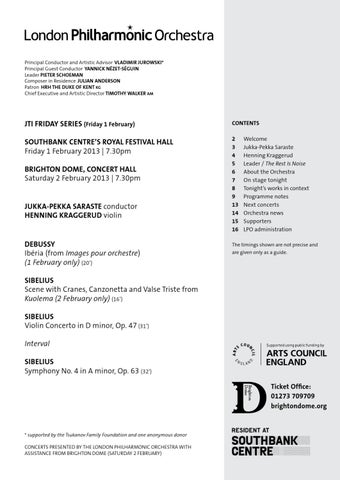
Principal Conductor and Artistic Advisor VLADIMIR JUROWSKI* Principal Guest Conductor YANNICK NÉZET-SÉGUIN Leader pieter schoeman Composer in Residence JULIAN ANDERSON Patron HRH THE DUKE OF KENT KG Chief Executive and Artistic Director TIMOTHY WALKER AM
JTI FRIDAY SERIES (Friday 1 February)
CONTENTS PROGRAMME £3
SOUTHBANK CENTRE’S ROYAL FESTIVAL HALL Friday 1 February 2013 | 7.30pm
2 Welcome CONTENTS 3 Jukka-Pekka Saraste WelcomeKraggerud 2 Henning 4 3 About the Orchestra 5 Leader / The Rest Is Noise 4 Tonight’s performers 6 About the Orchestra 5 On Stanisław Skrowaczewski 7 stage tonight 6 Garrick Ohlsson 8 Tonight’s works in context 7 Programme Programme notes notes 9 10 Orchestra news 13 Next concerts 11 Supporters 14 Orchestra news 12 Supporters LPO administration 15 16 LPO administration
BRIGHTON DOME, CONCERT HALL Saturday 2 February 2013 | 7.30pm
jukka-pekka saraste conductor henning Kraggerud violin
debussy Ibéria (from Images pour orchestre) (1 February only) (20’)
The timings shown are not precise and are given only as a guide. The timings shown are not precise and are given only as a guide.
SIBELIUS Scene with Cranes, Canzonetta and Valse Triste from Kuolema (2 February only) (16’) sibelius Violin Concerto in D minor, Op. 47 (31’) Interval sibelius Symphony No. 4 in A minor, Op. 63 (32’) Ticket Office: 01273 709709 brightondome.org
* supported by the Tsukanov Family Foundation and one anonymous donor CONCERTS PRESENTED BY THE LONDON PHILHARMONIC ORCHESTRA WITH ASSISTANCE FROM BRIGHTON DOME (saturday 2 february)
Friday 1 February
Saturday 2 February
Welcome to Southbank Centre
Welcome to Brighton Dome Chief Executive Andrew Comben
We hope you enjoy your visit. We have a Duty Manager available at all times. If you have any queries please ask any member of staff for assistance.
We hope you enjoy the performance and your visit to Brighton Dome. For your comfort and safety, please note the following:
Eating, drinking and shopping? Southbank Centre shops and restaurants include Foyles, EAT, Giraffe, Strada, YO! Sushi, wagamama, Le Pain Quotidien, Las Iguanas, ping pong, Canteen, Caffè Vergnano 1882, Skylon, Concrete and Feng Sushi, as well as cafes, restaurants and shops inside Royal Festival Hall, Queen Elizabeth Hall and Hayward Gallery.
LATECOMERS may not be admitted until a suitable break in the performance. Some performances may contain no suitable breaks.
If you wish to get in touch with us following your visit please contact the Visitor Experience Team at Southbank Centre, Belvedere Road, London SE1 8XX or phone 020 7960 4250 or email customer@southbankcentre.co.uk
SMOKING Brighton Dome is a no-smoking venue. INTERVAL DRINKS may be ordered in advance at the bar to avoid queues. PHOTOGRAPHY is not allowed in the auditorium. RECORDING is not allowed in the auditorium. MOBILES, PAGERS AND WATCHES should be switched off before entering the auditorium.
We look forward to seeing you again soon.
Thank you for your co-operation.
A few points to note for your comfort and enjoyment: PHOTOGRAPHY is not allowed in the auditorium. LATECOMERS will only be admitted to the auditorium if there is a suitable break in the performance.
The concert at Brighton Dome on 2 February 2013 is presented by the London Philharmonic Orchestra with assistance from Brighton Dome.
RECORDING is not permitted in the auditorium without the prior consent of Southbank Centre. Southbank Centre reserves the right to confiscate video or sound equipment and hold it in safekeeping until the performance has ended. MOBILES, PAGERS AND WATCHES should be switched off before the performance begins.
Brighton Dome gratefully acknowledges the support of Arts Council England and Brighton & Hove City Council. Brighton Dome is managed by Brighton Dome and Festival Ltd which also runs the annual three-week Brighton Festival in May. brightonfestival.org
2 | London Philharmonic Orchestra
Jukka-Pekka Saraste
© Bo Mathisen
conductor
Jukka-Pekka Saraste has established himself as one of the outstanding conductors of his generation, demonstrating remarkable musical depth and integrity. Born in Lahti, Finland, in 1956, he began his career as a violinist before training as a conductor with Jorma Panula at the Sibelius Academy in Helsinki. Actively seeking to bring the music of Finnish composers such as Kaija Saariaho, Magnus Lindberg and Esa-Pekka Salonen to greater prominence in the international concert repertoire, Saraste also has a special affinity with the sound and style of late Romantic music. Since August 2006 he has held the post of Chief Conductor of the Oslo Philharmonic Orchestra. At the beginning of the 2010/11 season, Saraste became Chief Conductor of the Cologne Radio (WDR) Symphony Orchestra. His previous positions include Principal Conductor of the Finnish Radio Symphony Orchestra (1987–2001) and Toronto Symphony Orchestra (1994–2001), as well as Principal Guest Conductor of the BBC Symphony Orchestra (2002–05). He was also Artistic Advisor of the Lahti Symphony Orchestra and founded the Finnish Chamber Orchestra’s annual Tammisaari Festival. Saraste’s engagements have included all the major North American orchestras; the Philharmonia, London Philharmonic, Royal Concertgebouw, Rotterdam Philharmonic, Cologne Radio (WDR) Symphony, Bavarian Radio Symphony, Munich Philharmonic, Vienna Symphony and Swedish Radio Symphony orchestras; the Orchestra Filarmonica della Scala, Milan; the RAI Orchestra in Turin; and the Orchestre Philharmonique de Radio France. At the 2005 Salzburg Festival he conducted the Dresden Staatskapelle. In 2007 he conducted the Oslo Philharmonic Orchestra at the Enescu Festival in Bucharest, and in 2009 he toured all the European musical capitals with the Oslo Philharmonic Orchestra and violinist Anne-Sophie Mutter. During the 2010/11 season he presided over a highly successful production of Puccini’s Turandot at the Royal Danish Opera. Recently he conducted the first
work of the opening-night programme at Helsinki’s new concert hall. Jukka-Pekka Saraste’s extensive discography includes an LPO Label recording of Sibelius’s Symphony No. 5 and Pohjola’s Daughter, and Lutosławski’s Concerto for Orchestra (LPO-0057). He has also recorded the complete symphonies of Sibelius and Nielsen with the Finnish Radio Symphony Orchestra as well as works by Bartók, Dutilleux, Mussorgsky and Prokofiev with the Toronto Symphony Orchestra. In 2008 he launched the Oslo Philharmonic Orchestra’s DVD recording career with Sibelius’s First and Fifth Symphonies. His recent CD recordings of Mahler’s Sixth Symphony with the Oslo Philharmonic Orchestra and the Ninth Symphony with the Cologne Radio Symphony Orchestra have received widespread acclaim.
Saraste conducts Sibelius on the LPO Label Sibelius Symphony No. 5 Pohjola’s Daughter Lutosławski Concerto for Orchestra LPO-0057 | £9.99
'This has to be one of the best recordings around of Sibelius's Fifth. And Lutosławski's Concerto can never have been more brilliantly played.' Classic FM Magazine, November 2011
Available from www.lpo.org.uk/shop, the London Philharmonic Orchestra Box Office (020 7840 4242, Monday–Friday 10am–5pm), all good CD outlets, the Royal Festival Hall shop and the Brighton Dome Ticket Office. Downloads available from iTunes, Amazon, eMusic and classicsonline.com.
London Philharmonic Orchestra | 3
Henning Kraggerud violin
© Robert Romik
Norwegian violinist Henning Kraggerud is a naturally gifted artist who combines an unusually sweet tone and beauty of expression with impressive virtuosity, drawing praise from audiences and critics alike. Henning is Co-Artistic Director of the Risør Festival of Chamber Music, succeeding Leif Ove Andsnes in 2011. In September 2012, he took up the post of Artistic Director of the Tromsø Chamber Orchestra. In August 2012, Henning made his debut at the Hollywood Bowl with the Los Angeles Philharmonic, where his performance was hailed by one critic as ‘the high point of the night. It was Mozart as, one suspects, Mozart himself would have wanted it played.’ In February 2012, Henning stepped in at late notice to perform two concertos with the Philharmonia Orchestra under Vasily Petrenko, gaining 5-star praise in the national press. Other highlights include a critically acclaimed debut at the 2010 BBC Proms with the Danish National Symphony Orchestra and a performance with the Orpheus Chamber Orchestra at Carnegie Hall in 2009. He is invited time and time again to many of the world’s most important orchestras, such as the Hallé, the Oslo Philharmonic, and the Toronto and Cincinnati symphony orchestras. This season he will join the Britten Sinfonia as player/director for their third major international tour together. Similarly, Henning’s collaborative nature earns him the respect of leading conductors with whom he has formed strong connections; examples include Stéphane Denève, Jukka-Pekka Saraste, Kwamé Ryan, Thomas Dausgaard, Osmo Vänskä, Paul McCreesh and Nicholas McGegan. Setting Henning aside from many other violinists of today, and in the spirit of the old masters such as Fritz Kreisler and Eugène Ysaÿe, he composes his own music, performing many of his own works, arrangements and cadenzas in concert. In addition, Henning is an accomplished improviser, a skill which has led him to his most recent CD release entitled Last Spring. Released in June 2012 on the ACT label, the disc was the result
4 | London Philharmonic Orchestra
of a collaboration with Norwegian jazz pianist Bugge Wesseltoft, exploring improvisations on Norwegian folk music. Bringing together classical and jazz elements, this unique recording made a far-reaching impression in the international press, including a 5-star Editor’s Choice from Classical Music Magazine. Henning’s impressive discography includes many diverse recordings on the Naxos label; most recently, a disc entitled Nordic Violin Favourites. On the Simax label he has recorded the complete unaccompanied violin sonatas by Ysaÿe, for which he won the prestigious Spellemann CD award. In addition, Henning appeared in a major television and cinema documentary about the Norwegian 19thcentury violin virtuoso and composer Ole Bull, released in November 2006 and more recently as an English language version. With his strong commitment to chamber music, Henning performs both on violin and viola at the major festivals and venues; recent collaborations have included a ‘Szymanowski Focus’ at London’s Wigmore Hall and New York’s Zankel Hall curated by Piotr Anderszewski, and performances at the Verbier Festival with Joshua Bell, Leonidas Kavakos and Martha Argerich. This season he appears with Imogen Cooper and Adrian Brendel at LSO St Luke’s for BBC Radio 3’s Lunchtime Concert series. In June 2010, Henning gave the first performance of the Munch Suite for Solo Violin – a unique concert project consisting of new pieces by 15 composers around the world. Taking place at the Haugar Vestfold Kunstmuseum in Tønsberg, Norway, as part of the Vestfold International Festival, these pieces were inspired by the works of Edvard Munch and were performed in dialogue with the paintings themselves at an exclusive arts experience. Born in Oslo in 1973, Henning studied with Camilla Wicks and Emanuel Hurwitz. He is a recipient of Norway’s prestigious Grieg Prize and in 2007 was awarded the Sibelius Prize for his interpretations and recording of Sibelius’s music around the world. Henning is a Professor at the Barratt-Due Music Conservatoire in Oslo, where he plays and directs the Oslo Camerata, and in April 2012 was a jury member at the Menuhin Competition in Beijing. Henning Kraggerud plays on a 1744 Guarneri del Gesu, provided by Dextra Musica AS.
Pieter Schoeman leader
© Patrick Harrison
Pieter Schoeman was appointed Leader of the LPO in 2008, having previously been Co-Leader since 2002. Born in South Africa, he made his solo debut aged 10 with the Cape Town Symphony Orchestra. He studied with Jack de Wet in South Africa, winning numerous competitions including the 1984 World Youth Concerto Competition in the US. In 1987 he was offered the Heifetz Chair of Music scholarship to study with Eduard Schmieder in Los Angeles and in 1991 his talent was spotted by Pinchas Zukerman, who recommended that he move to New York to study with Sylvia Rosenberg. In 1994 he became her teaching assistant at Indiana University, Bloomington. Pieter has performed worldwide as a soloist and recitalist in such famous halls as the Concertgebouw in Amsterdam, Moscow’s Rachmaninov Hall, Capella Hall in St Petersburg, Staatsbibliothek in Berlin, Hollywood Bowl in Los Angeles and Southbank Centre’s Queen Elizabeth Hall in London. As a chamber musician he regularly performs at London’s prestigious Wigmore Hall. As a soloist with the London Philharmonic Orchestra, Pieter has performed Arvo Pärt’s Double Concerto with Boris Garlitsky, Brahms’s Double Concerto with Kristina Blaumane, and Britten’s Double Concerto with Alexander Zemtsov, which was recorded and released on the Orchestra’s own record label to great critical acclaim. He has recorded numerous violin solos with the London Philharmonic Orchestra for Chandos, Opera Rara, Naxos, X5, the BBC and for American film and television, and led the Orchestra in its soundtrack recordings for The Lord of the Rings trilogy. In 1995 Pieter became Co-Leader of the Orchestre Philharmonique de Nice. Since then he has appeared frequently as Guest Leader with the Barcelona, Bordeaux, Lyon, Baltimore and BBC symphony orchestras, and the Rotterdam Philharmonic Orchestra. Pieter is a Professor of Violin at Trinity Laban Conservatoire of Music and Dance.
The concert on 1 February concert is part of
Southbank Centre’s The Rest Is Noise, inspired by Alex Ross’s book The Rest Is Noise Presented by Southbank Centre in partnership with the London Philharmonic Orchestra. southbankcentre.co.uk/therestisnoise The Rest Is Noise is a year-long festival that digs deep into 20th-century history to reveal the influences on art in general and classical music in particular. Inspired by Alex Ross’s book The Rest Is Noise, we use film, debate, talks and a vast range of concerts to reveal the fascinating stories behind the century’s wonderful and often controversial music. We have brought together the world’s finest orchestras and soloists to perform many of the most significant works of the 20th century. We reveal why these pieces were written and how they transformed the musical language of the modern world. Over the year, The Rest Is Noise focuses on 12 different parts. The music is set in context with talks from a fascinating team of historians, scientists, philosophers, political theorists and musical experts as well as films, online content and other special programmes. If you’re new to 20th-century music, then this is your time to start exploring with us as your tour guide. There has never been a festival like this. Jude Kelly Artistic Director, Southbank Centre London Philharmonic Orchestra | 5
London Philharmonic Orchestra
The London Philharmonic Orchestra is one of the world’s finest orchestras, balancing a long and distinguished history with a reputation as one of the UK’s most adventurous and forward-looking orchestras. As well as giving classical concerts, the Orchestra also records film and video game soundtracks, has its own record label, and reaches thousands of Londoners every year through activities for schools and local communities. The Orchestra was founded by Sir Thomas Beecham in 1932, and since then its Principal Conductors have included Sir Adrian Boult, Sir John Pritchard, Bernard Haitink, Sir Georg Solti, Klaus Tennstedt and Kurt Masur. The current Principal Conductor is Vladimir Jurowski, appointed in 2007, and Yannick Nézet-Séguin is Principal Guest Conductor.
The London Philharmonic Orchestra has recorded many blockbuster scores, from The Lord of the Rings trilogy to Lawrence of Arabia, The Mission, East is East, Hugo, and The Hobbit: An Unexpected Journey. It also broadcasts regularly on television and radio, and in 2005 established its own record label. There are now nearly 70 releases available on CD and to download. Recent additions include Tchaikovsky’s Symphonies Nos. 4 & 5 with Vladimir Jurowski; Brahms’s Symphonies Nos. 1 & 3 with Klaus Tennstedt; a disc of orchestral works by Mark-Anthony Turnage; and the world premiere of the late Ravi Shankar’s First Symphony conducted by David Murphy. In summer 2012 the London Philharmonic Orchestra performed as part of The Queen’s Diamond Jubilee Pageant on the River Thames, and was also chosen to record all the world’s national anthems for the London 2012 Olympics.
The Orchestra is Resident Orchestra at Southbank Centre’s Royal Festival Hall in London, where it has performed since it opened in 1951, giving around 40 The London Philharmonic concerts there each Orchestra maintains an season. 2012/13 The LPO were on exceptional form, energetic programme of highlights include activities for young people three concerts and the performance had a real and local communities. with Vladimir edge-of-your-seat excitement. The Guardian Highlights include the Jurowski based (29 September 2012, Royal Festival Hall: Rachmaninoff, Shchedrin, Denisov & Miaskovsky) Deutsche Bank BrightSparks around the theme Series; the Leverhulme of War and Peace Young Composers project; and the Foyle Future Firsts in collaboration with the Russian National Orchestra; orchestral training programme for outstanding young Kurt Weill’s The Threepenny Opera, also conducted by players. Over recent years, developments in technology Jurowski; 20th-century American works with Marin and social networks have enabled the Orchestra to Alsop; Haydn and Strauss with Yannick Nézet-Séguin; reach even more people worldwide: all its recordings and the UK premiere of Carl Vine’s Second Piano are available to download from iTunes and, as well Concerto with pianist Piers Lane under Vassily Sinaisky. as a YouTube channel, news blog, iPhone app and Throughout 2013 the Orchestra is collaborating with regular podcasts, the Orchestra has a lively presence on Southbank Centre on The Rest Is Noise festival, based Facebook and Twitter. on Alex Ross’s book of the same name and charting the 20th century’s key musical works and historical events. Find out more and get involved! The Orchestra has flourishing residencies in Brighton and Eastbourne, and performs regularly around lpo.org.uk the UK. Every summer, the Orchestra leaves London for four months and takes up its annual residency facebook.com/londonphilharmonicorchestra accompanying the famous Glyndebourne Festival Opera, where it has been Resident Symphony Orchestra twitter.com/LPOrchestra since 1964. The Orchestra also tours internationally, performing concerts to sell-out audiences worldwide. Tours in the 2012/13 season include visits to Spain, Germany, France, Switzerland, the USA and Austria. 6 | London Philharmonic Orchestra
On stage tonight
First Violins Pieter Schoeman* Leader Vesselin Gellev Sub-Leader Chair supported by John & Angela Kessler
Ilyoung Chae Chair supported by Moya Greene
Ji-Hyun Lee Katalin Varnagy Chair supported by Sonja Drexler
Thomas Eisner Tina Gruenberg Martin Höhmann Geoffrey Lynn Robert Pool Sarah Streatfeild Rebecca Shorrock Galina Tanney Peter Nall Alina Petrenko† Ishani Bhoola† Second Violins Philippe Honore Guest Principal Jeongmin Kim Joseph Maher Fiona Higham Ashley Stevens Marie-Anne Mairesse Nancy Elan Harry Kerr Gavin Davies Alison Strange Peter Graham Stephen Stewart Dean Williamson† Sioni Williams†
Violas Steven Burnard Guest Principal Robert Duncan Gregory Aronovich Katharine Leek Benedetto Pollani Laura Vallejo Susanne Martens Michelle Bruil Naomi Holt Alistair Scahill Claudio Cavalletti† Sarah Malcolm† Cellos Josephine Knight Guest Principal Laura Donoghue Francis Bucknall† Gregory Walmsley Sue Sutherley Susanna Riddell Elisabeth Wiklander Sibylle Hentschel Tae-Mi Song Tom Roff† Double Basses Kevin Rundell* Principal Laurence Lovelle George Peniston Richard Lewis Kenneth Knussen Helen Rowlands Thomas Walley† Catherine Rickets†
Flutes Sue Thomas Principal
Trumpets Paul Beniston* Principal Anne McAneney*
Chair supported by the Sharp Family
Chair supported by Geoff & Meg Mann
Sarah Bennington Julia Crowell†
Nicholas Betts† Co-Principal
Piccolos Stewart McIlwham*† Principal Julia Crowell†
Trombones Mark Templeton* Principal David Whitehouse
Oboes Ian Hardwick Principal Angela Tennick
Bass Trombone Lyndon Meredith Principal Tuba Lee Tsarmaklis*† Principal
Cor Anglais Sue Bohling† Principal Chair supported by Julian & Gill Simmonds
Timpani Simon Carrington* Principal
Clarinets Nicholas Carpenter* Principal Andrew Mason Paul Richards† Bassoons Gareth Newman* Principal Stuart Russell Emma Harding† Contrabassoon Simon Estell† Principal Horns John Ryan Principal David Pyatt Principal Martin Hobbs Mark Vines Co-Principal Gareth Mollison
Percussion Keith Millar Principal Sacha Johnson† James Bower† Nigel Bates† Harps Rachel Masters*† Principal Lucy Haslar† Celeste Catherine Edwards† * Holds a professorial appointment in London † 1 February only
The London Philharmonic Orchestra also acknowledges the following chair supporters whose players are not present at this concert: Andrew Davenport David & Victoria Graham Fuller Caroline, Jamie & Zander Sharp
London Philharmonic Orchestra | 7
Tonight’s works in context
1860
1862 Claude Debussy born in Saint-Germain-en-Laye, France 1863 World’s first underground railway opened in London (the Metropolitan Line) 1865 Jean Sibelius born in Hämeenlinna, Finland
1870
1869 Tolstoy’s War and Peace published 1874 Arnold Schoenberg born in Vienna 1876 Prototype telephone invented by Alexander Graham Bell
1880 1890
1880 Dostoyevsky’s The Brothers Karamazov published 1883 Anton Webern born in Vienna. Death of Richard Wagner 1886 First sales of Coca-Cola in the USA, originally marketed as a patent medicinal remedy Carl Benz patented the first motor car 1891 Carnegie Hall opened in New York City 1896 Henri Becquerel discovered radioactivity. First modern Olympic games held in Athens 1897 Bram Stoker’s Dracula published
1900
1903 Premiere of Sibelius’s Kuolema 1904 Premiere of Sibelius’s Violin Concerto 1906 Kellogg’s began selling Corn Flakes
1910
1910 Premiere of Debussy’s Ibéria 1911 Premiere of Sibelius’s Symphony No. 4 1914 Outbreak of World War I
1920
1918 End of World War I. Death of Debussy in Paris 1922 Creation of the Soviet Union (USSR). British Broadcasting Company (BBC) formed 1925 Premiere of Berg’s opera Wozzeck in Berlin
1930
1929 Wall Street Crash 1932 London Philharmonic Orchestra founded by Sir Thomas Beecham 1937 J R R Tolkien’s The Hobbit published
1940
1939 Outbreak of World War II in Europe 1942 Copland composed Fanfare for the Common Man 1945 End of World War II. Death of Anton Webern.
1950
1953 Death of Joseph Stalin 1954 First successful organ transplant (a kidney) took place in Boston, USA 1957 Death of Sibelius in Järvenpää, Finland
8 | London Philharmonic Orchestra
Programme notes
Speedread Jean Sibelius must have shuddered when he heard the words ‘Vienna Philharmonic’. When the Finnish composer lived in the Austrian capital he auditioned for the famous orchestra hoping to fulfil his dreams of becoming a noted violinist. The orchestra’s response was a resounding ‘don’t give up the day job’. Thankfully Sibelius didn’t. He poured all the longing of his virtuoso dream into a string of beautifully poised creations for violin, crowned by his testing concerto for the instrument – a strangely coloured piece in which we glimpse a little of the pain Sibelius felt in connection with his beloved instrument. The sort of still, plaintive melancholy that peppers the Concerto is an essential component of Sibelius’s work, and is heard in one of its purest forms in the incidental music he wrote for the play Kuolema (‘Death’) by his brother-in-law Arvid Järnefelt – three movements from which are performed in our Brighton concert on 2 February. Fast forward two decades from the fateful audition, and the Vienna Philharmonic was on hand to snub
Claude Debussy 1862–1918
It was, among others, the Anglo-American painter James McNeill Whistler who persuaded Claude Debussy to pursue his musical idea of ‘beauté complète’ – a ‘total beauty’ in sound requiring no commentary. The idea was tied to both men’s vision of nature becoming the most prominent shaper of art, because ‘nature is always right.’ In Debussy’s case it honed his ability to turn anything from nature into music: dusk, clouds, the moon, wind and gardens – or, as in the opening to Ibéria, sunshine and shadows on the hot, dance-infested streets of Spain.
Sibelius again – this time for his compositional efforts. Faced with the score for Sibelius’s chilling, silence-strewn and harmonically ambiguous Fourth Symphony, the Vienna Philharmonic froze, unable to get a handle on the Symphony’s snarling, hostile soundworld. Since then – and in recent years more than ever – the Fourth has been recognised as a piece almost unparalleled in its musical innovation and sheer bleakness of spirit. Our London concert on 1 February, though, starts at the opposite end of Europe – in every sense. Spain counters the cool thrift and orderly aesthetics of Finland with outlandish colour, gregariousness and heat. Claude Debussy loved Spain. So did a whole raft of French composers (and a few Finnish ones, too). But Debussy’s three orchestral postcards Ibéria have proved the musical high-point of French music’s longing gaze over the Pyrenees – works whose rhythms and colourings suggest so much that is Spanish while retaining an elegance and panache that is quintessentially French.
Ibéria (from Images pour orchestre) (Friday 1 February only) 1 Par les rues et par les chemins (‘In the streets and by-ways’) 2 Les parfums de la nuit (‘The fragrances of the night’) 3 Le matin d’un jour de fête (‘The morning of a festival day’)
The Iberian Peninsula cast a long spell over French composers, and Ibéria – the central movement of Debussy’s set of three orchestral Images completed in 1913 – has been cited as the greatest musical evocation of that spell. Debussy fell for Spanish folk music at the 1889 World Exhibition, finding it ‘so filled with imagination and rhythm’. Ibéria doesn’t actually cite any Spanish melodies, but it does employ suggestively Spanish devices such as strumming effects (to evoke guitars, notably in upper strings in the third movement),
London Philharmonic Orchestra | 9
Programme notes
colourful percussion (including castanets) and frequent, sensuous pulling and pushing at speeds. In performance, Debussy said, the piece should ‘seem not to have been written down’. Perhaps that’s one reason why it took him such a long time to write Images down – seven years in total, the first few of which were devoted to Ibéria, the set’s focal point. Debussy heard specific things in his head but his
music is, as always, more evocative of time and space than of specific sights or events. The languor of ‘In the streets and by-ways’ is invaded by an overtly Spanish celebration in the form of a jota, a dance announced by a horn fanfare. The intensity of ‘The fragrances of the night’ flows unbroken into morning bells and the final ‘The morning of a festival day’, which appears as a distant march before flourishing into a fiesta.
Jean Sibelius
From Kuolema:
1865–1957
(Saturday 2 February only)
It’s no exaggeration to suggest that the music of Jean Sibelius helped Finland discover both its musical and its national identity. But however much Sibelius adored Finland – including its indigenous language and culture – the composer was originally of Swedish tongue and genetic origin, in common with a large number of those artists who were actively involved in pushing Finland’s nationalistic cause.
Fifth Symphony: an understated string introduction is interrupted by the call of the cranes on woodwinds, heard in descending intervals of fifths and sixths.
One of those artists was Sibelius’s brother-in-law Arvid Järnefelt, who in 1903 wrote a play entitled Döden (‘Death’) for the Swedish-language theatre in Helsinki that still thrives in the bilingual city today. Sibelius contributed incidental music for the production, scored for strings and later arranged as a suite (including woodwinds) with the name Kuolema – the Finnish translation of the play’s title. ‘I have seen cranes flying south every day, laden with music’, Sibelius once wrote in his diary, ‘their cries, the thread which leads my life.’ There appeared a scene in Döden in which the composer could use the mention of cranes to explore his fascination with avian creatures. The second movement of the Kuolema suite, ‘Scene with Cranes’, is a musical mood-picture that contains a premonition of the famous ‘swan’ theme of his
10 | London Philharmonic Orchestra
Scene with Cranes Canzonetta Valse triste
Eight years after Döden’s first performance at the Swedish Theatre, the National Theatre in Helsinki revived the play in Finnish (now titled Kuolema). Sibelius augmented his original score to fit with the idiosyncrasies of the revised production, and the new material included a Rondino der Liebenden – later known simply as ‘Canzonetta’. This piece of mild but sustained melancholy pits a simply built sequenced accompaniment against a truly inspired melody, famously adored by Igor Stravinsky who described it as ‘Nordic Italianite’. By far the most celebrated piece from Kuolema is the ‘Valse triste’, which has enjoyed something of a second life as a concert encore. Järnefelt’s play was notable (and fashionable) for its symbolist tendency to alloy dream and reality; this haunting waltz was played as the dying mother of the play’s central character remembers a ball from her youth, as if it is playing out before her eyes. Sibelius’s brooding theme eventually twists upwards towards a chilling G minor triad from which – both harmonically and philosophically – there is no return.
Jean Sibelius 1865–1957
Jean Sibelius came to music via the violin and long dreamed of being a virtuoso. It was a dream that remained unfulfilled but dogged Sibelius psychologically for years. Instead of laying the virtuoso ghost once and for all, Sibelius’s failure to pass an audition for the Vienna Philharmonic seems to have become something of an open wound. In the end, Sibelius simply didn’t have the co-ordination and elan a virtuoso violinist needed, not to mention the temperament (his penchant for drinking before appearing in concerts wouldn’t have helped). What his writing for the violin consistently confirms, though, is Sibelius’s innate (and yes, virtuosic) understanding of the instrument from the inside; his Violin Concerto remains as precious a gift to the violin world as any musician could hope to make. There were a good few violinists (other than Sibelius) involved in the Concerto’s nativity. Concertmaster of the Helsinki Philharmonic Willy Burmester persuaded the composer to write it in the first place, hailing it as ‘masterly’ on viewing the score. But in something of a faux pas, Sibelius offered the work to another violinist, Victor Nováček, to perform. Burmester offered his services after Nováček’s premiere of the piece in February 1904, but again Sibelius gifted the nowrevised piece to someone else, this time Karl Halir, who gave the first performance of the Concerto in its established form in October 1905 in Berlin (Richard Strauss conducted). Poor old Burmester never got to perform the work in public.
Violin Concerto in D minor, Op. 47 Henning Kraggerud violin 1 Allegro moderato 2 Adagio di molto 3 Allegro, ma non tanto
As tiresome and clichéd as it might be to superimpose Finnish ideals and geography onto abstract music by Sibelius, Finland is present in almost every note the composer wrote. It’s there in the opening bars of the Concerto, as the piece emerges from a deep chill, as if moving from a glistening forest into a clearing. The rhapsodic solo flight of the violin dominates thereafter, often developing thematic material on its own (notably in the first cadenza) while the orchestral tectonics only occasionally shift below, however starkly. The dark, stormy secondary idea is based on a theme suggested earlier by the cellos; the orchestra launches into it en masse at the movement’s most explicit turning point. The soloist finally returns to the opening theme, recounting it in forthright, dark octaves as if the onset of an early sunset. Against an expansive, clear woodwind sky, the violin offers a song-like theme at the start of the Adagio before the orchestra turns dark. From the depths of its G string the violin soon finds hope and ascends, using cross-rhythms and double-stopping, and persuading the orchestra into the same thematic sentiments. Musicologist Donald Tovey famously described the finale as ‘a polonaise for polar bears’. It’s launched by rhythmically lurching timpani and low strings above which the soloist introduces the main skipping idea in another purposefully low register. Multi-stopping (playing more than one note at once) and a catalogue of other technical challenges ensue for the solo violinist, in whose heartfelt, soaring and wholly individual aspirations we can glimpse something of Sibelius’s virtuoso dream.
Interval An announcement will be made a few minutes before the end of the interval.
London Philharmonic Orchestra | 11
Programme notes
Jean Sibelius
Symphony No. 4 in A minor, Op. 63 1 Tempo molto moderato, quasi adagio 2 Allegro molto vivace 3 Il tempo largo 4 Allegro
1865–1957
The Fourth Symphony is Sibelius’s most challenging and disturbing symphonic creation. For some, it’s a masterpiece. For the musicians of the Vienna Philharmonic, it was a nemesis: they gave up rehearsing the work’s bleak, threatening and silence-stalked opening movement in 1912 and didn’t return to it for five decades. When the Symphony was first performed in Finland on 3 April 1911, one critic aligned it with Barkbröd – a period of famine in the country which forced its people to eat the bark from trees. Even after he’d become the darling of Finland and a true voice for independence, Sibelius retained his weaknesses – namely alcohol, cigars, raucous socialising and poor financial management. In 1908 he had undergone several operations to remove an incipient tumour in his throat. The event and resulting enforced abstinence from alcohol and tobacco constituted ‘a frightening warning from above’ for Sibelius. It had practical side effects, too: as he set to work on the Fourth Symphony in May 1909, Sibelius was informed that his debts now amounted to a colossal 100,000 Finnish marks. The Symphony could be said to combine its composer’s internal feelings of pain and anguish with the physical terrain of a remote area of Karelia – the district of eastern Finland in which the Kalevala tradition took root. Before starting work on the piece, Sibelius had made a visit to the bleak outpost of Koli with his brother-in-law. Its remoteness and (in the snow) colourlessness are instantly recognisable in music that seems sketched rather than painted. Also significant is the distinct light of this area of Finland: in early autumn, when Sibelius visited, the glowing, 22-hour light of summer makes way for the unsure, cool and similarly day-long darkness of winter.
Excerpts from Sibelius’s diary make disturbing reading against the music of the Fourth Symphony; the composer appears near mental collapse just as his music appears close to tonal meltdown as it struggles to maintain a hold on the home key of A minor. But while the work’s stark textures and periods of hesitance can feel disorientating against the busy journeying of the Third and Fifth Symphonies, there is plenty of Sibelius’s ‘miraculous logic’ at work in the way the piece develops its material. The eerie ‘tritone’ interval that opens the Symphony (a C, D and F sharp growled-out on low strings) is a constant reference point, while other material is developed extensively from small, fragmentary means. The opening movement is the most desolate of the four and perhaps the most affecting. It seems to search hesitantly for light, which is occasionally forthcoming in a series of rich but strangely chilling shafts of brass. Like the finale, the second movement appears to initiate a thaw, but its gaiety turns only to wringing inner turmoil as a brass salvo from the first movement reappears, darkly transformed. The movement is halted by three abrupt timpani strokes. The soft, non-committal nature of those timpani strokes is a chilling, disorientating tool. But the manner in which Sibelius ends his Symphony is even more so: a handful of lonely mezzo-forte chords. Tchaikovsky and Bruckner created something of a trend for ending symphonies on a pianissimo rather than the traditional forte Beethovenian full-stop, but never had a multi-movement piece wound up so suddenly and so uneasily as this. It’s not despair and it’s certainly not resolution. It feels, more, like the sudden, dull but terrifying disappearance of a figure at close range into thick, enveloping fog. Programme notes by Andrew Mellor © 2013
12 | London Philharmonic Orchestra
Next LPO concerts at Royal Festival Hall
Saturday 9 February 2013 | 7.30pm Respighi Fountains of Rome Falla Nights in the Gardens of Spain Respighi Il tramonto Ravel Pavane pour une infante défunte Ravel Rapsodie espagnole Enrique Mazzola conductor Javier Perianes piano Maria Luigia Borsi soprano
Friday 15 February | 7.30pm JTI Friday Series Rachmaninoff Piano Concerto No. 3 Rachmaninoff Symphony No. 2 Yannick Nézet-Séguin conductor Simon Trpčeski piano Free pre-concert performance 6.00pm–6.45pm | Royal Festival Hall Pianist Dimitri Mayboroda performs Rachmaninoff’s Piano Sonata No. 1. In co-operation with the Serge Rachmaninoff Foundation
Booking details Tickets £9–£39 London Philharmonic Orchestra Ticket Office (no transaction fee) 020 7840 4242 Monday to Friday 10.00am–5.00pm | lpo.org.uk Southbank Centre Ticket Office (transaction fees apply) 0844 847 9920 Daily 9.00am–8.00pm | southbankcentre.co.uk
Next LPO concerts at Brighton Dome Saturday 23 February 2013 | 7.30pm
Saturday 16 March 2013 | 7.30pm
Copland Fanfare for the Common Man Joan Tower Fanfare for the Uncommon Woman Copland Piano Concerto Gershwin Rhapsody in Blue Dvořák Symphony No. 9 (From the New World)
Beethoven Symphony No. 5 Schumann Cello Concerto Elgar Enigma Variations David Parry conductor Narek Hakhnazaryan cello
Marin Alsop conductor Garrick Ohlsson piano
Booking details Tickets £10–£32.50 Ticket Office 01273 709709 | Book online at brightondome.org
London Philharmonic Orchestra | 13
orchestra news
2013/14 season – now on sale
Birthday Appeal update
Our 2013/14 season at Royal Festival Hall is now on sale. Browse and book online at www.lpo.org.uk/newseason or call us on 020 7840 4208 to request a copy of the season brochure or to book by phone.
This season marks 80 years since the London Philharmonic Orchestra took to the stage with its founder, Sir Thomas Beecham. We have been asking audience members to help us celebrate this milestone by donating towards our present wish list as part of our Birthday Appeal.
Highlights of the new season include: • A centenary celebration of the music of Benjamin Britten, including Peter Grimes and the War Requiem. • The Orchestra celebrates The Genius of Film Music, exploring some of the scintillating film scores created between 1960–2000. • Yannick Nézet-Séguin demonstrates his flair for the French repertoire with Poulenc and Dutilleux. • Vladimir Jurowski conducts John Adams’s powerful and theatrical Nativity oratorio El Niño. • Classical guitarist Miloš Karadaglič performs Rodrigo’s evocative Concierto de Aranjuez. • The world premiere of James MacMillan’s Viola Concerto with soloist Lawrence Power.
We have had a fantastic and very generous response and want to say a big thank you to everyone who has bought us a present so far. The Birthday Appeal is running until the end of the season so there’s still time to get involved – visit www.lpo.org.uk/birthday for all the details. We have had lots of contributions towards our much-needed double bass stools and tom-toms, so if you haven’t had the chance to donate yet, how about helping us fund a recording for live streaming, or the animation artwork to bring our family concerts to life? All gifts are gratefully received by the Orchestra.
Details of the Orchestra’s 2013/14 Brighton Dome concerts will be announced later this spring.
Foyle Future Firsts in India
Glyndebourne Festival Opera 2013
In December 2012 a team of eight of our Foyle Future Firsts travelled to Mumbai at the invitation of Trinity College London to help celebrate 125 years of Trinity Exams in India. The musicians worked with the Bombay Chamber Orchestra, coaching sections and playing in the Orchestra’s 50th anniversary gala. Other links were forged by spending time with local instrumental teachers and visiting schools across Mumbai, performing for and running workshops with young musicians. They also spent an illuminating and inspiring morning with eminent tabla and sitar player, Pandit Nayan Ghosh.
The LPO has been Resident Symphony Orchestra at Glyndebourne Festival Opera since 1964, spending each summer accompanying the opera performances in the Sussex countryside. Summer 2013 marks Vladimir Jurowski’s 13th and final season as Music Director of Glyndebourne before he is succeeded by Robin Ticciati in 2014. The season opens on 18 May and will run until 25 August, during which time the Orchestra will give performances of a new production of Strauss’s Ariadne auf Naxos with Jurowski; a revival of the 2012 production of Mozart’s Le nozze di Figaro with Jérémie Rhorer; Donizetti’s Don Pasquale with Enrique Mazzola (a revival of the 2011 Tour production); and a revival of the 2010 production of Britten’s Billy Budd with Sir Andrew Davis. Public booking opens on 18 March 2013. Early access to tickets is available for corporate and individual supporters of the LPO.
The LPO Foyle Future Firsts programme bridges the transition between college and the professional platform for up to 16 outstanding young musicians each year. www.lpo.org.uk/education/futurefirsts.html Foyle Future Firsts is generously supported by the Foyle Foundation with additional contributions from The Fidelio Charitable Trust, Musicians Benevolent Fund and The Tillett Trust.
14 | London Philharmonic Orchestra
glyndebourne.com
We would like to acknowledge the generous support of the following Thomas Beecham Group Patrons, Principal Benefactors and Benefactors: Thomas Beecham Group The Tsukanov Family Foundation Anonymous The Sharp Family Julian & Gill Simmonds Garf & Gill Collins Andrew Davenport Mrs Sonja Drexler David & Victoria Graham Fuller Moya Greene John & Angela Kessler Mr & Mrs Makharinsky Geoff & Meg Mann Caroline, Jamie & Zander Sharp Eric Tomsett Guy & Utti Whittaker Manon Williams Principal Benefactors Mark & Elizabeth Adams Jane Attias Lady Jane Berrill Desmond & Ruth Cecil Mr John H Cook Mr Charles Dumas
David Ellen Commander Vincent Evans Mr Daniel Goldstein Mr & Mrs Jeffrey Herrmann Peter MacDonald Eggers Mr & Mrs David Malpas Mr Maxwell Morrison Mr Michael Posen Mr & Mrs Thierry Sciard Mr John Soderquist & Mr Costas Michaelides Mr & Mrs G Stein Mr & Mrs John C Tucker Mr & Mrs John & Susi Underwood Howard & Sheelagh Watson Mr Anthony Yolland Benefactors Mrs A Beare Dr & Mrs Alan Carrington CBE FRS Mr & Mrs Stewart Cohen Mr Alistair Corbett Mr David Dennis Mr David Edgecombe Mr Richard Fernyhough Ken Follett Michael & Christine Henry Ivan Hurry
Mr Glenn Hurstfield Mr R K Jeha Mr Gerald Levin Sheila Ashley Lewis Wg. Cdr. & Mrs M T Liddiard OBE JP RAF Mr Frank Lim Paul & Brigitta Lock Mr Brian Marsh Andrew T Mills John Montgomery Mr & Mrs Andrew Neill Edmund Pirouet Mr Peter Tausig Mrs Kazue Turner Lady Marina Vaizey Mr Laurie Watt Des & Maggie Whitelock Christopher Williams Bill Yoe Hon. Benefactor Elliott Bernerd Hon. Life Members Kenneth Goode Pehr G Gyllenhammar Edmund Pirouet Mrs Jackie Rosenfeld OBE
The generosity of our Sponsors, Corporate Members, supporters and donors is gratefully acknowledged: Corporate Members Silver: AREVA UK British American Business Destination Québec – UK Hermes Fund Managers Pritchard Englefield Bronze: Lisa Bolgar Smith and Felix Appelbe of Ambrose Appelbe Appleyard & Trew LLP Berkeley Law Charles Russell Lazard Leventis Overseas Corporate Donor Lombard Street Research Preferred Partners Corinthia Hotel London Heineken Lindt & Sprüngli Ltd Villa Maria
In-kind Sponsors Google Inc Sela / Tilley’s Sweets Trusts and Foundations BBC Performing Arts Fund The Boltini Trust Sir William Boreman’s Foundation The Boshier-Hinton Foundation Britten-Pears Foundation The Candide Trust The Coutts Charitable Trust Diaphonique, Franco-British fund for contemporary music Dunard Fund Embassy of Spain, Office for Cultural and Scientific Affairs The Equitable Charitable Trust Fidelio Charitable Trust The Foyle Foundation J Paul Getty Junior Charitable Trust The Jeniffer and Jonathan Harris Charitable Trust Capital Radio’s Help a London Child The Hobson Charity The Kirby Laing Foundation
The Idlewild Trust The Leverhulme Trust Marsh Christian Trust Adam Mickiewicz Institute The Peter Minet Trust Paul Morgan Charitable Trust The Diana and Allan Morgenthau Charitable Trust Maxwell Morrison Charitable Trust Musicians Benevolent Fund Newcomen Collett Foundation The Austin & Hope Pilkington Trust Serge Rachmaninoff Foundation The Rothschild Foundation The Samuel Sebba Charitable Trust The Bernard Sunley Charitable Foundation John Thaw Foundation The Tillett Trust The Underwood Trust Sir Siegmund Warburg’s Voluntary Settlement Kurt Weill Foundation for Music Garfield Weston Foundation and others who wish to remain anonymous
London Philharmonic Orchestra | 15
Administration
Board of Directors
General Administration
Orchestra Personnel
Archives
Victoria Sharp Chairman Stewart McIlwham* President Gareth Newman* Vice-President Desmond Cecil CMG Vesselin Gellev* Jonathan Harris CBE FRICS Dr Catherine C. Høgel Martin Höhmann* Angela Kessler George Peniston* Sir Bernard Rix Kevin Rundell* Julian Simmonds Mark Templeton* Sir Philip Thomas Natasha Tsukanova Timothy Walker AM Laurence Watt Dr Manon Williams
Timothy Walker AM Chief Executive and Artistic Director
Andrew Chenery Orchestra Personnel Manager
Philip Stuart Discographer
Sarah Thomas Librarian (maternity leave)
Gillian Pole Recordings Archive
Sarah Holmes Librarian (maternity cover)
Professional Services
* Player-Director
Advisory Council Victoria Sharp Chairman Richard Brass Sir Alan Collins Jonathan Dawson Christopher Fraser OBE Clive Marks OBE FCA Stewart McIlwham Lord Sharman of Redlynch OBE Timothy Walker AM American Friends of the London Philharmonic Orchestra, Inc. Margot Astrachan Chairman David E. R. Dangoor Vice Chair/Treasurer Kyung-Wha Chung Peter M. Felix CBE Alexandra Jupin Dr. Felisa B. Kaplan William A. Kerr Jill Fine Mainelli Kristina McPhee Dr. Joseph Mulvehill Harvey M. Spear, Esq. Danny Lopez Honorary Chairman Noel Kilkenny Honorary Director Victoria Sharp Honorary Director Richard Gee, Esq Of Counsel Robert Kuchner, CPA
Alison Atkinson Digital Projects Manager Finance David Burke General Manager and Finance Director
Michael Pattison Stage Manager
Matthew Freeman Recordings Consultant
Mia Roberts Marketing Manager
Education & Community
Rachel Williams Publications Manager
Charles Russell Solicitors
Crowe Clark Whitehill LLP Julia Boon Auditors Assistant Orchestra Personnel David Greenslade Manager FSC_57678 14 January 2011 15/09/2011 12:30 Page Dr 1 Louise Miller Finance and ITLPO Manager Honorary Doctor Ken Graham Trucking Concert Management Instrument Transportation London Philharmonic Roanna Gibson Development Orchestra Concerts Director 89 Albert Embankment (maternity leave) Nick Jackman London SE1 7TP Development Director Ruth Sansom Tel: 020 7840 4200 Artistic Administrator / Acting Fax: 020 7840 4201 Helen Searl Head of Concerts Department Box Office: 020 7840 4242 Corporate Relations Manager lpo.org.uk Graham Wood Katherine Hattersley Concerts and Recordings Charitable Giving Manager The London Philharmonic Manager Orchestra Limited is a Melissa Van Emden registered charity No. 238045. Barbara Palczynski Events Manager Glyndebourne and Projects Photographs of Debussy and Laura Luckhurst Administrator Sibelius courtesy of the Royal Corporate Relations and Jenny Chadwick College of Music, London. Events Officer Tours and Engagements Sarah Fletcher Manager Front cover photograph Development and Finance © Patrick Harrison. Alison Jones Officer Concerts Co-ordinator Printed by Cantate. Marketing Jo Orr PA to the Chief Executive / Kath Trout Concerts Assistant Marketing Director
Patrick Bailey Education and Community Director Alexandra Clarke Education Manager Caz Vale Community and Young Talent Manager Richard Mallett Education and Community Producer
16 | London Philharmonic Orchestra
Samantha Kendall Box Office Manager (Tel: 020 7840 4242) Libby Northcote-Green Marketing Co-ordinator Isobel King Intern Albion Media Public Relations (Tel: 020 3077 4930)