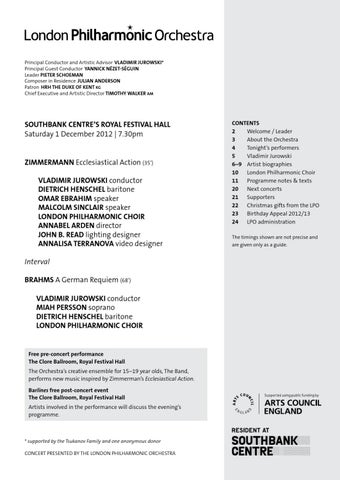
Principal Conductor and Artistic Advisor VLADIMIR JUROWSKI* Principal Guest Conductor YANNICK NÉZET-SÉGUIN Leader pieter schoeman Composer in Residence JULIAN ANDERSON Patron HRH THE DUKE OF KENT KG Chief Executive and Artistic Director TIMOTHY WALKER AM
SOUTHBANK CENTRE’S ROYAL FESTIVAL HALL Saturday 1 December 2012 | 7.30pm
ZIMMERMANN Ecclesiastical Action (35’) VLADIMIR JUROWSKI conductor DIETRICH HENSCHEL baritone OMAR EBRAHIM speaker MalcoLm Sinclair speaker LONDON PHILHARMONIC CHOIR ANNABEL ARDEN director JOHN B. READ lighting designer ANNALISA TERRANOVA video designer Interval BRAHMS A German Requiem (68’) VLADIMIR JUROWSKI conductor MIAH PERSSON soprano DIETRICH HENSCHEL baritone LONDON PHILHARMONIC CHOIR
Free pre-concert performance The Clore Ballroom, Royal Festival Hall The Orchestra’s creative ensemble for 15–19 year olds, The Band, performs new music inspired by Zimmerman’s Ecclesiastical Action. Barlines free post-concert event The Clore Ballroom, Royal Festival Hall Artists involved in the performance will discuss the evening’s programme.
* supported by the Tsukanov Family and one anonymous donor CONCERT PRESENTED BY THE LONDON PHILHARMONIC ORCHESTRA
CONTENTS Welcome / Leader 2 3 About the Orchestra 4 Tonight’s performers 5 Vladimir Jurowski 6–9 Artist biographies 10 London Philharmonic Choir 11 Programme notes & texts 20 Next concerts 21 Supporters 22 Christmas gifts from the LPO 23 Birthday Appeal 2012/13 24 LPO administration The timings shown are not precise and are given only as a guide.
Welcome
pieter schoeman Leader
Pieter Schoeman was appointed Leader of the LPO in 2008, having previously been Co-Leader since 2002.
WELCOME TO SOUTHBANK CENTRE
Eating, drinking and shopping? Southbank Centre shops and restaurants include Foyles, EAT, Giraffe, Strada, YO! Sushi, wagamama, Le Pain Quotidien, Las Iguanas, ping pong, Canteen, Caffè Vergnano 1882, Skylon, Concrete and Feng Sushi, as well as cafes, restaurants and shops inside Royal Festival Hall, Queen Elizabeth Hall and Hayward Gallery. If you wish to get in touch with us following your visit please contact the Visitor Experience Team at Southbank Centre, Belvedere Road, London SE1 8XX, phone 020 7960 4250, or email customer@southbankcentre.co.uk We look forward to seeing you again soon. A few points to note for your comfort and enjoyment: PHOTOGRAPHY is not allowed in the auditorium. LATECOMERS will only be admitted to the auditorium if there is a suitable break in the performance. RECORDING is not permitted in the auditorium without the prior consent of Southbank Centre. Southbank Centre reserves the right to confiscate video or sound equipment and hold it in safekeeping until the performance has ended. MOBILES, PAGERS AND WATCHES should be switched off before the performance begins.
© Patrick Harrison
We hope you enjoy your visit. We have a Duty Manager available at all times. If you have any queries please ask any member of staff for assistance.
Born in South Africa, he made his solo debut aged 10 with the Cape Town Symphony Orchestra. He studied with Jack de Wet in South Africa, winning numerous competitions including the 1984 World Youth Concerto Competition in the US. In 1987 he was offered the Heifetz Chair of Music scholarship to study with Eduard Schmieder in Los Angeles and in 1991 his talent was spotted by Pinchas Zukerman, who recommended that he move to New York to study with Sylvia Rosenberg. In 1994 he became her teaching assistant at Indiana University, Bloomington. Pieter has performed worldwide as a soloist and recitalist in such famous halls as the Concertgebouw in Amsterdam, Moscow’s Rachmaninov Hall, Capella Hall in St Petersburg, Staatsbibliothek in Berlin, Hollywood Bowl in Los Angeles and Southbank Centre’s Queen Elizabeth Hall in London. As a chamber musician he regularly performs at London’s prestigious Wigmore Hall. As a soloist with the London Philharmonic Orchestra, Pieter has performed Arvo Pärt’s Double Concerto with Boris Garlitsky, Brahms’s Double Concerto with Kristina Blaumane, and Britten’s Double Concerto with Alexander Zemtsov, which was recorded and released on the Orchestra’s own record label to great critical acclaim. He has recorded numerous violin solos with the London Philharmonic Orchestra for Chandos, Opera Rara, Naxos, X5, the BBC and for American film and television, and led the Orchestra in its soundtrack recordings for The Lord of the Rings trilogy. In 1995 Pieter became Co-Leader of the Orchestre Philharmonique de Nice. Since then he has appeared frequently as Guest Leader with the Barcelona, Bordeaux, Lyon, Baltimore and BBC symphony orchestras, and the Rotterdam Philharmonic Orchestra. Pieter is a Professor of Violin at Trinity Laban Conservatoire of Music and Dance.
2 | London Philharmonic Orchestra
LONDON PHILHARMONIC ORCHESTRA
The London Philharmonic Orchestra is one of the world’s finest orchestras, balancing a long and distinguished history with a reputation as one of the UK’s most adventurous and forward-looking orchestras. As well as giving classical concerts, the Orchestra also records film and video game soundtracks, has its own record label, and reaches thousands of Londoners every year through activities for schools and local communities.
The London Philharmonic Orchestra has recorded many blockbuster scores, from The Lord of the Rings trilogy to Lawrence of Arabia, The Mission, East is East, Hugo, and The Hobbit: An Unexpected Journey. It also broadcasts regularly on television and radio, and in 2005 established its own record label. There are now nearly 70 releases available on CD and to download. Recent additions include Dvořák’s Stabat Mater under Neeme Järvi; Tchaikovsky’s Symphonies Nos. 4 & 5 with Vladimir Jurowski; Sibelius’s Symphonies Nos. 5 & 6 under the late Paavo Berglund; and the world premiere of Ravi Shankar’s First Symphony conducted by David Murphy.
The Orchestra was founded by Sir Thomas Beecham in 1932, and since then its Principal Conductors have included Sir Adrian Boult, Bernard Haitink, Sir Georg Solti, Klaus Tennstedt and Kurt Masur. The current Principal Conductor is Vladimir Jurowski, ‘Jurowski and the LPO provided the appointed in 2007, and impossible that is perfection ... As things Yannick Nézet-Séguin is stand now, the LPO must rate as an Principal Guest Conductor.
example to all orchestras.’
In summer 2012 the London Philharmonic Orchestra performed as part of The Queen’s Diamond Jubilee Pageant on the River Thames, and was also chosen to record all the world’s national anthems for the London 2012 Olympics.
The Orchestra is Resident Musicalcriticism.com, July 2011 Orchestra at Southbank (BBC Proms 2011: Liszt, Bartók and Kodály) Centre’s Royal Festival Hall in London, where it has performed since it opened The London Philharmonic Orchestra maintains an in 1951, giving around 40 concerts there each season. 2012/13 highlights include three concerts with Vladimir energetic programme of activities for young people and local communities. Highlights include the Jurowski based around the theme of War and Peace Deutsche Bank BrightSparks Series; the Leverhulme in collaboration with the Russian National Orchestra; Young Composers project; and the Foyle Future Firsts Kurt Weill’s The Threepenny Opera, also conducted by orchestral training programme for outstanding young Jurowski; 20th-century American works with Marin players. Over recent years, developments in technology Alsop; Haydn and Strauss with Yannick Nézet-Séguin; and social networks have enabled the Orchestra to and the UK premiere of Carl Vine’s Second Piano reach even more people worldwide: all its recordings Concerto with pianist Piers Lane under Vassily Sinaisky. are available to download from iTunes and, as well Throughout 2013 the Orchestra will collaborate with as a YouTube channel, news blog, iPhone app and Southbank Centre on The Rest Is Noise festival, based regular podcasts, the Orchestra has a lively presence on on Alex Ross’s book of the same name and charting the Facebook and Twitter. 20th century’s key musical works and historical events. The Orchestra has flourishing residencies in Brighton and Eastbourne, and performs regularly around the UK. Every summer, the Orchestra leaves London for four months and takes up its annual residency accompanying the famous Glyndebourne Festival Opera, where it has been Resident Symphony Orchestra since 1964. The Orchestra also tours internationally, performing concerts to sell-out audiences worldwide. Tours in the 2012/13 season include visits to Spain, Germany, France, Switzerland, the USA and Austria.
Find out more and get involved! lpo.org.uk facebook.com/londonphilharmonicorchestra twitter.com/LPOrchestra
London Philharmonic Orchestra | 3
tonight’s performers
First Violins Pieter Schoeman* Leader Vesselin Gellev Sub-Leader Chair supported by John & Angela Kessler
Ilyoung Chae Chair supported by Moya Greene
Katalin Varnagy Thomas Eisner Tina Gruenberg Martin Höhmann Geoffrey Lynn Robert Pool Sarah Streatfeild Yang Zhang Grace Lee Galina Tanney Peter Nall Second Violins Alison Kelly Guest Principal Jeongmin Kim Joseph Maher Fiona Higham Ashley Stevens Marie-Anne Mairesse Nancy Elan Imogen Williamson Sioni Williams Alison Strange Mila Mustakova Harry Kerr Violas Edward Vanderspar Guest Principal Robert Duncan Gregory Aronovich Katharine Leek Benedetto Pollani Laura Vallejo Susanne Martens Naomi Holt Alistair Scahill Sarah Malcolm
Cellos Kristina Blaumane Principal Susanne Beer Co-Principal Francis Bucknall Laura Donoghue Jonathan Ayling Chair supported by Caroline, Jamie & Zander Sharp
Gregory Walmsley Santiago Carvalho† Sue Sutherley Double Basses Kevin Rundell* Principal Tim Gibbs Co-Principal Laurence Lovelle George Peniston Richard Lewis Helen Rowlands Flutes Paul Edmund Davies Guest Principal Sue Thomas Chair supported by the Sharp Family
Stewart McIlwham* Piccolos Stewart McIlwham* Principal Sue Thomas Alto Flute Stewart McIlwham* Oboes Ian Hardwick Principal Angela Tennick Sue Bohling Cor Anglais Sue Bohling Principal Chair supported by Julian & Gill Simmonds
Clarinets Robert Hill* Principal Nicholas Carpenter* Paul Richards Bassoons Gareth Newman* Principal Dominic Tyler Simon Estell Contrabassoon Simon Estell Principal Horns John Ryan* Principal Martin Hobbs Mark Vines Co-Principal Gareth Mollison Stephen Nicholls Trumpets Paul Beniston* Principal Anne McAneney* Chair supported by Geoff & Meg Mann
Nicholas Betts Co-Principal Trombones David Whitehouse Principal John Randall Offstage Trombones Roger Harvey Michael Lloyd David Stewart
Percussion Andrew Barclay* Principal Chair supported by Andrew Davenport
Keith Millar Jeremy Cornes Eddy Hackett Harps Rachel Masters* Principal Emma Ramsdale Organ Catherine Edwards Electric Guitar Dan Thomas Repetiteur Helen Crayford Assistant Conductor Jeremy Bines Chair supported by an anonymous donor
Production Assistant Peter Yarde Martin * Holds a professorial appointment in London † Chevalier of the Brazilian Order of Rio Branco
Bass Trombone Lyndon Meredith Principal Tuba Lee Tsarmaklis* Principal Timpani Simon Carrington* Principal
Chair Supporters The London Philharmonic Orchestra also acknowledges the following chair supporters whose player is not present at this concert: David & Victoria Graham Fuller
4 | London Philharmonic Orchestra
VLADIMIR JUROWSKI
© Chris Christodoulou
Principal Conductor and Artistic Advisor
One of today’s most sought-after and dynamic conductors, acclaimed worldwide for his incisive musicianship and adventurous artistic commitment, Vladimir Jurowski was born in Moscow, and completed the first part of his musical studies at the Music College of the Moscow Conservatory. In 1990 he relocated with his family to Germany, continuing his studies at the High Schools of Music in Dresden and Berlin. In 1995 he made his international debut at the Wexford Festival conducting Rimsky-Korsakov’s May Night, and the same year saw his debut at the Royal Opera House, Covent Garden, with Nabucco. Vladimir Jurowski has been Music Director of Glyndebourne Festival Opera since 2001, and in 2003 was appointed Principal Guest Conductor of the London Philharmonic Orchestra, becoming the Orchestra’s Principal Conductor in September 2007. He also holds the titles of Principal Artist of the Orchestra of the Age of Enlightenment and Artistic Director of the Russian State Academic Symphony Orchestra. He has also held the positions of First Kapellmeister of the Komische Oper, Berlin (1997–2001); Principal Guest Conductor of the Teatro Comunale di Bologna (2000–03); and Principal Guest Conductor of the Russian National Orchestra (2005–09). Vladimir Jurowski is a regular guest with many leading orchestras in both Europe and North America, including the Berlin and Oslo Philharmonic orchestras; the Dresden Staatskapelle; the Leipzig Gewandhausorchester; the Tonhalle Orchester Zurich; and the Royal Concertgebouw, Philadelphia, Chicago Symphony, Bavarian Radio Symphony and Mahler Chamber orchestras. Highlights of the 2012/13 season and beyond include his debuts with the Vienna Philharmonic, Boston Symphony, New York Philharmonic, NHK Symphony and San Francisco Symphony orchestras, and return visits to the Chamber Orchestra of Europe; the Tonhalle Orchester Zurich; the Accademia di Santa Cecilia; and the Philadelphia, St Petersburg Philharmonic, Royal Concertgebouw and Chicago Symphony orchestras.
Jurowski made his debut at the Metropolitan Opera, New York, in 1999 with Rigoletto, and has since returned for Jenůfa, The Queen of Spades and Hansel and Gretel. He has conducted Parsifal and Wozzeck at Welsh National Opera; War and Peace at the Opera National de Paris; Eugene Onegin at Teatro alla Scala, Milan; Ruslan and Ludmila at the Bolshoi Theatre; and Iolanta and Die Teufel von Loudon at the Dresden Semperoper, as well as The Magic Flute, La Cenerentola, Otello, Macbeth, Falstaff, Tristan und Isolde, Die Meistersinger von Nürnberg, Don Giovanni, The Rake’s Progress, The Cunning Little Vixen and Peter Eötvös’s Love and Other Demons at Glyndebourne Festival Opera. Future engagements include new productions of Ariadne auf Naxos at Glyndebourne; Die Frau ohne Schatten at the Metropolitan Opera; Moses und Aron at the Komische Oper, Berlin; and The Fiery Angel at the Bayerische Staatsoper in Munich. Jurowski’s discography includes the first ever recording of the cantata Exil by Giya Kancheli for ECM; Meyerbeer’s L’etoile du Nord for Marco Polo; Massenet’s Werther for BMG; and a series of records for PentaTone with the Russian National Orchestra. The London Philharmonic Orchestra has released a wide selection of his live recordings on its LPO Live label, including Brahms’s Symphonies Nos. 1 and 2; Mahler’s Symphony No. 2; Rachmaninoff’s Symphonic Dances; Tchaikovsky’s Symphonies 1, 4, 5, 6 and Manfred; and works by Turnage, Holst, Britten, Shostakovich, Honegger and Haydn. His tenure as Music Director at Glyndebourne has been documented in a CD release of Prokofiev’s Betrothal in a Monastery, and DVD releases of his performances of La Cenerentola, Gianni Schicchi, Die Fledermaus, Don Giovanni, and Rachmaninoff’s The Miserly Knight. Other DVD releases include Hansel and Gretel from the Metropolitan Opera New York; his first concert as the London Philharmonic Orchestra’s Principal Conductor featuring works by Wagner, Berg and Mahler; and DVDs with the Orchestra of the Age of Enlightenment (Beethoven’s Symphonies Nos. 4 and 7) and the Chamber Orchestra of Europe (Strauss and Ravel), all released by Medici Arts. Vladimir Jurowski’s position as Principal Conductor and Artistic Advisor of the London Philharmonic Orchestra is generously supported by the Tsukanov Family and one anonymous donor.
London Philharmonic Orchestra | 5
omar ebrahim
MALCOLM SINCLAIR
Speaker 1 (Ecclesiastical Action)
Speaker 2 (Ecclesiastical Action)
Omar Ebrahim became a chorister at Coventry Cathedral in 1964 and subsequently studied singing at the Guildhall School of Music & Drama. He served his performing apprenticeship at the Royal Shakespeare Company and in the Glyndebourne chorus, performing the role of Schaunard in La bohème for Glyndebourne Touring Opera.
British actor Malcolm Sinclair has played leading roles at the National Theatre, the Donmar, the Almeida, and the Royal Shakespeare Company. Most recently he played one of the leading roles in George Bernard Shaw’s The Doctor’s Dilemma at the National Theatre directed by Nadia Fall, and he will soon begin rehearsing Simon Gray’s Quartermaine’s Terms alongside Rowan Atkinson at Wyndham’s Theatre.
He has been associated with many new music projects including Nigel Osborne’s The Electrification of the Soviet Union and Birtwistle’s The Second Mrs Kong for Glyndebourne Festival Opera; and Berio’s Un re in ascolto and Birtwistle’s Gawain for the Royal Opera House. He appeared in Liza Lim’s opera The Navigator at festivals in Brisbane and Melbourne, and gave first performances of Enno Poppe’s concert and opera collaborations with Marcel Beyer – Interzone, Arbeit Nahrung Wohnung and IQ – at the Berlin Festival, the Munich Biennale and Schwetzingen. In exploring the connection between spoken word and song, he has helped recreate the soundworlds of Frank Zappa (The Adventures of Greggery Peccary with Ensemble Modern) and Blade Runner with the Heritage Orchestra. Other text-led projects include Morton Feldman’s Words and Music and Frank O’Hara songs with the Ensemble Recherche, and King Gesar by Peter Lieberson for the Munich Biennale. Closely associated with Ligeti’s Aventures et Nouvelles Aventures, he has performed the piece to critical acclaim with ensembles worldwide including Pierre Boulez and the Ensemble Intercontemporain, and Esa-Pekka Salonen and the Los Angeles Philharmonic. He has performed and recorded In the Penal Colony by Philip Glass, Michael Nyman’s Facing Goya, Kris Defoort’s House of the Sleeping Beauties and John Harle’s The Ballad of Jamie Allan. As an actor he has performed Schoenberg’s Ode to Napoleon Bonaparte at the Salzburg Festival, and Strauss’s melodrama on Tennyson’s Enoch Arden for IRCAM in Paris, as well as Schoenberg’s A Survivor from Warsaw and Henze’s The Raft of the Medusa with the BBC Symphony Orchestra. 6 | London Philharmonic Orchestra
Other recent theatre appearances include Rattigan’s Nijinsky (Chichester Festival Theatre), Racing Demon (Sheffield Crucible), The Habit Of Art (Royal National Theatre), The Power Of Yes (Royal National Theatre), Ivanov (Donmar Warehouse) and Rosmersholm (Almeida). In 2001 he won the Clarence Derwent Award for his role as Gavin Ryng-Maine in the Royal National Theatre’s production of Alan Ayckbourn’s House/Garden. He was also nominated for an Olivier Award as best supporting actor for his performance as Major Miles Flack in Peter Nichols’s Privates on Parade. Malcolm is perhaps best known for his role as Assistant Chief Constable Freddy Fisher in the television series Pie in the Sky (1994–97). His more recent television credits include Henry V (BBC2), Silk (BBC 1) and Parade’s End (HBO/BBC). His film appearances include A Belfast Story (directed by Nathan Todd), The Young Victoria (directed by Jean-Marc Vallée) and Casino Royale (directed by Martin Campbell).
© Thibault Stipal/Naïve
dietrich henschel
annabel arden
Baritone
Director (Ecclesiastical Action)
Dietrich Henschel was born in Berlin in 1967 and studied piano, singing and conducting at the conservatoires of Nuremberg and Munich. He made his professional debut at the Theater de Landeshauptstadt, Kiel. His international career began with Faust in Busoni’s Doktor Faust at Opéra National de Lyon (recorded on Erato), followed by productions at the Opéra de Paris and Deutsche Oper Berlin, as well as the opera houses of Amsterdam, Zurich, Geneva and Madrid (Monteverdi’s L’Orfeo) and Brussels (Wozzeck, Nick Shadow in The Rake’s Progress, and Golaud in Pelléas and Mélisande). Henschel is a regular visitor to prestigious European festivals including the Maggio Musicale Florence, the Aix-en-Provence Festival, the Munich Opera Festival and the BBC Proms. His concert appearances include collaborations with many renowned conductors such as Nikolaus Harnoncourt, Sir John Eliot Gardiner, René Jacobs, Christoph Eschenbach, Zubin Mehta, Kent Nagano and Philippe Herreweghe, with orchestras including the London Philharmonic, London Symphony, Berlin Philharmonic, Vienna Philharmonic and Royal Concertgebouw orchestras. His current season includes Beckmesser in Die Meistersinger von Nürnberg; Don Alfonso in Così fan tutte in Leipzig; Schubert with the Berlin Radio Symphony Orchestra and Marek Janowski; Britten with the Academia Santa Cecilia and Semyon Bychkov; and Mahler with the Leipzig Gewandhaus Orchestra and Riccardo Chailly. Recent successes include the title roles in the world premiere of Manfred Trojahn’s Orest at the Netherlands Opera and in Enecsu’s Oedipe at La Monnaie, and a performance of Britten’s War Requiem in Dallas.
Annabel Arden’s distinguished career encompasses opera, theatre and broadcasting as well as acting and devising new work. She graduated from Cambridge University and then trained with Lecoq in Paris. In 1983 she was a co-founder of the renowned Théâtre de Complicité. Her award-winning production of Dürrenmatt’s The Visit was Complicité’s first existing-text production and established the company’s relationship with the National Theatre. She later played in The Street of Crocodiles, which toured the world. Annabel’s landmark production for Complicité of The Winter’s Tale led to The Magic Flute for Opera North, followed by The Return of Ulysses, La traviata and The Cunning Little Vixen. She made her English National Opera debut directing The Rake’s Progress. In 2004 she directed Puccini’s Gianni Schicchi and Rachmaninoff’s The Miserly Knight at Glyndebourne, followed by the much-revived and toured L’elisir d’amore. George Aperghis’s Little Red Riding Hood was seen at the Almeida Theatre in 2005. Annabel’s production of Beethoven’s Leonore toured to Salzburg, New York and London in 1996. She has directed Faust in Lucerne; Der Zwerg in Florence and Turin; and L’elisir d’amore in Houston. She recently directed a concert performance of The Soldier’s Tale with the Chicago Symphony Orchestra, and earlier this year directed La bohème for Welsh National Opera. Her theatre productions have included plays at the National Theatre, the Arcola and the Royal Court, as well as for BBC radio. She directed Interruptions for the University of California and The Art of War for the Sydney Theatre Company. In November 2009, Annabel directed productions of two Schittke works with the London Philharmonic Orchestra and Vladimir Jurowski as part of the Orchestra’s ‘Between Two Worlds’ festival: excerpts from the opera The History of D. Johann Faustus, and The Yellow Sound. London Philharmonic Orchestra | 7
john B. read
pieter hugo
Lighting designer
Photographer
John B. Read was consultant lighting designer to the Royal Opera, the Royal Ballet and Birmingham Royal Ballet from 1992 to 2005. He is largely responsible for establishing lighting as an integral part of dance presentation. He has worked with major choreographers worldwide, notably Sir Frederick Ashton, Sir Kenneth MacMillan, Anthony Tudor, Glen Tetley, Jerome Robbins, Rudolf Nureyev, Anthony Dowell, David Bintley, Natalia Makarova, Christopher Bruce, Wayne Eagling and Ashley Page. Works for the Royal Ballet include Swan Lake, The Nutcracker, The Snow Queen, Mayerling, Anastasia, Frankenstein, La Bayadère and The Prince of the Pagodas. He has also lit contemporary dance for the Rambert Dance Company, London Contemporary Dance Theatre and Scottish Ballet. His West End work includes On Your Toes with Natalia Makarova, The Mystery of Edwin Drood with Ernie Wise, Elaine Paige’s Romance and the Stage and Ibsen’s Ghosts. He made his debut at the Royal National Theatre in 1991 with Stephen Berkoff’s The Trial (Kafka). His opera credits include Götz Friedrich’s production of the Ring Cycle; Andreas Schaaf’s Don Giovanni and The Marriage of Figaro; Colin Graham’s Death in Venice (also at the Met, New York) and Madame Butterfly (also in Seville); A Midsummer Night’s Dream, Anna Bolena, Tosca, Die Meistersinger von Nürnberg and La Cenerentola, all at the Royal Opera House; Aïda for the English National Opera; and many productions for the English Music Theatre and Opera Groups. Recently he has lit The Rite of Spring with L’après-midi d’un faune (English National Ballet 2012); Marguerite et Armand (La Scala, Milan) and L’histoire de Manon (Opéra/Ballet National de Paris), as well as revivals in Tokyo, New York, San Francisco, Prague, Munich, Vienna and Budapest. Kenneth MacMillan’s Romeo and Juliet was performed at The O2 in June 2011, newly lit by John B. Read.
8 | London Philharmonic Orchestra
Pieter Hugo was born in 1976 in Johannesburg and lives in Cape Town. In 2012 a survey show, This Must Be the Place, opened at the Fotomuseum Den Haag, The Netherlands, and travelled to the Musée de l’Elysée, Lausanne, Switzerland. Recent solo shows have also taken place at MAXXI – National Museum of 21st Century Arts, Rome (2011); Te Tuhi Centre for the Arts, Auckland (2011); the Institute of Modern Art, Brisbane, Australia (2010); Photographic Centre Peri, Turku, Finland (2010); Le Chateau d’Eau, Toulouse, France (2010); the Australian Centre for Photography, Sydney (2009); Tinglado 2, Tarragona, Spain (2009); and Foam Photography Museum, Amsterdam (2008). Recent group exhibitions include Africa, There and Back at the Folkwang Museum, Essen, Germany (2012); FotoTriennale.dk in Funen, Denmark (2012); ARS 11, Kiasma Museum of Contemporary Art, Helsinki (2011); Figures and Fictions: Contemporary South African Photography, V&A Museum, London (2011); and The Global Contemporary: Art Worlds after 1989 at ZKM Center for Art and Media, Karlsruhe (2011). Hugo was the Standard Bank Young Artist for Visual Art in 2007, and the winner of the KLM Paul Huf Award and the Arles Discovery Award at the Rencontres d’Arles Photography Festival, France, in 2008. He won the Seydou Keita Award at the 9th Rencontres de Bamako African Photography Biennial, Mali, in 2011, and was shortlisted for the Deutsche Börse Photography Prize in 2012.
annalisa terranova miah persson Soprano (A German Requiem)
Annalisa Terranova is currently in the second year of an MA course in Performance Design and Practice at Central Saint Martins College of Art and Design. She has a degree in stage design from the Academy of Fine Arts in Palermo, Italy, and is developing her own practice creating a series of video interactive installations. Annalisa designed the video projections for tonight’s concert as part of a collaboration between Central Saint Martins and the London Philharmonic Orchestra.
A note from the director Both Vladimir Jurowski and I thought we would like to use this opportunity to create an imaginative response to Luigi Nono's Julius Fučik on 28 November and Bernd Alois Zimmermann’s Ecclesiastical Action in tonight’s concert, rather than simply to use surtitles. I was inspired by the humanity and uncompromisingly harsh gaze of Pieter Hugo’s photographic work, and it speaks to me of Mankind’s condition as expressed by the Grand Inquisitor (from Dostoyevsky’s The Brothers Karamazov, used in Zimmermann’s Ecclesiastical Action). The images are deliberately made enigmatic, so as to capture the atmosphere – both timeless, and yet very modern – of the Zimmermann work. I showed the photographs (which Pieter Hugo was generous enough to let us use) to Annalisa Terranova, a young video artist from Italy with a strong interest in contemporary music and performance. Together we have integrated text and image to accompany these two works. Annabel Arden, November 2012
Swedish soprano Miah Persson is in great demand with the major opera houses, orchestras and recital halls of the world. She has worked with conductors including Daniel Barenboim, Pierre Boulez, Ivàn Fischer, Bernard Haitink, Sir Colin Davis, Nikolaus Harnoncourt, Daniel Harding, René Jacobs, Antonio Pappano, EsaPekka Salonen, Yannick Nézet-Séguin and Sir Charles Mackerras. She was appointed a court singer by the King of Sweden in 2011.
© Artistbilder
Video designer
Recent performances include Adina in L’elisir d’amore at the Festspielhaus Baden-Baden; Sophie in Der Rosenkavalier and Gretel in Hansel und Gretel at the Metropolitan Opera; and Anne Trulove in The Rake’s Progress, Donna Elvira in Don Giovanni and the Governess in The Turn of the Screw for Glyndebourne Festival Opera. Concert appearances include Howells’s Hymnus Paradisi with the BBCSO at the 2012 BBC Proms; Mahler’s Symphony No. 2 with the Philharmonia, Swedish Radio Symphony and Simón Bolivar Symphony orchestras, with Gustavo Dudamel in Salzburg and at the 2011 BBC Proms; Mahler’s Symphonies Nos. 2 and 4 with the Los Angeles Philharmonic Orchestra; Bach’s St Matthew Passion with the Rotterdam Philharmonic Orchestra; Mahler’s Symphony No. 4 with the Bayerische Rundfunk and Milwaukee Symphony orchestras; and recitals at London’s Wigmore Hall, the Vienna Konzerthaus and the Tonhalle Zurich. Forthcoming concerts include Pamina in The Magic Flute on a European tour with the Akademie für Alte Musik Berlin under René Jacobs; Peer Gynt with the BBC Symphony Orchestra; the Countess in concerts of The Marriage of Figaro with the Budapest Festival Orchestra in Berlin and New York; and Beethoven’s Symphony No. 9 and Schubert’s Mass in E flat at the Verbier Festival. Miah’s solo recordings include ‘Soul & Landscape’ with Roger Vignoles (Hyperion), ‘Mozart: Un moto di gioia: Opera and Concert Arias’ with the Swedish Chamber Orchestra (BIS), and ‘Portraits – Songs by Clara and Robert Schumann’ with pianist Joseph Breinl (BIS). London Philharmonic Orchestra | 9
london philharmonic choir PATRON HRH Princess Alexandra | PRESIDENT Sir Roger Norrington | ARTISTIC DIRECTOR Neville Creed ACCOMPANIST Jonathan Beatty | CHAIRMAN Mary Moore | CHOIR MANAGER Kevin Darnell
Founded in 1947, the London Philharmonic Choir is widely regarded as one of Britain’s finest choirs, consistently meeting with great critical acclaim. It has performed under leading international conductors throughout the last 65 years and made numerous recordings for CD, radio and television. Enjoying a close relationship with the London Philharmonic Orchestra, the Choir frequently joins it for concerts in the UK and abroad. In 2011/12, engagements included Scriabin’s Prometheus, Poem of Fire, Rossini’s Stabat Mater, Prokofiev’s Ivan the Terrible, Bruckner’s Te Deum, Szymanowski’s Symphony No. 3, Zemlinsky’s Psalm 23, Delius’s Sea Drift and Suk’s Ripening. This season, concerts with the LPO have included Rachmaninoff’s The Bells, Haydn’s Nelson Mass and Schoenberg’s A Survivor from Warsaw. Future engagements include Elgar’s The Dream of Gerontius, Stravinsky’s Symphony of Psalms, Orff’s Carmina Burana and Tippett’s A Child of our Time. Recently released CDs with the London Philharmonic Orchestra include Brahms’s Ein deutsches Requiem with Yannick NézetSéguin, Holst’s The Planets and Mahler’s Symphony No. 2 under Vladimir Jurowski, and Beethoven’s Missa Solemnis with Christoph Eschenbach. Sopranos: Annette Argent, Mary Bateman, Tessa Bartley, Laura Beeley, Laura Buntine, Olivia Carter, Gemma Chance, Paula Chessell, Alana Clark, Emily Clarke, Sheila Cox, Lucy Doig, Sally Donegani, Philippa Drinkwater, Jill Dye, Rosha Fitzhowle, Alison Flood, Claudie Gheno, Rachel Gibbon, Jane Hanson, Francesca Harris, Catrin Harrison, Sally Harrison, Carolyn Hayman, Elizabeth Hicks, Frances Holles, Georgina Kaim, Mai Kikkawa, Jenni Kilvert, Judith Kistner, Olivia Knibbs, Katelyn Krajenka, Frances Lake, Clare Lovett, Natasha Maslava, Janey Maxwell, Marj McDaid, Sophie Mearing-Smith, Katie Milton, Linda Park, Lydia Pearson, Alexia Prakas, Diana Richards, Christine Scholes, Victoria Smith, Louisa Sullivan, Tracey Szwagrzak, Susan Thomas, Agnes Tisza, Jenny Torniainen, Alicia Van der Merwe, Nicola Ward, Frances Wheare, Rebecca Wilson Altos: Jenny Adam, Joanna Arnold, Deirdre Ashton, Bisi Bajomo, Phye Bell, Susannah Bellingham, Sally Brien, Alexis Calice, Andrei Caracoti, Lara Carim, Isabelle Cheetham, Noel Chow, Liz Cole, Alice Conway, Margaret de Valois Rowney, Margaret Driver, Moira Duckworth, Fiona Duffy-Farrell, Elisa Dunbar, Lynn Eaton, Carmel Edmonds, Pauline Finney, Regina Frank, Kathryn Gilfoy, Sophy Holland, Sandra Horne, Marjana Jovanovic Morrison, Charlotte Kingston,
10 | London Philharmonic Orchestra
The Choir appears regularly at the BBC Proms at the Royal Albert Hall, and performances have included the UK premieres of Mark-Anthony Turnage’s A Relic of Memory and Goldie’s Sine Tempore in the Evolution! Prom. The Choir performed at the Doctor Who Proms in 2008 and 2010, and last year appeared in Verdi’s Requiem, Liszt’s A Faust Symphony and Beethoven’s Missa Solemnis. This season it performed Elgar’s The Apostles with Sir Mark Elder and Howells’s Hymnus Paradisi under Martyn Brabbins. The Choir has visited numerous European countries and performed in Kuala Lumpur, Hong Kong and Perth, Australia. The Choir also works with other leading orchestras, and in June joined forces with the London Symphony Orchestra and Chorus to perform Berlioz’s Grande Messe des Morts with Sir Colin Davis at St Paul’s Cathedral. The Choir also sings in Raymond Gubbay’s Classical Spectacular and Christmas concerts, and has appeared in gala concerts with Russell Watson and Katherine Jenkins. The Choir prides itself on achieving first-class performances from its members, who are volunteers from all walks of life. For more information, including details about how to join, please visit www.lpc.org.uk Andrea Lane, Claire Lawrence, Mary Moore, Sophie Morrison, Rachel Murray, Linnea Olsson, Helene Richards, Sheila Rowland, Jenny Ryall, Carolyn Saunders, Muriel Swijghuisen Reigersberg, Catherine Travers, Susi Underwood, Philippa Walden, Jenny Watson, Suzanne Weaver Tenors: Nicholas Arratoon, Christopher Beynon, Lorne Cuthbert, Kevin Darnell, Michael Delany, Aloysius Fekete, Robert Geary, Iain Handyside, Stephen Hodges, Geoffrey Hodgkins, Jesse Hollister, Rob Home, Patrick Hughes, Tony Masters, Bruce O’Brien, Phil Padfield, Rhydian Peters, Owen Toller, Bradley Warburton, Tony Wren Basses: Adam Bunzl, Geoff Clare, David Clark, Rob Collis, Phillip Dangerfield, Marcus Daniels, Ian Frost, Paul Gittens, John Graham, Nigel Grieve, Reeda Harris, Martin Harvey, Mark Hillier, David Hodgson, Rylan Holey, Martin Hudson, Steve Kirby, John Luff, Richard Miller, John D Morris, John G Morris, Ashley Morrison, Robert Northcott, William Parsons, Johan Pieters, Dominic Raeside, David Regan, Fraser Riddell, Ed Smith, Daniel Snowman, Peter Sollich, Alex Thomas, James Torniainen, Matthew Ward, Hin Yan Wong, John Wood
PROGRAMME NOTES
Despair and consolation The German Bible of Martin Luther provided the starting point for the two contrasting German works in tonight’s programme. In Bernd Alois Zimmermann’s last work of 1970, the spoken, sung and mimed ‘ecclesiastical action’ „Ich wandte mich und sah an alles Unrecht, das geschah unter der Sonne”, the fulminations of the prophet of the Book of Ecclesiastes are combined with the story of the
Bernd Alois Zimmermann
Grand Inquisitor from Dostoyevsky’s The Brothers Karamazov to present a despairing view of humanity in the world. For his German Requiem of 1865–69, Johannes Brahms selected texts from the Old and New Testaments, not to act as prayers for the dead like those of the Catholic Requiem Mass, but to convey an acceptance of death, and to console the bereaved.
„Ich wandte mich und sah an alles Unrecht, das geschah unter der Sonne” ‘I turned and saw all the injustices that are committed under the sun’ (Ecclesiastical Action)
1918–70
Dietrich Henschel baritone Omar Ebrahim Speaker 1 Malcolm Sinclair Speaker 2 London Philharmonic Choir Annabel Arden director John B. Read lighting designer Annalisa Terranova video designer Pieter Hugo photographer The text begins on page 13. Born near Cologne, Bernd Alois Zimmermann described himself memorably as ‘a Rhenish mixture of monk and Dionysian’. His studies were interrupted by wartime service in the German army. Emerging onto the postwar European musical scene, he found himself at odds with the purist orthodoxy of younger composers such as Stockhausen and Boulez; instead, he developed his own aesthetic, combining modernist techniques with references to music of different periods, from plainchant to jazz. His pluralist approach reached a climax in his opera Die Soldaten, premiered in 1965. Zimmermann’s later years were clouded by a growing unease with the materialism of the society around him and by serious illness.
Zimmermann’s last work, the ‘ecclesiastical action’ „Ich wandte mich und sah an alles Unrecht, das geschah unter der Sonne”, was commissioned by the German city of Kiel to be performed at the time of the Olympic regatta there in 1972. It draws on a part of the Lutheran Bible that was of great significance to the composer, the Old Testament Book of Ecclesiastes, in which the prophet – traditionally identified as King Solomon – rails against a society riddled with evil and folly. This is combined with a quasi-theological explanation for the state of humanity, the story of the Grand Inquisitor in Fyodor Dostoyevsky’s novel The Brothers Karamazov (1880). Christ has come back to the earth in 16th-century Spain, during the Inquisition, and begun performing miracles. He has been arrested and sentenced to death. The elderly Grand Inquisitor visits Him in his cell, and accuses Him of betraying humanity, during His 40 days in the wilderness, by rejecting Satan’s offer of worldly power. This has left humanity to exercise free will, which has been disastrous. The Church has gained authority by allying itself secretly with Satan. Christ remains silent throughout all this, responding only by kissing the Grand Inquisitor on the lips. The Inquisitor allows Him to leave and tells Him never to return. Continued overleaf London Philharmonic Orchestra | 11
PROGRAMME NOTES
The excerpts from Ecclesiastes are allocated to the solo bass and to a speaker, and the passages from Dostoyevsky are given to a second speaker (tonight’s performance is sung in German and spoken in English). In the opening section of the work, the two texts alternate (with the Biblical text sometimes spoken and then sung, sometimes sung and then spoken). The orchestra provides a sparing musical commentary: the Biblical texts are accompanied by forceful, arresting gestures, with three trombones in the auditorium recalling what the German Bible calls the ‘last trombone’ on the Day of Judgment; the story of the Grand Inquisitor is illustrated with gentler sounds, including those of an electric guitar. As the work continues, the two texts are brought more and more closely together, and their instrumental treatment begins to merge; the speakers, previously free in their declamation, begin to speak in notated rhythms, and to add emphasis with rhythmic foot-stamps. Towards the end of the story of the Grand Inquisitor, the orchestra plays a massive 12-note chord, in a crescendo accompanied by hammer-blows in the orchestra, and then reinforced by wildly improvising percussion and random phrases shouted by the speakers. The solo bass embarks on a wordless lament, on prescribed pitches but free in rhythm and dynamics, accompanied by a similarly free electric guitar. Against a background of strings, oboes and cor anglais, the solo bass then propounds the prophet’s remedy for the ills of the world, co-operation: ‘Thus it is better two than one’. The first speaker adds: ‘For should one fall, his fellow lifts him up. Who falls alone falls alone.’ The bass has another freely declamatory solo, on the text (in the words of the King James Bible) ‘Woe to him that is alone when he falleth.’ A percussionist adds an improvised slow blues rhythm; the speakers interpolate random
phrases from Ecclesiastes and Dostoyevsky. In these later phases of the work, the significance of the subtitle ‘ecclesiastical action’ becomes clear, as the score at different points prescribes various actions and attitudes for the speakers and the conductor. (Tonight’s director, Annabel Arden, has adopted these instructions as a template, but plans to take advantage of the presence of a chorus to enhance the random effect of the speakers’ improvised contributions. She has chosen to accompany the surtitles for the sung German with images by the South African photographer Pieter Hugo of humanity’s desecration of the planet.) After the singer’s final lament, the work ends with its only example of Zimmermann’s stylistic pluralism. Trumpets and trombones play the first three lines of the Lutheran chorale ‘Es ist genug’, a hymn acknowledging that God chooses the time of one’s death; the harmonisation is quoted from Bach’s Cantata No. 60, as it is in Alban Berg’s last completed work, his Violin Concerto. The chorale is followed by a brusque, ambiguous closing gesture. At the end of the score, Zimmermann inscribed the Jesuit motto ‘O.A.M.D.G.’, ‘All things to the greater glory of God’, and the date 5 August 1970. Five days later he committed suicide.
The Band – tonight’s pre-concert performance At 6pm this evening, the Orchestra’s creative ensemble for 15–19 year olds, The Band, performed on The Clore Ballroom with director Fraser Trainer and students from The Prince’s Trust’s xl club at Harris Academy Greenwich. The groups took tonight’s piece by Bernd Alois Zimmerman and the Bach chorale ‘Es ist genug’ as their starting points to create their own new music. For more information about The Band, visit www.lpo.org.uk/theband
12 | London Philharmonic Orchestra
Zimmermann: Ecclesiastical Action
Speaker 1 And turning then I saw all the injustice that is done under the heavens Bass And turning then I saw all the injustice that is done under the heavens Speaker 1 I saw too the victims weeping and oppressed harshly and lacking any comfort Bass I saw too the victims weeping and oppressed harshly and lacking any comfort Speaker 1 and all evil doers flourished waxing in power yet there was no comfort from oppression Bass and all evil doers flourished waxing in power yet there was no comfort from oppression Speaker 2 Suddenly in the deep darkness the iron door of the prison chamber opens and slowly, there enters, a lamp in hand, the aged Grand Inquisitor himself. He is alone; as he steals in, the door closes behind him. He halts at the entrance and gazes for a long moment into the prisoner’s countenance. At length he quietly approaches, places the lamp on the table and speaks: ‘Is it You? Really You?’ Without waiting for an answer, he adds ‘Not a word, be silent. What is there for You to say? I know only too well what You would say. Moreover You have no right to add anything more to what You have already said. Then why did You come to disturb us? Because You have indeed disturbed us and well You know it. But do You know what will happen tomorrow? I do not know who You really are, nor do I care to know whether it is indeed You or Your exact image ... Nevertheless, tomorrow I intend to condemn You as the most miserable of heretics. Bass Give praises to those whom death has taken more than all the living who yet have life to suffer. Speaker 1 I give praises to the dead, those whom death has taken more than all the living who yet have life to suffer. Speaker 2 But the prisoner is silent. He stares at the Inquisitor and says not a word. ‘Have You the right to reveal to us even one of the mysteries of the world You have come from? Now, the terrible and wise spirit, the spirit of self-destruction and non-being’, continues the old man, ‘this great spirit spoke with You in the wilderness and it is told us in the scriptures that he tempted You there. Can that be true? Was there ever a greater truth than what he revealed to You in the very formulation of those three questions which You rejected and which in the Bible are referred to as The Temptations? Judge for Yourself now who was right: You, or the one who questioned You then? Remember his first question: You wanted to go out into the world amongst mankind, and go empty-handed, with only some vague promise of freedom which mankind in his simplicity and unruliness cannot even comprehend, and which fills him with fear and anguish. Do You see these stones in the barren and blazing wilderness? Transform them into bread and all mankind will follow You like a herd of sheep, thankful and obedient ...’ Please turn the page quietly London Philharmonic Orchestra | 13
Zimmermann: Ecclesiastical Action continued
Speaker 1 And best of all, surely, would they be who encountered not the evil which prevails under the heavens Bass And best of all, surely, would they be who encountered not the evil which prevails under the heavens Speaker 1 But You would not deprive humanity of its freedom and so rejected the proposal Bass I saw then labour and all skilfulness in every matter envying each the other. This too is futile and grasping at the wind ... A fool locks his fingers tight together and destroys himself Speaker 2 I swear mankind is weaker and more worthless than You could ever have imagined. Could it ever have achieved what You hoped would come to pass? In Your high esteem for man You acted as if You no longer had compassion for him. You expected too much from him. You who claim to love mankind more than Your very self. Had You only esteemed him less You would have expected less and so You would have come closer to loving him, and lightening his burden. He is weak and base. To what purpose does he now rebel everywhere against our rule and pride himself on this? It is but the pride of a child, a schoolboy, they are like little children who make an uproar in class and chase their teacher out. They will tear down the temples and saturate the earth with blood. But in spite of their foolishness they will finally realise that rebels though they be, they are but impotent rebels, incapable of sustaining their rebellion … UN- REST CON-FUSION MIS-FORTUNE, this is the lot of all mankind. And You who suffered so much for their freedom, perhaps it is what You really want – to hear this secret from my lips. So listen: We are not with You but with HIM! That is our secret! For centuries we have ceased to work with You; we work with Him! Oh for many centuries the chaos of man’s free-thinking ... Speaker 1 I turned then and saw vanity under the heavens Speaker 2 of his science and cannibalism is yet to come ... Speaker 1 There is one who is without another, a solitary one ... Speaker 2 for having started to build their tower of Babel without us they will end by devouring each other Speaker 1 and has neither child nor brother, yet there is no end to his labour, nor are his eyes content with riches
14 | London Philharmonic Orchestra
The following texts are spoken overlapping and intercut, accompanied by rhythmic gestures. Speaker 1 Riches ... not content ... are his eyes ... with riches ... riches ... riches ... not content, and, his, eyes ... are not content, and, his eyes ... they shall ... riches, riches, riches and, his eyes. Whose the harvest ... for which I labour till my spirit fails ... This too, is ... evil ... and folly. Whose the harvest for which ... I labour till my spirit fails? Whose the harvest for which I labour till my spirit fails? Whose then is the harvest? Speaker 2 Freedom ... the free spirit ... and science ... will lead him into such confusion ... the free spirit and knowledge ... freedom, science, confusion, destroy themselves, extinguish each other, the mystery, the gross whore, You must know then that I too ... have been into the wilderness ... that I fed on the locusts and wild roots that I found ... that I, too, ... That I, too, ... that I, too, blessed the freedom which You gave as a blessing to all mankind ... I, too, was striving to become one of Your chosen ... one of Your chosen! From this point the speakers speak in order again. Speaker 2 The prisoner says nothing but quietly approaches the old man and kisses him gently on his aged lips. This is his only answer. The old man starts. His mouth quivers: he goes to the door, opens it and says: ‘Go, and do not return ... Do not return ... Never, never!’ Both speakers shout random phrases and words from their texts, expressing themselves with highly physical gestures. The Bass sings without words, a free dynamic, rhythm and interpretation. Speaker 1 The prisoner walks into the dark streets and squares of the city Bass And he lets him go forth Speaker 1 Thus it is better two than one Bass Thus it is better two than one. They are rewarded well for their labour done. Speaker 1 For should one fall his fellow lifts him up. Who falls alone, falls alone. Bass Woe him! Woe to him that is alone when he falleth!
INTERVAL – 20 minutes An announcement will be made five minutes before the end of the interval.
London Philharmonic Orchestra | 15
PROGRAMME NOTES
Johannes Brahms 1833–97
A German Requiem, Op. 45 1. 2. 3. 4. 5. 6. 7.
Selig sind, die da Leid tragen Denn alles Fleisch es ist wie Gras Herr, lehre doch mich Wie lieblich sind deine Wohnungen Ihr habt nun Traurigkeit Denn wir haben keine bleibende Statt Selig sind die Toten
Miah Persson soprano Dietrich Henschel baritone London Philharmonic Choir The text begins on page 18.
Ein deutsches Requiem (‘A German Requiem’) is Brahms’s largest work, and it was one of his earliest successes both in his native Germany and abroad. Its composition occupied him over more than a decade. Its roots lie in the mid-1850s: the second movement is said to have started life as part of the symphony that Brahms was working on at that time; and he may then have planned a requiem in memory of his friend and mentor Robert Schumann. But the impetus for the completion of the piece was the death of Brahms’s greatly loved mother in 1865. The Requiem was ready, as a six-movement work for baritone, chorus and orchestra, by the summer of 1866. In this form, it received a triumphant first performance in Bremen Cathedral, in Brahms’s native North Germany, on Good Friday 1868. Only after that did Brahms add the movement with solo soprano, ‘Ihr habt nun Traurigkeit’, to complete the German Requiem, as it was performed in Leipzig in February 1869, and published later that year. The text of the work was compiled by Brahms himself from different parts of the German Bible, including the Psalms, the Book of Ecclesiastes, the epistles of St Paul and the Book of Revelation. It is far from being any kind of Lutheran equivalent of the Catholic Requiem Mass, with its prayers to God and Christ for the souls of the departed, and its extended ‘Dies irae’ describing the Day of Judgment. Indeed, Brahms, a lifelong agnostic, excluded passages expressing orthodox Christian belief in redemption through Jesus, and even avoided any
16 | London Philharmonic Orchestra
mention of Christ by name; he once said that in the title he would ‘gladly have left out “German” and substituted “Human”’. Instead, his chosen texts emphasise the themes of the inevitability of death, comfort to the living, and the joy awaiting the souls of the righteous – all expressed both on a general level and, especially in the added movement, in more intimate, personal terms. The most striking precedent for Brahms’s compilation of a requiem text from the German Bible (it even makes use of one of the same passages) is Heinrich Schütz’s great funeral cantata of 1636, the Musikalische Exequien. It is not clear whether Brahms knew this work, which was not published in a modern edition until late in his life; but he almost certainly knew about it, through descriptions in works of musical history. And in general, Brahms had what was for his time a remarkably wideranging and detailed knowledge of the music of the Renaissance and Baroque periods. This is reflected in many aspects of the score of the German Requiem: its word-setting, its imitative textures, its balancing of choral forces, even some of its instrumental colouring. But the most obviously ‘historical’ feature of the work stems in fact from the living tradition of contrapuntal writing in large-scale religious works, which gives rise to the massive fugal closing sections of the second, third and sixth movements. The overall effect of the work, however, is far from archaic: the various features of early music are combined
with an essentially Romantic attitude to orchestral texture, chromatic harmony and expressive melody. And similarly, the clear-cut formal outlines of the individual movements – for the most part A–B–A, with the fugues of the second and third movements added as extended codas – are tempered by the fluidity of Brahms’s symphonic approach to his thematic material. There is even, as in Brahms’s symphonies, a strong sense of overall unity between movements. Several important themes, including the string phrase at the beginning of the work and the main theme of the second movement, have a common source in the Lutheran chorale ‘Wer nur den lieben Gott lässt walten’. Other distinctive phrases,
and even harmonic progressions, recur to link passages with similar associations in different movements. Most obviously, the material of the closing section of the final movement is gradually transformed until it is musically identical with that of the end of the first movement; but the words ‘Selig sind, die da Leid tragen’ are replaced by ‘Selig sind die Toten’ – so that ‘they that mourn’ are brought together with ‘the dead which die in the Lord’ in the same peaceful benediction. Programme notes by Anthony Burton © 2012
Barlines free post-concert event The Clore Ballroom, Royal Festival Hall Artists involved in the performance will discuss the evening’s programme. All welcome, no booking required.
‘A German Requiem’ on the LPO Label Brahms: A German Requiem Yannick Nézet-Séguin conductor Elizabeth Watts soprano Stéphane Degout baritone London Philharmonic Orchestra and Choir £9.99 | LPO-0045 ‘A German Requiem that doesn’t rush and achieves a remarkable inwardness ... I found so many things to enjoy about this recording that I didn’t begrudge a single minute of the time spent to savour them.’ Gramophone Available from www.lpo.org.uk/shop, the London Philharmonic Orchestra Box Office (020 7840 4242, Monday–Friday 10am–5pm), all good CD outlets and the Royal Festival Hall shop. Also available to download from iTunes, Amazon, eMusic and classicsonline.com.
London Philharmonic Orchestra | 17
Brahms: A German Requiem
1. Selig sind, die da Leid tragen
Blessed are they that mourn
Selig sind, die da Leid tragen, denn sie sollen getröstet werden. Die mit Tränen säen, werden mit Freuden ernten. Sie gehen hin und weinen, und tragen edlen Samen, und kommen mit Freuden und bringen ihre Garben.
Blessed are they that mourn, for they shall be comforted. They that sow in tears shall reap in joy. He that goeth forth and weepeth, bearing precious seed, shall doubtless come again with rejoicing, bringing his sheaves with him.
2. Denn alles Fleisch es ist wie Gras
For all flesh is as grass
Denn alles Fleisch es ist wie Gras und alle Herrlichkeit des Menschen wie des Grases Blumen. Das Gras ist verdorret und die Blume abgefallen.
For all flesh is as grass, and all the glory of man as the flower of grass. The grass withereth, and the flower thereof falleth away.
So seid nun geduldig, lieben Brüder, bis auf die Zukunft des Herrn. Siehe, ein Ackermann wartet auf die köstliche Frucht der Erde, und ist geduldig darüber, bis er empfange den Morgenregen und Abendregen.
Be patient therefore, brethren, unto the coming of the Lord. Behold, the husbandman waiteth for the precious fruit of the earth, and hath long patience for it, until he receive the early and latter rain.
Aber des Herrn Wort bleibet in Ewigkeit. Die Erlöseten des Herrn werden wiederkommen, und gen Zion kommen mit Jauchzen; Freude, ewige Freude wird über ihrem Haupte sein; Freude und Wonne werden sie ergreifen, und Schmerz und Seufzen wird weg müssen.
But the word of the Lord endureth for ever. And the ransomed of the Lord shall return, and come to Zion with songs and everlasting joy upon their heads; they shall obtain joy and gladness, and sorrow and sighing shall flee away.
3. Herr, lehre doch mich
Lord, let me know mine end
Herr, lehre doch mich, dass ein Ende mit mir haben muss, und mein Leben ein Ziel hat, und ich davon muss. Siehe, meine Tage sind einer Handbreit vor dir, und mein Leben ist wie nichts vor dir. Ach, wie gar nichts sind alle Menschen, die doch so sicher leben. Sie gehen daher wie ein Schemen, und machen ihnen viel vergebliche Unruhe; sie sammeln und wissen nicht wer es kriegen wird.
Lord, let me know mine end, and the measure of my days, what it is; that I may know how frail I am. Behold, thou hast made my days as an handbreadth; and mine age is as nothing before thee; verily every man at his best state is altogether vanity. Surely every man walketh in a vain show; surely they are disquieted in vain; he heapeth up riches, and knoweth not who shall gather them.
18 | London Philharmonic Orchestra
Nun, Herr, was soll ich mich trösten? Ich hoffe auf dich. Der Gerechten Seelen sind in Gottes Hand, und keine Qual rühret sie an.
And now, Lord, what wait I for? My hope is in thee. But the souls of the righteous are in the hand of God, and there shall no torment touch them.
4. Wie lieblich sind deine Wohnungen
How lovely are thy dwellings
Wie lieblich sind deine Wohnungen, Herr Zebaoth! Meine Seele verlanget und sehnet sich nach den Vorhöfen des Herrn; mein Leib und Seele freuen sich in dem lebendigen Gott. Wohl denen, die in deinem Hause wohnen, die loben dich immerdar.
How lovely are thy dwellings, O Lord of hosts! My soul longeth, yea, even fainteth for the courts of the Lord; my heart and my flesh crieth out for the living God. Blessed are they that dwell in thy house; they will be still praising thee.
5. Ihr habt nun Traurigkeit
And ye now therefore have sorrow
Ihr habt nun Traurigkeit; aber ich will euch wieder sehen, und euer Herz soll sich freuen, und eure Freude soll niemand von euch nehmen. Ich will euch trösten wie einen seine Mutter tröstet.
And ye now therefore have sorrow; but I will see you again, and your heart shall rejoice, and your joy no man taketh from you. As one whom his mother comforteth, so will I comfort you.
Sehet mich an: ich habe eine kleine Zeit Mühe und Arbeit gehabt, und habe grossen Trost gefunden.
Behold with your eyes, how that I laboured but a little, and found for myself much rest.
6. Denn wir haben keine bleibende Statt
For here have we no abiding city
Denn wir haben keine bleibende Statt, sondern die zukünftige suchen wir. Siehe, ich sage euch ein Geheimnis: wir werden nicht alle entschlafen, wir werden aber alle verwandelt werden; und dasselbige plötzlich, in einem Augenblick, zu der Zeit der letzten Posaune. Denn es wird die Posaune schallen, und die Toten werden auferstehen unverweslich, und wir werden verwandelt werden. Dann wird erfüllet warden das Wort, das geschrieben steht: Der Tod ist verschlungen in den Sieg.
For here have we no abiding city, but we seek one to come. Behold, I show you a mystery: we shall not all sleep, but we shall all be changed; in a moment, in the twinkling of an eye, at the last trump; for the trumpet shall sound, and the dead shall be raised incorruptible, and we shall be changed. Then shall be brought to pass the saying that is written: Death is swallowed up in victory. Please turn the page quietly London Philharmonic Orchestra | 19
Brahms: A German Requiem continued
Tod, wo ist dein Stachel? Hölle, wo ist dein Sieg?
O death, where is thy sting? O grave, where is thy victory?
Herr, du bist würdig zu nehmen Preis und Ehre und Kraft, denn du hast alle Dinge erschaffen, und durch deinen Willen haben sie das Wesen und sind geschaffen.
Thou art worthy, O Lord, to receive glory and honour and power, for thou hast created all things, and for thy pleasure they are and were created.
7. Selig sind die Toten
Blessed are the dead
Selig sind die Toten die in dem Herren sterben, von nun an. Ja, der Geist spricht dass sie ruhen von ihrer Arbeit, denn ihre Werke folgen ihnen nach.
Blessed are the dead which die in the Lord from henceforth. Yea, saith the Spirit, that they may rest from their labours, and their works do follow them.
Surtitles operated by Andrew Huth
next LPO concertS at royal festival hall Wednesday 12 December 2012 | 7.30pm Grisey Quatre chants pour franchir le seuil Mahler Symphony No. 5 Vladimir Jurowski conductor Allison Bell soprano 6.15–6.45pm FREE pre-concert discussion Royal Festival Hall The London Philharmonic Orchestra’s Composer in Residence, Julian Anderson, takes a look at the music of Gérard Grisey. All welcome, no booking required.
Friday 14 December 2012 | 7.30pm JTI Friday Series Brahms Tragic Overture Wagner (arr. Henze) Wesendonck Lieder Bruckner Symphony No. 1 (1877 Linz edition) Vladimir Jurowski conductor Anna Larsson contralto
Booking details London Philharmonic Orchestra Ticket Office 020 7840 4242 Monday to Friday 10.00am–5.00pm lpo.org.uk (no transaction fee) Southbank Centre Ticket Office (transaction fees apply) 0844 847 9920 Daily 9.00am–8.00pm southbankcentre.co.uk
20 | London Philharmonic Orchestra
We would like to acknowledge the generous support of the following Thomas Beecham Group Patrons, Principal Benefactors and Benefactors:
Guy & Utti Whittaker Manon Williams
David Ellen Commander Vincent Evans Mr Daniel Goldstein Mr & Mrs Jeffrey Herrmann Peter MacDonald Eggers Mr & Mrs David Malpas Andrew T Mills Mr Maxwell Morrison Mr Michael Posen Mr & Mrs Thierry Sciard Mr John Soderquist & Mr Costas Michaelides Mr & Mrs G Stein Mr & Mrs John C Tucker Mr & Mrs John & Susi Underwood Lady Marina Vaizey Howard & Sheelagh Watson Mr Laurie Watt Mr Anthony Yolland
Ken Follett Pauline & Peter Halliday Michael & Christine Henry Mr Ivan Hurry Mr Glenn Hurstfield Mr R K Jeha Mr Gerald Levin Sheila Ashley Lewis Wg. Cdr. & Mrs M T Liddiard OBE JP RAF Mr Frank Lim Paul & Brigitta Lock Mr Brian Marsh John Montgomery Mr & Mrs Andrew Neill Edmund Pirouet Mr Peter Tausig Mrs Kazue Turner Des & Maggie Whitelock Bill Yoe
Principal Benefactors Mark & Elizabeth Adams Jane Attias Lady Jane Berrill Desmond & Ruth Cecil Mr John H Cook Mr Charles Dumas
Benefactors Mrs A Beare Dr & Mrs Alan Carrington CBE FRS Mr & Mrs Stewart Cohen Mr Alistair Corbett Mr David Dennis Mr David Edgecombe Mr Richard Fernyhough
Hon. Benefactor Elliott Bernerd
Thomas Beecham Group The Tsukanov Family Anonymous The Sharp Family Julian & Gill Simmonds Garf & Gill Collins Andrew Davenport Mrs Sonja Drexler David & Victoria Graham Fuller Moya Greene John & Angela Kessler Mr & Mrs Makharinsky Geoff & Meg Mann Caroline, Jamie & Zander Sharp Eric Tomsett
Hon. Life Members Kenneth Goode Pehr G Gyllenhammar Edmund Pirouet Mrs Jackie Rosenfeld OBE
The generosity of our Sponsors, Corporate Members, supporters and donors is gratefully acknowledged: Corporate Members Silver: AREVA UK British American Business Hermes Fund Managers Pritchard Englefield Bronze: Lisa Bolgar Smith and Felix Appelbe of Ambrose Appelbe Appleyard & Trew LLP Berkeley Law Charles Russell Lazard Leventis Overseas Education Partner Boeing Corporate Donor Lombard Street Research Preferred Partners Corinthia Hotel Heineken Lindt & Sprüngli Ltd Villa Maria
In-kind Sponsors Google Inc Sela / Tilley’s Sweets Trusts and Foundations Addleshaw Goddard Charitable Trust Angus Allnatt Charitable Foundation BBC Performing Arts Fund The Boltini Trust Sir William Boreman’s Foundation Britten-Pears Foundation The Candide Trust The Coutts Charitable Trust Diaphonique, Franco-British fund for contemporary music Dunard Fund The Equitable Charitable Trust The Eranda Foundation Fidelio Charitable Trust The Foyle Foundation J Paul Getty Junior Charitable Trust The Jeniffer and Jonathan Harris Charitable Trust Capital Radio’s Help a London Child The Hobson Charity The Kirby Laing Foundation
The Idlewild Trust The Leverhulme Trust Marsh Christian Trust Adam Mickiewicz Institute The Peter Minet Trust Paul Morgan Charitable Trust The Diana and Allan Morgenthau Charitable Trust Maxwell Morrison Charitable Trust Musicians Benevolent Fund Newcomen Collett Foundation The Austin & Hope Pilkington Trust Serge Rachmaninoff Foundation The Rothschild Foundation The Samuel Sebba Charitable Trust The Bernard Sunley Charitable Foundation John Thaw Foundation The Tillett Trust The Underwood Trust Sir Siegmund Warburg’s Voluntary Settlement Kurt Weill Foundation for Music Garfield Weston Foundation and others who wish to remain anonymous London Philharmonic Orchestra | 21
Virtual Christmas Gifts from the London Philharmonic Orchestra Want to give a ‘different’ present to your music-loving friends or family this Christmas? How about a stocking filler or a gift for someone who has everything? Celebrate with the London Philharmonic Orchestra by giving one or more of our Virtual Gifts. Whether you are helping us to produce world-class concerts or providing a London child with their first experience of live music, your gift will have an impact long after the celebration itself. Each gift comes with a bespoke Christmas card which we can send to you or directly to the recipient with your own personal greeting, along with a 10% discount voucher for a spring 2013 London Philharmonic Orchestra concert of the recipient’s choice. For more details visit www.lpo.org.uk/virtualgifts or call 020 7840 4212.
Solo moments: £10 Your opportunity to support a sensational musical moment from the London Philharmonic Orchestra and guest soloists during one of next spring’s concerts. Choose from the following: • • • • • • • • •
Flute solo in Ravel’s Mother Goose (Saturday 16 February 2013) Cor anglais solo in Dvořák’s ‘New World’ Symphony (Wednesday 20 February 2013) Clarinet opening of Gershwin’s Rhapsody in Blue (Friday 22 February 2013) Bassoon solo in Stravinsky’s The Rite of Spring (Saturday 16 February 2013) Opening trumpet fanfare in Strauss’s Also sprach Zarathustra (Saturday 19 January 2013) Violin solo in Sibelius’s Violin Concerto (Friday 1 February 2013) Piano solo in Rachmaninoff’s Piano Concerto No. 3 (Friday 15 February 2013) Choir in Orff’s Carmina Burana (Saturday 6 April 2013) Vocal soloists in Weill’s The Threepenny Opera (Saturday 2 March 2013)
Adopt A Class: £30 Your gift will pay for an LPO player to spend an hour with disabled children in a London school, helping them overcome their disabilities through music.
Roll Call: £40 Help us liven up an assembly in one of South London’s schools by sending in a group of LPO musicians.
Centre Stage: £50 Your gift will help us offer the opportunity for a South London school child to perform on the Royal Festival Hall stage. Includes an invitation to watch the culmination of our Schoenberg New Horizons GCSE schools’ composition project on Wednesday 23 January 2013. You can also buy a gift of a year’s membership of the London Philharmonic Orchestra Friends or LPO Contemporaries: visit www.lpo.org.uk/gifts for more details. In order to guarantee delivery by Christmas please order by Wednesday 19 December 2012. Virtual gifts are intended as a way to show your support for the Orchestra’s charitable objectives this Christmas. The London Philharmonic Orchestra reserves the right to vary concert programmes if necessary. The London Philharmonic Orchestra is a registered charity No. 238045.
22 | London Philharmonic Orchestra
London Philharmonic Orchestra Birthday Appeal 2012/13 This season the London Philharmonic Orchestra has reached 80 years on the concert platform. We would like you to consider helping us celebrate by making a donation to our birthday wish list. These presents are all items that the Orchestra desperately needs this season. Alternatively you could make a donation to be spent on whatever we need the most.
£800
£250
£1,500
Two double bass stools
Three tom-toms
Carmina Burana music hire
Our double bass stools are on their last legs. Support our musicians by giving them something new to sit on!
We often have to hire percussion. Owning our own tom-toms would make a great birthday present!
Donate towards the score and part hire for the conductor, Orchestra and London Philharmonic Choir for the performance of Orff’s Carmina Burana on 6 April 2013.
£3,000
£5,000
£5,000
FUNharmonics illustrations
Recording a concert for live stream
New terminal server
Donate to the bespoke illustrations and animation designed for each themed FUNharmonics family concert, to help educate and increase engagement with our young audiences.
Help us to increase the Orchestra’s reach around the world through donating to the recording of a 2013 concert for live stream and potential CD release.
The socks option – sounds boring but we really need it! The terminal server keeps our staff and backstage team in touch by providing remote access to emails and files when the Orchestra is on tour.
Get involved and visit www.lpo.org.uk/birthday for more information. Alternatively get in touch via katherine.hattersley@lpo.org.uk or call 020 7840 4212.
London Philharmonic Orchestra | 23
administration
Board of Directors
General Administration
Orchestra Personnel
Archives
Victoria Sharp Chairman Stewart McIlwham* President Desmond Cecil CMG Vesselin Gellev* Jonathan Harris CBE FRICS Dr Catherine C. Høgel Martin Höhmann* Angela Kessler Gareth Newman* George Peniston* Sir Bernard Rix Kevin Rundell* Julian Simmonds Mark Templeton* Sir Philip Thomas Natasha Tsukanova Timothy Walker AM Laurence Watt Dr Manon Williams
Timothy Walker AM Chief Executive and Artistic Director
Andrew Chenery Orchestra Personnel Manager
Philip Stuart Discographer
Sarah Thomas Librarian
Gillian Pole Recordings Archive
Michael Pattison Stage Manager
Professional Services
Finance David Burke General Manager and Finance Director
Julia Boon Assistant Orchestra Personnel Manager
* Player-Director
Advisory Council Jonathan Dawson Clive Marks OBE FCA Lord Sharman of Redlynch OBE Victoria Sharp Timothy Walker AM American Friends of the London Philharmonic Orchestra, Inc. Margot Astrachan Chairman David E. R. Dangoor Vice Chair/Treasurer Kyung-Wha Chung Peter M. Felix CBE Alexandra Jupin Dr. Felisa B. Kaplan William A. Kerr Jill Fine Mainelli Kristina McPhee Dr. Joseph Mulvehill Harvey M. Spear, Esq. Danny Lopez Honorary Chairman Noel Kilkenny Honorary Director Victoria Sharp Honorary Director Richard Gee, Esq Of Counsel Robert Kuchner, CPA
Alison Atkinson Digital Projects Manager
Charles Russell Solicitors Crowe Clark Whitehill LLP Auditors
Ken Graham Trucking David Greenslade Instrument Transportation FSC_57678 14 January 2011 15/09/2011 12:30 Page Dr 1 Louise Miller Finance and ITLPO Manager Honorary Doctor Development Concert Management Roanna Gibson Concerts Director (maternity leave) Ruth Sansom Artistic Administrator / Acting Head of Concerts Department Graham Wood Concerts and Recordings Manager Barbara Palczynski Glyndebourne and Projects Administrator Jenny Chadwick Tours and Engagements Manager Alison Jones Concerts Co-ordinator Jo Orr PA to the Chief Executive / Concerts Assistant
Nick Jackman Development Director Helen Searl Corporate Relations Manager Katherine Hattersley Charitable Giving Manager Melissa Van Emden Events Manager Laura Luckhurst Corporate Relations and Events Officer Sarah Fletcher Development and Finance Officer Marketing Kath Trout Marketing Director Mia Roberts Marketing Manager
Matthew Freeman Recordings Consultant
Rachel Williams Publications Manager
Education & Community
Samantha Kendall Box Office Manager (Tel: 020 7840 4242)
Patrick Bailey Education and Community Director Alexandra Clarke Education Manager Caz Vale Community and Young Talent Manager Richard Mallett Education and Community Producer
24 | London Philharmonic Orchestra
Libby Northcote-Green Marketing Co-ordinator Claire Lampon Intern Albion Media Public Relations (Tel: 020 3077 4930)
London Philharmonic Orchestra 89 Albert Embankment London SE1 7TP Tel: 020 7840 4200 Fax: 020 7840 4201 Box Office: 020 7840 4242 lpo.org.uk The London Philharmonic Orchestra Limited is a registered charity No. 238045. Photograph of Zimmermann © Hannes Kilian. Photograph of Brahms courtesy of the Royal College of Music, London. Front cover photograph © Patrick Harrison. Printed by Cantate.