56305 LPO 1 December 10_56305 LPO 1 December 10 24/11/2010 10:15 Page 1
Principal Conductor VLADIMIR JUROWSKI Principal Guest Conductor YANNICK NÉZET-SÉGUIN Leader PIETER SCHOEMAN Composer in Residence JULIAN ANDERSON Patron HRH THE DUKE OF KENT KG Chief Executive and Artistic Director TIMOTHY WALKER
AM†
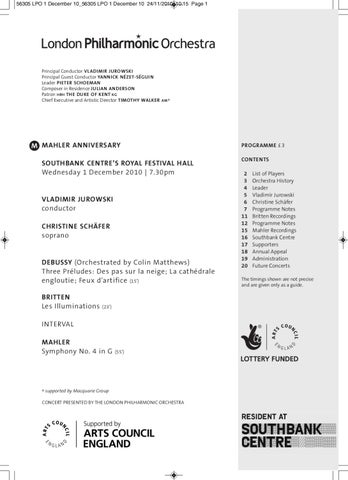
MAHLER ANNIVERSARY SOUTHBANK CENTRE’S ROYAL FESTIVAL HALL Wednesday 1 December 2010 | 7.30pm
VLADIMIR JUROWSKI conductor CHRISTINE SCHÄFER soprano
DEBUSSY (Orchestrated by Colin Matthews) Three Préludes: Des pas sur la neige; La cathédrale engloutie; Feux d’artifice (15’) BRITTEN Les Illuminations
(23’)
INTERVAL MAHLER Symphony No. 4 in G
†
(55’)
supported by Macquarie Group
CONCERT PRESENTED BY THE LONDON PHILHARMONIC ORCHESTRA
PROGRAMME £3 CONTENTS 2 3 4 5 6 7 11 12 15 16 17 18 19 20
List of Players Orchestra History Leader Vladimir Jurowski Christine Schäfer Programme Notes Britten Recordings Programme Notes Mahler Recordings Southbank Centre Supporters Annual Appeal Administration Future Concerts
The timings shown are not precise and are given only as a guide.
56305 LPO 1 December 10_56305 LPO 1 December 10 24/11/2010 10:15 Page 2
LONDON PHILHARMONIC ORCHESTRA
FIRST VIOLINS Pieter Schoeman* Leader Vesselin Gellev Sub-Leader Chair supported by John and Angela Kessler
Julia Rumley Katalin Varnagy Catherine Craig Thomas Eisner Tina Gruenberg Martin Hรถhmann Chair supported by Richard Karl Goeltz
Geoffrey Lynn Robert Pool Sarah Streatfeild Yang Zhang Rebecca Shorrock Peter Nall SECOND VIOLINS Clare Duckworth Principal Chair supported by Richard and Victoria Sharp
Jeongmin Kim Joseph Maher Kate Birchall Chair supported by David and Victoria Graham Fuller
Nancy Elan Fiona Higham Marie-Anne Mairesse Ashley Stevens Dean Williamson Sioni Williams Heather Badke Peter Graham VIOLAS Alexander Zemtsov* Principal Chair supported by The Tsukanov Family
Robert Duncan Katharine Leek Susanne Martens Benedetto Pollani Emmanuella Reiter-Bootiman
Laura Vallejo Alistair Scahill Isabel Pereira Sarah Malcolm
CLARINETS Robert Hill* Principal Nicholas Carpenter Paul Richards
CELLOS Kristina Blaumane Principal
E FLAT CLARINET Nicholas Carpenter Principal
Chair supported by Simon Yates and Kevin Roon
Francis Bucknall Laura Donoghue Santiago Sabino Carvalho + Gregory Walmsley Sue Sutherley Susanna Riddell David Bucknall DOUBLE BASSES Kevin Rundell* Principal Laurence Lovelle George Peniston Richard Lewis Joe Melvin Tom Walley Helen Rowlands Louis Garson FLUTES Jaime Martin* Principal Laura Lucas Susan Thomas* Jane Spiers PICCOLOS Susan Thomas* Principal Jane Spiers OBOES Ian Hardwick Principal Angela Tennick Sue Bohling COR ANGLAIS Sue Bohling Principal Chair supported by Julian and Gill Simmonds
BASS CLARINET Paul Richards Principal
TUBA Lee Tsarmaklis Principal TIMPANI Simon Carrington* Principal PERCUSSION Rachel Gledhill Principal Andrew Barclay* Co-Principal Chair supported by Andrew Davenport
CONTRA-BASS CLARINET Martin Robertson
Keith Millar Sarah Cresswell
SOPRANO SAXOPHONE Martin Robertson
HARPS Rachel Masters* Principal Emma Ramsdale
BASSOONS John Price Principal Gareth Newman* Simon Estell
CELESTE Catherine Edwards
CONTRA BASSOON Simon Estell Principal HORNS John Ryan Principal Abel Pereira Martin Hobbs Andrew Littlemore Gareth Mollison
ASSISTANT CONDUCTOR Thomas Blunt
TRUMPETS Paul Beniston* Principal Anne McAneney* Chair supported by Geoff and Meg Mann
Daniel Newell TROMBONES Mark Templeton* Principal David Whitehouse BASS TROMBONE Lyndon Meredith Principal
* Holds a professorial appointment in London +
Chevalier of the Brazilian Order of Rio Branco
Chair Supporters The London Philharmonic Orchestra also acknowledges the following chair supporters whose player is not present at this concert: Caroline, Jamie and Zander Sharp
2 | London Philharmonic Orchestra
56305 LPO 1 December 10_56305 LPO 1 December 10 24/11/2010 10:15 Page 3
LONDON PHILHARMONIC ORCHESTRA
Patrick Harrison
Seventy-eight years after Sir Thomas Beecham founded the London Philharmonic Orchestra, it is recognised today as one of the finest orchestras on the international stage. Following Beecham’s influential founding tenure the Orchestra’s Principal Conductorship has been passed from one illustrious musician to another, amongst them Sir Adrian Boult, Bernard Haitink, Sir Georg Solti, Klaus Tennstedt and Kurt Masur. This impressive tradition continued in September 2007 when Vladimir Jurowski became the Orchestra’s Principal Conductor and, in a further exciting move, the Orchestra appointed Yannick Nézet-Séguin its new Principal Guest Conductor from September 2008. The London Philharmonic Orchestra has been performing at Southbank Centre’s Royal Festival Hall since it opened in 1951, becoming Resident Orchestra in 1992. It plays there around 40 times each season with many of the world’s most sought after conductors and soloists. Concert highlights in 2010/11 include an exploration of Mahler’s symphonies and complete song cycles during the composer’s anniversary season; the premières of works by Matteo D’Amico, Magnus Lindberg and Brett Dean; a rare opportunity to hear Rossini’s opera Aureliano in Palmira in collaboration with long term partner Opera Rara; and works by the Orchestra’s new Composer in Residence, Julian Anderson. In addition to its London season and a series of concerts at Wigmore Hall, the Orchestra has flourishing
residencies in Brighton and Eastbourne, and performs regularly around the UK. It is unique in combining these concert activities with esteemed opera performances each summer at Glyndebourne Festival Opera where it has been the Resident Symphony Orchestra since 1964. The London Philharmonic Orchestra performs to enthusiastic audiences all round the world. In 1956 it became the first British orchestra to appear in Soviet Russia and in 1973 made the first ever visit to China by a Western orchestra. Touring continues to form a significant part of the Orchestra’s schedule and is supported by Aviva, the International Touring Partner of the London Philharmonic Orchestra. Tours in 2010/11 include visits to Finland, Germany, South Korea, Spain, France, Belgium and Luxembourg. Having long been embraced by the recording, broadcasting and film industries, the London Philharmonic Orchestra broadcasts regularly on domestic and international television and radio. It also works with the Hollywood and UK film industries, recording soundtracks for blockbuster motion pictures including the Oscar-winning score for The Lord of the Rings trilogy and scores for Lawrence of Arabia, The Mission, Philadelphia and East is East. The London Philharmonic Orchestra made its first recordings on 10 October 1932, just three days after its first public performance. It has recorded and broadcast
London Philharmonic Orchestra | 3
56305 LPO 1 December 10_56305 LPO 1 December 10 24/11/2010 10:15 Page 4
LONDON PHILHARMONIC ORCHESTRA
PIETER SCHOEMAN
regularly ever since, and in 2005 established its own record label. The recordings on its own label are taken mainly from live concerts given with distinguished conductors over the years including the Orchestra’s Principal Conductors from Beecham and Boult, through Haitink, Solti and Tennstedt, to Masur and Jurowski. Recent additions to the catalogue have included acclaimed releases of Elgar’s Symphony No. 1 and Sea Pictures with Vernon Handley and Janet Baker; Mahler’s Symphony No. 2 conducted by Klaus Tennstedt; Brahms’s Symphonies Nos 1 and 2 conducted by Vladimir Jurowski; and Dvořák’s Requiem under the baton of Neeme Järvi. The Orchestra’s own-label CDs are also widely available to download. Visit www.lpo.org.uk/shop for the latest releases.
‘ … a simply tremendous performance of Mahler’s 3rd Symphony … Jurowski and his players plunged us into a winter of discontent so profoundly expectant that even the inveterate coughers were silenced.’ EDWARD SECKERSON, THE INDEPENDENT, 23 SEPTEMBER 2010
The Orchestra reaches thousands of Londoners through its rich programme of community and school-based activity in Lambeth, Lewisham and Southwark, which includes the offshoot ensembles Renga and The Band, its Foyle Future Firsts apprenticeship scheme for outstanding young instrumentalists, and regular family and schools concerts. To help maintain its high standards and diverse workload, the Orchestra is committed to the welfare of its musicians and in December 2007 received the Association of British Orchestras/Musicians Benevolent Fund Healthy Orchestra Bronze Charter Mark. There are many ways to experience and stay in touch with the Orchestra’s activities: visit www.lpo.org.uk, subscribe to our podcast series, download our iPhone application and join us on Facebook and Twitter.
4 | London Philharmonic Orchestra
In 2002, Pieter Schoeman joined the London Philharmonic Orchestra as Co-Leader. He was appointed Leader in 2008. Born in South Africa, he made his solo debut with the Cape Town Symphony Orchestra at the age of ten. He studied with Jack de Wet in South Africa, winning numerous competitions, including the 1984 World Youth Concerto Competition in America. In 1987 he was offered the Heifetz Chair of Music scholarship to study with Eduard Schmieder in Los Angeles and in 1991 his talent was spotted by Pinchas Zukerman who recommended that he move to New York to study with Sylvia Rosenberg. In 1994 he became her teaching assistant at Indiana University, Bloomington. Pieter Schoeman has performed as a soloist and recitalist throughout the world in such famous halls as the Concertgebouw in Amsterdam, Moscow’s Rachmaninov Hall, Capella Hall in St Petersburg, Staatsbibliothek in Berlin, Hollywood Bowl in Los Angeles and Queen Elizabeth Hall in London. As a chamber musician he regularly performs at London’s prestigious Wigmore Hall. As a soloist with the London Philharmonic Orchestra, he has performed Arvo Pärt’s Double Concerto with Boris Garlitsky and Benjamin Britten’s Double Concerto with Alexander Zemtsov, which was recorded and released on the Orchestra’s own record label to great critical acclaim. In October he performed the Brahms Double Concerto with Kristina Blaumane. In 1995 Pieter Schoeman became Co-Leader of the Orchestre Philharmonique de Nice. Since then he has performed frequently as Guest Leader with the symphony orchestras of Barcelona, Bordeaux, Lyon and Baltimore as well as the BBC Symphony Orchestra. This season he has been invited to lead the Rotterdam Philharmonic Orchestra on several occasions. Pieter Schoeman has recorded numerous violin solos with the London Philharmonic Orchestra for Chandos, Opera Rara, Naxos, X5, the BBC and for American film and television. He led the Orchestra in its soundtrack recordings for The Lord of the Rings trilogy. He teaches at Trinity College of Music in London.
Patrick Harrison
LEADER
56305 LPO 1 December 10_56305 LPO 1 December 10 24/11/2010 10:15 Page 5
VLADIMIR JUROWSKI
Karen Robinson
CONDUCTOR
Born in Moscow, the son of conductor Mikhail Jurowski, Vladimir Jurowski completed the first part of his musical studies at the Music College of the Moscow Conservatory. In 1990 he relocated with his family to Germany where he continued his studies in Dresden and Berlin, studying conducting with Rolf Reuter and vocal coaching with Semion Skigin. In 1995 he made his international debut at the Wexford Festival, where he conducted Rimsky-Korsakov’s May Night. The same year saw his brilliant debut at the Royal Opera House Covent Garden in Nabucco. In 1996 he joined the ensemble of Komische Oper Berlin, becoming First Kapellmeister in 1997 and continuing to work at the Komische Oper on a permanent basis until 2001. Since 1997 Vladimir Jurowski has been a guest at some of the world’s leading musical institutions including the Royal Opera House Covent Garden, Teatro La Fenice di Venezia, Opéra Bastille de Paris, Théâtre de la Monnaie Bruxelles, Maggio Musicale Festival Florence, Rossini Opera Festival Pesaro, Edinburgh Festival, Semperoper Dresden and the Teatro Comunale di Bologna (where he served as Principal Guest Conductor between 2000 and 2003). In 1999 he made his debut at the Metropolitan Opera New York with Rigoletto. In January 2001 Vladimir Jurowski took up the position of Music Director of Glyndebourne Festival Opera and in 2003 was appointed Principal Guest Conductor of the London Philharmonic Orchestra, becoming the Orchestra’s Principal Conductor in September 2007. He also holds the title of Principal Artist of the Orchestra of the Age of Enlightenment, and from 2005 to 2009 served as Principal Guest Conductor of the Russian National Orchestra with whom he will continue to work in the years ahead.
Vladimir Jurowski is a regular guest with many of the world’s leading orchestras including the Berlin Philharmonic, Oslo Philharmonic, Royal Concertgebouw, Bavarian Radio Symphony, Dresden Staatskapelle, Los Angeles Philharmonic and Philadelphia Orchestras as well as the Gewandhausorchester Leipzig. Highlights of the 2010/11 season and beyond include his debuts with the Vienna Philharmonic, Cleveland, San Francisco Symphony and Mahler Chamber Orchestras, and return visits to the Chicago Symphony, Chamber Orchestra of Europe, Berlin Philharmonic, Royal Concertgebouw, St Petersburg Philharmonic and Philadelphia Orchestras. His operatic engagements have included Jenůfa, The Queen of Spades and Hänsel und Gretel at the Metropolitan Opera, Parsifal and Wozzeck at Welsh National Opera, War and Peace at the Opéra National de Paris, Eugene Onegin at La Scala Milan, as well as Die Zauberflöte, La Cenerentola, Otello, Macbeth, Falstaff, Tristan und Isolde, Don Giovanni, The Rake’s Progress and Peter Eötvös’ Love and Other Demons at Glyndebourne Opera. Future engagements include new productions of Die Meistersinger and The Cunning Little Vixen at Glyndebourne, Die Frau ohne Schatten at the Metropolitan Opera, Russlan and Ludmila at the Bolshoi Theatre, and Iolanta at the Dresden Semperoper. Jurowski’s discography includes the first ever recording of Giya Kancheli’s cantata Exil for ECM (1994), L’Étoile du Nord by Meyerbeer for Naxos-Marco Polo (1996), and Werther for BMG (1999) as well as live recordings of works by Rachmaninov, Turnage, Tchaikovsky, Britten, Brahms and Shostakovich on the London Philharmonic Orchestra’s own label, and Prokofiev’s Betrothal in a Monastery on Glyndebourne Opera’s own label. He also records for PentaTone with the Russian National Orchestra, with releases to date including Tchaikovsky’s Suite No. 3 and Stravinsky’s Divertimento from Le Baiser de la fée, Shostakovich’s Symphonies Nos 1 and 6, Prokofiev’s Symphony No. 5 and Tchaikovsky’s Hamlet Incidental Music. Glyndebourne have released DVD recordings of his performances of La Cenerentola, Gianni Schicchi, Die Fledermaus and Rachmaninov’s The Miserly Knight, and other recent DVD releases include Hänsel und Gretel from the Metropolitan Opera New York, and his first concert as the London Philharmonic Orchestra’s Principal Conductor featuring works by Wagner, Berg and Mahler (released by Medici Arts).
London Philharmonic Orchestra | 5
56305 LPO 1 December 10_56305 LPO 1 December 10 24/11/2010 10:15 Page 6
CHRISTINE SCHÄFER SOPRANO
staged by Oliver Hermann and accompanied by Irwin Gage, and has since made a highly-acclaimed recording of the work.
Christine Schäfer studied at the Berlin Conservatory with Professor Ingrid Figur, the late Arleen Auger, Aribert Reimann, Dietrich Fischer-Dieskau and Sena Jurinac and has gone on to enjoy one of the most successful international opera, concert, recital and recording careers of her generation. Her operatic roles have included Konstanze, Ilia, Lulu, Cherubino and Donna Anna at the Salzburg Festival; Konstanze, Gilda and Sophie at Covent Garden; Lulu and Gretel at the Met; Donna Anna and Cherubino at the Opéra National de Paris; Pamina, Cleopatra and Alcina for De Nederlandse Opera; Sophie in San Francisco and Berlin’s Deutsche Oper; Lulu at the Glyndebourne and Innsbruck Festivals; Alcina at the Drottningholm Festival; Zdenka in Houston; Zerbinetta in Munich; and Lucia di Lammermoor for Welsh National Opera. She also sang in Messiaen’s St François d’Assise in Paris and Pierrot Lunaire with Boulez in Berlin and Paris. In 2003, at Berlin’s Staatsoper she made her debut as Violetta in the new production of Verdi’s La Traviata conducted by Daniel Barenboim. As a concert singer she makes regular appearances on the major stages of Europe and America and collaborates with many of today’s pre-eminent conductors including Boulez, Eschenbach, Gatti, Haitink, Harding, Harnoncourt, Jurowski, Metzmacher, Rattle and Thielemann. After a successful 1988 recital debut at the Berlin Festival singing Aribert Reimann's Nachträume, Christine Schäfer has gone on to develop an international recital career, making regular tours of North America and Japan, and frequent appearances at such renowned venues as London’s Wigmore Hall and Vienna’s Musikverein. In 2002 at the Ruhr Triennale, she gave her first performance of Schubert’s Die Winterreise,
6 | London Philharmonic Orchestra
Her discography includes Konstanze in Die Entführung aus dem Serail with Les Arts Florissants and Christie; Mozart and Strauss arias with the Berlin Philharmonic and Abbado; Schoenberg’s Pierrot Lunaire and Boulez’s Pli selon Pli with the Ensemble Intercontemporain and Boulez; and a recital disc of Debussy and Chausson accompanied by Irwin Gage. She has also recorded Bach’s St Matthew Passion, Mozart’s Requiem and Handel’s Messiah, and performs on the multi awardwinning recording of Zemlinsky’s Lyrische Sinfonie with the Orchestre de Paris and Eschenbach. Her recording with the Petersen Quartet of an Aribert Reimann collection of Mendelssohn/Schumann song transcriptions, ‘…. oder soll es Tod bedeuten?’, won the 2007 ECHO Klassik Award for Best Lied recording. She also features on Graham Johnson's acclaimed series of Schubert and Schumann Lieder for Hyperion Records, and with Onyx Classics in a highly personalised collection of Purcell and Georg Crumb, entitled Apparition, with Eric Schneider. Highlights of her most recent operatic seasons have included Violetta in Christoph Marthaler’s new production of La Traviata at the Palais Garnier in Paris; her return to the Met for Richard Jones’s production of Hansel and Gretel conducted by Vladimir Jurowski and Der Rosenkavalier with James Levine; a first foray into Rossini in David Alden’s new Il Turco in Italia at Berlin’s Staatsoper; her Vienna operatic debut as Handel’s Partenope at the Theater an der Wien; Donizetti’s Lucia for Oper Frankfurt; the title role in Handel’s Theodora at the Salzburg Festival; and Asteria in Handel’s Tamerlano at Covent Garden. This season includes Rigoletto at the Metropolitan Opera, Konstanze and Adèle at the Berliner Staatsoper and the role of L’Ange in a new production of Messiaen’s St François d’Assise. In recital she can be heard in Berlin, Munich, Bonn, Brussels, Luxembourg, Frankfurt, Salzburg and Vienna, and on the concert platform in Lucerne with Welser-Möst, London, Birmingham and Berlin with Jurowski, Vienna with Harnoncourt, Berlin with Rattle and Munich with Thielemann.
56305 LPO 1 December 10_56305 LPO 1 December 10 24/11/2010 10:15 Page 7
PROGRAMME NOTES
SPEEDREAD Those who like intricate connections will find plenty to relish in this concert. Gustav Mahler’s Fourth Symphony is one of the richest and most moving explorations of the concept of childhood in music. Are all its pleasures and pains ‘innocent’, it seems to ask? Childhood, and how one preserves a sense of true innocence in a hostile and casually cruel world was also a lifelong preoccupation of Benjamin Britten, a composer who loved and admired Mahler hugely. Like Mahler, Britten didn’t shrink from reflecting the harsh realities of life in his orchestral song
Claude DEBUSSY
cycle Les Illuminations, but also like Mahler he shows how a truly liberated artistic imagination can counter these with realities of its own making. Setting French poetry in Les Illuminations was a freeing experience for Britten, and to set the Gallic scene we have three of Claude Debussy’s most famous miniature tone-paintings from the piano cycles Préludes, each a world of imagination in its own right. These are heard in orchestrations by composer Colin Matthews – who in turn worked with Britten, and helped Deryck Cooke in preparing his revelatory ‘performing version’ of Mahler’s incomplete Tenth Symphony.
THREE PRÉLUDES Des pas sur la neige | La cathédrale engloutie | Feux d’artifice
1862-1918 Orchestrated by Colin Matthews (born 1946)
Debussy’s two books of Préludes (1909-13) contain some of the most imaginative and powerfully suggestive tone-painting in the solo piano repertoire. Strikingly though, he didn’t print the titles of the individual pieces at the head of the page (as was the normal practice), but in brackets, underneath the very last notes, and introduced by three dots – eg (…Des pas sur la neige) – almost as though the descriptive tag was an afterthought. It’s as if the composer were saying: ‘Well, this is what they mean to me; what do you think?’ This unspoken invitation to make of the music what we will has had consequences Debussy may not have foreseen. Beautifully conceived for the piano as they are, to some ears the Préludes have also suggested orchestral colours. The conductors Henri Büsser and Leopold Stokowski both made striking arrangements of La cathédrale engloutie (‘The submerged cathedral’), whose deep bell effects and massive organ-chord-like climax do seem to cry out for full orchestral power and colour. Similarly Feux d’artifice (‘Fireworks’), with its
brilliant effects and swirling, coruscating textures comes across vividly when treated to the much fuller range of the orchestral palate. But Des pas sur la neige (‘Footsteps in the snow’) requires subtlety from the arranger: its fragile, halting lyricism, like someone whose voice is on the edge of breaking, and the prevailing mood of tendre et triste regret (tender and sad regret) could easily be broken. Fortunately the composer Colin Matthews knows as much as anyone about responding sympathetically to other composers’ sound worlds. His orchestrations of songs and fragments by Holst and Britten have become repertory pieces, and he also made a vital contribution to the Deryck Cooke ‘performing version’ of Mahler’s incomplete Tenth Symphony: many of the seemingly obvious ‘Mahler’ orchestral colours in that revelatory score were Matthews’s inspirations. We may safely expect similar ear-opening experiences in these three Préludes.
London Philharmonic Orchestra | 7
56305 LPO 1 December 10_56305 LPO 1 December 10 24/11/2010 10:15 Page 8
PROGRAMME NOTES
Benjamin BRITTEN
LES ILLUMINATIONS CHRISTINE SCHÄFER soprano Fanfare | Villes | Phrase | Antique | Royauté | Marine | Interlude | Being Beauteous | Parade | Départ
1913-1976
Although Britten is justly celebrated as one of the most sensitive and resourceful setters of English poetry – possibly equalled in this country only by Henry Purcell – his formative early masterpiece, Les Illuminations, shows him respond with equally intense feeling to the French language. By any stretch of the imagination it is a remarkable achievement for a 26 year-old Englishman, even when one knows that Britten had already made impressive settings of French poets in his Quatre chansons françaises – this was at the age of 15! It would seem that Britten found (as Stravinsky did around the same time when setting Latin in his Symphony of Psalms) that setting a foreign language can open one’s ears to the musical properties of words – the kind of thing one may miss when one’s main attention is focussed on their meanings. Take the final phrase of the brief but magical ‘Phrase’ (No. 3a): Britten sets the final word danse as an ecstatic pianissimo downward swoop. A native French-speaker might have wanted to create something more explicitly ‘dancing’, but Britten, apparently captivated by the pure sound of the word, comes up with something daringly original – and beautifully conceived for the female soprano voice. Britten indicated that Les Illuminations could also be sung by a tenor, but clearly the experience of writing for the soprano Sophie Wyss left a deep imprint on the style of the vocal writing. At every stage in Les Illuminations we can hear how Arthur Rimbaud’s intoxicating, extravagant, symbol-rich verse stimulated Britten’s musical imagination. The
8 | London Philharmonic Orchestra
string writing owes something to his recent experiments in the masterly Variations on a Theme of Frank Bridge for string orchestra (1937). The ghostly ‘harmonics’ of ‘Phrase’ strongly recall the eerie, hushed ‘Chant’ from the Variations, while the imitation of trumpet calls in ‘Fanfare’ similarly looks back to the opening of the earlier work. What Britten may have found above all in Rimbaud however was a more profound pointer to a possible way ahead, artistically and personally. Like Britten, Rimbaud was very conscious of the harsh realities of modern industrialised life, of its costs in human and more general natural terms. Britten’s earlier orchestral song cycle, Our Hunting Fathers (1936), was unmistakably a work of protest at man’s inhumanity to his fellow sentient creatures. The orchestra’s refusal to take it seriously during rehearsals for the first performance no doubt enhanced Britten’s feelings about casual human cruelty. Rimbaud’s poetry suggested another way of dealing with grim reality: a healing retreat into the world of the artistic imagination – for Britten’s English poet-hero William Blake this was more or less equivalent to Divine revelation. There are moments of otherworldly lyrical beauty, especially in ‘Antique’ and the exquisite ‘Being Beauteous’. But the poems in Les Illuminations don’t ignore the horrors of this world; indeed they contain a note of splendid defiance, as can be heard in the crucial thrice-heard phrase: ‘I alone hold the key to this savage parade’.
56305 LPO 1 December 10_56305 LPO 1 December 10 24/11/2010 10:15 Page 9
PROGRAMME NOTES
1. Fanfare
1. Fanfare
J'ai seul la clef de cette parade sauvage.
I alone hold the key to this savage parade.
2. Villes
2. Towns
Ce sont des villes! C'est un peuple pour qui se sont montés ces Alleghanys et ces Libans de rêve! Des chalets de cristal et de bois se meuvent sur des rails et des poulies invisibles. Les vieux cratères, ceints de colosses et de palmiers de cuivre rugissent mélodieusement dans les feux ... Des cortèges de Mabs en robes rousses, opalines, montent des ravines. Là-haut, les pieds dans l cascade et les ronces, les cerfs tettent Diane. Les Bacchantes des banlieues sanglotent et la lune brûle et hurle. Vénus entre dans les cavernes des forgerons et des ermites. Des groupes de beffrois chantent les idées des peuples. Des châteaux bâtis en os sort la musique inconnue ... Le paradis des orages s'effondre ... Les sauvages dansent sans cesse la Fête de la Nuit ...
These are towns! It is for the inhabitants of towns that these dream Alleghanies and Lebanons have been raised. Castles of crystal and wood move on rails and invisible pulleys. Old craters, encircled with colossal statues and palms of copper, roar melodiously in their fires ... Corteges of Queen Mabs in robes red and opaline, climb the ravines. Up there, their hoofs in the cascades and the briars, the stags give Diana suck. Bacchantes of the suburbs weep, and the moon burns and howls. Venus enters the caves of the blacksmiths and hermits. Groups of bell-towers sing aloud the ideas of the people. From castles built of bones proceeds unknown music ... The paradise of the thunders bursts and falls. Savages dance unceasingly the Festival of the Night.
Quels bons bras, quelle belle heure me rendront cette région d'où viennent mes sommeils et mes moindres mouvements?
What kindly arms, what good hour will restore to me those regions from which come my slumbers and the least of my movements?
3a. Phrase
3a. Phrase
J'ai tendu des cordes de clocher à clocher; des guirlandes de fenêtre à fenêtre; des chaînes d'or d'étoile à étoile, et je danse.
I have hung ropes from bell-tower to bell-tower; garlands from window to window; golden chains from star to star – and I dance.
3b. Antique
3b. Antique
Gracieux fils de Pan! Autour de ton front couronné de fleurettes et de baies, tes yeux, des boules précieuses, remeunt. Tachées de lies brunes, te joues se creusent. Tes crocs luisent. Ta poitrine ressemble à une cithare, des tintements circulent dans tes bras blonds. Ton coeur bat dans ce ventre où dort le double sexe. Promène-toi, la nuit, en mouvant doucement cette cuisse, cette seconde cuisse et cette jambe de gauche.
Oh, gracious son of Pan! Thine eyes – those precious globes – glance slowly; thy brow is crowned with little flowers and berries. Thy hollow cheeks are spotted with brown lees; thy tusks shine. Thy breast resembles a cithara; tinkling sounds run through thy blonde arms. Thy heart beats in that womb where sleeps Hermaphrodite. Walk at night, softly moving this thigh, this other thigh, this left leg.
4. Royauté
4. Royalty
Un beau matin, chez un peuple fort doux, un homme et une femme superbes criaient sur la place publique: ‘Mes amis, je veux qu'elle soit reine!’ ‘Je veux être reine!’ Elle riait et tremblait. Il parlait aux amis de révélation, d'épreuve terminée. Ils se pâmaient l'un contre l'autre. En effet ils furent rois toute une matinée où les tentures carminées se relevèrent sur les maisons, et toute l'aprèsmidi, où ils s'avancèrent du côté des jardins de palmes.
On a beautiful morning, in a country inhabited by mild and gentle people, a man and woman of proud presence stood in the public square and cried aloud; ‘My friends, it is my wish that she should be queen.’ ‘I wish to be queen!’ She laughed and trembled. To his friends he spoke of revelation, of a test concluded. Swooningly they leaned one against the other. And during one whole morning, whilst the crimson hangings were displayed on London Philharmonic Orchestra | 9
56305 LPO 1 December 10_56305 LPO 1 December 10 24/11/2010 10:15 Page 10
PROGRAMME NOTES
the houses, and during the whole afternoon, while they advanced towards the palm gardens, they were indeed kings. 5. Marine
5. Marine
Les chars d'argent et de cuivre – Les proues d'acier et d'argent – Battent l'écume, – Soulèvent les souches des ronces. Les courants de la lande, Et les ornières immenses du reflux, Filent circulairement vers l'est, Vers les piliers de la forêt, Vers les fûts de la jetée, Dont l'angle est heurté par des tourbillons de lumière.
Chariots of silver and of copper Prows of steel and of silver Beat the foam, Lift the stems of the brambles. The streams of the barren parts And the immense tracks of the ebb Flow circularly towards the east, Towards the pillars of the forest, Towards the piles of the jetty, Against whose angles are hurled whirlpools of light.
6. Interlude
6. Interlude
J'ai seul la clef de cette parade sauvage.
I alone hold the key to this savage parade.
7. Being Beauteous
7. Being Beauteous
Devant une neige un Être de Beauté de haute taille. Des sifflements de mort et des cercles de musique sourde font monter, s'élargir et trembler comme un spectre ce corps adoré: des blessures écarlates et noires éclatent dans les chairs superbes. Les couleurs propres de la vie se foncent, dansent, et se dégagent autour de la Vision, sur le chantier Et les frissons s'élèvent et grondent, et la saveur forcenée de ces effets se chargeant avec les sifflements mortels et les rauques musique que le monde, loin derrière nous, lance sur notre mère de beauté, – elle recule, elle se dresse. Oh! nos os sont revêtus d'un nouveau corps amoureux.
Against a background of snow is a beautiful Being of majestic stature. Death is all round her, and whistling, dying breaths, and circles of hollow music cause this adored body to rise, to swell, and to tremble like a spectre. Scarlet and black wounds break out on the superb flesh. Colours which belong to life deepen, dance, and separate themselves around the vision, upon the path. Shudders rise and mutter; and the mad savour of all these things, heavy with dying groans and raucous music, is hurled at our Mother of Beauty by the world far behind us. She recoils, she stands erect. Oh rapture! our bones are covered anew with a body of love.
O la face cendrée, l'écusson de crin, les bras de cristal! Le canon sur lequel je dois m'abattre travers la mêlée des arbres et de l'air léger!
Ah! The pale ashen face, the mane-like hair, the arms of crystal. And there is the cannon upon which I must cast myself through the noise of trees and light winds.
8. Parade
8. Parade
Des drôles très solides. Plusieurs ont exploité vos mondes. Sans besoins, et peu pressés de mettre en oeuvre leurs brillantes facultés et leur expérienc de vos consciences. Quels hommes mûrs! Des yeux hébétés à la façon de la nuit d'été, rouges et noirs, tricolorés, d'acier piqué d'étoiles d'or; des facies déformés, plombés, blêmis, incendiés; des enrouements folâtres! La démarche cruelle des oripeaux! – Il y a quelques jeunes –
These are very sturdy rogues. Many of them have made use of you and your like. Without wants, they are in no hurry to put into action their brilliant faculties and their experience of your consciences. What mature men! Here are sottish eyes out of a midsummer night’s dream – red, black, tricoloured; eyes of steel spotted with golden stars; deformed faces, leaden-hued, livid, enflamed; wanton hoarseness. They have the ungainly bearing of rag dolls. There are youths among them –
10 | London Philharmonic Orchestra
56305 LPO 1 December 10_56305 LPO 1 December 10 24/11/2010 10:15 Page 11
PROGRAMME NOTES
O le plus violent Paradis de la grimace enragée! ... Chinois, Hottentots, bohémiens, niais, hyènes, Molochs, vieilles démences, démons sinistres, ils mêlent les tours populaires, maternels, avec les poses et les tendresses bestiales. Ils interpréte raient des pièces nouvelles et des chansons ‘bonnes filles’. Maîtres jongleurs, ils transforment le lieu et les personnes et usent de la comédie magnétique ...
It is a violent Paradise of mad grimaces ... Chinese, Hottentots, gypsies, simpletons, hyenas, Molochs, old insanities, sinister demons, they alternate popular or material tricks with bestial poses and caresses. They can interpret modern plays or songs of a simple naivety at will. Master jugglers, they transform places and people, and make use of magnetic comedy.
J'ai seul la clef de cette parade sauvage.
I alone hold the key to this savage parade.
9. Départ
9. Depart
Assez vu. La vision s'est rencontrée à tous les airs. Assez eu. Rumeurs de villes, le soir, et au soleil, et toujours. Assez connu. Les arrêts de la vie. O Rumeurs et Visions! Départ dans l'affection et le bruit neufs!
Sufficiently seen. – The vision has been met in all guises. Sufficiently heard. – Rumours of the town at night, in the sunlight, at all times. Sufficiently known – Life’s decrees. Oh Rumours! Oh Visions! Departure in the midst of love and new rumours.
Arthur Rimbaud (1854-1891)
Translation by Helen Rootham
BRITTEN RECORDINGS ON THE LONDON PHILHARMONIC ORCHESTRA’S OWN RECORD LABEL
LPO-0037 Vladimir Jurowski conducts Britten’s Double Concerto (with Pieter Schoeman and Alexander Zemtsov), Frank Bridge Variations and Les Illuminations (with Sally Matthews)
LPO-0002 Bernard Haitink conducts Britten’s Our Hunting Fathers (with Heather Harper) along with Elgar’s Introduction and Allegro and Enigma Variations.
LPO-0010 Kurt Masur conducts Britten’s War Requiem with Christine Brewer, Anthony Dean Griffey, Gerald Finley and the London Philharmonic Choir
The recordings may be downloaded in high quality MP3 format from www.lpo.org.uk/shop. CDs may also be purchased from all good retail outlets or through the London Philharmonic Orchestra: telephone 020 7840 4242 (Mon-Fri 10am-5pm) or visit the website www.lpo.org.uk
London Philharmonic Orchestra | 11
56305 LPO 1 December 10_56305 LPO 1 December 10 24/11/2010 10:15 Page 12
PROGRAMME NOTES
INTERVAL 20 minutes An announcement will be made five minutes before the end of the interval.
Gustav MAHLER 1860-1911
When Mahler began work on his Fourth Symphony in 1899 he was thinking in terms of a ‘humoresque’ – a light, cheerful work, in strong contrast to the hugely ambitious Second and Third Symphonies. But it seems the muse had other ideas. ‘To my astonishment’, he wrote to a friend, ‘it became plain to me that I had entered a totally different realm... This time it is a forest with all its mysteries and its horrors which forces my hand and weaves itself into my work.’ This may surprise some listeners. At first sight the Fourth appears Mahler’s happiest and least complicated symphony: an idyllic picture of infant happiness, culminating in a child’s vision of Heaven. But Mahler knew only too well that childhood has its darker side. There is cruelty in the text Mahler sets in his finale, Das himmlische Leben (‘Heavenly Life’): ‘We lead a patient, innocent, patient, dear little lamb to death’, the child tells us contentedly; ‘St Luke slaughters the oxen’. Earlier we glimpse ‘the butcher Herod’, responsible for the Massacre of the Innocents in the Biblical Christmas story. What are characters like these doing in Heaven? In fact Mahler wrote his fascinatingly ambiguous songfinale some time before he began work on the preceding three movements – so although it comes last, it is really the starting point for the whole symphony. It was one of several settings of poems from the classic
12 | London Philharmonic Orchestra
SYMPHONY NO. 4 IN G CHRISTINE SCHÄFER soprano Bedächtig. Nicht eilen [Deliberate. Don’t hurry] – Recht gemächlich [Very leisurely] | In gemächlicher Bewegung. Ohne Hast [At a leisurely pace. Without haste] | Ruhevoll [Restful] | Sehr behaglich [Very cosy]
German folk collection Des Knaben Wunderhorn (‘The Boy’s Magic Horn’) Mahler had composed in the 1890s. Yet in the Fourth Symphony the three purely orchestral movements prepare the way for the closing vision of the song-finale on every possible level: its themes, orchestral colours, tonal scheme, and most of all its masked emotional complexity. The very opening of the Fourth Symphony is a foretaste of the finale. Woodwind and sleigh-bells set off at a slow jog-trot, then a languid rising violin phrase turns out to be the beginning of a disarmingly simple tune: Mahler in Mozartian peruke and frills. A warmly yearning second theme (cellos) soon subsides into the most childlike idea so far (solo oboe and bassoon). Soon another tune is introduced by four flutes in unison – panpipes, or perhaps whistling boys. After this the ‘mysteries and horrors’ rise to the surface, until horns, trumpets, bells and glittering high woodwind burst into a joyous medley of themes from earlier on. A dissonance, underlined by gong and bass drum, then trumpets sound out the fanfare rhythm Mahler later used to begin the sinister Funeral March in his Fifth Symphony. Suddenly the music stops, and the Mozartian theme starts again in mid-phrase, as though nothing had happened. All the main themes now return, leading to a brief, boisterous coda.
56305 LPO 1 December 10_56305 LPO 1 December 10 24/11/2010 10:15 Page 13
PROGRAMME NOTES
The second movement, a Scherzo with two contrasting trio sections, proceeds at a leisurely pace (really fast music is rare in this symphony). Mahler described the first theme as a portrait of ‘Freund Hain’ (‘Friend Hain’) – a pied-piper-like figure from German folklore whose fiddle playing beguiles its hearers into the land of ‘Beyond’ – death in disguise? The beguiling but sinister fiddler is evoked by the orchestral leader playing a violin tuned a tone higher than normal, sounding both coarser and – literally – more highly-strung. There are cosier moments, though the final shrill high forte leaves a faintly sulphurous aftertaste.
develops this ambiguity, culminating in a full orchestral outburst of pure joy in E major – the key in which the finale is to end. Then the slow movement slips back into peaceful sleep. Now the soprano soloist enters for the first time to open the finale. Mahler adds a note in the score: ‘To be sung in a happy childlike manner: absolutely without parody!’ At the mention of St Peter, the writing becomes hymn-like, then come the troubling images of slaughter. The singer seems unmoved by what she relates, but plaintive, animal-like cries from oboe and low horn create a momentary frisson. The movement makes its final turn to E major to the words, ‘There is no music on earth that can be compared to ours’. Then the child sings no more, and the music gradually fades until nothing is left but the deep bell-like tones of the harp.
According to Mahler the gorgeous string theme that opens the slow movement was inspired by ‘a vision of a tombstone on which was carved an image of the departed, with folded arms, in eternal sleep’ – an image half consoling, half achingly sad. A set of free variations
Programme notes by Stephen Johnson © 2010
Wir geniessen die himmlischen Freuden, D’rum tun wir das irdische meiden. Kein weltlich Getümmel Hört man nicht im Himmel! Lebt Alles in sanftester Ruh’!
We enjoy the heavenly pleasures, So we do avoid the earthly ones. No worldly commotion Is heard in heaven! All live in gentlest peace!
Wir führen ein englisches Leben! Sind dennoch ganz lustig daneben! Wir tanzen und springen, Wir hüpfen und singen! Sankt Peter in Himmel sieht zu!
We lead an angelic life! Yet we’re quite merry besides! We dance and jump, We hop and sing! St Peter in heaven looks on.
Johannes das Lämmlein auslasset, Der Metzger Herodes drauf passet! Wir führen ein geduldig’s, Unschuldig’s, geduldig’s, Ein liebliches Lämmlein zu Tod!
St John lets out the lambkin, The butcher Herod awaits it! We lead a patient, Innocent, patient, Dear little lamb to death!
Sankt Lucas den Ochsen tät schlachten Ohn’ einig’s Bedenken und Achten, Der Wein kost kein Heller Im himmlischen Keller, Die Englein, die backen das Brot.
St Luke slaughters the oxen Without any scruple or care, The wine costs not a penny In the heavenly cellar, The angels bake the bread.
Gut’ Kräuter von allerhand Arten, Die wachsen im himmlischen Garten! Gut’ Spargel, Fisolen Und was wir nur wollen! Ganze Schüsseln voll sind uns bereit!
Good plants of every kind Grow in the heavenly garden! Good asparagus, beans And whatever we want! Whole platefuls are prepared for us!
London Philharmonic Orchestra | 13
56305 LPO 1 December 10_56305 LPO 1 December 10 24/11/2010 10:15 Page 14
PROGRAMME NOTES
Gut’ Apfel, gut’Birn’ und gut’ Trauben, Die Gärtner, die Alles erlauben! Willst Rehbock, willst Hasen? Auf offener Strassen Sie laufen herbei!
Good apples, good pears and good grapes, The gardeners allow us them all! Do you want roebuck, want hares? On the open streets They are running about!
Sollt ein Festtag etwa kommen, Alle Fische gleich mit Freuden angeschwommen! Dort läuft schon Sankt Peter Mit Netz und mit Köder Zum himmlischen Weiher hinein. Sankt Martha die Köchin muss sein!
Should a feast-day be approaching, All fish alike come joyfully swimming! There already St Peter is running With net and bait To the heavenly pond. St Martha has to be cook!
Kein Musik ist ja nicht auf Erden Die unsrer verglichen kann werden. Elftausend Jungfrauen Zu tanzen sich trauen! Sankt Ursula selbst dazu lacht!
There is no music on earth That can be compared to ours. Eleven thousand maidens Make bold to dance! Even St Ursula laughs!
Cäcilia mit ihren Verwandten Sind treffliche Hofmusikanten! Die englischen Stimmen Ermuntern die Sinnen! Dass alles für Freuden erwacht.
Cecilia and her relations Are excellent court musicians! The angelic voices Arouse the senses! So all things awake for joy. English translation © Eric Mason
ListenAgain – free online concerts We want to share our live music making with as many people as possible and are delighted that this season we’re making a series of concerts available online for a limited period for you to listen to. If you’ve enjoyed this evening’s concert and would like to hear it again, visit www.lpo.org.uk/listenagain from 8 December to relive the evening.
14 | London Philharmonic Orchestra
56305 LPO 1 December 10_56305 LPO 1 December 10 24/11/2010 10:15 Page 15
MAHLER RECORDINGS ON THE LONDON PHILHARMONIC ORCHESTRA’S OWN RECORD LABEL LPO-0012 Klaus Tennstedt conducts Mahler’s Symphony No. 1 and Songs of a Wayfarer with Thomas Hampson ‘... a stirring account, with his tight control causing Mahler’s climactic outbursts – both joyous and nostalgic – to hit home potently ... The LPO’s lead bassist tackling Mahler’s minor-key overhaul of ‘Frère Jacques’ is fittingly melancholic, while the finale is packed with energy and bracing inevitability.’ CLASSIC FM
LPO-0044 Klaus Tennstedt conducts Mahler’s Symphony No. 2 ‘This live version of the Resurrection is frequently startling – extremely expansive but exciting, dramatic and highly charismatic …The playing and singing are excellent, and the recording, made by the Music Performance Research Centre, is near-faultless.’ GRAHAM RICKSON, THE ARTS DESK, 22 MARCH 2010
LPO-0038 Klaus Tennstedt conducts Mahler’s Symphony No. 6 ‘This live recording of a 1983 performance of Mahler’s Sixth Symphony might not be at the cutting edge of modern digital technology, but musically it sweeps away everything before it.’ CLASSIC FM MAGAZINE
LPO-0033 Jaap van Zweden conducts Mahler’s Symphony No. 5 ‘He unfolds the drama of the first movement with a sure grasp of the need for subtle variations of tempo … the finale is a joyous, life-affirming rondo that lifts the spirits.’ MICHAEL KENNEDY, THE SUNDAY TELEGRAPH, 10 AUGUST 2008
The recordings may be downloaded in high quality MP3 format from www.lpo.org.uk/shop. CDs may also be purchased from all good retail outlets or through the London Philharmonic Orchestra: telephone 020 7840 4242 (Mon-Fri 10am-5pm) or visit the website www.lpo.org.uk
London Philharmonic Orchestra | 15
56305 LPO 1 December 10_56305 LPO 1 December 10 24/11/2010 10:15 Page 16
FREE Pre-Concert Event The Clore Ballroom Royal Festival Hall Foyer Southbank Centre 4 December 2010 | 6 pm THE BAND The London Philharmonic Orchestra’s youth community fusion ensemble is back! The Band is a group of 15-19 year olds from the south London boroughs of Lambeth, Lewisham and Southwark. Meeting weekly at Southbank Centre, these talented young musicians work alongside members of the London Philharmonic Orchestra and the Orchestra’s Foyle Future Firsts to write and perform their own new compositions. Under the leadership of animateur Paul Griffiths, this vibrant group has been working over the past nine weeks to forge their own musical style, influenced by rock, classical, funk, jazz and blues. As well as the usual toe-tapping funky hits, this term’s music will in part be influenced by the flavours of Gustav Mahler whose centenary the Orchestra is celebrating this year. The Band is kindly supported by The Mercers’ Company.
www.lpo.org.uk/theband
SOUTHBANK CENTRE
WELCOME TO SOUTHBANK CENTRE We hope you enjoy your visit. We have a Duty Manager available at all times. If you have any queries please ask any member of staff for assistance. Eating, drinking and shopping? Southbank Centre shops and restaurants include: Foyles, EAT, Giraffe, Strada, YO! Sushi, wagamama, Le Pain Quotidien, Las Iguanas, ping pong, Canteen, Caffè Vergnano 1882, Skylon, Concrete and Feng Sushi, as well as cafes, restaurants and shops inside Royal Festival Hall, Queen Elizabeth Hall and Hayward Gallery. If you wish to get in touch with us following your visit please contact Kenelm Roberts, our Head of Customer Relations, at Southbank Centre, Belvedere Road, London SE1 8XX or email customer@southbankcentre.co.uk or phone 020 7960 4250. We look forward to seeing you again soon. A few points to note for your comfort and enjoyment: PHOTOGRAPHY is not allowed in the auditorium LATECOMERS will only be admitted to the auditorium if there is a suitable break in the performance RECORDING is not permitted in the auditorium without the prior consent of Southbank Centre. Southbank Centre reserves the right to confiscate video or sound equipment and hold it in safekeeping until the performance has ended MOBILES, PAGERS AND WATCHES should be switched off before the performance begins
16 | London Philharmonic Orchestra
56305 LPO 1 December 10_56305 LPO 1 December 10 24/11/2010 10:15 Page 17
We would like to acknowledge the generous support of the following Thomas Beecham Group Patrons, Principal Benefactors and Benefactors: Thomas Beecham Group Mr & Mrs Richard & Victoria Sharp Julian & Gill Simmonds The Tsukanov Family Simon Yates & Kevin Roon
Guy & Utti Whittaker
Commander Vincent Evans Mr Daniel Goldstein Mrs Barbara Green Oliver Heaton Peter MacDonald Eggers Mr & Mrs David Malpas Andrew T Mills Mr Maxwell Morrison Mr Michael Posen Mr & Mrs Thierry Sciard Mr John Soderquist & Mr Costas Michaelides Mr & Mrs G Stein Mr & Mrs John C Tucker Howard & Sheelagh Watson Mr Laurie Watt Mr Anthony Yolland
Principal Benefactors Mark & Elizabeth Adams Jane Attias Lady Jane Berrill Desmond & Ruth Cecil Mr John H Cook Mrs Sonja Drexler Mr Charles Dumas David Ellen
Benefactors Mrs A Beare Dr & Mrs Alan Carrington CBE FRS Marika Cobbold & Michael Patchett-Joyce Mr & Mrs Stewart Cohen Mr Alistair Corbett Mr David Edgecombe
Garf & Gill Collins Andrew Davenport David & Victoria Graham Fuller Richard Karl Goeltz John & Angela Kessler Mr & Mrs Makharinsky Geoff & Meg Mann Caroline, Jamie & Zander Sharp Eric Tomsett
Mr Richard Fernyhough Ken Follett Michael & Christine Henry Mr Glenn Hurstfield Mr R K Jeha Mr & Mrs Maurice Lambert Mr Gerald Levin Sheila Ashley Lewis Wg. Cdr. & Mrs M T Liddiard OBE JP RAF Mr Frank Lim Paul & Brigitta Lock Mr Brian Marsh John Montgomery Mr & Mrs Egil Oldeide Edmund Pirouet Mr Peter Tausig Mrs Kazue Turner Lady Marina Vaizey Mr D Whitelock Hon. Benefactor Elliott Bernerd Hon. Life Members Kenneth Goode Mrs Jackie Rosenfeld OBE
The generosity of our Sponsors, Corporate Members, supporters and donors is gratefully acknowledged. Corporate Members Appleyard & Trew llp AREVA UK British American Business Brown Brothers Harriman Charles Russell Destination Québec – UK Diagonal Consulting Lazard Leventis Overseas Man Group plc Québec Government Office in London Corporate Donor Lombard Street Research In-kind Sponsors Google Inc Heineken The Langham London Lindt & Sprüngli Ltd Sela / Tilley’s Sweets Villa Maria
Trusts and Foundations Allianz Cultural Foundation The Andor Charitable Trust Ruth Berkowitz Charitable Trust The Boltini Trust Borletti-Buitoni Trust Britten-Pears Foundation The Candide Charitable Trust The John S Cohen Foundation The Coutts Charitable Trust The Dorset Foundation The D’Oyly Carte Charitable Trust Dunard Fund The Equitable Charitable Trust The Eranda Foundation The Ernest Cook Trust The Fenton Arts Trust The Foyle Foundation The Jonathan & Jeniffer Harris Trust Capital Radio’s Help a London Child The Idlewild Trust The Emmanuel Kaye Foundation Maurice Marks Charitable Trust The Michael Marks Charitable Trust Marsh Christian Trust
UK Friends of the FelixMendelssohn-Bartholdy Foundation The Mercers’ Company Adam Mickiewicz Institute Paul Morgan Charitable Trust Maxwell Morrison Charitable Trust Musicians Benevolent Fund The R K Charitable Trust Serge Rachmaninoff Foundation The Rubin Foundation The Seary Charitable Trust The Samuel Sebba Charitable Trust Sound Connections The Steel Charitable Trust The Bernard Sunley Charitable Foundation The Swan Trust John Thaw Foundation The Underwood Trust Garfield Weston Foundation Youth Music and others who wish to remain anonymous.
London Philharmonic Orchestra | 17
56305 LPO 1 December 10_56305 LPO 1 December 10 24/11/2010 10:15 Page 18
London Philharmonic Orchestra Annual Appeal 2010/11
The London Philharmonic Orchestra’s Debut Sounds programme offers the cream of the UK’s young composing talent the opportunity to work with Composer in Residence, Julian Anderson, and members of the Orchestra to create a new ten-minute work for performance in June 2011 by a London Philharmonic Orchestra ensemble. Staging the Debut Sounds concert costs in excess of £20,000 and the Orchestra receives no public subsidy for its vital education programme. Great art has never been easy to commission or perform, and even the likes of Haydn and Beethoven were reliant on patronage from supporters taking a leap of faith. Today we are asking you to make an investment to support these young artists at the start of their careers. Give online from Monday 6 December to double your donation. If you donate online, your gift will be matched pound by pound thanks to generous pledges from The Sharp Family and The Big Give. But please hurry – we are competing against other arts organisations for this additional support. You can donate from 10am on 6 December 2010 for one week at this website: www.thebiggive.org.uk/donate/lpo Of course you can still donate by cheque or credit card. Please call Elisenda Ayats on 020 7840 4225.
18 | London Philharmonic Orchestra
56305 LPO 1 December 10_56305 LPO 1 December 10 24/11/2010 10:15 Page 19
ADMINISTRATION
BOARD OF DIRECTORS
GENERAL ADMINISTRATION
ORCHESTRA PERSONNEL
ARCHIVES
Martin Höhmann Chairman Stewart McIlwham Vice-Chairman Sue Bohling Simon Carrington Lord Currie* Jonathan Dawson* Anne McAneney George Peniston Sir Bernard Rix* Kevin Rundell Sir Philip Thomas* Sir John Tooley* The Rt Hon. Lord Wakeham DL* Timothy Walker AM †
Timothy Walker AM † Chief Executive and Artistic Director
Andrew Chenery Orchestra Personnel Manager
Edmund Pirouet Consultant
Sarah Thomas Librarian
Philip Stuart Discographer
Michael Pattison Stage Manager
Gillian Pole Recordings Archive
*Non-Executive Directors
THE LONDON PHILHARMONIC TRUST Pehr Gyllenhammar Chairman Desmond Cecil CMG Richard Karl Goeltz Jonathan Harris CBE FRICS Dr Catherine C. Høgel Martin Höhmann Angela Kessler Clive Marks OBE FCA Victoria Sharp Julian Simmonds Timothy Walker AM † Laurence Watt AMERICAN FRIENDS OF THE LONDON PHILHARMONIC ORCHESTRA, INC. We are very grateful to the Board of the American Friends of the London Philharmonic Orchestra for its support of the Orchestra’s activities in the USA. PROFESSIONAL SERVICES Charles Russell Solicitors Crowe Clark Whitehill LLP Auditors Dr Louise Miller Honorary Doctor
Alison Atkinson Digital Projects Manager FINANCE David Burke General Manager and Finance Director David Greenslade Finance and IT Manager CONCERT MANAGEMENT Roanna Chandler Concerts Director Ruth Sansom Artistic Administrator Graham Wood Concerts, Recordings and Glyndebourne Manager Alison Jones Concerts Co-ordinator Jenny Chadwick Tours and Engagements Manager Jo Orr PA to the Executive / Concerts Assistant
Camilla Begg Assistant Orchestra Personnel Manager Ken Graham Trucking Instrument Transportation (Tel: 01737 373305)
89 Albert Embankment London SE1 7TP Tel: 020 7840 4200 Fax: 020 7840 4201 Box Office: 020 7840 4242
DEVELOPMENT Nick Jackman Development Director Phoebe Rouse Corporate Relations Manager Sarah Tattersall Corporate Relations and Events Manager Melissa Van Emden Corporate Relations and Events Officer Elisenda Ayats Development and Finance Officer
LONDON PHILHARMONIC ORCHESTRA
www.lpo.org.uk Visit the website for full details of London Philharmonic Orchestra activities. The London Philharmonic Orchestra Limited is a registered charity No. 238045.
Photographs of Debussy and Mahler courtesy of the Royal College of Music, London.
MARKETING
Photograph on the front cover by Karen Robinson.
Matthew Freeman Recordings Consultant
Kath Trout Marketing Director
Programmes printed by Cantate.
EDUCATION AND COMMUNITY PROGRAMME
Ellie Dragonetti Marketing Manager
Anne Findlay Education Officer
Frances Cook Publications Manager
Isobel Timms Community Officer
Samantha Kendall Box Office Administrator (Tel: 020 7840 4242)
Alec Haylor Education and Community Assistant
Charly Fraser-Annand Intern
Richard Mallett Education and Community Producer
Valerie Barber Press Consultant (Tel: 020 7586 8560)
†Supported by Macquarie Group
London Philharmonic Orchestra | 19
56305 LPO 1 December 10_56305 LPO 1 December 10 24/11/2010 10:15 Page 20
FUTURE CONCERTS AT SOUTHBANK CENTRE’S ROYAL FESTIVAL HALL
MAHLER ANNIVERSARY Saturday 4 December 2010 | 7.30pm
MAHLER ANNIVERSARY Wednesday 19 January 2011 | 7.30pm
Beethoven Piano Concerto No. 4 Mahler Symphony No. 1 (original version including Blumine)
Beethoven Piano Concerto No. 5 (Emperor) Mahler Symphony No. 5
Vladimir Jurowski conductor Hélène Grimaud piano
Yannick Nézet-Séguin conductor Nicholas Angelich piano
Barlines – FREE Post-Concert Event Level 2 Foyer at Royal Festival Hall An informal discussion with Vladimir Jurowski following the evening’s performance.
Vladimir Jurowski and Hélène Grimaud
Wednesday 15 December 2010 | 7.30pm Beethoven Overture, Egmont Martinů Violin Concerto No. 2 Julian Anderson The Stations of the Sun Nielsen Symphony No. 5 Jukka-Pekka Saraste conductor Frank Peter Zimmermann violin Supported by The Boltini Trust 6.15pm–6.45pm | FREE Pre-Concert Event Royal Festival Hall The Orchestra’s new Composer in Residence, Julian Anderson, discusses his role and looks at the evening’s performance of The Stations of the Sun. MAHLER ANNIVERSARY JTI FRIDAY SERIES Friday 14 January 2011 | 7.30pm Szymanowski Violin Concerto No. 2 Mahler Symphony No. 6 Jaap van Zweden conductor Leonidas Kavakos violin 6.15pm–6.45pm | FREE Pre-Concert Event Royal Festival Hall With the help of the Orchestra’s percussion section we take a look at Mahler’s growing interest in non-standard instrumentation. 20 | London Philharmonic Orchestra
Yannick NézetSéguin and Nicholas Angelich
Saturday 22 January 2011 | 7.30pm Franck Symphony in D minor Fauré Requiem Yannick Nézet-Séguin conductor Sally Matthews soprano Gerald Finley bass baritone London Philharmonic Choir Barlines – FREE Post-Concert Event Level 2 Foyer at Royal Festival Hall An informal discussion with Yannick Nézet-Séguin following the evening’s performance.
TO BOOK
Tickets £9-£38 | Premium seats £55 London Philharmonic Orchestra Ticket Office 020 7840 4242 | www.lpo.org.uk Mon-Fri 10am-5pm; no booking fee Southbank Centre Ticket Office | 0844 847 9920 www.southbankcentre.co.uk/lpo Daily, 9am-8pm. £2.50 telephone / £1.45 online booking fees; no fee for Southbank Centre members