57680 LPO 19 Jan 2011_57680 LPO 19 Jan 2011 12/01/2011 13:27 Page 1
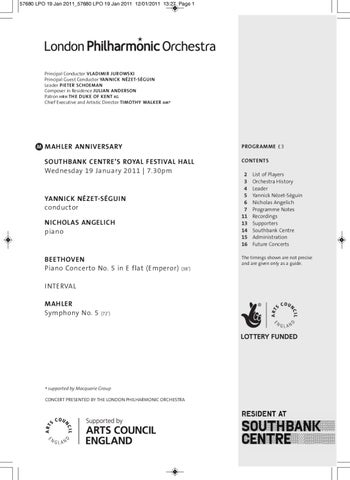
Principal Conductor VLADIMIR JUROWSKI Principal Guest Conductor YANNICK NÉZET-SÉGUIN Leader PIETER SCHOEMAN Composer in Residence JULIAN ANDERSON Patron HRH THE DUKE OF KENT KG Chief Executive and Artistic Director TIMOTHY WALKER
AM†
MAHLER ANNIVERSARY
PROGRAMME £3
SOUTHBANK CENTRE’S ROYAL FESTIVAL HALL Wednesday 19 January 2011 | 7.30pm
CONTENTS
YANNICK NÉZET-SÉGUIN conductor NICHOLAS ANGELICH piano
BEETHOVEN Piano Concerto No. 5 in E flat (Emperor)
†
List of Players Orchestra History Leader Yannick Nézet-Séguin Nicholas Angelich Programme Notes Recordings Supporters Southbank Centre Administration Future Concerts
The timings shown are not precise and are given only as a guide. (38’)
INTERVAL MAHLER Symphony No. 5
2 3 4 5 6 7 11 13 14 15 16
(72’)
supported by Macquarie Group
CONCERT PRESENTED BY THE LONDON PHILHARMONIC ORCHESTRA
57680 LPO 19 Jan 2011_57680 LPO 19 Jan 2011 12/01/2011 13:27 Page 2
LONDON PHILHARMONIC ORCHESTRA
FIRST VIOLINS Pieter Schoeman* Leader Vesselin Gellev Sub-Leader Chair supported by John and Angela Kessler
Ji Hyun Lee Katalin Varnagy Catherine Craig Thomas Eisner Tina Gruenberg Martin Hรถhmann Chair supported by Richard Karl Goeltz
Geoffrey Lynn Robert Pool Sarah Streatfeild Yang Zhang Rebecca Shorrock Peter Nall Galina Tanney Caroline Sharp SECOND VIOLINS Clare Duckworth Principal Chair supported by Richard and Victoria Sharp
Jeongmin Kim Joseph Maher Kate Birchall Chair supported by David and Victoria Graham Fuller
Nancy Elan Fiona Higham Marie-Anne Mairesse Ashley Stevens Dean Williamson Sioni Williams Heather Badke Peter Graham Stephen Stewart Mila Mustakova VIOLAS Alexander Zemtsov* Principal Chair supported by The Tsukanov Family
Robert Duncan Katharine Leek Susanne Martens
Benedetto Pollani Emmanuella Reiter-Bootiman Laura Vallejo Isabel Pereira Miranda Davis Sarah Malcolm Daniel Cornford Anthony Byrne CELLOS Susanne Beer Principal Francis Bucknall Laura Donoghue Santiago Sabino Carvalho + Jonathan Ayling Chair supported by Caroline, Jamie and Zander Sharp
Gregory Walmsley Sue Sutherley Susanna Riddell Tom Roff Helen Rathbone DOUBLE BASSES Kevin Rundell* Principal Tim Gibbs Co-Principal Laurence Lovelle George Peniston Richard Lewis Kenneth Knussen Joe Melvin Tom Walley FLUTES Susan Thomas* Principal Eilidh Gillespie Stewart McIlwham* Marta Santamaria PICCOLOS Stewart McIlwham* Principal Marta Santamaria OBOES Ian Hardwick Principal Angela Tennick Sue Bohling
COR ANGLAIS Sue Bohling Principal Chair supported by Julian and Gill Simmonds
CLARINETS Robert Hill* Principal Nicholas Carpenter Paul Richards E FLAT CLARINET Nicholas Carpenter Principal BASS CLARINET Paul Richards Principal
TUBA Lee Tsarmaklis Principal TIMPANI Simon Carrington* Principal PERCUSSION Rachel Gledhill Principal Andrew Barclay* Co-Principal Chair supported by Andrew Davenport
Keith Millar Ignacio Molins HARP Rachel Masters* Principal
BASSOONS John Price Principal Gareth Newman* Simon Estell CONTRA BASSOON Simon Estell Principal HORNS John Ryan Principal Martin Hobbs Adrian Uren Gareth Mollison Stephen Nicholls Marcus Bates Anthony Chidell TRUMPETS Paul Beniston* Principal Anne McAneney* Chair supported by Geoff and Meg Mann
Nicholas Betts Co-Principal Daniel Newell David Hilton TROMBONES Mark Templeton* Principal David Whitehouse BASS TROMBONE Lyndon Meredith Principal
* Holds a professorial appointment in London +
Chevalier of the Brazilian Order of Rio Branco
Chair Supporters The London Philharmonic Orchestra also acknowledges the following chair supporters whose player is not present at this concert: Simon Yates and Kevin Roon
2 | London Philharmonic Orchestra
57680 LPO 19 Jan 2011_57680 LPO 19 Jan 2011 12/01/2011 13:27 Page 3
LONDON PHILHARMONIC ORCHESTRA
Patrick Harrison
Seventy-eight years after Sir Thomas Beecham founded the London Philharmonic Orchestra, it is recognised today as one of the finest orchestras on the international stage. Following Beecham’s influential founding tenure the Orchestra’s Principal Conductorship has been passed from one illustrious musician to another, amongst them Sir Adrian Boult, Bernard Haitink, Sir Georg Solti, Klaus Tennstedt and Kurt Masur. This impressive tradition continued in September 2007 when Vladimir Jurowski became the Orchestra’s Principal Conductor and, in a further exciting move, the Orchestra appointed Yannick Nézet-Séguin its new Principal Guest Conductor from September 2008. The London Philharmonic Orchestra has been performing at Southbank Centre’s Royal Festival Hall since it opened in 1951, becoming Resident Orchestra in 1992. It plays there around 40 times each season with many of the world’s most sought after conductors and soloists. Concert highlights in 2010/11 include an exploration of Mahler’s symphonies and complete song cycles during the composer’s anniversary season; the premières of works by Matteo D’Amico, Magnus Lindberg and Brett Dean; a rare opportunity to hear Rossini’s opera Aureliano in Palmira in collaboration with long term partner Opera Rara; and works by the Orchestra’s new Composer in Residence, Julian Anderson. In addition to its London season and a series of concerts at Wigmore Hall, the Orchestra has flourishing
residencies in Brighton and Eastbourne, and performs regularly around the UK. It is unique in combining these concert activities with esteemed opera performances each summer at Glyndebourne Festival Opera where it has been the Resident Symphony Orchestra since 1964. The London Philharmonic Orchestra performs to enthusiastic audiences all round the world. In 1956 it became the first British orchestra to appear in Soviet Russia and in 1973 made the first ever visit to China by a Western orchestra. Touring continues to form a significant part of the Orchestra’s schedule and is supported by Aviva, the International Touring Partner of the London Philharmonic Orchestra. Tours in 2010/11 include visits to Finland, Germany, South Korea, Spain, France, Belgium and Luxembourg. Having long been embraced by the recording, broadcasting and film industries, the London Philharmonic Orchestra broadcasts regularly on domestic and international television and radio. It also works with the Hollywood and UK film industries, recording soundtracks for blockbuster motion pictures including the Oscar-winning score for The Lord of the Rings trilogy and scores for Lawrence of Arabia, The Mission, Philadelphia and East is East. The London Philharmonic Orchestra made its first recordings on 10 October 1932, just three days after its first public performance. It has recorded and broadcast
London Philharmonic Orchestra | 3
57680 LPO 19 Jan 2011_57680 LPO 19 Jan 2011 12/01/2011 13:27 Page 4
LONDON PHILHARMONIC ORCHESTRA
PIETER SCHOEMAN
regularly ever since, and in 2005 established its own record label. The recordings on its own label are taken mainly from live concerts given with distinguished conductors over the years including the Orchestra’s Principal Conductors from Beecham and Boult, through Haitink, Solti and Tennstedt, to Masur and Jurowski. Recent additions to the catalogue have included acclaimed releases of Christmas choral music conducted by Vladimir Jurowski, Bruckner’s Symphony No. 6 conducted by Christoph Eschenbach, Verdi’s Requiem conducted by Jesús López-Cobos, Holst’s The Planets conducted by Vladimir Jurowski and Elgar’s Symphony No. 1 and Sea Pictures with Vernon Handley and Janet Baker. The Orchestra’s own-label CDs are also widely available to download. Visit www.lpo.org.uk/shop for the latest releases.
‘ … a simply tremendous performance of Mahler’s 3rd Symphony … Jurowski and his players plunged us into a winter of discontent so profoundly expectant that even the inveterate coughers were silenced.’ EDWARD SECKERSON, THE INDEPENDENT, 23 SEPTEMBER 2010
The Orchestra reaches thousands of Londoners through its rich programme of community and school-based activity in Lambeth, Lewisham and Southwark, which includes the offshoot ensembles Renga and The Band, its Foyle Future Firsts apprenticeship scheme for outstanding young instrumentalists, and regular family and schools concerts. To help maintain its high standards and diverse workload, the Orchestra is committed to the welfare of its musicians and in December 2007 received the Association of British Orchestras/Musicians Benevolent Fund Healthy Orchestra Bronze Charter Mark. There are many ways to experience and stay in touch with the Orchestra’s activities: visit www.lpo.org.uk, subscribe to our podcast series, download our iPhone application and join us on Facebook and Twitter.
4 | London Philharmonic Orchestra
In 2002, Pieter Schoeman joined the London Philharmonic Orchestra as Co-Leader. He was appointed Leader in 2008. Born in South Africa, he made his solo debut with the Cape Town Symphony Orchestra at the age of ten. He studied with Jack de Wet in South Africa, winning numerous competitions, including the 1984 World Youth Concerto Competition in America. In 1987 he was offered the Heifetz Chair of Music scholarship to study with Eduard Schmieder in Los Angeles and in 1991 his talent was spotted by Pinchas Zukerman who recommended that he move to New York to study with Sylvia Rosenberg. In 1994 he became her teaching assistant at Indiana University, Bloomington. Pieter Schoeman has performed as a soloist and recitalist throughout the world in such famous halls as the Concertgebouw in Amsterdam, Moscow’s Rachmaninov Hall, Capella Hall in St Petersburg, Staatsbibliothek in Berlin, Hollywood Bowl in Los Angeles and Southbank Centre's Queen Elizabeth Hall in London. As a chamber musician he regularly performs at London’s prestigious Wigmore Hall. As a soloist with the London Philharmonic Orchestra, he has performed Arvo Pärt’s Double Concerto with Boris Garlitsky and Benjamin Britten’s Double Concerto with Alexander Zemtsov, which was recorded and released on the Orchestra’s own record label to great critical acclaim. Last October he performed the Brahms Double Concerto with Kristina Blaumane. In 1995 Pieter Schoeman became Co-Leader of the Orchestre Philharmonique de Nice. Since then he has performed frequently as Guest Leader with the symphony orchestras of Barcelona, Bordeaux, Lyon and Baltimore as well as the BBC Symphony Orchestra. This season he has been invited to lead the Rotterdam Philharmonic Orchestra on several occasions. Pieter Schoeman has recorded numerous violin solos with the London Philharmonic Orchestra for Chandos, Opera Rara, Naxos, X5, the BBC and for American film and television. He led the Orchestra in its soundtrack recordings for The Lord of the Rings trilogy. He teaches at Trinity College of Music in London.
Patrick Harrison
LEADER
57680 LPO 19 Jan 2011_57680 LPO 19 Jan 2011 12/01/2011 13:27 Page 5
YANNICK NÉZET-SÉGUIN
Marco Borggreve
CONDUCTOR
At 35 years old, Yannick Nézet-Séguin is one of the most highly respected and sought-after conductors on today’s international classical music scene and has been widely praised by audiences, critics and artists alike for his musicianship, dedication and charisma. He is Music Director of the Rotterdam Philharmonic Orchestra and in June 2010 was appointed Music Director Designate of the Philadelphia Orchestra with immediate effect and will take up the full title of Music Director from the 2012/13 season. He is also Principal Guest Conductor of the London Philharmonic Orchestra and Artistic Director and Principal Conductor of the Orchestre Métropolitain (Montreal). A native of Montreal, Yannick Nézet-Séguin has conducted all of the major Canadian orchestras. Since his European debut in 2004, he has appeared regularly with many of Europe’s leading orchestras including the Dresden Staatskapelle, Orchestre National de France, Royal Stockholm Philharmonic Orchestra and Chamber Orchestra of Europe. In 2009, he made his BBC Proms debut with the Scottish Chamber Orchestra. Recent conducting highlights have included highly successful tours of the Far East and North America with the Rotterdam Philharmonic, as well as his debuts with the Berlin Philharmonic, Vienna Philharmonic (at the 2010 Salzburg Mozartwoche), Zürich Tonhalle, Philadelphia, Boston Symphony and Los Angeles Philharmonic Orchestras. A notable operatic conductor, Yannick Nézet-Séguin made his critically acclaimed Metropolitan Opera debut in December 2009 with a new production of Bizet’s Carmen and has just returned for a new production of Verdi’s Don Carlo. For Netherlands Opera he has
conducted Janáček's The Makropoulos Case and Puccini’s Turandot with the Rotterdam Philharmonic. In summer 2010, he returned to the Salzburg Festival to conduct the Vienna Philharmonic in Mozart’s Don Giovanni as well as a revival of his 2008 production of Gounod’s Roméo et Juliette with the Mozarteum Orchester Salzburg. In addition to his regular orchestral commitments, the second half of his 2010/11 season will include a tour with the Chamber Orchestra of Europe which culminates in a performance at the Salzburg Mozartwoche in late January 2011, and debuts with the Chicago Symphony, Bayerischer Rundfunk (Munich) and Leipzig Gewandhaus Orchestras. He makes his house debut at the Teatro alla Scala, Milan, conducting Roméo et Juliette, returns to Montreal Opera for Salome and conducts the Mahler Chamber Orchestra in a production of Don Giovanni in Baden-Baden. He will make his debut at the Royal Opera House, Covent Garden, in 2011/12. Yannick Nézet-Séguin’s first three Rotterdam Philharmonic recordings on the EMI/Virgin label, all released during the 2009/10 season, comprise an Edison Award-winning album of Ravel’s orchestral works, the Beethoven and Korngold Violin Concertos with violinist Renaud Capuçon, and Fantasy: A Night at the Opera with flautist Emmanuel Pahud. Future releases include Berlioz’s Symphonie fantastique and La Morte de Cléopâtre for BIS Records. His discography also includes several award-winning recordings with the Orchestre Métropolitain on the ATMA Classique label. Yannick Nézet-Séguin studied piano, conducting, composition and chamber music at the Conservatoire de musique du Québec in Montreal, and continued his studies with renowned conductors, most notably the Italian maestro Carlo Maria Giulini. His honours include a prestigious Royal Philharmonic Society Award, the Virginia-Parker Award from the Canada Council in 2000, numerous Prix Opus from the Conseil québécois de la musique, and Canada’s highly coveted National Arts Centre Award.
London Philharmonic Orchestra | 5
57680 LPO 19 Jan 2011_57680 LPO 19 Jan 2011 12/01/2011 13:27 Page 6
NICHOLAS ANGELICH
Stéphane de Bourgies
PIANO
Born in the United States in 1970, Nicholas Angelich began studying the piano at the age of five with his mother. At seven, he gave his first concert playing Mozart’s Piano Concerto K467. When he was 13 he entered the Conservatoire National Supérieur de Musique in Paris where he studied with Aldo Ciccolini, Yvonne Loriod, Michel Beroff and Marie Françoise Bucquet, winning the First Prize for piano and chamber music. Nicholas Angelich attended masterclasses with Leon Fleisher, Dmitri Bashkirov and Maria João Pires. In 1989 he won Second Prize at the Robert Casadesus International Piano Competition in Cleveland and in 1994 First Prize at the Gina Bachauer International Piano Competition. In 2002 he received the ‘International Klavierfestival Ruhr – Young Talent Award’ from Leon Fleischer. In 2003, he made his debut with the New York Philharmonic under Kurt Masur at the Lincoln Center in New York. Vladimir Jurowski invited him to join him in opening the 2007/08 season of the Russian National Orchestra in Moscow. He has also performed with the Orchestre National de France under Marc Minkowski and Joseph Pons, Orchestre Philharmonique de Radio France and Paavo Järvi, Orchestre National de Lyon and David Robertson, Orchestre Philharmonique de MonteCarlo under Jesús López-Cobos and Kenneth Montgomery, St Petersburg Symphony under Alexander Dimitriev, Toulouse Orchestra under Jaap van Zweden in Amsterdam and Yannick Nézet-Séguin in San Sebastian, Orchestre de Chambre de Lausanne and Christian Zacharias, Stuttgart Radio Orchestra and Roger Norrington, Rotterdam Philharmonic Orchestra and Orchestre Métropolitain de Montréal with Yannick
6 | London Philharmonic Orchestra
Nézet-Séguin, Seoul Philharmonic Orchestra under Myung-Whun Chung, London Philharmonic Orchestra under Kazushi Ono and Vladimir Jurowski, Swedish Radio Orchestra and Daniel Harding and Los Angeles Symphony with Stephane Denève. He has given recitals in London, Munich, Geneva, Amsterdam, Brussels, Luxembourg, Rome, Lisbon, Brescia, Tokyo and Paris, and is a regular guest at the Verbier Festival and Martha Argerich’s festival in Lugano. He made his debut at the BBC Proms in July 2009 with the Scottish Chamber Orchestra and Yannick Nézet-Séguin. A great interpreter of the classical and romantic repertoire, Nicholas Angelich has played all Beethoven’s Sonatas and Liszt’s Années de Pélerinage in several countries. He is also very interested in 20th century composers such as Rachmaninov, Prokofiev, Shostakovich, Bartók, Ravel, Messiaen, Stockhausen, Boulez, Eric Tanguy and Pierre Henry, who dedicated his Concerto for piano without orchestra to him. A keen chamber musician, Nicholas Angelich has played with Gautier and Renaud Capuçon, Maxim Vengerov, Akiko Suwanai, Dmitry Sitkovetsky, Joshua Bell, Gérard Caussé, Daniel Müller-Schott, Jian Wang and Paul Meyer as well as with the Ysaÿe, Prazak and Ebène Quartets. His recordings include a Rachmaninov recital for Harmonia Mundi, a Ravel recital for Lyrinx, Liszt’s Années de Pélerinage for Mirare and a Beethoven recital with Akiko Suwanai for Decca. For Virgin Classics, he recorded a Brahms cycle comprising Trios with Renaud and Gautier Capuçon (which won the Preis der deutschen Schallplattenkritik), Sonatas for violin and piano with Renaud Capuçon (which won a Diapason d’Or) and two recitals. He has also recorded Brahms’s Piano Concertos Nos 1 and 2 with Paavo Järvi and the Frankfurt Radio Orchestra for Virgin Classics.
57680 LPO 19 Jan 2011_57680 LPO 19 Jan 2011 12/01/2011 13:27 Page 7
PROGRAMME NOTES
SPEEDREAD A hundred years after their composer’s death, and despite a slow first few decades, Mahler’s symphonies have never been higher in the public esteem – indeed they are now a ubiquitous presence on the concert scene. The complex, sometimes bafflingly contradictory Fifth, cherished for its famously beautiful Adagietto, is among the most frequently performed of all of them.
Ludwig van BEETHOVEN
Beethoven’s Fifth Piano Concerto was his last, marking both the end of his own career as a concert pianist (with increasing deafness making public performance with other musicians impossible, this was the first piano concerto that he did not première himself), and the achievement of a new level of heroic grandeur for the concerto form.
PIANO CONCERTO NO. 5 IN E FLAT, OP. 73 (EMPEROR) NICHOLAS ANGELICH piano Allegro | Adagio un poco mosso – | Rondo: Allegro
1770-1827
One has to wonder whether the organisers of the concert at which Beethoven’s Fifth Piano Concerto received its Viennese première in February 1812 – the actual première having taken place in Leipzig the previous November – provided the ideal audience. A contemporary report of the combined concert and art exhibition mounted by the Society of Noble Ladies for Charity tells us that ‘the pictures offer a glorious treat; a new pianoforte concerto by Beethoven failed’. And it is true that, while it was later to become as familiar a piano concerto as any, in its early years the ‘Emperor’ struggled for popularity. Perhaps its leonine strength and symphonic sweep were simply too much for everyone, not just the Noble Ladies. Cast in the same key as the ‘heroic’ Third Symphony, it breathes much the same majestically confident air, though in a manner one could describe as more macho. Composed in the first few months of 1809, with war brewing between Austria and France, this is Beethoven in what must have seemed overbearingly optimistic mood. The Concerto is certainly not reticent about declaring itself. The first movement opens with extravagant flourishes from the piano punctuated by stoic orchestral chords, leading us with unerring sense of direction
towards the sturdy first theme. This march-like tune presents two important thematic reference-points in the shape of a melodic turn and a tiny figure of just two notes (a long and a short) which Beethoven refers to constantly in the course of the movement. The latter ushers in the chromatic scale with which the piano reenters, and the same sequence of events later serves to introduce the central development section. Here the turn dominates, dreamily passed around the woodwind, but the two-note figure emerges ever more strongly, eventually firing off a stormy tirade of piano octaves. The air quickly clears, however, and reappearances of the turn lead back to a recapitulation of the opening material. Towards the end of the movement Beethoven makes his most radical formal move. In the early nineteenth century it was still customary at this point in a concerto for the soloist to improvise a solo passage (or cadenza), but in this work Beethoven for the first time includes one which is not only fully written-out, but involves the orchestra as well. It was an innovation that many subsequent composers, glad of the extra control it allowed them, would adopt. The second and third movements together take less time to play than the first. The Adagio, distant in
London Philharmonic Orchestra | 7
57680 LPO 19 Jan 2011_57680 LPO 19 Jan 2011 12/01/2011 13:27 Page 8
PROGRAMME NOTES
B major, opens with a serene, hymn-like tune from the strings, which the piano answers with a theme of its own before itself taking up the opening one in ornamented form. This in turn leads to an orchestral reprise of the same theme, now with greater participation from the winds and with piano decoration. At the end, the music dissolves, then eerily drops down a semitone as the piano toys idly with some quiet, thickly scored chords. In a flash, these are then transformed and revealed to be the main theme of the bouncy Rondo finale, which has followed without a break. Physical joins between movements were a trend in Beethoven’s music at this time, but so too were thematic ones. At one point in this finale, with the main theme firmly established, the strings gently put forward the ‘experimental’ version from the end of the slow
movement, as if mocking the piano’s earlier tentativeness. The movement approaches its close, however, with piano and timpani in stealthy cahoots before, with a final flurry, the end is upon us. The Concerto’s nickname was not chosen by Beethoven, and, given the composer’s angry reaction to Napoleon’s self-appointment as Emperor in 1804, it may seem more than usually inappropriate. Yet there is an appositeness to it if we take the music’s grandly heroic stance as a picture of what, perhaps, an emperor ought to be. Beethoven once remarked that if he had understood the arts of war as well as he had those of music, he could have defeated Napoleon. Who, listening to this concerto, could doubt that?
INTERVAL 20 minutes An announcement will be made five minutes before the end of the interval.
LONDON PHILHARMONIC ORCHESTRA RECORDING ARCHIVE The New Year may be a good time to sort through your collection of London Philharmonic Orchestra recordings. If seasonal gifts or indulgent shopping have resulted in a shelf space problem, we would be delighted to help out by taking any recordings you now feel you could part with. Last year we received some splendid windfalls from two generous supporters, whose gifts have filled in some of the gaps in our Recording Archive but there is still quite a long way to go. So, if you have any recordings that you think may be of interest, please get in touch with Gillian Pole at the London Philharmonic Orchestra, 89 Albert Embankment, London SE1 7TP.
8 | London Philharmonic Orchestra
57680 LPO 19 Jan 2011_57680 LPO 19 Jan 2011 12/01/2011 13:27 Page 9
PROGRAMME NOTES
Gustav MAHLER
SYMPHONY NO. 5
1860-1911
Part I Trauermarsch: In gemessenem Schritt. Streng. Wie ein Kondukt [Funeral March: At a measured pace. Strict. Like a cortège] Stürmisch bewegt. Mit grösster Vehemenz [Tempestuously. With utmost vehemence] Part II Scherzo: Kräftig, nicht zu schnell [Sturdy, not too fast] Part III Adagietto: Sehr langsam [Very slow] Rondo-Finale: Allegro – Allegro giocoso
spiritual journey; rather, the Fifth forces them to jostle side-by-side in an almost schizophrenic work in which, as the great Mahler commentator Deryck Cooke has described, ‘the most tragic and the most joyful worlds of feeling are separated from one another entirely, and only bound together by Mahler’s unmistakable personality and his command of large-scale symphonic construction.’ One of the benefits of Mahler’s strong structural grip was that it gave him the confidence to approach every one of his symphonies on its own architectural terms. The Fifth Symphony employs a unique format in which five movements are grouped into three parts, a long central Scherzo being framed by two pairs of movements, each of which in turn is based on shared material, as if deliberately presenting alternative treatments of the same subject. Further unity is provided by the reappearance of material from the second movement at the climax of the Fifth.
‘My dear friend’, Mahler once told his friend and conducting protégé Bruno Walter, ‘I used to possess certainty, but I lost it again. I will regain it tomorrow and lose it once more the day after.’ Changeableness and inner conflict are indeed important facets of Mahler’s creative personality, but perhaps few of his works so consistently leave us unsure of what is to The symphony begins with a movement with the come next, of where the overall trajectory is taking us, unequivocal title of ‘Funeral March’, in which attempts as the Fifth Symphony. This is not to say that its to climb towards optimistic expression are weighed separate messages are unclear: Mahler composed the work at his off-season retreat by the Wörthersee lake in down by a combination of sheer gravity and the fateful the summers of 1901 and 1902, and the world of nature rhythm stated in the trumpet’s first notes. Soon after the opening fanfares a yearning string melody makes an is present, almost overwhelmingly so, in the thirdappearance, eventually winning for itself a lyrical movement Scherzo. But the period of the Fifth’s composition also brought two hugely significant events extension, but just as that seems to be attaining a measure of peace it is snuffed out, this time by its own in Mahler’s life in the form of his first personal brush nightmarish transformation into a cruel whirling dance. with mortality thanks to a near-fatal haemorrhage in After this episode the music winds down again. At the February 1901, and his marriage to Alma Schindler (by then already pregnant with their first child) in March 1902, and so it is that death, marital love and exuberant joy ‘No composer matches Mahler’s relentlessness in are also major presences here. Yet putting up and knocking down propositions unlike Mahler’s other symphonies, this simultaneously. Next to nothing is taken on trust.’ one does not mould these elements JONATHAN CARR FROM THE REAL MAHLER into some smoothly observable London Philharmonic Orchestra | 9
57680 LPO 19 Jan 2011_57680 LPO 19 Jan 2011 12/01/2011 13:27 Page 10
PROGRAMME NOTES
point when the march has been reduced to a muffled timpani beat there is a second new episode derived from the string melody, but it is in a mood of sombre quiet that the movement ends. The second movement shatters the mood in an instant. Stormy and impetuous, it nevertheless contains slower sections based on material from the first movement, in particular its two contrasted episodes. The climax comes when a brass chorale melody briefly shines out to offer hopes of victory, but no sooner has it got going in earnest than it begins to subside and the stormy music returns. Clearly the battle is not won yet, and as the music draws to an uncertain close with a final reminder of the first movement, we feel as if we are on a knife-edge. Part II is the scherzo, a title justified by its dance-like character somewhere between a waltz and a ländler, and by a clear-cut formal use of repetition which links it to the minuets and scherzos of Haydn, Mozart and Beethoven. Led by a jaunty solo horn, its atmosphere is apparently that of the outdoors, of the forest, field and mountain, and on an early draft Mahler indicated that it could be taken to represent ‘a world without gravity’ (the German word he used for gravity, Schwere, carries a double-meaning similar to that of its English equivalent). Being Mahler, however, it is never as simple as that. True, it has a bouyancy absent from the heavylegged first part of the symphony, but few could feel that this is an entirely carefree movement. The first of the five to be written, it is also an intricately detailed piece of work which cost the composer much
‘A man in the full light of day who has reached the climax of his life.’ MAHLER ON THE SCHERZO OF THE FIFTH SYMPHONY
10 | London Philharmonic Orchestra
intellectual effort: ‘The apparent confusion must, as in a Gothic cathedral, be resolved into the highest order and harmony’, he wrote to a friend. ‘It is kneaded through and through until not a grain of the mixture remains unmixed and unchanged.’ The third and final section of the symphony begins with what has become one of Mahler’s most celebrated creations. The association of the Adagietto in many people’s minds with a Mahler-lookalike Aschenbach expiring in a deckchair in Luchino Visconti’s ravishing film Death in Venice is ironic, for this is one Mahler work which is very definitely not about death. In fact it is love music of the purest kind, offered by the composer to Alma soon after their meeting as a wordless declaration which, apparently, she well understood. The Mahlers’ marriage did not always run smoothly, but nine years later when Gustav was working on the finale of the Tenth Symphony in the wake of Alma’s recent infidelity, he recalled the tender atmosphere of this Adagietto, and with it the memory of their early years together. Part III opens with some chirpy calls to attention, before launching into a giant final movement which combines elements of sonata and rondo forms and features a lopingly bucolic main theme. As in Part I there are crossreferences to the previous movement, most clearly in a suave transformation of its string melody, but a new element is also introduced in the form of passages of busy fugal counterpoint. As the momentum builds towards the end, all sorts of fragments of themes we have heard are reshaped and thrown together, until at last the brass chorale which never quite made it into the sun in the second movement bursts out in full splendour. This time it cannot be stopped, the mood is triumphant at last, and a joyous celebratory coda hastens the music to an exhilarating finish. Programme notes © Lindsay Kemp
57680 LPO 19 Jan 2011_57680 LPO 19 Jan 2011 12/01/2011 13:27 Page 11
MAHLER RECORDINGS ON THE LONDON PHILHARMONIC ORCHESTRA’S OWN RECORD LABEL LPO-0012 Klaus Tennstedt conducts Mahler’s Symphony No. 1 and Songs of a Wayfarer with Thomas Hampson ‘... a stirring account, with his tight control causing Mahler’s climactic outbursts – both joyous and nostalgic – to hit home potently ... The LPO’s lead bassist tackling Mahler’s minor-key overhaul of ‘Frère Jacques’ is fittingly melancholic, while the finale is packed with energy and bracing inevitability.’ CLASSIC FM MAGAZINE
LPO-0044 Klaus Tennstedt conducts Mahler’s Symphony No. 2 ‘This live version of the Resurrection is frequently startling – extremely expansive but exciting, dramatic and highly charismatic …The playing and singing are excellent, and the recording, made by the Music Performance Research Centre, is near-faultless.’ GRAHAM RICKSON, THE ARTS DESK, 22 MARCH 2010 VOTED ONE OF THE TEN BEST CLASSICAL MUSIC CDS OF 2010 BY THE WASHINGTON POST
LPO-0033 Jaap van Zweden conducts Mahler’s Symphony No. 5 ‘He unfolds the drama of the first movement with a sure grasp of the need for subtle variations of tempo … the finale is a joyous, life-affirming rondo that lifts the spirits.’ MICHAEL KENNEDY, THE SUNDAY TELEGRAPH, 10 AUGUST 2008
LPO-0038 Klaus Tennstedt conducts Mahler’s Symphony No. 6 ‘This live recording of a 1983 performance of Mahler’s Sixth Symphony might not be at the cutting edge of modern digital technology, but musically it sweeps away everything before it.’ CLASSIC FM MAGAZINE
The recordings may be downloaded in high quality MP3 format from www.lpo.org.uk/shop. CDs may also be purchased from all good retail outlets or through the London Philharmonic Orchestra: telephone 020 7840 4242 (Mon-Fri 10am-5pm) or visit the website www.lpo.org.uk
London Philharmonic Orchestra | 11
57680 LPO 19 Jan 2011_57680 LPO 19 Jan 2011 12/01/2011 13:27 Page 12
international piano series 2010/11
Maurizio Pollini © Karen Robinson
SERGIO TIEMPO Tuesday 15 March 2011
THE POLLINI PROJECT
ANGELA HEWITT
Maurizio Pollini’s pilgrimage through seminal piano music from Bach to Modernism.
Tuesday 29 March 2011
Friday 28 January 2011 Bach
MARC-ANDRÉ HAMELIN Wednesday 13 April 2011
Tuesday 15 February 2011 Beethoven
Saturday 26 February 2011 Schubert
Friday 29 April 2011
CHARLES ROSEN
Chopin, Debussy and Boulez
Talk: Saturday 14 May 2011 Concert: Sunday 15 May 2011
Wednesday 25 May 2011
LANG LANG
Series discounts available if you book for more than one concert.
Tuesday 17 May 2011
Schumann, Stockhausen and Chopin
Tickets £9–£55
INGRID FLITER Tuesday 7 June 2011
12 | London Philharmonic Orchestra
0844 847 9929 SOUTHBANKCENTRE.CO.uk
57680 LPO 19 Jan 2011_57680 LPO 19 Jan 2011 12/01/2011 13:27 Page 13
We would like to acknowledge the generous support of the following Thomas Beecham Group Patrons, Principal Benefactors and Benefactors: Thomas Beecham Group Mr & Mrs Richard & Victoria Sharp Julian & Gill Simmonds The Tsukanov Family Simon Yates & Kevin Roon
Guy & Utti Whittaker
Commander Vincent Evans Mr Daniel Goldstein Mrs Barbara Green Oliver Heaton Peter MacDonald Eggers Mr & Mrs David Malpas Andrew T Mills Mr Maxwell Morrison Mr Michael Posen Mr & Mrs Thierry Sciard Mr John Soderquist & Mr Costas Michaelides Mr & Mrs G Stein Mr & Mrs John C Tucker Howard & Sheelagh Watson Mr Laurie Watt Mr Anthony Yolland
Principal Benefactors Mark & Elizabeth Adams Jane Attias Lady Jane Berrill Desmond & Ruth Cecil Mr John H Cook Mrs Sonja Drexler Mr Charles Dumas David Ellen
Benefactors Mrs A Beare Dr & Mrs Alan Carrington CBE FRS Marika Cobbold & Michael Patchett-Joyce Mr & Mrs Stewart Cohen Mr Alistair Corbett Mr David Edgecombe
Garf & Gill Collins Andrew Davenport David & Victoria Graham Fuller Richard Karl Goeltz John & Angela Kessler Mr & Mrs Makharinsky Geoff & Meg Mann Caroline, Jamie & Zander Sharp Eric Tomsett
Mr Richard Fernyhough Ken Follett Michael & Christine Henry Mr Glenn Hurstfield Mr R K Jeha Mr & Mrs Maurice Lambert Mr Gerald Levin Sheila Ashley Lewis Wg. Cdr. & Mrs M T Liddiard OBE JP RAF Mr Frank Lim Paul & Brigitta Lock Mr Brian Marsh John Montgomery Edmund Pirouet Mr Peter Tausig Mrs Kazue Turner Lady Marina Vaizey Mr D Whitelock Hon. Benefactor Elliott Bernerd Hon. Life Members Kenneth Goode Mrs Jackie Rosenfeld OBE
The generosity of our Sponsors, Corporate Members, supporters and donors is gratefully acknowledged. Corporate Members Appleyard & Trew llp AREVA UK British American Business Brown Brothers Harriman Charles Russell Destination Québec – UK Diagonal Consulting Lazard Leventis Overseas Man Group plc Québec Government Office in London Corporate Donor Lombard Street Research In-kind Sponsors Google Inc Heineken The Langham London Lindt & Sprüngli Ltd Sela / Tilley’s Sweets Villa Maria
Trusts and Foundations Allianz Cultural Foundation The Andor Charitable Trust Ruth Berkowitz Charitable Trust The Boltini Trust Borletti-Buitoni Trust Britten-Pears Foundation The Candide Charitable Trust The John S Cohen Foundation The Coutts Charitable Trust The Dorset Foundation The D’Oyly Carte Charitable Trust Dunard Fund The Equitable Charitable Trust The Eranda Foundation The Ernest Cook Trust The Fenton Arts Trust The Foyle Foundation The Jonathan & Jeniffer Harris Trust Capital Radio’s Help a London Child The Idlewild Trust The Emmanuel Kaye Foundation The Leverhulme Trust Maurice Marks Charitable Trust The Michael Marks Charitable Trust Marsh Christian Trust
UK Friends of the FelixMendelssohn-Bartholdy Foundation The Mercers’ Company Adam Mickiewicz Institute Paul Morgan Charitable Trust Maxwell Morrison Charitable Trust Musicians Benevolent Fund The R K Charitable Trust Serge Rachmaninoff Foundation The Reed Foundation The Rubin Foundation The Seary Charitable Trust The Samuel Sebba Charitable Trust Sound Connections The Stansfield Trust The Steel Charitable Trust The Bernard Sunley Charitable Foundation The Swan Trust John Thaw Foundation The Underwood Trust Garfield Weston Foundation Youth Music and others who wish to remain anonymous.
London Philharmonic Orchestra | 13
57680 LPO 19 Jan 2011_57680 LPO 19 Jan 2011 12/01/2011 13:27 Page 14
SOUTHBANK CENTRE
WELCOME TO SOUTHBANK CENTRE
A few points to note for your comfort and enjoyment: PHOTOGRAPHY is not allowed in the auditorium
We hope you enjoy your visit. We have a Duty Manager available at all times. If you have any queries please ask any member of staff for assistance. Eating, drinking and shopping? Southbank Centre shops and restaurants include: Foyles, EAT, Giraffe, Strada, YO! Sushi, wagamama, Le Pain Quotidien, Las Iguanas, ping pong, Canteen, Caffè Vergnano 1882, Skylon, Concrete and Feng Sushi, as well as cafes, restaurants and shops inside Royal Festival Hall, Queen Elizabeth Hall and Hayward Gallery.
LATECOMERS will only be admitted to the auditorium if there is a suitable break in the performance RECORDING is not permitted in the auditorium without the prior consent of Southbank Centre. Southbank Centre reserves the right to confiscate video or sound equipment and hold it in safekeeping until the performance has ended MOBILES, PAGERS AND WATCHES should be switched off before the performance begins
If you wish to get in touch with us following your visit please contact Kenelm Roberts, our Head of Customer Relations, at Southbank Centre, Belvedere Road, London SE1 8XX or email customer@southbankcentre.co.uk or phone 020 7960 4250. We look forward to seeing you again soon.
Hear every note
Hard of hearing? Visit the cloakroom for equipment to improve your concert experience.
Download London Philharmonic Orchestra recordings from www.lpo.org.uk/shop It’s easy to take the London Philharmonic Orchestra with you wherever you go! Visit our downloads site to choose the works (or even single movements) you’d like to buy, and download high quality MP3s to your computer for transfer to an MP3 player or CD. With regular additions of new recordings with conductors from Beecham to Jurowski you’ll always have a selection of great music to choose from.
14 | London Philharmonic Orchestra
57680 LPO 19 Jan 2011_57680 LPO 19 Jan 2011 12/01/2011 13:27 Page 15
ADMINISTRATION
BOARD OF DIRECTORS
GENERAL ADMINISTRATION
ORCHESTRA PERSONNEL
ARCHIVES
Martin Höhmann Chairman Stewart McIlwham Vice-Chairman Sue Bohling Simon Carrington Lord Currie* Jonathan Dawson* Anne McAneney George Peniston Sir Bernard Rix* Kevin Rundell Sir Philip Thomas* Sir John Tooley* The Rt Hon. Lord Wakeham DL* Timothy Walker AM †
Timothy Walker AM † Chief Executive and Artistic Director
Andrew Chenery Orchestra Personnel Manager
Edmund Pirouet Consultant
Sarah Thomas Librarian
Philip Stuart Discographer
Michael Pattison Stage Manager
Gillian Pole Recordings Archive
*Non-Executive Directors
THE LONDON PHILHARMONIC TRUST Pehr Gyllenhammar Chairman Desmond Cecil CMG Richard Karl Goeltz Jonathan Harris CBE FRICS Dr Catherine C. Høgel Martin Höhmann Angela Kessler Clive Marks OBE FCA Victoria Sharp Julian Simmonds Timothy Walker AM † Laurence Watt AMERICAN FRIENDS OF THE LONDON PHILHARMONIC ORCHESTRA, INC. We are very grateful to the Board of the American Friends of the London Philharmonic Orchestra for its support of the Orchestra’s activities in the USA. PROFESSIONAL SERVICES Charles Russell Solicitors Crowe Clark Whitehill LLP Auditors Dr Louise Miller Honorary Doctor
Alison Atkinson Digital Projects Manager FINANCE David Burke General Manager and Finance Director David Greenslade Finance and IT Manager CONCERT MANAGEMENT Roanna Chandler Concerts Director Ruth Sansom Artistic Administrator
Camilla Begg Assistant Orchestra Personnel Manager Ken Graham Trucking Instrument Transportation (Tel: 01737 373305)
89 Albert Embankment London SE1 7TP Tel: 020 7840 4200 Fax: 020 7840 4201 Box Office: 020 7840 4242
DEVELOPMENT Nick Jackman Development Director Harriet Mesher Charitable Giving Manager
Graham Wood Concerts, Recordings and Glyndebourne Manager
Phoebe Rouse Corporate Relations Manager
Alison Jones Concerts Co-ordinator
Sarah Tattersall Corporate Relations and Events Manager
Jenny Chadwick Tours and Engagements Manager
LONDON PHILHARMONIC ORCHESTRA
www.lpo.org.uk Visit the website for full details of London Philharmonic Orchestra activities. The London Philharmonic Orchestra Limited is a registered charity No. 238045.
Melissa Van Emden Corporate Relations and Events Officer
Photographs of Beethoven and Mahler courtesy of the Royal College of Music, London.
Elisenda Ayats Development and Finance Officer
Photograph on the front cover by Patrick Harrison.
Matthew Freeman Recordings Consultant
MARKETING
Programmes printed by Cantate.
EDUCATION AND COMMUNITY PROGRAMME
Kath Trout Marketing Director
Fiona Lambert Education and Community Consultant
Ellie Dragonetti Marketing Manager
Jo Orr PA to the Executive / Concerts Assistant
Anne Findlay Education Officer Isobel Timms Community Officer Richard Mallett Education and Community Producer
Helen Boddy Marketing Co-ordinator Frances Cook Publications Manager Samantha Kendall Box Office Administrator (Tel: 020 7840 4242) Ed Weston Intern Valerie Barber Press Consultant (Tel: 020 7586 8560)
†Supported by Macquarie Group
London Philharmonic Orchestra | 15
57680 LPO 19 Jan 2011_57680 LPO 19 Jan 2011 12/01/2011 13:27 Page 16
FUTURE CONCERTS AT SOUTHBANK CENTRE’S ROYAL FESTIVAL HALL
Saturday 22 January 2011 | 7.30pm Franck Symphony in D minor Fauré Requiem
Vladimir Jurowski and Barnabas Kelemen
Yannick Nézet-Séguin conductor Sally Matthews soprano Gerald Finley bass baritone London Philharmonic Choir
MAHLER ANNIVERSARY Saturday 29 January 2011 | 7.30pm
Barlines – FREE Post-Concert Event Level 2 Foyer at Royal Festival Hall An informal discussion with Yannick Nézet-Séguin following the evening’s performance.
Sally Matthews and Gerald Finley
Ligeti Lontano Bartók Violin Concerto No. 1 Mahler Das klagende Lied (original version) Vladimir Jurowski conductor Barnabas Kelemen violin Melanie Diener soprano Christianne Stotijn mezzo soprano Michael Koenig tenor Christopher Purves baritone London Philharmonic Choir
Wednesday 26 January 2011 | 7.30pm Peter Eötvös Shadows (UK première of the orchestral version) Liszt Piano Concerto No. 2 Zemlinsky Lyric Symphony Vladimir Jurowski conductor Alexander Markovich piano Melanie Diener soprano Thomas Hampson baritone
Kurt Masur and Anne-Sophie Mutter
JTI FRIDAY SERIES Friday 4 February 2011 | 7.30pm Brahms Double Concerto for violin and cello Brahms Symphony No. 1
6.15pm–6.45pm | FREE Pre-Concert Event Royal Festival Hall Surrey University music lecturer Jeremy Barham discusses Mahler, fin-de-siècle Vienna and the avantgarde generation.
Kurt Masur conductor Anne-Sophie Mutter violin Daniel Müller-Schott cello
Barlines – FREE Post-Concert Event Level 2 Foyer at Royal Festival Hall An informal discussion with Vladimir Jurowski following the evening’s performance.
TO BOOK
Tickets £9-£38 | Premium seats £55 London Philharmonic Orchestra Ticket Office 020 7840 4242 | www.lpo.org.uk Mon-Fri 10am-5pm; no booking fee
Melanie Diener and Thomas Hampson
16 | London Philharmonic Orchestra
Southbank Centre Ticket Office | 0844 847 9920 www.southbankcentre.co.uk/lpo Daily, 9am-8pm. £2.50 telephone / £1.45 online booking fees; no fee for Southbank Centre members