57689 LPO 19 Feb 2011_57689 LPO 19 Feb 2011 07/02/2011 08:32 Page 1
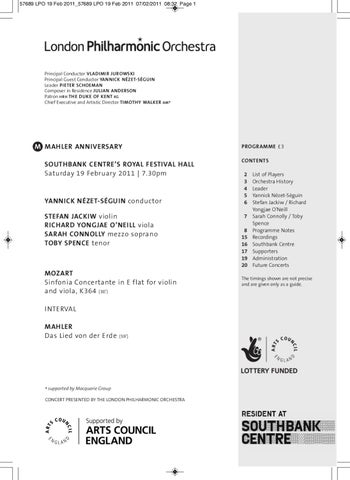
Principal Conductor VLADIMIR JUROWSKI Principal Guest Conductor YANNICK NÉZET-SÉGUIN Leader PIETER SCHOEMAN Composer in Residence JULIAN ANDERSON Patron HRH THE DUKE OF KENT KG Chief Executive and Artistic Director TIMOTHY WALKER
AM†
MAHLER ANNIVERSARY SOUTHBANK CENTRE’S ROYAL FESTIVAL HALL Saturday 19 February 2011 | 7.30pm
YANNICK NÉZET-SÉGUIN conductor STEFAN JACKIW violin RICHARD YONGJAE O’NEILL viola SARAH CONNOLLY mezzo soprano TOBY SPENCE tenor
MOZART Sinfonia Concertante in E flat for violin and viola, K364 (30’) INTERVAL MAHLER Das Lied von der Erde
†
(59’)
supported by Macquarie Group
CONCERT PRESENTED BY THE LONDON PHILHARMONIC ORCHESTRA
PROGRAMME £3 CONTENTS 2 3 4 5 6 7 8 15 16 17 19 20
List of Players Orchestra History Leader Yannick Nézet-Séguin Stefan Jackiw / Richard Yongjae O’Neill Sarah Connolly / Toby Spence Programme Notes Recordings Southbank Centre Supporters Administration Future Concerts
The timings shown are not precise and are given only as a guide.
57689 LPO 19 Feb 2011_57689 LPO 19 Feb 2011 07/02/2011 08:32 Page 2
LONDON PHILHARMONIC ORCHESTRA
FIRST VIOLINS Pieter Schoeman* Leader Vesselin Gellev Sub-Leader Chair supported by John and Angela Kessler
Ji-Hyun Lee Katalin Varnagy Catherine Craig Thomas Eisner Tina Gruenberg Martin Hรถhmann Chair supported by Richard Karl Goeltz
Geoffrey Lynn Robert Pool Sarah Streatfeild Yang Zhang Rebecca Shorrock Peter Nall Galina Tanney Caroline Sharp SECOND VIOLINS Clare Duckworth Principal Chair supported by Richard and Victoria Sharp
Jeongmin Kim Joseph Maher Kate Birchall Chair supported by David and Victoria Graham Fuller
Nancy Elan Fiona Higham Marie-Anne Mairesse Ashley Stevens Dean Williamson Sioni Williams Heather Badke Peter Graham Stephen Stewart Mila Mustakova
VIOLAS Tom Dunn Guest Principal Robert Duncan Katharine Leek Susanne Martens Benedetto Pollani Emmanuella Reiter-Bootiman Laura Vallejo Isabel Pereira Daniel Cornford Sarah Malcolm Miranda Davis Anthony Byrne CELLOS Susanne Beer Principal Francis Bucknall Laura Donoghue Santiago Sabino Carvalho + Jonathan Ayling Chair supported by Caroline, Jamie and Zander Sharp
Gregory Walmsley Sue Sutherley Susanna Riddell Tom Roff Helen Rathbone DOUBLE BASSES Kevin Rundell* Principal Tim Gibbs Co-Principal Laurence Lovelle George Peniston Richard Lewis Kenneth Knussen Joe Melvin Tom Walley FLUTES Jaime Martin* Principal Sue Thomas* Marta Santamaria
OBOES Ian Hardwick Principal Angela Tennick Sue Bohling COR ANGLAIS Sue Bohling Principal Chair supported by Julian and Gill Simmonds
CLARINETS Robert Hill* Principal Nicholas Carpenter Emily Meredith Paul Richards
BASS TROMBONE Lyndon Meredith Principal TUBA Lee Tsarmaklis Principal TIMPANI Simon Carrington* Principal PERCUSSION Rachel Gledhill Principal Andrew Barclay* Co-Principal
E FLAT CLARINET Nicholas Carpenter Principal BASS CLARINET Paul Richards Principal BASSOONS John Price Principal Gareth Newman* Simon Estell CONTRA BASSOON Simon Estell Principal
Chair supported by Andrew Davenport
Keith Millar Ignacio Molins HARPS Rachel Masters* Principal Helen Sharp CELESTE Catherine Edwards MANDOLIN Nigel Woodhouse
HORNS John Ryan Principal Martin Hobbs Adrian Uren Gareth Mollison Stephen Nicholls TRUMPETS Paul Beniston* Principal Anne McAneney* Chair supported by Geoff and Meg Mann
Daniel Newell PICCOLOS Stewart McIlwham* Principal Marta Santamaria
TROMBONES Mark Templeton* Principal David Whitehouse
* Holds a professorial appointment in London +
Chevalier of the Brazilian Order of Rio Branco
Chair Supporters The London Philharmonic Orchestra also acknowledges the following chair supporters whose player is not present at this concert: The Tsukanov Family
2 | London Philharmonic Orchestra
57689 LPO 19 Feb 2011_57689 LPO 19 Feb 2011 07/02/2011 08:32 Page 3
LONDON PHILHARMONIC ORCHESTRA
Patrick Harrison
Seventy-eight years after Sir Thomas Beecham founded the London Philharmonic Orchestra, it is recognised today as one of the finest orchestras on the international stage. Following Beecham’s influential founding tenure the Orchestra’s Principal Conductorship has been passed from one illustrious musician to another, amongst them Sir Adrian Boult, Bernard Haitink, Sir Georg Solti, Klaus Tennstedt and Kurt Masur. This impressive tradition continued in September 2007 when Vladimir Jurowski became the Orchestra’s Principal Conductor and, in a further exciting move, the Orchestra appointed Yannick Nézet-Séguin its new Principal Guest Conductor from September 2008. The London Philharmonic Orchestra has been performing at Southbank Centre’s Royal Festival Hall since it opened in 1951, becoming Resident Orchestra in 1992. It plays there around 40 times each season with many of the world’s most sought after conductors and soloists. Concert highlights in 2010/11 include an exploration of Mahler’s symphonies and complete song cycles during the composer’s anniversary season; the premières of works by Matteo D’Amico, Magnus Lindberg and Brett Dean; a rare opportunity to hear Rossini’s opera Aureliano in Palmira in collaboration with long term partner Opera Rara; and works by the Orchestra’s new Composer in Residence, Julian Anderson. In addition to its London season and a series of concerts at Wigmore Hall, the Orchestra has flourishing
residencies in Brighton and Eastbourne, and performs regularly around the UK. It is unique in combining these concert activities with esteemed opera performances each summer at Glyndebourne Festival Opera where it has been the Resident Symphony Orchestra since 1964. The London Philharmonic Orchestra performs to enthusiastic audiences all round the world. In 1956 it became the first British orchestra to appear in Soviet Russia and in 1973 made the first ever visit to China by a Western orchestra. Touring continues to form a significant part of the Orchestra’s schedule and is supported by Aviva, the International Touring Partner of the London Philharmonic Orchestra. Tours in 2010/11 include visits to Finland, Germany, South Korea, Spain, France, Belgium and Luxembourg. Having long been embraced by the recording, broadcasting and film industries, the London Philharmonic Orchestra broadcasts regularly on domestic and international television and radio. It also works with the Hollywood and UK film industries, recording soundtracks for blockbuster motion pictures including the Oscar-winning score for The Lord of the Rings trilogy and scores for Lawrence of Arabia, The Mission, Philadelphia and East is East. The London Philharmonic Orchestra made its first recordings on 10 October 1932, just three days after its first public performance. It has recorded and broadcast
London Philharmonic Orchestra | 3
57689 LPO 19 Feb 2011_57689 LPO 19 Feb 2011 07/02/2011 08:32 Page 4
LONDON PHILHARMONIC ORCHESTRA
PIETER SCHOEMAN
regularly ever since, and in 2005 established its own record label. The recordings on its own label are taken mainly from live concerts given with distinguished conductors over the years including the Orchestra’s Principal Conductors from Beecham and Boult, through Haitink, Solti and Tennstedt, to Masur and Jurowski. Recent additions to the catalogue have included acclaimed releases of Christmas choral music conducted by Vladimir Jurowski, Bruckner’s Symphony No. 6 conducted by Christoph Eschenbach, Verdi’s Requiem conducted by Jesús López-Cobos, Holst’s The Planets conducted by Vladimir Jurowski and Elgar’s Symphony No. 1 and Sea Pictures with Vernon Handley and Janet Baker. The Orchestra’s own-label CDs are also widely available to download. Visit www.lpo.org.uk/shop for the latest releases.
‘ … a simply tremendous performance of Mahler’s 3rd Symphony … Jurowski and his players plunged us into a winter of discontent so profoundly expectant that even the inveterate coughers were silenced.’ EDWARD SECKERSON, THE INDEPENDENT, 23 SEPTEMBER 2010
The Orchestra reaches thousands of Londoners through its rich programme of community and school-based activity in Lambeth, Lewisham and Southwark, which includes the offshoot ensembles Renga and The Band, its Foyle Future Firsts apprenticeship scheme for outstanding young instrumentalists, and regular family and schools concerts. To help maintain its high standards and diverse workload, the Orchestra is committed to the welfare of its musicians and in December 2007 received the Association of British Orchestras/Musicians Benevolent Fund Healthy Orchestra Bronze Charter Mark. There are many ways to experience and stay in touch with the Orchestra’s activities: visit www.lpo.org.uk, subscribe to our podcast series, download our iPhone application and join us on Facebook and Twitter.
4 | London Philharmonic Orchestra
In 2002, Pieter Schoeman joined the London Philharmonic Orchestra as Co-Leader. He was appointed Leader in 2008. Born in South Africa, he made his solo debut with the Cape Town Symphony Orchestra at the age of ten. He studied with Jack de Wet in South Africa, winning numerous competitions, including the 1984 World Youth Concerto Competition in America. In 1987 he was offered the Heifetz Chair of Music scholarship to study with Eduard Schmieder in Los Angeles and in 1991 his talent was spotted by Pinchas Zukerman who recommended that he move to New York to study with Sylvia Rosenberg. In 1994 he became her teaching assistant at Indiana University, Bloomington. Pieter Schoeman has performed as a soloist and recitalist throughout the world in such famous halls as the Concertgebouw in Amsterdam, Moscow’s Rachmaninov Hall, Capella Hall in St Petersburg, Staatsbibliothek in Berlin, Hollywood Bowl in Los Angeles and Southbank Centre’s Queen Elizabeth Hall in London. As a chamber musician he regularly performs at London’s prestigious Wigmore Hall. As a soloist with the London Philharmonic Orchestra, he has performed Arvo Pärt’s Double Concerto with Boris Garlitsky and Benjamin Britten’s Double Concerto with Alexander Zemtsov, which was recorded and released on the Orchestra’s own record label to great critical acclaim. Last October he performed the Brahms Double Concerto with Kristina Blaumane. In 1995 Pieter Schoeman became Co-Leader of the Orchestre Philharmonique de Nice. Since then he has performed frequently as Guest Leader with the symphony orchestras of Barcelona, Bordeaux, Lyon and Baltimore as well as the BBC Symphony Orchestra. This season he has been invited to lead the Rotterdam Philharmonic Orchestra on several occasions. Pieter Schoeman has recorded numerous violin solos with the London Philharmonic Orchestra for Chandos, Opera Rara, Naxos, X5, the BBC and for American film and television. He led the Orchestra in its soundtrack recordings for The Lord of the Rings trilogy. He teaches at Trinity College of Music in London.
Patrick Harrison
LEADER
57689 LPO 19 Feb 2011_57689 LPO 19 Feb 2011 07/02/2011 08:32 Page 5
YANNICK NÉZET-SÉGUIN
Marco Borggreve
CONDUCTOR
At 35 years old, Yannick Nézet-Séguin is one of the most highly respected and sought-after conductors on today’s international classical music scene and has been widely praised by audiences, critics and artists alike for his musicianship, dedication and charisma. He is Music Director of the Rotterdam Philharmonic Orchestra and in June 2010 was appointed Music Director Designate of the Philadelphia Orchestra with immediate effect and will take up the full title of Music Director from the 2012/13 season. He is also Principal Guest Conductor of the London Philharmonic Orchestra and Artistic Director and Principal Conductor of the Orchestre Métropolitain (Montreal). A native of Montreal, Yannick Nézet-Séguin has conducted all of the major Canadian orchestras. Since his European debut in 2004, he has appeared regularly with many of Europe’s leading orchestras including the Dresden Staatskapelle, Orchestre National de France, Royal Stockholm Philharmonic Orchestra and Chamber Orchestra of Europe. In 2009, he made his BBC Proms debut with the Scottish Chamber Orchestra. Recent conducting highlights have included highly successful tours of the Far East and North America with the Rotterdam Philharmonic, as well as his debuts with the Berlin Philharmonic, Vienna Philharmonic (at the 2010 Salzburg Mozartwoche), Zürich Tonhalle, Philadelphia, Boston Symphony and Los Angeles Philharmonic Orchestras.
conducted Janáček's The Makropoulos Case and Puccini’s Turandot with the Rotterdam Philharmonic. In summer 2010, he returned to the Salzburg Festival to conduct the Vienna Philharmonic in Mozart’s Don Giovanni as well as a revival of his 2008 production of Gounod’s Roméo et Juliette with the Mozarteum Orchester Salzburg. Last month he undertook a tour with the Chamber Orchestra of Europe which culminated in a performance at the Salzburg Mozartwoche. This season sees his debuts with the Chicago Symphony, Bayerischer Rundfunk (Munich) and Leipzig Gewandhaus Orchestras. He makes his house debut at the Teatro alla Scala, Milan, conducting Roméo et Juliette, returns to Montreal Opera for Salome and conducts the Mahler Chamber Orchestra in a production of Don Giovanni in Baden-Baden. He will make his debut at the Royal Opera House, Covent Garden, in 2011/12. Yannick Nézet-Séguin’s first three Rotterdam Philharmonic recordings on the EMI/Virgin label, all released during the 2009/10 season, comprise an Edison Award-winning album of Ravel’s orchestral works, the Beethoven and Korngold Violin Concertos with violinist Renaud Capuçon, and Fantasy: A Night at the Opera with flautist Emmanuel Pahud. Future releases include Berlioz’s Symphonie fantastique and La Mort de Cléopâtre for BIS Records. His discography also includes several award-winning recordings with the Orchestre Métropolitain on the ATMA Classique label. Yannick Nézet-Séguin studied piano, conducting, composition and chamber music at the Conservatoire de musique du Québec in Montreal, and continued his studies with renowned conductors, most notably the Italian maestro Carlo Maria Giulini. His honours include a prestigious Royal Philharmonic Society Award, the Virginia-Parker Award from the Canada Council in 2000, numerous Prix Opus from the Conseil québécois de la musique, and Canada’s highly coveted National Arts Centre Award.
A notable operatic conductor, Yannick Nézet-Séguin made his critically acclaimed Metropolitan Opera debut in December 2009 with a new production of Bizet’s Carmen and has just returned for a new production of Verdi’s Don Carlo. For Netherlands Opera he has
London Philharmonic Orchestra | 5
57689 LPO 19 Feb 2011_57689 LPO 19 Feb 2011 07/02/2011 08:32 Page 6
STEFAN JACKIW VIOLIN
RICHARD YONGJAE O’NEILL VIOLA
Born of Korean/German heritage in 1985, Stefan Jackiw began studying the violin at the age of four. His teachers have included Zinaida Gilels, Michèle Auclair and Donald Weilerstein. At the age of 14, he made a sensational debut with the Philharmonia Orchestra at the Royal Festival Hall and elsewhere in Europe he has performed with the Deutsches Sinfonieorchester Berlin, Royal Liverpool Philharmonic, Bournemouth Symphony, Orchestra del Maggio Musicale Fiorentino and Orchestre Philharmonique de Strasbourg. In 2002 he made his debut with the Baltimore Symphony Orchestra under Temirkanov and has become a regular guest with the orchestra. Elsewhere in North America he has recently performed with the New York Philharmonic, Cleveland, Boston Symphony, San Francisco Symphony and Chicago Symphony Orchestras, and worked with conductors including Sir Andrew Davis, Ludovic Morlot, James Gaffigan, Andris Nelsons, Hannu Lintu, Günther Herbig and Hans Graf. In recital Stefan Jackiw has performed at the SchleswigHolstein Music Festival with pianist Christoph Eschenbach and at the Louvre in Paris. In America he has given recitals at the Metropolitan Museum of Art in New York and at the opening night of Zankel Hall at Carnegie in New York. He is also a founding member of the Tessera Quartet. Highlights last season included concerts with the Philadelphia Orchestra and the Oregon, Toronto, Cincinnati and Seattle Symphony Orchestras as well as a US tour with the Russian National Orchestra. This season he performs with the Baltimore Symphony, Tampere Philharmonic, Real Filharmonia de Galicia and RTE National Symphony Orchestras and gives recitals throughout North America and Korea.
6 | London Philharmonic Orchestra
Richard Yongjae O’Neill is one of very few violists ever to receive an Avery Fisher Career Grant as well as a Grammy Award Nomination. He has appeared with the London Philharmonic, Los Angeles Philharmonic, Seoul Philharmonic, Korean Symphony and Moscow Chamber Orchestras with conductors including Vladimir Jurowski, Vassily Sinaisky and Yannick Nézet-Séguin. As a chamber musician he has played with Gil Shaham, Emanuel Ax and Edgar Meyer and has made solo debuts at Carnegie’s Weill and Zankel Halls, Avery Fisher Hall, Kennedy Center, Wigmore Hall, Salle Cortot and Seoul Arts Center. An advocate for the music of our time, he has collaborated with many composers including Elliott Carter, Paul Chihara, Mario Davidovsky, Oliver Knussen, Jo Kondo, Peter Lieberson, Huang Ruo, David del Tredici, Melinda Wagner, Charles Wuorinen and John Zorn, and has given premières and made recordings of their works. A Viola Concerto commissioned from Huang Ruo will be premièred this year as part of Camerata Pacifica’s Messenger Project. Richard Yongjae O’Neill has made five solo recordings that have sold well over 100,000 copies. His two most recent albums, Winter Journey for Deutsche Grammophon and Mysterioso for Archiv Produktion, have both earned him Platinum Disc Awards. A recording of Stravinsky’s Elegy for Solo Viola as well as Schoenberg's String Trio, Ode to Napoleon and Third String Quartet are due to be released this year. The first violist to receive the Artist Diploma from the Juilliard School, he holds a Bachelor of Music, magna cum laude, from the University of Southern California and a Master of Music from the Juilliard School. He plays on a fine and rare viola made by Matteo Goffriller of Venice in 1727.
57689 LPO 19 Feb 2011_57689 LPO 19 Feb 2011 07/02/2011 08:32 Page 7
SARAH CONNOLLY
TOBY SPENCE
MEZZO SOPRANO
TENOR
Born in County Durham, mezzo-soprano Sarah Connolly studied piano and singing at the Royal College of Music, of which she is now a Fellow. She was made CBE in the 2010 New Year’s Honours List. In opera, recent appearances have included the role of Purcell’s Dido at Covent Garden, La Scala Milan and La Monnaie Brussels; Komponist in Ariadne auf Naxos and Annio in La clemenza di Tito at the Metropolitan Opera, New York; the title role in Giulio Cesare and Brangäne in Tristan und Isolde at the Glyndebourne Festival; Gluck’s Orfeo and the title role in The Rape of Lucretia at the Bayerische Staatsoper, Munich; and Sesto in Giulio Cesare at the Paris Opera. Other roles have included the title role in Maria Stuarda for Opera North; Octavian in Der Rosenkavalier for Scottish Opera; and for English National Opera Handel's Agrippina, Xerxes and Ariodante, Dido in The Trojans, Susie in The Silver Tassie and Sesto in La clemenza di Tito for which she was nominated for an Olivier Award.
An honours graduate and choral scholar from New College, Oxford, Toby Spence studied at the Opera School of the Guildhall School of Music and Drama. In concert, he has sung with the Cleveland Orchestra under von Dohnányi, Berlin Philharmonic and the Vienna Philharmonic under Rattle, San Francisco Symphony under Tilson Thomas, Rotterdam Philharmonic under Gergiev, London Symphony Orchestra under Rattle and Davis, and Los Angeles Philharmonic under Dudamel, as well as at the Salzburg and Edinburgh Festivals. He has appeared in recital at the Edinburgh Festival, LSO St Lukes and Wigmore Hall, and has made numerous recordings for DG, Decca, BMG, Philips, Collins, Hyperion and EMI.
She has appeared in recital in London and New York and her concert engagements have included appearances at the Aldeburgh, Edinburgh, Salzburg and Tanglewood Festivals as well as at the BBC Proms where, in 2009, she was a memorable guest soloist at The Last Night. Other recent engagements have included performances of The Dream of Gerontius, Das Lied von der Erde, La Mort de Cléopâtre and Kindertotenlieder. She has given the world premières of Mark-Anthony Turnage’s Twice through the heart; Jonathan Harvey’s Songs of Li Po at the Aldeburgh Festival and, most recently, Sir John Tavener’s Tribute to Cavafy at Symphony Hall, Birmingham. A prolific recording artist, her many discs include Purcell’s Dido and Aeneas, Mahler’s Des Knaben Wunderhorn (winner of an Edison Award); Elgar’s Sea Pictures; and a CD of Handel arias.
For English National Opera, Toby has sung Fenton, Ferrando, Tamino, Candide and Paris in La Belle Hélène; and for The Royal Opera, Kudryash, Simpleton in Boris Godunov, Ferdinand in The Tempest, Count Almaviva and Ramiro. His many appearances with Paris Opera have included his first Tom Rakewell, a role which he has since performed in Madrid, Covent Garden and Theater an der Wien. He has also sung with Scottish Opera, Welsh National Opera, Bavarian State Opera, Netherlands Opera, Deutsche Staatsoper Berlin, San Francisco Opera and Metropolitan Opera as well as at the Glyndebourne and Santa Fe Festivals, La Monnaie in Brussels and the Châtelet in Paris. This season, Toby sings his first Faust for ENO, makes his debut with the Lyric Opera of Chicago as Nanki-Poo in The Mikado and will perform both Don Ottavio and Peter Quint for the Glyndebourne Festival. Next season, he will make his debut with the Vienna State Opera as Ferrando, sing his first Lensky for ENO and return to The Royal Opera as David in Die Meistersinger.
London Philharmonic Orchestra | 7
57689 LPO 19 Feb 2011_57689 LPO 19 Feb 2011 07/02/2011 08:32 Page 8
PROGRAMME NOTES
SPEEDREAD Most of Mozart’s greatest and most cherished masterpieces date from the last ten years of his life, spent in the conducive environment of Vienna. A handful of works from his Salzburg years, however, anticipate that later world of perfect beauty and profound expression, perhaps none more so than the matchless Sinfonia Concertante. Mahler had recently severed his professional connections with Vienna when he tried to
Wolfgang Amadeus MOZART
‘give God the slip’ (his wife’s words) by allotting his ‘Ninth’ Symphony a name – Das Lied von der Erde – but although he went on to write a ‘real’ Ninth and even start a Tenth, he died before any of them could be performed. Das Lied’s subject of implacable death might seem almost unbearably poignant, therefore, were it not for the work’s final radiant statement of belief in the eternally renewing beauty of nature.
SINFONIA CONCERTANTE IN E FLAT FOR VIOLIN AND VIOLA, K364 STEFAN JACKIW violin RICHARD YONGJAE O’NEILL viola
1756-1791
Allegro maestoso | Andante | Presto
Although Mozart’s Sinfonia Concertante for violin and viola is normally considered alongside his five violin concertos of the mid-1770s, it actually stands outside that group of works, not just chronologically but in terms of quality and emotional depth as well. We do not know why or for whom it was written, and there is no record of any performance. Neither is the date of composition entirely certain, though it probably dates from some time in the summer or autumn of 1779, a period when Mozart was particularly interested in concertos for more than one soloist, no doubt as a result of his recent visits to Paris and Mannheim, where such works were popular and where he himself had composed a Concerto for Flute and Harp and at least begun others for flute, oboe, horn and bassoon and for violin and piano.
impact on the French capital, and worse than that his mother, who had accompanied him there, died. These misfortunes, together with his humbling return home to the service of the Archbishop of Salzburg, all seem to have contributed to a new maturity and seriousness in his music, and nowhere is that better shown than in the superb Sinfonia Concertante, arguably his finest composition before his move to Vienna in 1781.
But the effects of his travels ran deeper than that: the Paris sojourn had been intended as a new start for him, an opportunity to forge a career in a city with a teeming concert life and where musicians were respected as independent professionals rather than court servants. In the end, however, he failed to make the desired
8 | London Philharmonic Orchestra
The first movement is a masterly mixture of noble strength and tender lyricism, the orchestra providing most of the former and the dialoguing soloists most of the latter; their emergence playing in octaves at the end of the opening orchestral section is a typically Mozartian marvel, as are the movement’s frequent turns to the minor. The C minor Andante is again pure Mozart; elegiac and richly beautiful, it is perhaps the single most profound movement he had yet composed, and a hint at the expressive power he would unleash in the great operas of the 1780s. The work ends, however, with a cheerful, suavely dancing and generously tuneful rondo.
57689 LPO 19 Feb 2011_57689 LPO 19 Feb 2011 07/02/2011 08:32 Page 9
PROGRAMME NOTES
INTERVAL 20 minutes An announcement will be made five minutes before the end of the interval.
Gustav MAHLER 1860-1911
The story that Mahler avoided calling Das Lied von der Erde his Ninth Symphony because he wished to cheat death, which had claimed Beethoven and Bruckner at the same stage in their careers, is a much-repeated one, and though its origins may be questionable it has the merit of plausibility. In the summer of 1907, a year after completing his gigantic, life-affirming Eighth Symphony, Mahler was staying with his family at their summer lakeside retreat at Maiernigg when he suffered the double blow of the death from scarlet fever of his elder daughter and the discovery of his own life-threatening heart condition. It was the beginning of a black period for him; ever aware of death, he was now forced even more into making an accommodation with it. Small wonder if portents of mortality gained extra strength. The summers were when Mahler did most of his composing – winters were devoted to a punishing conducting schedule – but the traumas of 1907 rendered the year creatively fruitless. That is unless we accept his widow Alma’s assertion that it was at the end of that summer that a friend gave him a copy of Die chinesische Flöte (The Chinese Flute), a small book of assorted Chinese poems, many of them ancient, gathered together in German translations by Hans Bethge. The collection may have had its faults as an academic exercise – Bethge’s ‘translations’ were in fact secondhand adaptations of other men’s work, and many of his attributions are incorrect – but it certainly touched something in Mahler. Chinoiserie was much in
DAS LIED VON DER ERDE (THE SONG OF THE EARTH) SARAH CONNOLLY mezzo soprano TOBY SPENCE tenor Das Trinklied vom Jammer der Erde | Der Einsame im Herbst | Von der Jugend | Von der Schönheit | Der Trunkene im Frühling | Der Abschied
vogue in European art at this time, but Mahler must have been drawn, too, to the poems’ highly concentrated reflections on natural beauty, the transience of human existence and the inevitable acceptance of death. When in 1908 he took up residence in a new summer home at Tolbach in the Dolomite Mountains (after a winter season which had seen his final performances as musical director at the Vienna State Opera and his first conducting engagements at the Metropolitan Opera in New York), he had already made a selection and was ready to turn them into an orchestral song-cycle. According to Alma, ‘he worked at white-heat all the summer … The scope of the composition grew as he worked. He linked up the separate poems and composed interludes, and so found himself drawn more and more to his true musical form – the symphony.’ The symphonic credentials of Das Lied are indeed strong. Its unique layout of six movements for solo voice and orchestra, with the last almost as long as the first five put together, seems not so unusual in the context of a symphonic canon which had already included much vocal music and a number of pragmatic formal designs, for instance in the Second, Third and Eighth symphonies. And while compared to those Das Lied is more like a song-cycle – the form which had dominated the earlier part of Mahler’s career – it is surely symphonic in its scope, its long-range thematic coherence and its sense of the voice as an ‘extra
London Philharmonic Orchestra | 9
57689 LPO 19 Feb 2011_57689 LPO 19 Feb 2011 07/02/2011 08:32 Page 10
PROGRAMME NOTES
instrument’ in an overall orchestral texture rather than as a tune-carrier in need of accompaniment. The orchestra for Das Lied is a rich mix, and leaps into action with immediate and full effect in the first movement, ‘Das Trinklied vom Jammer der Erde’ (‘Drinking Song of Earth’s Misery’). The solo part is high here, the orchestration thick, and the atmosphere is an almost hysterical one of forced cheerfulness, as if the tenor were drowning in awful awareness of the spoiling hand of death. The glimpse of the grave surmounted by a howling ape is terrifying, the movement’s bleak last chord like an unforgiving blow to the back of the head. The slow second movement brings a dramatic change in texture, and indeed recurrences of the noisy orchestral sounds of the first movement will be rare from now on, as extreme delicacy and precision take over. ‘Der Einsame im Herbst’ (‘Autumn Loneliness’) is sparingly scored, its winding solo winds and icy muted strings matching the cold intimacy of the poem’s imagery. The only outburst of warmth, at the words ‘Sun of love, will you never shine again?’, is snuffed out like the ‘little lamp’, the hope of one more spring answered by emptiness. The next three movements are shorter, a trio of scherzos to put thoughts of death temporarily aside. ‘Von der Jugend’ (‘Youth’) is all charm in its depiction of people drinking, talking and laughing in a porcelain
pavilion, and its gentle musical orientalisms are carried forward into the fourth movement, ‘Von der Schönheit’ (‘Beauty’), where maidens quietly picking flowers are disturbed by a passing group of horsemen who stir up their emotions (and with it, briefly, the orchestral sound-level) before disappearing to leave in their wake a nameless sense of longing. Finally, ‘Der Trunkene im Frühling’ (‘The Drunkard in Spring’) closes the sequence with a carefree, even boisterous reiteration of the opening movement’s advice to lose yourself in drink. Spring may come, it says, but who cares? Which brings us to the long final movement, ‘Der Abschied’ (‘Farewell’). At first it seems to be offering a similar picture to that of the second movement: the heightened senses of a person preparing for death. The vocal line is static, the music weighed down, haunted by intimations of a funeral march which eventually rears itself to full height in a vast and seemingly implacable orchestral development section. The mood of resignation resumes at the singer’s return, but this is not how it will end. As we ‘await the hour’, there suddenly comes realisation: natural beauty will continue; the earth is ever renewing. As the voice soars in ecstatic release, the sense of resolution is total; all is said, and this great work fades away to the serene and gentle pulse of one repeating word – ‘ewig’. Programme notes © Lindsay Kemp
1. Das Trinklied vom Jammer der Erde (Li-Tai-Po)
Drinking Song of Earth’s Misery
Schon winkt der Wein im gold’nen Pokale, Doch trinkt noch nicht, erst sing’ ich euch ein Lied! Das Lied vom Kummer soll auflachend in die Seele euch klingen. Wenn der Kummer naht, liegen wüst die Gärten der Seele, Welkt hin und stirbt die Freude, der Gesang. Dunkel ist das Leben, ist der Tod.
Wine is already sparkling in the golden goblet But do not drink yet; first I will sing you a song! The song of care shall sound laughing in your soul. When care draws near, the gardens of the soul lie waste, Joy and singing fade away and die. Dark is life; dark is death.
Herr dieses Hauses! Dein Keller birgt die Fülle des goldenen Weins! Hier, diese Laute nenn' ich mein!
Lord of this house! Your cellar holds abundance of golden wine! I call this lute here my own!
10 | London Philharmonic Orchestra
57689 LPO 19 Feb 2011_57689 LPO 19 Feb 2011 07/02/2011 08:32 Page 11
PROGRAMME NOTES
Die Laute schlagen und die Gläser leeren, Das sind die Dinge, die zusammen passen. Ein voller Becher Weins zur rechten Zeit Ist mehr wert als alle Reiche dieser Erde! Dunkel ist das Leben, ist der Tod! Das Firmament blaut ewig und die Erde Wird lange fest steh’n und aufblüh’n im Lenz. Du aber, Mensch, wie lang lebst denn du? Nicht hundert Jahre darfst du dich ergötzen An all dem morschen Tande dieser Erde! Seht dort hinab! Im Mondschein auf den Gräbern Hockt eine wild-gespenstische Gestalt – Ein Aff’ ist's! Hört ihr, wie sein Heulen Hinausgellt in den süßen Duft des Lebens! Jetzt nehmt den Wein! Jetzt ist es Zeit, Genossen! Leert eure gold’nen Becher zu Grund! Dunkel ist das Leben, ist der Tod!
To strike the lute and to drain the glasses, Those are the things which go together. A brimming cup of wine at the right time Is worth more than all the riches of this earth! Dark is life, dark is death! The heavens are ever blue and the earth Will long stand fast and blossom forth in spring. But thou, O man, how long wilt thou live? Not one hundred years may’st thou enjoy thyself With all the rotting trifles of this earth! Look down there! In the moonlight on the graves There crouches a wild and ghostly form – It is an ape! Listen, how its howling Rings out amidst the sweet scent of life! Now take up the wine! Now, friends, it is time! Drain your golden cups to the depths! Dark is life; dark is death!
2. Der Einsame im Herbst (Tchang-Tsi )
Autumn Loneliness
Herbstnebel wallen bläulich überm See; Vom Reif bezogen stehen alle Gräser; Man meint, ein Künstler habe Staub von Jade Über die feinen Blüten ausgestreut.
The autumn mists drift blue over the lake; The blades of grass stand covered with frost; One would think an artist had strewn jade-dust Over the delicate blossoms.
Der süße Duft der Blumen ist verflogen; Ein kalter Wind beugt ihre Stengel nieder. Bald werden die verwelkten, gold’nen Blätter Der Lotosblüten auf dem Wasser zieh’n.
The flowers’ sweet scent is gone; An icy wind bends down their stems. Soon the withered golden leaves Of the lotus-flowers will be drifting on the water.
Mein Herz ist müde. Meine kleine Lampe Erlosch mit Knistern, es gemahnt mich an den Schlaf. Ich komm’ zu dir, traute Ruhestätte! Ja, gib mir Ruh’, ich hab’ Erquickung not!
My heart is weary. My little lamp Has gone out with a sputter, it urges me to go to sleep. I come to you, beloved place of rest, Yes, give me rest; I need refreshment!
Ich weine viel in meinen Einsamkeiten. Der Herbst in meinem Herzen währt zu lange. Sonne der Liebe, willst du nie mehr scheinen, Um meine bittern Tränen mild aufzutrocknen?
Long do I weep in my loneliness. The autumn in my heart endures too long. Sun of love, will you never shine again Tenderly to dry my bitter tears?
3. Von der Jugend (Li-Tai-Po)
Youth
Mitten in dem kleinen Teiche Steht ein Pavillon aus grünem Und aus weißem Porzellan.
In the middle of the little pool Stands a pavilion of green And white porcelain. London Philharmonic Orchestra | 11
57689 LPO 19 Feb 2011_57689 LPO 19 Feb 2011 07/02/2011 08:32 Page 12
PROGRAMME NOTES
Wie der Rücken eines Tigers Wölbt die Brücke sich aus Jade Zu dem Pavillon hinüber.
Like a tiger’s back, The jade bridge arches itself Over to the pavilion.
In dem Häuschen sitzen Freunde, Schön gekleidet, trinken, plaudern, Manche schreiben Verse nieder.
In the little house friends are sitting Prettily dressed, drinking and chattering; Some are writing down verses.
Ihre seidnen Ärmel gleiten Rückwärts, ihre seidnen Mützen Hocken lustig tief im Nacken.
Their silk sleeves fall Backwards; their silk caps fall Roguishly over their necks.
Auf des kleinen Teiches stiller Wasserfläche zeigt sich alles Wunderlich im Spiegelbilde.
On the still surface of the little pool Everything is reflected Wonderfully as in a mirror.
Alles auf dem Kopfe stehend In dem Pavillon aus grünem Und aus weißem Porzellan.
Everything is standing on its head In the pavilion of green And white porcelain.
Wie ein Halbmond steht die Brücke, Umgekehrt der Bogen. Freunde, Schön gekleidet, trinken, plaudern.
The bridge stands like a half-moon With its arch upside-down. Friends Prettily dressed are drinking and chattering.
4. Von der Schönheit (Li-Tai-Po)
Beauty
Junge Mädchen pflücken Blumen, Pflücken Lotosblumen an dem Uferrande. Zwischen Büschen und Blättern sitzen sie, Sammeln Blüten in den Schoß und rufen Sich einander Neckereien zu. Gold’ne Sonne webt um die Gestalten Spiegelt sie im blanken Wasser wider, Sonne spiegelt ihre schlanken Glieder, Ihre süßen Augen wider. Und der Zephir hebt mit Schmeichelkosen das Gewebe Ihrer Ärmel auf, führt den Zauber Ihrer Wohlgerüche durch die Luft. O sieh, was tummeln sich für schöne Knaben Dort an dem Uferrand auf mut'gen Rossen? Weithin glänzend wie die Sonnenstrahlen; Schon zwischen dem Geäst der grünen Weiden Trabt das jungfrische Volk einher! Das Roß des einen wiehert fröhlich auf Und scheut und saust dahin, Über Blumen, Gräser, wanken hin die Hufe,
Young girls are picking flowers, Lotus-flowers by the river-bank. They are sitting among the bushes and the leaves, Gathering blossoms in their laps and calling Teasingly to one another. The golden sun shines over their forms And reflects them in the clear water; The sun reflects their slender limbs, And their sweet eyes. And the breeze lifts their embroidered sleeves Caressingly, and carries the magic of their perfume Through the air. Oh see, what fair youths are those There by the river-bank on their brave steeds? Flashing in the distance like sunbeams, The gay young men are trotting by, Among the branches of the green willows! The steed of one of them neighs merrily, Hesitates and plunges on. His hoofs pass over flowers and grass;
12 | London Philharmonic Orchestra
57689 LPO 19 Feb 2011_57689 LPO 19 Feb 2011 07/02/2011 08:32 Page 13
PROGRAMME NOTES
Sie zerstampfen jäh im Sturm die hingesunk’nen Blüten. Hei! Wie flattern im Taumel seine Mähnen, Dampfen heiß die Nüstern! Gold’ne Sonne webt um die Gestalten, Spiegelt sie im blanken Wasser wider. Und die schönste von den Jungfrau’n sendet Lange Blicke ihm der Sehnsucht nach. Ihre stolze Haltung ist nur Verstellung. In dem Funkeln ihrer großen Augen, In dem Dunkel ihres heißen Blicks Schwingt klagend noch die Erregung ihres Herzens nach.
Stormily they trample down the fallen blossoms. How his mane tosses in frenzy! Hot steam blows from his nostrils. The golden sun shines over the forms And reflects them in the clear water. And the fairest of the maidens casts Looks of longing after him. Her proud bearing is only pretence. In the flashing of her large eyes In the darkness of her warm glances, Her anxious heart cries after him.
5. Der Trunkene im Frühling (Li-Tai-Po)
The Drunkard in Spring
Wenn nur ein Traum das Leben ist, Warum denn Müh’ und Plag’? Ich trinke, bis ich nicht mehr kann, Den ganzen, lieben Tag!
If life is but a dream, Why are there toil and misery? I drink till I can drink no more The whole, long, merry day!
Und wenn ich nicht mehr trinken kann, Weil Kehl’ und Seele voll, So tauml' ich bis zu meiner Tür Und schlafe wundervoll!
And when I can drink no more, For body and mind are sated, I stagger to my door And sleep wonderfully.
Was hör ich beim Erwachen? Horch! Ein Vogel singt im Baum. Ich frag’ ihn, ob schon Frühling sei, Mir ist als wie im Traum.
And what do I hear when I awake? Hark! A bird is singing in the tree. I ask him if it is already spring; It seems to me like a dream.
Der Vogel zwitschert: Ja! Der Lenz Ist da, ist kommen über Nacht! Aus tiefstem Schauen lauscht’ ich auf, Der Vogel singt und lacht!
The bird twitters: Yes! Spring Is here; it came overnight! With deep attention I listened for it; The bird sings and laughs!
Ich fülle mir den Becher neu Und leer’ ihn bis zum Grund Und singe, bis der Mond erglänzt Am schwarzen Firmament!
I fill my glass anew And drain it to the bottom, And sing until the moon shines out In the dark heavens.
Und wenn ich nicht mehr singen kann, So schlaf’ ich wieder ein. Was geht mich denn der Frühling an? Laßt mich betrunken sein!
And when I can sing no more, I fall asleep again. What have I to do with spring? Let me remain a drunkard!
London Philharmonic Orchestra | 13
57689 LPO 19 Feb 2011_57689 LPO 19 Feb 2011 07/02/2011 08:32 Page 14
PROGRAMME NOTES
6. Der Abschied (Mong-Kao-Yen and Wang-Wei)
Farewell
Die Sonne scheidet hinter dem Gebirge. In alle Täler steigt der Abend nieder Mit seinen Schatten, die voll Kühlung sind. O sieh! Wie eine Silberbarke schwebt Der Mond am blauen Himmelssee herauf. Ich spüre eines feinen Windes Weh’n Hinter den dunklen Fichten! Der Bach singt voller Wohllaut durch das Dunkel.
The sun sinks behind the mountains. Evening falls in the valleys With its shadows, full of cooling freshness. See, how the moon above floats like a silver ship On the blue sea of the heavens. I feel a gentle wind blowing Behind the dark pines! The brook sings loud and melodious through the darkness. The flowers grow pale in the twilight. The earth breathes deeply in rest and sleep. All longing now has turned to dreaming. The tired people go homewards To find forgotten happiness in sleep And to learn youth anew! The birds crouch silent on the branches. The world falls asleep! There is a cool breeze in the shadow of the pines. I stand here waiting for my friend; I wait for him to take a last farewell. I long, my friend, to enjoy the beauty Of the evening at your side. Where are you? You have left me alone so long! I wander up and down with my lute On paths rich with soft grass. O beauty! O world, drunk for ever with love and life! He dismounted and I gave him the parting cup, I asked him where He was going, and also why it must be. He spoke, and his tones were veiled; O my friend,
Die Blumen blassen im Dämmerschein. Die Erde atmet voll von Ruh’ und Schlaf. Alle Sehnsucht will nun träumen. Die müden Menschen geh’n heimwärts, Um im Schlaf vergeßnes Glück Und Jugend neu zu lernen! Die Vögel hocken still in ihren Zweigen. Die Welt schläft ein! Es wehet kühl im Schatten meiner Fichten. Ich stehe hier und harre meines Freundes; Ich harre sein zum letzten Lebewohl. Ich sehne mich, o Freund, an deiner Seite Die Schönheit dieses Abends zu genießen. Wo bleibst du? Du läßt mich lang allein! Ich wandle auf und nieder mit meiner Laute Auf Wegen, die von weichem Grase schwellen. O Schönheit! O ewigen Liebens-Lebenstrunk’ne Welt! Er stieg vom Pferd und reichte ihm den Trunk Des Abschieds dar. Er fragte ihn, wohin Er führe und auch warum es müßte sein. Er sprach, und seine Stimme war umflort: Du, mein Freund, Mir war auf dieser Welt das Glück nicht hold! Wohin ich geh’? Ich geh’, ich wand’re in die Berge. Ich suche Ruhe für mein einsam Herz. Ich wandle nach der Heimat! Meiner Stätte. Ich werde niemals in die Ferne schweifen. Still ist mein Herz und harret seiner Stunde! Die liebe Erde allüberall blüht auf im Lenz und grünt Aufs neu! Allüberall und ewig blauen licht die Fernen! Ewig... ewig... Copyright 1989 by Universal Edition A.G., Wien Text von Hans Bethge aus der “Chinesischen Flöte” © mit freundlicher Genehmigung des Yin Yang Media Verlages. Reproduced by permission. All rights reserved. 14 | London Philharmonic Orchestra
Fortune was not kind to me in this world! Where am I going? I shall wander in the mountains, I am seeking rest for my lonely heart. I shall wander to my native land, to my home. I shall never roam abroad. Still is my heart; it is awaiting its hour! Everywhere the lovely earth blossoms forth in spring and grows green Anew! Everywhere, for ever, horizons are blue and bright! For ever and ever ... English translation reprinted by kind permission of the Decca Record Company.
57689 LPO 19 Feb 2011_57689 LPO 19 Feb 2011 07/02/2011 08:32 Page 15
RECORDINGS ON THE LONDON PHILHARMONIC ORCHESTRA’S OWN RECORD LABEL LPO-0012 Klaus Tennstedt conducts Mahler’s Symphony No. 1 and Songs of a Wayfarer with Thomas Hampson ‘... a stirring account, with his tight control causing Mahler’s climactic outbursts – both joyous and nostalgic – to hit home potently ... The LPO’s lead bassist tackling Mahler’s minor-key overhaul of ‘Frère Jacques’ is fittingly melancholic, while the finale is packed with energy and bracing inevitability.’ CLASSIC FM
LPO-0044 Klaus Tennstedt conducts Mahler’s Symphony No. 2 ‘This live version of the Resurrection is frequently startling – extremely expansive but exciting, dramatic and highly charismatic …The playing and singing are excellent, and the recording, made by the Music Performance Research Centre, is near-faultless.’ GRAHAM RICKSON, THE ARTS DESK, 22 MARCH 2010 VOTED ONE OF THE TEN BEST CLASSICAL MUSIC CDS OF 2010 BY THE WASHINGTON POST
LPO-0033 Jaap van Zweden conducts Mahler’s Symphony No. 5 ‘He unfolds the drama of the first movement with a sure grasp of the need for subtle variations of tempo … the finale is a joyous, life-affirming rondo that lifts the spirits.’ MICHAEL KENNEDY, THE SUNDAY TELEGRAPH, 10 AUGUST 2008
LPO-0031 Marin Alsop conducts Mark-Anthony Turnage’s Twice Through the Heart, sung by Sarah Connolly, The Torn Fields, sung by Gerald Finley, and Hidden Love Song with saxophonist Martin Robertson as soloist. ‘The exemplary singing from Sarah Connolly and Gerald Finley reminds us how effectively Turnage writes for the voice, but his orchestral writing is always distinctive, too, and comes across vividly and with clarity in the LPO’s playing.’ MATTHEW RYE, DAILY TELEGRAPH, 16 FEBRUARY 2008
The recordings may be downloaded in high quality MP3 format from www.lpo.org.uk/shop. CDs may also be purchased from all good retail outlets or through the London Philharmonic Orchestra: telephone 020 7840 4242 (Mon-Fri 10am-5pm) or visit the website www.lpo.org.uk
London Philharmonic Orchestra | 15
57689 LPO 19 Feb 2011_57689 LPO 19 Feb 2011 07/02/2011 08:32 Page 16
SOUTHBANK CENTRE
WELCOME TO SOUTHBANK CENTRE
We hope you enjoy your visit. We have a Duty Manager available at all times. If you have any queries please ask any member of staff for assistance. Eating, drinking and shopping? Southbank Centre shops and restaurants include: Foyles, EAT, Giraffe, Strada, YO! Sushi, wagamama, Le Pain Quotidien, Las Iguanas, ping pong, Canteen, Caffè Vergnano 1882, Skylon, Concrete and Feng Sushi, as well as cafes, restaurants and shops inside Royal Festival Hall, Queen Elizabeth Hall and Hayward Gallery. If you wish to get in touch with us following your visit please contact Kenelm Roberts, our Head of Customer Relations, at Southbank Centre, Belvedere Road, London SE1 8XX or email customer@southbankcentre.co.uk or phone 020 7960 4250.
A few points to note for your comfort and enjoyment: PHOTOGRAPHY is not allowed in the auditorium LATECOMERS will only be admitted to the auditorium if there is a suitable break in the performance RECORDING is not permitted in the auditorium without the prior consent of Southbank Centre. Southbank Centre reserves the right to confiscate video or sound equipment and hold it in safekeeping until the performance has ended MOBILES, PAGERS AND WATCHES should be switched off before the performance begins
We look forward to seeing you again soon.
Hear every note
Hard of hearing? Visit the cloakroom for equipment to improve your concert experience.
16 | London Philharmonic Orchestra
57689 LPO 19 Feb 2011_57689 LPO 19 Feb 2011 07/02/2011 08:32 Page 17
We would like to acknowledge the generous support of the following Thomas Beecham Group Patrons, Principal Benefactors and Benefactors: Thomas Beecham Group Mr & Mrs Richard & Victoria Sharp Julian & Gill Simmonds The Tsukanov Family
Guy & Utti Whittaker
Mr Daniel Goldstein Mrs Barbara Green Oliver Heaton Peter MacDonald Eggers Mr & Mrs David Malpas Andrew T Mills Mr Maxwell Morrison Mr Michael Posen Mr & Mrs Thierry Sciard Mr John Soderquist & Mr Costas Michaelides Mr & Mrs G Stein Mr & Mrs John C Tucker Howard & Sheelagh Watson Mr Laurie Watt Mr Anthony Yolland
Principal Benefactors Mark & Elizabeth Adams Jane Attias Lady Jane Berrill Desmond & Ruth Cecil Mr John H Cook Mrs Sonja Drexler Mr Charles Dumas David Ellen Commander Vincent Evans
Benefactors Mrs A Beare Dr & Mrs Alan Carrington CBE FRS Marika Cobbold & Michael Patchett-Joyce Mr & Mrs Stewart Cohen Mr Alistair Corbett Mr David Edgecombe Mr Richard Fernyhough
Garf & Gill Collins Andrew Davenport David & Victoria Graham Fuller Richard Karl Goeltz John & Angela Kessler Mr & Mrs Makharinsky Geoff & Meg Mann Caroline, Jamie & Zander Sharp Eric Tomsett
Ken Follett Michael & Christine Henry Mr Glenn Hurstfield Mr R K Jeha Mr & Mrs Maurice Lambert Mr Gerald Levin Sheila Ashley Lewis Wg. Cdr. & Mrs M T Liddiard OBE JP RAF Mr Frank Lim Paul & Brigitta Lock Mr Brian Marsh John Montgomery Edmund Pirouet Mr Peter Tausig Mrs Kazue Turner Lady Marina Vaizey Mr D Whitelock Hon. Benefactor Elliott Bernerd Hon. Life Members Kenneth Goode Mrs Jackie Rosenfeld OBE
The generosity of our Sponsors, Corporate Members, supporters and donors is gratefully acknowledged. Corporate Members Appleyard & Trew llp AREVA UK British American Business Brown Brothers Harriman Charles Russell Destination Québec – UK Diagonal Consulting Lazard Leventis Overseas Man Group plc Québec Government Office in London Corporate Donor Lombard Street Research In-kind Sponsors Google Inc Heineken The Langham London Lindt & Sprüngli Ltd Sela / Tilley’s Sweets Villa Maria
Trusts and Foundations Allianz Cultural Foundation The Andor Charitable Trust Arts and Business Ruth Berkowitz Charitable Trust The Boltini Trust Borletti-Buitoni Trust Britten-Pears Foundation The Candide Charitable Trust The John S Cohen Foundation The Coutts Charitable Trust The Dorset Foundation The D’Oyly Carte Charitable Trust Dunard Fund The Equitable Charitable Trust The Eranda Foundation The Ernest Cook Trust The Fenton Arts Trust The Foyle Foundation The Jonathan & Jeniffer Harris Trust Capital Radio’s Help a London Child The Idlewild Trust The Emmanuel Kaye Foundation The Leverhulme Trust Lord and Lady Lurgan Trust Maurice Marks Charitable Trust The Michael Marks Charitable Trust
Marsh Christian Trust UK Friends of the FelixMendelssohn-Bartholdy Foundation The Mercers’ Company Adam Mickiewicz Institute Paul Morgan Charitable Trust Maxwell Morrison Charitable Trust Musicians Benevolent Fund The R K Charitable Trust Serge Rachmaninoff Foundation The Reed Foundation The Rubin Foundation The Seary Charitable Trust The Samuel Sebba Charitable Trust Sound Connections The Stansfield Trust The Steel Charitable Trust The Bernard Sunley Charitable Foundation The Swan Trust John Thaw Foundation The Underwood Trust Garfield Weston Foundation Youth Music and others who wish to remain anonymous.
London Philharmonic Orchestra | 17
57689 LPO 19 Feb 2011_57689 LPO 19 Feb 2011 07/02/2011 08:32 Page 18
The London Philharmonic Orchestra Recording Archive
FUNharmonics Family Concert
Magic Music Sunday 27 February 2011 | 11.30am Royal Festival Hall Patterson The Magic Orchestra Dukas The Sorcerer’s Apprentice Chadwick Anansi the Magical Spiderman De Falla Ritual Fire Dance from Love, the Magician Arnold Overture, Tam O’Shanter Williams Hedwig’s Theme from Harry Potter and the Philosopher’s Stone Offenbach Orpheus in the Underworld
Many thanks to those kind supporters who have donated recordings to the London Philharmonic Orchestra Recording Archive. There are still many holes in our Archive so we would like to encourage any possible donors to delve into their own collections to see if they have any recordings which might fill in some of the gaps. Please contact Gillian Pole at the London Philharmonic Orchestra, 89 Albert Embankment, London SE1 7TP if you would like to make a donation.
David Angus conductor Chris Jarvis presenter
Foyer Events from 10am You can try your hand at playing an orchestral instrument at one of our Have-a-Go sessions, get your face painted or join our human orchestra – all in the foyers before and after the performance.
TICKETS Child £4-£8; Adult £8-£16 For booking details see page 20.
Download London Philharmonic Orchestra recordings from www.lpo.org.uk/shop It’s easy to take the London Philharmonic Orchestra with you wherever you go! Visit our downloads site to choose the works (or even single movements) you’d like to buy, and download high quality MP3s to your computer for transfer to an MP3 player or CD. With regular additions of new recordings with conductors from Beecham to Jurowski you’ll always have a selection of great music to choose from.
18 | London Philharmonic Orchestra
57689 LPO 19 Feb 2011_57689 LPO 19 Feb 2011 07/02/2011 08:32 Page 19
ADMINISTRATION
BOARD OF DIRECTORS
GENERAL ADMINISTRATION
ORCHESTRA PERSONNEL
ARCHIVES
Martin Höhmann Chairman Stewart McIlwham Vice-Chairman Sue Bohling Simon Carrington Lord Currie* Jonathan Dawson* Anne McAneney George Peniston Sir Bernard Rix* Kevin Rundell Sir Philip Thomas* Sir John Tooley* The Rt Hon. Lord Wakeham DL* Timothy Walker AM †
Timothy Walker AM † Chief Executive and Artistic Director
Andrew Chenery Orchestra Personnel Manager
Edmund Pirouet Consultant
Sarah Thomas Librarian
Philip Stuart Discographer
Michael Pattison Stage Manager
Gillian Pole Recordings Archive
*Non-Executive Directors
THE LONDON PHILHARMONIC TRUST Pehr Gyllenhammar Chairman Desmond Cecil CMG Jonathan Harris CBE FRICS Dr Catherine C. Høgel Martin Höhmann Angela Kessler Clive Marks OBE FCA Victoria Sharp Julian Simmonds Timothy Walker AM † Laurence Watt AMERICAN FRIENDS OF THE LONDON PHILHARMONIC ORCHESTRA, INC.
Alison Atkinson Digital Projects Manager FINANCE David Burke General Manager and Finance Director David Greenslade Finance and IT Manager CONCERT MANAGEMENT Roanna Chandler Concerts Director Ruth Sansom Artistic Administrator Graham Wood Concerts, Recordings and Glyndebourne Manager Alison Jones Concerts Co-ordinator Jenny Chadwick Tours and Engagements Manager Jo Orr PA to the Executive / Concerts Assistant Matthew Freeman Recordings Consultant
Camilla Begg Assistant Orchestra Personnel Manager Ken Graham Trucking Instrument Transportation (Tel: 01737 373305)
Nick Jackman Development Director Harriet Mesher Charitable Giving Manager Phoebe Rouse Corporate Relations Manager
Elisenda Ayats Development and Finance Officer MARKETING Kath Trout Marketing Director Ellie Dragonetti Marketing Manager
We are very grateful to the Board of the American Friends of the London Philharmonic Orchestra for its support of the Orchestra’s activities in the USA.
EDUCATION AND COMMUNITY PROGRAMME
Helen Boddy Marketing Co-ordinator
Fiona Lambert Education and Community Consultant
Frances Cook Publications Manager
PROFESSIONAL SERVICES
Anne Findlay Education Officer
Samantha Kendall Box Office Administrator (Tel: 020 7840 4242)
Richard Mallett Education and Community Producer
Ed Weston Intern
Charles Russell Solicitors Crowe Clark Whitehill LLP Auditors Dr Louise Miller Honorary Doctor
89 Albert Embankment London SE1 7TP Tel: 020 7840 4200 Fax: 020 7840 4201 Box Office: 020 7840 4242
DEVELOPMENT
Melissa Van Emden Events Manager
LONDON PHILHARMONIC ORCHESTRA
www.lpo.org.uk Visit the website for full details of London Philharmonic Orchestra activities. The London Philharmonic Orchestra Limited is a registered charity No. 238045.
Photographs of Mozart and Mahler courtesy of the Royal College of Music, London. Photograph on the front cover by Patrick Harrison. Programmes printed by Cantate.
Valerie Barber Press Consultant (Tel: 020 7586 8560)
†Supported by Macquarie Group
London Philharmonic Orchestra | 19
57689 LPO 19 Feb 2011_57689 LPO 19 Feb 2011 07/02/2011 08:32 Page 20
FUTURE CONCERTS AT SOUTHBANK CENTRE’S ROYAL FESTIVAL HALL
MAHLER ANNIVERSARY JTI FRIDAY SERIES Friday 25 February 2011 | 7.30pm Vladimir Jurowski and Christian Tetzlaff
Mahler Lieder eines fahrenden Gesellen Mahler Symphony No. 9 Christoph Eschenbach conductor Christopher Maltman baritone 6.15pm–6.45pm | FREE Pre-Concert Event Royal Festival Hall Surrey University music lecturer Jeremy Barham explores ‘Ends and beginnings: Mahler and the Ninth’.
THE THOMAS BEECHAM GROUP CONCERT Saturday 19 March 2011 | 7.30pm Julian Anderson The Crazed Moon Beethoven Violin Concerto Tchaikovsky Symphony No. 4 Vladimir Jurowski conductor Christian Tetzlaff violin
Christoph Eschenbach and Christopher Maltman Marin Alsop and John Adams
JTI FRIDAY SERIES Friday 18 March 2011 | 7.30pm Prokofiev Suite, The Love for Three Oranges Haydn Piano Concerto in D Stravinsky Capriccio Shostakovich Symphony No. 6
Wednesday 23 March 2011 | 7.30pm
Vladimir Jurowski conductor Emanuel Ax piano
Marin Alsop conductor London Philharmonic Choir
6.15pm–6.45pm | FREE Pre-Concert Event Royal Festival Hall How serious was the music of Haydn, Stravinsky, Prokofiev and Shostakovich? Professor Alexander Ivashkin discusses the use of jokes, allusions, parodies and enciphered riddles through the centuries.
TO BOOK
Vladimir Jurowski and Emanuel Ax
20 | London Philharmonic Orchestra
Brett Dean Komarov’s Fall (London première) John Adams Dr Atomic Symphony Holst The Planets
Tickets £9-£38 | Premium seats £55 London Philharmonic Orchestra Ticket Office 020 7840 4242 | www.lpo.org.uk Mon-Fri 10am-5pm; no booking fee Southbank Centre Ticket Office | 0844 847 9920 www.southbankcentre.co.uk/lpo Daily, 9am-8pm. £2.75 telephone / £1.75 online booking fees; no fee for Southbank Centre members