57697 LPO 16 Apr 2011_57697 LPO 16 Apr 2011 08/04/2011 11:04 Page 1
Principal Conductor VLADIMIR JUROWSKI Principal Guest Conductor YANNICK NÉZET-SÉGUIN Leader PIETER SCHOEMAN Composer in Residence JULIAN ANDERSON Patron HRH THE DUKE OF KENT KG Chief Executive and Artistic Director TIMOTHY WALKER
AM†
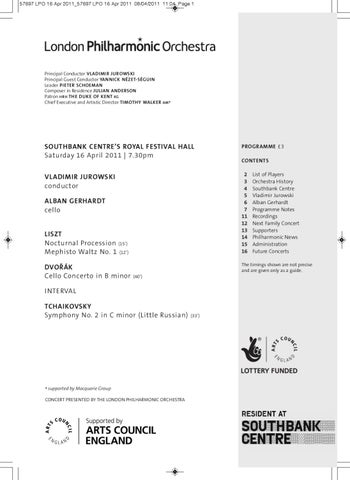
SOUTHBANK CENTRE’S ROYAL FESTIVAL HALL Saturday 16 April 2011 | 7.30pm
PROGRAMME £3
VLADIMIR JUROWSKI conductor
2 3 4 5 6 7 11 12 13 14 15 16
ALBAN GERHARDT cello LISZT Nocturnal Procession (15’) Mephisto Waltz No. 1 (12’) DVOŘÁK Cello Concerto in B minor
List of Players Orchestra History Southbank Centre Vladimir Jurowski Alban Gerhardt Programme Notes Recordings Next Family Concert Supporters Philharmonic News Administration Future Concerts
The timings shown are not precise and are given only as a guide. (40’)
INTERVAL TCHAIKOVSKY Symphony No. 2 in C minor (Little Russian)
†
CONTENTS
supported by Macquarie Group
CONCERT PRESENTED BY THE LONDON PHILHARMONIC ORCHESTRA
(33’)
57697 LPO 16 Apr 2011_57697 LPO 16 Apr 2011 08/04/2011 11:04 Page 2
LONDON PHILHARMONIC ORCHESTRA
FIRST VIOLINS Klaidi Sahatci Guest Leader Vesselin Gellev Sub-Leader Chair supported by John and Angela Kessler
Shlomy Dobrinsky Catherine Craig Thomas Eisner Tina Gruenberg Martin Hรถhmann Chair supported by Richard Karl Goeltz
Robert Pool Yang Zhang Rebecca Shorrock Alain Petitclerc Peter Nall SECOND VIOLINS Eugene Tichindeleanu Guest Principal Jeongmin Kim Joseph Maher Kate Birchall Chair supported by David and Victoria Graham Fuller
Nancy Elan Fiona Higham Nynke Hijlkema Marie-Anne Mairesse Ashley Stevens Imogen Williamson Sioni Williams Alison Strange
VIOLAS Alexander Zemtsov* Principal Chair supported by The Tsukanov Family
Robert Duncan Susanne Martens Benedetto Pollani Emmanuella Reiter-Bootiman Laura Vallejo Isabel Pereira Sarah Malcolm Martin Fenn Claudio Cavalletti CELLOS Kristina Blaumane Principal Laura Donoghue Jonathan Ayling Chair supported by Caroline, Jamie and Zander Sharp
Santiago Sabino Carvalho + Gregory Walmsley Sue Sutherley Susanna Riddell Lyubov Ulybesheva Tom Roff Tae-Mi Song DOUBLE BASSES Tim Gibbs Principal Laurence Lovelle George Peniston Tom Walley Helen Rowlands Louis Garson Damian Rubido Gonzalez Charlotte Kerbegian
FLUTES Jaime Martin* Principal Sue Thomas* Stewart McIlwham* PICCOLO Stewart McIlwham* Principal OBOES Ian Hardwick Principal Angela Tennick COR ANGLAIS Sue Bohling Principal Chair supported by Julian and Gill Simmonds
CLARINETS Robert Hill* Principal Paul Richards
TROMBONES Mark Templeton* Principal David Whitehouse BASS TROMBONE Lyndon Meredith Principal TUBA Lee Tsarmaklis Principal TIMPANI Simon Carrington* Principal PERCUSSION Rachel Gledhill Principal Andrew Barclay* Co-Principal Chair supported by Andrew Davenport
HARP Rachel Masters* Principal
BASSOONS John Price Principal Gareth Newman* HORNS Stephen Stirling Guest Principal Martin Hobbs Jenny Cox Gareth Mollison TRUMPETS Paul Beniston* Principal Daniel Newell
ASSISTANT CONDUCTOR Thomas Blunt
* Holds a professorial appointment in London +
Chevalier of the Brazilian Order of Rio Branco
Chair Supporters The London Philharmonic Orchestra also acknowledges the following chair supporters whose players are not present at this concert: Geoff and Meg Mann Richard and Victoria Sharp
2 | London Philharmonic Orchestra
57697 LPO 16 Apr 2011_57697 LPO 16 Apr 2011 08/04/2011 11:04 Page 3
LONDON PHILHARMONIC ORCHESTRA
Patrick Harrison
Seventy-eight years after Sir Thomas Beecham founded the London Philharmonic Orchestra, it is recognised today as one of the finest orchestras on the international stage. Following Beecham’s influential founding tenure the Orchestra’s Principal Conductorship has been passed from one illustrious musician to another, amongst them Sir Adrian Boult, Bernard Haitink, Sir Georg Solti, Klaus Tennstedt and Kurt Masur. This impressive tradition continued in September 2007 when Vladimir Jurowski became the Orchestra’s Principal Conductor and, in a further exciting move, the Orchestra appointed Yannick Nézet-Séguin its new Principal Guest Conductor from September 2008. The London Philharmonic Orchestra has been performing at Southbank Centre’s Royal Festival Hall since it opened in 1951, becoming Resident Orchestra in 1992. It plays there around 40 times each season with many of the world’s most sought after conductors and soloists. Concert highlights in 2010/11 include an exploration of Mahler’s symphonies and complete song cycles during the composer’s anniversary season; the premières of works by Matteo D’Amico, Magnus Lindberg and Brett Dean; a rare opportunity to hear Rossini’s opera Aureliano in Palmira in collaboration with long term partner Opera Rara; and works by the Orchestra’s new Composer in Residence, Julian Anderson. In addition to its London season and a series of concerts at Wigmore Hall, the Orchestra has flourishing
residencies in Brighton and Eastbourne, and performs regularly around the UK. It is unique in combining these concert activities with esteemed opera performances each summer at Glyndebourne Festival Opera where it has been the Resident Symphony Orchestra since 1964. The London Philharmonic Orchestra performs to enthusiastic audiences all round the world. In 1956 it became the first British orchestra to appear in Soviet Russia and in 1973 made the first ever visit to China by a Western orchestra. Touring continues to form a significant part of the Orchestra’s schedule and is supported by Aviva, the International Touring Partner of the London Philharmonic Orchestra. Tours in 2010/11 include visits to Finland, Germany, South Korea, Spain, France, Belgium and Luxembourg. Having long been embraced by the recording, broadcasting and film industries, the London Philharmonic Orchestra broadcasts regularly on domestic and international television and radio. It also works with the Hollywood and UK film industries, recording soundtracks for blockbuster motion pictures including the Oscar-winning score for The Lord of the Rings trilogy and scores for Lawrence of Arabia, The Mission, Philadelphia and East is East. The London Philharmonic Orchestra made its first recordings on 10 October 1932, just three days after its first public performance. It has recorded and broadcast
London Philharmonic Orchestra | 3
57697 LPO 16 Apr 2011_57697 LPO 16 Apr 2011 08/04/2011 11:04 Page 4
LONDON PHILHARMONIC ORCHESTRA
SOUTHBANK CENTRE
regularly ever since, and in 2005 established its own record label. The recordings on its own label are taken mainly from live concerts given with distinguished conductors over the years including the Orchestra’s Principal Conductors from Beecham and Boult, through Haitink, Solti and Tennstedt, to Masur and Jurowski.
WELCOME TO SOUTHBANK CENTRE
Recent additions to the catalogue have included acclaimed releases of Christmas choral music conducted by Vladimir Jurowski, Bruckner’s Symphony No. 6 conducted by Christoph Eschenbach, Verdi’s Requiem conducted by Jesús López-Cobos, Holst’s The Planets conducted by Vladimir Jurowski and Elgar’s Symphony No. 1 and Sea Pictures with Vernon Handley and Janet Baker. The Orchestra’s own-label CDs are also widely available to download. Visit www.lpo.org.uk/shop for the latest releases.
‘ … a simply tremendous performance of
We hope you enjoy your visit. We have a Duty Manager available at all times. If you have any queries please ask any member of staff for assistance. Eating, drinking and shopping? Southbank Centre shops and restaurants include: Foyles, EAT, Giraffe, Strada, YO! Sushi, wagamama, Le Pain Quotidien, Las Iguanas, ping pong, Canteen, Caffè Vergnano 1882, Skylon, Concrete and Feng Sushi, as well as cafes, restaurants and shops inside Royal Festival Hall, Queen Elizabeth Hall and Hayward Gallery. If you wish to get in touch with us following your visit please contact Kenelm Roberts, our Head of Customer Relations, at Southbank Centre, Belvedere Road, London SE1 8XX or email customer@southbankcentre.co.uk or phone 020 7960 4250.
Mahler’s 3rd Symphony … Jurowski and his players plunged us into a winter of discontent so profoundly expectant that even the inveterate coughers were silenced.’
A few points to note for your comfort and enjoyment:
EDWARD SECKERSON, THE INDEPENDENT, 23 SEPTEMBER 2010
LATECOMERS will only be admitted to the auditorium if there is a suitable break in the performance
The Orchestra reaches thousands of Londoners through its rich programme of community and school-based activity in Lambeth, Lewisham and Southwark, which includes the offshoot ensembles Renga and The Band, its Foyle Future Firsts apprenticeship scheme for outstanding young instrumentalists, and regular family and schools concerts. To help maintain its high standards and diverse workload, the Orchestra is committed to the welfare of its musicians and in December 2007 received the Association of British Orchestras/Musicians Benevolent Fund Healthy Orchestra Bronze Charter Mark. There are many ways to experience and stay in touch with the Orchestra’s activities: visit www.lpo.org.uk, subscribe to our podcast series, download our iPhone application and join us on Facebook and Twitter.
4 | London Philharmonic Orchestra
We look forward to seeing you again soon.
PHOTOGRAPHY is not allowed in the auditorium
RECORDING is not permitted in the auditorium without the prior consent of Southbank Centre. Southbank Centre reserves the right to confiscate video or sound equipment and hold it in safekeeping until the performance has ended MOBILES, PAGERS AND WATCHES should be switched off before the performance begins
57697 LPO 16 Apr 2011_57697 LPO 16 Apr 2011 08/04/2011 11:04 Page 5
VLADIMIR JUROWSKI
Karen Robinson
CONDUCTOR
Born in Moscow, the son of conductor Mikhail Jurowski, Vladimir Jurowski completed the first part of his musical studies at the Music College of the Moscow Conservatory. In 1990 he relocated with his family to Germany where he continued his studies in Dresden and Berlin, studying conducting with Rolf Reuter and vocal coaching with Semion Skigin. In 1995 he made his international debut at the Wexford Festival, where he conducted Rimsky-Korsakov’s May Night. The same year saw his brilliant debut at the Royal Opera House Covent Garden in Nabucco. In 1996 he joined the ensemble of Komische Oper Berlin, becoming First Kapellmeister in 1997 and continuing to work at the Komische Oper on a permanent basis until 2001. Since 1997 Vladimir Jurowski has been a guest at some of the world’s leading musical institutions including the Royal Opera House Covent Garden, Teatro La Fenice di Venezia, Opéra Bastille de Paris, Théâtre de la Monnaie Bruxelles, Maggio Musicale Festival Florence, Rossini Opera Festival Pesaro, Edinburgh Festival, Semperoper Dresden and the Teatro Comunale di Bologna (where he served as Principal Guest Conductor between 2000 and 2003). In 1999 he made his debut at the Metropolitan Opera New York with Rigoletto. In January 2001 Vladimir Jurowski took up the position of Music Director of Glyndebourne Festival Opera and in 2003 was appointed Principal Guest Conductor of the London Philharmonic Orchestra, becoming the Orchestra’s Principal Conductor in September 2007. He also holds the title of Principal Artist of the Orchestra of the Age of Enlightenment, and from 2005 to 2009 served as Principal Guest Conductor of the Russian National Orchestra with whom he will continue to work in the years ahead.
Vladimir Jurowski is a regular guest with many of the world’s leading orchestras including the Berlin Philharmonic, Oslo Philharmonic, Royal Concertgebouw, Bavarian Radio Symphony, Dresden Staatskapelle, Los Angeles Philharmonic and Philadelphia Orchestras as well as the Gewandhausorchester Leipzig. Highlights of the 2010/11 season and beyond include his debuts with the Vienna Philharmonic, Cleveland, San Francisco Symphony and Mahler Chamber Orchestras, and return visits to the Chicago Symphony, Chamber Orchestra of Europe, Berlin Philharmonic, Royal Concertgebouw, St Petersburg Philharmonic and Philadelphia Orchestras. His operatic engagements have included Jenůfa, The Queen of Spades and Hänsel und Gretel at the Metropolitan Opera, Parsifal and Wozzeck at Welsh National Opera, War and Peace at the Opéra National de Paris, Eugene Onegin at La Scala Milan, as well as Die Zauberflöte, La Cenerentola, Otello, Macbeth, Falstaff, Tristan und Isolde, Don Giovanni, The Rake’s Progress and Peter Eötvös’ Love and Other Demons at Glyndebourne Opera. Future engagements include new productions of Die Meistersinger and The Cunning Little Vixen at Glyndebourne, Die Frau ohne Schatten at the Metropolitan Opera, Russlan and Ludmila at the Bolshoi Theatre, and Iolanta at the Dresden Semperoper. Jurowski’s discography includes the first ever recording of Giya Kancheli’s cantata Exil for ECM (1994), L’Étoile du Nord by Meyerbeer for Naxos-Marco Polo (1996), and Werther for BMG (1999) as well as live recordings of works by Rachmaninov, Turnage, Tchaikovsky, Britten, Brahms and Shostakovich on the London Philharmonic Orchestra’s own label, and Prokofiev’s Betrothal in a Monastery on Glyndebourne Opera’s own label. He also records for PentaTone with the Russian National Orchestra, with releases to date including Tchaikovsky’s Suite No. 3 and Stravinsky’s Divertimento from Le Baiser de la fée, Shostakovich’s Symphonies Nos 1 and 6, Prokofiev’s Symphony No. 5 and Tchaikovsky’s Hamlet Incidental Music. Glyndebourne have released DVD recordings of his performances of La Cenerentola, Gianni Schicchi, Die Fledermaus and Rachmaninov’s The Miserly Knight, and other recent DVD releases include Hänsel und Gretel from the Metropolitan Opera New York, and his first concert as the London Philharmonic Orchestra’s Principal Conductor featuring works by Wagner, Berg and Mahler (released by Medici Arts).
London Philharmonic Orchestra | 5
57697 LPO 16 Apr 2011_57697 LPO 16 Apr 2011 08/04/2011 11:04 Page 6
ALBAN GERHARDT CELLO
Highlights of the 2010/11 season include performances with the NHK Symphony, Cleveland, Hallé, BBC Philharmonic, Sydney Symphony and London Philharmonic Orchestras as well as with the Orchestre National de Bordeaux and the Rundfunk SinfonieOrchester Berlin. He will perform the Unsuk Chin Cello Concerto in Amsterdam with the Residentie Orkest, Cologne with the Gurzenich Orchester, and with the Seoul Philharmonic, Tampere Philharmonic and Boston Symphony Orchestras. The concerto was written for him and premièred at the Proms in 2009 to great acclaim. Over the past decade, Alban Gerhardt has established himself among the greatest cellists of our time. His sound is unmistakable and his interpretations of the repertoire are distinguished by their originality. The cello starts to sing under his hands; standard works are newly discovered and unknown pieces are brought to life again. Gerhardt fascinates his growing audiences with the combination of an unerring musical instinct, intense emotion and a very natural, arresting stage presence. Of particular concern for him is his desire to help audiences break with old listening and concert habits and to open classical music to a younger audience. After early success at competitions and his debut with the Berlin Philharmonic Orchestra under Semyon Bychkov, Gerhardt has since performed with more than 170 different orchestras worldwide under conductors such as Kurt Masur, Christoph von Dohnányi, Christoph Eschenbach, Sir Neville Marriner, Marek Janowski, Sir Colin Davis, Leonard Slatkin, Michal Tilson Thomas, Fabio Luisi, Sakari Oramo, Paavo Järvi, Neeme Järvi, Christian Thielemann, Esa-Pekka Salonen and Andris Nelsons. Highlights of his recent seasons have included tours of Australasia, concerts in the Far East and performances with the Berlin Philharmonic, Royal Concertgebouw, Czech Philharmonic, Oslo Philharmonic, Finnish Radio Symphony, BBC Symphony, Leipzig Gewandhaus, City of Birmingham Symphony, Bavarian Radio Symphony, Netherlands Radio Philharmonic, Danish Radio, NDR Symphony, Philharmonia and Vienna Symphony Orchestras as well as the Zurich Tonhalle, Orchestre de la Suisse Romande, RTVE Madrid, Orchestre National de France, Chamber Orchestra of Europe and Gurzenich Orchester.
6 | London Philharmonic Orchestra
Alban Gerhardt’s repertoire includes almost 60 cello concertos, and he relishes rescuing lesser-known works from undeserved obscurity. His collaborations with composers such as Unsuk Chin, Peteris Vasks, Brett Dean, Jörg Widmann, Osvaldo Golijov, Mathias Hinke and Matthias Pintscher demonstrate his strong interest in enlarging the cello repertoire. As well as his intensive solo career, chamber music plays an important role in his life. He is a frequent performer at international festivals such as the BBC Proms in London and the Edinburgh Festival, and at the Wigmore Hall, Berlin Philharmonie, Suntory Hall Tokyo and Châtelet in Paris. His regular chamber music partners include Steven Osborne, Cecile Licad, Lars Vogt, Christian Tetzlaff, Lisa Batiashvili, Arabella Steinbacher, Tabea Zimmermann, Thomas Larcher and Emmanuel Pahud. Gerhardt is also a highly acclaimed recording artist and has won three ECHO Classic Awards most recently for his all-Reger double CD in 2009. He records exclusively with Hyperion, spearheading their ‘Romantic Cello Concertos’ series. Recent releases include a recital CD featuring sonatas by Chopin and Alkan with Steven Osborne and Prokofiev’s Sinfonia Concertante and Concerto in E minor Op. 58 with the Bergen Philharmonic Orchestra and Andrew Litton. Alban Gerhardt plays a unique instrument from the renowned maker Matteo Gofriller. He writes about his travelling and performing experiences in his blog, which can be accessed from: www.albangerhardt.com.
57697 LPO 16 Apr 2011_57697 LPO 16 Apr 2011 08/04/2011 11:04 Page 7
PROGRAMME NOTES
SPEEDREAD All three composers in this concert owed something to 19th century nationalism, yet ultimately they all transcended it. The Hungarian Franz Liszt was inspired by a great German legend – the story of Faust and his deal with the Devil – to write his two orchestral ‘episodes’: the first a brooding nocturnal forestscape, the second a furious, intoxicating waltz set in a disreputable tavern. Echoes of Czech folk music can be heard in Dvořák’s great Cello Concerto, but at its heart this glorious autumnal
Franz LISZT
work is engaged with painful personal matters – particularly a lost love, tenderly recalled just before the seemingly joyous fanfare ending. Tchaikovsky’s ‘Little Russian’ (for which read ‘Ukrainian’) Symphony delighted his nationalist colleagues with its vigorous and colourful use of folk-based themes, but there is so much more here than musical chauvinism: intense personal drama sits beside brilliant, exquisite balletic music, a delicious little march, and in the finale a riotous celebration of popular dance in its rawest, boldest colours.
NOCTURNAL PROCESSION AND MEPHISTO WALTZ NO. 1 (‘TWO EPISODES FROM LENAU’S FAUST’)
1811-1886
Liszt’s First Mephisto Waltz is so long established as an intoxicating display piece for solo piano that it tends to be forgotten that it was originally written for orchestra. Like many of the 19th century romantics, Liszt was fascinated by the legend of the medieval scholar Faust, who sold his soul to the Devil in exchange for knowledge and power. His hugely ambitious Faust Symphony (1854-57) was inspired by Goethe’s colossal two-part verse drama, Faust. But even then Liszt felt he had not finished with the story. Soon afterwards he turned to the poem Faust by Nicholas Lenau (1802-50) – whose epic Don Juan was to be such a powerful inspiration for the young Richard Strauss. Lenau’s Faust is intellectually simpler than Goethe’s, but it is also dramatically more direct, and Liszt clearly found that its broader brushstrokes readily suggested music to him.
The result was these two ‘episodes’ for orchestra. The second – the dazzling Mephisto Waltz – had its première in 1861. Mephisto is short for Mephistopheles, the satanic spirit described by Goethe as he ‘who wills evil, but achieves good’. He stands for the demonic side of human creativity, and in Liszt’s orchestral tour de force we sense both his danger and his ability to stimulate wild imagination and coruscating wit. First however comes the slow, sombre Nocturnal Procession, headed by an apt quotation from Lenau’s poem: ‘Dark clouds hang in the heavens, the forest listens expectantly. It is deepest night…’
London Philharmonic Orchestra | 7
57697 LPO 16 Apr 2011_57697 LPO 16 Apr 2011 08/04/2011 11:04 Page 8
PROGRAMME NOTES
Antonín DVOŘÁK
CELLO CONCERTO IN B MINOR, OP. 104 ALBAN GERHARDT cello Allegro | Adagio ma non troppo | Allegro moderato
1841-1904
Few people are surprised today when a composer chooses to write a cello concerto. As the great examples by Dvořák, Elgar, Schumann, Walton and Shostakovich show, this noble, rich-toned, soulfully expressive and remarkably agile instrument makes a splendid concerto soloist. But when the Czech composer Antonín Dvořák wrote his Cello Concerto in 1894-95, even connoisseurs were surprised. When Johannes Brahms – composer of one of the greatest violin concertos in the repertoire – first saw Dvořák’s score, he exclaimed, ‘Why on earth didn’t I know that one could write a cello concerto like this? If I had only known, I would have written one long ago!’
Beyond that, Brahms could hardly fail to have been impressed by Dvořák’s melodic writing. The Cello Concerto brims over with wonderful long tunes and characterful short motifs. Not all of these are initially identified with the cello. Like most concertos of the ‘classical’ era of Mozart and Beethoven, Dvořák begins the first movement with a long passage for orchestra alone. There is a darkly memorable theme for low woodwind at the start then, after the first big climax, a glorious long tune for solo horn. So when the cello enters for the first time, it not only has to cope with Dvořák’s technical assault course, it also has to establish a claim to these themes for itself.
Actually there’s no reason why Brahms should have known: in his and Dvořák’s day the cello was rarely played well as a solo instrument. In fact the situation seems to have lasted for some time after Dvořák’s death. As late as 1939, the famous Manchester Guardian critic Neville Cardus complained of ‘the wasp-in-thewindow effect which most times we have to put up with whenever a cellist gets to work.’ But there is also the issue of balance. The cello may seem to have a powerful voice, but its lower notes in particular can easily be overwhelmed if the orchestral accompaniment is too rich and strong. But Dvořák copes superbly with this potential problem. Though he uses a relatively large orchestra, the cello soloist rarely has to contend with anything like its full force. There are loud, impressive orchestral tuttis, but in these passages the cellist is mostly silent. The result is that, given a reasonably strong player, every note of the cello part should be audible. That must have been one of the concerto’s features that so impressed Brahms.
In the slow movement, the cellist’s powers as an instrumental singer are tested to the full. The first theme is relaxed and reflective, with strong suggestions of folksong. But this is interrupted by a darker minor-key central section. Here there is a definite autobiographical element. While Dvořák was working on the Concerto, he heard that his sister-in-law, Josefina Kaunitzova, was seriously ill – in his youth Dvořák had been in love with her. Josefina was particularly fond of Dvořák’s song ‘Leave me alone’ (Op. 82, No. 1), and in this slow movement he has the cello quote its melody just after the first stern entry of the trombones and tuba. This same melody re-appears near the end of the finale – this time in response to the news of Josefina’s death. The finale’s opening march theme does return in triumph to end the concerto, but that poignant reminiscence of lost love lingers in the memory – is this where the concerto’s heart truly lies?
8 | London Philharmonic Orchestra
57697 LPO 16 Apr 2011_57697 LPO 16 Apr 2011 08/04/2011 11:04 Page 9
PROGRAMME NOTES
INTERVAL 20 minutes An announcement will be made five minutes before the end of the interval.
Pyotr Ilyich TCHAIKOVSKY
SYMPHONY NO. 2 IN C MINOR (LITTLE RUSSIAN) Andante sostenuto – Allegro vivo | Allegretto marziale, quasi moderato | Scherzo: Allegro molto vivace | Finale: Moderato assai – Allegro vivo
1840-1893
Composers often blow hot and cold about their own music, but few have been subject to such extreme mood- and valuation-swings as Tchaikovsky. The Second Symphony is a case in point. At first his pride in his achievement was immense, clearly boosted by the judgements of trusted friends like Nikolay Kondratyev. ‘This work of genius (as Kondratyev calls my symphony) is close to completion… I think it’s my best composition as regards perfection of form – a quality for which I have not always been conspicuous.’ The positive feedback kept coming. When Tchaikovsky played the finale of the new symphony to his Russian nationalist colleagues – the so-called ‘Mighty Handful’ – at the house of Nikolay Rimsky-Korsakov in November 1872, he was thrilled by their reaction: ‘The whole company nearly tore me to pieces with rapture – and Madame Rimsky-Korsakov begged me in tears to let her arrange it for piano duet.’ But as so often with Tchaikovsky, the picture changed. When the publisher Bessel prevaricated about printing
the score, Tchaikovsky began to see this as a blessing in disguise. Seven years later he set to work on a major revision. The original first movement now made him shudder with horror: ‘My God, how difficult and noisy and disconnected and obscure it was!’ Indeed the whole symphony was ‘unlucky’ – Tchaikovsky seems to have forgotten that the first public performance in 1873 was so successful that the symphony had to be repeated two months later! Soon he was threatening to burn the first version, and doing his best to suppress the printed parts. Listening to the familiar revised version the first-time listener may find Tchaikovsky’s radical change of heart baffling. Could the original really be that bad? Granted the work isn’t quite as ‘perfect’ formally as he originally thought. Certainly the finales of his later symphonies are more subtly constructed. But the work is so generously tuneful, so imaginatively scored, and so full of what is obviously mature Tchaikovsky that it’s hard to identify any cause for shame on his part – however
London Philharmonic Orchestra | 9
57697 LPO 16 Apr 2011_57697 LPO 16 Apr 2011 08/04/2011 11:04 Page 10
PROGRAMME NOTES
exaggerated. Perhaps the real problem is that by the time he came to revise the Second Symphony, Tchaikovsky had turned his back decisively on the nationalism of the Mighty Handful. His musicianship, he realised, was altogether more cosmopolitan than theirs. Could it be that the original version of the symphony was simply tainted by association? Whatever the cause, we must be grateful that Tchaikovsky deemed the symphony worth saving. The very first notes make it clear we are in for something special. From an emphatic full-orchestral chord a hushed horn solo emerges, intoning a soulful theme – the first of three ideas in this work based on Ukrainian folksongs. (In Tchaikovsky’s time the Ukraine was known as ‘Little Russia’, hence the symphony’s nickname.) This builds to a powerful and dramatic Allegro vivo. But just when it seems that memories of that atmospheric slow introduction are forgotten, the horn cuts in again with its folk-inspired melody, its final phrase echoed by a lugubrious ‘dying’ low bassoon – a typically Tchaikovskian touch. Instead of the usual slow movement, Tchaikovsky brings contrast with a sweetly innocent march movement, its
outer sections taken from his rejected opera Undine (one of those scores which, alas, Tchaikovsky did manage to destroy). At its heart a solo clarinet introduces another Ukrainian folk-based tune, with a deliciously light accompaniment on two flutes. The following Scherzo raises the symphony to new imaginative heights: the colours scintillate, the rhythms dance with remarkable freedom and flexibility – from this movement alone you could probably guess that Tchaikovsky was also a great ballet composer. The finale is dominated by the symphony’s third Ukrainian folkbased tune (presented by the full orchestra in the brief slow introduction). As craftsmanship it may be a lot less refined than the Scherzo, but it can be tremendous bracing fun in performance – conjuring up the smell of vodka, the twang of balalaikas and the creaking of leather boots. There is one darker moment: rasping low woodwind, bass brass and an ominous fortissimo stroke on a gong. But the exhilarating Presto coda soon dismisses such thoughts, and the symphony ends in wild elation.
Programme notes by Stephen Johnson © 2011
Hear every note
Hard of hearing? Visit the cloakroom for equipment to improve your concert experience.
10 | London Philharmonic Orchestra
57697 LPO 16 Apr 2011_57697 LPO 16 Apr 2011 08/04/2011 11:04 Page 11
RECORDINGS ON THE LONDON PHILHARMONIC ORCHESTRA’S OWN RECORD LABEL
LPO-0042 Neeme Järvi conducts Dvořák’s Requiem with soloists Lisa Milne, Karen Cargill, Peter Auty, Peter Rose and the London Philharmonic Choir ‘Neeme Järvi leads a sturdy, evocative performance graced by gorgeous singing from the London Philharmonic Choir.’ JOSHUA KOSMAN, SAN FRANCISCO CHRONICLE, 7 MARCH 2010
LPO-0039 Vladimir Jurowski conducts Tchaikovsky’s Symphonies Nos 1 and 6 ‘Both are exceptional performances, superbly recorded with a breathtaking range of dynamics … In both works, the playing of the LPO is world class.’ ANDREW CLEMENTS, THE GUARDIAN, 4 SEPTEMBER 2009
LPO-0009 Vladimir Jurowski conducts Tchaikovsky’s Manfred Symphony ‘... it is a wonderfully vivid recording of an exceptionally vibrant, immaculately played performance ... a superb disc.’ THE GUARDIAN, 2 JUNE 2006
LPO-0051 Vladimir Jurowski conducts Haydn’s The Seven Last Words of our Saviour on the Cross with Lisa Milne, Ruxandra Donose, Andrew Kennedy, Christopher Maltman and the London Philharmonic Choir ‘This meld of orchestra, chorus and soloists is moving and magnificent, in both idea and execution.’ MICHAEL CHURCH, THE INDEPENDENT, 28 JANUARY 2011
The recordings may be downloaded in high quality MP3 format from www.lpo.org.uk/shop. CDs may also be purchased from all good retail outlets or through the London Philharmonic Orchestra: telephone 020 7840 4242 (Mon-Fri 10am-5pm) or visit the website www.lpo.org.uk
London Philharmonic Orchestra | 11
57697 LPO 16 Apr 2011_57697 LPO 16 Apr 2011 08/04/2011 11:04 Page 12
The London Philharmonic Orchestra Recording Archive
FUNharmonics Family Concert
Tick Tock Sunday 15 May 2011 | 11.30am Royal Festival Hall Kodály The Viennese Musical Clock from Háry János Suite Prokofiev Waltz from Cinderella: Suite No. 1 Haydn Excerpt from Symphony No. 101, (The Clock) McNeff The Clockwork Suite Beethoven Allegretto from Symphony No. 8 J Strauss Perpetuum mobile Ponchielli Dance of the Hours from La gioconda
Many thanks to those kind supporters who have donated recordings to the London Philharmonic Orchestra Recording Archive. There are still many holes in our Archive so we would like to encourage any possible donors to delve into their own collections to see if they have any recordings which might fill in some of the gaps. Please contact Gillian Pole at the London Philharmonic Orchestra, 89 Albert Embankment, London SE1 7TP if you would like to make a donation.
Stuart Stratford conductor Chris Jarvis presenter
Foyer Events from 10am You can try your hand at playing an orchestral instrument in one of our Have-a-Go sessions, get your face painted or join our human orchestra – all in the foyers before and after the performance. Generously supported by The Jeniffer and Jonathan Harris Charitable Trust.
TICKETS Child £4-£8 Adult £8-£16 For booking details see page 16.
12 | London Philharmonic Orchestra
Download London Philharmonic Orchestra recordings from www.lpo.org.uk/shop
It’s easy to take the London Philharmonic Orchestra with you wherever you go! Visit our downloads site to choose the works (or even single movements) you’d like to buy, and download high quality MP3s to your computer for transfer to an MP3 player or CD. With regular additions of new recordings with conductors from Beecham to Jurowski you’ll always have a selection of great music to choose from.
57697 LPO 16 Apr 2011_57697 LPO 16 Apr 2011 08/04/2011 11:04 Page 13
We would like to acknowledge the generous support of the following Thomas Beecham Group Patrons, Principal Benefactors and Benefactors: Thomas Beecham Group Mr & Mrs Richard & Victoria Sharp Julian & Gill Simmonds The Tsukanov Family Garf & Gill Collins Andrew Davenport David & Victoria Graham Fuller Richard Karl Goeltz John & Angela Kessler Mr & Mrs Makharinsky Geoff & Meg Mann Caroline, Jamie & Zander Sharp Eric Tomsett Guy & Utti Whittaker Principal Benefactors Mark & Elizabeth Adams Jane Attias Lady Jane Berrill Desmond & Ruth Cecil Mr John H Cook Mrs Sonja Drexler Mr Charles Dumas David Ellen Commander Vincent Evans
Mr Daniel Goldstein Mrs Barbara Green Oliver Heaton Mr & Mrs Jeffrey Herrmann Peter MacDonald Eggers Mr & Mrs David Malpas Andrew T Mills Mr Maxwell Morrison Mr Michael Posen Mr & Mrs Thierry Sciard Mr John Soderquist & Mr Costas Michaelides Mr & Mrs G Stein Mr & Mrs John C Tucker Howard & Sheelagh Watson Mr Laurie Watt Mr Anthony Yolland Benefactors Mrs A Beare Dr & Mrs Alan Carrington CBE FRS Marika Cobbold & Michael Patchett-Joyce Mr & Mrs Stewart Cohen Mr Alistair Corbett Mr David Edgecombe
Mr Richard Fernyhough Ken Follett Michael & Christine Henry Mr Glenn Hurstfield Mr R K Jeha Mr & Mrs Maurice Lambert Mr Gerald Levin Sheila Ashley Lewis Wg. Cdr. & Mrs M T Liddiard OBE JP RAF Mr Frank Lim Paul & Brigitta Lock Mr Brian Marsh John Montgomery Edmund Pirouet Mr Peter Tausig Mrs Kazue Turner Lady Marina Vaizey Mr D Whitelock Hon. Benefactor Elliott Bernerd Hon. Life Members Kenneth Goode Mrs Jackie Rosenfeld OBE
The generosity of our Sponsors, Corporate Members, supporters and donors is gratefully acknowledged. Corporate Members Appleyard & Trew llp AREVA UK British American Business Brown Brothers Harriman Charles Russell Destination Québec – UK Diagonal Consulting Lazard Leventis Overseas Man Group plc Québec Government Office in London Corporate Donor Lombard Street Research In-kind Sponsors Google Inc Heineken The Langham London Lindt & Sprüngli Ltd Sela / Tilley’s Sweets Villa Maria Trusts and Foundations Allianz Cultural Foundation The Andor Charitable Trust Arts and Business
Ruth Berkowitz Charitable Trust The Boltini Trust Borletti-Buitoni Trust Britten-Pears Foundation The Candide Charitable Trust The John S Cohen Foundation The Coutts Charitable Trust The Delius Trust The Dorset Foundation The D’Oyly Carte Charitable Trust Dunard Fund The Equitable Charitable Trust The Eranda Foundation The Ernest Cook Trust The Fenton Arts Trust The Foyle Foundation The Jeniffer and Jonathan Harris Charitable Trust Hattori Foundation for Music and the Arts Capital Radio’s Help a London Child The Idlewild Trust The Emmanuel Kaye Foundation The Leverhulme Trust Lord and Lady Lurgan Trust Maurice Marks Charitable Trust The Michael Marks Charitable Trust Marsh Christian Trust
UK Friends of the FelixMendelssohn-Bartholdy Foundation The Mercers’ Company Adam Mickiewicz Institute Paul Morgan Charitable Trust Maxwell Morrison Charitable Trust Musicians Benevolent Fund The R K Charitable Trust Serge Rachmaninoff Foundation The Reed Foundation The Rubin Foundation The Seary Charitable Trust The Samuel Sebba Charitable Trust Sound Connections The Stansfield Trust The Steel Charitable Trust The Bernard Sunley Charitable Foundation The Swan Trust John Thaw Foundation The Underwood Trust Garfield Weston Foundation Youth Music and others who wish to remain anonymous.
London Philharmonic Orchestra | 13
57697 LPO 16 Apr 2011_57697 LPO 16 Apr 2011 08/04/2011 11:04 Page 14
PHILHARMONIC NEWS
April Tour
Award
Earlier this month the Orchestra and Principal Guest Conductor Yannick Nézet-Séguin flew off to Luxembourg for the start of a five-concert tour which took them to Cologne, Heidelberg, Dortmund and Essen. The opening concert in Luxembourg on 5 April comprised Beethoven’s Piano Concerto No. 5 with Lars Vogt as soloist and Berlioz’s Symphonie fantastique. The concerto was repeated throughout the tour but Mahler’s Symphony No. 5 replaced the Berlioz at the last two concerts.
We are delighted that Gerald Finley has won the 2011 Canadian Academy of Recording Arts and Sciences ‘Juno’ Award in the Classical Album of the Year: Vocal or Choral Performance category, for the Great Operatic Arias CD the London Philharmonic Orchestra recorded with him in April 2009. Edward Gardner conducted the CD which features arias ranging from Mozart’s Don Giovanni, Verdi’s Otello, Wagner’s Tannhäuser and Puccini’s Tosca to John Adams’ Doctor Atomic, Mark-Anthony Turnage’s The Silver Tassie and Richard Rodgers’ South Pacific.
Listen again
Also included on the CD is the Aria ‘Verachtet mir die Meister nicht’ from Wagner’s Die Meistersinger von Nürnberg which is sung by Hans Sachs, a role Gerald Finley will sing with us this summer at Glyndebourne.
Tonight’s concert is being recorded by the Orchestra and will be available to listen to online for free from late April for two weeks. If you would like to receive an email alert when the concert is online, sign up now by visiting www.lpo.org.uk/listenagain.
For full details of the CD, visit the Chandos website www.chandos.net
NEW on the LPO Label Mahler’s Resurrection Symphony May’s release on the LPO Label will be Vladimir Jurowski’s first recorded Mahler Symphony. Taken from a concert given at the Royal Festival Hall in September 2009, this recording of Mahler’s almighty Symphony No. 2 (Resurrection) features soprano Adriana Kucerova, mezzo soprano Christianne Stotijn and the London Philharmonic Choir.
Get your exclusive iTunes pre-release ‘When the chorus finally stood up and let rip in the closing moments, it set the seal on a masterful performance from a world-class orchestra-conductor team.’ THE GUARDIAN
14 | London Philharmonic Orchestra
We are delighted to be able to offer you the chance to listen to this recording now through a special prerelease arrangement with iTunes. To take advantage of this special offer, search for ‘Mahler Jurowski’ on iTunes and download the Symphony today.
57697 LPO 16 Apr 2011_57697 LPO 16 Apr 2011 08/04/2011 11:04 Page 15
ADMINISTRATION
BOARD OF DIRECTORS
GENERAL ADMINISTRATION
ORCHESTRA PERSONNEL
ARCHIVES
Martin Höhmann Chairman Stewart McIlwham Vice-Chairman Sue Bohling Lord Currie* Jonathan Dawson* Gareth Newman George Peniston Sir Bernard Rix* Kevin Rundell Sir Philip Thomas* The Rt Hon. Lord Wakeham DL* Timothy Walker AM †
Timothy Walker AM † Chief Executive and Artistic Director
Andrew Chenery Orchestra Personnel Manager
Edmund Pirouet Consultant
Sarah Thomas Librarian
Philip Stuart Discographer
Michael Pattison Stage Manager
Gillian Pole Recordings Archive
*Non-Executive Directors
Alison Atkinson Digital Projects Manager FINANCE David Burke General Manager and Finance Director David Greenslade Finance and IT Manager CONCERT MANAGEMENT
THE LONDON PHILHARMONIC TRUST
Roanna Chandler Concerts Director
Pehr Gyllenhammar Chairman Desmond Cecil CMG Richard Karl Goeltz Jonathan Harris CBE FRICS Dr Catherine C. Høgel Martin Höhmann Angela Kessler Clive Marks OBE FCA Victoria Sharp Julian Simmonds Timothy Walker AM † Laurence Watt
Ruth Sansom Artistic Administrator
AMERICAN FRIENDS OF THE LONDON PHILHARMONIC ORCHESTRA, INC. We are very grateful to the Board of the American Friends of the London Philharmonic Orchestra for its support of the Orchestra’s activities in the USA. PROFESSIONAL SERVICES Charles Russell Solicitors Crowe Clark Whitehill LLP Auditors Dr Louise Miller Honorary Doctor
Graham Wood Concerts, Recordings and Glyndebourne Manager Alison Jones Concerts Co-ordinator Jenny Chadwick Tours and Engagements Manager Jo Orr PA to the Executive / Concerts Assistant Matthew Freeman Recordings Consultant
Camilla Begg Assistant Orchestra Personnel Manager Ken Graham Trucking Instrument Transportation (Tel: 01737 373305)
89 Albert Embankment London SE1 7TP Tel: 020 7840 4200 Fax: 020 7840 4201 Box Office: 020 7840 4242
DEVELOPMENT Nick Jackman Development Director Harriet Mesher Charitable Giving Manager Phoebe Rouse Corporate Relations Manager Melissa Van Emden Events Manager Elisenda Ayats Development and Finance Officer MARKETING Kath Trout Marketing Director Ellie Dragonetti Marketing Manager
EDUCATION AND COMMUNITY PROGRAMME
Helen Boddy Marketing Co-ordinator
Patrick Bailey Education and Community Director
Frances Cook Publications Manager
Anne Findlay Education Officer
Samantha Kendall Box Office Administrator (Tel: 020 7840 4242)
Caz Vale Community Officer
Ed Weston Intern
Richard Mallett Education and Community Producer
Valerie Barber Press Consultant (Tel: 020 7586 8560)
LONDON PHILHARMONIC ORCHESTRA
www.lpo.org.uk Visit the website for full details of London Philharmonic Orchestra activities. The London Philharmonic Orchestra Limited is a registered charity No. 238045.
Photographs of Liszt, Dvořák and Tchaikovsky courtesy of the Royal College of Music, London. Photograph on the front cover by Karen Robinson. Programmes printed by Cantate.
†Supported by Macquarie Group
London Philharmonic Orchestra | 15
57697 LPO 16 Apr 2011_57697 LPO 16 Apr 2011 08/04/2011 11:04 Page 16
FUTURE CONCERTS AT SOUTHBANK CENTRE’S ROYAL FESTIVAL HALL
MAHLER ANNIVERSARY Wednesday 20 April 2011 | 7.30pm
MAHLER ANNIVERSARY Saturday 28 May 2011 | 7.30pm
Mahler Suite from the Orchestral Works of JS Bach Shostakovich Violin Concerto No. 2 Webern Five Movements, Op. 5 Beethoven String Quartet in F minor, Op. 95 (arranged for string orchestra by Mahler)
Haydn Symphony No. 88 Mahler Songs from Des knaben Wunderhorn Brahms Symphony No. 4
Vladimir Jurowski conductor Janine Jansen violin 6.15pm–6.45pm | FREE Pre-Concert Event Royal Festival Hall Surrey University music lecturer Jeremy Barham discusses ‘Pasts and Futures: Mahler the arranger rethinks history’.
Vladimir Jurowski conductor Christian Gerhaher baritone 6.15pm–6.45pm | FREE Pre-Concert Event Royal Festival Hall Surrey University music lecturer Jeremy Barham examines ‘Music of the people? Mahler’s folksong revival in the Lieder and symphony’.
Barlines – FREE Post-Concert Event Level 2 Foyer at Royal Festival Hall An informal discussion with Vladimir Jurowski following the evening’s performance.
Vladimir Jurowski and Christian Gerhaher
Vladimir Jurowski and Janine Jansen
Wednesday 4 May 2011 | 7.30pm
TO BOOK
Wagner Overture, Die Meistersinger R Strauss Four Last Songs Tchaikovsky Symphony No. 5
Tickets £9-£38 | Premium seats £55 London Philharmonic Orchestra Ticket Office 020 7840 4242 | www.lpo.org.uk Mon-Fri 10am-5pm; no booking fee
Vladimir Jurowski conductor Christine Brewer soprano Supported by Pritchard Englefield
Southbank Centre Ticket Office | 0844 847 9920 www.southbankcentre.co.uk/lpo Daily, 9am-8pm. £2.75 telephone / £1.75 online booking fees; no fee for Southbank Centre members Vladimir Jurowski and Christine Brewer
16 | London Philharmonic Orchestra