56049 LPO 15 October 10_56049 LPO 15 October 10 08/10/2010 12:28 Page 1
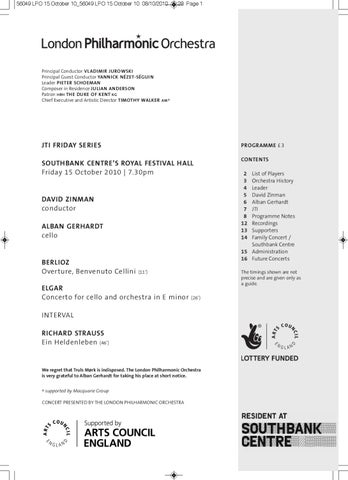
Principal Conductor VLADIMIR JUROWSKI Principal Guest Conductor YANNICK NÉZET-SÉGUIN Leader PIETER SCHOEMAN Composer in Residence JULIAN ANDERSON Patron HRH THE DUKE OF KENT KG Chief Executive and Artistic Director TIMOTHY WALKER
AM†
JTI FRIDAY SERIES
PROGRAMME £3
SOUTHBANK CENTRE’S ROYAL FESTIVAL HALL Friday 15 October 2010 | 7.30pm
DAVID ZINMAN conductor ALBAN GERHARDT cello
BERLIOZ Overture, Benvenuto Cellini
(11’)
ELGAR Concerto for cello and orchestra in E minor
(26’)
RICHARD STRAUSS Ein Heldenleben (46’)
We regret that Truls Mørk is indisposed. The London Philharmonic Orchestra is very grateful to Alban Gerhardt for taking his place at short notice. supported by Macquarie Group
CONCERT PRESENTED BY THE LONDON PHILHARMONIC ORCHESTRA
2 3 4 5 6 7 8 12 13 14
List of Players Orchestra History Leader David Zinman Alban Gerhardt JTI Programme Notes Recordings Supporters Family Concert / Southbank Centre 15 Administration 16 Future Concerts The timings shown are not precise and are given only as a guide.
INTERVAL
†
CONTENTS
56049 LPO 15 October 10_56049 LPO 15 October 10 08/10/2010 12:28 Page 2
LONDON PHILHARMONIC ORCHESTRA
FIRST VIOLINS Pieter Schoeman* Leader Vesselin Gellev Sub-Leader Julia Rumley Chair supported by Mrs Steven Ward
Katalin Varnagy Catherine Craig Thomas Eisner Tina Gruenberg Martin Hรถhmann
CLARINETS Robert Hill* Principal Emily Meredith Paul Richards
CELLOS Kristina Blaumane Principal
E FLAT CLARINET Nicholas Carpenter Principal
Chair supported by Richard Karl Goeltz
Robert Pool Florence Schoeman Peter Nall Galina Tanney Joanne Chen Alina Petrenko Lisa Obert Ishani Bhoola SECOND VIOLINS Clare Duckworth Principal Chair supported by Richard and Victoria Sharp
Joseph Maher Kate Birchall Chair supported by David and Victoria Graham Fuller
Nancy Elan Fiona Higham Marie-Anne Mairesse Ashley Stevens Dean Williamson Sioni Williams Peter Graham Stephen Stewart Mila Mustakova Elizabeth Baldey Steve Dinwoodie VIOLAS Andriy Viytovych Guest Principal Robert Duncan Katharine Leek Susanne Martens
COR ANGLAIS Victoria Walpole Guest Principal
Laura Vallejo Daniel Cornford Michelle Bruil Isabel Pereira Naomi Holt Claudio Cavalletti Martin Fenn Sarah Malcolm
Chair supported by Simon Yates and Kevin Roon
Francis Bucknall Laura Donoghue Jonathan Ayling Chair supported by Caroline, Jamie and Zander Sharp
Gregory Walmsley Sue Sutherley Susanna Riddell Tae-Mi Song Tom Roff Pavlos Carvalho DOUBLE BASSES Kevin Rundell* Principal Timothy Gibbs Co-Principal George Peniston Richard Lewis Tom Walley Joe Melvin Helen Rowlands Damian Rubido Gonzalez FLUTES Jaime Martin* Principal Susan Thomas* Anna Naranjo PICCOLO Stewart McIlwham* Principal OBOES Ian Hardwick Principal Owen Dennis Rachel Ingleton Victoria Walpole
BASS CLARINET Paul Richards Principal BASSOONS John Price Principal Gareth Newman* Emma Harding Simon Estell CONTRA BASSOON Simon Estell Principal HORNS John Ryan Principal Roger Montgomery Guest Principal Martin Hobbs Mark Vines Gareth Mollison Jonathan Barrett Jonathan Bareham Jeffrey Bryant Anthony Chidell
BASS TROMBONE Lyndon Meredith Principal EUPHONIUM David Whitehouse Principal TUBA Lee Tsarmaklis Principal TIMPANI Simon Carrington* Principal Nigel Thomas Antoine Bedewi PERCUSSION Andrew Barclay* Principal Chair supported by Andrew Davenport
Keith Millar Jeremy Cornes Antoine Bedewi HARPS Rachel Masters* Principal Helen Sharp
TRUMPETS Paul Beniston* Principal Anne McAneney* Chair supported by Geoff and Meg Mann
Nicholas Betts Co-Principal Anthony Cross Joe Sharp TROMBONES Mark Templeton* Principal Becky Smith
* Holds a professorial appointment in London
Chair Supporters The London Philharmonic Orchestra also acknowledges the following chair supporters whose players are not present at this concert: John and Angela Kessler Julian and Gill Simmonds
2 | London Philharmonic Orchestra
56049 LPO 15 October 10_56049 LPO 15 October 10 08/10/2010 12:28 Page 3
LONDON PHILHARMONIC ORCHESTRA
Patrick Harrison
Seventy-eight years after Sir Thomas Beecham founded the London Philharmonic Orchestra, it is recognised today as one of the finest orchestras on the international stage. Following Beecham’s influential founding tenure the Orchestra’s Principal Conductorship has been passed from one illustrious musician to another, amongst them Sir Adrian Boult, Bernard Haitink, Sir Georg Solti, Klaus Tennstedt and Kurt Masur. This impressive tradition continued in September 2007 when Vladimir Jurowski became the Orchestra’s Principal Conductor and, in a further exciting move, the Orchestra appointed Yannick Nézet-Séguin its new Principal Guest Conductor from September 2008. The London Philharmonic Orchestra has been performing at Southbank Centre’s Royal Festival Hall since it opened in 1951, becoming Resident Orchestra in 1992. It plays there around 40 times each season with many of the world’s most sought after conductors and soloists. Concert highlights in 2010/11 include an exploration of Mahler’s symphonies and complete song cycles during the composer’s anniversary season; the premières of works by Matteo D’Amico, Magnus Lindberg and Brett Dean; a rare opportunity to hear Rossini’s opera Aureliano in Palmira in collaboration with long term partner Opera Rara; and works by the Orchestra’s new Composer in Residence, Julian Anderson. In addition to its London season and a series of concerts at Wigmore Hall, the Orchestra has flourishing
residencies in Brighton and Eastbourne, and performs regularly around the UK. It is unique in combining these concert activities with esteemed opera performances each summer at Glyndebourne Festival Opera where it has been the Resident Symphony Orchestra since 1964. The London Philharmonic Orchestra performs to enthusiastic audiences all round the world. In 1956 it became the first British orchestra to appear in Soviet Russia and in 1973 made the first ever visit to China by a Western orchestra. Touring continues to form a significant part of the Orchestra’s schedule and is supported by Aviva, the International Touring Partner of the London Philharmonic Orchestra. Tours in 2010/11 include visits to Finland, Germany, South Korea, Spain, France, Belgium and Luxembourg. Having long been embraced by the recording, broadcasting and film industries, the London Philharmonic Orchestra broadcasts regularly on domestic and international television and radio. It also works with the Hollywood and UK film industries, recording soundtracks for blockbuster motion pictures including the Oscar-winning score for The Lord of the Rings trilogy and scores for Lawrence of Arabia, The Mission, Philadelphia and East is East. The London Philharmonic Orchestra made its first recordings on 10 October 1932, just three days after its first public performance. It has recorded and broadcast
London Philharmonic Orchestra | 3
56049 LPO 15 October 10_56049 LPO 15 October 10 08/10/2010 12:28 Page 4
LONDON PHILHARMONIC ORCHESTRA
PIETER SCHOEMAN
regularly ever since, and in 2005 established its own record label. The recordings on its own label are taken mainly from live concerts given with distinguished conductors over the years including the Orchestra’s Principal Conductors from Beecham and Boult, through Haitink, Solti and Tennstedt, to Masur and Jurowski. Recent additions to the catalogue have included acclaimed releases of Elgar’s Symphony No. 1 and Sea Pictures with Vernon Handley and Janet Baker; Mahler’s Symphony No. 2 conducted by Klaus Tennstedt; Brahms’s Symphonies Nos 1 and 2 conducted by Vladimir Jurowski; and Dvořák’s Requiem under the baton of Neeme Järvi. The Orchestra’s own-label CDs are also widely available to download. Visit www.lpo.org.uk/shop for the latest releases.
‘ … a simply tremendous performance of Mahler’s 3rd Symphony … Jurowski and his players plunged us into a winter of discontent so profoundly expectant that even the inveterate coughers were silenced.’ EDWARD SECKERSON, THE INDEPENDENT, 23 SEPTEMBER 2010
The Orchestra reaches thousands of Londoners through its rich programme of community and school-based activity in Lambeth, Lewisham and Southwark, which includes the offshoot ensembles Renga and The Band, its Foyle Future Firsts apprenticeship scheme for outstanding young instrumentalists, and regular family and schools concerts.
In 2002, Pieter Schoeman joined the London Philharmonic Orchestra as Co-Leader. He was appointed Leader in 2008. Born in South Africa, he made his solo debut with the Cape Town Symphony Orchestra at the age of ten. He studied with Jack de Wet in South Africa, winning numerous competitions, including the 1984 World Youth Concerto Competition in America. In 1987 he was offered the Heifetz Chair of Music scholarship to study with Eduard Schmieder in Los Angeles and in 1991 his talent was spotted by Pinchas Zukerman who recommended that he move to New York to study with Sylvia Rosenberg. In 1994 he became her teaching assistant at Indiana University, Bloomington. Pieter Schoeman has performed as a soloist and recitalist throughout the world in such famous halls as the Concertgebouw in Amsterdam, Moscow’s Rachmaninov Hall, Capella Hall in St Petersburg, Staatsbibliothek in Berlin, Hollywood Bowl in Los Angeles and Queen Elizabeth Hall in London. As a chamber musician he regularly performs at London’s prestigious Wigmore Hall. As a soloist with the London Philharmonic Orchestra, he has performed Arvo Pärt’s Double Concerto with Boris Garlitsky and Benjamin Britten’s Double Concerto with Alexander Zemtsov, which was recorded and released on the Orchestra’s own record label to great critical acclaim. Earlier this month he performed the Brahms Double Concerto with Kristina Blaumane.
In 1995 Pieter Schoeman became Co-Leader of the Orchestre Philharmonique de Nice. Since then he has performed frequently as Guest Leader with the symphony orchestras of Barcelona, Bordeaux, Lyon and To help maintain its high standards and diverse workload, Baltimore as well as the BBC Symphony Orchestra. This the Orchestra is committed to the welfare of its season he has been invited to lead the Rotterdam musicians and in December 2007 received the Philharmonic Orchestra on several occasions. Association of British Orchestras/Musicians Benevolent Fund Healthy Orchestra Bronze Charter Mark. Pieter Schoeman has recorded numerous violin solos with the London Philharmonic Orchestra for Chandos, There are many ways to experience and stay in touch Opera Rara, Naxos, X5, the BBC and for American film and with the Orchestra’s activities: visit www.lpo.org.uk, television. He led the Orchestra in its soundtrack subscribe to our podcast series, download our iPhone recordings for The Lord of the Rings trilogy. He teaches at application and join us on Facebook and Twitter. Trinity College of Music in London.
4 | London Philharmonic Orchestra
Patrick Harrison
LEADER
56049 LPO 15 October 10_56049 LPO 15 October 10 08/10/2010 12:28 Page 5
DAVID ZINMAN CONDUCTOR
In addition David Zinman has toured widely with many international orchestras and continues to tour in Europe, Asia and the USA with the Tonhalle-Orchester Zürich. In spring 2010 he conducted a very successful run of The Tales of Hoffmann at Zürich Opera.
David Zinman’s career has been distinguished by his programming of an extraordinarily broad repertoire, his strong commitment to the performance of contemporary music and his introduction of historically informed performance practice. He is in his sixteenth season as Music Director of the Tonhalle-Orchester Zürich. He studied conducting with Pierre Monteux and, since his debut with the Philadelphia Orchestra in 1967, he has conducted many of the world’s leading orchestras. Previous positions held include Music Director of the Rotterdam Philharmonic Orchestra, Rochester Philharmonic Orchestra and Baltimore Symphony Orchestra, as well as Music Director of the Aspen Music Festival and School, and American Academy of Conducting for 13 years. He has also conducted all the leading North American orchestras, including the Boston Symphony, Chicago Symphony, Cleveland, Philadelphia and New York Philharmonic Orchestras. European engagements have taken him to the Berlin Philharmonic, Gewandhaus Orchester Leipzig, Munich Philharmonic, Symphonieorchester des Bayerischen Rundfunks, WDR Sinfonieorchester and Orchestra of the Age of Enlightenment. He also conducts the Royal Concertgebouw, Vienna Philharmonic, London Philharmonic, BBC Symphony and Philharmonia Orchestras, as well as the Orchestre de Paris and Orchestre National de France. In 2009 he appeared with the NHK Symphony, Tokyo Philharmonic and Hong Kong Philharmonic Orchestras and is looking forward to a long awaited return to the Sydney Symphony and New Zealand Symphony Orchestras in 2012.
David Zinman’s extensive discography of more than 100 recordings has earned him numerous international honours, including five Grammy awards, two Grands Prix du Disque, two Edison Prizes, the Deutsche Schallplattenpreis and a Gramophone Award. He was also the 1997 recipient of the prestigious Ditson Award from Columbia University, given in recognition of his exceptional commitment to the performance of works by American composers many of which he has recorded in a series for Decca’s Argo label. On the Arte Nova label David Zinman and the TonhalleOrchester Zürich have released a highly acclaimed Beethoven cycle. Previous recordings, also on the same label, include Richard Strauss’s tone poems and a Schumann symphony cycle. Current projects for Sony/BMG are a Mahler cycle and a recording of all the Schubert symphonies. In 2000 the French Ministry of Culture awarded David Zinman the title of Chevalier de l’Ordre des Arts et des Lettres and in October 2002 he received the City of Zurich Art Prize for his outstanding artistic efforts, making him the first conductor and the first recipient of this award not originally from Switzerland. More recently, he received the prestigious Thomas Theodore award in recognition of his outstanding achievement and extraordinary service to his colleagues in advancing the art and science of conducting, reflecting honour on the profession. In 2008 he won the Midem Classical Artists of the Year Award for his work with the Tonhalle-Orchester Zürich.
London Philharmonic Orchestra | 5
56049 LPO 15 October 10_56049 LPO 15 October 10 08/10/2010 12:28 Page 6
ALBAN GERHARDT CELLO
Highlights of the 2010/11 season include performances with the NHK Symphony, Cleveland, Hallé, BBC Philharmonic, Sydney Symphony and London Philharmonic Orchestras as well as with the Rundfunk Sinfonie-Orchester Berlin and the Orchestre National de Bordeaux. He will perform the Unsuk Chin Cello Concerto with the Residentie Orkest in Amsterdam and with the Gurzenich Orchester in Cologne as well as with the Seoul Philharmonic, Tampere Philharmonic and Boston Symphony Orchestras. The concerto was written for him and premièred at the Proms in 2009 to great acclaim. Over the past decade, Alban Gerhardt has established himself as one of the greatest cellists of our time. His sound is unmistakable and his interpretations of the repertoire are distinguished by their originality. The cello starts to sing under his hands, standard works are newly discovered and unknown pieces are brought to life again. Gerhardt fascinates his growing audiences with the combination of an unerring musical instinct, intense emotion and a very natural, arresting stage presence. Of particular concern for him is his desire to help audiences break with old listening and concert habits and to open classical music to a younger audience. After early success at competitions and his debut with the Berlin Philharmonic Orchestra under Semyon Bychkov, Gerhardt has since performed with more than 170 different orchestras worldwide under conductors such as Christoph von Dohnányi, Sir Colin Davis, Christoph Eschenbach, Marek Janowski, Neeme Järvi, Paavo Järvi, Fabio Luisi, Sir Neville Marriner, Kurt Masur, Andris Nelsons, Sakari Oramo, Esa-Pekka Salonen, Leonard Slatkin, Christian Thielemann and Michael Tilson Thomas. Highlights of Gerhardt’s recent seasons have included tours of Australasia, concerts in the Far East and performances with the Berlin Philharmonic, Royal Concertgebouw, Czech Philharmonic, Finnish Radio Symphony, Oslo Philharmonic, BBC Symphony, Leipzig Gewandhaus, Netherlands Radio Philharmonic, Danish Radio, Philharmonia, Vienna Symphony, Zurich Tonhalle and City of Birmingham Symphony Orchestras as well as with the Chamber Orchestra of Europe, Gurzenich Orchester, Orchestre National de France and Orchestre de la Suisse Romande.
6 | London Philharmonic Orchestra
Alban Gerhardt’s repertoire includes almost 60 different cello concertos, and he relishes rescuing lesser-known works from undeserved obscurity. His collaborations with composers such as Unsuk Chin, Peteris Vasks, Brett Dean, Jörg Widmann, Osvaldo Golijov, Mathias Hinke and Matthias Pintscher demonstrate his strong interest in enlarging the cello repertoire. As well as his intensive solo career, chamber music plays an important role in Gerhardt’s life. He is a frequent performer at international festivals such as the BBC Proms in London and the Edinburgh Festival, and at the Wigmore Hall, Berlin Philharmonie, Suntory Hall in Tokyo and Châtelet in Paris. Gerhardt’s regular chamber partners include Steven Osborne, Cecile Licad, Lars Vogt, Christian Tetzlaff, Lisa Batiashvili, Arabella Steinbacher, Tabea Zimmermann, Thomas Larcher and Emmanuel Pahud. Gerhardt is also a highly acclaimed recording artist, and has won three ECHO Classic Awards most recently for his all-Reger double CD. He records exclusively with Hyperion, spearheading their ‘Romantic Cello Concertos’ series. Recent releases include a recital CD featuring Sonatas by Chopin and Alkan with Steven Osborne and Prokofiev’s Sinfonia Concertante and Concerto in E minor Op. 58 with the Bergen Philharmonic and Andrew Litton. Gerhardt now plays a unique instrument from the renowned maker Matteo Gofriller. He writes about his travelling and performing experiences in his blog, which can be accessed from his webpage: www.albangerhardt.com.
56049 LPO 15 October 10_56049 LPO 15 October 10 08/10/2010 12:28 Page 7
to everyone’s ever yone yone’s ears ears Every Friday in 1953, music lovers young and old came to enjoy a night of classical music from the London Philharmonic Orchestra. At just five shillings (25p) a seat, the concerts almost always sold out. The Orchestra has maintained accessible ticket prices for its Friday concerts for more than half a century. Today, thanks to the support of JTI and the launch of the ‘JTI Friday Series’, it can continue to make its high quality live musical performances available to everyone.
56049 LPO 15 October 10_56049 LPO 15 October 10 08/10/2010 12:28 Page 8
PROGRAMME NOTES
SPEEDREAD How life changes us. In his late Cello Concerto, Edward Elgar shed the rumbustious confidence of his youth in favour of more inward, thoughtful expressions. The Concerto’s elegiac themes shun excess but speak as loudly and often as angrily as the dizzying rollercoasterride that is Richard Strauss’s orchestral autobiography, Ein Heldenleben – ‘A Hero’s Life’. There’s not much sign of restraint in this piece. But like Elgar, Strauss did change, and he predicted as much in Ein Heldenleben’s music: it
Hector BERLIOZ
begins with heroic exhibitionism, scattering adversaries with panache. But it finishes in a place of peace, fulfilled and contented, suddenly as disarmingly noble as Elgar’s cello itself. Another portrait opens this evening’s concert – that of sixteenth century sculptor Benvenuto Cellini. Hector Berlioz thought him a ‘bandit of genius’. In the Overture to Berlioz’s operatic biography of the artist, you glimpse a man of striking impulse, flair and energy who was also blessed with the beating heart of a true Romantic. In that sense, it’s pretty much a picture of Berlioz himself, too.
OVERTURE, BENVENUTO CELLINI
1803-1869
For fifteen months in the early 1830s, Hector Berlioz revelled in the sights, sounds, histories and myths of Italy. The country (though not its music) so enchanted the French composer that it dominated his output for some years. There followed the tone poem Harold in Italy and initial thoughts on Romeo and Juliet – and then, in 1838, a rather strange beast: an opera based on the memoirs of the sixteenth-century Roman sculptor Benvenuto Cellini. The opera was a spectacular failure. Its music was ferociously difficult and daringly innovative. At the première in Paris, those few musicians who could cope with the rhythmically complex score showed little goodwill towards Berlioz, whom they viewed as grossly over ambitious. Audiences were just as merciless. Berlioz, though, might have been expecting it. He identified with his title character’s artistic heroism: Cellini was a man who fought mediocrity and
8 | London Philharmonic Orchestra
philistinism with entirely new visions for the future of his art; a man for whom the road to artistic success was rarely smooth. A re-instating of Berlioz’s uncompromising original vision has gone some way to restoring the opera’s reputation, but these days it’s most commonly namechecked with the performance of two associated orchestral pieces: the Roman Carnival Overture (which uses come of Cellini’s best themes) and the opera’s original Overture. The latter was about the only element of the piece that went down well at the première; it was reportedly greeted with sustained applause, despite its own rhythmic complexities audible from the very first bars. At around ten minutes long, the Overture is almost a tone-poem in itself – capturing Cellini’s impulsiveness, heroism, determination and brilliance as well as his passionate feelings for his beloved Teresa, whose hand he wins in the opera’s closing minutes.
56049 LPO 15 October 10_56049 LPO 15 October 10 08/10/2010 12:28 Page 9
PROGRAMME NOTES
Edward ELGAR 1857-1934
When this concerto was first performed on 27 October 1919, it took its audience at the Queen’s Hall in London by surprise. To them, the piece simply didn’t sound ‘like Elgar’. It’s well documented that the performance that night was poor; the composer conducted an underrehearsed London Symphony Orchestra. But if the ensemble felt its way hesitantly through Elgar’s score as if it ‘seemed not to have any idea of what the composer wanted’ (Ernest Newman), then perhaps, in so doing, it reflected the nature of Elgar’s stylistic shift. Gone were the palpable triumph of the symphonies and the rhapsodic virtuosity of the Violin Concerto. In their place were a musical conversation of shyness and economy and a virtuosity of daring and attack. Was it the shattering impact of the First World War, the nostalgic angst of old age, or a purely artistic quest for greater directness that lay behind the Cello Concerto’s style and shape? All three, probably. Besides, any Cello Concerto is bound by some basic science: the instrument’s range and tonal capacities mean it isn’t audible when pitted against large orchestral textures, and in this concerto the solo cello plays more-or-less continuously. That, in part, explains Elgar’s taut orchestration. More surprising is the conciseness with which the composer treats his musical material. The concerto encompasses so much in its emotional range, but it also seems to have shaken off anything superfluous. Beautiful orchestral colours are achieved by quite simple means.
CONCERTO FOR CELLO AND ORCHESTRA IN E MINOR, OP. 85 ALBAN GERHARDT cello Adagio – Moderato | Lento – Allegro molto | Adagio | Allegro – Moderato – Allegro, ma non troppo
The work opens with a brave, angry statement from the soloist in the manner of a recitative, an idea referenced again at the first movement’s close and again towards the end of the last movement. Elgar marks the passage nobilmente (‘nobly’), but its effect is often that of an outburst. It’s the deep-toned violas that introduce the rocking, world-weary melody taken up later by the soloist and then the whole orchestra. There’s no better example of Elgar’s creative use of minimal material than the opening of the second movement. The cello’s recitative idea (it flutters up and down a minor third and then down and up a tone) is played five times; each time Elgar asks for different expressions from the soloist. The movement proceeds wittily before the distilled beauty of the Adagio – a soliloquy which makes use of a single broad, elegiac theme. The sizeable final movement hints at the rumbustiousness of the pre-war Elgar with its malleable and occasionally whistle-able main theme. But the movement is both joyous and troubled: the cello is left in isolation on occasion by an orchestra that offers redemption, but attacks, too. If there is any of the ‘massive hope for the future’ of Elgar’s pre-war First Symphony, or even a sweet nostalgia in the soaring theme in which the orchestra eventually supports the cello, it appears to be quashed as the composer slams the door shut just after the reprise of the concerto’s opening statement.
INTERVAL 20 minutes An announcement will be made five minutes before the end of the interval.
London Philharmonic Orchestra | 9
56049 LPO 15 October 10_56049 LPO 15 October 10 08/10/2010 12:28 Page 10
PROGRAMME NOTES
Richard STRAUSS
EIN HELDENLEBEN, OP. 40
1864-1949
By 1898 the 34-year-old Strauss had completed seven large orchestral tone poems, five of them inspired by larger-than-life characters from literature or folklore. As he came to plan his eighth, ‘A Hero’s Life’, Strauss turned to a character who fascinated him ‘as much as Napoleon or Alexander’. That character was the composer himself; his new work was to be an orchestral autobiography. It sounds like an act of tremendous immodesty – even before you experience the bombastic brilliance of Strauss’s opening statements, intended to introduce the Hero’s qualities of ambition, resilience, bravery and intellect. But Strauss probably had his tongue firmly placed in his cheek when he talked of a picture of himself in the work. Besides, at the time of writing he was relatively young and on the brink of change. His move into opera would see him write some of the most touchingly vulnerable music ever created, while the effects of the Second World War would draw from him the resigned, autumnal shades of Metamorphosen and the Four Last Songs. Moreover, Strauss himself suggested that the heroic character represented in Ein Heldenleben was only partly his own. In a letter to his father he wrote that the Hero was in fact ‘not a single poetical or historical figure, but rather a more general and free ideal of great and manly heroism’. No matter what the heroic qualities (or otherwise) of Strauss the man, his music up to 1898 had been just about as heroic as it gets. Claude Debussy commented on its ‘frenzied energy which carries one with him as long as he chooses’, referring to his orchestral effects as ‘those of a book of pictures, or even a cinematography’. The tone poems Strauss had already spawned were powerful, rich, malleable, unpredictable, virtuosic, wickedly exciting, touchingly tender and intensely dramatic – all wrapped up in the composer’s own
10 | London Philharmonic Orchestra
brand of instrumental character and orchestral technicolour. In Ein Heldenleben, the listener experiences all of the above and more. This is Strauss’s most rounded, comprehensive and ambitious tone poem, and sees him expanding further his already impressive toolbox of orchestral effects. There’s room for all of them in Strauss’s music precisely because of its narrative range: we meet not just the central Hero, but a confection of souls with whom he fraternised and fought. The orchestral introduction to the Hero mentioned above launches with a broad, all-seeing theme spanning three octaves and lasting 16 bars. The second of Strauss’s six sections is labelled ‘The Hero’s Adversaries’, a thinly disguised caricature of music critics and a representation of more abstract barriers and doubts. For Strauss, there were four types of music critic: carpers (heard on the flute); vituperators (oboe); whiners (cor anglais); and hair-splitters (tuba). It’s said the latter’s theme is explicitly intended to mimic the name of Strauss’s nemesis in the Munich press, a certain Doctor Dehring (think Doc-tor DEH-ring). Needless to say, the Hero despatches them all with ease – though some critical spectres continue to haunt the coming sections. Listen out next for Strauss’s wife Pauline, represented by a lone violin which sings a series of increasingly demanding cadenzas. Pauline was capricious and tricky and Strauss knew it, but he also knew he couldn’t live without her; this section, ‘The Hero’s Companion’, ends with a rapturous love scene, gate-crashed at its conclusion by the sniping critics of the previous portrait. Three off-stage trumpets herald the next section, which depicts the Hero’s brave deeds on the battlefield with some of Strauss’s most energetic and fearsome music.
56049 LPO 15 October 10_56049 LPO 15 October 10 08/10/2010 12:28 Page 11
PROGRAMME NOTES
Strauss said at the time of writing that no instrument could be more heroic than the horn; at the battle’s conclusion all eight of the score’s horns join in unison to proclaim victory. Strauss’s most explicitly autobiographical music comes in the next section, titled ‘The Hero’s Works of Peace’. Here Strauss quotes from nine of his previous compositions including six tone poems. There are notable outings from Till Eulenspiegel’s Merry Pranks and Don Juan on woodwinds, as well as the return of the seemingly irrepressible tuba of Doctor Dehring, heard right at the section’s opening. In Strauss’s final chapter, the Hero ‘withdraws from the world and finds fulfilment.’ After one last internal
struggle the cor anglais recalls a pastoral theme from the tone poem Don Quixote, and the music moves from bravado to serenity, from confidence to disarming love. There are final utterances from a solo horn and violin; pictures of Strauss and his wife having transcended their troubles. Strauss lived through every note of his Heldenleben in public as the conductor of the work’s first performance on 3 March 1899 in Frankfurt. His compositional voice might have been on the brink of change, but Ein Heldenleben and its predecessors heralded an era of orchestral virtuosity that flourished in the 20th century and continues to do so today. For many – and not just the horn players – Ein Heldenleben remains the ultimate orchestral test-piece. Programme notes by Andrew Mellor © 2010
The London Philharmonic Orchestra’s October podcast presents the recent pre-concert talk by Jeremy Barham on the Mahler Anniversary. What did Mahler’s contemporaries think of his music? And how have his works been interpreted, performed and transformed over the 100 years since his death? With particular reference to Mahler's 3rd Symphony, this pre-concert talk, given by Dr Jeremy Barham on 22 September 2010, offers an overview of our Mahler anniversary celebrations. If you missed the talk, visit www.lpo.org.uk/podcasts to listen to it now.
Hear every note
Hard of hearing? Visit the cloakroom for equipment to improve your concert experience.
London Philharmonic Orchestra | 11
56049 LPO 15 October 10_56049 LPO 15 October 10 08/10/2010 12:28 Page 12
ELGAR RECORDINGS ON THE LONDON PHILHARMONIC ORCHESTRA’S OWN RECORD LABEL
LPO-0002 Bernard Haitink conducts Britten’s Our Hunting Fathers (with Heather Harper) along with Elgar’s Introduction and Allegro and Enigma Variations. ‘An intense live performance of Our Hunting Fathers, with Heather Harper indefatigably characterful, plus an incisive, emotional Enigma Variations.’ BBC MUSIC MAGAZINE
LPO-0016-0020 A 5-CD box set to celebrate the 150th anniversary of Elgar’s birth, with recordings dating from 1933 to 1988 featuring conductors including Elgar, Boult, Solti, Mackerras and Handley. Repertoire includes the Symphonies Nos 1 and 2, Enigma Variations, Sea Pictures (with Janet Baker), Cello Concerto (with Paul Tortelier), Violin Concerto, etc. ‘... a five-CD box with enough recorded treasures to last a lifetime ... Elgar himself directs a performance of the overture Froissart from 1933 – the year prior to his death – which bristles with character ... It’s a joy also to hear Janet Baker sing Sea Pictures.’ THE SCOTSMAN, MARCH 2007
LPO-0046 Vernon Handley conducts Elgar’s Symphony No. 1 and Sea Pictures with Janet Baker. ‘Elgar fans should rush to buy this live recording of an LPO Festival Hall concert from 1984. Vernon Handley’s eloquent account of the First Symphony, restrained yet generously abandoned, is one to treasure. But the plum is Janet Baker’s Sea Pictures … Her glorious, rich contralto voice, soaring and floating, is made for this music …’ FIONA MADDOCKS, THE GUARDIAN, 9 MAY 2010
The recordings may be downloaded in high quality MP3 format from www.lpo.org.uk/shop. CDs may also be purchased from all good retail outlets or through the London Philharmonic Orchestra: telephone 020 7840 4242 (Mon-Fri 10am-5pm) or visit the website www.lpo.org.uk
12 | London Philharmonic Orchestra
56049 LPO 15 October 10_56049 LPO 15 October 10 08/10/2010 12:28 Page 13
We would like to acknowledge the generous support of the following Thomas Beecham Group Patrons, Principal Benefactors and Benefactors: Thomas Beecham Group Mr & Mrs Richard & Victoria Sharp Julian & Gill Simmonds Mrs Steven Ward Simon Yates & Kevin Roon
Guy & Utti Whittaker
Commander Vincent Evans Mr Daniel Goldstein Mrs Barbara Green Oliver Heaton Peter MacDonald Eggers Mr & Mrs David Malpas Andrew T Mills Mr Maxwell Morrison Mr Michael Posen Mr & Mrs Thierry Sciard Mr John Soderquist & Mr Costas Michaelides Mr & Mrs G Stein Mr & Mrs John C Tucker Howard & Sheelagh Watson Mr Laurie Watt Mr Anthony Yolland
Principal Benefactors Mark & Elizabeth Adams Jane Attias Lady Jane Berrill Desmond & Ruth Cecil Mr John H Cook Mrs Sonja Drexler Mr Charles Dumas David Ellen
Benefactors Mrs A Beare Dr & Mrs Alan Carrington CBE FRS Marika Cobbold & Michael Patchett-Joyce Mr & Mrs Stewart Cohen Mr Alistair Corbett Mr David Edgecombe
Garf & Gill Collins Andrew Davenport David & Victoria Graham Fuller Richard Karl Goeltz John & Angela Kessler Mr & Mrs Makharinsky Geoff & Meg Mann Caroline, Jamie & Zander Sharp Eric Tomsett
Mr Richard Fernyhough Ken Follett Michael & Christine Henry Mr Glenn Hurstfield Mr R K Jeha Mr & Mrs Maurice Lambert Mr Gerald Levin Sheila Ashley Lewis Wg. Cdr. & Mrs M T Liddiard OBE JP RAF Mr Frank Lim Paul & Brigitta Lock Mr Brian Marsh John Montgomery Mr & Mrs Egil Oldeide Edmund Pirouet Mr Peter Tausig Mrs Kazue Turner Lady Marina Vaizey Mr D Whitelock Hon. Benefactor Elliott Bernerd Hon. Life Members Kenneth Goode Mrs Jackie Rosenfeld OBE
The generosity of our Sponsors, Corporate Members, supporters and donors is gratefully acknowledged. Corporate Members Appleyard & Trew llp AREVA UK British American Business Brown Brothers Harriman Charles Russell Destination Québec – UK Diagonal Consulting Lazard Leventis Overseas Man Group plc Québec Government Office in London Corporate Donor Lombard Street Research In-kind Sponsors Google Inc Heineken The Langham London Lindt & Sprüngli Ltd Sela / Tilley’s Sweets Villa Maria
Trusts and Foundations Allianz Cultural Foundation The Andor Charitable Trust Ruth Berkowitz Charitable Trust The Boltini Trust Borletti-Buitoni Trust The Candide Charitable Trust The John S Cohen Foundation The Coutts Charitable Trust The Dorset Foundation The D’Oyly Carte Charitable Trust Dunard Fund The Equitable Charitable Trust The Eranda Foundation The Ernest Cook Trust The Fenton Arts Trust The Foyle Foundation The Jonathan & Jeniffer Harris Trust The Idlewild Trust The Emmanuel Kaye Foundation Maurice Marks Charitable Trust The Michael Marks Charitable Trust Marsh Christian Trust UK Friends of the FelixMendelssohn-Bartholdy Foundation
The Mercers’ Company Adam Mickiewicz Institute Paul Morgan Charitable Trust Maxwell Morrison Charitable Trust Musicians Benevolent Fund The R K Charitable Trust Serge Rachmaninoff Foundation The Rubin Foundation The Samuel Sebba Charitable Trust Sound Connections The Steel Charitable Trust The Bernard Sunley Charitable Foundation The Swan Trust John Thaw Foundation The Underwood Trust Garfield Weston Foundation Youth Music and others who wish to remain anonymous.
London Philharmonic Orchestra | 13
56049 LPO 15 October 10_56049 LPO 15 October 10 08/10/2010 12:28 Page 14
SOUTHBANK CENTRE
WELCOME TO SOUTHBANK CENTRE We hope you enjoy your visit. We have a Duty Manager available at all times. If you have any queries please ask any member of staff for assistance. Eating, drinking and shopping? Southbank Centre shops and restaurants include: Foyles, EAT, Giraffe, Strada, YO! Sushi, wagamama, Le Pain Quotidien, Las Iguanas, ping pong, Canteen, Caffè Vergnano 1882, Skylon, Concrete and Feng Sushi, as well as cafes, restaurants and shops inside the Royal Festival Hall, Queen Elizabeth Hall and Hayward Gallery.
The Mozart Question Sunday 5 December 2010 | 3.30pm Royal Festival Hall An afternoon of music and storytelling, suitable for children aged 8 and over, based on Michael Morpurgo’s well-loved book which tells of one family’s experience of the holocaust and the incredible healing power of music. Vladimir Jurowski conductor Daniel Pioro violin Michael Morpurgo narrator Alison Reid narrator Simon Reade director Excerpts from: Beethoven Violin Concerto Vivaldi The Four Seasons Strauss The Blue Danube Bach Violin Sonata No. 1 Mozart Eine kleine Nachtmusik Running time 75 minutes. No interval. Tickets Under 16: £7 £9 Adult: £14 £18 For booking details see page 16. Dedicated by the Dorset Foundation in memory of the late Harry M. Weinrebe and supported by a syndicate of individual donors.
14 | London Philharmonic Orchestra
If you wish to get in touch with us following your visit please contact Kenelm Roberts, our Head of Customer Relations, at Southbank Centre, Belvedere Road, London SE1 8XX or email customer@southbankcentre.co.uk or phone 020 7960 4250. We look forward to seeing you again soon. A few points to note for your comfort and enjoyment: PHOTOGRAPHY is not allowed in the auditorium LATECOMERS will only be admitted to the auditorium if there is a suitable break in the performance RECORDING is not permitted in the auditorium without the prior consent of Southbank Centre. Southbank Centre reserves the right to confiscate video or sound equipment and hold it in safekeeping until the performance has ended MOBILES, PAGERS AND WATCHES should be switched off before the performance begins
56049 LPO 15 October 10_56049 LPO 15 October 10 08/10/2010 12:28 Page 15
ADMINISTRATION
BOARD OF DIRECTORS
GENERAL ADMINISTRATION
ORCHESTRA PERSONNEL
ARCHIVES
Martin Höhmann Chairman Stewart McIlwham Vice-Chairman Sue Bohling Simon Carrington Lord Currie* Jonathan Dawson* Anne McAneney George Peniston Sir Bernard Rix* Kevin Rundell Sir Philip Thomas* Sir John Tooley* The Rt Hon. Lord Wakeham DL* Timothy Walker AM †
Timothy Walker AM † Chief Executive and Artistic Director
Andrew Chenery Orchestra Personnel Manager
Edmund Pirouet Consultant
Sarah Thomas Librarian
Philip Stuart Discographer
Michael Pattison Stage Manager
Gillian Pole Recordings Archive
*Non-Executive Directors
THE LONDON PHILHARMONIC TRUST Pehr Gyllenhammar Chairman Desmond Cecil CMG Richard Karl Goeltz Jonathan Harris CBE FRICS Dr Catherine C. Høgel Martin Höhmann Angela Kessler Clive Marks OBE FCA Victoria Sharp Julian Simmonds Timothy Walker AM † Laurence Watt AMERICAN FRIENDS OF THE LONDON PHILHARMONIC ORCHESTRA, INC. We are very grateful to the Board of the American Friends of the London Philharmonic Orchestra for its support of the Orchestra’s activities in the USA. PROFESSIONAL SERVICES Charles Russell Solicitors Crowe Clark Whitehill LLP Auditors Dr Louise Miller Honorary Doctor
Alison Atkinson Digital Projects Manager FINANCE David Burke General Manager and Finance Director David Greenslade Finance and IT Manager CONCERT MANAGEMENT Roanna Chandler Concerts Director Ruth Sansom Artistic Administrator Graham Wood Concerts, Recordings and Glyndebourne Manager Alison Jones Concerts Co-ordinator Jenny Chadwick Tours and Engagements Manager Jo Orr PA to the Executive / Concerts Assistant
Camilla Begg Assistant Orchestra Personnel Manager Ken Graham Trucking Instrument Transportation (Tel: 01737 373305)
89 Albert Embankment London SE1 7TP Tel: 020 7840 4200 Fax: 020 7840 4201 Box Office: 020 7840 4242
DEVELOPMENT Nick Jackman Development Director Phoebe Rouse Corporate Relations Manager Sarah Tattersall Corporate Relations and Events Manager Melissa Van Emden Corporate Relations and Events Officer Elisenda Ayats Development and Finance Officer
LONDON PHILHARMONIC ORCHESTRA
www.lpo.org.uk Visit the website for full details of London Philharmonic Orchestra activities. The London Philharmonic Orchestra Limited is a registered charity No. 238045. Photographs of Berlioz, Elgar and Strauss courtesy of the Royal College of Music, London.
MARKETING
Photograph on the front cover by Pip Eastop.
Matthew Freeman Recordings Consultant
Kath Trout Marketing Director
Programmes printed by Cantate.
EDUCATION AND COMMUNITY PROGRAMME
Ellie Dragonetti Marketing Manager
Matthew Todd Education and Community Director
Frances Cook Publications Manager
Anne Findlay Education Officer
Samantha Kendall Box Office Administrator (Tel: 020 7840 4242)
Isobel Timms Community Officer
Charly Fraser-Annand Intern
Alec Haylor Education and Community Assistant
Valerie Barber Press Consultant (Tel: 020 7586 8560)
Richard Mallett Education and Community Producer
†Supported by Macquarie Group
London Philharmonic Orchestra | 15
56049 LPO 15 October 10_56049 LPO 15 October 10 08/10/2010 12:28 Page 16
FUTURE CONCERTS AT SOUTHBANK CENTRE’S ROYAL FESTIVAL HALL
MAHLER ANNIVERSARY Saturday 30 October 2010 | 7.30pm
Saturday 23 October 2010 | 7.00pm Rossini Aureliano in Palmira Concert performance given in association with Opera Rara. Sung in Italian with English surtitles. This performance will last approximately 2 hours 45 minutes including interval.
Maurizio Benini conductor Catriona Smith Zenobia Silvia Tro Santafé Arsace Kenneth Tarver Aureliano Andrew Foster-Williams Gran Sacerdote Ezgi Kutlu Publia Vuyani Mlinde Licinio Geoffrey Mitchell Choir Supported by the John S Cohen Foundation. 6.00pm–6.30pm | FREE Pre-Concert Event Royal Festival Hall Opera Rara continues its exploration of lesser known operas with a discussion around Rossini’s Aureliano in Palmira.
Brahms Piano Concerto No. 2 Beethoven (arr. Mahler) Symphony No. 3 (Eroica) Vladimir Jurowski conductor Leif Ove Andsnes piano
Vladimir Jurowski and Leif Ove Andsnes
MAHLER ANNIVERSARY Wednesday 17 November 2010 | 7.30pm R Strauss Death and Transfiguration Mahler Rückert-Lieder Ravel Suites Nos 1 and 2, Daphnis et Chloé Kazushi Ono conductor Nathalie Stutzmann contralto
Maurizio Benini and Catriona Smith
MAHLER ANNIVERSARY Wednesday 27 October 2010 | 7.30pm
Kazushi Ono and Nathalie Stutzmann
Mendelssohn Symphony No. 5 (Reformation) Mahler Kindertotenlieder Brahms Symphony No. 3 Vladimir Jurowski conductor Sarah Connolly mezzo soprano
Tickets £9-£38 | Premium seats £55
6.00pm–6.45pm | FREE Pre-Concert Event Royal Festival Hall A performance including Arvo Pärt’s The Abbot Agathon with Foyle Future Firsts, members of the London Philharmonic Orchestra and soprano Patricia Rozario conducted by Vladimir Jurowski.
Vladimir Jurowski and Sarah Connolly
16 | London Philharmonic Orchestra
TO BOOK
London Philharmonic Orchestra Ticket Office 020 7840 4242 | www.lpo.org.uk Mon-Fri 10am-5pm; no booking fee Southbank Centre Ticket Office | 0844 847 9920 www.southbankcentre.co.uk/lpo Daily, 9am-8pm. £2.50 telephone / £1.45 online booking fees; no fee for Southbank Centre members