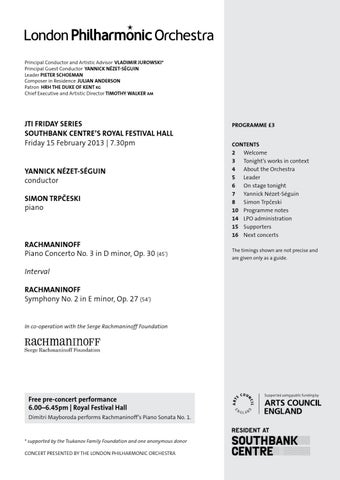
Principal Conductor and Artistic Advisor VLADIMIR JUROWSKI* Principal Guest Conductor YANNICK NÉZET-SÉGUIN Leader pieter schoeman Composer in Residence JULIAN ANDERSON Patron HRH THE DUKE OF KENT KG Chief Executive and Artistic Director TIMOTHY WALKER AM
JTI FRIDAY SERIES SOUTHBANK CENTRE’S ROYAL FESTIVAL HALL Friday 15 February 2013 | 7.30pm
YANNICK NÉZET-SÉGUIN conductor Simon trpČESKI piano
rachmaninoff Piano Concerto No. 3 in D minor, Op. 30 (45’) Interval rachmaninoff Symphony No. 2 in E minor, Op. 27 (54’)
In co-operation with the Serge Rachmaninoff Foundation
Free pre-concert performance 6.00–6.45pm | Royal Festival Hall Dimitri Mayboroda performs Rachmaninoff’s Piano Sonata No. 1.
* supported by the Tsukanov Family Foundation and one anonymous donor CONCERT PRESENTED BY THE LONDON PHILHARMONIC ORCHESTRA
PROGRAMME £3 CONTENTS 2 Welcome 3 Tonight’s works in context 4 About the Orchestra 5 Leader 6 On stage tonight 7 Yannick Nézet-Séguin 8 Simon Trpčeski 10 Programme notes 14 LPO administration 15 Supporters 16 Next concerts The timings shown are not precise and are given only as a guide.
Welcome
WELCOME TO SOUTHBANK CENTRE We hope you enjoy your visit. We have a Duty Manager available at all times. If you have any queries please ask any member of staff for assistance. Eating, drinking and shopping? Southbank Centre shops and restaurants include Foyles, EAT, Giraffe, Strada, YO! Sushi, wagamama, Le Pain Quotidien, Las Iguanas, ping pong, Canteen, Caffè Vergnano 1882, Skylon, Concrete and Feng Sushi, as well as cafes, restaurants and shops inside Royal Festival Hall, Queen Elizabeth Hall and Hayward Gallery. If you wish to get in touch with us following your visit please contact the Visitor Experience Team at Southbank Centre, Belvedere Road, London SE1 8XX, phone 020 7960 4250, or email customer@southbankcentre.co.uk We look forward to seeing you again soon. A few points to note for your comfort and enjoyment: PHOTOGRAPHY is not allowed in the auditorium. LATECOMERS will only be admitted to the auditorium if there is a suitable break in the performance. RECORDING is not permitted in the auditorium without the prior consent of Southbank Centre. Southbank Centre reserves the right to confiscate video or sound equipment and hold it in safekeeping until the performance has ended. MOBILES, PAGERS AND WATCHES should be switched off before the performance begins.
Southbank Centre’s The Rest Is Noise, inspired by Alex Ross’s book The Rest Is Noise Presented by Southbank Centre in partnership with the London Philharmonic Orchestra. southbankcentre.co.uk/therestisnoise The Rest Is Noise is a year-long festival that digs deep into 20th-century history to reveal the influences on art in general and classical music in particular. Inspired by Alex Ross’s book The Rest Is Noise, we use film, debate, talks and a vast range of concerts to reveal the fascinating stories behind the century’s wonderful and often controversial music. We have brought together the world’s finest orchestras and soloists to perform many of the most significant works of the 20th century. We reveal why these pieces were written and how they transformed the musical language of the modern world. Over the year, The Rest Is Noise focuses on 12 different parts. The music is set in context with talks from a fascinating team of historians, scientists, philosophers, political theorists and musical experts as well as films, online content and other special programmes. If you’re new to 20th-century music, then this is your time to start exploring with us as your tour guide. There has never been a festival like this. Jude Kelly Artistic Director, Southbank Centre
2 | London Philharmonic Orchestra
Tonight’s works in context
1870 1873 Serge Rachmaninoff born in Semyonovo, near Great Novgorod in northwest Russia 1876 Prototype telephone invented by Alexander Graham Bell
1880
1880 Dostoyevsky’s The Brothers Karamazov published 1882 Premiere of Wagner’s opera Parsifal in Bayreuth, Germany 1886 First sales of Coca-Cola in the USA, originally marketed as a patent medicinal remedy
1890
1891 Sergei Prokofiev born in Sontsovka, Russia (now part of Ukraine) 1896 Henri Becquerel discovered radioactivity. First modern Olympic games held in Athens 1897 Marconi awarded a patent for radio communication
1900
1901 Death of Queen Victoria 1904 Rachmaninoff took up position as conductor at the Bolshoi Theatre, Moscow 1908 Premiere of Rachmaninoff’s Symphony No. 2 in St Petersburg
1910
1920
1909 Premiere of Rachmaninoff’s Piano Concerto No. 3 in New York 1912 Sinking of the RMS Titanic. Premiere of Schoenberg’s Pierrot Lunaire in Berlin 1914 Outbreak of World War I 1917 Russian Revolution. Rachmaninoff emigrated from Russia, firstly to Scandinavia and then in 1918 to New York 1918 End of World War I 1922 Creation of the Soviet Union (USSR) 1925 Premiere of Berg’s opera Wozzeck in Berlin
1930
1929 Wall Street Crash 1932 London Philharmonic Orchestra founded by Sir Thomas Beecham 1934 Death of Edward Elgar. Rachmaninoff composed his Rhapsody on a Theme of Paganini 1936 Death of King George V
1940
1939 Outbreak of World War II in Europe 1943 Death of Rachmaninoff in Beverly Hills, California 1945 End of World War II
London Philharmonic Orchestra | 3
The LPO were on exceptional form, and the performance had a real edge-of-yourseat excitement. The Guardian (29 September 2012, Royal Festival Hall: Rachmaninoff, Shchedrin, Denisov & Miaskovsky)
The London Philharmonic Orchestra is one of the world’s finest orchestras, balancing a long and distinguished history with a reputation as one of the UK’s most adventurous and forward-looking orchestras. As well as giving classical concerts, the Orchestra also records film and video game soundtracks, has its own record label, and reaches thousands of Londoners every year through activities for schools and local communities. The Orchestra was founded by Sir Thomas Beecham in 1932, and since then its Principal Conductors have included Sir Adrian Boult, Sir John Pritchard, Bernard Haitink, Sir Georg Solti, Klaus Tennstedt and Kurt Masur. The current Principal Conductor is Vladimir Jurowski, appointed in 2007, and Yannick Nézet-Séguin is Principal Guest Conductor. The Orchestra is Resident Orchestra at Southbank Centre’s Royal Festival Hall in London, where it has performed since it opened in 1951, giving around 40 concerts there each season. 2012/13 highlights include three concerts with Vladimir Jurowski based around
4 | London Philharmonic Orchestra
the theme of War and Peace in collaboration with the Russian National Orchestra; Kurt Weill’s The Threepenny Opera, also conducted by Jurowski; 20th-century American works with Marin Alsop; Haydn and Strauss with Yannick Nézet-Séguin; and the UK premiere of Carl Vine’s Second Piano Concerto with pianist Piers Lane under Vassily Sinaisky. Throughout 2013 the Orchestra will collaborate with Southbank Centre on The Rest Is Noise festival, based on Alex Ross’s book of the same name and charting the 20th century’s key musical works and historical events. The Orchestra has flourishing residencies in Brighton and Eastbourne, and performs regularly around the UK. Every summer, the Orchestra leaves London for four months and takes up its annual residency accompanying the famous Glyndebourne Festival Opera, where it has been Resident Symphony Orchestra since 1964. The Orchestra also tours internationally, performing concerts to sell-out audiences worldwide. Tours in the 2012/13 season include visits to Spain, Germany, France, Switzerland, the USA and Austria.
© Patrick Harrison
London Philharmonic Orchestra
Pieter Schoeman leader
In summer 2012 the London Philharmonic Orchestra performed as part of The Queen’s Diamond Jubilee Pageant on the River Thames, and was also chosen to record all the world’s national anthems for the London 2012 Olympics. The London Philharmonic Orchestra maintains an energetic programme of activities for young people and local communities. Highlights include the Deutsche Bank BrightSparks Series; the Leverhulme Young Composers project; and the Foyle Future Firsts orchestral training programme for outstanding young players. Over recent years, developments in technology and social networks have enabled the Orchestra to reach even more people worldwide: all its recordings are available to download from iTunes and, as well as a YouTube channel, news blog, iPhone app and regular podcasts, the Orchestra has a lively presence on Facebook and Twitter. Find out more and get involved! lpo.org.uk facebook.com/londonphilharmonicorchestra
Pieter Schoeman was appointed Leader of the LPO in 2008, having previously been Co-Leader since 2002.
© Patrick Harrison
The London Philharmonic Orchestra has recorded many blockbuster scores, from The Lord of the Rings trilogy to Lawrence of Arabia, The Mission, East is East, Hugo, and The Hobbit: An Unexpected Journey. It also broadcasts regularly on television and radio, and in 2005 established its own record label. There are now nearly 70 releases available on CD and to download. Recent additions include Tchaikovsky’s Symphonies Nos. 4 & 5 with Vladimir Jurowski; Brahms’s Symphonies Nos. 1 & 3 with Klaus Tennstedt; a disc of orchestral works by Mark-Anthony Turnage; and the world premiere of the late Ravi Shankar’s First Symphony conducted by David Murphy.
Born in South Africa, he made his solo debut aged 10 with the Cape Town Symphony Orchestra. He studied with Jack de Wet in South Africa, winning numerous competitions including the 1984 World Youth Concerto Competition in the US. In 1987 he was offered the Heifetz Chair of Music scholarship to study with Eduard Schmieder in Los Angeles and in 1991 his talent was spotted by Pinchas Zukerman, who recommended that he move to New York to study with Sylvia Rosenberg. In 1994 he became her teaching assistant at Indiana University, Bloomington. Pieter has performed worldwide as a soloist and recitalist in such famous halls as the Concertgebouw in Amsterdam, Moscow’s Rachmaninov Hall, Capella Hall in St Petersburg, Staatsbibliothek in Berlin, Hollywood Bowl in Los Angeles and Southbank Centre’s Queen Elizabeth Hall in London. As a chamber musician he regularly performs at London’s prestigious Wigmore Hall. As a soloist with the London Philharmonic Orchestra, Pieter has performed Arvo Pärt’s Double Concerto with Boris Garlitsky, Brahms’s Double Concerto with Kristina Blaumane, and Britten’s Double Concerto with Alexander Zemtsov, which was recorded and released on the Orchestra’s own record label to great critical acclaim. He has recorded numerous violin solos with the London Philharmonic Orchestra for Chandos, Opera Rara, Naxos, X5, the BBC and for American film and television, and led the Orchestra in its soundtrack recordings for The Lord of the Rings trilogy.
twitter.com/LPOrchestra In 1995 Pieter became Co-Leader of the Orchestre Philharmonique de Nice. Since then he has appeared frequently as Guest Leader with the Barcelona, Bordeaux, Lyon, Baltimore and BBC symphony orchestras, and the Rotterdam Philharmonic Orchestra. Pieter is a Professor of Violin at Trinity Laban Conservatoire of Music and Dance. London Philharmonic Orchestra | 5
On stage tonight
First Violins Pieter Schoeman* Leader Vesselin Gellev Sub-Leader Chair supported by John & Angela Kessler
Ilyoung Chae Chair supported by Moya Greene
Katalin Varnagy Chair supported by Sonja Drexler
Catherine Craig Thomas Eisner Tina Gruenberg Geoffrey Lynn Robert Pool Sarah Streatfeild Rebecca Shorrock Alina Petrenko Galina Tanney Peter Nall Madeleine Easton Caroline Sharp Second Violins Philippe Honore Guest Principal Jeongmin Kim Joseph Maher Kate Birchall Chair supported by David & Victoria Graham Fuller
Fiona Higham Ashley Stevens Nancy Elan Emma Wragg Gavin Davies Harry Kerr Imogen Williamson Sioni Williams Alison Strange Peter Graham
Violas Joel Hunter Guest Principal Robert Duncan Gregory Aronovich Katharine Leek Benedetto Pollani Laura Vallejo Susanne Martens Naomi Holt Daniel Cornford Alistair Scahill Isabel Pereira Sarah Malcolm Cellos Kristina Blaumane Principal Francis Bucknall Laura Donoghue Jonathan Ayling Chair supported by Caroline, Jamie & Zander Sharp
Gregory Walmsley Santiago Carvalho†Sue Sutherley Susanna Riddell Tom Roff Helen Rathbone Double Basses Kevin Rundell* Principal Tim Gibbs Co-Principal Laurence Lovelle George Peniston Richard Lewis Kenneth Knussen Helen Rowlands Tom Walley Catherine Ricketts Sebastian Pennar
6 | London Philharmonic Orchestra
Flutes Samuel Coles Guest Principal Sue Thomas Chair supported by the Sharp Family
Trumpets Paul Beniston* Principal Anne McAneney* Chair supported by Geoff & Meg Mann
Stewart McIlwham*
Nicholas Betts Co-Principal Daniel Newell
Piccolo Stewart McIlwham* Principal
Trombones Mark Templeton* Principal David Whitehouse
Oboes Ian Hardwick Principal Angela Tennick Sue Bohling
Bass Trombone Lyndon Meredith Principal
Cor Anglais Sue Bohling Principal Chair supported by Julian & Gill Simmonds
Clarinets Nicholas Carpenter* Principal Emily Meredith Bass Clarinet Paul Richards Principal Bassoons Daniel Jemison Guest Principal Gareth Newman* Horns David Pyatt Principal John Ryan* Principal Martin Hobbs Mark Vines Co-Principal Gareth Mollison
Tuba Lee Tsarmaklis* Principal Timpani Simon Carrington* Principal Percussion Andrew Barclay* Principal Chair supported by Andrew Davenport
Keith Millar Jeremy Cornes Eddy Hackett
* Holds a professorial appointment in London †Chevalier of the Brazilian Order of Rio Branco
Yannick Nézet-Séguin
© Marco Borggreve
conductor
Music Director of The Philadelphia Orchestra since the start of the 2012/13 season, and Music Director of the Rotterdam Philharmonic Orchestra and Principal Guest Conductor of the London Philharmonic Orchestra since 2008, Yannick Nézet-Séguin has also been Artistic Director and Principal Conductor of the Orchestre Métropolitain (Montreal) since 2000, and has conducted all the major ensembles in his native Canada. His European debut in 2004 swiftly led to invitations to many ensembles such as the Dresden Staatskapelle, the Berlin Philharmonic, the Bavarian Radio Symphony Orchestra, the Vienna Philharmonic (in Salzburg, Lucerne and Vienna), the Accademia Nazionale di Santa Cecilia, the Royal Stockholm Philharmonic Orchestra and the Chamber Orchestra of Europe. He made his BBC Proms debut in 2009 with the Scottish Chamber Orchestra, returning the following year with the Rotterdam Philharmonic Orchestra. Summer 2012 saw concerts with the Orchestre Métropolitain in Canada; The Philadelphia Orchestra in Vail and Saratoga in the USA; and the Chamber Orchestra of Europe at Mostly Mozart, New York. A notable opera conductor, Nézet-Séguin made his debut at the Salzburg Festival in 2008 with a new production of Gounod’s Roméo et Juliette, returning to the city for the 2010 Mozartwoche and Don Giovanni at the 2010 and 2011 summer festivals. For the Metropolitan Opera he has conducted Carmen, Don Carlo and Faust, and will return each season. He made his debut at the Teatro alla Scala in 2011 with Roméo et Juliette and at the Royal Opera House, Covent Garden last year with Rusalka. With the Rotterdam Philharmonic Orchestra he has conducted The Makropulos Case, Turandot and Don Carlo; and in 2011 began a Mozart opera series for the Festspielhaus Baden-Baden. Alongside Yannick Nézet-Séguin’s acclaimed Philadelphia Orchestra inaugural concerts and Carnegie Hall debut with Verdi’s Requiem, the 2012/13 season includes the partnership’s first recording for Deutsche Grammophon;
two separate tours to Japan and the Far East with the Rotterdam Philharmonic Orchestra; a German tour with the London Philharmonic Orchestra; and the complete Schumann symphonies and concertos with the Chamber Orchestra of Europe, recorded live last November for DGG from Cité de la Musique in Paris. Following highly successful DVD releases of Roméo et Juliette (Salzburg Festival, 2008) and Carmen (Metropolitan Opera, 2010) for its Yellow Label, in July 2012 Deutsche Grammophon announced a major long-term collaboration with Nézet-Séguin. Their plans include symphonic releases with the Rotterdam Philharmonic and Philadelphia orchestras and the Chamber Orchestra of Europe, and live recordings of Mozart’s seven mature operas from Baden-Baden. The first, Don Giovanni (Mahler Chamber Orchestra) was released last year to outstanding reviews. The series continues with the Chamber Orchestra of Europe, and Così fan tutte is scheduled for release later this year. Nézet-Séguin’s Rotterdam Philharmonic Orchestra discography also includes recordings of Strauss (Ein Heldenleben/Four Last Songs) and Berlioz (Symphonie fantastique/La mort de Cléopâtre) for BIS Records; and three EMI/Virgin releases, including an Edison Awardwinning album of Ravel’s orchestral works. He has recorded Brahms’s German Requiem with the London Philharmonic Orchestra on its own label (LPO-0045) and, with the Orchestre Métropolitain, enjoys a fruitful recording relationship with the Canadian label ATMA Classique. A native of Montreal, Yannick Nézet-Séguin studied piano, conducting, composition and chamber music at Montreal’s Conservatoire de musique du Québec, and choral conducting at Westminster Choir College in Princeton, New Jersey. He continued his studies with renowned conductors including Carlo Maria Giulini. His honours include a prestigious Royal Philharmonic Society Award; Canada’s highly coveted National Arts Centre Award and the Prix Denise-Pelletier, the highest distinction for the arts in Quebec, awarded by the Quebec government. In 2011, he received an honorary doctorate from the University of Quebec in Montreal and in 2012 was appointed a Companion of the Order of Canada.
London Philharmonic Orchestra | 7
Simon Trpčeski
© Simon Fowler
piano
Macedonian pianist Simon Trpčeski has established himself as one of the most remarkable musicians to have emerged in recent years, performing with many of the world’s greatest orchestras and captivating audiences worldwide. He is praised not only for his impeccable technique and delicate expression, but also for his warm personality and his commitment to strengthening Macedonia’s cultural image. In the 2012/13 season Simon Trpčeski continues to appear with some of the most prestigious orchestras around the world. At the beginning of 2013, he performed Chopin’s E minor Concerto with the City of Birmingham Symphony Orchestra, the Swedish Chamber Orchestra and the Orchestra Sinfónica do Porto. He will perform Beethoven’s ‘Emperor’ Concerto with Sir Colin Davis and the London Symphony Orchestra, and Rachmaninoff’s Second Piano Concerto under Robin Ticciati with the Cleveland Orchestra and the Bergen Philharmonic Orchestra, as well as with the Minnesota Orchestra under Andrew Litton and the Danish National Symphony Orchestra under Gianandrea Noseda. He will also appear with the Los Angeles Philharmonic, Cincinnati Symphony, Hallé, Monte-Carlo Philharmonic, Baltimore Symphony and Royal Stockholm Philharmonic orchestras, and will give recitals at the Amsterdam Concertgebouw, the National Philharmonic in Warsaw, and in Berkeley, Vancouver and the UK. March 2010 saw Simon Trpčeski’s concerto recording debut on the Avie label, showcasing Rachmaninoff’s notoriously challenging Piano Concertos Nos. 2 and 3 with Vasily Petrenko and the Royal Liverpool Philharmonic Orchestra. The album was awarded the Diapason d’Or de l’année and Classic FM’s ‘Editor’s Choice’. In June 2011, the Avie label released a second concerto album from Trpčeski, Petrenko and the Royal Liverpool Philharmonic Orchestra: Rachmaninoff Piano Concertos Nos. 1 and 4 alongside the Rhapsody on a Theme of Paganini. This second disc was recognised with Classic FM and Gramophone ‘Editor’s Choice’ and Diapason d’Or distinctions. 8 | London Philharmonic Orchestra
A superb recitalist, Simon Trpčeski has given solo performances in such cultural capitals as New York, San Francisco, Washington DC, London, Paris, Amsterdam, Milan, Munich, Prague, Hamburg, Bilbao, Dublin and Tokyo. He has received widespread acclaim for his recital recordings on the EMI label. The first of these, released in 2002, featured works by Tchaikovsky, Scriabin, Stravinsky and Prokofiev, and received both the ‘Editor’s Choice’ and ‘Debut Album’ awards at the Gramophone Awards. His 2005 Rachmaninoff and 2007 Chopin discs both received extensive praise from critics. In 2008, he released an all-Debussy disc entitled Debussy: Images, which was equally applauded. Simon also performs chamber music as often as he can, appearing at such festivals as Aspen, Verbier and Risor. In summer 2011, he and cellist Nina Kotova performed works by Chopin for a theatrical event based on the life of the composer at the Tuscan Sun Festival in Cortona, Italy, featuring renowned actors Jeremy Irons and Sinéad Cusack. With the special support of KulturOp – Macedonia’s leading cultural and arts organisation – and the Ministry of Culture of the Republic of Macedonia, Simon works regularly with young musicians in Macedonia in order to cultivate the talent of the country’s next generation of artists. Born in the Republic of Macedonia in 1979, Simon Trpčeski has won prizes in international piano competitions in the UK, Italy and the Czech Republic. From 2001–03 he was a member of the BBC New Generation Artists Scheme and in May 2003 he was honoured with the Young Artist Award by the Royal Philharmonic Society. In December 2009, the President of Macedonia, Gjorge Ivanov, honoured him with the Presidential Order of Merit for Macedonia. Simon Trpčeski makes his home in Skopje with his family.
Making music accessible We support the arts because they help enrich people’s lives. Our long-term partnership with the London Philharmonic Orchestra is making music more accessible and promoting audience growth.
JTI is driven by the creativity of 25,000 diverse, enquiring minds made up of 90 nationalities. Imagine the potential. jti.com/UK
London Philharmonic Orchestra | 9
Programme notes
Speedread Not the two most popular of Rachmaninoff’s works, but – in the opinion of many – two of his finest, sit side by side in tonight’s concert. Both were criticised in earlier times and only in the last 50 years or so have they escaped from a prevailing attitude that thought it necessary to make them more palatable by means of savage cuts. Yet today, one of them
Serge Rachmaninoff 1873–1943
Although not as popular as its predecessor, and not as well-stocked with Romantically lingering tunes, Rachmaninoff’s Third Piano Concerto is in many other ways his most admired. This was not always the case; ‘dry, difficult and unappealing’ was how the young Prokofiev heard it (he preferred the ‘charming’ First and Second), and many of the earlier performances and recordings of the work (including the composer’s own, made in 1939) were afflicted by damaging cuts. Prokofiev was right about it being difficult, though. The Third is one of the most technically daunting of all the major piano concertos, its 45-minute span demanding of its executants heroic feats of virtuosity, stamina and power, while at the same time challenging them to show the more musicianly qualities of precision, clarity and line. Rachmaninoff composed it at his family estate in Ivanovka in the autumn of 1909 specifically for his forthcoming first tour to the USA, and he was the soloist at its premiere with the New York Symphony Orchestra on 28 November with Walter Damrosch conducting. An even more memorable performance,
10 | London Philharmonic Orchestra
has acquired a status as the ultimate model of the Romantic piano concerto – texturally rich, soaringly lyrical and toweringly difficult to play, as befits the work of one of the greatest pianists of the 20th century – while the other shows this great composer’s resource, seriousness and depth as a composer away from the keyboard. Rachmaninoff at his best!
Piano Piano Concerto Concerto No. No. 3 in 3 in DD minor, minor, Op. Op. 3030 Simon Simon Trpčeski Trpčeski piano piano 1 1 Allegro Allegro mama non non tanto tanto 2 2 Intermezzo: Intermezzo: Adagio Adagio – – 3 3 Finale: Finale: Alla Alla breve breve
however, must have been the one Rachmaninoff gave with the New York Philharmonic the following January, when the conductor was Gustav Mahler. ‘Mahler touched my composer’s heart straight away’, Rachmaninoff wrote, ‘by devoting himself to my concerto until the accompaniment, which is rather complicated, had been practised to the point of perfection.’ The complexity that Rachmaninoff refers to is due not only to the orchestral accompaniment’s richness, but also to the important role it plays in the work’s construction. While he may not have been the composer to reproduce the taut motivic discourse of a Schoenberg or a Bartók, in this Concerto Rachmaninoff achieves a satisfying sense of unity through laid-back but persistent allusion to themes outlined in the first movement. Of these, none is more of a presence than the long, tender melody uncurled by the piano right at the start. Its restless Russian melancholy is unmistakable, but Rachmaninoff denied suggestions that it had origins in folksong or Orthodox chant: ‘It simply wrote itself’, he said. ‘I was thinking only of the
sound. I wanted to “sing” the melody on the piano, as a singer would sing it.’ Whether naturally arising or not, this theme and its lilting accompaniment inform many of the melodic outlines that follow, giving the whole work the flavour of ongoing, seamless development. Eventually a second theme appears, introduced with a new rhythmic impulse that seems almost like a fanfare in the circumstances, but soon settling down to more expansive lyricism under the pianist’s hands. The development section starts with a reprise of the opening, though naturally one which takes new turns. The music builds to a climax, then subsides, the texture thinning until the piano is left to embark on a long solo cadenza whose own powerful climax is in turn calmed by snippets of the first theme on solo winds. A recapitulation of this theme in its original form follows, but the movement is nearly done now, and the end arrives with a few quiet echoes of the second theme. The title of the second movement, Intermezzo, suggests a desire to relax the atmosphere, as does the drop in key
to D-flat major. In fact the free variations on the sombre melody introduced by the orchestra at the outset encompass both textural detail and much Romantic warmth, while a faster and lighter section turns out to be a waltz-like, major-key transformation of the firstmovement theme in which brilliant piano figuration accompanies the woodwind. A brief and passionate return to the original theme is broken off, however, by a commanding interposition by the pianist, who whips things up and pitches us decisively into the Finale. Here the dominant element is a vigorous, twitching line made from an inversion of the rocking accompaniment figure from the opening of the Concerto. The somewhat militaristic flavour it now gives off is contrasted with another soaringly Romantic second theme, but it returns, along with a melancholy lower-string reminiscence of the first movement’s main theme, in a skittish development section. The recapitulation begins after a moment of near stillness, but, after the soaring theme has returned in glory, the Concerto ends in an exhilarating dash to the finish.
Interval – 20 minutes An announcement will be made five minutes before the end of the interval.
Serge Rachmaninoff
Symphony No. 2 in E minor, Op. 27
Thanks largely to the concertos, Rachmaninoff is usually thought of primarily as a composer for the piano, but before he left Russia for the last time in 1917 he was more widely recognised as a composer of vocal, chamber and orchestral music and a gifted conductor active both in the concert hall and the opera house. The Third Piano Concerto came well into a period of heartening success that had served to wipe away the creatively crippling depression caused by the disastrous premiere of the First Symphony ten years earlier:
1901 had seen him return to form with the Second Piano Concerto; in 1902 he had married, his wife giving birth to a daughter the following year; and 1904 had brought a conducting post at the Bolshoi Opera in Moscow, where, early in 1906, he presided over wellreceived premieres of his operas Francesca da Rimini and The Miserly Knight.
1 Largo – Allegro moderato 2 Allegro molto 3 Adagio 4 Allegro vivace
By the time of these last, however, Rachmaninoff was beginning to feel the strain of celebrity, and made
London Philharmonic Orchestra | 11
Programme notes
the decision to give himself more breathing space by removing himself and his family to Dresden. It was there that he composed his Second Symphony, in such secrecy that even his closest friends were unaware of the fact until they read about it in the press. ‘I have completed a symphony, it’s true!’, he wrote to one of them in February 1907. ‘It’s only ready in draft. I finished it a month ago and immediately put it aside. It was a severe worry to me and I am not going to think about it any more.’ The score was eventually completed early the following year and the premiere took place in St Petersburg on 8 February 1908, with Rachmaninoff himself conducting. The Second Symphony is both one of Rachmaninoff’s most popular orchestral compositions and one of his finest, a work of relaxed expansiveness and easy melodic flow, yet also one of great expressive power and sweep. Rachmaninoff’s talent for memorable melody is as present as ever here, but it never descends into facility; like Tchaikovsky (whose influence is unmistakable), he was able to move the listener with a big tune, but also to mould his melodies into great architectural spans with a subtlety that makes them appear totally natural. This Symphony is in fact shot through with motivic connections and links, but so organic do they seem that the listener could be forgiven for hardly noticing. Three important thematic cells are set out in the Symphony’s opening eight bars. The first, a weighty, undulating figure heard in the cellos and basses, is closely followed by a lightly syncopated stab from the woodwind and horns, and then by a downwardwinding line in the violins. All are significant to the work as a whole, but for the moment they serve to initiate a sombre slow introduction which is lengthy enough to include a powerful climax before subsiding on to a cor anglais solo. The main Allegro section of the movement features two main themes, the first a dreamy transformation of the opening cello-and-bass figure, and the second (heralded by a brief clarinet solo) a romantic dialogue between wind and strings with links to the syncopated second motif. Reminders of all three motifs then continue to appear as the music drives forward through a Tchaikovskian climax in the central development section (built largely on the first motif), warm restatements of the principal themes, and on to an impassioned finish. 12 | London Philharmonic Orchestra
The second movement starts out as a breezily confident scherzo. Simpler in design than its companions, it is in three sections, the third of which is essentially a reprise of the first. The outer sections oppose a striding main theme and a lovingly lyrical second for strings, while the central one introduces a contrasting texture of closely worked, chattering counterpoint. Towards the end of the reprise, the brass interrupt with an apparition of the first movement’s second motif, and the scherzo ends in unexpectedly ominous mood. The Adagio that forms the third movement is one of Rachmaninoff’s most generous melodic creations, a worthy cousin to the slow movement of the Second Piano Concerto, to which it bears similarities. Strangely, its two main themes are presented almost on top of each other, the initial arpeggio-based string melody being immediately followed by a long and languid solo clarinet tune, but both are given ample space to breathe in the course of the ravishing movement that follows, as Rachmaninoff handles their leisurely juxtaposition with great skill and expressive control, decorating them here and there with glistening remembrances of the by-now familiar motifs. The Finale announces its intentions in joyously whirling, carnivalesque music whose textural complexities carry numerous thematic references to what has gone before. Rachmaninoff does not intend to let the movement run away with him, however, and before long introduces a noble violin theme to calm things down. It is an uplifting new presence, and proves even more heart-swellingly so when – following a nostalgic reminiscence of the slow movement and a mountingly exciting section built on descending scales – it makes its majestic return as the Symphony’s crowning glory. Programme notes © Lindsay Kemp
The Serge Rachmaninoff Foundation announces the ‘Serge Rachmaninoff Jubilee Year 2013’ Dedicated to the dear memory of its founder Alexander Rachmaninoff February 14, 2013 – Madrid, Auditorium Nacional LONDON PHILHARMONIC ORCHESTRA Yannick Nézet–Séguin conductor – Simon Trpčeski piano February 15, 2013 – London, Royal Festival Hall LONDON PHILHARMONIC ORCHESTRA Yannick Nézet–Séguin conductor – Simon Trpčeski piano February 17, 2013 – Lausanne, Salle Metropole ORCHESTRE DE CHAMBRE DE LAUSANNE – ORCHESTRE DE l’HEMU Jesus Lopez–Coboz conductor March 7–11, 2013 – Milano, Teatro alla Scala REDISCOVERING RACHMANINOFF FESTIVAL Orchestra Filarmonica della Scala – Gianandrea Noseda conductor – Khatia Buniatishvili piano and Nikita Abrosimov, Sean Botkin, Vakhtang Kodanashvili, Geoffrey Norris, Tony Palmer, Edisher Savitsky March 27 & 28, 2013 – Paris, Salle Pleyel ORCHESTRE DE PARIS – Paavo Järvi conductor – Jorge Luis Pratt piano April 1 & 2, 2013 – Mozscow, Tchaikovsky Concert Hall STATE SYMPHONY ORCHESTRA OF RUSSIA Leonard Slatkin conductor – Denis Matsuev piano May 14 – June 1, 2013 – Geneva, Victoria Hall CYCLE RACHMANINOFF Orchestre de la Suisse Romande – Neeme Järvi conductor – Alexander Gavrylyuk piano May 26 – June 13, 2013 – Lucerne, KKL LUCERNE SYMPHONY ORCHESTRA Dima Slobodeniuk & James Gaffigan conductors – Boris Berezovsky & Denis Matsuev piano October 8 & 10, 2013 – Roma, Auditorium Parco della Musica ORCHESTRA DELL’ACCADEMIA NAZIONALE DI SANTA CECILIA Alexander Sladkovski conductor – Dmitri Mayboroda, Sean Botkin & Nikolai Lugansky piano November 8 & 10, 2013 – Bruxelles, BOZAR ORCHESTRE NATIONAL DE BELGIQUE Andrey Boreyko conductor – Dmitry Mayboroda, Denis Khozhukin & Denis Matsuev piano November 18, 2013 – Vienna, Konzerthaus ROTTERDAM PHILHARMONIC ORCHESTRA Yannick Nézet–Séguin conductor – Nikolai Lugansky piano
Administration
Board of Directors
General Administration
Orchestra Personnel
Archives
Victoria Sharp Chairman Stewart McIlwham* President Gareth Newman* Vice-President Desmond Cecil CMG Vesselin Gellev* Jonathan Harris CBE FRICS Dr Catherine C. Høgel Martin Höhmann* Angela Kessler George Peniston* Sir Bernard Rix Kevin Rundell* Julian Simmonds Mark Templeton* Sir Philip Thomas Natasha Tsukanova Timothy Walker AM Laurence Watt Dr Manon Williams
Timothy Walker AM Chief Executive and Artistic Director
Andrew Chenery Orchestra Personnel Manager
Philip Stuart Discographer
Sarah Thomas Librarian (maternity leave)
Gillian Pole Recordings Archive
Sarah Holmes Librarian (maternity cover)
Professional Services
* Player-Director
Advisory Council Victoria Sharp Chairman Richard Brass Sir Alan Collins Jonathan Dawson Christopher Fraser OBE Clive Marks OBE FCA Stewart McIlwham Lord Sharman of Redlynch OBE Timothy Walker AM American Friends of the London Philharmonic Orchestra, Inc. Margot Astrachan Chairman David E. R. Dangoor Vice Chair/Treasurer Kyung-Wha Chung Peter M. Felix CBE Alexandra Jupin Dr. Felisa B. Kaplan William A. Kerr Jill Fine Mainelli Kristina McPhee Dr. Joseph Mulvehill Harvey M. Spear, Esq. Danny Lopez Honorary Chairman Noel Kilkenny Honorary Director Victoria Sharp Honorary Director Richard Gee, Esq Of Counsel Robert Kuchner, CPA
Alison Atkinson Digital Projects Manager Finance David Burke General Manager and Finance Director
Michael Pattison Stage Manager
Matthew Freeman Recordings Consultant
Mia Roberts Marketing Manager
Education & Community
Rachel Williams Publications Manager
Charles Russell Solicitors
Crowe Clark Whitehill LLP Julia Boon Auditors Assistant Orchestra Personnel David Greenslade Manager FSC_57678 14 January 2011 15/09/2011 12:30 Page Dr 1 Louise Miller Finance and ITLPO Manager Honorary Doctor Ken Graham Trucking Concert Management Instrument Transportation London Philharmonic Roanna Gibson Development Orchestra Concerts Director 89 Albert Embankment (maternity leave) Nick Jackman London SE1 7TP Development Director Ruth Sansom Tel: 020 7840 4200 Artistic Administrator / Acting Fax: 020 7840 4201 Helen Searl Head of Concerts Department Box Office: 020 7840 4242 Corporate Relations Manager lpo.org.uk Graham Wood Katherine Hattersley Concerts and Recordings Charitable Giving Manager The London Philharmonic Manager Orchestra Limited is a Melissa Van Emden registered charity No. 238045. Barbara Palczynski Events Manager Glyndebourne and Projects Photograph of Rachmaninoff Laura Luckhurst Administrator courtesy of the Royal College Corporate Relations and Jenny Chadwick of Music, London. Events Officer Tours and Engagements Sarah Fletcher Manager Front cover photograph Development and Finance © Patrick Harrison. Alison Jones Officer Concerts Co-ordinator Printed by Cantate. Marketing Jo Orr PA to the Chief Executive / Kath Trout Concerts Assistant Marketing Director
Patrick Bailey Education and Community Director Alexandra Clarke Education Manager Caz Vale Community and Young Talent Manager Richard Mallett Education and Community Producer
14 | London Philharmonic Orchestra
Samantha Kendall Box Office Manager (Tel: 020 7840 4242) Libby Northcote-Green Marketing Co-ordinator Isobel King Intern Albion Media Public Relations (Tel: 020 3077 4930)
We would like to acknowledge the generous support of the following Thomas Beecham Group Patrons, Principal Benefactors and Benefactors: Thomas Beecham Group The Tsukanov Family Foundation Anonymous The Sharp Family Julian & Gill Simmonds Garf & Gill Collins Andrew Davenport Mrs Sonja Drexler David & Victoria Graham Fuller Moya Greene John & Angela Kessler Mr & Mrs Makharinsky Geoff & Meg Mann Caroline, Jamie & Zander Sharp Eric Tomsett Guy & Utti Whittaker Manon Williams Principal Benefactors Mark & Elizabeth Adams Jane Attias Lady Jane Berrill Desmond & Ruth Cecil Mr John H Cook Mr Charles Dumas
David Ellen Commander Vincent Evans Mr Daniel Goldstein Mr & Mrs Jeffrey Herrmann Peter MacDonald Eggers Mr & Mrs David Malpas Mr Maxwell Morrison Mr Michael Posen Mr & Mrs Thierry Sciard Mr John Soderquist & Mr Costas Michaelides Mr & Mrs G Stein Mr & Mrs John C Tucker Mr & Mrs John & Susi Underwood Lady Marina Vaizey Howard & Sheelagh Watson Mr Anthony Yolland Benefactors Mrs A Beare Dr & Mrs Alan Carrington CBE FRS Mr & Mrs Stewart Cohen Mr Alistair Corbett Mr David Dennis Mr David Edgecombe Mr Richard Fernyhough Ken Follett Michael & Christine Henry
Ivan Hurry Mr Glenn Hurstfield Mr R K Jeha Mr Gerald Levin Sheila Ashley Lewis Wg. Cdr. & Mrs M T Liddiard OBE JP RAF Mr Frank Lim Paul & Brigitta Lock Mr Brian Marsh Andrew T Mills John Montgomery Mr & Mrs Andrew Neill Edmund Pirouet Professor John Studd Mr Peter Tausig Mrs Kazue Turner Mr Laurie Watt Des & Maggie Whitelock Christopher Williams Bill Yoe Hon. Benefactor Elliott Bernerd Hon. Life Members Kenneth Goode Pehr G Gyllenhammar Edmund Pirouet Mrs Jackie Rosenfeld OBE
The generosity of our Sponsors, Corporate Members, supporters and donors is gratefully acknowledged: Corporate Members Silver: AREVA UK British American Business Destination Québec – UK Hermes Fund Managers Pritchard Englefield Bronze: Lisa Bolgar Smith and Felix Appelbe of Ambrose Appelbe Appleyard & Trew LLP Berkeley Law Charles Russell Lazard Leventis Overseas Corporate Donor Lombard Street Research Preferred Partners Corinthia Hotel London Heineken Lindt & Sprüngli Ltd Villa Maria
In-kind Sponsors Google Inc Sela / Tilley’s Sweets Trusts and Foundations BBC Performing Arts Fund The Boltini Trust Sir William Boreman’s Foundation The Boshier-Hinton Foundation Britten-Pears Foundation The Candide Trust The Coutts Charitable Trust Diaphonique, Franco-British fund for contemporary music Dunard Fund Embassy of Spain, Office for Cultural and Scientific Affairs The Equitable Charitable Trust Fidelio Charitable Trust The Foyle Foundation J Paul Getty Junior Charitable Trust The Jeniffer and Jonathan Harris Charitable Trust Capital Radio’s Help a London Child The Hobson Charity The Kirby Laing Foundation
The Idlewild Trust The Leverhulme Trust Marsh Christian Trust Adam Mickiewicz Institute The Peter Minet Trust Paul Morgan Charitable Trust The Diana and Allan Morgenthau Charitable Trust Maxwell Morrison Charitable Trust Musicians Benevolent Fund Newcomen Collett Foundation The Austin & Hope Pilkington Trust Serge Rachmaninoff Foundation The Rothschild Foundation The Samuel Sebba Charitable Trust The Bernard Sunley Charitable Foundation John Thaw Foundation The Tillett Trust The Underwood Trust Sir Siegmund Warburg’s Voluntary Settlement Kurt Weill Foundation for Music Garfield Weston Foundation and others who wish to remain anonymous
London Philharmonic Orchestra | 15
Next LPO concerts at Royal Festival Hall
Saturday 16 February 2013 | 7.30pm
Wednesday 20 February 2013 | 7.30pm
Ravel Mother Goose Prokofiev Violin Concerto No. 1 Stravinsky The Rite of Spring
Anon Spirituals – a cappella Dvořák Symphony No. 9 (From the New World) Milhaud La Création du monde Varèse Amériques
Yannick Nézet-Séguin conductor Leila Josefowicz violin Thomas Beecham Group Concert, generously supported by Dunard Fund
‘Josefowicz delivered a wide-screen, 3D interpretation, the colours as bright and vivid as any paint chart but more enticing.’ Evening Standard, April 2011 (Prokofiev Violin Concerto No. 1)
Marin Alsop conductor London Adventist Chorale Free pre-concert performance 6.00–6.45pm | Royal Festival Hall Foyle Future Firsts and conductor Andrew Gourlay present Les mariés de la Tour Eiffel by Les Six (orch. Constant) – a rare revival of the score to Cocteau’s nonsensical ballet.
London Philharmonic Orchestra Ticket Office: 020 7840 4242 Monday to Friday 10.00am–5.00pm | lpo.org.uk Southbank Centre Ticket Office: 0844 847 9920 Daily 9.00am–8.00pm | southbankcentre.co.uk
INTERNATIONAL PIANO SERIES 2012/13
CHRISTIAN BLACKSHAW
Tuesday 26 February
KARIM SAID
Sunday 3 March and Sunday 9 June
MITSUKO UCHIDA
Sunday 12 May Part of The Rest Is Noise
PIOTR ANDERSZEWSKI
STEPHEN KOVACEVICH
STEVEN OSBORNE
KIRILL GERSTEIN
ELISABETH LEONSKAJA
YUNDI
Thursday 18 April
16 | London Philharmonic Orchestra
DENIS KOZHUKHIN
Thursday 23 May
Thursday 4 April
TICKETS 0844 847 9929 SOUTHBANKCENTRE.CO.UK
Tuesday 7 May
Wednesday 6 March
Tuesday 19 March
Mitsuko Uchida © Roger Mastroianni
ANGELA HEWITT
Wednesday 29 May Part of The Rest Is Noise
Wednesday 5 June