56307 LPO 15 December 10_56307 LPO 15 December 10 08/12/2010 13:01 Page 1
Principal Conductor VLADIMIR JUROWSKI Principal Guest Conductor YANNICK NÉZET-SÉGUIN Leader PIETER SCHOEMAN Composer in Residence JULIAN ANDERSON Patron HRH THE DUKE OF KENT KG Chief Executive and Artistic Director TIMOTHY WALKER
AM†
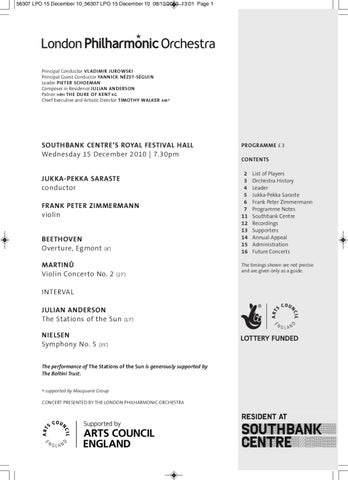
SOUTHBANK CENTRE’S ROYAL FESTIVAL HALL Wednesday 15 December 2010 | 7.30pm JUKKA-PEKKA SARASTE conductor FRANK PETER ZIMMERMANN violin BEETHOVEN Overture, Egmont
(8’)
MARTINŮ Violin Concerto No. 2
(27’)
INTERVAL JULIAN ANDERSON The Stations of the Sun NIELSEN Symphony No. 5
(17’)
(35’)
The performance of The Stations of the Sun is generously supported by The Boltini Trust. †
supported by Macquarie Group
CONCERT PRESENTED BY THE LONDON PHILHARMONIC ORCHESTRA
PROGRAMME £3 CONTENTS 2 3 4 5 6 7 11 12 13 14 15 16
List of Players Orchestra History Leader Jukka-Pekka Saraste Frank Peter Zimmermann Programme Notes Southbank Centre Recordings Supporters Annual Appeal Administration Future Concerts
The timings shown are not precise and are given only as a guide.
56307 LPO 15 December 10_56307 LPO 15 December 10 08/12/2010 13:02 Page 2
LONDON PHILHARMONIC ORCHESTRA
FIRST VIOLINS Pieter Schoeman* Leader Vesselin Gellev Sub-Leader Chair supported by John and Angela Kessler
Julia Rumley Katalin Varnagy Catherine Craig Thomas Eisner Tina Gruenberg Martin Hรถhmann Chair supported by Richard Karl Goeltz
Geoffrey Lynn Robert Pool Florence Schoeman Sarah Streatfeild Rebecca Shorrock Peter Nall Galina Tanney Joanne Chen SECOND VIOLINS Jeongmin Kim Principal Joseph Maher Kate Birchall Chair supported by David and Victoria Graham Fuller
Nancy Elan Fiona Higham Marie-Anne Mairesse Ashley Stevens Imogen Williamson Sioni Williams Heather Badke Alison Strange Peter Graham Mila Mustakova Elizabeth Baldey
VIOLAS Tom Dunn Guest Principal Katharine Leek Benedetto Pollani Emmanuella Reiter-Bootiman Laura Vallejo Michelle Bruil Alistair Scahill Daniel Cornford Isabel Pereira Martin Fenn Sarah Malcolm Rebecca Carrington
FLUTES Jaime Martin* Principal Susan Thomas* Stewart McIlwham*
TRUMPETS Paul Beniston* Principal Anne McAneney*
PICCOLOS Stewart McIlwham* Principal Susan Thomas*
Nicholas Betts Co-Principal
OBOES Ian Hardwick Principal Angela Tennick Owen Dennis
BASS TROMBONE Lyndon Meredith Principal
CELLOS Susanne Beer Principal Francis Bucknall Laura Donoghue Gregory Walmsley Sue Sutherley Susanna Riddell Helen Rathbone Emma Black Pavlos Carvalho Rosie Banks
COR ANGLAIS Owen Dennis Guest Principal
TUBA Lee Tsarmaklis Principal
CLARINETS Robert Hill* Principal Emily Meredith Paul Richards
TIMPANI Simon Carrington* Principal
DOUBLE BASSES Tim Gibbs Principal Laurence Lovelle George Peniston Richard Lewis Roger Linley Kenneth Knussen Tom Walley Joe Melvin
BASS CLARINET Paul Richards Principal BASSOONS John Price Principal Gareth Newman* Simon Estell CONTRA BASSOON Simon Estell Principal HORNS John Ryan Principal Martin Hobbs Gareth Mollison Richard Bayliss Nicolas Wolmark
Chair supported by Geoff and Meg Mann
TROMBONES Mark Templeton* Principal David Whitehouse
PERCUSSION Rachel Gledhill Principal Andrew Barclay* Co-Principal Chair supported by Andrew Davenport
Keith Millar Jeremy Cornes HARP Rachel Masters* Principal PIANO/CELESTE Catherine Edwards
* Holds a professorial appointment in London
Chair Supporters The London Philharmonic Orchestra also acknowledges the following chair supporters whose players are not present at this concert: Caroline, Jamie and Zander Sharp Richard and Victoria Sharp Julian and Gill Simmonds The Tsukanov Family Simon Yates and Kevin Roon
2 | London Philharmonic Orchestra
56307 LPO 15 December 10_56307 LPO 15 December 10 08/12/2010 13:02 Page 3
LONDON PHILHARMONIC ORCHESTRA
Patrick Harrison
Seventy-eight years after Sir Thomas Beecham founded the London Philharmonic Orchestra, it is recognised today as one of the finest orchestras on the international stage. Following Beecham’s influential founding tenure the Orchestra’s Principal Conductorship has been passed from one illustrious musician to another, amongst them Sir Adrian Boult, Bernard Haitink, Sir Georg Solti, Klaus Tennstedt and Kurt Masur. This impressive tradition continued in September 2007 when Vladimir Jurowski became the Orchestra’s Principal Conductor and, in a further exciting move, the Orchestra appointed Yannick Nézet-Séguin its new Principal Guest Conductor from September 2008. The London Philharmonic Orchestra has been performing at Southbank Centre’s Royal Festival Hall since it opened in 1951, becoming Resident Orchestra in 1992. It plays there around 40 times each season with many of the world’s most sought after conductors and soloists. Concert highlights in 2010/11 include an exploration of Mahler’s symphonies and complete song cycles during the composer’s anniversary season; the premières of works by Matteo D’Amico, Magnus Lindberg and Brett Dean; a rare opportunity to hear Rossini’s opera Aureliano in Palmira in collaboration with long term partner Opera Rara; and works by the Orchestra’s new Composer in Residence, Julian Anderson. In addition to its London season and a series of concerts at Wigmore Hall, the Orchestra has flourishing
residencies in Brighton and Eastbourne, and performs regularly around the UK. It is unique in combining these concert activities with esteemed opera performances each summer at Glyndebourne Festival Opera where it has been the Resident Symphony Orchestra since 1964. The London Philharmonic Orchestra performs to enthusiastic audiences all round the world. In 1956 it became the first British orchestra to appear in Soviet Russia and in 1973 made the first ever visit to China by a Western orchestra. Touring continues to form a significant part of the Orchestra’s schedule and is supported by Aviva, the International Touring Partner of the London Philharmonic Orchestra. Tours in 2010/11 include visits to Finland, Germany, South Korea, Spain, France, Belgium and Luxembourg. Having long been embraced by the recording, broadcasting and film industries, the London Philharmonic Orchestra broadcasts regularly on domestic and international television and radio. It also works with the Hollywood and UK film industries, recording soundtracks for blockbuster motion pictures including the Oscar-winning score for The Lord of the Rings trilogy and scores for Lawrence of Arabia, The Mission, Philadelphia and East is East. The London Philharmonic Orchestra made its first recordings on 10 October 1932, just three days after its first public performance. It has recorded and broadcast
London Philharmonic Orchestra | 3
56307 LPO 15 December 10_56307 LPO 15 December 10 08/12/2010 13:02 Page 4
LONDON PHILHARMONIC ORCHESTRA
PIETER SCHOEMAN
regularly ever since, and in 2005 established its own record label. The recordings on its own label are taken mainly from live concerts given with distinguished conductors over the years including the Orchestra’s Principal Conductors from Beecham and Boult, through Haitink, Solti and Tennstedt, to Masur and Jurowski. Recent additions to the catalogue have included acclaimed releases of Elgar’s Symphony No. 1 and Sea Pictures with Vernon Handley and Janet Baker; Mahler’s Symphony No. 2 conducted by Klaus Tennstedt; Brahms’s Symphonies Nos 1 and 2 conducted by Vladimir Jurowski; and Dvořák’s Requiem under the baton of Neeme Järvi. The Orchestra’s own-label CDs are also widely available to download. Visit www.lpo.org.uk/shop for the latest releases.
‘ … a simply tremendous performance of Mahler’s 3rd Symphony … Jurowski and his players plunged us into a winter of discontent so profoundly expectant that even the inveterate coughers were silenced.’ EDWARD SECKERSON, THE INDEPENDENT, 23 SEPTEMBER 2010
The Orchestra reaches thousands of Londoners through its rich programme of community and school-based activity in Lambeth, Lewisham and Southwark, which includes the offshoot ensembles Renga and The Band, its Foyle Future Firsts apprenticeship scheme for outstanding young instrumentalists, and regular family and schools concerts. To help maintain its high standards and diverse workload, the Orchestra is committed to the welfare of its musicians and in December 2007 received the Association of British Orchestras/Musicians Benevolent Fund Healthy Orchestra Bronze Charter Mark. There are many ways to experience and stay in touch with the Orchestra’s activities: visit www.lpo.org.uk, subscribe to our podcast series, download our iPhone application and join us on Facebook and Twitter.
4 | London Philharmonic Orchestra
In 2002, Pieter Schoeman joined the London Philharmonic Orchestra as Co-Leader. He was appointed Leader in 2008. Born in South Africa, he made his solo debut with the Cape Town Symphony Orchestra at the age of ten. He studied with Jack de Wet in South Africa, winning numerous competitions, including the 1984 World Youth Concerto Competition in America. In 1987 he was offered the Heifetz Chair of Music scholarship to study with Eduard Schmieder in Los Angeles and in 1991 his talent was spotted by Pinchas Zukerman who recommended that he move to New York to study with Sylvia Rosenberg. In 1994 he became her teaching assistant at Indiana University, Bloomington. Pieter Schoeman has performed as a soloist and recitalist throughout the world in such famous halls as the Concertgebouw in Amsterdam, Moscow’s Rachmaninov Hall, Capella Hall in St Petersburg, Staatsbibliothek in Berlin, Hollywood Bowl in Los Angeles and Queen Elizabeth Hall in London. As a chamber musician he regularly performs at London’s prestigious Wigmore Hall. As a soloist with the London Philharmonic Orchestra, he has performed Arvo Pärt’s Double Concerto with Boris Garlitsky and Benjamin Britten’s Double Concerto with Alexander Zemtsov, which was recorded and released on the Orchestra’s own record label to great critical acclaim. In October he performed the Brahms Double Concerto with Kristina Blaumane. In 1995 Pieter Schoeman became Co-Leader of the Orchestre Philharmonique de Nice. Since then he has performed frequently as Guest Leader with the symphony orchestras of Barcelona, Bordeaux, Lyon and Baltimore as well as the BBC Symphony Orchestra. This season he has been invited to lead the Rotterdam Philharmonic Orchestra on several occasions. Pieter Schoeman has recorded numerous violin solos with the London Philharmonic Orchestra for Chandos, Opera Rara, Naxos, X5, the BBC and for American film and television. He led the Orchestra in its soundtrack recordings for The Lord of the Rings trilogy. He teaches at Trinity College of Music in London.
Patrick Harrison
LEADER
56307 LPO 15 December 10_56307 LPO 15 December 10 08/12/2010 13:02 Page 5
JUKKA-PEKKA SARASTE CONDUCTOR
Orchestre Philharmonique de Radio France. Jukka-Pekka Saraste also took part in the first Abu Dhabi Classics seasons with the Sibelius Academy Orchestra and the Philharmonia Orchestra and conducted a substantial tour to all the European music capitals with the Oslo Philharmonic Orchestra and violinist Anne-Sophie Mutter.
At the beginning of the 2010/11 season, Jukka-Pekka Saraste took up the position of Chief Conductor of the WDR Symphony Orchestra in Cologne. Since August 2006 he has held the post of Music Director of the Oslo Philharmonic Orchestra. From 1987 to 2001, he was Music Director of the Finnish Radio Symphony Orchestra and created an orchestra much admired by audiences and critics throughout the world. From 1994 to 2001, he held the position of Chief Conductor of the Toronto Symphony Orchestra and from 2002 to 2005 he was Principal Guest Conductor of the BBC Symphony Orchestra. For the Finnish Chamber Orchestra he founded the Tammisaari Festival which takes place every summer. He is also Music Adviser of the Lahti Symphony Orchestra.
His discography includes the complete symphonies of Sibelius and Nielsen with the Finnish Radio Orchestra as well as works by Bartók, Dutilleux, Mussorgsky and Prokofiev with the Toronto Symphony Orchestra. His most recent recordings are of Mahler’s Symphony No. 9 with the WDR Symphony Orchestra, Mahler’s Symphony No. 6 and the first DVD releases of Sibelius’s Symphonies Nos 1 and 5 with the Oslo Philharmonic Orchestra.
Jukka-Pekka Saraste has established himself as one of the exceptional conductors of his generation, demonstrating considerable musical depth and integrity. He brought the music of Scandinavian composers such as Kaija Saariaho, Magnus Lindberg and Esa-Pekka Salonen to greater prominence in the concert repertoire and also has a strong affinity with the sound and style of late romantic music. His most recent engagements have taken him to the Philharmonia, Bavarian Radio Symphony, Concertgebouw, Chicago Symphony, Boston Symphony, Vienna Symphony, Munich Philharmonic, London Philharmonic, Rotterdam Philharmonic and Swedish Radio Orchestras as well as to the Orchestra Filarmonica della Scala, the WDR Orchestra Cologne and the
London Philharmonic Orchestra | 5
56307 LPO 15 December 10_56307 LPO 15 December 10 08/12/2010 13:02 Page 6
FRANK PETER ZIMMERMANN VIOLIN
Matthias Pintscher with the Berlin Philharmonic Orchestra and Peter Eötvös.
Born in 1965 in Duisburg, Germany, Frank Peter Zimmermann started playing the violin when he was five years old, giving his first concert with orchestra at the age of ten. Since finishing his studies with Valery Gradov, Saschko Gawriloff and Herman Krebbers in 1983, he has performed with the world’s most renowned orchestras and conductors at all the major concert venues as well as at international music festivals in Europe, the United States, Japan, South America and Australia. Future engagements will include performances with the Berlin Philharmonic and Royal Concertgebouw Orchestras both under Mariss Jansons; concerts with the Bavarian Radio Symphony Orchestra under Stéphane Denève and Yannick Nézet-Séguin as part of a residency with the orchestra this season; a residency in 2011/12 with the New York Philharmonic Orchestra (including a tour in Europe) under Alan Gilbert and Christoph von Dohnányi; performances with the Chicago Symphony Orchestra and Bernard Haitink and with the Cleveland Orchestra and Thomas Dausgaard; a residency in 2011/12 with the Bamberg Symphony Orchestra under Robin Ticciati, Manfred Honeck and Jonathan Nott; and a performance with the orchestra of La Scala Milan and Daniel Harding. Frank Peter Zimmermann has given the world premières of three violin concertos: in 2009 of Augusta Read Thomas’s Violin Concerto No. 3 ‘Juggler in Paradise’ with the Orchestre Philharmonique de Radio France and Andrey Boreyko; in 2007 of Brett Dean’s Violin Concerto ‘The Lost Art of Letter Writing’ (for which the composer received the 2009 Grawemeyer Award) with the Royal Concertgebouw Orchestra conducted by the composer; and in 2003 of the Violin Concerto ‘en sourdine’ by
6 | London Philharmonic Orchestra
As an avid chamber musician and recitalist, Frank Peter Zimmermann has given numerous concerts worldwide. His regular recital partners are pianists Piotr Anderzewski, Enrico Pace, Emanuel Ax and Martin Helmchen. Together with viola player Antoine Tamestit and cellist Christian Poltéra he forms the Trio Zimmermann which has performed in Amsterdam, Brussels, Cologne, London, Lyon, Milan, Munich, Paris and Vienna, as well as at the Salzburg and Edinburgh Festivals. Frank Peter Zimmermann was awarded the ‘Premio del Accademia Musicale Chigiana, Siena 1990’ and in 1994 the important Rheinischer Kulturpreis. In 2002 he received the Musikpreis of the city of Duisburg and in 2008 the ‘Bundesverdienstkreuz 1. Klasse der Bundesrepublik Deutschland’. His recordings include the Tchaikovsky Violin Concerto with the Oslo Philharmonic Orchestra and Manfred Honeck; the Bruch Violin Concerto No. 1 with the Royal Philharmonic Orchestra and Paavo Berglund; the Busoni Violin Concerto with the Orchestra Sinfonica Nazionale della RAI and John Storgards coupled with the Busoni Violin Sonata No. 2 with pianist Enrico Pace; the six Violin Sonatas by J.S. Bach, again with Enrico Pace; the two Violin Concertos of Szymanowski with the Warsaw Philharmonic Orchestra and Antoni Wit; the Britten Violin Concerto with the Swedish Radio Symphony Orchestra and Manfred Honeck; and the Sibelius Violin Concerto with the Helsinki Philharmonic Orchestra and John Storgards. For EMI Classics he recorded virtually all of the major concerto repertoire, ranging from Bach to Weill, as well as many works from the recital repertoire. On Teldec Classics he can be heard playing Ligeti’s Violin Concerto with the ASKO Ensemble and Reinbert de Leeuw. Many of the above recordings have received prestigious awards and prizes worldwide. Frank Peter Zimmermann plays a Stradivarius violin from 1711, which once belonged to Fritz Kreisler and which is kindly sponsored by the WestLB AG.
56307 LPO 15 December 10_56307 LPO 15 December 10 08/12/2010 13:02 Page 7
PROGRAMME NOTES
‘THE OLD PROBLEM OF MUSIC AS MUSIC’ In a programme note for the première of his Second Violin Concerto in 1943, Bohuslav Martinů drew attention to the tension between the soloist’s projection of the musical content of the work and the tendency of the orchestra to introduce ‘emotional elements’ which ‘serve to intensify not the real musical content but the dynamics of tone, sound and power.’ So, he went on: ‘We find ourselves faced with the old problem of music as music, “absolute music”, as against expressive music (in the literal sense of “expressing something”).’ The same tension can be found in the other works in tonight’s wide-ranging programme. Beethoven’s Egmont Overture of 1810 quite clearly ‘expresses something’, the plot of Goethe’s play about a heroic Flemish revolution against Spanish rule, ending in the death of the hero but the victory of his cause; but at the same time it follows, more closely than anything else this evening, a classical formal structure. The Stations of the Sun, an exuberantly
Ludwig van BEETHOVEN
virtuosic work from 1997/98 by the London Philharmonic Orchestra’s new Composer in Residence Julian Anderson, is essentially an abstract study of its own musical material; but the book of the title, about British folk customs over the cycle of the year, suggested the work’s outline of four linked sections, and its climactic celebration of Easter. As for Nielsen’s great Fifth Symphony of 1921/22, it can certainly be heard as a purely abstract work, ‘about’ its own musical processes. But its unconventional twomovement structure does seem to portray a powerful conflict of emotions. The first movement begins in a kind of moral wasteland, with militaristic interventions; a sense of security is established by a serene Adagio, which in a tumultuous battle overcomes the challenge of an improvised side-drum interruption. The second movement starts out resolutely, but becomes increasingly feverish, until a hectic fugue ends in collapse; but a calm second fugue restores confidence, and the Symphony ends in triumph.
OVERTURE, EGMONT, OP. 84
1770-1827
Goethe’s play Egmont is set in sixteenth-century Flanders, and tells the story of the revolt of the populace, led by Count Egmont, against Spanish oppression. The play, completed in 1788, was revived in Vienna in 1810: a significant gesture at a time when the city was under occupation by Napoleon’s troops. Beethoven was asked to write the incidental music, and responded with a will – although he took so much trouble over the project that the score was not ready until three weeks after the first night.
a form which Beethoven had virtually invented with his series of Leonora Overtures for the opera Fidelio. The slow introduction depicts the sternness of the Spanish rulers and the sufferings of the Flemish people. The main Allegro, in a concise sonata form with a second subject based on the themes of the introduction, describes the revolution itself; it begins with the first stirrings of resistance, and ends with Egmont’s arrest and execution. The major-key coda corresponds to the Victory Symphony which Beethoven had already written for the triumphant end of the drama.
The Overture, composed last, is in effect a miniature symphonic poem summarising the action of the play –
London Philharmonic Orchestra | 7
56307 LPO 15 December 10_56307 LPO 15 December 10 08/12/2010 13:02 Page 8
PROGRAMME NOTES
Bohuslav MARTINŮ
VIOLIN CONCERTO NO. 2 FRANK PETER ZIMMERMANN violin Andante – Poco allegro | Andante moderato | Poco allegro
1890-1959
Bohuslav Martinů learned the violin during his childhood in the rural borderland of Bohemia and Moravia, and became proficient enough on the instrument to hold down a job in the Czech Philharmonic Orchestra from 1919 to 1923. But at that point composition took over: he left Prague to study with Albert Roussel in Paris, where he was to make his home until the approach of the Nazis forced him to emigrate to the USA. However, his experience of the violin left its mark on his extensive catalogue, which includes, among much other music featuring the instrument, two full-scale violin concertos. The second of these was written in New York City in nine weeks between February and April 1943 for the Russian-born virtuoso Mischa Elman, who had been attracted to Martinů’s music by a hearing of his recent First Symphony. The première was given by Elman with the Boston Symphony Orchestra and Serge Koussevitzky on the last day of the same year. The Concerto is scored for a large orchestra, which begins the first movement at full throttle. The soloist enters with a short, dramatic cadenza, and then takes up the theme of the orchestral prelude and turns it into the first of the work’s many lyrical melodies. When this has been sung at some length, the woodwind begin a faster section in 6/8 time, two groups of three quick beats to the bar, though with characteristically lithe syncopations and cross-rhythms. The soloist dominates the later stages of this section with coruscating
virtuosity and, in a contrasting central episode, a broad singing melody. Suddenly the pace slackens, and after an expressive orchestral interlude the soloist re-enters with a new version of his initial lyrical melody. There are references back to the orchestral opening, and an extended reprise of the cadenza, before the movement comes to a quiet end. The central movement is more lightly scored, and full of intricately interlocking accompanying patterns. Another orchestral introduction precedes a long lyrical paragraph for the solo violin, again in 6/8 time. There is a middle section at a slightly slower basic tempo, but with increasingly active figuration in the solo part. Then the lyrical flow is resumed and extended in new directions, reaching a singing climax in the orchestra, which is followed by a short cadenza and a coda of upward-drifting scales. The finale sets out in ebullient duple-time polka rhythms, with the soloist soon contributing a swaggering main theme of chords and tremolos, later taken up by the orchestra. A more relaxed orchestral interlude leads into an increasingly athletic solo episode, once again in Martinů’s favourite 6/8 time, which is rounded off emphatically by the orchestra. The soloist brings back the main theme, adds a last cadenza, and is rejoined by the orchestra for a brisk triple-time coda.
INTERVAL 20 minutes An announcement will be made five minutes before the end of the interval.
8 | London Philharmonic Orchestra
56307 LPO 15 December 10_56307 LPO 15 December 10 08/12/2010 13:02 Page 9
PROGRAMME NOTES
Julian ANDERSON
THE STATIONS OF THE SUN
Born 1967
Julian Anderson, although newly appointed as the London Philharmonic Orchestra’s Composer in Residence, is no stranger to the Orchestra: he was its Composer in Focus in the 2002/03 season, he wrote Alleluia for it to perform at the reopening of the Royal Festival Hall in 2007, and for some years he has been a member of the London Philharmonic Choir. Born in London, he studied composition with John Lambert at the Royal College of Music, with Alexander Goehr at Cambridge University, and in Paris with Tristan Murail. He has been Composer in Residence with Sinfonia 21, Composer in Association with the City of Birmingham Symphony Orchestra, and a Daniel Lewis Young Composer Fellow with the Cleveland Orchestra; and from 2002 until this season he has been artistic director of the Philharmonia Orchestra’s early-evening ‘Music of Today’ series. Meanwhile, he has taught at the Royal College, at Harvard University, and since 2007 at the Guildhall School of Music and Drama. Anderson’s music belongs uncompromisingly to the modernist mainstream, but it has always succeeded in making a direct connection with audiences because of his imaginative handling of colour, his clear delineation of mood, and his use of simple melodic material, often derived from different folk traditions. He has always shown a special flair for writing for large orchestral forces, and indeed he described his recent Fantasias, given its British première by the National Youth Orchestra of Great Britain at this summer’s BBC Proms, as ‘a celebration of the modern symphony orchestra’. Anderson’s The Stations of the Sun is an earlier example of that orchestral flair, written in 1997/98 for the 1998 BBC Proms, at which it was first performed by the BBC Symphony Orchestra and Sir Andrew Davis. It is scored for a large orchestra, including a well equipped percussion section, in constantly varied colours and textures. Its title is that of a 1996 book by Ronald
Hutton which discusses and analyses annual folk customs in different parts of Britain, treating them in the order of the rotating seasons. From this, Anderson derived not a detailed programme, but the general concept of a work based on the idea of celebrations in a seasonal cycle. Its span of 17 or 18 minutes is therefore divided into four continuous but distinct sections, with transitions and a coda, and with what the composer calls ‘an increasing amount of interruption and crossreferencing’. The first section is a scherzo, beginning with interlocking fragments and jazzy syncopations and gradually coalescing in a climax. A transition of woodwind lines over sustained strings leads to the second, slow section, which begins with an unharmonised violin melody over bass drum strokes, and continues as a sequence of free variations on that theme, culminating in a mass of vibrant string tone. A dance-like episode, initiated by flutes and clarinets with harp and temple bells, leads to the third section. This is based on a variant of the theme of the previous section, ‘now revealed’, the composer says, ‘as the plainsong Alleluia Adorabo’. It begins over incisively rhythmic percussion, and gains momentum to arrive at a passage marked Sostenuto estatico, ‘sustained and ecstatic’, which Anderson describes as ‘the central plateau of the work’. After this, the fourth section is more fragmented, alternating between and combining material for different families of the orchestra: twining woodwind lines, dancing strings, insistent percussion patterns, and increasingly strident interjections by the brass. These different layers come together to reach the dramatic climax of the work, marked Carillonando tumultuoso, ‘carillonading and tumultuous’ – ‘an evocation of Easter’, Anderson says, ‘with an explosion of bells, both
London Philharmonic Orchestra | 9
56307 LPO 15 December 10_56307 LPO 15 December 10 08/12/2010 13:02 Page 10
PROGRAMME NOTES
real and imaginary’. A massive collapse leads to the coda, which represents the culmination of the work’s melodic and harmonic development. It begins with quiet tremolando strings and the intertwining woodwind once more, and builds up to a saturated full-
Carl NIELSEN
orchestra texture drifting over long-sustained Ds in the bass, before an open ending – suggesting, Julian Anderson says, ‘the beginning of something new which is cut off before we can fully glimpse it’.
SYMPHONY NO. 5, OP. 50 Tempo giusto – Adagio non troppo | Allegro – Presto – Andante un poco tranquillo – Allegro
1865-1931
Carl Nielsen began writing the last but one of his six symphonies in 1921, and completed it on 15 January 1922, only nine days before conducting the first performance in Copenhagen. It is not only one of the Danish composer’s masterworks, but also a landmark in the history of the symphony. Like the Seventh Symphony of Nielsen’s Finnish contemporary Sibelius two years later, it showed that it was possible to create a work with an entirely original structure which makes only vestigial references to the elements of traditional symphonic form, but which is still recognisably symphonic because of the organic inter-relationship of its themes, their logical and purposeful development, and (especially important in Nielsen’s case) the shaping power of tonality. But Nielsen’s individual symphonic achievement goes further. Without being associated with any specific programme, his themes and their treatment have the power to represent archetypal emotional states that we can all recognise and share: so that his great thematic and tonal arguments and their resolutions take on, like Beethoven’s or Mahler’s, a kind of moral force. The first of the two movements begins, as it were, in a wasteland: a deserted First World War battlefield, perhaps, or more probably a landscape of the mind. Violas waver apparently endlessly between two notes, wind instruments drift about in pairs, a violin melody rises higher and higher but falls back each time. There is
10 | London Philharmonic Orchestra
a stern march episode over a pizzicato bass of two alternating notes, with an insistently repeated military rhythm on the side-drum, and wailing woodwind counter-melodies. Babbling triplet figures are added to the texture, and persist through a reprise of the drifting wind idea, now stabilised over a long-held bass note, and a more threatening return of the march episode. Eventually the march peters out into echoes of earlier ideas, and the section ends with stray drum-taps and isolated violin notes, dying away. At this point, the tempo changes to Adagio, and a new note of humanity is sounded by a broad, sustained melody in G major, which grows in confidence, putting out new contrapuntal shoots, and reaches a sonorous climax. But when it tries to begin again, it is assailed by increasingly panicky echoes of the first section, and then by the side-drummer, first playing the rhythm of the earlier march episode at a faster tempo than everyone else’s, then instructed to improvise ‘as if at all costs to disturb the music’. A tumultuous battle ensues, from which the G major melody emerges victorious in a last great apotheosis. A rhapsodic clarinet cadenza over a quiet held chord sees off a final challenge from the side-drum’s martial rhythm, this time from the distance, to bring the movement to a quiet end. The second movement makes a fresh start in B major with a triple-time Allegro, starting resolutely and
56307 LPO 15 December 10_56307 LPO 15 December 10 08/12/2010 13:02 Page 11
PROGRAMME NOTES
continuing with a gentler woodwind melody and a Beethoven-like passage of giant strides. But the development of this material becomes increasingly feverish, and eventually collapses to a patch of stasis recalling the sterility of the opening section. The strings begin a scurrying Presto fugue in F minor, but this is soon attacked by timpani strokes and wild shrieks on the clarinets, and after a vehement climax it breaks
down completely. A second fugue begins, based on a slowed-up version of the opening theme of the movement, and this time calm and healing. It leads sure-footedly to a recapitulation of the Allegro opening, which this time moves with confidence and certainty of purpose to an assertive E flat major ending. Programme notes by Anthony Burton Š 2010
WELCOME TO SOUTHBANK CENTRE We hope you enjoy your visit. We have a Duty Manager available at all times. If you have any queries please ask any member of staff for assistance. Eating, drinking and shopping? Southbank Centre shops and restaurants include: Foyles, EAT, Giraffe, Strada, YO! Sushi, wagamama, Le Pain Quotidien, Las Iguanas, ping pong, Canteen, Caffè Vergnano 1882, Skylon, Concrete and Feng Sushi, as well as cafes, restaurants and shops inside Royal Festival Hall, Queen Elizabeth Hall and Hayward Gallery.
A few points to note for your comfort and enjoyment: PHOTOGRAPHY is not allowed in the auditorium LATECOMERS will only be admitted to the auditorium if there is a suitable break in the performance RECORDING is not permitted in the auditorium without the prior consent of Southbank Centre. Southbank Centre reserves the right to confiscate video or sound equipment and hold it in safekeeping until the performance has ended MOBILES, PAGERS AND WATCHES should be switched off before the performance begins
If you wish to get in touch with us following your visit please contact Kenelm Roberts, our Head of Customer Relations, at Southbank Centre, Belvedere Road, London SE1 8XX or email customer@southbankcentre.co.uk or phone 020 7960 4250. We look forward to seeing you again soon.
London Philharmonic Orchestra | 11
56307 LPO 15 December 10_56307 LPO 15 December 10 08/12/2010 13:02 Page 12
RECORDINGS ON THE LONDON PHILHARMONIC ORCHESTRA’S OWN RECORD LABEL
LPO-0026 Klaus Tennstedt conducts Beethoven’s Symphony No. 9 (Choral) as part of Volume 3 of the London Philharmonic Orchestra’s 75th Anniversary Box Sets. Soloists Lucia Popp, Ann Murray, Anthony Rolfe Johnson and René Pape join the London Philharmonic Choir for this performance. ‘ The other jewel is Tennstedt’s Beethoven: Ninth Symphony, crackling with nervous energy from the start and showcasing the LPO’s intuitive relationship with its late lamented German chief.’ ANDREW CLARK, FINANCIAL TIMES, 27 OCTOBER 2007
This volume features four CDs by the Orchestra’s most recent Principal Conductors: Klaus Tennstedt (Beethoven Symphony No. 9), Franz Welser-Möst (Strauss, Mozart, Schubert and Bruckner), Kurt Masur (Shostakovich Symphonies Nos 1 and 5) and Vladimir Jurowski (Shostakovich Symphony No. 14).
LPO-0035 Marin Alsop conducts James MacMillan, Thomas Adès and Jennifer Higdon ‘Exciting music, excitingly performed; from Alsop you expect nothing else.’ THE TIMES
LPO-0029 Kurt Masur conducts Schubert’s Unfinished Symphony and Janáček’s Glagolitic Mass ‘this awesomely muscular, vital account of Janáček’s Glagolitic (or Czech) Mass …’ RICK JONES, TIMES KNOWLEDGE, 8 SEPTEMBER 2007
The recordings may be downloaded in high quality MP3 format from www.lpo.org.uk/shop. CDs can also be purchased from all good retail outlets or through the London Philharmonic Orchestra: telephone 020 7840 4242 (Mon-Fri 10am-5pm) or visit the website www.lpo.org.uk
12 | London Philharmonic Orchestra
56307 LPO 15 December 10_56307 LPO 15 December 10 08/12/2010 13:02 Page 13
We would like to acknowledge the generous support of the following Thomas Beecham Group Patrons, Principal Benefactors and Benefactors: Thomas Beecham Group Mr & Mrs Richard & Victoria Sharp Julian & Gill Simmonds The Tsukanov Family Simon Yates & Kevin Roon
Guy & Utti Whittaker
Commander Vincent Evans Mr Daniel Goldstein Mrs Barbara Green Oliver Heaton Peter MacDonald Eggers Mr & Mrs David Malpas Andrew T Mills Mr Maxwell Morrison Mr Michael Posen Mr & Mrs Thierry Sciard Mr John Soderquist & Mr Costas Michaelides Mr & Mrs G Stein Mr & Mrs John C Tucker Howard & Sheelagh Watson Mr Laurie Watt Mr Anthony Yolland
Principal Benefactors Mark & Elizabeth Adams Jane Attias Lady Jane Berrill Desmond & Ruth Cecil Mr John H Cook Mrs Sonja Drexler Mr Charles Dumas David Ellen
Benefactors Mrs A Beare Dr & Mrs Alan Carrington CBE FRS Marika Cobbold & Michael Patchett-Joyce Mr & Mrs Stewart Cohen Mr Alistair Corbett Mr David Edgecombe
Garf & Gill Collins Andrew Davenport David & Victoria Graham Fuller Richard Karl Goeltz John & Angela Kessler Mr & Mrs Makharinsky Geoff & Meg Mann Caroline, Jamie & Zander Sharp Eric Tomsett
Mr Richard Fernyhough Ken Follett Michael & Christine Henry Mr Glenn Hurstfield Mr R K Jeha Mr & Mrs Maurice Lambert Mr Gerald Levin Sheila Ashley Lewis Wg. Cdr. & Mrs M T Liddiard OBE JP RAF Mr Frank Lim Paul & Brigitta Lock Mr Brian Marsh John Montgomery Edmund Pirouet Mr Peter Tausig Mrs Kazue Turner Lady Marina Vaizey Mr D Whitelock Hon. Benefactor Elliott Bernerd Hon. Life Members Kenneth Goode Mrs Jackie Rosenfeld OBE
The generosity of our Sponsors, Corporate Members, supporters and donors is gratefully acknowledged. Corporate Members Appleyard & Trew llp AREVA UK British American Business Brown Brothers Harriman Charles Russell Destination Québec – UK Diagonal Consulting Lazard Leventis Overseas Man Group plc Québec Government Office in London Corporate Donor Lombard Street Research In-kind Sponsors Google Inc Heineken The Langham London Lindt & Sprüngli Ltd Sela / Tilley’s Sweets Villa Maria
Trusts and Foundations Allianz Cultural Foundation The Andor Charitable Trust Ruth Berkowitz Charitable Trust The Boltini Trust Borletti-Buitoni Trust Britten-Pears Foundation The Candide Charitable Trust The John S Cohen Foundation The Coutts Charitable Trust The Dorset Foundation The D’Oyly Carte Charitable Trust Dunard Fund The Equitable Charitable Trust The Eranda Foundation The Ernest Cook Trust The Fenton Arts Trust The Foyle Foundation The Jonathan & Jeniffer Harris Trust Capital Radio’s Help a London Child The Idlewild Trust The Emmanuel Kaye Foundation Maurice Marks Charitable Trust The Michael Marks Charitable Trust Marsh Christian Trust
UK Friends of the FelixMendelssohn-Bartholdy Foundation The Mercers’ Company Adam Mickiewicz Institute Paul Morgan Charitable Trust Maxwell Morrison Charitable Trust Musicians Benevolent Fund The R K Charitable Trust Serge Rachmaninoff Foundation The Rubin Foundation The Seary Charitable Trust The Samuel Sebba Charitable Trust Sound Connections The Steel Charitable Trust The Bernard Sunley Charitable Foundation The Swan Trust John Thaw Foundation The Underwood Trust Garfield Weston Foundation Youth Music and others who wish to remain anonymous.
London Philharmonic Orchestra | 13
56307 LPO 15 December 10_56307 LPO 15 December 10 08/12/2010 13:02 Page 14
London Philharmonic Orchestra Annual Appeal 2010/11
You are a young composer. You have had the pleasure of hearing your small scale works performed, but how would you begin to think about writing for the myriad instruments of the orchestra? How could you ensure that it sounded just as you imagined? If you wrote the work, would it be performed? If so, by whom? Then, how could your talent be recognised and supported so that your music was heard and enjoyed by millions? These questions are addressed by the London Philharmonic Orchestra’s Debut Sounds programme which, in 2011, will offer the cream of the UK’s young composing talent the opportunity to work with Composer in Residence, Julian Anderson, to create a ten-minute work for performance in June 2011 by a London Philharmonic Orchestra ensemble. Staging the Debut Sounds concert costs in excess of £20,000 and the Orchestra receives no public subsidy for its vital education programme. It has never been easy to commission or perform great art, and even the likes of Haydn and Beethoven were reliant on patronage from supporters taking a leap of faith. Today we are asking you to make an investment to support these young artists at the beginning of their careers. The London Philharmonic Orchestra is grateful to all those who have already made donations to this appeal. To make your contribution please call Elisenda Ayats on 020 7840 4225.
A year in CDs – the perfect Christmas gift! Struggling for Christmas gift ideas? The London Philharmonic Orchestra is offering a unique CD subscription which would be ideal for your music-loving friends and family. We will send the latest CD on the LPO label each month, so that they always have something new to listen to. CDs will be dispatched before they are available in the shops and we can send the first disc to you so that you can give it in person or send a card with your personalised greeting. Full year CD subscription: £79.99 – 10 CDs (worth at least £100) Half year CD subscription: £44.99 – 5 CDs (worth at least £50) Visit www.lpo.org.uk/gifts to buy online or call the London Philharmonic Orchestra Ticket Office on 020 7840 4242 (Mon-Fri, 10am-5pm). No CDs are issued in July or August and, if there is no new release in any other month, a recording from our back catalogue will be issued.
14 | London Philharmonic Orchestra
56307 LPO 15 December 10_56307 LPO 15 December 10 08/12/2010 13:02 Page 15
ADMINISTRATION
BOARD OF DIRECTORS
GENERAL ADMINISTRATION
ORCHESTRA PERSONNEL
ARCHIVES
Martin Höhmann Chairman Stewart McIlwham Vice-Chairman Sue Bohling Simon Carrington Lord Currie* Jonathan Dawson* Anne McAneney George Peniston Sir Bernard Rix* Kevin Rundell Sir Philip Thomas* Sir John Tooley* The Rt Hon. Lord Wakeham DL* Timothy Walker AM †
Timothy Walker AM † Chief Executive and Artistic Director
Andrew Chenery Orchestra Personnel Manager
Edmund Pirouet Consultant
Sarah Thomas Librarian
Philip Stuart Discographer
Michael Pattison Stage Manager
Gillian Pole Recordings Archive
*Non-Executive Directors
THE LONDON PHILHARMONIC TRUST Pehr Gyllenhammar Chairman Desmond Cecil CMG Richard Karl Goeltz Jonathan Harris CBE FRICS Dr Catherine C. Høgel Martin Höhmann Angela Kessler Clive Marks OBE FCA Victoria Sharp Julian Simmonds Timothy Walker AM † Laurence Watt AMERICAN FRIENDS OF THE LONDON PHILHARMONIC ORCHESTRA, INC. We are very grateful to the Board of the American Friends of the London Philharmonic Orchestra for its support of the Orchestra’s activities in the USA. PROFESSIONAL SERVICES Charles Russell Solicitors Crowe Clark Whitehill LLP Auditors
Alison Atkinson Digital Projects Manager FINANCE David Burke General Manager and Finance Director David Greenslade Finance and IT Manager CONCERT MANAGEMENT Roanna Chandler Concerts Director Ruth Sansom Artistic Administrator Graham Wood Concerts, Recordings and Glyndebourne Manager Alison Jones Concerts Co-ordinator Jenny Chadwick Tours and Engagements Manager Jo Orr PA to the Executive / Concerts Assistant
Camilla Begg Assistant Orchestra Personnel Manager Ken Graham Trucking Instrument Transportation (Tel: 01737 373305)
89 Albert Embankment London SE1 7TP Tel: 020 7840 4200 Fax: 020 7840 4201 Box Office: 020 7840 4242
DEVELOPMENT Nick Jackman Development Director Phoebe Rouse Corporate Relations Manager Sarah Tattersall Corporate Relations and Events Manager Melissa Van Emden Corporate Relations and Events Officer Elisenda Ayats Development and Finance Officer MARKETING
LONDON PHILHARMONIC ORCHESTRA
www.lpo.org.uk Visit the website for full details of London Philharmonic Orchestra activities. The London Philharmonic Orchestra Limited is a registered charity No. 238045.
Photographs of Beethoven, Martinů and Nielsen courtesy of the Royal College of Music, London. Photograph of Julian Anderson by Maurice Foxhall.
Matthew Freeman Recordings Consultant
Kath Trout Marketing Director
Photograph on the front cover by Pip Eastop.
EDUCATION AND COMMUNITY PROGRAMME
Ellie Dragonetti Marketing Manager
Programmes printed by Cantate.
Anne Findlay Education Officer
Frances Cook Publications Manager
Isobel Timms Community Officer
Samantha Kendall Box Office Administrator (Tel: 020 7840 4242)
Richard Mallett Education and Community Producer
Charly Fraser-Annand Intern Valerie Barber Press Consultant (Tel: 020 7586 8560)
Dr Louise Miller Honorary Doctor †Supported by Macquarie Group
London Philharmonic Orchestra | 15
56307 LPO 15 December 10_56307 LPO 15 December 10 08/12/2010 13:02 Page 16
FUTURE CONCERTS AT SOUTHBANK CENTRE’S ROYAL FESTIVAL HALL
Wednesday 26 January 2011 | 7.30pm
MAHLER ANNIVERSARY JTI FRIDAY SERIES Friday 14 January 2011 | 7.30pm
Peter Eötvös Shadows (UK première of the orchestral version) Liszt Piano Concerto No. 2 Zemlinsky Lyric Symphony
Szymanowski Violin Concerto No. 2 Mahler Symphony No. 6 Jaap van Zweden conductor Leonidas Kavakos violin 6.15pm–6.45pm | FREE Pre-Concert Event Royal Festival Hall With the help of the Orchestra’s percussion section we take a look at Mahler’s growing interest in non-standard instrumentation.
Jaap van Zweden and Leonidas Kavakos
MAHLER ANNIVERSARY Wednesday 19 January 2011 | 7.30pm
Vladimir Jurowski conductor Alexander Markovich piano Melanie Diener soprano Thomas Hampson baritone 6.15pm–6.45pm | FREE Pre-Concert Event Royal Festival Hall Surrey University music lecturer Jeremy Barham discusses Mahler, fin-de-siècle Vienna and the avantgarde generation. Barlines – FREE Post-Concert Event Level 2 Foyer at Royal Festival Hall An informal discussion with Vladimir Jurowski following the evening’s performance.
Saturday 29 January 2011 | 7.30pm
Beethoven Piano Concerto No. 5 (Emperor) Mahler Symphony No. 5 Yannick Nézet-Séguin conductor Nicholas Angelich piano
Yannick NézetSéguin and Nicholas Angelich
Ligeti Lontano Bartók Violin Concerto No. 1 Mahler Das klagende Lied (original version) Vladimir Jurowski conductor Barnabas Kelemen violin Melanie Diener soprano Christianne Stotijn mezzo soprano Michael Koenig tenor Christopher Purves baritone London Philharmonic Choir
Saturday 22 January 2011 | 7.30pm Franck Symphony in D minor Fauré Requiem Yannick Nézet-Séguin conductor Sally Matthews soprano Gerald Finley bass baritone London Philharmonic Choir Barlines – FREE Post-Concert Event Level 2 Foyer at Royal Festival Hall An informal discussion with Yannick Nézet-Séguin following the evening’s performance.
16 | London Philharmonic Orchestra
TO BOOK
Tickets £9-£38 | Premium seats £55 London Philharmonic Orchestra Ticket Office 020 7840 4242 | www.lpo.org.uk Mon-Fri 10am-5pm; no booking fee Southbank Centre Ticket Office | 0844 847 9920 www.southbankcentre.co.uk/lpo Daily, 9am-8pm. £2.50 telephone / £1.45 online booking fees; no fee for Southbank Centre members