Principal Conductor and Artistic Advisor VLADIMIR JUROWSKI* Principal Guest Conductor YANNICK NÉZET-SÉGUIN Leader pieter schoeman Composer in Residence JULIAN ANDERSON Patron HRH THE DUKE OF KENT KG Chief Executive and Artistic Director TIMOTHY WALKER AM
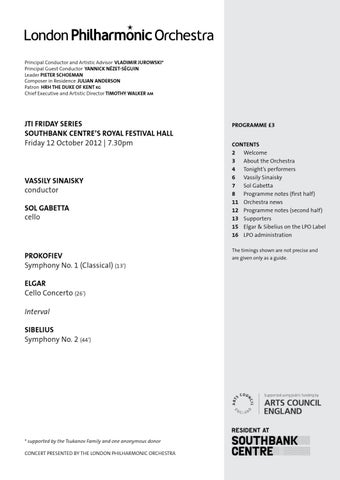
JTI FRIDAY SERIES SOUTHBANK CENTRE’S ROYAL FESTIVAL HALL Friday 12 October 2012 | 7.30pm
VASSILY SINAISKY conductor SOL GABETTA cello
prokofiev Symphony No. 1 (Classical) (13’) ELGAR Cello Concerto (26’) Interval SIBELIUS Symphony No. 2 (44’)
* supported by the Tsukanov Family and one anonymous donor CONCERT PRESENTED BY THE LONDON PHILHARMONIC ORCHESTRA
PROGRAMME £3 CONTENTS 2 Welcome 3 About the Orchestra 4 Tonight’s performers 6 Vassily Sinaisky 7 Sol Gabetta 8 Programme notes (first half) 11 Orchestra news 12 Programme notes (second half) 13 Supporters 15 Elgar & Sibelius on the LPO Label 16 LPO administration The timings shown are not precise and are given only as a guide.
Welcome
WELCOME TO SOUTHBANK CENTRE We hope you enjoy your visit. We have a Duty Manager available at all times. If you have any queries please ask any member of staff for assistance. Eating, drinking and shopping? Southbank Centre shops and restaurants include Foyles, EAT, Giraffe, Strada, YO! Sushi, wagamama, Le Pain Quotidien, Las Iguanas, ping pong, Canteen, Caffè Vergnano 1882, Skylon, Concrete and Feng Sushi, as well as cafes, restaurants and shops inside Royal Festival Hall, Queen Elizabeth Hall and Hayward Gallery. If you wish to get in touch with us following your visit please contact the Visitor Experience Team at Southbank Centre, Belvedere Road, London SE1 8XX, phone 020 7960 4250, or email customer@southbankcentre.co.uk
We look forward to seeing you again soon. A few points to note for your comfort and enjoyment: PHOTOGRAPHY is not allowed in the auditorium. LATECOMERS will only be admitted to the auditorium if there is a suitable break in the performance. RECORDING is not permitted in the auditorium without the prior consent of Southbank Centre. Southbank Centre reserves the right to confiscate video or sound equipment and hold it in safekeeping until the performance has ended. MOBILES, PAGERS AND WATCHES should be switched off before the performance begins.
next LPO concert at royal festival hall Wednesday 17 October 2012 | 7.30pm Beethoven Overture, Leonore No. 3 Carl Vine Piano Concerto No. 2 (UK premiere)* Shostakovich Symphony No. 10 Vassily Sinaisky conductor Piers Lane piano *Commissioned by the Sydney Symphony Orchestra, and London Philharmonic Orchestra with support from Garf and Gill Collins.
6.15–6.45pm FREE pre-concert event Royal Festival Hall Pianist Piers Lane discusses the UK premiere of Carl Vine’s Piano Concerto No. 2. All welcome, no booking required
Vassily Sinaisky and Piers Lane
2 | London Philharmonic Orchestra
Booking details London Philharmonic Orchestra Box Office 020 7840 4242 Monday to Friday 10.00am–5.00pm lpo.org.uk (no transaction fee) Southbank Centre Box Office (transaction fees apply) 0844 847 9920 Daily 9.00am–8.00pm southbankcentre.co.uk
LONDON PHILHARMONIC ORCHESTRA
The London Philharmonic Orchestra is one of the world’s finest orchestras, balancing a long and distinguished history with a reputation as one of the UK’s most adventurous and forward-looking orchestras. As well as giving classical concerts, the Orchestra also records film and video game soundtracks, has its own record label, and reaches thousands of Londoners every year through activities for schools and local communities. The Orchestra was founded by Sir Thomas Beecham in 1932, and since then its Principal Conductors have included Sir Adrian Boult, Bernard Haitink, Sir Georg Solti, Klaus Tennstedt and Kurt Masur. The current Principal Conductor is Vladimir Jurowski, appointed in 2007, and Yannick Nézet-Séguin is Principal Guest Conductor.
The London Philharmonic Orchestra has recorded many blockbuster scores, from The Lord of the Rings trilogy to Lawrence of Arabia, The Mission, East is East, Hugo, and The Hobbit: An Unexpected Journey. It also broadcasts regularly on television and radio, and in 2005 established its own record label. There are now nearly 70 releases available on CD and to download. Recent additions include Dvořák’s Stabat Mater under Neeme Järvi; Tchaikovsky’s Symphonies Nos. 4 & 5 with Vladimir Jurowski; Sibelius’s Symphonies Nos. 5 & 6 under the late Paavo Berglund; and the world premiere of Ravi Shankar’s First Symphony conducted by David Murphy. In summer 2012 the London Philharmonic Orchestra performed as part of The Queen’s Diamond Jubilee Pageant on the River Thames, and was also chosen to record all the world’s national anthems for the London 2012 Olympics.
The Orchestra is Resident Orchestra at the Royal Festival Hall in London’s Southbank Centre, where it has performed since it opened in 1951, giving around 40 The London Philharmonic Orchestra maintains an concerts there each season. 2012/13 highlights include energetic programme of activities for young people and three concerts with Vladimir Jurowski based around local communities. Highlights include the Deutsche the theme of War and Peace in collaboration with the Bank BrightSparks Russian National Orchestra; Kurt schools’ concerts; the Weill’s The Threepenny Opera, ‘As things stand now, the LPO must rate Leverhulme Young also conducted by Jurowski; as an example to all orchestras.’ Composers project; 20th-century American works Musicalcriticism.com, July 2011 and the Foyle Future with Marin Alsop; Haydn and (BBC Proms 2011: Liszt, Bartók and Kodály) Firsts orchestral Strauss with Yannick Nézettraining programme Séguin; and the UK premiere of for outstanding young players. Over recent years, Carl Vine’s Second Piano Concerto with pianist Piers developments in technology and social networks have Lane under Vassily Sinaisky. Throughout 2013 the enabled the Orchestra to reach even more people Orchestra will collaborate with the Southbank Centre worldwide: all its recordings are available to download on The Rest Is Noise festival, based on Alex Ross’s book from iTunes and, as well as a YouTube channel, news of the same name and charting the 20th century’s key blog, iPhone app and regular podcasts, the Orchestra musical works. has a lively presence on Facebook and Twitter. The Orchestra has flourishing residencies in Brighton Find out more and get involved! and Eastbourne, and performs regularly around the UK. Every summer, the Orchestra leaves London for four months and takes up its annual residency lpo.org.uk accompanying the famous Glyndebourne Festival Opera, where it has been Resident Symphony Orchestra facebook.com/londonphilharmonicorchestra since 1964. The Orchestra also tours internationally, performing concerts to sell-out audiences worldwide. twitter.com/LPOrchestra Tours in the 2012/13 season include visits to Spain, Germany, France, Switzerland, the USA and Austria.
London Philharmonic Orchestra | 3
tonight’s performers
First Violins Lisa Schatzman Guest Leader Vesselin Gellev Sub-Leader Chair supported by John & Angela Kessler
Ilyoung Chae Ji-Hyun Lee Catherine Craig Thomas Eisner Martin Höhmann Chair supported by Moya Greene
Geoffrey Lynn Robert Pool Yang Zhang Grace Lee Ben Roskams Peter Nall Robert Yeomans Rebecca Shorrock Catherine Van de Geest Second Violins Fredrik Paulsson Guest Principal Joseph Maher Ashley Stevens Sioni Williams Alison Strange Stephen Stewart Elizabeth Baldey Steve Dinwoodie Sarah Buchan Dafydd Williams Naomi Anner Emma Martin Fiona Higham Imogen Williamson
Violas Matthew Souter Guest Principal Robert Duncan Gregory Aronovich Benedetto Pollani Susanne Martens Isabel Pereira Martin Fenn Claudio Cavalletti Anthony Byrne Stephen Gorringe Naomi Holt Rebecca Carrington Cellos Alexander Somov Guest Principal Francis Bucknall Laura Donoghue Gregory Walmsley Santiago Carvalho† Susanna Riddell David Lale Helen Rathbone Tae-Mi Song David Bucknall Double Basses Kevin Rundell* Principal Tim Gibbs Co-Principal Laurence Lovelle George Peniston Richard Lewis Kenneth Knussen Helen Rowlands Tom Walley
Flutes Sue Thomas Principal Chair supported by the Sharp Family
Joanna Marsh Piccolo Joanna Marsh Oboes Ian Hardwick Principal Angela Tennick Clarinets Robert Hill* Principal Paul Richards
Bass Trombone Lyndon Meredith Principal Tuba Lee Tsarmaklis* Principal Timpani Simon Carrington* Principal
* Holds a professorial appointment in London † Chevalier of the Brazilian Order of Rio Branco
Bassoons Gareth Newman* Principal Claire Webster Horns Mark Vines Principal Martin Hobbs Jenny Cox Gareth Mollison Nicholas Wolmark Trumpets Paul Beniston* Principal Anne McAneney* Chair supported by Geoff & Meg Mann
Nicholas Betts Co-Principal Trombones Mark Templeton* Principal Becky Smith
Chair Supporters The London Philharmonic Orchestra also acknowledges the following chair supporters whose players are not present at this concert: Andrew Davenport David & Victoria Graham Fuller Caroline, Jamie & Zander Sharp Julian & Gill Simmonds
4 | London Philharmonic Orchestra
London Philharmonic Orchestra | 5
vassily sinaisky
© Marco Borggreve
conductor
Vassily Sinaisky’s international career was launched in 1973 when he won the Gold Medal at the prestigious Karajan Competition in Berlin. His early work with Kirill Kondrashin at the Moscow Philharmonic Orchestra and with Ilya Musin at the Leningrad Conservatoire provided him with an incomparable grounding. Soon after his success at the Karajan Competition, Sinaisky was appointed Chief Conductor of the Latvian National Symphony Orchestra, a post he held from 1976 to 1987. He then became Music Director and Principal Conductor of the Moscow Philharmonic Orchestra, leading numerous high-profile projects with the Orchestra both in Russia and on tour. In 2010, Sinaisky was announced as the new Chief Conductor and Music Director of the Bolshoi Theatre, Moscow. Highlights of the first seasons have included major new productions of Rimsky-Korsakov’s The Golden Cockerel by Kirill Serebrennikov, and Richard Strauss’s Der Rosenkavalier by Stephen Lawless (the first-ever staging of this work in Moscow). Sinaisky’s appointment coincided with the re-opening of the Bolshoi’s main stage following a five-year refurbishment, returning this legendary opera house to its position as one of the greatest in the world. As a guest conductor, Sinaisky enjoys regular collaborations with such orchestras as the London Philharmonic, Los Angeles Philharmonic, Berlin Radio Symphony, Stuttgart Radio Symphony, Czech Philharmonic and Cleveland orchestras. Recent seasons have also seen him conduct the Royal Concertgebouw Orchestra, Gewandhausorchester Leipzig, NDR Sinfonieorchester Hamburg, Orchestre Philharmonique de Radio France and NHK Symphony, Tokyo. Sinaisky additionally holds the positions of Conductor Emeritus of the BBC Philharmonic, and Honorary Conductor of the Malmö Symphony Orchestra, Sweden. Memorable projects with the BBC Philharmonic have included the ‘Shostakovich and his Heroes’ festival, tours to Europe and China, and many appearances at 6 | London Philharmonic Orchestra
the BBC Proms. With the Malmö Symphony, Sinaisky has toured to the UK and to Amsterdam’s Concertgebouw, and recorded an acclaimed four-disc series of the symphonies of Franz Schmidt. Sinaisky has also held the positions of Principal Guest Conductor of the Netherlands Philharmonic Orchestra and Music Director of the Russian State Orchestra. Sinaisky has a distinguished pedigree as an operatic conductor. In addition to his projects at the Bolshoi Theatre, he recently conducted Iolanta and Francesca da Rimini in new productions by Stephen Lawless at Vienna’s Theater an der Wien. He also recently conducted Boris Godunov at San Francisco Opera. Other projects have included productions of Carmen and Der Rosenkavalier for English National Opera, and an acclaimed Lady Macbeth of Mtsensk with Hans Neuenfels at the Komische Oper Berlin. Vassily Sinaisky’s recordings include the aforementioned set of Schmidt symphonies for Naxos with the Malmö Symphony Orchestra. His other recordings include many with the BBC Philharmonic including works by Shostakovich, Tchaikovsky, Rimsky-Korsakov, Shchedrin, Glinka, Liadov, Schreker and Szymanowski. Vassily Sinaisky is a noted and influential teacher, and holds the position of Professor of Conducting at the St Petersburg Conservatoire.
sol gabetta
© Uwe Arens
cello
Internationally acclaimed since her 2004 debut with the Vienna Philharmonic and Valery Gergiev, and winner of the Crédit Suisse Young Artist Award, cellist Sol Gabetta already holds several impressive awards.
Born in Córdoba, Argentina, she won her first competition at the age of ten. This was soon followed by the Natalia Gutman Award and commendations at the Moscow Tchaikovsky Competition and the ARD International Music Competition in Munich. A Grammy Award nominee, Sol Gabetta received the Gramophone Young Artist of the Year Award in 2010 and the Würth Prize from Jeunesses Musicales Germany in 2012. Following her first ECHO Klassik Award (received in 2007 for a CD featuring works by Tchaikovsky and Ginastera), Sol received a second for her interpretation of cello concertos by Haydn, Hofmann and Mozart, released in 2009. Most recently, she was awarded her third ECHO for a celebrated recording of Elgar’s Cello Concerto with the Danish National Symphony Orchestra. Her extensive discography also encompasses highly acclaimed recordings of Shostakovich’s cello concertos with the Munich Philharmonic Orchestra. This month sees the release of a duo recital recording with pianist Hélène Grimaud on Deutsche Grammophon.
Antonini, Mario Venzago, Charles Dutoit, Pablo HerasCasado and Thomas Hengelbrock. In addition to her career as a soloist, Sol Gabetta is a devoted chamber musician and has performed with distinguished partners such as Patricia Kopatchinskaja, Baiba Skride, Bertrand Chamayou and Olga Kern, in famous halls such as London’s Wigmore Hall and Palau de la Música Catalana in Barcelona. She has also founded her own chamber music festival, ‘Solsberg’, in Switzerland. As well as tonight’s debut with the London Philharmonic Orchestra, highlights of this season include debuts with the Orchestre National de France, the Tonhalle-Orchester Zürich, and the Philharmonia Orchestra. She will also return to work with the Munich Philharmonic Orchestra under the baton of David Zinman, to the Bamberg Symphony Orchestra, and to the Schubertiade Schwarzenberg festival. A recital tour with pianist Hélène Grimaud is planned for December 2012, and further chamber music recitals at Carnegie Hall and the Concertgebouw Amsterdam complete her season. Thanks to a generous private stipend from the Rahn Kulturfonds, Sol Gabetta is in a position to play a rare and precious cello by G.B. Guadagnini from 1759. Sol Gabetta has taught at the Basel Music Academy since 2005.
Sol Gabetta appears regularly with leading orchestras and conductors worldwide. She has worked with the Bamberg Symphony, City of Birmingham Symphony, Finnish Radio Symphony, Spanish National, Basel Chamber, Royal Philharmonic, Bolshoi and Philadelphia orchestras. She is a frequent guest at festivals including Verbier, Menuhin Festival Gstaad, Schwetzingen, Rheingau, Schleswig-Holstein, Beethovenfest Bonn and Schubertiade Schwarzenberg. Recent highlights include residencies at the Essen Philharmonie and Berlin Konzerthaus, and debuts with the Royal Concertgebouw, Bavarian Radio Symphony, Israel Philharmonic and Gulbenkian orchestras. Sol Gabetta works regularly with conductors such as Giovanni London Philharmonic Orchestra | 7
PROGRAMME NOTES
Speedread Music historians tend to use the word ‘nationalism’ to describe music born from a particular country’s indigenous creative traditions, which at the same time helped argue for that country’s freedom or recognition. When Jean Sibelius’s Second Symphony was first performed in a Russian-controlled Finland, many Finns thought its yearning main theme was a picture of their struggle for independence. Sibelius wanted an independent Finland as much as anyone, but he long claimed (and evidence suggests) that the Symphony’s sources of frailty, despair and hope lay rather closer to home. These days Edward Elgar is often called upon as a musical ambassador for the green and pleasant land that is England. In truth Elgar was something of an outsider; a Catholic in a staunchly Anglican Edwardian society and a man who knew all too well
Sergei Prokofiev 1891–1953
No sooner had he picked up his composition degree from the St Petersburg Conservatoire than Sergei Prokofiev re-enrolled in the same institution as a piano student. Prokofiev was quite a pianist, but in the mid 1910s – two piano concertos already under his belt – the composer started to feel the instrument’s stranglehold on his creative freedom. At the same time as he bemoaned the ‘temptation of improvisational “finger” composition’ that his piano-playing had started to engender, he began to discover his passion for the 18th-century music of Joseph Haydn and Wolfgang Amadeus Mozart. It wasn’t just the spirit of those two ‘Classical’ masters that enchanted Prokofiev, it was their musical structures
8 | London Philharmonic Orchestra
those feelings of loneliness and grief experienced by Sibelius. The bleakness and attack of Elgar’s Cello Concerto, however, stand in marked contrast to the striving concord of Sibelius’s Symphony. Was Elgar’s caustic voice in this work a response to his country’s involvement in a catastrophic war? Possibly, but the elements of personal struggle and crisis in the Cello Concerto are hard to miss. The subtext of Sergei Prokofiev’s First Symphony concerns little more than the search for a viable technique and aesthetic with which the composer could take his first symphonic steps. Prokofiev looked to the Classical masters Haydn and Mozart for help, and in so doing created a symphony that’s blissfully unaware of national events – including the slipping of post-Revolutionary Russia towards totalitarianism.
Symphony No. 1 in D major, Op. 25 (Classical) 1 Allegro 2 Larghetto 3 Gavotte: Non troppo allegro 4 Molto vivace
and textures, too (he expressed particular delight at their use of ‘staccato bassoons’, which says a thing or two about the particular angle of Prokofiev’s admiration). These were at the forefront of the composer’s mind when he started work on his first symphony in 1916. ‘It seemed to me that had Haydn lived to our day he would have retained his own style while accepting something of the new at the same time’, wrote Prokofiev in his memoirs. ‘That was the kind of symphony I wanted to write: a symphony in the Classical style.’ Prokofiev designed much of the music for this ‘Classical’ symphony while walking in the country. That – coupled with his liberation from the keyboard – surely
influenced the Symphony’s feeling of freedom and zest. Transparency of orchestration and simple treatment of themes came from the Classical tradition; the brilliance of those themes and a tendency to lend them 20thcentury melodic twists and harmonic scrunches came from Prokofiev. The Symphony is organised as one by Haydn might be, but with the standard Minuet replaced by a Gavotte – an earlier dance form with its roots in the Baroque. The first movement launches with a dashing theme and in its secondary idea Prokofiev seizes the opportunity to employ one of those staccato bassoons that so enchanted him (listen out for it accompanying the first violins). In accordance with Classical ideals, the movement returns to its first idea to finish.
Edward Elgar 1857–1934
When this Concerto was first performed on 27 October 1919, it took its audience at the Queen’s Hall in London by surprise. To them, the piece simply didn’t sound ‘like Elgar’. It’s well documented that the performance that night was poor. But if the ensemble felt its way hesitantly through Elgar’s score as if it ‘seemed not to have any idea of what the composer wanted’ (Ernest Newman), then perhaps, in so doing, it reflected the nature of Elgar’s stylistic shift. Gone were the victorious swagger of the symphonies and the rhapsodic virtuosity of the Violin Concerto. In their place were a musical conversation of shyness and economy and a virtuosity of daring and attack. Was it the shattering impact of the First World War, the nostalgic angst of old age, or a purely artistic quest for greater directness that lay behind the Cello Concerto’s style and shape? All three, probably. Besides, any cello concerto is bound by basic physics: the instrument’s
The Larghetto sees Prokofiev treating the time signature with the same ambiguity he does harmony in the first movement – it’s a dream-like view of the Classical symphony complete with wistful rising and falling strings. There follows the extrovert Gavotte for which the composer conjures a typically angular melody full of enchantment (Prokofiev, ironically, would play this movement as an encore in piano recitals). The fastest gear, though, is reserved for Prokofiev’s finale – a headlong, virtuosic tour-de-force that showers piquant orchestration and grinning wit on a lively conversation between all the themes heard thus far. It’s strange indeed to consider that the piece’s completion (10 September 1917) and first performance (21 April 1918) straddled Russia’s October revolution and the rise of the Soviets.
Cello Concerto in E minor, Op. 85 Sol Gabetta cello 1 Adagio – Moderato 2 Lento – Allegro molto 3 Adagio 4 Allegro – Moderato – Allegro, ma non troppo range and tonal capacities mean it isn’t audible when pitted against large orchestral textures, and in this Concerto the solo cello plays more or less continuously. That, in part, explains Elgar’s taut orchestration. More surprising is the conciseness with which he treats his musical material. The Concerto encompasses so much in its emotional range, but it also seems to have shaken off anything superfluous. Beautiful orchestral colours are achieved by simple means. The work opens with a brave, angry statement from the soloist in the manner of a recitative, an idea referenced again at the first movement’s close and again towards the end of the last movement. Elgar marks the passage nobilmente (‘nobly’), but its effect is often that of an outburst. It’s the deep-toned violas that introduce the rocking, world-weary melody taken up later by the soloist and then the whole orchestra. Continued overleaf London Philharmonic Orchestra | 9
PROGRAMME NOTES
There’s no better example of Elgar’s creative use of minimal material than the opening of the second movement. The cello’s recitative idea (it flutters up and down a minor third and then down and up a tone) is played five times; each time Elgar asks for different expressions from the soloist. The movement proceeds wittily before the distilled beauty of the Adagio – a soliloquy that makes use of a single broad, elegiac theme. The sizeable final movement hints at the rumbustiousness of the pre-war Elgar with its
malleable and whistle-able main theme. But the movement is both joyous and troubled: the cello is left in isolation on occasion by an orchestra that offers redemption, but attacks, too. If there is any of the ‘massive hope for the future’ of Elgar’s pre-war First Symphony, or even a sweet nostalgia in the soaring theme in which the orchestra eventually supports the cello, it appears to be quashed as the composer slams the door shut just after the reprise of the Concerto’s opening statement.
INTERVAL – 20 minutes An announcement will be made five minutes before the end of the interval.
Contemporaries We are delighted to welcome members of LPO Contemporaries to tonight’s concert. As part of this exciting membership scheme for young professionals, this evening LPO Contemporaries will enjoy this ‘must-see’ concert, an interval reception with cocktails courtesy of Sipsmith Independent Spirits, and a post-concert dinner at Southbank Centre’s stunning Skylon restaurant. LPO Contemporaries are young, dynamic Londoners in their 20s and 30s, keen to become involved in the city’s cultural life as members of an exclusive social group. At the centre of this group is the London Philharmonic Orchestra. Membership starts from £150 a year and perks include special complimentary ‘VIP Evenings’ at Royal Festival Hall, the annual ‘Champagne Saturday’ open rehearsal, invitations to bespoke events, and discounts and special offers with select London Philharmonic Orchestra partners. This autumn we have an exclusive event with premium Danish design brand Republic of Fritz Hansen, which is sure to be a season highlight. Find out more about LPO Contemporaries via our website, Facebook or Twitter: lpo.org.uk/contemporaries facebook.com/lpocontemporaries twitter.com/LPOContemps
10 | London Philharmonic Orchestra
orchestra news
Student Pulse: the new app for student concert-goers in London The London Philharmonic Orchestra and its student scheme, NOISE, have joined forces with nine other London orchestras and venues to launch an iPhone and Android app that pulls together each organisation’s student schemes onto one platform, offering discounted tickets and loyalty points to student bookers. Simply book tickets directly through the app on your phone, and receive your e-ticket on your phone to show on the door on the night. The app and the ticket discounts are available to full-time students from any UK university. To find out more about the scheme, its partners, and to download the app, visit studentpulselondon.co.uk
October CD releases on the LPO Label The London Philharmonic Orchestra launched its own record label in 2005 and there are now nearly 70 releases available on CD and to download from iTunes. This month saw two new releases: A third volume of orchestral works by Mark-Anthony Turnage with soloists Christian Tetzlaff, Lawrence Power and Michael Collins, featuring five world premiere recordings including Mambo, Blues and Tarantella (LPO-0066, £9.99). An audiobook of The Mozart Question by children’s author Michael Morpurgo, narrated by Michael himself with musical extracts performed by the London Philharmonic Orchestra under Nicholas Collon with violinist Jack Liebeck (LPO-0067, £9.99). Listen to soundclips and buy online at lpo.org.uk/shop
Greatest Video Game Music 2 Over the summer we were back in the recording studio for the follow-up album to last year’s hugely popular Greatest Video Game Music. Once again conductor Andrew Skeet has created symphony orchestra versions of a huge range of familiar tunes, including music from Final Fantasy VII, The Elder Scrolls V, Street Fighter II, Assassin’s Creed, Mass Effect 3, Halo, Legend of Zelda: Dragon Roost Island, Little Big Planet, and many others. The album will be released on Tuesday 6 November. Watch a short preview film and listen to advance soundclips at www.lpo.org.uk/heroes/
Animate Orchestra expands into Lambeth & Southwark Animate Orchestra is a partnership between Trinity Laban Conservatoire of Music and Dance, the London Philharmonic Orchestra and local music services that offers children aged 9–15 the opportunity to write their own music and play together in a mixed instrumental ensemble. September 2012 saw Animate Orchestra expand its reach into the boroughs of Southwark and Lambeth, following two successful years in Greenwich and Lewisham where it was launched in 2010. Members perform on instruments as varied as bassoon, guitar, ukulele and laptop, and draw upon their individual skills and interests to create their own music from scratch. To find out about Animate Orchestra courses in your borough, visit animateorchestra.org.uk Animate Orchestra is supported by The Mayor of London’s Fund for Young Musicians, Esmée Fairbairn Foundation, Lewisham Council and Trinity Laban Conservatoire of Music & Dance.
London Philharmonic Orchestra | 11
PROGRAMME NOTES
Jean Sibelius
Symphony No. 2 in D major, Op. 43 1 Allegretto 2 Tempo Andante, ma rubato 3 Vivacissimo 4 Finale
1865–1957
In the early months of 1901 Jean Sibelius and his family escaped the harsh Finnish winter to Rapallo, a small town on the west coast of Italy not far from Genoa. Sibelius borrowed a study up in the mountains, surrounded by ‘magnolia, cypresses, vine, palm trees and a manifold variety of flowers’. In this Mediterranean setting, the composer was reminded of the legend of Don Juan, and began to sketch a symphonic poem on the famous narrative entitled Festival. Physically and artistically, Sibelius was indulging in escapism and he knew it; the dark clouds in his life remained. His daughter Ruth was recovering from a dangerous illness – a tormenting situation for the composer and his wife Aino, who had lost a child the previous year. Meanwhile, Finland’s journey towards freedom from Russian rule had suffered yet another blow: in the wake of the 1899 February Manifesto, the Russians had begun the incorporation of the Finnish army into their own – a huge weakening of Finland’s position. It was back home in May 1901 that Sibelius started serious work on the piece he’d conceived amid the flowers of Rapallo – now planned as an abstract symphony uncontrolled by the Don Juan narrative but cast in the bright, floral key of D major. By the following spring it was complete, the composer conducting four successive performances in Helsinki starting with the premiere on 8 March. Robert Kajanus, director of the Helsinki Philharmonic Orchestra, concluded that the piece was an ode to Finnish nationalism – a stirring hymn to strengthen and inspire the programme of passive resistance that many artists (including Sibelius) had initiated. You can hear why Kajanus might have reached such a conclusion, but according to Sibelius he was way off the mark. The composer’s annotations and working 12 | London Philharmonic Orchestra
processes reveal struggles rather more private and personal: the second theme of the Andante was apparently inspired by Ruth’s recovery, and the more subdued, lamenting theme of the finale was dedicated to Elli Järnefelt, Sibelius’s sister-in-law, who had recently committed suicide. Technically speaking, the Symphony introduces some signs that would soon become Sibelius hallmarks. Perhaps the most important of these – alongside his particular use of ‘stepping’ string motifs and his fondness for themes based on adjacent notes – is the coherence of those themes, which emerge more naturally from one another as if tributaries to the same river. That’s immediately recognisable in the pastoral opening movement, which is controlled entirely by the three upward-stepping notes that are heard right at the beginning. The residue of the Don Juan tale lurks amid the conflicts of the movement that follows. Sibelius pits a theme he called ‘death’ (first heard on bassoons playing in unison an octave apart) against one he called ‘Christus’ (the ‘Ruth’ theme, which emerges from jagged strings). The third movement has been described as a ‘call to arms’, and is a stormy dance that eventually – after twice visiting a more saddened ‘trio’ section – collapses back into the three upward-stepping notes that formed the Symphony’s opening; with this, the Symphony slips inevitably into its finale and the mustering of a heroic, striving tune soaked in a sense of optimism and renewal in its journey from a cautious harmonisation to a brilliantly confident one. This idea, again born of those upwardly-stepping notes, lightens the dark shadows of the troubling Elli Järnefelt theme to suggest the blossoming of life anew, in all its richness and colour. Programme notes by Andrew Mellor
We would like to acknowledge the generous support of the following Thomas Beecham Group Patrons, Principal Benefactors and Benefactors:
Guy & Utti Whittaker Manon Williams
David Ellen Commander Vincent Evans Mr Daniel Goldstein Mr & Mrs Jeffrey Herrmann Peter MacDonald Eggers Mr & Mrs David Malpas Andrew T Mills Mr Maxwell Morrison Mr Michael Posen Mr & Mrs Thierry Sciard Mr John Soderquist & Mr Costas Michaelides Mr & Mrs G Stein Mr & Mrs John C Tucker Mr & Mrs John & Susi Underwood Lady Marina Vaizey Howard & Sheelagh Watson Mr Laurie Watt Mr Anthony Yolland
Ken Follett Pauline & Peter Halliday Michael & Christine Henry Mr Ivan Hurry Mr Glenn Hurstfield Mr R K Jeha Mr Gerald Levin Sheila Ashley Lewis Wg. Cdr. & Mrs M T Liddiard OBE JP RAF Mr Frank Lim Paul & Brigitta Lock Mr Brian Marsh John Montgomery Mr & Mrs Andrew Neill Edmund Pirouet Mr Peter Tausig Mrs Kazue Turner Mr D Whitelock Bill Yoe
Principal Benefactors Mark & Elizabeth Adams Jane Attias Lady Jane Berrill Desmond & Ruth Cecil Mr John H Cook Mr Charles Dumas
Benefactors Mrs A Beare Dr & Mrs Alan Carrington CBE FRS Mr & Mrs Stewart Cohen Mr Alistair Corbett Mr David Dennis Mr David Edgecombe Mr Richard Fernyhough
Hon. Benefactor Elliott Bernerd
Thomas Beecham Group The Tsukanov Family Anonymous The Sharp Family Julian & Gill Simmonds Garf & Gill Collins Andrew Davenport Mrs Sonja Drexler David & Victoria Graham Fuller Moya Greene John & Angela Kessler Mr & Mrs Makharinsky Geoff & Meg Mann Caroline, Jamie & Zander Sharp Eric Tomsett
Hon. Life Members Kenneth Goode Pehr G Gyllenhammar Edmund Pirouet Mrs Jackie Rosenfeld OBE
The generosity of our Sponsors, Corporate Members, supporters and donors is gratefully acknowledged: Corporate Members Silver: AREVA UK British American Business Destination Québec – UK Hermes Fund Managers Pritchard Englefield Bronze: Lisa Bolgar Smith and Felix Appelbe of Ambrose Appelbe Appleyard & Trew LLP Berkeley Law Charles Russell Lazard Leventis Overseas Education Partner Boeing Corporate Donor Lombard Street Research Preferred Partners Heineken Lindt & Sprüngli Ltd Villa Maria
In-kind Sponsors Google Inc Sela / Tilley’s Sweets Trusts and Foundations Addleshaw Goddard Charitable Trust Angus Allnatt Charitable Foundation The Boltini Trust Britten-Pears Foundation The Candide Trust The Coutts Charitable Trust Diaphonique, Franco-British fund for contemporary music Dunard Fund The Equitable Charitable Trust The Eranda Foundation Fidelio Charitable Trust The Foyle Foundation J Paul Getty Junior Charitable Trust The Jeniffer and Jonathan Harris Charitable Trust Capital Radio’s Help a London Child The Hobson Charity The Kirby Laing Foundation The Idlewild Trust The Leverhulme Trust
Marsh Christian Trust Adam Mickiewicz Institute The Peter Minet Trust Paul Morgan Charitable Trust The Diana and Allan Morgenthau Charitable Trust Maxwell Morrison Charitable Trust Musicians Benevolent Fund Newcomen Collett Foundation The Austin & Hope Pilkington Trust Serge Rachmaninoff Foundation The Rothschild Foundation The Seary Charitable Trust The Samuel Sebba Charitable Trust The David Solomons Charitable Trust The Steel Charitable Trust The Bernard Sunley Charitable Foundation John Thaw Foundation The Underwood Trust Sir Siegmund Warburg’s Voluntary Settlement Kurt Weill Foundation for Music Garfield Weston Foundation and others who wish to remain anonymous London Philharmonic Orchestra | 13
Deutsche Bank db.com
Passion for Music Deutsche Bank is committed to providing young people with access to the arts. Our free tickets scheme allows over 15,000 young people each year to attend a tailored performance by the London Philharmonic Orchestra, building musical understanding and appreciation.
This advertisement has been approved and/or communicated by Deutsche Bank AG. This advertisement does not constitute an offer or a recommendation to enter into any transaction. The services described in this advertisement are provided by Deutsche Bank AG or by its subsidiaries and/or affiliates in accordance with appropriate local legislation and regulation. Deutsche Bank AG is authorized under German Banking Law (competent authority: BaFin – Federal Financial Supervisory Authority) and authorized and subject to limited regulation by the Financial Services Authority. Details about the extent of Deutsche Bank AG’s authorization and regulation by the Financial Services Authority are available on request. Investments are subject to investment risk, including market fluctuations, regulatory change, counterparty risk, possible delays in repayment and loss of income and principal invested. The value of investments can fall as well as rise and you might not get back the amount originally invested at any point in time. Š Copyright Deutsche Bank 2012.
14 | London Philharmonic Orchestra
Elgar and Sibelius on the LPO Label Enjoyed tonight’s concert? Take the LPO home with you! LPO Label recordings available on CD and to download from iTunes
Elgar: Orchestral Works 5CD box set Includes Cello & Violin Concertos, Enigma Variations, Symphonies Nos. 1 & 2 Various conductors inc. Elgar, Boult, Solti, Mackerras & Handley
Elgar: Introduction and Allegro, Enigma Variations
Elgar: Sea Pictures, Symphony No. 1
Bernard Haitink conductor
Vernon Handley CBE conductor Dame Janet Baker contralto
LPO–0002 £9.99
LPO–0046 £9.99 Also available in 5CD box set LPO–0016-20
LPO–0016-20 £39.99 (5 Audio CDs)
New!
Sibelius: Symphonies Nos. 2 & 7 Paavo Berglund conductor LPO–0005 £9.99
Sibelius: Symphonies Nos. 5 & 6, The Swan of Tuonela Paavo Berglund conductor LPO–0065 £9.99
Sibelius: Symphony No. 5, Pohjola’s Daughter Lutosławski: Concerto for Orchestra Jukka-Pekka Saraste conductor LPO–0057 £9.99
All available from www.lpo.org.uk/shop, the London Philharmonic Orchestra Box Office (020 7840 4242, Monday–Friday 10am–5pm), all good CD outlets and the Royal Festival Hall shop. Downloads available from iTunes, Amazon, eMusic and classicsonline.com.
London Philharmonic Orchestra | 15
administration
Board of Directors
General Administration
Orchestra Personnel
Archives
Victoria Sharp Chairman Stewart McIlwham* President Desmond Cecil CMG Vesselin Gellev* Jonathan Harris CBE FRICS Dr Catherine C. Høgel Martin Höhmann* Angela Kessler Gareth Newman* George Peniston* Sir Bernard Rix Kevin Rundell* Julian Simmonds Mark Templeton* Sir Philip Thomas Natasha Tsukanova Timothy Walker AM Laurence Watt Dr Manon Williams
Timothy Walker AM Chief Executive and Artistic Director
Andrew Chenery Orchestra Personnel Manager
Philip Stuart Discographer
Sarah Thomas Librarian
Gillian Pole Recordings Archive
Michael Pattison Stage Manager
Professional Services
Finance David Burke General Manager and Finance Director
Julia Boon Assistant Orchestra Personnel Manager
* Player-Director
Advisory Council Jonathan Dawson Clive Marks OBE FCA Lord Sharman of Redlynch OBE Victoria Sharp Timothy Walker AM American Friends of the London Philharmonic Orchestra, Inc. Margot Astrachan Chairman David E. R. Dangoor Vice Chair/Treasurer Kyung-Wha Chung Peter M. Felix CBE Alexandra Jupin Dr. Felisa B. Kaplan William A. Kerr Jill Fine Mainelli Kristina McPhee Dr. Joseph Mulvehill Harvey M. Spear, Esq. Danny Lopez Honorary Chairman Noel Kilkenny Honorary Director Victoria Sharp Honorary Director Richard Gee, Esq Of Counsel Robert Kuchner, CPA
Alison Atkinson Digital Projects Manager
Charles Russell Solicitors Crowe Clark Whitehill LLP Auditors
Ken Graham Trucking David Greenslade Instrument Transportation FSC_57678 14 January 2011 15/09/2011 12:30 Page Dr 1 Louise Miller Finance and ITLPO Manager Honorary Doctor Development Concert Management Roanna Gibson Concerts Director (maternity leave) Ruth Sansom Artistic Administrator / Acting Head of Concerts Department Graham Wood Concerts and Recordings Manager Barbara Palczynski Glyndebourne and Projects Administrator Jenny Chadwick Tours and Engagements Manager Alison Jones Concerts Co-ordinator Jo Orr PA to the Chief Executive / Concerts Assistant
Nick Jackman Development Director Helen Searl Corporate Relations Manager Katherine Hattersley Charitable Giving Manager Melissa Van Emden Events Manager Laura Luckhurst Corporate Relations and Events Officer Sarah Fletcher Development and Finance Officer Marketing Kath Trout Marketing Director Mia Roberts Marketing Manager
Matthew Freeman Recordings Consultant
Rachel Williams Publications Manager
Education & Community
Samantha Kendall Box Office Manager (Tel: 020 7840 4242)
Patrick Bailey Education and Community Director Alexandra Clarke Education Manager Caz Vale Community and Young Talent Manager Richard Mallett Education and Community Producer
16 | London Philharmonic Orchestra
Libby Northcote-Green Marketing Co-ordinator Claire Lampon Intern Albion Media Public Relations (Tel: 020 3077 4930)
London Philharmonic Orchestra 89 Albert Embankment London SE1 7TP Tel: 020 7840 4200 Fax: 020 7840 4201 Box Office: 020 7840 4242 lpo.org.uk The London Philharmonic Orchestra Limited is a registered charity No. 238045. Photograph of Prokofiev © Boosey & Hawkes. Photograph of Sibelius courtesy of the Royal College of Music, London. Front cover photograph © Patrick Harrison. Printed by Cantate.