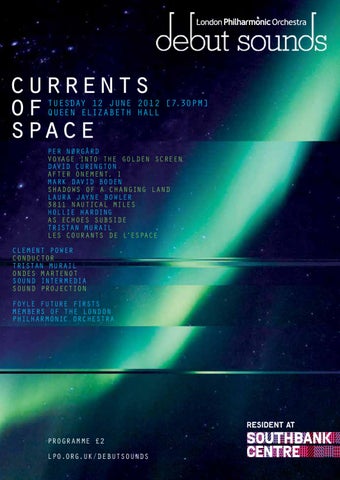
currents of space
Tuesday 12 June 2012 [7.30pm] Queen Elizabeth Hall
Per Nørgård
Voyage into the Golden Screen David Curington After Onement, I Mark David Boden Shadows of a Changing Land Laura Jayne Bowler 3811 nautical miles Hollie Harding As Echoes Subside Tristan Murail Les Courants de l’espace
Clement Power conductor Tristan Murail ondes Martenot sound intermedia sound projection Foyle Future Firsts Members of the London Philharmonic Orchestra
programme £2 lpo.org.uk/debutsounds
WELCOME
WELCOME TO SOUTHBANK CENTRE We hope you enjoy your visit. We have a Duty Manager available at all times. If you have any queries please ask any member of staff for assistance. Eating, drinking and shopping? Southbank Centre shops and restaurants include Foyles, EAT, Giraffe, Strada, YO! Sushi, wagamama, Le Pain Quotidien, Las Iguanas, ping pong, Canteen, Caffè Vergnano 1882, Skylon, Concrete and Feng Sushi, as well as cafes, restaurants and shops inside Royal Festival Hall, Queen Elizabeth Hall and Hayward Gallery. If you wish to get in touch with us following your visit please contact the Visitor Experience Team at Southbank Centre, Belvedere Road, London SE1 8XX, phone 020 7960 4250, or email customer@southbankcentre.co.uk
debut sounds
Debut Sounds is a celebration of the London Philharmonic Orchestra’s young talent programmes: Leverhulme Young Composers and Foyle Future Firsts. Over the past year, members of both programmes have been supported by the Orchestra and its Education and Community Department to explore new ideas, learn new skills and work closely with the Orchestra’s musicians. Tonight gives us the opportunity to hear the culmination of this work by some of the most exciting young musicians in classical music. Our young composers, David Curington, Mark David Boden, Laura Jayne Bowler and Hollie Harding, have worked with an ensemble comprising members of the London Philharmonic Orchestra and the Foyle Future Firsts programme throughout the academic year. In a series of workshops dedicated to trying out their compositional ideas, the four composers have received advice and support from Composer in Residence, Julian Anderson, and conductor, Clement Power.
We look forward to seeing you again soon.
Leverhulme Young Composers is supported by an Arts Portfolio Grant from the Leverhulme Trust.
A few points to note for your comfort and enjoyment:
The Foyle Future Firsts Programme is generously funded by The Foyle Foundation with additional support from the Angus Allnatt Charitable Foundation, the Idlewild Trust, the Lord and Lady Lurgan Trust, the Seary Charitable Trust and the Musicians Benevolent Fund.
PHOTOGRAPHY is not allowed in the auditorium. LATECOMERS will only be admitted to the auditorium if there is a suitable break in the performance. RECORDING is not permitted in the auditorium without the prior consent of Southbank Centre. Southbank Centre reserves the right to confiscate video or sound equipment and hold it in safekeeping until the performance has ended. MOBILES, PAGERS AND WATCHES should be switched off before the performance begins.
2 | London Philharmonic Orchestra
Concert supported by Diaphonique, Franco-British fund for contemporary music.
young composers
David Curington studied composition at masters’ level at the Royal Northern College of Music with Gary Carpenter, while taking oboe lessons from Melinda Maxwell. He graduated with Distinction; the Soroptimist International Award for composers; and the Evelyn Rothwell Prize for oboists. As well as a participant in the Leverhulme Young Composers scheme, David is a recipient of the 2011 RPS Composition Prize which, after workshops led by Unsuk Chin, will result in a commission for players of the Philharmonia Orchestra in the ‘Music of Today’ series. David appeared as both composer and oboist in two RNCM Chamber Music Festivals and, with the Eblana String Trio, was named 2010 RNCM Ensemble of the Year. Amongst performances in various RNCM composer festivals, including two at Wigmore Hall, David performed Brian Ferneyhough’s Coloratura to the composer with pianist Richard Casey during the RNCM Ferneyhough Day, and his performance history also includes works by Cage, Carter, Goehr, Knussen, Saxton and Weir.
Mark David Boden graduated from the Royal Welsh College of Music & Drama in 2008 with a First Class Honours degree in Composition and Contemporary Studies. He continued his composition studies at the Royal College of Music with Kenneth Hesketh, where he was generously supported by the RVW Trust and the Henry Wood Trust. He graduated with Distinction from the MMus course in Advanced Composition in 2011. Mark’s music has been performed across the UK by a variety of instrumentalists and ensembles including the Hebrides Ensemble, PM Ensemble, Ossian Ensemble, BBC National Orchestra of Wales, Alissa Firsova and Xenia Pestova (piano), Kate Price (cello), and Carla Rees (alto flute). In 2011, Mark began a three-year residency with the University of St Andrews Symphony Orchestra, and completed a substantial chamber work for the Hebrides Ensemble as part of their Quartet for the End of Time tour of Scotland. Mark is a lecturer in music at the Royal Welsh College of Music & Drama, and a tutor at the RWCMD Junior Department.
Laura Jayne Bowler is a composer and mezzo soprano. Her work is influenced by many composers and artists ranging from Stephen Sondheim to Harrison Birtwistle; the paintings of Kandinsky to the theatre of Antonin Artaud. Her passion for the theatre is apparent in her compositional output, with numerous theatre pieces alongside many concert works with a theatrical influence or performance quality. Laura is currently working on commissions for the Nouvel Ensemble Moderne (Montreal), the Marsyas Trio (London), and a chamber opera with BBC Radio playwright, Lavinia Murray, supported by the Stephen Oliver Award. Commissions include the BBC Symphony Orchestra, The Opera Group, ROH2, Tête à Tête Opera, Grimeborn Opera, London Sinfonietta, Esbjerg Ensemble, Ensemble Linea and the Kreutzer Quartet, among others. Laura is also the Founder and Artistic Director of Size Zero Opera and the Artistic Director of Land’s End Ensemble (Canada). She is currently an AHRC PhD research student at the Royal Academy of Music.
Hollie Harding graduated from Trinity College of Music in 2009, receiving First Class Honours, the Silver Medal for Composition, and the Cyril Cork Prize. She is currently studying for a Masters in Composition under David Sawer at the Royal Academy of Music, with funding from the Arts Humanities Research Council and the RVW Trust. Hollie has had an ongoing relationship with the Borealis Festival of New Music, Bergen, since undertaking a 6-week Internship and Young Composer in Residence Post in 2010, awarded by the Council of Bergen and Stifelsen Kulturhuset USF Verftet. She returned in 2011 to act as Producer to the Festival. Hollie’s work has been performed in England and Norway by soloists and groups including the Royal Academy of Music Symphony Orchestra, CHROMA ensemble, Contemporary Music for All, the Old Royal Naval College Chapel Choir, and Christopher Redgate. Hollie’s current work reflects her fascination with the composition of musical sounds in space.
London Philharmonic Orchestra | 3
FOYLE FUTURE FIRSTS
The 16 members of the Foyle Future Firsts programme are gifted and talented instrumentalists who aspire to be professional orchestral musicians. We seek to bridge their transition between college and the professional platform, developing talented players to form the base for future orchestral appointments with the London Philharmonic Orchestra and other orchestras and ensembles around the world. Now in its eighth year, our unique programme has gone from strength to strength. Members are supported and nurtured to the highest standards and we are proud to see current and past Foyle Future Firsts taking professional engagements with the London Philharmonic Orchestra and other world-class ensembles. Members of the Foyle Future Firsts programme benefit from individual lessons and mentoring from London Philharmonic Orchestra Principals, training seminars on audition techniques, and mock auditions. They also have opportunities to play in full orchestral rehearsals throughout the year, take part in high-profile and unique chamber performances, and work alongside London Philharmonic Orchestra musicians on education and community projects. lpo.org.uk/futurefirsts
TONIGHT’S PERFORMERS First Violins Ilyoung Chae* Fiona Higham Anna Croad Amy Tress† Second Violins Marie-Ann Mairesse Amanda Lake* Anna Ovsyanikova† Nicola Bates† Violas Katharine Leek Helen Bevin* Alison Jones†
Clarinets Paul Richards Ralph Lane*
Bassoons Simon Estell Sophie Shone*
* 2011/12 Foyle Future Firsts † guests
Horns Nicholas Wolmark Bryn Coveney†
Jamie & Zander Sharp
Double Basses George Peniston Kai Carson-West*
Oboes Chris O’Neal Jennifer Brittlebank*
Ondes Martenot Tristan Murail Sound Projection Sound Intermedia
Trumpets Paul Beniston Chair supported by Caroline, Robert Willson*
Iain Ward*
Piano / Celeste John Cuthbert* Caroline Jaya-Ratnam
Bass Clarinet Paul Richards
Cellos Jonathan Ayling
Flutes / Piccolos Sarah Bennington Hannah Grayson*
4 | London Philharmonic Orchestra
Cor Anglais Jennifer Brittlebank*
Trombone Stephanie Conway* Tuba Edward Hallinan* Percussion Eddy Hackett James Bower* Catherine Ring† Harp Rachel Wick*
For the London Philharmonic Orchestra Timothy Walker AM Chief Executive and Artistic Director Supported by Macquarie Group
Patrick Bailey Education and Community Director Caz Vale Community and Young Talent Manager
CLEMENT POWER
TRISTAn MURAIL
conductor
composer / ondes martenot
Clement Power, born in London in 1980, studied at Cambridge University and the Royal College of Music, London, and was subsequently named Assistant Conductor of the Ensemble Intercontemporain, Paris. He enjoys close associations with the world’s leading ensembles for new music. Recent engagements have included the NHK Symphony Orchestra, Ensemble Intercontemporain, London Philharmonic Orchestra, Birmingham Contemporary Music Group, BBC Scottish Symphony Orchestra, and the Philharmonia, as well as the Avanti! Chamber Orchestra (Finland), Orchestre de Bretagne, New London Chamber Choir, National Youth Orchestra of Catalonia and the Lucerne Festival Academy Orchestra. He has conducted numerous concerts and broadcasts with Austria’s foremost contemporary music ensemble, Klangforum Wien. Clement has conducted at international festivals including IRCAM Agora (Paris), Steirischer Herbst (Graz), Suntory Hall Summer Music Festival (Tokyo), Fórum Universal de las Culturas (Mexico), Ars Musica (Brussels), Huddersfield Contemporary Music Festival (UK), Contempuls (Prague), Sacrum-Profanum Festival (Krakow), Festival de Vlaams-Brabant (Belgium), and Rainy Days (Philharmonie, Luxembourg). He has given a total of 48 world premières, including the first performance of Hypermusic Prologue, an opera by Hèctor Parra, in the Centre Pompidou (Paris) and the Teatre del Liceu (Barcelona), and recorded on CD for KAIROS.
Born in 1947 in Le Havre, France, Tristan Murail received degrees in classical and North African Arabic (at the National School of Oriental Languages) and in economics (at the Paris Institute of Political Sciences) before turning to composition. A student of Olivier Messiaen, he won the Prix de Rome in 1971 and spent two years at the Villa Médicis. Upon his return to Paris in 1973, he founded the Ensemble l’Itinéraire with a group of young composers and performers. The group became widely renowned for its groundbreaking explorations of the relationship between instrumental performance and many aspects of electronics. In the 1980s, Tristan Murail began using computer technology to further his research into acoustic phenomena. This led him to years of collaboration with the IRCAM (Institut de Recherche et Coordination Acoustique/Musique), where he taught composition from 1991–97 and helped develop the Patchwork composition software. Tristan Murail has also taught at numerous schools and festivals worldwide, including the Darmstadt Ferienkurse, the Abbaye de Royaumont and the Centre Acanthes. From 1997–2011 he was a professor of composition at Columbia University, New York, and earlier this year was appointed as professor of composition at the Universität Mozarteum of Salzburg, Austria. © Editions Henry Lemoine
Future projects include re-invitations from Klangforum Wien, Birmingham Contemporary Music Group, Luxembourg Philharmonic and the New London Chamber Choir, and débuts with Ensemble Contrechamps (Geneva) and a residency at the ImPuls festival in Austria. Following work with Pierre Boulez at the 2011 Lucerne Festival Academy, he has been invited to conduct de Falla’s El retablo de maese Pedro at the 2012 Lucerne Festival. Clement will also conduct the opening concert of the 2012 Wien Modern Festival. London Philharmonic Orchestra | 5
programme notes
Tonight’s concert is framed by two contemporary classics by composers celebrating birthdays – Tristan Murail is 65 this year, whilst Per Nørgård has just turned 80. Both pieces are pioneering works, wellknown and long-established abroad, but alas rarely heard in the UK. Per Nørgård’s beautiful Voyage into the Golden Screen is a radiant sonic vision that combines influences from Sibelius with the composer’s investigations into the way we perceive sound in a magical hybrid world of shifting timbres and fluid melodies. Tristan Murail’s Les Courants de l’Espace gives new life to the ondes Martenot, an electronic instrument best known from Messiaen’s use of it in the Turangalîla-Symphonie. Here it is subjected to all manner of electronic treatment, distortion and enrichment, echoed, supported and reinforced by perpetually transforming chamber orchestra textures. As always in this annual concert, the classics are combined with four specially composed works by gifted young UK composers. These pieces have been carefully workshopped over the past few months by the LPO players, the Future First performers and conductor Clement Power, who has a great deal of experience in new music of all styles. The composers knew the musical context in which their pieces would be heard, but were not asked to imitate the classic works in any way. The excitingly varied results are given their first outing tonight. Julian Anderson Composer in Residence, London Philharmonic Orchestra Per Nørgård (born 1932) Voyage into the Golden Screen (1968–9) for chamber orchestra Like many Nordic composers, light is important to Per Nørgård, to the extent that light or colour are evoked in the titles of large numbers of his orchestral pieces. In addition to tonight’s Voyage into the Golden Screen, his works Iris, Backlight, Eclipse, Luna and Twilight all bear witness in different ways to this obsession. ‘It might come from my preoccupation with perception’, he suggested to Roger Wright in 1984. ‘When you see light reflected in a prism, you can quite easily feel synaesthetically how that might sound: if you have a sound reflected in a filter, when you hear all its 6 | London Philharmonic Orchestra
overtones in succession, then it’s very reminiscent of what happens to light. It’s sort of spread out in waves in both cases.’ The image of light reflected through a prism is central to the first movement of Voyage, a serene meditation on the inner details of sound. Two near-identical chords are used: a consonant overtone series on G, and the same chord tuned just a quarter-tone higher. The extremely close detuning of the two chords results in acoustical ‘beats’ as the frequencies of the two harmonies vibrate incessantly against each other to create a luminous shimmer strongly reminiscent of the visual effect known as the ‘Northern Lights’ (aurora borealis). Though Nørgård has never cited this in specific relation to tonight’s work, he has acknowledged the aurora as a stimulating poetic influence on his music more generally. The two overtone series are rarely heard complete: rather they are filtered against each other in different directions until finally at the climax they collide into strongly beating octaves a quarter-tone apart. After this the movement evaporates. The second movement of Voyage is equally focused but uses melody, not harmony. This movement is based upon Nørgård’s so-called ‘infinite row’, a melodic line which can be made to unfold endlessly without ever exactly repeating for more than a few notes. If you play every fourth pitch of this melody, you get the same melody at quarter-speed, in unison with the original; the same happens with every 8th or 16th or 32nd pitch, in fact at an infinite variety of speeds and levels. Since each melody speed is always at the unison with the original melody, and each like it is infinite, the aural result in Voyage when Nørgård combines many of these speeds at once in his orchestra is a hugely ambiguous kaleidoscope. The music very gradually expands in register, reaching a new peak just on the final bar before breaking off. In both movements of Voyage, as in so much of Nørgård’s music, the main poetic sentiment is that of wonder. Always fascinated by the natural sciences and their possible equivalents in music, he points out that ‘the biologist Wartington has compared the growth and development of a foetus with that of a musical composition. And that’s not a superficial comparison, because it goes quite far. During the development of a foetus, one particular group of cells (say, those concerning the nerves) will accelerate and develop;
then another level of cells starts (perhaps those concerning the stomach) and then it counterpoints the growth of the first level, and so on. So it seems that life itself is musical. I think we can consider everything in life as being vibration, and music is perhaps closest to that conception.’ Julian Anderson DAVID CURINGTON (born 1987) After Onement, I The title of this piece refers to Onement, I by American abstract expressionist painter Barnett Newman, and is partly a declaration of my love for abstract expressionism and partly a convenient icon for the character and content of this work. Newman’s paintings in his mature style are mostly characterised by a uniform background punctuated by a vertical ‘zip’. This bold and simple approach is emulated in the music: the material is largely monodic, occasionally sprouting more lines of counterpoint, and each of the six movements uses the same compositional techniques but employed either globally or locally, linearly or symmetrically. Themes manipulated in this way include linear gestures versus those that oscillate; tonal key centres versus atonality; slow versus fast; small intervals versus large ones; shifting timbres; parts ‘lagging’ behind others; and resonance versus dryness. DC MARK DAVID BODEN (born 1986) Shadows of a Changing Land Shadows of a Changing Land takes inspiration from a book of photography by Peter Freeman depicting the Lake District National Park. I was particularly drawn to Freeman’s use of natural light and shadow to capture the vivid and striking colours of the natural world. My piece is concerned with the way in which reflections, refractions and distortions of light affect the colours of visual landscapes. Although I imagined the piece as being one vista, the various inner structures are in a constant state of development, as though viewing a single landscape from varying angles and changing conditions. MDB
Interval: 20 minutes
LAURA JAYNE BOWLER (born 1986) 3811 nautical miles (for Rob F. Nichols) ‘3811 nautical miles’ is the distance from London to Calgary, Canada. Having made this trip numerous times over the past 12 months, I have had the opportunity to witness the serene, yet raw, beauty of the ice caps in this flight path. The severe but almost meditative quality of this landscape drew many parallels with the music I am currently writing, with my strong desire to explore stasis alongside extreme register, distorted and raw instrumental colour. Although this work is not inspired by the landscape, the title is an acknowledgement of the similarity between this image and my desires and interests as a composer. LJB Hollie Harding (born 1986) As Echoes Subside This piece is an exploration of resonance and echo, ignited by a rhythmic figure that pervades the orchestral space. The initial gesture evolves into increasingly complex harmonic structures, amorphous clouds of decaying resonance and melodic gestures that emerge, reverberate and disperse. The harmony moves from the superimposition of simple triads to larger symmetrical chord structures, where tight clusters form the central point from which increasingly widening intervals expand into the uppermost and deepest registers of the ensemble. This unfurling of registral range aims to open out the auditory space for the listener, thus forming the climactic peak of the work. Elongated resonances and sustained echoes evoke a cavernous acoustic in which melodic figures reside. This provides an ideal setting in which to explore the boundaries between polyphony, canon and heterophony. HH TRISTAN MURAIL (born 1947) Les Courants de l’Espace (1979) for ondes Martenot, live electronics and chamber orchestra While Tristan Murail trained as a composer in Olivier Messiaen’s class at the Paris Conservatoire from 1967– 72, he also trained as performer on the French electronic instrument much used by Messiaen, the ondes Martenot – studying this instrument with Messiaen’s sister-in-law
London Philharmonic Orchestra | 7
Jeanne Loriod. Several of Murail’s mature pieces use the ondes, to quite different stylistic and sonic ends from Messiaen. Les Courants de l’Espace (‘The Currents of Space’) is the most elaborate and ambitious of these. The ondes has amazing timbral variety, but can only play one note at a time. Partly to overcome this limitation, in Les Courants the ondes is fed through various electronic transformations. The most commonly used in this work is ‘ring modulation’, in which a pair of pitches are made to interact acoustically so that they produce richly ambiguous resultant harmonies. In Les Courants, the ondes provides one of the pairs of pitches fed into the ring modulator; the second pitch is provided, unheard, by a computer. Other transformations applied to the ondes Martenot include filtering and phasing, both of which result in broad sweeps across the ring modulation sounds at various speeds. Distortion of the ondes Martenot signal with white noise is used near the end of the work. The chamber orchestra has an exact sonic equivalent for each of these transformations. The most sophisticated
is the orchestral response to ring modulation: by calculating precisely the frequencies that result from each ring modulation, Murail can have the orchestra imitate modulation sonorities with startling exactitude, though this requires the players to perform numerous pitches outside the standard tuning of Western concert music. The result is highly sensuous in impact but wonderfully fresh due to the new tunings used. Phasing, filtering and white noise also have their clear orchestral equivalents, so that ondes and orchestra can engage in close dialogues or conflicts rather as in a traditional concerto. As in many Murail works from this period (1979), Les Courants unfolds as a long single process of gradually changing textures and harmony from start to finish. It’s a little like one of those engravings by Escher called Metamorphosis, in which defined visual images are constantly transformed. So in Les Courants any defined musical figures are just part of a continuously unfolding journey which ends, as it happens, in mid-air. Julian Anderson
YOUNG COMPOSERS MENTOR Julian Anderson is currently Composer in Residence of the London Philharmonic Orchestra. Born in London in 1967, he studied composition with John Lambert, Alexander Goehr and Tristan Murail. His first acknowledged work, Diptych (1990), won the 1992 Royal Philharmonic Society Prize for Young Composers and his two commissions for the London Sinfonietta, Khorovod (1994) and Alhambra Fantasy (2000), have been widely performed in Europe and the USA. His other most-played works include the orchestral BBC Proms commission The Stations of the Sun (1998) and the chamber work Poetry Nearing Silence (1997), a commission from the Nash Ensemble. From 1996 to 2001 Anderson was Composer in Residence with the chamber orchestra Sinfonia 21; from 2000 to 2005 he was Composer in Association with the
City of Birmingham Symphony Orchestra; and in 2002 he was appointed Artistic Director of the Philharmonia Orchestra’s ‘Music of Today’ series. Between 2005 and 2007 he was the Cleveland Orchestra’s Daniel Lewis Young Composer Fellow. His Book of Hours (2005), a piece for ensemble and electronics for Birmingham Contemporary Music Group, won the 2006 RPS Award for large-scale work. More recently his interest in choral music led to a BBC Proms commission, Heaven is Shy of Earth, and to his Alleluia, commissioned by Southbank Centre to open the newly refurbished Royal Festival Hall in 2007. Anderson was Professor of Composition at the Royal College of Music from 1996 and was Head of Composition there from 1999 to 2004. From 2004 to 2007 he was Fanny Mason Professor of Music at Harvard University. He returned to the UK in autumn 2007 to work as a freelance composer and take up a new post at Guildhall School of Music and Drama as Professor of Composition and Composer in Residence.
The right is reserved to substitute artists and to vary the programme if necessary. Southbank Centre is a registered charity No. 298909 • The London Philharmonic Orchestra is a registered charity No. 238045 • London Philharmonic Orchestra, 89 Albert Embankment, London SE1 7TP • lpo.org.uk 8 | London Philharmonic Orchestra