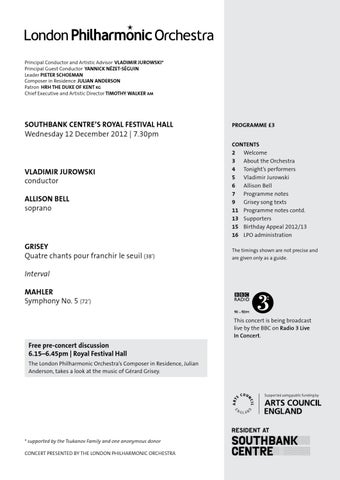
Principal Conductor and Artistic Advisor VLADIMIR JUROWSKI* Principal Guest Conductor YANNICK NÉZET-SÉGUIN Leader pieter schoeman Composer in Residence JULIAN ANDERSON Patron HRH THE DUKE OF KENT KG Chief Executive and Artistic Director TIMOTHY WALKER AM
SOUTHBANK CENTRE’S ROYAL FESTIVAL HALL Wednesday 12 December 2012 | 7.30pm
VLADIMIR JUROWSKI conductor ALLISON BELL soprano
GRISEY Quatre chants pour franchir le seuil (38’)
PROGRAMME £3 CONTENTS 2 Welcome 3 About the Orchestra 4 Tonight’s performers 5 Vladimir Jurowski 6 Allison Bell 7 Programme notes 9 Grisey song texts 11 Programme notes contd. 13 Supporters 15 Birthday Appeal 2012/13 16 LPO administration The timings shown are not precise and are given only as a guide.
Interval mahler Symphony No. 5 (72’) This concert is being broadcast live by the BBC on Radio 3 Live In Concert.
Free pre-concert discussion 6.15–6.45pm | Royal Festival Hall The London Philharmonic Orchestra’s Composer in Residence, Julian Anderson, takes a look at the music of Gérard Grisey.
* supported by the Tsukanov Family and one anonymous donor CONCERT PRESENTED BY THE LONDON PHILHARMONIC ORCHESTRA
Welcome
pieter schoeman leader
Pieter Schoeman was appointed Leader of the LPO in 2008, having previously been Co-Leader since 2002.
WELCOME TO SOUTHBANK CENTRE
Eating, drinking and shopping? Southbank Centre shops and restaurants include Foyles, EAT, Giraffe, Strada, YO! Sushi, wagamama, Le Pain Quotidien, Las Iguanas, ping pong, Canteen, Caffè Vergnano 1882, Skylon, Concrete and Feng Sushi, as well as cafes, restaurants and shops inside Royal Festival Hall, Queen Elizabeth Hall and Hayward Gallery. If you wish to get in touch with us following your visit please contact the Visitor Experience Team at Southbank Centre, Belvedere Road, London SE1 8XX, phone 020 7960 4250, or email customer@southbankcentre.co.uk We look forward to seeing you again soon. A few points to note for your comfort and enjoyment: PHOTOGRAPHY is not allowed in the auditorium. LATECOMERS will only be admitted to the auditorium if there is a suitable break in the performance. RECORDING is not permitted in the auditorium without the prior consent of Southbank Centre. Southbank Centre reserves the right to confiscate video or sound equipment and hold it in safekeeping until the performance has ended. MOBILES, PAGERS AND WATCHES should be switched off before the performance begins.
© Patrick Harrison
We hope you enjoy your visit. We have a Duty Manager available at all times. If you have any queries please ask any member of staff for assistance.
Born in South Africa, he made his solo debut aged 10 with the Cape Town Symphony Orchestra. He studied with Jack de Wet in South Africa, winning numerous competitions including the 1984 World Youth Concerto Competition in the US. In 1987 he was offered the Heifetz Chair of Music scholarship to study with Eduard Schmieder in Los Angeles and in 1991 his talent was spotted by Pinchas Zukerman, who recommended that he move to New York to study with Sylvia Rosenberg. In 1994 he became her teaching assistant at Indiana University, Bloomington. Pieter has performed worldwide as a soloist and recitalist in such famous halls as the Concertgebouw in Amsterdam, Moscow’s Rachmaninov Hall, Capella Hall in St Petersburg, Staatsbibliothek in Berlin, Hollywood Bowl in Los Angeles and Southbank Centre’s Queen Elizabeth Hall in London. As a chamber musician he regularly performs at London’s prestigious Wigmore Hall. As a soloist with the London Philharmonic Orchestra, Pieter has performed Arvo Pärt’s Double Concerto with Boris Garlitsky, Brahms’s Double Concerto with Kristina Blaumane, and Britten’s Double Concerto with Alexander Zemtsov, which was recorded and released on the Orchestra’s own record label to great critical acclaim. He has recorded numerous violin solos with the London Philharmonic Orchestra for Chandos, Opera Rara, Naxos, X5, the BBC and for American film and television, and led the Orchestra in its soundtrack recordings for The Lord of the Rings trilogy. In 1995 Pieter became Co-Leader of the Orchestre Philharmonique de Nice. Since then he has appeared frequently as Guest Leader with the Barcelona, Bordeaux, Lyon, Baltimore and BBC symphony orchestras, and the Rotterdam Philharmonic Orchestra. Pieter is a Professor of Violin at Trinity Laban Conservatoire of Music and Dance.
2 | London Philharmonic Orchestra
LONDON PHILHARMONIC ORCHESTRA
The London Philharmonic Orchestra is one of the world’s finest orchestras, balancing a long and distinguished history with a reputation as one of the UK’s most adventurous and forward-looking orchestras. As well as giving classical concerts, the Orchestra also records film and video game soundtracks, has its own record label, and reaches thousands of Londoners every year through activities for schools and local communities.
The London Philharmonic Orchestra has recorded many blockbuster scores, from The Lord of the Rings trilogy to Lawrence of Arabia, The Mission, East is East, Hugo, and The Hobbit: An Unexpected Journey. It also broadcasts regularly on television and radio, and in 2005 established its own record label. There are now nearly 70 releases available on CD and to download. Recent additions include Dvořák’s Stabat Mater under Neeme Järvi; Tchaikovsky’s Symphonies Nos. 4 & 5 with Vladimir Jurowski; Sibelius’s Symphonies Nos. 5 & 6 under the late Paavo Berglund; and the world premiere of Ravi Shankar’s First Symphony conducted by David Murphy.
The Orchestra was founded by Sir Thomas Beecham in 1932, and since then its Principal Conductors have included Sir Adrian Boult, Bernard Haitink, Sir Georg Solti, Klaus Tennstedt and Kurt Masur. The current Principal Conductor is Vladimir Jurowski, ‘Jurowski and the LPO provided the appointed in 2007, and impossible that is perfection ... As things Yannick Nézet-Séguin is stand now, the LPO must rate as an Principal Guest Conductor.
example to all orchestras.’
In summer 2012 the London Philharmonic Orchestra performed as part of The Queen’s Diamond Jubilee Pageant on the River Thames, and was also chosen to record all the world’s national anthems for the London 2012 Olympics.
The Orchestra is Resident Musicalcriticism.com, July 2011 Orchestra at Southbank (BBC Proms 2011: Liszt, Bartók and Kodály) Centre’s Royal Festival Hall in London, where it has performed since it opened The London Philharmonic Orchestra maintains an in 1951, giving around 40 concerts there each season. 2012/13 highlights include three concerts with Vladimir energetic programme of activities for young people and local communities. Highlights include the Jurowski based around the theme of War and Peace Deutsche Bank BrightSparks Series; the Leverhulme in collaboration with the Russian National Orchestra; Young Composers project; and the Foyle Future Firsts Kurt Weill’s The Threepenny Opera, also conducted by orchestral training programme for outstanding young Jurowski; 20th-century American works with Marin players. Over recent years, developments in technology Alsop; Haydn and Strauss with Yannick Nézet-Séguin; and social networks have enabled the Orchestra to and the UK premiere of Carl Vine’s Second Piano reach even more people worldwide: all its recordings Concerto with pianist Piers Lane under Vassily Sinaisky. are available to download from iTunes and, as well Throughout 2013 the Orchestra will collaborate with as a YouTube channel, news blog, iPhone app and Southbank Centre on The Rest Is Noise festival, based regular podcasts, the Orchestra has a lively presence on on Alex Ross’s book of the same name and charting the Facebook and Twitter. 20th century’s key musical works and historical events. The Orchestra has flourishing residencies in Brighton and Eastbourne, and performs regularly around the UK. Every summer, the Orchestra leaves London for four months and takes up its annual residency accompanying the famous Glyndebourne Festival Opera, where it has been Resident Symphony Orchestra since 1964. The Orchestra also tours internationally, performing concerts to sell-out audiences worldwide. Tours in the 2012/13 season include visits to Spain, Germany, France, Switzerland, the USA and Austria.
Find out more and get involved! lpo.org.uk facebook.com/londonphilharmonicorchestra twitter.com/LPOrchestra
London Philharmonic Orchestra | 3
tonight’s performers
First Violins Pieter Schoeman*† Leader Vesselin Gellev Sub-Leader Chair supported by John & Angela Kessler
Ilyoung Chae Chair supported by Moya Greene
Katalin Varnagy Catherine Craig Thomas Eisner Tina Gruenberg Martin Höhmann Geoffrey Lynn Robert Pool Sarah Streatfeild Yang Zhang Grace Lee Rebecca Shorrock Ben Roskams Galina Tanney Second Violins Fredrik Paulsson Guest Principal Jeongmin Kim Joseph Maher Fiona Higham Ashley Stevens Marie-Anne Mairesse Nancy Elan Dean Williamson Sioni Williams Peter Graham Mila Mustakova Elizabeth Baldey Sheila Law Sarah Buchan Alison Strange Stephen Dinwoodie Violas Cyrille Mercier Guest Principal Robert Duncan Gregory Aronovich Katharine Leek Benedetto Pollani Laura Vallejo Susanne Martens
Isabel Pereira Daniel Cornford Martin Fenn Sarah Malcolm Miranda Davis Pamela Ferriman Naomi Holt
Alto Flute Stewart McIlwham*†
Cellos Kristina Blaumane† Principal Francis Bucknall Laura Donoghue Jonathan Ayling
Cor Anglais Sue Bohling Principal
Chair supported by Caroline, Jamie & Zander Sharp
Gregory Walmsley Santiago Carvalho‡ Sue Sutherley Susanna Riddell Tom Roff Helen Rathbone Tae-Mi Song Sibylle Hentschel Double Basses Kevin Rundell*† Principal Tim Gibbs Co-Principal Laurence Lovelle George Peniston Richard Lewis Kenneth Knussen Helen Rowlands Tom Walley Catherine Ricketts Lowri Morgan Flutes Sue Thomas Principal Chair supported by the Sharp Family
Ian Mullin Stewart McIlwham*† Marta Santamaria Piccolo Stewart McIlwham*† Principal
Oboes Ian Hardwick Principal Angela Tennick Sue Bohling
Chair supported by Julian & Gill Simmonds
Clarinets Nicholas Carpenter* Principal Duncan Gould† Emily Meredith Paul Richards† Bass Clarinets Paul Richards† Principal Duncan Gould† Contrabass Clarinet Paul Richards† E-flat Clarinet Emily Meredith Saxophones Martin Robertson† Tim Holmes† Bassoons Gareth Newman* Principal Dominic Tyler Simon Estell Contrabassoon Simon Estell Principal Horns John Ryan* David Pyatt Guest Principal Martin Hobbs Mark Vines Co-Principal Gareth Mollison Duncan Fuller Anthony Chidell
Trumpets Paul Beniston*† Principal Anne McAneney* Chair supported by Geoff & Meg Mann
Nicholas Betts Co-Principal David Hilton William O’Sullivan Piccolo Trumpet Paul Beniston*† Trombones Mark Templeton* Principal David Whitehouse Bass Trombone Lyndon Meredith Principal Tubas Lee Tsarmaklis*† Principal David Kendall† Euphonium David Whitehouse† Timpani Simon Carrington* Principal Percussion Andrew Barclay*† Principal Chair supported by Andrew Davenport
Keith Millar Jeremy Cornes Eddy Hackett† Ignacio Molins† Harp Rachel Masters*† Principal * Holds a professorial appointment in London ‡ Chevalier of the Brazilian Order of Rio Branco † Players in Grisey’s Quatre chants pour franchir le seuil
The London Philharmonic Orchestra also acknowledges the following chair supporters whose player is not present at this concert: David & Victoria Graham Fuller
4 | London Philharmonic Orchestra
VLADIMIR JUROWSKI
© Chris Christodoulou
Principal Conductor and Artistic Advisor
One of today’s most sought-after and dynamic conductors, acclaimed worldwide for his incisive musicianship and adventurous artistic commitment, Vladimir Jurowski was born in Moscow, and completed the first part of his musical studies at the Music College of the Moscow Conservatory. In 1990 he relocated with his family to Germany, continuing his studies at the High Schools of Music in Dresden and Berlin. In 1995 he made his international debut at the Wexford Festival conducting Rimsky-Korsakov’s May Night, and the same year saw his debut at the Royal Opera House, Covent Garden, with Nabucco. Vladimir Jurowski has been Music Director of Glyndebourne Festival Opera since 2001, and in 2003 was appointed Principal Guest Conductor of the London Philharmonic Orchestra, becoming the Orchestra’s Principal Conductor in September 2007. He also holds the titles of Principal Artist of the Orchestra of the Age of Enlightenment and Artistic Director of the Russian State Academic Symphony Orchestra. He has also held the positions of First Kapellmeister of the Komische Oper, Berlin (1997–2001); Principal Guest Conductor of the Teatro Comunale di Bologna (2000–03); and Principal Guest Conductor of the Russian National Orchestra (2005–09). Vladimir Jurowski is a regular guest with many leading orchestras in both Europe and North America, including the Berlin and Oslo Philharmonic orchestras; the Dresden Staatskapelle; the Leipzig Gewandhausorchester; the Tonhalle Orchester Zurich; and the Royal Concertgebouw, Philadelphia, Chicago Symphony, Bavarian Radio Symphony and Mahler Chamber orchestras. Highlights of the 2012/13 season and beyond include his debuts with the Vienna Philharmonic, Boston Symphony, New York Philharmonic, NHK Symphony and San Francisco Symphony orchestras, and return visits to the Chamber Orchestra of Europe; the Tonhalle Orchester Zurich; the Accademia di Santa Cecilia; and the Philadelphia, St Petersburg Philharmonic, Royal Concertgebouw and Chicago Symphony orchestras.
Jurowski made his debut at the Metropolitan Opera, New York, in 1999 with Rigoletto, and has since returned for Jenůfa, The Queen of Spades and Hansel and Gretel. He has conducted Parsifal and Wozzeck at Welsh National Opera; War and Peace at the Opera National de Paris; Eugene Onegin at Teatro alla Scala, Milan; Ruslan and Ludmila at the Bolshoi Theatre; and Iolanta and Die Teufel von Loudon at the Dresden Semperoper, as well as The Magic Flute, La Cenerentola, Otello, Macbeth, Falstaff, Tristan und Isolde, Die Meistersinger von Nürnberg, Don Giovanni, The Rake’s Progress, The Cunning Little Vixen and Peter Eötvös’s Love and Other Demons at Glyndebourne Festival Opera. Future engagements include new productions of Ariadne auf Naxos at Glyndebourne; Die Frau ohne Schatten at the Metropolitan Opera; Moses und Aron at the Komische Oper, Berlin; and The Fiery Angel at the Bayerische Staatsoper in Munich. Jurowski’s discography includes the first ever recording of the cantata Exil by Giya Kancheli for ECM; Meyerbeer’s L’etoile du Nord for Marco Polo; Massenet’s Werther for BMG; and a series of records for PentaTone with the Russian National Orchestra. The London Philharmonic Orchestra has released a wide selection of his live recordings on its LPO Live label, including Brahms’s Symphonies Nos. 1 and 2; Mahler’s Symphony No. 2; Rachmaninoff’s Symphonic Dances; Tchaikovsky’s Symphonies 1, 4, 5, 6 and Manfred; and works by Turnage, Holst, Britten, Shostakovich, Honegger and Haydn. His tenure as Music Director at Glyndebourne has been documented in a CD release of Prokofiev’s Betrothal in a Monastery, and DVD releases of his performances of La Cenerentola, Gianni Schicchi, Die Fledermaus, Don Giovanni, and Rachmaninoff’s The Miserly Knight. Other DVD releases include Hansel and Gretel from the Metropolitan Opera New York; his first concert as the London Philharmonic Orchestra’s Principal Conductor featuring works by Wagner, Berg and Mahler; and DVDs with the Orchestra of the Age of Enlightenment (Beethoven’s Symphonies Nos. 4 and 7) and the Chamber Orchestra of Europe (Strauss and Ravel), all released by Medici Arts. Vladimir Jurowski’s position as Principal Conductor and Artistic Advisor of the London Philharmonic Orchestra is generously supported by the Tsukanov Family and one anonymous donor.
London Philharmonic Orchestra | 5
ALLISOn bell
© Mike Hoban
soprano
Allison Bell studied Music and History at the University of Sydney and continued her studies in Europe, including masterclasses with Joan Sutherland, Magda Olivero, Ghena Dimitrova, Ileana Cotrubas, Gundula Janowitz and Dietrich Fischer-Dieskau. She has received numerous awards including the La Scala Prize and a scholarship to study with Virginia Zeani at the Viñas Competition in Barcelona. Her opera roles include La Folie in Rameau’s Platée, Morgana in Handel’s Alcina, Aspasia in Mozart’s Mitridate, Madame Herz in Mozart’s Der Schauspieldirektor, Queen of the Night in Mozart’s The Magic Flute, Glauce in Cherubini’s Médée, Adele in Strauss’s Die Fledermaus, Oscar in Verdi’s Un ballo in maschera, Ophelie in Thomas’s Hamlet, Olympia in Offenbach’s The Tales of Hoffmann, Juliette in Gounod’s Roméo et Juliette, Zerbinetta in Strauss’s Ariadne auf Naxos, Waldvogel in Wagner’s Siegfried, Bubikopf in Ullmann’s Der Kaiser von Atlantis, Nachtigall in Braunfels’s Die Vögel, Cunegonde in Bernstein’s Candide, Pretty Polly in Birtwistle’s Punch and Judy, and Vole/Sun in Richard Ayres’s The Cricket Recovers. Allison was universally acclaimed for creating the role of Sierva Maria in the 2008 world premiere of Peter Eötvös’s opera Love and Other Demons at Glyndebourne Festival Opera under Vladimir Jurowski, as well as at the National Opera of Lithuania and the Opéra National du Rhin. She was the soloist in Eötvös retrospectives in Caen, Strasbourg, Budapest and Madrid and for the 2011 CD ‘Ensemble Linea plays Eötvös’, which won a Hungarian FONOGRAM award and the Orphée d’Or from the Académie du Disque Lyrique in Paris. With the London Philharmonic Orchestra under Vladimir Jurowski she was soloist for the UK premieres of Schnittke’s Three Scenes, Three Madrigals and Der gelbe Klang in 2009, followed by Schoenberg’s Pierrot Lunaire at Wigmore Hall. Her voice also features on the award-winning film Maska by the Quay Brothers.
6 | London Philharmonic Orchestra
Allison’s most recent and future engagements include Le Feu, La Princesse and Le Rossignol in Ravel’s L’enfant et les sortilèges with the Bolshoi in Moscow; Berio’s chamber music with the London Sinfonietta and Thomas Adès; Mahler’s Das klagende Lied in Berlin and Munich; Waldvogel in Wagner’s Siegfried at Longborough; the world premiere of Fabian Panisello’s song cycle Libro del Frio at the Klangspuren Festival as well as a recording of the same work for VERSO; and Schoenberg’s Pierrot Lunaire with Northern Sinfonia and the BBC Concert Orchestra. She also appears in the Australian premiere of Ligeti’s Mysteries of the Macabre and Lutosławski’s Chantefleurs et Chantefables with the Tasmanian Symphony Orchestra. She returns to the London Philharmonic Orchestra at Royal Festival Hall on 2 March 2013 to sing Polly Peachum in Weill’s The Threepenny Opera under Vladimir Jurowski. For all her concerts Allison is dressed courtesy of Comme des Garçons. She also acknowledges the generous support of the Richard Carne Trust and the Musicians Benevolent Fund.
PROGRAMME NOTES
Crossing the threshold The French composer Gérard Grisey wrote his Four chants for crossing the threshold, a ‘musical meditation on death’, for soprano and 15 players, between 1996 and 1998; by a tragic coincidence, it was his last work before his own sudden death. The work is a continuous setting of four texts in French drawn from different sources: a poem about the death of an angel by the contemporary writer Christian Guez Ricord; a catalogue of lost and fragmentary funeral inscriptions from ancient Egypt; an elegiac fragment by the ancient Greek poetess Erinna; and a description from one of the world’s oldest pieces of fiction, the Sumerian Epic of Gilgamesh, of the cataclysmic destruction of humanity, ending with the hope of survival. The use of quarter-tone writing, among other
advanced techniques, creates the feeling of a selfcontained soundworld subject to its own natural laws, appropriate to the remoteness of most of the sources and to the work’s subject matter on the borders of human experience. Gustav Mahler’s mighty Fifth Symphony, written in 1901 and 1902, follows an entirely different trajectory. It begins with a solemn funeral march, followed by an outburst of protest. But then it crosses a threshold of its own and opts for life: in a scherzo full of dance rhythms; in the famous Adagietto, a declaration of love for Mahler’s wife Alma (without the connotations of its use in the film Death in Venice); and above all in a brilliant and joyful finale.
Gérard Grisey
Quatre chants pour franchir le seuil (Four chants for crossing the threshold)
1946–98
The song texts begin on page 9.
Prelude – 1 The Death of the Angel – Interlude – 2 The Death of Civilisation – Interlude – 3 The Death of the Voice – False Interlude – 4 The Death of Humanity
Conservatoire. He was an acknowledged leader of his generation of French composers: he co-founded the influential ensemble L’Itinéraire; and he was a pioneer of the ‘spectralist’ approach to composition, which draws on computer analysis of the internal spectrum of sounds that gives a note on a particular instrument its colour. Grisey composed his Four chants for crossing the threshold, for soprano and 15 players, between 1996 and 1998 in response to a joint commission from BBC Radio 3, for the London Sinfonietta and the Ensemble Intercontemporain. Shortly after completing this ‘musical meditation on death’, he died suddenly of a ruptured aneurysm in November 1998. The premiere of the work, at Southbank Centre’s Queen Elizabeth Hall in February 1999, was dedicated to his memory, and is remembered by those who were there as an occasion of highly charged emotion. Continued overleaf
Born in Belfort, near France’s border with Switzerland, Gérard Grisey studied in Germany and then in Paris with Henri Dutilleux and Olivier Messiaen. After a period in Italy as winner of the Prix de Rome, he returned to Paris to study acoustics and to work at the IRCAM research centre. He taught at the University of California, Berkeley, from 1982 to 1986, and from 1987 at the Paris
Allison Bell soprano
London Philharmonic Orchestra | 7
PROGRAMME NOTES
The word ‘chants’ in the title means literally ‘songs’, but has connotations of rituals and the sacred; the ‘seuil’ or ‘threshold’ is that between life and death, as understood by the ancient Egyptians. In his own programme note (translated for the premiere by Christopher Wintle and Joe Bain), Grisey summarised his four chosen texts as concerning ‘the death of the angel, the death of civilisation, the death of the voice and the death of humanity’, and pointed out that they came from four different civilisations, Christian, Egyptian, Greek and Mesopotamian. The scoring of the work, he added, was dictated by the need to oppose the lightness of the solo voice with ‘something deeply massive, weighty yet sumptuous and coloured’. The solo soprano is joined at the front of the platform by three instruments of comparable brightness, violin, flute and trumpet, and behind this group three darker-coloured quartets are ranged: on the left, two saxophones, cello and percussion; on the right, two clarinets (for most of the time bass and contrabass clarinets), double bass and percussion; in the centre, tenor and bass tubas, harp and percussion. The writing for all the instruments is very detailed, with much use of quarter-tones, sometimes on specially tuned saxophones or harp strings, sometimes produced by adjustments to normal playing techniques; these are precisely aligned with the voice part, which has its own quarter-tones. The work plays continuously for about 40 minutes, the four ‘chants’ being prefaced and linked by Interludes of almost subliminal percussion sounds and breath tones which ward off any relaxation of tension. The Prelude leads to a setting of lines about dying ‘like an angel’ by the French poet Christian Guez Ricord, whom Grisey
knew in the 1970s, some years before his death in 1988, and whose oeuvre he described as ‘mystical, heavy with Judaeo-Christian images and almost medieval in its ceaseless quest for the Grail’. These lines are set to a small repertoire of vocal gestures, coloured by the treble instruments, against a background of drooping descending phrases; after a climactic change of texture, the word ‘ange’ loses its previous instrumental ‘halo’. The first Interlude precedes a setting of excerpts from a catalogue of funeral inscriptions from the Middle Kingdom of ancient Egypt, some obliterated and others surviving only in fragments: these are delivered in a manner ranging between neutral recitation and greater expressivity, over sustained notes and a recurring ostinato figure of three rising notes. The third ‘chant’ is a setting of an elegiac fragment by the shadowy ancient Greek poetess Erinna of Telos: here the voice part is the most prominent of several intertwining melodic lines. The final interlude is a ‘False Interlude’ because, although it begins neutrally like the others, it later anticipates the pitched sounds and insistent percussion rhythms of the instrumental opening of the fourth ‘chant’. This is a dramatic setting of a passage from one of the oldest known surviving works of fiction, the ancient Sumerian Epic of Gilgamesh, describing a cataclysm that reduces most of mankind to clay, but is survived by the narrator. After the storm has gradually abated, a slow-moving section followed by a long pause represents the aftermath. The final section of the work is a tender lullaby, which Grisey described as ‘not intended for inducing sleep but for an awakening’, ‘music for the dawn of a humanity finally disencumbered of the nightmare’.
INTERVAL – 20 minutes An announcement will be made five minutes before the end of the interval.
8 | London Philharmonic Orchestra
Grisey: Quatre chants pour franchir le seuil
1 La mort de l’ange
The Death of the Angel
De qui se doit de mourir comme ange
By him who has the duty to himself to die as an angel
comme il se doit de mourir comme un ange je me dois de mourir moi même
just as he has a duty to himself to die like an angel my duty is to die myself
il se doit son mourir son ange de mourir comme il s’est mort comme un ange
he owes this death to himself his angelic destiny is to die just as he has departed like an angel After ‘The Hours of the Night’ by Christian Guez Ricord
2 La mort de la civilisation
The Death of Civilisation
nº 811 et 812: (presque entièrement disparus) nº 814: « Alors que tu reposes pour l’éternité … » nº 809: (détruit) nº 868 et 869: (presque entièrement détruits) nº 870: « J’ai parcouru … j’ai été florissant … je fais une déploration … Le lumineux tombe à l’intérieur de … » nº 961 et 963: (détruits) nº 973: « qui fait le tour du ciel … jusqu’aux confins du ciel … jusqu’à l’étendue des bras … Fais-moi un chemin de lumière, laisse-moi passer … » nº 903: (détruit) nº 1050: « formule pour être un dieu … »
811 and 812: (almost entirely disappeared) 814: ‘Now that you rest for eternity’ 809: (destroyed) 868 and 869: (almost entirely destroyed) 870: ‘I have travelled through ... I have been prosperous I make my lamentation ... The Luminous falls inside the ...’ 961 and 963: (destroyed) 973: ‘that makes the circuit of the sky ... right to the borders of the sky ... right to the arms’ furthest reach ... Make me a pass of light, let me pass on ...’ 903: (destroyed) 1050: ‘Formula for being a god...’ After the Egyptian Sarcopaghi of the Middle Kingdom
London Philharmonic Orchestra | 9
Grisey: Quatre chants pour franchir le seuil continued
3 La mort de la voix Dans le monde d’en bas, l’écho en vain dérive. Et se tait chez les morts. La voix s’épand dans l´ombre.
The Death of the Voice In the world below, the echo drifts in vain, and fallen silent among the dead. The voice spreads in the shadow. After Erinna of Telos
4 La mort de l’humanité … Six jours et sept nuits, Bourrasques, Pluies battantes Ouragans et Déluge Continuèrent de Saccager la terre. Le septième jours arrivé. Tempête, Déluge et Hécatombe cessèrent. Après avoir distribué leurs coups de hasard, Comme une femme dans le douleurs, La Mer se calma et s’immobilisa. Je regardai alentour: Le silence régnait! Tous les hommes étaient Retransformés en argile‑: Et la plaine liquide Semblait une terrasse.
The Death of Humanity ... For six days and seven nights, Squalls, Pelting rains, Hurricanes and Flood Continued to ravage the earth. When the seventh day arrived, Tempest, Flood and Carnage ceased. Having distributed their random blows Like a woman in labour The Sea calmed herself into stillness. I looked about: Silence reigned! All mankind had been Returned to clay And the flat liquid Resembled a terrace.
(Berceuse) J’ouvris une fenêtre Et le jour tomba sur ma joue. Je tombai à genoux, immobile, Et pleurai … Je regardai l’horizon de la mer, le monde …
I opened a window And daylight fell on my cheek. I fell to my knees, immobile, And wept ... I looked at the sea’s horizon, the world ... After the Sumerian Epic of Gilgamesh
D’après Les heures à la nuit de Guez Ricord (I from Quatre chants pour franchir le seuil). Music by Gérard Grisey. Text by Christian Guez Ricord. Copyright © 1998 CASA RICORDI – Milano. All rights reserved. Reproduced by kind permission of MGB Hal Leonard s.r.l.
10 | London Philharmonic Orchestra
PROGRAMME NOTES
Gustav Mahler 1860–1911
The fifth of Mahler’s nine completed symphonies marks a turning point in his composing career. Its three predecessors had all introduced voices in their later stages, and through the choice of texts had made explicit their subject matter: death and resurrection; nature and eternity; a child’s view of life and the afterlife. The Fifth was the first in a group of three symphonies for orchestra alone, issued without titles or explanatory programmes – though hardly ‘abstract’ in the traditional symphonic sense, since they were still full of references to musical archetypes of universal resonance, such as funeral marches, fanfares and dances, and still explicit to the point of vehemence in their expression of clearly recognisable emotional states. Along with the return to instruments alone went a new emphasis on counterpoint. The large orchestra of the Fifth (including three of each woodwind and a fourth flute, six horns, and four trumpets) is used very rarely in monolithic tuttis, and chiefly as a reservoir of colours to clarify and balance different strands of complex textures. It was this aspect of the Symphony that caused Mahler the most difficulty. He drafted the work with relative ease in the course of two of his regular composing ‘holidays’ at Maiernigg, by a lakeside in Carinthia, in the summers of 1901 and 1902. But the orchestration occupied him until early 1903, and he went on adjusting it right up to the premiere, which he conducted in Cologne in October 1904. Even after that performance, according to Mahler’s young colleague and admirer Bruno Walter, the composer complained that ‘it seemed to him he never would be able to master the orchestral treatment.’ He made further revisions in the following months, and many more in 1906; and the Symphony reached the form in which we know it today only in New York in the early months of 1911, the last year of his life.
Symphony No. 5 Part I
Trauermarsch: Im gemessenem Schritt Stürmisch bewegt. Mit grösster Vehemenz
Part II
Scherzo: Kräftig, nicht zu schnell
Part III
Adagietto: Sehr langsam – Rondo-Finale: Allegro – Allegro giocoso. Frisch
As well as marking a musical turning point, the Fifth Symphony also coincided with a turning point in Mahler’s fortunes. When he began it in 1901, he had recently been suffering from a serious breakdown of his health; he probably owed his life to a doctor’s rapid action after a major haemorrhage. By the time he resumed work on the score the following year, he had found a new (if later precarious) security through his marriage to the young Alma Schindler, and they were already looking forward to the birth of their first child. Meanwhile, he was beginning to win greater recognition both as a composer and in the high-profile post of musical director of the Vienna Court Opera. It would be naive to relate these events in Mahler’s life too straightforwardly to the shape and progress of the Fifth Symphony: indeed, Bruno Walter wrote about it that ‘nothing in my talks with Mahler, not a single note in the work, suggests that any extrinsic thought or emotion entered into its composition.’ But at the same time, it is true that the Symphony does show an unusually marked dichotomy between contrasting emotional states. As the great British Mahlerian Deryck Cooke wrote, ‘in this symphony Mahler sets two utterly opposed attitudes side by side with so little reconciliation between them as to threaten the work with disunity ... The most tragic and the most joyful worlds of feeling are separated from one another entirely, and bound together only by Mahler’s unmistakable personality and his command of largescale symphonic construction and unification.’ The tragic section of the Symphony is the first of its three Parts, comprising two closely related movements. The first is a solemn funeral march in C-sharp minor, marked ‘with measured tread’; this alternates with two contrasting episodes, the first a wild outburst of protest in B-flat minor, the second an expressive lament in
London Philharmonic Orchestra | 11
PROGRAMME NOTES
A minor. The second movement is marked ‘Stormily, with the greatest vehemence’, and takes up the protesting mood of the first episode of the march in the key, A minor, of the second episode. The main contrasting idea here is again sorrowful, and is in the tempo of the first movement, with some thematic cross-references. The only note of affirmation in the whole of Part I is sounded by a brief glimpse of a chorale theme in D major shortly before the end of the second movement – a significant event because D major is to be the principal key of the rest of the Symphony. Part II, reportedly composed before the rest of the work, is a single movement, marked ‘Vigorous, not too fast’. It is a vast scherzo and trio, featuring a prominent solo horn, and with echoes of the Viennese waltz and the Austrian peasant Ländler in some of its disparate episodes. At times the music is poetic and introspective; but it never looks back to the tragedy of Part I.
Nor indeed does the celebrated Adagietto for strings and harp that opens Part III: Mahler told the Dutch conductor Willem Mengelberg that this had been intended as a ‘declaration of love’ for Alma. The diminutive title refers not to the tempo, which is ‘very slow’, but to the scale of the movement, an F major interlude between two big blocks of D major. The RondoFinale follows without a break. Its introduction quotes, on the bassoon, a phrase from one of Mahler’s Knaben Wunderhorn songs, ‘Lob des hohen Verstands’, which is about a singing contest presided over by a donkey. The four-note ‘tail’ of this phrase provides the opening of the broad rondo theme, while in more general terms the reference is an ironic anticipation of one of Mahler’s most sustained and brilliant displays of counterpoint. The movement is spun chiefly out of the material of the rondo theme and the introduction, but towards the end it gathers in ideas from the Adagietto and the secondmovement chorale, on the way to its jubilant conclusion. Programme notes by Anthony Burton © 2012
The Deutsche Bank BrightSparks Series As one of the flagship projects in its extensive Corporate Citizenship programme, Deutsche Bank has been supporting the London Philharmonic Orchestra’s BrightSparks schools’ concerts since 2001. Deutsche Bank’s generous funding ensures that children and their teachers have the opportunity to experience a live performance by the Orchestra at no cost. Across the year, the series of eight concerts at Royal Festival Hall reaches approximately 16,000 young people in full-time education. This year the series has been extended to include concerts for A-Level music students for the first time, ensuring that pupils aged 5 to 18 can experience the Deutsche Bank BrightSparks Series. In addition to its support of music education, Deutsche Bank’s Corporate Citizenship programme spans a range of themes aimed at addressing disadvantage, promoting social mobility and supporting emerging artists. Globally, hundreds of thousands of people each year participate in education programmes supported by Deutsche Bank. At this evening’s concert we are delighted to welcome young people from across London whose tickets have been provided by Deutsche Bank.
12 | London Philharmonic Orchestra
We would like to acknowledge the generous support of the following Thomas Beecham Group Patrons, Principal Benefactors and Benefactors:
Guy & Utti Whittaker Manon Williams
David Ellen Commander Vincent Evans Mr Daniel Goldstein Mr & Mrs Jeffrey Herrmann Peter MacDonald Eggers Mr & Mrs David Malpas Andrew T Mills Mr Maxwell Morrison Mr Michael Posen Mr & Mrs Thierry Sciard Mr John Soderquist & Mr Costas Michaelides Mr & Mrs G Stein Mr & Mrs John C Tucker Mr & Mrs John & Susi Underwood Lady Marina Vaizey Howard & Sheelagh Watson Mr Laurie Watt Mr Anthony Yolland
Ken Follett Pauline & Peter Halliday Michael & Christine Henry Mr Ivan Hurry Mr Glenn Hurstfield Mr R K Jeha Mr Gerald Levin Sheila Ashley Lewis Wg. Cdr. & Mrs M T Liddiard OBE JP RAF Mr Frank Lim Paul & Brigitta Lock Mr Brian Marsh John Montgomery Mr & Mrs Andrew Neill Edmund Pirouet Mr Peter Tausig Mrs Kazue Turner Des & Maggie Whitelock Bill Yoe
Principal Benefactors Mark & Elizabeth Adams Jane Attias Lady Jane Berrill Desmond & Ruth Cecil Mr John H Cook Mr Charles Dumas
Benefactors Mrs A Beare Dr & Mrs Alan Carrington CBE FRS Mr & Mrs Stewart Cohen Mr Alistair Corbett Mr David Dennis Mr David Edgecombe Mr Richard Fernyhough
Hon. Benefactor Elliott Bernerd
Thomas Beecham Group The Tsukanov Family Anonymous The Sharp Family Julian & Gill Simmonds Garf & Gill Collins Andrew Davenport Mrs Sonja Drexler David & Victoria Graham Fuller Moya Greene John & Angela Kessler Mr & Mrs Makharinsky Geoff & Meg Mann Caroline, Jamie & Zander Sharp Eric Tomsett
Hon. Life Members Kenneth Goode Pehr G Gyllenhammar Edmund Pirouet Mrs Jackie Rosenfeld OBE
The generosity of our Sponsors, Corporate Members, supporters and donors is gratefully acknowledged: Corporate Members Silver: AREVA UK British American Business Destination Québec – UK Hermes Fund Managers Pritchard Englefield Bronze: Lisa Bolgar Smith and Felix Appelbe of Ambrose Appelbe Appleyard & Trew LLP Berkeley Law Charles Russell Lazard Leventis Overseas Education Partner Boeing Corporate Donor Lombard Street Research Preferred Partners Corinthia Hotel London Heineken Lindt & Sprüngli Ltd Villa Maria
In-kind Sponsors Google Inc Sela / Tilley’s Sweets Trusts and Foundations Addleshaw Goddard Charitable Trust Angus Allnatt Charitable Foundation BBC Performing Arts Fund The Boltini Trust Sir William Boreman’s Foundation Britten-Pears Foundation The Candide Trust The Coutts Charitable Trust Diaphonique, Franco-British fund for contemporary music Dunard Fund The Equitable Charitable Trust The Eranda Foundation Fidelio Charitable Trust The Foyle Foundation J Paul Getty Junior Charitable Trust The Jeniffer and Jonathan Harris Charitable Trust Capital Radio’s Help a London Child The Hobson Charity The Kirby Laing Foundation
The Idlewild Trust The Leverhulme Trust Marsh Christian Trust Adam Mickiewicz Institute The Peter Minet Trust Paul Morgan Charitable Trust The Diana and Allan Morgenthau Charitable Trust Maxwell Morrison Charitable Trust Musicians Benevolent Fund Newcomen Collett Foundation The Austin & Hope Pilkington Trust Serge Rachmaninoff Foundation The Rothschild Foundation The Samuel Sebba Charitable Trust The Bernard Sunley Charitable Foundation John Thaw Foundation The Tillett Trust The Underwood Trust Sir Siegmund Warburg’s Voluntary Settlement Kurt Weill Foundation for Music Garfield Weston Foundation and others who wish to remain anonymous London Philharmonic Orchestra | 13
Deutsche Bank db.com
Passion for Music Deutsche Bank is committed to providing young people with access to the arts. Our free tickets scheme allows over 15,000 young people each year to attend a tailored performance by the London Philharmonic Orchestra, building musical understanding and appreciation.
This advertisement has been approved and/or communicated by Deutsche Bank AG. This advertisement does not constitute an offer or a recommendation to enter into any transaction. The services described in this advertisement are provided by Deutsche Bank AG or by its subsidiaries and/or affiliates in accordance with appropriate local legislation and regulation. Deutsche Bank AG is authorized under German Banking Law (competent authority: BaFin – Federal Financial Supervisory Authority) and authorized and subject to limited regulation by the Financial Services Authority. Details about the extent of Deutsche Bank AG’s authorization and regulation by the Financial Services Authority are available on request. Investments are subject to investment risk, including market fluctuations, regulatory change, counterparty risk, possible delays in repayment and loss of income and principal invested. The value of investments can fall as well as rise and you might not get back the amount originally invested at any point in time. Š Copyright Deutsche Bank 2012.
14 | London Philharmonic Orchestra
London Philharmonic Orchestra Birthday Appeal 2012/13 This season the London Philharmonic Orchestra has reached 80 years on the concert platform. We would like you to consider helping us celebrate by making a donation to our birthday wish list. These presents are all items that the Orchestra desperately needs this season. Alternatively you could make a donation to be spent on whatever we need the most.
£800
£250
£1,500
Two double bass stools
Three tom-toms
Carmina Burana music hire
Our double bass stools are on their last legs. Support our musicians by giving them something new to sit on!
We often have to hire percussion. Owning our own tom-toms would make a great birthday present!
Donate towards the score and part hire for the conductor, Orchestra and London Philharmonic Choir for the performance of Orff’s Carmina Burana on 6 April 2013.
£3,000
£5,000
£5,000
FUNharmonics illustrations
Recording a concert for live stream
New terminal server
Donate to the bespoke illustrations and animation designed for each themed FUNharmonics family concert, to help educate and increase engagement with our young audiences.
Help us to increase the Orchestra’s reach around the world through donating to the recording of a 2013 concert for live stream and potential CD release.
The socks option – sounds boring but we really need it! The terminal server keeps our staff and backstage team in touch by providing remote access to emails and files when the Orchestra is on tour.
Get involved and visit www.lpo.org.uk/birthday for more information. Alternatively get in touch via katherine.hattersley@lpo.org.uk or call 020 7840 4212.
London Philharmonic Orchestra | 15
administration
Board of Directors
General Administration
Orchestra Personnel
Archives
Victoria Sharp Chairman Stewart McIlwham* President Gareth Newman* Vice-President Desmond Cecil CMG Vesselin Gellev* Jonathan Harris CBE FRICS Dr Catherine C. Høgel Martin Höhmann* Angela Kessler George Peniston* Sir Bernard Rix Kevin Rundell* Julian Simmonds Mark Templeton* Sir Philip Thomas Natasha Tsukanova Timothy Walker AM Laurence Watt Dr Manon Williams
Timothy Walker AM Chief Executive and Artistic Director
Andrew Chenery Orchestra Personnel Manager
Philip Stuart Discographer
Sarah Thomas Librarian
Gillian Pole Recordings Archive
Michael Pattison Stage Manager
Professional Services
Finance David Burke General Manager and Finance Director
Julia Boon Assistant Orchestra Personnel Manager
* Player-Director
Advisory Council Richard Brass Sir Alan Collins Jonathan Dawson Clive Marks OBE FCA Lord Sharman of Redlynch OBE Victoria Sharp Timothy Walker AM American Friends of the London Philharmonic Orchestra, Inc. Margot Astrachan Chairman David E. R. Dangoor Vice Chair/Treasurer Kyung-Wha Chung Peter M. Felix CBE Alexandra Jupin Dr. Felisa B. Kaplan William A. Kerr Jill Fine Mainelli Kristina McPhee Dr. Joseph Mulvehill Harvey M. Spear, Esq. Danny Lopez Honorary Chairman Noel Kilkenny Honorary Director Victoria Sharp Honorary Director Richard Gee, Esq Of Counsel Robert Kuchner, CPA
Alison Atkinson Digital Projects Manager
Charles Russell Solicitors Crowe Clark Whitehill LLP Auditors
Ken Graham Trucking David Greenslade Instrument Transportation FSC_57678 14 January 2011 15/09/2011 12:30 Page Dr 1 Louise Miller Finance and ITLPO Manager Honorary Doctor Development Concert Management Roanna Gibson Concerts Director (maternity leave) Ruth Sansom Artistic Administrator / Acting Head of Concerts Department Graham Wood Concerts and Recordings Manager Barbara Palczynski Glyndebourne and Projects Administrator Jenny Chadwick Tours and Engagements Manager Alison Jones Concerts Co-ordinator Jo Orr PA to the Chief Executive / Concerts Assistant
Nick Jackman Development Director Helen Searl Corporate Relations Manager Katherine Hattersley Charitable Giving Manager Melissa Van Emden Events Manager Laura Luckhurst Corporate Relations and Events Officer Sarah Fletcher Development and Finance Officer Marketing Kath Trout Marketing Director Mia Roberts Marketing Manager
Matthew Freeman Recordings Consultant
Rachel Williams Publications Manager
Education & Community
Samantha Kendall Box Office Manager (Tel: 020 7840 4242)
Patrick Bailey Education and Community Director Alexandra Clarke Education Manager Caz Vale Community and Young Talent Manager Richard Mallett Education and Community Producer
16 | London Philharmonic Orchestra
Libby Northcote-Green Marketing Co-ordinator Claire Lampon Intern Albion Media Public Relations (Tel: 020 3077 4930)
London Philharmonic Orchestra 89 Albert Embankment London SE1 7TP Tel: 020 7840 4200 Fax: 020 7840 4201 Box Office: 020 7840 4242 lpo.org.uk The London Philharmonic Orchestra Limited is a registered charity No. 238045. Photograph of Grisey © Casa Ricordi, Milan. Front cover photograph © Patrick Harrison. Printed by Cantate.