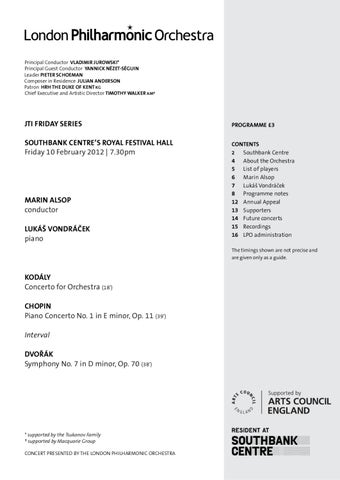
Principal Conductor VLADIMIR JUROWSKI* Principal Guest Conductor YANNICK NÉZET-SÉGUIN Leader pieter schoeman Composer in Residence JULIAN ANDERSON Patron HRH THE DUKE OF KENT KG Chief Executive and Artistic Director TIMOTHY WALKER AM†
JTI FRIDAY SERIES
PROGRAMME £3
SOUTHBANK CENTRE’S ROYAL FESTIVAL HALL Friday 10 February 2012 | 7.30pm
CONTENTS 2 Southbank Centre 4 About the Orchestra 5 List of players 6 Marin Alsop 7 Lukáš Vondráček 8 Programme notes 12 Annual Appeal 13 Supporters 14 Future concerts 15 Recordings 16 LPO administration
MARIN ALSOP conductor LUKÁŠ VONDRÁČEK piano
The timings shown are not precise and are given only as a guide.
KODÁLY Concerto for Orchestra (18’) CHOPIN Piano Concerto No. 1 in E minor, Op. 11 (39’) Interval DVOŘÁK Symphony No. 7 in D minor, Op. 70 (38’)
* supported by the Tsukanov Family † supported by Macquarie Group CONCERT PRESENTED BY THE LONDON PHILHARMONIC ORCHESTRA
Welcome
WELCOME TO SOUTHBANK CENTRE We hope you enjoy your visit. We have a Duty Manager available at all times. If you have any queries please ask any member of staff for assistance. Eating, drinking and shopping? Southbank Centre shops and restaurants include Foyles, EAT, Giraffe, Strada, YO! Sushi, wagamama, Le Pain Quotidien, Las Iguanas, ping pong, Canteen, Caffè Vergnano 1882, Skylon, Concrete and Feng Sushi, as well as cafes, restaurants and shops inside Royal Festival Hall, Queen Elizabeth Hall and Hayward Gallery. If you wish to get in touch with us following your visit please contact Kenelm Robert, our Head of Customer Relations, at Southbank Centre, Belvedere Road, London SE1 8XX or phone 020 7960 4250 or email customer@southbankcentre.co.uk
Hear every note
Are you hard of hearing or do you use a hearing aid? Did you know Royal Festival Hall, Queen Elizabeth Hall and Purcell Room all have free-of-charge equipment available to help you get the most out of the music you may be missing? Visit the relevant cloakroom up to one hour before the performance to collect the equipment and learn how to use it effectively.
2 | London Philharmonic Orchestra
We look forward to seeing you again soon. A few points to note for your comfort and enjoyment: PHOTOGRAPHY is not allowed in the auditorium. LATECOMERS will only be admitted to the auditorium if there is a suitable break in the performance. RECORDING is not permitted in the auditorium without the prior consent of Southbank Centre. Southbank Centre reserves the right to confiscate video or sound equipment and hold it in safekeeping until the performance has ended. MOBILES, PAGERS AND WATCHES should be switched off before the performance begins.
The London Philharmonic Orchestra has maintained accessible ticket prices for its Friday concerts for more than half a century. Our support of the ‘JTI Friday Series’ ensures it can continue to do so. JTI is driven by the creativity of 25,000 diverse, enquiring minds made up of 90 nationalities. Imagine the potential.
www.jti.com
LONDON PHILHARMONIC ORCHESTRA
The London Philharmonic Orchestra is one of the world’s finest orchestras, balancing a long and distinguished history with a reputation as one of the UK’s most adventurous and forward-looking orchestras. As well as performing classical concerts, the Orchestra also records film and computer game soundtracks, has its own record label, and reaches thousands of Londoners every year through activities for schools and local communities. The Orchestra was founded by Sir Thomas Beecham in 1932, and since then has been headed by many of the great names in the conducting world, including Sir Adrian Boult, Bernard Haitink, Sir Georg Solti, Klaus Tennstedt and Kurt Masur. The current Principal Conductor is Russian Vladimir Jurowski, appointed in 2007, with French-Canadian Yannick Nézet-Séguin as Principal Guest Conductor. The Orchestra is based at Royal Festival Hall in London’s Southbank Centre, where it has performed since it opened in 1951 and been Resident Orchestra since 1992. It gives around 40 concerts there each season with many of the world’s top conductors and soloists. Concert highlights in 2011/12 include a three-week festival celebrating the music of Prokofiev, concerts with artists including Sir Mark Elder, Marin Alsop, Renée Fleming, Stephen Hough and Joshua Bell, and several premières of works by living composers including the Orchestra’s Composer in Residence, Julian Anderson. In addition to its London concerts, the Orchestra has flourishing residencies in Brighton and Eastbourne, and performs regularly around the UK. Every summer, the Orchestra leaves London for four months and takes up its annual residency accompanying the famous Glyndebourne Festival Opera in the Sussex countryside, where it has been Resident Symphony Orchestra since 1964. The London Philharmonic Orchestra tours internationally, performing to sell-out audiences worldwide. In 1956 it became the first British orchestra to appear in Soviet Russia and in 1973 made the first-ever visit to China by a Western orchestra. Touring remains a big part of the Orchestra’s life: tours in the 2011/12 season include visits to Belgium, Switzerland, Germany, the US, Spain, China, Russia, Oman, Brazil and France.
4 | London Philharmonic Orchestra
You may well have heard the London Philharmonic Orchestra on film soundtrack recordings: it has recorded many blockbuster scores, from The Lord of the Rings trilogy to Lawrence of Arabia, The Mission, Philadelphia and East is East. The Orchestra also broadcasts regularly on television and radio, and in 2005 established its own record label. There are now over 50 releases on the label, which are available on CD and to download. Recent additions include Dvořák’s Symphonic Variations and Symphony No. 8 conducted by Sir Charles Mackerras; Holst’s The Planets conducted by Vladimir Jurowski; Mahler’s Symphony No. 8 under Klaus Tennstedt; Shostakovich Piano Concertos with Martin Helmchen under Vladimir Jurowski; and Sibelius’s Symphony No. 5, Pohjola’s Daughter and Lutosławski’s Concerto for Orchestra under Jukka-Pekka Saraste. The Orchestra was also recently honoured with the commission to record all 205 of the world’s national anthems for the London 2012 Olympics Team Welcome Ceremonies and Medal Ceremonies. To help maintain its high standards and diverse workload, the Orchestra is committed to the welfare of its musicians and in December 2007 received the Association of British Orchestras/Musicians Benevolent Fund Healthy Orchestra Bronze Charter Mark. The London Philharmonic Orchestra maintains an energetic programme of activities for young people and local communities. Highlights include the ever-popular family and schools concerts, fusion ensemble The Band, the Leverhulme Young Composers project and the Foyle Future Firsts orchestral training scheme for outstanding young players. Over the last few years, developments in technology and social networks have enabled the Orchestra to reach even more people worldwide: all its recordings are available to download from iTunes and, as well as a YouTube channel, news blog, iPhone app and regular podcasts, the Orchestra has a thriving Twitter presence. Find out more and get involved! lpo.org.uk twitter.com/LPOrchestra
LONDON PHILHARMONIC ORCHESTRA
First Violins Lisa Schatzman Guest Leader Jhi-Hyun Lee Martin Höhmann Chair supported by Richard Karl Goeltz
Geoffrey Lynn Robert Pool Yang Zhang Rebecca Shorrock Alain Petitclerc Peter Nall Galina Tanney Caroline Frenkel Alina Petrenko Robert Yeomans Francesca Smith Ishani Bhoola Catherine Van de Geest Second Violins Philippe Honore Guest Principal Clare Duckworth Co-Principal Chair supported by the Sharp Family
Joseph Maher Fiona Higham Ashley Stevens Dean Williamson Sioni Williams Alison Strange Mila Mustakova Elizabeth Baldey Stephen Dinwoodie Naomi Anner Stephen Stewart Dafydd Williams
Violas David Marks Guest Principal Gregory Aronovich Benedetto Pollani Laura Vallejo Susanne Martens Michelle Bruil Naomi Holt Daniel Cornford Sarah Malcolm Martin Fenn Isabel Pereira Claudio Cavalletti Cellos Timothy Gill Guest Principal Susanne Beer Co-Principal Francis Bucknall Laura Donoghue Jonathan Ayling Chair supported by Caroline, Jamie & Zander Sharp
Santiago Carvalho† Tae-Mi Song Jonathan Kitchen David Bucknall William Routledge Double Basses Tim Gibbs Principal Laurence Lovelle George Peniston Kenneth Knussen Catherine Ricketts Lowri Morgan Antonia Bakewell Charlotte Kerbegian
Flutes Jaime Martín* Principal Eilidh Gillespie Stewart McIlwham* Piccolo Stewart McIlwham* Principal Oboes Ian Hardwick Principal Angela Tennick Clarinets Robert Hill* Principal Nicholas Carpenter* Bassoons Marcelo Padilla Guest Principal Gareth Newman* Horns John Ryan* Principal Martin Hobbs Mark Vines Co-Principal Gareth Mollison Marcus Bates
Trombones Mark Templeton* Principal David Whitehouse Bass Trombone Lyndon Meredith Principal Tuba Lee Tsarmaklis* Principal Timpani Simon Carrington* Principal Percussion Andrew Barclay* Principal Chair supported by Andrew Davenport
* Holds a professorial appointment in London † Chevalier of the Brazilian Order of Rio Branco
Trumpets Paul Beniston* Principal Anne McAneney* Chair supported by Geoff & Meg Mann
Nicholas Betts Co-Principal
Chair Supporters The London Philharmonic Orchestra also acknowledges the following chair supporters whose players are not present at this concert: David & Victoria Graham Fuller John & Angela Kessler Julian & Gill Simmonds
London Philharmonic Orchestra | 5
MARIN ALSOP
© Grant Leighton
CONDUCTOR
Marin Alsop is an inspiring and powerful voice in the international music scene, a Music Director of vision and distinction who passionately believes that music has the power to change lives. She is recognised worldwide for her innovative approach to programming, and for her deep commitment to education and to the development of audiences of all ages.
Alsop is currently Artist in Residence at Southbank Centre, and in the 2009/10 season was appointed Artistic Director of the Centre’s year-long Bernstein Project.
Her success as Music Director of the Baltimore Symphony Orchestra was recognised when, in 2009, her tenure was extended to 2015. At the start of the 2012/13 season she will also take up the post of Chief Conductor of the São Paulo Symphony Orchestra, where she will steer the orchestra in its artistic and creative programming, recording ventures and its education and outreach activities.
In 2008 Marin Alsop became a Fellow of the American Academy of Arts & Sciences, and the following year was chosen as Musical America’s Conductor of the Year. She is the recipient of numerous awards and is the only conductor to have received a MacArthur Fellowship, the award given by the MacArthur Foundation for exceptional creative work. In 2011 Alsop was made an Honorary Member of the Royal Academy of Music in London.
Since 1992, Marin Alsop has been Music Director of California’s Cabrillo Festival of Contemporary Music, where she has built a devoted audience for new music. She retains strong links with all of her previous orchestras, including the Bournemouth Symphony Orchestra, where she was Principal Conductor from 2002–08 and now holds the post of Conductor Emeritus, and the Colorado Symphony Orchestra, where she was Music Director from 1993–2005 and is now Music Director Laureate. Alsop is a regular guest conductor with the world’s greatest orchestras, including the New York Philharmonic, Los Angeles Philharmonic, Royal Concertgebouw and Bavarian Radio Symphony orchestras; The Philadelphia Orchestra; Tonhalle Zürich; Orchestre de Paris; and La Scala, Milan. She has close relationships with both the London Philharmonic and London Symphony orchestras, and appears with both most seasons. She also returns regularly to the Netherlands Radio Philharmonic, Frankfurt Radio Symphony, Royal Stockholm Philharmonic, Danish Radio Symphony, Oslo Philharmonic and Czech Philharmonic orchestras.
6 | London Philharmonic Orchestra
Since taking up her position at the Baltimore Symphony Orchestra in 2007, Marin Alsop has spearheaded educational initiatives reaching over 60,000 school and pre-school students. In 2008 she launched ‘OrchKids’, which provides music education, instruments and mentorship to the city’s neediest young people, and in 2010 the BSO Academy, where local non-professional musicians work for a week with members of the orchestra.
Alsop’s extensive discography, which includes a notable set of Brahms symphonies with the London Philharmonic Orchestra on the Naxos label, is further distinguished by a new Dvořák series with the Baltimore Symphony Orchestra. Other recent recordings include Bernstein’s Mass (Editor’s Choice at the 2010 Gramophone Awards), also with the BSO, and John Adams’s Nixon in China with the Colorado Symphony Orchestra, which the Financial Times gave five stars, calling it an ‘incandescent performance’. Born in New York City, Marin Alsop attended Yale University and received her Master’s degree from The Juilliard School. Her conducting career was launched when, in 1989, she was a prize-winner at the Leopold Stokowski International Conducting Competition and in the same year was the first woman to be awarded the Koussevitzky Conducting Prize from the Tanglewood Music Center, where she was a pupil of Leonard Bernstein.
LUKÁŠ VONDRÁČEK
© Susan Wilson
piano
Lukáš Vondráček’s natural and assured musicality, together with a remarkable technical ability, mark him out as a gifted and mature musician who is building a major career. He has worked with conductors including Paavo Järvi, Gianandrea Noseda, Marin Alsop, Zdeněk Macál, Pietari Inkinen, Vasily Petrenko, Christoph Poppen and Anu Tali.
At the 2009 International Van Cliburn Piano Competition, Lukas Vondráček received the Raymond E. Buck Jury Discretionary Award. His first commercial recording, a solo album for Octavia records featuring works by Mendelssohn, Liszt, Janáček and Dohnányi, was released in 2004. Born in the Czech Republic in 1986, Vondráček made his first public appearance at the age of four. Following studies at the Academy of Music in Katowice and the Vienna Conservatoire, Vondráček is currently pursuing an Artist Diploma at Boston’s New England Conservatory under the tutelage of Hung-Kuan Chen.
Highlights of the current season include concerts with the Orchestre National de Belgique; Orquestra Sinfónica Portuguesa; National Symphony Orchestra, Washington DC; and the London Philharmonic, BBC Philharmonic and Royal Liverpool Philharmonic orchestras. Further performances include the Wiesbaden Festspielhaus as part of the Burghofspiele Festival, and the Rudolfinum in Prague at the Dvořák Prague International Music Festival. He will also give recitals at the Celebrity Series in Boston and the Washington Performing Arts Society. Vondráček has appeared in recital at the Cité de la musique in Paris, Palais des Beaux-Arts in Brussels, Auditorio Nacional in Madrid, Tonhalle Zürich, Concertgebouw Amsterdam, Festival La Roque d’Anthéron, Belfast Festival, Gilmore Festival, Ravinia Rising Stars series and the Next Generation Festival in Dortmund. He gave his UK recital début in 2002 at Southbank Centre’s Queen Elizabeth Hall as part of the London International Piano Series, where he was the youngest pianist featured in its history. In May 2002 Vondráček made his début with the Czech Philharmonic Orchestra under Vladimir Ashkenazy with concerts in Prague and Italy, followed by a major US tour in 2003 and concerts in Cologne, Vienna, Lucerne and Birmingham. He went on to work with orchestras including the St Petersburg Philharmonic; TonhalleOrchester Zürich; Deutsches Symphonie-Orchester Berlin; NDR Sinfonieorchester; Gulbenkian Orchestra; BBC Philharmonic; Orquestra Sinfônica do Estado de São Paulo; and the Detroit, Baltimore, Bournemouth, Vienna, NHK, Cincinnati, Iceland and Sydney symphony orchestras, as well as the Royal Scottish National Orchestra and the Australian Youth Orchestra. London Philharmonic Orchestra | 7
PROGRAMME NOTES
Speedread All three pieces in tonight’s concert were written by Eastern European composers for audiences further West. The commission that resulted in Zoltán Kodály’s Concerto for Orchestra winged its way from the American state of Illinois to Kodály’s Budapest. Chopin created both his piano concertos for the audience he hoped he’d woo in travelling from Warsaw to Paris. And our very own London Philharmonic Society commissioned the Seventh Symphony in 1884 from the patriarch of Czech music, Antonín Dvořák. So in delivering works for audiences away from home, did our three composers adapt or change their compositional voices? Yes and no. Certainly Kodály’s established style was what it was: thoroughly Hungarian, born of a Magyar mind and forged on the anvil of that country’s folk tradition. Chopin was no less idiosyncratic – probably more so, in fact – but he
Zoltán KODÁLY 1882–1967
Like his compatriot and colleague Béla Bartók, Zoltán Kodály spent much of his career discovering, researching and collating Hungarian folk music. In a sense, Kodály’s compositional career took a back seat as a result: he wrote only nine orchestral scores and when asked why, protested that he’d been busy ‘educating a public.’ But his thirst for folk music actually enriched his music immeasurably – not only as the impetus behind its creation, but also as the raw material on which he’d forge his own distinctive voice. That voice was firmly established by 1939 when the Chicago Symphony Orchestra commissioned Kodály to 8 | London Philharmonic Orchestra
was also rather more susceptible to stylistic osmosis. His piano concertos were unashamedly tailored to the emerging fashions of early 19th-century Paris in their nonchalant glitz and elegant romance. Dvořák was subjected to rather different pressures when writing his ‘London’ symphony, both internal and external. The composer didn’t attempt any shift in his musical accent, but he did want to prove in his Seventh, to himself and his mentors, that he could deal with the development of themes like the best symphonic composers (certainly more a German trait than an English one). He did so knowing that the discerning London audience wouldn’t shy away from rating him against the best composers of the day (not much has changed there); but he also, vitally, wrote music that feels entirely un-pressurized in its very natural, very Dvořákian sentiments.
CONCERTO FOR ORCHESTRA Allegro risoluto Largo Tempo primo Largo Tempo primo
write and conduct a piece as part of its 50th birthday celebrations. The resulting Concerto for Orchestra was finished in 1940, but war prevented the composer from traveling across the Atlantic to conduct the piece. As it happened, Kodály’s old friend Bartók was leaving for America and so took the score with him; the piece was first heard in Chicago in February 1941, where the CSO was conducted by its then music director Frederick Stock. A handful of ‘Concertos for Orchestra’ were written in mid-20th-century Eastern Europe, in what became something of a trend. Often the works were conceived as ‘re-imaginings’ of the Baroque concerto grosso,
in which individual instruments or instrumental groups would step out of the orchestral melee as soloists. Kodály follows that principle and employs the fast-slowfast structure prevalent in the Baroque, but his melodic motifs are shaped by ancient Hungarian folksong and by his own characteristic ‘open’ intervals of fourths and fifths. Together, they lend the music an earthy, primeval quality. To begin, a unison theme is given a pulsating energetic treatment that captures all the bustle of a Baroque
Frédéric CHOPIN 1810–49
Two centuries on from his birth, Frédéric Chopin remains a unique figure in the history of music, and in more than one respect. He’s the only accepted ‘major’ 19th-century composer not to have contributed a single symphony, opera or choral work to the repertoire. During his short life, the piano was Chopin’s prime (or rather, sole) focus. In such resolute commitment to his instrument, he didn’t so much expand its vocabulary as gift it a whole new language. As a performer, he countered the thundering virtuosity of Liszt with a unique, transcendental poise: his recitals stunned audiences into silence with their poeticism, intricacy and hypnotic magic. Chopin became, before long, a phenomenon. But first there were the obstacles of obscurity and geography to overcome. As the 1820s drew to a close, Chopin was making a name for himself in Warsaw. But to achieve lasting success he would need to head for one of Europe’s musical hubs – preferably with some vehicles for his virtuosity in his luggage. In 1829 he began to conceive two piano concertos. Though he did have some experience of writing for piano and orchestra, this was ambitious: the piano concerto was
Allegro. More themes are introduced before a slackening of the tempo for the slow central section; here the repetition of a deep-set three-in-a-bar theme (first heard on low strings) references the passacaglia, a Baroque form in which variations are laid over a recurring harmonic track. Hungarians, though, have come to admire this passage more as a depiction of their country’s natural beauty. The energy and poetry of those two sections combine in the Concerto’s final chapter, as do their various thematic strands as the piece closes with the very musical motif with which it opened.
Piano Concerto No. 1 in E minor, op. 11 Lukáš Vondráček piano Allegro maestoso Romance – Larghetto Rondo – Vivace
a sovereign musical form; that with which the great geniuses Mozart and Beethoven had made their names. In Prague, in late 1829, a concerto in F minor began to crystallize in Chopin’s mind. He returned to Warsaw, wrote it down, performed it privately at home on 3 March 1830 and gave the public première two weeks later at the Polish National Theatre. Chopin was ready to head out into Europe again, and planned to use the concerto as his calling card in France, from where his parents had moved just months before he was born. But before he left Warsaw, Chopin had time to complete a second concerto in the key of E minor. And yes, that is the right order: as with Beethoven’s first two piano concertos, the chronology is the reverse of the title numbering. So, the concerto we hear tonight is actually Chopin’s second – its publication before the concerto we now know as ‘No. 2’ explains the paradoxical titling. As with the so-called ‘first’ concerto, Chopin purposefully kept his orchestral writing relatively simple (in that piece the orchestral parts were simple enough London Philharmonic Orchestra | 9
PROGRAMME NOTES
for the composer to re-write them from memory after mislaying them). While the concertos of Mozart and Beethoven had seen increasingly complex dialogues between piano and orchestra, Chopin’s, in the tradition of Hummel, were different: the orchestra acted more as an accompanist, occasionally teeing-up moments of virtuosity which are themselves focused squarely on the soloist. Of course, that soloist was originally Chopin himself. The composer described the E minor concerto’s slow movement as ‘a kind of Romance, tranquil and melancholy. It is meant to create the impression of a loving look back at a special place, which awakens thousands of sweet memories.’ Before that comes
a broad opening Allegro in which the string players introduce three themes before the grand entrance of the piano. The composer’s final movement’s Rondo theme is conceived as a brilliant Krakowiak – a Polish national dance with two beats to the bar, which the piano frolics through here with minimal contribution from the strings. Though he’d use Polish dances in the future, it turns out Chopin was bidding something of a farewell to Poland here: on arriving in Paris, the composer had already seen the last of his homeland. From then on, his address, lifestyle and even his name would embrace the French nationality of his father.
INTERVAL – 20 minutes An announcement will be made five minutes before the end of the interval.
INTERNATIONAL piano series SPRING – SUMMER 2012 Richard Goode
Mitsuko Uchida
Piano Takeover
Yuja Wang
Peter Donohoe
Lars Vogt
Maurizio Pollini
Arcadi Volodos
François-Frédéric Guy
Alexei Volodin
Sunday 12 February
Saturday 25 February
Tuesday 28 February Yuja Wang ©Felix Broede
Tuesday 6 March
Tuesday 20 March
Leif Ove Andsnes Thursday 29 March
TICKETS 0844 847 9929 SOUTHBANKCENTRE.CO.UK
10 | London Philharmonic Orchestra
Monday 23 April
Tuesday 1 May
Tuesday 15 May
Tuesday 22 May
Wednesday 13 June
Antonín DVOŘÁK 1841–1904
The Seventh might not be Dvořák’s most popular symphony, but it’s arguably his best. In the composer’s own mind, he simply had to deliver something special for the London Philharmonic Society, who had commissioned the piece in 1884. His career was at a crossroads: success had finally come, offers were being made, and contacts were putting themselves forward. Brahms and others were urging Dvořák to consider a move from his hometown of Prague to Vienna or Berlin. All Dvořák had to do was prove that he could write first-class symphonic music already; music that didn’t rely overtly on indigenous Czech themes and that demonstrated a firm grasp of symphonic thought. On that front Dvořák more than succeeded with his Seventh Symphony. It was first performed on 22 April 1885 in St James’s Hall, London, and was immediately hailed as a masterpiece. As a symphony, it is near flawless, and certainly Dvořák’s most organic and wellargued. For that, the composer had Brahms to thank. Dvořák had recently heard Brahms’s Third Symphony, whose taut, concise and clear-cut structure is wholly evident here. There are also a good few points of direct comparison: both symphonies contain radiant horn solos (you’ll hear Dvořák’s in his second movement), and both are stalked by a sense of underlying darkness. That darkness – perhaps ‘severity’ is a better word – had been uncommon in Dvořák’s music up to this point. The Seventh was the composer’s first symphony written in a minor key and it only rarely finds the major. Even so, the joy and bustle associated with Dvořák’s music is somehow ever-present – either fighting to be heard or peering through the composer’s minor-key colourings. Perhaps it’s the profusion of rich melodies that keeps the symphony so consistently radiant, even when resolutely rooted in the minor (as in the demonic dance of the Scherzo, for example).
SYMPHONY NO. 7 in D minor, op. 70 Allegro maestoso Poco adagio Scherzo: Vivace Finale: Allegro
So organic and rich in cross-referencing is the Seventh’s music that an analysis of its themes and their origins is best left for academics. What’s worth listening out for in the first movement, however, is the restlessness of Dvořák’s lower strings, which helps create a feeling of impending stormy weather; throughout, instruments enter in a fragmentary fashion, each seeming to stride into the conversation with a conflicting view. Dvořák’s second movement is a continuous, river-like flow of inspired melodies opening with what sounds like an ancient chorale in a serene F major, the key that also closes the movement. The aforementioned horn solo that comes later represents one of the symphony’s only moments of warmth; a sudden appearance of the sun between clouds. Though the third movement features an idyllic Trio section, it’s surrounded by a demonic dance built from an insistent, syncopated figure which combines duple and triple time in reference to the ‘furiant’, a Czech folk dance. Dvořák didn’t want to over-egg his use of devices and themes from Czech folk music in the symphony, and uses them similarly fleetingly and subtly in his finale. This movement is a fierce tussle, relieved only by its bright secondary idea cast in a major key and first heard on cellos, supported by lightly ornamenting violins. Dvořák triumphs over the movement’s nervous energy with a theme of distinctly Czech character first heard on the flutes. In a dramatic coda, the symphony’s final paragraph, the music at last finds victory as it discovers the warmth of D major. Programme notes © Andrew Mellor
London Philharmonic Orchestra | 11
London Philharmonic Orchestra
Annual Appeal 2011/12 in aid of the Community Programme Despite living close to Royal Festival Hall, many people in South London have never visited the venue or heard an orchestra perform. We are committed to our work in the community to ensure that as many people as possible can access and enjoy music of the highest quality. There are three dynamic projects within the Community Programme, providing inspirational musical opportunities for children and their families. Animate Orchestra is a young person’s ‘orchestra for the 21st century’, offering young people in Lewisham and Greenwich a creative pathway for them to continue their playing as they make the transition from primary to secondary education – a time when many young musicians give up. Young people make music side by side with London Philharmonic Orchestra musicians. The Band is the Orchestra’s fusion ensemble for young people in South London, at which they improvise, create, and rehearse their own music – from classical to jazz, hip hop, rock, and more. Members have inspirational contact with London Philharmonic Orchestra players, in sessions led by some of the UK’s leading tutors. FUNharmonics are our Family Concerts – an interactive introduction for all the family to music and the orchestra, presented by Chris Jarvis of CBeebies. Free foyer activities before and after the concert include Have-a-Go sessions where children can try out a range of orchestral instruments with our musicians; and the Human Orchestra – fun rhythmic sessions where music is performed using body percussion, singing, drumming, and clapping. Your Support In order to undertake this essential work we depend entirely on donations from charitable sources each year, and we are asking you to help us to support this work in the communities surrounding the South Bank. If you do feel able to contribute to this year’s Appeal we would be extremely grateful. Gifts of any size make a real difference; to donate please contact Elisenda Ayats on 020 7840 4225 or elisenda.ayats@lpo.org.uk. For more information, and to donate online, please visit lpo.org.uk/support_us/appeal And now, for the first time, you can also donate up to £10 to the Orchestra by text message. To donate, text PHIL12 and the amount you wish to donate (£1, £2, £3, £4, £5, or £10) to 70070. e.g. to donate £10 text PHIL12 £10 to 70070 For more information, please visit lpo.org.uk/text
12 | London Philharmonic Orchestra
We would like to acknowledge the generous support of the following Thomas Beecham Group Patrons, Principal Benefactors and Benefactors: Thomas Beecham Group The Tsukanov Family Anonymous The Sharp Family Julian & Gill Simmonds Garf & Gill Collins Andrew Davenport David & Victoria Graham Fuller Richard Karl Goeltz John & Angela Kessler Mr & Mrs Makharinsky Geoff & Meg Mann Caroline, Jamie & Zander Sharp Eric Tomsett Mrs Sonja Drexler Guy & Utti Whittaker Principal Benefactors Mark & Elizabeth Adams Jane Attias Lady Jane Berrill Desmond & Ruth Cecil Mr John H Cook Mr Charles Dumas
David Ellen Commander Vincent Evans Mr & Mrs Jeffrey Herrmann Peter MacDonald Eggers Mr & Mrs David Malpas Andrew T Mills Mr Maxwell Morrison Mr Michael Posen Mr & Mrs Thierry Sciard Mr John Soderquist & Mr Costas Michaelides Mr & Mrs G Stein Mr & Mrs John C Tucker Mr & Mrs John & Susi Underwood Lady Marina Vaizey Howard & Sheelagh Watson Mr Laurie Watt Mr Anthony Yolland
Ken Follett Pauline & Peter Halliday Michael & Christine Henry Mr Ivan Hurry Mr Glenn Hurstfield Mr R K Jeha Mr Gerald Levin Sheila Ashley Lewis Wg. Cdr. & Mrs M T Liddiard OBE JP RAF Mr Frank Lim Paul & Brigitta Lock Mr Brian Marsh John Montgomery Edmund Pirouet Mr Peter Tausig Mrs Kazue Turner Mr D Whitelock Bill Yoe
Benefactors Mrs A Beare Dr & Mrs Alan Carrington CBE FRS Mr & Mrs Stewart Cohen Mr Alistair Corbett Mr David Dennis Mr David Edgecombe Mr Richard Fernyhough
Hon. Benefactor Elliott Bernerd Hon. Life Members Kenneth Goode Pehr G Gyllenhammar Edmund Pirouet Mrs Jackie Rosenfeld OBE
The generosity of our Sponsors, Corporate Members, supporters and donors is gratefully acknowledged: Corporate Members Appleyard & Trew LLP AREVA UK Berkeley Law British American Business Charles Russell Destination Québec – UK Lazard Leventis Overseas Corporate Donor Lombard Street Research In-kind Sponsors Google Inc Heineken Lindt & Sprüngli Ltd Sela / Tilley’s Sweets Villa Maria Trusts and Foundations Addleshaw Goddard Charitable Trust Arts and Business Allianz Cultural Foundation Angus Allnatt Charitable Foundation The Boltini Trust
Britten-Pears Foundation The Candide Charitable Trust The Coutts Charitable Trust The Delius Trust Dunard Fund The Equitable Charitable Trust The Eranda Foundation The Fenton Arts Trust The Foyle Foundation The Jeniffer and Jonathan Harris Charitable Trust Hattori Foundation for Music and the Arts Capital Radio’s Help a London Child The Hobson Charity The Kirby Laing Foundation The Idlewild Trust The Leverhulme Trust Lord and Lady Lurgan Trust Maurice Marks Charitable Trust Marsh Christian Trust The Mercers’ Company Adam Mickiewicz Institute The Peter Minet Trust Paul Morgan Charitable Trust
The Diana and Allan Morgenthau Charitable Trust Maxwell Morrison Charitable Trust Musicians Benevolent Fund Newcomen Collett Foundation The Austin & Hope Pilkington Trust The Serge Prokofiev Foundation Serge Rachmaninoff Foundation The Reed Foundation The Rothschild Foundation The Seary Charitable Trust The Samuel Sebba Charitable Trust The David Solomons Charitable Trust The Steel Charitable Trust The Stansfield Trust The Bernard Sunley Charitable Foundation The Swan Trust John Thaw Foundation The Thistle Trust The Underwood Trust Kurt Weill Foundation for Music Garfield Weston Foundation Youth Music and others who wish to remain anonymous London Philharmonic Orchestra | 13
future concerts
Tuesday 14 February 2012 | 7.30pm Friday 17 February 2012 | 7.30pm Royal Festival Hall JTI Friday Series (Friday 17 February) Rachmaninoff Piano Concerto No. 2* Kreisler (arr. Rachmaninoff/orch. Leytush) Liebesleid (European première) Rachmaninoff Symphony No. 2 Neeme Järvi conductor Boris Giltburg piano In co-operation with the Serge Rachmaninoff Foundation * Supported by Dunard Fund
Saturday 24 March 2012 | 7.30pm Royal Festival Hall Julian Anderson The Discovery of Heaven (world première)† Delius Sea Drift** Elgar Symphony No. 1 Sir Mark Elder conductor Roderick Williams baritone London Philharmonic Choir † Commissioned by the London Philharmonic Orchestra with kind support from The Boltini Trust and the Britten-Pears Foundation, and the New York Philharmonic (Alan Gilbert, Music Director). ** Performance generously supported by The Delius Trust.
Neeme Järvi and Boris Giltburg Sir Mark Elder and Roderick Williams
Wednesday 22 February 2012 | 7.30pm Royal Festival Hall Mozart Symphony No. 32 Brahms Violin Concerto Zemlinsky Psalm 23, Op. 14 Szymanowski Symphony No. 3 (The Song of the Night)
Barlines: free post-concert event Level 2 Foyer at Royal Festival Hall Sir Mark Elder and Composer in Residence Julian Anderson discuss The Discovery of Heaven.
Vladimir Jurowski conductor Joshua Bell violin Jeremy Ovenden tenor London Philharmonic Choir
Booking details
Concert generously supported by the Adam Mickiewicz Institute as part of the Polska Music grant programme
Tickets £9–£39 | Premium seats £65
Free pre-concert discussion Royal Festival Hall | 6.15–6.45pm Dr Stephen Downes, Reader in Musicology at the University of Surrey, discusses the music of Szymanowski and Zemlinsky.
London Philharmonic Orchestra Box Office 020 7840 4242 Monday to Friday 10.00am–5.00pm lpo.org.uk (no transaction fee) Southbank Centre Box Office 0844 847 9920 Daily 9.00am–8.00pm southbankcentre.co.uk (transaction fees apply) In person at Royal Festival Hall Box Office Daily 10.00am–8.00pm (no transaction fee)
14 | London Philharmonic Orchestra
New recordings
on the London Philharmonic Orchestra label
Jukka-Pekka Saraste conducts Sibelius’s Symphony No. 5 and Pohjola’s Daughter, and Lutosławski’s Concerto for Orchestra
LPO-0057
‘This has to be one of the best recordings around of Sibelius’s Fifth. And Lutosławski’s Concerto can never have been more brilliantly played.’ Classic FM magazine, December 2011 Supported by the Adam Mickiewicz Institute as part of the Polska Music grant programme
Vladimir Jurowski conducts Honegger’s Pastorale d’été, Symphony No. 4 and Une Cantate de Noël
LPO-0058
‘[The Fourth Symphony] is full of charm and tactile invention, vividly realised in this live recording.’ The Sunday Times, 30 October 2011
bernard haitink conducts ravel’s daphnis et chloÉ
christoph eschenbach conducts beethoven’s missa solemnis
March 2012
April 2012
LPO-0060
LPO-0061
LPO-0059
Coming soon ...
ravi shankar: symphony April 2012
Browse and order online at lpo.org.uk/shop, or call the Box Office on 020 7840 4242
London Philharmonic Orchestra | 15
Administration
Board of Directors
General Administration
Orchestra Personnel
Archives
Martin Höhmann Chair Stewart McIlwham Vice-Chair Sue Bohling Lord Currie* Jonathan Dawson* Gareth Newman George Peniston Sir Bernard Rix* Kevin Rundell Sir Philip Thomas* Timothy Walker AM†
Timothy Walker AM† Chief Executive and Artistic Director
Andrew Chenery Orchestra Personnel Manager
Philip Stuart Discographer
Sarah Thomas Librarian
Gillian Pole Recordings Archive
*Non-Executive Directors
The London Philharmonic Trust Victoria Sharp Chair Desmond Cecil CMG Jonathan Harris CBE FRICS Dr Catherine C. Høgel Martin Höhmann Angela Kessler Clive Marks OBE FCA Julian Simmonds Timothy Walker AM† Laurence Watt American Friends of the London Philharmonic Orchestra, Inc. We are very grateful to the Board of the American Friends of the London Philharmonic Orchestra for its support of the Orchestra’s activities in the USA.
Alison Atkinson Digital Projects Manager
London Philharmonic Orchestra 89 Albert Embankment David Burke London SE1 7TP General Manager and Tel: 020 7840 4200 Finance Director Ken Graham Trucking Fax: 020 7840 4201 FSC_57678 LPO 14 January 2011 15/09/2011 12:30 Page Box 1 Office: 020 7840 4242 David Greenslade Instrument Transportation Finance and IT Manager (Tel: 01737 373305) lpo.org.uk Finance
Crowe Clark Whitehill LLP Auditors Dr Louise Miller Honorary Doctor
Julia Boon Assistant Orchestra Personnel Manager
Concert Management
Development
Roanna Gibson Concerts Director
Nick Jackman Development Director
Ruth Sansom Artistic Administrator
Harriet Mesher Charitable Giving Manager
Graham Wood Concerts, Recordings and Glyndebourne Manager
Alexandra Rowlands Corporate Relations Manager
Alison Jones Concerts Co-ordinator Jenny Chadwick Tours and Engagements Manager Jo Orr PA to the Executive / Concerts Assistant Matthew Freeman Recordings Consultant
Professional Services Charles Russell Solicitors
Michael Pattison Stage Manager
Education & Community Patrick Bailey Education and Community Director Anne Findlay Education Manager Caz Vale Community and Young Talent Manager Richard Mallett Education and Community Producer
Melissa Van Emden Events Manager Laura Luckhurst Corporate Relations and Events Officer Elisenda Ayats Development and Finance Officer Marketing Kath Trout Marketing Director Ellie Dragonetti Marketing Manager Rachel Fryer Publications Manager Helen Boddy Marketing Co-ordinator Samantha Kendall Box Office Manager (Tel: 020 7840 4242) John Barnett Intern Valerie Barber Press Consultant (Tel: 020 7586 8560)
16 | London Philharmonic Orchestra
The London Philharmonic Orchestra Limited is a registered charity No. 238045. Photograph of Kodály © Boosey & Hawkes Photographs of Chopin and Dvořák courtesy of the Royal College of Music, London. Front cover photograph © Benjamin Ealovega. Printed by Cantate. †Supported by Macquarie Group