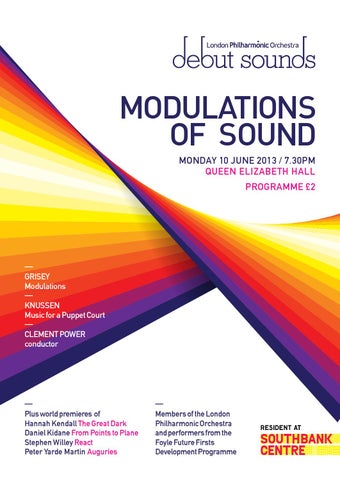
MODULATIONS OF SOUND MONDAY 10 JUNE 2013 / 7.30PM QUEEN ELIZABETH HALL Programme £2
– GRISEY Modulations – KNUSSEN Music for a Puppet Court – CLEMENT POWER conductor
– Plus world premieres of Hannah Kendall The Great Dark Daniel Kidane From Points to Plane Stephen Willey React Peter Yarde Martin Auguries
– Members of the London Philharmonic Orchestra and performers from the Foyle Future Firsts Development Programme
Welcome
Welcome to Southbank Centre We hope you enjoy your visit. We have a Duty Manager available at all times. If you have any queries please ask any member of staff for assistance. Eating, drinking and shopping? Southbank Centre shops and restaurants include Foyles, EAT, Giraffe, Strada, YO! Sushi, wagamama, Le Pain Quotidien, Las Iguanas, ping pong, Canteen, Caffè Vergnano 1882, Skylon, Concrete and Feng Sushi, as well as cafes, restaurants and shops inside Royal Festival Hall, Queen Elizabeth Hall and Hayward Gallery. If you wish to get in touch with us following your visit please contact the Visitor Experience Team at Southbank Centre, Belvedere Road, London SE1 8XX, phone 020 7960 4250, or email customer@southbankcentre.co.uk We look forward to seeing you again soon.
A few points to note for your comfort and enjoyment: PHOTOGRAPHY is not allowed in the auditorium. LATECOMERS will only be admitted to the auditorium if there is a suitable break in the performance. RECORDING is not permitted in the auditorium without the prior consent of Southbank Centre. Southbank Centre reserves the right to confiscate video or sound equipment and hold it in safekeeping until the performance has ended. MOBILES, PAGERS AND WATCHES should be switched off before the performance begins.
2
Debut Sounds
Debut Sounds is a celebration of the London Philharmonic Orchestra’s young talent programmes: Leverhulme Young Composers and Foyle Future Firsts. Over the past year, members of both programmes have been supported by the Orchestra and its Education & Community Department to explore new ideas, learn new skills and work closely with the Orchestra’s musicians. Tonight gives us the opportunity to hear the culmination of this work by some of the most exciting young musicians in classical music. Our young composers – Hannah Kendall, Daniel Kidane, Stephen Willey and Peter Yarde Martin – have worked with an ensemble comprising members of the London Philharmonic Orchestra and the Foyle Future Firsts programme throughout the academic year. In a series of workshops dedicated to trying out their compositional ideas, the four composers have received advice and support from Composer in Residence Julian Anderson, and conductor Clement Power. Leverhulme Young Composers is supported by an Arts Portfolio Grant from the Leverhulme Trust. Foyle Future Firsts is generously supported by The Foyle Foundation with additional support from Musicians Benevolent Fund, Kurt Weill Foundation for Music, Fidelio Charitable Trust and The Tillett Trust.
Young Composers
Daniel Kidane is a graduate of the Royal Northern College of Music in Manchester, where he studied with Gary Carpenter and David Horne. His music has been performed extensively across the UK and internationally, as well as being broadcast on BBC Radio 3. Described by the Financial Times as ‘quietly impressive’ and by the Times as ‘tautly constructed’ and ’vibrantly imagined’, his works are packed with incident and expression. He recently toured with Manchester Camerata, conducting his harpsichord concerto Feuersturm, written for Mahan Esfahani. His piano trio Flux and Stasis was written for and premiered by the Fournier Trio in the Park Lane Group’s New Year Concert Series, receiving critical acclaim in the Times. Other performances include premieres of his works by the Royal Liverpool Philharmonic Orchestra’s 10/10 Ensemble and at the 2011 Adelaide International Cello Festival, where he was invited and attended as guest composer.
Stephen Willey’s music explores an immediate and direct soundworld. He composes music for concert, theatre, dance and computer games, colliding a number of influences including rock, folk, contemporary, electronics and science to create strong contrasts and exposed timbres. Recent performances include pieces for Martin Roscoe (piano) at Stratford Music Festival, Garth Knox (viola and electronics) at Birmingham Conservatoire, and Thumb Ensemble at the Greenbelt and Sounds New festivals. As a theatre composer, Stephen has had the pleasure of working with director Tim Ford on productions of The Caucasian Chalk Circle, The Women of Troy and The Bacchae at Birmingham Rep Theatre and Southampton’s Nuffield Theatre. Stephen studied at Birmingham Conservatoire at both undergraduate and Masters level with scholarships from the RVW Trust and Birmingham Conservatoire, obtaining First Class Honours and Distinction respectively. During his time there he studied with Ed Bennett, Michael Wolters, Richard Causton and Joe Cutler.
Peter Yarde Martin lives and works in London, dividing his time between composing, performing, teaching and working as Music Director at St Peter’s Church, Notting Hill, where he plays the organ and runs a band and gospel choir. He studied music at Pembroke College, Cambridge, where he was an organ scholar, graduating with a double First in 2010. From 2010–12 he took a Master’s degree in Composition at the Guildhall School of Music & Drama, studying with Malcolm Singer. He passed with Distinction, winning the Mary Ryan Award and the Ian Horsburgh Memorial Prize for best postgraduate composition. Recent projects include collaborations with contemporary dance, poetry and video, as well as founding a chamber group, Sudden Junction, to play a mixture of contemporary music and arrangements of early music, jazz and electronica. Peter enjoys drinking coffee, traveling to Iceland and playing Boggle.
© Eithne Kane
© Ruby Handley-Stone
© Chris Alexander
Hannah Kendall’s music has been described as ‘intricately and skilfully wrought’ by the Sunday Times and has attracted the attentions of the UK’s finest groups including the Bournemouth Symphony Orchestra and the BBC Singers. Hannah graduated from the University of Exeter with First Class Honours in Music and obtained a Masters in Advanced Composition with Distinction from the Royal College of Music, studying with Kenneth Hesketh and funded by the Arts and Humanities Research Council, the RVW Trust and an RCM Study Award. She enjoys collaborating with artists from other creative forms and most recently joined forces with Gallery Libby Sellers in developing Middlegame for solo piano, taking its inspiration from the Gallery’s GAMES exhibition. Commissioned by the Richard Thomas Foundation, the work was premiered by Andrew Matthews-Owen and expanded into a three-movement piece that was performed at the Purcell Room in May 2013. Future projects include a new piece for Southbank Sinfonia, which will be premiered in September.
3
Foyle Future Firsts
Now in its ninth year, our unique programme has gone from strength to strength. Members are supported and nurtured to the highest standards and we are proud to see current and past Foyle Future Firsts taking professional engagements with the London Philharmonic Orchestra and other world-class ensembles.
© Benjamin Ealovega
The 16 members of the Foyle Future Firsts programme are gifted and talented instrumentalists who aspire to be professional orchestral musicians. We seek to bridge their transition between college and the professional platform, developing talented players to form the base for future orchestral appointments with the London Philharmonic Orchestra and other orchestras and ensembles around the world.
On stage tonight Violins Geoffrey Lynn Marie-Ann Mairesse Kate Birchall Chair supported by David & Victoria Graham Fuller
Members of the Foyle Future Firsts programme benefit from individual lessons and mentoring from London Philharmonic Orchestra Principals, training seminars on audition techniques, and mock auditions. They also have opportunities to play in full orchestral rehearsals throughout the year, take part in high-profile and unique chamber performances, and work alongside London Philharmonic Orchestra musicians on education and community projects.
Anna Ovsyanikova* Elizabeth Lamberton* Amy Tress† May Robertson† Oliver Sapsford†
lpo.org.uk/futurefirsts
Double Basses George Peniston Katy Furmanski*
Violas Katharine Leek Steve Doman* Asher Zaccardelli† Chris Beckett† Cellos Gregory Walmsley Anne Chauveau* Daniel James† Leah Evans†
Flutes/Piccolos Stewart McIlwham Stephanie Tepper*
4
Oboes/Cor Anglais Will Oinn Lucinda Sprague* Clarinets/Bass/ Contrabass Clarinets Emily Meredith Adam Slater* Cosima Yu† Bassoons/ Contrabassoons Graham Hobbs Sophie Robertshaw* Horns Marcus Bates Mark Bennett* Trumpets Joe Sharp Hannah Bishop* Trombone David Whitehouse Bass Trombones Lyndon Meredith Barry Clements* Tuba Ray Hearne*
Percussion Ignacio Molins Serge Vuille† Ross Garrod† Harp Rebecca Royce* Piano/Celeste/ Hammond Organ Clíodna Shanahan SoYeong Kim* Guitar Tom Gamble† * 2012/13 Foyle Future Firsts † guests For the London Philharmonic Orchestra Timothy Walker AM Chief Executive and Artistic Director Patrick Bailey Education and Community Director Caz Vale Community and Young Talent Manager
conductor
Composer in Residence and Young Composers mentor Clement Power, born in London in 1980, studied at Cambridge University and the Royal College of Music, London, and was subsequently named Assistant Conductor of the Ensemble Intercontemporain, Paris.
Recent engagements have included the NHK Symphony Orchestra (Japan), Ensemble Intercontemporain, Birmingham Contemporary Music Group, Orchestre Philharmonique de Luxembourg, BBC Scottish Symphony Orchestra and Philharmonia Orchestra, as well as the Avanti! Chamber Orchestra (Finland), Orchestre de Bretagne, New London Chamber Choir and National Youth Orchestra of Catalonia. He has conducted numerous concerts and broadcasts with Austria’s foremost contemporary music ensemble, Klangforum Wien, including the opening of the 2012 Wien Modern festival. Clement has conducted at international festivals including IRCAM Agora (Paris), Steirischer Herbst (Graz), Suntory Hall Summer Music Festival (Tokyo), Fórum Universal de las Culturas (Mexico), Ars Musica (Brussels), Huddersfield Contemporary Music Festival (UK), Contempuls (Prague), Sacrum-Profanum Festival (Krakow), Festival de Vlaams-Brabant (Belgium) and Rainy Days (Philharmonie, Luxembourg). He has given over 50 world premieres, including the first performance of Hypermusic Prologue, an opera by Hèctor Parra, in the Centre Pompidou (Paris) and the Teatre del Liceu (Barcelona), and recorded on CD for KAIROS. Future projects include Klangforum Wien, MusikFabrik (Cologne), Contrechamps (Geneva), Ensemble Modern (Frankfurt) and Birmingham Contemporary Music Group. Following an invitation to conduct de Falla’s El retablo de maese Pedro at the 2012 Lucerne Festival, Clement stood in for an indisposed Pierre Boulez for concerts (including Schoenberg’s Erwartung) with the Lucerne Festival Academy Orchestra in the Lucerne KKL and the Salle Pleyel, Paris.
© Maurice Foxall
Julian Anderson
© Sisi Burn
Clement Power
Julian Anderson is Composer in Residence of the London Philharmonic Orchestra. Born in London in 1967, he studied composition with John Lambert, Alexander Goehr and Tristan Murail. His first acknowledged work, Diptych (1990), won the 1992 Royal Philharmonic Society Prize for Young Composers and his two commissions for the London Sinfonietta, Khorovod (1994) and Alhambra Fantasy (2000), have been widely performed in Europe and the USA. His other most-played works include the orchestral BBC Proms commission The Stations of the Sun (1998) and the chamber work Poetry Nearing Silence (1997), a commission from the Nash Ensemble. From 1996–2001 Anderson was Composer in Residence with the chamber orchestra Sinfonia 21; from 2000–05 he was Composer in Association with the City of Birmingham Symphony Orchestra; and in 2002 he was appointed Artistic Director of the Philharmonia Orchestra’s ‘Music of Today’ series. Between 2005 and 2007 he was the Cleveland Orchestra’s Daniel Lewis Young Composer Fellow. His Book of Hours (2005), a piece for ensemble and electronics for Birmingham Contemporary Music Group, won the 2006 RPS Award for large-scale work. His interest in choral music led to a BBC Proms commission, Heaven is Shy of Earth, and to his Alleluia, commissioned by Southbank Centre to open the newly refurbished Royal Festival Hall in 2007. His LPO commission The Discovery of Heaven was recently awarded a 2013 South Bank Sky Arts Award. A CD of this work, together with Anderson’s Fantasias and The Crazed Moon, is planned for release on the LPO Label this autumn. His new opera Thebans will be premiered at English National Opera in May 2014, and next season he also starts a three-year post as Composer in Residence at Wigmore Hall. Previously Head of Composition at London’s Royal College of Music and Fanny Mason Professor of Music at Harvard University, Julian is currently Professor of Composition and Composer in Residence at the Guildhall School of Music & Drama. 5
Programme notes
Introduction Tonight’s concert highlights two masterpieces from roughly the same period, which focus in almost opposite ways on the same central phenomenon of colour in music. Not colour as superficial added colouration, but colour as a fundamental part of the musical structure, as an essential expressive force. Certainly this is achieved with greatly differing means. Knussen’s Music for a Puppet Court presents us with two visions of colour: a spacious, luminous re-imagining of late Medieval puzzle canons on modern instruments; and, in Knussen’s own idiom, brilliantly hectic, multi-layered polyrhythmic machines in which millions of colours fly off at odd angles in ever-shifting perspectives. This is genuinely fast music, some of the fastest ever conceived, and it makes for fantastically virtuosic listening as well as performing. Everything is surprising, yet everything is right and inevitable and leaps off the page into riotous life. Grisey’s Modulations is, by contrast, a seamlessly gradual flow of colour in which direct contrast is virtually eliminated. Instead the listener is led on a voyage of discovery in which colour begets colour, each fresh and differently beautiful. Breaking the limits of normal tuning, the music sounds both new and yet curiously familiar, unwinding repeatedly into simple repetitive consonances before taking off on new transformations. Hearing these two works in the same concert makes one paradoxically aware of just how much ground they have in common, beneath the obvious musical and technical differences. Most notably, both explode simple basic material into precisely imagined worlds of fabulous elaboration. Above all, both display the exceptional degrees of imagination and strong personality that we still rightly associate with the word ‘genius’. Since both Knussen and Grisey (during his lifetime) have been very active in helping younger colleagues, what could be more appropriate company for their music than specially composed new works by four gifted young composers, each with their own ideas on sound colour? Julian Anderson Composer in Residence, London Philharmonic Orchestra 6
Programme Oliver Knussen Music for a Puppet Court Hannah Kendall The Great Dark Daniel Kidane From Points to Plane Stephen Willey React Peter Yarde Martin Auguries Gérard Grisey Modulations Please note that the programme order is not confirmed and is subject to change. There will be a 20-minute interval, to be announced.
OLIVER KNUSSEN (born 1952) Music for a Puppet Court: Puzzle Pieces for two Chamber Orchestras after John Lloyd, Op. 11 (1972/1983) 1 2 3 4
Puzzle I (‘Iste tenor ascendit...) Toyshop Music (after ‘Tris’) Antiphon (after ‘Iste tenor ascendit…’) Puzzle II (‘Tris’)
Music for a Puppet Court is bookended by two ‘puzzle canons’ from a Court songbook dating from the early years of Henry VIII’s reign, transcribed in 1972 by Oliver Knussen. In these pieces, three parts are written out in full, but the fourth part, a slow-moving cantus firmus, is only alluded to in cryptic crossword-like clues. ‘Iste tenor ascendit…’ is the beginning of a Latin inscription that describes the outline of the pitches in esoteric terminology, and ‘Tris’ – the Greek for ‘three times’ – is written over a series of four descending notes, played 3 x 3 times in steadily accelerating note lengths, from breves to quavers. Knussen extended and re-arranged the transcriptions in 1983, dividing the orchestra into two groups: the first (left) centred around a celeste, a guitar and two flutes, and the second (right) around a harp and two clarinets. The slowly-moving cantus firmus in each movement hovers on the edge of audibility, played by the vibraphone and double basses in Puzzle I, and an assortment of bells and horns in Puzzle II, obscuring the ‘solution’ in an aural equivalent of the cryptic original.
The middle movements add further layers of puzzles to the older pieces. ‘Toyshop Music’ takes the four descending notes of ‘Tris’, and extends its use of close canons and varying speeds. The descending motif is exploded all over the orchestra and superimposed at different pitches, speeds, inversions and registers to create a bustling kaleidoscope of miniature mayhem. The third movement transplants the flute canons from ‘Iste tenor ascendit…’ onto the clarinets, accompanied by a quivering moto perpetuo in the rest of the righthand group. They are periodically interrupted by the other half of the ensemble, distorting the guitar lines from the first puzzle into a kind of bewitched, maniacal dance. Knussen writes that the title ‘refers less to the historical origin of the puzzle canons than to the intended character of these instrumental settings, miniature in size but fanciful – perhaps extravagant – in effect’, and we can hear the clatter of clockwork mechanisms clearly in the ‘Toyshop Music’’s rattling ratchets, maracas and güiros, and perhaps the twitching of marionettes in the lurching and raucous woodwind interjections in the ‘Antiphon’. Peter Yarde Martin
HANNAH KENDALL (born 1984) The Great Dark The Great Dark takes its title from the poem by Martin Carter, a Guyanese political activist and one of the leading Caribbean writers of the 20th century. The piece is presented in three movements, focusing on different ideas derived from cosmology and Caribbean folklore in the text. The opening section, the great dark, as the name suggests, immediately establishes a broad and menacing atmosphere, exploring the connection between the Sun and the orbiting Earth and Moon. This gives way to the delicate and still middle section, the probability of the spirit, which conjures a sense of desolation and solitude. The final movement, the ever weaving weaver, depicts Anansi, the spider god and trickster of the planets according to Caribbean myth. The fast-moving and kinetic music characterises the strength and power of his tangling web. HK
DANIEL KIDANE (born 1986) From Points to Plane In writing From Points to Plane, I was interested in a soundworld that was constantly being shaped by intertwining and enveloping lines. The thematic material throughout focuses in and out of acceleration and descent, with the lines becoming more capricious and rhythmically volatile as they unravel. As these contours become intertwined and warped, the pitting of various pulses shimmer through and the clearer tonality becomes denser. The initial stimulus for the piece was Wassily Kandinsky’s (1866–1944) writing Point and Line to Plane, from which the title of my piece stems, and his fascination with the expressive power of linear forms. Perhaps it was Kandinsky’s novel understanding of form that led to my conscious dialogue throughout the piece with various musical lineages, which further added to the startingpoints for the intricate processes of transformation. DK
STEPHEN WILLEY (born 1988) React React is the result of clashing together musical materials that constantly fight with one another. They do little to try and coexist with one another; however they are forced to exist in one other’s company. Forceful action and diversionary tactics within the music attempt to break down and avoid barriers presented along the way. The piece has an erratic structural narrative that often shifts sharply from one context to another. The soundworld is very direct, utilising both free-moving and strictly ordered material in a vibrant manner. When writing the piece, an argument between two groups of people with extremely different views was very influential. It tends to be a number of outspoken individuals within the groups that are very forward about their view whilst the others follow. As the arguments grow they tend to be less solution-driven, but more irrational and emotionally focussed. SW
7
PETER YARDE MARTIN (born 1988) Auguries The opening of Auguries is a simple setting of an eight-note melody with which I became completely preoccupied while starting to write the piece. As it is overlaid with more and more layers of activity, the pitches of the melody are pulled apart and put back together in a series of variations, and they are never far from the surface of the music. An augury is a divination or prediction, and the title takes its cue from William Blake’s poem Auguries of Innocence. The poem’s opening exhortation ‘To see a World in a Grain of Sand’ seemed appropriate to a piece that came to be about searching for the possibilities and suggestions inherent within a small and simple grain of musical material. PYM
GÉRARD GRISEY (1946–98) Modulations (1976) ‘The form of this piece is the same story as the sounds which compose it.’ Gérard Grisey’s description of his work for 33 musicians, Modulations, stands as a fitting summary of his output as a whole, an exploration into the acoustic properties of sound and how we perceive it. Instead of building his pieces around melodies and motifs, Grisey works with even more fundamental materials: the quality of sound and musical time itself. Grisey was instrumental in the development of ‘spectral music’, basing his compositional material on the properties of harmonic spectrums and merging the harmony with timbre. For Modulations, Grisey analysed the harmonic spectra of muted brass instruments playing a low E2 to determine the pitches (or ‘partials’) within each sound. Using the orchestra like a large and highly adaptable synthesizer, he amplifies, separates and manipulates these partials, treating the harmonic spectra as collections of pitches to be re-ordered, transposed and inverted.
His approach to musical time is equally innovative, sculpting large-scale musical structures through gradual processes of transformation that move slowly, almost imperceptibly, in patterns of rest–inhalation– exhalation. The points of rest are where the music is most regular, periodic and based around the harmonic spectrum of the low E; these repetitions build through the inhalations, becoming increasingly unstable, before the exhalations move from the resulting disorder back to a new state of rest on E. Modulations begins in a state of disorder, with irregularly spaced stabbing chords pitting the string section against the brass and wind. As the energy of the opening subsides, the contrasting blocks of chords gradually lengthen and become more periodic, coming to rest on a sequence of gently undulating chords passing across the orchestra, and eventually leaving just the brass section, muted, alone. After coming to a point of rest on a series of bassdrum rolls, the music explodes into a second sequence of chords, based around pairs of notes in the brass section. As the higher pitches become predominant, a complex, many-layered polyphony emerges, in which every instrument moves independently. Grisey divides the orchestra into four groups, each playing different sequences of pitches derived from the harmonic spectrum of a muted brass tone. As the layers gradually align and then build momentum, the string instruments come to rest on long held Es spread across their entire range, while the rest of the ensemble progress through a series of spectral chords, high answered by low, which gradually coalesce in register and grow in intensity towards the work’s dramatic conclusion. Peter Yarde Martin
Five-string double bass kindly provided by Thwaites: www.thwaites.com
The right is reserved to substitute artists and to vary the programme if necessary. Southbank Centre is a registered charity No. 298909 • The London Philharmonic Orchestra is a registered charity No. 238045 • London Philharmonic Orchestra, 89 Albert Embankment, London SE1 7TP • lpo.org.uk
8