Date: 21..02.22
COSHH Assessment
Review Date: 21.02.22
Substance used:
Ammonium Sulphide 20% in aqueous solution GPR RECTAPU
Manufacturer:
VNR Chemicals
Description of product:
Yellow colour, viscous
Emergency telephone number
01270502894 (Carechem 24) 01865 407333 (Anti Poison Centre Emergency No-24 Hours).
Location of process
Various
Activity being carried out?
Colouring/patinaton of bronze
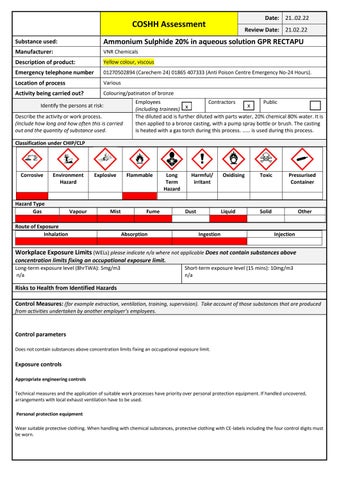
Identify the persons at risk: Describe the activity or work process. (Include how long and how often this is carried out and the quantity of substance used.
Employees Contractors Public x (including trainees) x The diluted acid is further diluted with parts water, 20% chemical 80% water. It is then applied to a bronze casting, with a pump spray bottle or brush. The casting is heated with a gas torch during this process. …… is used during this process.
Classification under CHIP/CLP
Corrosive
Environment Hazard
Hazard Type Gas
Vapour
Explosive
Mist
Route of Exposure Inhalation
Flammable
Long Term Hazard
Fume
Absorption
Harmful/ irritant
Dust
Oxidising
Liquid
Ingestion
Toxic
Pressurised Container
Solid
Other
Injection
Workplace Exposure Limits (WELs) please indicate n/a where not applicable Does not contain substances above concentration limits fixing an occupational exposure limit. Long-term exposure level (8hrTWA): 5mg/m3 n/a
Short-term exposure level (15 mins): 10mg/m3 n/a
Risks to Health from Identified Hazards Control Measures: (for example extraction, ventilation, training, supervision). Take account of those substances that are produced from activities undertaken by another employer’s employees.
Control parameters Does not contain substances above concentration limits fixing an occupational exposure limit.
Exposure controls Appropriate engineering controls Technical measures and the application of suitable work processes have priority over personal protection equipment. If handled uncovered, arrangements with local exhaust ventilation have to be used. Personal protection equipment Wear suitable protective clothing. When handling with chemical substances, protective clothing with CE-labels including the four control digits must be worn.
Eye/face protection Eye glasses with side protection (Visors) Skin protection Minimum protection foir hands: Nitrle gloves NBR (Nitrile rubber) 0,12 mm > 480 min VWR 112-0998 By long-term hand contact Suitable material: Thickness of the glove material: Breakthrough time:: Recommended glove articles : Respiratory protection NBR (Nitrile rubber) 0,12 mm > 480 min VWR 112-0998 Respiratory protection necessary at: aerosol or mist formation Suitable respiratory protection apparatus: Recommendation: Suitable material: Recommendation: Additional information Full-/half-/quarter-face masks (DIN EN 136/140) VWR 111-0206 ABEK2P3 VWR 111-0059 Wash hands before breaks and after work. Avoid contact with eyes and skin. When using do not eat, drink or smoke. Provide eye shower and label its location conspicuously. 8.2.3 Environmental exposure controls no data available
First Aid Measures IF exposed: Immediately call a POISON CENTRE/doctor. If unconscious but breathing normally, place in recovery position and seek medical advice. Never give anything by mouth to an unconscious person or a person with cramps. Change contaminated, saturated clothing. Do not leave affected person unattended.
After inhalation Immediately call a POISON CENTRE/doctor. Remove casualty to fresh air and keep warm and at rest. If breathing is irregular or stopped, administer artificial respiration.
In case of skin contact After contact with skin, wash immediately with plenty of water and soap. Remove contaminated, saturated clothing immediately. Immediate medical treatment required because corrosive injuries that are not treated are hard to cure.
After eye contact In case of contact with eyes flush immediately with plenty of flowing water for 10 to 15 minutes holding eyelids apart and consult an ophthalmologist. Protect uninjured eye. Remove contact lenses, if present and easy to do. Continue rinsing.
In case of ingestion Immediately call a POISON CENTRE/doctor. Do NOT induce vomiting. Rinse mouth thoroughly with water. Give nothing to eat or drink.
Self-protection of the first aider First aider: Pay attention to self-protection!
Storage & Handling
Precautions for safe handling All work processes must always be designed so that the following is as low as possible: Inhalation skin contact Eye contact Use extractor hood (laboratory). If handled uncovered, arrangements with local exhaust ventilation have to be used. If local exhaust ventilation is not possible or not sufficient, the entire working area must be ventilated by technical means.
Conditions for safe storage, including any incompatibilities Recommended storage temperature: no data available Storage class: no data available Keep container tightly closed and in a well-ventilated place. Keep/Store only in original container.
Specific end use(s) Apart from the uses mentioned in section 1.2 no other specific uses are stipulated.
Disposal of Substances & Contaminated Containers Appropriate disposal / Product Dispose according to local legislation. Consult the appropriate local waste disposal expert about waste disposal.
Appropriate disposal / Package Dispose according to local legislation. Handle contaminated packages in the same way as the substance itself.
Fire Fighting Measures Advice for firefighters DO NOT fight fire when fire reaches explosives. Special protective equipment for firefighters Wear a self-contained breathing apparatus and chemical protective clothing.
Additional information Do not allow run-off from fire-fighting to enter drains or water courses. Do not inhale explosion and combustion gases. Use caution when applying carbon dioxide in confined spaces. Carbon dioxide can displace oxygen. Use water spray jet to protect personnel and to cool endangered containers. In case of fire: Evacuate area.
Water
x
AAAF
CO2
x
Dry Powder
X
This assessment must be shown to all operatives working with this substance
Is exposure adequately controlled?
Yes
x
No
Risk Rating Following Control Measures High
Medium
Low