Date: 24/12/15
COSHH Assessment
Review Date: 24/12/16
Substance used:
Diesel
Manufacturer:
Various
Description of product:
Pinkish/Red Liquid used to fuel diesel engines.
Emergency telephone number
01865 407333 (Anti Poison Centre Emergency No-24 Hours).
Location of process
Various
Activity being carried out?
Refueling of Plant
Identify the persons at risk: Describe the activity or work process. (Include how long and how often this is carried out and the quantity of substance used. Classification under CHIP/CLP
Corrosive
Environment Hazard
Hazard Type Gas
Explosive
Vapour
Mist
Route of Exposure Inhalation
Employees Contractors x (including trainees) x Refueling of plant and machinery. 5 – 100l dependant on type of plant being refueled Daily
Flammable
Fume
Absorption
Long Term Hazard
Harmful/ irritant
Oxidising
Dust
Liquid
Public
Toxic
x
Pressurised Container
Solid
Ingestion
Other
Injection
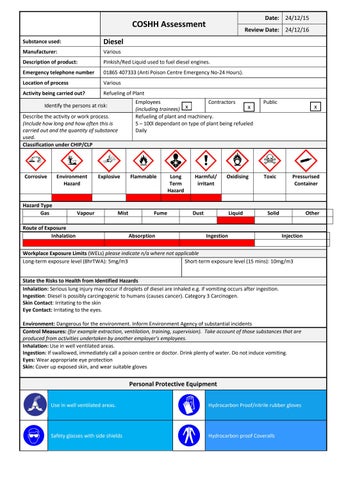
Workplace Exposure Limits (WELs) please indicate n/a where not applicable Long-term exposure level (8hrTWA): 5mg/m3 Short-term exposure level (15 mins): 10mg/m3 State the Risks to Health from Identified Hazards Inhalation: Serious lung injury may occur if droplets of diesel are inhaled e.g. if vomiting occurs after ingestion. Ingestion: Diesel is possibly carcingogenic to humans (causes cancer). Category 3 Carcinogen. Skin Contact: Irritating to the skin Eye Contact: Irritating to the eyes. Environment: Dangerous for the environment. Inform Environment Agency of substantial incidents Control Measures: (for example extraction, ventilation, training, supervision). Take account of those substances that are produced from activities undertaken by another employer’s employees. Inhalation: Use in well ventilated areas. Ingestion: If swallowed, immediately call a poison centre or doctor. Drink plenty of water. Do not induce vomiting. Eyes: Wear appropriate eye protection Skin: Cover up exposed skin, and wear suitable gloves
Personal Protective Equipment Use in well ventilated areas.
Hydrocarbon Proof/nitrile rubber gloves
Safety glasses with side shields
Hydrocarbon proof Coveralls
Respirator with vapour absorbing cartridge if used in enclosed, unventilated space
Irritaant to skin and eyes.
FP3
First Aid Measures General information: You should remove yourself from the source of exposure. After inhalation: If you have inhaled diesel you should seek medical advice. After skin contact: If you have got diesel on your skin, remove soiled clothing, wash the affected area with lukewarm water and soap for at least 10 – 15 minutes and seek medical advice. After eye contact: If you have got diesel in your eyes, remove contact lenses, irrigate the affected eye with lukewarm water for at least 10 – 15 minutes and seek medical advice. After swallowing: If you have ingested diesel do not make yourself sick. If you have ingested a small amount of diesel and you do not have any symptoms (choking, coughing, vomiting) you should be observed at home under supervision for 6 hours. If you do develop any symptoms you should attend hospital.
Storage & Handling Handling: Prevent the formation of vapours, mist and aerosols. Handle in well-ventilated premises. Keep the product away from food and beverages. Operations involving the inspection, cleaning and maintenance of storage containers require the application of strict procedures and must be entrusted to qualified specialist personnel only. DO NOT SMOKE. AVOID INHALING VAPOURS. AVOID CONTACT WITH THE SKIN AND MUCOUS MEMBRANES. NEVER ATTEMPT TO PRIME THE CONTAINER SIPHON BY SUCKING WITH THE MOUTH. WEAR SUITABLE PROTECTION AND PROTECTIVE CLOTHING. Never weld, drill, grind, cut or saw any empty container. Storage: Prevent any build-up of static electricity. Make the necessary arrangements to prevent water and soil pollution. Don't withdraw the danger labels of the containers (even if they are empty). Storage precautions: - Suitable: Store packaged product (drums, samples, cans...) in well-ventilated areas. STORE AT AMBIENT TEMPERATURE, away from water, moisture, heat, and any source of ignition.
Disposal of Substances & Contaminated Containers Waste disposal: The recommanded method is recycling or incineration at an approved installation. Disposal of contaminated packaging: Empty packagings may contain flammable or explosive vapours. Disposal via an authorised waste contractor.
Fire Fighting Measures Fire • Flammable • Mixtures of diesel vapour and air may be explosive • Use foam and liquid-tight protective clothing with breathing apparatus. Water
AAAF
X
CO2
Dry Powder
X
This assessment must be shown to all operatives working with this substance Yes
Is exposure adequately controlled?
x
No
Risk Rating Following Control Measures High
Medium
Low
Date: 27/01/16
COSHH Assessment
Review Date: 26/01/17
Substance used:
Unleaded Petrol
Manufacturer:
Various providers
Description of product:
Fuel for spark ignition engines designed to run on unleaded fuel.
Emergency telephone number
N/A
Location of process
Various garage forecourts countrywide or on site if provided via storage containers
Activity being carried out?
Refuelling vehicles or small engine powered tools and equipment. Employees Contractors Public x (including trainees) x Product is normally dispensed by hand held pumping unit on garage forecourt, but may be held in storage containers which can store fuels safely.
Identify the persons at risk: Describe the activity or work process. (Include how long and how often this is carried out and the quantity of substance used. Classification under CHIP/CLP
Corrosive
Environment Hazard
Hazard Type Gas Route of Exposure Inhalation
Vapour
Explosive
Mist
Flammable
Fume
Absorption
Long Term Hazard
Harmful/ irritant
Oxidising
Dust
Liquid
Toxic
Pressurised Container
Solid
Ingestion
Other
Injection
Workplace Exposure Limits (WELs) please indicate n/a where not applicable Long-term exposure level (8hrTWA): Short-term exposure level (15 mins): Benzene 1ppm (Source EH/40 2005 (amendment 2007) N/A n-Hexane 20ppm N/A State the Risks to Health from Identified Hazards Skin Contact: Irritating to skin. Eyes: Moderately irritating to eyes. Inhalation: Vapours may cause drowsiness and dizziness. Slightly irritating to respiratory system. Ingestion: Harmful: may cause lung damage if swallowed. Pre-existing medical conditions of the following organ(s) or organ system(s) may be aggravated by exposure to this material: Eyes, Skin, and Respiratory system. Possibility of organ or organ system damage from prolonged exposure. Target organ(s): Bloodforming organs. Peripheral nervous system. May cause heritable genetic damage. Possible risk of harm to the unborn child. A component or components of this material may cause cancer. This product contains benzene which may cause leukaemia (AML - acute myelogenous leukaemia). May cause MDS (Myelodysplastic Syndrome). Environment: Toxic to aquatic organisms; may cause long-term adverse effects in the aquatic environment. Ether oxygenates are significantly more water soluble and less biodegradable than benzene, toluene, ethyl benzene and xylenes (BTEX). Consequently ether oxygenates have the potential to migrate relatively longer distances than BTEX in groundwater. Control Measures: (for example extraction, ventilation, training, supervision). Take account of those substances that are produced from activities undertaken by another employer’s employees. Eyes: Goggles or safety glasses with side shields must be used if possibilities of eye contact. Skin: When using, wear wear impervious gloves/gauntlets. Inhalation: Avoid breathing vapours or contact with material. Only use in well ventilated areas. Ingestion: When using do not eat or drink. High standard of hygiene to be maintained. Environmental: Contain residual material at affected sites to prevent material from entering drains (sewers), ditches, and waterways. Shut off leaks, if possible without personal risks. Remove all possible sources of ignition in the surrounding area. Use appropriate containment (of product and fire fighting water) to avoid environmental contamination. Prevent from spreading or
COSHH Assessment – WD40 Substances used:
WD40
Manufacturer and emergency telephone number
WD40 Company Ltd UK, PO Box 440, Kiln Farm, Milton Keynes, MK11 3LF Tel: 01908 555400 Emergency TEL: +49 (0)700 24 112 112
Location of process/activity being carried out? Identify the persons at risk:
Employees (including trainees)
Contractors
X
X
Public
Describe the activity or work process. (Include how long and how often this is carried out and the quantity of substance used. Classification under CHIP/CLP
Corrosive
Environment Hazard
Hazard Type Gas
Explosive
Vapour
Route of Exposure Inhalation
Flammable
Mist
Fume
Long Term Hazard
Harmful/ irritant
Oxidising
Dust
Absorption
Liquid
Ingestion
Toxic
Pressurised Container
Solid
Other
Injection
Workplace Exposure Limits (WELs) please indicate n/a where not applicable Long-term exposure level (8hrTWA): Carbon Dioxide: TWA – 5000ppm / 9150 Oil mist, mineral: TWA – 5mg/m3
Short-term exposure level (15 mins): Carbon Dioxide: STEL – 15,000ppm / 27,400 mg/m3 Oil mist, mineral: STEL – 10mg/m3
State the Risks to Health from Identified Hazards General: Vapours may cause drowsiness and dizziness. Formation of explosive mixtures is possible without adequate ventilation. Danger of bursting when exposed to heat. Hydrocarbons can be harmful to water. Skin: Repeated exposure may cause skin dryness or cracking Inhalation: Vapours may cause lung irritation Ingestion: Maybe harmful if ingested Fire: Foam, CO2, powder. Cool container at risk with water. Control Measures: (for example extraction, ventilation, training, supervision). Take account of those substances that are produced from activities undertaken by another employer’s employees. Skin: Avoid contact with the skin Inhalation: Use in well ventilated area. Ingestion: May be harmful if ingested. (Ingestion unlikely) Fire: Do not pierce or burn, even after use. Do not spray on a naked flame or any incandescent material. Keep away from sources of ignition – No smoking.
Personal Protective Equipment