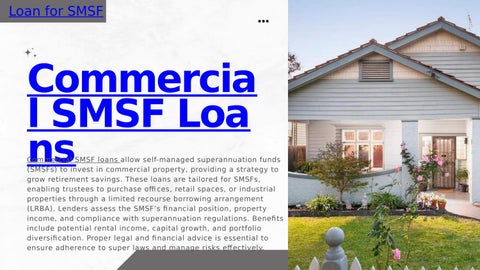

Commercia l SMSF Loa
nsCommercial SMSF loans allow self-managed superannuation funds (SMSFs) to invest in commercial property, providing a strategy to grow retirement savings. These loans are tailored for SMSFs, enabling trustees to purchase offices, retail spaces, or industrial properties through a limited recourse borrowing arrangement (LRBA). Lenders assess the SMSF’s financial position, property income, and compliance with superannuation regulations. Benefits include potential rental income, capital growth, and portfolio diversification. Proper legal and financial advice is essential to ensure adherence to super laws and manage risks effectively.


Loan for SMSF
SMSF Loan Requireme nts
To qualify for an SMSF loan, the self-managed super fund must be properly established and fully compliant with superannuation laws. The fund’s trust deed must specifically allow property investments. Borrowing must be structured as a Limited Recourse BorrowingArrangement (LRBA), meaning the lender’s recourse is limited to the property purchased. Trustees need to demonstrate the SMSF’s financial capacity to service the loan, typically through existing contributions, savings, or projected rental income. Lenders often require a minimum deposit, detailed cash flow forecasts, and a clear investment strategy showing how the property fits the fund’s long-term objectives. Evidence of property valuation, legal compliance, and adherence to super regulations is essential. Professional legal, financial, and accounting advice is strongly recommended to ensure the loan is structured correctly and risks are managed effectively. This careful preparation helps protect both the SMSF and its members while allowing the fund to grow through strategic property investment.

SMSF L oan Intere st Rates
SMSF loan interest rates are the rates charged on loans taken out by self-managed super funds to invest in property. These rates are typically higher than standard residential mortgages because SMSF loans are considered higher risk by lenders. Rates depend on the loan type, property type (commercial or residential), deposit size, and the SMSF’s financial position. They can be fixed, variable, or a combination, with variable rates offering flexibility and fixed rates providing repayment certainty. Lenders also consider fees, loan term, and the fund’s compliance with superannuation rules. Regular comparison and professional advice are essential to ensure the rate is competitive and the loan remains sustainable within the SMSF’s investment strategy.

SMSF Ho me L oan Rates Loan for SMSF
SMSF home loan rates are generally higher than standard home loan rates due to the additional risk, strict compliance requirements, and limited lender options involved in SMSF lending. Rates can vary depending on the lender, whether the property is residential or commercial, the loan-to-value ratio (LVR), and the overall strength of the SMSF, including rental income and fund balance. Most SMSF loans are offered under Limited Recourse Borrowing Arrangements (LRBA), which also impacts pricing. While rates may be higher, SMSF loans provide the opportunity to grow retirement wealth through property investment within a compliant superannuation structure. Comparing specialist lenders is key to securing a competitive SMSF loan


SMSF Commerci al P roperty Loan
An SMSF Commercial Property Loan allows a self-managed super fund to purchase business real estate such as offices, warehouses, factories, or retail premises under a Limited Recourse Borrowing Arrangement (LRBA). This type of loan is popular with business owners, as the SMSF can lease the property to a related business at market rates, helping convert rent payments into long-term retirement savings. SMSF commercial loans typically require higher deposits, lower loan-to-value ratios, and come with higher interest rates compared to standard loans due to compliance and lender risk. Rental income and super contributions are used to service the loan, while strict ATO and superannuation rules ensure the investment remains compliant and focused on long-term growth.
Key Features of an SMSF Loan Loan for SMS

Limited Recourse Borrowing
Arrangement
Higher Deposit Requirements
1
All SMSF loans operate under a Limited Recourse Borrowing
Arrangement. This means if the SMSF defaults on the loan, the lender can only recover the asset purchased with the loan and has no claim over other SMSF assets. This structure protects the fund but increases lender risk, which is reflected in stricter lending criteria.
Single Acquirable Asset Rule
SMSF loans can only be used to purchase a single acquirable asset, such as one residential property or one commercial property. Improvements that change the character of the asset are not permitted during the loan term, ensuring compliance with superannuation regulations.
SMSF loans generally require larger deposits compared to standard home loans. Loan-to-value ratios (LVRs) are typically capped at lower levels, with residential properties often requiring at least 30–40% deposit and commercial properties requiring more.
SMSF-Specific Ownership Structure
The property is held in a separate bare trust until the loan is fully repaid. The SMSF is the beneficial owner, while the trustee of the bare trust holds legal ownership. Once the loan is cleared, the property title is transferred to the SMSF.
Loan for SMS F Why Choose US

SMSF Loan
AccessSpecialists to Specialist
End-to-EndLenders Support Compliance-First TailoredApproachSMSF CompetitiveSolutionsRates & PropertyTerms ClearExpertise & Honest Advice Time-Saving Process

u
Loan for SMSF
Our Services
01. 03. 04. 02.
SMSF Loan
Structuring
We help structure your SMSF loan correctly to meet superannuation and ATO requirements. Finance solutions for buying residential or commercial property through your SMSF. Review and refinance existing SMSF loans to secure better rates or terms. Fast pre-approval to help you understand borrowing capacity before purchasing.
Loan for SMS
Conclusion
In conclusion, loans for SMSFs provide a powerful strategy for selfmanaged super funds to invest in property and grow retirement savings. By using a Limited Recourse Borrowing Arrangement (LRBA), trustees can access funds to purchase residential or commercial property while limiting the lender’s recourse to the specific asset. However, SMSF loans are complex and require strict adherence to superannuation laws, including having a compliant trust deed, a documented investment strategy, and evidence of the fund’s ability to service the loan. Trustees should carefully consider the risks, including interest rate fluctuations, property market changes, and compliance obligations. Professional advice from financial planners, accountants, and legal experts is essential to ensure the loan is structured correctly, meets regulatory requirements, and aligns with the fund’s long-term retirement goals. With thorough planning, due diligence, and ongoing management, an SMSF loan can be an effective tool to build wealth, generate rental income, and diversify investments, providing a strong foundation for a secure retirement.