
LNC Motto
Together we learn, lead and serve
The curriculum at LNC strives to meet the individual student’s needs by providing a balanced, diversified program of studies.
Each year during the spring, students are given course information to help them select classes for the next year.
LNC adheres to and enhances the North Carolina required curriculum referred to as the North Carolina Standard Course of Study.
provide us the opportunity to educate the whole child.
LNC is also committed to the personal leadership development of its students and staff.
Leadership in Action, which is rooted in personal integrity and core values, provides a strong foundation for responsible citizenship and service to the community.
LNC Mission Statement
“Lake Norman Charter School provides a rigorous and comprehensive educational environment to develop students with a focus on college readiness, leadership, and social responsibility”
In addition to the required core classes, students are offered a balanced array of electives that
Core and elective classes are designed to help students become independent lifelong learners with well-developed critical thinking skills and strong moral character.
At Lake Norman Charter, the student body, parents, community, and staff cultivate a unique culture of partnership, trust, safety and pride. Together, we are LNC.
LNC provides and supports a challenging academic curriculum, empowering each student to realize her or his full academic potential.
LNC delivers a comprehensive educational environment, enabling personal growth through participation in extra-curricular activities, athletics, community service and LNC’s Leadership in Action Program.

LNC believes in the importance of global diversity and inclusivity, celebrating and embracing both what we have in common as well as what makes each of us unique.
LNC reveres honor, high expectations and responsible citizenship.
The Language Arts curriculum challenges students to improve all areas of communication. Employing the North Carolina Standard Course of Study, classes are designed to expand students’ understanding of grammar, literature, the writing process, and vocabulary development.
Students spiral outward from informal, personal reflection to a formal, societal critical stance. Student skills are enhanced through engagement in small group work, Socratic Seminar, technology, research, public speaking and presentation, individual accountability, peer editing, and analytical problem solving.

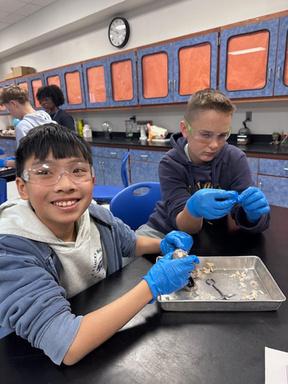
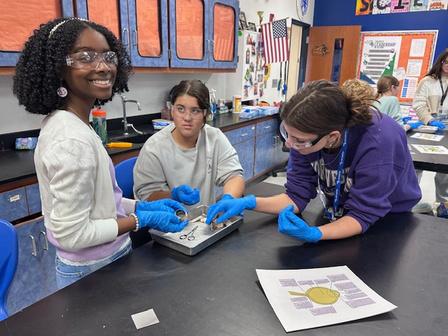
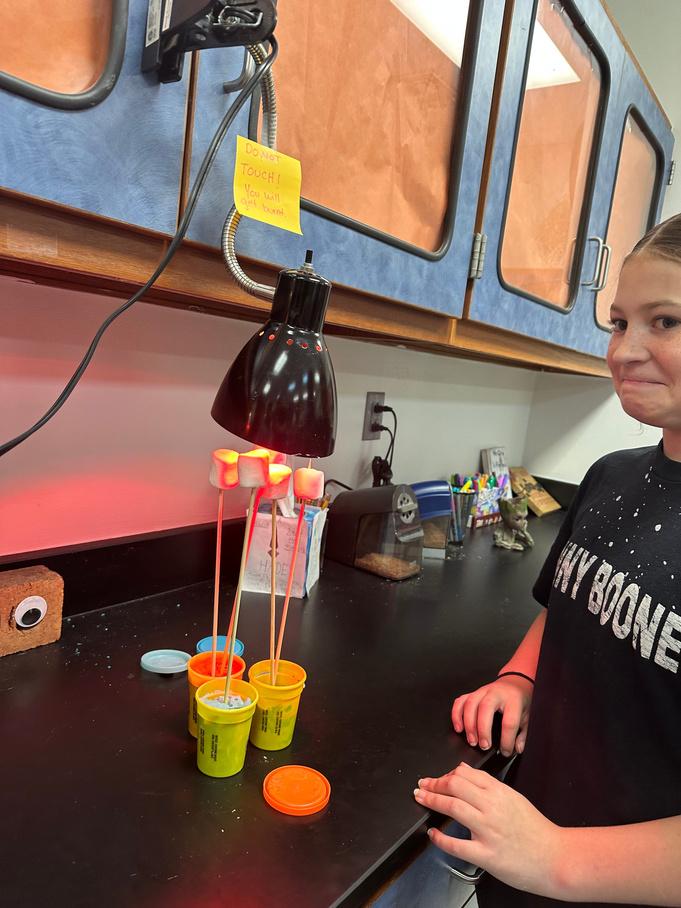
At LNC, the Science Department uses the North Carolina Standard Course of Study as the framework for our curriculum. In all grades, students are encouraged to ask questions and seek answers using scientific processes and the scientific method. There is an emphasis on students not only knowing the grade level material, but being able to design and conduct inquiries. Our goal is to not simply have students that are experts in the content area, but who are curious about the world around them.
SPECIFIC COURSES:
5th Grade
5th Grade ELA
6th Grade
6th Grade ELA
7th Grade
7th Grade ELA
Advanced ELA*
8th Grade
8th Grade ELA
Advanced ELA*
*Placement with appropriate test scores.
Students are taught to ask scientific and testable questions, formulate hypotheses based on research and past knowledge, as well as collect and analyze data. Finally, they must use critical thinking to propose explanations and to identify relationships among events in the physical world. Stewardship and global awareness are also emphasized to help students see how each standard in the curriculum is important even outside of school.

The LNC Mathematics Department meets each student at the ability level where they are and challenges them to achieve yearly growth. It also supports the recognition and talent development of gifted math students. In addition to identifying different learning styles, we teach with variety and encourage open-ended methods of problem solving and critical thinking. Using technology when and where appropriate for every ability level, we will engage practical, real-life and hands-on application of skills utilizing our community as role models for our students.

SPECIFIC COURSES:
5th Grade
5th Grade Mathematics
6th Grade 6th Grade Mathematics
Advanced Mathematics
7th Grade
7th Grade Mathematics
Pre-Math 1*
Math 1*
8th Grade
8th Grade Mathematics (Pre-Math 1)
Math 1*
Math 2*
*Placement with appropriate test scores
Credit by Demonstrated Mastery (CDM) is the process by which a student may earn credit for a high school course by demonstrating a deep understanding of the content without course enrollment or seat time. CDM was designed to respond to the needs of students, families, AIG community, school personnel and leadership. CDM specifically offers North Carolina students the opportunity to personalize and accelerate their learning, thus allowing for optimal student growth while providing an opportunity to have effective seat time to learn new content.
Because Lake Norman Charter Middle School offers an accelerated track in Math, we will only offer CDM for Math 2. To be considered for a CMD in Math 2, a student must be currently enrolled in Math 1 at LNC Middle School, have a 95 or higher average for the first semester in Math 1, and score a 290 or higher on the Fall or Winter MAP test of the current year.
Students shall demonstrate mastery through a multiphase assessment, consisting of:
Phase 1: A standard examination, which shall be the EOC/EOG where applicable, or a final exam developed locally; and
Phase 2: An artifact which requires the student to apply knowledge and skills relevant to the content standards. (This artifact will be completed over several sessions during Knight Time).
While the CDM process is open to all students, it not designed for whole groups of students. Likewise, it is not intended to replace the general accelerated pathways local school districts often provide for advanced students.
“I recognize that attending LNC is a privilege, and as a member of this community, I pledge to uphold and promote the pillars of honesty, integrity, respect, and responsibility as outlined in the LNC Honor Code.”
The LNC Social Studies Department stresses the interdependence of North Carolina with the United States and the world. All of the classes follow the North Carolina Standard Course of Study for Social Studies and the corresponding skill competency goals.
Continuing the history, geography, civics and government, economics and culture strands from previous grades, fifth grade expectations will address change and continuity in United States history. Students begin the study of United States history with American Indian groups indigenous to the United States before the arrival of European settlers and conclude with the Civil War and Reconstruction period.
Students in sixth grade will continue to expand the knowledge, skills and understandings acquired in the fourth and fifth grade studies of North Carolina and the United States by connecting those studies to their first formal look at a study of the world. Sixth graders will focus heavily on the discipline of geography by using the themes of location, place, movement, humanenvironment interaction and region to understand the emergence, expansion and decline of civilizations and societies from the beginning of human existence to the Age of Exploration. Students will take a systematic look at the history and culture of various world regions including the development of economic, political and social systems through the lens of change and continuity.
As students examine the various factors that shaped the development of civilizations, societies and regions in the ancient world, they will examine both similarities and differences between these areas. A conscious effort should be made to
integrate various civilizations, societies and regions from every continent (Africa, Asia, Europe and the Americas). During this study, students will learn to recognize and interpret the “lessons of history;” those transferable understandings that are supported throughout time by recurring themes and issues.
Students in seventh grade will continue to expand upon the knowledge, skills and understanding acquired in the sixth grade examination of early civilizations. Seventh graders study the world from the Age of Exploration to contemporary times in order to understand the implications of increased global interactions. The focus will remain on the discipline of geography by using the themes of location, place, movement, human-environmental interaction and region to understand modern societies and regions. This course will guide students through patterns of change and continuity with a focus on conflict and cooperation, economic development, population shifts, political thought and organization, cultural values and beliefs and the impact of environment over time.

Through an investigation of the various factors that shaped the development of societies and regions in the modern world and global interactions, students will examine both similarities and differences. A conscious effort should be made to include an integrated study of various societies and regions from every continent (Africa, Asia, Europe, the Americas and Australia).
Students in eighth grade will continue to build on the fourth and fifth grade introductions to North Carolina and the United States by embarking on a more rigorous study of the historical foundations and democratic principles that continue to shape our state and nation. Students will begin with a review of the major ideas and events preceding the foundation of North Carolina and the United States. The main focus of the course will be the critical events, personalities, issues, and developments in the state and nation from the Revolutionary Era to contemporary times. Inherent in this study is an analysis of the relationship of geography, events and people to the political, economic, technological and cultural developments that shaped our existence in North Carolina and the United States over time. Although the major focus is state and national history, efforts should also be made to include a study of local history.
The LNC Art Program is both sequential and cumulative. Although experience at the earlier grade levels is not essential for success, each course expands on the key concepts from the prior year. The students’ age and experience are considered in the development of lessons and activities. Students are encouraged to push their artistic and creative skills to produce their personal best.
TheArtcurriculumisfocusedon fourcurriculumgoals:
Criticalandcreativethinking skillsforunderstanding, producingandevaluatingart
Mediaapplicationskills
Elementsandprinciplesof design
Connectionsbetweenartand oursurroundingworldaswell asindividuality,historical referencesandother curriculumareas
Chorus is designed for students in grades 5, 6, 7 and 8 who enjoy singing and performing with a group.The curriculum builds sequentially on musical concepts while focusing on the application of good vocal technique and part-singing (posture, breath control, intonation, range, diction, resonance, and blend). Middle school Chorus classes provide the foundation for the Vocal Music program at the high school level.
SPECIFICCOURSES:
Chorus5
Quarter-long
Chorus6
Semester-long
Chorus7**
SPECIFIC COURSES:
Art 5, 6
Quarter-long
Art 7 and 8
Semester-long
Art Major
(Visual Arts: Beginning)
This is a year-long course for 8th grade students only and will count as a pre requisite for Art 2 (Visual Arts: Intermediate) at the high school. Art Major is designed as a survey of art fundamentals, including emphasis on the basic elements and principles of design, composition, art history, and the connections of art to the core curriculum.

Semester-long(StudentscanselectChorusfor2semesters)
Chorus8**
Semester-long(StudentscanselectChorusfor2semesters)
ChorusYearLong(Major)**+
Thisisayear-longcoursefor8thgradestudentsonly.ChorusMajorwillbethe flagshipperformancechoiroftheLNCMiddleSchoolChoralArtsDepartment. Thesestudentswillperformaroundthecommunityandwillhavefirstpriorityfor anyoff-campusperformanceexperiences.Becausethisisadistinguished ensemble,thesestudentswillbeheldtoahigherstandardofaccountabilityand performance.StudentswillberequiredtoauditiontoparticipateinChorusMajor.
**feerequired
+teacherrecommendationrequired
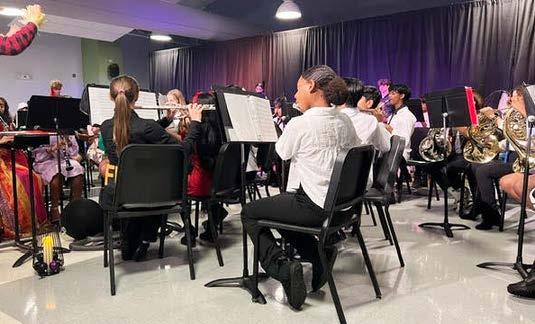
The processes of learning, creating, and understanding music are the primary goals of the music program. Students develop aesthetic awareness and learn to evaluate and validate their work and the choices they make. Students also look outside themselves, discovering and demonstrating respect for the efforts and work of others.
Students will learn to recognize inter-relationships and differences between music and other arts areas as well as areas outside the arts.
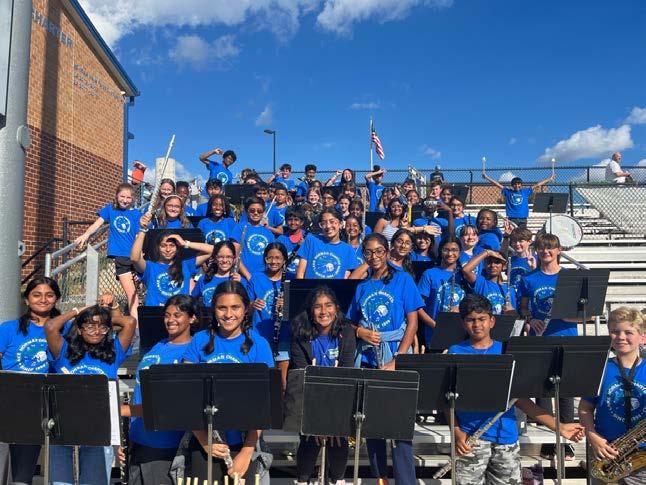
The study of band music is cumulative and sequential to include learning from previous grade levels.
**fee required
The focus areas for learning at this level include:
Demonstrating appropriate expressive and technical vocal and instrumental practices
Demonstrating pitch and rhythmic accuracy
Reading and notating rhythmic and melodic patterns
Identifying and applying traditional symbols and terms and using appropriate terminology
Improvising, composing and arranging music
Listening to, analyzing and evaluating music
Developing understanding of music in relation to history, culture and other content areas
SPECIFIC COURSES:
5th Grade
Beginning Band (Year-long)
6th Grade* Band (Year-long)
7th Grade* Band (Year-long)
8th Grade* Band (Year-long)
*6th, 7th, and 8th grade Band require successful completion of the prior year band
TheLNCprograminsecondlanguagestudiesisdesignedtoafford studentstheopportunitytodevelopcommunicativecompetencein anotherlanguageandincreaseculturalunderstanding.
Thecurriculumisorganizedintosevenoverarchinggoalsthathave beenadaptedfromtheStandardsforForeignLanguageLearning: Preparingforthe21stCentury.Ateachlevelofinstruction,students willbeabletodemonstrateincreasedproficiencyinthefollowing areas:
InterpersonalCommunication
InterpretiveCommunication
PresentationCommunication
Cultures
Comparisons
Connections
Communities
The 5th and 6th Grade French program at LNC is designed for students who are beginning the study of the language and for those who have had minimal exposure to French in earlier grades. The program is an introduction to both the language and its culture. The emphasis is on building a strong foundation through listening and speaking activities.
The 7th grade semester-long elective is designed to help prepare students for further language in 8th grade or high school. Upon successful completion of the year-long course in 8th grade, a student may receive high school credit for French I.
French
5th Grade
Elementary French (Quarterlong)
6th Grade
Introduction to French (Semester-long)
7th Grade
Beginning French (Semesterlong)
8th Grade
French I* (Year-long) (HS credit)
*Prerequisite:
Beginning French 7th grade

While Spanish is not an available elective at the middle school level, students still have the opportunity to complete Spanish 1 and 2 when they are at the HS.
The purpose of the LNC physical education program is to promote behaviors that contribute to a healthful lifestyle and improved quality of life for all students.
Current research studies indicate that healthy, active students have fewer absences, fewer discipline problems, and perform better academically.
LNC encourages all students to study significant health issues and participate in daily physical
The early teen years are a crucial period for shaping attitudes and behaviors.
The health curriculum at LNC is designed to help each student develop health-promoting behaviors.
Throughout the course, students will investigate stress management, protecting self and others, relationships, nutrition/weight management, substance abuse, personal fitness, healthful lifestyles, appreciation for diversity, social wellness, fitness and sports literacy. General information on family living, ethical behavior, and human sexuality (FLEBHS) will also be addressed.
activitythroughouttheirschool experienceincludingthe developmentof:
Motorskills
Excellenthealthsense
Responsiblepersonaland socialbehaviorsinphysical activitysettings
Anunderstandingofand respectfordifferences amongpeopleinphysical activitysettings.
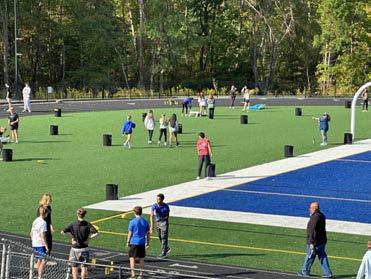
Physical Education
5th, 6th, 7th, 8th Grade Quarter-longclasses
TheNationalHealthEducation Standardswerecreatedwiththe goalofimprovingeducational achievementforstudentsand improvinghealthintheUnited Statesthroughthepromotionof healthliteracy.
Thesevenhealthstandardsareas follows:
Healthpromotionanddisease prevention
Accessvalidhealth information
Practicehealthenhancing behaviors
Analyzetheinfluenceof culture,mediaandtechnology onhealth
Useinterpersonal communicationskillsto enhancehealth
Use goal-setting to enhance health
Ability to advocate for personal, family, and community health
Health
5th, 6th, 7th , 8th Grade Quarter-long classes
The state of North Carolina passed legislation in 2023 requiring all public high school students complete a Computer Science course to graduate. This legislative update aims to bridge the modern skills gap, providing our students with the essential coding and problem-solving tools required for 21st-century careers.
Beginning with the 2026-2027 school year, middle school students will use Minecraft to learn how to design algorithms and write simple programs. In 6th and 7th grades, they will explore how programming steps work together, practice debugging to fix mistakes, and build problem-solving skills. Students will also learn how these skills connect to careers in computer science and technology.
Beginning in the 2027-2028 school year, 7th grade students will use block-based coding and
MakeCode in Minecraft to create programs that solve problems. They will learn how to use variables, logic, and loops while building and testing their own code. Students will also explore how these coding skills connect to careers in digital technology and computer science.
In 8th grade students will explore the basics of data science by learning how to organize, analyze, and visualize data. They will use different technology tools to create charts and graphs, work with simple databases, and solve real-world data questions.
Additionally, students will discover how data science skills connect to future careers in technology. Upon successful completion of this course, students will receive a high school credit, satisfying the Computer Science graduation requirement.
SPECIFIC COURSES:
Elementary STEM 5th (Quarter-long)
Coding in Minecraft-Introductory 6th grade (Semester-long)
Coding in Minecraft-Introductory 7th grade (Semester-long)
Coding in Minecraft-Intermediate (2027-2028) 7th grade (Semester-long)*
Introduction to Data Science 8th grade (Year-long) (HS credit)
*Prerequisite Coding in Minecraft-Introductory

Technology provides an excellent platform where students can collect information in multiple formats and then organize, link and discover relationships among facts and events.
Having an array of tools for acquiring information and for thinking expression provides increased opportunities for students to learn and live productive lives in the global, digital and information-based future.
LNC keyboarding and computer technology skills curriculum is designed to form the foundation
The media assistant elective is a semester long elective for which rising sixth, seventh, and eighth grade students can apply. Applications are due in May for spaces the following year. Spaces are limited, and students will be chosen on the basis of their application, staff recommendations, understanding of the position, and familiarity with the media center.
Media assistants must be responsible, independent, organized people who have a passion for reading and helping others. Responsibilities include
for continuous learning and to be applicable to ever-changing innovations in technology.
In Exploring Business Procedures and Leadership, 8th grade students are introduced to a variety of business procedures and basics of leadership. Students learn lifelong career success-building skills like business etiquette, ethics and how to seek, gain, and maintain employment. Students also learn leadership skills including communication, team building, collaboration, and other desirable traits.
promoting literature and information resources, including the creation of themed displays, bulletin boards, digital book-trailers and book-talks, digital citizenship content, booklists, makerspace and broadcasting room.
Students assist at the circulation desk, keep the shelves organized, clean when needed, and help out with daily tasks and projects in the media center.
As a media assistant, students not only earn school credit, but they develop communication and leadership skills as well as
SPECIFIC COURSES:
Keyboarding I and II
5th & 6th grades (Quarter-long)
Computer Applications I 7th grade (Quarter-long)
Computer Applications II 8th grade (Quarter-long)
Exploring Business Procedures and Leadership 8th grade (Quarter-long)

organizational, interpersonal and other skills to add to their resume for jobs and colleges. Applications will be available in Schoology group MS Student News during MS course registration.
SPECIFIC COURSES:
Media Assistant 6 6th grade (Semester-long)
Media Assistant 7
7th grade (Semester-long)
Media Assistant 8
8th grade (Semester-long)
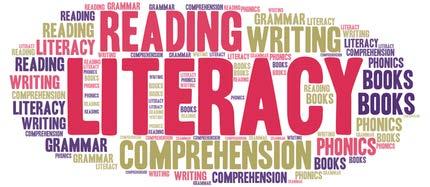
The Essential Literacy elective is an opportunity for reading growth for middle school students at Lake Norman Charter. Core ELA teachers recommend students who demonstrate a need in comprehension, fluency, vocabulary acquisition or even basic phonics and word recognition instruction.The elective course is structured for class sizes no larger than 15 to ensure a more individual approach to guided reading. During the course, students will be reintroduced to reading concepts to rebuild solid understanding and shore up any possible gaps in phonics, fluency and comprehension.
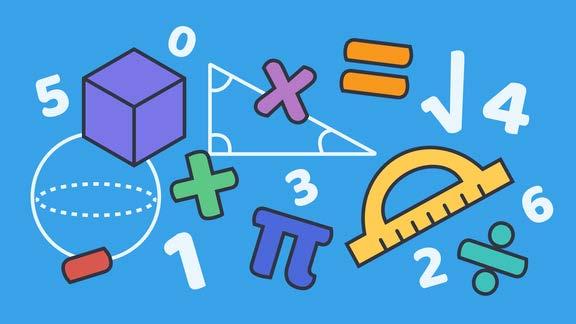
The Essential Math elective is designed to help students create paths to support confident, self-directed learners. During the course, students will be reintroduced to mathematical concepts in an effort to build a solid understanding and shore up any knowledge gaps. Students will receive small-group lessons to re-teach critical math concepts as well as have unique assignments that will cater to their specific needs.
In addition to improving foundational skills, students in Essential Math will receive a weekly sneak peek into a concept their classroom teachers will soon be introducing. This pre-teaching will introduce vocabulary and create a foundation from which the new skill can be built. The course will address student needs with positive reinforcement as well as with specific strategies students can take back into their math classroom, thereby creating confident mathematical thinkers.