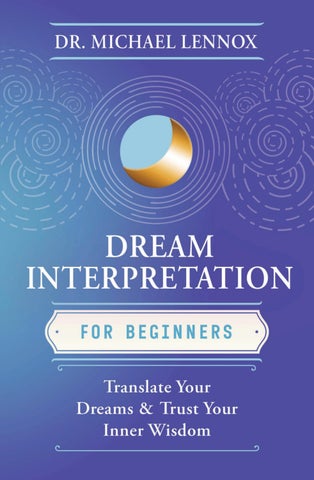
DREAM INTERPRETATION FOR BEGINNERS
s
ig n
es
©
is lar So
D
About the Author Dr. Michael Lennox (Los Angeles, CA) is a psychologist, astrologer, and expert in dreams and dream interpretation. He has appeared on SyFy, MTV, NBC, and countless radio shows and podcasts, and has published articles in Today’s Woman, TV Guide, Star, The Independent, the Daily Mail, and many other magazines. He teaches classes in self-investigation to a worldwide audience and can be found on social media and in his weekly podcast, Conscious Embodiment: Dreaming with Dr. Michael Lennox. Visit www.michaellennox.com.
DREAM INTERPRETATION FOR BEGINNERS Translate Your Dreams & Trust Your Inner Wisdom
DR. MICHAEL LENNOX
Dream Interpretation for Beginners: Translate Your Dreams & Trust Your Inner Wisdom Copyright © 2026 by Dr. Michael Lennox. All rights reserved. No part of this book may be used or reproduced in any manner whatsoever, including internet usage, without written permission from Llewellyn Worldwide Ltd., except in the case of brief quotations embodied in critical articles and reviews. No part of this book may be used or reproduced in any manner for the purpose of training artificial intelligence technologies or systems. First Edition First Printing, 2026 Book design based on a design by Rordan Brasington Cover design by Shira Atakpu Llewellyn Publications is a registered trademark of Llewellyn Worldwide Ltd. Library of Congress Cataloging-in-Publication Data Names: Lennox, Michael, author Title: Dream interpretation for beginners : translate your dreams & trust your inner wisdom / by Dr. Michael Lennox. Description: First edition. | Woodbury, Minnesota : Llewellyn Worldwide, [2026] | Includes bibliographical references. | Summary: “Decode your dreams and learn to trust your inner wisdom with this rich and empowering introduction to dream interpretation. Dr. Michael Lennox teaches you how to remember your dreams more fully, decipher the meaning of people and places in your dreams, and ease stress.”—Provided by publisher. Identifiers: LCCN 2026037311 (print) | LCCN 2026037312 (ebook) | ISBN 9780738784434 trade paperback | ISBN 9780738784489 ebook Subjects: LCSH: Dream interpretation | Dreams Classification: LCC BF1091 .L5259 2026 (print) | LCC BF1091 (ebook) LC record available at https://lccn.loc.gov/2026037311 LC ebook record available at https://lccn.loc.gov/2026037312 Llewellyn Worldwide Ltd. does not participate in, endorse, or have any authority or responsibility concerning private business transactions between our authors and the public. All mail addressed to the author is forwarded but the publisher cannot, unless specifically instructed by the author, give out an address or phone number. Any internet references contained in this work are current at publication time, but the publisher cannot guarantee that a specific location will continue to be maintained. Please refer to the publisher’s website for links to authors’ websites and other sources. Llewellyn Publications A Division of Llewellyn Worldwide Ltd. 2143 Wooddale Drive Woodbury, MN 55125-2989 www.llewellyn.com Printed in the United States of America GPSR Representation: UPI-2M PLUS d.o.o., Medulićeva 20, 10000 Zagreb, Croatia matt.parsons@upi2mbooks.hr
Other Books by Dr. Michael Lennox Psychic Dreamer (Llewellyn, 2024) Llewellyn’s Little Book of Dreams (Llewellyn, 2017) Llewellyn’s Complete Dictionary of Dreams (Llewellyn, 2015) Dream Sight (Llewellyn, 2011)
There aren’t enough words to describe the value of working with my dreams to know myself more deeply and move toward integration. I stepped onto this path when I was sixteen, and it has led me here. If you have ever woken up and said, “Wow, I had a crazy dream last night,” this book is dedicated to you.
Contents Introduction Chapter 1: Why Dreams Matter
7
Chapter 2: Preparing to Dream
15
Chapter 3: Types of Dreams
1
35
Chapter 4: Tools for Dream Interpretation Chapter 5: Interpreting Your Dreams Chapter 6: Wrapping It Up
77
115
169
Chapter 7: Dream Circles: Sharing Dreams with Community 173 Acknowledgments
183
Recommended Reading Bibliography
187
185
Introduction
Dreams are universal. We all have them, even if we don’t regularly remember them. And the fact that so many of us are all dreaming about the same images points to the existence of something we call the collective unconscious. This is a realm of intelligence we all share that connects us to a pool of unconscious symbolism and imagery that is pure human. There are no borders in dreamland, nor are there any political divides. We are connected more than we are separate, and nowhere is that more apparent than in the world of dreams, where we as individuals are tapping into the same potential that unites us at the deepest level of our shared humanity. Dreams are also deeply personal. They happen inside of us. As messages from the unconscious, they reflect aspects of our waking life, offering wisdom that comes from within. The unconscious mind really is unconscious, but it holds so much information that can offer tremendous value if we have the capacity to understand it. Dreams open the door between our conscious awareness and our unconscious mind that can’t be accessed in any other way. Learning how to interpret your dreams can change your life. 1
2
Introduction
I still remember the first dream I ever had. I was about three years old, and I woke up from a dream that was not exactly a nightmare but it was a little terrifying. In the dream, I was in this strange landscape, not anywhere organic or natural. I had this profound awareness of multiple levels. I was in one plane of existence, and above me there were incomprehensible shapes that were more enormous than I could conceive. I had the sense of the tiniest particles that were so small, I could not see them, but I knew they were there. Now, of course, I can’t recall how I might have spoken about this dream at age three, but I can tell you that as someone who has devoted their entire life to the interpretation of dreams, I did eventually hear this very same dream described by plenty of other dreamers. Long before I encountered other people who’d had this same dream, I understood it first from the perspective of these three levels. When I grew old enough to recognize things like the concept of infinity, the impossible smallness of molecules, and the enormity of our solar system, I noticed there was something similar to them all. The shape we use to represent a molecule looks just like the structure of our galaxy. Now, I thought I was special and this dream was unique. But it turns out, this is a universal dream. While it’s not as ordinary and frequent as dreams about flying or the zombie apocalypse, I have connected with many dreamers who have had similar dreams of three levels of awareness just like mine, and have found that many of them had it when they were very young as well. My journey as an interpreter of dreams began as a child, where I was captivated by these magnificent nighttime storylines. Life was more challenging for me than for many of my peers, and it was my imagination and creativity that got me through a difficult childhood. Remembering and talking about my dreams was a big
Introduction 3
part of that experience. When I was in high school, I began asking my friends to share their dreams with me and then offering a response in turn. Immediately I was met with fascination and wide-eyed curiosity, as people would validate my interpretations as, at the very least, interesting and somehow germane to their experience. As someone who craved attention, this very quickly turned into something I offered everywhere I went. By the time I was in my mid-twenties, I had become known in the various offices I was temping in as the “dream guy,” and I was often called by friends of my coworkers to interpret dreams they were having. When I reached my forties, I had become a psychologist and gained some larger recognition by being on a television show about dream interpretation. The show didn’t last very long before it was canceled, but it solidified the notion that I could devote my life to the service of dreams. I have been delighted to teach people what dreams are and how to work with them to have a richer experience of self-investigation. Dreams reveal so much about what is going on in the mysterious realms below consciousness. Working with them opens an ongoing conversation with your unconscious mind, a process that is both revealing and beneficial, and in my view one of the yummiest experiences you can have in life. Paying attention to your dreams can be mind-expanding in so many ways. For one thing, they are about the most fun you can have while still staying asleep. They are so wild and dynamic, they captivate us like no other personal human experience can. Sharing them with others fosters connection and community. Because they happen inside of us, they are intimate and therefore precious to share. Doing so draws people together, as folks tend to be pretty fascinated by not only their own dreams but also the dreams of others.
4
Introduction
When it comes to going deeper, to really working with your dreams and learning how to interpret them, it can start to feel complicated. You might feel like you have to know exactly how to interpret a dream before even attempting to do so, fearing there is a right way and you might be incorrect in how you are doing it. But that’s not true. Dreams are entirely personal, and just having them and being aware of them is like tending to the most powerful relationship you will ever have. That is the relationship you have with yourself. I wrote this book because I have such a passion for dreams and know how valuable they can be when we relate to them directly. I myself have benefited from a lifetime of using dreams for context and guidance, and I’ve witnessed countless clients and students develop deep insight and self-awareness just from paying attention to them with more focus and intention. In these pages, I will introduce you to different ways of working with dreams, including interpreting symbols and examining recurring themes, and will show you how creative exercises can take your dream experience to a whole new level. What you will not find here is not based on superstition or being too reliant on rigid interpretations in dream dictionaries (though I myself have written one). This is about learning to trust your own inner wisdom and building a relationship with the unconscious mind in a way that only dreaming can generate. I will teach you how to recall your dreams more fully and introduce you to different ways of working with them, from starting a dream journal to methods of bringing your creative impulses into the process. You will learn some basics of dream interpretation, such as the connection between dreams of water and emotional material from your waking life. I will help you understand how to consider every person in your dreams as a reflection of you.
Introduction 5
Dreams are one of the most reliable inner guides we have for navigating life. My hope is that this book will give you the courage to trust your dreams and, through them, to trust yourself. I invite you to bring your curiosity, your openness, and your willingness to explore. Let this book be your inspiration to add dreams to your journey, allowing them to illuminate the mysterious terrain of your inner world. Whether you’re brand-new to dreamwork or have been keeping a dream journal for years, my wish is that you will find inspiration here to deepen the dialogue with your unconscious, discover hidden wisdom, and embrace the powerful guidance that your dreams are always offering. Have at it!
CHAPTER 1
Why Dreams Matter
The first question I am always asked about dreams is what they are and why we have them. Dreams are universal. Everyone has them, even if we don’t remember them. We suspect that our animal companions dream as well. Anyone who has watched a dog twitching and running in their sleep knows exactly what I mean. Dreams are powerful, mysterious, and deeply felt, and while science has many theories, the truth is we don’t actually know why they happen. And yet, most people sense there is something meaningful going on in them. Dreams have fascinated humans for as long as we have been telling stories. They feel important. They stir emotion, memory, and imagination in ways that waking life often does not. Some people dismiss them as random brain noise, but those who pay attention know better. A dream not explored is like receiving a message about your deepest feelings and ignoring it. When you turn toward your dreams and ask, “What do you have to show me?,” they offer insight, emotional clarity, creative inspiration, and sometimes a deeper spiritual connection to life itself.
7
8
Chapter 1
Humans have been gathering to share their dreams since the earliest days of community. Imagine a small group of people sitting around a fire thousands of years ago. There is no television, no internet, no distractions, just stories. Someone begins talking about a dream in which their grandmother, who recently died, came to visit them in the night. Across the fire, another voice says, “She visited me too.” In that moment, the dreamworld becomes a shared place, a realm where the dead still seem present, where meaning moves beyond the individual. This may have been the beginning of the idea that there is a deeper layer of human experience we all participate in, what we would later come to call the collective unconscious. In early civilizations, people believed dreams were messages from the divine. The dreamer was thought to leave the body at night and travel to another realm where dreams took place. Good dreams were seen as blessings and bad dreams as attacks from dark forces. These beliefs appeared across cultures and shaped mythology, religion, and spiritual life for thousands of years. Even today, many religious traditions treat dreams as sacred experiences and sources of guidance. The biggest shift in how we understand dreams came in the nineteenth century when psychology moved them from the realm of religion into the realm of the mind. In his book The Interpretation of Dreams, Sigmund Freud famously called dreams the “royal road” to the unconscious, but he believed nearly everything in them stemmed from sexual desire. His student Carl Jung disagreed. Jung saw dreams as expressions of something much larger, shaped by emotion, myth, and deep human patterns shared by all people. Their break changed the direction of dream study and opened the door to understanding dreams as meaningful messages from within.
Why Dreams Matter 9
Jung noticed that his patients, regardless of background, were having the same kinds of dreams: falling, flying, being chased, losing their teeth. When he later spent time with tribal communities in Africa, he was astonished to find they were having the very same dreams, though with different details. This led him to the idea that there is a shared layer of human experience beneath culture and upbringing, a universal inner landscape that shapes our dreams. Many people worry when their dreams are strange, dark, or disturbing. I want to be clear about this: There is no wrong way to dream. Scary dreams do not mean that there is something wrong with you or something bad is going to happen. Dreams always work in service of growth. They are trying to show you something, not hurt you. You may not remember your dreams easily at first. That’s normal. Dream recall is a skill, and it can be learned. As you begin to pay attention, you will start to notice connections between your waking life and your dream life. Symbols will become familiar. Patterns will emerge. What once felt random will begin to make sense. By learning the language of dreams, you begin to eavesdrop on a conversation that has been happening inside you since you were born. Over time, you become an active participant in that dialogue. You learn how to listen. You learn how to respond. And eventually you learn how to work with your dreams as powerful allies in your personal growth. At the end of the day, what matters most is not settling the debate over where dreams come from but how they can serve you. Whether they arise from brain chemistry, deep psychology, or spiritual realms, your dreams are a doorway to your inner life. They are guides, mirrors, and sometimes tricksters but always messengers with something to say. By choosing to listen, you
10
Chapter 1
step into an ancient human practice and begin a journey that will deepen your relationship with yourself in ways that are both practical and mysterious. Another significant thing about dreams is how they connect us as individuals to the collective unconscious through the principle of universality. Something is universal when people recognize it everywhere, no matter where they live or what language they speak. It’s a shared human experience that shows up again and again. Jung described an archetype as a pattern built into the human psyche, what he called “a tendency to form such representations of a motif—representations that can vary a great deal in detail without losing their basic pattern.” 1 Think of archetypes as deep templates in the mind that show up in myths, art, and dreams no matter what culture you come from. Jung also said that archetypes are “the psychic residua of innumerable experiences of the same type,” 2 meaning they are formed out of the shared experiences of humanity across time. In simple terms, archetypes are the universal images and storylines we all recognize because they live in us before we even encounter them. In some ways, universal meaning comes out of agreement. This will be important to understand as we take this universal sensibility and turn it toward the interpretation of dreams. If I held up a glass, the kind typically used to drink water, there are very few people on earth who would not immediately know what it is. We would all be in agreement that it is definitely a glass and just that. For this example, there are no other details to color what we might think about this glass, such as if it is half-filled with water or half-empty. Just the glass. Now we explore the use of this glass, its 1. Jung, “Approaching the Unconscious,” 67. 2. Jung, “On the Relation of Analytical Psychology to Poetry,” para. 127.
Why Dreams Matter 11
essence, if you will. Not only can it contain something, but it does this so that what is being held can be consumed. If we add to our interpretation the layer of the water in the glass, which is the substance needed for life to exist, then this glass of water takes on the universal symbolic meaning of “that which I use to draw life force to me.” If the story of a dream features a glass that breaks, we get to add to our interpretation the nuance of the dreamer’s difficulty to do the same. So an image that might be confused with clumsiness is imbued with this meaning of sustenance, and the capacity to receive and contain it. Or consider the symbolic meaning of a pen (which is easily recognizable as a writing implement) as reflecting the dreamer’s desire or capacity to express themselves. The ink in the pen adds the distinction of permanence, as a dream of a pencil would imply the impermanence associated with using an eraser. Let’s do one more symbol so you get the hang of it. This example will be easier or harder for people based on their brain. For some, it may take some thinking for the essential meaning of the symbol to land, while others might connect more directly with it because of how their mind works. While how you identify with any storyline or image in a dream and what you personally associate with it is absolutely a crucial part of working with your dreams, it is this ability to consider universal meaning that will take your experience of dream interpretation to a whole other level. A washing machine in the real world is a human-made mechanism that cleans our clothing. We all know what it does, so its use is obvious. But in dreams, we have to look past the practical function to deepen the meaning. Dirty clothes can connect to the impact of how we show up in the world every day, the layers of our persona. The ability to wash our clothes is symbolic of freshness, renewal, and taking responsibility for how we present ourselves. That’s its
12
Chapter 1
essence. The washing machine in dreams reflects our capacity to release the wear and tear of being in the world. And if the machine is broken, overflowing, or brand-new and gleaming, then our interpretation would carry this symbolism (or something similar) into that moment of the dream story. The dream state is where we have the most direct access to our personal unconscious mind that is built into our body. But there is another space below that is called the collective unconscious, a realm of intelligence that we share with all humans. This is why we all have so many of the same dreams. Similar to Jung’s discovery that people in Africa were having the same dreams as his patients in Switzerland, the details of the dreams might differ but the universal themes are exactly the same. This realm we share is where archetypes “live,” if you will. When you step into the world of learning how to interpret your dreams, it is important to respect this potential of the dreamworld to connect you to a realm of consciousness that is not your own. When you can connect with grace to the innate wisdom in your dreamwork, you gain a greater ability to trust the invisible aspects of your waking life, such as intuition and other subtle energies. Think of a dream as a story, one told in the language of symbols. Interpreting a dream is like telling a story about the story, where the new version consists of stringing together the universal meanings of each of the symbols that help the story unfold. The unconscious has no language; that is a construct of the waking mind. The material that comes from and through the unconscious mind has tremendous intelligence, but it can only be expressed in symbols. Here is a simple dream as an example. You dream of walking on a path in nature by yourself. In the middle of the path you come
Why Dreams Matter 13
upon a large snake, which coils up like it is about to strike. You lunge toward it with an attacking gesture and then wake up. The three main images in this dream are the path in the woods, the dangerous snake in your path, and your attempts to confront the snake out of fear and a sense of danger. Walking alone on a path is a very intimate trek, and it suggests that the dreamer is focused on their personal journey alone, without consideration for any conflicts with the outside world. Snakes are symbols of change and transformation, reflected by the process of shedding an old skin while the new skin is already underneath. The dreamer is investigating where their journey is taking them in terms of their personal life, private considerations, and solo path at the time of the dream. A symbol of disruptive change appears and stops the dreamer in their path, forcing them to make a choice of how to respond. For our dreamer, snakes are scary and so is change, so they lunge aggressively at the snake, reflecting their fearful reaction to sudden change, and then they wake. Armed with this universal information, our dreamer can make a connection between this dream they had and the life events that might have inspired it. Suddenly, an upsetting dream about a dangerous snake becomes an invitation to consider what actual changes in their life might be troubling them. Additionally, this dream asks the dreamer to look at their attitude toward change, because the dream suggests they have more fear than faith at this moment. Let’s look at an example that’s a little more complex. You dream you’re in a crowded train station trying to catch a train. You’re carrying a heavy suitcase but realize you’ve forgotten your ticket. You search your pockets frantically as the train arrives. The doors open, but before you can board, the train pulls away and you’re left standing on the platform, suitcase in hand. This is a standard stress
14
Chapter 1
dream a person might have when they are feeling overwhelmed with life, and it arrives to help them process that stress in order to wake up the next day ready to face life all over again. The images in this dream that tell the story are a train as transportation, a crowded train station, a heavy suitcase, a missing ticket, and the train leaving without you. The story starts with movement through life. In our first example, the path in nature implies an intimate walk with the private self. Then each successive faster mode of transportation describes the quality of the transformation taking place. Trains are fast but are still grounded, and since this is a mode of transportation that is shared with others, the dream is reflecting public life, not a private space. The crowd in the train station represents lots of thoughtforms in the dreamer’s mind, so perhaps anxiety or overthinking is being reflected. Baggage is a well-known stand-in for the things we have to carry, like responsibilities and burdens from the past. The missing ticket is also a fairly standard symbol. It may be reflecting the anxiety of feeling unprepared for the unstable experience of change, feelings of unworthiness, or the sense that life is moving ahead while you feel stuck. As you can see, learning to recognize universal meanings gives you a powerful entry point into the dreamworld. By looking past the literal object and finding its essence, you can begin to tell the story about the story—the deeper narrative your unconscious is offering you. Symbols such as water, pens, washing machines, snakes, and trains all reveal universal layers of meaning that connect your personal dream life to the collective unconscious we all share.
Body, Mind & Spirit / Dreams
YOUR DREAMS HAVE BEEN TALKING TO YOU. ARE YOU LISTENING? Every night, your unconscious mind speaks through images, emotions, people, and places. Learning to understand this symbolic language can help you see your waking life in a new way and discover the wisdom already within you. Psychologist and professional dream interpreter Dr. Michael Lennox draws on more than 20 years of experience to show you how dreamwork can ease stress, deepen your relationships, and help you make peace with nightmares. Using this warm, practical guide, you’ll learn how to remember your dreams more fully, recognize recurring symbols and archetypes, and explore the personal meaning of the people and places in your dreams. Rather than memorizing a dream dictionary, you’ll learn to trust your own associations and intuition. Come curious, come open, and discover what your dreams are waiting to tell you.
DR. MICHAEL LENNOX is a psychologist, astrologer, and expert in dreams and dream interpretation. He has appeared on SyFy, MTV, NBC, and countless radio shows and podcasts. Dr. Lennox has published articles in Today’s Woman, TV Guide, Star, Daily Mail, The Independent, and many other magazines. He teaches classes in self-investigation to a worldwide audience and hosts the weekly podcast Conscious Embodiment: Dreaming with Dr. Michael Lennox. He is also the author of Psychic Dreamer, Llewellyn’s Complete Dictionary of Dreams, and Llewellyn’s Little Book of Dreams. Visit him at MichaelLennox.com. Facebook.com/LlewellynBooks X: @LlewellynBooks Instagram: @LlewellynBooks
www.Llewellyn.com
$15.99 US