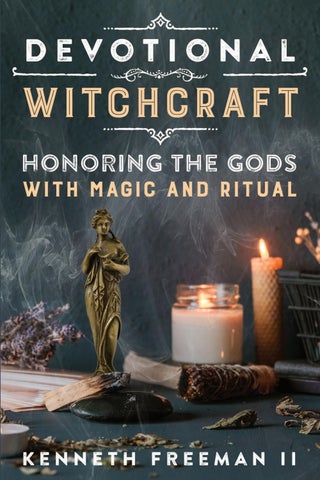
Praise for Devotional Witchcraft “Devotional Witchcraft is not for people who want spiritual ‘vibes.’ It’s for people who want relationship, real devotion, real power, and real transformation. This book invites you to step beyond trendy witchcraft and into sacred reciprocity— where you’re not just requesting blessings, you’re showing up with integrity, consistency, and respect.”
—Gina Spriggs, author of The Intuitive Tarot Workbook, writer for Enchanted Living Magazine, and co-owner of the shop Curio, Craft & Conjure “In Devotional Witchcraft, practitioners of all backgrounds are invited to move beyond the superficial and feel empowered to transform their practice into a genuine act of devotion. This manuscript serves as an essential compass for these uncertain times, offering a much-needed challenge to the modern trend of spiritual ‘syncretism’ by grounding magic in cultural responsibility, historical context, and disciplined study.”
—Elhoim Leafar, author of Manifestation Magic and Dream Witchery “Kenneth Freeman’s work grants readers freedom to explore while demanding painstaking knowledge. It centers the conversation on the necessary dichotomy between blind devotion and a commitment rooted in compassion and critical analysis. This supportive book reminds us that devotional witchcraft requires personal sincerity and patience as we embrace the challenging, transformative process of growth.”
—Mawiyah Kai EL-Jamah Bomani, author of Hoodoo Saints and Root Warriors “A gorgeous book that offers a clear and concise description of how hard polytheists look at and practice modern witchcraft within a devotional context. Kenneth Freeman paints a beautiful picture of how relationships with the gods and other spirits enhance our lives and unfold through devotional relationships. This book lays out how profound devotional relationships can be, with step-bystep instructions for building and maintaining them.”
—Phoenix LeFae, author of Spirit Magic and Witches, Heretics, and Warrior Women
“Devotional spirituality is one of the most ancient and fruitful spiritual paths found throughout the world. If you’ve never tasted its nectar or crave a deeper relationship with the gods you already revere, I encourage you to read this magnificent offering from Kenneth Freeman. … He guides seekers into the priceless treasure of an intimate, everyday, and culturally respectful relationship with the gods.”
—Durgadas Allon Duriel, author of The Little Work “Devotional Witchcraft is not a beginner’s aesthetic guide or a collection of borrowed rituals—it is a theology of relationship. Kenneth Freeman writes with clarity, courage, and deep reverence. … What makes this work so powerful is its balance: mysticism grounded in ethics, gnosis held alongside discernment, devotion braided with sovereignty.”
—Dave Gaddy, the Weathered Wiseman, author of The Simple Magick of Wild Things “A rare book written from the heart. Each page of this book shines with sincerity as Kenneth Freeman shows that relationship and connection are the foundation of a successful witchcraft practice. Thanks to Freeman’s wisdom, Devotional Witchcraft is an essential read for anyone who wants to build a witchcraft practice that feels deep, meaningful, and more fulfilling than spellcasting alone.”
—Jack Chanek, author of Tarot for the Magically Inclined “Devotional Witchcraft is a powerful reminder that the gods haven’t gone anywhere. They are still out there and patiently waiting for us to love them.”
—Blake Malliway, author of A Witch’s Guide to Fetch Work A much-needed beacon of queer and BIPOC representation in devotional deity work. As a native Greek priestess, I value his thoughtful attention to the land and culture from which each deity originates. With inclusivity, cultural awareness, and discernment, Freeman presents a hard polytheist approach that recognizes the gods as distinct, dynamic presences without prescribing a single path. Instead, he empowers readers to follow the relationships they are genuinely called toward and build respectful devotional practices of their own.
—Elyse Welles, author of Sacred Wild
© Rochelle J. Photography
About the Author Dr. Kenneth “KC” Freeman II is a social worker, educator, researcher, and lifelong devotee of the Gods. He holds bachelor’s and master’s degrees in Social Work from North Carolina Central University and a doctorate of Social Work from Tulane University. Professionally his work focuses on mental health, community empowerment, cultural humility, and the intersection of spirituality and human well-being. As a practicing polytheist and initiate within the Minoan Brotherhood tradition, KC’s spiritual path is rooted in devotional practice, ancestor reverence, spirit relationships, and the cultivation of meaningful relationships with the Divine. His work seeks to bridge the gap between scholarship and spirituality, encouraging practitioners to approach their religious lives with both critical thought and heartfelt devotion. Through his writing, teaching, and community leadership, KC is passionate about creating spaces where people can engage the sacred with authenticity, reverence, and purpose. Devotional Witchcraft is his first book. He resides in North Carolina with a life filled with gods, spirits, community, and an ever-growing collection of books.
Devotional Witchcraft: Honoring the Gods with Magic and Ritual Copyright © 2026 by Kenneth Freeman II. All rights reserved. No part of this book may be used or reproduced in any manner whatsoever, including internet usage, without written permission from Llewellyn Worldwide Ltd., except in the case of brief quotations embodied in critical articles and reviews. No part of this book may be used or reproduced in any manner for the purpose of training artificial intelligence technologies or systems. First Edition First Printing, 2026 Book design by Rordan Brasington Cover design by Kevin R. Brown Editing by Sophia Kurtz Interior illustrations by Llewellyn Art Department Llewellyn Publications is a registered trademark of Llewellyn Worldwide Ltd. Library of Congress Cataloging-in-Publication Data (Pending) ISBN: 978-0-7387-8368-0 Llewellyn Worldwide Ltd. does not participate in, endorse, or have any authority or responsibility concerning private business transactions between our authors and the public. All mail addressed to the author is forwarded but the publisher cannot, unless specifically instructed by the author, give out an address or phone number. Any internet references contained in this work are current at publication time, but the publisher cannot guarantee that a specific location will continue to be maintained. Please refer to the publisher’s website for links to authors’ websites and other sources. Llewellyn Publications A Division of Llewellyn Worldwide Ltd. 2143 Wooddale Drive Woodbury, MN 55125-2989 www.llewellyn.com Printed in the United States of America GPSR Representation: UPI-2M PLUS d.o.o., Medulićeva 20, 10000 Zagreb, Croatia matt.parsons@upi2mbooks.hr
To the gods, spirits, and ancestors who have walked beside me through every season of my life, thank you. Thank you for your guidance, your protection, your correction, and your unwavering presence. This book exists because you called, and because I finally learned to listen. Most especially, I dedicate this work to Hera, Queen, Sovereign, and Keeper of Oaths, who lifted my head when I could not do it myself, who taught me the sacredness of dignity, and who reminded me time and again that my worth was never something that needed to be earned. To my tribe, the family I spent years praying for before I ever knew your names. Your love, support, laughter, wisdom, and presence have been a panacea to the weight of the world more times than I can count. Zaren, Angel, Martel, and Kristen, thank you for holding space for me, believing in me, and loving me through every triumph and every storm. To Leonidas and Korax, my Minos and his husband, thank you for gifts that words cannot adequately express. Thank you for your guidance, your example, your patience, your friendship, and for helping me become more fully myself. The impact you have had on my life lives far beyond anything that can be captured on a page. And finally, to every Black gay boy who sees magick in every flower, every star, every song, every spirit, and every sacred thing except himself: This book is for you. I know what it is to search for divinity everywhere while struggling to recognize it within. I want you to know that I see you. Your ancestors see you. The spirits see you. The gods see you. You have never been forgotten, and you have never been alone. There is wonder in you. There is power in you. There is holiness in you. May you come to know that truth for yourself. This book is dedicated to you all, with gratitude, devotion, and love.
Contents Exercise List … xi Foreword … xiii Introduction … 1
Section I: Foundations of Devotion Chapter 1: The Gods Are Real: A Hard Polytheist View … 5 Chapter 2: Symbiosis and Sovereignty … 15 Chapter 3: Knowing Through Gnosis … 29 Chapter 4: Deities in Devotional Witchcraft … 39
Section II: Living Devotion Chapter 5: Cultivating Relationship with Deity … 55 Chapter 6: Running From or Running Toward … 71 Chapter 7: Sacred Time, Sacred Space … 85 Chapter 8: Devotion as Craft … 93
Section III: Devotion Within Culture Chapter 9: Cultural Context and Respectful Practice … 109 Chapter 10: Ancestors, Spirits, and the Liminal … 125
Section IV: Devotion in Action Chapter 11: Devotional Community and Leadership … 145 Chapter 12: Crafting a Living Practice … 163 Chapter 13: Bridging the Sacred and the Clinical … 173 Chapter 14: Living Legacy … 179 Conclusion … 187 Recommended Reading … 193 Bibliography … 197
Exercises Guided Reflection: Sovereignty Check-In … 22 Devotional Meditation: Rooted in Relationship, Anchored in Self … 24 Ritual: The Remembering and the Welcome … 47 Daily Devotional: Rhythm … 63 Exercise: Weekly Anchor Practices … 68 Journaling Exercise: Remembering Your Spiritual Roots … 73 Group Devotional Exercise: Call and Response Invocation … 78 Exercise: Create Your Own Devotional Oil … 80 Journaling: From Flight to Faith … 82 Sacred Pause: A Devotional Moment in the Middle of Chaos … 90 Exercise: Crafting a Modern Prayer-Spell … 94 Devotional Spell: Abundance with Tyche … 97 Exercise: Devotional Ethics Checklist … 120 Ritual: For the Known Dead: Honoring the Names … 128 Ritual: For the Unknown Dead: Calling the Forgotten Home … 131 Journaling: Mapping My Devotional Lineage … 156 Ritual: Tending the Flame, Planting the Future … 183
xi
Foreword
Some books teach techniques. Some offer systems or step-by-step instructions meant to polish the practitioner into something flawless and impressive. And then, very rarely, a book arrives that feels less like instruction and more like invitation. A book that meets you at the heart and quietly says to come closer. Devotional Witchcraft is that kind of book. When we first came to know Kenneth Freeman, known to us as KC, we did not yet realize how deeply his path would shape our own. We did not know that he would be a friend, confidant, priest, and spiritual kindred. What began as latenight conversations, shared rituals, and collaborative work in Grove and community slowly revealed something unmistakable about him: His devotion is not theoretical. It is lived, embodied, and daily. The gods are not distant metaphors in his world. They are present, relational, and deserving of the whole heart. This book grows directly from that life. KC writes not from abstraction but from experience as a hard polytheist, a devoted practitioner, and a Black gay man navigating spiritual spaces that have not always made room for the fullness of who he is. From that lived truth emerges a voice that is warm, grounded, and fiercely honest. He does not promise perfection or spiritual elitism. Instead, he offers something far more difficult and far more sacred: relationship. In a culture that often treats spirituality as aesthetic, performance, or commodity, Devotional Witchcraft is a grounding shake-up. It reminds us that Witchcraft is not something we master. It is something that forms us. Devotion is not just about beautiful altars but about integrity, consistency, and presence. Never spectacle, it is reciprocity. Through these pages, the divine is encountered as living presence. Deities such as Osun, Hera, Eos, Asteria, and Seshat are approached not as symbols or xiii
xiv
Foreword
archetypes, but as beings who call us into accountability, sovereignty, and care. KC never shies away from the harder truths: Devotion disrupts and demands discernment. It asks for cultural respect, ethical responsibility, and the courage to repair lineages and honor ancestors with sincerity rather than appropriation. We have witnessed these principles firsthand. Whether walking the same Grove and Tradition, collaborating in sacred work, or co-hosting conversations that bridge the sacred and the clinical, we have seen how consistency and reverence transform a solitary practice into a living relationship. We have watched KC wrestle honestly with questions of ancestry, identity, and service as he built priesthood not from performance but from presence. For both of us, this book has become companion and catalyst. It has encouraged ancestral repair, reclamation of silenced traditions, and the courage to craft practices that are both rooted and wholly our own. It offers a framework anchored in the twin pillars of Symbiosis and Sovereignty: We exist in mutual relationship with the divine yet remain autonomous agents responsible for how we show up in the world. Devotion is measured by the integrity of follow-through with the beauty of the ritual the icing on the cake. What makes this book extraordinary is that it mirrors KC himself. It is unpretentious, compassionate, and transformative. It cuts through the noise of performative spirituality and returns us to something older and truer. It reminds us that Witchcraft is holy collaboration. If you are new to devotional practice, let this be your gentle entry point. If you are seasoned, let it broaden your listening. And wherever you stand, may these pages encourage you to become what this path ultimately asks of all of us: a living altar. As KC so beautifully writes, you were never meant to stay at the altar. You were meant to become one. We are honored to walk this path alongside him, and now, alongside you. May the gods meet you here, and may your devotion grow roots, breath, and life of its own. With deep respect and enduring admiration, Zaren Allen Angel Fisher High Priests of the Minoan Brotherhood and cohost of Roots and Realms Podcast
Introduction
I did not come to Witchcraft looking for power; I came looking for connection. What I found was something deeper, more intricate, and infinitely more intimate: relationship. Devotional Witchcraft, as I have come to know it, is not a practice rooted solely in spellcasting or aesthetics, nor is it an open buffet of spiritual modalities to pick and choose from based on mood. It is a sacred, reciprocal relationship, a dynamic of reverence, trust, and cocreation between practitioner and the divine. This book is a love letter to that relationship, a map drawn from both mystical experience and disciplined study. In some ways, it is also a challenge to the current climate of spiritual syncretism that often lacks cultural grounding, historical context, and spiritual responsibility. Devotional Witchcraft asks us to slow down, sit at the feet of our gods, and listen not just to the myths and the mysteries but to the living breath of our ancestors, the rhythm of our spirits, and the truths that emerge when gnosis is tempered by practice and humility. I write this from the lens of a hard polytheist, someone who believes the gods are not merely symbolic representations or facets of a single divine source, but real, individual entities. For me, the gods are not metaphors. They are not psychological archetypes or aspects of a singular universal force. They are distinct, sentient, sacred beings with agency, history, and power. And they are worthy of our reverence. But devotion is not one size fits all. My journey, like many others, has been winding. As a Black gay man raised on the fringe of both church and culture, I know what it means to hunger for spiritual belonging while carrying the fear of further rejection. I’ve walked into rooms where my skin or my sexuality made me 1
2
Introduction
an outsider. I’ve stepped into temples built on the bones of stolen belief systems. And I’ve found, again and again, that the gods still call, especially the ones I had been taught to fear or forget. In recent years, my own path has led me into an intimate relationship with deities across traditions. Osun, whose laughter and lamentation echo through my bloodline. Eos, who emerged in radiant tenderness at the threshold of personal rebirth. Hera, whose regality and uncompromising dignity remind me of the power in sacred boundaries. Asteria, quiet and starlit, who watches over the mystery of dreams and divination. Seshat, architect of knowledge and records, whose presence affirms the structure of spiritual practice. These are more than just archetypes— they are beings with whom I share breath, dreams, offerings, and trust. Devotional Witchcraft, then, is the weaving of lived truth, ancestral reverence, divine relationship, and magical discipline. It is deeply personal, yet not without accountability. It is rooted in cultural specificity and spiritual sovereignty. It asks you to know your gods, your spirits, and your people, and to walk with them in integrity. This book is here to offer a framework, a mirror, and perhaps a touchstone, never to convert anyone. Whether you are new to the path or deep into your practice, I hope you find in these pages a reaffirmation of sacred reciprocity. I pray you are challenged to deepen not just your spellwork but your listening. And I trust that you are inspired to build not just altars but relationships. Welcome to Devotional Witchcraft. May your journey be guided, your devotion be rooted, and your magic be holy.
Section I
Foundations of Devotion
Chapter One
The Gods Are Real: A Hard Polytheist View
To practice Devotional Witchcraft is to begin with the assumption that the gods are real. Not metaphorically “real,” not fragments of our psyche projected into cosmic symbols, and not ancient stories meant to inspire moral clarity. Real. Present. Individual. Divine beings with identities, wills, desires, and histories of their own. Gods who existed long before our births and who will continue to exist long after our names are forgotten by this world. This chapter guides you through the foundational beliefs of Devotional Witchcraft by introducing the concept of hard polytheism. You’ll learn how this framework differs from symbolic or archetypal views of deity and why treating gods as distinct, sentient beings changes everything about how we engage in sacred relationship. We will explore what it means to see the gods as real; as active forces with agency, power, and personality; and why this understanding is central to the devotional path outlined in this book. To be a hard polytheist is to say “these gods are not extensions of me—they are in relationship with me.” It is a theological stance just as much as it is a devotional one. It is the choice to engage the divine as subject, not as symbol. And yet this stance places one at odds with much of contemporary spiritual discourse. In modern esoteric spaces is a strong pull toward what I call the Great Homogenizing. The divine is often reduced to One Source, One Energy, One Unified Field. There is an insistence that all gods are facets of the same diamond or faces of the One. While these perspectives may offer comfort to some, they are theologically incompatible with the lived experiences of many polytheists, especially those of us whose gods come from colonized cultures or marginalized histories.
5
6
Chapter One
To say Osun and Aphrodite are really the same goddess is not a bridge, it is a blurring. To say that Hera is simply another name for the divine feminine is not honoring, it is effacement. These are not different moods of the same force. They are beings in their own right, shaped by cosmologies, cultural contexts, and divine agendas that are not interchangeable.
Multiplicity as Sacred Truth Hard polytheism embraces multiplicity not as a problem to solve but as a sacred truth to be honored. In a culture that often prizes simplicity, singularity, and synthesis, this path says: What if the many is holy too? What if complexity is not a sign of confusion but a sign of life? Multiplicity allows us to understand that spiritual reality is not a singular monolith but a vibrant, layered ecosystem. To be a hard polytheist is to affirm that Osun of the African Diasporic traditions of Ifá and Lucumi, is not the Roman Venus, that Brigid of the Celtic pantheon is not the Kemetic Isis, and that Sumerian Astarte is not Inanna of the Phoenicians; even if all rule over love, creation, or magic in their respective cultures. Each deity is rooted in a unique cosmology and carries a story embedded in a people, a language, and a land. These stories, customs, and rituals are not easily collapsed into one another, and doing so strips them of their depth and dignity. Multiplicity demands that we resist the urge to universalize and instead develop the humility to learn. The sacredness of multiplicity is not just theological, it’s ethical. It reminds us that honoring the gods means honoring their distinctions. Just as we wouldn’t assume all cultures or people are interchangeable, neither should we assume the same about deities. Multiplicity teaches us to show up with care, ask questions, do our research, and make space for difference without defensiveness. In practice, this means being specific in our devotions. We don’t simply say “to the goddess”— we say to whom, in what way, and why. We learn the colors, prayers, songs, and days sacred to the gods we serve. We don’t treat them like abstract energies; we learn to greet them by name. And in doing so, our devotional work becomes rooted, relational, and real.
Mythology as Sacred Language Mythology is one of the first doorways through which many seekers approach deity. It offers us names, stories, and patterns to how the divine has been known
The Gods Are Real: A Hard Polytheist View
7
and understood across time. For the hard polytheist, mythology is not just folklore or metaphor, it is sacred language. It carries memory, identity, and a sense of continuity with those who walked the path before us. However, mythology is never neutral. Every myth is shaped by the cultural, political, and historical moment in which it was written. Greek myths, for example, reflect a patriarchal society where the older goddesses were often rewritten as jealous, vengeful, or vain.1 African cosmologies, when translated through colonial lenses, were stripped of nuance and made to sound primitive or superstitious.2 This doesn’t mean mythology should be discarded, but it does mean it must be read with care. Sacred stories are important because they teach us how a deity was revered, feared, or misunderstood. They can tell us what offerings were made, what lessons were passed down, and what mysteries are still hidden. But stories are not static. They evolve. They are rewritten. They are reclaimed. And so our job as devotees is not just to recite myths but to wrestle with them, to sit with them, and to ask what they still have to teach. For example, knowing the stories of Osun’s descent into the river, her refusal to be disrespected, and her role in creation gives us insight into how to approach her. But that myth alone is not enough. It’s the starting point, not the endpoint. Without critical context and lived relationship, myth becomes a script rather than a conversation. The goal is not just to know the stories but to live in such a way that we become part of them.
Relationship as Devotional Core Ultimately, relationship is the beating heart of Devotional Witchcraft. If multiplicity gives us context and mythology gives us language, then relationship gives us life. Relationship is not something we assume or demand, it is something we build over time with sincerity, patience, and love. It is where reverence becomes reality. 1. “ Hera’s Jealousy: A Feminist Analysis of the Queen of Gods,” GreekMythsGreekMythology.com, accessed March 10, 2025, https://www.greekmyths-greekmythology .com/hera-jealousy-feminist-analysis/. 2. Takudzwa Hillary Chiwanza,“Was Religion a Tool for Colonialism in Africa?” Africa Rebirth, January 10, 2022, https://www.africarebirth.com/was-religion-a-tool-for-colonialism -in-africa/.
8
Chapter One
My first experience with Osun did not come from a book. It came through presence, a honeyed warmth that showed up uninvited but deeply welcome, in the quiet moments when my spirit was unraveling. I didn’t know her name. I didn’t know her color or her story. I only knew that something golden and alive was near me, comforting and radiant, like light on water. Later, when I began reading about the orishas and studying African traditional religions, I recognized her. It was like recognizing someone I’d met in a dream, but even that recognition was not relationship. That took time. Offerings. Songs. Silence. Study. Messy attempts and moments of clarity. All of it mattered. All of it helped me become known to her, not just someone who knows her name. Relationship is not something you build through a checklist; it’s a living, breathing process. It involves trust, reciprocity, and consistency. You show up. You listen. You learn. You apologize when you get it wrong and celebrate when the connection deepens. And through that, the divine moves from being an idea in your head to a presence in your life. That is what makes devotion sacred. That is what makes it whole.
Gods Who Choose One of the most humbling lessons in Devotional Witchcraft is this: While you may feel drawn to a particular deity, it is not always your choice to claim them. The gods choose you. This can be a difficult truth to accept in a modern spiritual landscape where deity relationships are often framed like marketplace transactions, selectable and customizable in a consumer-driven approach. But the reality of sacred relationship is not transactional. It is reciprocal, mysterious, and sometimes unpredictable. Yes, you can seek out the gods. You can petition, pray, light candles, and offer devotion in the hope of beginning a relationship. Sometimes those prayers are heard and embraced. But other times, the answer is silence or even clear refusal. Gods are not obligated to reciprocate our interest. Aesthetic attraction or spiritual curiosity does not guarantee divine engagement. Just as in any meaningful relationship, consent matters. The gods are not cosmic vending machines or energy sources we are entitled to access at will. They are sovereign beings, and they get to choose. And sometimes they choose you. Not because you asked or were ready, but because they see something in you—something that needs shaping, honing, or remembering. A god may arrive uninvited, stirring your dreams,
The Gods Are Real: A Hard Polytheist View
9
pressing into your intuition, or showing up in your rituals. Their arrival may feel like blessing or disruption. They may ask for changes you did not think you were capable of making. They may call you toward truths you have been avoiding. But here is the important part: You can say no. Just as they are not obligated to claim you, you are not bound to follow. Free will remains intact. However, if the presence of a god continues to stir your spirit, challenge your patterns, or ignite your devotion despite discomfort, it may be worth sitting with the possibility that this connection is not accidental. Spiritual refinement is not always gentle. The gods may not be concerned with your comfort, but that does not mean they are cruel. They come to initiate, to unmask, and to reorient. They arrive not to dominate your life but to partner with your potential. They come when it is time to grow beyond the limits of ego, identity, or illusion. A true relationship with deity is not about control. It is not about claiming or owning. It is about recognition, reverence, and response. The gods are not tools to be wielded, brands to be worn, or archetypes to be projected upon. They are beings who are vast, ancient, and sacred. To walk with them is to walk with mystery. To serve them is to serve the truth of your own becoming.
Agency and Reciprocity When we affirm that the gods are real, we must also affirm that they have agency. They are not passive repositories of our emotional projections. They can accept or reject offerings. They can speak or remain silent. They can initiate contact or withdraw it. Their agency is part of the sacred risk of devotional work. You are not conjuring a god; you are inviting them. You are not commanding; you are communing. In that sense, devotional work is not control, it is cocreation. Every relationship with deity will look different. Some gods come with loud, unmistakable signs. Others whisper for years before revealing their names. Some demand ritual precision; others care more for the sincerity of your presence. But all relationships require reciprocity. You cannot build intimacy by only showing up when you want something. You cannot demand mystery without reverence. You cannot expect blessing while withholding yourself.
10
Chapter One
Reciprocity in Devotional Witchcraft is not only spiritual; it is behavioral. It is shown through consistent offerings, prayer, altar tending, and showing up even when life feels mundane or messy. Some modern practitioners begin each day with a spoken prayer or libation of water or coffee to their gods. Others maintain an ancestral or deity altar, ensuring it is kept clean, refreshed, and vibrant with offerings such as flowers, incense, food, or sacred symbols. Journaling your dreams and spiritual impressions, preparing meals with intention on holy days, or dedicating acts of service to your deity’s values are all forms of daily devotion. If your deity is associated with beauty, you might honor them by dressing in a way that reflects their energy, tend to your body with love, or help someone else recognize their own beauty. If they are linked to justice, perhaps you volunteer or advocate in their name for a cause that reflects them. If they are guardians of the home, then sweeping your floor and lighting a candle with intention can be a form of reverence. Keeping a garden or volunteering to plant trees honors the name of a nature god or goddess. In traditional religions such as Ifá, Vodun, Hellenism, Kemeticism, and Shinto, devotion was (and is) a communal and lifelong practice. The gods were not hypothetical. They were kin, patrons, ancestors, rulers. They had temples and feast days, liturgies and lineage priests. To return to devotion in a modern context is not mimicking the past blindly but remembering that relationship is work. Sacred work, daily work.
Personal, Not Private Devotional work is mostly personal but it is not private. Gods engage communities. They reveal themselves through art, story, ritual, and shared vision. There is power in collective worship. There is clarity in communal discernment. There is strength in knowing that others have seen the same stars you pray to; and called them by name. Devotion has been a lifeline for me. As mentioned in the introduction, I’ve often found myself at the periphery of both religious and spiritual communities. In many churches, I was only welcome if I kept parts of myself hidden. In magical spaces, I’ve encountered the hollow claim of colorblindness that too often masked cultural erasure. Yet the gods I serve—Osun, Eos, Hera, Asteria, Seshat—have never asked me to fragment myself. They have invited me to be whole. They have asked me to be present, accountable, and real.
The Gods Are Real: A Hard Polytheist View
11
One of the most transformative experiences I’ve had is with Eos, the Hellenic titan goddess of the dawn. Eos embodies to me the very essence of what the dawn represents: hope after despair, renewal after weariness, and endurance through all that would try to extinguish the light. She came to me with quiet persistence the same way light creeps back over the horizon each morning. My devotion to her began in solitude. I offered morning prayers whispered in dim light, lit candles as the sky shifted from navy to rose, and sat in silence to let her energy fill the room. She reminded me that no night, internal or external, is endless. But my devotion did not remain private. It rippled outward. My relationship with Eos deepened when I began to publicly honor her during retreats and community rituals. One moment I vividly recall was gathering with other queer practitioners during a Summer Solstice ceremony. We sang together as the first rays of light appeared, not just for the dawn but for our own resilience, our right to exist, to hope, to heal. In that moment, I was not worshiping Eos alone. I was part of a web of light-bearers, all honoring the sacred together. This is what devotional Witchcraft can offer us, personal comfort alongside shared strength. Just as worshippers of Yemaya in Brazil gather at the water’s edge to offer gifts and prayers, even though their daily practices unfold in private homes, we too are called to remember that devotion is not simply an inward act. It is a communal one.
Beginning in Truth Devotional Witchcraft must begin with the truth that the gods are real. If this truth does not live in your bones, the rest of the practice becomes hollow. Because without the reality of the gods, devotion becomes performance. Spell work becomes manipulation. And Witchcraft becomes a self-referential echo chamber. But when the gods are real, when they are beings with presence, power, and personality, everything shifts. Ritual becomes dialogue. Offerings become love. And magic becomes an act of holy collaboration. You do not have to be perfect to walk this path. You only have to be honest. And so I ask before we move forward: Are you willing to approach the gods as real? Are you willing to be changed by relationship? Are you willing to give reverence, not just request assistance?
12
Chapter One
If the answer is yes to all three questions, then you are ready. Not to master Witchcraft but to be mastered by devotion. Not to wield power but to be formed by presence. This is the beginning. The gods are real. And they are waiting.
personal Reflection: Walking with Hera When I tell people that I serve Hera, I’m often met with confusion or quiet judgment. A man devoted to the queen of Olympus? It challenges the narrow image many have of her. But the Hera I know is not the jealous wife of myth or the bitter figure of pop culture. Those are a distortion, a shadow cast by patriarchal storytelling that reduced her to Zeus’s appendage. In truth, Hera is majesty incarnate. She is sovereign not because she was wed to a king but because she is queen in her own right, before, beyond, and without any husband. She is the embodiment of sacred authority. Oathkeeper. Guardian of boundaries. The flame that sanctifies commitment. When she came to me, it was not to demand obedience but to awaken dignity. She showed me how to lift my head, claim space, and walk with presence, especially as I moved through worlds that often try to erase or reduce me. In her presence, I learned that worth is not given. It is remembered. She didn’t ask me to shrink or apologize for my fullness. She reminded me that sovereignty is not arrogance but a sacred remembering that I am mine before I am anyone else’s. Through her, I came to understand priesthood not as hierarchy but as embodiment. I honor her through how I move, how I speak truth, how I maintain my integrity even when it is costly. She holds me to my word. She holds me to myself. Hera does not tolerate half-measures. She does not whisper permission. She declares truth. And in her truth I am cherished, not merely accepted but seen and claimed. Hera is not jealous. She is not small. She is not bitter.
The Gods Are Real: A Hard Polytheist View
She is sovereign. She is oathkeeper. She is mine. And I am hers.
13
“This book invites you to step beyond trendy witchcraft and into sacred reciprocity—where you’re not just requesting blessings, you’re showing up with integrity, consistency, and respect.” —Gina Spriggs, author of The Intuitive Tarot Workbook, writer for Enchanted Living Magazine, and co-owner of the shop Curio, Craft & Conjure
Build an Intimate, Powerful, and Profound Relationship with the Gods Rooted in lived experience, cultural reverence, and hard polytheism, this book empowers you to craft a daily sacred practice that is honest, embodied, and unapologetically personal. Kenneth Freeman II challenges the modern movement of spiritual syncretism and encourages you to seek cultural grounding, historical context, and spiritual responsibility in your practice. A former Baptist, Kenneth shares his journey to becoming a hard polytheist who honors gods as living beings with agency, power, and a will of their own. He asks you to slow down, sit at the feet of your gods, and listen to the rhythms of your spirit and the truths that emerge when gnosis is tempered with informed practice and humility. “Practitioners of all backgrounds are invited to move beyond the superficial and feel empowered to transform their practice into a genuine act of devotion.” —Elhoim Leafar, author of Manifestation Magic and Dream Witchery Kenneth Freeman II is a social worker and professor. He walks a polytheistic path as a High Priest of the Minoan Brotherhood, founded Temenos Epifaneia in Raleigh, North Carolina, and is an Aborisha in the Ile Ori’lagba spiritual house under Baba Faseye Sangobukunmi. Kenneth’s passion is helping marginalized practitioners reclaim the sacred through culturally reverent devotion. Visit him at TheDevotionalWitch.com. Facebook.com/LlewellynBooks X: @LlewellynBooks © Rochelle J. Photography
Instagram: @LlewellynBooks
www.Llewellyn.com
$18.99 US
E devotional witchcraft E freeman
Body, Mind & Spirit / Witchcraft