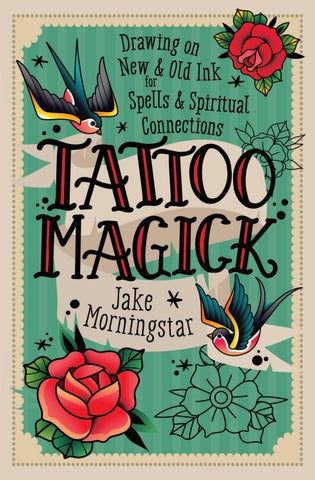
Praise for Tattoo Magick “Tattoo Magick not only explains, but also directs on constructing, empowering, energizing, and making even more sacred the very symbols we use to mark our skin.” —Elwynn the Witch, author of Between the Horns “A must have for any witchy tattoo lover!” —Mandi Em, author of Witchcraft Therapy “A powerful bridge between the culturally tied tattooing of the past and the magic of marking the flesh in the present.” —Rebecca Beyer, author of Wild Witchcraft “Tattoo Magick is pure art.” —Morgan Moss, owner of Inked Goddess Creations (IG: @inkedgoddesscreations) “A wonderful book to help everyone evolve spiritually and attain their goals.” —Lisa Stardust, author of The Astrology Deck “Jake’s book is a rarity, providing thought-provoking advice.” —Laura Tempest Zakroff, author of Sigil Witchery “A spellbinding fusion of artistry, devotion, and power.” —Michael Herkes, author of The GLAM Witch “A well-researched, well-written book.” —Melissa Cynova, author of Kitchen Table Tarot “A powerful exploration of tattooing.” —Caroline Lindskov, tattoo artist, Miss Kali Tattoos (IG: @misskalitattoos) “As someone who has used tattoos to heal by covering my body in inked prayer, I found this beautiful book incredibly inspiring.” —Damien Echols, author of Life After Death “Tattoo Magick dives deep into the sacred power of ink.” —Theresa Reed, “The Tarot Lady,” author of The Book of Astrological Returns “A must-read book for the curious, the inked, and the magically inclined.” —Richard Webster, best-selling author of over one hundred books
“Tattoo Magick brings insight through experience and thought-provoking reflections for tapping into the power and potential of the ancient and transformative art of tattooing.” —Coby Michael, author of the Poison Path series “An intriguing and in-depth look at the way that tattoos can be woven into spirituality and become more than just ink in skin.” —Morgan Daimler, author of Fairy and Pantheon: The Irish “Tattoo Magick is a long overdue gem.” —Tess Whitehurst, author of The Halloween Forever Oracle “An incredibly thorough, magickal guide.” —Nikki Wardwell Sleath, author of Dream Sorcery “A thorough and magickal exploration of tattooing from a modern witchcraft context.” —Phoenix LeFae, author of Spirit Magic “This book shows how tattoos can be empowered and activated to achieve willed purposes in ritual magic.” —Donald Tyson, author of the critically acclaimed Necronomicon series “This well-researched and clearly written book explores the profound layers of tattooing as more than decoration.” —Amy Zerner & Monte Farber, authors of The Enchanted Tarot “An insightful and practical guide to working with tattoos as vessels of intention, history, and power.” —Jen Sankey, author of Manifesting by the Moon “Jake writes with both scholarship and soul, weaving history and modern witchcraft into something deeply personal and empowering.” —Monica Crosson, author of Wild Magical Soul “A refreshing, wise, and in-depth book.” —Raven Digitalis, author of Shadow Magick Spellbook “If you want to mix magic with your ink, this is the book for you.” —Deborah Blake, author of Everyday Witch’s Book of Deities
“Tattoo Magick welcomes you to explore how tattoos can become powerful, living symbols of intention, healing, devotion, and personal transformation.” —Ethony Dawn, author of Become an Exceptional Tarot Reader “Jake walks us through the art of choosing a magical tattoo, empowering it, and using it to manifest our desires.” —Chris Allaun, author of The Queer Spirit Worker “Jake Morningstar draws upon a continuum of magical, spiritual, and devotional traditions to inspire a practice anchored in the modern day.” —Mhara Starling, author of Welsh Witchcraft “Every part of our life can be enhanced by, and serve, our magick; a truth exemplified in Tattoo Magick.” —Anthony Rella, author of Slow Magic “A unique and standout book.” —Chris Carter, magickal tattoo artist and Chaos Gnostic practitioner (IG: @cursecartertattoos) “An excellent guide to help you enhance your magick in a way you may never have considered.” —Stephanie Woodfield, author of Call of the Morrigan Oracle “Jake Morningstar shares creative and powerful ways of working with tattoos in magic.” —Durgadas Allon Duriel, author of The Little Work “A wealth of knowledge for anyone who has a tattoo or is interested in getting one.” —Astrea Taylor, author of Intuitive Witchcraft and Air Magic “A groundbreaking new approach to magick that deserves a place on every practitioner’s shelf.” —Danielle Blackwood, author of The Twelve Faces of the Goddess “For anyone trying to pin down the ‘I know this is magical but how to do it’ thought, this book is for you!” —Debra Burris, author of Weather Magic
“Morningstar provides a structured framework for intention, symbolism, and ritual.” —Natan Alexander, tattoo artist, Witch City Ink & Star and Snake (IG: @natanink) “Anyone and everyone can gain new and fantastic ideas from reading this book.” —Stacey Lynne Stewart, coauthor, Heathen Traditions of the Pennsylvania Dutch “Jake Morningstar offers thoughtful practices and rituals for working intentionally with tattoos.” —Celeste Larsen, author of Heal the Witch Wound “Original and empowering.” —Elliot Adam, best-selling author of Fearless Tarot “A FANTASTIC companion for Witches (and all magickal folk) interested in adorning their body with the art of tattoo!” —Mulysa Mayhem, magickal tattoo artist (IG: @mulysamayhem) “A fascinating exploration of the magick of tattoos.” —Cyndi Brannen, author of Keeping Her Keys “Jake Morningstar’s compelling ideas and thought-provoking concepts are presented in an approachable and comprehensive way.” —Dree Amandi Pike, author of The Art of Aromatherapy in Magick “Jake Morningstar gives us a precious gift in the form of this book.” —Priestess Stephanie Rose Bird, author of 365 Days of Hoodoo “This book is an essential addition to your library.” —Jaime Gironés, author of Llewellyn’s Little Book of the Day of the Dead “A powerful exploration of what it means to embody your spiritual practice —literally.” —Aly Kravetz, founder of BetterWitch Coaching “Bold, rebellious, and layered in artistic meaning.” —Tomás Prower, author of La Santa Muerte “Jake Morningstar shows that tattooing can be much more than just ink on skin.” —Jack Chanek, author of Tarot for the Magically Inclined
Tattoo Magick
© Jake Morningstar
About the Author Jake Morningstar, the founder and high priest of Diamond Eye coven, has been a Witch for over twenty years. A true believer in learning (eleven years!), Jake has a BS in neuroscience from Brown and a PhD in marketing from Wharton. He has taught hundreds in the mundane and esoteric arts. Visit him at @that_morningstar_ witch on Instagram.
Tattoo Magick Drawing on New and Old Ink for Spells and Spiritual Connections Jake Morningstar
Tattoo Magick: Drawing on New and Old Ink for Spells and Spiritual Connections Copyright © 2026 by Jake Morningstar. All rights reserved. No part of this book may be used or reproduced in any manner whatsoever, including internet usage, without written permission from Llewellyn Worldwide Ltd., except in the case of brief quotations embodied in critical articles and reviews. No part of this book may be used or reproduced in any manner for the purpose of training artificial intelligence technologies or systems. First Edition First Printing, 2026 Book design by Donna Burch-Brown Cover design by Shannon McKuhen Interior art by the Llewellyn Art Department Llewellyn Publications is a registered trademark of Llewellyn Worldwide Ltd. Photography is used for illustrative purposes only. The persons depicted may not endorse or represent the book’s subject. Library of Congress Cataloging-in-Publication Data Names: Morningstar, Jake author Title: Tattoo magick : drawing on new and old ink for spells and spiritual connections / by Jake Morningstar. Description: First edition. | Woodbury, MN : Llewellyn Publications, a division of Llewellyn Worldwide Ltd, 2026. | Includes bibliographical references and index. | Summary: “New, old, temporary, or still in the design phase, any tattoo can be a powerful conduit for your workings. Learn how to set up spells during your tattooing session, discover how pain can be harnessed for power, and explore what magick you can do with preexisting tattoos”— Provided by publisher. Identifiers: LCCN 2026021037 (print) | LCCN 2026021038 (ebook) | ISBN 9780738783161 trade paperback | ISBN 9780738783246 ebook Subjects: LCSH: Magic | Tattooing | Witchcraft | LCGFT: Trivia and miscellanea. Classification: LCC BF1621 .M676 2026 (print) | LCC BF1621 (ebook) LC record available at https://lccn.loc.gov/2026021037 LC ebook record available at https://lccn.loc.gov/2026021038 Llewellyn Worldwide Ltd. does not participate in, endorse, or have any authority or responsibility concerning private business transactions between our authors and the public. All mail addressed to the author is forwarded but the publisher cannot, unless specifically instructed by the author, give out an address or phone number. Any internet references contained in this work are current at publication time, but the publisher cannot guarantee that a specific location will continue to be maintained. Please refer to the publisher’s website for links to authors’ websites and other sources. Llewellyn Publications A Division of Llewellyn Worldwide Ltd. 2143 Wooddale Drive Woodbury, MN 55125-2989 www.llewellyn.com Printed in the United States of America GPSR Representation: UPI-2M PLUS d.o.o., Medulićeva 20, 10000 Zagreb, Croatia matt.parsons@upi2mbooks.hr
To Jay and Ash for their unwavering support To Elysia for taking a chance To that twelve-year-old baby Witch who would have lost his shit if he only knew
Contents Disclaimer xiii For Any Readers Who Don’t Already Have a Tattoo or Don’t Already Practice Magick xv Introduction
1
1: The Intersection of Tattoos and Spirituality
7
2: The Ways Healed Tattoos Can Be Used in Magick
19
3: Devotional Tattoos 43 4: Ancestor Work with Tattoos
63
5: Finding Your Tattoo “Aesthetic” 75 6: Designing Your Magickal Tattoo 7: Magickally Versatile Tattoos
91
113
8: The Set-Up: Finding an Artist and Timing the Tattoo 9: Making Magick in the Tattooing Session 10: The Power in Pain
147
161
11: Making a Tattoo Session Ritual
179
12: Touch-Ups, Cover-Ups, and Reversals
199
13: Magick with Temporary Body Decoration Conclusion 223 Acknowledgments 225 Glossary
227
Bibliography Index
243
233
211
127
Disclaimer Tattooing is a procedure that you elect to receive at your own risk. There are inherent risks involved, and outcomes can vary. No party associated with the writing, publishing, distribution, or sale of this book is liable for any injuries, complications, or adverse effects that may occur before, during, or after the procedure. The parties associated with the writing, publishing, distribution, and sale of this book do not endorse self-harm, unsafe practices, or illegal conduct. Readers are urged to prioritize safety at all times.
xiii
For Any Readers Who Don’t Already Have a Tattoo or Don’t Already Practice Magick Welcome! So nice to have you! I figure some of you might be interested in this book not because you practice magick but because you have tattoos and the idea of magick is intriguing. Conversely, you might be a magickal practitioner who wants to get a tattoo. Maybe you are neither! Either way, you are about to embark on one of the most fulfilling and empowering journeys of your life. If you haven’t gotten a tattoo before, I hope this book is the catalyst for you to take the plunge. Tattoos are not something to be entered into too lightly, though. They are permanent, after all. So, feel free to take all the time you need to come up with the design and find a good tattoo artist. But don’t worry: While you are working up to your first tattoo, you can read the final chapter of this book. It will give you ideas for magick you can make with temporary forms of body decoration. If one of the reasons you’ve held off on getting a tattoo is the pain, I highly recommend reading my chapter “The Power in Pain.” Hopefully it will help show you that the pain is not necessarily a bad thing; in fact it might be the coolest part of a spell you make in the tattooing session. If you haven’t practiced magick before, I should say, as a point of warning, that this is not a magick 101 book. In my mind, a good 101 book lays the foundation for you to work with a wide variety of types of magick. As versatile as the practice is that’s the subject of this book, it is only one class of magick. So, I’ve written this assuming the reader has some magickal experience. That doesn’t mean you have to set this book down, though. The glossary will help explain any of the magickal concepts you come across. But I do recommend you read a 101 book. I have several recommendations here:
xv
xvi
For Any Readers …
• Psychic Witch: A Metaphysical Guide to Meditation, Magick & Manifestation by Mat Auryn • Ritual: An Essential Grimoire by Damien Echols and Lorri Davis • The Witch’s Book of Spellcraft: A Practical Guide to Connecting with the Magick of Candles, Crystals, Plants & Herbs by Jason Mankey, Matt Cavalli, Amanda Lynn, and Ari Mankey • To Ride a Silver Broomstick: New Generation Witchcraft by Silver RavenWolf Bon voyage and blessed be!
Introduction
D
id you know about one in three people in the United States has at least one tattoo? And two out of three people with tattoos will get more than one.1 If you have a tattoo, or are even thinking of getting a tattoo, you are in good company. If you’re a magickal practitioner, you are especially in good company. Go to any Pagan gathering and you will see quite a few people with ink on their bodies. So many people get tattoos as a form of self-expression, and Witches are very self-expressive. A lot of us are creatives. A lot of us are completely unafraid of our uniqueness, and want it to be known. A lot of us discover that magick gives us the agency to be who we are in a repressive, marginalizing environment. Now that we are free, we want to share ourselves with the world. If you don’t have a tattoo but are considering one, make the decision at your own pace, but know you are surrounded by people who understand. If some people say tattoos are for freaks, we all say louder, “Let your freak flag fly!” Consider why you got that tattoo you have or why you want to get your first tattoo. Sometimes, maybe often, it’s a meaningful and personal reason. Maybe it is celebrating something you’ve done or reminding you of a habit you don’t want to do. Maybe it highlights
1. Schaeffer and Dinesh, “32% of Americans Have a Tattoo.”
1
2
Introduction
something you love about yourself or a quality you want to bring out. Maybe it is a reminder of a loved one or someone you’ve lost. What if you could tap into that meaning and enhance it? What if you could use your tattoo to achieve more of the things you celebrate or to reprogram bad habits? Use it to enhance the characteristic you love and get that quality or feeling you want more of? Use it to connect with your loved ones on a deeper level? In other words, what if you could turn that tattoo into magick? It might escape a magickal practitioner or two that tattoos have powerful parallels with magick. Personal symbols connected to powerful need—even getting something because it looked cool is fulfilling a need—is a valid description of tattoos. It also describes the props we use to focus in magick. It can also describe the object of the magick, the outcome we visualize and the object that we enchant to draw upon later. Tattoos, then, are vessels through which we can express our magickal will if we so choose. The act of tattooing is a spell waiting to be harnessed. Like most people who get tattoos, ever since I was little, I craved self-expression and self-empowerment. I wanted to be myself, to be unique, to successfully stand up to the bullies who picked on me for being different. As a gay person in the ’90s/’00s—and someone whose mental health weighed him down—this was hard. But it meant that every trial and tribulation I faced successfully, with or without magick, was something to be celebrated. One day, that took the form of a small tattoo on my hip. It was a celebration of recovering from an eating disorder and a reminder to not let it happen again. It stayed in secret while I was living with a parent who did not approve. Every time I was able to get a peek at it, though, I felt a little happier, a little more like myself. Four years later, shortly after moving out, I got my entire left chest tattooed. Fourteen triangles, each representing an event I
Introduction
3
found especially traumatic. I am of the opinion that what doesn’t kill you lands you in therapy. It does not make you stronger. But I hoped seeing what I had gone through would give me faith I could withstand future trials. So, I tattooed. To be honest, I picked triangles because out of all the markings I made on my skin with a permanent marker, they looked the coolest. No deep symbolism with that, just pure aesthetic expression. In fact, triangles do not stand for hope in any magickal system, nor do they stand for strength. Most often, triangles are in symbols for protection and banishment, and the number three in numerology typically stands for creativity and communication. What I found over time, though, was when I was planning the placement of multiple candles in a spell, often I would put them in a triangle. Not in spells for banishment or protection or communication. They showed up in spells where I needed strength. I found the exact same thing when I started making sigils out of shapes instead of letters, a practice I began thanks to Laura Tempest Zakroff ’s life-changing book Sigil Witchery. Whenever I needed to incorporate strength into a sigil, the triangle was always a shape I thought to add. What I realized was that I wasn’t associating triangles with strength. I was associating my triangle tattoo with strength. My tattoo was showing up in my magick. Now, some people might say that the reason I got the tattoo was at least tangentially to give me strength and an association was made between my tattoo and strength, and the association, being in my mind, made its way into my Witchcraft. Sure. But here’s the thing: That connection would not have happened unless it worked, unless the tattoo somehow got past my cynicism about trauma and made me stronger. I had inadvertently cast a spell. Since the realization that tattoos have power, I have been playing with tattoo magick, experimenting with spells. One tattoo was
4
Introduction
added to enhance my power and never let me forget it. One tattoo was added to enhance and inspire all of my spellwork. One tattoo was added to provide a space for daily affirmations. Another was added because it just looked cool. Hey, they don’t all have to be functional! But even that tattoo, like others that I didn’t mention here, was a magickal, sacred act. I pass the results of my experiments on to you now. This book is a culmination of my workings and my research—not just into tattoos but things that are tattoo adjacent, such as temporary body decoration. I have tried to be pretty comprehensive across the thirteen chapters of this book. Knowing that tattoo magick is not very widespread, at least in our country, I start with a look at the historical and modern intersection of tattoos and spirituality around the world. I hope that this will bring to life the power of tattooing, which we can work with using the system of magick we practice. After that is the chapter you all came for: “The Ways Healed Tattoos Can Be Used in Magick.” But magick is not the only spiritual use for tattoos, so I focus the third chapter on using tattoos for spiritual devotions and the fourth on ancestor work. At this point, we transition from healed tattoos to new tattoos. There is nothing saying we can’t make more tattoos to do fun magickal things with, and in fact you can even work magick during the tattooing session. We work through it chronologically, though, because there are several steps to a new tattoo. We start with two chapters on designing the tattoo. One of them is going to help you figure out what you want your tattoos to look like in general—your “tattoo aesthetic.” Let’s be real: You need to design your tattoo for your magick, but you also want a tattoo you’ll like to look at since, you know, tattoos are permanent. After that, we get into designing your tattoo for your intention. Then we talk about how to find a tat-
Introduction
5
too artist; even if you already have someone you like to work with, they aren’t guaranteed to be comfortable with magickal tattoos. We also go into magickal timing so you can schedule your tattoo for the perfect moment. Now we get to the tattoo session. There is a chapter on how to work magick in the tattoo session itself. There are several ways to raise energy during your tattoo, but one that is especially relevant—pain—deserves a special mention. This is because there are documented links between pain and spiritual experiences, making it a particularly powerful sensation to work with. The chapter “The Power in Pain” starts by establishing that link and then covers how to work with it in your tattooing session. Since for most of us spellwork exists within a larger ritual—cleansing and consecrating, casting the magick circle, and so on—there is a chapter on how you make a ritual with the restrictions a tattoo studio places on you. It’s not like there will be space for all your magickal tools, for example. We round out the book with two additional chapters I felt were absolutely necessary. Hopefully, you get a new tattoo and that’s it, but not all of us are that lucky. With that in mind, I have a chapter on tattoo touch-ups. The chapter also covers tattoo cover-ups and spell reversals. Finally, tattooing is a permanent body decoration, but no one said a body decoration has to be permanent to have power. You also don’t always have the perfect tattoo for the job. So, I go over working magick with some temporary forms of body decoration, such as temporary tattoos and marker. I look forward to sharing with you this entire book, the result of a hell of a lot of experimentation. And there’s no time like the present, is there? Let’s begin!
1
The Intersection of Tattoos and Spirituality
T
attoo magick is not a widespread practice, or at least it’s not in this country at the time I am writing this. Is that a sign tattoo magick doesn’t work? Absolutely not. There are many examples throughout history and around the world of people getting tattoos to bring on spiritual, supernatural powers; interact with deities and spirits; or navigate other realms. Starting this book by telling you about some of them is a great way for you to get acquainted with the power of tattooing so you aren’t just taking my word for it. I will not go into great detail because this book is about what you will do with your tattoo using the system of Witchcraft that I and many of you use. It is not about what others have done with theirs. But I hope I have included enough to open your eyes and maybe even spark your curiosity. If you want to know more, I suggest some books at the end of this chapter. The overlap of tattooing and spirituality goes back thousands of years to one of the earliest known preserved tattoos. A body dating around 2600 BCE was found in 2006 in a place called Rostov Oblast, at the eastern border of Russia and Ukraine. The mummy 7
8 Chapter 1
had a snake tattoo over the shin. That same spot is where the person had a rather nasty fracture that never healed properly. Now, it is known that Indigenous groups in that region, as late as the turn of the twentieth century, believed that snakes corresponded to healing. The snake was used in remedial rituals and placed on healing amulets. It might not be a stretch to say that these are practices that go back a long time with these Indigenous peoples, perhaps even to the time that person was tattooed. Therefore, academics have argued the tattoo was used to channel the power of the snake and heal the man’s fractured leg.2 Six hundred years after that, we have the first written record of tattooing in ancient Egypt. This occurred in its eleventh dynasty, around 2100–2000 BCE. This is also the dynasty from which some of the earliest Egyptian mummies with tattoos have appeared. The most famous is a priestess of Hathor, goddess of beauty, named Amunet. The purpose of her tattoos is debated. Some believe they were used to treat a hip condition; others believe they were meant to amplify her fertility and beauty. It is significant that the pattern of the dots that make up the tattoo are very similar to markings found on a clay figurine in Eastern Europe. This figurine, which some believe is a goddess, dates to 5000 BCE.3 Over the last couple centuries, anthropologists in the Americas, Africa, and Asia have documented several tattoo practices that are spiritual in nature. These include practices of people you’ll hear about later in the chapter, such as the Nlaka’pamux in Canada, the Kayabi in the Amazon,4 and the Ainu in Japan.5 Thankfully, many of these practices have survived to today or are experiencing a recent revival. 2. Shishlina et al., “Bronze Age Tattoos,” 71–72. 3. Rush, Spiritual Tattoo, 20–21. 4. Krutak, Spiritual Skin, 68–82. 5. Krutak, Tattoo Traditions of Asia, 6.
The Intersection of Tattoos and Spirituality
9
Ultimately, who started tattooing for spiritual reasons—and when—is irrelevant. Tattooing is global. Archaeological evidence for tattooing in the United States goes back to 1600 BCE, maybe as far back as 3500 BCE.6 A mummy with a mustache-like tattoo, recovered in Chile, is estimated to date back to 2500 BCE.7 Indigenous peoples in Papua New Guinea in Southeast Asia have tattooed since at least 1650 BCE according to carbon dating of tattooing implements.8 Almost anywhere you go, at one point there were people who tattooed. This is a universal phenomenon we can all embrace.
Tattoos and Magick More Recently There are myriad spiritual tattooing traditions practiced today or in the relatively recent past. I have organized a sampling of them. Again, the purpose of this book is what you can do with your tattoos. Many of these practices belong to groups of people I am not a part of, and many of you aren’t either. I can’t tell you it is okay to take these practices for your own. I only want to give you enough information to understand that the use of tattoos for spiritual reasons is perfectly valid. The actual execution will be discussed later on in the context of the Witchcraft system that I, and many of you, practice.
Tattooing for Help During the Afterlife Death and what comes after was and is a big deal to many peoples, going back hundreds of thousands of years. Funeral rituals are truly a global phenomenon, just like tattooing. It should come as no surprise that tattoos in many cultures were at least partly designed to assist with the afterlife.
6. Deter-Wolf et al., “Ancient Native American Bone Tattooing Tools and Pigments.” 7. Deter-Wolf et al., “The World’s Oldest Tattoos.” 8. Furey, “Archaeological Evidence for Tattooing in Polynesia and Micronesia,” 160.
10 Chapter 1
Tattoos have been given to people so they can be identified in the afterlife. This is the case for the Naga people in Myanmar, the Adi people in Tibet, and the Kondh people in India.9 There were physical items that could be used for identification—necklaces for the Naga and brass for the Adi—but if you couldn’t afford them, tattoos were the way to go.10 This is practiced by relatively few people today, but its spiritual importance cannot be understated. Sometimes, tattoos determined what you did during the afterlife. Fully tattooed women of the Long Glat in Borneo could bathe in the streams of the afterlife and catch pearls. Partially tattooed women could only sit and watch, and women who weren’t tattooed couldn’t go anywhere near the stream.11 For Tharu and Newari in Tibet, women’s tattoos would include household items that one would want or need to have in the afterlife.12 In other words, if you didn’t get a tattoo of the item, you wouldn’t be able to use it after death. The Dawan in Indonesia used their tattoos as a currency of sorts. After death, the Dawan barter their tattoos for fire to light their way to their ancestors.13 Finally, tattoos helped people reach the afterlife. The Lakota believed that when a warrior died, their tattoos would be inspected on their way to the afterlife by a being named the Owl-Maker. If they did not have the appropriate tattoos, they would be turned into ghostly wanderers instead.14 For the Dayak in Indonesia, tattoos reflect the individual’s experiences and deeds throughout their 9. Siegel, “India on the Road.” 10. Hambly, The History of Tattooing, 52–53. 11. Sanders and Vail, Customizing the Body, 11. 12. “Tattoo Tourism.” 13. Krutak, Indigenous Tattoo Traditions, chapter 6. 14. Jennings, 100 Places to See After You Die, 15.
The Intersection of Tattoos and Spirituality
11
life. This makes them truly an identifier of that person and their unique life. When they die, they face inspection by the guardian of the bridge over the River of Death. If their tattoos did not indicate their success in life, they were eaten by a catfish spirit. If they had the right tattoos, they went on to a place of darkness where their tattoos emitted a golden light, illuminating the rest of the way.15
Tattoo Protection Talismans In some cultures, tattoos were given to provide protection. The Amazigh peoples in Tunisia have tattoo designs that hold the power to protect against malevolent spirits and aid in healing.16 An old practice among the Pashtun in Iran, Afghanistan, and Pakistan is to make tattoos for people to avoid the evil eye. The tattoo is named “sheen khaal” for the blue/green dots that make it up.17 For Ainu women in Japan, getting tattoos protected against demons, which they believed to cause disease.18 The tattoos allowed them to be mistaken for goddesses, making the demons too afraid to bother them.19 People in Thailand have specific magickal tattoos known as Sak Yant, which can provide protection among many other things. In fact, it is said that people with a Sak Yant protection tattoo will be impervious to bullets.20 Similarly, the Naga in Myanmar have tattoos believed to protect the wearer from knife and machete cuts.21
15. Krutak, “In the Realm of Spirits.” 16. Krutak, Indigenous Tattoo Traditions, chapter 1. 17. Griswold, I Am the Beggar of the World, 14. 18. Ankirskiy, “Perception of Tattoos,” 11. 19. Jang, “World Cultures.” 20. Cook, “Tattoos, Corporeality and the Self,” 24. 21. Krutak, “Naga Tattoos of Myanmar.”
12 Chapter 1
Magickal Medicine Medicinal tattoos, as a form of sympathetic magick, are quite widespread. Europe’s oldest intact human mummy had sixty-one tattoos, which were frequently located above arthritic joints. This led some academics to believe the tattoos were meant to be medicinal.22 Remember also the body found in Russia with the snake tattoo over the broken bone. The snake in that area was believed to have healing powers, so tattooing the snake over the broken bone might have been a way for the bone to receive the restorative power of the snake. Indigenous Alaskans would tattoo over joints to prevent disease-causing spirits from entering the body.23 While the ancient traditions of the Kalinga in the Philippines have all but died out, we do know people could receive tattoos on their neck as a cure for goiter.24 The Wodaabe in West Africa use tattooing for pain relief.25 The Ainu in Japan would tattoo to restore eyesight.26 Finally, the Kayan in Borneo would tattoo a bead design on the wrists to prevent the loss of one’s soul, which they believed caused disease.27 It was believed sickness was the result of the soul leaving the body, and the bead was supposed to tie the soul down to, or rather into, the body.
Adopting Animal and Spirit Abilities While not as common, there are magickal tattoos that allow someone to take on the abilities of a particular animal. The Meriam peoples of the Torres Strait Islands had many such possible totems. For 22. Krutak, Spiritual Skin, 144–46. 23. Krutak, “Therapeutic Tattooing in the Arctic,” 107. 24. Abbacan-Tuguic and Marnag, “Whatok (Tattooe),” 738. 25. Krutak, Indigenous Tattoo Traditions, chapter 1. 26. Krutak, Tattoo Traditions of Asia, 25. 27. Krutak, Spiritual Skin, 140.
The Intersection of Tattoos and Spirituality
13
example, people who had cassowary tattoos could run faster. In New Georgia, the largest island in the Solomon Islands, the totem tattoo has to go on specific body parts. Getting a porpoise tattoo won’t mean much there unless you get it on your legs. If you do, the tattoo will give you speed for swimming. In Myanmar, tattooing a tiger made one more cunning.28 Men of the Mentawai in Indonesia will get small dog paw tattoos on their inner thighs and the tops of their feet to allow them to run as fast as a dog.29 In Vancouver among the Haida, a halibut tattoo might prevent the wearer from drowning.30 Some totemic abilities came not from the tattoo design but the tattoo material. Among the Kwengo in Namibia, deer fat rubbed into a fresh tattoo provided speed and endurance.31 The Nlaka’pamux in Canada had a practice not dissimilar, where tattooing one’s guardian spirit allowed the individual to take on their powers. Getting a tattoo of a mountain guardian spirit made you strong; a tattoo of an arrow spirit made you more skilled at archery.32 While not linked to an animal, ship parts were tattooed on some American sailors in the beginning of the twentieth century, functioning as a form of sympathetic magick. Eyes were tattooed on eyelids or nipples to increase watchfulness. Propellers were tattooed on the butt to enable someone to move more dexterously and quickly. Hinges were placed on the joints for strength.33
28. Lippert, “Tattooing,” 164. 29. Krutak, Indigenous Tattoo Traditions, chapter 6. 30. Bunn-Marcuse, “Wearing Identity,” 44. 31. Krutak, Indigenous Tattoo Traditions, chapter 1. 32. Krutak, Spiritual Skin, 70. 33. Lippert, “Tattooing,” 164.
14 Chapter 1
Channeling Children Tattoos are frequently linked with courtship and reproduction too. The Wodaabe of West and Central Africa tattoo for fertility and to magickally increase beauty.34 Tattoos in the genital area are given to Makonde women in Tanzania and Mozambique. These are supposed to get them a husband and enhance fertility. The Siberian Chukchi will cast fertility spells with tattoos specifically on the cheeks.35
Other Magickal Uses There is a grab bag of other magickal uses for tattoos, which I am adding last to round things out. Chukchi warriors in Siberia would tattoo representations of men they had just killed on their bodies to capture their opponents’ souls and turn them into spiritual helpers. Thai tattoo masters had the ability to create tattoos to make people act in an awestruck manner to the wearer. The Mentawai in Indonesia have tattoo designs of beads on the backs of their hands, created to make the hands more dexterous.36 Several tribes in Africa, including the Sekele Bushmen in Southern Angola, the Kwengo of Namibia, and the Wodaabe, have tattoos to bring good luck.37 The Thai Sak Yant tattoos I mentioned previously are frequently given for protection, yes, but in truth they are pretty much all-purpose. You can get a Sak Yant tattoo for almost anything, from good luck and wealth to power and charisma.38 Tattoo artists in Polynesia were able to control and manipulate mana, or spiritual power, in their clients through tattooing.39 34. Krutak, Indigenous Tattoo Traditions, chapter 1. 35. Krutak, Spiritual Skin, 138. 36. Krutak, Spiritual Skin, 140. 37. Krutak, Indigenous Tattoo Traditions, chapter 1. 38. “Sak Yant Information.” 39. Krutak, “Embodied Symbols of the South Seas.”
The Intersection of Tattoos and Spirituality
15
I have been mentioning peoples in Asia and Africa a lot, but even if you identify as European, you have documented talismanic tattooing in your history. In 1609, an Englishman named Simon Forman tattooed the signs of Venus, Jupiter, and Cancer on himself. These entities governed his horoscope, so he believed by getting them tattooed on himself he could harness the power of his horoscope and thereby alter the trajectory of his life. This mirrored a tradition in the area of drawing symbols on the body to achieve magickal results.40 To be fair, though, those were not strictly meant to be permanent.
The Sanctity of Tattooing Tattoos aren’t just magickal for the benefits they can give. The application of tattoos itself is sacred. You can see that first and foremost through the impact the tattoo ritual has on people’s lives. Naga women in Myanmar are tattooed around the age of puberty. Now that they are able to bear children, they are suitable for marriage. Interestingly, among the Naga little attention is paid to a woman’s first menses as the sign that she is able to bear children and be marriable. Instead, it is determined largely by whether she has gone through the puberty rites of tattooing.41 Now, of course, the tattooing isn’t necessary for someone to bear children. Many people without tattoos have children. It is a sign, though, of how sacred the act of tattooing is that it should accompany such a momentous occasion and symbolically be assigned this power. The Naga are not the only ones with these kinds of magickal initiatory traditions. Tattooing accompanies initiations for other peoples, such as the Kayabi in Brazil. The Kayabi change their names frequently to mark significant life moments, new achievements, and so on. Those names are often divined by a shaman, making them quite sacred, and are frequently 40. Rosecrans, “Wearing the Universe,” 47–48. 41. Longchar, “Rites of Passage,” 37.
16 Chapter 1
tattooed onto their bodies. At the very least, a Kayabi man will always have a tattoo of the name provided when he, as a boy, was initiated into a full-fledged member of their society.42 You can tell that the act of tattooing is sacred in many places by what type of person does the tattooing. For the Paiwan in Taiwan, tattooing used to be performed by a shaman.43 For the Marquesans in Fiji, the tattoo artist isn’t necessarily a priest, but he might as well be one. His relationship with his patron deity is so strong that the power from his deity envelops a person as they are being tattooed.44 Sak Yant, the magickal tattooing system from Thailand, is traditionally applied by a Buddhist monk, though it isn’t a hard rule. Among the Kayabi in Brazil, some, but not all, tattoos are designed through a shaman. The shaman’s spiritual helpers choose the design, which the shaman must divine through conversations with them.45 Finally, frequently, there are elements of tattooing rituals that are or were explicitly spiritual in nature. This is particularly so for the practices people used to have on the Marshall Islands in the Pacific Ocean. On the Marshall Islands, the gods were summoned before a tattoo was given to determine whether they believed it was a good idea. If it was good, offerings were made to the gods of tattooing. Prayers and blessings were said over the person to be tattooed. Following that, there was a ceremony of chanting and ritualistic drumming.46 Among the Marquesans, the process of collecting the pigment for the ink was highly labor intensive and spiritualized. It was very dangerous, spiritually speaking. If done incorrectly, the per42. Krutak, Indigenous Tattoo Traditions, chapter 3. 43. Krutak, “Losing Your Head Among the Tattooed Headhunters of Taiwan.” 44. Krutak, Indigenous Tattoo Traditions, chapter 4. 45. Krutak, Spiritual Skin, 84. 46. Kaeppler, “Tattooed Beauty,” 12.
The Intersection of Tattoos and Spirituality
17
son preparing the pigment could be infested with negative energy. The kernels of the candlenut were placed into a fire and the smoke funneled up to a smooth stone, which was constantly and continually tapped while the soot collected on it. When the tattoo artist arrived, the soot would be mixed with water. All of this took place within a sacred house built specifically for the tattoo, which was burned to the ground when the tattoo was done.47 Sak Yant are applied in an explicitly spiritual ceremony. Offerings are made, frequently flowers and incense. Tools are blessed. Prayers are chanted by the monk to imbue the tattoo with energy, and a gold leaf talisman is applied afterward for blessings.48
If your ancestors came from Europe, it may feel a little disappointing to hear so little discussion about European magickal tattooing. I’m not saying one man in the seventeenth century is the extent of magickal tattoo practices in Europe. There are ancient European tattooing practices people hypothesize to be magickal, such as the snake tattoo found in Russia. We can’t say for sure, though, because there is no written record of what they were for. And most cultures on this planet did not keep meticulous records. It seems like much of magickal tattooing is confined to Africa and Southeast Asia, but that’s just because those places have magickal traditions that exist today. If you want more exposition about tattoos and spiritual traditions, I suggest the books at the end of the chapter. In particular, I highly recommend anything by Lars Krutak. He is a well-known and respected scholar on tattooing who makes a point of connecting respectfully with the peoples of Indigenous tattooing cultures. He 47. Handy, Tattooing in the Marquesas, 10. 48. Jerrentrup, “The Body, the Spirit, and the Other,” 38.
18 Chapter 1
publishes books and has a vast blog with more information than you could want. What this chapter has meant to show is how universal tattoos are for magick. Tattoo magick is something that can readily be used in any system. It just falls on us to figure out how to create it in the system we are a part of. I practice, as many of us do, in the system of magick or “Witchcraft,” which derived from Western ceremonial magick, folk magick, and Neopaganism, and I will start to show you how to work tattoo magick in that system in the next chapter.
Some Further Reading Written on the Body: The Tattoo in European and American History, edited by Jane Caplan 49 Indigenous Tattoo Traditions: A History of Humanity Through Skin and Ink by Lars Krutak Spiritual Tattoo: A Cultural History of Tattooing, Piercing, Scarification, Branding, and Implants by John A. Rush
49. Written on the Body has little in the way of discussing magick. The chapter on Simon Forman is mostly the extent of the magickal discourse. It is a nice book on European and American tattooing history, though.
Body, Mind & Spirit / Tattoos / Magick
Transform Your Life, Not Just Your Skin, with the Sacred Power of Ink Tattoos have powerful parallels with magick. They already contain multiple elements of spellwork: time, intention, and personal symbolism. Now you can harness those elements for stronger results in your personal practice. Jake Morningstar proves that any tattoo— new, old, temporary, or still in the design phase—can be an effective conduit for healing, transformation, and many other goals. Learn how to set up spells during your tattooing session, discover how pain can be harnessed for power, and explore what magick you can do with preexisting tattoos. This refreshing guide shows you how to incorporate tattoos into your ancestor or devotional work, find the right artist, and so much more. “Jake Morningstar shows beautifully just how powerful tattoos truly are.” —Lindsay Squire, author of The Witch of the Forest’s Guide to Natural Magick “Tattoo Magick arrives at exactly the right moment as tattooing continues its evolution. … It offers a blueprint to create long-lasting magick in your everyday life.” —Temperance Alden, author of Year of the Witch “Every witchy tattoo enthusiast needs a copy of this enchanting book.”
© Jake Morningstar
—Minerva Siegel, author of Tarot for Self-Care
Jake Morningstar, the founder and high priest of Diamond Eye coven, has been a Witch for over twenty years. He has a BS in neuroscience from Brown and a PhD in marketing from Wharton. Jake has taught hundreds in the mundane and esoteric arts. Visit him at Instagram.com/that_morningstar_witch. Facebook.com/LlewellynBooks X: @LlewellynBooks Instagram: @LlewellynBooks
www.Llewellyn.com
$16.99 US