Praise for Obeah “Jamaica’s Afro-Shamanic tradition of Obeah is probably the least well known and most mysterious spiritual practice of the African diaspora. This book, combining careful historical context, folklore and suggested practices, is a long overdue treasure that shines a welcome beam of light on the study of Obeah.”
—Angeline Morrison, singer and multi-instrumentalist and songwriter “Obeah is an incredible journey of reclaiming heritage that fosters connection and trust. Emma Kathryn strips away layers of colonial disinformation to reveal the grounded, vibrant heart of Jamaican Obeah as a living, breathing tradition. It’s a rare, beautiful blend of historical grit and practical magic that teaches you how to find power in your own roots and the landscape around you. I was genuinely amazed by how she weaves her own story into the work, making the spirits and lore feel like a welcoming homecoming for anyone searching for their true self.”
—Elhoim Leafar, author of Manifestation Magic and Dream Witchery “Emma Kathryn’s work serves as a vital reminder that decolonization is a spiritual process before it is a political one. Her exploration of Obeah reveals it to be far more than a set of beliefs; it is a potent tool of resistance that once terrified colonial authorities and empowered enslaved Africans. …Within these pages, Obeah is reclaimed as a source of healing, justice, and revolutionary strength. It is the belief that even a world steeped in white narcissism can be made to bend under the weight of justice. Kathryn highlights why revolutionary spirituality remains ‘problematic’ to a white supremacist status quo. …Kathryn’s work treats Obeah as a repository
of ancestral knowledge, asserting that the Earth itself provides the medicine necessary for holistic health. Just as it once made Tacky’s rebels feel bulletproof, modern workings are used today to instill confidence during job interviews, court cases, or when navigating systemic racism. Emma Kathryn’s language of Obeah and its shared rituals endure, forever keeping our communities resilient against all outside pressures.”
—Mawiyah Kai EL-Jamah Bomani, author of Hoodoo Saints and Root Warriors “Spiritual traditions often wax and wane in popularity, and the potential for cultural appropriation is ever present when they lie outside European practices. Some traditions are understandably and rightfully closed to outsiders, yet unfortunately, misinformation can rush to fill the void for the curious. Obeah has been a victim of this, with people either misunderstanding the practice, or falling for the stereotypes. Thankfully, Emma Kathryn has written an accessible introduction to Obeah, clearing up the misconceptions and providing a starting point for those who ultimately wish to find a teacher. Make no mistake, this is not a ‘how to’ manual, but a primer about the practice for interested readers and the first step towards initiation for would-be practitioners. Emma has a wonderfully warm style, and as with her other books, it feels like you’re sitting having a chat over a warm beverage, perhaps listening to the wind rustling the trees nearby. If you’ve ever been curious about Obeah, or you’ve long wanted to know where to start, then this is the book for you.”
—Icy Sedgwick, writer and host of the Fabulous Folklore podcast
OBEAH
© D.D. Fixter
About the Author Emma Kathryn is the author of Witch Life, Season Songs, and Obeah. She has also written for Witch Way Magazine, The House of Twigs blog, Stone, Root, and Bone blog, the Spiral Nature blog, and Gods & Radicals. She hosts Wild Witch Podcast and has spoken at several UK Pagan events, including Magickal Women Conference in London. Visit her online at www.EmmaKathrynWildWitchcraft.com.
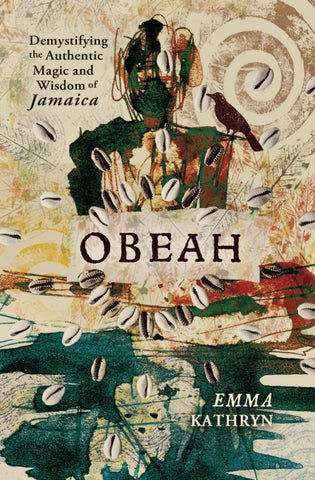
OBEAH Demystifying the Authentic Magic and Wisdom of Jamaica EMMA KATHRYN
Obeah: Demystifying the Authentic Magic and Wisdom of Jamaica Copyright © 2026 by Emma Kathryn. All rights reserved. No part of this book may be used or reproduced in any manner whatsoever, including internet usage, without written permission from Llewellyn Worldwide Ltd., except in the case of brief quotations embodied in critical articles and reviews. No part of this book may be used or reproduced in any manner for the purpose of training artificial intelligence technologies or systems. First Edition First Printing, 2026 Book design by Samantha Peterson Cover design by Shira Atakpu Interior illustrations by Llewellyn Art Department Llewellyn Publications is a registered trademark of Llewellyn Worldwide Ltd. Library of Congress Cataloging-in-Publication Data (Pending) ISBN: 978-0-7387-8313-0 Llewellyn Worldwide Ltd. does not participate in, endorse, or have any authority or responsibility concerning private business transactions between our authors and the public. All mail addressed to the author is forwarded but the publisher cannot, unless specifically instructed by the author, give out an address or phone number. Any internet references contained in this work are current at publication time, but the publisher cannot guarantee that a specific location will continue to be maintained. Please refer to the publisher’s website for links to authors’ websites and other sources. Llewellyn Publications A Division of Llewellyn Worldwide Ltd. 2143 Wooddale Drive Woodbury, MN 55125-2989 www.llewellyn.com Printed in the United States of America GPSR Representation: UPI-2M PLUS d.o.o., Medulićeva 20, 10000 Zagreb, Croatia, matt.parsons@upi2mbooks.hr
Other Books by Emma Kathryn Wild Witchcraft Witch Life Season Songs Libra Witch (contributor) Reclaiming Ourselves Reclaiming Food
For Dad, Jaxon, Jermain, and Mabel: my heritage and my future. For Pearl.
Contents Introduction: A Journey to the Self
1
Part I: A Brief History 7 One: Origins of Obeah 9 Two: Rebellion, Uprising, and Freedom Fighters Three: Obeah Today and Beyond 31 Part II: The Spirits of Obeah 43 Four: Nyame, the Sky God 45 Five: Sasabonsam, the Dark Lord of the Forest 55 Six: Asase, the Spirit of the Earth 73 Seven: Papa Bones, the Gardener 87 Eight: Anima Sola, the Lonely Soul 97 Nine: The Trickster Anansi 111 Ten: The Ancestors 123 Eleven: The Duppy Ah Come! 131 Part III: Practical Work 149 Twelve: The Obeah Tree 151 Thirteen: Plant Work 163 Fourteen: Divination 177 Fifteen: Initiation 187 Conclusion: From the Land of Wood and Water 199 Acknowledgments 203 Bibliography 205
ix
17
introduction
A Journey to the Self
Magic is old, perhaps as old as humankind itself. I’ve often heard people say that belief in magic and witchcraft, just like superstition, was a way for our early ancestors to understand the world and their place in it. For some, this might be a suitable and logical explanation, easy to agree with. But I’ve always felt this isn’t wholly true. Such a one-dimensional and shallow explanation doesn’t really cut it when you consider the many varied forms magic has taken across the world and throughout history. It’s too simplistic and does a disservice to those who came before, who paved the way for us who have followed. An understanding of the world and the powers that control it is an aspect of magic and witchcraft, but it is not the only one, and it does little to explore the interplay of power and politics that have shaped the human and natural worlds. Magic and witchcraft have sought to redress the balance between those with power and those without, whether that power was physical, social, economic, or political. They’ve been a way of connecting with the landscape where
1
2
Introduction
people have found themselves, whether they got there by their own free will, by force, or simply through the circumstances of their birth and upbringing. Magic has been a way to not only survive but thrive, even when the odds have been stacked against those who have practiced, whether they called themself a witch or not. And besides, if such a simple view of magic is true, then how does that explanation fare today, in this modern age of science and technology, when we can explain so much? Why does magic continue to fascinate and inspire us today? Why do so many people practice and continue to be drawn to magical practices? Whatever the reasons are, we do indeed continue to explore and develop our magical practices today, and I’m sure we each have our own range of reasons and feelings that relate to how we understand them. One thing I adore about magic is the inclusivity of it all. Magic belongs to all of us, no matter our heritage or where we find ourselves in the world. It spans political persuasions, or any of the other arbitrary divides we humans like to use to distinguish one from another. That’s why there are so many practices and traditions across the world, whether we know their names or not, whether they are familiar or shrouded in secrecy. All of these can be seen as beautifully individual threads that weave together the stories of our existence into a wondrous tapestry, resplendent in its variety of colour and form. Maybe I’m biased; I am a witch after all. But I am also an Obeah woman too. Obeah is a Caribbean spiritual and magical practice with African roots, and it is an integral part of my own magical practice. It is an initiatory tradition that requires a period of apprenticeship under an Obeah practitioner. It is a learning journey that teaches humility and the sacrifice of ego, but in its place, gives power over
Introduction
3
self and the power to transform the ordinary and overcome the trials and tribulations of life. It’s no wonder the most well-known Obeah men and women of the past were leaders of the people who helped to throw off the shackles of oppression. Obeah is woven through my own cultural heritage—one of the threads in my own magical tapestry—but it has been a journey. Sometimes the path has been blocked or not easily traversed. In finding myself, I have overcome a lack of information as well as a whole heap of disinformation, hatred, and bigotry—all of which has only made me stronger and more determined to embrace all of who and what I am. I am mixed race. My mum is white English, and my dad is black Jamaican. He came to the UK as a child during the Windrush era. I see echoes of the history and practice of Obeah in my own history and that of my ancestors’. We share the same resilience to trials and tribulations, as well as a power greater than the self but carried within it nonetheless. I love all parts of my heritage: the food, the music, the stories and lore, and, of course, the magical and spiritual traditions and practices. All of these individual threads connect us to the tapestries of our cultures and to our ancestors. However, it doesn’t end there. Witchcraft and magic are ever-evolving journeys because we— those of us who practice them—are always changing. Yes, we are made by those who came before and are influenced by all the lore and cultural elements, but we are also shaped and moulded through the lens of our own experiences and the lessons we take from them. We, in turn, add these elements and nuance into the collective, shaping the tapestries with ever-new threads, colour, and form. In this way, tradition—including magical tradition—is a living thing, not some dusty relic that has been resigned to the halls of history.
4
Introduction
My own journey has been one of learning and assimilation of knowledge and experience. This includes my experiences within my heritage and culture. I have been a serious practitioner of Traditional British Witchcraft for over twenty years. And while I adore it and it is an integral part of what I do and who I am, for a long time I felt as though I was not fully honouring all of who I was. So I set out on a journey of discovery. I found Vodou and became a Vodouisant, but my journey to my true self did not stop there. And for a long time, I felt as though I were on a pendulum swinging back and forth between these two important traditions. Both added meaning and magic to my life; both were important to me and the path I was on, but it still felt as though something was missing. It was my dad who set me on the path of Obeah. He isn’t an Obeah man (though one of my uncles always half jokes he is). One day he was perusing my bookshelf while visiting, and upon noticing my books on Western magic, witchcraft, and occultism, along with my books on Vodou, he asked me where my books on Obeah were. From that moment on, I was on a mission. I bugged him to death to tell me all he could. I sought out books, though there are very few with any reliable information. And those books I did come across dealt with the history of the Caribbean and the negative connotations of Obeah. It’s important to say that many of the old texts talk about Obeah from a colonial perspective, including the views of slave owners, plantation owners, and overseers, and as a result, the language and intent is highly racist. I was lucky enough to find a teacher who accepted me as a student, and from there, my journey began in earnest. And what a journey it has been—a homecoming, if you will. It is Obeah that has unified all the different parts of myself. The journey has not been an easy one. And yet here I am, adding to the story of myself, adding shape and form to my own individual tapestry.
Introduction
5
I must state now, before you go further, that this book is not intended to replace the proper order of things, such as the period of apprenticeship and initiation. These things are an integral part of the process. The initiation journey teaches important skills and techniques as well as the songs and chants that are an important part of the practice. Instead, it is my hope that this small volume speaks to those who, like I was, are searching for parts of their own self, seeking to reclaim part of their own heritage and culture that has been denied them or lost to fear and obscurity. This book seeks to go some way in redressing the misinformation and downright lack of information about a tradition that is shrouded in mystery and, quite often, negativity. It must also be stated that Obeah exists in many related but differing forms wherever it is found in Africa and the Caribbean, and as such, my focus here is on Jamaican Obeah, as that is where my family and my own mentor are from. Obeah is many things to many people. To me, it has been the discovery of my true self, reflecting my own particular journey through magical practice—a return to the truth of myself and those who came before. Obeah is a varied and magical practice that is intimately connected to the people who practice it, no matter where in the world they find themselves. It adds to the tapestry of our stories; it helps us overcome the worst difficulties with a beautifully strong spirit and the power to change what no longer serves us. This small volume offers a brief exploration of the history of Obeah as well as offering an insight into Obeah today. The latter half of the book will focus on some of the major spirits within Obeah, including offerings, invocations, journeys, and workings. We’ll explore folklore, ways to understand soul and spirit, and other aspects that make up Obeah.
6
Introduction
While Obeah does require that period of mentoring and initiation already touched upon, anyone can honour the spirits in a respectful way and begin to develop relationships. Some secrets of magical praxis are open to all, and Obeah is indeed a magical and spiritual practice. May we continue to live in power and take strength from our ancestors, the land, and the spirits that reside there, as well as from ourselves as we continue to add to the stories of who we are. May we continue to keep our practices as living traditions shaped by those who came before and moulded by us in the present.
part i
A Brief History In order to understand Obeah, it is necessary to look at its origins and movements. As mentioned in the introduction, I will be concentrating on Obeah as it is found in Jamaica, but many parallels can be made with the wider Caribbean. The history of the Caribbean is steeped in the movement of people, and in power, racism, and colonialism. All of this impacted the people who found themselves there. These forces affected their cultures, religions and spiritual practices, and their own lived experiences. We can also see this process of change and evolution echoed in almost every other magical tradition or practice. As people move and are affected by a multitude of experiences, they assimilate those new experiences and are changed because of what they have been through. As such, their own practices change in small and large ways, developing to suit their evolving needs. In witchcraft today, we can see how this happens by considering all of the magical tools that are now available to practitioners. Any herb, any crystal or stone, and candles in a variety of colours, forms, and materials can be bought
7
8
Part I: A Brief History
over the internet. I imagine that witches of old would be astounded by their modern counterparts and the widespread availability of resources and materials! Everything changes; nothing stays the same because the world is constantly in flux.
one
Origins of Obeah
The specific origins of Obeah are shrouded in mystery and lost to time. That it began in Africa cannot be denied, but Africa is a large continent made up of many countries, and those countries are home to many peoples, each with their own cultural customs and languages. In her book Obeah, Race and Racism: Caribbean Witchcraft in the English Imagination, Eugenia O’ Neal highlights the difficulty in tracing reliable source material relating to Obeah from the continent.1 Many, if not all, of the written accounts and secondary source material stem from a colonial and racist perspective, where the main focus was on exploration, trade, and exploitation of land, resources, and people. O’Neal’s work doesn’t centre on the detailed practice of Obeah itself but provides an excellent overview of how it and the people who practiced it were seen, treated, and depicted. Her work provides useful insight into attitudes toward them and Obeah itself. 1. Eugenia O’Neal, Obeah, Race and Racism: Caribbean Witchcraft in the English Imagination (University of West Indies Press, 2020), ebook.
9
10
Origins of Obeah
Accounts of religious and spiritual practice, where they did occur, were often lurid, with little attempt at thorough and accurate understanding. Writers such as Edward Long wrote about Africa and Africans with no firsthand knowledge. Long was an historian with ties to the slave trade in Jamaica. In his book The History of Jamaica, Long made arguments for the continuation of slavery.2 This propaganda helped to instil the idea that Black Africans made up a savage race, inferior to “civilised” Europeans. Long’s text is still available, but it’s not a pleasant read, as it contains racist ideas and, by today’s standards, outdated language. Accounts like Long’s made it easier for the colonisation of the continent and the people. That the colonisers were doing the “savage and inferior” Africans a favour by lifting them out of devil worship and bringing them into the “enlightenment” of Christianity and European ways of living was often used as a justification for the enslavement of Black Africans. All of this muddies the water when trying to find historical and specific information relating to the practice of Obeah.
West Africa Roots Modern historians believe it is likely that Obeah came to the Caribbean from West Africa. It makes sense, considering that approximately 6.2 million enslaved were taken from West African countries, including modern-day Ghana and Nigeria, to the Caribbean,
2. Edward Long, The History of Jamaica or, General Survey of the Ancient and Modern State of That Island […]. T. Lowndes, 1774.
Origins of Obeah
11
with around 1.02 million enslaved taken to Jamaica alone.3 It is worth mentioning that those numbers do not account for the many who died along the brutal Middle Passage. Besides the documented history of the enslavement and forced movement of the people from West Africa to the Caribbean, much of the evidence to support the origins of Obeah comes from the etymology of the word itself as well as through the meanings of other words and phrases used in modern West African cultures. The Twi-speaking Ashanti people, for example, come from what is now modern-day Ghana. The Twi words obi okomfo mean “priest,” and the word for “witch,” “wizard,” or “sorcerer” is obayifo. That there are different words for priest and sorcerer suggests that the two roles were very different. Priests were often considered to have spiritual authority. These people, usually males, were the intermediaries between the lay people and their god, seeking aid from their creator god for protection, good health, successful crops, and bountiful food. Witches and sorcerers, in comparison, sought to bring good or ill fortune onto others by the use of magic. This also included using magic to protect them from the will or authority of their god, thus averting any divine consequences for what might have been seen as more baneful magic. One might draw the conclusion that the priest worked for the good of the whole community, while the witch or sorcerer were more involved with individual pursuits and desires. When looking at language, it’s also important to consider dialects within a particular language. The Ashanti peoples are part 3. David Altis and David Richardson, “9. Volume and Direction of the TransAtlantic Slave Trade from All African to All American Regions,” Echoes: The Slave Voyages Blog (blog), Slave Voyages, September 5, 2025, https://www .slavevoyages.org/blog/volume-and-direction-trans-atlantic-slave-trade.
14
Origins of Obeah
of the Akan, an ethnolinguistic group of peoples in Africa. The Ashanti used different dialects, though all came under the umbrella of the Akan language, with Twi being a widely used dialect. Within the Akan language, the word bayi means “sorcery.” 4 Tracing the etymology of the word Obeah, or Obia in the Efik language of southern Nigeria, might also provide clues to the African origins of Obeah. The word ubio refers to magic that causes or brings ill health or bad fortune.
From Africa to the New World One thing that I often find annoying about the history of places that have been colonised is that in history books and on websites it’s as if those places didn’t exist before being “discovered,” and it’s the same with the history of the Caribbean. Of course, it is now common knowledge that Columbus interacted with and was terrible to the local peoples as soon as he arrived. It would be two years later that Columbus came to Jamaica, claiming it for the Spanish in May of 1494, though it wasn’t until 1534 that Jamaica became a Spanish royal colony. Under Spanish rule, the island was named Santiago. Before Columbus found himself in the Caribbean, though, the original inhabitants of Jamaica were the Taino, an Arawak-speaking people who originally came to the island in canoes from the north coast of South America. They named the island Xaymaca, an Arawak word meaning “land of wood and water”—an apt name for an island nation rich with trees, plants, and animals as well as wide, flowing rivers and waterfalls. 4. “4: The Bantu Migrations,” Story of Africa: Programmes, BBC World Service. https://www.bbc.co.uk/worldservice/africa/features/storyofafrica/index _section16.shtml.
Origins of Obeah
15
The arrival of the Spanish was devastating for the Taino peoples. Those not killed in fighting were subjected to slavery themselves. And not only that; they had little immunity to the colds, flu, and other common illnesses the Spanish brought with them.5 It was the Spanish who first began bringing enslaved West Africans to the island, a practice that continued, and indeed grew, under British rule. Britain defeated Spain, taking control of the island in 1655, renaming it Jamaica. Jamaica brought massive wealth to the British empire, mostly through the sugar plantations, which the enslaved Africans were forced to labour in. After enduring terrible conditions on the slave ships during the Middle Passage, conditions on the plantations were even more horrific, with the life expectancy of an enslaved person working in the Jamaican plantations believed to be around seven years. Many died due to starvation, beatings, and torture, as well as the terrible living conditions they were forced to endure.6 It’s no wonder the enslaved Africans fought back as best they could. This hostile takeover that marked the beginning of the island known as Jamaica (not to be confused with the land that has been there since time immemorial), might be seen as something of a precursor for what was to come
5. Kenneth Morgan, A Concise History of Jamaica (Cambridge University Press, 2023), 74–76. 6. “History of Jamaica,” Embassy of Jamaica, accessed 07.01.2025, https://www .embassyofjamaica.org/about_jamaica/history.htm.
Body, Mind & Spirit / Caribbean Spirituality “Within these pages, Obeah is reclaimed as a source of healing, justice, and revolutionary strength.” —Mawiyah Kai EL-Jamah Bomani, author of Hoodoo Saints and Root Warriors
Lift the Veil of Secrecy Shrouding Obeah and Connect with Your Ancestral Roots Written by an authentic Obeah woman, this illuminating book shares the truth and beauty of a deeply magical practice. Emma Kathryn presents Obeah in a modern way, reclaiming it from the grips of misinformation based on fear and racism. She reveals Obeah’s West African origins and its history amid slavery and rebellion in the Caribbean before introducing you to the main spirits of its cosmology. She then provides insight into Obeah’s practical work, from divination to plant work. While it will not initiate or train you in Obeah, this treasury of knowledge will help you celebrate its profound spirituality and reclaim your own heritage. Even if you have no links to this tradition, the priceless information within transforms an often-misunderstood practice into one of power, connection, and inspiration. “A long overdue treasure that shines a welcome beam of light on the study of Obeah.” —Angeline Morrison, singer, songwriter, and multi-instrumentalist
Emma Kathryn is the author of multiple books, including Witch Life, and a contributor to Libra Witch and Llewellyn’s popular almanacs. She has also written for Witch Way Magazine, The House of Twigs blog, Stone, Root, and Bone blog, the Spiral Nature blog, and Gods & Radicals. Emma hosts Wild Witch Podcast and has spoken at several UK Pagan events, including Magickal Women Conference in London. Visit her at EmmaKathrynWildWitchcraft.com. Facebook.com/LlewellynBooks
© DDFixter
X: @LlewellynBooks Instagram: @LlewellynBooks
www.Llewellyn.com
$15.99 US