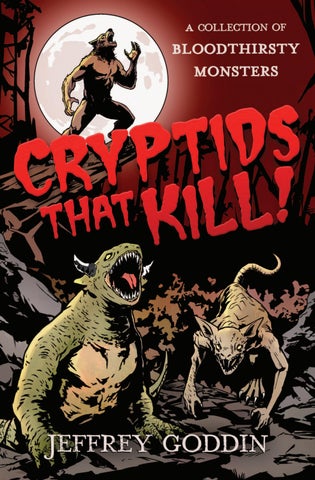
Cryptids That Kill!
About the Author Jeffrey Goddin is a retired educator who has been writing nature articles, short fiction, and even a couple of novels off and on since the later Pleistocene. He also taught a class on paranormal topics at the Hutton Honors College, and he has written articles for Fate magazine.
To Write to the Author If you wish to contact the author or would like more information about this book, please write to the author in care of Llewellyn Worldwide Ltd. and we will forward your request. Both the author and the publisher appreciate hearing from you and learning of your enjoyment of this book and how it has helped you. Llewellyn Worldwide Ltd. cannot guarantee that every letter written to the author can be answered, but all will be forwarded. Please write to: Jeffrey Goddin ⁄o Llewellyn Worldwide 2143 Wooddale Drive Woodbury, MN 55125-2989 c
Please enclose a self-addressed stamped envelope for reply, or $1.00 to cover costs. If outside the U.S.A., enclose an international postal reply coupon.
Many of Llewellyn’s authors have websites with additional information and resources. For more information, please visit our website at https://www.llewellyn.com.
Cryptids That Kill! A COLLECTION OF BLOODTHIRSTY MONSTERS
JEFFREY GODDIN
Cryptids That Kill: A Collection of Bloodthirsty Monsters Copyright © 2026 by Jeffrey Goddin. All rights reserved. No part of this book may be used or reproduced in any manner whatsoever, including internet usage, without written permission from Llewellyn Worldwide Ltd., except in the case of brief quotations embodied in critical articles and reviews. No part of this book may be used or reproduced in any manner for the purpose of training artificial intelligence technologies or systems. First Edition First Printing, 2026 Book design by Christine Ha Cover art and chapter opener art by Ian Seo Cover design by Shannon McKuhen “The Indiana Panthers” originally appeared in a slightly different form in Fate, 2016. “Fearsome Flying Heads” originally appeared in Fate, December 2020. A few paragraphs of “Unknown Predators” appeared in the article “Mystery Predators” in Fate, June 2013. Llewellyn Publications is a registered trademark of Llewellyn Worldwide Ltd. Library of Congress Cataloging-in-Publication Data (Pending) ISBN: 978-0-7387-8311-6 Llewellyn Worldwide Ltd. does not participate in, endorse, or have any authority or responsibility concerning private business transactions between our authors and the public. All mail addressed to the author is forwarded but the publisher cannot, unless specifically instructed by the author, give out an address or phone number. Any internet references contained in this work are current at publication time, but the publisher cannot guarantee that a specific location will continue to be maintained. Please refer to the publisher’s website for links to authors’ websites and other sources. Llewellyn Publications A Division of Llewellyn Worldwide Ltd. 2143 Wooddale Drive Woodbury, MN 55125-2989 www.llewellyn.com Printed in the United States of America GPSR Representation: UPI-2M PLUS d.o.o., Medulićeva 20, 10000 Zagreb, Croatia, matt.parsons@upi2mbooks.hr
Other Books by Jeffrey Goddin Fiction Blood of the Wolf Fear the Witch Kind The Living Dead The Smell of Cherries
Contents List of Monsters xi Introduction 1 Chapter 1: Bad Bigfoot 7 Chapter 2: Skunk Apes and Lizard Men 29 Chapter 3: Terror from the Sky: The Giant Birds 47 Chapter 4: Chupacabras: The Red-Eyed Monsters 57 Chapter 5: The Phantom Panthers Attack! 77 Chapter 6: Predators Known and Unknown 103 Chapter 7: Phantom Predators of Myth and Legend 117 Chapter 8: Shapeshifters: Deadly in Any Form 139 Chapter 9: The Fearsome Flying Heads 153 Chapter 10: The Immigrant Werewolf 161 Chapter 11: The Livestock Mutilators 169 Conclusion 181 Recommended Reading 183 Bibliography 187
Monsters Chapter 1: Bad Bigfoot Bigfoot El Dientudo Chapter 2: Skunk Apes and Lizard Men Skunk Apes The Flintville Creature The Mill Race Monster MoMo, the Missouri Monster The Lizard People The Lake Thetis Monster The Scape Ore Lizard Man Chapter 3: Terror from the Sky: Giant Birds Thunderbirds Tlanuwa Chapter 4: Chupacabras: The Red-Eyed Monsters Chupacabra El Vampiro de Moca
xi
Monsters
Chapter 5: The Phantom Panters Attack! Phantom Panthers The Ohio Predator The Bloomington Panthers The Surrey Puma The Beast of Bodmin Moor The Black Beast of Exmoor The Beast of Ollersett Moor Chapter 6: Predators Known and Unknown The Mystery Beast of 1904 The Thing of Sheep’s Hill Bearilla Raccoon Thing The Wiscasset Sheep Killer The Demon Dog of Abingdon Guinea Marsh Predator Chapter 7: Phantom Predators of Myth and Legend Ahool Anchanchu Asanbosam Asin Chortí La Ciguapa Dakhanavar Deer Women Dila Garkain Hodag Kakamora xii
Monsters
Kaki Besar Kappa Kongamato Lindorm Mara The Mongolian Death Worm Olitiau Orang Pendek Santu Sakai Shampe The Shunka Warak’in Ukteni Wakwak Wendigo Chapter 8: Shapeshifters: Deadly in Any Form Aswang Baak Estrie Jorōgumo Krasue Kumiho Soucouyan and Sukuyan The Manananggal Kushtaka Stikini Biasd Bheulach Brollachan Buggane Each-Uisge Kelpies xiii
Monsters
Chapter 9: The Fearsome Flying Heads Flying Heads Chapter 10: The Immigrant Werewolf Werewolves Loup-Garou The Werewolf of Vincennes Rougarou
xiv
Introduction
T
hey wait, they watch, and when the time is right, they make their move in the darkness. They want blood. All cryptids are not dangerous, but this is a book about the ones that are, the ones that attack. There are many kinds of cryptids in the world, animals that are or have been thought not to exist, but they can all be placed in three broad categories: There are real animals, such as the coelacanth or the okapi, that were thought to be mythical but later proven to exist. The giant squid and the Komodo dragon fall into this category— and both can be quite dangerous. There are a number of good books about this type of entity, such as Bernard Heuvelmans’s On the Track of Unknown Animals (listed in the recommended reading), so this book will concentrate on the second and third types of phantom creatures. The second type of cryptid is creatures that look like animals we’re familiar with but behave in a fashion unlike normal creatures. An example would be phantom black panthers that seem to be able to appear and disappear at will. The phantom panthers have killed many farm animals in places as far apart as rural North America and the north of England.
1
Introduction
The third type is made up of creatures that have unique, often very weird shapes and variations and are believed to be real, such as the Chupacabras, which have left a trail of animal bodies drained of blood in their wake. There is also a wide variety of often bizarre creatures that are part of cultural traditions—drawn from local myth and legend—such as the bloody Aswang of the Philippines or the fearsome winged humanoid Garkain of Australia. These creatures seem imaginary—except there are tales of real people encountering them. Native American and Canadian First Nation lore is rich in tales of these kinds of entities, such as the wendigo of the Indigenous peoples of Canada. This book is about the phantoms and shapeshifters we share the world with but only those that seem to be dangerous to humans or beasts. These entities are hunters—hunters of livestock, wild animals, and sometimes, people. These are the cryptids that kill. Some of the tales of encounters with these creatures are part of a “flap,” a term invented by the United States military to describe a period when things are getting publicity and events are somewhat chaotic. It is often used in the context of UFO sightings and related events. This is a good way of describing a time period such as 1995– 1996, for example, when there was a flood of Chupacabra sightings and attacks on livestock and pets in Puerto Rico. Many of these sightings take place in “window” areas. Window areas are geographical areas that seem to have more than their share of paranormal phenomena, sometimes briefly but sometimes consistently over long periods of time. Examples of window areas are Point Pleasant, West Virginia, where Mothman was sighted, and the Bridgewater Triangle, home of the Demon Dog of Abingdon, in Southeastern Massachusetts.
2
Introduction
A Night at the Cabin When I was a kid growing up in rural Southern Indiana, I was not that fond of education, or much of anything about being forced to spend most of three seasons in school, really. I would eagerly wait most of the year for those amazing days of summer freedom, and one particular thing I loved about summer was that I could go down to my cousin’s cabin in a little Indiana river valley. There I could canoe, hike the woods, do some target shooting with gun or bow and arrow, and pursue all kinds of amateur nature study. Refreshments were provided; on the gently sloping hillside above the cabin grew raspberries, dewberries, and blackberries, and a cold spring that emerged from the limestone bluff back in the woods provided water. We’d catch crawfish, turn over stones in the river and find mudpuppies, photograph or draw the amazing dragonflies of various styles and colors, and watch for the big green luna or yellow imperial moths that would drift out of the deeper woods to the lights of the cabin by night. Night was also story time. While sitting on the rocky riverbank waiting for the long, slow pull of a river catfish on the fishing line or leaning over a fire roasting hot dogs or marshmallows on green sassafras sticks, whoever was down on the river would always have a story—and some of the stories were about the kittywampus. Old Tommy, a retired police officer and housepainter who spent much of his time in the nearest cabin, had seen the kittywampus on a number of occasions, and not always when drinking that clear liquor that was made back in the Kentucky hills. The kittywampus was a big black panther with glowing eyes and six toes on each forepaw. It liked to sneak up and scare people but would usually not hurt them unless they came after it, which was not a good idea. Occasionally a cow would be found killed, 3
Introduction
which was sometimes blamed on a dog pack but sometimes on the kittywampus. People had tried to hunt it, but no one could ever shoot it, and this occupation was more dangerous to the hunter than to the hunted. I was out at night a lot in that little river valley. I never saw the kittywampus, but sometimes I felt it out there, watching me, and I would just catch a glimpse of magical green eyes … When I got old enough to drive, I would visit that river valley at odd times, and it was that one night at the cusp of winter and spring that I was staying in the concrete block cabin alone. The cabin was scented with pine from the wood in the fireplace, the fire had died down to glowing red embers, and I’d been drifting in and out of sleep when I heard something outside. The edge of the woods is quiet in the hour just before dawn, and in the chilly winter, it’s doubly quiet. Old Tommy’s cabin was across a field, and nobody was staying there. The nearest tiny town was five miles away. There was nothing human in the area to make a sound, but I very clearly heard the sound of slow, deliberate steps on the cold, crunchy ground outside. The steps circled the cabin once and came back to the door on the south side, the one closest to my sleeping bag. I was not afraid of much in those days, but when those steps stopped, I felt a wave of unease more powerful than anything I’d ever experienced. The door was locked, but I had a feeling that detail would mean little to whatever stood on the other side. I wanted to see what was out there, but I couldn’t move. Whatever was out there was different, and I had the feeling it might not like me. Gradually the steps moved away from the door. My paralysis broken, I reached for my machete and pulled it into the sleeping bag. I thought I might try to see what was going on outside, but with strange suddenness I fell asleep. 4
Introduction
The next morning had a light breeze and cold, damp clouds. There had been a dusting of snow, just enough to cover the ground. I circled the cabin, but there was no trace in the frozen ground to show that any kind of creature had been there. I now had my own story, but it was a story without an ending. My curiosity was whetted to find out as much as I could about things that moved in the night in places like that little river valley—and many of these stories also end with a mystery.
5
CHAPTER 1
Bad Bigfoot
I
n 1957 two men were hunting deer among the tall ponderosa pines of Deschutes National Forest near Bend, Oregon. Deschutes is an outdoor lover’s dream, with a million and a half acres of pure wilderness. The autumn air was crisp, and it was a great day to be in the woods. The men shot a deer and walked into a clearing in the forest to retrieve it—only to see a huge, hairy creature walk into the clearing on two legs and pick up the deer. With a wild mix of emotions, one of the men shot the hairy creature, which simply made a loud whistling sound and walked away with the deer.1 What’s with that? Isn’t Bigfoot our friend, not to mention an enduring cultural icon, especially in the Pacific Northwest? The majority of Bigfoot sightings are benevolent, or at least neutral, but there have been a number of Bigfoot encounters that weren’t peaceful at all. Some Bigfoot encounters, in a variety of times and places, have even been dangerous to man and beast.
1. Matthews, Bigfoot, 34.
7
Chapter 1
But First, What Is a Bigfoot? Bigfoot is a part of North American culture, and as such, most people think they know what a Bigfoot looks like. We’ve often seen the creature depicted on a wide variety of objects, including shirts, signs, and big trucks, and throughout media, including numerous commercials. There’s even at least one beer named after it. The usual description of a Bigfoot is of an entity covered with hair that walks upright like a human. These creatures can be as much as seven or eight feet tall and look like they might weigh five hundred to six hundred pounds. They are covered with thick hair that is most often said to be reddish brown but has also been described as gray, black, or, occasionally, white. Where their skin is visible, it is dark. They have strong ridges over their eyebrows (supraorbital ridges), as are often seen in visual reconstructions of prehistoric Neanderthal humans, big jaws, and peaked skulls like apes. Their bodies are massively muscular, and hair-covered breasts are visible on the females. They are most often seen alone but sometimes move about in pairs and occasionally in small groups. Bigfoots are said to have supernatural powers of self-protection. There are many accounts of people shooting Bigfoots with a wide variety of weapons and not harming them. While it’s quite common for hunters to completely miss their targets, that Bigfoots aren’t harmed by bullets is a standard feature of their lore. Many Bigfoot stories tell of these creatures communicating with each other by whistling or knocking on the trunks of trees. Some people go out to the forest looking for them and knock on trees with sticks in an attempt to get a Bigfoot’s attention—although they might actually be going up for a hot date without knowing it. Another almost universal feature of Bigfoot stories is that the creatures are described as smelling worse than a boys’ locker room 8
Bad Bigfoot
(to humans, at least), and the awful smell is said to linger if the creature was recently in a particular area. As there are quite a few accounts of hairy monsters in North America and elsewhere, it’s useful to try to distinguish Bigfoot entities from their apparent relatives, although making an absolute distinction in some cases would be difficult. There is a hairy humanoid creature of the Southern states often referred to as a skunk ape, for example, and other shaggy entities that are sometimes described as walking upright with dog- or wolflike faces. The features that seem to especially set Bigfoot apart from its paranormal relatives are its often extremely tall size, unique facial structure, combination of both human and apelike characteristics, and sometimes uncanny level of intelligence.
Bigfoot and Sasquatch People have reported the presence of Bigfoots in every state but Hawaii, and some of the Western states, such as Oklahoma, have a lot of Bigfoot lore. The creatures have a particular fondness for showing up in the Pacific Northwest, the area with the longest history and greatest number of sightings, and are frequently also sighted in Alaska and throughout Canada. In the Northwestern states and Canada, Bigfoot is sometimes called Sasquatch. The name Sasquatch was first used by educator J. W. Burns in an article he wrote in 1929 called “Introducing B. C.’s Hairy Giants.” Burns taught at the Chehalis Indian Reserve in British Columbia, and the name is similar to the words Burns’s First Nations friends used to indicate a very Bigfootlike creature: sokqueatl and soss-q’tal.2 Burns describes a number of encounters that took place between First Nations peoples and Bigfoots, including one account where
2. Coleman and Clark, Cryptozoology A to Z, 215.
9
Chapter 1
a man named Peter Williams, who lived on the Chehalis Reserve, encountered a six-and-a-half-foot tall Bigfoot in the early 1900s. This Bigfoot was definitely hostile, and Williams thought to escape him by paddling his dugout across the Chehalis River—but the Bigfoot swam the river in pursuit! This Bigfoot was extremely aggressive and followed Williams home, nearly destroying his wooden house and rendering it unlivable. The following winter Peter had another run-in with the Bigfoot, which gave chase immediately, but Peter was able to outrun him.3
The Bluff Creek Bigfoot Popular Bigfoot coverage really got off the ground in 1958 in the Bluff Creek area of Northern California, a key location in Bigfoot lore. In the wilderness around Bluff Creek, a tributary of the Klamath River, a construction crew was bedeviled by something messing with their equipment when they weren’t around. Whatever it was left huge footprints, and a highway contractor named Ray Wallace made plaster casts of these footprints. A photograph of a cast, the footprint of a mystery creature given the name Bigfoot, found its way into world media. The smallest of the casts were about 14 inches long and 7 inches wide, while the largest impression was 18 inches long and 9.2 inches wide, indicating a creature of enormous size.4 In October 1958, there was also an actual sighting not far from where the footprints were found. A resident of McKinleyville, Ray Kerr, saw a huge eight-to-ten-foot-tall creature covered with hair in the Bluff Creek area. The evening after Kerr’s sighting, an Indigenous man named Curtis Mitchell was traveling the Elk River Road in the
3. Burns, “Introducing B. C.’s Hairy Giants,” 9, 61. 4. McClelland, “Tracking the Legend of Bigfoot.”
10
Bad Bigfoot
same area when he discovered the bodies of four dogs that had been horribly savaged by some unknown predator.5 When Roger Patterson and Bob Gimlin made a short movie on Kodachrome II film of what seems to be a very hairy female Bigfoot in Bluff Creek, the name Bigfoot became even more widely known to the general public. The men said the film, about a minute long, was shot on October 20, 1967. The authenticity of the film is still a subject of lively debate.
A Vintage Bigfoot Sighting The sightings of creatures that appear to be Bigfoots in America go back much further than the Bluff Creek sightings, and these sightings have not been confined to the Pacific Northwest. A menacing Bigfoot appeared in Vicksburg, Mississippi, just a few years after the Civil War. Such sightings are discussed by W. Ritchie Benedict in his article “Bigfoot in the Sixties—the 1860s,” which appeared in Fate magazine. Benedict references an article from the March 1, 1868, Vicksburg Herald, which then appeared in the March 26, 1868, edition of the Halifax Citizen. The Toronto Telegraph for July 4, 1868, also reprinted an article on the same subject from the St. Louis Dispatch.6 In the vicinity of a small stream, Bear Creek, which empties into the Big Black River, African Americans told stories of a hairy creature that was “eight feet high” with each eye “as large as a hen’s egg.”7 These stories would be confirmed by a group of men hunting bear in the swamp, as they also encountered the creature, describing it as such:
5. Keel, Strange Creatures from Time and Space, 100. 6. Benedict, “Bigfoot in the Sixties—the 1860s,” 33. 7. Benedict, “Bigfoot in the Sixties—the 1860s,” 33.
11
Chapter 1
No nose, no upper lip, his two eye teeth as large as a man’s thumb, extending down over his chin about eight inches; his right foot points directly to the front, and the left to the rear, and the measure of the track is just twenty-three inches in length; his fingernails are about six inches long; the hair on his head—which is stiff and wiry—sweeps the ground as he walks, and is parted in the rear and brought down in front on each side of his singularly formed chest, which is not round or flat but is angular like that of a fowl. The hair on the body … is very stiff, and grows to the rear, parting at the angle of the breastbone, growing back.8 They added that the spine extends behind the back for about a foot like wild boar bristles, and the hair on the arms and legs grows in such a way as to form a brush behind each arm and leg.9 The idea of one foot pointing forward and the other pointing backward is, of course, pretty odd, but feet turned in the wrong direction is not uncommon in Bigfoot—or other cryptid—lore. A party of men hunting bear in the swampy Bear Creek area discovered huge human tracks, which were often reversed, in the soft soil. The reversed tracks could indicate that the creature was walking backward, and the men were on their guard. The hunting dogs were set to follow the tracks, and the men followed on horses. A strange, hairy humanoid entity suddenly appeared, gave a horrendous yell, and fled the dogs. After the hunters chased it for ten miles, the creature was cornered on the banks of the Big Black River, and by then it was ready for a fight. It grabbed the first dog and tore it in half, then grabbed the second dog and bit through its skull. 8. Benedict, “Bigfoot in the Sixties—the 1860s,” 33. 9. Benedict, “Bigfoot in the Sixties—the 1860s,” 33.
12
Bad Bigfoot
A hunter fired at the creature twice. It dived into the water and disappeared. After five minutes, the creature surfaced with a horrible scream, swam to the other bank of the river, and escaped into the forest. Oddly enough, there have been modern Bigfoot sightings in the Vicksburg area as well, many happening near a playground in 2013 and 2014.10
Attack in Ape Canyon The famous and often repeated story of a Bigfoot attack on a group of miners in 1924 was first printed in the Oregonian newspaper from Portland. It was later reprinted in many places and is still anthologized today. As the story goes, in the Lewis River area, near Mount St. Helens, a group of prospectors was attacked by “mountain gorillas” in what was called “The Battle of Ape Canyon.” The prospectors found footprints fourteen inches long and on one occasion saw a seven-foot-tall manlike creature watching them from the woods. In 1958 one of the men provided more information about this incident, including accounts of a nocturnal attack where the creatures jumped on the roof of the prospectors’ cabin and pounded on the walls. The authors of many books seem not to know, however, that it is very probable that this incident was a hoax. According to an article posted on The Chronicle site, Rant Mullens, then aged eighty-six, said that he and George Ross, his uncle, had heard about the ape stories the miners were telling and created this incident on the spur of the moment by rolling some rocks over the edge of a cliff over the mining camp. This does not account for the footprints, but it’s not impossible that someone else was having fun with the miners,
10. “Bigfoot Possibly Hangs Out on an Abandoned Playground.”
13
Chapter 1
who had told many people of the scary “mountain apes” haunting the forests.11 Mullens, however, had so much fun with this that four years later he carved two Bigfoot feet out of alder wood, put long handles on them, and gave them to a friend of his to make fresh Bigfoot tracks on the banks of the Muddy River.12
The Oklahoma Bigfoot The entire state of Oklahoma seems to be prone to paranormal phenomena, and this includes the presence of paranormal predators. With about four million residents, which is about half the population of New York City, Oklahoma is a thinly populated state, and there’s a lot of open space, including four mountain ranges, where strange entities might dwell. Southeastern Oklahoma has traditionally been an area for Bigfoot sightings. In the fall of 1971, around homecoming, a group of high school kids saw a huge hairy monster on a back road in the Green Hill area of Talihina. This was the kind of area known to kids around the world, the type that is often the site of youthful parties, well out of sight of parents’ watchful eyes, with easy road access and woods on one side. When the local sheriff followed up on the sighting and investigated the area, he found the bodies of three deer that had been ripped open from end to end.13 This region of Oklahoma is also home to a famous Bigfoot-type entity in the Boggy Creek area: the Boggy Bottom Bigfoot (not to be confused with the Boggy Creek monster in Fouke, Arkansas). There are at least five areas in this part of Oklahoma named after the 11. “Toledo Retiree Admits Bigfoot Hoax in 1982.” 12. “Toledo Retiree Admits Bigfoot Hoax in 1982.” 13. Clark, “‘Manimals’ Make Tracks in Oklahoma.”
14
Bad Bigfoot
long-meandering Boggy Creek, and this one, a popular canoeing and kayaking area, is near Caney, which is close to the Choctaw Nation Reservation. Hikers can tell this five hundred-pound Bigfoot is nearby because it makes a cry sort of like a whippoorwill, though not quite right, and smells so bad you can detect it from a considerable distance. The creature is said to be more than seven feet tall, have reddish-brown hair, and have a broad, scary face with the overhanging brow ridge so often noted in Bigfoot descriptions. Sightings of this entity have extended into the millennium. Near Honobia, a little community with a general store and an RV park, a family reported continual harassment by a Bigfoot in January of 2000. Some very hungry creature, assumed to be a Bigfoot, discovered an outdoor shed with a big freezer and stole the meat of three deer from it. The thing then tried to get into the house, yanking at the doors, and finally pulled off part of a window frame. Night after night, something would try the windows and rattle the doorknobs. When one of the occupants was sent outside to stop whatever was trying to break into the house, he ran into a massive creature, which he described as a Bigfoot, and took a shot at the intruder as it fled into the woods. The creature—or creatures—just kept coming back and trying to get into the house. A strangely mutilated deer was discovered nearby, and when hunters went into the woods at night to try to find the creatures, they heard weird noises, and their lights reflected red eyeshine on occasion (red eyeshine is said to be characteristic of Bigfoots)—but no creature was caught. The phenomena went on for weeks, then finally died down.14
14. “The ‘Seige’ at Honobia.”
15
Chapter 1
In southeastern Oklahoma in the same area, near the Kiamichi Mountains, some huge Bigfoot-type footprints were discovered in May 2009. These prints were fifteen inches long and five inches wide with distinct toe impressions. There is even a Bigfoot museum in a little community called Talihina that’s complete with a photo-ready ten-and-a-half-foot-tall stuffed Bigfoot named Buddy (a replica, not an actual Bigfoot that’s been taxidermized), footprint casts, and a variety of artifacts. The museum, located a mile south of downtown Talihina in what used to be an American Legion Hall, was founded by a local couple so there would be a place where people could share Bigfoot stories. Why is Oklahoma, particularly the southwestern mountains, so rich in cryptids? If one follows the idea that there are certain areas of the world where the veil between our dimension and others is thin and that travel both ways is possible, then this part of Oklahoma, where so many weird creatures are seen, might be one such spot. Many sightings have taken place in Comanche County, named for the Indigenous tribe that once held a huge area in the region, and places that are sacred to Native Americans are also often great places for paranormal activity. In a similar vein, the military base of Fort Sill, where soldiers received artillery training during the Vietnam War, is near Lawton, Oklahoma. Lawton holds a very important place in the history of the old West, and the famous Chiricahua Apache Chief Geronimo and a number of his descendants are buried there. Geronimo, who was a shaman as well as a great chief, spent his last days in loose captivity in Oklahoma. He hated the invading culture and rightly so, particularly as his mother, one of his wives, and all of their children, including an unborn son, were murdered by Mexican soldiers, who received payment for their scalps. The presence of the remains of one of history’s most brilliant Indigenous leaders could only enhance the 16
Bad Bigfoot
spiritual aura of the area, and visitors to Geronimo’s grave often leave small offerings, such as coins, knives, or tobacco, in his honor.
Dog Killer in Kentucky Although most often seen in the Western United States, Bigfoots’ hairy presence has been noted in many other parts of the country. About nine hundred miles east of Talihina, a very Bigfoot-like creature made its appearance in 2004 in rural Lawrence County, Kentucky, not far from the Big Sandy River. Two dogs had gone missing, and they were eventually found ripped apart with a number of their major organs gone. The dogs’ owners, a couple, believe that they met the cause of their pets’ deaths while out ginseng hunting one warm summer morning. They had heard the sounds of something huge crashing through the brush. When they looked for the source of the sounds, they saw a giant manlike creature, six or seven feet tall with four-foot shoulders. “It was covered in long, reddish-brown hair and had a manlike face with large, dark eyes.” It also had a rank odor, “like a cross between a skunk and a wet dog.”15
The Southern Bigfoot Like Kentucky, Arkansas is a long way from the traditional Pacific Northwest haunts of Bigfoot, but if you delve into tales of the past, you’ll find stories of Bigfoots acting badly in the Southern states. An early account comes from Greene County, Arkansas, where, in 1851, two hunters witnessed a hairy manlike creature that walked on two legs try to grab a calf from a herd of cattle. This story was reported on May 30, 1851, in the Arkansas Gazette as a “wild man” 15. Nunnelly, Mysterious Kentucky, 80.
17
Chapter 1
sighting. The creature was huge and hairy with feet that measured fourteen inches. It was able to leap as far as fourteen feet. According to the article, the being had been sighted off and on for seventeen years, and one (rather nonsensical) theory was that the creature was a human survivor of the earthquake of 1841 who had grown to unnatural size and become feral because of the necessity of living off of the wilderness.16
A Bigfoot in Tennessee Mary Green, a Tennessee researcher, collected a lot of information about Bigfoot in her state. In the late 1990s, Green found the body of a calf in a wooded area. The animal had been attacked in a very unusual manner. The calf ’s spine and neck had been broken, its stomach had been torn open, and the main internal organs appeared to have been eaten. Huge four-toed, humanlike prints were scattered in the soft earth all around the calf ’s body. Green speculated that the prevalence of forested areas in this part of Tennessee, in Overton County in the region of the Cumberland Mountains, made for good cover for Bigfoots and that they tended to travel by the gulleys, streams, and riverbeds through the deep woods.17
Bigfoot in Michigan Bigfoot has also put in a number of appearances in the Upper Midwest. Author Linda Godfrey, who did the first detailed investigations of the famous Beast of Bray Road in the early 1990s and has written some very lively books about the furry—and other— monsters of the 16. “The History of Bigfoot in Arkansas.” 17. Thacker, Mountain Mysteries, 76.
18
Bad Bigfoot
United States, wrote about a bizarre and very scary Bigfoot encounter in Michigan in her book Weird Michigan. The story she references was originally discussed in the Ann Arbor News in October of 1979. In 1965 Rose Owen and her daughter, Christine Van Acker, aged seventeen, were traveling in rural Monroe County, Michigan. It was just a typical dark night on a Michigan country road, with no expectation of any complications to the trip. Suddenly a huge, hairy creature stalked out of the darkness on two legs and leaped out in front of their car. Owen slammed on the brakes and the car stalled out, just missing the creature. This very-annoyed Bigfoot reached through the open car windows, attacked the two women, then ran off. A medical exam found both women to have bruises, and Owen had two black eyes, evidence that makes it hard to ignore that they’d been through a harrowing experience.18
Attack on a Michigan Farm In September 1981, Cindy Barone of St. Clair County, Michigan, felt like her farm was under siege. She had heard “high-pitched screams” coming out of the darkness on her farm and was generally on edge, as a phantom intruder had been tearing up her fencing and had even ripped the barn door off its hinges. Whatever was doing all this damage had also broken into barrels of grain and been eating the contents. One night her two daughters, aged twelve and thirteen, went out to do their chores. In this waking nightmare, when one daughter reached for the light switch in the barn, her hand touched fur. The owner of the fur was huge with two blazing-red eyes, and it growled at the terrified girl. The girls ran for their brother, who quickly armed himself and chased the mystery creature off with a
18. Godfrey, Weird Michigan, 79.
19
Chapter 1
shotgun. It is said that some videos exist of this Bigfoot entering a forest in this area.19
A Carnivorous Bigfoot in Argentina The more dangerous kinds of Bigfoot, or its close relatives, have not confined their activities to the United States. There are heavily forested nature preserves totaling well over one thousand acres near Buenos Aires, Argentina—plenty of cover for the country’s own version of Bigfoot: El Dientudo. El Dientudo means “Big Teeth,” and this Bigfoot-type entity is described as having a fearsome appearance and awesome fangs. The creature is a humanoid towering over seven feet tall and covered with dark fur, with the charming odor of decaying meat. It’s said that it carries people off into the woods. Whether just to kill them or eat them is not entirely clear, but the gruesome, bloody remains of its victims are found in the forest. Cryptozoologist Scott Corrales has spent many years investigating cryptid sightings and encounters with a critical eye and depth of observation. In “Bigfoot Beyond Our Borders,” he discusses a story of El Dientudo that received some publicity in 1963. A weird, six-foottall, hairy creature with glowing eyes and the long fangs that have given the beast its name appeared at the village of Ranelagh, about sixteen miles to the southeast of the center of Buenos Aires. The creature was spotted lurking near a small bridge over the large creek that runs through the area. A number of people were injured by the beast, and several dogs were killed and eaten.20
19. “A Family Reports Repeated Encounters on Their Farm.” 20. Corrales, “Bigfoot Beyond Our Borders.”
20
Bad Bigfoot
Finally the beast was shot by a police officer, though it escaped into the darkness. Traces of blood were found the next day, but after this violent encounter, the creature disappeared.21
What Is Bigfoot All About? Is Bigfoot real or paranormal? In 2012 the University of Oxford and the Museum of Zoology in Lausanne, Switzerland, collected samples of hair said to be from Bigfoot species around the world for a detailed study of the mitochondrial genes (genes that help produce energy in cells) in the DNA. Of the thirty-seven samples from America, Russia, and India, all of the usable samples turned out to be of “real” animals, including deer, bears, and horses.22 Back in 1990, however, Frank Poirier, an anthropology professor at Ohio State, analyzed hair samples from China’s version of Bigfoot, and the hair was found to be unique—not of any known creature but more closely matching human hair.23
Detective Work with Bigfoot Footprints On June 10, 1982, a Bigfoot sighting that provided possible evidence of Bigfoot’s existence as a unique species took place in the Blue Mountains in the Walla Walla Ranger District of the Umatilla National Forest, an area that overlaps Washington and Oregon. Paul Freeman, a patrolman with thirty years of experience with the United States Forest Service, was walking down a logging trail called Tiger Canyon Road when he smelled a horrendous stench and
21. Corrales, “Bigfoot Beyond Our Borders” 22. Sykes et al., “Genetic Analysis of Hair Samples Attributed to Yeti, Bigfoot and Other Anomalous Primates.” 23. Browne, “On the Trail of a ‘Wildman.’”
21
Chapter 1
ran into a huge apelike creature that stood eight and a half feet tall. Interestingly, the hair on the creature’s head and neck stood up three times—a weird phenomenon often noted in Bigfoot encounters. After the creature left and more people arrived, twenty-one footprints, measuring fourteen by seven inches, were discovered. These prints were photographed and three casts were made. The day after this sighting, a five-person team from the sheriff ’s office looking for the body of a boy who had been missing found additional cryptid tracks and made a cast of one of the new tracks. Later, forty tracks were found in the Mill Creek Watershed area of Washington, and some casts were also made. A tracker with the United States Border Patrol declared these tracks to be fake, but Freeman noted that they were found in a nearly inaccessible area unlikely to receive many human visitors and that a hoax here would be unlikely. The casts of the tracks from the two visits to Tiger Creek and the visit to Mill Creek were provided to an anthropologist known as the top scientific authority on Bigfoot, an associate professor at Washington State University named Grover Krantz. In his analysis of the prints, Krantz determined that they came from a creature weighing at least six hundred pounds. Something very unusual about these prints was that some showed dermal ridges—the kind of fine lines we see in human fingerprints. Krantz showed these casts to a forensics expert from the Wyoming Law Enforcement Academy in Douglas, Denny D. Kling, who was of the opinion that the dermal ridges were those of “higher primates,” though the shapes of the feet matched neither those of monkeys nor humans. In other words, they seemed to be of a distinct species. A further convincing bit of evidence is that in some casts the dermal ridges showed evidence of the kind of wear that a foot would have from its owner going barefoot for a long time. The two men also 22
Bad Bigfoot
concluded that a hoax was highly unlikely given the fine fingerprintlevel detail found in the dermal ridges. Krantz remarked that the prints “come from a higher primate that doesn’t exist. So we have an interesting problem here.”24
The Paranormal Possibility: Mirror Life, Tulpas, and Other Dimensions The main problem in verifying Bigfoot’s existence, of course, is that we have never found a verifiable body or even bones of a dead Bigfoot. This can be explained, however, if we assume that some entities are of paranormal origin. Author John Keel was of the opinion that the Bigfoot accounts of the 1960s and early 1970s had so many occult elements that they constituted an occult phenomenon.25 In Keel’s thinking, transdimensional beings visit our universe periodically to play around with us, and the fact that we have no Bigfoot bodies would help support the idea that they are visitors from other dimensions, as would the occasional observation of Bigfoots and UFOs together. Or perhaps these entities are examples of what is coming to be called “mirror life” in synthetic biology. In this situation, certain cells are “mirrors” of natural cells in that they look just like them but have all their structures reversed, as images are reversed when you look in a mirror. In laboratory settings, scientists have created mirror enzymes, proteins, and DNA. These substances might play different roles and react differently to specific stimuli. They could be
24. Clark, “Bigfoot,” 54–59. 25. Chorvinsky, “Our Strange World,” 43.
23
Chapter 1
dangerous, as a disease bacteria made of mirror cells, for example, may not be vulnerable to any normal antibiotic. Mirror cells don’t occur in nature—in our dimension—but could they occur in another dimension or even be the building blocks of that dimension? A whole organism or creature made up of such cells from another dimension—say, a Bigfoot—would not necessarily be subject to many of the natural forces that creatures made up of normal cells might be. It might not be bound by gravity in the same way, meaning it could float in the air instead of walking and move rapidly from place to place, and it might be virtually indestructible! Bigfoot could also be a candidate for a tulpa phenomenon. The word “tulpa” is of Tibetan origin. The creation of a tulpa is one of the exercises of traditional esoteric Tibetan magic: A tulpa is an entity brought into real, concrete existence by intense mental concentration. The term was brought into Western consciousness via a book called Magic and Mystery in Tibet by Alexandra David-Neel. David-Neel was one of those marvelous Victorian women who had adventures. In her case, they were incredible adventures, as she traveled the world and became a Tibetan monk and studied Tibetan occultism. On one occasion, she decided to experiment with the creation of a tulpa, which she envisioned in the form of a monk. She concentrated on creating a mental image of this monk for several months and was so successful in bringing her creation to life that others would greet the monk on her travels. Eventually the monk became sullen and rebellious, and it took David-Neel a number of months to dematerialize it again! In the last decade or two, a tulpa has come to represent the idea that popular belief—particularly by a large number of people—can lead to the creation of something that can act autonomously. At any given time, how many people are reading about Bigfoot, watching videos about Bigfoot, talking about Bigfoot, or out looking for the 24
Bad Bigfoot
creature? Could all this thought focused on one of our favorite cryptids bring it into existence in the real world? This process would not depend on the deliberate focus and discipline of Tibetan mystical tradition leading to materialization but rather on a sheer matter of scale. Humans are energy creatures. Every human being generates about a hundred watts of energy—but most of this energy is used in maintaining our own nervous system and metabolism. That these energies could be concentrated collectively would require many people in physical proximity concentrating on a Bigfoot focus point with a physical orientation, which is pretty unlikely. It’s more likely that a specific group of people, such as a Bigfoot club, might inadvertently (or even deliberately) help create a local “energy” Bigfoot through physical proximity and belief. Another pseudoscientific explanation, however, is that since electromagnetic energy is often associated with paranormal phenomena. The use of the familiar K2 meter in ghost hunting is based on the idea that there will be fluctuations in electromagnetic energy in the presence of ghosts and other entities and in paranormally charged areas. What if the large quantities of Bigfoot information—or even just Bigfoot images—present in electronic form on the web and the frequent acts of accessing this information would allow the image of Bigfoot to bleed over into the physical realm in terms of electromagnetic energy of a certain big, hairy shape? Today, Bigfoots are found or thought to exist practically everywhere there is a stretch of significant forest in areas from coast to coast. There’s a Bigfoot club investigating the nearest public forest near my home. Although a number of Indigenous tribes believed in something similar to these creatures, not to mention that Bigfoot has been sighted in every state in the continental United States, the idea that there is a physical creature that big in every swath of forest in the country is a bit of a stretch. 25
Chapter 1
Bigfoot footprints are the iconic sign of a Bigfoot’s presence, and these have been found all over North America—but they have also, as noted, been faked. You would think, however, that these footprints would indicate that Bigfoot is a physical cryptid. The Tibetan tulpa, however, was sometimes created to perform tasks, so why wouldn’t a tulpa Bigfoot be able to make footprints? A problem with making generalizations about Bigfoots is that they seem to have two distinctively different types of personalities. Some are neutral or even slightly friendly when it comes to Bigfoothuman interaction, but some seem capable of serious aggression, which is not usually an aspect of the popular image of this creature. This could, however, also be explained by the Tibetan tulpa theory, as once created, a tulpa eventually begins to act on its own. If Bigfoot is a paranormal entity, thought form, or transdimensional visitor, it would help explain the complexity of the evidence for its existence. That said, there is also the possibility that there are two types of Bigfoot—real physical cryptids that have lived for centuries in certain parts of the world AND paranormal Bigfoots, either creatures from another dimension or tulpa Bigfoots patterned after the originals! There are many people—and some jurisdictions—that assume that Bigfoot is a real flesh-and-blood creature. In some places, action has been taken to protect Bigfoot from hunters. Back in the late 1970s, the Standing Rock Sioux Tribe published a legal notice in the Mobridge Tribune banning all Bigfoot hunting on their reservation. In 1969 Skamania County in Washington State passed a law referring to Bigfoot hunting to the effect: Any premeditated, willful, and wanton slaying of any such creature shall be deemed a felony punishable by a fine not to
26
Bad Bigfoot
exceed $10,000, and/or imprisonment in the county jail for a period not to exceed five years.26 In looking for signs of both natural and paranormal creatures, I’ve wandered some wilderness areas of the eastern half of North American for quite a few decades, including the Tennessee-North Carolina border areas of the Great Smoky Mountains, the Cumberland Mountains of western Kentucky, the dense hardwood bottomlands of eastern Kentucky, the forests of the West Virginia/Pennsylvania border area, the forests of southern Indiana, the swampland South of New Orleans, and the forests of the loon-haunted Rangeley Lake area of western Maine. From these experiences, I would say that you should definitely avoid the Kentucky wildernesses during deer hunting season and wear hunter orange if you do go there, although the weird whirring sound that deer slugs make going over your head and the loud “thunk!” when one hits a tree are kind of interesting. I’ve never personally seen anything that could be considered a Bigfoot sign or footprint (cougars are another story), but maybe I’ve just not been in the right places. Bigfoots constitute a great mystery—and people keep running into them! May their population continue to increase and prosper (the peaceful ones, that is)!
26. Oxley, “Did You Know?”
27
Body, Mind & Spirit / Paranormal
MeeT the Apex PReDaTORS of the
ParAnormal Realm Fearsome flying heads. Phantom panthers. Skunk apes. The secrets of these denizens and many more are revealed in this thrilling collection of bloodthirsty monsters. Jeffrey Goddin presents creatures from around the world that attack and kill pets, wildlife, livestock, and even humans. Jeffrey introduces you to more than seventy cryptids, including:
• Kelpies • Thunderbirds • kappA • ChupacaBrAs • Lizard People • Werewolves • Tulpas • WendiGos • Deer Women • Bad biGfoots Cryptids That Kill provides firsthand accounts and compelling research to help you prepare for any supernatural creature that may cross your path.
Jeffrey Goddin has published a variety of fiction and non-fiction, including nature articles and a few horror and fantasy novels. His horror fiction has appeared in multiple anthologies, and he has written articles on weird entities and mystical holidays for Fate magazine. Jeffrey also taught a class on paranormal topics for the Hutton Honors College. Facebook.com/LlewellynBooks X: @LlewellynBooks Instagram: @LlewellynBooks
www.Llewellyn.com
$16.99 US