About the Author
Jason Offutt was born in Ray County, Missouri, a rural constituency whose population, at the time, was less than the occupancy of the Empire State Building. The major difference between the two is the Empire State Building takes up much less space than Ray County, and Ray County has never been attacked by a twenty-four-foot-tall gorilla.
Jason has published twenty books of paranormal nonfiction, novels, humor, and biography.
He’s appeared on TV shows such as Ancient Aliens, Monsters and Mysteries in America, and The Dead Files, and radio programs/ podcasts like Coast to Coast AM, Whitley Strieber’s Dreamland, Fade to Black with Jimmy Church, and Binnall of America
When not researching and writing, he works an actual job teaching journalism at a university, cooks for his family, and thinks about mowing the lawn, but rarely does.
Chasing the World’s Monsters: Over 150 Creatures and Cryptids from All Seven Continents Copyright © 2026 by Jason Offutt. All rights reserved. No part of this book may be used or reproduced in any manner whatsoever, including internet usage, without written permission from Llewellyn Worldwide Ltd., except in the case of brief quotations embodied in critical articles and reviews. No part of this book may be used or reproduced in any manner for the purpose of training artificial intelligence technologies or systems.
First Edition
First Printing, 2026
Book design by Samantha Peterson
Cover art by Michael Koelsch
Cover design by Kevin R. Brown
Interior illustrations by Llewellyn Art Department
Llewellyn Publications is a registered trademark of Llewellyn Worldwide Ltd.
Library of Congress Cataloging-in-Publication Data (Pending)
ISBN: 978-0-7387-8292-8
Llewellyn Worldwide Ltd. does not participate in, endorse, or have any authority or responsibility concerning private business transactions between our authors and the public.
All mail addressed to the author is forwarded but the publisher cannot, unless specifically instructed by the author, give out an address or phone number.
Any internet references contained in this work are current at publication time, but the publisher cannot guarantee that a specific location will continue to be maintained. Please refer to the publisher’s website for links to authors’ websites and other sources.
Llewellyn Publications
A Division of Llewellyn Worldwide Ltd. 2143 Wooddale Drive Woodbury, MN 55125-2989 www.llewellyn.com
Printed in the United States of America
GPSR Representation:
UPI-2M PLUS d.o.o., Meduli eva 20, 10000 Zagreb, Croatia, matt.parsons@upi2mbooks.hr
Other Books by Jason Offutt
Paranormal Nonfiction
Chasing North American Monsters: A Guide to Over 250 Creatures from Greenland to Guatemala (2025)
Chasing American Monsters: 251 Creatures, Cryptids, and Hairy Beasts (2019)
What Lurks Beyond: The Paranormal in Your Backyard (2010)
Paranormal Missouri: Show Me Your Monsters (2010)
Darkness Walks: The Shadow People Among Us (2009)
Haunted Missouri: A Ghostly Guide to the Show-Me State’s Most Spirited Spots (2007)
Fiction
The Boy from Two Worlds (2024)
The Girl in the Corn (2022)
So You Had to Build a Time Machine (2020)
Bad Day for a Road Trip (2018)
Bad Day for the Apocalypse (2017)
Road Closed: Twelve Bloody Stories to Brighten Your Day (2017)
Matriarchal Nazi Cannibals (2016)
A Funeral Story (2014)
Humor
How to Kill Monsters Using Common Household Items (2015)
Across A Corn-Swept Land: An Epic Beer Run Through the Upper Midwest (2013)
On Being Dad (2005)
Biography for Elementary Readers
J. C. Penney: The Man with a Thousand Partners (2017)
Ella Ewing: The Missouri Giantess (2016)
Helen Stephens: The Fulton Flash (2014)
For Norville “Shaggy” Rogers, who taught me long ago, that no matter what kind of monster you’re running from—a werewolf, a vampire, or an empty suit of armor—there’s always time to stop and make a sandwich.
Foreword
I hope you enjoy Jason’s wonderful compendium of cryptids as much as I did.
If you are unfamiliar with my work, then I think it is important to tell you that I have looked for unknown cryptids all over the world. I have led expeditions to look for the Mokele-Membe, the Yeren, the Orang-Pendek, and the Yeti. So, I hope that you would consider me well qualified to offer an opinion on Jason’s book.
Sometimes, when you are researching cryptids, there can be a seemingly overwhelming amount of information, most of which will have little worth, or very little information, which has you scouring for any scrap of detail you can find about them. What Jason has done particularly well in this book, is to condense important information into a highly entertaining narrative, which flows very easily from creature to creature. And because of his ability to write both colloquially and concisely, he makes this seem much easier than it is in reality. He is clearly very well researched on the subject, as the extensive bibliography that accompanies the book
Foreword
lays testament to. He also has a skill of injecting appropriate humor into the narrative, which makes it all the more readable, even for those who had no prior interest in the subject.
The Mokele-Membe, Africa’s alleged dinosaur, one of my particular favorites. I suffered greatly in crossing the Likoula Swamp to get to Lake Tele, which is regarded as the epicenter of activity for the creature. While I would concur that it is not likely to be a surviving dinosaur, I also do not think it is a forest elephant either. The local tribes, who are well familiar with it, would be insulted if you made that suggestion to them. And Jason makes the point that we in the West show terrible arrogance if we just dismiss what they say in some paternalistic manner. Anyway, I claim the honors for being the first person to play drums with the Aka, so there’s that.
Inevitably, there is often a romantic wishfulness about the search for cryptids, and you can see that portrayed in this book. What if dodos or the thylacine still existed? Certainly with the former, and no least in Papua, that may very well be true. How would that impact our understanding of evolution and extinction, were it to be true? And with companies now seeking to bring both these creatures back from the dead, how do we, who often regard ourselves as this planet’s caretakers, feel about that?
Jason also works hard to ensure that he achieves balance in his work. As well as articulating the case for those who believe a particular creature might exist, he is also careful to ensure that the current mainstream position is also put forward. This is very important and ensures that his work can act as a useful reference guide that you can keep on your shelves.
While I am fascinated by the Orang-Pendek and have conducted eight expeditions to look for it, I like that Jason has chosen
Foreword xiii
to explore different cultures and mythologies too. Jinns are a particular favorite, but I now know more about Icelandic fairies than I ever did, and I am much the better for it. And with some Welsh ancestry, I was pleasantly surprised that he included folklore from the area, too.
Jason makes the point that there are some areas, such as Australia, that remain largely uninhabited, yet in others, our encroachment on unique environments may lead to extinction. This is painful for me to consider, yet he is right. Once, when I was in Sumatra, I travelled for thirty miles by Jeep on a little dirt track through some wonderful virgin rainforest. When I returned five years later, the forest was destroyed, turned into a sterile palm oil plantation.
I agree with Jason that the Mapinguari is a highly plausible cryptid. I hope I get out to look for it someday. I certainly will if I can afford it. Don’t think for a moment that you can’t influence future research. I had wanted to look for evidence of the Chinese Yeren for some time. I put together a pitch for MonsterQuest, and to my great surprise, the producers agreed! I was delighted that the result of the film was the scientific collaboration that Jason writes about. We can all influence; we can all do something. Some of us are more compelled than others, but just by buying this book I would argue that you have helped.
I hope this book sits proudly on your shelf. Most importantly, I want this torch to be passed to future generations of researchers and explorers as our light dims.
It is an important work that needs to be preserved.
Adam Davies,
explorer, adventurist, cryptozoologist, and author
Introduction
Warning: This book may make some readers angry. Hey, it’s not me, it’s you.
everyone has theIr favorIte monster. Mine’s Bigfoot, for lots of reasons, but the big hairy guy might not be your favorite cryptid.You may have picked up Chasing the World’s Monsters hoping to read an account of the Tote-Road Shagamaw, only to discover it’s not here. (You’re in luck. I wrote of this beast from New Brunswick, Canada, in Chasing North American Monsters. Enjoy!) Then again, I may not have covered your favorite monster at all. The reason for this is simple: The earth is big. Not Jupiter big, of course, not even Neptune big, but with a surface area of 196.9 million square miles, our planet is big enough to hide plenty of creepy-crawlies.
The earth is home to 2.16 million known species (including us!), which means, of the estimated 8.7 million animals on earth, 6.54 million of them have yet to be identified. One hundred fiftyfive of those creatures are in this book, but as for the rest? No way.
There’s simply not enough room in this volume for them all. So, if your favorite monster isn’t included here, let me know. I’ll try to get it in the next volume of Chasing Monsters. Now, back to our regularly scheduled introduction.
Sitting in Row 21 of a Boeing 737 on a cheap flight from Houston to Kansas City, Missouri, sipping a glass of tomato juice (I like it, okay? Don’t judge. Besides, it was free), I looked out the window over what’s by now probably Oklahoma, and think, I wonder what’s down there? I don’t mean people, a decent barbecue spot, or a really big swimming pool—you know, in case we crash—I mean monsters. What monsters are down there?
Oklahoma has legends of a giant freshwater killer octopus, the Lawton Wolf Man, the El Reno Chicken Man, the Deermen, Boarmen, and all sorts of monster men that I reported in my 2019 precursor to this book, Chasing American Monsters. Then there’s the Stikini I found in my 2025 follow-up, Chasing North American Monsters (and, ooooh, they’re all sorts of witchy, owly evil).
In Chasing the World’s Monsters, I even found another Oklahoma beastie, but you’ll read about it soon enough. The point is, we don’t really know everything that lives (and lurks, and slinks in the darkness) below us, or above us, or beside us. Who’s that person sweating two seats down at the baseball game? He’s twitching. Is he tweaking? Or is he about to body-shift into a gray space alien who has a hankerin’ to probe? I don’t know about you, but I’m not going to stick around to find out.
What’s the monster in your neck of the woods? Is it the Hawkesbury River Monster? The Tiddy Mun? The Man Bat of Briggs Road,Wisconsin? The Ningen? (If it’s the Ningen, congrats! You’re one in only one to five thousand people who live some of
the year in Antarctica!) Chances are, if you have one hairy/slimy/ scaly/wingy creature in your neighborhood, there are probably more nearby just waiting for you to stumble upon them. So, if you’re curious as to what those monsters may be, get up and go for a walk. People didn’t find any of the critters in this book by looking for them. They simply stepped outside.
A Bit About Convergent Cryptid Evolution
Let’s get all science-y for the next 821 words.
The world is, in a word, fantastic. And, by “fantastic,” I mean in the Greek root word phantazein sort of way. Phantazein means “imagine,” and “fantasy,” and, dang, when it comes to fantasy, The Lord of the Rings ain’t got squat on planet earth.1 What I’m saying is, don’t believe your eyes; not all is as it seems.
Have you ever eaten king crab? You know, legs steamed, squirted with lemon juice, and served with melted butter in a little cup? I’m told they’re delicious. I wouldn’t know because I can’t trust an animal with the skeleton on the outside of its body. But, that’s not the point.
The point is this: What if I told you the king crab isn’t really a crab? Why would I say such an obviously silly thing? I mean, there’s crab in the name. King crab. I say this because the king crab is, in fact, not a crab. The king crab, and about 3,343 other species of crab-like creatures inhabiting our oceans, aren’t crabs at all. They’re Anomura infraorder, or false crabs.
The case is similar with moles. There are forty-two species of true moles on earth. However, there are also two species of
1. Please don’t tell the jumping lice Psylla frodobagginsi, the freshwater pipefish Pseudophallus galadrielae, or the shark Gollum attenuatus. They might be sensitive about it.
marsupial moles, the naked mole rat (that is neither mole nor rat), tuco-tucos, and pink fairy armadillos that aren’t moles, but have adapted to live a happy little mole-like existence in the Argentinian deserts.
This phenomenon of animal doppelgängers is called convergent evolution. According to the London Natural History Museum, convergent evolution occurs when unrelated species evolve to become similar creatures because they’ve adapted to serve similar ecological roles in similar environments. In the ocean, the optimal form for crustaceans is apparently crab. For earthbound burrowers, the optimal form is mole. For what lions, tigers, wolves, etc., consider prey, it’s fleet, hooved quadrupeds that taste delicious. For midlevel naked ape office dwellers, that form apparently involves Dockers.
Other examples of convergent evolution include fins (fish and water mammals are not at all related), wings (neither are birds, bats, or houseflies), and a snakelike body (snakes, legless lizards, earthworms, and those big sand things from Dune aren’t at all), per A–Z Animals. How about members of the different political parties? Looks like you can forget about it. We all might as well be from Narnia and Dagobah.
Unlike crabs/not-crabs and moles/not-moles, a salmon and a porpoise don’t look alike, neither do storks and butterflies. How much can one animal resemble another? Consider the peregrine falcon. (Stop staring. They get fidgety.) According to the Natural History Museum, the peregrine falcon’s closest relative is the parrot, although they look and act much more like a hawk. This is because the peregrine falcon evolved to fill the job of bird of prey in an environment where the job of pretty-bird, pretty-bird,
5 was already taken. What does this have to do with cryptozoology? Quite a bit.
The world is filled with monsters. In my three volumes of Chasing Monsters, I’ve covered around seven hundred creatures unknown to science. There are more, a lot more. But, despite some obvious differences (scales/feathers/fur, wings/legs/hands, etc.), there are plenty of obvious similarities to cryptids separated by miles and millennia.
Sasquatch, Hibagon, Yowie, Almasti, Yeren, Yeti, Nittaewo, and many more Bigfoot-like creatures have been sighted all over the world. The descriptions of height, arm length, stench, and behavior are eerily similar.
Same with the Kongamato, Ropen, Ahool, and other pterosaur-like creatures seen over the centuries from Africa, to New Guinea, to Texas.
Muki and Tommyknockers are both mischievous small men, about two feet tall, dressed as miners, who either help human miners, or hurt them.There are more similarities, but you can read about those later.Why would the people of Peru and of Cornwall, England, create exactly the same entity if that entity weren’t (can I say it? Should I say it?) real?
The vampires Adze, Asema, and Shtrigë are nearly identical despite the fact these creatures all come from different continents, and were spoken of before humans crossed oceans (that we know of ). The same with the doormat monsters Xizi and Cuero, identical creatures from China and South America.
Could these monsters (if, of course, they exist) be examples of convergent evolution? Are they the same, or do they simply appear the same? There are at least four types of Bigfoot in the United States alone, although, through my research, I suspect
there are more. Are these big, hairy, human-ape beasts the same creature, or a different creature that has adapted to fill a similar role in a similar ecosystem?
You can make up your own mind. I’ve already made up mine. Yes. It’s yes.
Chapter 1 Africa
the afrIcan contInent Is huge, the second-largest continent after Asia. It covers about one-fifth of earth’s land surface at approximately 11,724,000 square miles. Funny that, although it is home to 18.25 percent of the world’s population, there aren’t many people there compared to the landscape. I said it was huge. Africa has the second-most diversity of animal species (after South America) and the second-most diverse geography (also after South America). Its history is contentious, having been invaded and colonized in the late nineteenth and early twentieth centuries by a good part of Europe.
Today, only small parts of the continent have European control. But let’s step back and appreciate this great, beautiful land, because it’s our home. Yep. It’s the birthplace of every single one of us. Nearly two million years ago, our human ancestors climbed down from the foliage and figured out how to walk on two legs and kill each other with pointed sticks. Oh, sure, these ancestors
were quite chimp-like, but that changed fast enough (by history’s standards), and eventually something that looked vaguely, but not quite, like the guy standing behind you at the coffee shop left Africa to wreck the rest of the planet.
A problem with the Western perception of Africa is that it’s jungle and desert in the middle, with the Egyptian pyramids on the top, and Nelson Mandela’s legacy on the bottom. The fiftyfour nations that compose the continent have a vast, rich history of societies that developed advanced mathematics, metallurgy, astronomy, medicine, and, really, really early on, fire. Research kingdoms like Kush, Nok, and Aksum, and you’ll see what I mean. One country, Ethiopia, may also be the home of the Ark of the Covenant, but you can tackle that one on your own. I’m too excited to talk about Africa’s monsters.
Adjule the Sahara Desert
The North African bush dog, the Adjule, is a bit shy. So shy that wildlife biologists, with their scientific method, and requiring “proof” and all, don’t believe it exists. What a shame. North Africa’s cryptid canine has apparently never attacked a human being, so he’s a good boy.
This good boy was first reported by Europeans (don’t get me started on Western science consistently ignoring the knowledge of Indigenous peoples) when French scholar, naturalist, and explorer Théodore Monod saw one of these wild dogs in North Africa on the edge of the Sahara Desert.
The Adjule, known by peoples living in the Sahara region (it’s a big region) for centuries, is around thirty inches tall, with blue-
splotched, tough red skin, and webbed feet. They hunt in packs of more than a dozen.
But the Adjule attributes don’t stop there. The locals claim this bush dog can mentally cause humans to argue instead of hunt so the Adjule can have greater access to prey.
Could this bush dog exist? Naturalists agree the legends of this canine are most probably a misidentification. Either a mutated species of wild dog, overly large wild dogs, or wild dogs with mange. Boring.
The most recent reported sighting of the Adjule was by villagers in Western Mauritania, a coastal North African country bordered by Morocco, Algeria, Mali, and Senegal. How recent was the sighting? Um, 1992. I said the Adjule was shy. Give it a break; it’s a cryptid for a reason.
Dingonek
Uganda, Kenya, and Tanzania
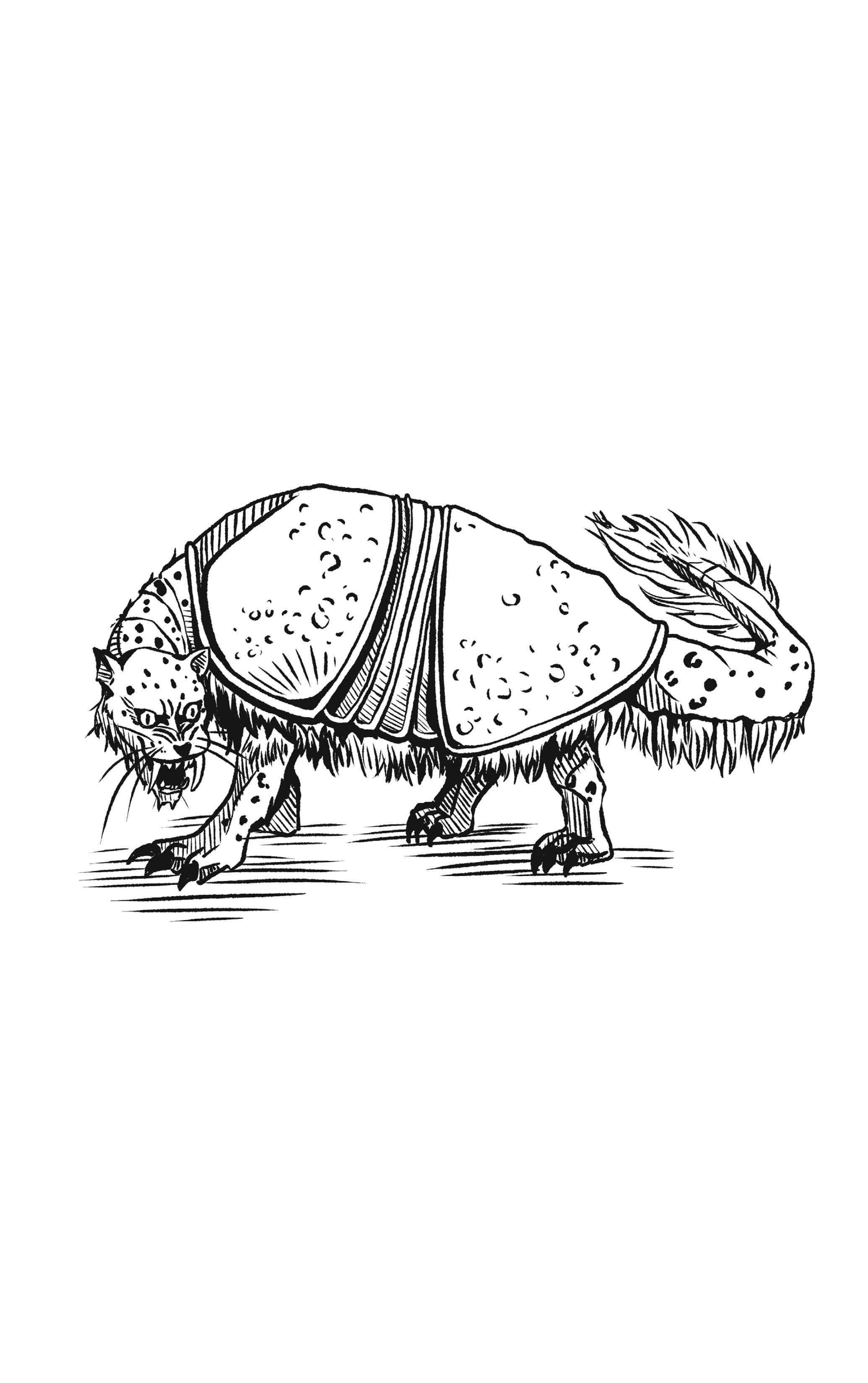
An eighteen-foot-long aquatic monster lurks in the rivers of East Africa. Sure, Nile crocodiles grow that big, but look nothing like the savage Dingonek.
The Dingonek, long known by natives, is a chimera of known creatures. Large, leopard-shaped head (sometimes described as looking like an otter or dog), the armored body of an armadillo, feet the size of a hippopotamus’s but tipped in sharp deadly claws, and a tail that aids it in swimming. Oh, and walrus-like tusks, long and white. It lurks in Kenya’s Maggori River as well as Lake Victoria, which stretches into Uganda, Kenya, and Tanzania.
British big game hunter John Alfred Jordan claimed to have encountered a Dingonek in the mid-nineteen-naughts, relating
his story to Edgar Beecher Bronson, a Nebraskan rancher, big game hunter, and author.
Jordan told Bronson the creature was parts of a leopard, whale, and sea serpent.
“Before me lay a totally unknown monster which I should be the first to record,” Jordan said in Bronson’s 1910 book, In Closed Territory. As a big game hunter, he had the right caliber bullet, and put a .303 slug behind the Dingonek’s “leopard” ear. Then the beast did something that surprised Jordan. It didn’t die.
“An extraordinary thing occurred,” Jordan said. “The beast turned and, facing the bank, leapt straight upward into the air, standing, as it appeared to me, ten or twelve feet on end.What happened after that I do not know, for, losing my nerve, I scrambled up the bank.”
Jordan later returned to the spot of the encounter, but found neither creature, nor footprints.
Around the same time as Jordan’s encounter, the British Superintendent of African protectorates, Clemet Hill, witnessed what he believed to be a Dingonek from the steamship he was aboard on Lake Victoria. A head reached out of the water and attempted to snatch a sailor.
“He was quite certain it wasn’t a crocodile,” an acquaintance later said, according to an article in Atlas Obscura.
The clincher for the possibility the Dingonek exists is the natives know it exists. They believe it is a spiritual (and frighteningly physical) being that, when sighted, means a good harvest, and healthy flocks. But, if this creature exists, what is it?
Portuguese writer Carlos Albuquerque thinks he knows, and published his thoughts in a 2024 article in Medium Magazine entitled “The Dingonek Is a Dicynodont!”
The dicynodont lived in the mid-Permian period (270 million years ago) in Gondwana, a landmass that included present-day Africa, Madagascar, Australia, Antarctica, the Arabian Peninsula, and the Indian subcontinent. That’s a lotta space.
They were herbivores with tusks and a beak (make up your mind, dude). The end-Permian Extinction, 252 million years ago, decimated the dicynodont, but the species didn’t go extinct until the end of the Triassic Period 201 million years ago. At least, I guess.
Drawings of a creature like the Dicynodont are on walls in the famous prehistoric French cave paintings, as well as in caves in South Africa.
Hmm. If the Dicynodont lived long enough for humans to paint it (anatomically correct humans have only been around for 300,000 years, folks), why couldn’t this prehistoric beast still be alive today?
Trunko
Durban, South Africa
The story starts where all good stories do, with an unsubstantiated firsthand account. However, it ends in a rotten mess. That doesn’t sound like much fun, but just wait.
H. C. Ballance, of Durban, South Africa, walked along the beach at Margate on October 25, 1924, when he saw a great thrashing in the water. Two whales fought for their lives “against a strange sea monster whose head reared up twenty feet above the surface of the sea,” claimed an article in the (Elwood, Indiana) Call-Leader. March 25, 1925. “Ballance watched while the monster killed both whales and, exhausted—” (Now, here’s where it gets interesting—) “floated ashore on its back.”
Ballance left and went home. (Because he remembered an “appointment”? I hope your haircut was worth ignoring what could have been the greatest zoological find of the century, pal.) When he returned the next day and measured it, the beached sea monster was forty-seven feet long, with a ten-foot-long, two-foot-wide tail, and “instead of a head, a trunk like an elephant’s, five feet long and fourteen inches in diameter, but resembling a pig’s snout at the end.”
The most interesting characteristic (at least to me) was the “snow-white hair ten inches long” that covered the sea creature’s body. What sea creature is covered with hair long enough to style?
It lay on the beach for the next ten days (wait—physical evidence?), according to the newspaper account, then a “native saw it reflect itself and swim off in a southeasterly direction.”
Okay, okay. I get that a Giant Yeti Sea Monster may have swum the shark-infested waters off South Africa battling whales with its elephant/pig snout, then chilled on the beach for nearly a fortnight until it recovered from its fight, but the fact that nobody went to the beach to throw rocks at it is beyond me.
It only took seventy-four years to give the monster a name. British zoologist Dr. Karl P. N. Shuker in his 1996 book The Unexplained: An Illustrated Guide to the World’s Natural and Paranormal Mysteries dubbed the creature Trunko. Fitting.
Calling Trunko “one of the most bizarre cryptids ever reported” in a 2010 blog post, Shuker pointed out what you’re already thinking, that Trunko “washed up onto the beach, where it lay for several days before the sea took it back out, never to be seen again. During those several days, however, not a single scientist bothered to venture forth to examine or even observe this extraordinary creature’s remains.” Right.
And Shuker, as the rest of the world’s cryptozoological enthusiasts believed, was also curious as to why no one ever thought to take a photograph. Apparently, someone did.
A. C. Jones of Johannesburg, a reporter and photographer with the Rand Daily Mail and Wide World Magazine, had indeed taken pictures of this creature. Annnnnnnd, it was a globster.
A globster is a huge unidentified mass of decaying sea creature that washes up on a shore and raises quite a stink—figuratively, and literally.
What was Trunko? Experts speculate it was probably the carcass of a whale shark or an actual whale. But, then again, Ballance reported seeing a huge hairy sea monster with an elephant trunk. I’m not going to argue with him.
Marozi
Kenya, Ethiopia, Rwanda, Uganda
The lion, smaller than a typical lion, without a mane, but with a hide adorned with leopard-like rosettes, roams the mountains of Kenya, Ethiopia, Rwanda, and Uganda. At least, that’s what the locals say, because Western science doesn’t think it exists.
Legends of the lion, the Marozi, are firmly implanted in East Africa, but the beast wasn’t seen by a Western man until British Colonel Richard Meinertzhagen claimed to have seen a spotted lion in 1903 in the Kenyan mountains. Meinertzhagen, a soldier, spy, diplomat, scientist, and ornithologist, wrote books on the subject of birds, and donated more than twenty thousand stuffed specimens to the British Museum. And, unfortunately, after his death, turns out Meinertzhagen was largely full of $%#&, having “embellished” many facts about his life, according to the article
“Meinertzhagen: Hero or Fraud?” by historian John Critchley. Unfortunate.
Nevertheless, in 1931, a European transplant to Kenya, farmer Michael Trent, encountered two spotted lions while in the Aberdare Mountains at an elevation of around ten thousand feet. He didn’t just “claim” to encounter them, he did what any upstanding European would have done to a beautiful wild (potentially rare and endangered) beast in 1931: He killed them, according to an article by Adam Benedict, “Cryptid Profile: Marozi,” from The Pine Barrens Institute.
The adult lions indeed had leopard spots, although since juvenile lions also have those same spots, later to outgrow them, some naturalists suspected they were normal lions.
The Nairobi Game Department, however, was interested in the specimens. The large male measured eight feet, eight inches long, including a two-foot, nine-inch tail. Both specimens possessed rosettes on their shoulders, thighs, and flanks, and solid spots on the abdomen and legs. The game department let the farmer keep the hide and skull from one of the animals.
In 1933, game warden Captain R. E. Dent saw four Marozi in the Aberdare Mountains at 10,000 feet, and two more at 11,500 feet.
Explorer K. C. Gandar Dower, vastly inexperienced and underprepared for a wilderness expedition in Africa, found himself in Nairobi (Kenya’s capital) in 1934, and set off in search of adventure, and wild beasts.
“How could I hope to find this rare animal, the very existence of which had for so long been unsuspected, in two thousand square miles of wilderness, through which we could hardly travel, to find
it and track it down, and shoot it, or photograph it and capture it alive?” Dower wrote in his 1937 book, The Spotted Lion.
Although Dower didn’t discover the Marozi, he did find lion tracks at the same elevation as Trent. He reported them to be smaller than a normal adult lion.
Mainstream science has never taken the Marozi seriously. Zoological speculation has ranged from Somali lions, or plains lions, or East African lions simply holding on to their spots too long, to lion-leopard crossbreeds (a leopon, to general knowledge is only produced in captivity), to an undiscovered species of lion. According to The Pine Barrens Institute, in 1955, cryptozoologist Dr. Bernard Heuvelmans dubbed the Marozi Leo maculatus.
I have my fingers crossed one day you’ll be proven right, Dr. Heuvelmans.
Bili Apes
Bili Forest, Democratic Republic of the Congo
The lion killer of the Bili Forest. When the Western world, especially primate specialists, heard stories from the thick forests of the Democratic Republic of the Congo of a great ape that walked on two legs, howled at the moon, looked like a giant chimpanzee, but built ground nests like a gorilla, and could kill and eat lions, the general consensus was, What are those tribesmen smoking, and where can I get some?
Then 2003 rolled around, and it wasn’t so funny anymore. Independent primatologist Shelly Williams, funded by a 20,000dollar research grant from National Geographic, marched five hours into the 34,175-square-mile forest in search of the apes in June of that year, and, well goldarn it, she found them.
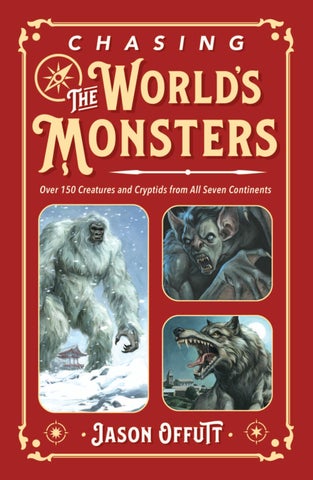
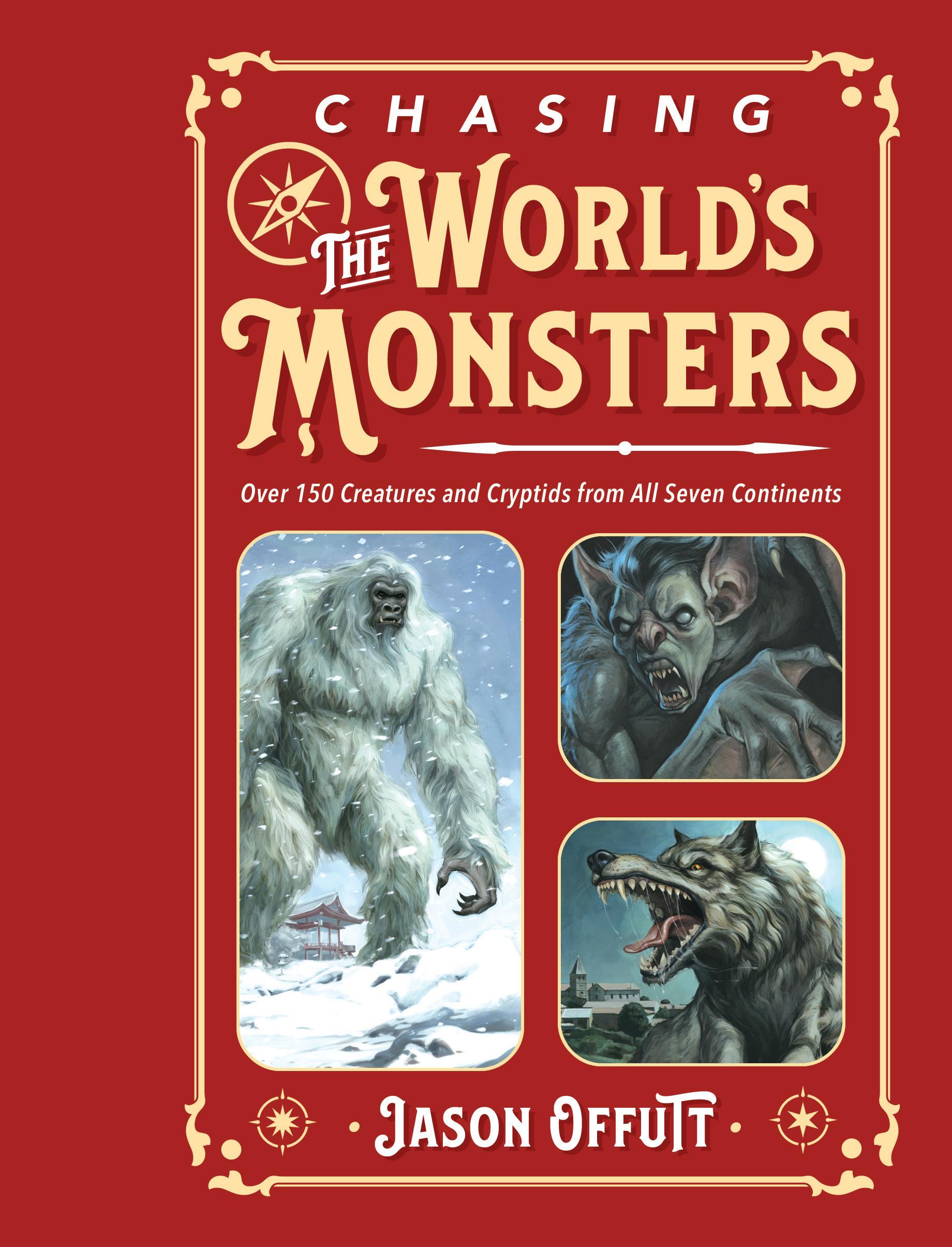
From Asia to Antarctica, this book travels across every continent in search of mysterious creatures. Cryptozoologist Jason Offutt is back, inviting you to follow along as he chases the Kongamato, Mongolian Death Worm, Orang Pendek, Man Bat of Briggs Road, and many more.
Featuring illustrations throughout, this riveting book shares eyewitness accounts of lake creatures like Argentina’s Nahuelito, jungle dinosaurs like the Congo’s Mokele-Mbembe, and giant birds like India’s Garuda. Even Antarctica has a slew of beasties that will fascinate and frighten you.
Are these monsters real? Find out in this thrilling collection.
•Escape the clutches of Russia’s Baba Yaga
•Dare to get personal with New Guinea’s Devil-Pig
•Uncover the lair of Ucumar, the bear-man of Argentina
•Protect the children from Ghana’s Adze (vampire)
•Search through murky waters for Encantado, the Amazon River’s were-dolphin
Jason Offutt teaches journalism at Northwest Missouri State University. He’s the author of numerous books, including Chasing American Monsters and Chasing North American Monsters. He has been interviewed on Ancient Aliens, Beyond Belief, Investigation Alien, Coast to Coast AM, Whitley Strieber’s Dreamland, Destination America, Binnall of America, Darkness Radio, and other prominent paranormal podcasts. Visit him at JasonOffutt.com.