Krampus, Witches, and the Wild Hunt, by Christian Brunner, Sophie Reyer, and Wolfgang Liemberger
Praise for Krampus, Witches, and the Wild Hunt
“This is literally a folkloric feast, straight from Europe’s highest, most romantic, and most story-laden mountains. It manages to mix exciting folklore, practical seasonal ritual and magic, and delicious local food recipes, in equally generous quantity—the perfect gift for the dark of the year, anywhere in the world that looks to European roots.”
—Ronald Hutton, author and historian
“For the last century or so, we have painted over our fear of the colder months with songs and stories of mistletoe and holly; with tidings of love and good cheer. But no matter what façade we slap over winter, what has always lurked within the frigid darkness are monsters, witches, and ghosts haunting and hunting us when we’re most vulnerable. Thankfully, these beasts are making a Yuletide comeback because we need them now more than ever. In Krampus, Witches, and the Wild Hunt, three Austrians hailing from the land of Krampus bring their unique perspectives and expertise in this entertaining guide to the legends and lore of dark seasons long, long ago. You may want to leave the lights on this winter.”
—Jeff Belanger, author of The Fright Before Christmas
“As a longtime companion and friend in constant dialogue with Wolfgang Liemberger about the ancient myths between our Rhineland and their Alps, I am all the more delighted by this fascinating result of decades of love for myths and mysteries, which he has manifested together as a collaborative authorship with Sophie Reyer and Christian Brunner. …This book is an atmospheric journey through the dark heart of Alpine traditions, combining profound knowledge and impressive results of persistent, passionate research with captivating narrative power. An authentic masterpiece for all who wish to understand which archaic forces remain alive in our legends to this day.”
—Rebecca Hohlbein, author and artist
“This book is both an incredible documentation of passed on traditions and a collection of firsthand experiences. More importantly, it is a call to action to keep these practices alive through detailed instructions. You will feel inspired to embark on your own journey, fostering a deeply profound spiritual awareness and connection. Much of the intuitive connection our ancestors had to
the ‘unseen’ has faded. By bringing fantasy to life with my work in prosthetics, creature design, and SFX makeup, I aim to awaken the imagination and reestablish a connection to those hidden realms. This outstanding folkloric work about Krampus, witches, and the Wild Hunt achieves that effortlessly.”
—Pamela Goldammer, SFX makeup artist and prosthetic designer, Oscar nominee
Krampus, Witches, and the Wild Hunt
About the Authors
CHRISTIAN BRUNNER is an Austrian-born folklorist whose work centers on the living and historical Alpine traditions. Raised in small-town Austria, he grew up in a landscape where Krampus-runs, Perchten masks, and midwinter customs were part of cultural life rather than staged spectacle. These early experiences shaped his lifelong interest in how communities use ritual, story, and material culture to navigate life, including the darkest time of the year.
Brunner is the author of the award-winning book Alpine Witchery and other works on traditions of this region. His research blends archival sources, trial records, and ethnographic observation to illuminate the social and symbolic roles of winter creatures and customs. Now based in Massachusetts, he teaches, writes, and leads workshops that explore how these traditions continue to evolve, offering insight into the enduring human need for meaning, protection, and transformation during the long nights of midwinter.
Vienna-born SOPHIE REYER is an Austrian author, playwright, composer, and screenwriter and lives in Baden, Lower Austria. With her incredible output of over 170 books—from novels to poetry to children’s fairy tales and scientific essays—she is one of the most published writers in German-speaking territories.
Reyer holds degrees in Composition/Music Theatre and Scenic Writing and earned her PhD in Language Arts and Screenwriting from the Academy of Media Arts Cologne in 2018. She lectures at the University College of Teacher Education of the State of Lower Austria and conducts research at the University of Applied Arts in Vienna.
She received the Literary Advancement Award of the City of Graz and the Manuskripte Advancement Award. She was shortlisted for the Austrian Book Prize in 2019 for Mutter brennt and in 2021 for 1431
Sophie Reyer also wrote the screenplay for the thriller-drama Death of My Youth (1st Prize at Chelsea Film Festival 2025). Dealing with myths and strong female heroines is her passion, and her books 111 Wiener Orte und ihre Legenden (2019) and Tod bei den Salzburger Festspielen (2025) became bestsellers.
WOLFGANG LIEMBERGER is an Austrian filmmaker, author, and cultural documentarian, working as director, screenwriter, cameraman, and producer realising feature films and documentaries for cinema and TV—also image films, music videos, theatre projects, and cultural events. Early on, he was fascinated with dark winter spirits, storytelling, and myths and studied filmmaking, screenwriting, and journalism at Vienna Film School and University of Vienna. Liemberger began succeeding as a filmmaker, screenwriter, and creative producer who cowrote Austrian comedy drama blockbusters Echte Wiener—Parts 1 & 2 and Blunzenkönig/The Butcher King, all with legendary Austrian actor Karl Merkatz.
He works on books with media and mythology topics as cowriter, editor, and photographer, as well as being a journalist and media trainer. Currently he develops fantastical film and book projects about and with German bestselling fantasy author Wolfgang Hohlbein, and he explores the shadowed Perchten folklore with documentary, feature film, and book projects. Liemberger’s goal is to bring the Otherworld into our world between eternal darkness and renewal light. He is a member of the Austrian Film Academy.
Krampus, Witches, and the Wild Hunt
Alpine Traditions for the Dark Half of the Year
Christian Brunner • Sophie Reyer • Wolfgang Liemberger
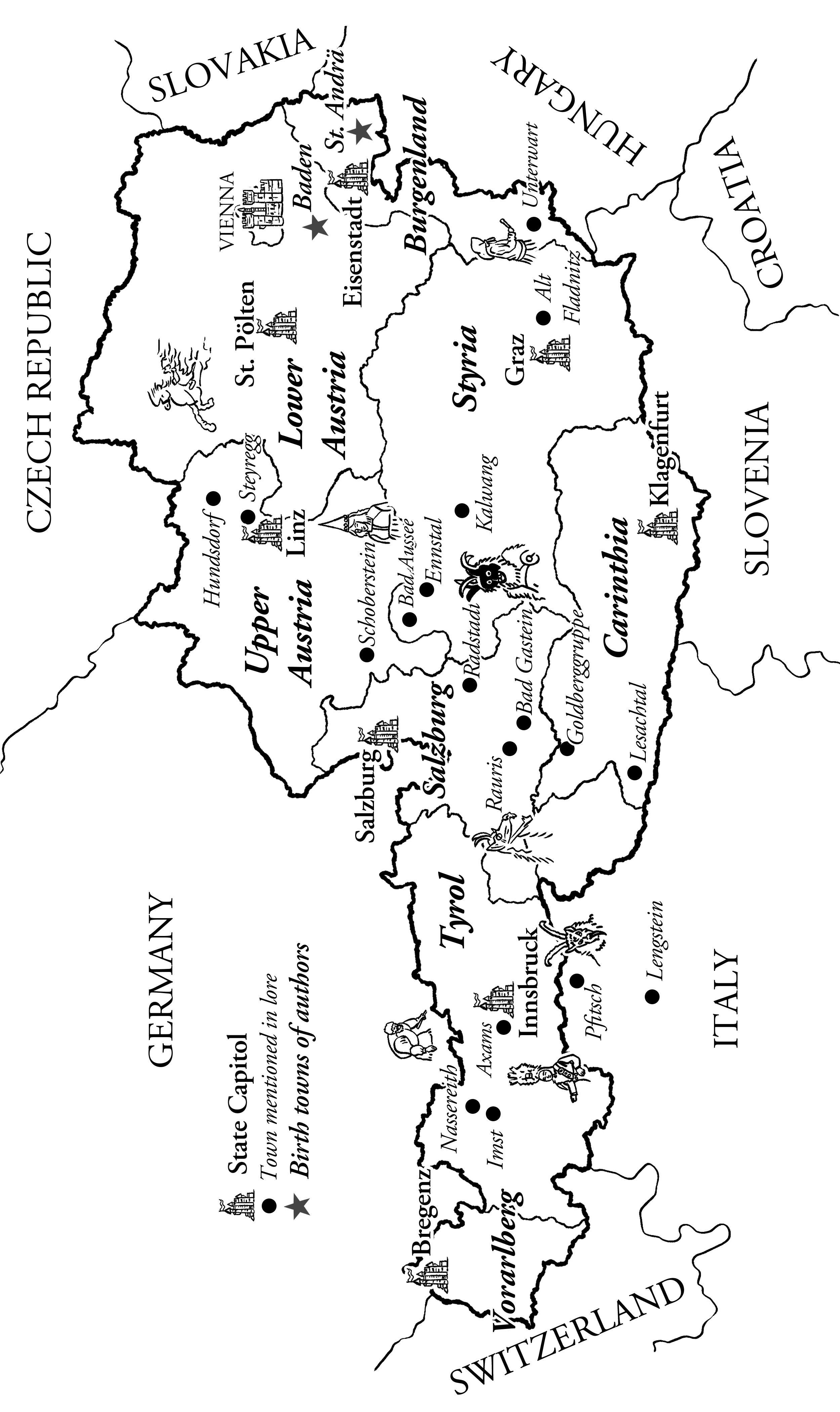
Map illustration by Christian Brunner and the Llewellyn Art Department
Photography is used for illustrative purposes only. The persons depicted may not endorse or represent the book’s subject.
Llewellyn Publications is a registered trademark of Llewellyn Worldwide Ltd.
Library of Congress Cataloging-in-Publication Data (Pending)
ISBN: 978-0-7387-8215-7
Llewellyn Worldwide Ltd. does not participate in, endorse, or have any authority or responsibility concerning private business transactions between our authors and the public.
All mail addressed to the author is forwarded but the publisher cannot, unless specifically instructed by the author, give out an address or phone number.
Any internet references contained in this work are current at publication time, but the publisher cannot guarantee that a specific location will continue to be maintained. Please refer to the publisher’s website for links to authors’ websites and other sources.
Llewellyn Publications
A Division of Llewellyn Worldwide Ltd. 2143 Wooddale Drive Woodbury, MN 55125-2989 www.llewellyn.com
Printed in the United States of America
GPSR Representation:
UPI-2M PLUS d.o.o., Medulićeva 20, 10000 Zagreb, Croatia, matt.parsons@upi2mbooks.hr
Forthcoming Follow-Up to Krampus, Witches, and the Wild Hunt
Krampus, Witches, and the Wild Hunt Oracle Deck
Other Books by Christian Brunner
Alpine Witchery: Austrian Folk Magic, Lore, and Spellcraft
Amanita: A Shamanic Novel
Forthcoming Books by Christian Brunner
Traditional Folk Magic in the Alps
Austrian Cooking for the Wheel of the Year
An Alpine Druid Path
Other Works by Sophie Reyer
Books
Tod bei den Salzburger Festspielen
Die Wilderin
Ein Schrei. Meiner
Die Königsbraut und das fremde Kind
BioMachtData
1431
111 Wiener Orte und ihre Legenden
Mutter brennt
Films
Death of My Youth (cowriter)
Forthcoming Books by Sophie Reyer
Im Schatten des Opernballs
Other Works by Wolfgang Liemberger
Films
Franzens World Panorama: A Ferry Radax Bricolage (codirector, writer, producer)
Toifi Tag: Devils Day (director, DOP)
Paul Morrissey: Trans Human Flesh and Blood (DOP, coproducer)
Der Herr Karl (codirector, DOP)
Der Blunzenkönig: King of Black Pudding (cowriter, creative producer)
The Eternal Servant: Hans Moser in Portrait (director, writer)
Echte Wiener: True Viennese (cowriter)
The Lost Child (director, producer)
Books (coauthor)
40 Years: Wolfgang Hohlbeins—The Hexer from Salem
Serielle Zustände
Ferry Radax: Vision, Utopie, Experiment
Forthcoming Films by Wolfgang Liemberger
Percht! (director, writer)
Gerhard Heinz: A Life for Film Music (cowriter, DOP)
Contents
Introduction 1
Chapter 1: The Dark Half 9
Section 1: From Light to Darkness
Chapter 2: November 2nd—All Souls’ 19
Chapter 3: December 4th—Goddess and Saint 27
Chapter 4: December 5th—Krampusnacht 33
Chapter 5: December 13th—Luzltag 43
Section 2: Darkness
Chapter 6: The Rauhnächte 55
Chapter 7: The Wild Hunt 67
Chapter 8: Mother Percht 75
Chapter 9: The Perchten 93
Chapter 10: Winter Spirits 121
Chapter 11: In Your Practice 145
Section 3: From Darkness to Light
Chapter 12: February 2nd—Lichtmess 173
Chapter 13: Fasching 181
Chapter 14: March 21st—Spring Equinox 187
Chapter 15: April 30th—Walpurgisnacht 193
Conclusion 203
Calendar 205
Pronunciation Guide 207
Works Cited 215
Introduction
It may have been simple coincidence, the calling of fate, or whispers from the realms of the spirits that brought us three Austrians—a Druid and writer; a bestselling author, screenwriter, and professor specialised in Alpine lore; and a filmmaker, cameraman, and author—together and urged us to create a book about the time between November 1st and April 30th, also known as the dark half of the year. In this fun, fruitful, and mysterious collaboration, we will share from our childhoods and our later travels throughout the Alps the many peculiar traditions, dark lore, rituals, and recipes that come from the folk culture of Austria.
Our ancestors are believed to have divided the year into two halves rather than four seasons; this book is about the dark half. While there is an abundance of lore and traditions related to the light half, our interest was drawn to the ominous, to the mystery of the darkness. What is it that compels people to see monsters and strange creatures in the shadows of the night or in the deep forest? Why would folks dress up as terrifying demons, tell frightening stories to their children, and visit homesteads to perform ritual?
But before we answer these and many more questions, let us introduce ourselves.
Christian’s Memories
As the snow slowly blankets the small village where I, Christian, am spending this year’s winter holidays in a fluffy, white cover, absorbing all sounds and quelling the business of the mundane world, I sit here next to the old
green-tile stove and enjoy a mug of hot mulled wine. Whatever is out there in this dark night cannot get to me, for I am inside, warm and safe. This is how I remember the nights between the Winter Solstice and the Perchtlnacht (January 5th) of my childhood here in my late grandparents’ house.
As a child, it was a dare to go outside during those nights. Earlier in the month, Krampus might have caught you and taken you to his lair for a year and a day, and all kinds of other creatures were said to linger in the shadows of the old barns and to hide in the elderberry bushes along the creek. When the winds howled through the swaying pine trees, all you wanted to do was hurry back home so the Wild Hunt wouldn’t take you with them. After all, the Percht could get hold of you, and if your room was messy, she would slit your tummy open and fill it with the muck in your chamber.
Yet it is not only the darkest core of winter that is filled with traditions that more often than not have been handed down since pagan times, since before approximately 500 CE. We also stroll around cemeteries in the evenings of All Souls’ and All Saints’—two festivals held in early November that revere the dead—and we gaze in amazement at the sea of candlelights on all the graves. Eleven days later, we fill our bellies with Frau Holle’s bird, the goose. There is no inn or restaurant that doesn’t serve this rather fatty waterfowl together with dumplings, red cabbage, and, if you are lucky, a dessert of sweetened chestnuts with whipped cream and Schnaps to help the stomach deal with all that grease and sugar.
Fasching, as we call the period around what is known as Imbolc in contemporary Paganism, was a favourite time of mine, both as a child dressing up in costumes as well as a teenager going to parties. Not much has changed throughout the years, only that the cute little prince with the three-pointed hat, cape, and plastic sword from back then is now dressed as Axl Rose from Guns N’ Roses or as the Terminator, all with fake lacerations of the facial skin and aluminium foil underneath as if my skull were made of metal. There also were—and still are—the more official ballroom dances during that time with attendees wearing fancy gowns and tuxedos.
In March, how many have spent the witch’s hour on a mountaintop lighting a bonfire only to observe the same happening on the peaks around them? And who didn’t stay up all night doing almost orgiastic feasts and dances with witchy friends somewhere on the mountains during the Walpurgisnacht?
Now, several decades later, I have since learned the archaic practice of shamanic work—first through core shamanism and then through short but intense work with shamans from Tuva, Siberia. Later, when residing in the United States, and in the end Austria, I was taught to be a guide for the dying and their loved ones after hospice ends and before undertaking begins—in other words, to be a death midwife—and dedicated myself to the path of a Druid. I am also fulfilling my destiny by telling the world about the intricate—and sometimes frightening—traditions and mystical tales of my home country of Austria. Together with my brilliant coauthors, Sophie Reyer and Wolfgang Liemberger, I am now embarking on a fascinating exploration of a period we encounter each year: the dark half.
Sophie’s Memories
Even as a small child, I loved it when the leaves dropped from the trees and I had to bury my nose deep in the collar of my coat when I was out on a walk. Maybe my heart was always lifted at the beginning of the dark season because my birthday is in winter on the day before the solstice, and I was already looking forward to the gifts and holidays as the nights began to grow longer in autumn.
I don’t know. But the dark half of the year has always been my time, still to this day. When the days grow shorter, the world seems more magical. The veil that separates the apparent world from imagination is lifted, and for a short while, everything seems possible.
I remember visiting the cemetery at All Saints’ with my parents when I was young. I asked, “What’s underneath that stone?”
“A body,” they responded.
“And why all the candles?”
“For the dead.”
I nodded, buried my hands deep in the pockets of my warm jacket, and tucked my chin under the collar of my turtleneck. I didn’t really comprehend it then, and if I am completely honest, neither do I today. I have asked myself ever since if “the rip” can even be fully understood. One time someone is here, and then no longer, their body crumbling to dust and ashes.
But not understanding death has never meant not being fascinated by it. Even as a child I was interested in everything around it, and in all that is
connected to the realms betwixt and between, to the Otherworld. All Saints’ was also intriguing because my father would hollow out a pumpkin, carve a face into the rind, and place a candle inside it so it looked as if the fruit had come to life. It was alive for me, anyway.
I also loved watching the Krampusse run around in my small home village of St. Andrä am Zicksee. They were enormous and hideous and reminded me of my grandmother’s stories about all the otherworldly creatures described in this book. Her favourite was the tale of when the animals can speak like people at midnight of December 24th.
These childhood experiences inspired me from the early days of my life, and as a student I began to look more into the historical and theoretical aspects of this wintery period. I read a lot of lore, penned down the tales of my grandmother and others, and began interviewing folks from other regions of Austria. Soon, I began to recognise repeating patterns and structures that drove me to research the matter in even more depth. In that sense, this book is a start to bring what I have gathered over the years into the light.
Wolfgang’s Memories
Since my early childhood, I have been fascinated by tales about the creatures of the Wild Hunt. My grandmother told their stories on winter evenings when sitting in the warm living room of her home while the world outside had been lost in the snow for weeks. As a kid, I pressed my face against the cold windows whenever I could, staring into the darkness and trying to get a whiff of the noises the creatures of the winter nights are rumoured to make. These stories of my grandmother fascinated me more than all those regular fairy tales and have always inspired my imagination.
Nowadays, I strive to carry this imagination, these creatures, into the world, by means of books like this one and as the filmmaker that I am— working on a dark fantasy feature film and a mystic documentary film, both of which deal intensively with the Perchten mythology. These legends are more relevant than ever. The archaic symbolism for eternal winter and the manifestation of animalistic darkness, which we carry deep in our souls, needs to break out into the apparent world. Pagan beliefs, myths, symbolism, and legends, descending from the culture local to the Alps, are all melting together and lead our inner child into this shadowy, magical Otherworld.
To me, the dualism of male and female, dark and light, of giving and taking life, are all aspects of the principle of mirroring, where the nocturnal realm reflects the world of daylight and vice versa. Thus, I am on an everlasting search for the counterparts of man, beast, and plant in the domain of shadow, and what better place to find them than in the darkness where they lurk, in the time between times? Particularly during the darkest part of the year, I feel the doors to the Otherworld open wide, and the veil to the realm of spirit is especially thin and permeable. And for me, this comes with a reciprocal energetic connection between us and these spirits and creatures.
In this way, the Percht, the White Woman, and the Salige Madln, the dark creatures like the Schiachperchten, Krampus, and some real nightmares of phantastic beasts like the Habergeiss, the Saurüssel, and the mighty Schnabelperchten have all gotten close to me; I would even call them friends, and therefore it is my—our—goal to bring this Otherworld into our realm, closer to you, so close that you can almost feel its icy breath on your neck.
Life in the Alps
The Alps, and particularly what we call the Innergebirg (the inner mountains), present themselves as this wonderfully serene landscape, with beautiful villages, pastures bursting with wildflowers, where cows graze and, as we say, fox and hare say goodnight to each other. In the world-renowned 1965 movie The Sound of Music, we witness the full beauty of the scenery when the main character, Maria, frolics over a meadow with the village where Christian’s grandparents once lived in the background.
Yet the folks dwelling there year in and year out—and even more so our ancestors a mere three, four generations and beyond ago—have always perceived the area a bit differently. Those whose livelihood depended on the land, as well as the trades supplying the needs of the farmers—blacksmiths, millers, bakers, tailors—have always known the darker side of life when surrounded by peaks up to four thousand meters (thirteen thousand feet). The flat areas in the valleys where you can sow and harvest crops are very limited. The deeper you venture into the range, the steeper the mountainsides get, and more often than not farming machinery cannot be used lest they tumble into the valley. The Austrian government even subsidises farmers based on
the degree of incline of their land to enable them to somewhat compete with those in the rolling foothills and the flat lands in the east of the country.1
Dairy production there is easier than planting crops, for the cattle can be brought up to the high Alpine pastures for the summer, and cows, goats, and sheep do not mind the gradient of their feeding grounds, particularly as the fodder up there is rich, tasty, and healthy.
The incline itself also harbours some danger to humans, livestock, and homes. Heavy storms, particularly in August, often forming anew during the morning and midday, send torrential rain down the mountains. The small creeks become dangerous flash floods, and every now and then, a mountainside gives way to erosion and crashes down on farms and villages. It’s not much better in winter, for instead of mud, avalanches slide down the mountains, having the same effect. And if it’s not avalanches in the depth of winter, huge amounts of snowfall often cut whole valleys, and with that people and their animals, off from the rest of the world, off from food and health services.
Even when enjoying the beauty of the Alps as tourists, hundreds of people come face-to-face with the wrath of nature there, falling to their death, overestimating their hearts’ health when hiking uphill for hours, not being equipped for the sudden changes in weather—we all sometimes bear witness to snowfall in the summer here—or underestimating the time needed to get back down to the safety of the village and then getting lost in the darkness of night.
One of these places is in the Rauris Valley, were the Bucheben hamlet—a cluster of farms, single-family homes, and horse pastures, all tucked between high mountains, including the Sonnblick glacier—lies in continuous shadow throughout the winter months. When temperatures below freezing and icy winds arrive in late fall, they keep that valley in deep snow for almost the entire dark half of the year.
Let’s also not forget that it is generally darker in narrow valleys throughout the day than on wide-open plains. It takes much longer for the sun to rise above ridges so high that they are covered by eternal ice, and at the same time the big, warming star giving light to us sinks below the equally high
1. B. f.-S., 2025.
ridges on the other side of the valley early in the afternoon. There are glens oriented from north to south in the high Alps that don’t get any sunshine in winter, which can take a toll on the minds and spirits of the people living there.
This is not at all meant to discourage you from visiting this beautiful place—please do, and we are sure you would enjoy it greatly. But knowing about this less-advertised side of life in the Alps should help you get a glimpse of why we keep our dark and beloved traditions alive.
Chapter 1
The Dark Half
We don’t know for sure how our ancient ancestors who dwelled in the Alpine region divided up the year. We do know that agriculture was the main form of income in the centuries past until urbanization and emancipation from feudal systems allowed more and more people to take vacations, which gave rise to a solid tourism industry. But how they perceived time, and measured it, we can only guess. There are indicators, though.
Agriculture is heavily tied to and dependent on seasons, even today. Yes, transportation cost for out-of-season food items is so low nowadays that we can enjoy fruits and vegetables that grow in different climates all year or in the other hemisphere when winter has gripped the land in our own. But that notwithstanding, the crop growers still cannot sow in fall and harvest in the dead of winter.
Therefore, it makes absolute sense that the farmers of old divided the year into segments. They could and we still can observe four distinct seasons as we experience them in the temperate climate zone in which the Alps are located. And in each season, different farming chores need to be done to ensure we take advantage of the cycle of growth throughout the year.
In today’s world, the seasons are linked to the four main stations of the sun, each quarter starting either at an equinox (i.e., spring or autumn) or a solstice (i.e., winter or summer). And many megalithic and other thousandsof-years-old monuments all over the world are clearly aligned with these four prominent stations of the sun. That counts also for the Alps, although folks there didn’t always have to erect markers to measure these important transition
days. Many mountain peaks still bear names indicating how people there used them to mark solstices or equinoxes. Sometimes the actual point in time the mountain peak was used to measure has been lost to memory, but the peaks still bear temporally significant names, such as the Peilstein (Sussing Rock) near our—the authors’—hometowns.
Yet there also was a different way to section the year into parts. One of these was to divide the time the earth revolves around the sun into two halves. In the lighter half, people and livestock are out and about producing stuff, and in the darker half, they are inside, seeking shelter from the cold and inclement weather, readying themselves for the lighter half. Likewise, they prepare during the light half to survive the dark one. A never-ending cycle. Interestingly, the division points of these two segments are not aligned with any of the four stations of the sun but are each set right between an equinox and a solstice.
The Journey Within the Book
This book has three main sections. Each one opens with a beautiful, mysterious poem crafted by Sophie before we dive deep into the dark mysteries of each of the three time periods of the dark half of the year.
The first period starts on November 1st, in modern Paganism often referred to as Samhain and the day after All Hallows’ Eve or Halloween, and ends on the Winter Solstice on December 21st or 22nd, the astronomical beginning of winter with the shortest day and longest night, the time when the land and humans slide into the darkness of winter. The second section is all about the fortnight following the Winter Solstice. While a much shorter period, only two and a half weeks long, it is the darkest one and it therefore may not come as a surprise that this is the centre of the book, where we meet the most mystical creatures, some deities, and outright beasts. We finally dedicate a third section to the time from January 7th to the night before Mayday, Walpurgisnacht, the witches’ Sabbath. In this part, we explore traditions that slowly lead Alpine folks back into the light half, summer.
The first and third periods—or book sections—are all neatly structured. There are certain days when we honour the dead or some deities that are disguised as Catholic saints, delve into the shenanigans around Krampus, or party until early morning in February.
The middle section, short as it is, represents utter chaos. And it is this very chaos that compels us to thoroughly explore its many details. There are days on which we observe certain traditions, and then there are traditions we observe on all these days. There is a plethora of creatures that are rumoured to roam around that time, none tied to a certain day, and nobody knows when they show up and haunt you. All we know is that they will show up— it can be any night or many nights—but there is neither rhyme nor reason.
The chapters all have segments where we take a more anthropological approach and present the origins of the celebrations and characters associated with the festivals. But, when researching for the book, it became quite clear early on that there are too many individual traditions and myths for any given day or character for us to include. The Percht alone has so many aspects and variations that we could fill a large volume with just observances about her, with all the various practices relative to her in this mountain range. With that in mind, we decided to stick with only the Eastern Alps, which includes Southern Bavaria and parts of Italy, and didn’t touch upon the traditions held in Switzerland and France. While we know that there are overlaps, we are not in a position to write about these areas with the same confidence we have writing about our region.
In the centre of the book, you will also find photos of several Perchtenruns and similar live events taken by filmmaker Wolfgang Liemberger, who banned the beasts of winter into bloodcurdling photographs.
Perchtenläufe, Heischebräuche, and Folklore
In this journey into, through, and out from the darkest time of the year, there are a lot of customs, many of which are exhibited in this book. However, there are a few traditions that are not bound to a singular day or event but are observed multiple times during fall, winter, and spring. We would like to present them here in advance so that you know all about customs like Heischebräuche and the Krampus- and Perchten-runs when they appear in this book.
Krampuslauf, Passen, Perchtenlauf
When visiting Austria and its bordering Alpine regions in Bavaria (Germany), Switzerland, Liechtenstein, Italy, and Slovenia around December 5th, you would likely find advertising for a so-called Krampuslauf. We will dive into the
traditions and lore about Krampus in depth later but want to take the opportunity to describe what’s behind a Lauf. The word itself is the noun to the verb laufen, which means “running” in English. There may be occasional running during these events, but for all intents and purposes, they are more like parades.
A Krampuslauf is organised by a group that is called a Pass. While that is, in its singular form, the same word as passport and mountain pass, here it just means “group.”
Until recently, there were only men in a Pass, but nowadays, women are acting as Krampus too.
Passen (which is the plural of a single Pass) are not limited to Krampusruns. Groups that organise Perchten-runs and even those who perform the tradition of Aperschnalzen—cracking whips rhythmically as a whole group—are called a Pass too. Many of these Passen perform all three customs.
There are differences between Krampus- and Perchten-runs, not only regionally, but also depending on the size of the community. In smaller ones, the Krampus-run may happen in the village centre with everyone gathering on the main square, organised by the local Pass. Depending on the size of the village or town, the organising Pass might invite other ones. The hosting Pass is the one who has a St. Nicholas as a character in the event, while the visiting groups leave their Nikolos at home. Children these days are used to the thought of seeing multiple, if not even hundreds, of Krampusse at a time, but more than one St. Nicholas is considered too confusing for the little ones and therefore is often avoided.2
Sometimes it feels that the Krampusse and other beautifully mysterious and shadowy creatures steal St. Nicholas’s thunder, even though he distributes the goodies to the folks around. But who could blame the onlookers from kid to grandparent for being fascinated by the shenanigans of furry beasts making a ruckus?
Larger Krampus-runs are organised as parades, with whole streets or blocks closed to traffic and metal fences separating spectators and the Pass; the latter walks along, showing off masks, costumes, and gear. There is some taunting and whipping too, but not like in village settings.
Originally, Krampus-runs take place only around December 5th, and Perchtenruns are not performed before the Winter Solstice, and not after January 6th.
2. Kronawettleitner, 2024.
Even though it’s typically the same Pass that performs both, if they consider themselves traditional, the creatures don’t appear in the respective other run.
Nowadays, these runs are sometimes no longer bound to these narrow time frames, except in the areas where particularly traditional groups staunchly adhere to century-old lore.
Unfortunately, commercialisation has infiltrated this tradition since the 1980s, and many newer groups especially in urban areas now start their activities after Halloween, which has been introduced in Austria to a certain extent. Often enough, masks inspired by horror movies and the current fantasy movie boom have also found their way into the custom.
At the same time, there are Perchten-runs after January 6th mostly in Alpine Bavaria, merging the Perchten traditions with those of the subsequent carnival season.
Heischebräuche
Another practice that we find in the Alps is the Heischebräuche. One of the best known of these is the custom of trick-or-treating children in the United States of America widely observe on Halloween. This practice seems to stem from Irish immigrants to the United States and therefore does not originate there. Trick-or-treating is only one form of these Heischebräuche, one that threatens to play a trick if the desired treat is not given. This form does exist in the Alps too, while others are based on small performances—a poem, dance, or song, for example—for which the children get something in return. Bräuche (or singular Brauch) is simply a German word for “tradition” or “custom,” but heischen needs a bit more explanation. It is an older word and hardly ever used in colloquial German anymore. The only time it may appear in modern text is within a short phrase: “um jemandes Gunst heischen,” which means “to beg for someone’s grace or goodwill.” Although, it’s not really begging in the sense of being subservient; it is more like asking for a gift convincingly, and part of the convincing can be a small favour or the threat of mischief.
Other Elements Along the Journey
Along with specific customs, you will find other regular elements in each chapter to enhance your journey and exploration of the dark half. We will
share recipes, folklore, and practices, new and old. We will explore them generally here so you are ready when they appear in the course of this book.
Folklore
Each chapter includes lore relevant to the days and characters highlighted. For some chapter topics, there is so much available lore we had a hard time choosing which stories to incorporate, and for others we had an equally hard time finding any folktales, especially ones that are “of” the character—mostly legends of saints—or “with” the character, where they interact with humans. Where we had to choose from many, we were aware that there are usually even more versions of the same plot told in various regions of the Alps. Also, there are other tales of the same figure or about the same day.
One key element of folktales is that they are tied to a specific place or time, regardless of the presence of magic and supernatural beings. To keep this characteristic—which is one of the main differences to the fairy tale, which takes place in an imaginary realm—we left names of people and locations as they appear in the stories. By all means, map them out on the internet and find photos of the villages or mountains mentioned in the tales to get an even better picture of what local lore tells us.
Practice, Ritual, and Folk Belief
Third, we present selected practices such as rituals and meditations, some of which are very much traditional and have been widely observed for many centuries, while others are very local or newer. We do mention the area and reach of the practices wherever we know, but there is still a good chance that if you asked someone from the Alps about a specific custom, they might have never heard of it or know it being done differently. That is just the nature of these traditions, for they are influenced by the history of the people living in certain areas, whole families having stayed in the same village, valley, or region for centuries, others having been settled there in droves, their exposure to immigration, modern tourism, and pop culture shaping their practices.
What we also tried to do is make some of these traditions practical for readers far away from the origin of these customs. These are our own thoughts, and we do not want to give the impression that these represent traditions. They are marked as such to not cause any confusion.
Part of the practice suggestions we added are meditations. This is a newer concept and not traditional in the narrower sense. Yet even though folks of old might not have said “meditation,” they did lie in the grass and let their “soul dangle” or—maybe more feasible in the cold wintertime—sit in their armchairs, staring into the fire musing, pondering, or reflecting. There is always time to be active, and then there is time to put it all together, contemplate, and reflect—even navel gaze if you will.
Recipes
Finally, there are the recipes. Food is such an intricate part of celebration in the Alps. Whenever there are traditional items prepared for a specific day— for example, a particular sweet bread on All Souls’ Day—we present the recipe on that very day. Other food is just typically made and eaten during the period but doesn’t have a specific correlating day. For example, we drink Glühwein (sweet, mulled wine) on any day between November and the end of the skiing season in March. In the end, we had to choose to attach these food traditions that are relevant for a whole period to some topic, whether that be a specific day or one of the wild characters we are presenting. If we associate a meal with a specific day, that does not necessarily mean it’s the one and only day we brew, bake, or cook those things, but we did make sure that the recipe fits into the theme of these days somehow. Some of us eat Faschingskrapfen (filled doughnuts traditionally associated with carnival time, known as Fasching in German) all year round, because they are so good, and not only on Fat Tuesday, when it made most sense to present the recipe for them.
As is widely customary in Austria, the measures for the ingredients are first and foremost in the metric system, i.e., in grams and litres. We have translated the grams into ounces and pounds, but please be aware that the latter are still more approximations than exact amounts. For the most part, however, if you have a scale with ounces, you should get the expected results. Other recipes are flexible enough that we could give you a rounded number of ounces. There, you can eye whether more or less of an ingredient is needed, or you can change the amount according to your personal taste, especially when it comes to spices.
Section 1 From Light to Darkness
Parallel Goddess
Sophie Reyer
All your storms In all directions Inside and out. You become dragon Leading an army. You become wolf In all large forests. Become great hind With silver antlers Outlasting centuries. You sleep in the hollow peaks, Shape of movements, Crone of the darkness of night. Parallel Goddess.
Half a year is a long time, and we can observe several distinct periods in each half. For the dark half, autumn, which has started six weeks earlier at the equinox, sets in for real at the beginning of November. The days have been shortening since late September, but now you can notice it. The leaves have turned and fallen off the trees, and what’s left on the fields withers away, disintegrates, and provides food for microorganisms, which allows plants to grow next spring. The harvest has been brought in; only the vintners wait for the first nights of frost to affect the few grapes they left on the vines so that they become even sweeter, yielding strong dessert wines, also known as ice wines.
This first section of the dark half lasts until the first true snowfall. Every now and then, snow comes much earlier in the Alps, sometimes even in September. But that snowfall doesn’t stay on the ground for long. These early snows only lead us into the darkest time of the year, when the white cover sticks and we are getting close to the Winter Solstice—the shortest, darkest three days of the year.
Throughout this first period, folks in the Alps mark a number of dates with a variety of festivities, all in preparation for when the sun has reached its lowest point. We start with remembering those who have departed the plane of the living. A little more than a week later, some remnants of the old feudal system, where tax days were connected to the agricultural quarter days—in contemporary Paganism known as Samhain, Imbolc, Bealtaine, and Lughnasadh—are celebrated by a feast nowadays attributed to St. Martin on November 11th. At the beginning of December, there are three consecutive days addressing even older traditions: St. Barbara Day on the 4th, Krampus Night a day later, and then St. Nicholas on December 6th. About a week later, on December 13th, St. Lucia and her alter ego, the Bloodstained Luz, are the last characters celebrated and honoured before the world goes quiet for a week—until the doors to the Otherworld are pushed wide open at the Winter Solstice.
Chapter 2 November 2nd—All Souls’
The dark half of the year begins the day after Halloween with a sombre acknowledgment that there is no life without death. The eternal cycle of being, especially when considering new life being a rebirth—as at least some of our ancestors believed—requires the decay of the old one, a phase of withdrawal into the womb of the life-giving All-Mother Earth, before it can rise again after gestation, whether that is nine months in the mother’s womb or the season of winter for the seeds waiting to spawn again.
About seven weeks before the Winter Solstice, at All Saints’ and All Souls’, people in the Alps remember the dead in various ways. Influenced by Catholicism, the traditions nowadays centre around a visit to the graveyard or cemetery. While that is typically done on November 1st and 2nd anytime of the day, it is most mystical once darkness has set in. At that time, you might saunter sombrely through a sea of candles often in red, plastic containers, which give the flames an even more magical feel. The lanes between the graves are only sparsely lit, and thus you often see the other people visiting their ancestors resting there only as shadows gliding left and right between crosses, grave markers, and yews, the trees of eternity.
Yet this is only one part of the festivities of commemorating the departed. Irish lore, for example, tells us that there was much more going on relative to revering the dead, and that included the carving of turnips—pumpkins came later—and placing them on doorsteps, putting candles on windowsills to guide the souls of the ancestors to visit the home of their living kin, or
feasting in remembrance of those no longer with the tribe, while the children of the poor went from house to house to solicit some food.
While heavily commercialised internationally nowadays as Halloween, there were customs of hollowing out pumpkins and putting candles into them observed in the Lower Austria Wood Quarter and in the Burgenland next to Styria, regions renowned for growing pumpkins.
Unlike many other days of celebration following this first festival of the dark half of the year, All Souls’ does not have a particular Alpine creature associated with it. Of course, there is Death itself, the personification of this transition from the living to the dead. In correspondence with its function, Death is typically depicted as the Grim Reaper, a figure in a dark hooded cloak carrying a scythe.
Sometimes we see a skeleton under the cloak, but often there is just a gaping void where the face would be. Because of the tool that is thought to cut the thread of life, and to not say out loud what he is all about, Death is often called the Sensenmann (Scythe Man) or Schnitter (Crops Cutter, implying wielding a scythe). Because he is omnipresent and we can’t get rid of him, not unlike family, he is also often called Gevatter (Godfather) Death.
Other Early November Traditions
In the Alps, we do find a few of these traditions in some variation, yet most notably spread over a period of eleven days. Not on every one of these eleven days, but particularly on November 1st, 2nd, and 11th. Pope Gregor IV decreed November 1st as All Saints’ in 835 CE to give the faithful a day to celebrate the saints specifically. This was not meant to be a day of sorrow, and was therefore not really what folks were used to doing that time of year. Shortly before the turn of the first millennium, an abbot named Odilo of Cluny called for a day to remember the souls of the departed faithful, and shortly thereafter, per decree from Pope John XVIII, All Souls’ was instituted on November 2nd as a nod to the people wanting to not only celebrate the lives of some unknown folks the Church considered important, but also remember their own family members they lost to the Grim Reaper.3 3. Wolf, 2015.
Heischebräuche
In addition to the custom of visiting the cemetery, we find some regional Heischebräuche. Most notably, bakeries prepare an All Saints’ Striezel (braided bun) for people at home but also to hand out to children going door-to-door. Should the homesteaders not have such a sweet bread, they would give at least some other loafs or buns to the kids. Here is an actual Heischespruch, a little saying children would say when asking for an All Saints’ Striezel:
I humbly ask for an All Saints’ Striezel
But one that is white, Else I can’t bite
One that is long, For a short one I can’t get.4
At times, these customs got out of control—the youth asking for the bread threatened to cause some damage—so the buns were given to the local parish priest to distribute amongst the poor.5
These customs are very similar to modern Halloween, which is celebrated on the eve of All Saints’ Day.
St. Martin’s Day
November 11th is the day of feasting. While we know that the Irish had a banquet as part of the ancestor veneration festivities around Samhain in the Alps, this component drifted apart from the actual days of remembering the dead on November 2nd. There are a few reasons for that. One is that these quarter-day festivals were originally not associated with a calendar date, simply because sun-based calendars with numerated days and months were not inherent in the Celtic or Germanic cultures. There simply was no first or second of November, nor even a month or day like that in the year. We can assume, with a high degree of certainty, that the moon cycles were counted and used as a way for our ancient ancestors to figure where in the year they currently were, possibly with the aid of their learned folk who also knew the stations of the sun. So, Samhain and whatever that quarter day was called by
4. Euler-Rolle, 1993. 5. Wolf, 2015.
Body, Mind & Spirit / Folklore / Paganism
“Three Austrians hailing from the land of Krampus bring their unique perspectives and expertise in this entertaining guide to the legends and lore of dark seasons long, long ago.”
—Jeff Belanger, author of The Fright Before Christmas
’Tis
the Dark Half of the Year, and Krampus Draws Near. Are You Ready for the Hunt?
Step into the Alpine region of Austria and immerse yourself in the local customs, beliefs, and folklore surrounding the dark half of the year. Three Austrian authors bring you face-to-face with the ghostly procession of otherworldly beings called the Wild Hunt, the goddess Percht who slits open the bellies of the idle and lazy, as well as that most feared and sensationalized figure of the Yuletide season: Krampus. Featuring a plethora of authentic festivities, rituals, recipes, and divination methods rooted in traditions from the shadows of the Alps, this book reveals Austrian Paganism and folk spirituality in fun, frightful, and fascinating detail.
Includes an 8- page color insert of photos
Christian Brunner is an Austrian folklorist, Druid, and ritualist whose work brings the mysteries of Alpine tradition to a global audience. Author of Alpine Witchery and a Sacred Space Conference speaker, he captivates with authentic insight into living mountain lore. Visit him at ChristianBrunner.com.
Sophie Reyer lectures as a professor at the Academy of Pedagogy in Baden, and she researches at the Academy of Applied Arts in Vienna. She is an Austrian bestselling author, known for 170 published books ranging from mythological and historical novels to poetry and fairy tales. Visit her at SophieReyer.at.
Wolfgang Liemberger is an Austrian filmmaker and author, creating feature films, cultural documentaries, books, and theatre projects. He cowrote Austrian comedy blockbusters with actor Karl Merkatz, explores mythology, collaborates with fantasy author Wolfgang Hohlbein, and develops fantastical film and book projects about the Perchten folklore, bringing the Otherworld into our world.