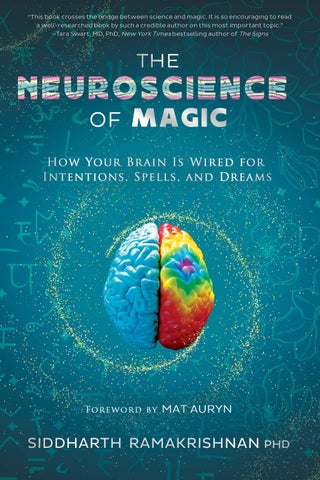
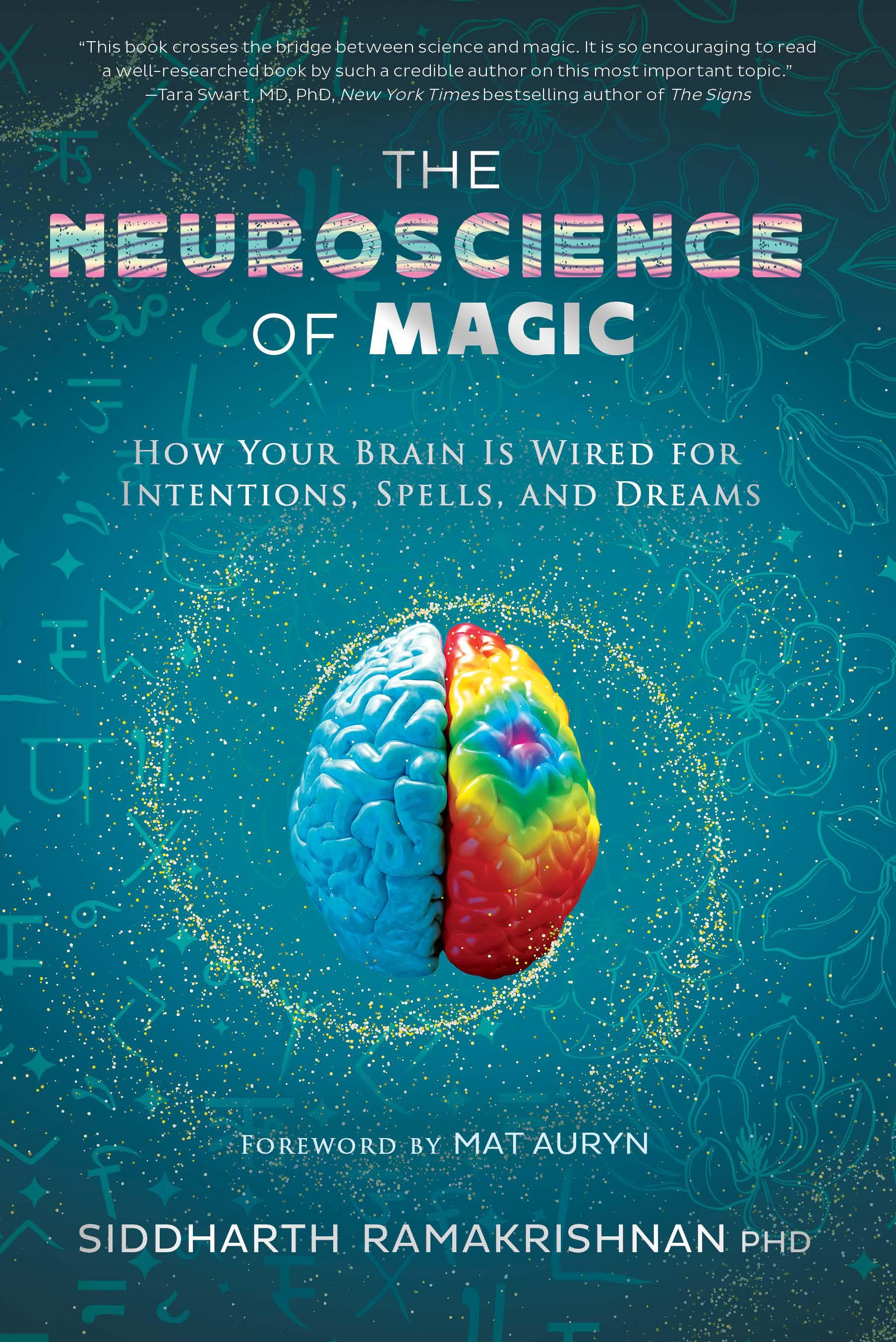
The Neuroscience of Magic, by Siddharth Ramakrishnan, PhD
Praise for The Neuroscience of Magic
“This book crosses the bridge between science and magic. It is so encouraging to read a well-researched book by such a credible author on this most important topic.”
—Tara Swart, MD, PhD, New York Times bestselling author of The Signs
“A rare and luminous bridge between worlds—one that reveals how deeply our brains are built for imagination, intention, and transformation. Siddharth Ramakrishnan masterfully weaves neuroscience with ancient spiritual insight, showing that visualization is not just a poetic idea but a biologically grounded technology of the mind. His explanations illuminate why visualization works—how neural circuits for imagery, intention, memory, and emotion collaborate to shape our inner and outer experience—and his practices offer readers a grounded way to engage that innate capacity with clarity and purpose. This book is a gift for anyone seeking a scientifically informed and spiritually expansive understanding of human potential. It is empowering, beautifully written, and deeply validating of the magic that lives within all of us.”
—Helané Wahbeh, ND, MCR, Director of Research, Institute of Noetic Sciences
THE Neuroscience OF Magic
About the Author
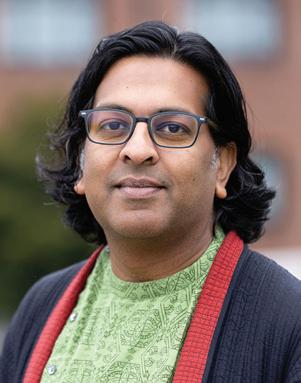
Siddharth Ramakrishnan, PhD, is a neuroscientist, artist, and educator. He is the chair of neuroscience at the University of Puget Sound and a recipient of the prestigious National Science Foundation CAREER award and W. M. Keck Foundation award. An avid tarot reader for the last twenty years, Siddharth explores the intersections of science, art, and mysticism. This led him to design and create the Neuro Tarot deck inspired by the major arcana of tarot but infused with neuroscience concepts. He also runs a blog offering neuroscience insights for tarot readers. Learn more at BrainMystic.com.
To Write to the Author
If you wish to contact the author or would like more information about this book, please write to the author in care of Llewellyn Worldwide Ltd. and we will forward your request. Both the author and the publisher appreciate hearing from you and learning of your enjoyment of this book and how it has helped you. Llewellyn Worldwide Ltd. cannot guarantee that every letter written to the author can be answered, but all will be forwarded. Please write to:
Please enclose a self-addressed stamped envelope for reply, or $1.00 to cover costs. If outside the U.S.A., enclose an international postal reply coupon.
Many of Llewellyn’s authors have websites with additional information and resources. For more information, please visit our website at https://www .llewellyn.com.
THE Neuroscience OF Magic
HOW YOUR BRAIN IS WIRED FOR INTENTIONS, SPELLS, AND DREAMS
Book design by Christine Ha Cover design by Shannon McKuhen
Interior illustrations (pages 7, 17, 38, 42, 45, 51, 62, 67, 70, 78, 88, 93, 104, 108, 110, 112, 116, 128, 140, 155, 167, 171, 175, 180, 187 & 214) by the Llewellyn Art Department Image 6 (page 114): Circle (Mandala). Watercolour by a Tibetan painter. Wellcome Collection. Source: Wellcome Collection.
Photography is used for illustrative purposes only. The persons depicted may not endorse or represent the book’s subject.
Llewellyn Publications is a registered trademark of Llewellyn Worldwide Ltd.
Library of Congress Cataloging-in-Publication Data (Pending)
ISBN: 978-0-7387-8207-2
Llewellyn Worldwide Ltd. does not participate in, endorse, or have any authority or responsibility concerning private business transactions between our authors and the public. All mail addressed to the author is forwarded but the publisher cannot, unless specifically instructed by the author, give out an address or phone number. Any internet references contained in this work are current at publication time, but the publisher cannot guarantee that a specific location will continue to be maintained. Please refer to the publisher’s website for links to authors’ websites and other sources.
Llewellyn Publications
A Division of Llewellyn Worldwide Ltd. 2143 Wooddale Drive Woodbury, MN 55125-2989 www.llewellyn.com
Printed in China
GPSR Representation:
UPI-2M PLUS d.o.o., Medulićeva 20, 10000 Zagreb, Croatia, matt.parsons@upi2mbooks.hr
Other
Books by Siddharth Ramakrishnan
Major Arcana Anthology (coauthor)
The Neuroscience of Tarot
CONTENTS
List of Exercises xi
List of Brain Illustrations xiii
List of Images xv
List of Mantras xvii
Foreword xix
An Invocation to Begin xxv
Introduction 1
Chapter 1
Magical Thinking 15
Chapter 2
Magic of Visualization and Intention 35
Chapter 3
Setting the Stage, Preparing the Mind 59
Chapter 4
Sacred Spaces and Sacred Objects 85
Chapter 5
Sacred Sigils and Sacred Portals 103
Chapter 6
Rituals 123
Chapter 7
The Magic of Words 139
Chapter 8
Intuition and Interoception 165
Chapter 9
Faith 185
Chapter 10
Mystical Journeys 199
Conclusion 221
Thanks To 227
Glossary 229
Recommended Reading 235
Bibliography 237
Index 263
EXERCISES
Exercise 1: Practicing Magical Thinking 21
Exercise 2: Magical Ideation Spectrum 25
Exercise 3: Your Way of Magical Thinking 28
Exercise 4: Altering Your Magical Ideation 32
Exercise 5: Vivid Visualization 40
Exercise 6: Plot the Future 43
Exercise 7: Mentalizing the Other 47
Exercise 8: Down the Intention Path 55
Exercise 9: Affect Grid 67
Exercise 10: Altering Your Mood with Smell 74
Exercise 11: Playing with Beats 82
Exercise 12: Adding Sacred Value to Objects 99
Exercise 13: Making Sigils 107
Exercise 14: Creating Your Own Yantra 112
Exercise 15: Creating Mental Flow 120
Exercise 16: Teasing Apart Your Rituals 132
Exercise 17: Dissecting a Ritual 135
Exercise 18: Words to Imagery 143
Exercise 19: Playing with Tone 149
Exercise 20: Casting a Spell on Others 153
Exercise 21: Rewiring Through Self-Talk 156
Exercise 22: Being the Observer 158
Exercise 23: Sending Notes to the Divine 159
Exercise 24: Crafting Your Own Mantra or Spell 163
Illustration 11: Wired for Magical Symbols and Objects 93
Illustration 12: Ritual Transformation of the Brain 128
Illustration 13: The Magic of Spells 140
Illustration 14: Rewiring the Brain with Words 155
Illustration 15: Intuition 167
Illustration 16: Insight 171
Illustration 17: Interoceptive Awareness 175
Illustration 18: Clairvoyance 180
Illustration 19: Wired for Faith and Transcendence 187
Illustration 20: Wired for Dreams of Futures 214
IMAGES
Image 1: Affect Grid 67
Image 2: Ganesha’s Curl 104
Image 3: Sigils 108
Image 4: The Kali Yantra and the Ganesha Yantra 110
Image 5: Sri Yantra 112
Image 6: Mandala 114
Image 7: Tree of Life 116
MANTRAS
Mantra 1: Invocation of the Mind 36
Mantra 2: Grounding the Mind 60
Mantra 3: Navadurga Kavacha: Invocation of Protection 110
Mantra 4: Invocation for Spells 139
Mantra 5: The Gayatri Mantra 146
Mantra 6: Invocation for the Body and Organs 193
Mantra 7: Invocation for Dreaming 216
Mantra 8: Purnahuti: Invocation for Completion 225
FOR EWORD
Afew years ago, I was invited to give the keynote talk at the Northwest Tarot Symposium. Before the event, the organizers suggested I sit in on a workshop by a teacher named Siddharth. When I arrived, the room was already full, so I went to another session instead. Even though I missed it, I heard people talking about that workshop all weekend. Their excitement was steady and genuine. Among those praising it was the legendary tarot author and scholar Mary K. Greer. When Mary recommends a teacher, it’s worth paying attention to.
At that time, Siddharth hadn’t yet written a book, though that would soon change. I later learned that his PhD was in neuroscience, which caught my attention. That year, I’d been experiencing a string of synchronicities involving neuroscience, something extremely unusual for me. At several conferences and events, people would approach me after my talks, often in hallways or elevators, to tell me they were neuroscientists who had read my book or attended my class. Each time, I felt a jolt of anxiety. My book Psychic Witch touches on neuroscience, drawing from research connected to psychic ability and magick,1 yet I’ve never claimed to be a neuroscientist. So, every time one of them started a conversation, I braced myself for correction or critique. Instead, every single one of them was kind, supportive, and encouraging.
1. In Western occultism, the word magick is often spelled with a k, an archaic form revived by Aleister Crowley to distinguish esoteric practice from the stage illusions of entertainers. The spelling appears in early modern texts such as Agrippa’s Three Books of Occult Philosophy and has since become standard within many occult traditions. In this foreword, except when quoting a source that uses the alternate spelling, I retain Crowley’s form. Throughout the book, Siddharth uses magic without the k. Both spellings refer to the same practice and differ only in stylistic preference.
A few years later, I reached out to Mary to ask if she might be interested in reading the manuscript for my upcoming book The Psychic Art of Tarot. I also asked if, should it resonate with her, she would consider offering an endorsement. True to her generous and encouraging nature, Mary agreed to read it for consideration. When my manuscript arrived, she told me she’d just finished writing a foreword for Siddharth Ramakrishnan’s debut book, The Neuroscience of Tarot. She said she was struck by the timing. Both works explored similar ideas from very different directions, each presenting exercises with parallel intentions through distinct methods.
Needless to say, my curiosity was sparked. I remembered Siddharth as the teacher whose workshop I hadn’t managed to attend—the one everyone had spoken about with such enthusiasm. So, I reached out to him and shared what Mary had told me. I asked if he’d be open to me reading his manuscript for a possible endorsement and whether I could send him copies of my previous books, as I thought he might find them interesting. He welcomed the idea. I sent him my books, and in return, he sent me his manuscript along with the NeuroTarot deck he had created.
As I read his work, I was struck by both its brilliance and its accessibility. Siddharth managed to present technical material and concepts from neuroscience that were intricate with clarity and ease, making them entirely approachable. What impressed me most, though, was how he transformed that science into something practical. His book offered exercises and selfreflective surveys that allowed readers to directly apply those insights to deepen and refine their tarot practice.
I invited Siddharth to appear on THE CIRCLE IS podCAST , which I had started with my friend Rachel True, an actress, author, and fellow tarot enthusiast. Many in our community know Rachel for her role as Rochelle in the 1990s cult classic The Craft. Siddharth joined us for our sixteenth episode of the first season, titled “Neuroscience, Intuition, and Tarot with Siddharth Ramakrishnan.”
During our conversation, I shared a story about a discussion I once had with one of my witchcraft elders regarding Dr. Masaru Emoto’s well-known water crystal experiments. These experiments became famous for suggesting that water could form different crystalline structures depending on the words, emotions, or music it was exposed to. I told my elder how many other
scientists had dismissed Emoto’s work as pseudoscience because the results couldn’t be consistently replicated under controlled conditions by others. My elder offered a perspective that stayed with me, one that I brought up during the podcast. They reminded me that in alchemy, which is the ancestor of our modern Newtonian science, consciousness itself was viewed as an essential part of the experiment. Success depended as much on the practitioner’s inner state as on the external materials. This was why alchemists placed such emphasis on refining their minds and spirits before engaging in their work.
Siddharth surprised me by explaining that within scientific laboratories, many researchers engage in behaviors that mirror ritual or magickal thinking. During experiments, they often develop personal customs of small, precise actions they repeat each time, born from the uncertainty that surrounds experimental outcomes where success depends on countless unseen factors. Most of them may never realize they are doing this, nor consciously link their ritualistic behavior to the experiment’s results. He observed that the public rarely glimpses this side of science, since such moments never appear in journals or research papers. Scientists are viewed as purely rational, their work seemingly reduced strictly to data and method. Yet in the quiet of the laboratory, a subtler process can take shape. Emotion, belief, and intuition can blend with systematic procedure, softening the border between empirical inquiry and personal enchantment in ways most of us don’t realize or understand.
Arthur C. Clarke once wrote in Profiles of the Future: An Inquiry into the Limits of the Possible that “any sufficiently advanced technology is indistinguishable from magic.”2 That observation has followed me for years, surfacing whenever I encounter work like Siddharth’s. Many occultists have echoed the sentiment, describing magick as a kind of science whose laws have yet to be mapped. Aleister Crowley defined magick as “the Science and Art of causing Change to occur in conformity with Will,”3 a statement that framed it as a disciplined process of intentional transformation. Dion Fortune later refined that definition, calling it “the art and science of causing changes
2. Clarke, Profiles of the Future, 21.
3. Crowley, Magick Without Tears, 27.
in consciousness in conformity with Will.”4 Her addition of that one word reshaped the understanding of magick entirely.
Fortune’s training in psychology, and her familiarity with Jung’s ideas about the unconscious, led her to place consciousness at the center of the magickal act. To her, every ritual, symbol, and meditative technique operated as a technology of mind. Transformation began internally, through the refinement of perception and awareness, before expressing outwardly as change in the physical world. She viewed the psyche as both laboratory and instrument, echoing the alchemists’ belief that the purification of matter and spirit were not just interconnected but inseparable.
This idea reaches far beyond early modern occultism and into the foundations of Hermetic philosophy, one of the direct ancestors of the Western magickal traditions. In the Corpus Hermeticum and related texts, the cosmos itself is described as an emanation of divine intellect, the Nous. All creation arises through thought, through the movement of a conscious principle that animates existence. Humanity, bearing a reflection of that divine mind, possesses within it the same creative potential. The Hermetic philosophers taught that by transforming one’s own consciousness, one could participate in the continual unfolding of the universe.
Siddharth’s exploration of magick and neuroscience continues a dialogue that stretches from the temples of Thoth to contemporary laboratories. Across centuries, seekers have turned to both mystical practice and scientific investigation to approach the same mystery: how consciousness shapes reality and how intention moves through matter. From alchemical furnaces to neural imaging, the impulse to understand this relationship has endured. What Clarke, Fortune, the Hermetic philosophers, and alchemists all recognized is that every act of discovery, whether performed through ritual or experiment, begins in the mind, where observation, imagination, and will converge to shape experience. As you enter this work, approach it as part of that lineage of exploration. Treat consciousness as both participant and instrument, and let intellect and intuition collaborate rather than compete. As you begin this book, I invite you to read slowly and with curiosity. Let both reason and reflection guide you, allowing insight to unfold in its
4. Fortune, “The Rationale of Magic.”
own rhythm. Within these pages, magick and neuroscience speak in harmony, revealing the living intelligence that moves through every act of creation and understanding. Remember that the line between experiment and enchantment fades wherever curiosity leads and that every act of true inquiry becomes a kind of spell, uncovering the mind as both the question and the answer.
—Mat Auryn
Author of Psychic Witch, Mastering Magick, and The Psychic Art of Tarot
AN INVOCATION TO BEGIN
In many Hindu households, prayer is offered to Ganesha, or Pillayar, the elephant-headed god, before beginning any task. We consider him the remover of obstacles. While praying to him, sometimes I imagine Ganesha or an elephant with a palm frond in his trunk, sweeping away the obstacles in front of me.
Vakratunda mahaakaya suryakoti Samaprabha| Nirvighnam kuru me deva sarvakaaryeshu sarvadaa||
May Ganesha, the one tusked, remove all obstacles from my tasks.
Words without meaning are just nonsense. Words without intention have no power. When they become merged and part of a whole, we create magic. Shiva and Shakti are entwined and parts of a whole. In some depictions, they form the god Ardhanaareshwara, half man and half woman. Some say Shiva represents the form and Shakti the function—and without one there cannot be the other. The following invocation is like a spell.
May my words and their meanings be entwined like Shiva and Shakti.
INTRODUCTION
No matter what culture we are from or where we were born, we are all surrounded by tales of magic. Pixie dust, fairies with wings, supernatural entities—these abound in our tales and myths. Along with them are woven tales of sorcery, divination, and sometimes even sheer luck. Whether you believe in the supernatural or not, magic is something each one of us experiences. Some have experienced healing in unforeseen spaces. Others have received signs from the universe, pointing them in directions that have completely changed lives. We have all heard words spoken that have altered the way we perceive ourselves—for better or worse. Many of us practice selftalk, which functions as self-fulfilling prophecies. Some of us may have a specific morning routine or clothes that we wear in order for the day to unfold in a particular manner. We all have our little rituals and talismans that help us get through our lives. Magic touches all our lives every day.
For every one of you who has conversed with the universe—thanked it for giving you a sign, cursed it for letting you down, or invoked it with your magical forces—this book is for you. It is about the human side of magic. In this book, I will explore the kind of everyday magic that is enmeshed in our lives. I will also give space for the more transcendental magic that allows us to manifest and create futures for ourselves, influencing the world and altering how things unfold.
As a neuroscientist, tarot reader, and inquiring mystic, I have been wondering about what gives us the capacity to explore these complex phenomena, which have been investigated by philosophers, mystics, and magical practitioners from different cultures across centuries. While we do not yet have all the answers, we have begun exploring this world through the tools of neuroscience. In this book, I seek to understand and peel back the curtain on
how our brains make us magical, and try to provide tools to become a more magical creature.
My Journey into This Book
Writing this book has been a bit difficult, for initially I felt more like an observer of magic commenting on something others experience. But as I delved more and more into the matter, I realized that I have always been surrounded by magic and have always practiced it. Sometimes magic feels like it is at the grasp of my fingers and at other times remote, but I can always sense something beyond. I am a Hindu and grew up in a household that was not really devout. But looking back, I realize that my everyday life had been constantly surrounded by mysticism: myths, rituals, chanting of mantras, pujas where mandalas were drawn, astrological charts and divinations, and a schooling surrounding yoga and fire worship. To many, this may seem like a part of organized religion, but to others, this upbringing verges on the occult.
As a kid, like many of us, I was also prone to magical thinking. One distinct memory was of having dreams that left me with bad feelings and connecting them with real people dying. Other dreams also concerned death, influencing my perception that my actions or experiences directly caused the death of people I knew and loved. Aside from this, predictions and prognostications were a part of my life each day. Even the day calendar in my parents’ dining room was marked with days of luck or hourly spans of direness based on lunations and solar houses. On top of this was my penchant to read magical stories of fairies and other worlds. My first magical phrase was “Sim Salami Foo Foo,” uttered as I was dressed in a silver gown and wings and holding a wand, perhaps when I was four. Ever since then I have looked to my hands to create magic of sorts, waiting for the tingling in my fingers when I approach tasks, finding that magic can be quite electric and tangible when I look for it.
From that time as a kid, I have moved cities and countries and lived lives. I also became a neuroscientist, perhaps a destiny as far removed from magic as you can get. But after earning a PhD, I realized that they call it a doctor of philosophy for a reason, for more and more my questions have been focused on how this marvelous organ inside of our heads can do so much. I realized that the answers I sought could not be addressed by just reductionist science
and started looking into spirituality, mysticism, and practices that have contemplated the meaning of our lives for thousands of years. I think having a PhD allows me to say “I don’t know” to many questions posited and to be open to new ways of thinking about what the brain can do along with new ways of exploring the brain.
At every stage of life, when things became difficult or uncertain, I could always turn to my own magical practices—chanting my protection mantras, grounding myself, visualizing possible futures, and casting spells. I am an avid tarot reader and follow astrological omens pretty regularly. Even in the practice of science, I sometimes indulge in manifestation. These actions are part of my everyday life. Again, when I started writing this book, I never really considered myself a practitioner of magic, but I realized quite quickly how entwined I am with the universe and how frequently I interact with it using magical ideation and practices.
Defining Magic
When I talk about magic, I am not referring to illusionists or the conjuring of Houdini or PC Sorcar or the sleight of hand that you encounter on the sidewalk or subway. Our senses are extremely susceptible to such illusions and tricks, and there is a wealth of studies on how to cheat each of those senses into believing things or making things up. I will not go into that. In his book Real Magic, Dean Radin defines magic in three categories: the force of will, divination, and evoking the spirit.5 Here, I will primarily talk about the first kind—the force of will. Further, magic can be defined by how we use the power of the brain to create intention; move into a space where that is focused; and use words or spells to define the intent, rituals to package it, and sigils, objects, or symbols to invoke it, thereby exerting influence on the world around us. In my earlier book, The Neuroscience of Tarot, I delved into the brain science behind divination, using tarot as the medium. There I probed into how the brain moves from mental imagery and simple associations to intuition and insight and also explored the concept of neuroforecasting. While that book primarily uses tarot imagery, you can extrapolate it to any form of divination.
5. Radin, Real Magic, 18–19.
Magic has been studied and used across centuries, and Chris Gosden has an excellent book on the history and anthropological evolution of magic. His definition of magic “emphasizes human connections with the universe” and the influence humans and the universe exert on each other. “I touch the world and the world touches me back.”6 We have all, in some form or other, done this in our lives—whether you delve in the esoteric or not. In this book, I hope to shed light on how we are wired to accomplish these connections and thereby help the reader get better at forming those bridges and become a more aware magician.
Why Magic and the Brain?
It is difficult for some of us to believe that we can actually exert influence over the world around us. Especially when we are in times of uncertainty, it may seem as if we have no agency. But magic can be about simple things, such as words, phrasings, and tones and how they can be formulated into spells that can affect you and others. Magic can shape our thoughts. It can also offer a sense of protection from the actions of others and can be how we guard ourselves from being affected so much by their words. This is nothing new. There have been so many books on how the power of our thoughts and words can influence the universe and people. Many individuals have also looked into the law of attraction and the process of changing our beliefs to get a better life. Here, I aim to peel back the curtain on the changes and rewiring that you can experience during magical practice and then provide some tools to become better at the craft.
In that, I am inspired by author and witch Mat Auryn. In his book the Psychic Witch , he lays out simple yet effective techniques to develop your magical craft and insists that “you don’t have to be born a certain way or have a natural talent” to practice this.7 I am of the same opinion. We all have similar brain circuits and potentials, and all of us can home in on these tools and become better at using them. Yes, some of us may be further along in the journey, but it does not mean we can’t get better at it. Each of us brings in our own experiences and lives on this journey and that is going to color how we
6. Gosden, Magic, 1 7. Auryn, Psychic Witch, 1–2
experience and influence the world. Whether we like it or not, our very presence has an effect, a ripple on the world around us. We are in essence magic by our very being. This book gives you more tools to become intentional about it and to realize how we activate different brain circuits to manipulate the world around us. In my own life, aside from daily rituals, I have dove into magical practices to leap forward—grounding exercises to calm the brain down, visualization tools to create space for relationships, and manifesting with intent to bring a child into my life, which is no small feat being a gay man.
The brain is the instrument through which we filter information from the world and interact with it. The powers to influence, enthrall, and invoke come from the millions of neurons firing in certain rhythms and patterns. The energies we feel around us, the palpable faith, all emanate from mental processes. We cannot completely free the mind from the brain, as we cannot experience this world without it. We also cannot express ourselves without our body and hence our brain. I hope this book gives you the confidence to tease apart the inner working of your brain and rewire or train it to become even more magical.
Your Magic Cauldron Brain
Throughout this book, I will talk about different brain regions, and while a primer in neuroanatomy is not necessary to get through this book, it might be useful to get a few landmarks of your head.
Use your hands to feel the different parts of your head. Run your hands across your forehead, behind it sits the forebrain, your seat for executive reasoning (Illustration 1, blue). We will address this area a lot when talking about value assessment, thinking about the self, and rationalization. Slowly move your hands toward your temples, the place that you massage for headaches or sometimes press when you want to remember things. Beneath this is the temporal lobe. This is where you are able to remember things, place them in sequence, or even categorize them (green). Go behind your ears and locate the base of your skull above the neck, this is the main visual area, or occipital lobe (yellow). Move your hands to the top of your head, in line with your ears, where you will find the parietal lobe (pink), which we will talk
about during discussions of the self and the other, reimagining, and dreaming about spaces and transcendence.
Sometimes brain anatomy uses language that is difficult to parse, but if you know the individual words, it usually becomes easy to navigate. Place the palm of your right hand against your right ear. Now imagine your hand slowly scanning, moving through your head from one side to the other side, from one ear to the other. The parts of the brain toward the outside are called lateral. The parts of the brain toward your midline (in line with your nose and third eye) will be called medial. Place your hand face down on top of your head. Now slowly imagine this hand as a scanner moving down from the crown (top) of your head to just below your chin (bottom). The areas of the brain closer to the top are called dorsal. Those closer to the base of your skull are called ventral. Finally, place your palm on the tip of your nose. Visualize scanning your head from your nose to the back of your neck. Areas of the brain closest to your nose are anterior. Those closest to the back are posterior.
Refer back to this first illustration from time to time. Most chapters also have illustrations with relevant brain pathways, which will help you navigate the main structures in those chapters. My suggestion would be to use your fingers to feel the different parts of your head as you visualize your brain from inside out. This can help you understand what parts are being activated and deactivated during different aspects of your magical journey. It will also help you focus on what parts you want engaged or disengaged during your practice.
The neurons in your body and brain communicate via electrical signals. Sometimes they get excited, and sometimes they are inhibited. Both are important, and one shouldn’t think that an inhibition or deactivation of an area is bad. Think of your own behaviors. Calmness and excitement both have a role in your life. We need both to function and to interact with the world. This is similar to neural activity; the silences or inhibitions are as important as neural activation. In fact, we gain a lot of information from the timing between neural silences and bursts as well. All of this helps our brain make sense of what goes on around us and within us.
Lateral (to the side)
Frontal Lobe
• executive reasoning
• current mental state
Medial (to middle)
Parietal Lobe
• self-perception
• object location
Occipital Lobe
• visual info
Dorsal (to top)
Ventral (to bottom)
Temporal Lobe
• time & memory
• object recognition
• categorizations
• empathy
Cerebellum
• balance
Posterior (toward back)
Anterior (toward front)
Illustration 1: Basic Brain Anatomy Landmarks
Brain regions can be labeled based on global landmarks or based on their specific locations. For instance, if something is labeled ventromedial , you can assume that it is toward the base of the brain (ventral) and the middle (medial); if a region is labeled temporoparietal , look for a space between the temporal and parietal lobes.
Now that you have an orientation of the basic brain, let’s look a bit further in the context of being wired for magic. Think of your brain as a magic cauldron. Within it are different bits needed to create the perfect recipe for a spell. Sometimes you recruit certain parts, and at other times, you use others. But just like in any crafter’s arsenal, there are a few important ingredients that will appear over and over again. Let us look at some of these specific brain areas involved in magic.
Amygdala: Emotional Core
Emotions are a part of us. Whenever we move forward with intent or want to attract something, we are asked to feel it. When we think of someone else, the process is tied into emotions. Whether we are infusing a talisman with luck or warding off negativity, our emotions are woven into our lives. Part of the limbic system, the amygdala sits deep within, on either side of your brain, and regulates your emotional responses. It is closely tied with the memory centers.
Hippocampus: Memory Storage
Whether we are reciting chants from past learning, invoking the imagery of someone, or following a tradition, we are constantly tapping into our memory centers. These are also being rewired every time we do anything but especially during repetitive tasks, including rituals. The hippocampus curves like ram horns inside your brain, deep within the temporal lobe, and is the space for memory and learning.
Hypothalamus: Holistic Control
We react to situations as a whole organism, not just in individual body parts. We also transform from stressful, joyful, or otherwise emotional experiences. A lot of these changes and holistic control is through our hormonal and immune systems. If you take a pencil and shove it up your nose, you will reach the brain. (Don’t do this! Through the nose is how Egyptians removed the brain during mummification, as they considered this area not very important for the afterlife.) Right up there sits the pituitary and slightly above that the hypothalamus. These areas are the ones that control hormonal
release into the bloodstream, which can have effects for hours, days, or even years after an experience. The hypothalamus also exerts control over your autonomic nervous system, controlling hunger, thirst, blood pressure, and such. When you see something exciting and feel flushed, your heart beating faster, stomach tightening, and breath constricting, look to this area as the master holistic controller.
Insula: The Body within the Brain
Aside from the five senses we use to interact with the external world, we also get internal messages from our heart, lungs, stomach, and other organs. These messages are then interpreted by the brain as emotions. We also respond to outside forces with instant body reactions. The more we practice our magical craft, the more embodied our reactions will be. For example, think about repeating a daily ritual over and over again. After some time, the ritual becomes ingrained in your body. Perhaps you reach out for objects and even know them by just the feel. All this encoding is happening in the insula. Some scientists think the insula is the seat of consciousness.
Default Mode Network: The Self
Within us is the sense of self that can place us in the past, present, and future. This sense of “I” can plan ahead and also learn from the past. This is part of the default mode network, often referred to simply as the DMN. It is called a network because it is located in multiple areas of the brain: the prefrontal cortex; deeper within and toward the back in the posterior cingulate cortex; and the lateral posterior cortex, which is in the back of the head to either side (slide your fingers from the top of your head to either side where the skull is most prominent). Anything to do with self-agency, intention, and self-belief will activate this network. This network quietens during meditation and mystical experiences where we move beyond just ourselves.
Temporoparietal Junction: The Other
If there is a sense of self, there is also the sense of the other. One aspect of this is attributing a mind to someone else and wondering what they may or may not do. This can go beyond just living beings and extend to external
agencies, such as spirits, gods and goddesses, objects of power, and so on. One main region involved in this is situated just above your ears where two brain regions intersect: your parietal and temporal lobes. Think of this as the region where space and time interact. This is the temporoparietal junction.
Cingulate Cortex: Making Meanings from Patterns
Finding meanings in patterns and making sense of them is the way in which we navigate the world. In order to think magically and believe in the supernatural, we sometimes have to suspend disbelief and connect the dots in interesting ways. This is what the anterior cingulate cortex helps with. Whether you accept that the universe has shown you a certain way or that the stone in your hand has powers to heal, this is the brain area you will access. This region of the brain extends from the front of your skull all the way along the curve toward the back. It is a tad bit deeper than the surface.
Prefrontal Cortex: Adding Value to Thoughts
An important aspect of magic is intent and the power of thought. This becomes more powerful the more need or want we have for a particular goal. This drive is based on how your brain values the salience of different things. We have a spot in the brain that constantly measures how much we value things. It is tied in with both reward and disgust. Place your palm just under the third eye, as if to cup the base of the brain. Right there is the ventromedial prefrontal cortex. Whether we are casting spells with great focus, placing our faith in the spirits around us, or trusting a talisman to bring us luck, this area will be in play. * * *
We use a combination of these spaces and other areas in the brain to create concoctions that help us use our words to visualize futures and create dreams from nothing. Just like creating a potion, these brain ingredients can be used in lesser or greater quantities to create change in potency, and the more you get used to using them, the easier it will be to recreate that magical recipe going forward.
Who Is This Book For?
For those of you who do not consider yourself magical or magically inclined, think about the number of times you set goals in life, envision your future, and try to manifest desires. Think about how you use words to influence people, create rituals to bond with family and community, or even design logos to attract customers. These are all forms of magic we practice in our everyday life. This book teases apart the way our brains make this possible, adding power to such practices.
If you are a practitioner of the craft, then I would suggest coming in with an eye toward understanding how different aspects of your magic operate. Even though you might be quite adept at spellwork, you may not know exactly what goes on in the brain when you chant words or place them into rhythm. For instance, if you regularly practice setting boundaries or grounding yourself, this book will offer insights on what could be happening inside of you while you practice these techniques. If you are just curious about magic and are not an active practitioner, this book has exercises that can guide you through some basics of spells, sigils, and boundary rituals—with an eye on self-reflection and how your brain is parsing these steps. My suggestion is to dive in without fear and think of each practice as just another writing or journaling exercise.
We all have brains and use them constantly to explore the world outside of us, contemplate that which is inside, and bridge the two worlds constantly. There is no reason why we should not actively explore this amazing instrument and try to understand how it has capabilities beyond what we are taught. Each of us is smart in our own way and is capable of such wonderful things. The hope is that this book will provide you with the language needed to explain some of the things that you can do or have been thinking about.
Neuroscience, at least so far, has been a reductionist science. As scientists we take things apart and look at minute proteins and cells to try to figure out why we do what we do. More and more we are realizing that this is not the way to approach topics such as consciousness, telepathy, or in this case, magic. A lot of neuroscience also deals with mental health and problematizing the brain. My suggestion to you, as you research and look at the references, is to not actively self-diagnose or self-identify with mental disorders. It is easier to publish about magical thinking in relation to a disordered
brain as opposed to talking about its role in a regular brain. Neurodiversity is a newer concept, and the field has not completely caught up to it. Use this book as a tool to understand yourself and your functioning better and not as a way to other yourself.
How Is This Book Structured?
While the book moves from a focus on being wired for magical thinking to dreaming, it need not be read in a linear fashion. It would behoove you to read the first chapter to get an overview of some of the brain areas and anatomy, especially regarding magical thinking, but this is not essential for understanding the individual chapters. You are not expected to be either a neuroscience expert or a full-fledged witch in order to comprehend or enjoy the book. What may be useful is if you have a journal to work through some of the exercises and maybe even sketch out some of the brain structures to get a feel of what you use during your practices.
I begin the book by discussing magical thinking and its underpinning neural circuitry in chapter 1. Magical thinking is how we attribute agency to forces such as the universe, external spirits, or gods. This is also what gives us the ability to think that we can change the world and our very belief in magic. Most magical practices or manifestations involve setting an intent and moving toward it. In chapter 2, I talk about how to rewire your brain for setting intentions and how these transform your neurons. When we set intentions, we also tend to visualize them in our head to make them clear and purposeful. Chapter 2 will also discuss mental imagery and visualizations.
In order for us to perform any sort of magic well, we need to set the stage and get into a mental state ready for invoking and inviting magic. In chapter 3, I will talk about getting into the right frame of mind and how you can change your brain circuits to get ready for magic. I will discuss the science behind grounding techniques and using tools such as posture, herbs, or music to prepare for magic.
Setting the stage also involves preparing the environment for magical acts. This may involve creating sacred spaces or marking boundaries for rituals. In chapter 4, I will discuss how our brain reframes the spaces around us as special, thereby making them sacred and magical. I will also discuss
objects of power and how our neurons prime us to reimagine a piece of wood as a wand or a stone as a deity.
In some magical practices, the stage involves creating portals or infusing symbols with magical power. In chapter 5, I will look at sigils, mandalas, and yantras and how humans have been using such drawings across centuries to invoke magical elements.
Many magical practices involve elaborate rituals. Humans have been involved in such structured ceremonies for centuries and across cultures.
Chapter 6 delves into rituals, our need for them, and how our brains are wired for them. In chapter 7, I look into words and spells, their use in magic, and their power to transform both our brains and those of others.
Sometimes you just know things. Some may call this instinct. Others label it as ancient wisdom or whispers from the universe. Many come to magic almost intuitively. Others learn or apprentice and hone their intuition over time. Chapter 8 deals with our power of intuition and insight. I also discuss how we have the ability to know with our bodies, the powerful sense of interoception, and using it in your magic. While not much is known scientifically about psychic abilities, I will discuss some aspects of them, such as clairvoyance and telepathy.
Magic is rendered impotent without belief. Some of this belief emanates from within each of us; some relies on belief and agency in an external power. Chapter 9 deals with faith—in oneself and in the outside—and how it shapes magic.
We all know that there are truths that exist beyond our own physical bodies. To grasp at them, we have to embark on mystical journeys. Some of us reach these states by meditation and self-transcendence. We may also approach them through our own dreams. Chapter 10 dives into both of these ideas and how we are wired for oneness.
Most chapters have illustrations of the brain and circuits pertinent to the areas discussed, but you may have to refer to earlier images for some context. The book draws heavily from journal articles on the brain and its workings. References substantiating statements have been included as footnotes and a detailed bibliography can be found in the back of the book. While these references are many, they are definitely not exhaustive.
There are exercises associated with many sections, and they can help you observe your own brain processes during magical thinking and magical acts. Having a journal on hand while reading the book may be useful for these. No prior magical or scientific experience is expected for these exercises. But if you are a practitioner, it would be nice for you to place it within the context of your own magical rituals and habits. For those who do not actively identify with magic, think about how you use these things in your everyday life for manifesting or influencing your goals.
There are a few mantras in Sanskrit peppered through the book. The English transliteration and succinct meaning are also provided for these. * * *
As I wrote this book, I delved into personal aspects of my life that I never thought I would talk about. I read papers that suggested that all children are theists until about age five and that we all indulge in magical thinking at least until then. We all also tend to agree with paranormal or supernatural explanations for concepts, meaning that attributing meaning and agency to the spiritual realm or other external factors is innate in all of us. I hope that as you read this book you appreciate how the brain is wired to respond to the universe around us and how we have the agency to shape and respond to it. With this book, I hope that you can rediscover your curious inner child and believe that you are indeed wired for magic.
CHAPTER 1
MAGICAL THINKING
When I was in fourth grade, I got into trouble at school. I fought with some other kid, which I usually did not do, and hit him. I felt ashamed and was overcome with a sense of foreboding. Throughout the bus ride home, I was silent and sad. Not just because I had hit someone or worried about what folks would say but because I had a sense that something was wrong. When I reached home, I found that my aunt had passed away. I had been super close to her, and in my mind, I could directly connect me hitting my classmate to her dying. Even after more than three decades and many rationalizations, I still have some guilt. I look back and wonder, “If only I had not done that ….” Was there a direct connection? No. But in my head, there was, and I would say this thought still exists. Connecting disparate events that have no direct cause and consequence is a form of belief called magical thinking.8
Magical thinking is something we experience all the time. Some of us may have felt that something was about to happen or that someone was going to call, and within a short span, what we had pictured happens. Sometimes we plan on buying a certain dress of a particular color but can’t find it and suddenly it appears. Connecting these events together to make sense of them is a form of magical ideation. We all have these ideas. Even as a scientist, in some labs I was told, “Let’s get to work on December twenty-fifth,” for that is when supposedly all the experiments worked! When it comes to these beliefs, there is no logical explanation as to why A is connected to B or why if I do this, something else will happen. Some people term these thoughts— often rightfully so—as superstition. But it may not always be the case. Perhaps you like to wear a specific shirt for an interview to be successful or follow
8. Subbotsky, “Causal Explanations of Events by Children and Adults.”
a particular routine or perform certain rituals to begin an auspicious day. Magical thinking allows us to create patterns that help us control or provide a sense of control over things beyond our own agency. Many of us have this sense of magical thinking as children. I used to have ladybirds as pets and somehow got it into my head that eating sand will help them live longer. So, unbeknownst to my parents, I would snack on sand. The ladybirds lived and eventually died—but I knew in my mind that I had made them live longer. Somewhere along the growth from being a child to being an adult, we cover up most of this magical thinking.9 Logic becomes paramount. It is suggested that extended magical thinking is what underlies obsessive-compulsive disorder, schizophrenia, and certain types of anxiety disorders where irrational beliefs and behaviors become more pronounced. Neuroscience studies tend to look for differences between brains, emphasizing that which is out of the norm and mainly classifying these deviations as disorders and syndromes. But until recently, not many studies have tried to understand the extraordinary, and there is not much research into looking at magical thinking in adults as a perfectly normal part of life. Sometimes, if you go in looking for something wrong as an explanation for a behavior, chances are you will find evidence for that aberration. This is called confirmation bias. Sadly, science is heavily skewed against validating any form of magical thinking that would be considered normal or extraordinary. Hopefully with the advent of technology and it becoming cheaper and more accessible, we will have more studies looking into such topics.
9. Kuhn, “The Powerful Role of Magical Beliefs in Our Everyday Thinking.”
Supressing Judgment
• prefrontal cortex
Beliefs in External Agency
• theory of mind network
• temporoparietal junction (TPJ)
Emotions & Memory
• amygdala
• hippocampus
Creating Magical Feeling
• feel presence
• evokes mystical & spiritual experiences
• paranormal beliefs
• temporal lobe
Patterns & Connections
• making meanings
• suppressing disbelief
• anterior cingulate cortex
Magical thinking begins with the ability to allow us to give agency to external objects or ideas (orange). Sometimes these thoughts are highly emotionally charged based on past experiences (green). Magical feelings of external presences, the paranormal, or supernatural beliefs arise in the temporal lobe (purple). We then connect the dots, sometimes suppressing disbelief in order to make sense of how the “universe” or another concept has impacted us or we have extended influence outside (blue). Finally, we accept that this magic is working by inhibiting internal judgment (pink).
Illustration 2: Wired for Magical Thinking
Wired to Think Magically
Humans by nature are looking for purpose and meaning, trying to make sense of their lives. This is because of the pattern-seeking nature of our brains, which are constantly trying to figure out how A is connected to B. Even if there is no logical reasoning behind the connection, our brains have the ability to match them up as cause and effect.
Belief in an External Power
When I lived in Chicago as a grad student, I got a free TV from a yard sale. It didn’t come with a remote, and the only way to change channels was to push the buttons at the bottom. But every so often my TV would very randomly switch to one particular channel on its own! No amount of banging or pressing buttons would change it back—until it suddenly started working normally again. Over time I became convinced that there was some message coming forth from the universe but could never figure out what! Normally, if I saw the channel change, I would look around to see if someone was holding a remote. For my special TV, one might suggest an electronic hypothesis, but I decided to attribute the occurrence to some unknown force. Feel the area of your head right behind the top of your ears and slowly move up toward the top. Stop when you are midway between the top of your skull and your ears. This area of the brain is called the temporoparietal junction, shortened to TPJ, and helps you with intentions and assigning ideas about who is controlling what (Illustration 2, orange). This, along with the rest of your temporal lobe from the temple to the back of your ears, helps you create beliefs about external powers influencing the world or the sense of detecting a spiritual force.10 I blame this part of the brain for my attributing disturbances in the universe or external messages being the reason the TV changed channels. The TPJ region gets activated especially by paranormal beliefs.
One important aspect attributed to human consciousness is our ability to understand the minds of others. We are constantly trying to understand someone’s desire, their motivations, abilities, and plans. This is what is termed as theory of mind. This ability to attribute agency to others is 10. Young et al., “What Gets the Attention of the Temporo-Parietal Junction?”
generated in the TPJ region. Interestingly enough, our brains don’t care if this external agency is human, animal, or even inanimate!
Many days when I am about to step out of my house, I realize I am missing my keys or my glasses. In some instances, I later hear about an accident on the road—and think about how the two-minute delay in the house had helped me avoid the accident. In such instances, many of us may say, “The universe helped me” or “All the signs from the universe were asking me not to do that.” Here we are applying the same circuits that we use to understand and interpret people around us to interpret inanimate objects or events, giving them magical potency.
Exploring the Supernatural
In Jainism there is a belief that even inanimate objects have senses. When you touch a table, it touches you back. In this philosophy, these inanimate objects also have agency of their own. In our day-to-day lives, we may even attribute feelings to objects around us. We say and think things like “the computer was angry at me today” or “the house did not want me to leave.” In many ways, we attribute humanlike personalities to such objects. Our ability to attribute different agencies onto objects and events around us also leads us to pray to gods and symbols and develop deep personal relationships with them.
The area of the brain from our temples to just behind our ears is the temporal lobe, the place for time and memory (Illustration 2, purple). During experiments using a device called “God’s Helmet,” this area was stimulated with weak magnetic fields that caused participants to feel a presence or experience magical sensations.11 Seizures in this region can cause feelings of heightened religiosity, mystical experiences, or supernatural beliefs. 12 I say this not to imply that magical thinking is only developed with illnesses but to highlight the fact that we indeed have circuits in us that allow us to move in these realms. I also want to point out that while in modern Western medicine forms of magical thinking are almost immediately relegated to realms of disorders, in many other cultures, folks who see visions or have
11. Castillo, “The Sixth Dimension and God’s Helmet.”
12. Devinsky and Lai, “Spirituality and Religion in Epilepsy.”
transcendental experiences are venerated. This is not to say that medical help is not needed in every instance of altered brain activity but that we should view it with an open mind of neurodiversity, which leads to a rich variety of individual experiences of the world around us.
Connecting the Dots for Magical Intent
A few years back my partner and I were doing long distance. I decided to take a leave of absence from my position and look for something where he was located, in New York City. I landed an interview at a certain institution, and as I was riding the elevator up for my interview, my mind, which had been spinning around for a few months, completely stopped. It felt like I had been rattling dice and they had come to rest. I looked around and said, “Home.” Now, this was before the interview, but I just knew that this place would be home. My logical brain kept trying to tell me that this place was not what I trained for. But something else said it was. I proceeded to land the job, and the work was so rewarding. But I keep going back to that moment where the patterns clicked in my head and said “home.”
Somehow my brain had put together different patterns and had come up with a way to suggest that this job was the right fit. One of the main integrators of different bits of information, from emotions and memories to words and objects, is the anterior cingulate cortex (Illustration 2, blue). While normally this is supreme in logical reasoning, it is suppressed when we want to connect magical dots. In my case, when I decided that the universe was changing my TV channels to send me a message or that the job which was not really the logical choice on paper was actually the best fit, it is likely that this area was being told to shut up a little bit. In some ways as we grow older, we are training the brain to paper over illogical explanations, but it never really stops trying to push them through. This is what helps us make sense of disparate patterns and formulate meanings around them, giving us a magical lens into the world. In many cases, our magical thinking is tied with emotions, especially if those emotions happen to be very strong. I started the chapter talking about connecting my troublemaking at school with my aunt’s death. I can still feel the strength of the emotions from this experience that happened decades ago. The amygdala and hippocampus, which are parts of
the limbic system, play a big role in tying your magical thinking to past emotions and memory (green).
Altering Judgment to Allow for Magic
Finally, we come to the great inhibitor, the seat of judgment and reasoning: the prefrontal cortex (Illustration 2, pink). In some ways it is obvious that children show the most magical thinking, as their frontal cortex is still developing. But reduced neural activation in this area helps with magical thinking by suppressing judgment.13 It is suggested that the chemical serotonin is suppressed during this reduced activation. Even as I write this sentence, I can feel there is a negative connotation in how I phrased this, as if suppressing judgment is always a bad thing. This is my own bias.
In effect, you have circuits to create belief in an external agency, form meanings out of random patterns, tag these with emotional connotations based on previous memories and experiences from both your brain and your body, and suppress logic and rational explanations to allow for extraordinary meanings and magical context in your life. This is what makes you magical!
Exercise 1 PRACTICING MAGICAL THINKING
As adults, we have been taught to tone down our magical thinking even though we have innate circuits for this mode of thought. This exercise will help you revive magical thinking or offer a new way into it. After each part of this exercise, journal about how you feel.
13. Mendez, “Frontolimbic Affective Bias and False Narratives from Brain Disease”; Zhong et al., “Prefrontal Brain Lesions Reveal Magical Ideation Arises from Enhanced Religious Experiences.”
Part 1: Creating Rituals
Rituals are magical acts repeated with intention and can make simple everyday things sacred. Here, you will create a small ritual around an everyday act by adding gestures and a phrase to tie in while performing the task. I’ll use drinking coffee as an example. You can create a similar ritual for any mundane task that you do routinely without much intention or focus.
Steps
1. Choose your task. In this example, it’s drinking coffee.
2. Add gestures. Stir the coffee with a spoon three times clockwise, then anticlockwise. Tap the mug three times, creating a ringing tone.
3. Add a chant. Recite, “With this stirring thrice, awake! Arise!”
4. Add focus. Observe the ripples in the coffee before you take a sip.
5. Take time for reflection. Note how you felt about the task (i.e., drinking coffee) before and after the ritual. Repeat the ritualized task for a few days and note any changes in the way you perceive this everyday task.
Part 2: Giving Meaning to Objects
Magical thinking often arises from assigning meanings to objects and making them into talismans, relics, and charms. For this exercise, pick one household object that you interact with every day, such as a spoon, fork, or blanket. Here, I’ll use a spoon and a specific purpose as an example.
Steps
1. Pick an object. In this example, we’ll use a spoon.
2. Assign it a specific magical function. “This spoon is for clarity of purpose.”
3. Use the object. Look into the spoon. Carry the spoon with you for a day.
4. Take time for reflection. Journal about how you perceived the spoon before making it a magical object. Note how your perception of the spoon altered when you assigned it a magical function. At the end of the day, reflect on whether the magic spoon, with its special function, altered your interactions.
Part 3: Finding Patterns of Chance
Our brains thrive on patterns, especially those that seem to defy chance. Perhaps some numbers keep showing up in your life or you keep running into the same person after having never seen them for a year. Many of these patterns are recognized unconsciously. This exercise will help you bring some of these patterns to the forefront. It will also help you recognize your cognitive styles.
Steps
1. For the next week, jot down every coincidence, hunch, or strange dream in your journal.
2. Take time for reflection. Note how you felt when you saw patterns emerging. Think about whether you noticed the first instance of the pattern or only recognized it after it appeared again and again. Also think about how you made sense of the pattern. Did you dismiss it as probability or think more along the lines of synchronicity?
Why Do We Have Magical Thinking?
I was once waiting by a crosswalk in Chicago at the intersection of Grand Avenue and State Street. It is a pretty big and busy intersection, and I was undecided if I wanted to cross Grand Avenue and walk toward the river or cross State Street to go to the lake. Suddenly, I felt this grasp on my hand. An old woman standing next to me had grabbed my hand and said, “Come
“This is exactly the kind of work we need to synthesize modern biology with ancient intuitive traditions and practices.”
—Mona Sobhani, PhD, author of ProofofSpiritualPhenomena
HARNESS YOUR MIND’S I NNATE POWE R TO CRAFT MORE POTENT SPELLS AND RITUALS
Your brain is wired for magic. This book pulls back the curtain on how the mind makes you magical and provides the tools to become even more so. Using straightforward language and full-color brain maps, neuroscientist Siddharth Ramakrishnan translates the complex science behind your brain’s circuitry and reveals how practicing magic alters these circuits in amazing ways. Through dozens of practical exercises, you’ll learn how to amplify the power of your words, intentions, and beliefs to manifest desired results. Rewire your mind to strengthen your magical abilities. Add potency to your spells, rituals, mandalas, dreams, sigils, and much more. With his expertise as a neuroscientist, tarot reader, and mystic, Siddharth helps you rediscover your curious inner child and feel empowered in your magical journey.
Siddharth Ramakrishnan is a neuroscientist, artist, educator, and author of The Neuroscience of Tarot. He is the chair of neuroscience at the University of Puget Sound and a recipient of the prestigious National Science Foundation CAREER award and W. M. Keck Foundation award. An avid tarot reader for the last twenty years, Siddharth explores the intersections of science, art, and mysticism. This led him to design and create the Neuro Tarot deck, inspired by the major arcana of tarot but infused with neuroscience concepts. He also runs a blog offering neuroscience insights for tarot readers. Learn more at BrainMystic.com.