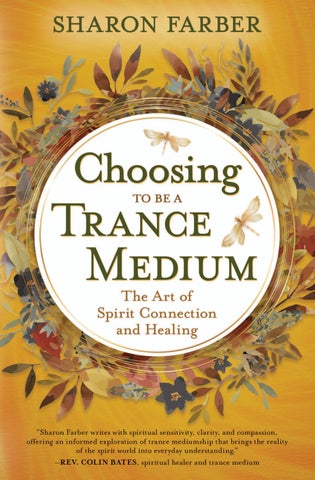
Praise for Choosing to Be a Trance Medium “Sharon Farber writes with spiritual sensitivity, clarity, and compassion, offering an informed exploration of trance mediumship that brings the reality of the spirit world into everyday understanding. … The text reflects the unfolding trance development and healing journey as a sacred and transformative process, grounded in the personal relationship with the spirit world. Sharon highlights the role of spirit guides, teachers, and loved ones in spirit as ongoing sources of wisdom, support, and care, affirming their presence within both personal and collective spiritual development. Recognising that each path is unique, Sharon’s writing gently leads the reader toward a deeper appreciation of the voyage of spiritual discovery. Her work is informed by many years of devoted practice, lived experience, and a sincere commitment to honouring the many pathways through which spirit communicates and healing unfolds.”
—Rev. Colin Bates, spiritual healer and trance medium
Choosing TO BE A
Trance Medium
About the Author Sharon graduated with honors from UMass Amherst in 1983 with a BA in sociology. She is a healer, award-winning artist, medium, teacher, and mentor. Sharon is the author of Choosing to Be a Medium (Llewellyn/Blackstone Audio, 2019) and the Choosing to Be a Medium Companion Journal (2019). Known for her down-to-earth approach, Sharon specializes in training new and experienced mediums. Having chosen to learn mediumship, she inspires students with an “If I can do it, so can you!” attitude. She provides encouragement and guidance to those who never imagined they could become mediums. Sharon offers mediumship readings, public demonstrations, private mentorship, classes, and development circles online and in person, and she leads mediumship retreats. She welcomes invitations to bring her classes or retreats to your community. Learn more at www .sharonfarber.net.
Choosing TO BE A
Trance Medium The Art of Spirit Connection and Healing
SHARON FARBER
Choosing to Be a Trance Medium: The Art of Spirit Connection and Healing Copyright © 2026 by Sharon Farber. All rights reserved. No part of this book may be used or reproduced in any manner whatsoever, including internet usage, without written permission from Llewellyn Worldwide Ltd., except in the case of brief quotations embodied in critical articles and reviews. No part of this book may be used or reproduced in any manner for the purpose of training artificial intelligence technologies or systems. First Edition First Printing, 2026 Book design by Christine Ha Cover design by Shannon McKuhen Llewellyn Publications is a registered trademark of Llewellyn Worldwide Ltd. Library of Congress Cataloging-in-Publication Data Names: Farber, Sharon Title: Choosing to be a trance medium : the art of spirit connection and healing / Sharon Farber. Description: First edition. | Woodbury, Minnesota : Llewellyn Publications, [2026] | Includes bibliographical references. | Summary: "Farber teaches you how to enhance your mediumship practice by learning to trance speak and trance heal"—Provided by publisher. Identifiers: LCCN 2026037317 (print) | LCCN 2026037318 (ebook) | ISBN 9780738781822 trade paperback | ISBN 9780738782027 ebook Subjects: LCSH: Mediums | Spiritualism Classification: LCC BF1286 .F3723 2026 (print) | LCC BF1286 (ebook) LC record available at https://lccn.loc.gov/2026037317 LC ebook record available at https://lccn.loc.gov/2026037318 Llewellyn Worldwide Ltd. does not participate in, endorse, or have any authority or responsibility concerning private business transactions between our authors and the public. All mail addressed to the author is forwarded but the publisher cannot, unless specifically instructed by the author, give out an address or phone number. Any internet references contained in this work are current at publication time, but the publisher cannot guarantee that a specific location will continue to be maintained. Please refer to the publisher’s website for links to authors’ websites and other sources. Llewellyn Publications A Division of Llewellyn Worldwide Ltd. 2143 Wooddale Drive Woodbury, MN 55125-2989 www.llewellyn.com Printed in the United States of America GPSR Representation: UPI-2M PLUS d.o.o., Medulićeva 20, 10000 Zagreb, Croatia, matt.parsons@upi2mbooks.hr
Other Books by Sharon Farber Choosing to Be a Medium Choosing to Be a Medium Companion Journal
Disclaimer Not everybody has the ideal emotional strength and stability to engage in any type of mediumship, including trance mediumship. Good mental health, including a strong connection to reality, is vital. People with certain types of mental illness, including schizophrenia or other psychosis, are advised to consult a health care provider before pursuing mediumship development. Do not engage in trance mediumship or any other type of mediumship if you’re feeling physically, mentally, emotionally, or spiritually unhealthy. Do not practice mediumship while depressed, drained, seriously sleep-deprived, or emotionally unstable, nor while drunk or under the influence of mind-altering drugs. Neither the publisher nor the author take any responsibility for any possible consequence that may result from the reader’s use of content contained in this publication and recommend common sense when engaging in the practices described in this book.
Contents
Exercise List xiii Author’s Note xv Introduction 1
Part 1: Trance Mediumship
5
Chapter 1: Mediumship 7 Chapter 2: What to Know Before You Start 27 Chapter 3: How to Do Trance Mediumship 45 Chapter 4: Wisdom from Spirit 75 Chapter 5: Overcoming Challenges 113
Part 2: Trance Healing
121
Chapter 6: Trance Healing 123 Chapter 7: How to Give a Trance Healing 133 Chapter 8: Trance Healing Sessions and Insights
145
Part 3: Pioneer Trance Mediums and Healers Chapter 9: Inspiration from the Pioneers
187
185
Contents
Conclusion 207 Glossary 209 Acknowledgments 215 Bibliography 217
xii
Exercises
Arm Swings—Rotation 51 Front-to-Back Leg Swings 52 Side-to-Side Leg Swings 53 Connecting Heaven and Earth 53 Conscious Breathing 55 Box Breathing 55 Ten-to-Zero Breathing 56 Blending and Un-Blending 63 Inspired Writing 91 Automatic Writing 109
xiii
Author’s Note
The people, examples, and anecdotes in this book are real and derived from my own experiences. Some identifying information has been changed to protect identity.
xv
Introduction
Trance mediums serve as bridges between the physical and spiritual worlds, but unlike with regular mediumship, they invite spirit people to speak and heal directly through them. Through this profound connection, spirit guides offer guidance and wisdom to those seeking insight. Trance mediumship enables advanced souls to inspire, educate, and uplift those still on Earth. In addition to providing sacred healing, trance enhances a medium’s ability to merge deeply with spirit communicators, strengthening their overall mediumistic abilities. Trance healing is a powerful and fascinating aspect of trance mediumship. Trance healers enter the same state as those inviting Spirit to speak through them, but instead, they allow spirit healers to heal through them. Healing may occur on mental, emotional, spiritual, or physical levels, or on multiple levels at once. Trance speaking provides healing through words, while trance healing focuses on encouraging optimal health and well-being. Many trance mediums engage in both. Trance mediumship is not possession. Spirit people do not take over a medium; instead, the medium consciously and willingly 1
Introduction
invites a spirit to blend with them in a sacred communion. The purpose is always to heal, inspire, and educate for the highest good of all.
Grandma’s Support Spirit often confirms the direction I’m meant to take, and one of the most moving examples of this is the support I receive from my grandmother in spirit. When I began writing my first book, Choosing to Be a Medium, she came through to let me know I was on the right path before I’d told a single living soul that I was writing it. Years later, on the day the proposal for this book was sent to my publisher, she appeared again—twice in one evening, through two different mediums in my circle—to voice her encouragement for this next project. Her love and reassurance let me know once more that I was exactly where I needed to be. I am profoundly grateful for the ongoing presence and support I receive from her and others in the spirit world. Choosing to Be a Medium explains what mediumship is and isn’t, shares my journey of becoming a medium, and provides guidance for those looking to develop their mediumship abilities, even if they have no previous experience. If you are new to mediumship, you may find it helpful to read or listen to that book first as an introduction.
Why I Wrote This Book There are currently very few resources that clearly explain what trance mediumship is, how it works, and how to develop as a trance medium or healer. The purpose of this book is to fill that gap by providing a comprehensive foundation for anyone interested in exploring or advancing their skills in trance speaking and trance healing. I’ve been passionately developing as a medium ever since I discovered that spirit communication is real, profound, and healing. 2
Introduction
I didn’t spontaneously fall into a trance; I chose to study and learn how to enter the state safely and effectively. That puts me in a unique position to guide you step by step, sharing both my own experiences and the wisdom of the spirit world.
How This Book Is Organized Part 1 of this book focuses on trance speaking. Part 2 explores trance healing. These two aspects of trance are distinct yet interconnected, so you’ll notice intentional overlap between the sections. Part 3 introduces you to some of the great Spiritualist pioneers of trance mediumship and healing. Their stories illustrate the extraordinary potential of this work, and I hope they inspire you as much as they continue to inspire me. Throughout this book, I include words of encouragement and insight I’ve received from spirit guides. Each chapter begins with a short message delivered through inspired writing, and in several chapters, I share excerpts from transcriptions of trance speaking recorded in my development circles. I believe the messages weren’t meant only for me or those present in circle but were instead intended for a wider audience through these pages, which is why I’ve included them here.
A Few Clarifications To make things clear throughout this book, I use the term mediumship, or regular mediumship, to refer to evidential mediumship— where a medium typically speaks in the third person and tells the sitter about their loved ones in spirit. I specify trance mediumship when discussing trance speaking and trance healing when speaking about healing.
3
Introduction
The person receiving a reading from a medium is called the sitter. In trance, sitters observe and support the medium as they enter a trance state and may receive messages from the spirit world. The spirit beings who communicate through the medium are referred to as spirit people, spirit communicators, spirit guides, spirit friends, or loved ones in spirit. Some people use the term controls for spirit guides who speak through a trance medium.
Let’s Begin! With that sorted out, prepare for the fun! If you’re ready to embark on this exciting journey, I’m honored to be your guide. Trance mediumship will deepen your connection with the spirit world, strengthen your bond with your spirit guides, and open the door to profound healing and wisdom. Thank you for walking this path with me!
4
PART 1
TRANCE MEDIUMSHIP
Chapter 1
Mediumship Delightful Is the day, Filled with Spirit. Mediumship, trance, healing, and altered states have existed for as long as humanity itself, likely across all continents and cultures. However, the form of mediumship I practice and teach, particularly trance speaking and healing, has been shaped most strongly by the Spiritualist movement of the past two centuries. Spiritualism offers a structured path for developing mediumship. The National Spiritualist Association of Churches (NSAC) defines Spiritualism as “the Science, Philosophy, and Religion of continuous life, based upon the demonstrated fact of communication, by means of mediumship, with those who live in the Spirit World.”1 Not all mediums are Spiritualists, and not all Spiritualist churches support trance development, but the movement’s influence on trance speaking and healing is undeniable and worth acknowledging as we begin.
1. “Spiritualism Explained,” National Spiritualist Association of Churches, accessed February 9, 2025, https://nsac.org/spiritualism-explained/.
7
Chapter 1
In chapter 9, I share stories of some remarkable pioneers in the Spiritualist movement whose work helped shape trance mediumship as we know it. Their passion, persistence, and trust in Spirit continue to move and encourage me, and I hope their stories will spark your own connection to Spirit. Mediumship is the sacred art of bringing love, connection, and healing between those of us in the physical world and our loved ones in spirit. To be clear, the following practices are not mediumship: psychic readings, angel readings, past-life readings or regression, channeling, connecting with power animals, tarot card readings, astrology, numerology, and accessing the Akashic records. While these practices may be genuine, valuable, and healing, their intentions and purposes differ from those of mediumship. Mediumship is one of many psychic abilities, and it’s a skill that can be learned. You don’t need to be born with special gifts to develop mediumistic abilities. You may have heard accounts of people who knew they had special abilities or saw supernatural things they couldn’t explain, possibly since they were children. You might think that if you haven’t had those experiences you cannot be a medium, but it isn’t so. I chose to become a medium and learned how to do so, and I’ve taught hundreds of students how to do the same. My philosophy is simple: If I can do it, so can you. Mediumship development generally takes dedication, practice, and long-term commitment. However, some people spontaneously develop mediumistic abilities without even seeking them. In such cases, they may choose to refine their skills, establish good boundaries, and learn the ethics of mediumship. Others may find these abilities undesirable instead of a blessing and prefer to suppress them, opting not to engage in mediumship at all. The choice is theirs. I’ve watched several of my students progress from having no mediumship experience to giving evidential mediumship readings within 8
Mediumship
twenty-four hours. I watch in awe when this happens, while they often take their achievements in stride. Like those students, some people display a natural knack for trance mediumship, sometimes even entering a trance state unintentionally while giving a reading. Mediumship promotes peace and healing, eases the grief of those who have lost loved ones, and can even help alleviate the fear of death. It also provides an opportunity for our loved ones in spirit to reconnect with those still on the physical plane. They’re given a second chance to express unspoken words, such as “I love you,” “I’m sorry,” “I’m proud of you,” and “It wasn’t your fault.” Evidential mediumship is the process by which a medium connects with significant, recognizable loved ones in spirit for one or more sitters. These spirit beings once lived physically on Earth and may include the sitter’s deceased friends, relatives, pets, associates, or ancestors. The medium provides evidence that validates the spirit communicator’s identity and often conveys healing messages that resonate with the sitter. The information presented is not vague, full of cliches, woo-woo, or frightening. Instead, it’s specific, logical, rooted in verifiable details, and more like science than fortune-telling.
Trance Mediumship Trance mediumship is an expansion of mediumship that emphasizes inspiration and upliftment rather than direct connections with loved ones in spirit. Mediums invite spirit people to blend with them and impress them with words of guidance and insight. This process is a collaboration between mediums and their spirit team—a sacred merging fueled by love, healing, and spiritual growth. Trust and pure intention lie at the heart of this connection. The messages that come through should reflect clarity, wisdom, and usefulness to those receiving them. 9
Chapter 1
Evidential trance mediumship typically serves one of two purposes. The medium may connect with and speak for a loved one in spirit who can be recognized by a sitter through their words, mannerisms, or essence. This isn’t common, and it’s not the primary focus of trance. More often, the medium brings through a spirit guide or another trusted spirit communicator who offers messages that are thoughtful, coherent, and uplifting. In both cases, the medium demonstrates that the information originates from a distinct spirit consciousness rather than their own thoughts or higher self. For the rest of this book, unless otherwise noted, trance mediumship refers to speaking for spirit guides or other trusted spirit beings rather than loved ones in spirit. My definition of trance mediumship entails connecting with a spirit who was once physically embodied on this planet. I once attended a so-called trance mediumship circle where connecting with dragons was considered acceptable, but I didn’t return. While there’s no harm in channeling angels, one’s higher self, Pleiadeans, or even dragons, that’s not what I was seeking. To me, such experiences fall under the category of channeling rather than trance mediumship. The trance mediumship I discuss in this book involves connecting with intelligent spirit communicators with origins on Earth. Beginner trance mediums are not expected or required to provide evidence. In the early stages, the focus is on surrendering to the process, as new trance mediums often struggle to quiet their minds. Trance typically starts with inspired messages, where the medium’s own consciousness is still involved. Don’t wait until you’re certain the words are coming exclusively from a spirit person before allowing yourself to speak. Let Spirit influence your thoughts and words; the evidence will follow. Opening your mouth is the first step. I’ll always remember the first words I let Spirit speak through me after years of sitting for trance. It happened during a mediumship 10
Mediumship
development retreat I was leading in the Blue Ridge Mountains. It was the final day of a four-day class, and I offered my students a taste of trance in a group setting. We sat in a loose circle, each person taking a turn to enter trance while the rest of us supported them with our power and intention. After each student had taken a turn, they encouraged me to give it a go. I happily accepted. At the time, I wasn’t sitting in a trance development circle, so I eagerly welcomed the opportunity. I was honest with them: I’d felt on the verge of speaking for a long time, but it hadn’t quite happened yet. The students were excited and expectant, and their enthusiasm was contagious. I felt ready and a little nervous. It had been a while since I’d done trance in person with a group. Once again, after hundreds of times, I allowed myself to sink into deep relaxation and enter a light trance. I promised myself again that I would say aloud whatever came to me. After a few minutes of breathing, I let myself say, “A waterfall starts with a drop of rain.” That was it. I felt complete and gently returned to my normal state of awareness. It felt natural and almost effortless, which was strange after all the fuss I’d made for so long. Like we did for every participant, the students offered kind, supportive feedback. One noted that I spoke differently and more softly than usual. Another admitted she’d recorded me, and I was thrilled—my first spoken words in trance had been captured! Though I had sort of spoken in trance before, mostly responding to prompts from a mentor, this felt like a real breakthrough. From that point on, I spoke nearly every time I sat in trance. Just like the metaphor in my first words, “A waterfall starts with a drop of rain,” my trance speaking had begun with a single phrase. I’d always known it would happen eventually, but it took longer than I expected.
11
Chapter 1
The next time I spoke in trance was with a partner over Zoom. I’m glad I recorded that session or I wouldn’t have remembered what I said. Watching the replay was exhilarating. I saw my partner sit up straight, eyes wide—it was the first time she’d ever heard me speak in trance. This is what came through: Insight isn’t black and white, Growth isn’t always green, Stay open for the in-between … Dandelions are flowers too. I didn’t feel like the words came from me. I couldn’t say whom they came from, but I didn’t need to know. The message felt like it was meant for me, and I received it with gratitude. That experience demonstrated how varied trance can be, especially when you’re just starting out. In the next section, I’ll share how I understand the different levels of trance and what you might expect as you develop.
Light, Medium, and Deep Trance There’s no numerical scale for measuring the depth of one’s trance; it’s not an exact science. Each person’s experience is unique, so definitions of light versus deep trance will vary. I think of it as more of a spectrum, and I’ll share how I perceive the differences. A light trance happens when a medium blends with and speaks for a spirit while remaining aware and actively engaged in the process. If I were to assign rough percentages, I’d say a light trance might involve about 5 to 25 percent Spirit influence, with the remaining 75 to 95 percent coming from the medium’s own consciousness. This level is common for those just learning to speak for Spirit. Their
12
Mediumship
mind may still be busy, wondering if they’re truly connecting or just making it up. They remain aware of their surroundings, even with eyes closed, and are likely to remember what they said, at least shortly afterward. A deep trance, by contrast, involves the medium entering a deeply relaxed state and fully stepping aside to allow the spirit to come forward. The medium surrenders their thoughts and allows the spirit to choose what to say and how to say it. In this state, the medium’s own mind exerts little to no influence. Their voice may change, and they may use words or phrases they wouldn’t typically use. In some cases, deep trance provides evidential proof, such as sharing accurate information the medium couldn’t possibly know or speaking a language they don’t understand. Often, the medium remembers little of what was said. Disturbing someone in this deep of a state can be energetically disruptive, like waking someone from a sound sleep with sudden, loud noise. A medium-depth trance falls somewhere in between. As I mentioned, trance exists on a spectrum. Beginners typically experience lighter trances, while seasoned mediums tend to enter deeper states. The depth of trance can vary depending on factors like the medium’s mood, health, and energy level, and the strength of the sitters’ support. No matter the depth of trance you’re working in, a strong spiritual foundation and regular practice help support the process. One of the most valuable tools for strengthening your connection with Spirit and your own spirit is a practice known as sitting in the power.
Sitting in the Power Sitting in the power, also known as sitting for spirit, sitting in the silence, or attuning to the spirit world, is a form of meditation specifically 13
Chapter 1
designed to support and strengthen mediumship. Unlike traditional meditation, which focuses on quieting the mind, sitting in the power invites us to expand our soul and open to the energy of Spirit. Through this practice, we step into the presence of Divine Spirit, boost our mediumistic power, and deepen our relationship with the spirit world. We begin by attuning to our own divine essence, remembering that we are spirit too; we just happen to be in physical bodies. From that awareness, we reach out to our spirit guides, teachers, and other trusted helpers, ultimately blending with Infinite Spirit or Source. The goal isn’t to connect with deceased loved ones, but to build a stronger link with the spirit world itself, which provides a vital foundation for both regular and trance mediumship. Here’s a piece of inspired writing I received from Spirit in 2021:
Sitting in the Power Seek peace, Quiet time. Find release, Let it rhyme. Take a breath, Let it go. No need to have Ducks in a row. Shoulders down, Eyes close. Let all relax, But don’t quite doze.
14
Mediumship
Hear the voices, Feel the presence. We are here, Feel our essence. Don’t try hard, Give a smile. Just let go, For a while. I appreciated this gentle and humorous encouragement from the spirit world. The words may seem lighthearted, but that really is how to sit in the power (except, of course, for the part about rhyming). I was grateful for the reminder. I used to have a challenging relationship with sitting in the power. I’d promise myself that I would sit daily, only to do it less frequently over time. I never fully committed to the practice because I wasn’t convinced it made a real difference in my mediumship. Still, I encourage you to try it; you might find it’s a game changer. But sitting for trance? That’s a different story! The experiences I had during trance were so fascinating, powerful, and meaningful that I never questioned whether the practice was worthwhile.
Sitting for Trance Sitting for trance typically involves an audience of at least one person, though usually more. These people are called sitters, and their job is to provide power to support the person entering trance and to observe what happens while the medium is in trance. The medium entering trance closes their eyes, focuses on their breath, and clears their mind. As they enter a deep state of
15
Chapter 1
relaxation, they invite a trusted spirit guide to blend with them and speak through them. I became aware of the power of sitting for trance the first day I tried it. I thought it would feel like sitting in the power, but it’s very different. Two mediums sat for me, and I was amazed at the power I felt flowing from them. Their energy, intention, and mediumistic power strengthened the blending process, and I felt deeply relaxed but alert, alive, and empowered. It was several years before I allowed Spirit to speak through me, but the power of those sitters enabled me to feel Spirit blend with me in a way I hadn’t previously experienced. When it was my turn to be a sitter while someone else went into trance, I felt the pull of energy being drawn from me. This was just as validating as receiving the energy, and I knew I was helping to fuel the blending of the other medium with her guide. It was all very real. I was used to regular mediumship where connections are validated by evidence, but this was a subtle yet powerful demonstration of merging with Spirit. As sitters, we sometimes noticed subtle changes in the entranced person’s face or sensed the presence of a spirit person. We shared these observations, providing more evidence for the experience. When I was the trance medium, I felt cocooned, safe, and completely immersed in the love of the spirit world. I hope you get to experience this unique blessing.
Trance Circles Those early experiences helped me understand how essential it is to sit regularly with others in a supportive space. That’s what trance circles are all about.
16
Mediumship
In regular mediumship, development happens through giving readings. With trance, the best way to develop is to feel safe and supported and to have people to speak to. That usually means being part of a development circle. The right environment makes a difference. It’s possible to practice on your own and record the sessions, so don’t be discouraged if you can’t immediately find the right circle. But if your goal is to become a competent trance medium, you’ll ultimately need people to speak to. Trance circles are gatherings where people come together to practice trance mediumship at a designated time, date, and place. These circles may take place in person or online, be ongoing or part of a series, and vary in size and structure. Yes, online trance circles can work! Some are free, while others require payment. They may focus on teaching, practice, or both. A closed circle maintains the same members over time, while an open circle welcomes newcomers. Circles can be tailored for beginners, experienced mediums, or mixed-level participants. Some have a set duration, while others are open-ended. Ideally, a trance circle is led by an experienced medium who determines the structure and offers guidance. Leaders often establish clear expectations regarding age, experience, and commitment. A well-organized circle conveys a clear intention, helping members understand what to expect and whether they’re a good fit. Some trance circles are composed entirely of trance mediums, while others include sitters who may not be mediums at all. Typically, one person enters trance while the others sit in support. In some circles, a single medium works regularly with the same group of sitters. Many sitters may generate more energy than a few, but not always. The quality of the energy matters more than the quantity. Fifteen bored or skeptical sitters might not inspire a deep trance. A few highly engaged, motivated ones might. Enthusiastic beginners may bring unexpected power to a circle, while confident, committed 17
Chapter 1
sitters are a good bet for a strong circle. The goal is to create a safe, intimate space where intention and synergy matter more than size. Trance circles are ideal for fostering deep states because the combined energy of the group is often greater than the sum of the parts. Mediums support and inspire one another, not just the person in trance. If a sitter loses focus or slips into a light trance, the group still holds the power. It’s like a chorus, where singers take turns breathing so the song never stops. Even sitters who never speak in trance may grow stronger by regularly participating. Circles tend to focus on either trance speaking or trance healing. Traditionally, these practices remain separate, one centered on delivering messages and philosophy, the other on facilitating healing. However, it’s possible to adopt a more fluid, experimental approach, allowing spirit communication to unfold naturally. This structure works best for experienced mediums who are already comfortable with both speaking and healing. For newer mediums, a circle with a clear focus is usually more effective. I run separate circles for evidential mediumship, trance speaking, and trance healing. However, if a spirit guide offers healing during a speaking circle, or a healer wants to share a verbal message during a healing session, I remain open and receptive. Both practices are based on trust and surrender to the spirit world, so it would be silly to tell a spirit guide, “Sorry, we’re not doing that today.” I’ve even had one of my trance guides show up in an evidential mediumship circle. A strong circle balances intention and flexibility, always supporting the highest good. Not all trance circles are the right fit for everyone. I created and led one in-person and three different online trance circles, all before I’d spoken a word in trance. I offered each of them for free so I’d have a circle to develop in. They were okay, but none of them gained momentum. I tried joining three separate paid online trance circles 18
Mediumship
run by professional trance mediums, but they met my needs even less. None offered the support I sought. It was only after I began speaking in trance that I established a circle that truly worked, and it continues to this day. Once the time was right, I easily found the right people, and everything changed. Make sure you find a circle that fits. You should feel safe, comfortable, inspired, and in alignment with the group’s energy and intentions. Sitting in circle has been essential for my development, and I continue to do so regularly. In circle, my trance speech expanded quickly, as if my guides were making up for lost time. I recorded many early sessions, transcribed some of them, and share excerpts throughout this book. What began as short phrases quickly expanded into full paragraphs and more. The others in the circle also blossomed, often giving poignant and enlightening messages. The words I received from Spirit included both guidance for trance development and broader spiritual teachings. Here’s one example, followed by feedback from circle members:
This Gentle Power Appreciate connection, Warmth, love, trust, and kindness. Simple kindness and presence Are more important than the secrets of the universe, Or that special wisdom you seek. You have what you need. It’s all inside you. It’s simpler than you think. We are inside you also. You don’t have to look outside. It’s mostly getting out of the way. 19
Chapter 1
Peace can be simple, Strong, And powerful. It’s already your potential. It’s in you As wisdom And kindness. The more you embrace your peace, wisdom, and kindness, The more you’re able to spread and share This gentle power. Don’t try so hard. Let yourself be, and trust. You’re already there. And so are we.
Reflections Siobhán: There was language that was exactly what you hear from Buddhist texts. Patti: I agree; it was very much in line with what Buddhists teach. Siobhán: Your cadence was also different. You were parsing out words in a way you don’t normally speak.
Trance Demonstrations A trance speaking demonstration is an event where a medium enters a trance state and allows Spirit to communicate through them to an audience. These events are often offered by professional trance mediums, though students may give demonstrations as part of their training. In person, the medium typically sits at the front of the
20
Mediumship
room while the audience watches. In online settings like Zoom, participants remain muted unless invited to speak. To allow the medium to fully relax and enter a deep trance, someone else facilitates the demonstration. This person explains how the event will proceed and sets expectations for the audience. In an in-person setting, they instruct attendees to remain silent, minimize movement, avoid leaving during the demonstration, and prevent any disruptions. They also ensure the medium is not disturbed during the session. An online facilitator serves the same function and can electronically mute or remove people if necessary. The purpose of a trance speaking demonstration is to deliver uplifting messages to the entire audience. While much of the content is meant for the group as a whole, certain portions may resonate more deeply with specific individuals or smaller groups. Occasionally, a loved one in spirit may come through with a personal message for someone in attendance. These demonstrations can be inspiring and motivating for developing mediums, but witnessing someone else giving a demonstration is different from doing one yourself. That’s where practice, support, and sometimes mentorship come in.
Mentorship Having a mentor isn’t essential for developing trance mediumship, but it can be tremendously helpful. Most students have questions, doubts, and fears about trance, and the internet isn’t the best source of information for this kind of journey. Comprehensive books are rare, and even this book can’t hold your hand. Not everyone has a good Spiritualist church to take them under its wing or a trusted mediumship school nearby. A mentor can help you feel safe, provide continuity, and be your cheerleader. Some mediums are confident 21
Chapter 1
and comfortable developing exclusively with the support of their spirit helpers. If you’re like me and want assistance from an embodied person, know that it’s okay to ask for it. Mentors are rarely free, but they don’t have to cost a fortune. Training can be expensive in the US and with well-known tutors in the UK, but there are affordable ways to receive quality mentorship. I’ve taken cost-efficient residential and online classes and paid reasonable hourly fees for private Zoom sessions. If you have the resources, investing in the right mentor, or mentors, can be deeply rewarding. You may even come across someone who teaches for free, asks only a modest fee, or works on a donation basis. Some mentors love to teach and aren’t focused on income. With patience, you can find a mentor who feels like the right fit for you. If you wish to have a mentor, choose someone you admire for their warmth, professionalism, ethics, and ability. Look for someone who supports your unique energy and helps you become the best trance medium you can be, not a copy of them. Mentors may work with you in groups or one-on-one, and ideally, they’ll be available when you need them most. Try a couple of private sessions or a workshop with a potential mentor before committing to a long-term program. Make sure you’re a good match before making a large investment. I had a mentor from the Netherlands; I’ll call him Oliver. He was my one constant source of guidance and support throughout my trance journey. Without him, I might have given up on becoming a trance medium. In the early years of our mentorship, our one-onone sessions focused on evidential mediumship. As my confidence in that work grew, we shifted our attention to trance. By then, I needed practice more than teaching. My challenge wasn’t understanding trance; it was surrendering to it. My lessons became practice sessions. Oliver would sit for me while I tried to enter trance and invite a spirit guide to speak through 22
Mediumship
me. Sometimes he gave me guided meditations, and occasionally he offered prompts to help get me talking under the influence of Spirit. I didn’t consider this trance speaking, but I knew the words were inspired rather than solely mine, and it felt like a stepping stone. Oliver encouraged me to sit by myself and practice inspired writing, a process I grew to enjoy. One day, he asked Spirit to place a specific word in my awareness for that evening’s writing. To my delight, it worked; I received the word and included it in my writing. That exercise deepened my trust in my connection with the spirit world and my guides. Oliver played an instrumental role in my trance development, and I was saddened when he stopped offering private lessons. In hindsight, his decision supported my shift toward working directly with teachers and guides from the spirit world. They were ready and waiting to help, but I’ll always be grateful for Oliver’s kindness, patience, and support.
Why Do Trance Mediumship? Trance mediumship isn’t necessary. Mediumship is a complete and profound practice by itself, and it brings immense growth and healing to both mediums and sitters. There are brilliant mediums who have no interest in trance work, and their mediumship is fabulous. There’s nothing “less than” about mediums who choose not to work in trance states. Trance mediumship is simply an option. Some mediums spontaneously shift into trance during readings, sometimes before they even realize what’s happening. Others deliberately pursue trance development to deepen their connection with the spirit world and strengthen their mediumship. I am one of those mediums.
23
Chapter 1
Why Trance Mediumship May Be Easier Trance mediumship is passive. You surrender, step out of the way, and let the spirit world do the talking. Unlike regular mediumship, there’s no need to interpret messages, plead for evidence, or ensure that a sitter recognizes the spirit communicator. You don’t need to rephrase information to help the sitter understand, and there’s no pressure to meet the emotional needs of a grieving sitter who is desperate to hear from their loved one in spirit. Trance is experimental, and part of its beauty lies in the mystery of what may unfold. It’s exciting; you may even go so deep that you don’t remember what you said. Maurice Barbanell, the well-known medium who worked with the spirit guide Silver Birch, thought he’d fallen asleep during his first trance speaking. He thought he’d had a nap. When he returned to normal consciousness, he began apologizing, only to be told that he had been in a deep trance and had delivered incredible messages.2 Trance is a unique and expansive experience that can bring an exciting new dimension to your mediumship.
Why Trance Mediumship May Be Harder Although trance may not involve active work in the traditional sense, it still requires significant effort and intention. Quieting the mind, releasing thoughts, and keeping the intellect from interfering can be challenging. I learned to give a short mediumship reading in a few weeks, and some achieve that in a day. But it took me years to speak even a few words in trance. You’ll evolve at your own perfect pace. You can’t force yourself into a trance state. Trying too hard to enter trance works about as well as willing yourself to have an
2. “About Silver Birch,” The Spiritual Truth Foundation, accessed January 6, 2025, https://www.spiritualtruthfoundation.org/barbanell-silver-birch/.
24
Mediumship
orgasm. While regular mediumship also can’t be forced, trance requires an even deeper level of surrender. Trance demands that you have trust, faith, and confidence in your relationship with the spirit world. You must feel safe enough to let go of control. In the beginning, you must allow yourself to speak even when you believe the words are your own. Regular mediumship provides immediate validation, often in the first reading you give. A brandnew medium might offer five pieces of evidence and prove they’re connected to a loved one in spirit. A trance medium may sit for months or even years without speaking, or they may struggle to trust that the words they do speak are genuinely those of an independent spirit communicator. For an evidential medium, developing trance can be particularly challenging because it requires an entirely different approach. You may have trouble shifting into a passive role. You might feel a spirit person blending with you and want to describe them, provide evidence, and refer to them in the third person. Or you might not have this issue; I’ve witnessed students seamlessly ease their way into trance, making it look easy. A professional trance medium offering demonstrations to large audiences might experience performance anxiety. That pressure can interfere with their ability to surrender and trust, making it more difficult to enter trance. But that’s not something you need to worry about now, or possibly ever. Allow your trance journey to unfold naturally, step by step, and allow the journey to be as easy as possible.
25
Body, Mind & Spirit / Spiritualism
Develop Trance Mediumship & Experience the Healing Power of Spirit Step into the profound world of trance mediumship—a sacred practice where spirit guides speak and heal directly through the medium. Sharon Farber, an experienced medium who knows how to enter the trance state safely and effectively, provides a clear, step-by-step roadmap for your own development.
© Schroen Photography
In her previous book, Choosing to Be a Medium, Sharon showed you how to communicate with those who have crossed over. This book proves that spirit work doesn’t have to stop with simple communication. Through hands-on exercises and personal stories, Sharon helps you develop your trance abilities, strengthen your connection with Spirit, and experience the healing power of trance. She also introduces you to the great pioneers of trance mediumship and their inspiring stories. With this book, you will open the door to powerful healing and wisdom. SHARON FARBER graduated with honors from UMass Amherst with a BA in sociology. She is a healer, award-winning artist, medium, teacher, and mentor. She is also the author of Choosing to Be a Medium and Choosing to Be a Medium Companion Journal. Known for her down-to-earth approach, Sharon specializes in training new and experienced mediums. She offers mediumship readings, public demonstrations, private mentorship, classes, and development circles online and in person, and she leads mediumship retreats. Learn more at SharonFarber.net. Facebook.com/LlewellynBooks X: @LlewellynBooks Instagram: @LlewellynBooks
www.Llewellyn.com
$16.99 US